

Submitted:
19 January 2025
Posted:
20 January 2025
You are already at the latest version
Abstract
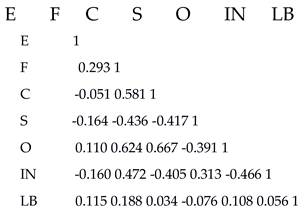
Background: Smartphones usage in school-aged children has increased over the last two decades. This overuse interferes in emotions regulation and interpersonal relationships. The purpose of this work was to analyze the interplay between smartphone addiction risk and personality dimensions in primary school children. Methods: The Smartphone Addiction Risk for Children Questionnaire (SARCQ) and the Big Five Children questionnaire (BFC) were administered to a sample (N =94) [EN1] of children. The aim of this research is to verify the percentage of Smartphone Addiction (SA) in a sample of primary school children and to explore the relationship between personality dimensions and SA.Results: We found that, in our sample, the percentage of children matching the definition of emotional addiction from smartphones is 16% and that a subgroup of children using the smartphone as a transitional object represents 15% of the sample. The correlations between the SARCQ and BFC factors showed a significant negative correlation between the “I’m not afraid with you” (INAWY) factor and Friendliness, INAWY and Conscientiousness and between INAWY and Openness. In contrast, a positive correlation between INAWY and the Emotional Instability factor has been observed. For the “Linus Blanket” (LB) factor a significant negative correlation with the Friendliness and with the Conscientiousness factor have been observed. Conclusion: The risk of SA, with the use of the smartphone as "emotion-handling tool" or as a "transitional object", was observed in children with personality negative dimensions.
Keywords:
1. Introduction
2. Materials and Methods
- Participants
- Procedures
Smartphone Addiction Risk Children Questionnaire (SARCQ)
- SACRQ is 13-ítems questionnaire. The items measuring smartphone addition are 11:
- item 1: “I check my smartphone to see if any-one has called or sent me a message“;
- item 2: “I need to keep my smartphone with me to feel more confident”;
- item 3: “I feel alone if I can’t use my smartphone”;
- item 4: “When take my smartphone with me I feel closer to mom and dad”;
- item 5: “I get angry if I cannot use my smartphone”;
- item 6: “I use my smartphone instead of doing something else (for example: play, draw, stay with friends)”;
- item 7: “When I take my smartphone with me, I feel safer”;
- item 8: “I use my smartphone to get better when I’m sad”;
- item 9: “Mom and dad are calmer when I take my smartphone with me”;
- item 10: “I feel sad if something of bad is happening and I cannot use my smartphone”;
- item 11: “, and “I go to sleep late because I use my smartphone”.
3. Results
3.1. The SARCQ Questionnaire

| Descriptive Statistics | ||||||||
|---|---|---|---|---|---|---|---|---|
| Mean | S. E. of the mean | Median | Std. Deviation | Skewness | S. E. of Skewness | Kurtosis | S. E. of Kurtosis | |
| Item 1 | 2.04 | .038 | 2 | .823 | -.067 | .113 | -1.521 | .225 |
| Item 2 | 1.62 | .035 | 1 | .762 | .769 | .113 | -.874 | .225 |
| Item 3 | 1.3 | .027 | 1 | .594 | 1.809 | .113 | 2.093 | .225 |
| Item 4 | 1.65 | .034 | 1 | .742 | .654 | .113 | -.916 | .225 |
| Item 5 | 1.6 | .033 | 1 | .722 | .768 | .113 | -.720 | .225 |
| Item 6 | 1.53 | .029 | 1 | .638 | .805 | .113 | -.39 | .225 |
| Item 7 | 1.77 | .037 | 2 | 0,807 | .444 | .113 | -1.327 | .225 |
| Item 8 | 1.59 | .033 | 1 | .721 | .809 | .113 | -.667 | .225 |
| Item 9 | 1.78 | .038 | 2 | .821 | .428 | .113 | -1.389 | .225 |
| Item 10 | 1.44 | .031 | 1 | 0,665 | 1.224 | .113 | .234 | .225 |
| Item 11 | 1.44 | .030 | 1 | .655 | 1.212 | .113 | .247 | .225 |
| item3 | item5 | item23 | item25 | item34 | item42 | item45 | item49 | item51 | item53 | item56 | |
| item3 | 1,000 | ,477 | ,328 | ,523 | ,523 | ,429 | ,299 | ,355 | ,229 | ,338 | ,207 |
| item5 | ,477 | 1,000 | ,481 | ,572 | ,640 | ,473 | ,360 | ,293 | ,217 | ,384 | ,216 |
| item23 | ,328 | ,481 | 1,000 | ,453 | ,428 | ,397 | ,331 | ,262 | ,121 | ,316 | ,193 |
| item25 | ,523 | ,572 | ,453 | 1,000 | ,637 | ,428 | ,361 | ,357 | ,291 | ,489 | ,268 |
| item34 | ,523 | ,640 | ,428 | ,637 | 1,000 | ,431 | ,246 | ,302 | ,217 | ,379 | ,189 |
| item42 | ,429 | ,473 | ,397 | ,428 | ,431 | 1,000 | ,388 | ,415 | ,259 | ,352 | ,290 |
| item45 | ,299 | ,360 | ,331 | ,361 | ,246 | ,388 | 1,000 | ,462 | ,375 | ,505 | ,423 |
| item49 | ,355 | ,293 | ,262 | ,357 | ,302 | ,415 | ,462 | 1,000 | ,412 | ,495 | ,370 |
| item51 | ,229 | ,217 | ,121 | ,291 | ,217 | ,259 | ,375 | ,412 | 1,000 | ,566 | ,502 |
| item53 | ,338 | ,384 | ,316 | ,489 | ,379 | ,352 | ,505 | ,495 | ,566 | 1,000 | ,555 |
| item56 | ,207 | ,216 | ,193 | ,268 | ,189 | ,290 | ,423 | ,370 | ,502 | ,555 | 1,000 |
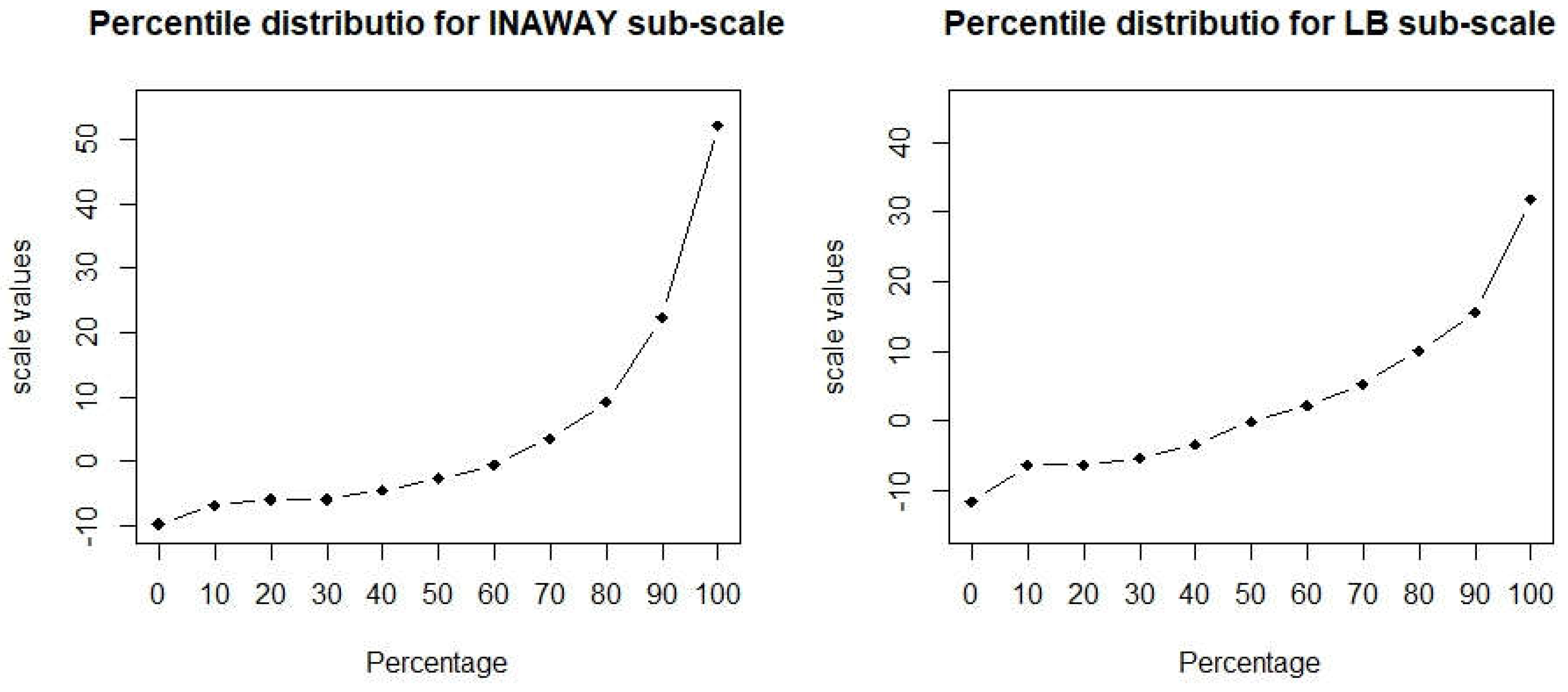
| Min | 10% | 20% | 30% | 40% | 50% | 60% | 70% | 80% | 90% | Max | |
|---|---|---|---|---|---|---|---|---|---|---|---|
| INAWY | -9.69 | -6.75 | -5.87 | -5.87 | -4.46 | -2.62 | -0.55 | 3.57 | 9.16 | 22.34 | 52.13 |
| LB | -11.57 | -6.26 | -6.26 | -5.33 | -3.32 | -0.049 | 2.16 | 5.37 | 10.07 | 15.55 | 31.73 |
3.2. The Structural Confirmatory Factorial Model for SARCQ Questionnaire
| LAMBDA-X | |||||||||||
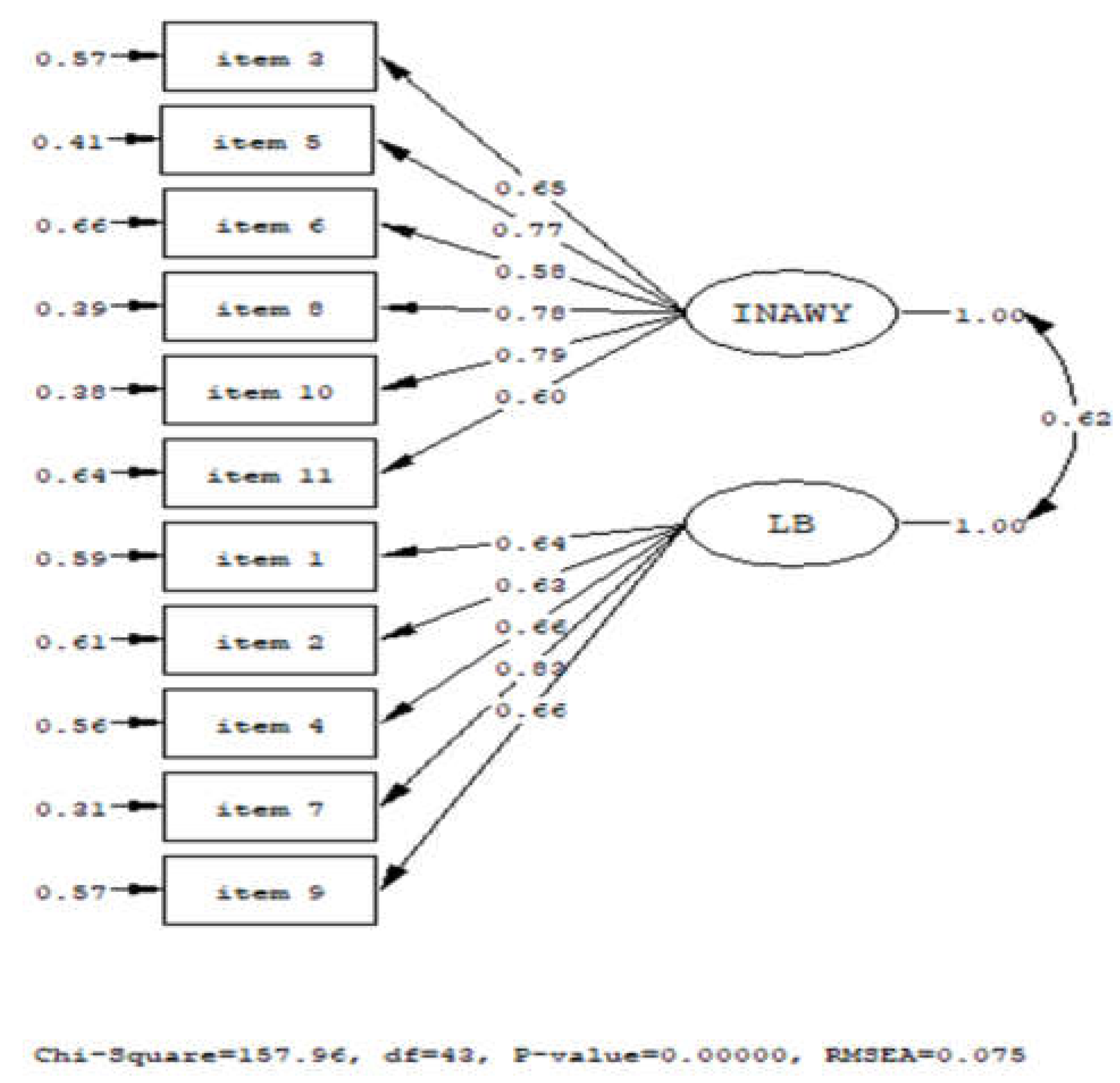
| Items | 1 | 2 | 3 | 4 | 5 | 6 | 7 | 8 | 9 | 10 | 11 |
| INAWY | 0.65* | 0.77* | 0.58* | 0.78* | 0.79* | 0.60* | |||||
| LB | 0.64* | 0.63* | 0.66* | 0.83* | 0.66* | ||||||
3.3. The Structural Equation Model Between BFC and SARCQ
| BFC | SARCQ | |||
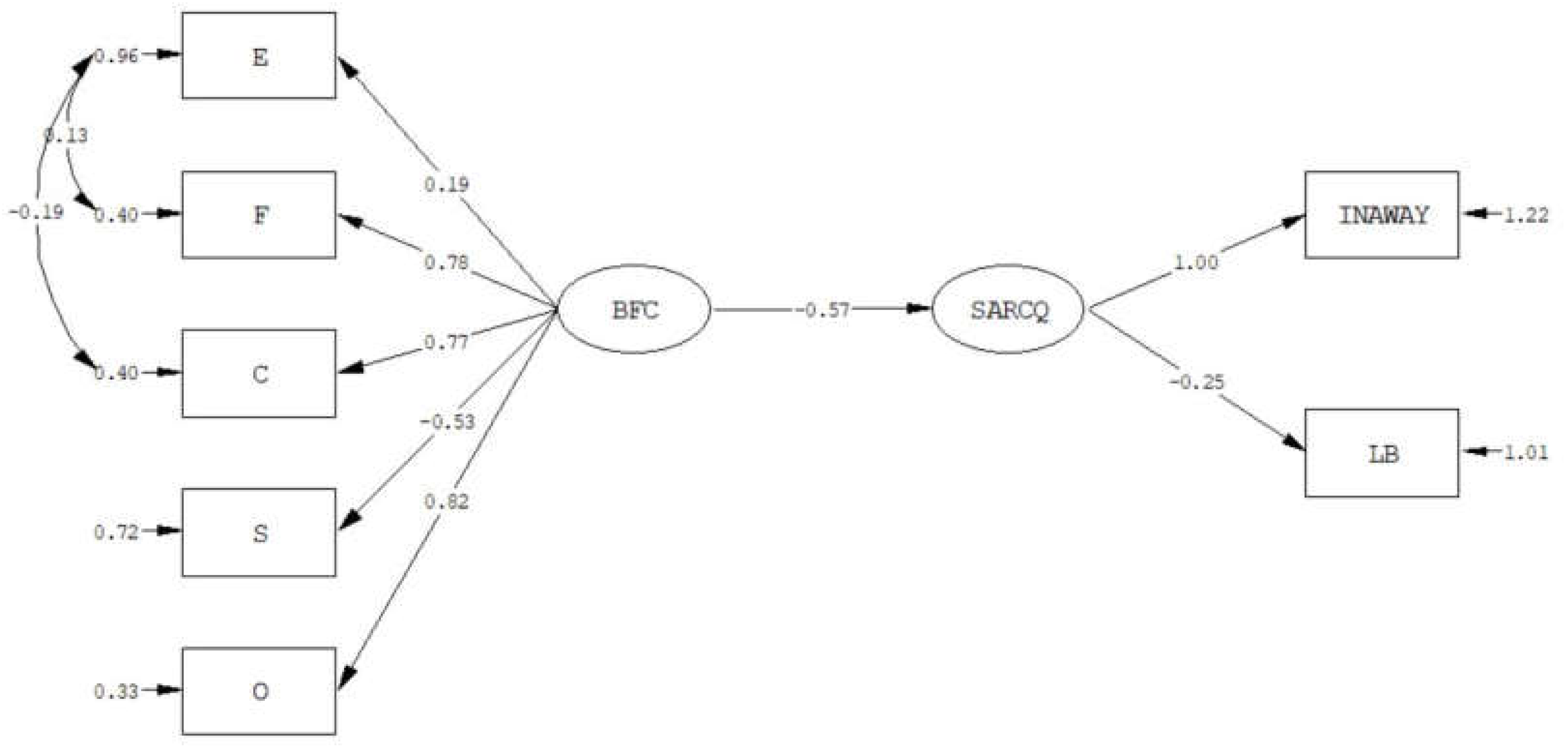
| λx | θδ | λy | θε | |
| E | 0.19 | 0.96 | - | - |
| F | 0.78 | 0.40 | - | - |
| C | 0.77 | 0.40 | - | - |
| S | -0.53 | 0.72 | - | - |
| O | 0.82 | 0.33 | - | - |
| INAWAY | - | - | 1.00 | 1.22 |
| LB | - | - | -0.25 | 1.01 |
4. Discussion
Author Contributions
Funding
Conflicts of Interest
References
- ISTAT Giovani.stat: dati e indicatori sulla popolazione di 15-34 anni in Italia [Internet]. 2024 [cited 2023 May 22]. Available from: http://dati-giovani.istat.it/.
- De Marchi, V. Tempi digitali - Atlante dell’infanzia (a rischio) 2023. Save the Children Italia, editor. Roma: Save the Children Italia; 2023.
- Park, J.H.; Park, M. Smartphone use patterns and problematic smartphone use among preschool children. PLoS One. 2021, 16, e0244276. [Google Scholar] [CrossRef] [PubMed]
- Domoff, S.E.; Radesky, J.S.; Harrison, K.; Riley, H.; Lumeng, J.C.; Miller, A.L. A naturalistic study of child and family screen media and mobile device use. J Child Fam Stud. 2019, 28, 401–410. [Google Scholar] [CrossRef] [PubMed]
- Truzoli, R.; Biscaldi, V.; Valioni, E.; Conte, S.; Rovetta, C.; Casazza, G. Socio-demographic factors and different internet-use patterns have different impacts on internet addiction and entail different risk profiles in males and females. Act Nerv Super Rediviva. 2024, 66, 2024. [Google Scholar]
- Wolniewicz, C.A.; Tiamiyu, M.F.; Weeks, J.W.; Elhai, J.D. Problematic smartphone use and relations with negative affect, fear of missing out, and fear of negative and positive evaluation. Psychiatry Res. 2018, 262, 618–623. [Google Scholar] [CrossRef]
- Sohn, S.Y.; Rees, P.; Wildridge, B.; Kalk, N.J.; Carter, B. Prevalence of problematic smartphone usage and associated mental health outcomes amongst children and young people: a systematic review, meta-analysis and GRADE of the evidence. BMC Psychiatry. 2019, 19, 356. [Google Scholar]
- Elhai, J.D.; Dvorak, R.D.; Levine, J.C.; Hall, B.J. Problematic smartphone use: A conceptual overview and systematic review of relations with anxiety and depression psychopathology. J Affect Disord. 2017, 207, 251–259. [Google Scholar] [CrossRef]
- Branciforti, S.; Valioni, E.; Biscaldi, V.; Rovetta, C.; Viganò, C.; Truzoli, R. Internet addiction disorder’s screening and its association with socio-demographic and clinical variables in psychiatric outpatients. Act Nerv Super Rediviva. 2023, 65, 112–119. [Google Scholar]
- Ko, C.H.; Yen, J.Y.; Yen, C.F.; Chen, C.S.; Chen, C.C. The association between Internet addiction and psychiatric disorder: a review of the literature. Eur Psychiatry. 2012, 27, 1–8. [Google Scholar] [CrossRef] [PubMed]
- Carter, B.; Payne, M.; Rees, P.; Sohn, S.Y.; Brown, J.; Kalk, N.J. A multi-school study in England, to assess problematic smartphone usage and anxiety and depression. Acta Paediatr. 2024, 113, 2240–2248. [Google Scholar] [CrossRef]
- Sapacz, M.; Rockman, G.; Clark, J. Are we addicted to our cell phones? Comput Human Behav. 2016, 57, 153–159. [Google Scholar] [CrossRef]
- Scott, D.A.; Valley, B.; Simecka, B.A. Mental Health Concerns in the Digital Age. Int J Ment Health Addict. 2017, 15, 604–613. [Google Scholar] [CrossRef]
- Brand, M.; Young, K.S.; Laier, C.; Wölfling, K.; Potenza, M.N. Integrating psychological and neurobiological considerations regarding the development and maintenance of specific Internet-use disorders: An Interaction of Person-Affect-Cognition-Execution (I-PACE) model. Neurosci Biobehav Rev. 2016, 71, 252–266. [Google Scholar] [CrossRef] [PubMed]
- Dell’Osso B, Di Bernardo I, Vismara M, Piccoli E, Giorgetti F, Molteni L, et al. Managing Problematic Usage of the Internet and Related Disorders in an Era of Diagnostic Transition: An Updated Review. Clin Pract Epidemiol Ment Health. 2021, 17, 61–74. [Google Scholar] [CrossRef]
- Fineberg, N.A.; Menchón, J.M.; Hall, N.; Dell'Osso, B.; Brand, M.; Potenza, M.N.; Chamberlain, S.R.; Cirnigliaro, G.; Lochner, C.; Billieux, J.; Demetrovics, Z.; Rumpf, H.J.; Müller, A.; Castro-Calvo, J.; Hollander, E.; Burkauskas, J.; Grünblatt, E.; Walitza, S.; Corazza, O.; King, D.L.; Stein, D.J.; Grant, J.E.; Pallanti, S.; Bowden-Jones, H.; Ameringen, M.V.; Ioannidis, K.; Carmi, L.; Goudriaan, A.E.; Martinotti, G.; Sales, C.M.D.; Jones, J.; Gjoneska, B.; Király, O.; Benatti, B.; Vismara, M.; Pellegrini, L.; Conti, D.; Cataldo, I.; Riva, G.M.; Yücel, M.; Flayelle, M.; Hall, T.; Griffiths, M.; Zohar, J. Advances in problematic usage of the internet research - A narrative review by experts from the European network for problematic usage of the internet. Compr Psychiatry. 2022, 118, 152346. [Google Scholar] [CrossRef] [PubMed]
- Validity and reliability of the Turkish version of the smartphone addiction scale in a younger population. Klin. Psikofarmakol. Bul. -Bull. Clin. Psychopharmacol. 2014, 24, 226–234. [CrossRef]
- Bianchi, A.; Phillips, J.G. Psychological predictors of problem mobile phone use. Cyberpsychol Behav. 2005, 8, 39–51. [Google Scholar] [CrossRef] [PubMed]
- Griffiths, M.D. Gambling on the internet: a brief note. Journal of Gambling Studies 1996, 12, 471–473. [Google Scholar] [CrossRef]
- León Méndez, M.; Padrón, I.; Fumero, A.; Marrero, R.J. Effects of internet and smartphone addiction on cognitive control in adolescents and young adults: A systematic review of fMRI studies. Neurosci Biobehav Rev. 2024, 159, 105572. [Google Scholar] [CrossRef] [PubMed]
- Wrzus, Cornelia. (2020). Processes of personality development: An update of the TESSERA framework. [CrossRef]
- Shiner, R.L. How shall we speak of children's personalities in middle childhood? A preliminary taxonomy. Psychol Bull. 1998, 124, 308–332. [Google Scholar] [CrossRef] [PubMed]
- Kim, E.; Cho, I.; Kim, E.J. Structural Equation Model of Smartphone Addiction Based on Adult Attachment Theory: Mediating Effects of Loneliness and Depression. Asian Nurs Res (Korean Soc Nurs Sci). 2017, 11, 92–97. [Google Scholar] [CrossRef]
- Diotaiuti, P.; Mancone, S.; Corrado, S.; De Risio, A.; Cavicchiolo, E.; Girelli, L.; Chirico, A. Internet addiction in young adults: The role of impulsivity and codependency. Front Psychiatry. 2022, 13, 893861. [Google Scholar] [CrossRef] [PubMed] [PubMed Central]
- Fischer-Grote, L.; Kothgassner, O.D.; Felnhofer, A. Risk factors for problematic smartphone use in children and adolescents: a review of existing literature. Neuropsychiatr Klin Diagnostik, Ther und Rehabil Organ der Gesellschaft Osterr Nervenarzte und Psychiater. 2019, 33, 179–190. [Google Scholar] [CrossRef] [PubMed]
- You, Z.; Zhang, Y.; Zhang, L.; Xu, Y.; Chen, X. How does self-esteem affect mobile phone addiction? The mediating role of social anxiety and interpersonal sensitivity. Psychiatry Res. 2019, 271, 526–531. [Google Scholar] [CrossRef] [PubMed]
- Peterka-Bonetta, J.; Sindermann, C.; Elhai, J.D.; Montag, C. Personality Associations With Smartphone and Internet Use Disorder: A Comparison Study Including Links to Impulsivity and Social Anxiety. Front public Heal. 2019, 7, 127. [Google Scholar] [CrossRef] [PubMed]
- Marengo, D.; Sindermann, C.; Häckel, D.; Settanni, M.; Elhai, J.D.; Montag, C. The association between the Big Five personality traits and smartphone use disorder: A meta-analysis. J Behav Addict. 2020, 9, 534–550. [Google Scholar] [CrossRef]
- Barbaranelli, C.; Caprara, G.V.; Rabasca, A.B.F.Q.-C. Big Five Questionnaire-Children. Manuale. Firenze: Organizzazioni Speciali; 1998. pp. 3–83.
- Conte, S.; Ghiani, C.; Nicotra, E.; Bertucci, A.; Truzoli, R. Development and validation of the smartphone addiction risk children questionnaire (SARCQ). Heliyon. 2022, 8, e08874. [Google Scholar] [CrossRef]
- Winnicott, D. Gioco e realtà. Fabbri Editore, editor. Milano; 1971.
- Cinti, M.E. Goldberg I. (1995). IAD. In: Internet Addiction Disorder: un fenomeno sociale in espansione. p. 6–7.
- Al-Barashdi, H. Smartphone Addiction among University Undergraduates: A Literature Review. J Sci Res Reports. 2015, 4, 210–225. [Google Scholar] [CrossRef]
- Chen, J.; Liang, Y.; Mai, C.; Zhong, X.; Qu, C. General Deficit in Inhibitory Control of Excessive Smartphone Users: Evidence from an Event-Related Potential Study. Front Psychol. 2016, 7, 511. [Google Scholar] [CrossRef]
- Drennan, J.; James, D. Exploring Addictive Consumption of Mobile Phone Technology. 2005.
- Wang, J.-L. The role of stress and motivation in problematic smartphone use among college students. Comput Human Behav. 2015, 53, 181–188. [Google Scholar] [CrossRef]
- Bian, M.; Leung, L. Linking Loneliness, Shyness, Smartphone Addiction Symptoms, and Patterns of Smartphone Use to Social Capital. Soc Sci Comput Rev. 2014, 33, 61–79. [Google Scholar] [CrossRef]
- PJ Flores, Addiction as an attachment disorder. Jason Aronson Inc. Publisher, Lanham (MD), 2004.
- Engelberg, E.; Sjöberg, L. Internet use, social skills, and adjustment. Cyberpsychol Behav. 2004, 7, 41–47. [Google Scholar] [CrossRef] [PubMed]
- Webster-Stratton, C.; Taylor, T. Nipping early risk factors in the bud: Preventing substance abuse, delinquency, and violence in adolescence through interventions targeted at young children (0-8 years). Prevention Science 2001, 2, 165192. [Google Scholar] [CrossRef] [PubMed]
- Izard, C.E. Translating emotion theory and research into preventive interventions. Psychological Bulletin 2002, 128, 796–824. [Google Scholar] [CrossRef] [PubMed]
- Pérez de Albéniz Garrote, G.; Rubio, L.; Medina Gómez, B.; Buedo-Guirado, C. Smartphone Abuse Amongst Adolescents: The Role of Impulsivity and Sensation Seeking. Front Psychol. 2021, 12, 746626. [Google Scholar] [CrossRef] [PubMed] [PubMed Central]
- Ramey, C.T.; Ramey, S.L. Early learning and school readiness: Can early intervention make a difference? Merrill-Palmer Quarterly 2004, 50, 471–491. [Google Scholar] [CrossRef]
- Rapee, R.M.; Kennedy, S.; Ingram, M.; Edwards, S.; Sweeney, L. Prevention and early intervention of anxiety disorders in inhibited preschool children. Journal of Counsulting Clinical Psychology 2005, 73, 488–497. [Google Scholar] [CrossRef]
- Nur, Hifizah; Setyaningrum, Putri; Novandita, Annisa. Permissive, Authoritarian, and Authoritative Parenting Style and Smartphone Addiction on University Students. Journal of Educational Health and Community Psychology. 2021, 10, 419. [Google Scholar] [CrossRef]
- Hunter, J.; Hooker, E.; Rohleder, N.; Pressman, S. The Use of Smartphones as a Digital Security Blanket. Psychosomatic Medicine 2018, 80, 345–352. [Google Scholar] [CrossRef]
- Girela-Serrano, B.M.; Spiers, A.D.V.; Ruotong, L.; Gangadia, S.; Toledano, M.B.; Di Simplicio, M. Impact of mobile phones and wireless devices use on children and adolescents' mental health: a systematic review. Eur Child Adolesc Psychiatry. 2024, 33, 1621–1651. [Google Scholar] [CrossRef] [PubMed] [PubMed Central]
| Item 3 | Item 5 | Item 6 | Item 8 | Item 10 | Item 11 |
|---|---|---|---|---|---|
| 0.43 | 0.59 | 0.34 | 0.61 | 0.62 | 0.36 |
| Item 1 | Item 2 | Item 4 | Item 7 | Item 9 |
|---|---|---|---|---|
| 0.41 | 0.39 | 0.44 | 0.69 | 0.43 |
| Cronbach’s α | Standardized Cronbach’s α | INAWAY Cronbach’s α | LB Cronbach’s α |
| ,868 | ,870 | .849 | .814 |
| GFI | AGFI | PGFI | RMR | SRMR | RMSEA | NFI | PNFI | ; d.f.=11 | |
| 0.98 | 0.95 | 0.38 | 0.23 | 0.087 | 0.001 | 0.97 | 0.51 | 7.02 | 7.02/11 |
| SARCQ | ||||
| E | F | C | S | O |
| -0.11 | -044 | -044 | 0.30 | -0.47 |
Disclaimer/Publisher’s Note: The statements, opinions and data contained in all publications are solely those of the individual author(s) and contributor(s) and not of MDPI and/or the editor(s). MDPI and/or the editor(s) disclaim responsibility for any injury to people or property resulting from any ideas, methods, instructions or products referred to in the content. |
© 2025 by the authors. Licensee MDPI, Basel, Switzerland. This article is an open access article distributed under the terms and conditions of the Creative Commons Attribution (CC BY) license (http://creativecommons.org/licenses/by/4.0/).