

Submitted:
17 January 2025
Posted:
20 January 2025
You are already at the latest version
Abstract
Lighting Systems (LSs) play a fundamental role in almost every aspect of human activities. Since the advent of light, both academia and industry are engaged in raising the quality of the service offered by these systems. The advent of Light Emitting Diode (LED) lighting represented a giant step forward for such systems in terms of light quality and energy saving. To further raise the quality of the services offered by LSs, increase the range of services they offer, while at the same time consolidating their reliability and security, we see the need to explore the contribution that can derive from the use of the Artificial Intelligence of Things (AIoT) emerging technology. This paper systematically reviews and compares the state-of-the-art about the impact of the AIoT in the smart LSs domain. The study reveals that the field is relatively new, in fact the first works date back to 2019. In addition to that, the review delves into recent research works focusing on the usage of Machine Learning (ML) algorithms in an Edge-Cloud-based computing architecture. Our findings reveal that this topic is almost unexplored. Finally, the survey sheds light on future research opportunities that can overcome the current gaps, with the final aim of guiding scholars and practitioners in advancing the field of smart LSs. The study is reported in full details, so it can be replicated.
Keywords:
Internet of Things
; Artificial Intelligence
; Machine Learning (ML)
; Smart lighting Systems
; Edge Computing
; EdgeML
; Systematic Literature Review
1. Introduction
The kernel of Lighting Systems (LSs) consists of lamps (also called light bulb) that include the filament or an arc tube, the glass casing, and electrical connectors; luminaires (i.e., the entire lighting unit comprising the lamp, its holder, and the reflectors and diffusers used to distribute and focus the light); mounting hardware (e.g., a light pole or a wall bracket used to fix the luminary); and electrical power which operates the lamps. The light bulb is one of the most revolutionary inventions ever, that has sped-up human progress, improving, at the same time, the quality of life [1].
LSs are everywhere: at home, in public buildings, inside cities, along streets and highways. The side effect from the massive, and often incorrect, use of LSs is quantified by the huge energy consumption associated with them. The situation is aggravated by the fact that 75% of public lighting assets in the European Union (EU) are more than 25 years old and mostly use inefficient lamps (source: https://smart-cities-marketplace.ec.europa.eu/sites/default/files/2021-06/Smart%20Lighting%20Factsheet_0.pdf - accessed on 10 Nov. 2024). In 2022, the 25% of EU total energy consumption in households is for electricity. (source: https://ec.europa.eu/ eurostat/statistics-explained/index.php?title=Energy_consumption_in_households – 10 Nov. 2024). Pasolini et al. [2] report that street lighting has a tremendous impact on energy consumption. In EU, for instance, they alone account about 40% of municipal electricity bills. The same number is mentioned in the following source: https://energy-cities.eu/the-evolution-of-public-lighting-from-torches-to-smart-services/ – accessed on 10 Nov. 2024)
Today, both academia and industry are engaged in a converging effort to turn LSs into sustainable systems, so reducing their energy consumption, raising at the same time their security, improving the overall quality of service by preventing outages, preserving the citizens’ personal data, also keeping their daily management as easy as possible. The present Systematic Literature Review (SLR) aims at investigating the state-of-the-art in the adoption of Internet of Things (IoT), Machine Learning (ML) methods, and the Edge computing paradigm in reaching a target that cannot be postponed any further. Figure 1 shows the organization of this paper. Hereafter, the arguments are presented in the same order.
1.1. IoT + AI = AIoT
The Internet of Things (IoT) is a network of physical devices, actuators, interfaces, and connectivity. At a high level of abstraction, an IoT infrastructure is composed of the basic components briefly described in the following:
- gather real-time data from the environment. They convert a physical phenomenon (e.g., a sudden rise of the light intensity in a room) into a digital signal that is converted into a readable format that a machine can interpret and act on. Sensors can function in either digital or analog mode. IoT systems use passive sensors, active sensors, and, more recently, self-powered sensors. The term IoT device is commonly used to denote a real-life device (e.g., a smart Light Emitting Diode (LED) bulb) which embeds a certain number of sensors;
- Microcontroller units (MCU) process and manage the data collected by the sensors. An MCU is an integrated circuit that includes memory, processor, and input/output peripherals;
- modules transmit (either in wireless or wired mode) the data over the network. Largely used wireless communication protocols are the following: Bluetooth, BLE (Bluetooth Low Energy), ZigBee, Z-Wave, 6LoWPAN, WiFi, 802.11ax, Radio-frequency identification (RFID), NFC (Near-Field Communication), LoRa (Long Range) (a Low-Power Wide-Area Network (LPWAN) technology), SigFox (a LPWAN solution), LTE (Long-Term Evolution, also called “4G LTE”), and NarrowBand IoT (NB-IoT) (it provides low-cost, low-power, wide-area cellular connectivity for the IoT). In ref. [3] they are described in some detail. A new entry in the protocol family is Matter: an industry-unifying standard based on IP that facilitates communication across smart home appliances (e.g., lights, ovens, TV, and washing machines) and an application framework for home automation1. Matter is the output of a Connectivity Standards Alliance project started in 2019 together with relevant international firms (e.g., Amazon, Apple, Google, and Zigbee Alliances);
- includes storage and servers needed for real-time operations and processing of data sensed by the IoT devices.
IoT devices sense huge amounts of data. To make this data truly actionable, it needs to be supplemented with context. AI and IoT together (shortly, AIoT) are the context [4,5]. IoT augmented and enhanced by AI is multiplying the impact and benefit to firms that are adopting these complementary technologies. Combining IoT with rapidly advancing AI technologies can create “smart systems” that simulate intelligent behaviour to make well-informed decisions with little or no human intervention. AI is beneficial for both real-time processing (allows responding quickly to specific situations in case of abnormal behaviour) and post event processing (allows identifying patterns in datasets and running predictive analytics). The benefits deriving from the adoption of the AIoT technology have been reported for all IoT application domains, such as: industry [6], retail [7]; smart cities [8,9]; and healthcare [10,11].
1.2. Cloud Computing
Cloud computing is the well-known term used to refer to the delivery of hosted computing services (including servers, storage, databases, networking, software, analytics, and intelligence) over the Internet with pay-as-you-use pricing. This paradigm frees users from the need of purchasing, operating, and maintaining on-premises physical data centers and servers. In connection with the IoT, the Cloud computing paradigm conceptually can be implemented as a four-layer architecture composed of [12]:
- layer: it consists of sensors and actuators. The sensors are the things that detect and respond to environmental changes, which may come from a variety of sources;
- layer: it ensures connectivity among the devices taking part of the IoT network. A plenty of protocols may be involved;
- layer (also called Service layer): it provides storage, computational power, and software tools services essential in the implementation of IoT applications;
- the layer: it consists of mobile apps and stand-alone applications offered to users to control the IoT devices.
1.3. Edge Computing
The Cloud has been the deployment model of IoT systems for many years. However, connecting IoT devices directly to the Cloud poses serious latency constraints to preserve performance [3]. To mitigate the issue, it has been added a further computing layer called Edge, moving from the Cloud-only computing paradigm to the Edge-Cloud continuum paradigm [13,14], and [15]. It is worth noticing that Edge Computing (EC) is a broad definition that embraces several computing paradigms, in other words this name is appropriate at a high level of abstraction. [14] and [16] discuss the available computing paradigms variants from several perspectives. Singh and Gill [14] remark that in the range 2009 – 2014 four variants have been proposed to implement the Edge computing concept, namely: Edge Computing Cloudlets, Fog Computing, Mobile Edge Computing and Micro Data Centres. In 2017, Mobile Edge Computing was renamed Multi Access Edge Computing. Given Fog computing is a way to implement EC, in the following only two alternative paradigms are distinguished: Cloud-based computing and Edge-Cloud-based computing.
1.4. Machine Learning
As new technology applications emerge where IoT works hand in hand with AI – the resulting innovations are proving how IoT can create new markets and opportunities, create value, disrupt traditional business models, and dramatically change the competitive landscape. AI is an umbrella that brings together many methods. In this SLR the focus is on Machine Learning (ML) methods. The latter comprise Supervised Learning, Deep Learning (DL), Ensemble Learning (EL), and Reinforcement Learning (RL). Ref. [17] is an interesting source to start learning ML models.
Solutions based on fuzzy logic, agents, and natural language processing are labelled as “out of scope” in the present SLR.
1.5. AIoT implementation
In light of previous considerations, the present SLR looks at studies where the implementation of AIoT systems leverages ML methods. The latter comprise the well-known training and inference two-stages process (Figure 2). The first stage uses data coming from the IoT devices to train the model, while the second stage uses the built ML model to make inferences from the actual input data.
Figure 3 shows the two alternatives to implement the AIoT. Figure 3(a) depicts the Cloud-based path, where both model building and model inferencing are performed by the server on the Cloud. On the other side of the IoT network, IoT devices upload data and receive decisions from the Cloud.
Figure 3(b) depicts the Edge-Cloud computing scenario where IoT devices are connected to the edge servers close to them. Model building is still performed in the Cloud, then the model is delivered to the edge where inferencing takes place in near real-time. Again, the decisions are returned to the IoT devices. It is worth noticing that initially the Edge still must send to the Cloud a meaningful quantity of data sensed by the IoT devices for building the model, but while this step usually takes place once, the model is used several times to make inferences.
An Edge-Cloud collaborative computing platform (called Sophon Edge) for building AIoT applications is described in [13]. Specifically, Rong et al. present, in sequence, the platform computing model, its architecture, and how the evolution of the ML model is supported.
1.6. EdgeML
As mentioned introducing the Edge computing paradigm (Sec. 1.3), running ML algorithms in the Cloud has severe counter indications, but, at the same time, running them on edge-side electronic devices is challenging due to the lack of sufficient computing resources. In the previous section, it has been pointed out that distributing the processing of ML algorithms between the Edge and the Cloud is the best strategy to overcome these issues. Today we observe a twofold convergent effort to improve the current state-of-the-art. On the industry side, there is an enormous growth in the market of hardware devices and complementary embedded software that can process ML algorithms, while academia is investigating new methods for pushing the processing of IoT data as close as possible to the IoT devices where the data comes from.
Two proposals by the industry are the following. Microsoft is developing EdgeML (https://www.microsoft.com/en-us/research/project/edgeml/ – accessed on 15 Nov. 2024), a suite of ML algorithms that are trained on the Cloud and can run on resource-constrained edge IoT devices. The code of ML algorithms for edge devices developed at Microsoft Research India is available at the following repository https://github.com/Microsoft /EdgeML. Google has released the LiteRT (short for Lite Runtime, formerly called TensorFlow Lite) platform. LiteRT features tools for converting TensorFlow Neural Network models into a simplified version, that then can be run on edge-constrained devices.
An interesting project from the academia is the development of the Edge Learning Machine (ELM) framework. The latter aims to supporting developers in designing and deploying ML solutions on edge-constrained devices. In ELM, the ML model is created, trained, and optimized on a desktop computer, while inferences are run on MCUs. The framework implements three well-known supervised ML algorithms (SVM, kNN, and DT), moreover it supports ANNs leveraging the X-Cube-AI package for STM 32 devices [18]. The framework is open-source and distributes a platform-independent C language implementation of those algorithms (https://github.com/Edge-Learning-Machine – accessed on 15 Nov. 2024). Another project from the academia is the EdgeML framework described in [19]. It controls the execution of DNN models by combining workload offloading mechanism and dynamic neural architecture. To achieve good latency-accuracy-energy performance on edge-constrained IoT devices, EdgeML adopts the RL model. Authors implemented EdgeML for several well-known DNN models on the latest edge devices. EdgeML is developed on top of TensorFlow. The source code of EdgeML is available at: https://github.com/Kyrie-Zhao/EdgeML.git (accessed on 15 Nov. 2024).
In previous studies, it has been largely used the term EdgeAI (Edge intelligence in [20]) to recap the scenario we are talking about, that is to signify that ML models are run either close to where the data is collected (for example by leveraging MCUs connected to the IoT sensors immersed in the physical space), or in a dedicated hardware (also called Edge server or micro-data center) located near by the IoT sensors. Ref. [21] is a recent work on EdgeAI. It reviews the hardware suitable for implementing EdgeAI, the supporting APIs, and the applications that can benefit from it. McEnroe et al. [22] review the convergence of Edge computing and AI for unmanned aerial vehicles, while Tu et al. [23] adopt the EdgeAI paradigm to implement an EdgeAI-based vehicle tracking system.
1.7. TinyML
TinyML is strictly connected to EdgeML. The TinyML community, born in 2019, aims at promoting the development of algorithms, software, and hardware suitable to run ML models on low-cost and resource-constrained IoT devices. Prospectively, by leveraging TinyML it will become viable the analysis and interpretation of data on the IoT devices and, if necessary, reply in real-time. Both academia and industry agree that TinyML will play a fundamental role in the next future in providing intelligent IoT solutions, with least possible access to the Cloud. The TinyML as-a-Service project ongoing at Ericsson Research is just an example of this believe (https://www.ericsson.com/en/blog/2019/12/tinyml-as-a-service – accessed on 16 Nov. 2024).
Figure 5 shows the TinyML workflow. It starts from data collection by sensors located in the environment, then the ML model is built in the Cloud or in a data center, compressed to be deployed in MCUs where, eventually, the inference step will take place. The steps in the figure are detailed in [24], where the available open-source software frameworks that support the advancement of ML research in MCUs are also listed. An introduction to TinyML, followed by a discussion of hardware and software tools supporting it, and state-of-art applications of TinyML may be found in the [25]. Oliveira et al. [26] provide a holistic perspective on the challenging and rapidly evolving TinyML research field. Ref. [27] is another useful study to get an overview on how TinyML-based systems are built. Such a study also focuses on the techniques suitable to reduce the complexity of the ML/DL algorithms so that they can be run on MCUs.
1.8. Smart Lighting Systems
The three principal benefits offered by the advent of high-power LEDs in the early 2000s regard: higher energy efficiency, longer lifespan (and then reduction of maintenance costs), and basic dimming capabilities. The specific consumption per dwelling for lighting is decreasing thanks to the phase out of incandescent light bulbs. In EU, in 2021 it accounts for 14% of captive electricity, compared to 20% in 2000 (source: https://www.odyssee-mure.eu/publications/efficiency-by-sector/households/household-eu.pdf - accessed on 10 Nov. 2024). Currently, European cities spend 20+% of their energy bills on lighting (source: https://smart-cities-marketplace.ec.europa.eu/sites/default/files/2021-06/Smart %20Lighting%20Factsheet_0.pdf - accessed on 10 Nov. 2024). According to a study by Northeast Group and CityLab Insights [28], in US cities street lighting alone accounts for about a quarter of cities’ electricity usage.
Building on the LED technology, smart LSs are emerging. They have the potential to become the backbone of infrastructure for homes, buildings, cities, and rural areas, featuring benefits that go beyond energy efficiency up to user comfort. For citizens, lighting professionals, and urban/rural planners understanding and leveraging this technology is no longer optional: it’s essential. The global smart lighting market is expected to grow at an annual growth rate of 22.9% between 2022 and 2030 (source: https://energy-cities.eu/the-evolution-of-public-lighting-from-torches-to-smart-services/ – accessed on 10 Nov. 2024)
In ref. [29], it has been pointed out that in the extant literature there are six alternative synonyms to the phrase “smart LS”. Each terminology aiming at emphasizing a specific characteristic of this category of systems. When the notion of smart lighting was firstly introduced in 2011 by Bhardwaj et al. [30], authors meant just a system composed of sensors and actuators connected through a network that cooperate to meet specific user needs. In the present review, the sentence “smart LS” brings also embedded intelligence coming from the adoption of ML methods. This definition corresponds to the meaning of the phrase “intelligent smart LSs” adopted by Kim and Park [31].
Smart LSs comprise hardware and software. In turn, hardware includes LED luminaires, sensors, and the communication network; while software consists of either a manufacture’s app (this is frequent in the case of homes’ smart LSs) or a central management system (as in the case of smart street LSs). In addition, a hardware-software component is present usually called Control system [2]. These elements are briefly described in the following. Each LED luminary includes a certain number of LED bulbs (also called lamps) and a built-in driver (called light controller in [2]). The latter regulates the power to the bulbs, ensuring proper current and voltage for optimal performance and longevity. Advanced LED drivers include dimming capabilities and can communicate with the Control system. Smart luminaires embed different types of sensors. Table 1 compares six commonly used ones. Control systems manage the lighting based on sensor data and pre-programmed parameters. Communication networks are wireless or wired networks that allow the lights to communicate with each other and with either an app or the central management system. The central management system allows operators to monitor and control the lighting network.
The Philips Hue line of bulbs was the first smart bulb on the market. Now, several alternative products are available. Each product consists of wireless RGB LED bulbs and supports connectivity. The latter may change with the product. For instance, Philips Hue smart LED bulb released before 2019 communicates through the Zigbee Light link protocol, a compatible subset of Zigbee 3.0; while Hue released later supports both Zigbee 3.0 and Bluetooth. Adding the Hue Bridge component to the LS based on Hue smart LED bulbs and using the official Philips Hue Bluetooth app on either a phone or tab, opens the door to a long list of smart functions (https://www.currys.co.uk/products/philips-hue-white-and-colour-ambiance-smart-led-bulb-b22-800-lumens-triple-pack-10246932.html), such as: control up to 50 lights, group lights into rooms or zones, full voice control (installing Amazon Alexa, Google Assistant, Apple HomeKit, or Samsung SmartThings speaker in the room), away-from-home control, set timers and schedules.
LED and smart street LSs reduce energy usage on two levels: first from more efficient LED luminaires and second from dimming capability with smart controllers. A benchmark study carried out by Northeast Group in partnership with CityLab Insights on 16 US cities, with population ranging from 8,000 to over 4 million, states that the cities using LED and smart street LSs get a 60% to 80% reduction in energy usage [28]. More in detail, the participants reported that they achieved at least 50% energy savings from LEDs, and extra 10-20% savings from dimming.
The transition to smart LSs is still ongoing. Table 2 lists recent research’s projects on the topic, addressing three well-known application domains. All these projects do not adopt ML methods, but the adoption of ML in the smart LSs domain is a research opportunity to further rise the user experience with this category of service. Processing the data collected by indoor/outdoor luminaires is a pre-condition for:
Previous research has clarified the link between ML and Human Activity Recognition (HAR), Computer Vision (CV), Voice Recognition (VR) e Speech Recognition (SpR), four fields of AI that play growing importance in modern smart LSs [45,46,47]. For example, by using digital images from cameras and DL models, it is possible to train computers to classify objects, and then be able to react to what they “see.” In practical terms, image recognition allows to modify the light intensity in daily situations because of human presence in a room or a pedestrian walking along a city street [46]. Laad et al. [47] discuss the transformative influence of CV methods on well-established ML methods to build versatile ML models that leverage the strengths of both disciplines. Ref. [48] discusses an AIoT face-recognition-based LS which potentially can create light conditions which adhere to intensity values initially set by home inhabitants. A review of the state-of-the-art on both traditional and DL-based methods of speaker recognition may be found in [49,50]. Sarbast and Mohsin [51] investigated the effectiveness of Random Forest (RF), K-Nearest Neighbours (KNN), and Support Vector Machine (SVM) classifiers to solve the speech recognition problem. In the smart LSs context, SR is frequently used for turning on/off lights in a room to enhance user experience. Putrada et al. [52] pointed out that ML together with speech recognition, voice recognition, and face recognition look very promising for enhancing people comfort.
Smart LSs are a domain of primary importance in the context of the creation of smart cities. The EU, for example, is investing lot of money to support projects consistent with this objective (https://commission.europa.eu/eu-regional-and-urban-development/topics/cities-and-urban-development/city-initiatives/smart-cities_en – accessed on 10 Nov. 2024). Manufacturers of smart LSs products claim that this technology brings substantial cost savings through energy efficiency and improved maintenance, enhances public safety, and contributes to environmental sustainability goals. The present SLR aims at assessing whether the state-of-the-art of the appeared research confirms all these wonderful promises.
1.9. Smart LSs and EdgeML
Within this paper, the EdgeML term does not refer neither to the EdgeML library under development at Microsoft, nor to the EML framework mentioned in Sec. 1.6. Hereinafter, EdgeML simply denotes that ML models are thought to be run as close as possible to the edge-constrained IoT devices of an AIoT architecture that implements a smart LS. The adoption of the EdgeML computing paradigm is relevant in the smart LSs domain as briefly explained in the following. Both indoor and outdoor smart LSs can enhance considerably the well-being and safety of citizens of advanced smart cities. But there are at least three stringent requirements these systems must meet: cut down the latency, limit the network overhead, and protect the personal data:
- the latency constraint is particularly stringent for smart street LSs where light controllers are responsible for dynamically adapting the light intensity to the traffic conditions to ensure the safety of drivers;
- the number of luminaires world-wide is becoming huge2, consequently the size of the data collected by them is huge as well. Processing the data collected by the luminaires at the edge of the IoT network is a best practice to limit network overhead;
- it has been remarked that because future indoor and outdoor LSs become smarter, they need to collect more data about people and their daily activities [53]. This situation poses a twofold ethical concern. Firstly, the collected data must be securely archived to be protected against violation of privacy; secondly, the use of personal data must comply with the personal-data protection laws. Limit the transit of personal data on the network is a precondition to protect it.
1.10. Aim of the Study and Paper’s Contribution
The research described in this paper aims at investigating the state-of-the-art of the research on EdgeML-based smart LSs without any restriction, i.e., the study is not focused on a specific perspective. On the opposite, previous reviews have adopted a single perspective. Soheilian et al. [29], for example, investigated the effects of smart LSs on energy saving and people well-being in residential buildings by reviewing studies published in the range 2001 February 2021. 10 studies, out of the 13 included in the review, focus on energy outcomes, either alone or combined with people well-being. In ref. [52], it has been pointed out that despite several studies have surveyed the smart lighting literature, up to the end of 2021 none of them have investigated the adoption of ML algorithms in such an application domain. Moving from such an observation, Putrada et al. carried out an in depth SLR looking for ML methods suitable to increase people comfort, a socially relevant topic. The SLR covers the period 2014-2021.
The present study has the following merits:
- it reports on a SLR realized by following the well-known method proposed by Kitchenham and Charters in 2007 [54]. This method allows to select, study, and summarize the state-of-the-art with respect to a given set of research questions in a way that is unbiased and (to a large extent) repeatable. It has been remarked that often SLRs are conducted without following a well-defined methodology [55];
- it promotes knowledge transfer from academia to firms. Knowledge transfer is a pushing factor in the economic growth of Small and Medium-sized Enterprises (SMEs) all over the world. In the case of EU, they represent 99% of all businesses (source: https://single-market-economy.ec.europa.eu/smes/sme-fundamentals/sme-definition_en). Knowledge transfer between academia and industry has received a lot of attention by scholars [56,57]. Ref. [57] reports on a review that summarizes the ways in which the transfer of knowledge between academia and industry takes place. From such a study, it comes out that the knowledge is transferred mostly by means of published research findings; that is, researchers write papers that, once published, become knowledge accessible to people. Unfortunately, as the literature shows, this method used by academia is not entirely working. The present SLR was carried out through a strict cooperation between University of L’Aquila and an Italian SME called B2B S.r.l. which represents another channel of knowledge transfer [56,57]. ;
- it follows multiple recommendations suggested by Santos et al. in their study (available online on 28 August 2024) that applies the notion of sustainability to the SLR domain. Briefly, [58] defines what sustainable SLRs are in terms of: 15 major characteristics, 15 critical factors that should be taken into consideration in the SLR process, and 16 guidelines for carrying out them. For example, the research questions of our SLR answer the needs of the stakeholders through evidence from the scientific literature (this aspect intercepts the C11 characteristic in [58]). In the context of this study, the stakeholders are B2B’s practitioners that took part to the SLR process and directly will benefit from the outcomes. In addition, our SLR overcomes critical factors CF2 and CF4 in [58] as will be clarified in the following section. In conducting the SLR all the guidelines (G1-G6) were adopted. They pertain the Communication & Collaboration among people taking part to the review process;
- it provides an up-to-date state-of-the-art about the role of the EdgeML in the development of future smart LSs. In detail, the study: (a) brings a map about high quality publications on such a topic; (b) adopts a taxonomy of the topics that have been investigated so far; (c) informs about the ML methods mostly adopted; (d) reports on the degree of adoption of the EdgeML computing paradigm; and lastly, (e) discusses several lines of future research opportunities. By exploring the potential of the integration of the AIoT into the LSs, this review provides valuable insights into the next generation of smart LSs.
The present work is structured as follows. Sec. 2 presents the Research Method adopted in the study. The section is quite long, so it comprises two sub-sections talking about, Planning activities (Sec. 2.1) and Conducting activities (Sec. 2.2). The former sub-section declares the Review need and the Research questions, while the latter sub-section details the process followed to isolate the studies to be analysed in detail. Inclusion/exclusion criteria and quality criteria are adopted to reach such a goal. Sec. 3 is about Results and Discussion. The former contains the reply to the given research questions, while the latter (Sec. 3.1) throws some lights on current gaps which represent future research opportunities both for academia and industry. Sec. 4 focuses on two related works, while Sec. 5 analyses potential threats to validity of the findings of the present study. Sec. 6 ends the paper. The acronyms used within this paper are listed at the end of this document.
2. Research Method
The overall workflow of our study is composed of an informal research followed by a well-defined research methodology. By “informal research”, we mean an unstructured research that originated as our curiosity to conduct a preliminary search, with the understanding that if it had produced an encouraging result, then we would have spent more time running the second stage mentioned above. The informal research was performed by running the following string against the Scopus database:
- (internet AND things) AND
- ((lighting AND system*) OR (smart AND light*)) AND
- (tertiary AND stud*)
As the output was the empty set, we learnt that so far didn’t appear tertiary studies connecting (smart) LSs to the IoT technology. So, we decided to carry out an SLR, starting from primaries and secondary studies (if any), to provide an overview of the selected research area to know if scientific studies already exist on the selected topic and quantify the research evidence [54] (p.44).
The SLR study was articulated in three phases, as suggested in [54]: Planning the review, Conducting the review, and Reporting the review results. The Reporting phase is self-evident, so below we focus on the other two phases. There are three basic Planning activities:
- identification of the review need;
- specification of the research questions;
- elaboration of the review protocol (i.e., explanation of the method that will be used to conduct the SLR).
2.1. Planning Activities
The review need
As previously mentioned, the present SLR is the result of a collaboration between the B2B S.r.l (an Italian SME) and the Department of Industrial and Information Engineering and Economics of the University of L’Aquila (Italy). At the beginning of summer 2024, B2B S.r.l expressed the need to write an unbiased report about the adoption of the AIoT technology in the development of smart LSs. The interest in the topic arose within IT projects currently being carried out at B2B S.r.l. One of the authors of this article (Di Felice) is an academic, while most of the remaining co-authors work at B2B S.r.l. It has been remarked that the team’s experience in conducting SLR is a critical factor (CF4 in [58]) with a direct impact in the quality of the results. That’s why the review process was coordinated by the academic person. B2B S.r.l. declared interest in acquiring up-to-date knowledge about the state-of-the-art in the domain of delivering smart LSs leveraging the EdgeML.
Research questions
The aim of the SLR was to answer the general research question mentioned above. The latter, in turn, splits in the following Research Questions (RQs):
(RQ1) What is the map of published primary and secondary studies about AIoT-based LSs?
(RQ2) What are the main topics addressed for AIoT-based LSs?
(RQ3) What are the key ML methods enabling the implementation of AIoT-based LSs?
(RQ4) Do the selected studies through RQ3 implement the EdgeML computing paradigm?
While RQ1, RQ2, and RQ3 isolate the extant literature about smart LSs leveraging the AIoT technology, RQ4 restricts the subset of the selected pool of studies to those that actually leverage EdgeML. Studying this restricted set of papers (if any) is the final aim of the present SLR. All the previous RQs translate specific stakeholders’ needs. The final point was reached through constant communication with and competent participation of B2B S.r.l professionals in the Planning stage of the SLR.
2.2. Conducting Activities
Standard database search and snowballing are the dominant approaches to search for studies to be included in a SLR [59]. The review protocol adopted in the present SLR comprises both approaches to cut down the risk to lose relevant studies. The left side of Figure 6 summarizes the four stages necessary to select the first set of studies that were included in the review. Initially, the Scopus database was queried by entering the search string, then the returned documents were filtered against the inclusion/exclusion criteria followed by the quality assessment stage. The title of the (21) selected studies was the input of the right side of the workflow in Figure 6 that implements the Forward Snowballing strategy [60]. The forward search was accomplished by making recourse to the Scopus engine which for a given paper returns the list of later papers citing it (if any). (Google scholar is a relevant alternative tool to accomplish the forward snowballing.) The retrieved studies were filtered against a distinct set of inclusion/exclusion criteria followed by the quality assessment stage. The reason why the inclusion and exclusion criteria adopted for the snowballing activity are distinct from those used in the stages depicted in the left side of Figure 6 will be explained later. 7 further papers were selected at the end of the filtering stages. So, 21 + 7 studies were included in the present SLR. Hereinafter, the activities of the Conducting phase are detailed.
2.2.1. Selection of the First Set of Studies
Search string
The search string is the following:
("Internet of Things" OR IoT) AND
("Artificial Intelligence" OR "Machine learning" OR Learning) AND
("Lighting systems" OR "Smart Lighting")
Search process
The search was realized (by one of the authors, actually a B2B’s practitioner) as a hand-operated search of Scopus articles that mention the keywords in the search string either in the Title, in the Abstract, or among the authors’ keywords. The entered search string was enhanced by adding a filter about the language (“English”) and four more filters for limiting the retrieval to the following document types: Article, Conference Paper, Review, and Book Chapter. The complete syntax of the Scopus search string looks as follows:
TITLE-ABS-KEY (("Internet of Things" OR iot) AND
("Artificial Intelligence" OR"Machine learning" OR learning) AND
("Lighting systems" OR "Smart Lighting")) AND
(LIMIT-TO (DOCTYPE, "cp") OR LIMIT-TO (DOCTYPE, "ar") OR
LIMIT-TO (DOCTYPE, "ch") OR LIMIT-TO (DOCTYPE, "re"))
The search was carried out on November 2, 2024. A list of 89 items were retrieved. Table 3 and Table 4 show, respectively, the distribution over the years of the retrieved documents, as well as the number of publications aggregated by types. For each retrieved study, we asked the Scopus engine to return the following metadata: authors’ name, title, abstract, authors keywords, publication venue, doi, and number of citations.
Once the likely pertinent studies have been collected, it is necessary to assess their actual relevance. According to [54], the assessment is accomplished in two stages. Firstly, Inclusion/Exclusion selection criteria are used to determine which studies are included in, or excluded from, the SLR; then the actual quality of the remaining studies must be assessed. By borrowing the hint from [61], it can be said that the application of the Inclusion/Exclusion criteria represents the primary selection phase; while the application of the quality assessment criteria implements the secondary selection phase.
Inclusion criteria
All the documents returned by the Scopus engine (either primary or secondary English study) has been included since they contain the keywords in the search string. It is worth noticing that all the papers indexed by Scopus are subject to peer-review. Moreover, since the search involved only items in the Scopus database, duplicate publications were not possible.
Exclusion criteria
The selection of articles returned by Scopus has been narrowed by ignoring documents belonging to at least one of the eight categories listed in Table 5.
The selection of the studies suitable for the present review was conducted iteratively. This is a best practice that contributes to the realization of sustainable SLRs, as are they called in [58]. Firstly, two authors analysed abstract and authors’ keywords of the 89 articles. They worked individually by taking into account the exclusion criteria to decide which papers are to be entered into the full-text screening phase. The involvement of at least two reviewers to perform SLR activities that implicate sensitive judgments is one of the guidelines recommended in [58] for reducing bias. In this stage, 19 papers were removed, obtaining a total of 70 publications (Figure 6). Table 6 collects the reference to the 19 papers excluded after Abstract reading.
Then, all the authors read the full-text of the 70 papers to decide about their inclusion into the SLR based on the exclusion criteria. The admittance of a study to the SLR was reached by consensus among the authors during meetings. In this step, 43 papers were removed, obtaining 27 publications (Figure 6). Table 7 collects the reference to the 43 papers excluded after full-text reading.
The following study was deleted from the list because retracted by the publisher:
Alim M.E. et al., Computational Intelligence Algorithm Implemented in Indoor Environments based on Machine Learning for Lighting Control System, Inter. Journal of Advanced Computer Science and Applications, 2022, 13 (2), 64–76, DOI: 10.14569/IJACSA.2022.0130208 (https://thesai.org / Publications/ViewPaper?Volume=13&Issue=2&Code=IJACSA&SerialNo=8, accessed on 15 of Sept-ember 2024).
Study quality assessment
SLRs must adopt quality criteria suitable to exclude poor-quality studies that may bias the result synthesis, while the best available evidence is taken into consideration. References [54] and [62] recommend investigating the quality of selected studies in order to enhance the filtering effectiveness of the inclusion/exclusion criteria. This statement has been reiterated and enriched more recently in [63]. References [64,65,66] and [61] are SLRs where such a perspective is adopted. In the present study, the output of the quality assessment stage of both primary and secondary studies is used for the same purpose. We evaluated the quality of primary and secondary studies in sequence, as explained in the following.
Quality of primary studies
A primary source in science is a document or article that reports on a study, experiment, case study, survey, research project, and so on. Primary studies are usually written by the person(s) who did the research, conducted the study, or ran the experiment(s), and include hypothesis, methodology, and results. So, the structure and aim of primary studies are deeply different from secondary studies, that is why it is not possible to apply to them the same quality criteria of the latter. It has been remarked that the quality of findings and conclusions of a SLR directly depends on the quality of the primary studies selected for the study [63]. Nevertheless, it is worth noticing that Budgen et al. [67] carried out a tertiary study consisting in analyzing 37 secondary studies, to assess how well these studies are reported. They observed that just 8 papers out of 37 gave a score to primary studies. Recently, Santos et al. [58] linked such a behaviour of researchers with the time required for scoring the quality of primary studies as their number increase constantly. Assessing the quality of primary studies varies greatly as a consequence of the lack of a shared definition about such a concept [54,63]. In the present SLR, we adopted a set of quality criteria based on the recent SLR by Yang et al. [63], where paper’s quality is expressed by what authors call “study characteristic”. By analyzing 241 SLRs in the software engineering domain, between 2004 and 2018, Yang et al. observed that the characteristics of primary studies were scored by taking into account either: (a) reporting, rigor, credibility, and relevance or (b) rigor and industrial relevance. For example, ref. [68] follows the first way. Vice versa, we followed the other one since such a method captures the perspective of the B2B firm which commissioned the review reported in this paper. Hereafter, we briefly recall the second alternative for readers to be able to understand the rationale behind the Quality assessment Criteria (QC) introduced shortly. Ivarsson and Gorschek [69] defined scientific rigor and relevance as follows.
where:
- refers to the description of techniques, product, tools, and people necessary to follow the study, compare it with others, and replicate it;
- study design refers to the description of the approaches used for data collection and analysis;
- refers to the discussion of any limitations or threats to the validity of the study.
As pointed out by Ivarsson and Gorschek, the rigor characteristic refers to the extent to which the method adopted in the study is presented, while the evaluation of its actual rigor is out of scope of the model.
where:
- concerns whether the industrial context is representative;
- research method concerns whether the method adopted in the study adds value to industry;
- concern whether the subjects of the study are representative of practitioners;
- concerns whether the size of the study is meaningful (“toy” examples are useless).
From Equation (1) the following QC follow:
QC1. Is there a description of the context?
QC2. Is there a description of the study design?
QC3. Are study limitations discussed?
From Equation (2) the following QC follow:
QC4. Is there a description of the context?
QC5. Is there a description of the research method?
QC6. Are the subjects of the study described and representative of practitioners?
QC7. Does the size of the study have an industrial scale?
To the previous QC, the following one was added:
QC8. Does the publication venue is a journal, a conference, or a book chapter?
QC8 is frequently considered in SLRs [61].
The QC score of each primary study was calculated using the following schema: N(o) = 0, Y(es) = 1, P(artial) = 0.5. In detail, the QC were scored as follows:
QC1. The context is implicit: N; the context is clearly sketched, so the reader can understand and compare it to other contexts: Y; the context can be inferred: P.
QC2. The study design is omitted: N; the study design is properly described, so the reader can understand it: Y; the study design is just sketched: P.
QC3. The description of threats to validity is omitted: N; threats to validity are discussed in detail: Y; threats to validity are partially defined: P.
QC4. The evaluation is either performed in a setting not representative of the reality or omitted: N; the evaluation is carried out in an industrial setting representative of the intended usage setting: Y; the setting is only partially representative of the intended final setting: P.
QC5. The research method is not detailed: N; the research method used in the evaluation is relevant for the actual practitioners: Y; the research method is just sketched: P.
QC6. The subjects used in the evaluation are either not mentioned or not representative of the actual practitioners: N; the subjects used in the evaluation are representative of the actual practitioners: Y; the subjects used in the evaluation are only partially representative of the actual practitioners: P.
QC7. The evaluation is missing: N; the application used in the evaluation is of industrial scale: Y; the evaluation was done by using a small application size: P.
QC8. The publication venue is either a conference or a book chapter: N; the publication venue is a top-class journal (i.e., an ACM, IEEE, Elsevier, Springer, Wiley publication): Y; the publication venue is not a top-class journal, however it is indexed by Scopus: P.
Quality of secondary studies
The quality of the selected secondary studies was evaluated by applying the following QC.
QC1. Are the RQs explicit?
QC2. Is the review protocol well-defined?
QC3. Is the search string reported?
QC4. Are the inclusion criteria described and related to the study goals?
QC5. Are the exclusion criteria described and related to the study goals?
QC6. Are the years covered in the review declared?
QC7. Do the queried scientific databases ensure that the result of the search can wrap all the significant published studies?
QC8. Is the quality of the included studies assessed?
QC9. Is the data extraction activity adequate to the purpose of the study?
QC10. Is the data synthesis method described?
QC11. Are the selected studies adequately illustrated?
QC12. Does the study adequately answer the RQs?
QC13. Are the open issues adequately discussed?
QC14. Is the analysis of the threats to validity done?
QC15. Does the publication venue is a journal, a conference, or a book chapter?
The QC score of each study was calculated using the following schema: N(o) = 0, Y(es) = 1, P(artial) = 0.5. In detail, the QC were scored as follows:
QC1. The RQs are implicit: N; the RQs are explicit: Y; the RQs can be inferred: P.
QC2. The review protocol is missing: N; the review protocol is well-defined: Y; the review protocol is not fully-defined: P.
QC3. The search string is not reported: N; the search string is reported: Y; the search string can be inferred: P.
QC4. The inclusion criteria are not mentioned: N; the inclusion criteria are described and they relate to the study goals: Y; the inclusion criteria are not explicitly described: P.
QC5. The exclusion criteria are not mentioned: N; the exclusion criteria are described and they relate to the study goals: Y; the exclusion criteria are not explicitly described: P.
QC6. The years covered in the review are not declared: N; the years covered in the review are declared: Y; the years covered in the review can be inferred: P.
QC7. The searched databases are not mentioned: N; the searched databases are scientifically relevant and ensure a wide coverage of published articles: Y; the authors have searched only a small set of scientific sources (either journals or proceedings). So, not all the relevant published articles are investigated: P.
QC8. The quality assessment stage of the selected studies is omitted: N; quality criteria are defined and applied to each primary study: Y; the quality assessment strategy can be inferred: P.
QC9. The data extraction activity is not described: N; the data extraction activity is adequate to the purpose of the study: Y; the data extraction activity does not provide sufficient details on all the aspects that are part of such a stage (e.g., the output of the exclusion criteria, the procedure to remove duplicate publications, the type of paper (e.g., article, book chapter, or conference paper), etc.): P.
QC10. The data synthesis method is not described: N; it is described: Y; it could be derived: P.
QC11. The findings of each study are not specified: N; the information is carefully summarized for each study: Y; only a recapped description is given for each individual paper: P.
QC12. The study does not answer the RQs: N; the study adequately answers the RQs: Y; the answer of the RQs is not fully satisfactory: P.
QC13. Open issues are not discussed: N; open issues are listed and adequately discussed in the study: Y; open issues are listed, but emerging lines of research potentially suitable for solving them are just touched: P.
QC14. The threats to validity analysis are omitted: N; the threats to validity analysis is done and countermeasures are taken to limit potential threats: Y; the threats to validity analysis is superficial: P.
QC15. The publication venue is either a conference or a book chapter: N; the publication venue is a top-class journal (i.e., an ACM, IEEE, Elsevier, Springer, Wiley publication): Y; the publication venue is not a top-class journal, however it is indexed by Scopus: P.
As suggested in [54], the score of each QC was extracted by one of the authors and checked by the other ones to prevent errors. The score of the 26 analysed papers is shown in the following. Table 8 and Table 9 show, respectively, the result of the quality assessment stage of the 22 primary studies and 4 secondary ones which entered the secondary selection phase. Three primary studies and two secondary studies were excluded in this secondary selection phase of the review methodology because their score is very low. Table 10 and Table 11 list them, in sequence.
Despite the score of paper [89] is low too (4.5, Table 9), and close to that of (Mukhopadhyay2024), we decided to keep it into the final set of studies to be investigated in detail. This choice was determined by observing that [89] has got 416 citations (up to 13 October 2024), of which 203 from journals’ papers. Table 12 shows the citations distribution over the years. Citation-based paper selection is frequent in reviews and that because higher is the number of citations, higher is the paper quality [56]. The main reason for such an interest towards [89] by the researchers’ community is because it was the first review investigating the ways in which the transportation domain can benefit from the AoIT. It is also fair to remark that such a study got score 4.5 because it doesn’t follow any well-structured research methodology. That is the reason why quality criteria QC2-QC10 scored zero.
2.2.2. Identification of Citing Studies
Below, it is reported in detail how the second set of studies to be considered for further investigation was built through the forward snowballing (Figure 6). Detailing the snowballing strategy is a best practice that in published SLRs is often ignored, as observed by Budgen et al. [67] in their tertiary study. The second column of Table 13 shows the number of citations got by each paper belonging to the first set of selected studies, while the third column shows the number of citations that are pertinent to the present SLR. The papers without citations are not in the list.
Inclusion criteria and skipping of repetitions
The papers found through the forward snowballing do not satisfy the search string that was used to query the Scopus database, otherwise they would have been extracted at that stage. A citing paper is labelled as pertinent to the present SLR if the “smart lighting” string is present either in its Title, Abstract, or among the authors’ keywords. The total number of pertinent citations (#PCs) got by the 12 papers in Table 13 is 45 (third column). Each row in Table 14 denotes, in order, a paper in Table 13, the #PCs, and the reference to the citing study. Table 15, vice versa, lists the citing papers and their number of repetitions: 1 denotes no repetition. From such a table it emerges that there are 31 distinct citing papers. But, since the last eight papers are already present in the initial set of 21 primary studies, it follows that the papers to be evaluated against the Exclusion criteria and then against the quality criteria are 23.
Exclusion criteria
The 23 distinct papers satisfying the inclusion criteria have been narrowed by ignoring those belonging to the category in Table 16.
All the authors read the full-text of the 23 papers to decide about their inclusion into the SLR based on the exclusion criteria. The admittance of a study to the SLR was reached by consensus among the authors during meetings. In this step, 15 papers were removed, obtaining 8 publications (Figure 6). Table 17 references the 15 excluded papers.
Study quality assessment
The quality of primary and secondary studies belonging to the pool of the 8 papers captured through the forward snowballing was done by applying the quality criteria previously introduced. Table 18 and Table 19 show the result of this activity. None of the primary studies were excluded, opposite to the single secondary study because of its low score. Table 20 references this latter work.
Data extraction
The advice in ref. [54], p.65 about this stage has been implemented as follows: first we designed a data extraction form (Table 21) listing the metadata describing the information to be extracted from the selected studies and the link of these metadata to the research questions to be answered. Then, we added other tables comprising as many columns as the number of items in Table 21. These latter tables were filled with the actual information, during the data synthesis stage (Figure 6). To prevent the risk of bias, the data extraction form was defined when the study protocol was planned.
Data synthesis
The aim of this step of the study protocol (Figure 6) is to synthesize the selected 28 papers in correspondence of each of the rows of Table 21, which allows, in turn, to derive an answer to the research questions (Sec. 2.1). As already said, each author of this SLR read all the selected studies. Few meetings were sufficient to debate the differences that occurred during the process. The synthesis is spread into nine tables (i.e., from Table 22 up to Table 30).

Table 22.
Data synthesis from secondary studies.
| Ref. | Source | Year | Length | Scientific DB(s) |
|---|---|---|---|---|
| [52] | Journal | 2022 | 42 | Google Scholar |
| [89] | Journal | 2019 | 32 | Not explicited |
Table 23.
Data synthesis from secondary studies (1).
| Ref. | Time interval | References | Citations | Number of RQs | Surveyed papers |
|---|---|---|---|---|---|
| [52] | 1993 until 2021 | 434 | 47 | 3 | Not declared |
| [89] | It is not explicit | 74 | 425 | 0 | Not declared |
Table 24.
Data synthesis from secondary studies (2).
| Ref. | Topic | Paper’s keywords |
|---|---|---|
| [52] | On the adoption of ML methods in smart lighting to increase user comfort. | SL, SLR, ML, user comfort, activity recognition |
| [89] | A review on extant AIoT techniques for smart transportation applications. | Big data, IoT, ML, Intelligent transportation systems, Smart city, Smart transportation |
Table 25.
Data synthesis from secondary studies (3).
| Ref. | The RQs |
|---|---|
| [52] | RQ1. What are the topics discussed in studies about smart LSs? |
| RQ2. What smart lighting studies adopted ML? | |
| RQ3. What smart lighting studies implemented ML to improve user comfort? | |
| [89] | They are not explicit |
Table 26.
Data synthesis from secondary studies (4).
| Ref. | Contribution |
|---|---|
| [52] | The review: (a) maps ML methods for smart lighting research since 2014; (b) groups the ML applications in smart lighting; (c) discusses the ML topics in smart lighting able to boost people comfort; (d) mentions research gaps in the application of ML in smart lighting related to boosting the people comfort. |
| [89] | Authors structure the smart transportation sector into six categories: (lights is one of them). Then, they review the studies which addressed the six categories by using IoT and/or ML techniques. Algorithm name, algorithm learning type, and number of times each algorithm is used in the literature are also given. |
Table 27.
Data synthesis from primary studies.
| Ref | Source | Year | Length | References | Citations |
|---|---|---|---|---|---|
| [70] | Journal | 2020 | 16 | 159 | 33 |
| [82] | Journal | 2021 | 15 | 108 | 87 |
| [71] | Journal | 2020 | 26 | 54 | 22 |
| [72] | Journal | 2023 | 11 | 42 | 8 |
| [73] | Journal | 2024 | 10 | 33 | 3 |
| [77] | Journal | 2022 | 10 | 31 | 10 |
| [80] | Conference | 2020 | 16 | 38 | 6 |
| [83] | Conference | 2019 | 5 | 12 | 6 |
| [75] | Conference | 2023 | 6 | 35 | 3 |
| [84] | Conference | 2024 | 6 | 8 | 0 |
| [86] | Conference | 2024 | 5 | 11 | 0 |
| [74] | Conference | 2024 | 6 | 31 | 0 |
| [78] | Conference | 2024 | 6 | 14 | 0 |
| [79] | Conference | 2023 | 8 | 12 | 0 |
| [76] | Conference | 2019 | 5 | 20 | 4 |
| [87] | Conference | 2024 | 4 | 10 | 0 |
| [85] | Conference | 2022 | 4 | 11 | 0 |
| [81] | Conference | 2022 | 8 | 25 | 0 |
| [88] | Conference | 2020 | 13 | 16 | 0 |
| [90] | Journal | 2022 | 22 | 68 | 13 |
| [91] | Journal | 2023 | 11 | 74 | 6 |
| [92] | Journal | 2023 | 12 | 30 | 3 |
| [93] | Conference | 2024 | 18 | 39 | 0 |
| [94] | Conference | 2022 | 6 | 25 | 5 |
| [95] | Conference | 2023 | 6 | 23 | 1 |
| [96] | Conference | 2022 | 5 | 20 | 3 |
Table 28.
Data synthesis from primary studies (1).
| Ref. | Topic | Paper’s keywords |
|---|---|---|
| [70] | Personalized energy-use behaviors in commercial buildings. | Commercial buildings, IoT, Smartphone, Wi-Fi network, energy-use behavior, DL |
| [82] | Digitalization of highways. | Highway, DL, vulnerable road safety, smart city, IoT, vision node, renewable energy |
| [71] | Smart LSs for the learning context. | IoT; Smart lighting, Smart classroom, Environmental data-processing framework, Learning context, LED lighting control |
| [72] | Horticultural LS. | Daylight harvesting, energy-efficiency, horticultural lighting, IoT, ML, NNs, Photosynthetically active radiation measurement |
| [73] | Human activity recognition. | Smart lighting, Channel state information (CSI), HAR, EL |
| [77] | Activity recognition for smart lighting in office buildings. | Smart lighting, activity recognition, IoT, KNN, Naive Bayes, Hierarchical hidden Markov model, PIR sensor |
| [80] | Personalized service provision in a smart LS. | Smart lighting, Edge-cloud collaborated learning, Edge intelligence, DRL, Personalized service provision |
| [83] | Smart LS that integrates dimming level with light intensity. | Smart lighting, light intensity, dimming level, particle swarm optimization |
| [75] | Digital Twins of Smart Campus. | CPSs, Digital Twin, Urban IoT |
| [84] | Indoor automatic dimming system. | Smart lighting, daylight response dimming system, PSO |
| [86] | Building automation. | IoT, smart lighting, building automation, DL |
| [74] | Model Compression on Edge Computing-Based Smart Lighting. | Smart lighting, EC, NearCount, model compression, product-of-sum |
| [78] | Lighting automation. | Smart home, ML, automation, transformer |
| [79] | Voice-controlled LS. | Smart village micro-utilities, Embedded ML, Edge Impulse, Voice-activated LED lighting |
| [76] | Detection of occupancy sensor signal anomalies. | Occupancy sensors, Connected lighting, RF classifier. |
| [87] | Smart home control. | Smart home, IoT, ML, SR, Pervasive Computing |
| [85] | Human activity recognition for smart lighting control. | IoT, AI, NN, MCU, Kalman filter |
| [81] | Data-centric anomaly-based detection system. | IoT, interactive ML, intrusion detection, anomaly detection, IoT security, Poisoning attack, virtual sensors |
| [88] | Monitoring system for domestic appliances. | ANN, automation, cloud computing, facial recognition, image processing, IoT, ML, microcontroller, NN, sensors |
| [90] | Automatic LS control based on human presence. | Smart lighting, classification model, movement data, user comfort |
| [91] | Edge-computing architecture for smart lighting control. | Edge-computing, smart lighting, model compression, knowledge distillation, kNN |
| [92] | Lighting control system tailored on home residents. | Personalized lighting, intelligent lighting, prediction control strategy, back-propagation neural network |
| [93] | Quantization method for Edge computing in smart LSs. | Smart lighting, edge computing, NodeMCU, kNN, model compression, quantization |
| [94] | Comparison of RNN architectures. | IoT, smart lighting, binary classification, DT, RNNs, LSTM, time-series |
| [95] | Occupants’ privacy-preserving in smart LSs. | Smart lighting, general data protection regulation, privacy, camera, image perturbation |
| [96] | Smart lighting control of offices. | Office room, camera, smart lighting, object localization, SSD MobileNet |
Table 29.
Data synthesis from primary studies (2).
| Ref. | ML methods | Computing paradigm | Employed IoT devices |
|---|---|---|---|
| [70] | DL | Cloud-based | CO2 sensors, infrared sensors, motion sensors, sound sensors, and temperature sensors are available for occupancy detection. |
| [82] | DL | EdgeML | Motion sensor, light-dependent resistor sensor, light dimmer, and a long-range RF module. |
| [71] | RL | Cloud-based | Ambient light sensors and PIR sensors. |
| [72] | Multi-linear regression, RF, NN, and DT | Cloud-based | Sony IMX219 image sensors, multi-channel spectral light sensors AS-7341. |
| [73] | RF, Gradient Boosting, and Extreme Gradient Boosting Classifier. | Cloud-based | None. |
| [77] | KNN, Naive Bayes, and HHMM | Cloud-based | Light sensor and PIR sensor. |
| [80] | DRL | EdgeML | Light sensor, ultrasonic sensor, and infrared sensor. |
| [83] | PSO | Cloud-based | Ultrasonic sensor, smart lighting device, lux sensor. |
| [75] | Supervised learning methods (SVM, LR, and KNN), Ensemble learning (RF), and a DL method (LSTM) | Cloud-based | Light sensor. |
| [84] | PSO | Cloud-based | Light sensor, illuminance sensor |
| [86] | DL | Cloud-based | None |
| [74] | KNN, NearCount-PoS | EdgeML | Motion sensor, PIR sensor |
| [78] | DL, DNN, RL | Cloud-based | Human presence sensors, environmental sensors, brightness sensors. |
| [79] | NN Classifier. | EdgeML | Microphone. |
| [76] | RF classifier. | Cloud-based | Light sensor, occupancy sensor (PIR motion sensor). |
| [87] | SR | Cloud-based | None. |
| [85] | ANNs | Cloud-based | Light sensor, MCU, Monitor (Node-RED), Arduino MCU (MKR WiFi 1010) |
| [81] | RF classifier. | Cloud-based | Smart camera, climate sensmitter, smart lighting sensor, smart phone. |
| [88] | ANN, LSTM, CNN, and Naïve Bayes | Cloud-based | PIR, LDR. |
| [90] | KNN, SVM, DT, NB, and Ensemble Voting. | Cloud-based | PIR |
| [91] | DNN, KNN | EdgeML | PIR |
| [92] | CNN, RF, DT, polynomial regression, SVR, Ridge, Lasso, Elastic net, KNN, and BPNN. | Cloud-based | None. |
| [93] | KNN | EdgeML | PIR |
| [94] | DT, RNNs, and LSTM. | Cloud-based | PIR |
| [95] | CNN | EdgeML | Raspicam |
| [96] | CNN | Cloud-based | Raspicam |
Table 30.
Data synthesis from primary studies (3).
| Ref. | Contribution |
|---|---|
| [70] | An IoT-based smartphone energy assistant (iSEA) tool. iSEA aims at promoting smart energy-aware behaviours in the occupants of commercial buildings. iSEA methodology and its IoT architecture are detailed. |
| [82] | Classification of highway digitalization into five components: smart highway LS is one of them. An architecture for smart highway lighting, smart traffic, and emergency management is also proposed. |
| [71] | Design and implementation of a smart LS, which dynamically controls the classroom lighting in accordance with the learning context. The primary aim is to gain students’ performance. |
| [72] | Description of a neural-network learning control system composed of light sensors, dimmable LED light fixtures, cameras, and a firmware devoted to crop monitoring and performance evaluation. |
| [73] | A solution to HAR through passive sensing is proposed and evaluated. Leveraging ensemble ML algorithms, the data extracted from the ESP32 microcontroller is used for classifying different human activities. |
| [77] | An AIoT proposal that applies the HHMM for AR in smart lighting in office buildings. The performance of the solution is proven to be superior to well-known ML methods. |
| [80] | Design and implementation of a DRL model devoted to offering to users a personalized illumination in order to enhance the quality of their experience with the LS. |
| [83] | The study proposes a smart LS composed of two NodeMCU sensor nodes connected via MQTT. The system uses PSO to integrate dimming level with light intensity. |
| [75] | Adoption of a Digital-Twin-based CPS to collect data generated on a campus to be used to determine space occupancy based on the ambient light sensors. |
| [84] | An AIoT-based system capable of achieving optimal illumination through sunlight, reducing, at the same time, the lighting energy utilization. |
| [86] | A ML-based building automation system that uses images captured by a camera inside the room. |
| [74] | Proposal of a method which performs sampling for the compression of the KNN model in edge computing-based smart LSs. |
| [78] | Proposal of a smart LS able to predict the occupant’s next position in order to adapt the light accordingly. |
| [79] | Assessment of the influence of Raspberry Pi Pico W-based voice-activated LED lighting on smart village micro-utilities. |
| [76] | Adoption of frequency and temporal features to feed a RF classifier to detect occupancy sensor anomalies in an apartment. |
| [87] | An SR-based method to learn the behaviour in smart homes. It leverages the data gathered from sensors in the rooms and the actuator settings. |
| [85] | A NN technique combined with the Kalman filter is adopted for controlling IoT devices to augment the intelligence of the controller. |
| [81] | Proposal of a data-centric anomaly-based detection system. Experiments are carried out in a campus that involves, among the others, a smart lighting component. |
| [88] | An AIoT-based monitoring system for interacting through vocal commands with usual domestic appliances (e.g., the luminaires). |
| [90] | A novel Classification-Integrated Moving Average (CIMA) model that leverages human presence in a room to control the LS to enhancing occupant comfort. |
| [91] | A novel edge computing architecture for smart lighting control (EdgeSL) based on the CIMA model and a new distillation algorithm of the KNN model as compression model to deploy CIMA in NodeMCU on EdgeSL. |
| [92] | A method to control lights in rooms of a house leveraging the dwellers’ habits. |
| [93] | A quantization method to compress the KNN model to run in NodeMCU being part of a smart LS. |
| [94] | An IoT implementation of a smart LS is proposed and used to compare the classification performance of distinct RNN models. |
| [95] | Implementation of a camera-based smart LS architecture. The solution ensures anonymization through pixelation, moreover it supports Edge computing. |
| [96] | Implementation of an AIoT prototype of a smart lighting control system in office rooms. The prototype combines the lighting control with the SSD MobileNet object localization. |
3. Results and Discussion
The RQs of Sec. 2.1 are answered below, considering the findings arising from the accurate analysis of the 26 selected primary studies, while the two secondary studies are analysed as related work.
(RQ1) What is the map of published primary and secondary studies about AIoT-based LSs?
Table 31 and Table 32 show, respectively, the distribution of the 28 selected papers over the years and their type as well. 26 papers are primary studies; moreover, 2 journal papers out of 11 belong to the review category. The first occurrence of a paper emphasizing the impact of the adoption of the AIoT in the development of smart LSs is quite recent (2019). It is worth noticing that despite there is large agreement in academia and industry about the relevance of the AIoT in the solution of real-life problems in manifold application domains, Table 31 proves that the benefits that the AIoT can bring to the lighting domain are almost unexplored. This aspect is emphasized by the consideration that only 28 studies (25.0%) are resulted pertinent to the aim of the present SLR out of the 112 papers dealing with LSs that leverage the IoT technology. 17 primary studies out of the 26 analysed (i.e., the 65.4%) are conference papers. This number tells us that the penetration of the AIoT in the lighting domain is still in an infancy stage. The survey reported in [97] and available online in August 2024 confirms the previous conclusion of our SLR. In fact, despite the survey talks about IoT-based smart public street LSs, the advent of AIoT-based LSs is just mentioned as future trend.
(RQ2) What are the main topics addressed for AIoT-based LSs?
Table 33 recaps the content of column “Topic” in Table 28, while Table 34 crosses the topics in Table 33 against the selected 26 primary studies. The “+” in box <i,j> of Table 34 denotes that primary study “i” deals with topic “j”. As we can see, the matrix is very sparse which denotes that the analysed studies mostly focus on unrelated topics. The top three investigated topics are, in decreasing order, Energy efficiency (13/26), Human activity recognition (7/26), and Personalized service provision (6/26), while Privacy protection occupies the bottom position. Below, we elaborate a bit more on these points. The present SLR:
- shows that HAR is carrying out an increasing role in the domain of smart LSs because it is a preliminary step towards the automation of a variety of functions in smart homes/buildings for lighting control based on human occupancy and/or human actions;
- reveals that personalized service provision is in the third position. Personalized services are services tailored to individual users’ interests and preferences. In the case of smart LSs, personalized services mean offering light conditions that meet daily human habits in indoor/outdoor environments in order to rise their comfort. In ref. [52], Putrada et al. state that high user comfort is still in the infancy stage. In fact, reaching such an ambitious goal requires further progresses in the field of HAR in combination with optimized ML models.
Table 35 maps the 17 topics in Table 33 to well-known application domains, while in Table 36 the latter are listed according to their number of occurrences.
(RQ3) What are the key ML methods enabling the implementation of AIoT-based LSs?
Table 37 offers a global view about the ML methods used in the analysed 26 primary studies to solve the problem they report about. The table is structured in terms of ML categories (first column), ML sub-categories (second column), specific method name (third column), and primary studies which adopt the latter method (fourth column). As we can see, the supervised ML methods are the most investigated (12 papers out of 26 adopt them), followed by the DL methods (11 papers), then the Ensemble learning methods (5 papers), and Reinforcement learning methods (4 papers). Cruising, in sequence, from Table 31 to Table 34 and then to Table 35, it is possible to join a specific ML method to the topic where it has been shown to be effective and, then to the application domain that would benefit from its adoption.
(RQ4) Do the selected studies through RQ3 implement the EdgeML computing paradigm?
Sipola et al. [21] concluded their review on the AIoT ecosystem by stating that up to the end of 2021 the EdgeAI ecosystem was still in its infancy. Our SLR confirms that at the end of 2024 the trend in the smart LS domain is pretty the same, in fact the Cloud-only computing paradigm is largely the most adopted one (Table 38). In numbers, we found that just 7 works (out of 26) included in the SLR propose AIoT-based smart LSs leveraging an actual cooperation between the cloud and the edge, so they promote EdgeML. As further confirmation of previous statements, it is worth noting that 5 studies out of 7 are conference papers that usually report on ongoing projects.
Hereinafter, it is recapped how the EdgeML solution is implemented in these 7 primary studies. The synopsis refines the information collected in Table 28, Table 29, and Table 30.
In [80], authors adopt a cloud-aided edge RL framework to support the downloading of the global consensus model from the Cloud and integrates it into the edge learning process. The efficiency and effect of applying the downloaded pre-trained model are boosted by applying an input expansion strategy followed by an output correction strategy. The approach’s effectiveness and performance are shown through experiments on data generated by the open software DAILux.
Singh et al. [82] suggest the adoption of the MEC paradigm to implement the smart LS component of a digital highway. The IoT architecture is structured as a network of wireless highway light controllers. Each controller comprises a sensor node and an edge device-based vision node, both embedding a computing unit. The sensor nodes integrate the sensors (e.g., LDR sensors, light dimmers, motion sensors). The edge device-based vision node is responsible for processing the data coming from the sensors and the internal camera by making use of DL algorithms. Then, accordingly, it sends information to the computing unit of the sensor node that, in turn, uses it to adapt the light intensity on the highway lane.
In ref. [79], Narasimharao et al. propose a low-cost solution to voice-activated LED lighting. As hardware it is used Raspberry Pi Pico W, a microphone, a LED light bar, the power supply, and the breadboard. Raspberry Pi Pico W captures audio inputs from the microphone, processes the audio signals, and controls the LED lights. The LED light bar provides visual feedback according to voice commands. Data collection, data pre-processing, and model training are carried out through the Edge Impulse EON Tuner platform (https://docs.edgeimpulse.com/docs/edge-impulse-studio/eon-tuner), which allows model design and optimization on edge devices. Edge Impulse uses a NN classifier to perform voice command recognition and control of the LED lights. The ML model is trained on a large dataset of voice commands. The NN classifier is responsible for classifying the audios into different classes (e.g., start, stop, noise, and other).
Prabowo et al. [95] propose a way to guarantee occupants’ privacy-preserving in smart LSs. Anonymization is brought through image pixelation. The images are elaborated by means of the CNN model. The adopted solution implements a camera-based smart LS within the Edge computing architecture. The edge environment is where the images received by Raspicam are processed. Raspberry Pi 3B+ is used as edge processor.
In ref. [91], authors introduce an Edge computing architecture for smart lighting control (EdgeSL) based on the CIMA model presented in [90]. Moreover, they describe a new distillation algorithm of the KNN model (DistilKNN) as compression method to deploy CIMA in a NodeMCU part of the EdgeSL architecture. Experiments running DistilKNN on NodeMCU returned better performance than those obtained using Cloud computing: (a) best accuracy compared to methods using quantization and pruning, and (b) better average processing time.
The work by Putrada et al. [74] introduces a variant of the NearCount sampling method (NearCount-PoS) as compression strategy to reduce the number of samples needed to feed the ML model to be run in an Edge computing-based smart LS. The MQTT publish/subscribe protocol is used to connect IoT edge devices over the Internet and with the Cloud. NearCount-PoS returns better prediction accuracy than KNN at sample numbers above 9,000.
Putrada et al. [93] adopt the quantization method to compress the well-known KNN model to be able to run it in the NodeMCU being part of a smart LS. This is the first study that investigated the performance of the quantization compression strategy on the KNN model deployed on NodeMCU as part of an EdgeML-based smart LS.
Eventually, Table 39 describes the previous 7 studies through the tuple:
<paper’s reference, (used) ML model, (used) IoT devices, (used) hardware at
the edge>.
3.1. Discussion
Figure 7 depicts open research challenges in connection with EdgeML-based smart LSs. They are discussed after a brief recap of the results presented in the previous section.
The output of the research on Scopus, starting from the search string, was very promising. Indeed, the Scopus engine returned 89 studies. Unfortunately, 68 of them did not pass the filter criteria (i.e., IC/EC and quality assessment – Sec. 2). From this stage of the present SLR emerges that only two secondary studies have appeared (until the end of October 2024) on the topics of this review. This finding is the consequence of the very low number of published primary studies that we have found (i.e., 19). This package of studies has been increased with 7 more primary studies selected by carrying out the forward snowballing.
In total, 7 primary studies propose the adoption of the EdgeML computing paradigm to implement a new generation of smart LSs. This scarcity of research on the adoption of EdgeML in the lighting domain confirms the conclusion in [99], a book chapter that focuses on the state-of-the-art of IoT and ML applications in the smart city transportation domain. In the work, city transportation is the umbrella that comprises street lighting. Sharma et al. state that from the extant body of research comes out that ML is inadequately represented on smart LSs, which means that nothing has changed since this deficiency was first reported in [89].
The answer to RQ2 reveals that energy efficiency is the most investigated research topic. This finding confirms previous works as, for instance, [100] and [52]. As already remarked in the Introduction, the motivation that pushes the research on smart LSs in such a direction is the huge energy consumption caused by them.
PREDICTIVE MAINTENANCE
None of the 26 selected primary studies talks about predictive maintenance. Having an automatic support in carrying out the maintenance of LSs, especially those of public interest such as hospitals, schools, universities, malls, city downtown, and so on, is an emerging concern by the installers/maintainers of these systems since the effectiveness of this activity has a direct repercussion on the quality of service. A low-quality value can lead to the interruption of assistance contracts with serious economic and image damage for the manager. This deficiency has been highlighted in previous sector studies as briefly reported on below.
Alahi et al. [101] highlight the primary role of AIoT in implementing predictive maintenance of LSs in the context of future city management.
Galatanu et al. [102] state that the maintenance of public LSs is done by periodical inspections in-situ of luminaires. During the inspection, the lamps that are likely to stop running are replaced, based on the only one parameter that is monitored, namely their running time. To overcome such unsatisfactory practice, they propose the adoption of an imaging method suitable to analysing the degradation in time of the LS parameters, on the basis of which predictive maintenance activities can be scheduled.
Singh et al. [82] cite six studies about highway LSs published between 2016 and 2020. None of them talk about the "fault detection and diagnosis system" that, vice versa, authors consider an imperative component in future applications for highways to prevent outages of the LS due to faults.
The review reported in [52] does not even mention the words “predictive maintenance”. However, authors talk about “predictive control” as the precondition to predict the proper maintenance time for street luminaires.
In 2024, Pasolini et al. [2] describe the general architecture and functionality of a city lighting infrastructure. The latter leverages environmental sensors and a wireless communication network that connects thousand smart, remotely controlled streetlights. In addition, the research discusses two lighting infrastructures deployed, respectively, in Italy and Vietnam. In the current version of the system, functional parameters (i.e., lamp temperature, electrical parameters, and energy consumption) of each luminaire are remotely controlled and stored. As future work, authors plan expanding the functionality of the infrastructure by implementing ML algorithms that learn from this huge data asset in order to offer an accurate predictive-maintenance service to the managers of the infrastructure. In summary, predictive-maintenance is a software functionality that should be featured by AIoT-based LSs in any application domain among those listed in Table 36.
PROTECTION OF PERSONAL DATA
It has been remarked that because future indoor/outdoor LSs become smarter, they need to collect more data about people and their daily activities [53]. This point rises the data privacy concern which at present is a big issue for all IoT systems that handle personal information. In May 2018, EU put into effect the General Data Protection Regulation. GDPR is a privacy and security law that imposes obligations and fixes penalties for organizations that collect data about people in the EU3. Because of the advent of the GDPR and subsequent privacy regulations in other countries all over the world, the adherence to the following principles are considered a precondition for an actual protection of personal data: Data minimization; Storage limitation; Purpose limitation; Accuracy; Lawfulness, fairness, and transparency; Integrity and confidentiality; and Accountability4.
The present SLR on AIoT-based smart LSs points out that, in the set of the selected 26 primary studies, there is just one conference paper (namely, [95]) about the privacy-preserving of personal data (Table 34). In such a study, authors propose a solution that addresses the Data minimization principle mentioned above. According to the GDPR, this principle states that only as much data as really necessary for the purposes specified are to involved in the processing.
NEED OF HIGH-QUALITY REAL-WORLD DATASETS
The answer to RQ3 reveals that the categories of ML algorithms mostly investigated in the domain of smart LSs are, in decreasing order of relevance, Supervised ML methods, DL methods, Ensemble learning methods and Reinforcement learning methods. It is worth repeating that the number of studies that have explored the adoption of ML methods in the LSs domain is low. An objective cause behind this delay emerges from the very recent study conducted by Shao et al. [103]. In such a work, authors explore strategies for prototyping an IoT- and BIM-based efficient LS of a library, as an alternative to that based on the adoption of ML algorithms. The motivation behind this choice lies in the lack of high-quality real-world data and the lack of procedural understanding which prevent ML models from producing trustworthy findings. Concerns about the quality and size of datasets used to train ML methods are reported in most studies that adopt the AI technology to make predictions [81,104].
SECURITY
AIoT-based LSs are vulnerable to cyber-attacks than can cause the system’s outage. In ref. [52], authors mention the issue as a new recent research topic in such a domain. Three years later, the situation is almost the same. Besides the manifold attacks already studied in connection with IoT networks, EdgeML-based smart LSs are exposed to further potential threats strictly related to the credibility of ML predictions. Poisoning integrity attack against ML systems is one of them [105]. It is the potential adversarial control of the training dataset in order to modifying the model predictions and, hence, adversely affect the operation of the LS. Through the present SLR, we found just one conference paper touching the security of smart LSs [81]. Such a study introduces a data-centric anomaly-based detection system for the identification of poisoning integrity attacks.
[104] is an authoritative study that deeply analyse the security vulnerabilities that may originate from the absence of trustworthy human supervision during the collection process of datasets to be used for the training of ML classifiers. In simple words, it may happen that the training datasets are manipulated to control and degrade the downstream behaviours of learned models. This study classifies a large range of dataset vulnerabilities, then it focuses on ways for defending against the threats, eventually it lists open problems in the area. The latter represent a research opportunity for scholars investigating EdgeML-based smart LSs.
LEVERAGING TinyML
Among the 26 primary studies included in the present SLR, only [79] explored the feasibility and effectiveness of adopting a TinyML-based voice-activated LED LS. It has been remarked in Sec. 1.7 that there are huge expectations on the benefits that the TinyML paradigm can bring to EdgeML-based systems. So, much more attention should be devoted to exploring the impact of TinyML on the smart LSs domain. As pointed out in [25], there are lot open challenges in TinyML research. Key points which require prompt attention include the capacity of TinyML to implement DNNs at the edge and the assessment of the power consumption versus performance of the ML model. A complementary research opportunity consists in evaluating EdgeML-based LSs with respect to the four metrics identified as relevant for evaluating TinyML systems, namely: accuracy, power consumption, latency, and memory requirements [25].
COMPRESSION OF ML MODELS
The higher the degree of compression of the ML models, the more possible it will be to perform the inference phase on the Edge. Recent research is moving in this direction [74,90,91], but further efforts are needed. Two popular DL methods for compression in Edge computing are CNN and DNN. Model compression is the other face of the coin of the memory requirements metric mentioned in [25] to compare the performance of EdgeML-based LSs against the classical Cloud-based architecture. [91] selected in the present SLR explores such a research direction.
A FEDERATED LEARNING ARCHITECTURE
Figure 8, inspired by one in ref. [3], shows the architecture that, considering what emerged from the present SLR, we envision as suitable for the deployment of EdgeML-based smart LSs. Before going into detail about the previous claim, hereafter a brief description of Figure 8 follows, moving from bottom to top.
The first layer concerns smart IoT devices in the sense given in [106], that is, devices made up of one or more sensors directly connected, generally in Bluetooth or wireless mode, to an MCU, the latter equipped with memory and computing capacity, albeit to a limited extent. This layer can host an arbitrary number of smart devices among those listed in Table 1. The number of devices and their type depend on the addressed use case.
The intermediate level in Figure 8 is composed of a certain number of nodes, each equipped with memory and computation capacity that is significantly greater than the level offered by the MUCs. Solutions based on the use of Raspberry Pi family hardware are widely reported in the literature [3]. These nodes can take charge of the training phase of any ML algorithm among those listed in Table 37, in addition to carrying out the task of sending the code of the corresponding inference algorithm to the smart devices connected to them. Figure 8 also highlights that “horizontal” collaborations are possible between the nodes of the intermediate level, useful, for example, to build the training model of the chosen ML algorithm, also drawing on data present on multiple nodes of the intermediate level.
The Cloud layer is the network node where in a sense unlimited computing and data storage resources are concentrated, therefore it is the natural location for the permanent storage of “valuable” data and their processing. Figure 8 ignores the Application layer mentioned in Sec. 1.2 because it is not relevant at this stage of the study.
An important feature of the architecture in Figure 8 is that it allows to experiment with the use of federated ML algorithms. The latter imply the collaboration of the cloud node with the nodes of the intermediate level, thus reducing the resources required at the Edge layer, keeping at the same time the sensed data decentralized and hence secure. We envision that the adoption of this kind of architecture might be appropriate for the deployment of EdgeML-based smart LSs because of the findings in ref. [20]. In such a study, Zhou et al. present an Edge-Cloud architecture that leverages FL among layers, by referring to the transportation domain as use case. In this study, authors have proved that the adopted architecture delivers high quality of service to AIoT devices, while protecting the user privacy, so it overcomes the limitations of traditional Cloud computing ones.
At the beginning of 2022, Putrada et al. [52] stated that the smart lighting technology was still in the proof-of-concept stage. The investigation of current trends coming from the manufacturers’ side is outside the scope of the present SLR.
Table 40 recaps the open issues discussed in this section. Each of them represents a research opportunity both for academia and industry.
4. Related Works
The two secondary studies selected through the present SLR constitute the related work. They are recapped below.
[89] is a 23-length review which references 74 papers. Neither the period covered by the study, nor the scientific databases queried by authors are declared. It has accumulated 425 citations, until end of October 2024. This study summarizes the extant AIoT techniques for smart transportation, where LSs are one of the six components. Specifically, the study talks about smart streetlights. The pillar topics within the frame of the study are road lighting and energy efficiency.
[52] is a remarkable SLR that has accumulated 47 citations until October 2024. The 42-length study covers the time interval from 1993 up to 2021 and references 434 papers taken from Google Scholar. Authors declare that 332 studies (out of 434) are specific to answering their RQs. However, it is worth noticing that the actual number of studies where there is the confluence of IoT and AI/ML in the advancement of LSs goes down to 196, since the first studies belonging to this category date back to 2019, [83] and [76].
The investigation is carried out by answering three RQs (Table 23) whose aim is to learn, first, the topics discussed in studies about smart LSs and then the ML algorithms implemented to improve user comfort. Based on the results of a text mining on the keywords of the retrieved studies, [52] classifies them into four main issues (user comfort, light control, lighting network, and energy consumption reduction), four main implementation domains (smart city, smart home, smart building/office, and smart street lighting), and six main technologies (sensors, LED lights, IoT, intelligence, energy harvesting, and renewable energy). Table 41 links the topics in Table 33 to the previous four main issues. As we can see, 13 topics (out of 17) relate to light control, while 12 (out of 17) relate to user comfort.
The present SLR:
- is orthogonal to [52], in the sense that the findings from our study cross different application domains (smart home/building, smart healthcare, smart city, smart transportation, smart classroom, public safety, smart farm, smart village – Table 36), while [52] focuses on the use of the AIoT to control LSs to increase people comfort.
5. Threats to Validity
Construct validity concerns the risk to lose relevant studies during the searching stage. Consequently, some concepts, definitions, case studies, and so on may not have appeared in the study results. This threat was mitigated by carrying out the selection stage (Figure 6) in independent groups, and by performing regular internal meetings to reach a consensus on which studies would be included. Moreover, the “IoT” word was added to the search string, so that the Scopus engine could retrieve those papers that in the title, abstract, and keywords only used “IoT” instead of “Internet of Things”. [73] and [79] are two papers that would not have been identified by the Scopus engine, that, instead, are pertinent to the SLR reported in this paper. Lastly, the forward snowballing activity was carried out by making recourse to the Scopus engine. Through this further effort 7 more papers were added to the final pool of studies to be analysed.
Internal validity is the extent to which the design and conduct of the study are likely to avoid systematic errors [54]. The protocol of Figure 6 guided us in avoiding this threat.
External validity refers to the degree of applicability, outside of this study, of the observed results [54]. We can say that the more the retrieved studies were published in relevant peer-reviewed venues, the more our findings are applicable. To address this threat, we queried the Scopus scientific repository.
Conclusion validity refers to threats that can impact the reliability of the conclusions. In this regard, a potential threat might be caused by an incorrect interpretation of the results described in the collected papers. To mitigate this threat, all the articles returned by the Scopus engine were reviewed by all the authors and no decision was taken individually, but collectively.
6. Conclusions
This paper provides an extensive survey of the extant literature about AIoT-based smart LSs. From the analysis, we know the following:
- the penetration of the AIoT in the lighting domain is still in an infancy stage;
- the top three investigated topics are, in decreasing order, Energy efficiency, Human activity recognition, and Personalized service provision;
- the top three application domains are Smart home/building, Smart healthcare, and Smart city;
- the Supervised ML methods are the most investigated, followed by the DL methods, then the Ensemble learning methods;
- the Cloud-only computing paradigm is largely the most adopted one. We found that just 7 works (out of 26) included in the SLR propose AIoT-based smart LSs leveraging an actual cooperation between the cloud and the edge, so they promote EdgeML.
About the future research necessary to promote the EdgeML paradigm in the LSs domain, it should focuses, primarily, on methods suitable for: (a) supporting predictive maintenance, (b) protecting the personal data of the users of these systems, (c) generating high-quality and trustable open-real-world datasets necessary to training ML models, (d) raising the level of protection of these systems against cyber-attacks, (e) promoting the adoption of TinyML-based architectures, (f) reducing the size of ML models without reducing their accuracy, (g) being deployed on a federated learning architecture.
Author Contributions
Conceptualization, P.D.F. and G.P.; methodology, P.D.F. and G.P.; validation, A.P., R.P., and J.C.; formal analysis, P.D.F.; investigation, P.D.F., G.P., A.P., R.P., and J.C.; data curation, F.P.; writing—original draft preparation, P.D.F. and F.P.; visualization, R.P. and F.P.; supervision, F.P. and G.P.; funding acquisition, G.P. All authors have read and agreed to the published version of the manuscript.
Funding
This research didn’t receive external funds.
Data Availability Statement
Not applicable.
Conflicts of Interest
The authors declare no conflicts of interest.
Abbreviations
The following abbreviations are used in this manuscript:
| Acronym | Definition |
| AI | Artificial Intelligence |
| AIoT | Artificial Intelligence of Things |
| ANN(s) | Artificial Neural Network(s) |
| AR | Activity Recognition |
| CNN | Convolution NN |
| CPS(s) | Cyber Physical Systems |
| CV | Computer Vision |
| DNN | Deep Neural Network |
| DRL | Deep Reinforcement Learning |
| DT | Decision Tree |
| EC | Edge Computing |
| EL | Ensemble Learning |
| FL | Federated Learning |
| HAR | Human Activity Recognition |
| HHMM | Hierarchical Hidden Markov Model |
| IIoT | Industrial Internet of Things |
| IoT | Internet of Things |
| KNN | K-Nearest Neighbor |
| LED | Light Emitting Diode |
| LDR | Light Dependent Resistor |
| LiR | Liner Regression |
| LoR | Logistic Regression |
| LS(s) | Lighting System(s) |
| LSTM | Long Short-Term Memory |
| MCU | Microcontroller Unit |
| MEC | Mobile Edge Computing |
| ML | Machine Learning |
| NB | Naïve Bayes |
| NN(s) | Neural Network(s) |
| PIR | Passive Infrared |
| PIR | Passive Infrared |
| PSO | Particle swarm optimization |
| RF | Random Forest |
| RL | Reinforcement Learning |
| RNN(s) | Recurrent Neural Network(s) |
| SML | Supervised ML |
| SpR | Speech Recognition |
| SME(s) | Small and Medium-sized Enterprise(s) |
| SVM | Support Vector Machine |
| SVR | Support Vector Regression |
| SyR | Symbolic Regression |
| VR | Voice Recognition |
| WSN | Wireless Sensor Network |
References
- de Kort, Y. and Michalos, A.C. Light and Quality of Life, Encyclopedia of Quality of Life and Well-Being Research, Springer, 2014, 3615–3620. [CrossRef]
- Pasolini, G.; Toppan, P.; Toppan, A.; Bandiera, R.; Mirabella, M.; Zabini, F.; Bonata, D.; Andrisano, O. Comprehensive Assessment of Context-Adaptive Street Lighting: Technical Aspects, Economic Insights, and Measurements from Large-Scale, Long-Term Implementations. Sensors 2024, 24, 5942. [Google Scholar] [CrossRef] [PubMed]
- Merenda, M.; Porcaro, C.; Ier, D. Edge Machine Learning for AI-Enabled IoT Devices: A Review. Sensors 2020, 20, 2533. [Google Scholar] [CrossRef]
- Debauche, O.; Mahmoudi, S.; Mahmoudi, S.A.; Manneback, P.; Lebeau, F. A new edge architecture for AI-IoT services deployment. Procedia Computer Science 2020, 175, 10–19. [Google Scholar] [CrossRef]
- Sung, T.W.; Tsai, P.W.; Gaber, T.; Lee, C.Y. Artificial intelligence of things (AIoT) technologies and applications. Wireless Communications and Mobile Computing, 2021; 1. [Google Scholar] [CrossRef]
- Achouch, M.; et al. On predictive maintenance in industry 4.0: overview, models, and challenges. Applied Sciences, 12. [CrossRef]
- Vemuri, V.P.; Naik, V.R.; Chaudhary, V.; RameshBabu, K. Analyzing the use of internet of things (IoT) in artificial intelligence and its impact on business environment. Materials Today: Proceedings 2022, 51, 2194–2197. [Google Scholar] [CrossRef]
- Syed, A.S.; Sierra-Sosa, D.; Kumar, A.; Elmaghraby, A. IoT in smart cities: a survey of technologies, practices and challenges, Smart Cities Mar. 2021, 4. 429–475. [CrossRef]
- Herath, H.M. and Mittal, M. Adoption of artificial intelligence in smart cities: a comprehensive review, Inter. Journal of Information Management Data Insights Apr. 2022, 2, no. 1. [CrossRef]
- Firouzi, F.; Farahani, B.; Barzegari, M.; Daneshmand, M. AI-driven data monetization: the other face of data in IoT-based smart and connected health, IEEE Internet of Things Journal Apr. 2022, 9, no. 5581; 8. [Google Scholar] [CrossRef]
- Sivalingam, S.M. and Thisin, S. A new framework to enhance healthcare monitoring using patient-centric predictive analysis, Inter. Journal of Electrical and Computer Engineering (IJECE), Jun. 2024, 14, no. 3295; 3. [Google Scholar] [CrossRef]
- Lombardi, M.; Pascale, F.; Santaniello, D. Internet of Things: A General Overview between Architectures, Protocols and Applications. Information 2021, 12, 87. [Google Scholar] [CrossRef]
- Rong, G.; Xu, Y.; Tong, X.; Fan, H. 3: edge-cloud collaborative computing platform for building AIoT applications efficiently, Journal of Cloud Computing: Advances, Systems and Applications 2021 10, 2021. [CrossRef]
- Singh, R. and Gill, S.S. Internet of Things and Cyber-Physical Systems, 2023; 3. [Google Scholar] [CrossRef]
- Gkonis, P.; Giannopoulos, A.; Trakadas, P.; Masip-Bruin, X.; D’Andria, F. A Survey on IoT-Edge-Cloud Continuum Systems: Status, Challenges, Use Cases, and Open Issues. Future Internet 2023, 15, 383. [Google Scholar] [CrossRef]
- Shahraki, A.; Ohlenforst, T.; Kreyß, F. Shahraki, A.; Ohlenforst, T.; Kreyß, F. When machine learning meets Network Management and Orchestration in Edge-based networking paradigms, Journal of Network and Computer Applications 2023, 212, 103558,. [CrossRef]
- Khoei, T.T. and Kaabouch, N. Machine Learning: Models, Challenges, and Research Directions, Future Internet 2023, 15. 332. [CrossRef]
- Sakr, F.; Bellotti, F.; Berta, R.; De Gloria, A. Machine learning on mainstream microcontrollers, Sensors 20, 20, no. s, 20 May. [CrossRef]
- Zhao, Z.; Wang, K.; Ling, N.; Xing, G. EdgeML: An AutoML Framework for Real-Time Deep Learning on the Edge, Proc. of the Inter. Conference on Internet-of-Things Design and Implementation, Charlottesvle, VA, USA, 2021. [Google Scholar] [CrossRef]
- Zhou, J.; Pal, S.; Dong, C.; Wang, K. Enhancing quality of service through federated learning in edge-cloud architecture, Ad Hoc Networks 2024, 156, 103430. [CrossRef]
- Sipola, T.; Alatalo, J.; Kokkonen, T.; Rantonen, M. Artificial intelligence in the IoT era: a review of edge AI hardware and software, 31st Conference of Open Innovations Association (FRUCT) Apr. 2022. [Google Scholar] [CrossRef]
- McEnroe, P.; Wang, S.; Liyanage, M. A Survey on the Convergence of Edge Computing and AI for UAVs: Opportunities and Challenges, IEEE Sensors Journal Sept. 1: 2022, 9, Issue, 2022; 9. [Google Scholar] [CrossRef]
- Tu, D.V.; Quang, P.M.; Nghi, H.P.; Thinh, T.N. An Edge AI-Based Vehicle Tracking Solution for Smart Parking Systems. In: Dao, NN., Thinh, T.N., Nguyen, N.T. (eds) Intelligence of Things: Technologies and Applications. ICIT 2023. Lecture Notes on Data Engineering and Communications Technologies, Vol 187. Springer, Cham. Inter. Conference on Intelligence of Things. [CrossRef]
- Dutta, D.L. and Bharali, S. TinyML meets IoT: a comprehensive survey, Internet of Things Dec. 2021; 16. [Google Scholar] [CrossRef]
- Kallimani, R.; Pai, K.; Raghuwanshi, P.; et al. TinyML: Tools, applications, challenges, and future research directions. Multimedia Tools and Applications 2024, 83, 29015–29045. [Google Scholar] [CrossRef]
- Oliveira, F.; Costa, D.G.; Assis, F.; Silva, I. A: of Intelligent Things: A Convergence of Embedded Systems, Edge Computing and Machine Learning, Internet of Thing, 2024; 26. [CrossRef]
- Capogrosso, L.; Cunico, F.; Cheng, D.S.; Fummi, F.; Cristani, M. 2024; 12. [CrossRef]
- The Benefits of LED & Smart Street Lighting. A Performance Benchmark of US Cities, Northeast Group and CityLab Insights, 2021 (source: https://northeast-group.com/services-2/, accessed on 10 Nov. 2024.
- Soheilian, M.; Fischl, G.; Aries, M. Smart Lighting Application for Energy Saving and User Well-Being in the Residential, Environment. Sustainability 2021, 13, 6198. [Google Scholar] [CrossRef]
- Bhardwaj, S.; Syed, A.A.; Ozcelebi, T.; Lukkien, J. Power-managed smart lighting using a semantic interoperability architecture, IEEE Transaction on Consumer Electronics, 11, 57, no. 2, 420–427. 20 May.
- Kim, T.Y. and Park, N.H. Design of path prediction smart street lighting system on the Internet of Things, J. Chosun Natural Sci. 2019, 12, no. 1.
- Putri, M.; Iriani, A.J.; Syahruddin, M.; et al. Control and Monitoring System for Lighting Through Timing Based on The Internet of Things, Inter. Journal of Applied Research and Sustainable Sciences (IJARSS) 2023, 2 No. 9, 781–792. [Google Scholar] [CrossRef]
- Polepaka, S.; Swami Das, M.; Ram Kumar, R.P. A: of things and its applications, 2020; 75. [CrossRef]
- Zandbergen, D. T: Unfinished Lampposts: The (anti-) Politics of the Amsterdam Smart Lighting Project, City and Society 2020, 32 (1), 135–156, 2020. [CrossRef]
- Kanthi, M. and Dilli, R. Smart streetlight system using mobile applications: secured fault detection and diagnosis with optimal powers, Wireless Networks 2023, 29 (5), 2015–2028. [CrossRef]
- Nusrat, M.A. , Sahil, P.; et al., Practicle Coordination and Aspect of IoT for Smart Cities and Healthcare System, 12th Inter. Conference on System Modeling and Advancement in Research Trends, SMART 2023, 280–287, 2023. [Google Scholar] [CrossRef]
- Chiradeja, P.; Yoomak, S. Chiradeja, P.; Yoomak, S. Development of public lighting system with smart lighting control systems and internet of thing (IoT) technologies for smart city, Energy Reports 2023, 10, 3355–3372. [CrossRef]
- Mouaadh, Y.; Bousmaha, B.; Mhamed, R. Intelligent Control and Reduce Energy Consumption of Smart Street Lighting System, Inter. Journal of Power Electronics and Drive Systems (IJPEDS) Dec. 2022, 13, No. 1966; 4. [Google Scholar] [CrossRef]
- Nigel, F.T. and Longe, O.M. Smart energy efficient lighting system for smart buildings, IEEE PES/IAS PowerAfrica, PowerAfrica 2021. [CrossRef]
- Yu, T.; Yang, X.; Sang, P. Design strategy of green intelligent building using deep belief network, Inter. Journal of System Assurance Engineering and Management 2023, 14(1), 196–205. [Google Scholar] [CrossRef]
- Widartha, V.P.; Ra, I.; Lee, S.Y.; Kim, C.S. Advancing Smart Lighting: A Developmental Approach to Energy Efficiency through Brightness Adjustment Strategies, Journal of Low Power Electronics and Applications 2024, 14 (6),. [CrossRef]
- Vinh, P.V. and Dung, P.X. Designing a Smart Lighting System for Illuminating Learning Experiences, Lecture Notes in Networks and Systems, 1062 LNNS 2024, 296–305. [CrossRef]
- Bernardo, M.; Fajardo, A.; Medina, R. Bernardo, M.; Fajardo, A.; Medina, R. End-Product of Solar-Sharing Smart Lighting Artificial Intelligence Driven Platform for High-Valued Crops (Lactuca Sativa) on Indoor Hydroponics System, IEEE 10th Conference on Systems, Process and Control, ICSPC 2022, 160–165. 2022. [Google Scholar] [CrossRef]
- Bernardo, M.S. Bernardo, M.S. DLI and PPFD throughput of Solar and AI-Based Smart Lighting Apply on Illumination Stratums, IEEE 11th Conference on Systems, Process and Control, ICSPC 2023, 171–176. [CrossRef]
- Ferrari, A.; Micucci, D.; Mobilio, M.; Napoletano, P. Ferrari, A.; Micucci, D.; Mobilio, M.; Napoletano, P. On the Personalization of Classification Models for Human Activity Recognition, IEEE Access 2020, 8, 32066–32079. [CrossRef]
- Matveev, I.; Karpov, K.; Iushchenko, M.; Dugaev, D.; Luzianin, I.; Siemens, E.; Chmielewski, I. Comparative Analysis of Object Detection Methods in Computer Vision for Low-Performance Computers Towards Smart Lighting Systems, Lecture Notes in Networks and Systems 2023, 548, 203–215. [CrossRef]
- Laad, M.; Maurya, R.; Saiyed, N. UUnveiling the Vision: A Comprehensive Review of Computer Vision in AI and ML, Inter. Conference on Advances in Data Engineering and Intelligent Computing Systems (ADICS), Chennai, India, 2024, 1–6. [CrossRef]
- Vaidya, M.; Chatterjee, P.; Bhopatkar, K. Vaidya, M.; Chatterjee, P.; Bhopatkar, K. Energy Efficient Smart Lighting System for Rooms, Studies in Big Data 2022, 92, 107–125,. [CrossRef]
- Tandel, N.H.; Prajapati, H.B.; Dabhi, V.K. Voice Recognition and Voice Comparison using Machine Learning Techniques: A Survey, 6th Inter. Conference on Advanced Computing and Communication Systems (ICACCS), Coimbatore, India, 2020, 459–465. 2020. [Google Scholar] [CrossRef]
- Chandolikar, N.; Joshi, C.; Roy, P.; Gawas, A.; Vishwakarma, M. Voice Recognition: A Comprehensive Survey, Inter. 2022; 51. [Google Scholar] [CrossRef]
- Sarbast, H.M. and Abdulazeez, M. Voice Recognition Based on Machine Learning Classification Algorithms: A Review, Indonesian Journal of Computer Science (IJCS) 2024, 13 No. 3. [CrossRef]
- Putrada, A.G.; Abdurohman, M.; Perdana, D.; Nuha, H.H. A: Learning Methods in Smart Lighting Toward Achieving User Comfort, 2022; 10. [CrossRef]
- Parise, G.; Kermani, M.; Zissis, G.; Cumberbatch, T. A: Comprehensive Exploration of Smart Lighting Aspects: Area of Use, Methodologies and Purposes, IEEE Industry Applications Society Annual Meeting, IAS 2023, 2023. [CrossRef]
- Kitchenham, B.; and Charters, S. Guidelines for Performing Systematic Literature Reviews in Software Engineering. EBSE, Technical Report EBSE-2007-01. 2007. Available online: https://www.525444systematicreviewsguide.pdf (accessed on 25 August 2024).
- Kuhrmann, M.; Fernández, D.; Daneva, M. a: the pragmatic design of literature studies in software engineering, 2017. [CrossRef]
- Fabiano, G.; Marcellusi, A.; Favato, G. Channels and processes of knowledge transfer: How does knowledge move between university and industry? Science and Public Policy, 20 April; 2. [CrossRef]
- Cazón-Martin, A. Transferring Knowledge from Academia to the Companies: A New Method. In: Ferraro, V., Kääriäinen, P., Morer-Camo, P., Pasold, A. (eds), Materialising the Future. Research for Development. Springer, Cham. 2023; 80. [Google Scholar] [CrossRef]
- dos Santos, V.; Iwazaki, A.Y.; Felizardo, K.R.; de Souza, E.F.; Nakagawa, E.Y. Sustainable systematic literature 206 reviews, Information and Software Technology 2024, 176, 10755. [CrossRef]
- Wohlin, C.; Kalinowski, M.; Felizardo, K.; Mendes, E. Successful combination of database search and snowballing for identification of primary studies in systematic literature studies, Information and Software Technology 2022, 147, 106908. [CrossRef]
- Wohlin, C. Wohlin, C. Guidelines for Snowballing in Systematic Literature Studies and a Replication, Software Engineering, EASE 2014 May 13–14 2014, London, England. 14. [CrossRef]
- Sakshi, K.V. T: learning and non-machine learning methods in mathematical recognition systems: Two decades’ systematic literature review, Multimedia Tools and Applications, 2024; 83. [CrossRef]
- Kitchenham, B.; Brereton, P.O.; Budgen, D.; Turner, M. Bailey, J.; Linkman, S. Systematic literature reviews in software engineering. A systematic literature review. Information Software Technology 2009, 51, 7–15. [Google Scholar] [CrossRef]
- Yang, L.; Zhang, H.; Shen, H.; Huang, X.; Zhou, X.; Rong, G.; Shao, D. A: Assessment in Systematic Literature Reviews, 2021. [CrossRef]
- Cadavid, R.H.; Andrikopoulos, V.; Avgeriou, P. A: systems of systems, 2020. [CrossRef]
- Singh, J.; Singh, P.; Gill, S.S. Fog computing: A taxonomy, systematic review, current trends and research challenges, J. Parallel and Distributed Computing 2021, 157, 56–85. [Google Scholar] [CrossRef]
- Iftikhar, S.; Gill, S.S.; Song, C.; et al. A: AI-based fog and edge computing, 2023; 21. [CrossRef]
- Budgen, D.; Brereton, P.; Drummond, S.; Williams, N. S: systematic reviews, 2018; 95. [CrossRef]
- Pérez, J. de la Rosa Baeza and Vera, R.A.A. Quality Assessment for Selected Primary Studies in a Systematic Literature Review: A Case Study, IEEE Mexican Inter. 2022; 6. [Google Scholar] [CrossRef]
- Ivarsson, M. , andGorschek, T. method for evaluating rigor and industrial relevance of technology evaluations. Empirical Software Engineering, 2011. [Google Scholar] [CrossRef]
- Rafsanjani, H.N.; Ghahramani, A.; Nabizadeh, A.H. Rafsanjani, H.N.; Ghahramani, A.; Nabizadeh, A.H. iSEA: IoT-based smartphone energy assistant for prompting energy-aware behaviors in commercial buildings, Applied Energy 2020, 266. [CrossRef]
- Sun, B.; Zhang, Q.; Cao, S. Development and implementation of a self-optimizable smart lighting system based on learning context in classroom, Inter. Journal of Environmental Research and Public Health, 2020, 17 (4). 2020. [Google Scholar] [CrossRef]
- Mohagheghi, A. and Moallem, M., An Energy-Efficient PAR-Based Horticultural Lighting System for Greenhouse Cultivation of Lettuce, IEEE Access 2023, 11, 8834—8844. [CrossRef]
- Natarajan, A.; Krishnasamy, V.; Singh, M. Natarajan, A.; Krishnasamy, V.; Singh, M. Design of a Low-Cost and Device-Free Human Activity Recognition Model for Smart LED Lighting Control, IEEE Internet of Things Journal 2024, 11 (4), 5558–5567. [CrossRef]
- Putrada, A.G.; Abdurohman, M.; Perdana, D.; Nuha, H.H. NearCount for Model Compression on Edge Computing-Based Smart Lighting with Product-of-Sum Function, Inter. Conference on Smart Computing, IoT and Machine Learning, SIML 2024, 13–18. [CrossRef]
- Hussaini, A.; Qian, C.; Guo, Y.; Lu, C.; Yu, W. Digital Twins of Smart Campus: Performance Evaluation Using Machine Learning Analysis, IEEE/ACIS 21st Inter. 2023. [Google Scholar] [CrossRef]
- Violatto, G.; Pandharipande, A.; Li, S.; Schenato, L. Violatto, G.; Pandharipande, A.; Li, S.; Schenato, L. Anomalous occupancy sensor behavior detection in connected indoor lighting systems, IEEE 5th World Forum on Internet of Things, WF-IoT 2019, 335—339. [CrossRef]
- Putrada, A.G.; Ramadhan, N.G.; Al Makky, M. Putrada, A.G.; Ramadhan, N.G.; Al Makky, M. An Evaluation of Activity Recognition with Hierarchical Hidden Markov Model and other Methods for Smart Lighting in Office Buildings, ICIC Express Letters 2022, 16 (1), 91–100. [CrossRef]
- Zhu, J.; Tan, J.; Wu, W. Data-Driven End-to-End Lighting Automation Based on Human Residential Trajectory Analysis Inter. Conference on Smart Applications, Communications and Networking, SmartNets 2024. 2024. [Google Scholar] [CrossRef]
- Narasimharao, M.; Swain, B.; Nayak, P.P.; Bhuyan, S. Assessing the Feasibility and Efficacy of TinyML Based Voice-Activated LED Lighting System for Smart Village Micro-Utilities, IEEE 3rd Inter. 2023. [Google Scholar] [CrossRef]
- Na, J.; Zhang, H.; Deng, X.; Zhang, B.; Ye, Z. A: personalized IoT service provision by cloud-aided edge reinforcement learning: g: A case study on smart lighting, Lecture Notes in Computer Science (including subseries Lecture Notes in Artificial Intelligence and Lecture Notes in Bioinformatics), 12571 LNCS 2020, 69–84, 1257; 84. [CrossRef]
- Bugeja, J. and Persson, J.A. A Data-Centric Anomaly-Based Detection System for Interactive Machine Learning Setups, Inter. 2022. [Google Scholar] [CrossRef]
- Singh, R.; Sharma, R.; Vaseem, A.S.; Gehlot, A.; Buddhi, D.; Malik, P.K.; Arya, R. Highway 4.0: 0: Digitalization of highways for vulnerable road safety development with intelligent IoT sensors and Machine Learning, Safety Science, 2021. [Google Scholar] [CrossRef]
- Maharani, T.; Abdurohman, M.; Putrada, A.G. Smart Lighting in Corridor Using Particle Swarm Optimization (2019) Proc. of 2019 4th Inter. Conference on Informatics and Computing, ICIC 2019. 2019. [Google Scholar] [CrossRef]
- Hsueh, Y.F.; Kuan, C.X.; Ho, K.C.; Liu, Y.H.; Cheng, Y.S.; Kung, C.J. Indoor automatic dimming system based on particle swarm optimization, IEEE Inter. Symposium on Industrial Electronics 2024. [Google Scholar] [CrossRef]
- Intarungsee, I.; Thararak, P.; Jirapong, P.; Pengwon, K.; Kaewwong, S. Intelligent Internet of Things Using Artificial Neural Networks and Kalman Filters for Energy Management Systems, Inter. 2022. [Google Scholar] [CrossRef]
- Aizono, Y.; Sakamoto, T.; Ochiai, H.; Esaki, H. Building Automation with Vision Transformer Using Synthetic Indoor Images for Room Light Control, 16th Inter. 2024; 44. [Google Scholar] [CrossRef]
- Zdankin, P.; Matkovic, V.; Schiele, G.; Weis, T. Towards Predicting the Perceived Brightness in a Smart Home Through Symbolic Regression, IEEE Inter. 2024. [Google Scholar] [CrossRef]
- Banerjee, T.; Chowdhury, P.; Ghosal, S.; Saha, S.K.; Bandyopadhayay, R. An integrated domestic sensing and control system with supervisory check and real-time data acquisition. Advances in Intelligent Systems and Computing 2020, 1112, 645–657. [Google Scholar] [CrossRef]
- Zantalis, F.; Koulouras, G.; Karabetsos, S.; Kandris, D. A review of machine learning and IoT in smart transportation. Future Internet 2019, 11. [Google Scholar] [CrossRef]
- Putrada, A.G.; Abdurohman, M.; Perdana, D.; Nuha, H.H. A Novel Classification-Integrated Moving Average Model for Smart Lighting Intelligent Control Based on Human Presence. 2022. [Google Scholar] [CrossRef]
- Putrada, A.G.; Abdurohman, M.; Perdana, D.; Nuha, H.H. EdgeSL: Edge-Computing Architecture on Smart Lighting Control with Distilled KNN for Optimum Processing Time, IEEE Access 2023, 11, 64697–64712. [CrossRef]
- Zhang, J.; Chen, Z.; Wang, A.; Li, Z.; Wan, W. Intelligent Personalized Lighting Control System for Reside. 2023. [Google Scholar] [CrossRef]
- Putrada, A.G.; Abdurohman, M.; Perdana, D.; Nuha, H.H. Q8KNN: A Novel 8-Bit KNN Quantization Method for Edge Computing in Smart Lighting Systems with NodeMCU. In: Arai, K. (eds) Intelligent Systems and Applications. IntelliSys 2023. Lecture Notes in Networks and Systems, vol 824. Springer, Cham. 2024. [Google Scholar] [CrossRef]
- Putrada, A.G.; Abdurohman, M.; Perdana, D.; Nuha, H.H. Recurrent Neural Network Architectures Comparison in Time-Series Binary Classification on IoT-Based Smart Lighting Control, 10th Inter. Conference on Information and Communication Technology, ICoICT 2022, 391-396. [CrossRef]
- Prabowo, S.; Putrada, A.G.; Oktaviani, I.D. , and Abdurohman, M., Camera-Based Smart Lighting System that complies with Indonesia’s Personal Data Protection Act, ICADEIS 2023 – Inter. – Inter. Conference on Advancement in Data Science, E-Learning and Information Systems: Data, Intelligent Systems, and the Applications for Human Life, Proceeding. [CrossRef]
- Hadi, A.A.; Pahlevi, R.R.; Putrada, A.G. Office Room Smart Lighting Control with Camera and SSD MobileNet Object Localization, 2022 Inter. Inter. Conference on Advanced Creative Networks and Intelligent Systems: Blockchain Technology, Intelligent Systems, and the Applications for Human Life. [CrossRef]
- Khemakhem, S. and Krichen, L. A comprehensive survey on an IoT-based smart public street lighting system application for smart cities, Franklin Open 2024, Vo. 1001; 8. [Google Scholar] [CrossRef]
- Mora, H.; Peral, J.; Ferrández, A.; Gil, D.; Szymanski, J. A: Architectures for Intensive Urban Computing, 2019; 7. [CrossRef]
- Sharma, V.; Srivastava, D.; Kumar, L.; Payal, M. A novel study on IoT and machine learning-based transportation. Machine Learning Techniques and Industry Applications, 2024; 28. [Google Scholar] [CrossRef]
- Sung, W.T.; Devi, I.V.; Hsiao, S.J. Smart Lamp Using Google Firebase as Realtime Database. Intelligent Automation and Soft Computing 2022, 33, 967–982. [Google Scholar] [CrossRef]
- Alahi, M.E.E.; Sukkuea, A.; Tina, F.W.; Nag, A.; Kurdthongmee, W.; Suwannarat, K.; Mukhopadhyay, S.C. Integration of IoT-Enabled Technologies and Artificial Intelligence (AI) for Smart City Scenario: Recent Advancements and Future Trends, Sensors 2023, 23, 5206. s. [CrossRef]
- Gălătanu, C.D.; Haba, C.G.; Petrisor, D.; Breniuc, L. Imaging measurements for public lighting predictive maintenance, 11-th Int. Symposium on Advanced Topics in Electrical Engineering (ATEE), -30, 2019, 1–5, Bucharest, Romania. 28 March.
- Shao, Z.; Li, Y.; Huang, P.; Abed, A.M.; et al. Analysis of the opportunities and costs of energy saving in lightning system of library buildings with the aid of building information modelling and Internet of things. 2023, 352. [Google Scholar] [CrossRef]
- Goldblum, M.; Tsipras, D.; Xie, C.; et al. , Dataset Security for Machine Learning: Data Poisoning, Backdoor Attacks, and Defenses, IEEE Transactions on Pattern Analysis & Machine Intelligence Feb. 2023, 45, no. 1563; 02. [Google Scholar] [CrossRef]
- Oprea, A.; Singhal, A.; Vassilev, A. Poisoning Attacks Against Machine Learning: Can Machine Learning Be Trustworthy?, Computer Nov. 2022, 55, no. u. [CrossRef]
- Paolone, G.; Pilotti, F. , Piazza, A. Evolution of the concept of device moving from Internet of Things to Artificial Intelligence of Things, Inter. Journal of Electrical and Computer Engineering (IJECE) Dec. 2024, 14, n. 6, 7236–7243. [CrossRef]
| 1 |
www.buildwithmatter.com and https://csa-iot.org/all-solutions/matter/ (accessed on 20 Nov., 2024) |
| 2 | About 360 million street lights are foreseen on the globe by 2029 (source: https://smart-cities-marketplace.ec.europa.eu/sites/default/files/2021-06/Smart%20Lighting%20Factsheet_0.pdf – accessed on 10 Nov. 2024). |
| 3 | Guide to GDPR may be found here: https://gdpr.eu/ (accessed on 22 Nov., 2024) |
| 4 |
https://gdpr.eu/what-is-gdpr/ (accessed on 22 Nov., 2024) |
Figure 1.
Organization of this SLR.
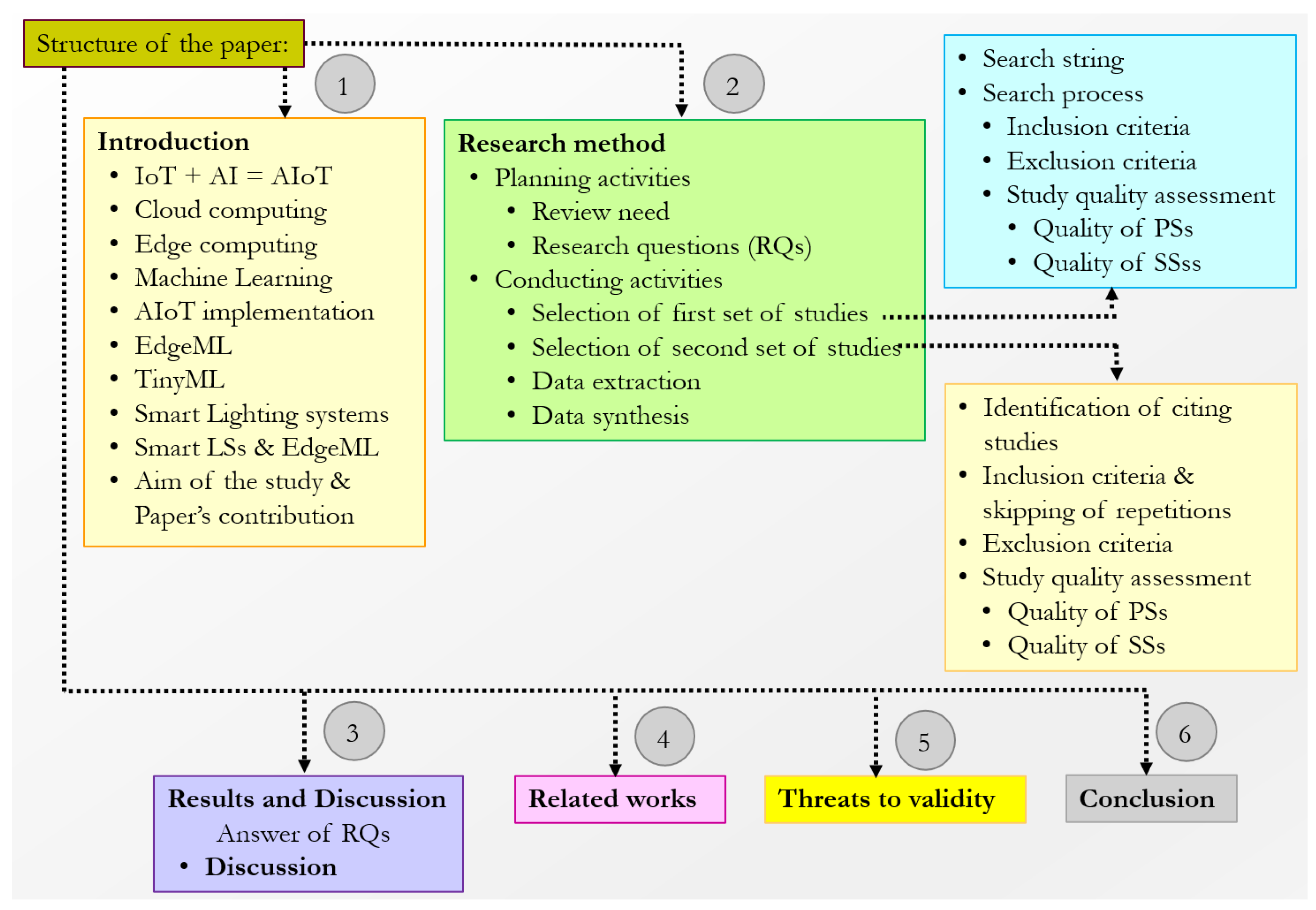
Figure 2.
The two-stages process of ML.
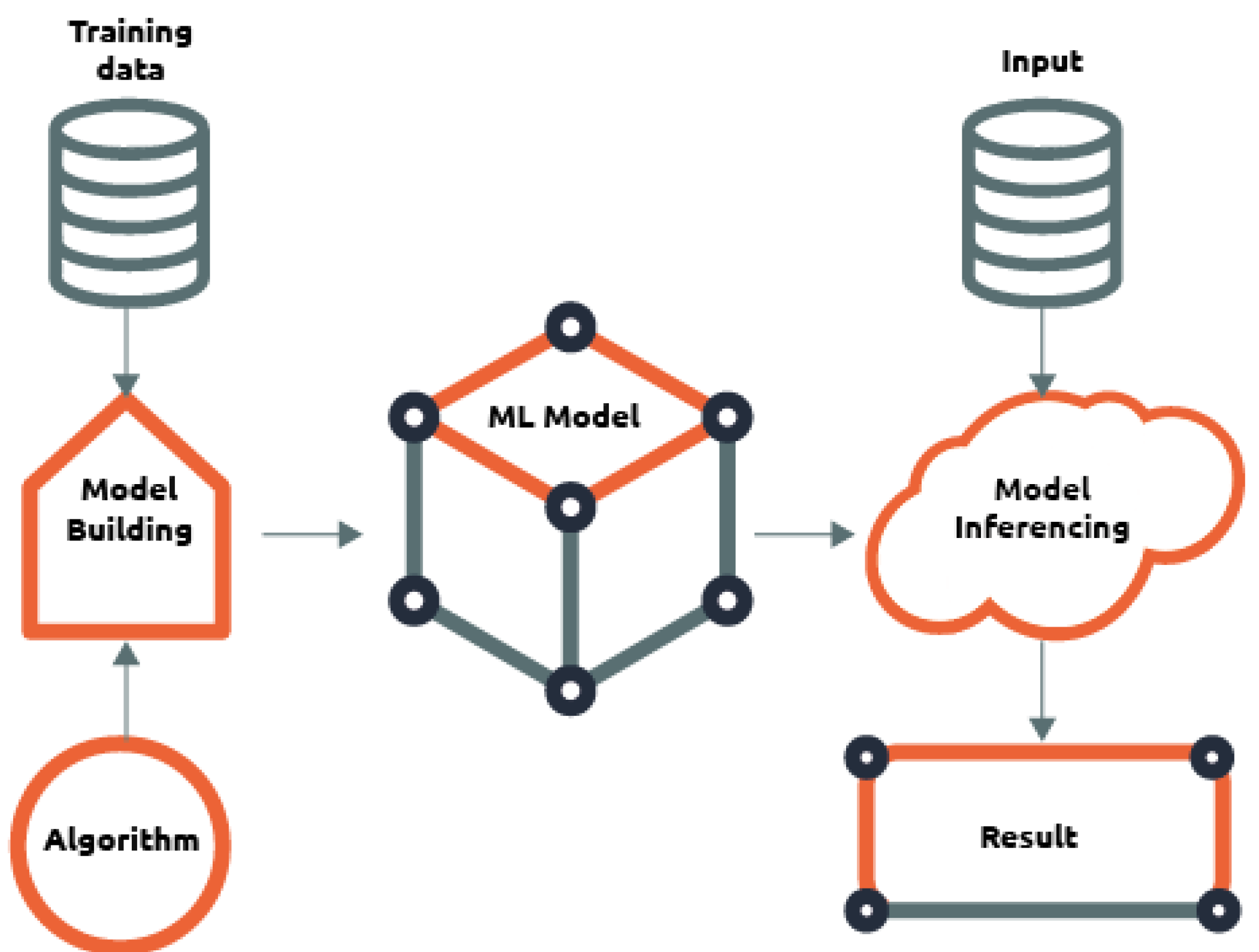
Figure 3.
Two alternatives implementation of AIoT.
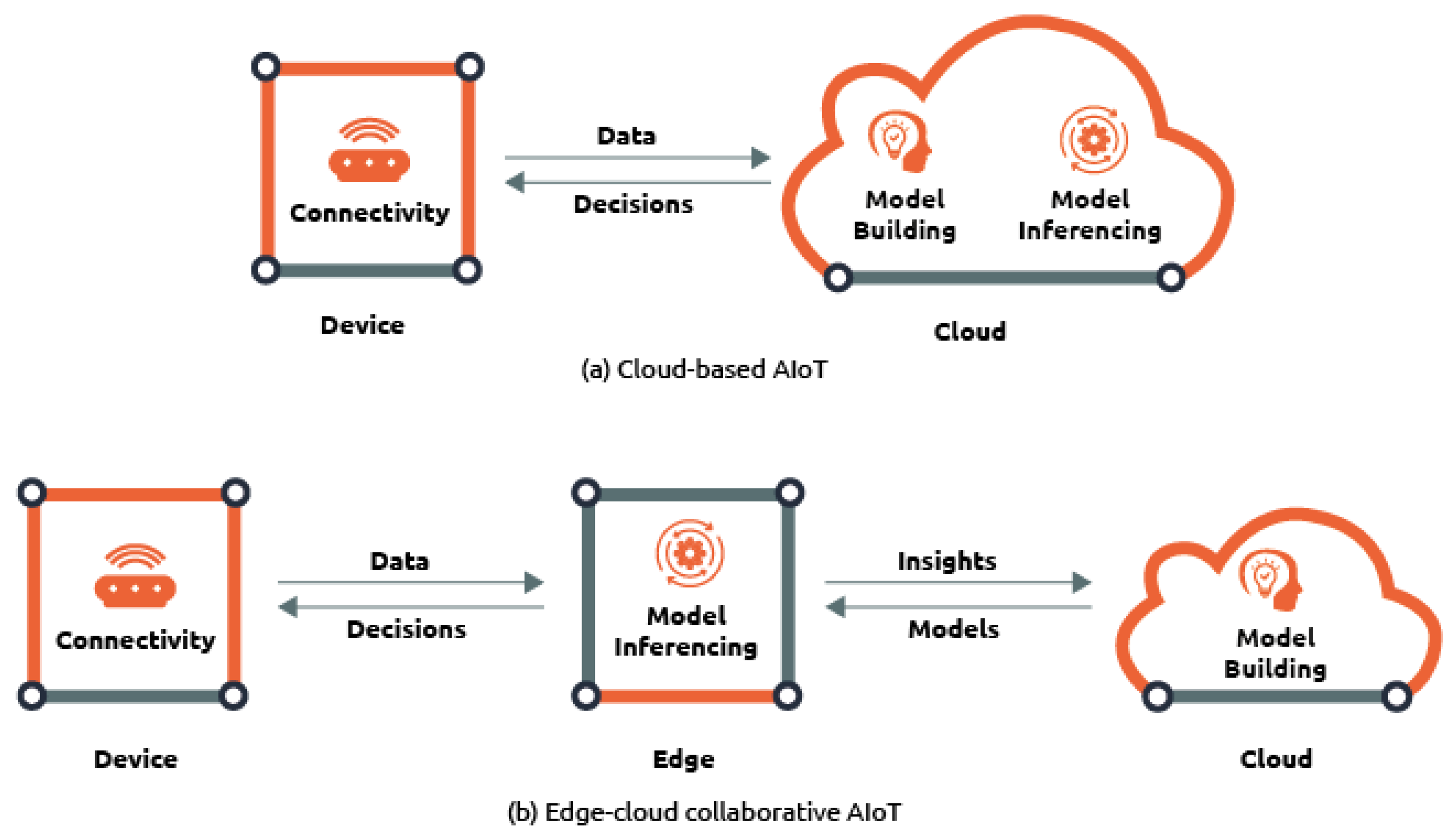
Figure 4.
EdgeML supporting architecture.
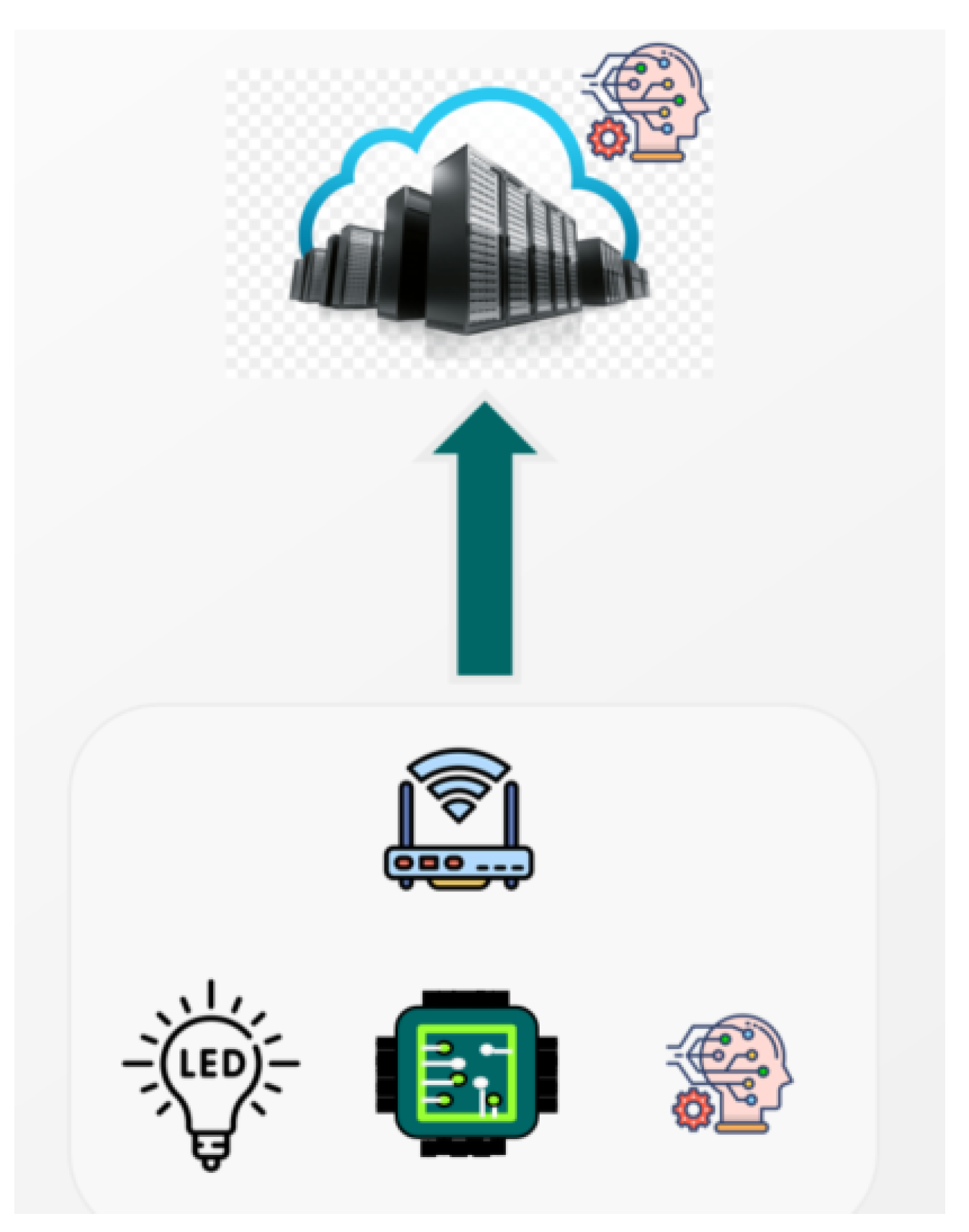
Figure 5.
TinyML workflow.
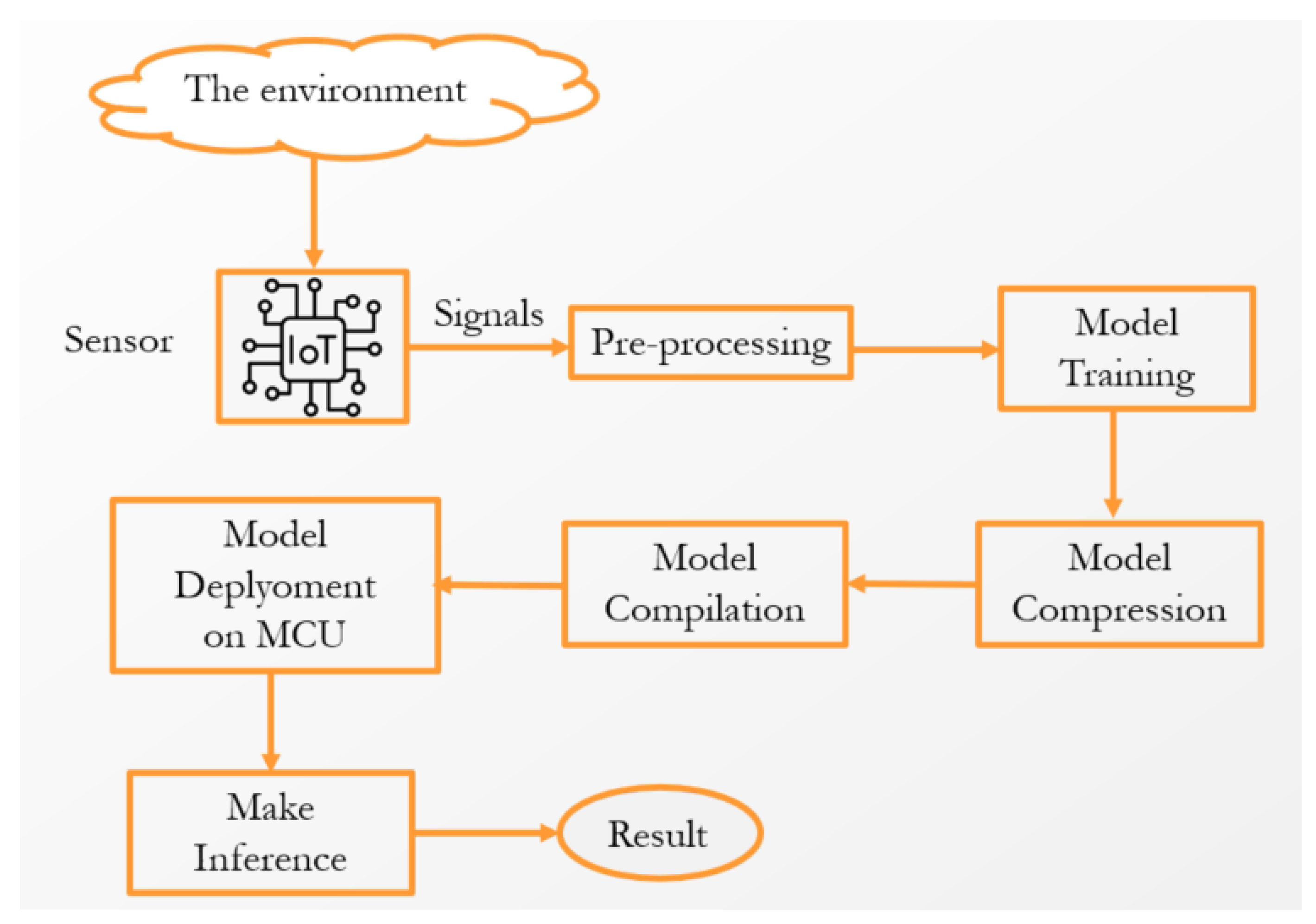
Figure 6.
The implemented SLR protocol.
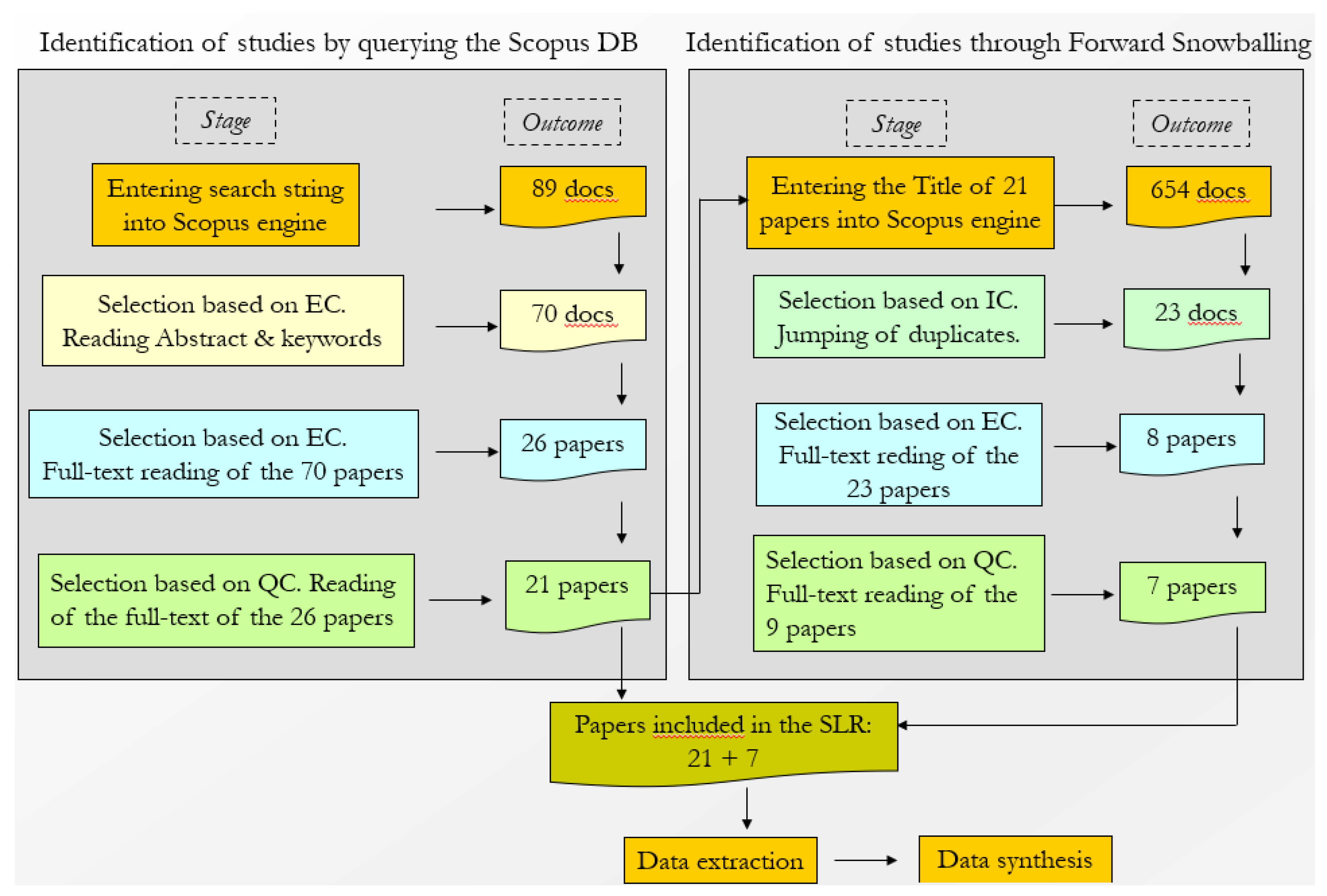
Figure 7.
Open research challenges in EdgeML smart LSs.
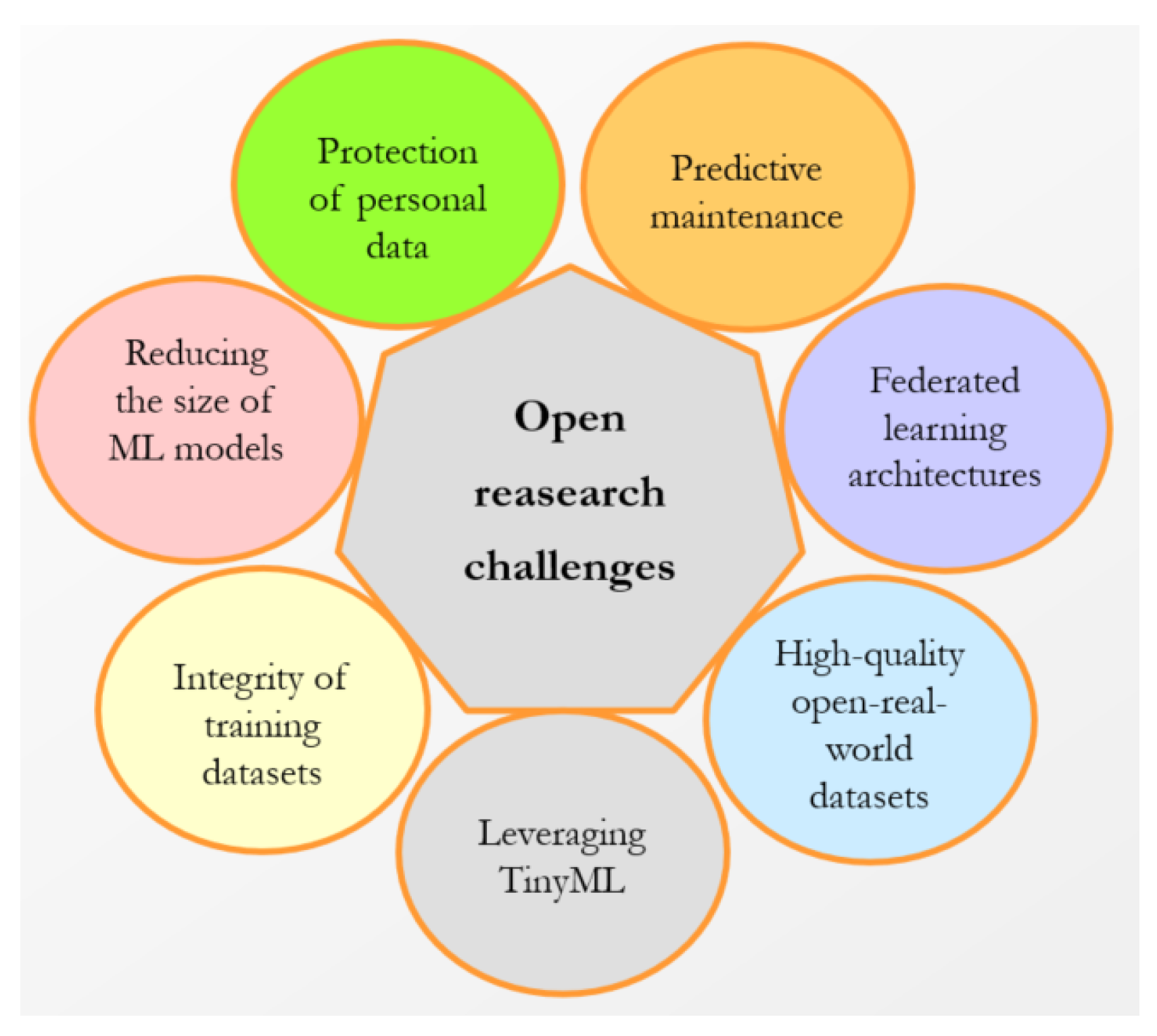
Figure 8.
A three layers architecture of an EdgeML-based LS.
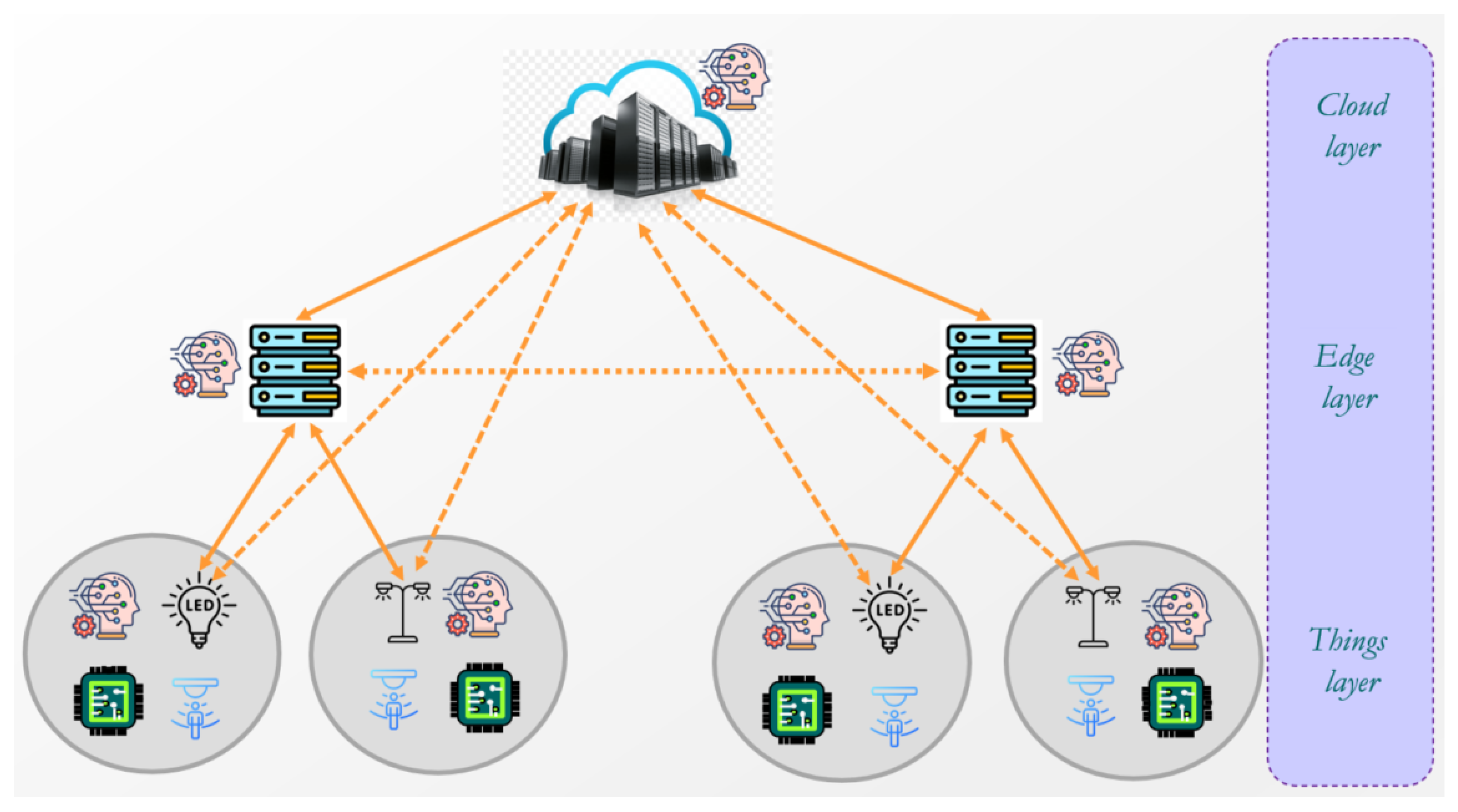
Table 1.
Comparison of sensors embedded in commercially available luminaires.
| Sensor type | Detection method | Advantages | Disadvantages | Applications |
|---|---|---|---|---|
| Photosensitive | Light Level | Automatic on/off based on ambient light, energy-saving | Limited functionality, affected by sudden light changes | Outdoor lighting |
| Passive Infrared (PIR) | Motion (body heat) | Energy saving, motion detection for security | Can be triggered by pets or heat sources, limited field of view | Indoor lighting, hallways, entrances |
| Ultrasonic | Motion | Wide detection range, good for small object movement | Affected by air movement, requires precise installation | Warehouses, large spaces |
| Microwave | Motion | Long range, penetrates walls (limited) | Expensive, potential health concerns | Security lighting, large spaces |
| Temperature | Temperature | Over-temperature protection for LED lamps | No motion detection or direct lighting control | LED luminaires |
| Voice | Sound | Hands-free lighting control | Requires specific voice commands, privacy concerns | Specific applications |
Table 2.
Recent publications on smart LSs.
| Application domain | Use case | Studies |
|---|---|---|
| Smart city | Smart street LS | [33,34,35,36,37,38] |
| Smart building | [33,39,40,41] | |
| Smart education | Smart lab | [42] |
| Smart agriculture | Monitoring of lettuce growth | [43,44] |
Table 3.
Distribution of papers over the years.
| Year | Documents | Year | Documents |
|---|---|---|---|
| 2024 | 13 | 2018 | 4 |
| 2023 | 17 | 2017 | 2 |
| 2022 | 18 | 2016 | 0 |
| 2021 | 13 | 2015 | 1 |
| 2020 | 14 | 2014 | 1 |
| 2019 | 6 |
Table 4.
Aggregation of papers by types.
| Document type | Documents | Document type | Documents |
|---|---|---|---|
| Conference Paper | 54 (60.7%) | Book Chapter | 8 (9.0%) |
| Article | 23 (25.8%) | Review | 4 (4.5%) |
Table 5.
The reasons for exclusion of a study retrieved by the Scopus engine.
| Exclusion criteria | Reason for exclusion |
|---|---|
| EC1. In the retrieved paper, the keywords “Artificial Intelligence” and/or "Internet of Things" are part of the name of the conference where the work was presented, but the manuscript doesn’t touch the AIoT topic. | False positive |
| EC2. In the retrieved paper, the keywords “Artificial Intelligence” and/or "Internet of Things" are listed as authors’ keywords, but the manuscript doesn’t touch the AIoT topic. | False positive |
| EC3. In the retrieved study, the word “Learning” (part of the search string) concerns Education and not the AI. | Out of scope |
| EC4. The study focuses on the adoption of AI in connection with LSs, but the methods considered are not the ML ones. | out of scope |
| EC5. The study mentions ML, but it does not elaborate on how ML methods can act as an enabler for the advancement in the development of smart LSs. So, the paper is too generic from the perspective of the stakeholders which commissioned the present SLR. | Not relevant |
| EC6. The study adopts a ML classifier just to automate lighting ON/OFF, for example through face recognition. | Not relevant |
| EC7. In the retrieved paper, the sub-string ("Lighting systems" OR "Smart Lighting") is mentioned as a potential application domain, but the study doesn’t elaborate on the topic. So, the paper is useless from the perspective of the stakeholders which commissioned the present SLR. | Not relevant |
| EC8. In the full-text of the study, the Edge-Cloud continuum paradigm is either marginal or not mentioned at all. So, the paper is useless from the perspective of the stakeholders which commissioned the present SLR. | Not relevant |
Table 6.
Papers excluded after Abstract reading.
| Reference | Aim | Motivation for exclusion |
|---|---|---|
| Nieh H.-M. and Chen H.-Y., An Arduino-Based Experimental Setup for Teaching Light Color Mixing, Light Intensity Detection, and Ambient Temperature Sensing, Physics Teacher, 61 (2), 2023, 133 - 137, DOI: 10.1119/5.0066060 | On teaching light color mixing and light intensity detection in Physics courses. | EC1 |
| Klimek R., Proposal of a multi-agent system for a smart outdoor lighting environment, LNCS, 10246 LNAI, 2017, 255 - 266, DOI: 10.1007/978-3-319-59060-8_24 | Proposal of a multi-agent system for a rural environment. | EC4 |
| Mandaric K. et al, Agent-based approach for user-centric smart environments, Smart Innovation, Systems and Technologies, 2020, 186, 37 - 46, DOI: 10.1007/978-981-15-5764-4_4 | Proposal of an agent-based smart environment system. | EC4 |
| Mandaric K. et al., A Multi-Agent System for Service Provisioning in an Internet-of-Things Smart Space Based on User Preferences, Sensors, 24 (6), 2024, DOI: 10.3390/s24061764 | Adoption of a context-aware multi-agent negotiation algorithm to a smart lighting use case. | EC4 |
| Zandbergen D., The Unfinished Lampposts: The (anti-) Politics of the Amsterdam Smart Lighting Project, (2020) City and Society, 32 (1), 135–156, DOI: 10.1111/ciso.12251 | Overview of a smart lighting project concerning lampposts located in Amsterdam. | EC2 |
| Vale Z. et al., An overview on smart buildings, Encyclopedia of Electrical and Electronic Power Engineering, 2022 DOI:10.1016/B978-0-12-821204-2.00066-0 | Overview on building types, technologies, enablers, risks, cultural aspects, and smart building applications. | EC5 |
| Tsoukas V. et al., A Gas Leakage Detection Device Based on the Technology of TinyML Technologies, 11 (2), 2023, DOI: 10.3390/technologies11020045 | Summary of a gas leakage detection system based on TinyML. | EC2 |
| Wang J., Design of the Intelligent Elderly’s Lighting Emotional Interactive Experience System based on Internet of Things, Proc. of Inter. Conference on Artificial Intelligence and Smart Systems, ICAIS 2021, 1347–1351 DOI: 10.1109/ICAIS50930.2021.9395946 | Design of an intelligent elderly’s lighting emotional system based on the IoT. | EC2 |
| Biagetti G. et al., ToLHnet: A low-complexity protocol for mixed wired and wireless low-rate control networks. Proc. of the 6th European Embedded Design in Education and Research Conference 2014, 177–181 DOI: 10.1109/EDERC.2014.6924383 | Principles of a protocol and presentation of a case study detailing its implementation and performance. | EC3 |
| Dalela P.K. et al., Surveillance enabled smart light with oneM2M based IoT networks, Communications in Computer and Information Science, 2017), 775, 296–307, DOI: 10.1007/978-981-10-6427-2_24 | Conversion of an existing lighting infrastructure to a centralized, web based, surveillance enabled smart lighting. | EC4 |
| Sharma D. et al., Design of photo-voltaic source fed efficient corridor lighting system in green buildings, Proc. 3rd Inter. Conference on Emerging Technologies in Computer Engineering: Machine Learning and Internet of Things, ICETCE 2020, 58–62 DOI:10.1109/ICETCE48199.2020.9091767 | Summary of savings following the adoption of lighting controls and usage of renewable energy for the lighting system of Indian public buildings. | EC1 |
| Sun Y. et al., MagicHand: Interact with IoT devices in Augmented Reality environment, 26th IEEE Conference on Virtual Reality and 3D User Interfaces, VR 2019, 1738 - 1743, DOI: 10.1109/VR.2019.8798053 | Proposal of an AR-based visualization and interaction tool that offers a touch-less mode to interact with LSs. | EC5 |
| Wakim P. and Mershad K., Using Internet of Things in a Learning Management System for Campus Access Control, Inter. Conference on Computer and Applications, ICCA 2018, 46–51, DOI: 10.1109/COMAPP.2018.8460302 | Integration into the university Learning Management System of a security feature through an Arduino IoT device. | EC3 |
| Yang Y.-T. et al., Improving Students’ Learning Effectiveness by an AIoT Human Centric Lighting System, 14th IIAI Inter. Congress on Advanced Applied Informatics, IIAI-AAI 2023, 180–181, DOI: 10.1109/IIAI-AAI59060.2023.00045 | Investigation of the long-term impact of a human-centric LS on students’ learning effectiveness. | EC5 |
| Scholtz B. et al., An Internet of Things (IoT) Model for Optimising Downtime Management: A Smart Lighting Case Study, IFIP Advances in Information and Communication Technology, 2019, 548, 89–104, DOI: 10.1007/978-3-030-15651-0_9 | Adoption of IoT in Field Service Management to manage data quality and service delivery challenges. | EC4 |
| Asilian A. et al., The Role of Microelectronics for Smart Cities, Smart Grids and Industry 5.0: Challenges, Solutions, and Opportunities, 13th Smart Grid Conference, SGC 2023, DOI: 10.1109/SGC61621.2023.10459310 | Smart LSs are mentioned as an application domain of microelectronics. | EC4 |
| Kouah S. et al., Internet of Things-Based Multi-Agent System for the Control of Smart Street Lighting, (2024) Electronics (Switzerland), 13 (18), DOI: 10.3390/electronics13183673 | Proposal of a smart street LS based on IoT, fuzzy logic, and multi-agents. | EC4 |
| Tse, R. et al., Deepclass: Edge based class occupancy detection aided by deep learning and image cropping, (2020) Proc. of SPIE - International Society for Optical Engineering, DOI: 10.1117/12.2572948 | An image processing-based people counting method to control the presence of humans in classrooms to set lights accordingly. | EC6 |
| Buniel G. and Dela Cerna M., I-Detect: An Internet of Things Voice-Activated Home Automation with Smoke and Fire Detection and Mitigation System, IEEE 13th Inter. Conference on Humanoid, Nanotechnology, Information Technology, Communication and Control, Environment, and Management, 2021, DOI: 10.1109/HNICEM54116.2021.9731884 | A voice-activation of luminaires through the Amazon Alexa. | EC6 |
Table 7.
Papers excluded after full-text reading.
| Reference | Aim | Motivation for exclusion |
|---|---|---|
| Vaidya M. et al., Energy Efficient Smart Lighting System for Rooms, Studies in Big Data, 2022, 92, 107 – 125 DOI: 10.1007/978-3-030-77214-7 | Illustration of a self-adjusting LS and a facial recognition-based Lighting Management System. | EC5 |
| Nigel F.T. and Longe O.M., Smart energy efficient lighting system for smart buildings, 2021 IEEE PES/IAS PowerAfrica, PowerAfrica DOI: 10.1109/PowerAfrica52236.2021.9543273 | Description of a LS that regularly updates the count of occupants in a room, detects any motion, and measures light intensity in the room. | EC4 |
| Panicker, J.G. and Azman, M., Robust and Lightweight Control System for IoT Networks: Enabling IoT for the Developing World, Advances in Intelligent Systems and Computing, 2021, 1245, 73–92, DOI: 10.1007/978-981-15-7234-0_8 | Proposal of a secure speech-based automation and control system for residential and commercial buildings. | EC4 |
| Shanmugasundaram N. et al., Smart Lighting System Using the Internet of Things, 8th Inter. Conference on Advanced Computing and Communication Systems, ICACCS 2022, 2037–2040, DOI: 10.1109/ICACCS54159.2022.9785327 | Remote monitoring of home appliances with an Android application that uses the Wi-Fi technology. | EC4 |
| Chen B. et al, Three-dimensional ultraflexible triboelectric nanogenerator made by 3D printing, Nano Energy, 2018, 45, 380–389, DOI: 10.1016/j.nanoen.20 17.12.049 | Proposal of a 3D-TENG able to charge common electronics through harvesting energy from human motions. | EC1 |
| Matveev I. et al., Comparative Analysis of Object Detection Methods in Computer Vision for Low-Performance Computers Towards Smart Lighting Systems, LNNS, 2023, 548, 203–215, DOI: 10.1007/978-3-031-16368-5_10 | Comparison of the performance of DL algorithms for object detection targeted to low-performance embedded microprocessors. | EC5 |
| Nusrat M.A. et al., Practicle Coordination and Aspect of IoT for Smart Cities and Healthcare System, 12th Inter. Conference on System Modeling and Advancement in Research Trends, SMART 2023, 280–287, DOI: 10.1109/SMART59791.2023.10428643 | An overview of smart city projects. | EC1 |
| Al-Daweri M.S. et al., Dynamic Temperature, Humidity, and Lighting System for Smart Home Based on Fuzzy Logic, Advances in Science, Technology and Innovation, 2024, 149–164, DOI: 10.1007/978-3-031-52303-8_11 | Design and testing of a fuzzy-logic home system. | EC4 |
| Higuera, J. et al., Smart lighting system ISO/IEC/IEEE 21451 compatible, IEEE Sensors Journal, 15 (5), 2015, 2595–2602, DOI: 10.1109/JSEN.2015.2390262 | Adoption of a fuzzy logic algorithm to determine light levels on the office desk during the working day. | EC4 |
| Polepaka S. et al., Internet of things and its applications: An overview, LNEE, 2020, 643, 67–75, DOI: 10.1007/978-981-15-3125-5_8 | An overview of IoT elements and application domains. | EC2 |
| Sharma V. et al., A novel study on IoT and machine learning-based transportation, Machine Learning Techniques and Industry Applications, 2024, 1–28, DOI: 10.4018/979-8-3693-5271-7.ch001 | On the relevance of AIoT to advance the smart transportation sector. | EC5 |
| Anagnostopoulos T. et al., Challenges and Solutions of Surveillance Systems in IoT-Enabled Smart Campus: A Survey, IEEE Access, 9, 2021, 131926–131954, DOI: 10.1109/ACCESS.2021.3114447 | A comparative assessment around surveillance systems for Smart Campuses. | EC5 |
| Bierzynski K. et al., The Learning of the OpenLicht system, a self-learning lighting system at the edge of the network, Smart Systems Integration 2018 – Inter. Conference and Exhibition on Integration Issues of Miniaturized Systems, 155–162 | Discussion of problems and challenges around the implementation of self-learning LSs. | EC6 |
| Subbarao V. et al., A survey on internet of things based smart, digital green and intelligent campus, 4th Inter. Conference on Internet of Things: Smart Innovation and Usages, IoT-SIU 2019, DOI: 10.1109/IoT-SIU.2019.8777476 | An overview of components of a future Smart and Digital Green Educational Campus. | EC5 |
| Kanthi M. and Dilli R., Smart streetlight system using mobile applications: secured fault detection and diagnosis with optimal powers, Wireless Networks, 29 (5), 2023, 2015–2028, DOI: 10.1007/s11276-023-03278-9 | A smart streetlight controller facilitating the control and management of lighting through an app. | EC2 |
| Pestana E. and Paice A., Learning Algorithms for Building Control Applied to the iHomeLab Lighting System, 2021, CEUR Workshop Proceedings, 3116 Proceedings of FTAL 2021, October 28–29, 2021, Lugano, Switzerland | Description of an approach based on IoT, digital twins and ML for the configuration of building management systems. | EC4 |
| Qin F., Modern Intelligent Rural Landscape Design Based on Particle Swarm Optimization, Wireless Communications and Mobile Computing, 2022, DOI: 10.1155/2022/8246368 | The PSO method is investigated to modernize the workflow of rural landscape design. | EC5 |
| Choi Y. et al., Predicting wearable IoT Adoption: Identifying core consumers through Machine learning algorithms. (2024) Telematics & Informatics, 93, 10.1016/j.tele.2024.102176 | Investigation of the performance of ML algorithms in predicting consumer adoption of wearable devices. | EC5 |
| Zhang J. and He S., Smart technologies and urban life: A behavioral and social perspective, (2020) Sustainable Cities and Society, 63, DOI: 10.1016/j.scs.2020.102460 | The foreword of the special issue: “Smart technologies and urban life: a behavioral and social perspective”. | EC5 |
| Samuel, R. et al., Smart living: Role of the internet of everything and the challenges (2022) Internet of Everything: Smart Sensing Technologies, 1–30 | A survey on the role of the Internet of Everything in future smart cities. | EC5 |
| Vinh P.V. and Dung P.X., Designing a Smart Lighting System for Illuminating Learning Experiences, LNNS, 1062 LNNS, 2024, 296–305, DOI: 10.1007/978-3-031-65656-9_30 | Proposal of an open and active learning environment. | EC2 |
| Puig, S. and Foukia, N., CleverTrash: An ML-based IoT system for waste sorting with continuous learning cycle, Inter. Conference on Electrical, Computer, and Energy Technologies, ICECET 2022 DOI: 10.1109/ICECET55527.2022.9872943 | Proposal of a waste recognition system that aims at educating people to properly recycle their waste. | EC5 |
| Puig, S. and Foukia, N., CleverTrash: an IoT system for waste sorting with deep learning, IEEE Inter. Conferences on Internet of Things, iThings 2022, IEEE Green Computing and Communications, GreenCom 2022, IEEE Cyber, Physical and Social Computing, CPSCom 2022 and IEEE Smart Data, SmartData 2022, 1–8, DOI: 10.1109/iThings-GreenCom-CPSCom-SmartData-Cybermatics55523.2022.00016 | The performance of CNNs part of a waste recognition system is explored. | EC5 |
| Altrad, A. IoTs Traffics Detection and Analysis Using Machine Learning for Cybersecurity Application, IEEE 5th Eurasia Conference on IoT, Communication and Engineering, ECICE 2023, 78–83, DOI: 10.1109/ECICE59523.2023.10383018 | Application of the feature extraction technique to detect IoT’s benign and attack traffic features. | EC5 |
| Park, J.S. et al., Building IoT-based Zero-Contact Experimental Environment for Studying Picture Preference under Various Illumination Conditions, Digest of Technical Papers - IEEE Inter. Conference on Consumer Electronics, 2021 January, DOI: 10.1109/ICCE50685.2021.9427755 | Various experiments are reported under various lighting conditions. | EC5 |
| John, J. and Mahalingam, P, Automated Fish Feed Detection in IoT Based Aquaponics System, 8th Inter. Conference on Smart Computing and Communications: Artificial Intelligence, AI Driven Applications for a Smart World, ICSCC 2021, 286–290, DOI: 10.1109/ICSCC51209.2021.9528186 | Detection of excess fish feed on the water surface by adopting an object detection algorithm. | EC5 |
| Pridmore J. and Mols A., Personal choices and situated data: Privacy negotiations and the acceptance of household Intelligent Personal Assistants, Big Data and Society, 2020, 7(1), DOI: 10.1177/2053951719891748 | Investigation on how people negotiate and make choices about household intelligent personal assistants. | EC5 |
| Singh A.K. et al., Future Technology: Internet of Things (IoT) in Smart Society 5.0, (2023) Intelligent Techniques for Cyber-Physical Systems, 245–265, DOI: 10.1201/9781003438588-15 | A book chapter on the role of AIoTin the development of Smart Society 5.0. | EC5 |
| Thomas A.S. and Robinson A.Y., IoT, Big Data, Blockchain and Machine Learning Besides its Transmutation with Modern Technological Applications, Intelligent Systems Reference Library, 2020, 180, 47–63, DOI: 10.1007/978-3-030-39119-5_4 | Overview of ML techniques and IoT applications in the transportation domain. | EC5 |
| Rahman, M.A. et al., IoT based Comprehensive Approach Towards Shaping Smart Classrooms, Proc. of the 5th Inter. Conference on I-SMAC (IoT in Social, Mobile, Analytics and Cloud), I-SMAC 2021, 103–109, DOI: 10.1109/I-SMAC52330.2021.9640669 | An application for reducing power consumption in institutions by using cameras to detect human presence and operate appliances accordingly. | EC6 |
| Yu, T. et al., Design strategy of green intelligent building using deep belief network, Inter. Journal of System Assurance Engineering and Management, 14 (1), 2023, 196–205, DOI: 10.1007/s13198-021-01513-0 | The LS of a medical building is designed by adopting the biophysical design theory and the IoT technology. | EC4 |
| Bernardo M. et al., End-Product of Solar-Sharing Smart Lighting Artificial Intelligence Driven Platform for High-Valued Crops (Lactuca Sativa) on Indoor Hydroponics System, IEEE 10th Conference on Systems, Process and Control, ICSPC 2022, 160–165, DOI: 10.1109/ICSPC55597.2022.10001821 | An IoT-based LED LS to control the light intensity in an indoor environment. The system adopts a fuzzy logic controller. | EC4 |
| Bernardo M.S., DLI and PPFD throughput of Solar and AI-Based Smart Lighting Apply on Illumination Stratums, IEEE 11th Conference on Systems, Process and Control, ICSPC 2023, 171–176, DOI: 10.1109/ICSPC59664.2023.10419940 | A solar-sharing smart LS that control LED indoor illumination. The system adopts a fuzzy logic controller. | EC4 |
| Rahman M. et al., IoT and ML Based Approach for Highway Monitoring and Streetlamp Controlling, Lecture Notes of the Institute for Computer Sciences, Social-Informatics and Telecommunications Engineering, LNICST, 491 LNICST, 2023, 376–385, DOI: 10.1007/978-3-031-34622-4_30 | An AIoT-based system to control streetlamps to provide illumination according to the brightness of the area. | EC6 |
| Sung W.-T. et al., Smart Lamp Using Google Firebase as Realtime Database, Intelligent Automation and Soft Computing, 2022, 33 (2), pp. 967–982, DOI: 10.32604/iasc.2022.024664 | A discussion on the manufacture of smart lamps. | EC1 |
| Khoa T.A. et al., Designing efficient smart home management with IoT smart lighting: A Case Study, Wireless Communications and Mobile Computing, 2020, DOI: 10.1155/2020/8896637 | A proposal to strengthen home security by using IoT. | EC1 |
| Thipards R. et al., Smart Street Lighting Control for Electrical Power on Saving by IoT, Inter. Computer Science and Engineering Conference 2022, 55–60, DOI: 10.1109/ICSEC56337.2022.10049363 | A system saving energy by dimming the electricity when there are no people or vehicles on the street. | EC7 |
| Kumar P. et al., Smart lighting and switching using Internet of Things, 11th Inter. Conference on Cloud Computing, Data Science and Engineering, 2021, 536–539, DOI:10.1109/Confluence51648.2021.9377078 | Proposal of an IoT-based method for sensing and monitoring of smart LSs through an app. | EC4 |
| Rauniyar K.R. and Khan J.A., Application of IoT and AI in the Development of Smart Cities Smart Cities Concepts, Practices, and Applications, 2022, 181–196, DOI: 10.1201/9781003287186-7 | A primer about the services that AIoT can provide to smart cities. | EC5 |
| Garg S. et al., Real time adaptive street lighting system, Communications in Computer and Information Science, 1192 CCIS, 2020, 223–239, DOI: 10.1007/978-981-15-3666-3_19 | Proposal of a fuzzy-logic-based data aggregation strategy for the deployment of energy efficient street LSs. | EC4 |
| Shao Z. et al., Analysis of the opportunities and costs of energy saving in lighting system of library buildings with the aid of building information modelling and Internet of things, Fuel, 352, 2023, DOI: 10.1016/j.fuel.2023.128918 | About strategies for prototyping an IoT- and BIM-based efficient LS of a university library as an alternative to the use of ML. | EC3 |
| Goyal S.B. et al., Smart Luminaires for Commercial Building by Application of Daylight Harvesting Systems, LNNS, 2022, 218, 293–305, DOI: 10.1007/978-981-16-2164-2_24 | A daylight harvesting strategy integrated with AI to upgrade the infrastructure of existing commercial buildings. | EC4 |
| Yan G., Intelligent Lighting System based on Digital Twins in Smart Home, Proc. of SPIE - The Inter. Society for Optical Engineering, 12940, 2023, DOI: 10.1117/12.3010705 | An introduction to the adoption of the digital twin technology in the smart home domain. | EC4 |
Table 8.
Quality assessment results for the 22 primary studies.
| Reference | QC1 | QC2 | QC3 | QC4 | QC5 | QC6 | QC7 | QC8 | Score |
|---|---|---|---|---|---|---|---|---|---|
| [70] | 1 | 1 | 1 | 1 | 1 | 1 | 1 | 1 | 8 |
| [71] | 1 | 1 | 0 | 1 | 1 | 1 | 1 | 1 | 7 |
| [72] | 1 | 1 | 0.5 | 1 | 1 | 0.5 | 0.5 | 1 | 6.5 |
| [73] | 1 | 1 | 0.5 | 0.5 | 1 | 0.5 | 0.5 | 1 | 6 |
| [74] | 1 | 1 | 0 | 1 | 1 | 1 | 1 | 0 | 6 |
| [75] | 1 | 1 | 0 | 1 | 1 | 1 | 1 | 0 | 6 |
| [76] | 1 | 1 | 0.5 | 1 | 1 | 1 | 0.5 | 0 | 6 |
| [77] | 1 | 1 | 0 | 0.5 | 1 | 0.5 | 0.5 | 1 | 5.5 |
| [78] | 1 | 1 | 0.5 | 0.5 | 1 | 1 | 0.5 | 0 | 5.5 |
| [79] | 1 | 1 | 0 | 1 | 1 | 0.5 | 0.5 | 0 | 5 |
| [80] | 1 | 1 | 0 | 0.5 | 1 | 1 | 0.5 | 0 | 5 |
| [81] | 1 | 1 | 0 | 1 | 1 | 0.5 | 0.5 | 0 | 5 |
| [82] | 1 | 1 | 0 | 1 | 1 | 0 | 0 | 1 | 5 |
| [83] | 1 | 1 | 0 | 0.5 | 1 | 0.5 | 0.5 | 0 | 4.5 |
| [84] | 1 | 1 | 0 | 0.5 | 1 | 0.5 | 0.5 | 0 | 4.5 |
| [85] | 1 | 1 | 0 | 0.5 | 1 | 0.5 | 0.5 | 0 | 4.5 |
| [86] | 1 | 1 | 0 | 0.5 | 1 | 0.5 | 0.5 | 0 | 4.5 |
| [87] | 1 | 1 | 0 | 0.5 | 1 | 0.5 | 0.5 | 0 | 4.5 |
| [88] | 1 | 1 | 0.5 | 0.5 | 1 | 1 | 0.5 | 0 | 4.5 |
| (Tang2021) | 1 | 1 | 0 | 0.5 | 1 | 0 | 0.5 | 0 | 4 |
| (Huang2022) | 1 | 1 | 0 | 1 | 0 | 0.5 | 0 | 0 | 3.5 |
| (Martin2021) | 0 | 0 | 0 | 0 | 1 | 1 | 0 | 0 | 2 |
Table 9.
Quality assessment results for the secondary studies.
| Ref. | QC1 | QC2 | QC3 | QC4 | QC5 | QC6 | QC7 | QC8 | QC9 | QC10 | QC11 | QC12 | QC13 | QC14 | QC15 | Score |
|---|---|---|---|---|---|---|---|---|---|---|---|---|---|---|---|---|
| [52] | 1 | 1 | 0.5 | 1 | 1 | 1 | 1 | 1 | 1 | 0.5 | 1 | 1 | 1 | 0 | 1 | 13 |
| [89] | 0.5 | 0 | 0 | 0 | 0 | 0 | 0 | 0 | 0 | 0 | 1 | 1 | 1 | 0 | 1 | 4.5 |
| (Mukhopadhyay2024) | 0.5 | 0 | 0 | 0 | 0 | 0 | 0 | 0 | 0 | 0 | 1 | 0.5 | 1 | 0 | 0.5 | 3.5 |
| (Patil2018) | 0 | 0 | 0 | 0 | 0 | 0 | 0 | 0 | 0 | 0 | 0 | 0 | 0.5 | 0 | 0 | 0.5 |
Table 10.
Reference to the three primary studies excluded at the quality assessment stage.
| (Tang2021) Tang D. et al., An Intelligent Fault Diagnosis Method for Street Lamps, Inter. Conference on Internet, Education, and Information Technology, IEIT 2021, 300–303, DOI: 10.1109/IEIT53597.2021.00073 |
| (Huang2022) Huang Y., Design of Rural Road Lighting System Based on Internet of Things and Deep Learning, Inter. Conference on Industrial IoT, Big Data and Supply Chain, IIoTBDSC 2022, 6–9, DOI: 10.1109/IIoTBDSC57192.2022.00012 |
| (Martin2021) Martin G. et al., AI-TWILIGHT: AI-digital TWIn for LIGHTing - A new European project, 27th Inter. Workshop on Thermal Investigations of ICs and Systems, THERMINIC 2021, DOI: 10.1109/THERMINIC52472.2021.9626541 |
Table 11.
Reference to the two secondary studies excluded at the quality assessment stage.
| (Mukhopadhyay2024) Mukhopadhyay S. et al., A Review and Analysis of IoT Enabled Smart Transportation Using Machine Learning Techniques, Inter. Journal of Transport Development and Integration, 8 (1), 2024, 61–77, DOI: 10.18280/ijtdi.080106 |
| (Patil2018) Patil A.A. and Badgujar V.S., A Comprehensive Survey on Theoretic Perspective Providing Future Directions on IoT, Inter. Conference on Smart City and Emerging Technology, ICSCET 2018, DOI: 10.1109/ICSCET.2018.8537285 |
Table 12.
Distribution over the years of citations of reference [89].
Table 12.
Distribution over the years of citations of reference [89].
| Year | 2019 | 2020 | 2021 | 2022 | 2023 | 2024 | 2025 |
|---|---|---|---|---|---|---|---|
| Total Citations | 6 | 38 | 60 | 110 | 115 | 86 | 1 |
| Citations from journals’ articles | 4 | 15 | 26 | 56 | 60 | 41 | 1 |
Table 13.
Total number of citations against the number of pertinent citations received by the studies belonging to the first set of selected studies.
Table 13.
Total number of citations against the number of pertinent citations received by the studies belonging to the first set of selected studies.
| Studies in the first set | Number of citations | Pertinent citations |
|---|---|---|
| [89] | 425 | 6 |
| [52] | 46 | 16 |
| [80] | 6 | 2 |
| [82] | 87 | 2 |
| [70] | 33 | 0 |
| [71] | 22 | 6 |
| [77] | 9 | 8 |
| [72] | 8 | 0 |
| [83] | 6 | 4 |
| [73] | 3 | 0 |
| [75] | 3 | 0 |
| [76] | 4 | 1 |
Table 14.
List of papers citing the selected 21.
| Papers in Table 13 | #PCs | Reference to the citing paper |
|---|---|---|
| [80] | 2 | Putrada, A.G. et al., EdgeSL: Edge-Computing Architecture on Smart Lighting Control With Distilled KNN for Optimum Processing Time, (2023) IEEE Access, 11, 64697-64712. DOI: 10.1109/ACCESS.2023.3288425 |
| Putrada, A.G. et al., Machine Learning Methods in Smart Lighting Toward Achieving User Comfort: A Survey, (2022) IEEE Access, 10, 45137-45178. DOI: 10.1109/ACCESS.2022.3169765 | ||
| [82] | 2 | Agramelal, F. et al., Smart Street Light Control: A Review on Methods, Innovations, and Extended Applications, (2023) Energies, 16 (21), DOI: 10.3390/en16217415 |
| Chiradeja, P. and Yoomak, S., Development of public lighting system with smart lighting control systems and internet of thing (IoT) technologies for smart city, (2023) Energy Reports, 10, 3355-3372, DOI: 10.1016/j.egyr.2023.10.027 | ||
| [71] | 6 | Wang, Y. and Durmus, D., Image Quality Metrics, Personality Traits, and Subjective Evaluation of Indoor Environment Images, (2022) Buildings, 12 (12), DOI: 10.3390/buildings12122086 |
| Vale, Z., et al., An overview on smart buildings, (2022) Encyclopedia of Electrical and Electronic Power Engineering: Volumes 1-3, 2, V2-431-V2-440. DOI: 10.1016/B978-0-12-821204-2.00066-0 | ||
| Putri, A.K. et al., The Smart Lighting System in the Coworking Space’s Meeting Room, 4th Inter. Conference on Informatics, Multimedia, Cyber and Information System, ICIMCIS 2022, 534-538, DOI: 10.1109/ICIMCIS56303.2022.10017802 | ||
| Daniel, W. et al., Integrated Smart Lighting Dashboard on the Office Desk to Accommodate User Activity, 10th Inter. Conference on Cyber and IT Service Management, CITSM 2022, DOI: 10.1109/CITSM56380.2022.9935875 | ||
| Widartha, V.P. et al., Advancing Smart Lighting: A Developmental Approach to Energy Efficiency through Brightness Adjustment Strategies, (2024) Journal of Low Power Electronics and Applications, 14 (1), DOI: 10.3390/jlpea14010006 | ||
| Parise, G. et al., A Comprehensive Exploration of Smart Lighting Aspects: Area of Use, Methodologies and Purposes, IEEE Industry Applications Society Annual Meeting, IAS 2023, DOI: 10.1109/IAS54024.2023.10406744 | ||
| [52] | 16 | Putrada, A.G. et al., EdgeSL: Edge-Computing Architecture on Smart Lighting Control with Distilled KNN for Optimum Processing Time, (2023) IEEE Access, 11, 64697-64712, DOI: 10.1109/ACCESS.2023.3288425 |
| Zhu, J. et al., Data-Driven End-to-End Lighting Automation Based on Human Residential Trajectory Analysis, Inter. Conference on Smart Applications, Communications and Networking, SmartNets 2024. | ||
| Barandas, M. et al., Iterative wireless node localization based on Bluetooth and visible light for smart lighting systems, (2024) Wireless Telecommunications Symposium, DOI: 10.1109/WTS60164.2024.10536676 | ||
| Aizono, Y. et al., Building Automation with Vision Transformer Using Synthetic Indoor Images for Room Light Control, KST 2024 - 16th Inter. Conference on Knowledge and Smart Technology, 40-44, DOI: 10.1109/KST61284.2024.10499683 | ||
| Putrada, A.G. et al., Q8KNN: A Novel 8-Bit KNN Quantization Method for Edge Computing in Smart Lighting Systems with NodeMCU, 824 LNNS, 2024598-615. DOI: 10.1007/978-3-031-47715-7_41 | ||
| Mohammadrezaei, E. et al., Systematic Review of Extended Reality for Smart Built Environments Lighting Design Simulations, (2024) IEEE Access, 12, 17058-17089, DOI: 10.1109/ACCESS.2024.3359167 | ||
| Zhang, J. et al., Intelligent Personalized Lighting Control System for Residents, (2023) Sustainability (Switzerland), 15 (21), DOI: 10.3390/su152115355 | ||
| Agramelal, F. et al., Smart Street Light Control: A Review on Methods, Innovations, and Extended Applications, (2023) Energies, 16 (21), DOI: 10.3390/en16217415 | ||
| Cerpentier, J. et al., Adaptive museum lighting using CNN-based image segmentation, (2023) Building and Environment, 242, DOI: 10.1016/j.buildenv.2023.110552 | ||
| Parise, G. et al., A Comprehensive Exploration of Smart Lighting Aspects: Area of Use, Methodologies and Purposes, IEEE Industry Applications Society Annual Meeting, IAS 2023, DOI: 10.1109/IAS54024.2023.10406744 | ||
| Prabowo, S. et al., Camera-Based Smart Lighting System that complies with Indonesia’s Personal Data Protection Act, ICADEIS 2023 – Inter. Conference on Advancement in Data Science, E-Learning and Information Systems: Data, Intelligent Systems, and the Applications for Human Life, Proceeding, DOI: 10.1109/ICADEIS58666.2023.10271086 | ||
| Petkovic, M. et al., Smart Dimmable LED Lighting Systems, (2022) Sensors, 22 (21), DOI: 10.3390/s22218523 | ||
| Hadi, A. et al., Office Room Smart Lighting Control with Camera and SSD MobileNet Object Localization, 2022 Inter. Conference on Advanced Creative Networks and Intelligent Systems: Blockchain Technology, Intelligent Systems, and the Applications for Human Life, DOI: 10.1109/ICACNIS57039.2022.10055274 | ||
| Putrada, A.G., et al., Recurrent Neural Network Architectures Comparison in Time-Series Binary Classification on IoT-Based Smart Lighting Control, 10th Inter. Conference on Information and Communication Technology, ICoICT 2022, 391-396, DOI: 10.1109/ICoICT55009.2022.9914831 | ||
| Putrada, A.G. et al., CIMA: A Novel Classification-Integrated Moving Average Model for Smart Lighting Intelligent Control Based on Human Presence, Complexity, 2022, DOI: 10.1155/2022/4989344 | ||
| Putrada, A.G. et al., Synthetic Data with Nested Markov Chain for CIMA-Based Smart Lighting Control Deployment Simulation, 11th Inter. Conference on Information and Communication Technology, ICoICT 2023, August, 148-153. DOI: 10.1109/ICoICT58202.2023.10262430 | ||
| [83] | 4 | Putrada, A.G. et al., Homomorphic Encryption for Privacy Preservation in Occupancy Sensor-Based Smart Lighting, Inter. Conference on Data Science and Its Applications, ICoDSA 2024, 168-173, DOI: 10.1109/ICoDSA62899.2024.10651987 |
| Prabowo, S. et al., Camera-Based Smart Lighting System that complies with Indonesia’s Personal Data Protection Act, ICADEIS 2023 – Inter. Conference on Advancement in Data Science, E-Learning and Information Systems: Data, Intelligent Systems, and the Applications for Human Life, Proceeding, DOI: 10.1109/ICADEIS58666.2023.10271086 | ||
| Putrada, A.G. et al., Machine Learning Methods in Smart Lighting Toward Achieving User Comfort: A Survey, (2022) IEEE Access, 10, 45137-45178, DOI: 10.1109/ACCESS.2022.3169765 | ||
| Putrada, A.G. et al., An Evaluation of Activity Recognition with Hierarchical Hidden Markov Model and other Methods for Smart Lighting In Office Buildings, (2022) ICIC Express Letters, 16 (1), 91-100, DOI: 10.24507/icicel.16.01.91 | ||
| [76] | 1 | Putrada, A.G. et al., Machine Learning Methods in Smart Lighting Toward Achieving User Comfort: A Survey, (2022) IEEE Access, 10, 45137-45178, DOI: 10.1109/ACCESS.2022.3169765 |
| [89] | 6 | Putrada, A.G. et al., Machine Learning Methods in Smart Lighting Toward Achieving User Comfort: A Survey, (2022) IEEE Access, 10, 45137-45178, DOI: 10.1109/ACCESS.2022.3169765 |
| Cerpentier, J. et al., Adaptive museum lighting using CNN-based image segmentation, (2023) Building and Environment, 242, DOI: 10.1016/j.buildenv.2023.110552 | ||
| Cerpentier, J. et al., Smooth output from adaptive illumination systems with pixelated LED arrays, (2023) Proceedings of SPIE - The Inter. Society for Optical Engineering, 12765, DOI: 10.1117/12.2688496 | ||
| Cerpentier, J. et al., Controlling the target pattern of projected LED arrays for smart lighting, (2023) Optics Express, 31 (22), 37316-37324, DOI: 10.1364/OE.504077 | ||
| Sharma, V. et al., A novel study on IoT and machine learning-based transportation, (2024) Machine Learning Techniques and Industry Applications, 1-28, DOI: 10.4018/979-8-3693-5271-7.ch001 | ||
| Mukhopadhyay, S. et al., A Review and Analysis of IoT Enabled Smart Transportation Using Machine Learning Techniques, (2024) Inter. Journal of Transport Development and Integration, 8 (1), 61-77. DOI: 10.18280/ijtdi.080106 | ||
| [77] | 8 | Putrada, A.G. et al., Homomorphic Encryption for Privacy Preservation in Occupancy Sensor-Based Smart Lighting, Inter. Conference on Data Science and Its Applications, ICoDSA 2024, 168-173, DOI: 10.1109/ICoDSA62899.2024.10651987 |
| Putrada, A.G. et al., NearCount for Model Compression on Edge Computing-Based Smart Lighting with Product-of-Sum Function, Inter. Conference on Smart Computing, IoT and Machine Learning, SIML 2024, 13-18, DOI: 10.1109/SIML61815.2024.10578110 | ||
| Putrada, A.G. et al., Q8KNN: A Novel 8-Bit KNN Quantization Method for Edge Computing in Smart Lighting Systems with NodeMCU, (2024) LNNS, 824 LNNS, 598-615. DOI: 10.1007/978-3-031-47715-7_41 | ||
| Putrada, A.G. et al., SLTAM: Remodelling Technology Acceptance Model to Measure User Comfort in Smart Lighting with Exploratory Factor Analysis, 3rd Inter. Conference on Intelligent Cybernetics Technology and Applications, ICICyTA 2023, 414-419. DOI: 10.1109/ICICyTA60173.2023.10428882 | ||
| Putrada, A.G. et al., Synthetic Data with Nested Markov Chain for CIMA-Based Smart Lighting Control Deployment Simulation, 11th Inter. Conference on Information and Communication Technology, ICoICT 2023, August, 148-153, DOI: 10.1109/ICoICT58202.2023.10262430 | ||
| Hadi, A. et al., Office Room Smart Lighting Control with Camera and SSD MobileNet Object Localization, ICACNIS 2022 – Inter. Conference on Advanced Creative Networks and Intelligent Systems: Blockchain Technology, Intelligent Systems, and the Applications for Human Life, Proceeding, DOI: 10.1109/ICACNIS57039.2022.10055274 | ||
| Putrada, A.G. et al., Recurrent Neural Network Architectures Comparison in Time-Series Binary Classification on IoT-Based Smart Lighting Control | ||
| Putrada, A.G. et al., Machine Learning Methods in Smart Lighting Toward Achieving User Comfort: A Survey, (2022) IEEE Access, 10, 45137-45178, DOI: 10.1109/ACCESS.2022.3169765 |
Table 15.
List of citing papers and the number of repetitions.
| Citing Papers | # of repetitions |
|---|---|
| Agramelal, F. et al., Smart Street Light Control: A Review on Methods, Innovations, and Extended Applications, (2023) Energies, 16 (21), DOI: 10.3390/en16217415 | 2 |
| Barandas, M. et al., Iterative wireless node localization based on Bluetooth and visible light for smart lighting systems, (2024) Wireless Telecommunications Symposium, DOI: 10.1109/WTS60164.2024.10536676 | 1 |
| Cerpentier, J. et al., Smooth output from adaptive illumination systems with pixelated LED arrays, (2023) Proceedings of Inter. Society for Optical Engineering, 12765. DOI: 10.1117/12.2688496 | 1 |
| Cerpentier, J. et al., Controlling the target pattern of projected LED arrays for smart lighting, (2023) Optics Express, 31 (22), 37316-37324. DOI: 10.1364/OE.504077 | 1 |
| Cerpentier, J. et al., Adaptive museum lighting using CNN-based image segmentation, (2023) Building and Environment, 242, DOI: 10.1016/j.buildenv.2023.110552 | 2 |
| Chiradeja, P. and Yoomak, S., Development of public lighting system with smart lighting control systems and internet of thing (IoT) technologies for smart city, (2023) Energy Reports, 10, 3355-3372, DOI: 10.1016/j.egyr.2023.10.027 | 1 |
| Daniel, W. et al., Integrated Smart Lighting Dashboard on the Office Desk to Accommodate User Activity, 10th Inter. Conference on Cyber and IT Service Management, CITSM 2022, DOI: 10.1109/CITSM56380.2022.9935875 | 1 |
| Putrada, A.G. et al., Recurrent Neural Network Architectures Comparison in Time-Series Binary Classification on IoT-Based Smart Lighting Control, 10th Inter. Conference on Information and Communication Technology, ICoICT 2022, 391-396. DOI: 10.1109/ICoICT55009.2022.9914831 | 2 |
| Hadi, A. et al., Office Room Smart Lighting Control with Camera and SSD MobileNet Object Localization, ICACNIS 2022 – Inter. Conference on Advanced Creative Networks and Intelligent Systems: Blockchain Technology, Intelligent Systems, and the Applications for Human Life, Proceeding. DOI: 10.1109/ICACNIS57039.2022.10055274 | 2 |
| Mohammadrezaei, E. et al., Systematic Review of Extended Reality for Smart Built Environments Lighting Design Simulations, (2024) IEEE Access, 12, 17058-17089. DOI: 10.1109/ACCESS.2024.3359167 | 1 |
| Parise, G. et al., A Comprehensive Exploration of Smart Lighting Aspects: Area of Use, Methodologies and Purposes, IEEE Industry Applications Society Annual Meeting, IAS 2023. DOI: 10.1109/IAS54024.2023.10406744 | 2 |
| Petkovic, M. et al., Smart Dimmable LED Lighting Systems, (2022) Sensors, 22 (21), DOI: 10.3390/s22218523 | 1 |
| Prabowo, S. et al., Camera-Based Smart Lighting System that complies with Indonesia’s Personal Data Protection Act, ICADEIS 2023 – Inter. Conference on Advancement in Data Science, E-Learning and Information Systems: Data, Intelligent Systems, and the Applications for Human Life, Proceeding. DOI: 10.1109/ICADEIS58666.2023.10271086 | 2 |
| Putrada, A.G. et al., EdgeSL: Edge-Computing Architecture on Smart Lighting Control with Distilled KNN for Optimum Processing Time, (2023) IEEE Access, 11, 64697-64712. DOI: 10.1109/ACCESS.2023.3288425 | 2 |
| Putrada, A.G. et al., Q8KNN: A Novel 8-Bit KNN Quantization Method for Edge Computing in Smart Lighting Systems with NodeMCU, (2024) 824 LNNS, 598-615. DOI: 10.1007/978-3-031-47715-7_41 | 2 |
| Putrada, A.G. et al., CIMA: A Novel Classification-Integrated Moving Average Model for Smart Lighting Intelligent Control Based on Human Presence, Complexity, 2022. DOI: 10.1155/2022/4989344 | 1 |
| Putrada, A.G. et al., Homomorphic Encryption for Privacy Preservation in Occupancy Sensor-Based Smart Lighting, Inter. Conference on Data Science and Its Applications, ICoDSA 2024, 168-173. DOI: 10.1109/ICoDSA62899.2024.10651987 | 2 |
| Putrada, A.G. et al., SLTAM: Remodelling Technology Acceptance Model to Measure User Comfort in Smart Lighting with Exploratory Factor Analysis, 3rd Inter. Conference on Intelligent Cybernetics Technology and Applications, ICICyTA 2023, 414-419. DOI: 10.1109/ICICyTA60173.2023.10428882 | 1 |
| Putrada, A.G. et al., Synthetic Data with Nested Markov Chain for CIMA-Based Smart Lighting Control Deployment Simulation, 11th Inter. Conference on Information and Communication Technology, ICoICT 2023, August, 148-153. DOI: 10.1109/ICoICT58202.2023.10262430 | 2 |
| Putri, A.K. et al., The Smart Lighting System in the Coworking Space’s Meeting Room, 4th Inter. Conference on Informatics, Multimedia, Cyber and Information System, ICIMCIS 2022, 534-538. DOI: 10.1109/ICIMCIS56303.2022.10017802 | 1 |
| Wang, Y. et al., Quality Metrics, Personality Traits, and Subjective Evaluation of Indoor Environment Images, (2022) Buildings, 12 (12), DOI: 10.3390/buildings12122086 | 1 |
| Widartha, V.P. et al., Advancing Smart Lighting: A Developmental Approach to Energy Efficiency through Brightness Adjustment Strategies, (2024) Journal of Low Power Electronics and Applications, 14 (1), DOI: 10.3390/jlpea14010006 | 1 |
| Zhang, J. et al., Intelligent Personalized Lighting Control System for Residents, (2023) Sustainability (Switzerland), 15 (21). DOI: 10.3390/su152115355 | 1 |
| Mukhopadhyay, S. et al., A Review and Analysis of IoT Enabled Smart Transportation Using Machine Learning Techniques, (2024) International Journal of Transport Development and Integration, 8 (1), 61-77. DOI: 10.18280/ijtdi.080106 | 1 |
| Aizono, Y. et al., Building Automation with Vision Transformer Using Synthetic Indoor Images for Room Light Control, KST 2024 - 16th Inter. Conference on Knowledge and Smart Technology, 40-44. DOI: 10.1109/KST61284.2024.10499683 | 1 |
| Zhu, J. et al., Data-Driven End-to-End Lighting Automation Based on Human Residential Trajectory Analysis, Inter. Conference on Smart Applications, Communications and Networking, SmartNets 2024 | 1 |
| Sharma, V. et al., A novel study on IoT and machine learning-based transportation, (2024) Machine Learning Techniques and Industry Applications, 1-28, DOI: 10.4018/979-8-3693-5271-7.ch001 | 1 |
| Vale, Z. et al., An overview on smart buildings, (2022) Encyclopedia of Electrical and Electronic Power Engineering: Volumes 1-3, 2, V2-431-V2-440. DOI: 10.1016/B978-0-12-821204-2.00066-0 | 1 |
| Putrada, A.G. et al., An Evaluation of Activity Recognition with Hierarchical Hidden Markov Model and Other Methods For Smart Lighting In Office Buildings, (2022) ICIC Express Letters, 16 (1), 91-100, DOI: 10.24507/icicel.16.01.91 | 1 |
| Putrada, A.G. et al., NearCount for Model Compression on Edge Computing-Based Smart Lighting with Product-of-Sum Function, Inter. Conference on Smart Computing, IoT and Machine Learning, SIML 2024, 13-18. DOI: 10.1109/SIML61815.2024.10578110 | 1 |
| Putrada, A.G. et al., Machine Learning Methods in Smart Lighting Toward Achieving User Comfort: A Survey, (2022) IEEE Access, 10, 45137-45178. DOI: 10.1109/ACCESS.2022.3169765 | 5 |
Table 16.
The reason for exclusion of a study retrieved by the Scopus engine.
| Exclusion criteria | The way excluded studies are tagged in the tables of this SLR |
|---|---|
| EC9. The study does not leverage ML. | Out of scope. |
Table 17.
Papers excluded after full-text reading.
| Reference | Aim | Motivation for exclusion |
|---|---|---|
| Wang, Y. and Durmus, D., Image Quality Metrics, Personality Traits, and Subjective Evaluation of Indoor Environment Images, (2022) Buildings, 12 (12), DOI: 10.3390/buildings12122086 | Experimental investigation with humans of the relationship between the perceived quality of indoor environments, personality, and image quality metrics. | EC9 |
| Putrada, A.G. et al., Homomorphic Encryption for Privacy Preservation in Occupancy Sensor-Based Smart Lighting, Inter. Conference on Data Science and Its Applications, 2024, 168-173. DOI: 10.1109/ICoDSA62899.2024.10651987 | A computational method to convert data about human presence in a room into an integer to perform data homomorphic encryption. | EC9 |
| Putrada, A.G. et al., Synthetic Data with Nested Markov Chain for CIMA-Based Smart Lighting Control Deployment Simulation, 11th Inter. Conference on Information and Communication Technology, ICoICT 2023, 2023, 148-153, DOI: 10.1109/ICoICT58202.2023.10262430 | A deployment simulator for smart lighting control that uses synthetic datasets. | EC9 |
| Cerpentier, J. et al., Adaptive museum lighting using CNN-based image segmentation, Building and Environment, 242, 2023, DOI: 10.1016/j.buildenv.2023.110552 | A lighting fixture comprising a LED, a sequence of lenses, and a diffuser to obtain an adaptive LS. | EC9 |
| Cerpentier, J. et al., Controlling the target pattern of projected LED arrays for smart lighting, Optics Express, 31 (22), 2023, 37316-37324. DOI: 10.1364/OE.504077 | A new method for calculating the optimal LED pixel addressing scheme to match a target distribution. | EC9 |
| Cerpentier, J. et al., Smooth output from adaptive illumination systems with pixelated LED arrays, (2023) Proc. of SPIE - The Inter. Society for Optical Engineering, 12765. DOI: 10.1117/12.2688496 | A computational, image-processing based method to achieve adaptive LED array illumination with smooth output. | EC9 |
| Mohammadrezaei, E. et al., Systematic Review of Extended Reality for Smart Built Environments Lighting Design Simulations, (2024) IEEE Access, 12, 17058-17089, DOI: 10.1109/ACCESS.2024.3359167 | A SLR aiming at exploring the use of extended reality for smart built environments. | EC9 |
| Barandas, M. et al., Iterative wireless node localization based on Bluetooth and visible light for smart lighting systems, (2024) Wireless Telecommunications Symposium, DOI: 10.1109/WTS60164.2024.10536676 | An approach that simplifies the configuration process of smart LSs. | EC9 |
| Parise, G. et al., A Comprehensive Exploration of Smart Lighting Aspects: Area of Use, Methodologies and Purposes, 2023 IEEE Industry Applications Society Annual Meeting, IAS 2023, DOI: 10.1109/IAS54024.2023.10406744 | An overview of relevant topics about smart LSs as an urban service. | EC9 |
| Daniel, W. et al., Integrated Smart Lighting Dashboard on the Office Desk to Accommodate User Activity, 10th Inter. Conference on Cyber and IT Service Management, CITSM 2022. DOI: 10.1109/CITSM56380.2022.9935875 | A case study devoted to assessing whether the lighting intensity level in offices meets the standard. | EC9 |
| Petkovic, M. et al., Smart Dimmable LED Lighting Systems, (2022) Sensors, 22 (21), DOI: 10.3390/s22218523 | An energy-efficient method for the design of the positioning of LED lamps to illuminate an indoor floor plan. | EC9 |
| Widartha, V.P. et al., Advancing Smart Lighting: A Developmental Approach to Energy Efficiency through Brightness Adjustment Strategies, (2024) Journal of Low Power Electronics and Applications, 14 (1), DOI: 10.3390/jlpea14010006 | A prototype application that combines IoT sensors and daylight data to raise energy efficiency in smart LSs. | EC9 |
| Putri, A.K. et al., The Smart Lighting System in the Coworking Space’s Meeting Room, 4th Inter. Conference on Informatics, Multimedia, Cyber and Information System, ICIMCIS 2022, 534-538. DOI: 10.1109/ICIMCIS56303.2022.10017802 | A case study that investigates the impact on workers of the light intensity within a conference space. | EC9 |
| Putrada, A.G. et al., SLTAM: Remodelling Technology Acceptance Model to Measure User Comfort in Smart Lighting with Exploratory Factor Analysis, 3rd Inter. Conference on Intelligent Cybernetics Technology and Applications, 2023, 414-419. DOI: 10.1109/ICICyTA60173.2023.10428882 | A new model for measuring the user comfort and degree of acceptance of the smart lighting technology. | EC9 |
| Chiradeja, P. and Yoomak, S., evelopment of public lighting system with smart lighting control systems and internet of thing (IoT) technologies for smart city, (2023) Energy Reports, 10, 3355-3372, DOI: 10.1016/j.egyr.2023.10.027 | Design and development of public LSs integrated with IoT applications within smart cities. | EC9 |
Table 18.
Quality assessment results for the 7 primary studies captured through forward snowballing.
Table 18.
Quality assessment results for the 7 primary studies captured through forward snowballing.
| Reference | QC1 | QC2 | QC3 | QC4 | QC5 | QC6 | QC7 | QC8 | Score |
|---|---|---|---|---|---|---|---|---|---|
| [90] | 1 | 1 | 0.5 | 1 | 1 | 0.5 | 1 | 1 | 7 |
| [91] | 1 | 1 | 0 | 1 | 1 | 0.5 | 1 | 1 | 6.5 |
| [92] | 1 | 1 | 0 | 1 | 1 | 0.5 | 0.5 | 1 | 6 |
| [93] | 1 | 1 | 0 | 1 | 1 | 0.5 | 1 | 0 | 5.5 |
| [94] | 1 | 1 | 0.5 | 0.5 | 1 | 0.5 | 1 | 0 | 5.5 |
| [95] | 1 | 1 | 0 | 1 | 1 | 0.5 | 0.5 | 0 | 5 |
| [96] | 1 | 1 | 0 | 0.5 | 1 | 0.5 | 1 | 0 | 5 |
Table 19.
Quality assessment results for the secondary study.
| Ref. | QC1 | QC2 | QC3 | QC4 | QC5 | QC6 | QC7 | QC8 | QC9 | QC10 | QC11 | QC12 | QC13 | QC14 | QC15 | Score |
|---|---|---|---|---|---|---|---|---|---|---|---|---|---|---|---|---|
| (Agramelal2023) | 0.5 | 0 | 0 | 0 | 0 | 0 | 0 | 0 | 0 | 1 | 1 | 0.5 | 0.5 | 0 | 1 | 4.5 |
Table 20.
Reference to the secondary study excluded at the quality assessment stage.
| (Agramelal2023) Mukhopadhyay, S. et al., A Review and Analysis of IoT Enabled Smart Transportation using Machine Learning Techniques, Inter. Journal of Transport Development and Integration, 8 (1), 2024, 61–77 DOI: 10.18280/ijtdi.080106 |
Table 21.
Data items to be extracted from the selected studies.
| Metadata | Explanation | RQs |
|---|---|---|
| Type of study | Primary or secondary study | RQ1 |
| Source | Article, Conference Paper, Review, Book Chapter | RQ1 |
| Year | Year of Publication | RQ1 |
| Length | Number of pages of the paper | RQ1 |
| Scientific DB(s) | Scientific databases queried by authors (applies to reviews) | RQ1 |
| Time interval | The range of years covered by the study (applies to reviews) | RQ1 |
| References | Number of references listed in the study | RQ1 |
| Citations | Number of citations got by the study | RQ1 |
| Number of RQs | Number of RQs investigated (applies to reviews) | RQ2 |
| Surveyed papers | Number of papers investigated in deep (applies to reviews) | RQ2 |
| Topic | Problem solved by the study (applies to primary studies). | |
| Topic addressed by the study (applies to secondary studies) | RQ2 | |
| Paper’s keywords | List of keywords proposed by authors of the study | RQ2 |
| The RQs | The research questions addressed in the study (applies to reviews) | RQ2 |
| ML method(s) | The ML method(s) adopted in the study (applies to primary studies) | RQ3 |
| Computing paradigm | The computing paradigm proposed in the study (applies to primary studies) | RQ4 |
| Employed IoT devices | Employed IoT devices in the implementation of EdgeML-based lighting systems (applies to primary studies) | RQ4 |
| Contribution | Contribution of the study | RQ3, RQ4 |
Table 31.
Distribution of the 28 papers over the years.
| Year | Papers | Year | Papers |
|---|---|---|---|
| 2024 | 7 | 2021 | 1 |
| 2023 | 6 | 2020 | 4 |
| 2022 | 7 | 2019 | 3 |
Table 32.
Aggregation of the 28 selected papers by publication venue.
| Study category | Type | Number |
|---|---|---|
| Primary study | Journal Paper | 9 |
| Conference Paper | 17 | |
| Secondary study | Journal Paper | 2 |
| Conference Paper | 0 |
Table 33.
Topic coding.
| ID | Topic |
|---|---|
| 1 | Anomaly detection (Intrusion detection). |
| 2 | Detection of occupancy sensor signal anomalies |
| 3 | Energy-use behaviour |
| 4 | Energy efficiency |
| 5 | Horticultural lighting system |
| 6 | Human activity recognition |
| 7 | Personalized service provision |
| 8 | Highway digitalization |
| 9 | Smart lighting system for the learning context |
| 10 | Smart village micro-utilities |
| 11 | Voice-controlled lighting system |
| 12 | Edge computing |
| 13 | Image processing |
| 14 | Model compression |
| 15 | Facial recognition |
| 16 | Classification performance of ML models |
| 17 | Privacy protection |
Table 34.
Cross link between the 17 topics in Table 33 (the columns) and the primary studies (the rows).
Table 34.
Cross link between the 17 topics in Table 33 (the columns) and the primary studies (the rows).
| Ref. | 1 | 2 | 3 | 4 | 5 | 6 | 7 | 8 | 9 | 10 | 11 | 12 | 13 | 14 | 15 | 16 | 17 |
|---|---|---|---|---|---|---|---|---|---|---|---|---|---|---|---|---|---|
| [70] | ✓ | ✓ | ✓ | 8 | 9 | 10 | 11 | 12 | 13 | 14 | 15 | 16 | 17 | ||||
| [82] | ✓ | ✓ | |||||||||||||||
| [71] | ✓ | ✓ | |||||||||||||||
| [72] | ✓ | ✓ | |||||||||||||||
| [73] | ✓ | ✓ | |||||||||||||||
| [77] | ✓ | ||||||||||||||||
| [80] | ✓ | ||||||||||||||||
| [83] | ✓ | ||||||||||||||||
| [75] | ✓ | ||||||||||||||||
| [84] | ✓ | ||||||||||||||||
| [86] | ✓ | ||||||||||||||||
| [74] | ✓ | ✓ | |||||||||||||||
| [78] | ✓ | ✓ | |||||||||||||||
| [79] | ✓ | ✓ | ✓ | ||||||||||||||
| [76] | ✓ | ||||||||||||||||
| [87] | ✓ | ✓ | |||||||||||||||
| [85] | ✓ | ✓ | |||||||||||||||
| [81] | ✓ | ||||||||||||||||
| [88] | ✓ | ✓ | |||||||||||||||
| [90] | ✓ | ✓ | ✓ | ||||||||||||||
| [91] | ✓ | ✓ | |||||||||||||||
| [92] | ✓ | ✓ | ✓ | ||||||||||||||
| [93] | ✓ | ✓ | |||||||||||||||
| [95] | ✓ | ||||||||||||||||
| [94] | ✓ | ||||||||||||||||
| [96] | ✓ | ✓ |
Table 35.
Mapping of the topics investigated in the 26 primary studies into well-known application domains.
Table 35.
Mapping of the topics investigated in the 26 primary studies into well-known application domains.
| ID | Topic | Application domain |
|---|---|---|
| 1 | Anomaly detection (Intrusion detection). | Smart home/building, public safety |
| 2 | Detection of occupancy sensor signal anomalies | Smart home/building, smart healthcare |
| 3 | Energy-use behaviour | Smart home/building, smart city |
| 4 | Energy efficiency | Smart home/building, smart city, smart transportation, smart classroom, smart healthcare, smart farm |
| 5 | Horticultural lighting system | Smart farm |
| 6 | Human activity recognition | Smart home/smart building, smart healthcare, smart classroom |
| 7 | Personalized service provision | Smart home/building, smart city, smart transportation, smart healthcare, smart classroom |
| 8 | Highway digitalization | Smart transportation, public safety |
| 9 | Smart lighting system for the learning context | Smart classroom |
| 10 | Smart village micro-utilities | Smart village |
| 11 | Voice-controlled lighting system | Smart home/building, smart healthcare |
| 12 | Edge computing | Smart home/building, smart city, smart healthcare, smart transportation |
| 13 | Image processing | Smart home/building, smart healthcare, smart city, smart transportation |
| 14 | Model compression | Smart city, smart transportation, smart home/building, smart healthcare |
| 15 | Facial recognition | Smart home/building, smart healthcare, smart classroom, public safety |
| 16 | Classification performance of ML models | Smart home/building, smart city, smart transportation, smart healthcare |
| 17 | Privacy protection | Smart home/building, smart classroom, smart healthcare, smart city |
Table 36.
Ranking of the application domains.
| Application domain | Number of occurrences |
|---|---|
| Smart home/building | 13 |
| Smart healthcare | 11 |
| Smart city | 8 |
| Smart transportation | 7 |
| Smart classroom | 6 |
| Public safety | 3 |
| Smart farm | 2 |
| Smart village | 1 |
Table 37.
A summary table linking primary studies and ML method.
| ML category | ML sub-category | Method name | Primary studies |
|---|---|---|---|
| Supervised learning | Classification | DT | [72,90] |
| NN | [72,79,85] | ||
| ANN | [88] | ||
| KNN | [74,75,77,81,90,91,93] | ||
| SVM | [75,90] | ||
| LR | [75] | ||
| NB | [77,88,90] | ||
| Regression | LiR | [72] | |
| SR | [87] | ||
| Ensemble learning | Bagging | RF | [72,73,75,76] |
| Boosting | Gradient boosting | [73,92] | |
| XGBoost | [73] | ||
| Deep learning | Not specified | [70,82] | |
| DNN | [86,91] | ||
| CNN | [88,92,95,96] | ||
| Recurrent NN | LSTM | [20,75,94] | |
| Reinforcement learning | Evolutionary computing | PSO | [83,84] |
| RF | [71] | ||
| DRL | [80] |
Table 38.
Aggregation of the selected 26 primary studies by computing paradigm.
| Edge-Cloud-based (EdgeML) | Cloud-based | |
|---|---|---|
| [80] | [86] | [77] |
| [82] | [88] | [90] |
| [79] | [81] | [94] |
| [95] | [96] | [70] |
| [91] | [84] | [71] |
| [74] | [75] | [76] |
| [93] | [85] | [87] |
| [83] | [78] | |
| [72] | [92] | |
| [73] | ||
Table 39.
A short description of the 7 primary studies that promote EdgeML.
| Paper | ML model | IoT devices | Hardware at the edge |
|---|---|---|---|
| [80] | DRL | Light sensor, ultrasonic sensor, and infrared sensor | Not specified |
| [82] | DRL | LDR sensors and light dimmers | Not specified |
| [79] | NN | LED light bar and a microphone | Raspberry Pi Pico W |
| [91] | CIMA + DistilKNN | PIR sensor | NodeMCU |
| [74] | KNN | Motion sensor and PIR sensor | NodeMCU |
| [93] | KNN | PIR sensor | NodeMCU |
| [95] | CNN | Raspicam | Raspberry Pi 3B+ |
Table 40.
Open issues related to future EdgeML smart LSs.
| Open issue |
|---|
| Lack of methods for the automatic support of predictive maintenance polices of these systems |
| Protection of personal data of users of these systems |
| Lack of high-quality open-real-world datasets |
| Lack of protection methods against attacks of the integrity of training datasets |
| Leveraging TinyML in the development of these systems |
| Reducing the size of ML models without reducing their accuracy |
| Exploring the usage of federated learning architectures |
| Investigate the current trends coming from the manufacturers’ side |
| ID | Topic | Main issue, [52] |
|---|---|---|
| 1 | Anomaly detection (Intrusion detection) | User comfort |
| 2 | Detection of occupancy sensor signal anomalies | User comfort, light control |
| 3 | Energy-use behaviour | User comfort, light control, energy consumption reduction |
| 4 | Energy efficiency | Energy consumption reduction |
| 5 | Horticultural lighting system | Light control |
| 6 | Human activity recognition | User comfort, light control |
| 7 | Personalized service provision | User comfort, light control |
| 8 | Highway digitalization | User comfort, light control |
| 9 | Smart lighting system for the learning context | User comfort, light control |
| 10 | Smart village micro-utilities | User comfort, light control |
| 11 | Voice-controlled lighting system | User comfort, light control |
| 12 | Edge computing | Light control, lighting network |
| 13 | Image processing | User comfort, light control, energy consumption reduction |
| 14 | Model compression | Light control |
| 15 | Facial recognition | User comfort, light control, energy consumption reduction |
| 16 | Classification performance of ML models | Light control |
| 17 | Privacy protection | User comfort |
Disclaimer/Publisher’s Note: The statements, opinions and data contained in all publications are solely those of the individual author(s) and contributor(s) and not of MDPI and/or the editor(s). MDPI and/or the editor(s) disclaim responsibility for any injury to people or property resulting from any ideas, methods, instructions or products referred to in the content. |
© 2025 by the authors. Licensee MDPI, Basel, Switzerland. This article is an open access article distributed under the terms and conditions of the Creative Commons Attribution (CC BY) license (http://creativecommons.org/licenses/by/4.0/).
Copyright: This open access article is published under a Creative Commons CC BY 4.0 license, which permit the free download, distribution, and reuse, provided that the author and preprint are cited in any reuse.


