1. Introduction
Investors and other users of financial statements are too much interested with firm market value, and give enough attention for this issue. Investors or shareholders normally assume that they invest and postpone their consumption with the expectation of receiving a reasonable future rate of return on their investments. Actually, shareholders receive dividends, but they are interested with the market value of their investments, in addition to these dividends. Firm market value occupies enough area in the minds of investors whenever they are engaged with investment decisions. Investors prefer choosing the investment in corporations with high profitability and with an increasing firm market value.
Despite that investors normally focus on understanding and analyzing few financial indicators regarding the financial performance, but they are more interested with firm market value, whenever they need to take an investment decision. Investors and shareholders often focus on profitability, liquidity, financial position, and firm market value. Firms with an increasing market value, are more attractive to investors, because investors expect a higher return to their investments with such firms. The required and actual return is classified into return from dividends and return from capital gains, where return from capital gains results from the increase in the share market value, whether these investments are sold or still held. Therefore, firm market value can be considered as one among the most important basis for investors’ decisions.
According to Permatasari & Azizah (2018), the increase in firm market value has a strong impact on investor’s investment decision. Managements of business organization are also too much interested with their firm market value, because the firm market value is assumed to reflect the financial performance of the firm, and also reflects the effectiveness of management. Tangible fixed assets are normally acquired and held by manufacturing firms, and other business organizations, to be used in operations and production of goods or services, where it is assumed that, holding more tangible assets leads to more production, more sales, and at the end to more profitability. Several studies found that profitability has a positive significant impact on firm value such as Jonnius and Marsudi (2021), Chen and Chen (2011), Sudiyatno, et al (2021), and others. Tangible fixed assets are used in operations, and most of these tangible assets are subject to periodic depreciation. Therefore, there is a probability that tangible fixed assets affect firm market value.
While several prior studies showed that profitability has a significant impact on firm value such as, Novi Mubyarto, (2020), (Haugen & Baker, 1996), (Dwaikat, et al, 2023) the continuous questionable issue is the determinants of firm value and whether fixed tangible assets play a role in determining the firm market value, and whether firm profitability mediates the assumed impact of assets tangibility on firm market value. More investment in assets is assumed to improve the financial performance or profitability. The normal situation that business organizations, especially manufacturing firms, do not acquire a fixed tangible asset, without the existence of an urgent and important need for that asset, and to be used in operations and in the productions of goods and services. Sometimes and underline the technological development, from time to time, firms attempt to dispose an asset, in order to acquire a more developed asset that leads to an increase in productivity or improvement in the quality of products, or to simplify the process of production.
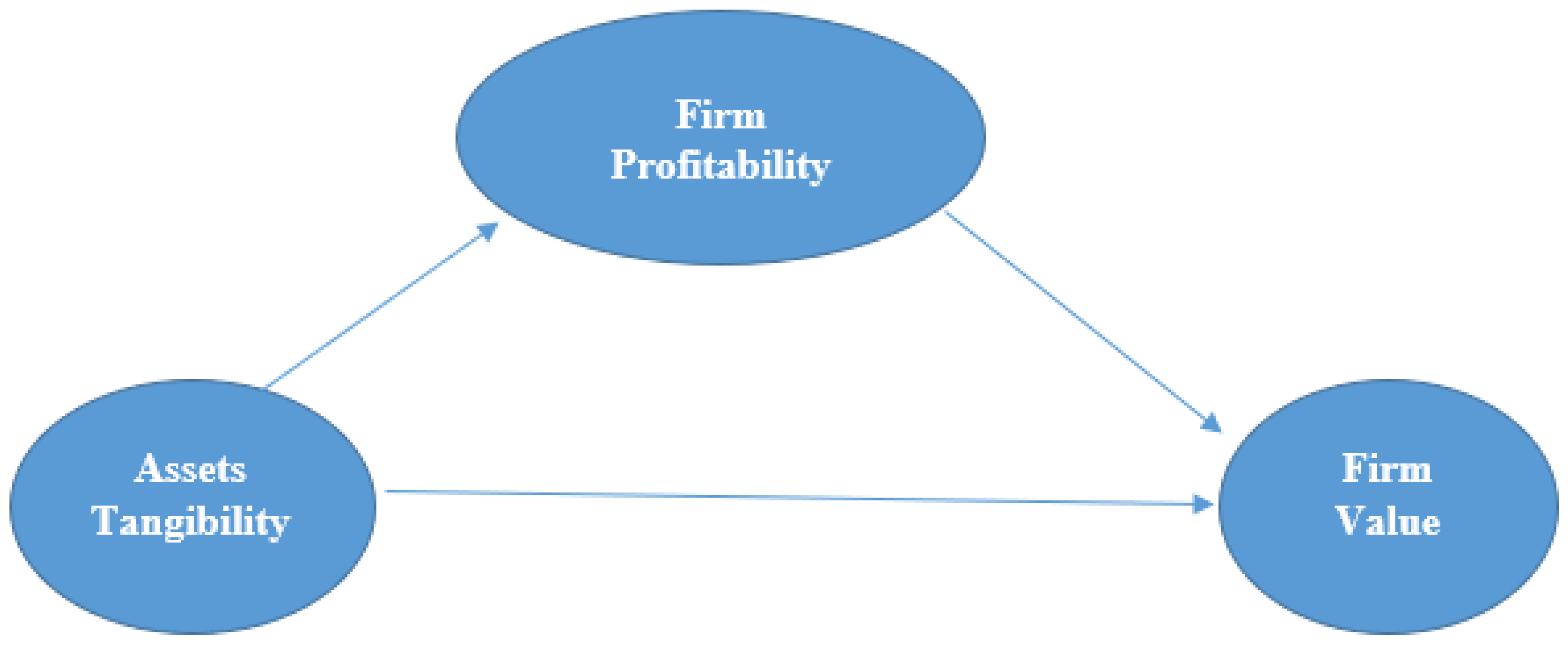
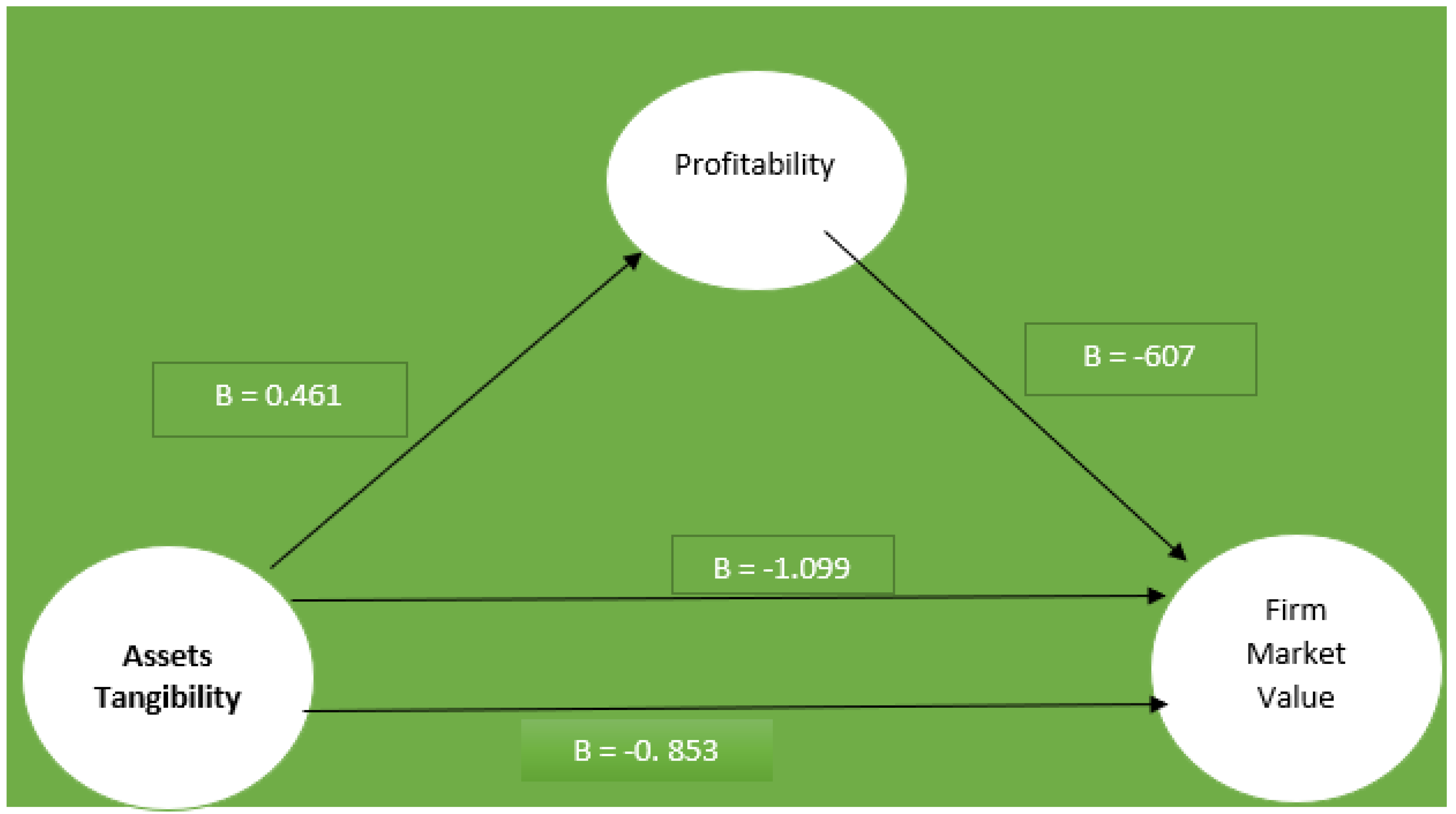
The problem of the current study seems apparent. Most business organizations in Jordan, including the manufacturing firms, are suffering of difficult financial situations these days, especially next to Corona Pandemic, that deployed among people all around the Word, since the starting of 2020. Manufacturing firms in the Middle East, including firms that are working on the land of Jordan, have more financial difficulties, because of the war taking place in the Middle East area. Therefore, the listed manufacturing firms, as of other nonmanufacturing firms, are facing financial difficulties, and a decline in market value. Most authors, academics, and practitioners, believe that profitability is the most important driver of firm market value, but profitability is not the unique variable affecting firm market value. The current study comes to provide an understanding or answers to the following two questions. First, does assets tangibility affects the firm market value of the listed manufacturing firms at Amman Stock Exchange (ASE)? The second question is, does the profitability of the listed manufacturing firms at ASE, mediates the impact of assets tangibility on firm market value? The current study is an attempt to provide clear answers to these two questions.
The study is of great importance, sine it focuses on issues needed by investors and creditors. It focuses on the relationship between assets tangibility and firm market value, where the related information to these two issues, are considered among the most important required information for investment decisions. The study is of applicable importance because these two issues (tangibility and firm value), should be carefully considered and deeply analyzed before investors take their investment decisions. The financial difficulties that most of the listed manufacturing firms in Jordan and within the area of the Middle East, encounter these days, increase the importance of the study, where the findings of the study provide help for different parties inside and outside business organization. In general, business organizations cannot continue without continuous profitability, so the findings of the study are also beneficial for firm success and survival. Moreover, the importance of the study increases, where the findings can benefit the managements of business organizations. Firms with an increasing firm value will attract more investment, and will not find any difficulties whenever they need funding, whether through additional equity or through borrowing.
Several objectives the study looks to achieve. The key objective of the study is to determine whether assets tangibility affects the firm market value. Another key objective of the study, is to determine whether firm profitability plays a mediating role in the assumed effect relationship of assets tangibility on firm market value. Profitability or financial performance is of great importance for different parties, and therefore acquiring and holding more tangible assets, is assumed to lead for more productivity and profitability, and affects the market value of the listed mining and extraction firms at ASE. One additional objective of the study, is to add more to the available literature regarding tangible assets impact on firm value.
The remaining of the study is structured as follows.
Section 2 explores the related literature and the prior related research, and section 3 provides the development of hypotheses based on the consideration of the literature and prior research.
Section 4 shows the methodology followed by the authors while preparing the study, starting from data collection to the findings.
Section 5 reveals the analysis and discussions including the hypotheses testing, whereas section 6, shows the conclusions and findings of the study.
2. Literature Review and Prior Research
A firm survival and development depends, to a large degree, on a number of different factors, including investment in assets (Efeeloo, et al, 2023). Assets are resources controlled by the holding firm, result from past transactions, where expected future economic benefits are expected to flow to the firm, as a result of using these assets in operations. The most important portion of the assets in mining and extraction firms, is normally fixed tangible assets. Therefore, an asset is acquired and held to be used in a firm, in a way that it contributes in the flow of benefits to the firm owning or controlling that asset. The Generally Accepted Accounting Principles (GAAP), and the International Financial Reporting Standards (IFRS), classify assets into current and noncurrent assets, where current assets are expected to be liquidated or converted to cash within one year or less, while noncurrent assets require more than one to year to be liquidated or converted to cash, with its actual value, and without a substantial loss. In addition, assets are classified into tangible and intangible assets. Tangible assets have a physical substance, while nontangible assets lack this physical substance. Examples of tangible assets include land, buildings, equipment, vehicles, furniture et al, where except land, other tangible fixed assets are subject to depreciation. Intangible assets have no physical substance, such as goodwill, trademarks, patent, copyright, and trade names.
According to Igbru and Onuora (2020), most tangible assets have higher market value and can be easily sold in case of liquidation. Moreover, the ownership of tangible assets is a key factor in case of borrowing, where lenders are more ready to provide more loans with less cost, for the borrowing firms when those firms have higher tangible assets, because these tangible assets can be used as collateral against the loans (Rahman and Yilun, 2021).
Investment in tangible assets is a normal issue in manufacturing firms, where these tangible fixed assets, whatever its form or type, are necessary to be acquired and held because these tangible assets are used in goods production. Fixed tangible assets constitutes the largest asset in manufacturing firms, including the mining and extraction firms. Except land, most fixed tangible assets are subject to depreciation, and have an economic useful life, where its book value declines along its useful life. Considering any investment, whether it is investment in tangible, intangible, or financial asset, there is a motivation standing behind the investment. Investors postpone their consumption of money, for the motivation of achieving a reasonable Rate of Return (ROI). It is also known that the rate for investments is categorized into two types. The first type of return is called yield, and takes the form of dividends paid by the firm to its shareholders. Another type of rate on investment is called capital gains, resulting from the increase or decrease in share market value.
Most investments, including investment in fixed tangible assets involve a level of risk. Investment risk is normally the difference between return received and the expected return to be received (Saleh, 2018). When the difference between the received and expected return of an investment is high, the risk of that investment is considered high, while when this difference is low, the risk will be low. The risk of an investment can be attributed to different factors including interest rate risk, inflation risk, market rate risk, firm risk, financial risk, currency exchange risk, liquidity risk, and state risk. In general, risks are commonly divided into systematic and nonsystematic risk. The systematic risk is related to a firm, and can be declined, through diversification.
According to Picker (1992), assets tangibility is of great importance, since the tangibility of assets is used in conveying information to the lenders of funds regarding the repayment of the borrowed funds. This means that, as more assets are held and owned by firms, as borrowing is easier, and less costing, since tangible assets sends signs to lenders that the firm owning more tangible assets, and it is more probable to pay these amounts when they due. The importance of holding tangible assets also arises from the revenue-expense relationship, where no revenue can be acquired without incurring expenses and costs. More investments are needed to be used in assets acquisition and lease, and more funds are required to be paid for the acquisition or development of assets, but these assets are necessary to be used in production and operations, and the revenue of the firm depends, to a large degree, on tangible assets, since these assets are used in production, and most of these assets are necessary to be acquired, in order to simplify the process of production, and leads to better quality of products, and thereafter, more productivity and profitability.
During the last century, profit maximization was the goal that had given the first priority. Profit maximization means that the firm is required to make profits as large as possible. Nowadays, profit maximization did not continue as the goal of business organizations that occupies the first priority, but getting good firm market value is now the goal which has the first priority, among managements of firms (Sampurna and Romawati 2019). As a result, recently, especially along the 20 years ago, firm market value received enough attention by academics, researchers, financial analysts, practitioners, eta al, because of the importance of this indicator to investors and other users of financial information. Firm market value means many things to investors. Investors attempt to invest their funds in more successful firms, where success of firms refers to its profitability. More Profitable firms are more successful in the literature and environment in business. It is assumed that more tangible assets lead to more profits, because when the different needed tangible assets are available, with good status, it leads to more products with higher quality, and thereafter higher profitability and increasing firm market value. But the issue of tangible assets, that a firm hold, is critical. When a firm owns a large amounts of different tangible assets, especially owning assets of rare needs, this may, in opposite leads to less profitability, and as a result, decreasing firm value.
A firm value is the present value of the expected future cash flows, where these expected future cash flows are influenced by the firm involved risk, and it reflects the value of assets (Gamaliel, 2024). There are several values for a firm, such as nominal value, book value, intrinsic value, and market value refers, for market valuation of a firm, and it is the most important value of firms from the perspectives of investors, shareholders, and creditors. The nominal value of a firm, is the value recorded in the firm’s article when it is founded, or according to its deed of change (Gamaliel, 2024). The nominal value is also written on the character of its shares, before the shares are traded in the stock exchange. A firm book value is based on the accounting books, and can be founded by deducting total liabilities from total assets, and dividing the result of this deduction by the number of shares outstanding to find the share book value. The intrinsic value of firms is based on the financial analysis, and is used in the assessment of share price, and also used by investors in making investment decisions.
The firm market value is called sometimes as the market price, which is the result of market valuation, or as a result of bargaining between sellers and buyers of the firm shares in the stock exchange. As a result, the firm value is determined in the stock exchange when its shares are listed in the stock exchange. The importance of a firm market value is stemmed from the attention given to this value by shareholders and investors, because investors prefer investing more in firms that are expected to provide them with more returns, and a portion of these returns is gained through the increasing price of shares, in addition to dividends.
Few and rare studies investigated the possible impact of assets tangibility on firm market value, especially where profitability is taken into consideration as a mediator in the assumed effect relationship. Several prior research are considered in this context, and the following is a summary of each one.
Vuković, et al (2024), carried out a study aiming for building a model of the firm’s optimal value by assessing the performance of the firm based on the analysis of the financial statements. The study attempts to identify the most important determinants of firm value. Several financial indicators are thoroughly considered in the study including, financial leverage, profitability, size, growth, liquidity, and assets tangibility. Secondary data of 158 Eastern and Western European firms, covering the period 2015-2020, had been collected and used in the analysis and hypotheses testing. Descriptive statistics and the regression method, are used in data analysis and hypotheses testing. Employing the regression method in hypotheses testing, the results showed that debt to assets ratio, return on equity, and assets tangibility, have a significant adverse effect on firm value, while return on assets and firm size, have a significant favorable impact.
Dwaikat, et al (2023), carried out a study to investigate the mediating impact of financial performance on the impact relationship of assets utilization on firm market value of the Palestinian listed firms. To achieve the objective of the study, the authors collected the published related secondary data, that covers the period 2010-2018, of a sample consisted of 21 listed Palestinian firms, and used this data in the analysis and hypotheses testing of the study. The structural equation model is used in testing the different hypotheses. The results showed that assets utilization enhances the financial performance, and in turn, the market value of firms, and financial performance mediated the impact of assets utilization on firm market value.
Omereas and Eblaghan (2023), investigated the determinants of tangible assets with an objective of determining the firm specific factors affecting the tangible assets of the 10 oil and gas multinational firms working in Nigeria. The relevant secondary data that covering the period 2013-2022 of the 10 firms, had been collected and used in the analysis and hypotheses testing. Employing the generalized linear model, the results revealed that the tangible assets of multinational oil and gas firms in Nigeria, are positively and significantly affected by Return on Assets (ROA) and firm age, whereas it is negatively affected by financial leverage.
Nangih, et al (2023), investigated the impact of assets tangibility of the consumer and industrial Nigerian listed firms, on the market performance. The secondary data that is covering the period 2013-2022 of 13 listed consumer and industrial firms, had been collected and used in data analysis and hypotheses testing. Employing descriptive statistics, correlation, and regression methods, the results showed that assets tangibility are significant in predicting the market performance of firms, and that tangible noncurrent assets had a negative insignificant impact on market performance indicators. While tangible noncurrent assets have a negative insignificant impact on market performance indicators, and the intangible noncurrent assets have a positive significant impact on market performance. The study recommended firms to invest minimally in intangible noncurrent assets, and to invest more in intangible resources.
Ramadhan, et al (2022), carried out a study aiming for determining whether tangible and intangible assets affect firm value, using the sustainable growth as moderating variable. Secondary data of a sample consisted of 48 firms for 2019 and 2020, had been collected using IDX and yahoo finance, and used in the analysis and hypotheses testing. Employing panel data regression and moderated regression analysis, the results showed that there is a positive significant impact of tangible assets on the value of the listed firms at the Egyptian Stock Exchange. Secondary data covering the period 2012-2014, of the most continuously active and included in EGX 30 listed firms at the Egyptian Stock Exchange, had been collected and used in the analysis, and the results, had been and used in the analysis and hypotheses testing. Employing the regression method in hypotheses testing, the results showed that the level of intangible assets has a significant positive impact on firm value, using Tobin’s Q, while the level of firm liquidity is not significantly influenced by the level of intangibility. The results also demonstrated that the level of intangibility has a significant impact on firm activity, at the aggregate level, whereas the intensity of investment in intangibles has no impact on firm activity level.
Mubyarto (2020), carried out a study aiming for determining the impact of profitability on firm value, and whether capital structure plays a mediating role in the impact of profitability on firm value. To achieve the objective of the study, the author used a panel secondary data, covering the period 2015-2018, of 44 listed firms at LQ45, in the analysis and hypotheses testing. Employing path analysis method including, Sobel test and Bootstrapping technique, the results showed that there is a direct positive significant effect of profitability on firm value, and an indirect negative effect of profitability on firm value, when capital structure is used as a mediator. The results also revealed a negative direct impact of capital structure on firm value, while profitability has a direct impact on capital structure.
The aim of Mohammed and Al Ani’s (2020) study, was to examine the impact of calculated tangible assets, financial performance, and financial policy, on the firm value of the listed industrial firms at Muscat Securities Market. To achieve the objectives of the study, secondary data covering the period 2010-2014, and attributed to a sample consisted of 46 listed firms at Muscat Securities Market, had been collected and used in the analysis and hypotheses testing, Namely, the study takes into consideration three variables including, intangible assets, financial policy, and financial performance. Tobin’s Q is used in the study as a measure of firm value, as the dependent variable. Employing the regression method in data analysis and hypotheses testing, the result showed that assets intangibility, financial performance, and financial policy, each of which, has a significant influence on firm value.
Ismail (2019), investigated the relationship between intangibles assets in one hand, and both of firm market value and financial performance, in the other hand, of the listed firms at the Egyptian Stock Exchange. Secondary data covering the period 2000-2014, of a sample consisted of 30 firms, of 6 different industries, had been collected and used in the analysis and hypotheses testing. Employing the linear regression method in hypotheses testing, the results showed that the level of intangible assets has a positive impact on firm value, where firm value is measured using Tobin’s Q in the study. The results also showed that there is no significant impact of assets tangibility on firm liquidity. In addition, the results showed that the level of intangible assets significantly affects firm’s activity, on the aggregate level.
Sampurna and Romawati (2019), attempted to determine the most important factors determining the firm market value. The goal of the study was to examine some probable determinants of firm value of the listed manufacturing firms at Indonesia Stock Exchange (IDX), at a five-year period. The study took into consideration five possible determinants including, institutional ownership, firm size, profitability, leverage, and investment opportunity. To achieve this objective, the secondary data of 84 listed manufacturing firms had been collected and used in the analysis and hypotheses testing. Employing the multiple linear regression method, the results showed that firm size, return on assets, and market to book value of equity, have a positive significant impact on firm value, while debt to total assets and institutional ownership, had a negative significant impact on firm value.
Saleh (2018), carried out a study with the purpose of determining whether the tangible and intangible assets of the listed manufacturing firms at Indonesia Stock Exchange, affects the market value of these firms. To achieve the objective of the study, the secondary data that covers the period 2012-2016, of a sample consisted of 51 of the entire 43 listed manufacturing firms, had been gathered and used in the analysis and hypothesis testing. Three regression models were used including the common effect model, the fixed effect model, and the random effect model. Firm value is measured in the study using return on assets, price to book value, and stock return. Employing the regression method, the results revealed that the fixed effect model is more precise model in predicting the impact of investment in tangible and intangible assets on firm market value. The results also showed that only tangible assets in addition to control variables including, current ratio, earnings per share, and net profit margin, are significantly affecting the firm market value.
A study carried out by Saleh (2018), with the purpose of examining the impact of investing in tangible and intangible assets on the market value of the listed manufacturing firms at Indonesia Stock Exchange. The study is based on secondary data covering the period 2012-2016, of 51 out of 143 listed manufacturing firms. Using the collected data in the analysis, and employing the common effect, fixed effect, and random effect model, the results of the study showed that tangible assets has a significant impact on firm value.
The purpose of Setiadharma and Machali’s (2017) study, was to analyze the direct and indirect impact of asset structure and firm size on the firm value. To achieve the purpose of the study, a secondary data covering the period 2010-2014, had been collected from a sample that consisted of 34 property and real estate listed firms at Indonesia Stock Exchange. Employing the regression method and following the path analysis in data analysis and hypotheses testing, the results showed that there is a direct significant effect of asset structure on the firm value, while there is no indirect significant effect of asset structure on the firm value when capital structure is used as an intervening variable. In addition, the results revealed no direct effect of firm size on the firm value, and no indirect effect of firm size on the firm value with capital structure as intervening variable. Therefore, the capital structure as an intervening variable cannot mediate the relationship between asset structure and firm size on the firm value.
Gharaibeh and Sarea (2015), carried out a study aiming for determining the impact of financial leverage and other firm specific variables on firm value. Secondary data covering the period 2006-2013, of 48 listed firms at Kuwait Stock Exchange, had been collected and analyzed to achieve the objective of the study. Descriptive statistics, correlations, and the multiple linear regression methods, were employed in data analysis and hypotheses testing. When ROA is used as an indicator for firm value, the results showed that capital structure (financial leverage), is the most influential variable on firm value, while firm specific variables including, business risk, previous firm values, dividends payout ratio, firm size, growth opportunities, and firm liquidity, each of which, has a significant impact on firm value. When ROE is used, as another indicator for firm value, the result revealed that capital structure, firm size, and growth opportunities. each of which, significantly affects firm value.