

Submitted:
13 January 2025
Posted:
14 January 2025
You are already at the latest version
Abstract
Background: New safety concerns of the targeted anticancer agents (TAAs) often emerge in the first few years after their initial regulatory approval. Our aim was to determine whether new serious and potentially fatal adverse drug reactions (ADRs) continue to emerge in updated drug labels of TAAs several years after their initial regulatory approval and whether their emergence can be predicted. Methods: Updated drug labels of TAAs agents approved by the U.S. Food and Drug Administration before July 2013 were analyzed. Serious and potentially fatal ADRs were identified in the Warnings & Precautions (WPs) and Boxed Warnings (BWs) sections of updated drug labels. Generalized linear mixed models were used to examine associations between the number of adverse drug reactions and time, drug type (small molecules vs. monoclonal antibodies), and the availability of companion diagnostics for biomarkers. Results: Among 37 eligible TAAs, 25 (68%) were small molecules and 11 (30%) had available companion diagnostics for biomarkers. Time was a significant predictor of new WPs (p ˂ 0.001) and BWs (p = 0.008). Updated drug labels of small molecules received significantly more new WPs (p = 0.042) as compared to monoclonal antibodies. The availability of companion diagnostics for biomarkers did not have an impact on the emergence of new ADRs. Conclusions: New serious ADRs of TAAs continue to emerge in updated drug labels several years after their initial regulatory approval. Oncologists, regulators, and payers should be aware of changing risk-benefit ratios of approved TAAs.
Keywords:
1. Introduction
2. Methods
2.1. Identification of TAAs and Analysis of ADRs
2.2. Outcomes of Interest
2.3. Statistical Analysis
3. Results
3.1. Characteristics of Eligible Targeted Anticancer Agents
3.2. Reporting of Warnings and Precautions
3.3. Reporting of Boxed Warnings
4. Discussion
5. Conclusions
Supplementary Materials
Author Contributions
Funding
Data availability statement
Acknowledgments
Conflicts of interest
List of contributors
References
- Min HY, Lee HY. Molecular targeted therapy for anticancer treatment. Experimental & Molecular Medicine. 2022;54(10):1670-1694.
- US Department of Health and Human Services: In vitro companion diagnostics devices: guidance for industry and food and drug administration staff. Available online: https://www.fda.gov/regulatory-informa.on/search-fda-guidance-documents/invitro-companion-diagnos.c-devices (accessed on 10th January 2025).
- Basak D, Arrighi S, Darwiche Y, Deb S. Comparison of Anticancer Drug Toxicities: Paradigm Shift in Adverse Effect Profile. Life. 2021;12(1):48.
- Niraula S, Amir E, Vera-Badillo F, Seruga B, Ocana A, Tannock IF. Risk of Incremental Toxicities and Associated Costs of New Anticancer Drugs: A Meta-Analysis. Journal of Clinical Oncology. 2014;32(32):3634-3642.
- Assoun S, Lemiale V, Azoulay E. Molecular targeted therapy-related life-threatening toxicity in patients with malignancies. A systematic review of published cases. Intensive Care Medicine. 2019;45(7):988-997.
- Srikanthan A, Vera-Badillo F, Ethier J, et al. Evolution in the eligibility criteria of randomized controlled trials for systemic cancer therapies. Cancer Treatment Reviews. 2016;43:67-73.
- Seruga B, Templeton AJ, Badillo FEV, Ocana A, Amir E, Tannock IF. Under-reporting of harm in clinical trials. The Lancet Oncology. 2016;17(5):e209-e219.
- Baldo P, De Paoli P. Pharmacovigilance in oncology: evaluation of current practice and future perspectives. Journal of Evaluation in Clinical Practice. 2014;20(5):559-569.
- Food and Drug Administration: MedWatch: The FDA Safety Information and Adverse Event Reporting Program. Available online: https://www.fda.gov/safety/medwatch-fda-safety-information-and-adverse-event-reporting-program (accessed on 10th January 2025).
- Seruga B, Sterling L, Wang L, Tannock IF. Reporting of Serious Adverse Drug Reactions of Targeted Anticancer Agents in Pivotal Phase III Clinical Trials. Journal of Clinical Oncology. 2011;29(2):174-185.
- Food And Drug Administration: Drugs@FDA: FDA-Approved Drugs. Available online: https://www.accessdata.fda.gov/scripts/cder/daf/index.cfm (accessed on 10th January 2025).
- Food and Drug Administration, Center for Drug Evaluation and Research and Center for Biologics Evaluation and Research: Warnings and Precautions, Contraindications, and Boxed Warning Sections of Labeling for Human Prescription Drug and Biological Products — Content and Format. Available online: https://www.fda.gov/regulatory-information/search-fda-guidance-documents/warnings-and-precautions-contraindications-and-boxed-warning-sections-labeling-human-prescription (accessed on 10th January 2025).
- Bates D, Mächler M, Bolker B, Walker S. Fitting linear mixed-effects models using lme4. Journal of Statistical Software. 2015;67(1).
- IQVIA - Global Oncology Trends 2018. Available online: https://www.iqvia.com/insights/the-iqvia-institute/reports-and-publications/reports/global-oncology-trends-2018 (accessed on 10th January 2025).
- Stoelinga J, Bloem LT, Russo M, Kesselheim AS, Feldman WB. Comparing supplemental indications for cancer drugs approved in the US and EU. European Journal of Cancer. 2024;212:114330.
- Kerstin Noëlle Vokinger, Glaus CEG, Kesselheim AS, Serra-Burriel M, Ross JS, Hwang TJ. Therapeutic value of first versus supplemental indications of drugs in US and Europe (2011-20): retrospective cohort study. Published online July 5, 2023:e074166-e074166.
- Pignatti F, Jonsson B, Blumenthal G, Justice R. Assessment of benefits and risks in development of targeted therapies for cancer - The view of regulatory authorities. Molecular Oncology. 2014;9(5):1034-1041.
- Huang Y, Xiong W, Zhao JW, Li W, Ma L, Wu H. Early phase clinical trial played a critical role in the Food and Drug Administration–approved indications for targeted anticancer drugs: a cross-sectional study from 2012 to 2021. Journal of Clinical Epidemiology. 2023;157:74-82.
- Kuo WK, Weng CF, Lien YJ. Treatment beyond progression in non-small cell lung cancer: A systematic review and meta-analysis. Frontiers in Oncology. 2022;12.
- Serra F, Faverio C, Lasagna A, et al. Treatment beyond progression and locoregional approaches in selected patients with BRAF-mutated metastatic melanoma. Drugs in Context. 2021;10:1-6.
- Kirkali Z. Adverse events from targeted therapies in advanced renal cell carcinoma: the impact on long-term use. BJU International. 2011;107(11):1722-1732.
- Lin A, Giuliano CJ, Palladino A, et al. Off-target toxicity is a common mechanism of action of cancer drugs undergoing clinical trials. Science translational medicine. 2019;11(509).
- Steegmann JL, Cervantes F, le Coutre P, Porkka K, Saglio G. Off-target effects of BCR–ABL1 inhibitors and their potential long-term implications in patients with chronic myeloid leukemia. Leukemia & Lymphoma. 2012;53(12):2351-2361.
- Benn CL, Dawson LA. Clinically Precedented Protein Kinases: Rationale for Their Use in Neurodegenerative Disease. Frontiers in Aging Neuroscience. 2020;12.
- Imai K, Takaoka A. Comparing antibody and small-molecule therapies for cancer. Nature Reviews Cancer. 2006;6(9):714-727.
- Castelli MS, McGonigle P, Hornby PJ. The pharmacology and therapeutic applications of monoclonal antibodies. Pharmacology Research & Perspectives. 2019;7(6).
- Calvo E, Walko C, Dees EC, Valenzuela B. Pharmacogenomics, Pharmacokinetics, and Pharmacodynamics in the Era of Targeted Therapies. American Society of Clinical Oncology Educational Book American Society of Clinical Oncology Annual Meeting. 2016;35:e175-184.
- Gharwan H, Groninger H. Kinase inhibitors and monoclonal antibodies in oncology: clinical implications. Nature Reviews Clinical Oncology. 2016;13(4):209-227.
- Mueller-Schoell A, Groenland SL, Scherf-Clavel O, et al. Therapeutic drug monitoring of oral targeted antineoplastic drugs. European Journal of Clinical Pharmacology. 2021;77(4):441-464.
- Mikus G, Foerster KI. Role of CYP3A4 in kinase inhibitor metabolism and assessment of CYP3A4 activity. Translational Cancer Research. 2017;6(S10):S1592-S1599.
- Ocana A, Ethier JL, Díez-González L, et al. Influence of companion diagnostics on efficacy and safety of targeted anti-cancer drugs: systematic review and meta-analyses. Oncotarget. 2015;6(37):39538-39549.\.
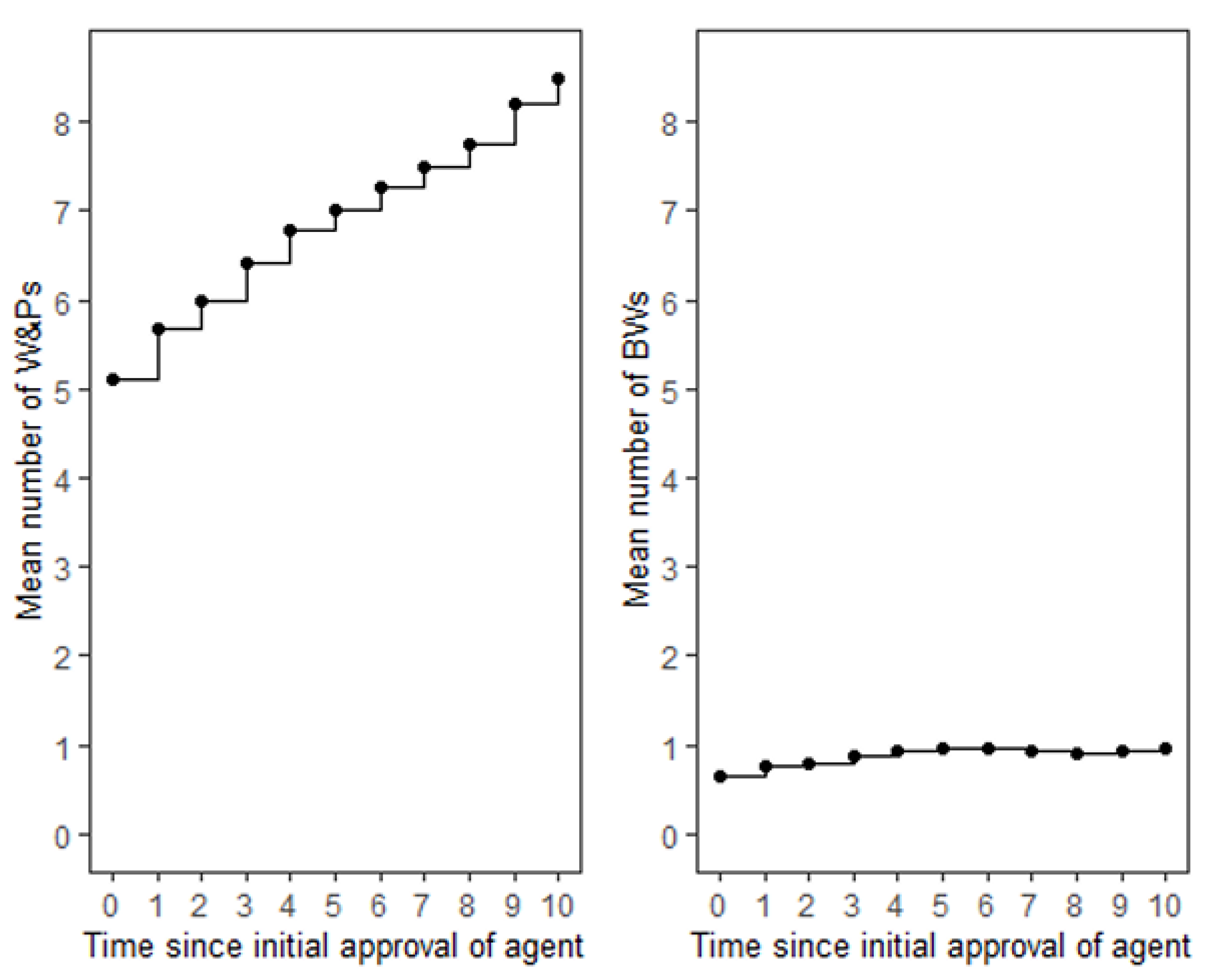

| Variable |
Coef. |
Confidence int. |
P-value |
|---|---|---|---|
| Intercept | 1.35 | [1.05, 1.64] | < 0.001 |
| Time | 0.06 | [0.04, 0.08] | < 0.001 |
| Time2 | -0.002 | [-0.003, -0.001] | 0.001 |
| Drug type SMs (Ref. mAbs) |
0.35 |
[0.006, 0.69] |
0.042 |
| CDx availability Yes (Ref. No) |
-0.15 |
[-0.54, 0.24] |
0.440 |
| Variable | Coef. | Confidence int. | P-value |
|---|---|---|---|
| Intercept | 0.07 | [1.05, 1.19] | 0.90 |
| Time | 0.07 | [0.02, 0.13] | 0.008 |
| Time2 | -0.005 | [-0.007, -0.002] | 0.001 |
| Drug type SMs (Ref. mAbs) |
-3.11 |
[-4.60, -1.61] |
<0.001 |
| Availability of CDx Yes (Ref. No) |
0.22 |
[-1.33, 1.78] |
0.77 |
Disclaimer/Publisher’s Note: The statements, opinions and data contained in all publications are solely those of the individual author(s) and contributor(s) and not of MDPI and/or the editor(s). MDPI and/or the editor(s) disclaim responsibility for any injury to people or property resulting from any ideas, methods, instructions or products referred to in the content. |
© 2025 by the authors. Licensee MDPI, Basel, Switzerland. This article is an open access article distributed under the terms and conditions of the Creative Commons Attribution (CC BY) license (http://creativecommons.org/licenses/by/4.0/).