

Submitted:
09 January 2025
Posted:
10 January 2025
You are already at the latest version
Abstract
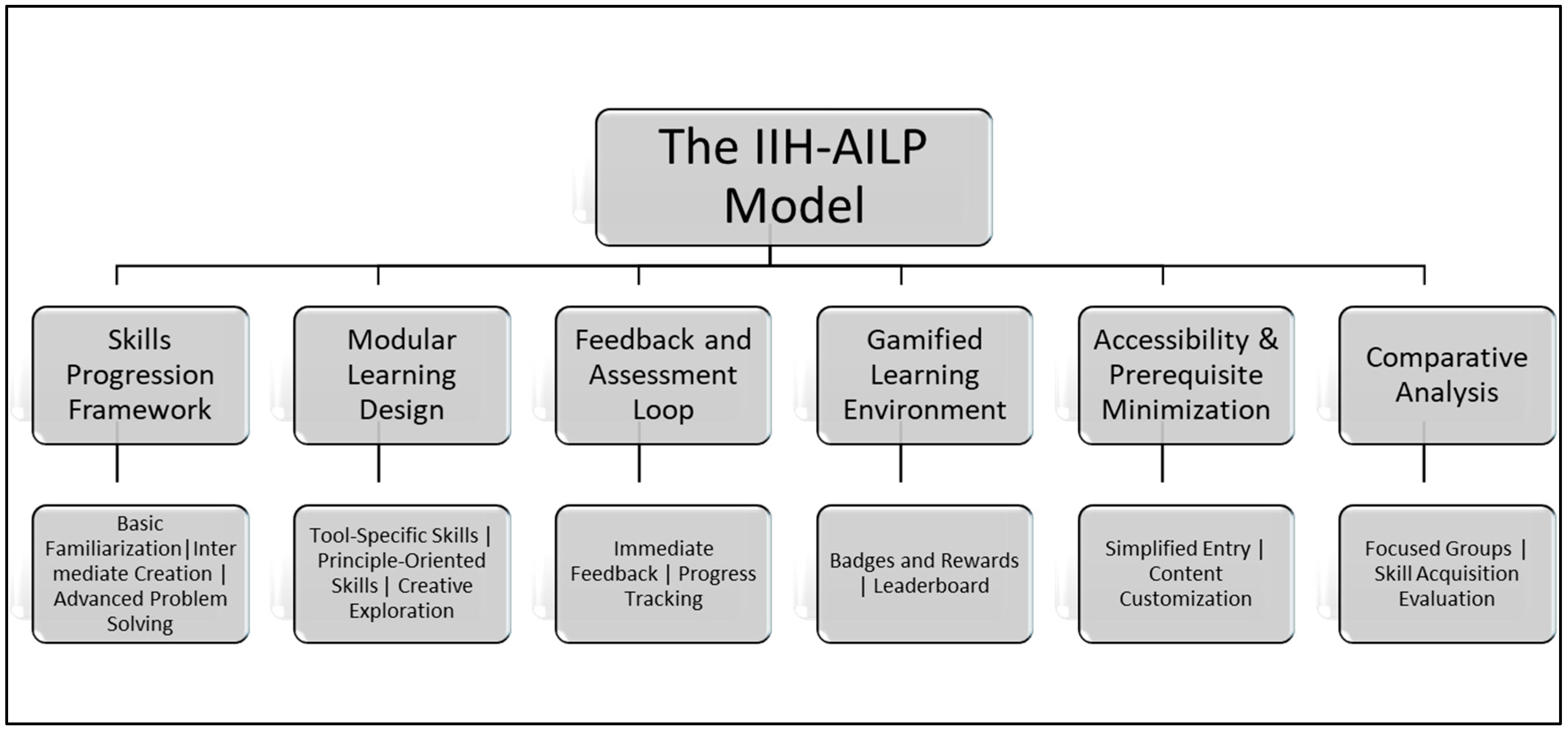
The integration of artificial intelligence (AI) tools into graphic design education has gained attention as a means to simplify skill acquisition for beginners. Traditional graphic design tools often present steep learning curves, making it difficult for novice learners to acquire practical skills without extensive technical expertise. This paper proposes the IIH-AILP Model, a structured pedagogical framework designed to leverage AI-powered platforms such as Canva and Adobe Firefly to improve accessibility, inclusivity, and efficiency in graphic design education. The methodology employs a 12-week intervention with a mix of sequential and integrated components, including pre- and post-assessments, modular learning, skill progression, gamified engagement, and comparative evaluations. Participants’ design abilities were assessed across creativity, task completion time, and learning curve improvements using carefully designed evaluation metrics. The results demonstrate that the IIH-AILP model significantly reduces the learning curve, enhances creativity, and improves task efficiency, confirming the potential of AI-powered graphic design platforms to streamline education for beginners with little to no technical expertise.
Keywords:
1. Introduction
2. Literature Review
2.1. Challenges in Acquiring Graphic Design Skills Using Traditional Tools.
2.2. The Uniqueness of AI-Driven Platforms
2.3. Pedagogical Models for Practical Skill Development
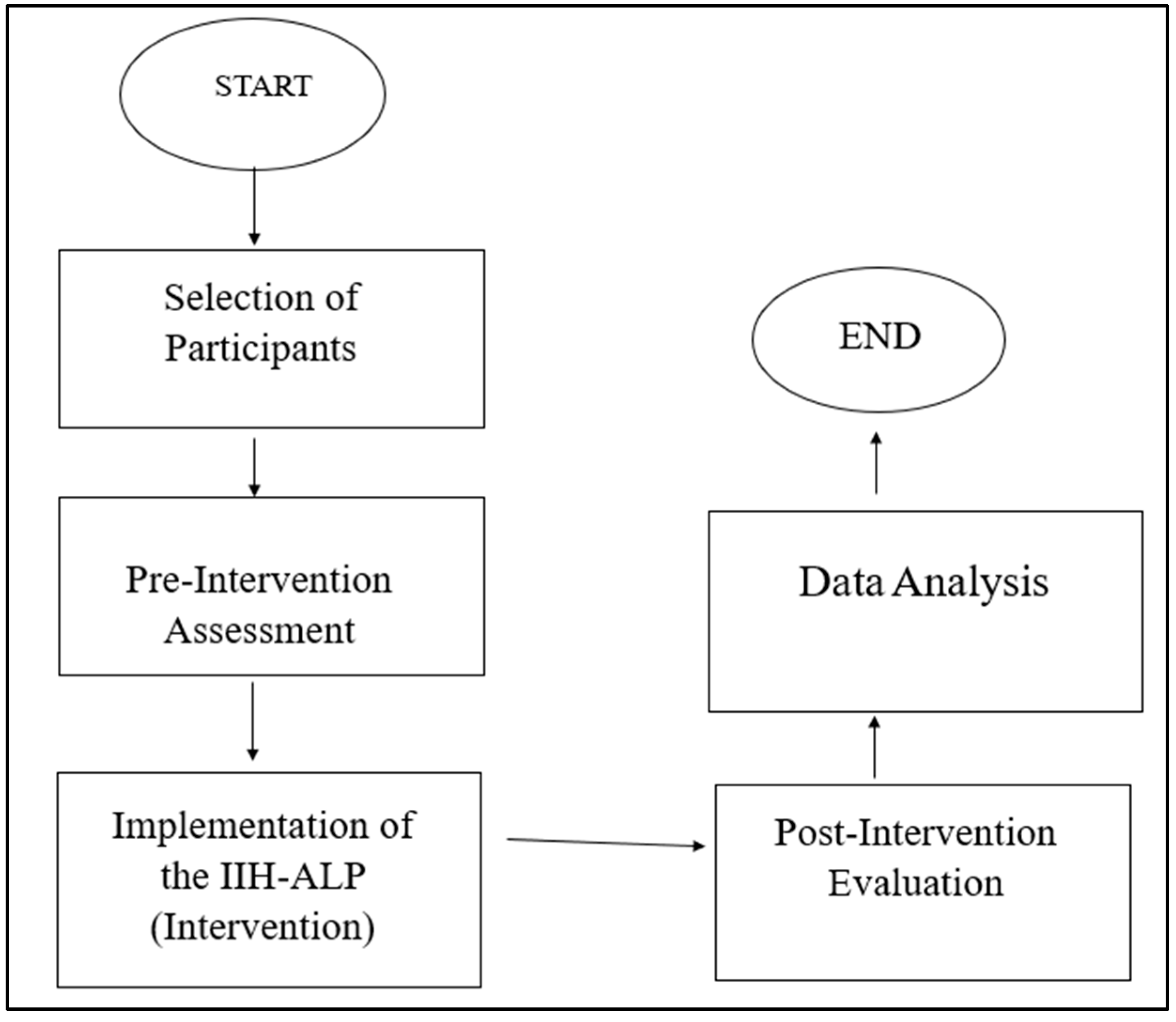
3. Methodology
3.1. Implementation Overview
3.2. Participants Selection
3.3. Demography & Pre-Intervention Assessments
3.4. Implementation of the IIH-AILP Model (Intervention)
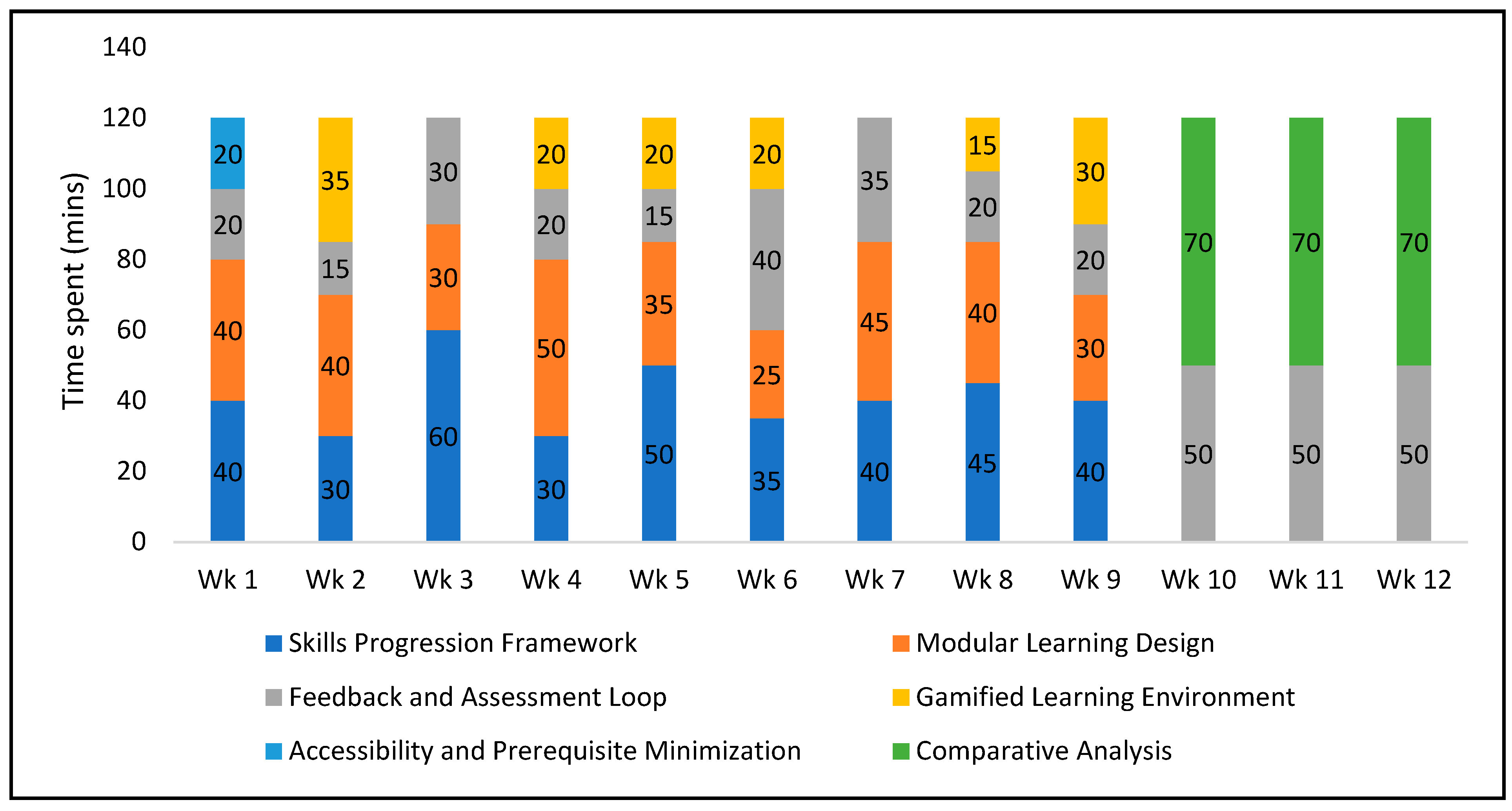
3.5. Measurement Evaluation Metrics
3.5.1. Learning Curve/ Skill Acquisition

| Criteria | Excellent (4) | Good (3) | Fair (2) | Poor (1) |
|---|---|---|---|---|
|
Task Completion |
The tasks were of a high standard and completed within the given time. |
Most tasks were completed within the given time and were of good quality. | Quality is below average standard and struggled to complete tasks on time. | Failed to complete tasks on time with unsatisfactory quality. |
|
Tools Proficiency |
Completed tasks independently with Excellent Mastery of all AI-powered tools. |
Showed mastery over most tools and needed occasional guidance. | Needed frequent guidance and has limited mastery over tools. | Challenged with the use of basic tools and relies heavily on assistance. |
|
Problem-Solving Skills |
Identified design problems and addressed them independently. |
Required occasional assistance but resolved most design problems independently |
Struggled to address challenges independently when not assisted. | Entirely relied on others to resolve design problems. |
|
Design Principles |
Consistent with the effective application of principles like alignment, balance, and contrast. |
Design principles were applied in the majority of tasks with negligible flaws. | Applied design principles, but inconsistently and with occasional errors. | Barely applied any principles of design and had too many obvious errors . |
|
Improvement Overtime |
Significant progress and independence from the first to the last week. | Needed occasional assistance but resolved most challenges independently. | Whenever not assisted, struggles with addressing design challenges. | Entirely relied on others to resolve design challenges. |
3.5.2. Task Completion Time and Efficiency
3.5.3. Creativity of Output
3.5.4. Comparative Analysis IIH-AILP and Traditional Tools
4. Results & Analysis
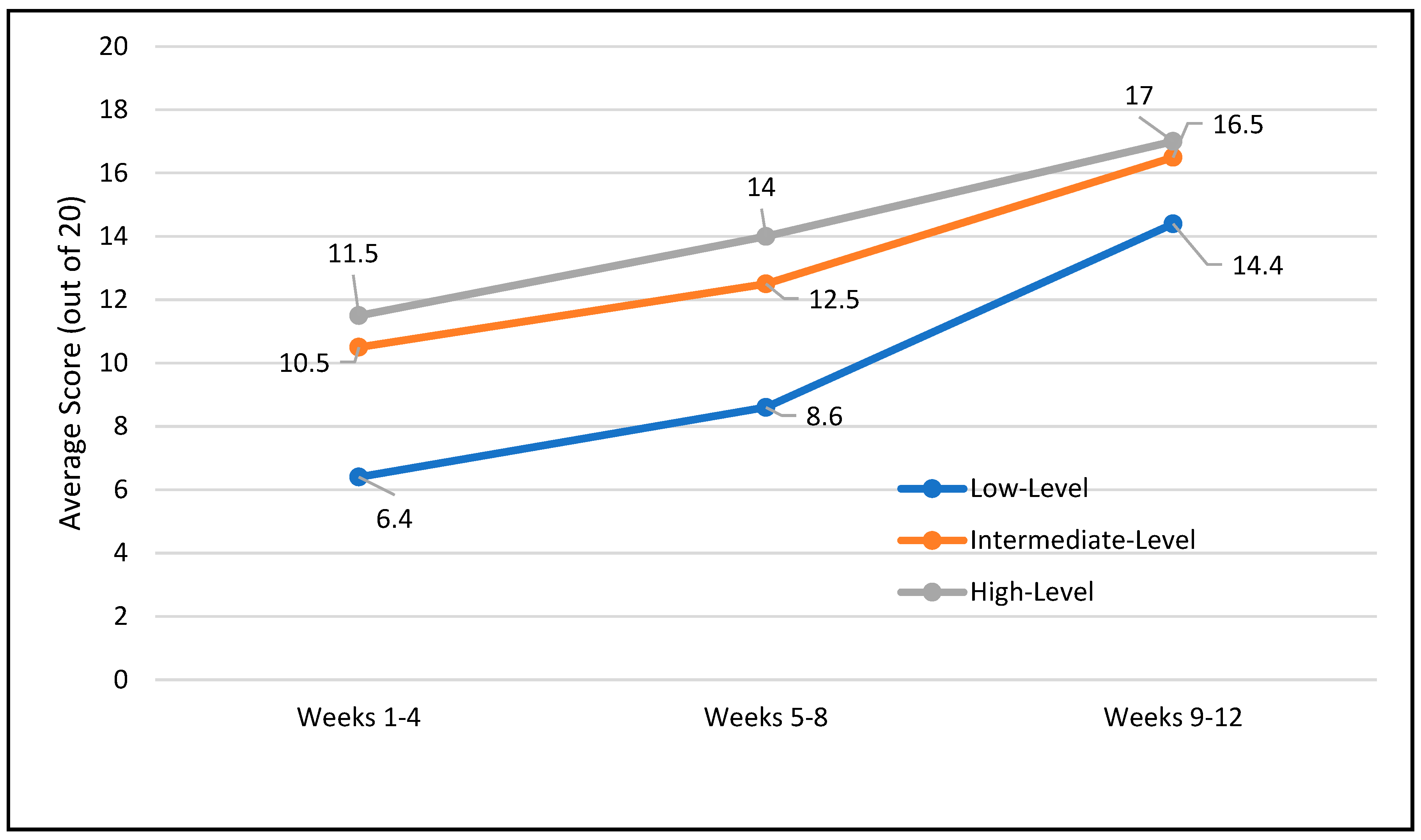
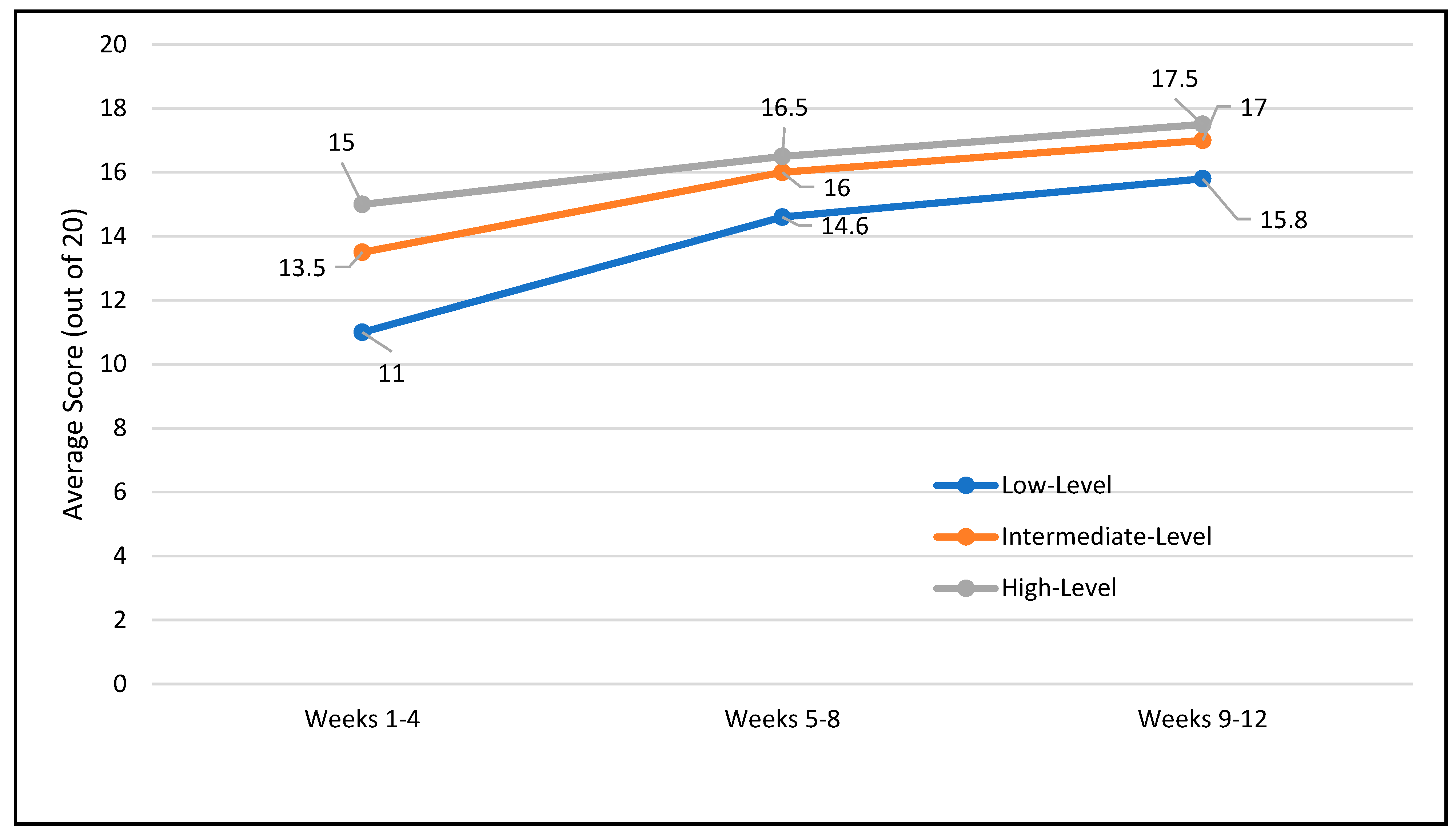
4.1. Learning Curve/Skill Acquisition
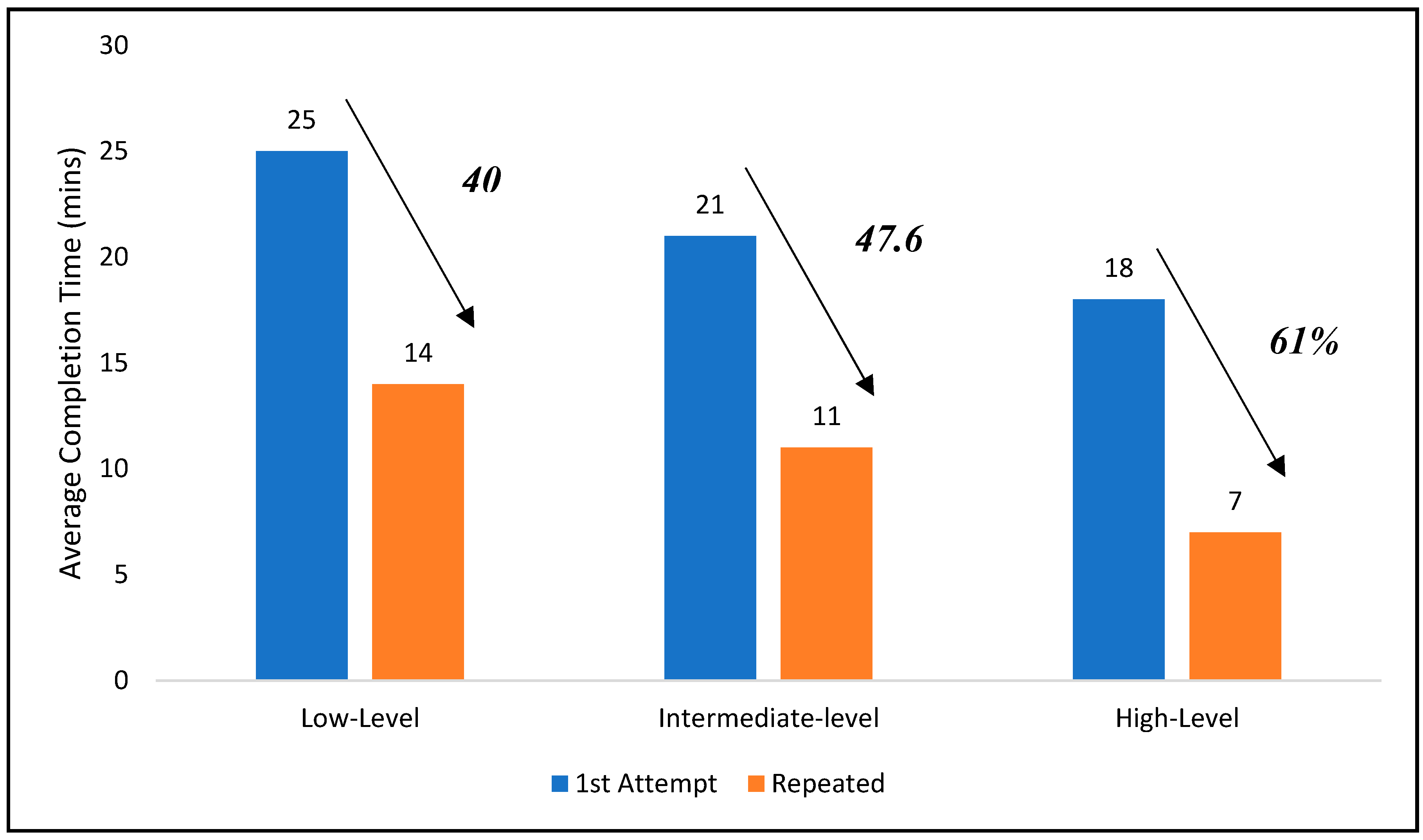
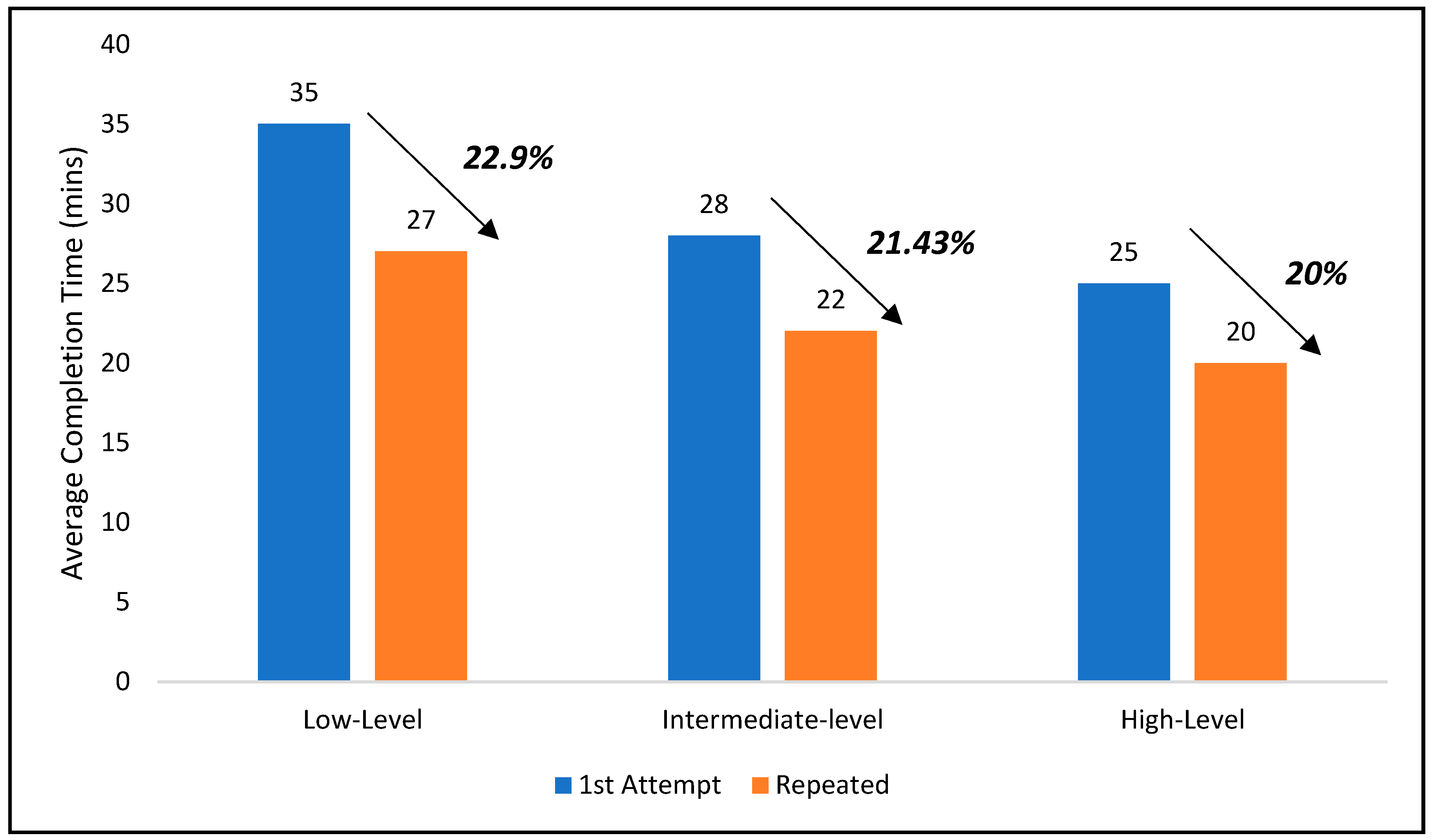
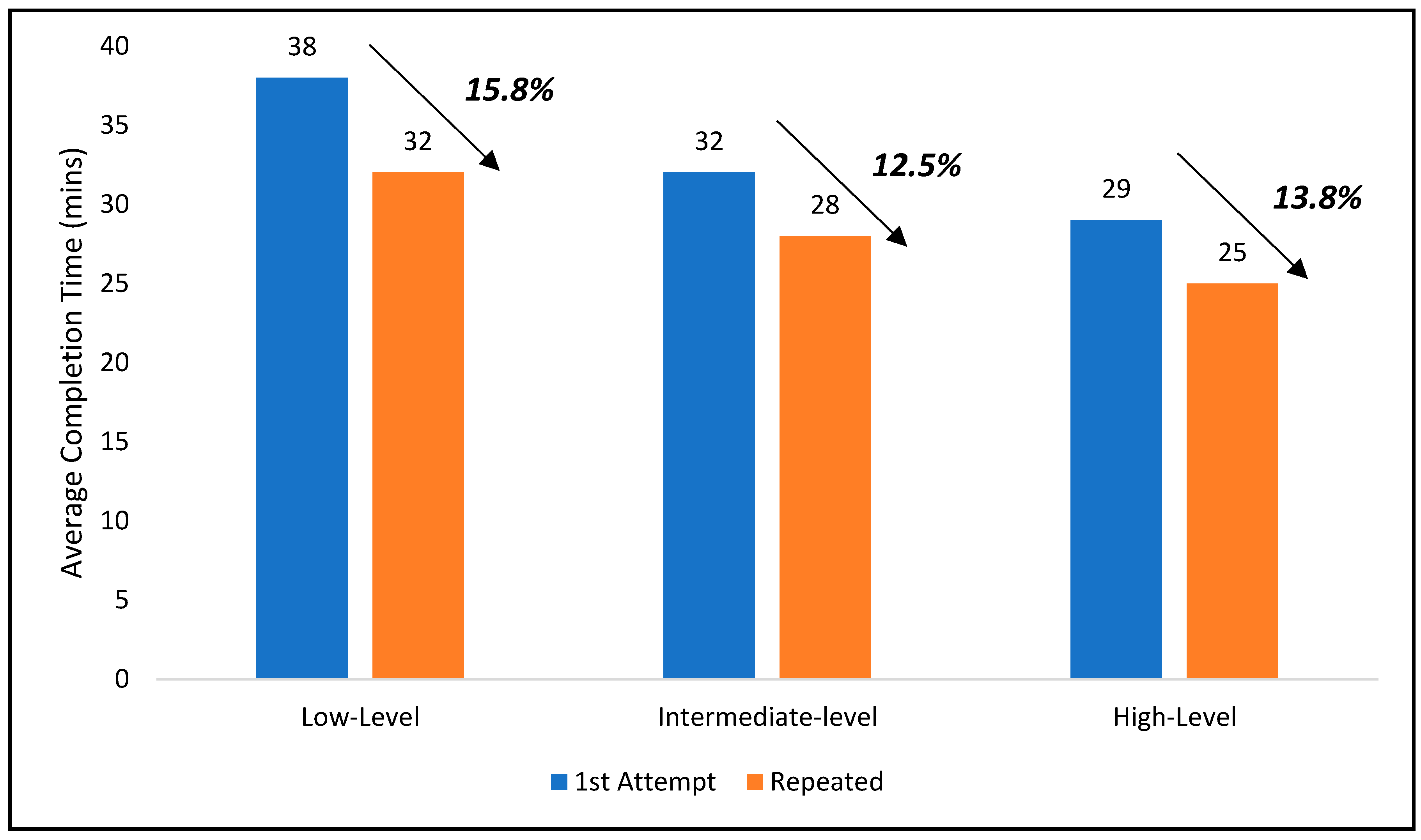
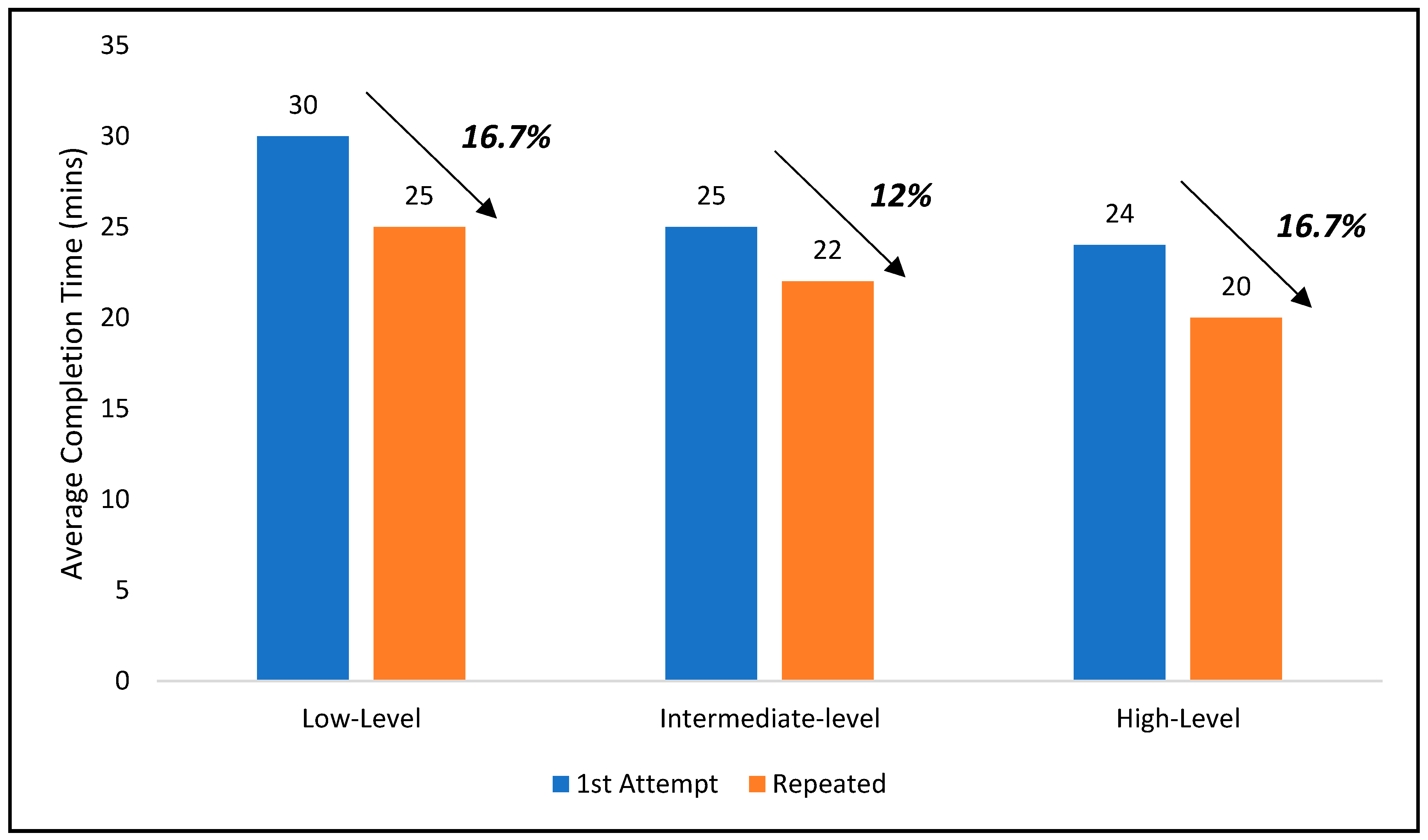
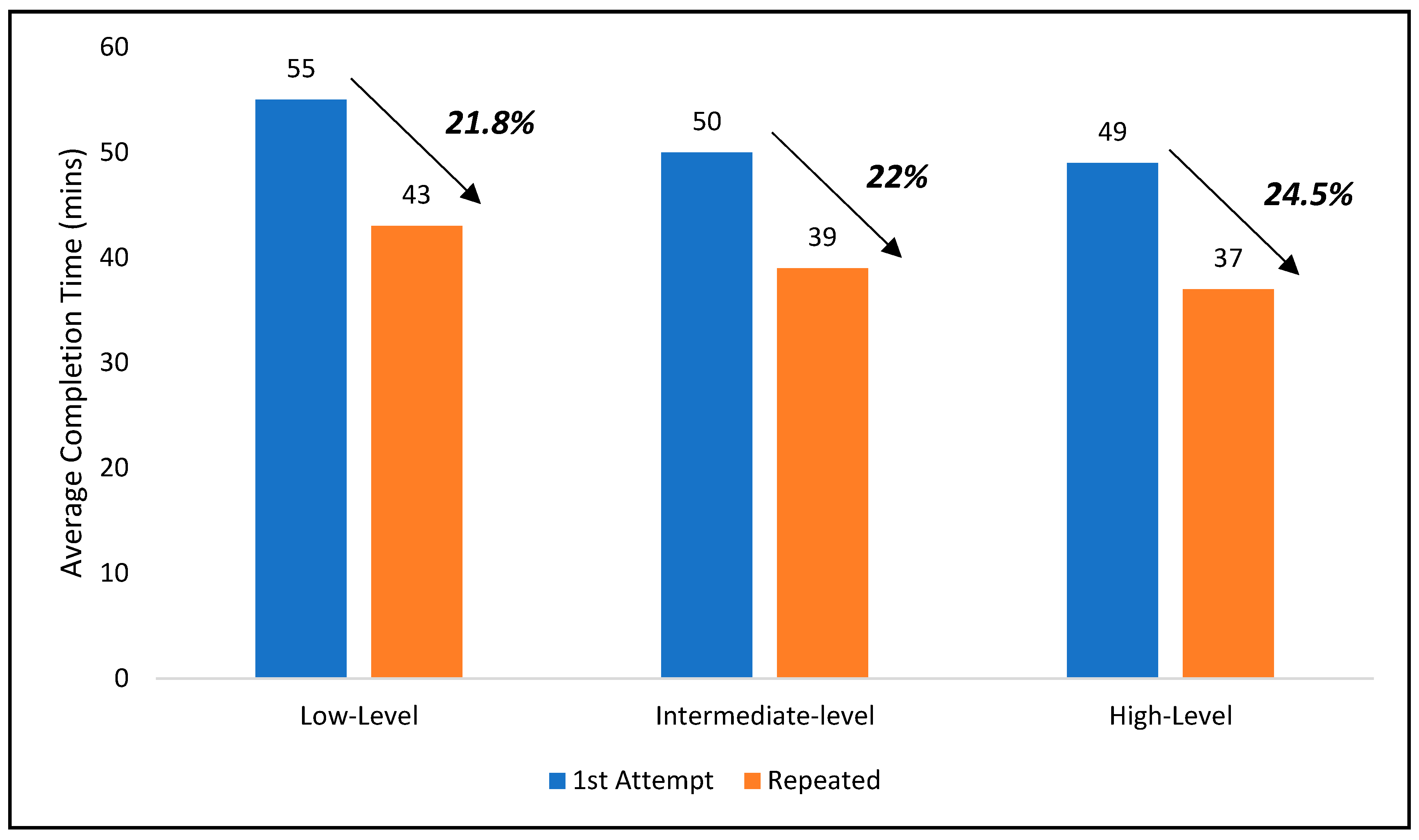
4.2. Task Completion Time and Efficiency
4.3. Creativity Output
4.4. Comparative Analysis
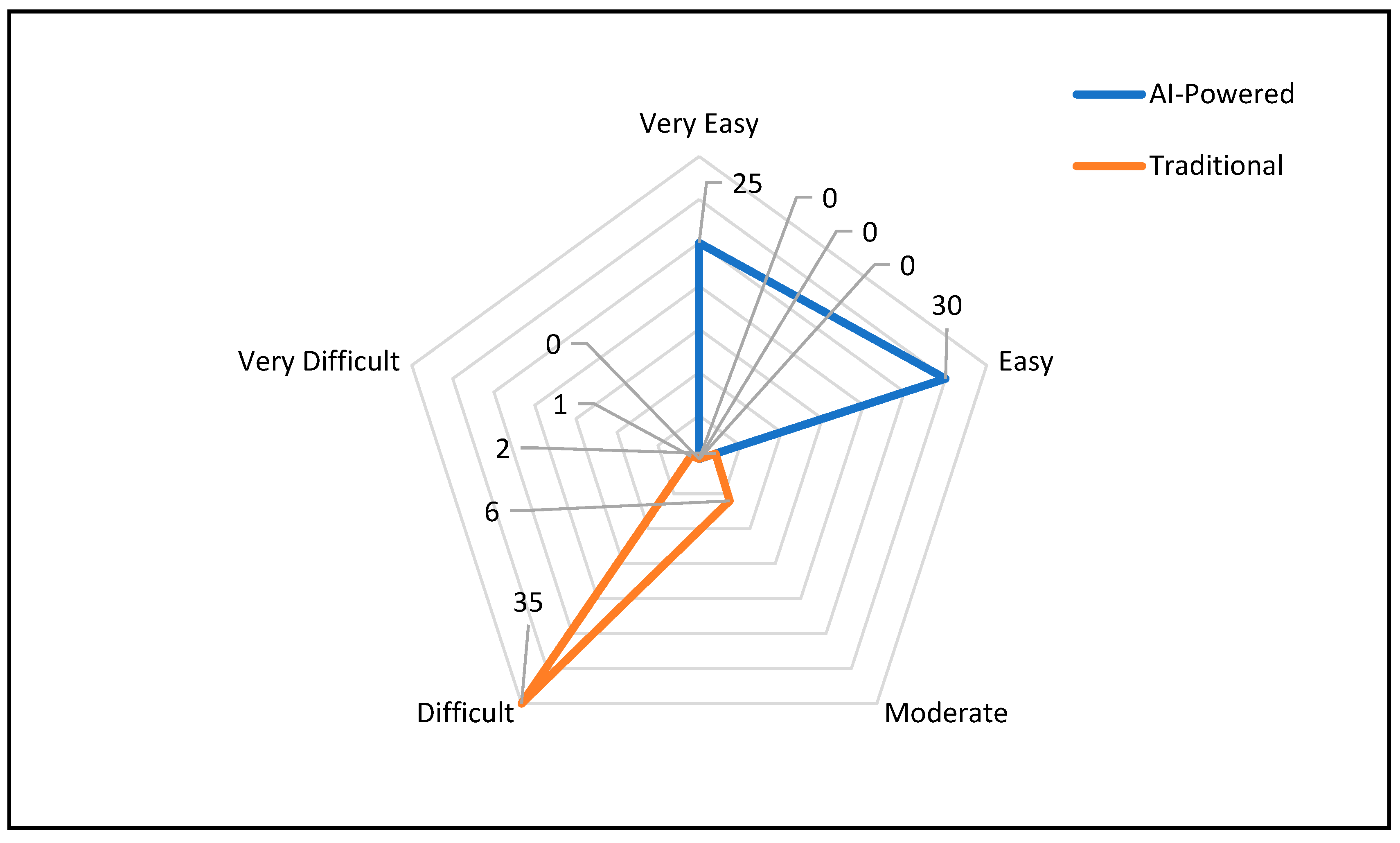
4.4.1. Perception of Ease of Use
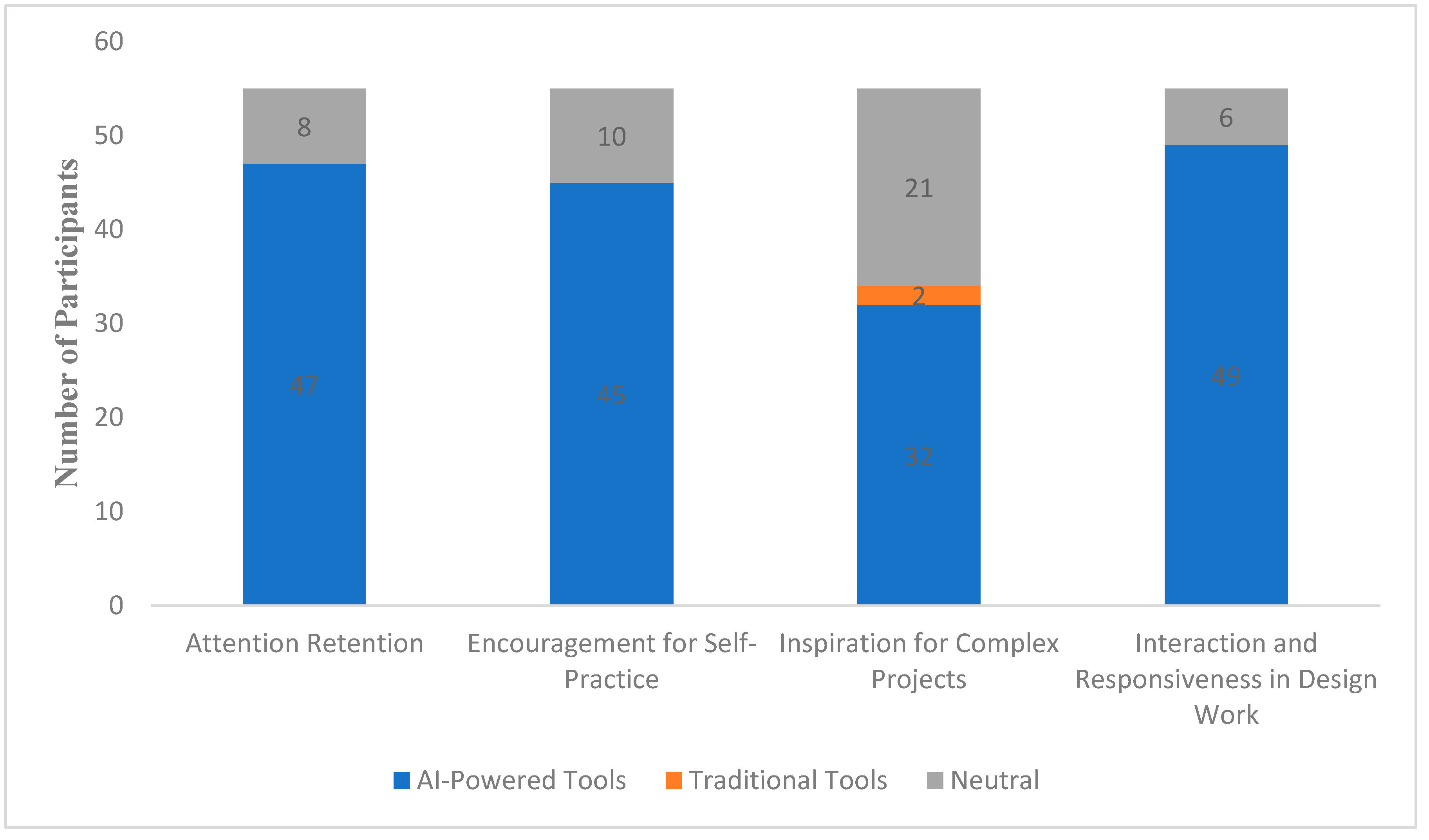
4.4.2. Participants’ Engagement and Motivation
5. Summary & Conclusion
Funding
Data Availability Statements
Competing Interest
Compliance with Ethical Standards
Informed Consent
References
- AAMUSTED. (2024, April 25). 73 Young Females Begin Training under Invest-In-Her Programme at AAMUSTED. Https://Aamusted.Edu.Gh/73-Young-Females-Begin-Training-under-Invest-in-Her-Programme-at-Aamusted/.
- Adarkwah, M. A. (2021). The power of assessment feedback in teaching and learning: a narrative review and synthesis of the literature. SN Social Sciences, 1(3), 75. [CrossRef]
- Atuweni, Y. M., & Mtende, M. (2024). AI-aided design studio: Enhancing graphic design and user interface with machine learning. I-Manager’s Journal on Artificial Intelligence & Machine Learning, 2(2), 10. [CrossRef]
- Baltes, S., & Diehl, S. (2018). Towards a theory of software development expertise. Proceedings of the 2018 26th ACM Joint Meeting on European Software Engineering Conference and Symposium on the Foundations of Software Engineering, 187–200. [CrossRef]
- Bhagya Prabhashini C, & M. Latha. (2024). Language Assessment Feedback Towards Pedagogical Conversational Agent. Sino-US English Teaching, 21(5). [CrossRef]
- Curcic, D. (2024). Enhancing Digital Drawing Proficiency: An Examination of Assignment Redesign and Instructional Approaches in Higher Education Contexts. International Journal of Technology in Education and Science, 8(4), 602–626. [CrossRef]
- de Campos, V., David, J. M. N., Ströele, V., & Braga, R. (2023). Supporting the recruitment of software development experts: aligning technical knowledge to an industry domain. Anais Do XVIII Simpósio Brasileiro de Sistemas Colaborativos (SBSC 2023), 183–192. [CrossRef]
- de Campos, V., David, J. M. N., Ströele, V., & Braga, R. (2024). Aligning technical knowledge to an industry domain in global software development: A systematic mapping. Journal of Software: Evolution and Process, 36(12). [CrossRef]
- Duong, K. H., & Nguyen, L. T. (2024). Technology and Graphic Design: Building a STEM Education Ecosystem for the Future. 2024 9th International STEM Education Conference (ISTEM-Ed), 1–4. [CrossRef]
- Fahmi Romisa, & Dewi Rosita. (2024). Rancang Bangun Media Pembelajaran Interaktif pada Mata Pelajaran Desain Grafis. JURNAL ILMIAH SAINS TEKNOLOGI DAN INFORMASI, 2(3), 18–24. [CrossRef]
- Glazunova, O. G., Parkhomenko, O. V., Korolchuk, V. I., & Voloshyna, T. V. (2022). BUILDING THE PROFESSIONAL COMPETENCE OF FUTURE PROGRAMMERS USING METHODS AND TOOLS OF FLEXIBLE DEVELOPMENT OF SOFTWARE APPLICATIONS. Information Technologies and Learning Tools, 89(3), 48–63. [CrossRef]
- Headleand, C., & James, D. (2024). Games Design Frameworks: A Novel Approach for Games Design Pedagogy. European Conference on Games Based Learning, 18(1), 426–431. [CrossRef]
- HORINCHOI, R., & POLYAKOV, S. (2023). PEDAGOGICAL APPROACHES TO THE DEVELOPMENT OF GRAPHIC CULTURE OF 8-9 GRADE STUDENTS IN TECHNOLOGY LESSONS. ТHE SOURCES OF PEDAGOGICAL SKILLS, 32, 44–52. [CrossRef]
- Kyrylashchuk, S., & Kolomiiets, A. (2024). Formation of graphic competence of future specialists in technical specialities by means of artificial intelligence. Health and Safety Pedagogy, 9(1), 50–56. [CrossRef]
- Li, X., Lam, S. W., Zhang, Y., & Chu, S. K. W. (2023). Pedagogical Models for Plagiarism-Free Learning in Academia (pp. 85–95). [CrossRef]
- Lits, M. O. (2024). Teaching International Law to Students: Traditional Teaching Methods and New Approaches. Legal Education and Science, 21–26. [CrossRef]
- M. Fakhri Sholahuddin, & Tata Sutabri. (2024). Analisis Efektifitas UI/UX Design Software Pengolah Gambar Menggunakan Metode Design Thingking terhadap Kenyamanan Pengguna dalam Industry Animasi. Router : Jurnal Teknik Informatika Dan Terapan, 2(4), 66–72. [CrossRef]
- Maksymchuk, A., Shvets, O., Shtainer, T., Petrova, I., Kravchenko, N., & Abramova, O. (2024). Developing Art and Graphic Skills among Future Designers: An Integrative Principle and A Methodical Model. Revista Romaneasca Pentru Educatie Multidimensionala, 16(2), 105–117. [CrossRef]
- Materne, A. (2024). „Grafika komputerowa” – nauczyciel i uczeń w cyfrowym świecie obrazów. Notatki pedagogiczne. Studia Edukacyjne, 70, 93–109. [CrossRef]
- Mayor-Peña, F. C. Y., Barrera-Animas, A. Y., Escobar-Castillejos, D., Noguez, J., & Escobar-Castillejos, D. (2024). Designing a gamified approach for digital design education aligned with Education 4.0. Frontiers in Education, 9. [CrossRef]
- Muji, S., Svensson, E., & Faraon, M. (2023). Engaging With Artificial Intelligence in Graphic Design Education. 2023 5th International Workshop on Artificial Intelligence and Education (WAIE), 31–37. [CrossRef]
- Niu, Y., & Guan, Z. (2024). Performance Improvement of Art Design Drawing Tools Based on Multi-Objective Optimization Algorithm. 2024 3rd International Conference on Artificial Intelligence and Autonomous Robot Systems (AIARS), 630–636. [CrossRef]
- Nouraei, F., Siu, A., Rossi, R., & Lipka, N. (2024). Thinking Outside the Box: Non-Designer Perspectives and Recommendations for Template-Based Graphic Design Tools. Extended Abstracts of the CHI Conference on Human Factors in Computing Systems, 1–9. [CrossRef]
- Patel, B. C., Goel, N., & Deshmukh, K. (2021). Traditional Teaching Pedagogy (pp. 42–57). [CrossRef]
- Qu, M., Liu, Y., & Feng, Y. (2021). Artificial Intelligence Empowered Visual Communication Graphic Design. 2021 International Conference on Networking Systems of AI (INSAI), 50–53. [CrossRef]
- Rafiyev, R., Novruzova, M., Aghamaliyeva, Y., & Salehzadeh, G. (2024). Contemporary trends in graphic design. InterConf, 43(193), 570–574. [CrossRef]
- Ray, S., Ngomba, R. T., & Ahmed, S. I. (2022). The impact of assessment and feedback practice on the student learning experiences in higher education. Essays in Biochemistry, 66(1), 83–88. [CrossRef]
- Rui, L., & Yang, C. (2024). Promoting Effect of Art Design Competition on Teaching Reform of Visual Communication Design Specialty. International Journal of High Speed Electronics and Systems. [CrossRef]
- Salim, M. S., Saad, M. N., & Nor, B. M. (2021). Comparative Study of Low-Cost Tools to Create Effective Educational Infographics Content. 2021 11th IEEE International Conference on Control System, Computing and Engineering (ICCSCE), 23–28. [CrossRef]
- Shilkova, T. V., Yefimova, N. V., & Semenova, M. V. (2023). Methodological approaches to teaching biological disciplines in a pedagogical university. Samara Journal of Science, 12(3), 331–338. [CrossRef]
- Tahsin, M., & Azzahra, P. L. (2024). Penerapan Kecerdasan Buatan untuk Meningkatkan Pembelajaran Desain Logo dalam Industri Kreatif. Design Journal, 2(1), 23–32. [CrossRef]
- Tang, Y., Ciancia, M., Wang, Z., & Gao, Z. (2024). What’s Next? Exploring Utilization, Challenges, and Future Directions of AI-Generated Image Tools in Graphic Design. http://arxiv.org/abs/2406.13436.
- Tang, Y., Zhang, N., Ciancia, M., & Wang, Z. (2024). Exploring the Impact of AI-generated Image Tools on Professional and Non-professional Users in the Art and Design Fields. http://arxiv.org/abs/2406.10640.
- Tella, R. R., Agarwal, S., & Kondepu, K. (2024). Exploiting Open Source Tools for FPGA Design Flow. 2024 16th International Conference on COMmunication Systems & NETworkS (COMSNETS), 324–326. [CrossRef]
- The Impact of Artificial Intelligence on the Graphic Design Industry. (2023). Arts and Design Studies. [CrossRef]
- Torta, S., & Saalmuller, L. (2024). Adobe InDesign. De Gruyter. [CrossRef]
- Vasylyshyna, N. (2022). CONTEMPORARY ACTIVE ENGLISH LANGUAGE TEACHING METHODS: THEORETICAL REVIEW AND PRACTICAL ASSIGNMENTS. Modern Information Technologies and Innovation Methodologies of Education in Professional Training Methodology Theory Experience Problems, 184–191. [CrossRef]
- Wang, K., & Chen, Q. (2024). Analysis and Recommendations on Empowering Non-Art Background College Students to Generate Visual and Textual Content Using AIGC Tools. Curriculum Learning and Exploration, 2(3). [CrossRef]
- Yue, S. (2024). The Evolution of Pedagogical Theory: from Traditional to Modern Approaches and Their Impact on Student Engagement and Success. Journal of Education and Educational Research, 7(3), 226–230. [CrossRef]
- Zharov, V. K., Mardanov, A. P., & Okbayeva, N. U. (2022). ON THE ISSUE OF MODELING THE METHODOLOGY OF TEACHING DISCIPLINES IN PEDAGOGY. RSUH/RGGU Bulletin. Series Information Science. Information Security. Mathematics, 1, 120–136. [CrossRef]
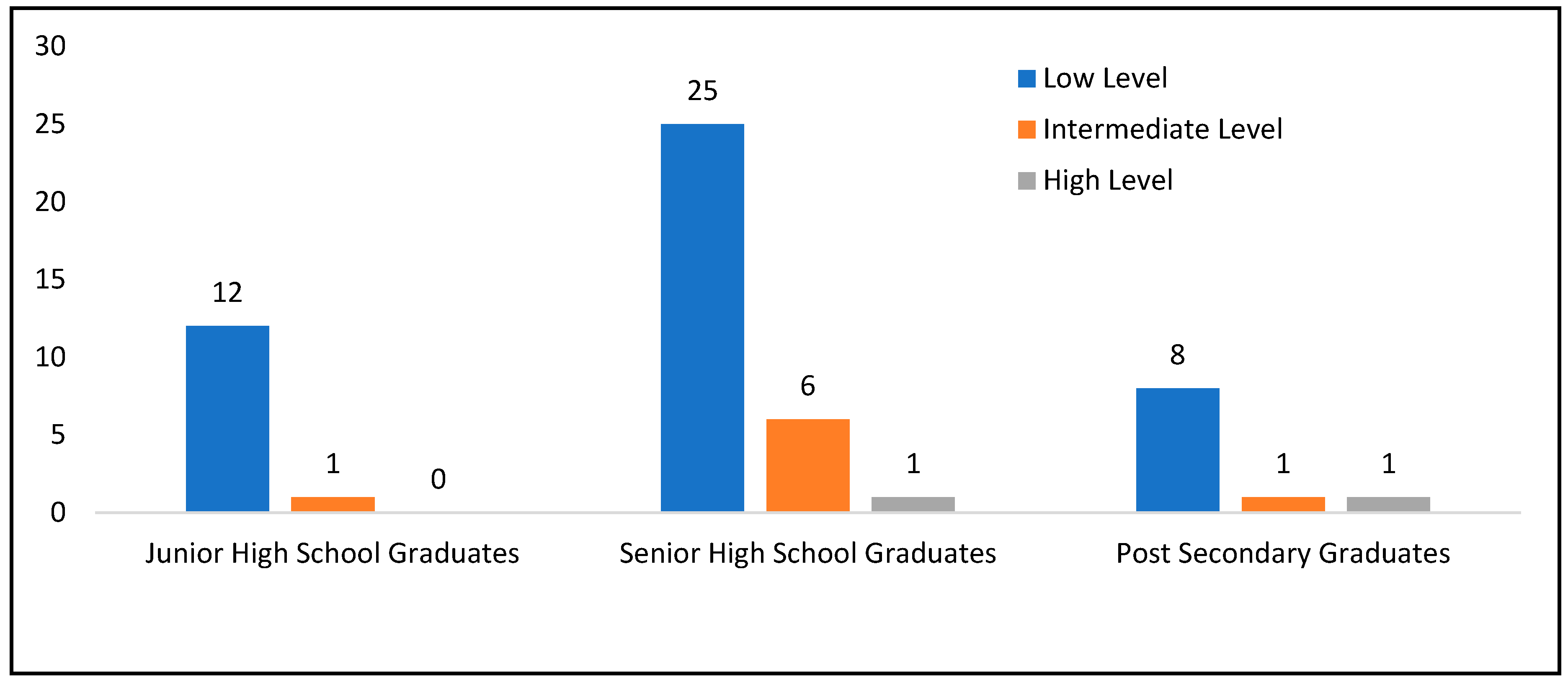
| Beginner Level Details | Number of Participants |
Percentage (Approximated) |
|
| Level | Description | ||
|
Low |
Participants in this category have zero knowledge of any graphic design software. They require a comprehensive introduction to design concepts and basic functionalities of graphic design tools. |
45 |
82% |
|
Intermediate |
Participants with minimal exposure to traditional graphic design tools. They somehow understand basic design principles but need guidance in navigating traditional tools. They have no exposure to AI-driven platforms. |
8 |
14% |
|
High |
Similar to intermediate-level participants but with some casual exposure to AI-driven graphic design platforms. |
2 |
4% |
| TOTAL | 55 | 100% | |
|
Component |
Weeks |
Mode of Execution |
|---|---|---|
|
Skills Progression Framework |
Week 1-9 |
Sequential |
| Modular Learning Experience |
Week 1-9 |
Parallel with the Progression Framework |
| Feedback & Assessment Loop |
Weeks 1-12 |
Integrated into all components |
| Gamified Learning Environment |
Weeks 2,4,5,6,8 &9 |
Integrated |
| Accessibility & Prerequisite Minimization |
Week 1 & Continuous |
Foundational & Integrated |
| Comparative Analysis |
Weeks 10-12 |
Sequential &Final Evaluation |
| Criteria | Excellent (4) | Good (3) | Fair (2) | Poor (1) |
|---|---|---|---|---|
|
Conceptual Depth |
A unique interpretation and deep understanding of the set of instructions for the task. |
A clear understanding of the set of instructions for the task. | Basic interpretation of the set of instructions. | Generic design that has no conceptual depth. |
|
Innovation |
Introduced novel approaches to design. | Demonstrated some creativity with common ideas. |
The design is too simplistic and has little creativity. | Design lacked creativity. |
|
Adaptability |
Excellent integration of AI-generated feedback and suggestions along with personal touches. |
An effective blend of AI suggestions with personal flair. | Relied mainly on AI suggestions with little personal touches. | Depends entirely on AI suggestions. |
|
Quality of Output |
A flawless output with no errors in spacing, alignment, or typography. | High-quality output with few inconsistencies or minor errors. | Obvious errors that diminish the overall quality of the work. | Too many technical flaws in the design . |
|
Visual Appeal |
Excellent use of layouts, colors, and fonts. | Minor design flaws but aesthetically pleasing output. | Moderately pleasing design with some visual element flaws. | The design lacks aesthetic appeal with a poor choice of layouts, colors, and fonts. |
| Task | Difficulty Level |
Expected Time Completion Time |
|---|---|---|
| Creating a personalized name tag or badge | Basic | 15-20 minutes |
| Designing a simple event flyer (using a pre-made template) |
Basic | 30 minutes |
| Developing a business card (customized layout and colors) |
Intermediate | 40 minutes |
| Designing a social media post | Intermediate | 35 minutes |
| Designing an infographic (custom layout, icons, and visuals) | Advanced | 60 minutes |
| Description | |
|---|---|
| Very Easy |
|
| Easy |
|
| Moderate |
|
| Difficult |
|
| Very Difficult |
|
Disclaimer/Publisher’s Note: The statements, opinions and data contained in all publications are solely those of the individual author(s) and contributor(s) and not of MDPI and/or the editor(s). MDPI and/or the editor(s) disclaim responsibility for any injury to people or property resulting from any ideas, methods, instructions or products referred to in the content. |
© 2025 by the authors. Licensee MDPI, Basel, Switzerland. This article is an open access article distributed under the terms and conditions of the Creative Commons Attribution (CC BY) license (http://creativecommons.org/licenses/by/4.0/).


