

Submitted:
08 January 2025
Posted:
09 January 2025
You are already at the latest version
Abstract
This brief report presents a novel unsupervised learning representation learning method called momentum contrast. Momentum contrast uses a contrastive learning technique to learn representations by comparing features of related yet dissimilar images for efficient feature extraction and unsupervised representation learning. Similar images are grouped together, and dissimilar images are placed far apart. The method builds upon previous works in contrastive learning but includes a momentum optimisation step to improve representation learning performance and generate better quality representations. Experiments on various datasets demonstrate that momentum contrast is able to learn high-quality representations, allowing us to directly use them to achieve competitive performance with fewer labelled examples.
Keywords:
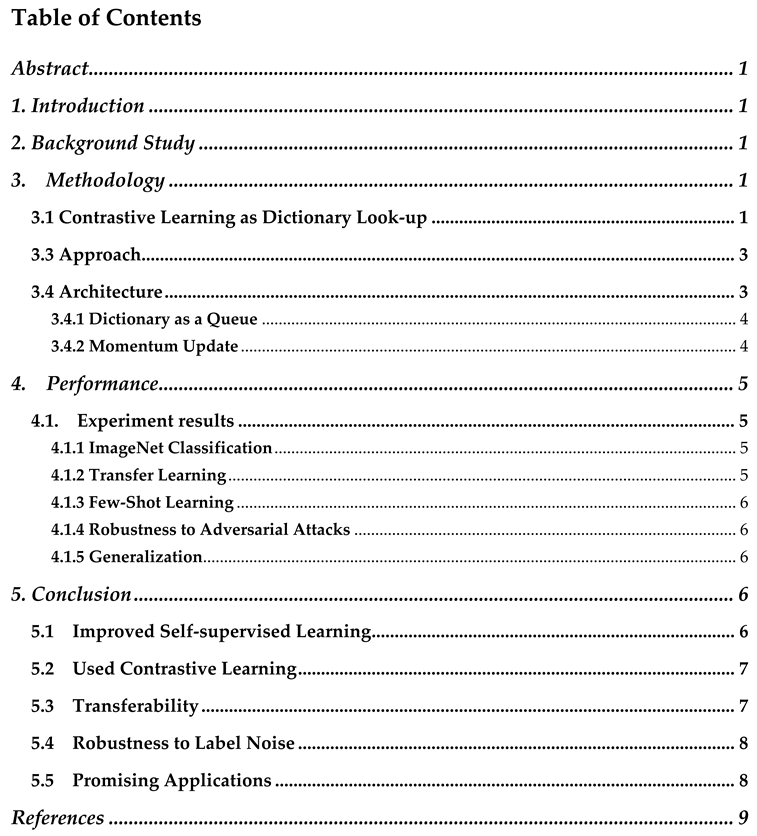
1. Introduction
2. Background Study
3. Methodology
3.1. Contrastive Learning as Dictionary Look-up
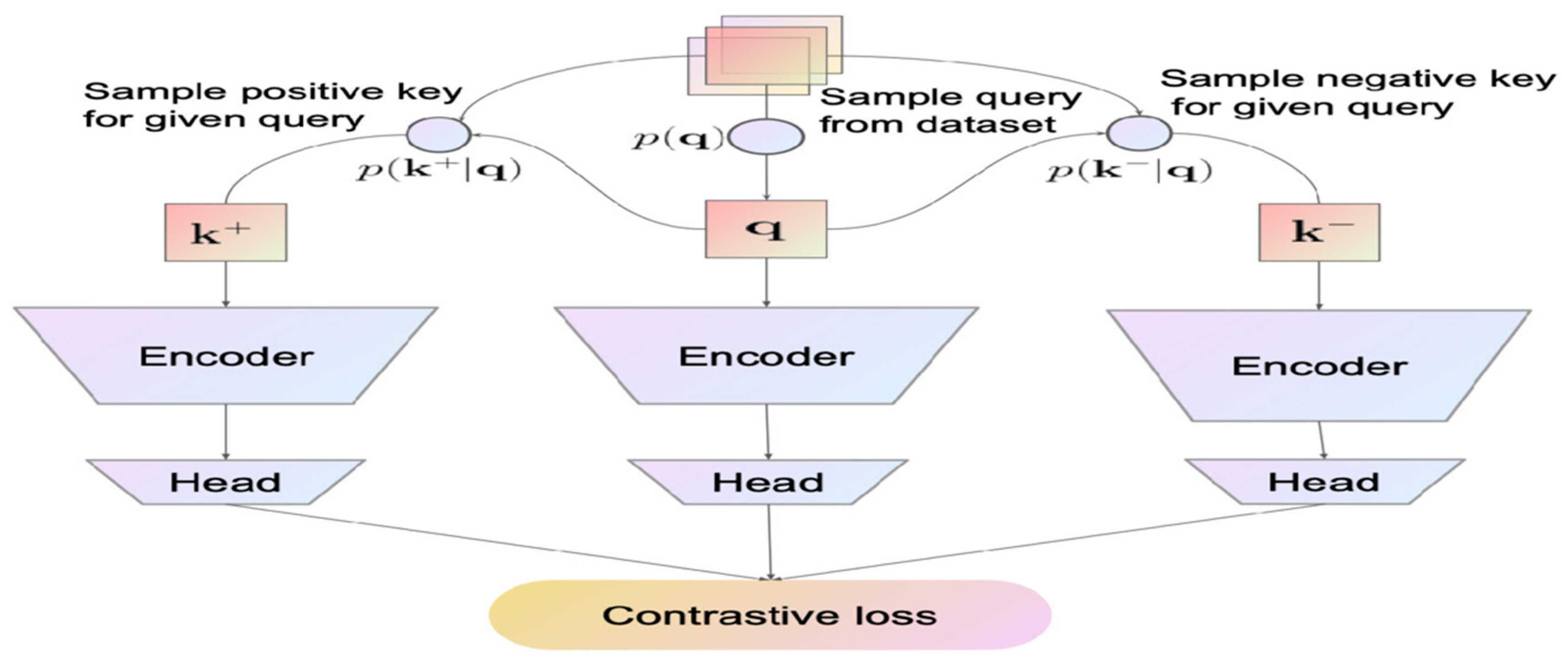
3.2. Momentum Contrast
3.3. Approach
3.4. Architecture
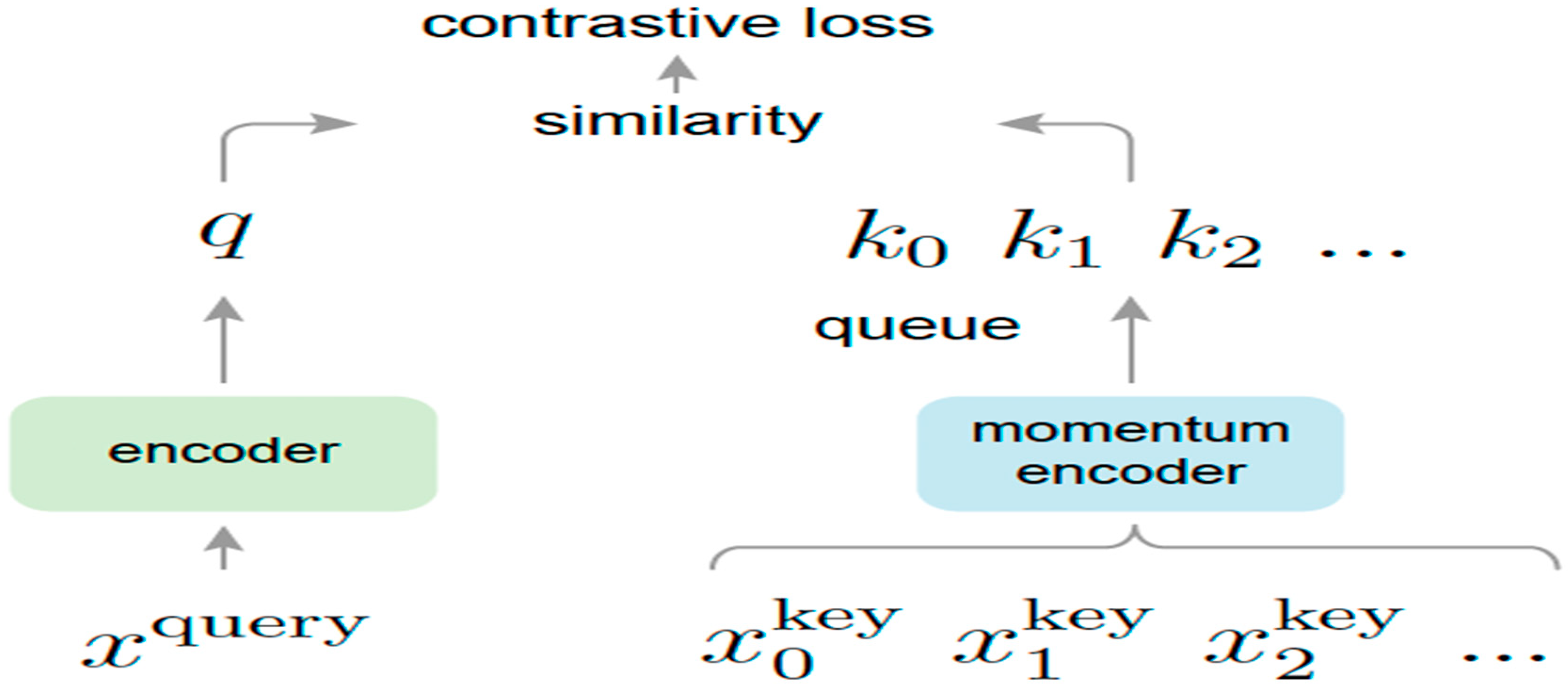
3.4.1. Dictionary as a Queue
3.4.2. Momentum Update
4. Performance
4.1. Experiment results
4.1.1. ImageNet Classification
4.1.2. Transfer Learning
4.1.3. Few-Shot Learning
4.1.4. Robustness to Adversarial Attacks
4.1.5. Generalization
5. Conclusion
5.1. Improved Self-supervised Learning
5.2. Used Contrastive Learning
5.3. Transferability
5.4. Robustness to Label Noise
5.5. Promising Applications
References
- K. He, H. Fan, Y. Wu, S. Xie and R. Girshick, "Momentum Contrast for Unsupervised Visual Representation Learning," 2020 IEEE/CVF Conference on Computer Vision and Pattern Recognition (CVPR), Seattle, WA, USA, 2020, pp. 9726-9735. [CrossRef]
- P. H. Le-Khac, G. Healy and A. F. Smeaton, "Contrastive Representation Learning: A Framework and Review," in IEEE Access, vol. 8, pp. 193907-193934, 2020. [CrossRef]
- Y. Zhang, X. Hu, N. Sapkota, Y. Shi and D. Z. Chen, "Unsupervised Feature Clustering Improves Contrastive Representation Learning for Medical Image Segmentation," 2022 IEEE International Conference on Bioinformatics and Biomedicine (BIBM), Las Vegas, NV, USA, 2022, pp. 1820-1823. [CrossRef]
- S. Becker and G. E. Hinton, ‘‘Self-organizing neural network that dis- covers surfaces in random-dot stereograms,’’ Nature, vol. 355, no. 6356, pp. 161–163, Jan. 1992. [CrossRef]
- J. Bromley, I. Guyon, Y. LeCun, E. Säckinger, and R. Shah, ‘‘Signature verification using a ‘siamese’ time delay neural network,’’ in Proc. Adv. Neural Inf. Process. Syst., Feb. 1993, pp. 737–744.
- T. Nguyen, T. X. Pham, C. Zhang, T. M. Luu, T. Vu and C. D. Yoo, "DimCL: Dimensional Contrastive Learning for Improving Self-Supervised Learning," in IEEE Access, vol. 11, pp. 21534-21545, 2023. [CrossRef]
- X. Chen, H. Fan, R. Girshick and K. He, "Improved baselines with momentum contrastive learning", arXiv:2003.04297, 2020.
- M. Federici, A. Dutta, P. Forré, N. Kushman and Z. Akata, "Learning robust representations via multi-view information bottleneck", Proc. Int. Conf. Learn. Represent. (ICLR), 2020.
- Misra, C. L. Zitnick and M. Hebert, "Shuffle and learn: Unsupervised learning using temporal order verification", Proc. Eur. Conf. Comput. Vis., pp. 527-544, 2016.
- F. Schroff, D. Kalenichenko and J. Philbin, "FaceNet: A unified embedding for face recognition and clustering", Proc. IEEE Conf. Comput. Vis. Pattern Recognit. (CVPR), pp. 815-823, Jun. 2015.
- K. Sohn, "Improved deep metric learning with multi-class n-pair loss objective", Proc. Adv. Neural Inf. Process. Syst., pp. 1857-1865, 2016.
- X. Wang and A. Gupta, "Unsupervised learning of visual representations using videos", Proc. IEEE Int. Conf. Comput. Vis. (ICCV), pp. 2794-2802, Dec. 2015.
Disclaimer/Publisher’s Note: The statements, opinions and data contained in all publications are solely those of the individual author(s) and contributor(s) and not of MDPI and/or the editor(s). MDPI and/or the editor(s) disclaim responsibility for any injury to people or property resulting from any ideas, methods, instructions or products referred to in the content. |
© 2025 by the authors. Licensee MDPI, Basel, Switzerland. This article is an open access article distributed under the terms and conditions of the Creative Commons Attribution (CC BY) license (http://creativecommons.org/licenses/by/4.0/).