
Submitted:
08 January 2025
Posted:
08 January 2025
You are already at the latest version
Abstract
The labour market constitutes a pivotal element of the national economy, exerting a profound influence on the health and stability of the broader economic system. In recent years, the role of media journalism in the dissemination of information has increased significantly, with a notable impact on supply-demand and price fluctuations in the labour market. By analysing the impact of media news, it is possible to gain a deeper understanding of, and insight into, the dynamics of the labour market. This study employs a combination of machine learning techniques and a dynamic stochastic general equilibrium model (DMP model) to assess the influence of media news on labour market efficiency. The use of machine learning algorithms enables the processing and analysis of substantial quantities of media news data, facilitating the extraction of sentiment and topic changes. The DMP model is employed to simulate the matching process in the labour market and evaluate the impact of news on the efficiency of matching job seekers and job openings. The study demonstrates, through experimental analysis, the disparate impacts of media news on the labour market across different economic cycles, and validates the efficacy and practicality of the model.
Keywords:
Labour Market
; Media News
; Efficiency Evaluation
; Machine Learning
; DMP Model
I. Introduction
The labour market constitutes a significant component of the national economy, and the issue of employment has consistently represented a pivotal economic challenge for all countries. China is a vast country with a large population, and its economic development is currently undergoing a period of transition. The labour market is characterised by a number of complex factors, including a surplus of rural labour, an evident dual structure of urban and rural areas, difficulties in recruiting workers in coastal labour-intensive enterprises, a coexistence of challenges in finding jobs and recruiting workers, and the gradual disappearance of the demographic dividend [1]. It is therefore evident that a theoretical study of the labour market is of great practical significance. In the context of globalisation and the rapid development of information technology, the impact of media news on all areas of the economy is becoming increasingly significant, especially in the labour market. The efficiency of the labour market is not only contingent upon the prevalence of self-employment and enterprise labour costs; it is also an essential indicator of the robust growth of the national economy [2]. Nevertheless, the intricate and evolving nature of the labour market presents a significant challenge to researchers. While traditional economic models offer insights into labour market behaviour, they are increasingly unable to account for the sheer volume of information and the rapid shifts in the market environment [3].
The proposal of search matching theory has initiated a novel direction for the study of the labour market. Since the advent of the inaugural equilibrium matching model in the 1980s, the search matching model has undergone significant advancements. The DMP model was developed by three economists, Diamond, Pissarides and Mortensen, and is used to study a set of theoretical frameworks for the labour market [4]. In the course of its development, the DMP model has become an indispensable instrument for elucidating the dynamics of the labour market and for analysing the impact of economic policies on unemployment, job vacancies and wages. The DMP model is comprised of two distinct components: search matching in the labour market and wage theory. The proposed search matching function provides an adequate explanation for the frictional unemployment that exists in the labour market. Wage theory is of paramount importance in understanding the labour market. Since its inception, wage stickiness has been a focal point of considerable interest. The concept of labour market friction offers a fertile ground for further investigation into the nuances of wage stickiness [5].
Recently, the study of macroeconomic fluctuations under the dynamic stochastic general equilibrium (DSGE) model has become increasingly sophisticated, with the development of this framework. The DSGE model has several advantages. It is consistent with both macro and micro theoretical approaches. It allows for sticky prices and sticky wages. It provides a good explanation of the economic shock mechanism. Most importantly, the DSGE and DMP models are based on individual optimal choice. This makes the DMP model an ideal complement to the DSGE framework. In light of the aforementioned considerations, numerous foreign scholars have incorporated the DMP model into the DSGE framework with the objective of examining the labour market [6].
In recent years, the development of machine learning technology has opened up new avenues for economic research. The capacity of machine learning to process vast quantities of unstructured data and extract meaningful insights from it, unveiling intricate patterns that traditional methods often fail to discern, represents a significant advancement in the field of data analysis [7]. The combination of the DMP model with the Dynamic Stochastic General Equilibrium Model (DSGE Model) allows researchers to analyse the labour market matching process in greater depth and evaluate the impact of media news on labour supply and demand.
The objective of this study is to evaluate the impact of media journalism on labour market efficiency through the utilisation of machine learning and DMP models. In particular, machine learning is employed to process and analyse a substantial corpus of media news data, extract changes in sentiment and topic, and incorporate this information into a DMP model to simulate the matching process in the labour market. It is our intention that this approach will enable us to identify the disparate impacts of media news on the labour market across a range of economic cycles, thereby providing a scientific foundation for the formulation of policy and the forecasting of economic trends.
II. Related Work
In recent years, the evaluation of labor market efficiency has become an important field of economic research, especially in the contemporary society where information is rapidly disseminated and extensive. As the main channel for information dissemination, the media has a profound impact on the relationship between supply and demand and the matching efficiency of the labor market. Dumont [8] points out that the impact of information on the market is achieved by changing the expectations and behaviors of market participants. Media news can influence the decisions of job seekers and employers by conveying information about economic conditions, policy changes, and business dynamics.
The development of sentiment analysis technology has allowed researchers to extract sentiment information from a large number of news texts. Baker studied the impact of media uncertainty on economic activity and found that negative sentiment in media coverage can lead to increased uncertainty in the labor market, which in turn affects the matching efficiency of job seekers and employers. By analyzing emotional information in media news, it is possible to better understand behavioral changes in the labor market. Additionally, Machine learning techniques are becoming more and more widely used in economic research. Ghahramani [9] points out that machine learning algorithms (ML) can process and analyze large amounts of data to reveal complex patterns that traditional economic models struggle to capture.
The DMP model (Diamond-Mortensen-Pissarides model) is a classic tool for studying the labor market matching process. The model is able to effectively explain the unemployment rate, job vacancies, and wage dynamics. Ravn and Sterk [10] incorporated media news sentiment data into the DMP model and found that media sentiment can significantly affect the matching efficiency of the labor market. Governments and policymakers [11] have also begun to pay attention to the impact of media news on the labor market, seeking to mitigate the negative impact through policy interventions. In summary, significant progress has been made in the study of the impact of media news on labor market efficiency. Future research can further explore how to combine machine learning technology and DMP models to more accurately evaluate the dynamic impact of media news on the labor market, and provide a more scientific basis for policy making.
III. Methodologies
A. Notions
We summarize the primary used parameters in Table 1.
B. Sentiment Analysis of Media News Data
Initially, we collect a lot of news data on the economy, employment, and policy from major news outlets and social media platforms. The data is stored in text form, cleaned and preprocessed, including stop word removal, punctuation, and stemming. Sentiment analysis using machine learning techniques. In this subsection, we used a bidirectional long short-term memory network (Bi-LSTM) model based on deep learning to extract emotional information from news texts. The Sentiment score can be expressed as Equation 1.
Where represents the news data collected at time , and represents the sentiment analysis model. The sentiment score is summarized into a monthly sentiment index It, which is calculated as Equation 2.
Where is the number of news items collected at time , and is the sentiment score of the news. In the traditional DMP model, the labor market matching process can be described by the following Equation 3.
Where is the number of matches at time , is the number of unemployed, is the number of job openings. represents the matching efficiency parameter of the labor market. It measures the efficiency of being able to successfully match a job given the number of unemployed and the number of job openings. Parameter indicates the elasticity of the number of unemployed to the matching function, that is, the weight of the number of unemployed in the matching process. Specifically, describes the importance of the number of unemployed relative to the number of job openings in the matching process.
We introduce the media news sentiment index into the matching function to capture the impact of news sentiment on the matching efficiency. The extended matching function is expressed as Equation 4, where is the parameter that reflects the influence of the sentiment index.
The news sentiment is calculated by performing sentiment analysis on the collected news data. Initially, news data on the economy, employment, and policies is collected from major news outlets and social media platforms, and pre-processed, such as removing stop words and punctuation. Subsequently, a dictionary-based approach or a machine learning model is used to analyze the sentiment of the news text, and the sentiment score of each news item is obtained . Finally, all the sentiment scores in a certain period of time are summarized and the average value is calculated to form the sentiment index of the time period, which reflects the overall sentiment tendency of media news.
C. Model Solving and Analysis
To solve the model, we first define the state variables of the labor market, including the unemployment rate , the job vacancy rate , and the wage . The dynamic behavior of the model can be described by the following Equations 5 of state. The Beveridge curve describes the relationship between the unemployment rate and the job vacancy rate, reflecting the matching efficiency of the labor market.
Where indicates market tightness, the ratio of the number of job openings to the number of unemployed people . Parameter denotes the unemployment rate at time , and denotes the job vacancy rate at time .
The wage essence equation describes the mechanism by which wages are determined in the labor market, reflecting the impact of productivity, market tensions, and unemployment benefits on wages, which is expressed as Equation 6.
Where denotes the salary for time . is the productivity rate, which represents the productivity of the labor force at time . is the market tension. The bargaining power for a job seeker reflects the relative strength of the job seeker in salary negotiations. represents the unemployment benefits, which provide basic income during the period of unemployment. is the wage stickiness parameter, which indicates the degree to which wages respond to productivity and market tensions.
The dynamic equation describes the process of change in the unemployment rate, reflecting the impact of turnover rate and matching efficiency on the unemployment rate, which is expressed as Equation 7.
Where denotes the unemployment rate at time . Parameter is the turnover rate, which represents the proportion of people who have moved from employment to unemployment in each period. is the matching number, which represents the number of unemployed who found a job at time . To ensure that the model accurately reflects the dynamic behavior of the actual labor market, we calibrate the model parameters using historical data. The main parameters include α and .
We combine machine learning techniques with the diamond-mortensen-pissaridesmodel within the dynamic stochastic general equilibrium framework to evaluate the impact of media news on labor market efficiency. Sentiment analysis of media news is conducted using a bidirectional long short-term memory network, extracting sentiment scores to form a sentiment index. This index is integrated into the DMP model to modify the labor market matching function, capturing the influence of news sentiment on matching efficiency. Key model parameters are set as follows: learning rate of 0.001, batch size of 32, 50 epochs, and hidden layer dimensions of 128 units.
IV. Experiments
A. Experimental Setup
The dataset used in the experiment is from the Kaggle competition, where each row represents a job posting, and the data is presented in tabular form. The dataset includes columns, with columns such as jobDescription, JobRequirement, RequiredQual, ApplicationP, and AboutC as text or unstructured data. These columns provide detailed job information and company background, while the JobPost column synthesizes this textual information. Processing this text data requires preprocessing and feature extraction in order to effectively analyze the impact of media news on labor market efficiency and provide high-quality input data for model training and evaluation. Following Figure 1 demonstrates the total job postings.
B. Experimental Analysis
We used the following evaluation indicators to measure the quality of the results. The Sentiment Score is the core metric, and it consists of two components: Polarity and Subjectivity. Affective polarity ranges from -1 (extremely negative) to +1 (extremely positive) and is used to measure the emotional tendencies of a text. Affective subjectivity ranges from 0 (objective) to 1 (subjective) and reflects the degree of subjectivity in the text. In addition, we calculated the sentiment distribution ratio, classifying the text as positive, negative, or neutral according to the sentiment polarity, and counted the proportions of each category to visualize the overall distribution of sentiment in the text. Following Figure 2 shows the sentiment analysis results.
Figure 3 measures the performance of the model by comparing the efficiency assessment results of each method under positive, neutral, and negative affective scores. We calculated the results of each method under each sentiment score category and presented these results in order to visually compare the effectiveness of the methods. We are able to understand the relative performance of different methods when processing data with different affective tendencies and evaluate their practical application in the analysis of labor market efficiency.
Figure 3 illustrates the performance of the DMP, ML, and Ours methods in assessing labor market efficiency with different sentiment scores. The Ours method performed best in all affective score categories, especially in positive and neutral affectivity, with the highest efficiency assessment results. This suggests that the Ours method is able to more accurately reflect the efficiency of the labor market when dealing with data with different affective tendencies.
V. Conclusions
In conclusion, this work explores the impact of media journalism on labor market efficiency, combining the DMP (Diamond-Mortensen-Pissarides) model and machine learning techniques. Through the combined application of sentiment analysis and machine learning methods, we are able to gain a deeper understanding of the impact of media news sentiment on labor market efficiency. Experimental results show that the DMP model can effectively describe the basic dynamic behavior of the labor market, and the Ours method combined with machine learning technology shows significant advantages when processing data with different sentiment scores. Specifically, the Ours method provides more accurate and reliable results when assessing labor market efficiency under positive and neutral emotions, showing its superiority in practical application. These findings not only verify the effectiveness of the model and methodology, but also provide a valuable reference for further policy formulation and labor market analysis.
References
- Mamatzakis, E.; Pegkas, P.; Staikouras, C. Labour market regulations and efficiency in tourism industry. Tour. Econ. 2022, 29, 1032–1054. [Google Scholar] [CrossRef]
- Orfao, G.; Malo, M.Á. Are active labour market policies effective for the older unemployed? A meta-evaluation. Ageing Soc. 2021, 43, 1617–1637. [Google Scholar] [CrossRef]
- Liotti, G. Labour Market Regulation and Youth Unemployment in the EU-28. Ital. Econ. J. 2022, 8, 77–103. [Google Scholar] [CrossRef]
- Hutter, C.; Weber, E. Labour market miracle, productivity debacle: Measuring the effects of skill-biased and skill-neutral technical change. Econ. Model. 2021, 102, 105584. [Google Scholar] [CrossRef]
- Agénor, P.; Ozdemir, K.K.; Moreira, E.P. Gender Gaps in the Labour Market and Economic Growth. Economica 2021, 88, 235–270. [Google Scholar] [CrossRef]
- Savelieva, G.; Zaharov, S. Analysis of Principal Tendencies of Labour Market in the Republic of Moldova. HOLISTICA – J. Bus. Public Adm. 2022, 13, 143–158. [Google Scholar] [CrossRef]
- Gurmu, A.T. Fuzzy synthetic evaluation of human resource management practices influencing construction labour productivity. Int. J. Prod. Perform. Manag. 2020, 70, 256–276. [Google Scholar] [CrossRef]
- Dumont, B. "Book Review: Information Rules: A Strategic Guide to the Network Economy." (2000): 101-107.
- Baker, Scott R., Nicholas Bloom, and Steven J. Davis. "Measuring economic policy uncertainty." The quarterly journal of economics 131.4 (2016): 1593-1636.
- Ghahramani, Z. Probabilistic machine learning and artificial intelligence. Nature 2015, 521, 452–459. [Google Scholar] [CrossRef] [PubMed]
- Ravn, Morten O., and Vincent Sterk. "Job uncertainty and deep recessions." Journal of Monetary Economics 90 (2017): 125-141.
Figure 1.
Experimental Data Illustration.
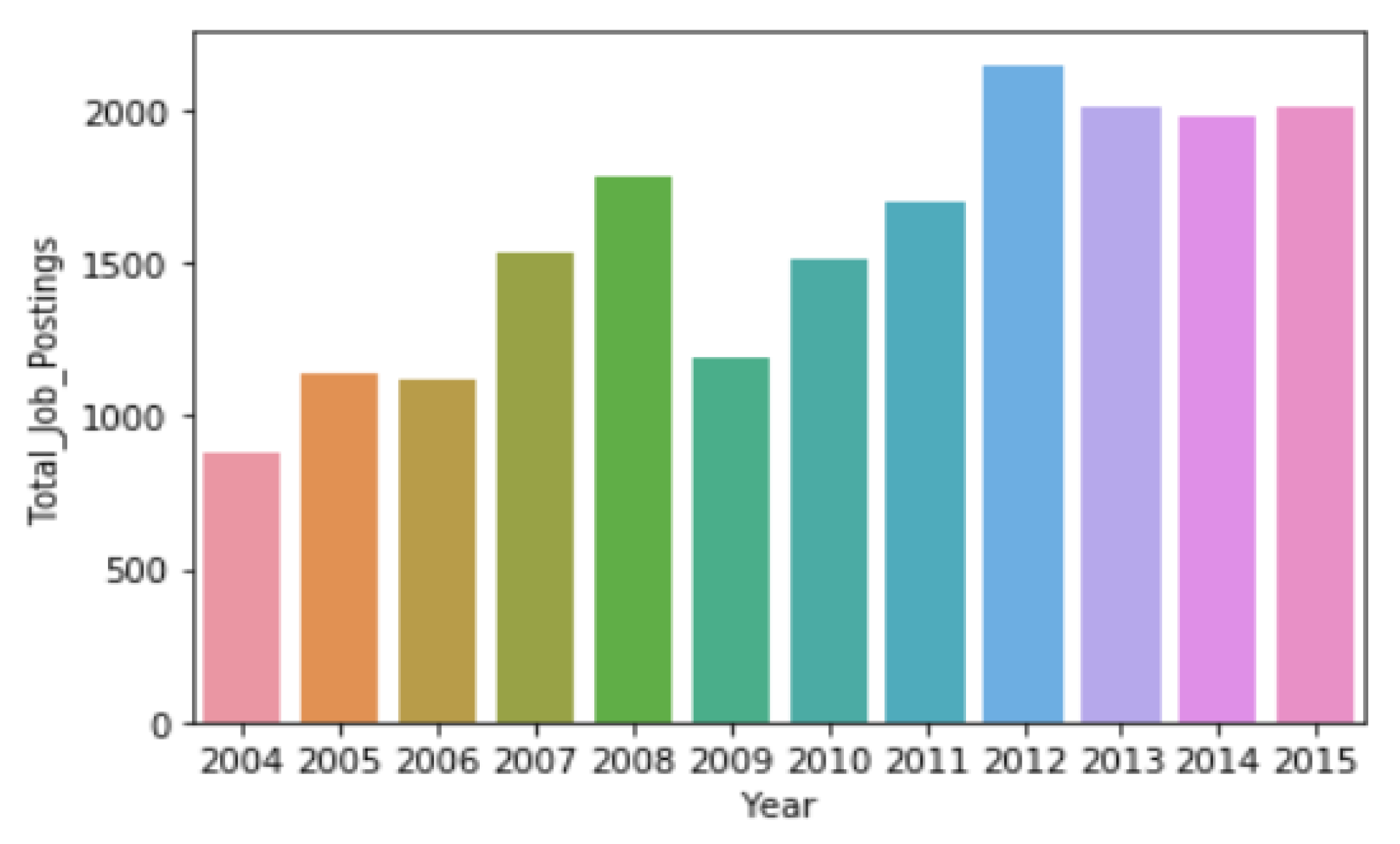
Figure 2.
Sentiment Analysis Results Using TextBlob.
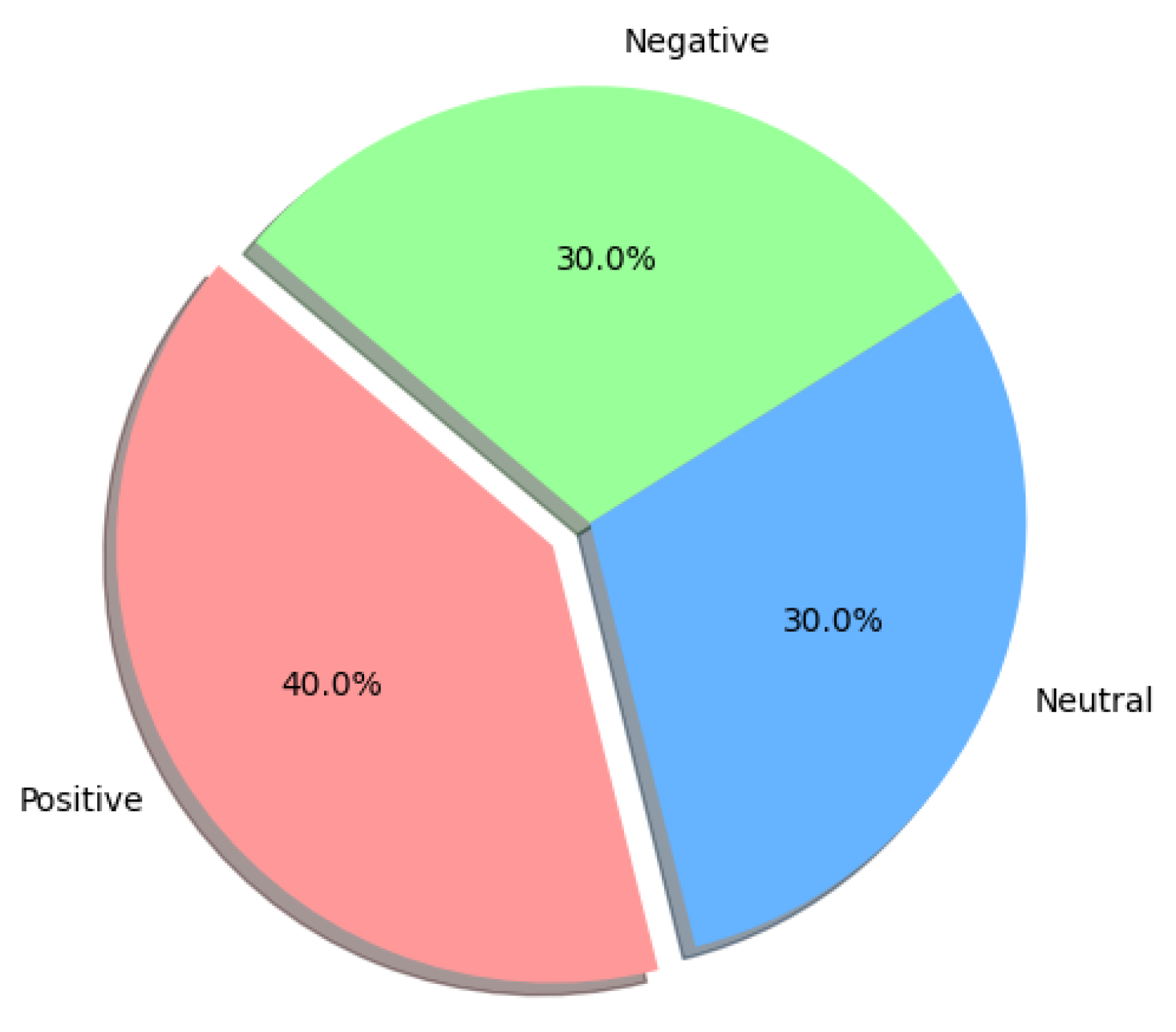
Figure 3.
Comparison of Labour Market Efficiency Evaluation under Different Sentiment Scores.
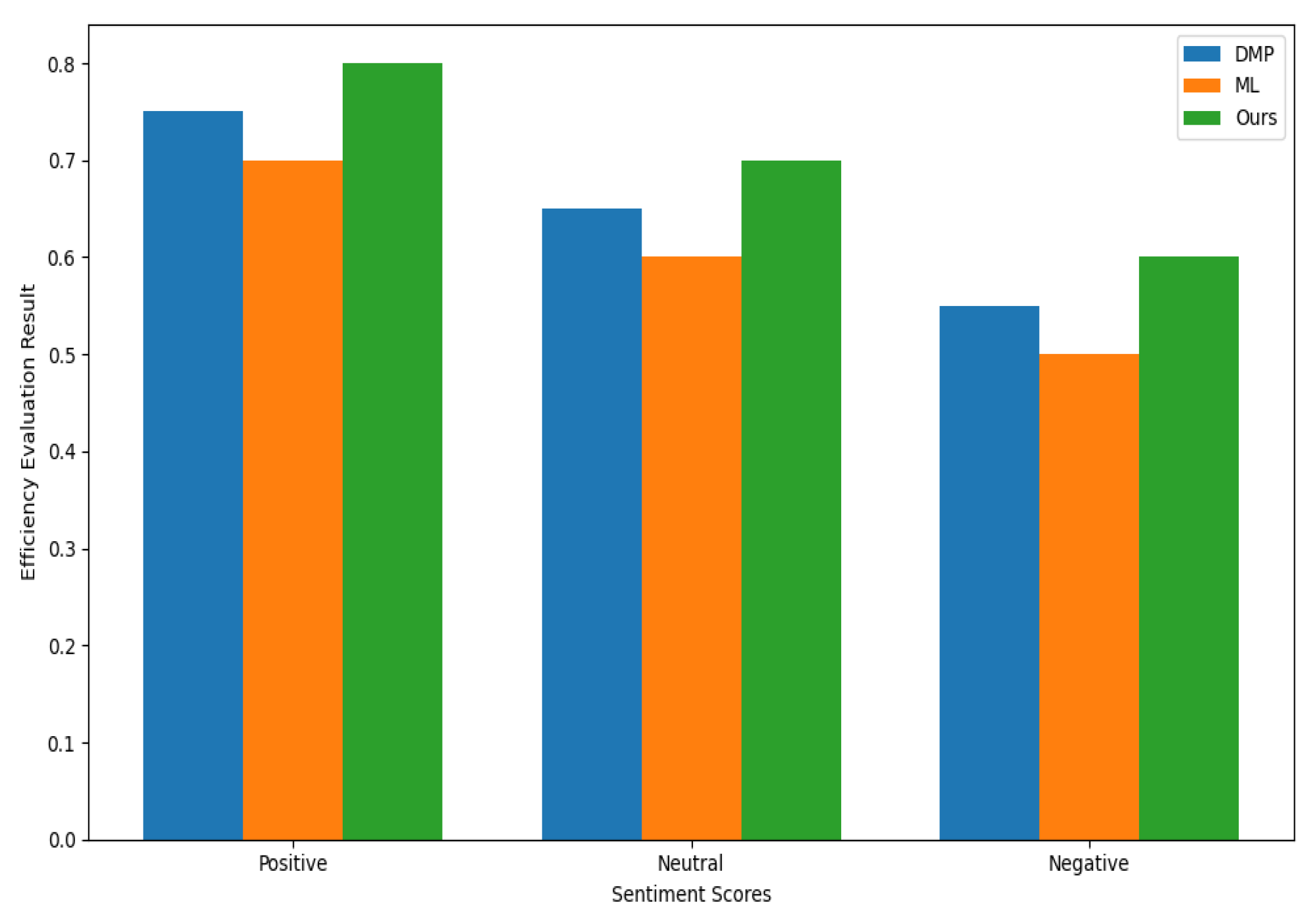

Table 1.
Primary Notions.
| Parameter Symbols | Explanations |
|---|---|
| News data collected at time | |
| Sentiment analysis model | |
| Number of news items | |
| Number of matches | |
| Number of unemployed | |
| Number of job openings | |
| Set of sentiment scores |
Disclaimer/Publisher’s Note: The statements, opinions and data contained in all publications are solely those of the individual author(s) and contributor(s) and not of MDPI and/or the editor(s). MDPI and/or the editor(s) disclaim responsibility for any injury to people or property resulting from any ideas, methods, instructions or products referred to in the content. |
© 2025 by the authors. Licensee MDPI, Basel, Switzerland. This article is an open access article distributed under the terms and conditions of the Creative Commons Attribution (CC BY) license (https://creativecommons.org/licenses/by/4.0/).
Copyright: This open access article is published under a Creative Commons CC BY 4.0 license, which permit the free download, distribution, and reuse, provided that the author and preprint are cited in any reuse.