

Submitted:
07 January 2025
Posted:
08 January 2025
You are already at the latest version
Abstract
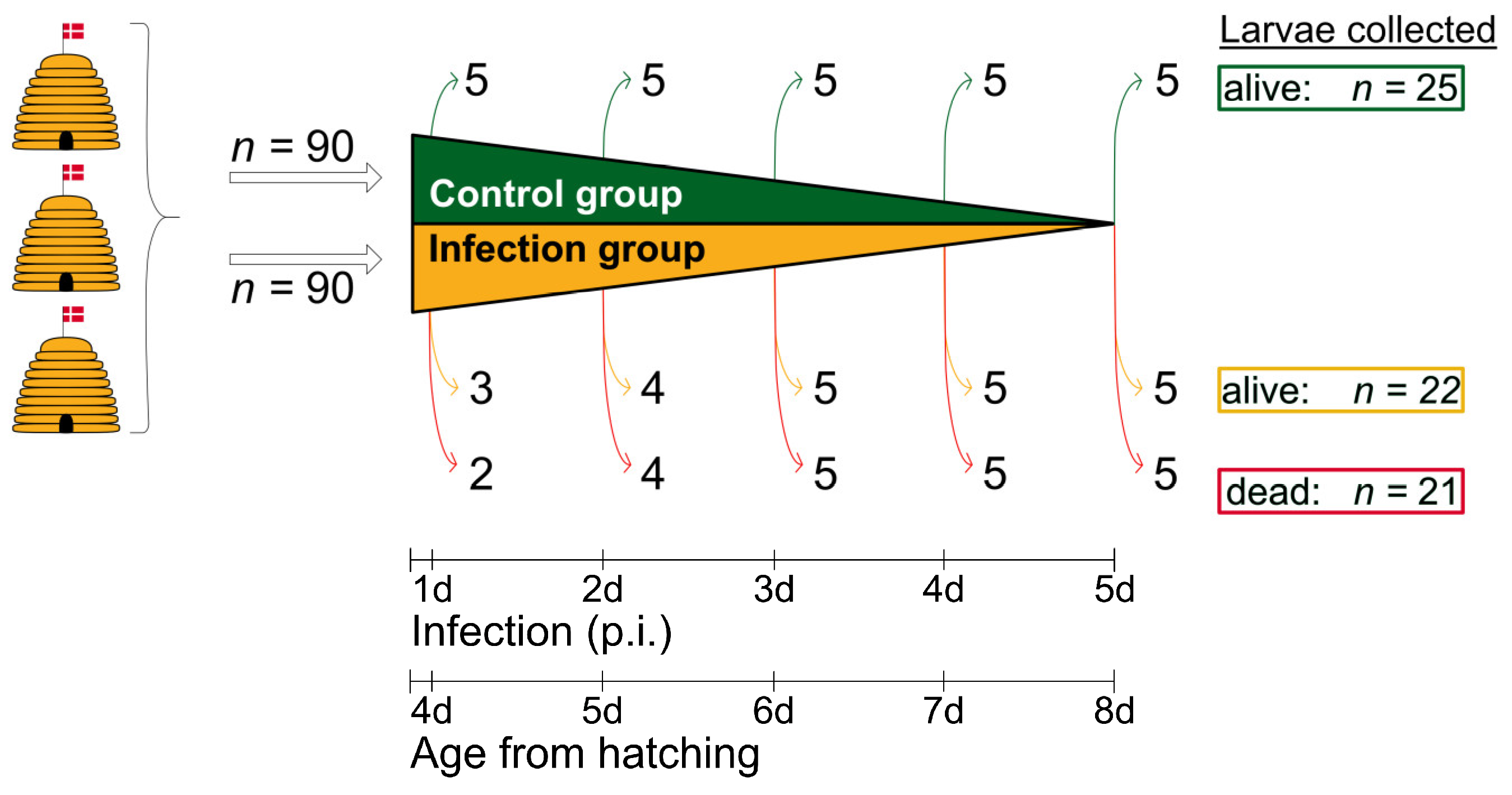
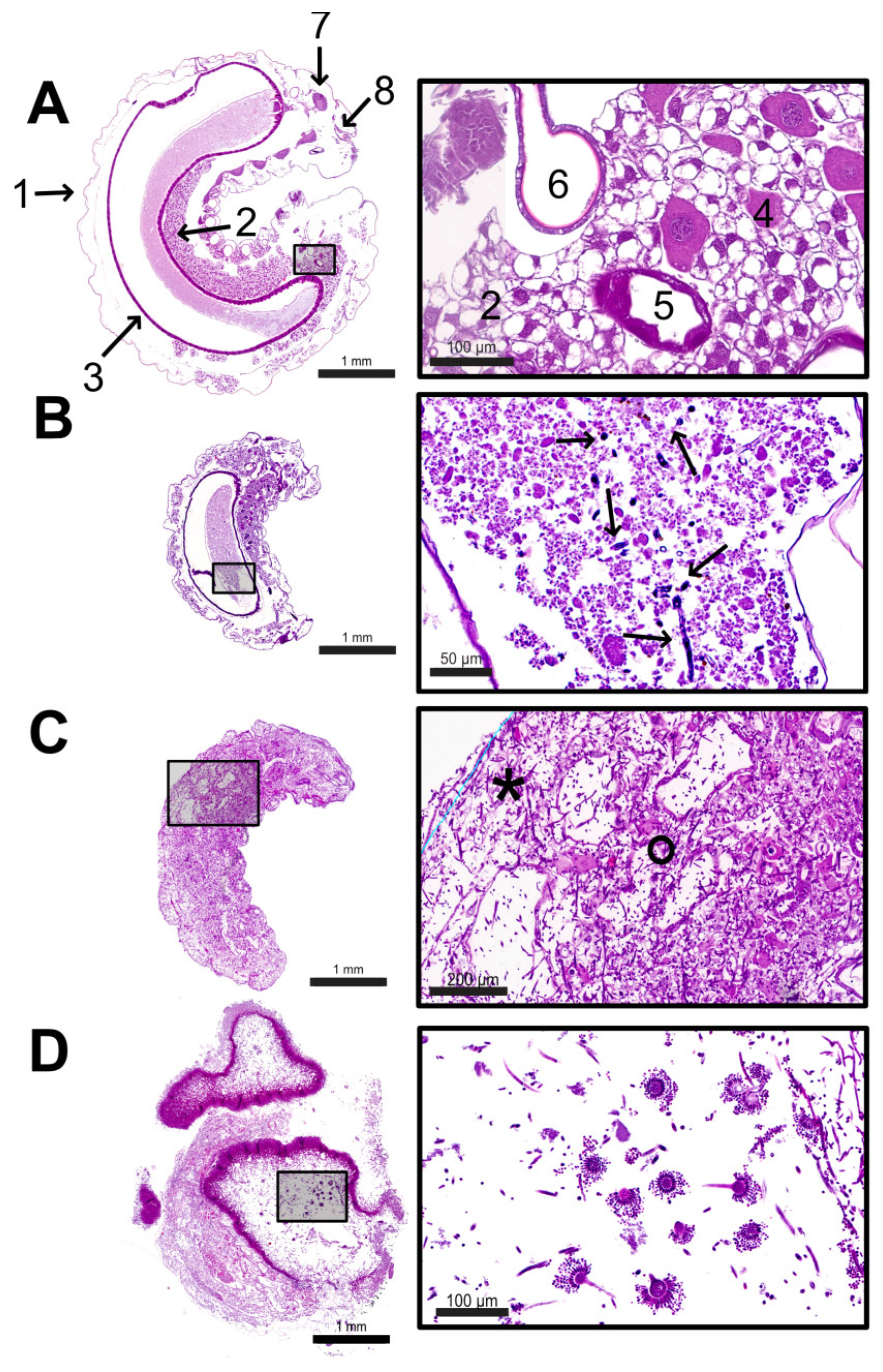
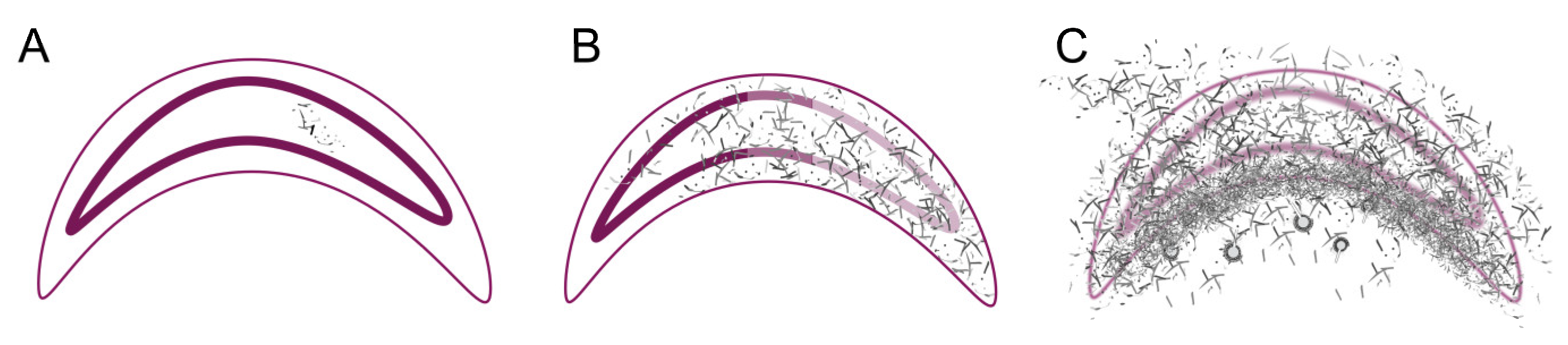
Stonebrood (Aspergillus sp.) is a rare; poorly described disease of the Western honey bee (Apis mellifera) that can affect adult bees and brood. This study describes the pathogenesis using artificially reared pathogen free Apis mellifera larvae, experimentally infected (5 x 10² spores/larva) with Aspergillus flavus. Between day 1 and 5 p.i. (larval age 4 until 8 days), 5 uninfected control larvae, up to 5 infected living larvae, and up to 5 infected dead larvae were collected and examined macroscopically. Subsequently the larvae were photographed, fixed (4% formaldehyde), and processed for histological examination (hematoxylin-eosin stain, Grocott silvering). Sections were digitized, measured (area, thickness), and statistically analyzed. 19 of 43 collected infected larvae showed signs of infection (germinating spores/fungal mycelium): dead larvae (from day 2 p.i.) showed clear histological and macroscopic signs of infection, while larvae collected alive (from day 1 p.i.) were only locally affected. Infected larvae were significantly smaller (day 2 p.i.: p < 0.001, 4 p.i.: p < 0.01, 5 p.i.: p < 0.01) than uninfected larvae (control group). The short incubation period and the early death during pathogenesis could explain why the disease often goes unnoticed: the worker bees remove dead larvae when mycelium has not yet infiltrated the brood cell.
Keywords:
1. Introduction
2. Materials and Methods
2.1. Bees and Aspergillus Flavus Spores
2.2. Experimental Infection of Apis mellifera Larvae
2.3. Macroscopic and Histological Preparation
2.4. Histological Measurements and Evaluation
2.5. Statistical Analyses
3. Results
3.1. Macroscopic Findings in the Control and the Infection Group

3.2. Histological Findings in the Control and the Infection Group
4. Discussion
5. Conclusions
Author Contributions
Funding
Conflicts of Interest
Appendix A

| Collection Time point | Control group | Infection group | ||||
| non-infected | with histological signs of stonebrood (infected) | without histological signs of stonebrood | ||||
|
area (median in mm2) |
thickness (median in mm) |
area (median in mm2) |
thickness (median in mm) |
area (median in mm2) |
thickness (median in mm) |
|
| 1 d p.i. | 7.7 (3.7-9.2) |
1.5 (1.2-1.8) |
4.4 (4.0-4.8) |
1.3 (1.3-1.3) |
6.0 (1.5-8.2) |
1.2 (0.8-1.3) |
| 2 d p.i. | 11.4 (6.2-17.1) |
1.7 (1.5-2.0) |
3.9 (1.2-6.5) |
1.2 (0.7-1.3) |
11.0 (3.9-15.2) |
2.1 (1.3-2.3) |
| 3 d p.i. | 17.7 (12.0-21.2) |
2.3 (2.2-2.5) |
9.3 (8.5-29.3) |
1.6 (1.6-3.5) |
20.4 (7.3-27.7) |
2.7 (1.4-3.5) |
| 4 d p.i. | 25.1 (18.1-28.2) |
3.3 (2.6-3.5) |
11.1 (6.0-20.9) |
1.8 (1.0-3.1) |
20.1 (9.1-26.7) |
2.7 (1.8-3.6) |
| 5 d p.i. | 34.7 (27.4-44.7) |
3.5 (3.1-4.9) |
26.7 (10.3-33.3) |
3.4 (2.0-3.8) |
32.4 (19.2-41.5) |
3.9 (3.1-4.6) |
| Collection Time Point |
Control Group (Non-Infected) |
Infection Group (With Histological Signs of Chalkbrood; Infected) |
||
| Area | Thickness | Area | Thickness | |
| Kruskal-Wallis test | p < 0.001 | p < 0.001 | p < 0.01 | p < 0.01 |
| Dunn-Bonferroni tests | ||||
| day 1 vs. day 4 | p = 0.001 | p < 0.001 | n.s. | n.s. |
| day 1 vs. day 5 | p < 0.001 | p < 0.001 | n.s. | n.s. |
| day 2 vs day 4 | p = 0.014 | p = 0.004 | n.s. | n.s. |
| day 2 vs day 5 | p < 0.001 | p < 0.001 | p < 0.01 | p < 0.01 |
| day 3 vs day 5 | p = 0.011 | n.s. | n.s. | n.s. |
| day 4 vs day 5 | n.s. | n.s. | n.s. | n.s. |
References
- Jensen, A.B.; Aronstein, K.; Flores, J.M.; Vojvodic, S.; Palacio, M.A.; Spivak, M. Standard methods for fungal brood disease research. J. Apic. Res. 2013, 52. [Google Scholar] [CrossRef]
- Jensen, A.B.; Pedersen, B.V.; Eilenberg, J. Differential susceptibility across honey bee colonies in larval chalkbrood resistance. Apidologie 2009, 40, 524–534. [Google Scholar] [CrossRef]
- Fathy, H.; El-Serafy, H.; Mandouh, D. Survey of chalk and stone brood fungal dieseases on honey bee colonies in Dakahlia Governorate, Egypt. Journal of Plant Protection and Pathology 2012, 3, 811–817. [Google Scholar] [CrossRef]
- Burnside, C.E.; Burnside, C.E. Fungous diseases of the honeybee // Fungous Disease of the Honeybee 1930, no. 149. [CrossRef]
- Foley, K.; Fazio, G.; Jensen, A.B.; Hughes, W.O.H. The distribution of Aspergillus spp. opportunistic parasites in hives and their pathogenicity to honey bees. Vet. Microbiol. 2014, 169, 203–210. [Google Scholar] [CrossRef]
- Gilliam, M.; Vandenberg, J.D. Fungi: Stonebrood. In Honey bee pests, predators, and diseases, 2. ed.; Morse, R.A., Nowogrodzki, R., Eds.; Cornell Univ. Pr: Ithaca, 1990; pp. 81–86. ISBN 0-8014-2406-2. [Google Scholar]
- Latgé, J.P. Aspergillus fumigatus and aspergillosis. Clin. Microbiol. Rev. 1999, 12, 310–350. [Google Scholar] [CrossRef] [PubMed]
- Galimberti, R.; Kowalczuk, A.; Hidalgo Parra, I.; Gonzalez Ramos, M.; Flores, V. Cutaneous aspergillosis: a report of six cases. Br. J. Dermatol. 1998, 139, 522–526. [Google Scholar] [CrossRef] [PubMed]
- Otsuka, R.; Kushima, H.; Fujita, M.; Ishii, H. Aspergillus Niger-pulmonary Aspergillosis in an Immunocompetent Woman. Intern. Med. 2021, 60, 2341–2342. [Google Scholar] [CrossRef]
- Shoreit, M.N.; Bagy, M. Mycoflora associated with stonebrood disease in honeybee colonies in Egypt. Microbiological Research 1995, 150, 207–211. [Google Scholar] [CrossRef]
- Bailey, L.; Ball, B.V. Fungi. In Honey Bee Pathology; Elsevier, 1991; pp. 53–63. ISBN 9780120734818. [Google Scholar]
- Puerta, F.; Flores, J.M.; Ruiz, J.A.; Ruz, J.M.; Campano, F. Fungal diseases of the honeybee (Apis mellifera L.). In Bee disease diagnosis; Ball, B.V., Colin, M.E., Kilani, M., Eds.; Zaragoza: CIHEAM, 1999; pp. 61–68. [Google Scholar]
- Mayack, C.; Hakanoğlu, H. Honey Bee Pathogen Prevalence and Interactions within the Marmara Region of Turkey. Veterinary Sciences 2022, 9. [Google Scholar] [CrossRef]
- Truong, A.-T.; Yoo, M.-S.; Seo, S.K.; Hwang, T.J.; Yoon, S.-S.; Cho, Y.S. Prevalence of honey bee pathogens and parasites in South Korea: A five-year surveillance study from 2017 to 2021. Heliyon 2023, 9, e13494. [Google Scholar] [CrossRef]
- González, G.; Hinojo, M.J.; Mateo, R.; Medina, A.; Jiménez, M. Occurrence of mycotoxin producing fungi in bee pollen. Int. J. Food Microbiol. 2005, 105, 1–9. [Google Scholar] [CrossRef] [PubMed]
- Gilliam, M.; Prest, D.B.; Lorenz, B.J. Microbiology of pollen and bee bread: taxonomy and enzymology of molds. Apidologie 1989, 20, 53–68. [Google Scholar] [CrossRef]
- Bush, D.S.; Calla, B.; Berenbaum, M.R. An Aspergillus flavus strain from bee bread of the Western honey bee (Apis mellifera) displays adaptations to distinctive features of the hive environment. Ecol. Evol. 2024, 14, e10918. [Google Scholar] [CrossRef]
- Nardoni, S.; D’Ascenzi, C.; Rocchigiani, G.; Moretti, V.; Mancianti, F. Occurrence of moulds from bee pollen in Central Italy--A preliminary study. Ann. Agric. Environ. Med. 2016, 23, 103–105. [Google Scholar] [CrossRef]
- Peterson, S.W.; Varga, J.; Frisvad, J.C.; Samson, R.A. Phylogeny and subgeneric taxonomy of Aspergillus. In Aspergillus in the genomic era; Varga, J., Samson, R.A., Eds.; Wageningen Academic Publ: Wageningen, 2008; pp. 33–56. ISBN 978-90-8686-065-4. [Google Scholar]
- Baker, S.; Bennett, J. An Overview of the Genus Aspergillus, 20071260, 3–13. [CrossRef]
- Samson, R.A.; Visagie, C.M.; Houbraken, J.; Hong, S.-B.; Hubka, V.; Klaassen, C.H.W.; Perrone, G.; Seifert, K.A.; Susca, A.; Tanney, J.B.; et al. Phylogeny, identification and nomenclature of the genus Aspergillus. Stud. Mycol. 2014, 78, 141–173. [Google Scholar] [CrossRef] [PubMed]
- Seyedmousavi, S.; Guillot, J.; Arné, P.; Hoog, G.S. de; Mouton, J.W.; Melchers, W.J.G.; Verweij, P.E. Aspergillus and aspergilloses in wild and domestic animals: a global health concern with parallels to human disease. Medical Mycology 2015, 53, 765–797. [Google Scholar] [CrossRef]
- Tell, L.A. Aspergillosis in mammals and birds: impact on veterinary medicine. Medical Mycology 2005, 43 Suppl 1, S71–3. [Google Scholar] [CrossRef]
- Becchimanzi, A.; Nicoletti, R. Aspergillus-bees: A dynamic symbiotic association. Front. Microbiol. 2022, 13, 968963. [Google Scholar] [CrossRef] [PubMed]
- Batra, L.R.; Batra, S.W.T.; Bohart, G.E. The mycoflora of domesticated and wild bees (Apoidea). Mycopathologia 1973, 49, 13–44. [Google Scholar] [CrossRef]
- Varga, J.; Kocsubé, S.; Tóth, B.; Frisvad, J.C.; Perrone, G.; Susca, A.; Meijer, M.; Samson, R.A. Aspergillus brasiliensis sp. nov., a biseriate black Aspergillus species with world-wide distribution. Int. J. Syst. Evol. Microbiol. 2007, 57, 1925–1932. [Google Scholar] [CrossRef]
- Frisvad, J.C.; Hubka, V.; Ezekiel, C.N.; Hong, S.-B.; Nováková, A.; Chen, A.J.; Arzanlou, M.; Larsen, T.O.; Sklenář, F.; Mahakarnchanakul, W.; et al. Taxonomy of Aspergillus section Flavi and their production of aflatoxins, ochratoxins and other mycotoxins. Stud. Mycol. 2019, 93, 1–63. [Google Scholar] [CrossRef] [PubMed]
- Hilldrup, J.L.; Llewellyn, G.C. Acute Toxicity of the Mycotoxin Aflatoxin B 1 in Apis Mellifera. J. Apic. Res. 1979, 18, 217–221. [Google Scholar] [CrossRef]
- Meeker, D.P.; Gephardt, G.N.; Cordasco, E.M.; Wiedemann, H.P. Hypersensitivity pneumonitis versus invasive pulmonary aspergillosis: two cases with unusual pathologic findings and review of the literature. Am. Rev. Respir. Dis. 1991, 143, 431–436. [Google Scholar] [CrossRef]
- Kumar, V.; Singh, G.P.; Babu, A.M. Surface ultrastructural studies on the germination, penetration and conidial development of Aspergillus flavus Link:Fries infecting silkworm, Bombyx mori Linn. Mycopathologia 2004, 157, 127–135. [Google Scholar] [CrossRef] [PubMed]
- Kawakami, K. Susceptibility of several varieties of the silkworm, Bombyx mori L. To Aspergillus disease and germination of fungus spores in larval hemolymph. J. Serc. Sci. Jpn. 1975, 44, 39–44. [Google Scholar] [CrossRef]
- Mohamed, M.I.; El-Khadem, M. Asperigillus flavusLink als neuer Parasit auf Tetralonia lanuginosa Klug. Zentralbl. Bakteriol. Parasitenkd. Infektionskr. Hyg. 1976, 131, 569–570. [Google Scholar] [CrossRef]
- Venkatesh, M.V.; Joshi, K.R.; Harjai, S.C.; Ramdeo, I.N. Aspergillosis in desert locust (Schistocerka gregaria Forsk). Mycopathologia 1975, 57, 135–138. [Google Scholar] [CrossRef]
- Pathak, S.C.; Kulshrestha, V. Experimental aspergillosis in the German cockroach Blattella germanica: a histopathological study. Mycopathologia 1998, 143, 13–16. [Google Scholar] [CrossRef] [PubMed]
- Ramírez-Camejo, L.A.; Torres-Ocampo, A.P.; Agosto-Rivera, J.L.; Bayman, P. An opportunistic human pathogen on the fly: strains of Aspergillus flavus vary in virulence in Drosophila melanogaster. Medical Mycology 2014, 52, 211–219. [Google Scholar] [CrossRef]
- Knoblauch, T. von; Jensen, A.B.; Mülling, C.K.W.; Aupperle-Lellbach, H.; Genersch, E. Chalkbrood Disease Caused by Ascosphaera apis in Honey Bees (Apis mellifera)—Morphological and Histological Changes in Infected Larvae. Veterinary Sciences 2024, 11, 415. [Google Scholar] [CrossRef] [PubMed]
- Crailsheim, K.; Brodschneider, R.; Aupinel, P.; Behrens, D.; Genersch, E.; Vollmann, J.; Riessberger-Gallé, U. Standard methods for artificial rearing of Apis mellifera larvae. J. Apic. Res. 2013, 52, 1–16. [Google Scholar] [CrossRef]
- Mikroskopische Technik; Mulisch, M., Aescht, E., Romeis, B., Eds.; Springer Spektrum: Heidelberg, 2015; ISBN 978-3-642-55189-5. [Google Scholar]
- Gilliam, M. Identification and roles of non-pathogenic microflora associated with honey bees. FEMS Microbiology Letters 1997, 155, 1–10. [Google Scholar] [CrossRef]
- Omar, M.O.M.; Moustafa, A.M.; Ansari, M.J.; Anwar, A.M.; Fahmy, B.F.; Al-Ghamdi, A.; Nuru, A. Antagonistic Effect of Gut Bacteria in the Hybrid Carniolan Honey Bee, Apis Mellifera Carnica, Against Ascosphaera Apis, the Causal Organism of Chalkbrood Disease. Journal of Apicultural Science 2014, 58, 17–27. [Google Scholar] [CrossRef]
- Evans, J.D.; Spivak, M. Socialized medicine: individual and communal disease barriers in honey bees. Journal of Invertebrate Pathology 2010, 103 Suppl 1, S62–72. [Google Scholar] [CrossRef]
- Hilldrup, J.A.; Eadie, T.; Llewellyn, G.C. Fungal growth and aflatoxin production on apiarian substrates. J. Assoc. Off. Anal. Chem. 1977, 60, 96–99. [Google Scholar] [CrossRef] [PubMed]
- Gunst, K.W.; Hilldrup, J.L.; Llewellyn, G.C. Aflatoxin Production on Apis Mellifera Artificially Inoculated with Aspergillus Flavus and Aspergillus Parasiticus. J. Apic. Res. 1978, 17, 81–83. [Google Scholar] [CrossRef]
- Vojvodic, S.; Jensen, A.B.; James, R.R.; Boomsma, J.J.; Eilenberg, J. Temperature dependent virulence of obligate and facultative fungal pathogens of honeybee brood. Vet. Microbiol. 2011, 149, 200–205. [Google Scholar] [CrossRef]

| 1 d p.i. | 2 d p.i. | 3 d p.i. | 4 d p.i. | 5 d p.i. | |
| larvae alive (n = 5) | |||||
| mycelium localization | midgut | - | midgut | midgut | midgut |
| (n = 1/1) | (n = 1/1) | (n = 1/1) | (n = 2/2) | ||
| dead larvae (n = 14) | |||||
| mycelium localization | - | complete larval body | Caudal part of larval body | complete larval body | complete larval body |
| (n = 4/4) | (n = 2/2) | (n = 5/5) | (n = 3/3) | ||
| cuticle perforation | - | no | no | yes | yes |
| (n = 5/5) | (n = 1/3) | ||||
| autolysis | - | partially | partially | complete | complete |
| (n = 2/4) | (n = 1/2) | (n = 5/5) | (n = 3/3) | ||
| fruiting bodies | - | no | no | yes | no |
| (n = 3/5) | |||||
| Stonebrood | Chalkbrood | |
| Pathogen | Aspergillus flavus | Ascosphaera apis |
| Incubation period | < 24 h | 48-72 h |
| Localisation Germination | whole midgut | caudal part of midgut |
| Time of Death | from 24 – 48 h p.i. | from 72 h |
Disclaimer/Publisher’s Note: The statements, opinions and data contained in all publications are solely those of the individual author(s) and contributor(s) and not of MDPI and/or the editor(s). MDPI and/or the editor(s) disclaim responsibility for any injury to people or property resulting from any ideas, methods, instructions or products referred to in the content. |
© 2025 by the authors. Licensee MDPI, Basel, Switzerland. This article is an open access article distributed under the terms and conditions of the Creative Commons Attribution (CC BY) license (http://creativecommons.org/licenses/by/4.0/).


