1. Introduction
In the ever-evolving landscape of space exploration and technological advancements, satellite communications have emerged as a critical component of our global connectivity infrastructure. The New Space Era, characterized by rapid innovation, increased private sector involvement, and the development of small satellite constellations, has ushered in new opportunities and challenges for satellite communications.
The New Space Era has witnessed the deployment of advanced satellite networks, pushing the boundaries of communication capabilities and fuelling the growth of new applications. As of January 2020, SpaceX has deployed 242 satellites to build its Starlink constellation, with the goal to reach nearly 12000 satellites by mid-2020 [
1].
This survey report aims to provide a comprehensive analysis of the current state of satellite communications in the New Space Era. It explores the technological advancements, emerging trends, and the future challenges faced by this dynamic industry. By examining the evolution of satellite communications and its integration with other technologies, we seek to gain insights into the potential applications and implications for various sectors.
The report delves into the historical background of satellite communications, tracing its origins from the early days of space exploration to the present. It examines the advancements in satellite miniaturization, the deployment of high-throughput satellites, and the integration of satellite networks with terrestrial infrastructure. Additionally, the report explores the role of artificial intelligence and machine learning in optimizing satellite communications systems.
While the New Space Era brings forth exciting opportunities, it also presents significant challenges that need to be addressed. Spectrum congestion, space debris management, cybersecurity threats, and regulatory considerations are among the hurdles that demand attention. The report highlights the importance of international collaboration, policy frameworks, and innovative solutions to ensure the sustainable growth and resilience of satellite communications in the face of these challenges.
Furthermore, the report explores the potential applications and opportunities that satellite communications offer in the New Space Era. From bridging the digital divide and supporting Internet of Things (IoT) connectivity to facilitating disaster management and enabling remote sensing for climate monitoring, the possibilities are vast and promising.
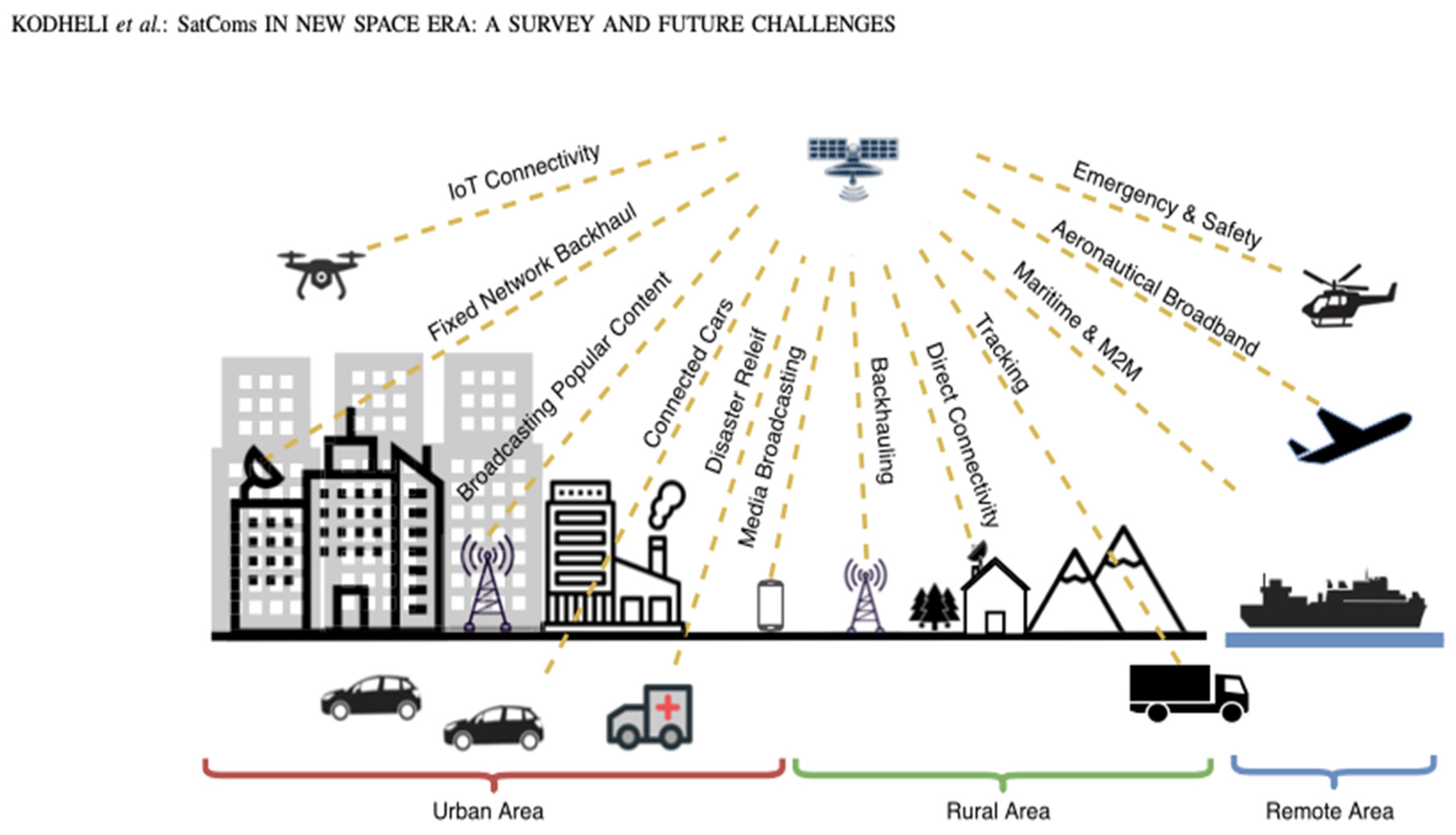
Figure 1.
The function of satellites in the 5G environment [
2]
.
Figure 1.
The function of satellites in the 5G environment [
2]
.
2. Low Earth Orbit (LEO) Satellite Constellations
Low Earth Orbit (LEO) satellite constellations are networks of satellites that orbit the Earth at relatively low altitudes. These constellations are designed to provide various services, including global broadband internet coverage, Earth observation, communication, and scientific research.
Low Earth Orbit (LEO) satellite constellations are networks of satellites that orbit the Earth at relatively low altitudes. These constellations are designed to provide various services, including global broadband internet coverage, Earth observation, communication, and scientific research.
Low Earth Orbit (LEO) satellite constellations have emerged as a disruptive force in the field of satellite communications. Unlike traditional geostationary satellites, LEO satellites orbit the Earth at lower altitudes, typically ranging from a few hundred to a couple of thousand kilometres above the Earth’s surface. These constellations consist of a large number of satellites working together in a coordinated manner to provide a wide range of services.
One of the primary objectives of LEO satellite constellations is to provide global broadband internet coverage. Companies such as SpaceX’s Starlink, OneWeb, and Amazon’s Project Kuiper are actively deploying LEO constellations to bring high-speed internet connectivity to underserved and remote areas of the world. By distributing satellites across different orbital planes and orbits, LEO constellations ensure continuous coverage and reduce signal latency compared to traditional satellite systems.
In addition to broadband internet, LEO satellite constellations facilitate Earth observation and remote sensing capabilities. With their close proximity to the Earth’s surface, these constellations enable high-resolution imaging, real-time monitoring of the environment, and collection of scientific data. They contribute to fields such as climate research, disaster management, agricultural monitoring, and urban planning.
Communication services are another key application of LEO satellite constellations. By leveraging inter-satellite links and efficient routing techniques, these constellations enable seamless communication across vast distances. They support various communication needs, including voice, data, and video services. LEO constellations can enhance connectivity in remote areas, maritime and aviation communications, and enable reliable communication in challenging environments.
LEO satellite constellations offer several advantages over traditional satellite systems. The lower altitudes at which LEO satellites operate result in significantly reduced signal travel time, leading to lower latency. This low latency is beneficial for applications that require real-time communication, such as video conferencing, online gaming, and autonomous vehicles.
The distributed nature of LEO constellations also improves global coverage compared to geostationary satellites. These constellations can provide connectivity to remote and underserved regions where terrestrial infrastructure is limited or unavailable, bridging the digital divide and connecting people around the world to offer continuous worldwide coverage, it is crucial to evaluate the LEO constellations’ capacity and backhaul needs for user terminals [
9,
10].
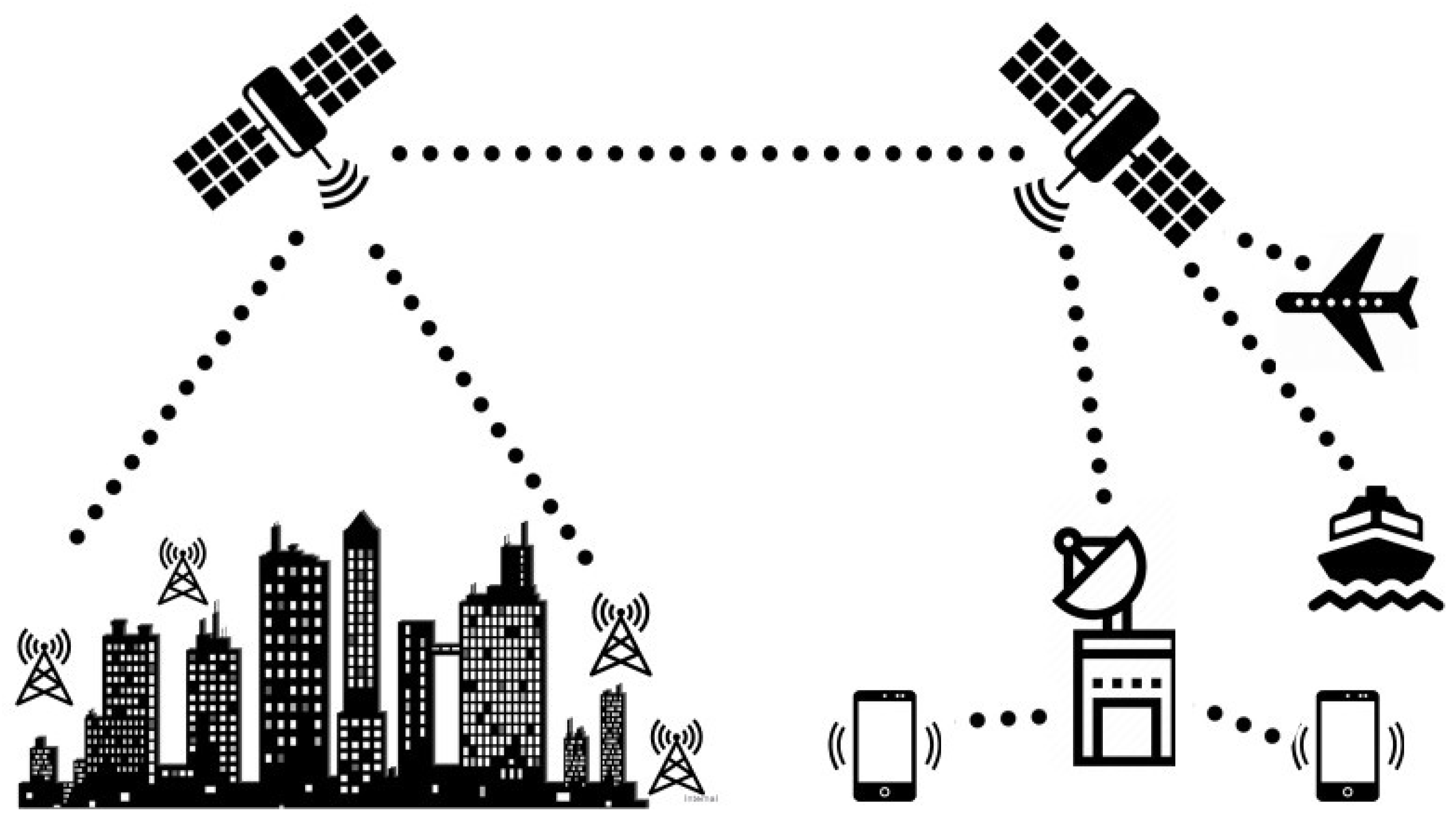
Figure 2.
Shows LEO satellites [
3].
Figure 2.
Shows LEO satellites [
3].
2.1. LEO satellite constellations Characteristics
LEO satellite constellations are characterized by the following key features:
2.1.1. Altitude
LEO satellites orbit at altitudes ranging from a few hundred kilometres to around 2,000 kilometres above the Earth’s surface. This low altitude allows for shorter signal latency compared to satellites in higher orbits, enabling faster communication and internet connectivity.
2.1.2. Large Number of Satellites:
LEO constellations typically consist of hundreds or even thousands of satellites working together to provide global coverage. These satellites are distributed across different orbital planes and orbits, forming a mesh network to ensure continuous connectivity.
2.1.3. Orbital Period
Satellites in LEO have relatively short orbital periods, typically ranging from 90 minutes to a few hours. This means they orbit the Earth multiple times a day, providing frequent passes over any given location and reducing the time between satellite visibility.
2.1.4. Inter-Satellite Communication
LEO constellations rely on inter-satellite communication to establish seamless connectivity. Satellites within the constellation communicate with each other, relaying data across the network and ensuring continuous coverage as satellites move in and out of range of ground stations.
2.1.5. Replenishment and Replacement
LEO constellations may require regular replenishment or replacement of satellites due to factors like atmospheric drag, hardware degradation, or technological advancements. The dynamic nature of LEO constellations allows for easier upgrades and satellite maintenance.
LEO satellite constellations have gained significant attention in recent years due to their potential to provide global broadband internet access to underserved areas. Companies like SpaceX’s Starlink, OneWeb, and Amazon’s Project Kuiper are among the prominent players developing and deploying LEO satellite constellations for this purpose. These constellations aim to bridge the digital divide by providing high-speed internet connectivity to remote regions and improving communication capabilities globally
2.2. Advantages of LEO Satellite Constellations
“LEO (Low Earth Orbit) satellite constellations have several advantages compared to traditional satellite systems. Some of the key advantages are:
2.2.1. Lower Latency
LEO satellites operate at lower altitudes compared to geostationary satellites, resulting in significantly reduced signal travel time. This lower latency is beneficial for applications that require real-time communication, such as video conferencing, online gaming, and autonomous vehicles.
2.2.2. Improved Global Coverage
LEO constellations consist of a large number of satellites deployed in a distributed network, enabling better global coverage. These constellations can provide connectivity to remote and underserved regions that lack terrestrial infrastructure, bridging the digital divide.
2.2.3. Higher Data Transfer Rates
LEO satellites can support high-speed data transfer due to their proximity to Earth. With advancements in technology and the deployment of large constellations, LEO systems can offer faster download and upload speeds, facilitating bandwidth-intensive applications like streaming, cloud computing, and IoT (Internet of Things) devices.
2.2.4. Enhanced Scalability and Flexibility
LEO constellations are designed to be highly scalable, allowing for the addition of more satellites as demand increases. This scalability enables satellite operators to adapt to changing needs and expand their capacity easily. Additionally, the distributed nature of LEO constellations allows for more efficient utilization of resources and improved network management.
2.2.5. Lower Cost
Compared to traditional satellite systems, LEO constellations can be deployed at a lower cost. The use of smaller satellites and the ability to launch multiple satellites in a single mission reduce manufacturing and launch expenses. The lower cost structure can potentially lead to more affordable services for end-users.
2.2.6. Reduced Signal Interference
LEO satellites operate at lower altitudes, which reduces the impact of signal interference caused by atmospheric conditions, such as rain fade. The shorter signal path also reduces signal attenuation, resulting in improved signal quality and reliability.
2.2.7. Enables new applications
The low latency and high-speed connectivity provided by LEO constellations open up possibilities for new applications and services. These include remote sensing, Earth observation, disaster management, precision agriculture, maritime and aviation communications, and global broadband connectivity for underserved areas.
It’s worth noting that while LEO constellations offer numerous advantages, they also face challenges such as the need for a large number of satellites, complex network management, and concerns about space debris. However, ongoing technological advancements and regulatory efforts aim to address these challenges and further enhance the benefits of LEO satellite constellations.”
3. Satellite Communication in Remote Areas
Satellite communication plays a crucial role in providing connectivity to remote areas where traditional terrestrial infrastructure is either limited or unavailable. It enables people in these areas to access voice, data, and internet services, bridging the digital divide and connecting them with the rest of the world. Here are some key aspects of satellite communication in remote areas:
3.1. Satellite Communication in Remote Areas Characteristics
3.1.1. Wide Coverage
Satellites can provide coverage to even the most remote and isolated regions of the Earth, including deserts, mountains, and oceanic areas. They can reach areas where it is impractical or uneconomical to deploy terrestrial communication infrastructure.
3.1.2. Connectivity Solutions
Satellite communication offers various connectivity solutions, including broadband internet access, voice services, video conferencing, and data transfer. These services are essential for education, healthcare, emergency response, and economic development in remote areas.
3.1.3. Ubiquitous Access
Satellite communication provides ubiquitous access, meaning that as long as there is a clear line of sight to the satellite, users can access the services regardless of their location. This makes it ideal for remote areas where other communication options are limited.
3.1.4. Disaster Resilience
Satellites are crucial during natural disasters and emergencies when terrestrial infrastructure may be damaged or destroyed. Satellite networks can quickly be deployed to restore communication, enabling coordination of relief efforts and facilitating communication with affected populations.
3.1.5. Mobile and Fixed Terminals
Satellite communication supports both fixed and mobile terminals. Fixed satellite dishes can provide connectivity to communities and businesses, while portable terminals allow for on-the-move communication, such as in maritime, aviation, and remote field operations.
3.1.6. Diverse Applications
Satellite communication serves a wide range of applications in remote areas, including telemedicine, distance learning, e-commerce, weather monitoring, environmental monitoring, and precision agriculture. These applications contribute to the social and economic development of remote regions.
3.1.7. Technology Advancements
Advancements in satellite technology, such as the emergence of LEO satellite constellations, have made satellite communication more affordable, scalable, and capable of providing higher data rates. This has expanded the possibilities for connectivity in remote areas.
Despite the advantages, it’s important to note that satellite communication has certain limitations, including higher latency compared to terrestrial networks and potential issues with signal obstruction due to geographical features or adverse weather conditions. However, continuous advancements in satellite technology are addressing these challenges and improving the efficiency and reliability of communication services in remote areas. ”
4. High Throughput Satellites (HTS)
High Throughput Satellites (HTS) refer to a type of satellite technology that enables the transmission of large amounts of data at high speeds. The HTS technology is particularly suited to crowded regions and is considered a cost-effective alternative to wired networks.[
4]. These satellites are designed to provide significant improvements in capacity and performance compared to traditional satellite systems. The satellite sector is developing the next generation for the HTS, the Terabit/s-based systems, through several R&D studies over the last years sponsored by the European Space Agency, National Space Agencies, and the European Commission[
5].
HTS systems achieve their high throughput capabilities through a combination of advanced satellite designs and innovative communication techniques. Some key features of HTS include:
Frequency Reuse: HTS employ frequency reuse techniques, such as spot beams or multi-beams, which allow the satellite to reuse frequencies multiple times within its coverage area. This increases the available capacity and enables more efficient use of the satellite’s resources.
Ka-Band and Ku-Band Frequencies: HTS typically operate in the Ka-band or Ku-band frequencies, which offer higher data transfer rates compared to the C-band or L-band used in traditional satellites. These higher frequencies allow for more extensive bandwidth and greater data throughput.
Multiple Spot Beams: HTS employ multiple spot beams or narrow, focused beams that can cover smaller geographic areas. This enables targeted coverage and allows the satellite to concentrate its capacity where it is needed the most, increasing overall system efficiency.
Steerable Beams: HTS often have steerable beams, which can be dynamically directed to specific regions on Earth. This flexibility allows the satellite to adapt to changing demand patterns and provide enhanced capacity to areas of high traffic.
High Gateway Density: HTS systems typically incorporate a large number of ground-based gateway stations to support the communication between the satellite and end-users. This high gateway density facilitates efficient data transmission, minimizes latency, and improves overall system performance.
HTS technology has revolutionized the satellite communications industry, enabling a wide range of applications such as broadband internet access, video streaming, cellular backhaul, maritime and aeronautical connectivity, and remote sensing. It has significantly increased the capacity and efficiency of satellite networks, making them more competitive with terrestrial alternatives in terms of speed and bandwidth.
5. Future Challenges in Satellite Communications
5.1. Spectrum Management and Allocation
As the demand for satellite communications increases, effective spectrum management and allocation become crucial. The radio frequency spectrum used for satellite communications is a limited resource that needs to be allocated efficiently to avoid interference and ensure optimal performance. Future challenges in this area include addressing spectrum congestion, resolving conflicts between different users and services, and accommodating the growing number of satellite systems while maintaining spectrum integrity.
5.2. Space Debris Mitigation
Space debris, including defunct satellites, spent rocket stages, and fragments from previous space missions, poses a significant challenge to satellite communications. With the increasing number of satellites in orbit, the risk of collisions and the creation of additional space debris escalate. Future challenges involve implementing effective space debris mitigation strategies, such as satellite deorbiting, collision avoidance measures, and responsible satellite disposal practices to minimize the impact on satellite communications.
5.3. Interference and Congestion Management
As more satellites and communication systems are deployed, the risk of interference and congestion in the radio frequency spectrum increases. Interference can degrade signal quality and disrupt communication links. Congestion can lead to reduced data rates and capacity limitations. Future challenges include developing advanced interference detection and mitigation techniques, efficient spectrum sharing mechanisms, and dynamic resource management to optimize satellite communication performance and mitigate the impact of interference and congestion.
5.4. Security and Cyber Threats
Data interception and meaconing (the interception and retransmission of signals) pose a significant danger to space cybersecurity [
8]. Satellites and ground infrastructure are potential targets for cyber-attacks, resulting in service disruptions, data breaches, or unauthorised access. Future challenges involve strengthening satellite communication systems’ security through robust encryption, authentication mechanisms, intrusion detection systems, and cybersecurity protocols to protect against evolving threats and maintain the integrity and confidentiality of communication links. Protecting these channels in a UAV system is one of the most crucial components of its security because all information critical to the operation is provided over wireless communication channels [
6]. Differently, several incidents of satellites being used or controlled by terrorist groups were reported in 2007 by various sources [
7].
5.5. Regulatory and Policy Considerations
Satellite communications operate within a complex regulatory and policy framework at the national and international levels. Future challenges involve addressing regulatory barriers, harmonizing spectrum management policies across different jurisdictions, and fostering international cooperation for satellite communication systems. Policy considerations include spectrum access rights, licensing procedures, orbital slot allocation, and coordination mechanisms to ensure fair and efficient utilization of resources, encourage innovation, and enable the sustainable growth of satellite communications.
To tackle these future challenges, collaboration among satellite operators, regulatory bodies, governments, and international organizations is essential. Technological advancements, such as advanced signal processing techniques, machine learning algorithms, and adaptive network architectures, can also play a vital role in addressing these challenges and optimizing the performance and resilience of satellite communication systems.
6. Conclusions
In conclusion, satellite communications have become an indispensable component of the New Space Era, driven by technological advancements and the proliferation of small satellite constellations. This survey report has provided a comprehensive analysis of the current state of satellite communications, shedding light on key advancements, emerging trends, and future challenges.
The historical background of satellite communications highlights the miniaturization of satellites, the deployment of high-throughput satellites, and the integration of satellite networks with terrestrial infrastructure. These advancements have expanded the capabilities and accessibility of satellite communications, enabling a wide range of applications and bridging the digital divide.
However, the industry faces several challenges that must be addressed for sustained growth and resilience. Spectrum congestion, space debris management, cybersecurity threats, and regulatory considerations pose significant hurdles.
The report also explores the potential applications and opportunities offered by satellite communications in the New Space Era.
Furthermore, the advantages of Low Earth Orbit satellite constellations are highlighted, including wider coverage, connectivity solutions, disaster resilience, and diverse applications. Satellite communication initiatives in remote areas are also discussed, showcasing their ability to provide connectivity and services in areas with limited infrastructure.
While acknowledging the limitations of satellite communication, the report emphasizes ongoing technological advancements that address challenges and improve the efficiency and reliability of communication services in remote areas. These advancements offer hope for overcoming barriers and extending the benefits of satellite communications to more regions.
References
-
WiKipedia. Accessed: June. 16, 2023. [Online]. Available: https:// en.wikipedia.org/wiki/SpaceX_Starlink.
- O. Kodheli et al., “Satellite Communications in the New Space Era: A Survey and Future Challenges,” in IEEE Communications Surveys & Tutorials, vol. 23, no. 1, pp. 70-109, Firstquarter 2021. [CrossRef]
- S. Carlini, “Schneider Electric,” 11 August 2021. [Online]. Available: https://blog.se.com/datacenter/2021/08/11/low-earth-orbiting-satellites-leo-will-be-the-future-of-delivering-a-seamless-5g-experience/. [Accessed June 2023].
- J. Farserotu and R. Prasad, “A survey of future broadband multimedia satellite systems issues and trends”, IEEE Communications Magazine, vol. 38, no. 6, pp. 128-133, 2000. [CrossRef]
- P. Inigo et al., “Review of terabit/s satellite, the next generation of HTS systems,” 2014 7th Advanced Satellite Multimedia Systems Conference and the 13th Signal Processing for Space Communications Workshop (ASMS/SPSC), Livorno, Italy, 2014, pp. 318-322. [CrossRef]
- A. Y. Javaid, W. Sun, V. K. Devabhaktuni and M. Alam, “Cyber security threat analysis and modeling of an unmanned aerial vehicle system,” 2012 IEEE Conference on Technologies for Homeland Security (HST), Waltham, MA, USA, 2012, pp. 585-590. [CrossRef]
- S. Northcutt, “Are Satellites Vulnerable to Hackers?”, SANS Technology Institute, May 15, 2007. http://www.sans.edu/research/ securitylaboratory/article/satellite-dos.
- L. Berthoud and S. Agass, “Identifying Space Threats for SpaceAware Resilience- a Spacecraft and Satellite Service Resilience Model,” 2022 IEEE Aerospace Conference (AERO), Big Sky, MT, USA, 2022, pp. 1-9. [CrossRef]
- F. Liu and G. Qian, “Simulation Analysis of Network Capacity for LEO Satellite”, 2020 International Conference on Computer Science and Management Technology (ICCSMT), pp. 100-104, 2020. [CrossRef]
- R. Deng, B. Di, H. Zhang, L. Kuang and L. Song, “Ultra-Dense LEO Satellite Constellations: How Many LEO Satellites Do We Need?”, IEEE Transactions on Wireless Communications. [CrossRef]
|
Disclaimer/Publisher’s Note: The statements, opinions and data contained in all publications are solely those of the individual author(s) and contributor(s) and not of MDPI and/or the editor(s). MDPI and/or the editor(s) disclaim responsibility for any injury to people or property resulting from any ideas, methods, instructions or products referred to in the content. |
© 2025 by the authors. Licensee MDPI, Basel, Switzerland. This article is an open access article distributed under the terms and conditions of the Creative Commons Attribution (CC BY) license (http://creativecommons.org/licenses/by/4.0/).