

Submitted:
04 January 2025
Posted:
07 January 2025
You are already at the latest version
Abstract
The COVID-19 pandemic led to significant disruptions in healthcare services worldwide, including dental care, resulting in increased reliance on antibiotics as a substitute for in-person dental interventions. This study aimed to examine the utilization of different classes of antibiotics at the University Dental Clinical Center of Kosovo during the COVID-19 pandemic and compare it with prescription trends from the pre-pandemic period. Methods: A retrospective analysis was conducted on antibiotic prescription data from the University Dental Clinical Center of Kosovo, spanning from 2019 to 2022. The study compared prescription trends before and during the pandemic and identified the most prescribed antibiotic classes. Additionally, findings were contextualized by reviewing global literature on antibiotic use in dental practices during the pandemic. Results: The study revealed a significant increase in the prescription of broad-spectrum antibiotics, including amoxicillin, clavulanic acid, clindamycin, and metronidazole, during the pandemic period. These findings mirrored global trends, where restricted access to dental care and increased self-medication led to higher antibiotic consumption. Concerns about antimicrobial resistance (AMR) were raised due to the over-prescription of these antibiotics during the pandemic. Conclusions: The study highlights the impact of the COVID-19 pandemic on dental antibiotic prescription practices in Kosovo, revealing a concerning increase in broad-spectrum antibiotic use. This underscores the need for improved antibiotic stewardship in dental settings, particularly during public health crises, to prevent the exacerbation of antimicrobial resistance. Ensuring continued access to routine dental care and developing robust protocols for antibiotic prescription during emergencies are essential to mitigate the long-term public health impacts of increased antibiotic use.
Keywords:
1. Introduction
2. Methodology
3. Results
4. Discussion
5. Conclusions
References
- Abubakar, S.; Sartelli, M. Ten golden rules for optimal antibiotic use in hospital settings: the WARNING call to action. World J. Emerg. Surg. 2023, 18, 1–35. [Google Scholar] [CrossRef]
- Albrecht, H.; Schiegnitz, E.; Halling, F. Facts and trends in dental antibiotic and analgesic prescriptions in Germany, 2012–2021. Clin. Oral Investig. 2024, 28, 1–10. [Google Scholar] [CrossRef] [PubMed]
- Aliaga, L. , Aliaga, A., & Gjorgieva Ackova, D. (2024). Medication Adherence in Kosovo-A Comprehensive Survey Study.
- Aliaga, L. , Aliaga, A., & Gjorgieva Ackova, D. (2024). Survey about medication adherence in Kosovo.
- Bara, W.; Brun-Buisson, C.; Coignard, B.; Watier, L. Outpatient Antibiotic Prescriptions in France: Patients and Providers Characteristics and Impact of the COVID-19 Pandemic. Antibiotics 2022, 11, 643. [Google Scholar] [CrossRef]
- Bjelovucic, R.; Par, M.; Rubcic, D.; Marovic, D.; Prskalo, K.; Tarle, Z. Antibiotic prescription in emergency dental service in Zagreb, Croatia – a retrospective cohort study. Int. Dent. J. 2019, 69, 273–280. [Google Scholar] [CrossRef] [PubMed]
- Bordea, I.R.; Candrea, /. S.; Sălăgean, /.T.; Pop, I.D.; Lucaciu, O.; Ilea, A.; Manole, M.; Băbțan, A.-M.; Sirbu, A.; Hanna, R. Impact of COVID-19 Pandemic on Healthcare Professionals and Oral Care Operational Services: A Systemic Review. Risk Manag. Heal. Policy 2021, 14, 453–463. [Google Scholar] [CrossRef]
- Cakolli, V.; Hoxha, V.; Ferizi, V.; Shabani, L. Knowledge, Attitude, and Perception Among the Dental Students During the COVID-19 Pandemic in Kosovo. Int. J. Biomed. 2023, 13, 161–167. [Google Scholar] [CrossRef]
- Castro-Sánchez, E. , & Worldwide Antimicrobial Resistance National/International Network Group. (2023). Ten golden rules for optimal antibiotic use in hospital settings: the WARNING call to action.
- Chakraborty, I.; Maity, P. COVID-19 outbreak: Migration, effects on society, global environment and prevention. Sci. Total Environ. 2020, 728, 138882. [Google Scholar] [CrossRef] [PubMed]
- Chandrasekara, B.; Patel, V.; Nathwani, S.; Rahman, N.; Kandiah, T. Prescribing antibiotics in an urgent dental care service during the COVID-19 pandemic. Fac. Dent. J. 2021, 12, 131–137. [Google Scholar] [CrossRef]
- Dar-Odeh, N. , Babkair, H., Abu-Hammad, S., Borzangy, S., Abu-Hammad, A., & Abu-Hammad, O. (2020). COVID-19: present and future challenges for dental practice. International journal of environmental research and public health, 17(09), 3151.
- Downey, E. , Fokeladeh, H. S., & Catton, H. (2023). What the COVID-19 pandemic has exposed: the findings of five global health workforce professions. World Health Organization.
- Dulčić, N., Pandurić, V., Janković, B., Marović, D., Klarić, E., Mandić, V. N., ... & Vodanović, M. (2023). Book of abstracts 9th International Congress of the School of Dental Medicine University of Zagreb. Acta stomatol Croat, 57(2), 191-203.
- Dulčić, N., Pandurić, V., Marović, D., Janković, B., Klarić, E., & Mandić, V. N. (2024). 10th International Congress of the School of Dental Medicine University of Zagreb. Acta stomatol Croat, 58(1), 94-108.
- Duncan, E.M.; Goulao, B.; Clarkson, J.; Young, L.; Ramsay, C.R. 'You had to do something': prescribing antibiotics in Scotland during the COVID-19 pandemic restrictions and remobilisation. Br. Dent. J. 2021, 1–6. [Google Scholar] [CrossRef] [PubMed]
- Etana, N.; Iticha, G.; Fufa, F. Antibiotic use pattern at dental clinic: a cross-sectional, retrospective study. J. Turgut Ozal Med Cent. 2017. [Google Scholar] [CrossRef]
- Haliti, F.; Haliti, N.; Koçani, F.; Begzati, A.; Dragidella, F.; Ferizi, L.; Krasniqi, L.; Doberdoli, D.; Bajrami, S.; Krasniqi, S. The antibiotic utilization at the university dentistry clinical center of Kosovo. Open J. Stomatol. 2013, 03, 492–496. [Google Scholar] [CrossRef]
- Haliti, F., Krasniqi, S., Gllareva, B., Shabani, N., Krasniqi, L., & Haliti, N. (2017). Antibiotic prescription patterns in ambulatory dental care in Kosovo. OHDM, 16, 1-4.
- Krasniqi, S.; Haliti, N.; Haliti, F.; Koçani, F.; Gashi, A.; Mrasori, S.; Hyseni, V.; Bytyqi, S.; Krasniqi, L.; Murtezani, A. Surveillance of antibiotic and analgesic use in the Oral Surgery Department of the University Dentistry Clinical Center of Kosovo. Ther. Clin. Risk Manag. 2015, 11, 1497–1503. [Google Scholar] [CrossRef] [PubMed]
- Haliti, N.; Krasniqi, S.; Begzati, A.; Gllareva, B.; Krasniqi, L.; Shabani, N.; Mehmeti, B.; Haliti, F. Antibiotic prescription patterns in primary dental health care in Kosovo. Fam. Med. Prim. Care Rev. 2017, 2, 128–133. [Google Scholar] [CrossRef]
- Hamiti-Krasniqi, V.; Agani, Z.; Shtino, G.; Loxha, M.; Ahmedi, J.; Rexhepi, A. Impact of Local Application of Clindamycin in Preventing Dry Socket after Third Mandibular Molar Extraction. Open J. Stomatol. 2014, 04, 463–469. [Google Scholar] [CrossRef]
- Horvat, O.; Petrović, A.T.; Kusturica, M.P.; Bukumirić, D.; Jovančević, B.; Kovačević, Z. Survey of the Knowledge, Attitudes and Practice towards Antibiotic Use among Prospective Antibiotic Prescribers in Serbia. Antibiotics 2022, 11, 1084. [Google Scholar] [CrossRef]
- Hoti, A. , Šutej, I., & Jakupi, A. (2023). ANTIBIOTIC PRESCRIBING IN THE CLINIC OF ORAL SURGERY OF THE UNIVERSITY CLINICAL DENTISTRY CENTRE OF KOSOVA IN THE PERIOD 2019-2021. Acta Stomatologica Croatica, 57(2).
- Immel, R.; Bohlouli, B.; Amin, M. The Impact of the COVID-19 Pandemic on Pattern of Antibiotic and Opioid Prescriptions by Dentists in Alberta, Canada. Clin. Exp. Dent. Res. 2024, 10, e913. [Google Scholar] [CrossRef] [PubMed]
- Ivanovic, I.; Jokic, Z. FUNCTIONING OF PRIVATE DENTAL ORGANIZATIONS DURING THE COVID-19 PANDEMIC. MEST J. 2023, 11, 75–89. [Google Scholar] [CrossRef]
- Kalas, N.; Nagy, A.; Kovács, N.; Dombrádi, V.; Bányai, G.; Bíró, K.; Boruzs, K. Changes in Antibiotic Redemption Related to Hungarian Dental Care During COVID-19. Int. Dent. J. 2024, 74, 946–952. [Google Scholar] [CrossRef] [PubMed]
- Kaye, A.D.; Okeagu, C.N.; Pham, A.D.; Silva, R.A.; Hurley, J.J.; Arron, B.L.; Sarfraz, N.; Lee, H.N.; Ghali, G.E.; Gamble, J.W.; et al. Economic impact of COVID-19 pandemic on healthcare facilities and systems: International perspectives. Best Pract. Res. Clin. Anaesthesiol. 2021, 35, 293–306. [Google Scholar] [CrossRef] [PubMed]
- Khami, M.R.; Zadeh, A.G.; Rahi, D. A cross-sectional study on COVID-19-related changes in self-medication with antibiotics. PLOS ONE 2022, 17, e0269782. [Google Scholar] [CrossRef] [PubMed]
- Khan, S.; Hasan, S.S.; Bond, S.E.; Conway, B.R.; Aldeyab, M.A. Antimicrobial consumption in patients with COVID-19: a systematic review and meta-analysis. Expert Rev. Anti-infective Ther. 2022, 20, 749–772. [Google Scholar] [CrossRef] [PubMed]
- Kitano, T.; A Brown, K.; Daneman, N.; MacFadden, D.R.; Langford, B.J.; Leung, V.; So, M.; Leung, E.; Burrows, L.; Manuel, D.; et al. The Impact of COVID-19 on Outpatient Antibiotic Prescriptions in Ontario, Canada; An Interrupted Time Series Analysis. Open Forum Infect. Dis. 2021, 8, ofab533. [Google Scholar] [CrossRef] [PubMed]
- Krasniqi, S.; Versporten, A.; Jakupi, A.; Raka, D.; Daci, A.; Krasniqi, V.; Deva, Z.; Rashiti, A.; Brajshori, N.; Hajdari, S.; et al. Antibiotic utilisation in adult and children patients in Kosovo hospitals. Eur. J. Hosp. Pharm. 2019, 26, 146–151. [Google Scholar] [CrossRef]
- Krasniqi, V.; Disha, V.; Krasniqi, S.; Qorolli, M.; Beqaj, S. Craniofacial Pain Management in Severe COVID-19 Patients During the Pandemic Peak in Kosovo: A Comprehensive Approach. Cureus 2023, 15, e46111. [Google Scholar] [CrossRef]
- Lila, G.; Mulliqi-Osmani, G.; Raka, L.; Kurti, A.; Bajrami, R.; Azizi, E. Molecular epidemiology of Pseudomonas aeruginosa in University Clinical Center of Kosovo. Infect. Drug Resist. 2018, 11, 2039–2046. [Google Scholar] [CrossRef]
- Mallah, S. I. , Ghorab, O. K., Al-Salmi, S., Abdellatif, O. S., Tharmaratnam, T., Iskandar, M. A.,... & Al-Qahtani, M. (2021). COVID-19: breaking down a global health crisis. Annals of clinical microbiology and antimicrobials, 20(1), 35.
- Mancini, A. , Jamilian, P., Converti, I., Maggiore, M. E., Ferati, K., Bexheti-Ferati, A.,... & Jamilian15, A. (2022). Orthodontic emergencies and patients’ perceptions of orthodontic patients during the COVID-19 pandemic. JOURNAL OF BIOLOGICAL REGULATORS AND HOMEOSTATIC AGENTS, 36(2), 381-397.
- Mian, M.; Teoh, L.; Hopcraft, M. Trends in Dental Medication Prescribing in Australia during the COVID-19 Pandemic. JDR Clin. Transl. Res. 2021, 6, 145–152. [Google Scholar] [CrossRef] [PubMed]
- Mustafa, L.; Islami, H.; Sutej, I. Administration of Systemic Antibiotics for Dental Treatment in Kosovo Major Dental Clinics: A National Survey. Eur. J. Dent. 2022, 16, 430–436. [Google Scholar] [CrossRef] [PubMed]
- Mustafa, L.; Islami, H.; Šutej, I. The Pattern in the Utilization of the First-Choice Antibiotic among Dentists in the Republic of Kosovo: A Prospective Study. Eur. J. Gen. Dent. 2023, 12, 56–60. [Google Scholar] [CrossRef]
- Mustafa, L.; Tolaj, I.; Baftiu, N.; Fejza, H. Use of antibiotics in COVID-19 ICU patients. J. Infect. Dev. Ctries. 2021, 15, 501–505. [Google Scholar] [CrossRef]
- Petrac, L.; Gvozdanovic, K.; Perkovic, V.; Zugaj, N.P.; Ljubicic, N. Antibiotics Prescribing Pattern and Quality of Prescribing in Croatian Dental Practices—5-Year National Study. Antibiotics 2024, 13, 345. [Google Scholar] [CrossRef]
- Petrač, L. , Perković, V., Petek Žugaj, N., & Ljubičić, N. (2024). Antibiotic consumption in the counties of Slavonija in the Republic of Croatia. In 10. Međunarodni kongres Stomatološkog fakulteta Sveučilišta u Zagrebu (Vol. 58, No. 1, pp. 103-103).
- Rabie, H.; Figueiredo, R. Provision of dental care by public health dental clinics during the COVID-19 pandemic in Alberta, Canada. Prim. Dent. J. 2021, 10, 47–54. [Google Scholar] [CrossRef]
- Rodríguez-Fernández, A.; Vázquez-Cancela, O.; Piñeiro-Lamas, M.; Figueiras, A.; Zapata-Cachafeiro, M. Impact of the COVID-19 Pandemic on Antibiotic Prescribing by Dentists in Galicia, Spain: A Quasi-Experimental Approach. Antibiotics 2022, 11, 1018. [Google Scholar] [CrossRef] [PubMed]
- Serretiello, E.; Manente, R.; Dell’annunziata, F.; Folliero, V.; Iervolino, D.; Casolaro, V.; Perrella, A.; Santoro, E.; Galdiero, M.; Capunzo, M.; et al. Antimicrobial Resistance in Pseudomonas aeruginosa before and during the COVID-19 Pandemic. Microorganisms 2023, 11, 1918. [Google Scholar] [CrossRef] [PubMed]
- Shah, S.; Wordley, V.; Thompson, W. How did COVID-19 impact on dental antibiotic prescribing across England? Br. Dent. J. 2020, 229, 601–604. [Google Scholar] [CrossRef] [PubMed]
- Soleymani, F.; Martínez, C.P.-A.; Makiabadi, M.; de Val, J.E.M.S. Mapping Worldwide Antibiotic Use in Dental Practices: A Scoping Review. Antibiotics 2024, 13, 859. [Google Scholar] [CrossRef]
- Sović, J.; Šegović, S.; Pavelić, B.; Bago, I.; Šutej, I.; Tomašić, I. Patterns of Antibiotic Prescription in Endodontic Therapy in the Republic of Croatia. Antibiotics 2024, 13, 645. [Google Scholar] [CrossRef]
- Subramanya, S.H.; Czyż, D.M.; Acharya, K.P.; Humphreys, H. The potential impact of the COVID-19 pandemic on antimicrobial resistance and antibiotic stewardship. VirusDisease 2021, 32, 330–337. [Google Scholar] [CrossRef]
- Sulis, G. (2021). Antibiotic abuse in low-and middle-income countries. McGill University (Canada).
- Šutej, I.; Lepur, D.; Bašić, K.; Šimunović, L.; Peroš, K. Changes in Medication Prescribing Due to COVID-19 in Dental Practice in Croatia—National Study. Antibiotics 2023, 12, 111. [Google Scholar] [CrossRef] [PubMed]
- Taghizade, S.; Chattu, V.K.; Jaafaripooyan, E.; Kevany, S. COVID-19 Pandemic as an Excellent Opportunity for Global Health Diplomacy. Front. Public Heal. 2021, 9, 655021. [Google Scholar] [CrossRef] [PubMed]
- Thompson, W.; Shah, S.; Wordley, V.; Edwards, D. Understanding the impact of COVID-19 on dental antibiotic prescribing across England: 'it was a minefield'. Br. Dent. J. 2022, 233, 653–658. [Google Scholar] [CrossRef] [PubMed]
- Tolaj, I.; Fejza, H.; Alidema, F.; Mustafa, L. Prevalence of Antibiotic Use in Hospitalized COVID-19 Patients: An Observational Study in Secondary Healthcare Hospitals in Kosovo. IIUM Med J. Malays. 2024, 23. [Google Scholar] [CrossRef]
- Tousi, F.; Al Haroni, M.; Lie, S.A.; Lund, B. Antibiotic prescriptions among dentists across Norway and the impact of COVID-19 pandemic. BMC Oral Heal. 2023, 23, 649. [Google Scholar] [CrossRef] [PubMed]
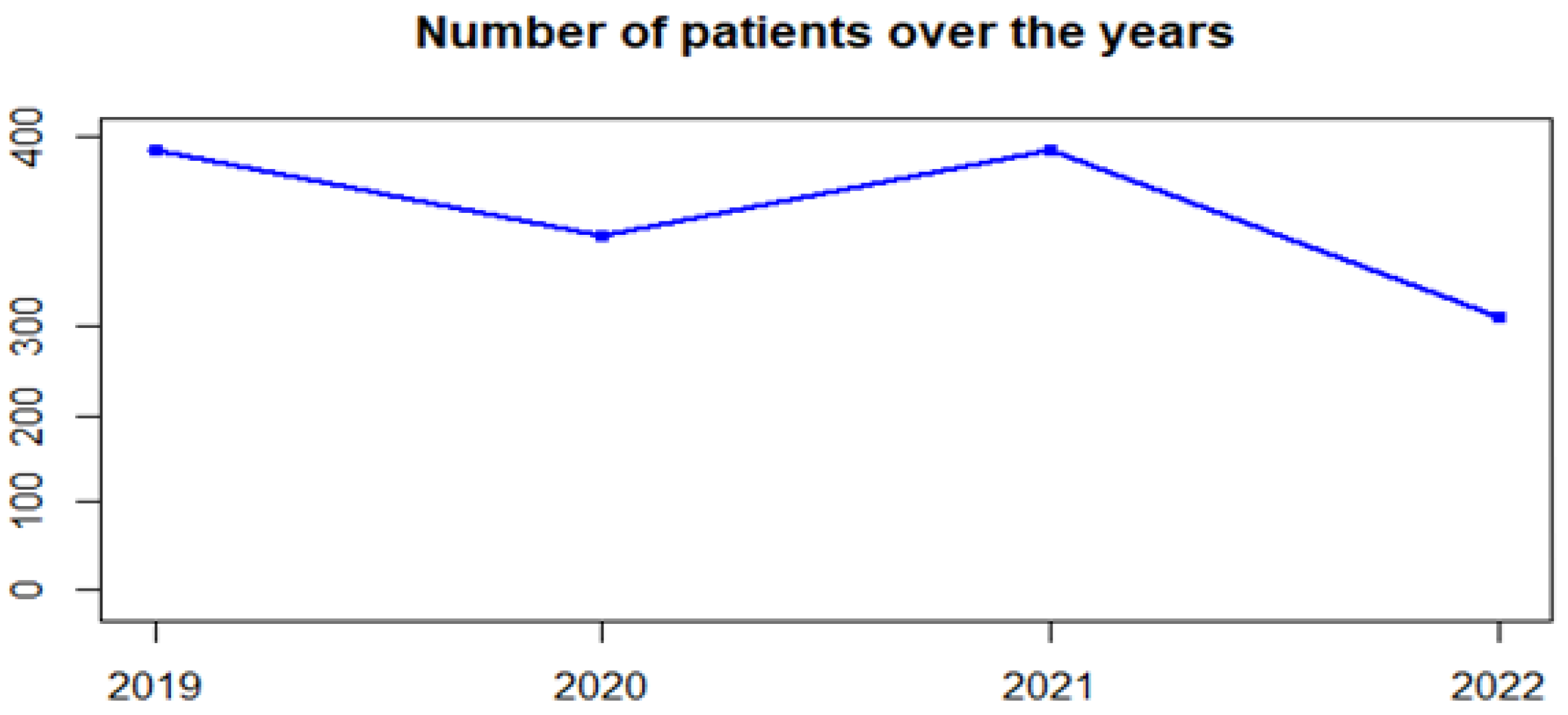

| Year | Frequency | Percent | Valid Percent | Cumulative Percent | |
| Valid | 2019 | 451 | 25.8 | 25.8 | 25.8 |
| 2020 | 416 | 23.8 | 23.8 | 49.6 | |
| 2021 | 482 | 27.6 | 27.6 | 77.2 | |
| 2022 | 399 | 22.8 | 22.8 | 100.0 | |
| Total | 1748 | 100.0 | 100.0 | ||
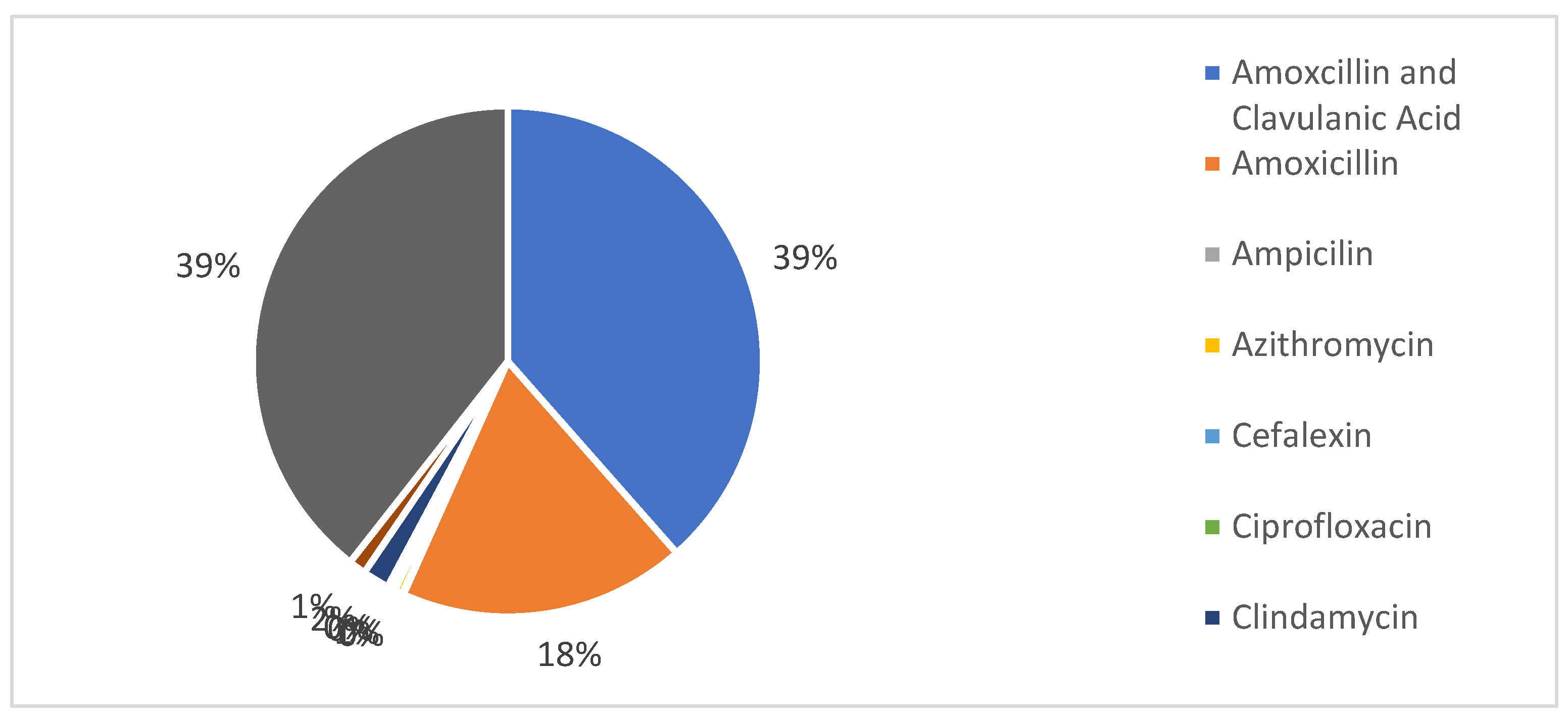
| Name | Frequency | Percent |
| Amoxicillin and Clavulanic Acid | 673 | 38.5 |
| Amoxicillin | 319 | 18.2 |
| Ampicillin | 1 | 0.1 |
| Azithromycin | 8 | 0.5 |
| Cefalexin | 6 | 0.3 |
| Ciprofloxacin | 3 | 0.2 |
| Clindamycin | 29 | 1.7 |
| Erythromycin | 20 | 1.1 |
| Metronidazole | 688 | 39.4 |
| STUDY REFERENCE & COUNTRY | KEY FINDINGS | PRESCRIPTION TRENDS/ANTIBIOTICS USED | METHODOLOGY |
| Shah et al. (2020, England) | 25% increase in antibiotic use due to limited dental access | Amoxicillin, Clindamycin | NHS Business Services Authority data analysis (2018-2020) |
| Duncan et al. (2021, Scotland) | 49% increase in prescriptions due to suspended routine dental care | Amoxicillin, Metronidazole | Public Health Scotland national prescribing data and online dentist survey |
| Bara et al. (2022, France) | Increased prescriptions among elderly patients and reduced paediatric use | Penicillin, Amoxicillin | French National Health Data System (2019-2020) |
| Mian et al. (2021, Australia) | Rise in prescriptions of amoxicillin with clavulanic acid | Amoxicillin + Clavulanic Acid | PBS data from January-June 2019 and 2020 |
| Tousi et al. (2023, Norway) | Reversed downward trend in antibiotic use during COVID-19 | Penicillin, Amoxicillin | Norwegian Prescription Register (2016-2021) |
| Šutej et al. (2023, Croatia) | 39.3% increase in azithromycin prescriptions | Azithromycin, Amoxicillin | Croatian Health Insurance Fund (2015-2020) |
| Krasniqi et al. (2023, Kosovo) | High dependency on pharmacological treatment with analgesics like ibuprofen | Amoxicillin, Ibuprofen | Cross-sectional study on 55 severe COVID-19 patients |
| Hoti, A. et al. (2023, Kosovo) | Overuse of broad-spectrum antibiotics like amoxicillin and enzyme inhibitors | Amoxicillin + Clavulanic Acid, Clindamycin, Metronidazole | Retrospective analysis at University Dental Clinical Center of Kosovo (2019-2022) |
| Tolaj, I. et al. (2024, Kosovo) | All COVID-19 patients in secondary healthcare hospitals were treated with antibiotics | Ceftriaxone, Co-Amoxiclav | Cross-sectional study with 460 patients using ID-IRI questionnaire |
| Mustafa, L. et al. (2021, Kosovo) | ICU patients were treated with broad-spectrum antibiotics, raising concerns about resistance | Imipenem, Ceftriaxone | Observational study of 52 ICU patients at University Hospital in Pristina |
| Aliaga, L. et al. (2024, Kosovo) | Ongoing study focusing on medication adherence during the pandemic | Various | Survey distributed among healthcare professionals and patients |
| Chandrasekara et al. (2021, UK) | 17% decrease in prescriptions during the pandemic. | Amoxicillin, Clindamycin | Retrospective data collection from urgent dental care records. |
| Subramanya et al. (2021, Global) | AMR worsened due to disrupted global health programs and increased antibiotic use. | Various, AMR-related drugs | Systematic review of AMR and antibiotic use during the pandemic. |
| Khami et al. (2022, Iran) | 3.39-fold increase in self-medication with antibiotics post-pandemic. | Self-prescribed antibiotics, mainly broad-spectrum | Cross-sectional study of patient records pre- and post-pandemic. |
| Rabie & Figueiredo (2021, Canada) | 66% increase in prescriptions, especially antibiotics and analgesics. | Amoxicillin, Clindamycin, Ibuprofen | Retrospective analysis of prescriptions in public dental clinics. |
| Dar-Odeh et al. (2020, Global) | Dentists restricted to emergency treatments, raising concerns over AMR. | Various, including amoxicillin, clindamycin | Literature review on dental practices during COVID-19. |
| Rodríguez-Fernández et al. (2022, Spain) | Decrease in prescriptions during lockdown, but rebound in 2021. | Amoxicillin, Clindamycin | Quasi-experimental study on prescription data. |
| Bordea et al. (2021, Global) | Emphasized need for strict infection control to prevent virus spread. | Various, dental-specific antibiotics | Systematic review of global dental policies during COVID-19. |
| Immel et al. (2024, Canada) | Significant reduction in antibiotic prescriptions during lockdown. | Amoxicillin, Ibuprofen | Retrospective time-series analysis of prescriptions. |
| Kitano et al. (2021, Canada) | 31.2% reduction in antibiotic prescriptions during pandemic. | Respiratory antibiotics | Interrupted time series analysis of outpatient prescriptions. |
| Aliaga et al. (2024, Kosovo) | Medication adherence worsened during pandemic; findings still ongoing. | Various, adherence-related medications | Comprehensive survey of healthcare professionals and patients in Kosovo. |
| Soleymani et al. (2024, Global) | Decreasing trends in dental antibiotic use reversed during COVID-19. | Penicillin, Clindamycin | Scoping review across global databases. |
| Cakolli et al. (2024, Kosovo) | High antibiotic use among dental students during COVID-19 in Kosovo. | Amoxicillin, Clindamycin | Survey of knowledge, attitude, and perception among dental students. |
| Petrac et al. (2024, Croatia) | Consistent prescribing patterns over 5 years, but COVID-19 disrupted practices. | Amoxicillin, Clindamycin, Cefuroxime | Retrospective cohort study of national dental practices. |
| Sović et al. (2024, Croatia) | Patterns of antibiotics used for endodontic therapy during COVID-19. | Amoxicillin, Clindamycin | Retrospective analysis of endodontic records during the pandemic. |
| Khan et al. (2022, Global) | Increase in antimicrobial consumption in COVID-19 patients globally. | Azithromycin, Doxycycline | Systematic review and meta-analysis. |
| Ivanovic & Jokic (2023, Serbia) | Private dental organizations faced significant challenges during COVID-19. | Amoxicillin, Azithromycin | Observational study of private dental practices during the pandemic. |
| Sulis (2021, Global) | Widespread antibiotic abuse in low- and middle-income countries worsened by COVID-19. | Amoxicillin, Azithromycin | McGill University study on global antibiotic abuse trends. |
| Petrač et al. (2024, Croatia) | Antibiotic consumption increased in Slavonia during the pandemic. | Amoxicillin, Penicillin | Observational study on antibiotic use in Croatian counties. |
| Serretiello et al. (2023, Italy) | AMR in Pseudomonas aeruginosa worsened during the pandemic. | Carbapenems, Fluoroquinolones | Retrospective cohort analysis in Italian hospitals. |
| Aliaga et al. (2024, Kosovo) | Survey study on medication adherence in Kosovo during COVID-19. | Amoxicillin, Adherence-related medications | Survey conducted with healthcare professionals and patients in Kosovo. |
| Mancini et al. (2022, Kosovo) | Orthodontic emergencies and antibiotic use increased during COVID-19. | Amoxicillin, Doxycycline | Retrospective cohort study on orthodontic emergencies. |
| Abubakar & Sartelli (2023, Global) | Identified 10 golden rules for antibiotic use in hospital settings. | Broad-spectrum antibiotics | International call to action on optimizing antibiotic use in hospitals. |
| Haliti et al. (2015, Kosovo) | Over-prescription of antibiotics in Kosovo’s dental clinics. | Amoxicillin, Clindamycin | Retrospective analysis of dental prescriptions at the Oral Surgery Department. |
| Haliti et al. (2013, Kosovo) | Study on antibiotic utilization at the university dental clinic in Kosovo. | Amoxicillin, Clindamycin | Open Journal of Stomatology study on prescription trends. |
| Horvat et al. (2022, Serbia) | Survey on knowledge and attitudes towards antibiotic use among prescribers. | Amoxicillin, Penicillin | Prospective antibiotic prescribers survey in Serbia. |
| Lila et al. (2018, Kosovo) | Pseudomonas aeruginosa prevalence and AMR trends in Kosovo’s University Hospital. | Carbapenems, Fluoroquinolones | Molecular epidemiology study at the University Clinical Center of Kosovo. |
| Etana et al. (2017, Ethiopia) | Cross-sectional study on antibiotic use patterns at a dental clinic. | Amoxicillin, Metronidazole | Retrospective analysis of prescriptions in Ethiopian dental practices. |
| Hamiti-Krasniqi et al. (2014, Kosovo) | Local application of Clindamycin reduced dry socket after molar extraction. | Clindamycin | Randomized, placebo-controlled trial in Kosovo dental clinics. |
Disclaimer/Publisher’s Note: The statements, opinions and data contained in all publications are solely those of the individual author(s) and contributor(s) and not of MDPI and/or the editor(s). MDPI and/or the editor(s) disclaim responsibility for any injury to people or property resulting from any ideas, methods, instructions or products referred to in the content. |
© 2025 by the authors. Licensee MDPI, Basel, Switzerland. This article is an open access article distributed under the terms and conditions of the Creative Commons Attribution (CC BY) license (http://creativecommons.org/licenses/by/4.0/).


