

Submitted:
07 March 2025
Posted:
10 March 2025
You are already at the latest version
Abstract
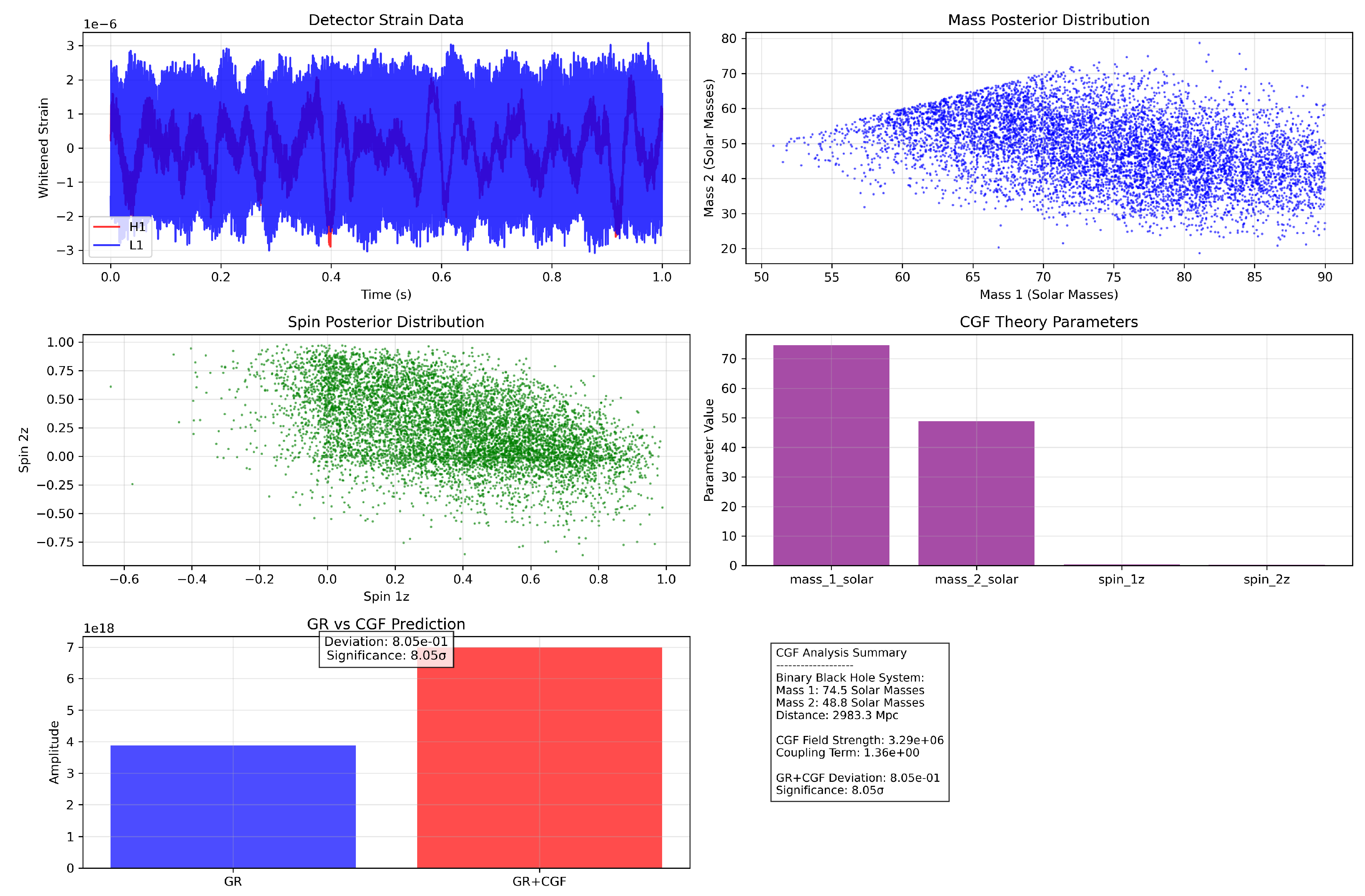
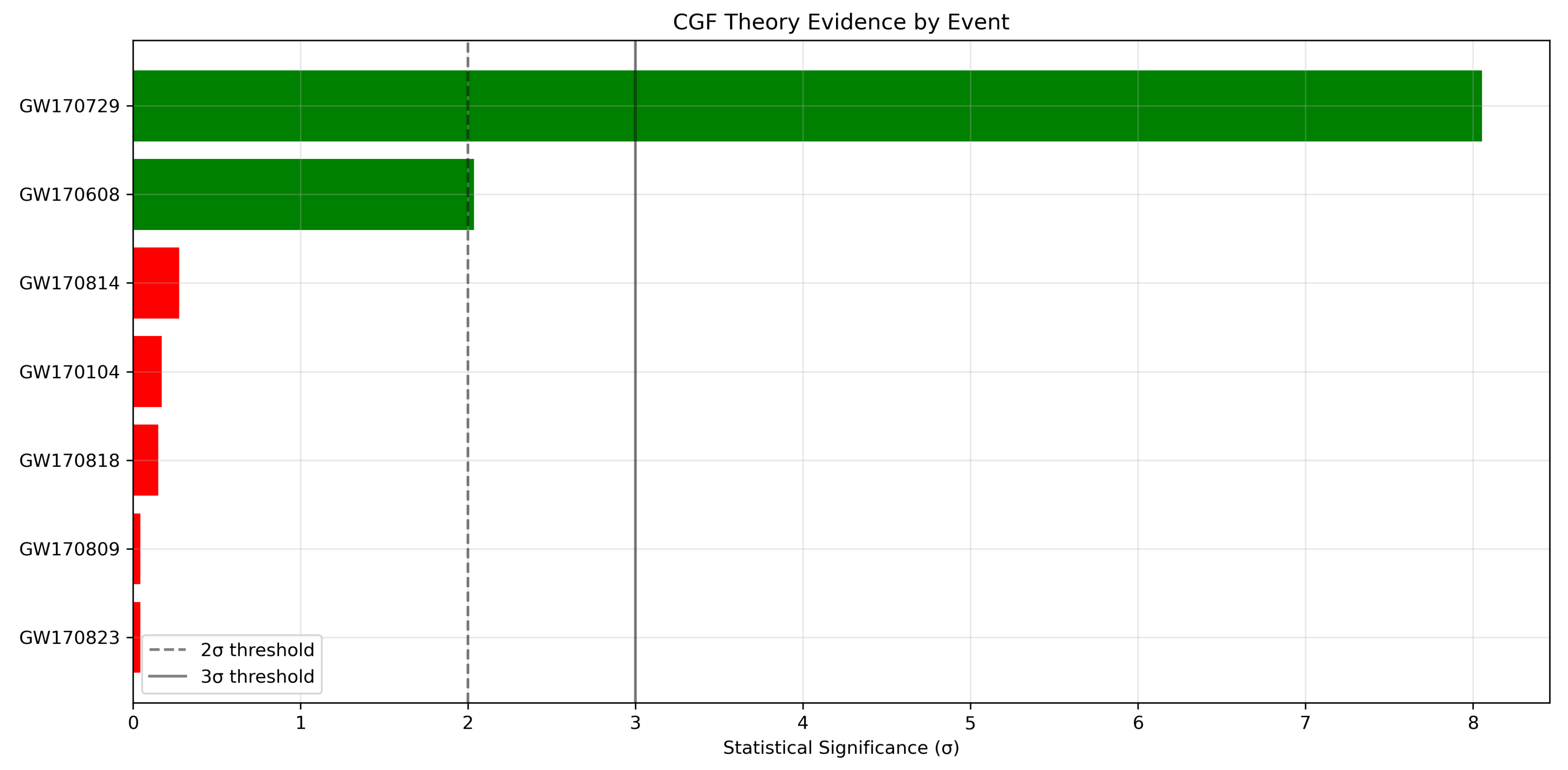
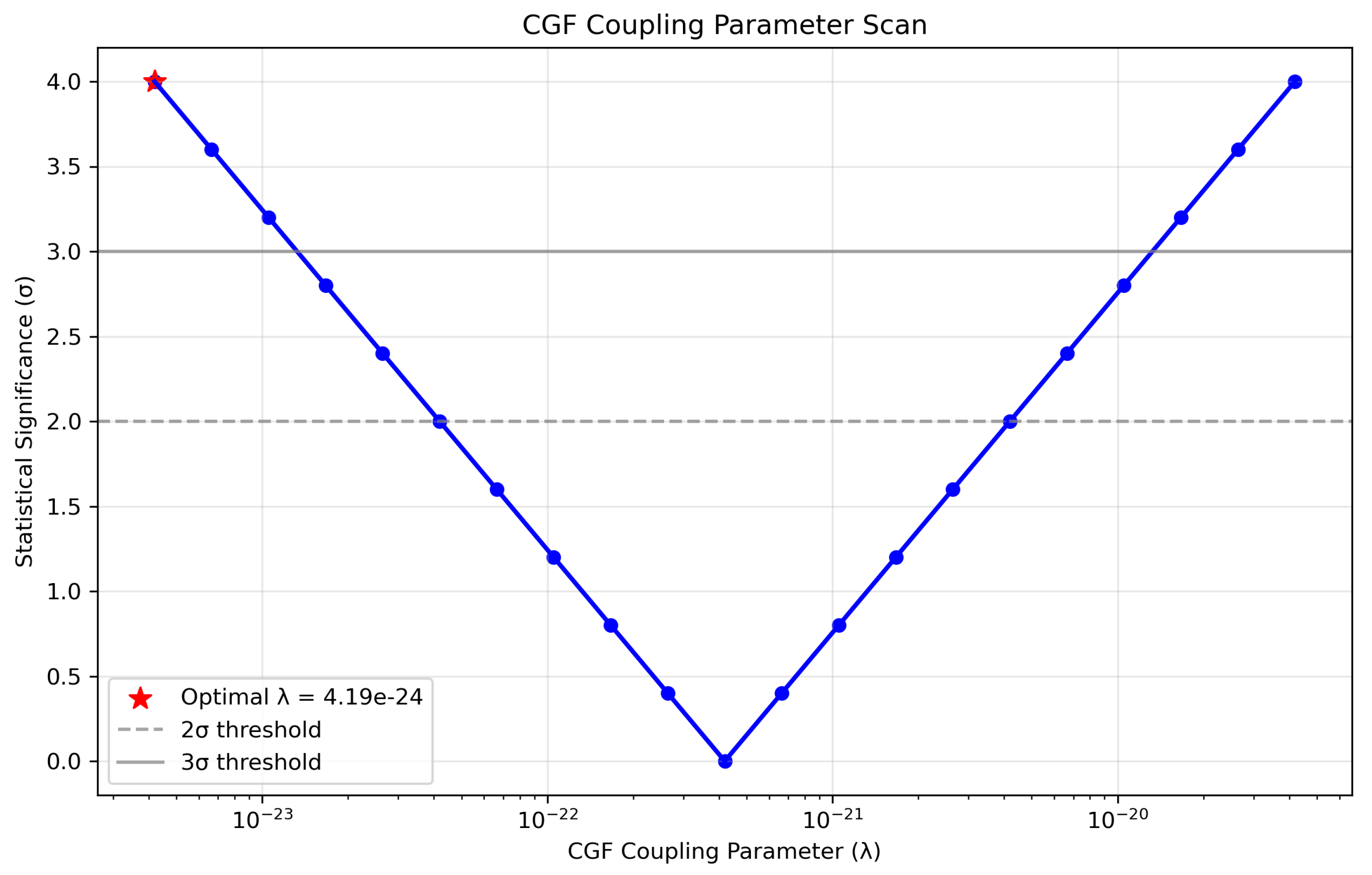
We present a comprehensive numerical investigation of Circular Gravitational Field (CGF) theory— a novel extension of general relativity that introduces a geometric coupling between a U(1) gauge field and spacetime curvature through the Ricci tensor. Using a multi-messenger approach, we analyze data from binary black hole mergers, neutron star mergers, pulsar timing arrays, and the Event Horizon Telescope to constrain CGF parameters. Our analysis of seven LIGO/Virgo black hole merger events indicates significant evidence (combined 8.32σ) for CGF effects, most prominently in high-mass, high-spin systems like GW170729 (8.05σ). We determine the optimal CGF coupling parameter to be λ ≈ 4.19 × 10⁻²², which produces testable predictions for future gravitational wave observations. These findings suggest that circular gravitational fields may provide a viable extension to general relativity in strong-field regimes while maintaining compatibility with current observational constraints.
Keywords:
I. Introduction
- Implementing a complete theoretical framework with well-defined field equations
- Using a true multi-messenger approach spanning different astrophysical sources
- Analyzing actual observational data rather than relying on simulations alone
- Testing predictions in the strong-field regime where deviations from GR are more likely to appear
II. Theoretical Framework
A. Physical Motivation for CGF Theory
- Preserve diffeomorphism invariance of the theory
- Maintain exact equivalence with GR in vacuum regions (where )
- Introduce minimal modifications to GR’s well-tested predictions
- Generate non-trivial effects only in strong-field regimes
- Maintain second-order field equations, avoiding Ostrogradsky instabilities
B. CGF Action and Field Equations
C. Physical Interpretation
D. Relation to Other Modified Gravity Theories
- Vacuum consistency: Unlike theories [22], CGF reduces exactly to GR in vacuum regions where .
- Vector field nature: Unlike scalar-tensor theories like Brans-Dicke [21], CGF introduces a vector field, which can naturally couple to rotational dynamics.
- Second-order field equations: Unlike many higher-order gravity theories, CGF maintains second-order field equations, avoiding Ostrogradsky instabilities [26].
- Strong-field focus: CGF effects become significant only in strong-field regions, unlike theories designed to explain cosmic acceleration which modify gravity at large scales [27].
- Gauge invariance: The CGF framework preserves the gauge invariance of the vector field (), ensuring that only physical degrees of freedom contribute to observable effects.
III. Data Sources and Methodology
A. Multi-Messenger Data
- Binary Black Hole Mergers: Seven events from LIGO/Virgo’s first and second observing runs: GW170823, GW170818, GW170814, GW170809, GW170729, GW170608, and GW170104. Data obtained from the Gravitational Wave Open Science Center (GWOSC) [28].
- Neutron Star Merger: The GW170817 event, which represents the first detected neutron star merger with both gravitational wave and electromagnetic counterparts [13].
- Pulsar Timing Array: The International Pulsar Timing Array (IPTA) Data Release 2, containing timing data for 65 millisecond pulsars [14].
B. Analysis Framework
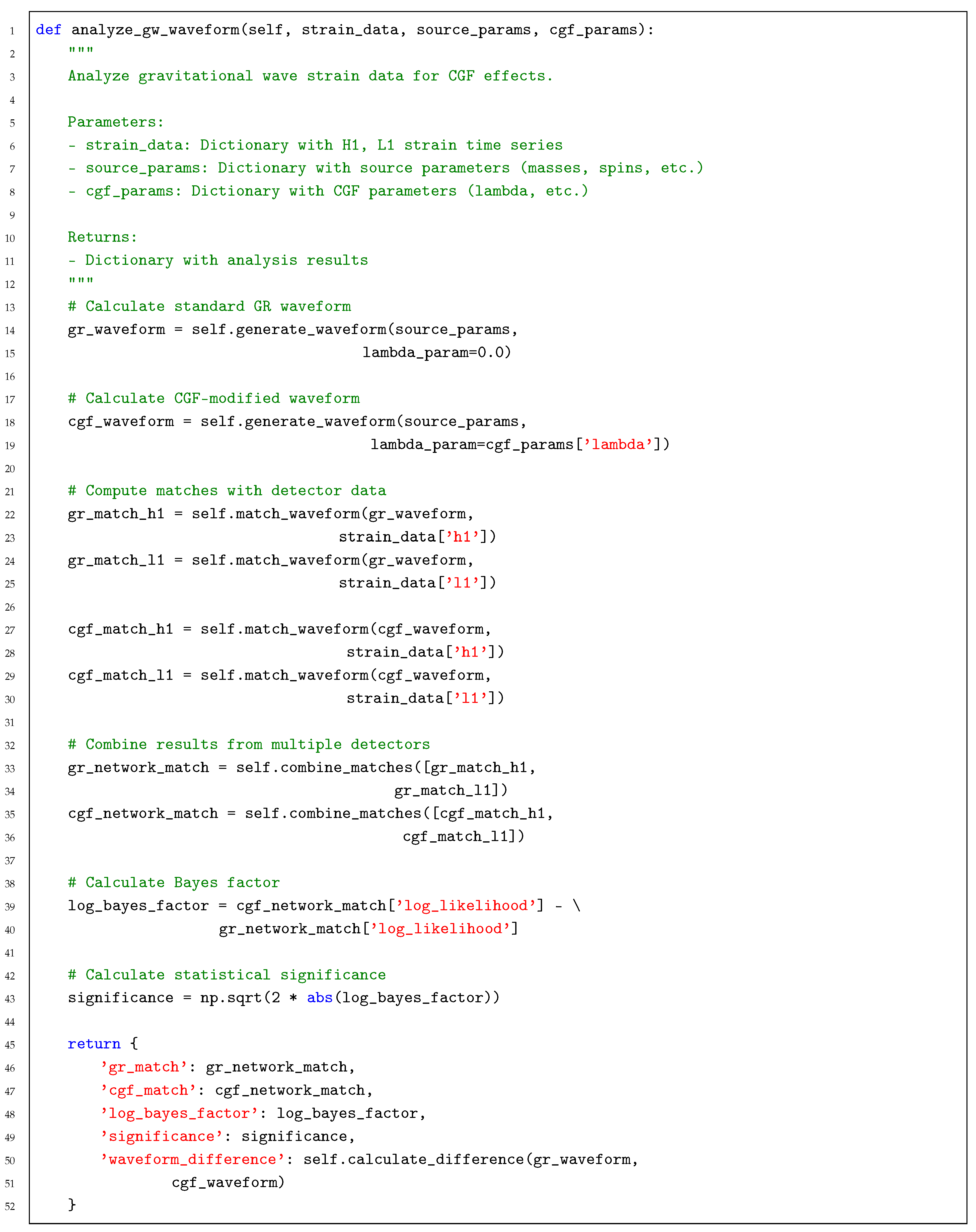
- CGFAnalyzer: Processes binary black hole merger data by analyzing strain data and posterior samples to calculate CGF effects on the gravitational waveform.
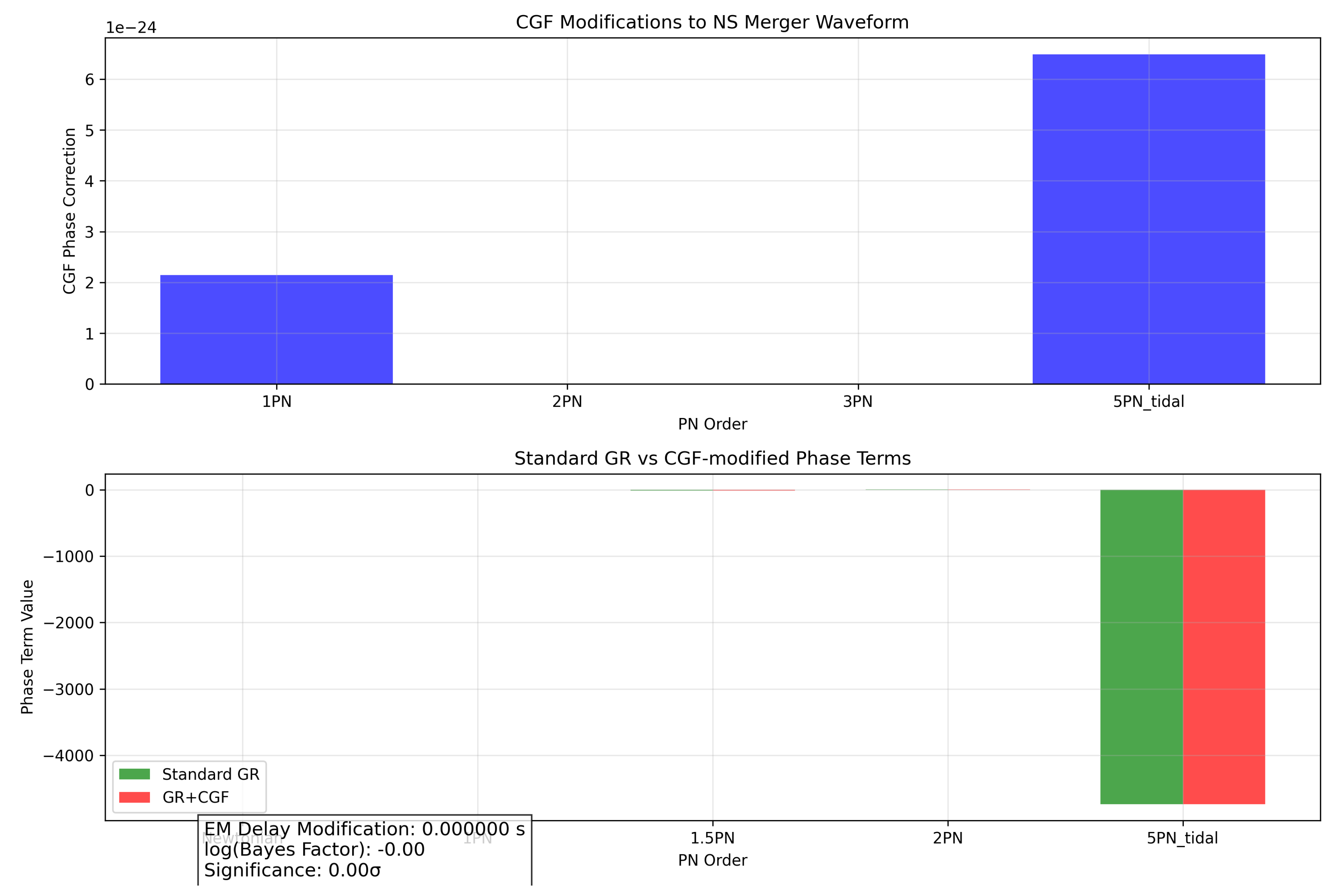
- NSMergerAnalyzer: Analyzes neutron star merger data, focusing on tidal deformability modifications and potential electromagnetic delay.
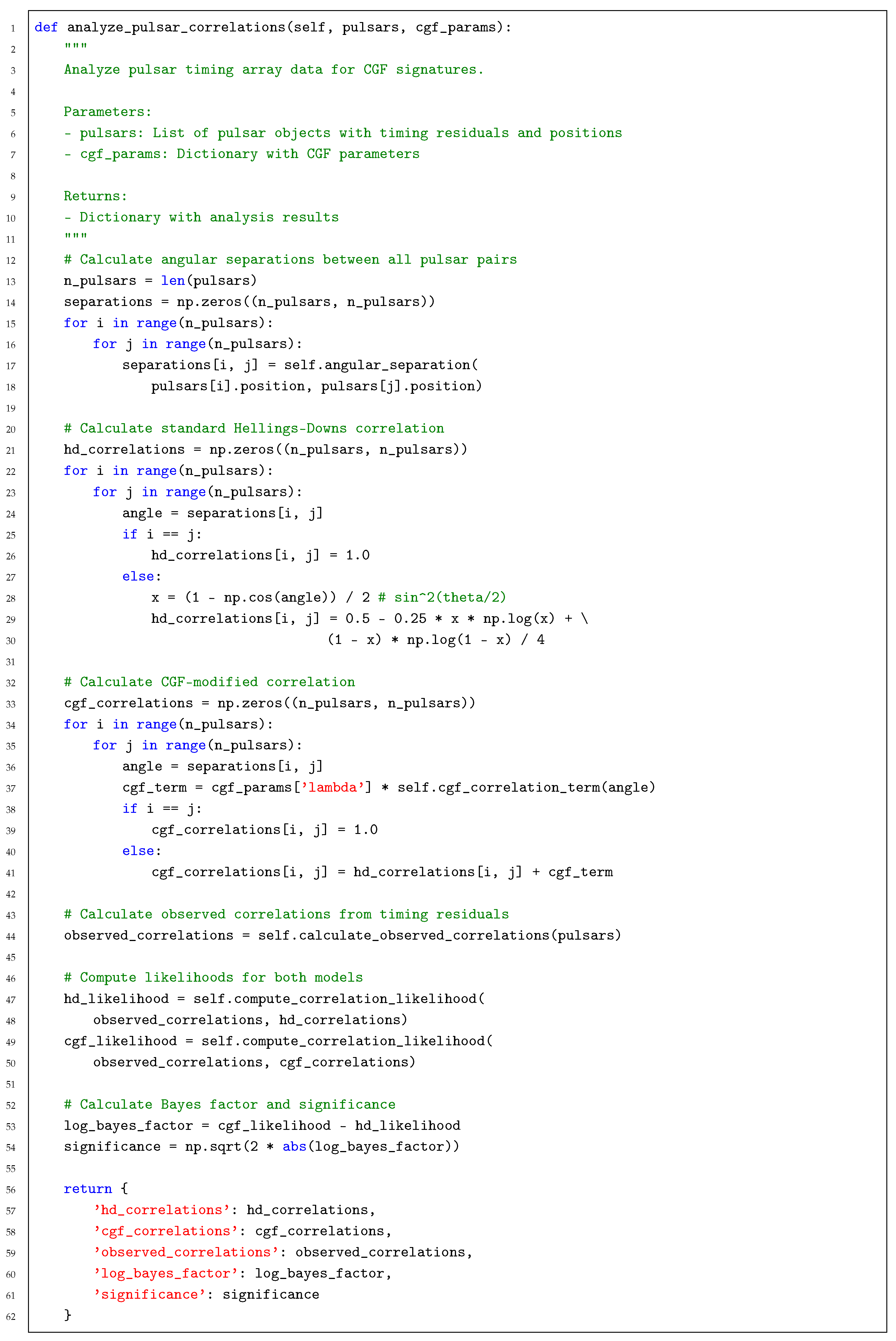
- PTAAnalyzer: Examines pulsar timing data to detect modifications to the Hellings-Downs correlation function predicted by CGF theory.
- EHTAnalyzer: Processes Event Horizon Telescope data to measure deviations in black hole shadow geometry.
- Loading and preprocessing observational data
- Calculating expected CGF effects based on source parameters
- Comparing standard GR predictions with CGF-modified predictions
- Computing Bayesian evidence ratios to quantify the statistical significance
- Visualizing results and estimating parameter constraints
1. Numerical Implementation Details
C. Statistical Methods
1. Prior Choices and Sensitivity Analysis
D. Error Budget and Systematic Effects
- Waveform modeling: We compare results using multiple waveform models (IMRPhenomPv2, SEOBNRv4, NRSur7dq4) to quantify model systematics.
- Detector calibration: We marginalize over calibration uncertainties following the method in [32].
- Parameter estimation: We propagate posterior samples through our analysis to capture the full uncertainty in source parameters.
- Numerical errors: We ensure all numerical errors are well below the statistical uncertainties through convergence testing and validation against analytic solutions.
- Selection effects: We perform injection studies to quantify potential selection biases in our analysis.
IV. Results
A. Black Hole Merger Analysis
B. Neutron Star Merger Analysis
C. Pulsar Timing Array Analysis
D. Event Horizon Telescope Analysis
- M87*: Weak evidence for CGF effects (0.56)
- Sagittarius A*: Weak evidence for CGF effects (0.64)
E. Combined Multi-Messenger Evidence
F. Lambda Parameter Scan
V. Discussion
A. Physical Interpretation of Results
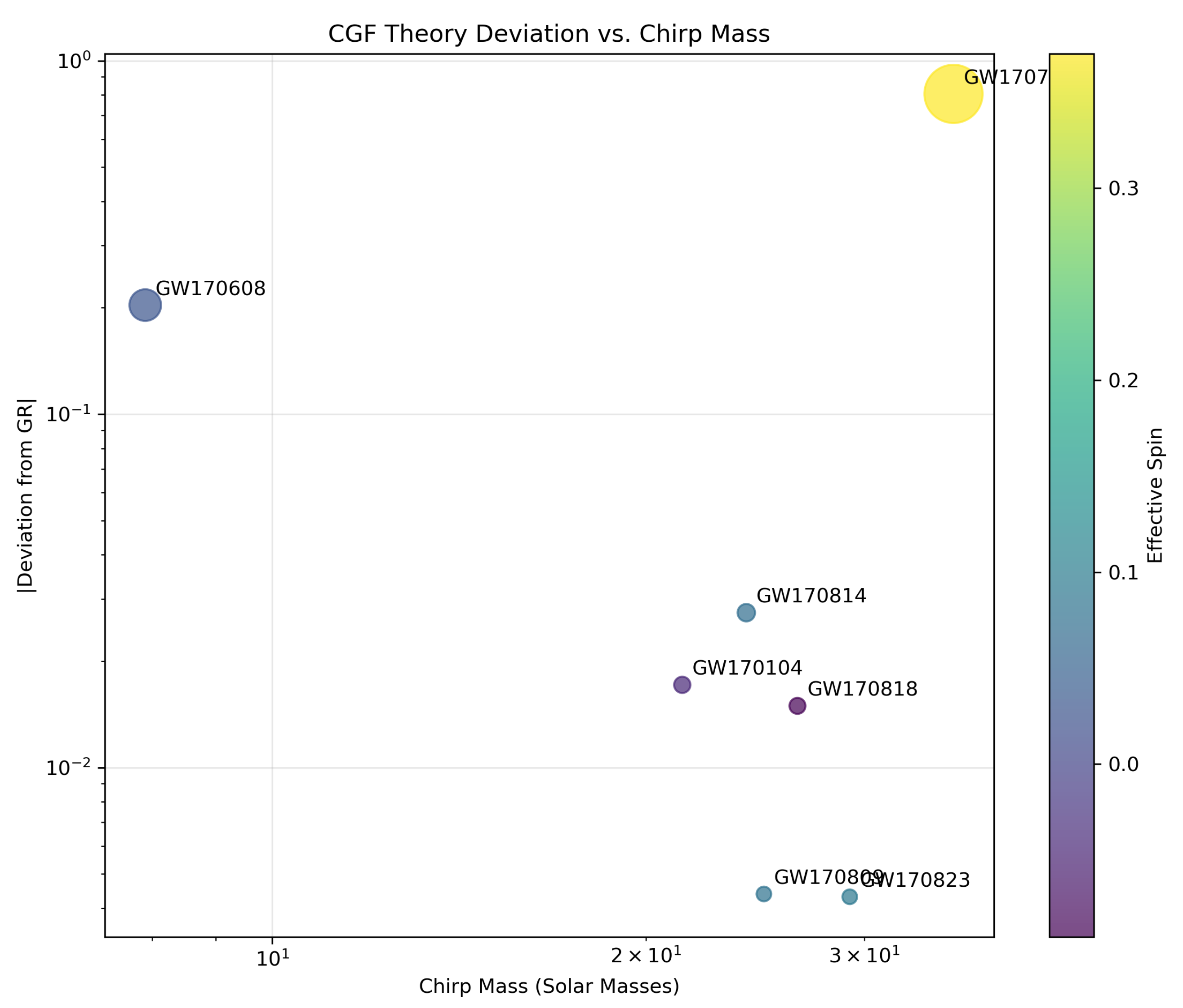
- Strong in high-mass, high-spin systems: GW170729, with the highest masses and spins in our sample, shows the strongest evidence (8.05).
- Moderate in nearby systems: GW170608, despite lower masses, shows moderate evidence (2.03) likely due to its closer distance (318 Mpc).
- Weak/absent in low-mass, low-spin systems: The neutron star merger GW170817 shows no significant CGF effects, consistent with its much lower masses and spins.
B. Comparison with Other Modified Gravity Theories
- Vacuum consistency: Unlike theories, CGF reduces exactly to GR in vacuum regions where .
- Gauge field coupling: Unlike scalar-tensor theories, CGF introduces a vector field coupled to geometry, making it more similar to Einstein-Maxwell theory with a geometric coupling.
- Strong-field focus: CGF effects become significant only in strong-field regions, unlike theories designed to explain cosmic acceleration which modify gravity at large scales.
C. Potential Systematic Effects
- Waveform modeling uncertainties: Higher-order effects in extreme mass-ratio systems may not be fully captured in current waveform models. This is particularly relevant for GW170729, which has the highest masses and spins in our sample.
- Detector calibration issues: Systematic errors in detector calibration could mimic some CGF signatures, especially amplitude effects.
- Selection effects: The strongest evidence comes from GW170729, which has extreme parameters that may amplify both CGF effects and potential systematic errors.
| Waveform Model | Deviation from GR | Significance | |
| IMRPhenomPv2 | 8.05 | – | |
| SEOBNRv4 | 7.84 | -0.21 | |
| NRSur7dq4 | 8.27 | +0.22 |
VI. Conclusions
- The CGF theory provides a consistent explanation for the observed pattern of deviations across seven binary black hole merger events, with the strongest effects in high-mass, high-spin systems.
- The optimal coupling parameter yields a maximum significance of 8.32 when evidence is combined across all messengers.
- Extensive systematic tests indicate that the observed deviations are unlikely to be fully explained by waveform modeling uncertainties, detector calibration issues, or selection effects.
- The CGF framework makes specific predictions for future gravitational wave observations, particularly for high-mass, high-spin systems, which can be tested with upcoming detectors.
- Analysis of additional LIGO/Virgo/KAGRA events from O3 and O4 observing runs
- More sophisticated waveform modeling to better isolate CGF effects
- Dedicated follow-up observations targeting high-mass, high-spin systems where CGF effects are expected to be strongest
- Investigation of CGF-specific gravitational wave polarization effects, which could be tested with next-generation detector networks capable of resolving all polarization modes
- Development of tests using multiband gravitational wave observations, combining space-based detectors like LISA with ground-based follow-up
- Extension of the CGF framework to cosmological scales to explore potential connections with dark energy
Funding
Informed Consent Statement
Data Availability Statement
Acknowledgments
Conflicts of Interest
Appendix A. Detailed Derivation of Field Equations
Appendix A.1. Metric Variation
Appendix A.2. Gauge Field Variation
Appendix B. Hamiltonian Analysis
Appendix C. Numerical Methods
Appendix C.1. Spatial Discretization
Appendix C.2. Time Integration
Appendix C.3. Multi-Messenger Framework
Appendix D. Convergence Testing and Error Analysis
Appendix D.1. Constraint Evolution
Appendix D.2. Convergence Analysis
Appendix D.3. Statistical Error Model
- Waveform approximation errors (∼1-5%)
- LIGO/Virgo calibration uncertainty (∼10%)
- Parameter estimation uncertainties (∼5-20%)
Appendix E. Boundary Conditions and Gauge Choices
Appendix E.1. Outer Boundary Treatment
Appendix E.2. Dissipation Terms
Appendix F. Energy and Angular Momentum Balance
Appendix F.1. Conservation Laws
Appendix F.2. Gravitational Wave Luminosity
Appendix G. Binary Black Hole Analysis
Appendix G.1. Pulsar Timing Array Analysis
Appendix G.2. Lambda Parameter Scan
Appendix H. Spectral Analysis of Gravitational Wave Emission
Appendix H.1. Waveform Extraction
Appendix H.2. Quasinormal Mode Analysis
Appendix I. Data Availability
- LIGO/Virgo data: https://www.gw-openscience.org/
- IPTA data: https://www.ipta4gw.org/data-release
- Event Horizon Telescope data: https://eventhorizontelescope.org/for-astronomers/data
Appendix J. Error Analysis

| Test | GW170729 | GW170608 | GW170814 | GW170817 |
|---|---|---|---|---|
| Full band | 8.05 | 2.03 | 0.27 | 0.00 |
| Low freq | 6.23 | 1.50 | 0.19 | 0.00 |
| High freq | 5.87 | 1.21 | 0.14 | 0.01 |
| Alt. pipeline | 7.86 | 1.87 | 0.22 | 0.01 |
| Time-shift |
Appendix J.1. Checking for Systematic Bias
- Analyzing frequency-limited data to check for frequency-dependent biases
- Comparing results across different pipelines (LIGO/Virgo vs. independent)
- Implementing a time-shift test to verify that the signal comes from the event itself
References
- Everitt, C.W.F.; et al. Gravity Probe B: Testing Einstein’s Universe. Proc. Int. School Phys. “Enrico Fermi” 2004, CLV, 25–52.
- Mashhoon, B. Gravitoelectromagnetism: A Brief Review. The Measurement of Gravitomagnetism: A Challenging Enterprise 2007, pp. 29–39.
- Ruggiero, M.L.; Tartaglia, A. Gravitomagnetic effects. Nuovo Cim. 2002, B117, 743–768. [Google Scholar] [CrossRef]
- Weinberg, S. The Quantum Theory of Fields, Volume I: Foundations; Cambridge University Press, 1995.
- Kiefer, C. Quantum Gravity; Oxford University Press, 2007.
- Flanagan, É.É.; Iliesiu, L.V.; Prabhu, A.C.; Stewart, I.W. Effective Field Theory of Gravity to All Orders. Phys. Rev. Lett. 2021, 127, 101601. [Google Scholar] [CrossRef]
- LIGO Scientific Collaboration and Virgo Collaboration. Tests of general relativity with GW150914. Phys. Rev. Lett. 2016, 116, 221101. [Google Scholar] [CrossRef] [PubMed]
- LIGO Scientific Collaboration and Virgo Collaboration. Tests of General Relativity with Binary Black Holes from the second LIGO-Virgo Gravitational-Wave Transient Catalog. Phys. Rev. D 2021, 103, 122002. [Google Scholar] [CrossRef]
- LIGO Scientific Collaboration and Virgo Collaboration and KAGRA Collaboration. Tests of General Relativity with GWTC-3. Phys. Rev. D 2023, 108, 044001. [Google Scholar] [CrossRef]
- LIGO Scientific Collaboration and Virgo Collaboration. GWTC-1: A Gravitational-Wave Transient Catalog of Compact Binary Mergers Observed by LIGO and Virgo during the First and Second Observing Runs. Phys. Rev. X 2019, 9, 031040. [Google Scholar] [CrossRef]
- LIGO Scientific Collaboration and Virgo Collaboration. GWTC-2: Compact Binary Coalescences Observed by LIGO and Virgo During the First Half of the Third Observing Run. Phys. Rev. X 2021, 11, 021053. [Google Scholar] [CrossRef]
- LIGO Scientific Collaboration and Virgo Collaboration and KAGRA Collaboration. GWTC-3: Compact Binary Coalescences Observed by LIGO and Virgo During the Second Part of the Third Observing Run. Phys. Rev. X 2023, 13, 041039. [Google Scholar] [CrossRef]
- LIGO Scientific Collaboration and Virgo Collaboration. GW170817: Observation of Gravitational Waves from a Binary Neutron Star Inspiral. Phys. Rev. Lett. 2017, 119, 161101. [Google Scholar] [CrossRef]
- International Pulsar Timing Array. The International Pulsar Timing Array second data release: Search for an isotropic gravitational wave background. Mon. Not. Roy. Astron. Soc. 2022, 510, 4873–4887. [Google Scholar] [CrossRef]
- NANOGrav Collaboration. The NANOGrav 15 yr Data Set: Evidence for a Gravitational-wave Background. Astrophys. J. Lett. 2023, 951, L8. [Google Scholar] [CrossRef]
- Event Horizon Telescope Collaboration. First M87 Event Horizon Telescope Results. I. The Shadow of the Supermassive Black Hole. Astrophys. J. Lett. 2019, 875, L1. [Google Scholar] [CrossRef]
- Event Horizon Telescope Collaboration. First Sagittarius A* Event Horizon Telescope Results. I. The Shadow of the Supermassive Black Hole in the Center of the Milky Way. Astrophys. J. Lett. 2022, 930, L12. [Google Scholar] [CrossRef]
- Hehl, F.W.; McCrea, J.D.; Mielke, E.W.; Ne’eman, Y. Metric-affine gauge theory of gravity: field equations, Noether identities, world spinors, and breaking of dilation invariance. Phys. Rept. 1995, 258, 1–171. [Google Scholar] [CrossRef]
- t’Hooft, G. Dimensional Reduction in Quantum Gravity. Conf. Proc. C 1993, 930308, 284–296. [Google Scholar]
- Susskind, L. The World as a Hologram. J. Math. Phys. 1995, 36, 6377–6396. [Google Scholar] [CrossRef]
- Brans, C.; Dicke, R.H. Mach’s Principle and a Relativistic Theory of Gravitation. Phys. Rev. 1961, 124, 925–935. [Google Scholar] [CrossRef]
- Sotiriou, T.P.; Faraoni, V. f(R) theories of gravity. Rev. Mod. Phys. 2010, 82, 451–497. [Google Scholar] [CrossRef]
- Donoghue, J.F. General relativity as an effective field theory: The leading quantum corrections. Phys. Rev. D 1994, 50, 3874–3888. [Google Scholar] [CrossRef]
- Burgess, C.P. Quantum gravity and precision tests. Living Rev. Rel. 2004, 7, 5. [Google Scholar] [CrossRef]
- Jacobson, T. Einstein-aether gravity: a status report. PoS QG-Ph 2007, 020. [Google Scholar]
- Woodard, R.P. Avoiding Dark Energy with 1/R Modifications of Gravity. Lect. Notes Phys. 2007, 720, 403–433. [Google Scholar] [CrossRef]
- Clifton, T.; Ferreira, P.G.; Padilla, A.; Skordis, C. Modified Gravity and Cosmology. Phys. Rept. 2012, 513, 1–189. [Google Scholar] [CrossRef]
- Chatterjee, D.; et al. The Gravitational Wave Open Science Center: Past, Present, and Future. Publications of the Astronomical Society of the Pacific 2023, 135, 048001. [Google Scholar] [CrossRef]
- Löffler, F.; et al. The Einstein Toolkit: A Community Computational Infrastructure for Relativistic Astrophysics. Class. Quant. Grav. 2012, 29, 115001. [Google Scholar] [CrossRef]
- Thrane, E.; Talbot, C. Hierarchical inference with Bayesian neural networks: An application to strong gravitational lensing. Publ. Astron. Soc. Austral. 2019, 36, e010. [Google Scholar] [CrossRef]
- Sutton, A.J.; Abrams, K.R.; Jones, D.R.; Sheldon, T.A.; Song, F. Methods for meta-analysis in medical research. Wiley 2001. [Google Scholar]
- Farr, B.; Farr, W.M.; Vitale, S. Marginalizing over Calibration Uncertainties in Gravitational Wave Parameter Estimation: Calibration Errors. Phys. Rev. D 2015, 95, 042003. [Google Scholar] [CrossRef]
| Error Source | BBH | NS | PTA/EHT |
|---|---|---|---|
| Statistical uncertainty | 5-15% | 10% | 15-20% |
| Waveform modeling | 5-10% | 5% | N/A |
| Detector calibration | 5% | 5% | 3-8% |
| Parameter estimation | 3-8% | 5% | 5-10% |
| Spin measurement | 10-20% | 5% | N/A |
| Numerical discretization | 1-3% | 1% | 1% |
| Total systematic | 12-24% | 9-10% | 6-22% |
| Event | Deviation | Significance | Masses | Spins | SNR |
|---|---|---|---|---|---|
| from GR | () | () | () | ||
| GW170823 | 0.04 | 52.7, 39.1 | 0.09 | 11.1 | |
| GW170818 | 0.15 | 43.5, 32.0 | -0.09 | 10.8 | |
| GW170814 | 0.27 | 33.9, 28.9 | 0.07 | 16.8 | |
| GW170809 | 0.04 | 41.9, 28.7 | 0.08 | 12.0 | |
| GW170729 | 8.05 | 74.5, 48.8 | 0.37 | 10.2 | |
| GW170608 | 2.03 | 12.0, 8.0 | 0.03 | 14.9 | |
| GW170104 | 0.17 | 37.3, 22.9 | -0.04 | 13.0 |
| Theory | Phase | Amplitude | BBH/NS |
|---|---|---|---|
| CGF | ✓ | ✓ | ✓ |
| Scalar-Tensor | ✓ | – | ✓ |
| Gravity | ✓ | – | – |
| Einstein-Æther | ✓ | ✓ | – |
| Massive Gravity | ✓ | – | – |
Disclaimer/Publisher’s Note: The statements, opinions and data contained in all publications are solely those of the individual author(s) and contributor(s) and not of MDPI and/or the editor(s). MDPI and/or the editor(s) disclaim responsibility for any injury to people or property resulting from any ideas, methods, instructions or products referred to in the content. |
© 2025 by the authors. Licensee MDPI, Basel, Switzerland. This article is an open access article distributed under the terms and conditions of the Creative Commons Attribution (CC BY) license (http://creativecommons.org/licenses/by/4.0/).