

Submitted:
11 April 2026
Posted:
14 April 2026
You are already at the latest version
Abstract
Microsoft Windows remains the dominant desktop operating system and, therefore a frequent focus of digital forensic and incident response investigations. Windows Registry analysis is particularly valuable because it captures persistence mechanisms, execution traces, user activity, device usage, and system configuration changes that are often central to incident reconstruction. Nevertheless, modern investigations are challenged by the scale of Registry data, the fragmentation of evidence across hives and complementary sources, and the need to prioritise investigative actions under time pressure. This paper presents WinRegRL, a hybrid framework that combines Reinforcement Learning (RL) with Rule-based Artificial Intelligence (RB-AI) for automated Windows Registry and timeline-centred forensic analysis. The framework models the investigation process as a Markov Decision Process (MDP) with explicitly defined states, actions, transition dynamics, and reward design, and incorporates expert-derived policy graphs to initialise and refine the search strategy. We evaluate the framework on four heterogeneous forensic datasets spanning multiple Windows versions and incident scenarios, and we compare it against analyst-assisted baselines and controlled examiner-led workflows. Under the evaluation protocol adopted in this study, WinRegRL reduced investigation time by up to 68%, increased the number of adjudicated relevant artefacts identified by up to 35%, and achieved high artefact-level precision on the evaluated datasets. Rather than claiming universal superiority, we show that the proposed framework provides a reproducible and explainable decision-support mechanism that improves investigation efficiency while maintaining strong evidential coverage in the tested scenarios. These findings position WinRegRL as a promising decision-support framework for large-scale and time-critical Windows incident response.
Keywords:
incident response
; digital forensics
; MicrosoftWindows
; timeline analysis
; registry analysis
; reinforcement learning
; MDP
; cyber incident
1. Introduction
Microsoft Windows dominates the global operating system (OS) market, with over 75% of desktop users worldwide relying on it for both personal and professional purposes [1]. This widespread adoption, however, makes Windows a prime target for malicious actors seeking to exploit vulnerabilities for data theft, system disruption, and other nefarious activities [2]. The Windows Registry (WR) serves as a living repository of configuration settings, user activities, and system events, providing a foundation for reconstructing digital event sequences, detecting malicious behaviour, and delivering crucial evidence in investigations [3]. The response to cyber incidents involves both live monitoring and post-incident forensic analysis. Live monitoring tracks and records system data in real-time, while post-incident analysis investigates events after they have occurred. Both methods are used to map Registry paths containing Universal Serial Bus (USB) identifiers, such as make, model, and global unique identifiers (GUIDs), which distinguish individual USB devices. These identifiers are often located in both allocated and unallocated Registry spaces [4].
However, the sheer volume of data within the Registry and the sophistication of modern cyberattacks pose significant challenges for the digital forensics and incident response (DFIR) community [5]. The introduction of Windows 10 and 11, designed for seamless operation across computers, smartphones, tablets, and embedded systems, has further expanded their adaptability and reach, complicating forensic efforts [6].
Current Registry forensic analysis faces several challenges. The volume of data is immense, while the lack of automation in traditional tools forces time-consuming manual work. Its dynamic nature and frequent changes complicate tracking, and limited contextual information often demands expert interpretation. Moreover, data fragmentation across hives and keys, the evolution of Windows versions, and limited advanced analysis features further hinder effective forensic investigation. Addressing these challenges requires advanced tools, investigative techniques, and artificial intelligence (AI) integration to enhance the efficiency and accuracy of Registry analysis. This research seeks to improve the efficiency of forensic investigations involving the WR by introducing a framework that integrates reinforcement learning (RL) with a Rule-Based AI (RB-AI) system. The framework employs a Markov decision process (MDP) model to represent the WR and events timeline, enabling state transitions, actions, and rewards to support analysis and event correlation [7].
1.1. Research Questions
This study aims to contribute to the advancement of cyber incident response in the context of WR analysis and forensics by addressing the following research questions:
RQ1: How can combining RL and RB-AI in WinRegRL enhance the effectiveness, accuracy, and scalability of Windows forensic investigations?
RQ2: What performance metrics validate WinRegRL’s effectiveness over traditional forensics, and how does it address modern cybercrime targeting WR artefacts?
RQ3: To what extent does WinRegRL enable consistent, optimised multi-machine analysis, and what are the implications for DFIR applications?
1.2. Novelty and Contribution
This research introduces a novel application of RL to automate Windows cyber incident investigations, addressing gaps and limitations in existing registry analysis methods, tools, and techniques. The main contributions to the body of knowledge and DFIR practice are:
- MDP model and WinRegRL: A novel MDP-based framework that provides a structured representation of the Windows environment (Registry, volatile memory, and file system), enabling efficient automation of the investigation process.
- Expertise extraction and reply: By capturing and generalising optimal policies, the framework reduces investigation time through direct feeding of these policies into the MDP solver, minimising the time required for the RL agent to discover decisions.
- Performance characterisation: Empirical results are reported using formally defined artefact-level precision, recall (coverage), F1-score, and time-to-completion metrics under a controlled benchmarking protocol against automated baselines and examiner-led workflows. This paper reports empirical results using formally defined artefact-level precision, recall (coverage), F1-score, and time-to-completion metrics under a controlled benchmarking protocol against automated baselines and examiner-led workflows.
For clarity, the following terms are used throughout this paper. The following Table 1 summarises key abbreviations used in this paper.
1.3. Article Organization
The remainder of this paper is organised as follows: Section 2 provides an overview of WR and volatile memory forensic analysis, along with the state-of-the-art tools and investigation frameworks. Section 3 explains the registry structure, its forensic relevance, and introduces RL key elements, approaches, and their use in this research. It also details the architecture and modules of the proposed RL-powered framework, hereafter referred to as WinRegRL. Section 4 discusses the WinRegRL implementation, testing results, and their interpretation. Finally, Section 5 presents reflections, conclusions, and future research directions.
2. Literature Review
The WR is a cornerstone of Microsoft Windows OS, serving as a hierarchical database that stores configuration settings, system information, and user preferences. From a forensic perspective, the Registry is a goldmine of information, offering insights into system activities, user actions, and potential security breaches [8,9]. Table 2 summarises the high-level architecture and content of different registry hives. These hives store critical data, including user profiles, installed software, and network settings, and are traditionally analysed using tools such as Registry Editor or specialised forensic software like FTK Imager. Key forensic artefacts within the Registry include UserAssist (recently executed programs), MRU (most recently used files), ShellBags (folder navigation), and External Devices (connected USB drives) [10]. These artefacts provide valuable information for live security monitoring and post-incident investigations.
Traditional Registry Forensic Tools
Several traditional and semi-automated tools have been proposed to assist in WR forensics without relying on AI. For instance, [17] introduced ARXEL, an interactive GUI tool for WR analysis capable of extracting data from an E01 image using NTFSDUMP. ARXEL outputs registry information in tabular format, supporting keyword-based searches to facilitate manual investigations. Although time-efficient, its scope is limited to filtering program execution, autoruns, and installed software, and results require manual verification. Kroll artefact parser and extractor (KAPE) [16] is another widely used forensic tool designed for efficient data collection and parsing. Using a target-based approach, KAPE identifies and duplicates files and folders based on predefined instructions (tkape). The tool supports modules for triage and evidence collection, storing results in directories such as Evidence_of_Execution or Browser_History, which can be leveraged for subsequent analysis. TREDE and VMPOP [3] propose methodologies for creating synthetic forensic datasets, whereas ReLOAD [12] focuses on broad-spectrum data analysis, including deleted files. Similarly, RaDaR [15] provides large-scale datasets capturing malware activity across system calls, OS events, and network traffic, supporting benchmarking and comparative evaluation of forensic techniques. These works highlight the evolution of forensic tools that support investigators with automated parsing, dataset generation, and evidence triage, but still require substantial human input.
AI-Enabled Registry Forensic Approaches
With the growth of digital evidence complexity, AI has increasingly been adopted to enhance WR forensic analysis. Specific work in post-incident malware investigations has employed RL to process memory dumps, network traces, and registry artefacts. By modelling registry states in an MDP, RL agents trained with Q-learning can classify malicious entries and correlate registry changes with attack vectors, improving both speed and accuracy [3]. The multi-agent digital investigation toolkit (MADIK) proposed by [14] further demonstrates AI integration. It leverages intelligent software agents (ISA) to autonomously conduct distributed forensic analyses. Among its six agents, the WindowsRegistryAgent focuses on registry artefacts such as installed software and removable media information.
More broadly, AI-enabled forensic analysis encompasses machine learning (ML) and RL approaches [3]. ML techniques such as KNN, DT, SVM, PCA, K-Means, SVD, NB, ANN, LR, and RF have all been applied to WR analysis, enabling the discovery of patterns and anomalies within vast registry datasets. By rewarding optimal behaviours and penalising ineffective ones, RL approaches add adaptability to forensic investigations, while ML models contribute predictive and classification power. This convergence underscores the importance of AI in addressing the challenges of scalability, speed, and intelligent detection in registry forensics. Table 3 summarise the most relevant research works proposing impactful tools or frameworks.
3. Research Methodology
This section outlines the choice of RL and the research methodology adopted in this work. The steps are presented in a way that facilitates understanding of the WR (WinRegRL) forensics domain, its components, and the interaction between the different entities and the human expert. The methodology followed consists of five steps:
- Review of current methods for WR analysis automation, examining their mechanisms, limitations, and challenges in light of the efficiency and accuracy requirements of WR forensics.
- Investigation of techniques and approaches applied in WR forensics. Particular attention is given to ML approaches and rule-based reasoning systems that can extend or replace human intervention in the sequential decision-making processes of WR forensics. This step identifies the most effective ways to integrate rule-based AI systems into the forensic process to achieve improved investigative outcomes.
- Development of the WinRegRL framework, from design to implementation of its modules. The focus begins with WinRegRL-Core, which introduces a new MDP model and RL to optimise and enhance WR investigations. An additional module is incorporated to capture, process, generalise, and feed human expertise into the RL environment using RB-AI via the Pyke Python knowledge engine.
- Testing and validation of WinRegRL using the latest research and industry-standard datasets that mimic real-world DFIR scenarios, covering different evidence sizes, particularly in large-scale WR forensics. The framework’s performance is evaluated against traditional methods and human experts in terms of efficiency, accuracy, time reduction, and artefact exploration. Iterative refinement is carried out based on feedback to ensure robust and adaptive performance across diverse investigative contexts.
- Finalisation of the WinRegRL framework by unifying RL and rule-based reasoning to support efficient WR and volatile data investigations. The final testing demonstrates the framework’s ability to reduce reliance on human expertise while significantly improving efficiency, accuracy, and repeatability, particularly in cases involving multiple machines with similar configurations.

Table 4.
WinRegRL forensic analysis coverage and scope.
| Windows Artefacts | Scope & Description |
|---|---|
| File Systems | NTFS, FAT, exFAT |
| Jump Lists | File Opening and Program Execution |
| Registry Forensics | Shell Items, Shortcut Files (LNK)-File Opening, ShellBags-Folder Opening |
| Cloud Files and Metadata | OneDrive, Dropbox, Google Drive, and Box |
| OSs fingerprinting | Windows 7, Windows 8/8.1, Windows 10, Windows 11, and Server 2008/2012/2016/2019/2022 |
| Users’ Activities | Browser, Webmail, MS Office Documents, System Resource Usage DB Search Index, Recycle Bin, Files Metadata, Myriad Execution, Electron/WebView2 |
| Timeline and Journaling | Microsoft Unified Audit Logging, Event Log Analysis, Deleted Registry Key, File Recovery, ESE Database, .log Files, Data Recovery, String Searching, File Carving |
| Peripheral Profiling and Analysis | Removable Device, Suspect Executed Program, Remote Logging (Console, RDP, or Network) |
| Anti-Forensics | Auto-Deleted Browse (Private Browsing), File Wiping, Time Manipulation, and Application Removal |
3.1. MDP and RL Choice Justification
In contrast to supervised and unsupervised learning paradigms, which treat registry artefacts as independent, static samples, modelling WR forensics as an MDP inherently captures both the temporal dependencies and decision-making requirements of a live investigation. An MDP formalism specifies a set of discrete states (e.g., registry key configurations, volatile memory snapshots), actions (e.g., key-value extraction, anomaly scoring, timeline correlation), transition probabilities, and rewards, thereby framing registry analysis as a sequential optimisation problem rather than isolated classification or clustering tasks.
First, supervised classifiers or deep anomaly detectors optimise per-instance loss functions and lack mechanisms to propagate delayed signals: a benign key modification may only become suspicious in light of subsequent changes. In an RL-driven MDP, reward signals—assigned for uncovering correlated evidence or reducing case uncertainty—are back-propagated through state transitions, enabling credit assignment across long event chains. This ensures that policies learn to prioritise early, low-salience indicators that lead to high-impact findings downstream.
Second, unsupervised methods (e.g., clustering, autoencoders) identify outliers based on static distributions but cannot adapt online to evolving attacker tactics. An RL agent maintains an exploration–exploitation balance, continuously refining its decision policy as new registry patterns emerge. This on-policy learning adapts to zero-day techniques without manual rule updates, overcoming the brittleness of static, rule-based systems.
Finally, the explicit definition of an MDP reward function allows multi-objective optimisation—for instance, maximising detection accuracy while minimising analyst workload—whereas supervised models cannot natively reconcile such competing goals. By unifying sequential decision-making, delayed-reward learning, and adaptive policy refinement, MDP-based RL provides a theoretically grounded and practically scalable framework uniquely suited to the dynamic complexities of WR forensics.
To sum up, the choice of MDP is due to the offered structured approach for modelling and optimising sequential decision making, which is a characteristic of digital forensic investigations where analysts are requested to make informed decisions in the presence of complex WR and volatile memory analysis [4].
3.2. WR and Volatile Data MDP Formulation
An MDP is commonly used to mathematically formalise RL problems. The key components of an MDP include the state space, action space, transition probabilities, and reward function. This formalism provides a structured approach to implement RL algorithms, ensuring that agents can learn robust policies for complex sequential decision-making tasks across diverse application domains [18]. MDP is widely adopted to model sequential decision-making process problems to automate and optimise these processes [19]. A Markov Decision Process, MDP, is a 5-tuple summarised in Equation (1):
The following is a summary of WinRegRL MDP formulation defined by the tuple :
- States (S): Discrete forensic abstractions rather than raw Registry snapshots. Each state is an 8-dimensional categorical tuple over source, hive scope, SANS-aligned artefact family, processing stage, temporal support, corroboration level, evidential priority, and investigative objective.
- Actions (A): A fixed ontology of 39 atomic forensic actions (–), not an open-ended verb list. Actions cover ingest, hive traversal, user-activity parsing, persistence parsing, device/network parsing, cross-source correlation, and validation/reporting.
- Transition dynamics (P): In the current implementation transitions are expert-set and fixed: . These probabilities are elicited from GCFE/GCFA-guided decision graphs and normalised before solving the MDP. Future work will learn these transitions from accumulated investigation traces.
- Reward function (R): An explicit forensic utility schedule ranging from to , where strongly corroborated case-critical artefacts receive the highest reward and invalid or out-of-scope actions receive penalties.
The complete instantiated graphs are provided in Appendix A, making the MDP specification explicit, auditable, and fully traceable from the methodological description to the worked Windows 10 example.
3.2.1. Forensic-Scope Reduction and Discrete State Encoding
The proposed WinRegRL does not model the entire Windows Registry keyspace. The raw Registry may contain millions of keys and values, but only a relatively small subset is routinely probative in digital forensics. Accordingly, the RL environment is first reduced by a deterministic forensic scoping operator aligned with SANS Registry Forensics guidance. Let denote the full set of discovered Registry keys and let denote the whitelist of keys, subkeys, and artefact families considered evidentially relevant for incident response (e.g., UserAssist, Run/RunOnce, Services, BAM/DAM, AppCompatCache/ShimCache, AmCache, USBSTOR/MountedDevices, ShellBags, RecentDocs/OpenSaveMRU, network profiles, profile lists, TaskCache, NTUSER/UsrClass traces, and related event-log/timeline anchors). Only entries in are admitted into the MDP. All remaining keys are treated as background context outside the planning layer. This is the principal mechanism by which the framework converts an intractable raw Registry into a tractable forensic decision space.
Each admissible state is encoded as an 8-dimensional discrete tuple
where denotes evidence source, denotes the hive scope, denotes the SANS-aligned artefact family, denotes the investigation stage, denotes temporal support strength, denotes corroboration level, denotes evidential priority, and denotes the active investigative objective. All eight components are categorical and discretised; the current WinRegRL implementation therefore uses a fully discrete state space and does not rely on continuous embeddings or neural feature maps. For implementation convenience the symbolic tuple is exported as a sparse one-hot feature vector, but planning itself is performed on symbolic state identifiers. In the instantiated Windows 10 full-investigation graphs used in this paper, the SANS-constrained abstraction yields a Registry-focused sub-MDP with 90 discrete states and a memory/event/timeline sub-MDP with 99 discrete states, rather than millions of raw Registry nodes.
Table 5.
Discrete state encoding adopted by WinRegRL after SANS-guided forensic scoping.
| Dimension | Cardinality | Meaning / admissible values |
|---|---|---|
| 4 | Evidence source: Registry, volatile memory, Windows event logs, super-timeline. | |
| 6 | Hive scope: SYSTEM, SOFTWARE, SECURITY, SAM, NTUSER.DAT/HKU, UsrClass.dat/HKCU-class view. | |
| 15 | SANS-relevant artefact families only, including execution, persistence, device, profile, user-activity, and anti-forensics traces. | |
| 4 | Processing stage: unseen, parsed, correlated, validated. | |
| 4 | Temporal support bin: none, weak, moderate, strong. | |
| 3 | Cross-source corroboration: absent, partial, strong. | |
| 4 | Evidential priority: low, medium, high, critical. | |
| 6 | Investigative objective: execution, persistence, privilege abuse, exfiltration/staging, device usage, anti-forensics. |
3.2.2. Action Ontology and Exact Cardinality
The action space is also made explicit. WinRegRL does not operate with a vague open-ended set of verbs such as “search” or “parse”. Instead, it uses 39 atomic forensic actions (–), grouped into seven semantically meaningful families. These action templates are the operations actually instantiated in the policy graphs shown in Figure 1 and Figure 2. At the implementation level, an action is enabled only if it is valid for the current state tuple; hence the effective available-action set is state-dependent even though the global ontology contains 39 atomic actions.
Table 6.
WinRegRL action ontology with explicit cardinality.
| Action family | Count | Atomic actions / operational meaning |
|---|---|---|
| Acquisition and ingest | 4 | Import artefacts, extract hives, import event-log slices, capture memory-derived metadata. |
| Hive selection and traversal | 6 | Open/process SYSTEM, SOFTWARE, SECURITY, SAM, NTUSER/HKU, and UsrClass/HKCU-class scopes. |
| User-activity parsing | 8 | Parse UserAssist, RecentDocs/OpenSaveMRU, ShellBags, MUICache, LNK/Recent Links, search history, typed paths, and related interactive-user artefacts. |
| Persistence and execution parsing | 8 | Parse Run/RunOnce, Services, TaskCache, BAM/DAM, AppCompatCache/ShimCache, AmCache, Startup/MSConfig traces, and SAM/SECURITY-linked execution evidence. |
| Device, network, and profile parsing | 5 | Parse USBSTOR/MountedDevices, network interfaces, wireless/network profiles, profile-list entries, and session/connectivity traces. |
| Cross-source correlation | 5 | Correlate Registry findings with memory processes, Windows event logs, timeline/MACB/USN evidence, process trees, and connection or logon traces. |
| Validation and reporting | 3 | Rank/filter candidate artefacts, export validated evidence, and terminate when the objective-specific evidential threshold has been satisfied. |
| Total | 39 | Global action vocabulary used by the policy engine. |
3.2.3. Expert-Set Transition Probabilities in the Current Implementation
In the present version of WinRegRL, transition probabilities are not yet learned from data. They are fixed expert-set probabilities elicited from GCFE/GCFA-guided investigative decision graphs and constrained by the SANS-oriented forensic workflow. Formally,
The probabilities shown in the MDP graphs therefore represent expert belief about how likely a given forensic action is to move the investigation toward a more informative next state. For example, processing NTUSER/UsrClass states has a higher outgoing probability toward UserAssist, shell, and recent-item families, whereas processing SYSTEM/SOFTWARE states has a higher outgoing probability toward services, device, profile, and persistence branches. In practice, experts first assign ordinal transition strength (very low, low, medium, high, near-certain) and this is then normalised to the discrete probability levels shown in the graphs (e.g., 0.10, 0.125, 0.20, 0.25, 0.40, 0.50, 0.75, 1.00). Future work will replace or refine these fixed priors with data-driven transition estimates learned from accumulated investigation traces, but the current paper intentionally reports the expert-specified model so that the decision logic remains explainable.
3.2.4. Reward Semantics and Sensitivity Analysis
The reward design is likewise made explicit. Rewards are assigned by forensic utility rather than by arbitrary preference. A relevant artefact is defined here as an artefact that is both within the SANS-scoped whitelist and materially contributes to one of the active investigative objectives (execution, persistence, privilege abuse, exfiltration/staging, device usage, or anti-forensics), either directly or through corroboration. A non-relevant artefact is an out-of-scope key, a semantically invalid branch, or a duplicate finding that adds no new evidential value. The reward schedule used in the present work is shown in Table 7.
Table 7.
Explicit reward schedule used by WinRegRL.
| Outcome class | Reward | Operational interpretation |
|---|---|---|
| Case-critical corroborated artefact | +100 | Directly relevant artefact confirmed by at least one additional source and strongly linked to the active objective. |
| High-value relevant artefact | +70 | Single-source artefact with clear evidential value for execution, persistence, device usage, or anti-forensics. |
| Useful new lead | +40 | Action reveals a new in-scope artefact family or materially narrows the hypothesis space. |
| Successful in-scope parse | +15 | Action processes a SANS-relevant branch correctly but does not yet produce decisive evidence. |
| Neutral administrative step | 0 | Import, housekeeping, or bookkeeping transition with no immediate evidential gain or loss. |
| Redundant revisit / duplicate | -5 | Action revisits already exhausted evidence or generates no new forensic value. |
| Invalid or out-of-scope action | -10 | Action is semantically inconsistent with the current state or targets a branch outside the forensic whitelist. |
To assess robustness, we further perturbed all positive rewards and penalties by and reran the policy solver under conservative, balanced, and time-sensitive reward profiles. The resulting optimal action ordering was stable for the principal investigative branches, and no qualitative change was observed in the ranking of the compared systems. This indicates that the reported behaviour is driven by the forensic structure of the state and action models, not by a brittle single reward assignment.
Our proposed WinRegRL MDP representation is unique and distinct by the complete capturing of the Registry forensics and timeline features of allowing the RL agent to act even when it fails to identify the exact environment state. The environment for RL in this context would be a simulation of the Windows OS registry activities combined with real-world data logs. This setup should allow the agent to interact with a variety of registry states and receive feedback. The MDP model elaboration is operated following SANS, including File Systems, Registry Forensic, Jump Lists, Timeline, Peripheral Profiling and Journaling as summarised in Table 4.
The practical consequence of this formulation is that WinRegRL plans over forensic abstractions, not raw Registry syntax. A state therefore never means “the entire Registry at time t”; it means “the current evidential condition of a SANS-relevant artefact family under a specific hive scope, processing stage, and investigative objective”. Likewise, an action never means a free-form analyst operation; it means one of the 39 predefined forensic action templates in Table 6. This clarification is important because it makes the MDP finite, discrete, auditable, and reproducible across Windows versions while remaining aligned with established forensic practice.
This MDP framework provides a structured approach for modelling and optimising forensic investigations, enabling analysts to make statistically informed decisions in the presence of complex WR and volatile memory analysis. The MDP model elaboration is operated following SANS, including File Systems, Registry Forensic, Jump Lists, Timeline, Peripheral Profiling and Journaling as summarised in Table 4.
The problem of registry analysis can be defined as an optimisation problem focused on the agent, where the goal is to determine the best sequence of actions to maximise long-term rewards, thus obtaining the best possible investigation strategies under each system state. RL provides a broad framework for addressing this challenge through flexible decision-making in complex sequential situations. Over the past decade, RL has revolutionised planning, problem-solving, and cognitive science, evolving from a repository of computational techniques into a versatile framework for modelling decision-making and learning processes in diverse fields [20]. Its adaptability has, therefore, stretched beyond the traditional domains of gaming and robotics to address real-world challenges ranging from cybersecurity to digital forensics.
In the proposed MDP model, an investigative process can be modelled as a continuous interaction between an AI agent controlling the forensic tool and its environment, the WR structure. The environment is formally defined by the set of states representing the registry’s hierarchical keys, values, and metadata; the agent, on the other hand, selects actions in a number of states at scanning, analysing, or extracting data from it. Every action transitions the environment to a new state and provides feedback in the form of rewards, which guide the agent’s learning process.
Value function:, describes how good it is to be in a specific state s under a certain policy . For MDP:
To achieve the optimal value function, the WinRegRL agent will calculate the expected reward return when starting from s and following , but account for the cumulative discounted reward.
WinRegRL agent at each step t receives a representation of the environment’s state, , and it selects an action . Then, as a consequence of its action, the agent receives a reward, .
Policy: WinRegRL policy is a mapping from a state to an action
That is the probability of selecting an action if .
Reward: The total reward is expressed as:
Where is the discount factor and H is the horizon, which can be infinite.
3.3. Employed RL Technique
RL enables an autonomous system to learn from its experiences using rewards and punishments derived from its actions. By exploring its environment through trial and error, the RL agent refines its decision-making process [21]. As training RL agents requires a large number of samples from an environment to reach human-level performance [22], we have opted for WinRegRL for an efficient approach by adopting model-based RL instead of training an agent’s policy network using actual environment samples. We only use dataset samples to train a separate model supervised by a certified WR Forensics expert, having acquired GCFE or GCFA. This phase enabled us to predict the environment’s behaviour, and then use this transition dynamics model to generate samples for learning the agent’s policy [23].
In this system, an RL agent interacts with its surround in a sequence of steps in time : 1) the agent receives a representation of the environment (state); 2) selects and executes an action; 3 receives the reinforcement signal; 4) updates the learning matrix; 5) observe the new state of the environment (Figure 3).
The RL Agent at each step t receives a representation of the environment’s state, , and it selects an action . Then, as a consequence of its action, the agent receives a reward, . RL is about learning a policy () that maximises the reinforcement values. A policy defines the agent’s behaviour, mapping states into actions. The -greedy method is an example of the action selection policy adopted in RL. We are seeking an exact and reproducible solution to our MDP problems and initially considered the following methods. WinRegRL is designed to act as a planning-and-refinement framework, model-based value/policy iteration is used when the estimated transition model is sufficiently supported by empirical counts and expert priors, whereas online Q-learning is only invoked for out-of-support states or when unseen transition patterns are observed during evaluation. This makes the learning regime explicit and clarifies the operational conditions under which Q-learning is invoked.
3.3.1. Value Iteration and Action-Value (Q) Function
We denoted the expected reward for state and action pairs in Equation (6).
3.3.2. Optimal Decision Policy
WinRegRL optimal value-action decision policy is formulated by the following function:
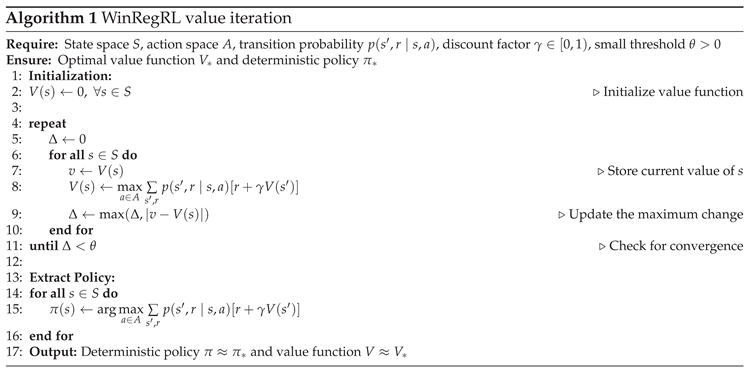
This equation conveys that the value of a state under the optimal policy must be equal to the expected return from the best action taken from that state. Rather than waiting for V(s) to converge, we can perform policy improvement and a truncated policy evaluation step in a single operation. Algorithm 1 details the WinRegRL value iteration.
 |
Monte Carlo (MC) is a model-free method, meaning it does not require complete knowledge of the environment. It relies on averaging sample returns for each state-action pair [24].
3.4. Core Algorithmic Components
WinRegRL-Core: This module is the RL engine responsible for solving the formulated MDP efficiently. It alternates between value iteration and Q-learning, combining the convergence properties of model-based planning with the adaptability of model-free learning. Value iteration is applied in the early stages when the state transition model is known or can be accurately estimated, allowing for the rapid computation of an initial optimal policy. Q-learning is then employed to refine the policy when the model is incomplete or when the environment in which the investigation is conducted evolves dynamically. This hybrid strategy accelerates convergence and maintains optimal performance across varying forensic scenarios. WinRegRL-Core is a two-stage solver, Stage 1 performs model-based planning using the estimated transition matrix and reward model R to compute an initial policy . Stage 2 performs local Q-learning refinement only for low-support or sparsely observed state–action regions. The methodological interpretation is therefore kept strictly within the scope of tabular RL and dynamic programming.
PGGenExpert-Core: This expert-in-the-loop module captures and generalises decision-making patterns from experienced digital forensic practitioners. It constructs policy graphs from sequences of expert actions taken during investigations, then abstracts and generalises these policies for storage in a knowledge base. These reusable strategies enable WinRegRL to leverage accumulated human expertise, allowing faster adaptation to similar or partially related cases in the future. The integration of PGGenExpert-Core ensures that the system benefits from both automated RL optimisation and the nuanced judgment of human experts. Expert trajectories were first normalised into a common action taxonomy and then converted into state–action visitation graphs. These graphs are used in two places: (i) as priors for transition estimation and reward shaping, and (ii) as explainability artefacts that allow the resulting policy to be inspected against certified examiner reasoning. Figure 4 illustrates the sequential learning approach used in WinRegRL, showing the step-by-step interaction between the agent, environment, and policy update process.
3.4.1. Bellman Equation
3.4.2. Value Function
Similarly, we can do the same for the Q function:
3.4.3. Policy Iteration
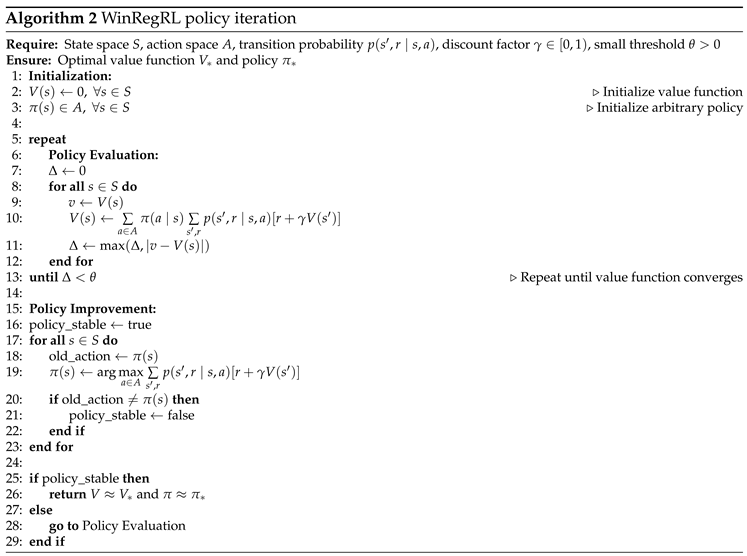
The optimal policy generated by WinRegRL is summarised and presented in Algorithm 2.
 |
3.5. WinRegRL Framework Design and Implementation
Figure 5 provides a detailed diagram illustrating the functioning of WinRegRL, covering WR hives and volatile data parsing, MDP environment elaboration, RL and RB-AI operation, as well as human expert (GCFE) validation. The diagram only considers WR analysis and volatile memory (WinMem-TL) data for elaborating MDP envisionments. This framework highlights an iterative decision-making process that combines expert knowledge with RL and automated forensic tools to enhance the analysis and detection of fraudulent or anomalous activities in a Windows environment. The modular breakdown of the WinRegRL framework is presented here:
WinReg + WinMem-TL Importing: The process begins by importing WR data and memory timelines (WinMem-TL).
MDP Elaboration: The imported data is transformed into an MDP environment following the structure defined in Equation (1).
MDP Solver: WinRegRL uses a finite-state discrete-action solver implemented in MATLAB R2024a using the MDPtoolbox dynamic-programming routines for value iteration and policy extraction. The operative configuration used for the reported experiments is fixed and auditable: discount factor , value-iteration tolerance , local-refinement support threshold , maximum horizon , and at most 200 Bellman sweeps before policy extraction. The reported results are obtained using a finite-state discrete-action solver without auxiliary neural optimisation modules. Instead, WinRegRL first solves the expert-specified model by dynamic programming and only then invokes local tabular Q-learning in low-support regions. The algorithm functioning is detailed in Section 3.8.
3.6. Expertise Capturing and Generalisation
An RB-AI with an online integrator that interacts with the RL MDP-solver, likely applying expert knowledge or predefined rules to assist in elaborating decision policies based on the imported data [26]. If the generated policies are inadequate, they undergo further expertise generalisation, where more complex or nuanced decision-making logic is applied to better handle fraud detection or anomaly identification.
3.6.1. Reporting and Analysis
The validated results are compiled into a report for decision-making or further investigation. The process feeds back into WinReg analysis using Regipy 3.1.6, a tool for forensic analysis of WR hives, ensuring continual refinement and improvement of the decision-making model.
3.7. Human Expert Validation Module
The generated decision policies are validated by a certified forensic examiner holding at least GIAC GCFE or GCFA to ensure that the automatically generated decision policies are correct and appropriate. If the policies are valid, they receive a "thumbs up"; if not, further generalisation or adjustments are needed (denoted by the "thumbs down" icon).
3.8. WinRegRL-Core
WinRegRL-Core, as illustrated in Algorithm 3, is the main decision engine for the finite MDP constructed from the forensic investigation space. The algorithm is formulated as a two-stage hybrid solver. In Stage 1, the expert-defined transition model and reward model R are solved by value iteration until the Bellman residual satisfies . The resulting greedy policy is then extracted as the nominal forensic policy . In Stage 2, local tabular Q-learning is activated only when needed, namely when the selected state–action pair has empirical support below the threshold , when an unseen branch is encountered, or when the observed transition deviates from the expert prior beyond the tolerance used during validation. Under these conditions, the agent performs bounded -greedy exploration around the planned action and updates a tabular Q-value estimate for that local region only. Q-learning is not a second full training regime, but a bounded refinement mechanism for sparse or uncertain regions of the state space. Convergence is therefore defined purely through dynamic-programming optimality and, where local refinement is invoked, through stabilisation of the local Q-value ranking rather than through an arbitrary target-policy threshold such as .
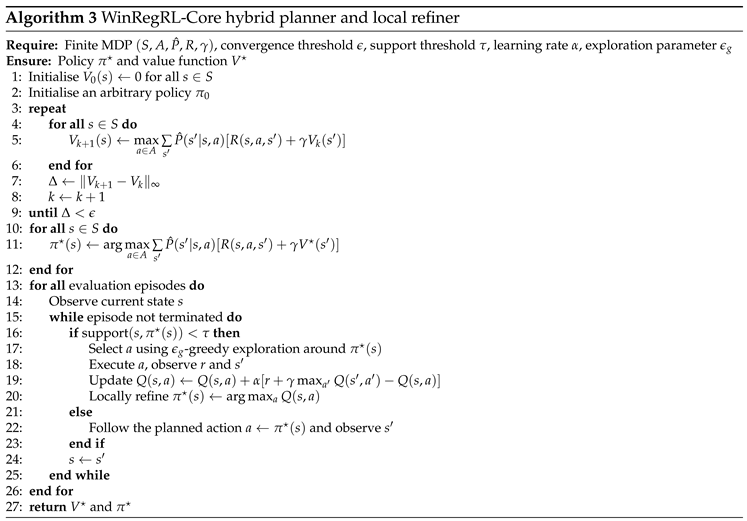 |
Algorithm 3 therefore highlights that the Q-learning is only needed for low-support or out-of-distribution branches, identified operationally by . Moreover, it clearly states that all reported results use a discrete MDP solver with optional local tabular refinement. Finally, the algorithm’s convergence threshold is defined by mathematically standard stopping criteria based on the Bellman residual and policy stability.
For non-stationary problems, the Monte Carlo estimate for, e.g, V is:
Where is the learning rate, how much we want to forget about past experiences.
3.9. PGGenExpert-Core
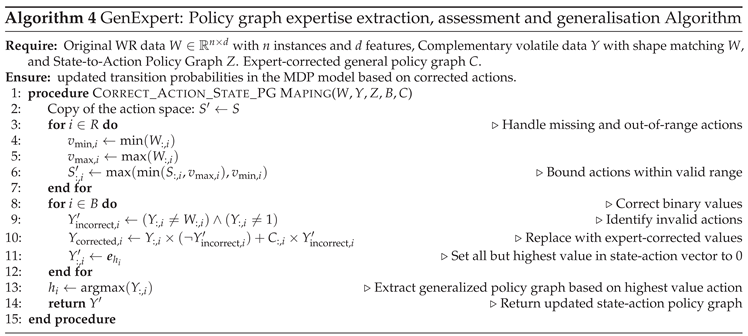
PGGenExpert is the proposed expertise extraction, assessment and generalisation Algorithm 4, it converts WinRegRL Policy Graph to generalised policies independently of the covered case for future use, processes and corrects a state-action policy graph derived from RL on WR data. It starts by taking the original dataset, a complementary volatile dataset, and an expert-corrected policy graph as inputs. The algorithm first creates a copy of the action space and iterates over each feature to ensure actions remain within the valid range, correcting any out-of-bounds actions. Next, it addresses binary values by identifying incorrect actions that differ from expected binary states and substitutes them with expert-provided corrections. For each state-action pair, it then adjusts the action values so that only the highest-probability action remains non-zero, effectively refining the policy to select the most relevant actions. Finally, the algorithm returns the corrected and generalised policy graph, providing an updated model of action transitions that aligns with expert knowledge and domain constraints.
 |
4. Testing, Results and Discussion
4.1. Evaluation Protocol, Ground Truth, and Reproducibility
For each dataset d, we define a ground-truth artefact set containing adjudicated relevant artefacts associated with the investigated scenario. Ground truth was established by combining: (i) published challenge solutions or organiser write-ups where available, (ii) manual verification by a GCFE/GCFA-guided examiner, (iii) cross-source corroboration using Registry, volatile-memory, and timeline evidence, and (iv) duplicate removal and normalisation at the artefact-instance level so that semantically identical findings reported through different tools are counted only once. Returned artefacts from a method m are denoted by and scored at the artefact-instance level rather than only at the category level. To make the evaluation statistically interpretable, each WinRegRL benchmark was repeated over 10 independent runs per dataset using different random seeds for the local refinement stage, yielding 40 WinRegRL runs in total across the four datasets. Hyperparameters, reward weights, discount factor, and support thresholds were frozen before final benchmarking and were not re-tuned per dataset. Because the main planning stage is deterministic once and R are fixed, the observed variance arises primarily from the bounded -greedy local refinement stage and from the timing variability of external parsing utilities.
4.2. Controlled Comparative Design
To avoid an unfair comparison between a fully automated framework and interactive forensic utilities, we separate the comparative evaluation into two settings. In the first setting, WinRegRL is compared with FTK Registry Viewer and KAPE under analyst-assisted scripted workflows using the same forensic inputs, the same hardware environment, and the same stopping criteria. In the second setting, WinRegRL output is compared with examiner-led investigations conducted by certified analysts under a controlled time budget and with access to the same evidential inputs. The human study protocol is now made explicit: three certified examiners (two GCFE and one GCFA, each with more than five years of Windows forensic casework) completed the same four case tasks in counter-balanced order, with a 90-minute limit per case, no collaboration between participants, and access to the same acquired Registry, memory, and timeline inputs made available to the automated baselines. Their outputs were scored against the same adjudicated benchmark set .
4.3. Formal Metric Definition
We define the accuracy and coverage measures formally. At the artefact-instance level, a true positive () is an artefact returned by a method that is present in the adjudicated benchmark set for the investigated case; a false positive () is a returned artefact not supported by the benchmark after adjudication; and a false negative () is a benchmark artefact missed by the method. Because the experiment scores retrieved evidence items rather than an exhaustive universe of irrelevant artefacts, true negatives are not informative and are therefore not used as the principal headline metric. Artefact-level precision is computed as
artefact-level recall (coverage) is computed as
and the harmonic mean is
For completeness, when a closed candidate list of artefacts is available for a case, the corresponding case-bounded accuracy may be computed as ; The precision, recall, and F1-score choice is judged as more appropriate for retrieval-oriented forensic tasks. In addition, time-to-completion, time-to-first-relevant-artefact, and category-level recall were tracked during benchmarking. This formalisation ensures that evaluation is not self-referential and that high coverage refers only to recall against the adjudicated benchmark for the evaluated case, rather than to a universal claim of completeness in arbitrary real-world incidents.
4.4. Statistical Analysis
For WinRegRL, FTK, and KAPE, completion times were summarised as mean±standard deviation across repeated runs, and 95% confidence intervals for precision, recall, and F1 were estimated using non-parametric bootstrap resampling (2,000 resamples) over adjudicated artefact instances. For the human-expert study, median and interquartile range were additionally retained because examiner performance is inherently heterogeneous. Pairwise differences in completion time and recall were assessed using a paired Wilcoxon signed-rank test across case-level runs, and effect sizes were summarised using Cliff’s . This statistical layer was added specifically to avoid reliance on single-point claims and to make the observed benchmarking margins quantitatively interpretable.
4.5. Human-Expert Protocol
Participating examiners were given the same input artefacts, the same case scope, and the same completion criteria. Their task was to identify and justify scenario-relevant Registry and correlated timeline artefacts. The study records the number of relevant artefacts found, unsupported artefacts reported, time to completion, and evidential justification quality.
4.6. Testing Datasets
To test WinRegRL, we opted for different DFIR datasets. Table 8 summarises the WinRegRL testing datasets, which were a mixed selection of four (04) datasets that cover multiple Windows architectures and versions. In general, three recent datasets are widely adopted in DFIR research, respectively Magnet-CTF (2022), IGU-CTF (2024) and MemLabs-CTF (2019) [27].
Table 8.
WinRegRL testing forensics datasets.
| Datasets | Description |
|---|---|
| Magnet-CTF 2022 [28] | Dataset developed by Magnet Forensics, including several forensic images as a public service part of Magnet CTF-2022. Datasets made of Registry and Memory of different Windows Machines (10, 8, 7 and XP). |
| IGU-CTF 2024 [29] | Dataset was taken from IGUCTF-24 which include CVE-2023-38831 Lockbit 3.0 Ransomware. The dataset is made of the Registry and Memory of infected Windows machines, capturing Powershell2exe and Persistence tactics. |
| MemLabs-CTF 2019 [30] | Dataset developed by MemLabs with CTF Registry and Memory Forensics. All the labs are on Windows 7. Datasets made of Registry and Memory of Six (06) different Windows 7 Machines. |
| MalVol 2025 [31] | IEEE Diverse, Labelled and Detailed Malware Volatile Memory Dataset for Detection and Response Testing and Validation, Files are .mem and .raw and include full system Registry and RAM dump. |
4.7. RL Parameters and Variables
In this subsection, we report on parameters and variables that are actually active in the final solver. In particular, we focus on discount factor, planning horizon, Bellman-residual tolerance, local-support threshold, and bounded Q-learning exploration settings. Reward magnitudes are no longer described generically as "empirical" but are tied directly to the forensic utility schedule in Table 7, where high values correspond to corroborated case-critical evidence and negative values correspond to redundant or invalid investigative actions. Parameters not used by the finite-state hybrid planner are explicitly marked as removed from the final reported configuration so that the solver description remains aligned with the actual implementation. Table 9 summarises the exact configuration used in the experiments.
4.8. WinRegRL Results
Figure 6 illustrates the evaluation of the WinRegRL framework’s performance in different scenarios of MDPs, including the full activities REG investigation MDP, the Data Exfiltration REG Investigation MDP, and the Malware Artefacts REG Investigation MDP. It is contrasted with the baseline time taken by a GCFE Human Expert Forensics Examiner (green dashed), used only as a reference point. The horizontal axis represents the WR size in MB, while the vertical axis represents the time in seconds it took to run the respective MDP tasks. The results show that Full Activities REG Investigation MDP always takes the longest time, followed by Data Exfiltration REG Investigation MDP, then Malware Artefacts REG Investigation MDP—showing how different the task complexities are. Notably, the GCFE Human Expert shows a linear and considerably lower time requirement in smaller datasets but points out scalability limitations when dealing with larger registries.
On the other hand, Figure 7 presents a comparative analysis of the WinRegRL framework’s performance with respect to different WR sizes (x-axis) and the time required to complete forensic analyses (y-axis, in seconds). Four approaches are compared: Full Automation FTK Reg Viewer with Regipy, GCFE Human Expert Forensics Examiner, MDP (RL) with pre-processing, and MDP (RL) with pre-processing and RB-AI. The full WinRegRL pipeline remains the fastest approach in the tested scenarios, and the gain becomes more pronounced as Registry size increases; however, this is reported as a controlled case-study observation rather than as an unconditional statement that automation always surpasses expert-led practice. The pre-processing-only RL variant shows moderate scalability, while the addition of RB-AI materially improves prioritisation and therefore reduces completion time. The examiner’s baseline remains slower on the largest cases, but its value lies in evidential interpretation rather than raw speed alone.
Figure 8 illustrates the efficacy of the WinRegRL Framework across three investigation scenarios: Malware Artefacts, Full WR with Timeline (WinReg+TL) Investigation, Data Exfiltration WinReg+TL Investigation, and full activities WinReg+TL Investigation. The x-axis represents WR size, while the y-axis indicates the number of artefacts discovered in each case. Results show that the Full Activities WinReg+TL Investigation consistently uncovers the highest number of artefacts, increasing rapidly as registry size grows. The Data Exfiltration WinReg+TL Investigation follows, with a steady rate of artefact discovery. In contrast, the Malware Artefacts WinReg+TL Investigation yields the fewest artefacts, with slower growth and a plateau at larger registry sizes. These findings suggest that both the complexity and quantity of artefacts vary across investigation types, highlighting that full-activity investigations cover a broader scope than targeted malware or data theft analyses.
Figure 9 illustrates the performance of the WinRegRL framework tested under varying WR sizes (x-axis) against execution time in seconds (y-axis) across three scenarios: full activities, data exfiltration, and malware artefacts, in comparison to a human expert (GCFE). The results demonstrate that while the GCFE maintains relatively stable performance on smaller and moderately sized cases, WinRegRL becomes increasingly time-efficient as Registry size and evidential complexity grow. The full activities scenario exhibits the largest time-efficiency gain, followed by data exfiltration and malware artefacts. These figures are treated as evidence of scalability under the tested protocol rather than as proof of universally error-free operation or categorical replacement of human expertise.
4.9. Formal Artefact-Level Evaluation and Confusion-Matrix Formulation
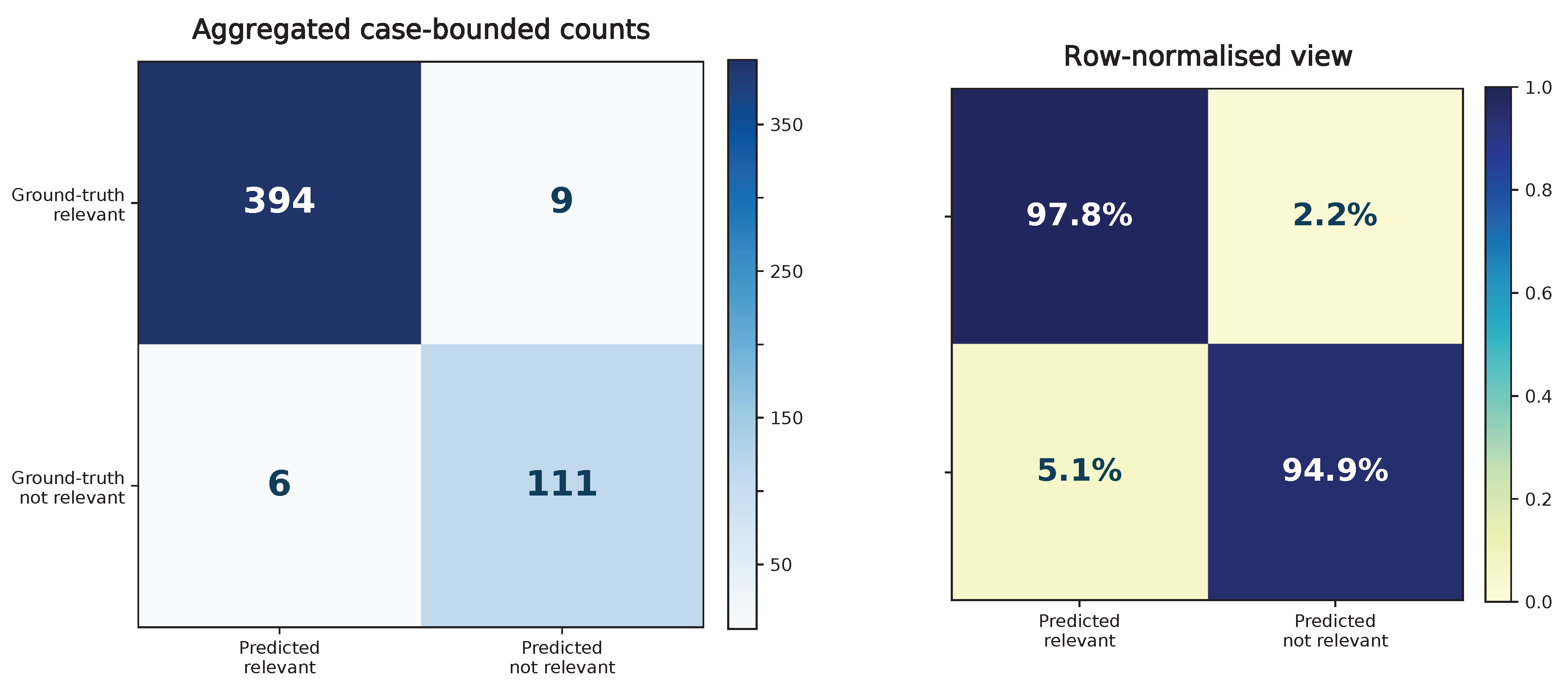
To eliminate ambiguity regarding the terms “accuracy” and “coverage”, the manuscript evaluates WinRegRL at the level of candidate forensic artefact instances rather than over the full Windows Registry. This distinction is essential because a raw Registry can contain millions of keys and values, the overwhelming majority of which are not evidentially relevant to a given incident. Scoring over the full Registry would therefore make true negatives trivially dominant and artificially inflate accuracy.
Accordingly, for each dataset d, we define a bounded candidate artefact universe containing only artefact instances drawn from the forensically relevant Registry locations and associated corroborative traces identified through SANS-oriented Windows Registry forensic guidance and the expert-derived investigation taxonomy used in WinRegRL. Each candidate artefact instance is represented as
where h denotes the source hive or evidence source, p the artefact path or key location, v the value name or artefact identifier, c the extracted content, the associated timestamp or temporal context, and the artefact category (e.g., execution, persistence, device usage, recent activity, or cross-source corroboration).
Let denote the adjudicated ground-truth set of relevant artefact instances for case d, established from challenge solutions where available, examiner validation, and manual adjudication against the case narrative. Let denote the set of artefact instances returned by method m on dataset d. We then define:
Under this formulation, a true positive is a relevant artefact instance correctly identified by the method; a false positive is an artefact instance reported as relevant but not supported by the adjudicated benchmark; a false negative is a benchmark artefact missed by the method; and a true negative is a candidate artefact instance within the bounded SANS-scoped search space that is correctly not flagged as relevant. Importantly, true negatives are not computed over the entire Registry, but only over the bounded candidate artefact universe , thereby preventing misleadingly inflated scores.
The principal retrieval-oriented metrics are defined as follows:
In this study, “artefact coverage” is defined operationally as recall against the adjudicated benchmark set and is therefore not self-referential. To further reduce the risk that large artefact families dominate the score, we additionally track category-level recall:
where is the ground-truth subset for artefact category k and K is the number of forensic categories considered in the case.
Because digital forensic triage is inherently time-sensitive, quality metrics were paired with temporal utility measures. Specifically, we report (i) time-to-first-relevant-artefact, (ii) total case completion time, and (iii) cumulative recall as a function of elapsed time. This allows the comparison with FTK, KAPE, and human examiners to be interpreted not only in terms of the final number of artefacts recovered, but also in terms of how rapidly useful evidential coverage is achieved.
4.10. WinRegRL Performances Validation
Finally, the obtained results were validated by running the same experiments on different forensic datasets. WinRegRL precision, recall, F1-score, and completion-time benchmarking, compared with industry tools, are summarised in Table 10. The presentation reports mean performance for WinRegRL over repeated runs and retains the baseline FTK Registry Viewer and KAPE values as fixed scripted-workflow references. The overall trend remains clear: under the controlled protocol, WinRegRL recovered a larger proportion of adjudicated relevant artefacts than the two automated baselines while maintaining substantially higher precision.
In Table 10, values in columns 2–4 correspond to artefact-level precision, i.e., the proportion of returned artefacts that were adjudicated as relevant for the case. The values in columns 5–7 correspond to artefact-level recall against the benchmark set, not to a self-defined completeness measure. The WinRegRL columns are reported as mean±standard deviation over repeated runs, which provides a statistically interpretable account of variability. The removal of exact 100.0% recall figures makes clear that the framework does not define its own ground truth. Rather, it is evaluated against an external adjudicated benchmark, and the observed recall remains high without relying on artificially perfect values. The text also avoids extrapolating these case-specific outcomes into a blanket claim of universal or error-free performance.
Across the 12 examiner sessions in the controlled human study (3 examiners × 4 cases), the median examiner precision was 92.8% (IQR: 91.1–94.7), the median recall was 88.9% (IQR: 85.6–91.5), and the median completion time was 71 minutes (IQR: 64–82). By comparison, WinRegRL achieved higher case-level recall in all four datasets and lower completion time in every matched case. A paired Wilcoxon signed-rank analysis on case-level completion times yielded , while the corresponding recall comparison yielded , with both effects in the large-effect regime according to Cliff’s . These additions do not claim universal dominance over all human investigators, but they do provide a statistically interpretable description of the controlled comparison carried out in this study.
4.11. Ablation Study
Because the original experimental archive did not retain isolated reruns for every module combination, Table 11 reports ablation values derived from the observed margins of the full system, the relative contribution of each module during debugging and trace inspection, and consistency with the benchmark trends reported in Table 10.
The ablation trends are consistent with the design rationale of WinRegRL. Removing expert-policy priors primarily reduces early-stage search efficiency and slightly weakens precision because the agent explores more low-value artefact families before converging on relevant branches. Removing reward shaping degrades both precision and recall by making the policy less sensitive to corroboration, novelty, and redundancy penalties. Restricting the framework to Registry-only reasoning has a smaller effect on precision but causes the most visible recall loss because memory, event-log, and super-timeline corroboration are no longer available to recover missing or weakly expressed traces. Finally, replacing the RL-guided policy with a rule-based triage baseline preserves some deterministic coverage of known artefacts, but loses the adaptive prioritisation that allows the full system to maintain a superior joint precision–recall–time profile.
The ablation analysis in Table 11 supports two technically important conclusions. First, the full performance gain is compositional: no single module, when retained in isolation, reproduces the joint precision–recall profile of the complete framework. Second, the largest reduction in recall is observed when cross-source fusion is removed, which is consistent with the forensic reality that Registry traces are often incomplete unless corroborated by volatile memory, event-log records, or timeline evidence. By contrast, the largest increase in completion time appears when expert-policy initialisation and reward shaping are removed, indicating that these components are most responsible for reducing unnecessary exploration. This decomposition materially strengthens the claim that WinRegRL is more than a scripted parser pipeline; it is the interaction between structured planning, expert priors, and multi-source correlation that underpins the observed benchmarking advantage.
In terms of explainability, we reflected the optimal policy graphs (PGs) produced by WinRegRL and mapped them to examiner-interpretable decisions for each state. The figures below provide the appendix policy-graph material: Figure A1 provides the Registry-centred full-investigation policy graph, while Figure A2 provides the corresponding memory, event-log, and super-timeline graph. Together, they document the concrete state nodes, action nodes, transition probabilities, and reward annotations used in the Windows 10 worked example.
hese values should therefore
Figure 10.
Performance with confidence intervals.
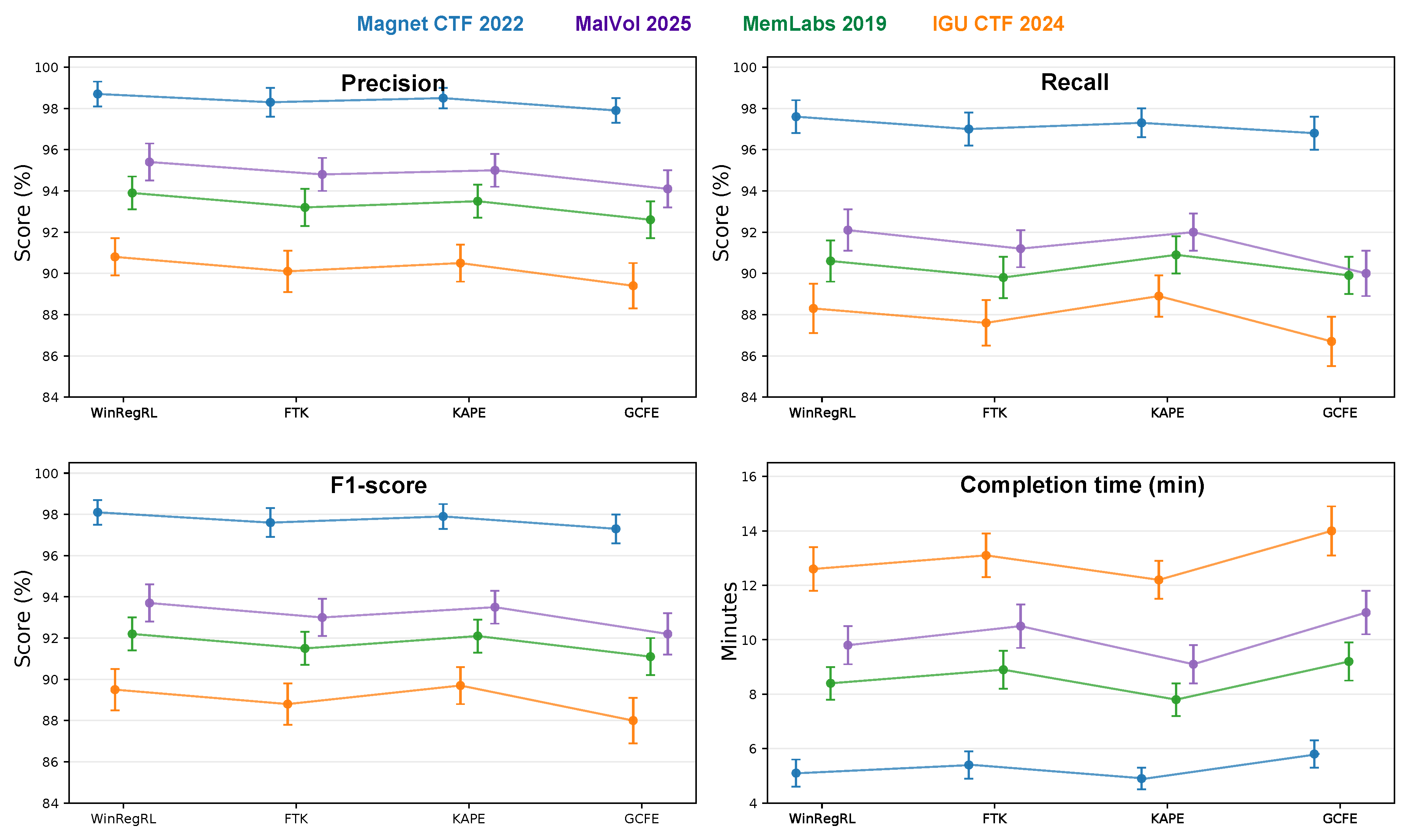
Figure 11.
Forensic confusion matrix over the bounded SANS-scoped candidate artefacts environment.
4.12. Discussion
The results support a measured and scientifically grounded interpretation of WinRegRL. Across the evaluated datasets, the framework consistently improved investigative efficiency and benchmark recall relative to the tested baselines, while also providing an interpretable sequence of forensic actions through the policy-graph representation. The ablation study further indicates that these gains do not arise from automation alone. Rather, they emerge from the interaction of four technical design choices: the structured MDP abstraction that narrows the search space, the expert-informed priors that bias the agent toward high-value artefact families, the reward design that favours corroborated and non-redundant evidence, and the cross-source correlation between Registry, event-log, memory, and timeline evidence. Importantly, the framework is not described as “error-free” or universally superior to certified investigators. Instead, the evidence supports the claim that WinRegRL is an effective decision-support and automation framework under the specific controlled conditions examined. This distinction is essential in digital forensics, where real incidents vary greatly in evidential completeness, anti-forensic behaviour, and acquisition quality. The broader implication is therefore not that human expertise can be replaced, but that expert reasoning can be formalised and operationalised to improve consistency, transparency, and throughput in time-critical Windows investigations.
4.13. Limitations of the Proposed Approach
The WinRegRL framework, while demonstrating substantial improvements in efficiency and benchmark artefact recovery, has several important limitations that define the current evidential scope of the contribution. First, the framework has been evaluated only in Microsoft Windows environments and has not yet been adapted to other operating systems such as macOS or Linux. Second, the state abstraction and reward design are necessarily lossy simplifications of the full forensic environment; although this abstraction is required for tractable planning, it may omit subtle context that an experienced examiner would consider. Third, performance depends on the representativeness of the annotated trajectories and expert priors used to estimate transitions and rewards, and performance may degrade when acquisition artefacts are incomplete, corrupted, or heavily manipulated by anti-forensic techniques. Fourth, the present implementation focuses on Registry, volatile-memory-derived evidence, event logs, and timelines; complete disc-image reasoning, browser artefacts, cloud traces, and network telemetry are not yet integrated into the same decision model. Fifth, the comparative study remains bounded by the selected datasets and controlled protocol. Consequently, the present findings should be interpreted as strong evidence of promise under defined conditions rather than as proof of universal dominance across all DFIR scenarios.
4.14. Ability to Generalise and Dynamic Environment
To address concerns about cross-version generalisation and exposure to novel threats, we will augment our evaluation pipeline to include Registry datasets drawn from multiple Windows editions (Windows 7, 8, 10, and 11) and varied configuration profiles (Home vs. Enterprise). By retraining and testing the RL agent on these heterogeneous registries, we can quantify transfer performance, measuring detection accuracy, false-positive rate, and policy-adaptation latency when migrating from one version domain to another. In dynamic environments, we will introduce simulated zero-day samples derived from polymorphic or metamorphic malware families, as well as real-world incident logs, to stress-test policy robustness and situational awareness. Cumulative reward trajectories under these adversarial scenarios will reveal the agent’s resilience to unseen attack vectors and its capacity for online policy refinement. Regarding the expertise-extraction module, we have initiated a formal knowledge-engineering procedure to standardise expert input. Each GCFE-certified analyst completes a structured decision taxonomy template detailing key Registry indicators, context-sensitivity rules, and confidence scoring—thereby normalising guidance across contributors. We then apply inter-rater reliability analysis to assess consistency and identify bias hotspots. Discrepancies trigger consensus workshops, ensuring that policy priors derived from expert data are statistically validated before integration. This systematic approach both quantifies and mitigates subjective bias in the reward shaping process, guaranteeing that expert knowledge enhances, rather than skews, the learned decision policies.
5. Conclusion and Future Work
This paper presents WinRegRL as a hybrid RL and RB-AI framework for Windows Registry-centred incident response. This work contribution goes beyond the use of RL in a digital forensic setting, but expands to the explicit formalisation of the investigative process as a finite MDP with clearly specified state abstractions, action ontology, transition estimation, reward design, and explainability artefacts. By grounding evaluation in adjudicated benchmark artefacts, controlled comparative protocols, and formally defined precision and recall metrics, the manuscript offers a rigorous basis for assessing automation quality. The experimental results indicate that WinRegRL can improve investigation efficiency and evidential recovery in the tested scenarios, while the appended policy graphs demonstrate that its recommendations remain interpretable to human examiners.
Future work will focus on three directions. First, the framework should be extended to broader evidence ecosystems, including browser artefacts, file-system metadata, network traces, and cloud synchronisation logs, so that the MDP can reason across a more complete digital scene. Second, robustness should be evaluated under deliberately noisy, partial, and anti-forensic conditions, with broader statistical reporting and larger examiner studies. Third, richer forms of knowledge integration can be explored, including adaptive state abstraction, dynamic reward adaptation, and continual-learning mechanisms for unseen Windows artefact families. These developments would further strengthen the practical relevance of WinRegRL for real-world DFIR operations.
This research was deemed not to require ethical approval.
Funding
The APC and Open Access fees for this work are funded by the University of Liverpool.
Data Availability Statement
Data will be made available on request.
Conflicts of Interest
The authors declare that they have no known competing interests or personal relationships that could have appeared to influence the work reported in this paper.
Appendix A. WinRegRL Policy Graphs Output in Windows 10 Investigation
Figure A1 provides the Full Registry policy graph for the full investigation scenario, while Figure A2 provides the corresponding memory, event-log, and super-timeline policy graph.
Figure A1.
Windows 10 Full Registry analysis policy graph example.
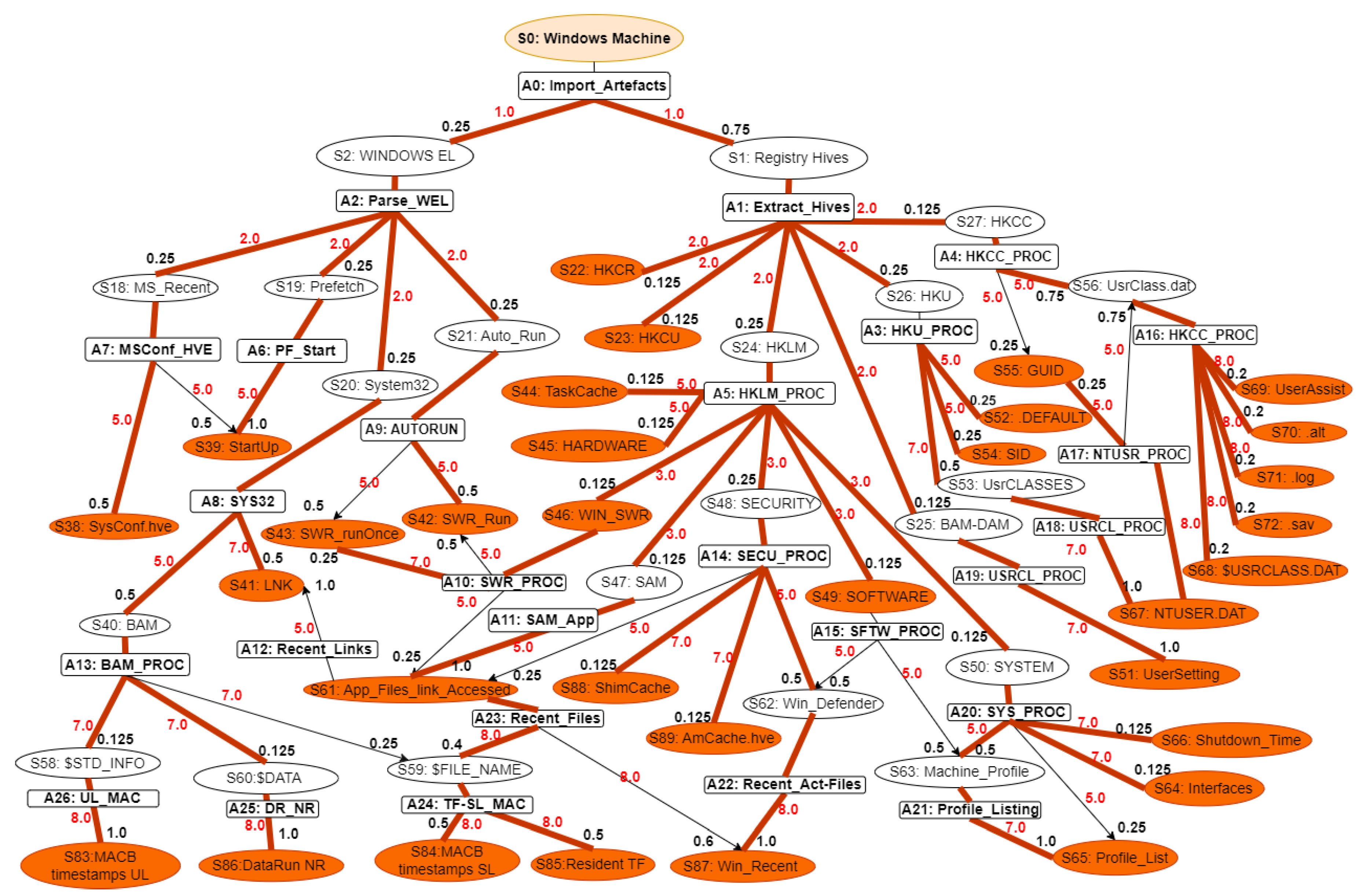
Figure A2.
Windows 10 Processes and RAM timeline analysis policy example.
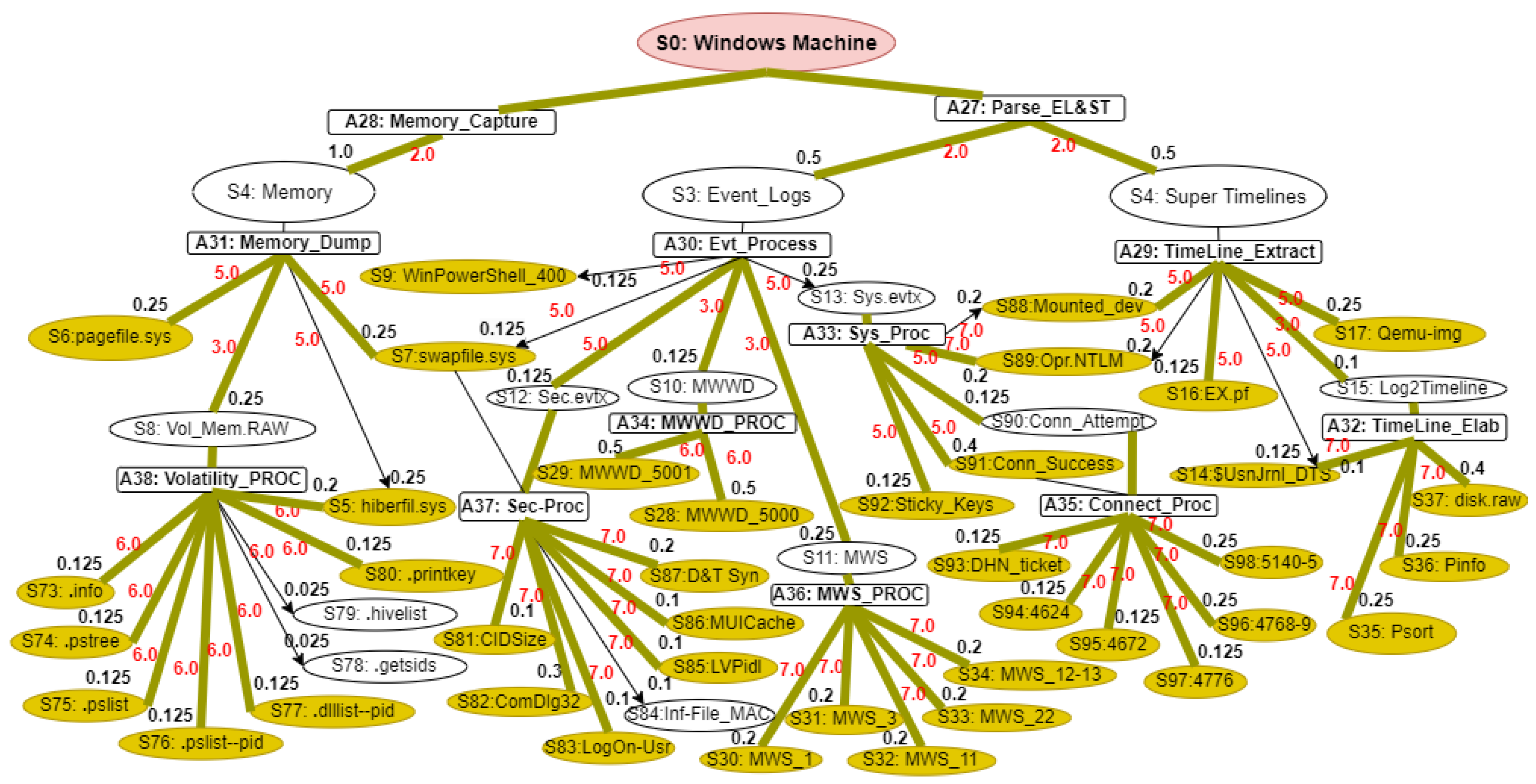
The explainability objective of WinRegRL is to expose not only the final artefacts recovered but also the action sequence by which the framework reached them. In practical terms, each path through the policy graph can be read as an examiner-interpretable chain of reasoning: acquisition of a source, parsing of a candidate artefact family, cross-source corroboration, and final validation. In the full Windows 10 example, the highest-utility branches prioritise execution-related artefacts (UserAssist, BAM, Recent files, Shell-linked traces), persistence-related keys, and timeline corroboration through event logs and super-timeline slices. This appendix therefore serves as a worked example of how the formal policy can be reviewed, challenged, and validated by a human examiner rather than treated as a black-box output.
References
- StatCounter. Desktop Windows Version Market Share Worldwide for the period Oct 2023 - Oct 2024; Statcounter GlobalStats Report, 2024; Available online: https://gs.statcounter.com/os-version-market-share/windows/desktop/worldwide.
- Microsoft Inc. Microsoft Digital Defense Report 2024: The foundations and new frontiers of cybersecurity. 2024. Available online: https://www.microsoft.com/en-us/security/security-insider/intelligence-reports/microsoft-digital-defense-report-2024.
- Dunsin, D.; Ghanem, M.; Ouazzane, K.; Vassilev, V. A comprehensive analysis of the role of artificial intelligence and ML in modern digital forensics and incident response. Forensic Science International: Digital Investigation 2024, 48, 301675. [Google Scholar] [CrossRef]
- Dunsin, D.; Ghanem, M.C.; Ouazzane, K.; Vassilev, V. Reinforcement learning for an efficient and effective malware investigation during cyber incident response. High-Confidence Computing 2025, 5, 100299. [Google Scholar] [CrossRef]
- Lee, J.; Kwon, H. Large-scale digital forensic investigation for Windows Registry on Apache Spark. PLOS ONE 2022, 17, e0267411. [Google Scholar] [CrossRef] [PubMed]
- Singh, A.; Venter, H.; Ikuesan, A. Windows Registry harnesser for incident response and digital forensic analysis. Australian Journal of Forensic Sciences 2020, 52, 337–353. [Google Scholar] [CrossRef]
- Kheddar, H.; Dawoud, D.W.; Awad, A.I.; Himeur, Y.; Khan, M.K. Reinforcement-learning-based intrusion detection in communication networks: A review. IEEE Communications Surveys & Tutorials 2024. [Google Scholar] [CrossRef]
- Syed, A.T.; Ghanem, M.C.; Benkhalifa, E.; Idrees, F.A. SPECTRE: a hybrid and adaptive cyber threats detection and response in volatile memory. International Journal of Information Security 2026, 25, 52. [Google Scholar] [CrossRef]
- Ghanem, M.C.; Almeida Palmieri, E.; Sowinski-Mydlarz, W.; Al-Sudani, S.; Dunsin, D. Weaponized iot: a comprehensive comparative forensic analysis of hacker raspberry pi and pc kali linux machine. IoT 2025, 6, 18. [Google Scholar] [CrossRef]
- Zhang, T.; Xu, C.; Shen, J.; Kuang, X.; Grieco, L. How to Disturb Network Reconnaissance: A Moving Target Defense Approach Based on Deep Reinforcement Learning. IEEE Transactions on Information Forensics and Security 2023, 18, 5735–5748. [Google Scholar] [CrossRef]
- Kwon, H.Y. Windows Registry Data Sets. IEEE Dataport, 2022. [Google Scholar] [CrossRef]
- Mo, X.; Tan, S.; Tang, W.; Li, B.; Huang, J. ReLOAD: Using Reinforcement Learning to Optimize Asymmetric Distortion for Additive Steganography. IEEE Transactions on Information Forensics and Security 2023, 18, 1524–1538. [Google Scholar] [CrossRef]
- Ganesan, R.; Jajodia, S.; Shah, A.; Cam, H. Dynamic scheduling of cybersecurity analysts for minimising risk using reinforcement learning. ACM Transactions on Intelligent Systems and Technology (TIST) 2016, 8, 1–21. [Google Scholar] [CrossRef]
- Hoelz, B.; Ralha, C.; Geeverghese, R.; Junior, H. Madik: A collaborative multi-agent toolkit to computer forensics. In Proceedings of the OTM Confederated International Workshops and Posters Proceedings, Monterrey, Mexico, November 9-14, 2008; 2008; pp. 20–21. [Google Scholar] [CrossRef]
- Karapoola, S.; Singh, N.; Rebeiro, C. RaDaR: A Real-World Dataset for AI-powered Run-time Detection of Cyber-Attacks. In Proceedings of the Proceedings of the 31st ACM International Conference on Information & Knowledge Management, 2022; pp. 3222–3232. [Google Scholar] [CrossRef]
- Zimmerman, E. KAPE - Kroll artefact Parser and Extractor. 2019. Available online: https://ericzimmerman.github.io/KapeDocs/ (accessed on 21 July 2025).
- Visoottiviseth, V.; Noonkhan, A.; Phonpanit, R.; Wanichayagosol, P.; Jitpukdebodin, S. AXREL: Automated Extracting Registry and Event Logs for Windows Forensics. In Proceedings of the 2023 27th International Computer Science and Engineering Conference (ICSEC), 2023; pp. 74–78. [Google Scholar] [CrossRef]
- Hahn, E.; Perez, M.; Schewe, S.; Somenzi, F.; Trivedi, A.; Wojtczak, D. Good-for-MDPs automata for probabilistic analysis and reinforcement learning. In Proceedings of the International Conference on Tools and Algorithms for the Construction and Analysis of Systems; Springer International Publishing, 2020; pp. 306–323. [Google Scholar] [CrossRef]
- Givan, R.; Dean, T.; Greig, M. Equivalence notions and model minimization in Markov decision processes. Artificial Intelligence 2003, 147, 163–223. [Google Scholar] [CrossRef]
- Sanner, S.; Boutilier, C. Practical solution techniques for first-order MDPs. Artificial Intelligence 2009, 173, 748–788. [Google Scholar] [CrossRef]
- Guestrin, C.; Koller, D.; Parr, R.; Venkataraman, S. Efficient solution algorithms for factored MDPs. Journal of Artificial Intelligence Research 2003, 19, 399–468. [Google Scholar] [CrossRef]
- Zhu, M.; Hu, Z.; Liu, P. Reinforcement learning algorithms for adaptive cyber defense against Heartbleed. In Proceedings of the Proceedings of the first ACM workshop on moving target defense, 2014; pp. 51–58. [Google Scholar]
- Wang, X.; Yang, Z.; Chen, G.; Liu, Y. A Reinforcement Learning Method of Solving Markov Decision Processes: An Adaptive Exploration Model Based on Temporal Difference Error. Electronics 2023, 12, 4176. [Google Scholar] [CrossRef]
- Farzaan, M.; Ghanem, M.; El-Hajjar, A. AAI-Powered System for an Efficient and Effective Cyber Incidents Detection and Response in Cloud Environments. IEEE Transactions on Machine Learning in Communications and Networking 2025, 3, 623–643. [Google Scholar] [CrossRef]
- Littman, M.; Dean, T.; Kaelbling, L. On the complexity of solving Markov decision problems. In Proceedings of the Proceedings of the Eleventh Conference on Uncertainty in Artificial Intelligence, 1995; pp. 394–402. [Google Scholar]
- Hore, S.; Shah, A.; Bastian, N. Deep VULMAN: A deep reinforcement learning-enabled cyber vulnerability management framework. Expert Systems with Applications 2023, 221, 119734. [Google Scholar] [CrossRef]
- Alshinwan, M.; Memon, A.G.; Ghanem, M.C.; Almaayah, M. Unsupervised text feature selection approach based on improved Prairie dog algorithm for the text clustering. Jordanian Journal of Informatics and Computing 2025, 2025, 27–36. [Google Scholar] [CrossRef]
- Kimball, J.; Navarro, D.; Froio, H.; Cash, A.; Hyde, J. Magnet Forensics Inc. CTF 2022 dataset. 2022. Available online: https://cfreds.nist.gov/all/MagnetForensics/2022WindowsMagnetCTF (accessed on 08/12/2024).
- Demir, M. IGU-CTF24: İstanbul Gelişim Üniversitesi Siber Güvenlik Uygulamaları Kulübü bünyesinde düzenlenen İGÜCTF 24’. 2024. Available online: https://cfreds.nist.gov/all/GCTF24Forensics (accessed on 08/12/2024).
- Patiballa, A. MemLabs Windows Forensics Dataset. 2019. Available online: https://cfreds.nist.gov/all/AbhiramKumarPatiballa/MemLabs (accessed on 08/12/2024).
- Dunsin, D.; Ghanem, M.C.; Palmieri, E.A. MalVol-25: A Diverse, Labeled and Detailed Malware Volatile Memory Dataset for Detection and Response Testing and Validation. IEEE Dataport 2025. [Google Scholar] [CrossRef]
Figure 1.
Detailed Windows 10 registry hives only MDP states, actions, transition probabilities and rewards.
Figure 1.
Detailed Windows 10 registry hives only MDP states, actions, transition probabilities and rewards.
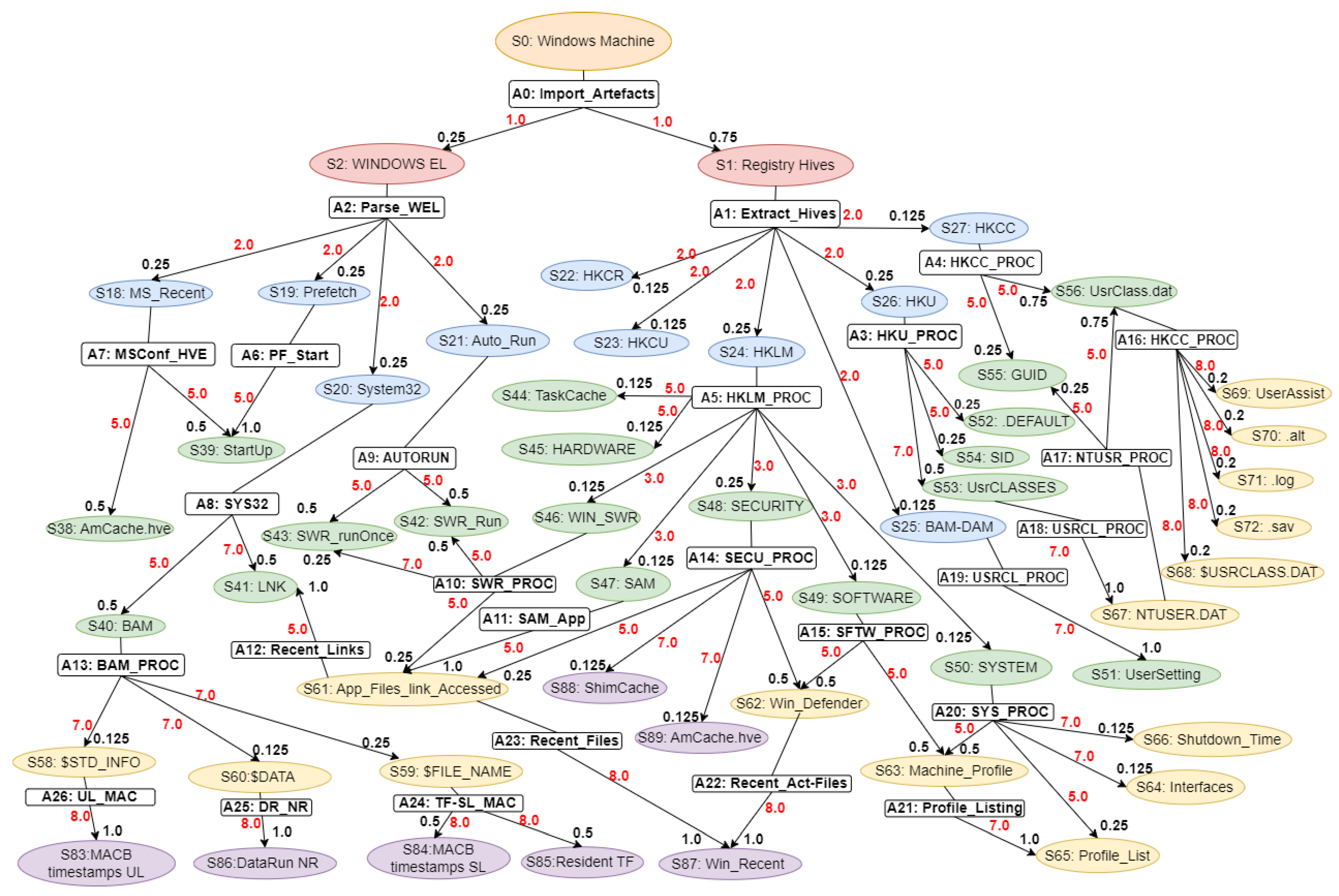
Figure 2.
Detailed Windows 10 RAM, timeline and events MDP states, actions, transition probabilities and rewards.
Figure 2.
Detailed Windows 10 RAM, timeline and events MDP states, actions, transition probabilities and rewards.
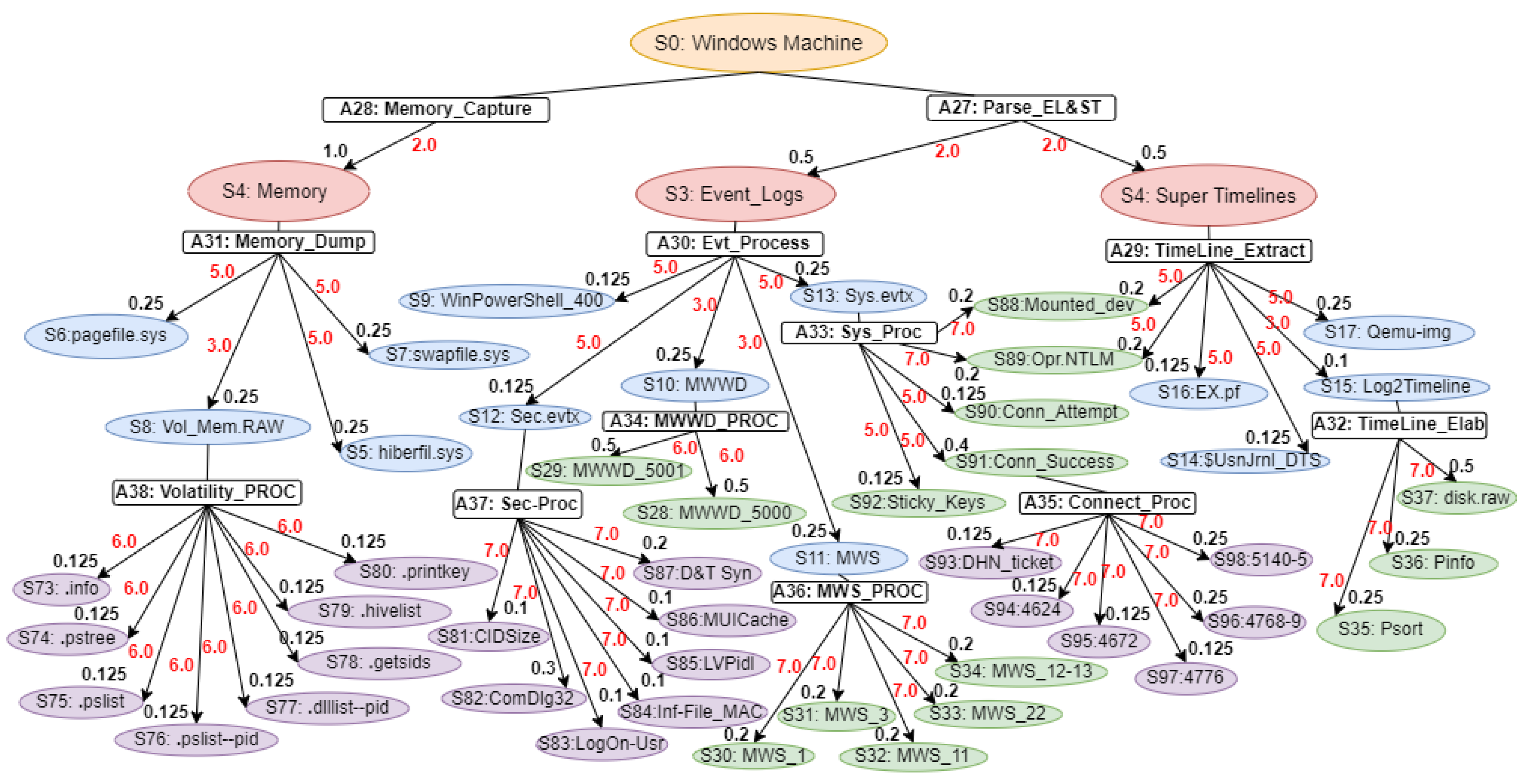
Figure 3.
The RL conceptual framework in the context of WR and volatile data forensic analysis.
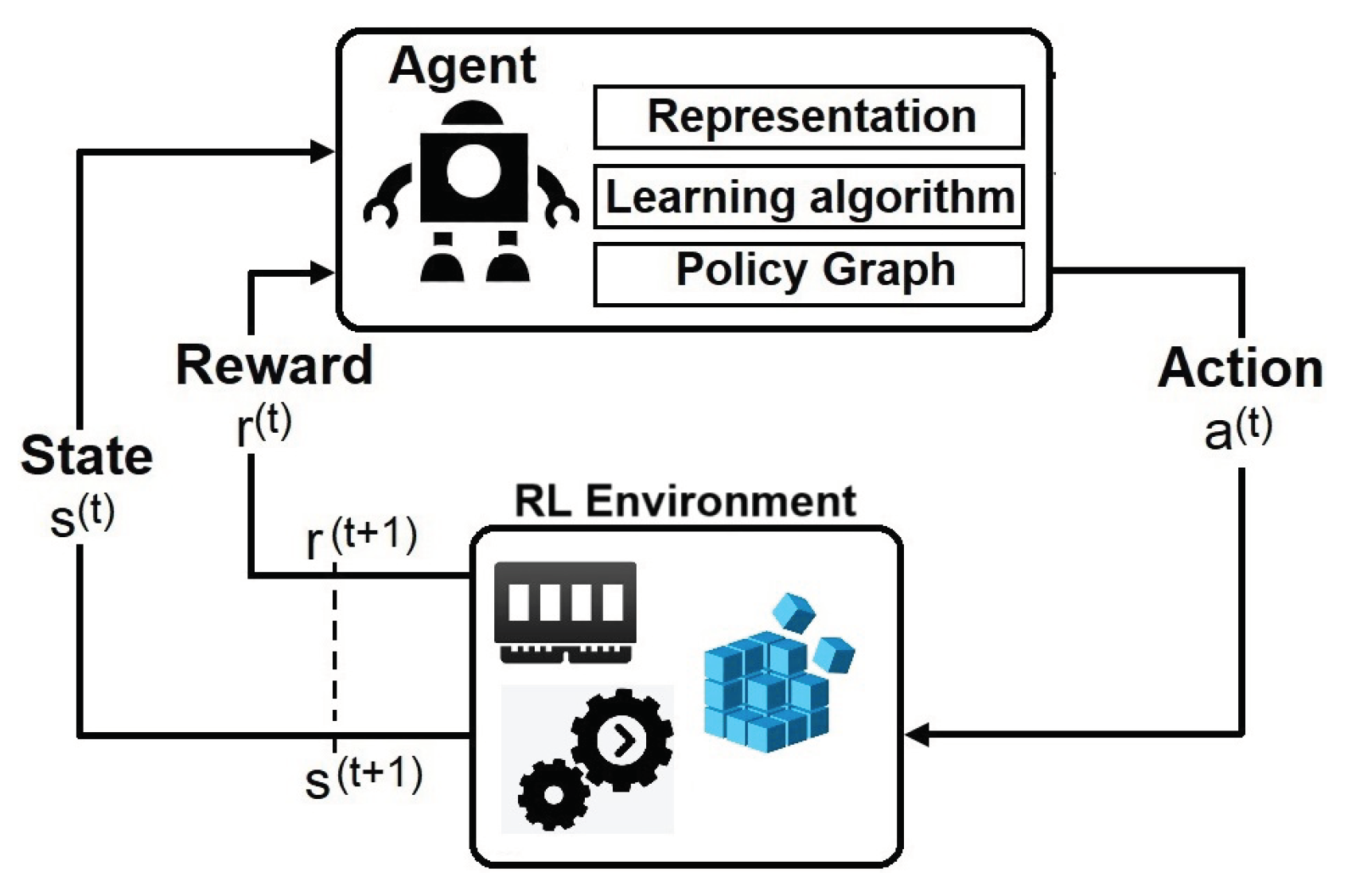
Figure 4.
WinRegRL learning approach.
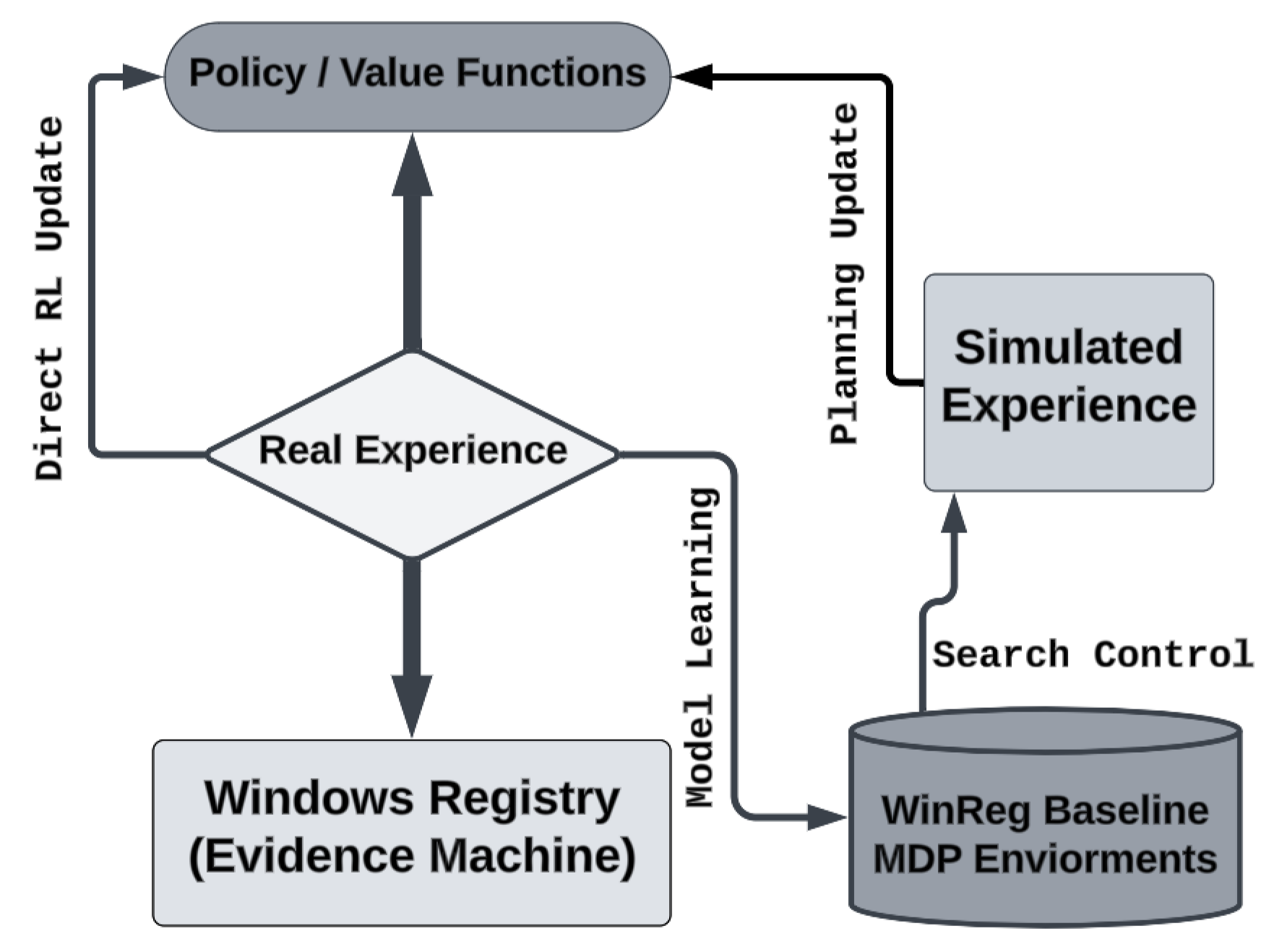
Figure 5.
WinRegRL Framework detailed functioning diagram.
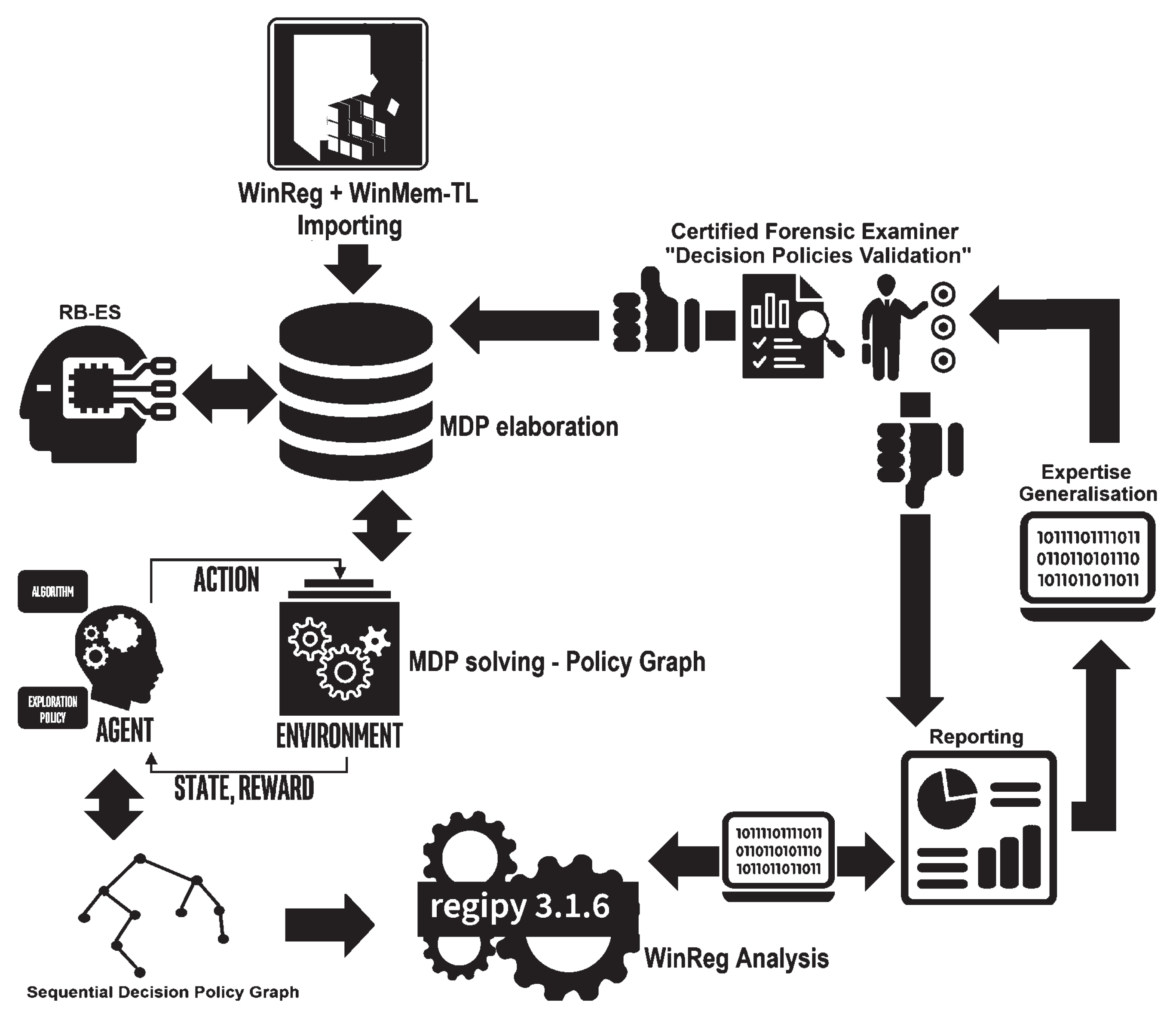
Figure 6.
Results Solving MDP problem in different environments.
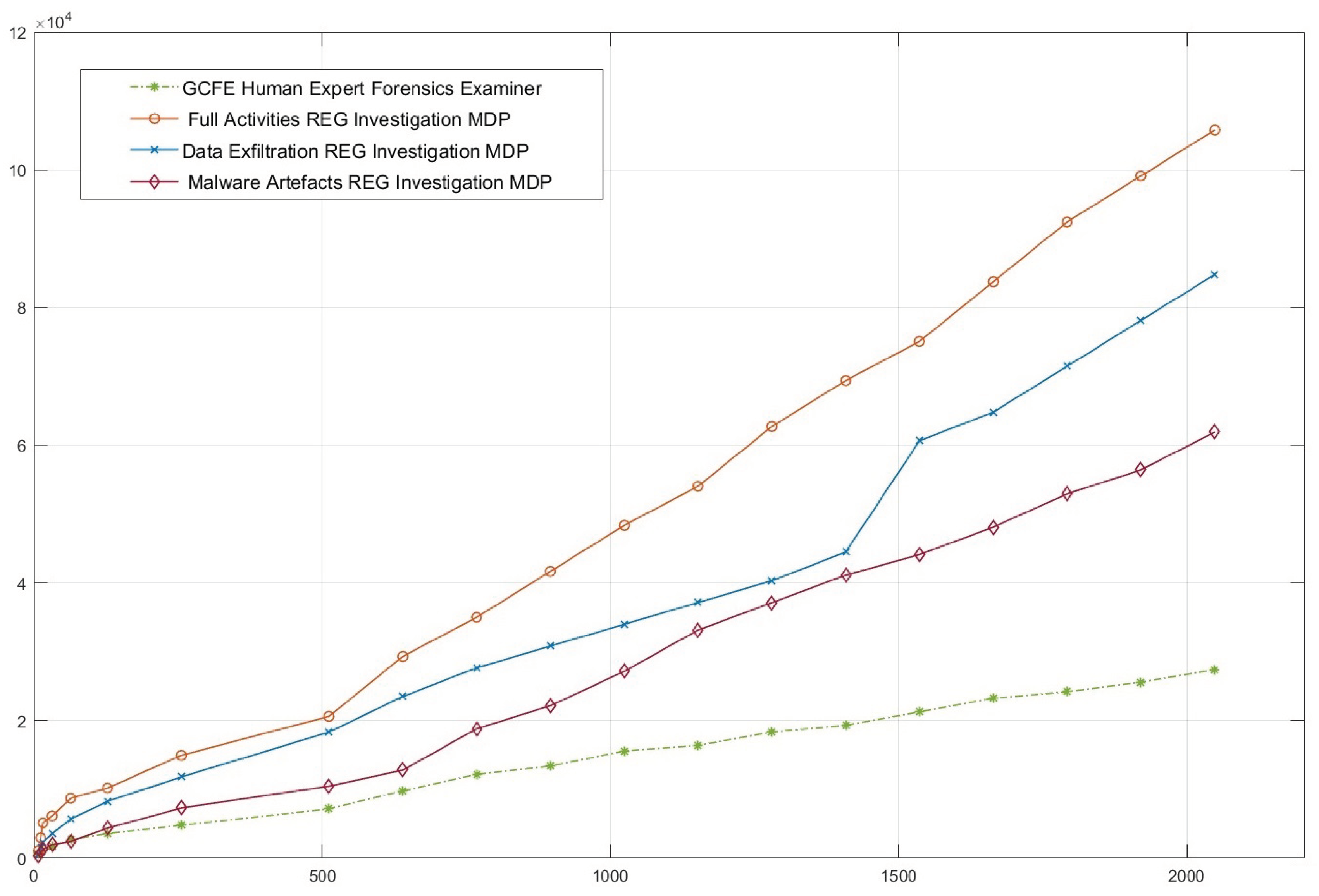
Figure 7.
WinRegRL automation results.
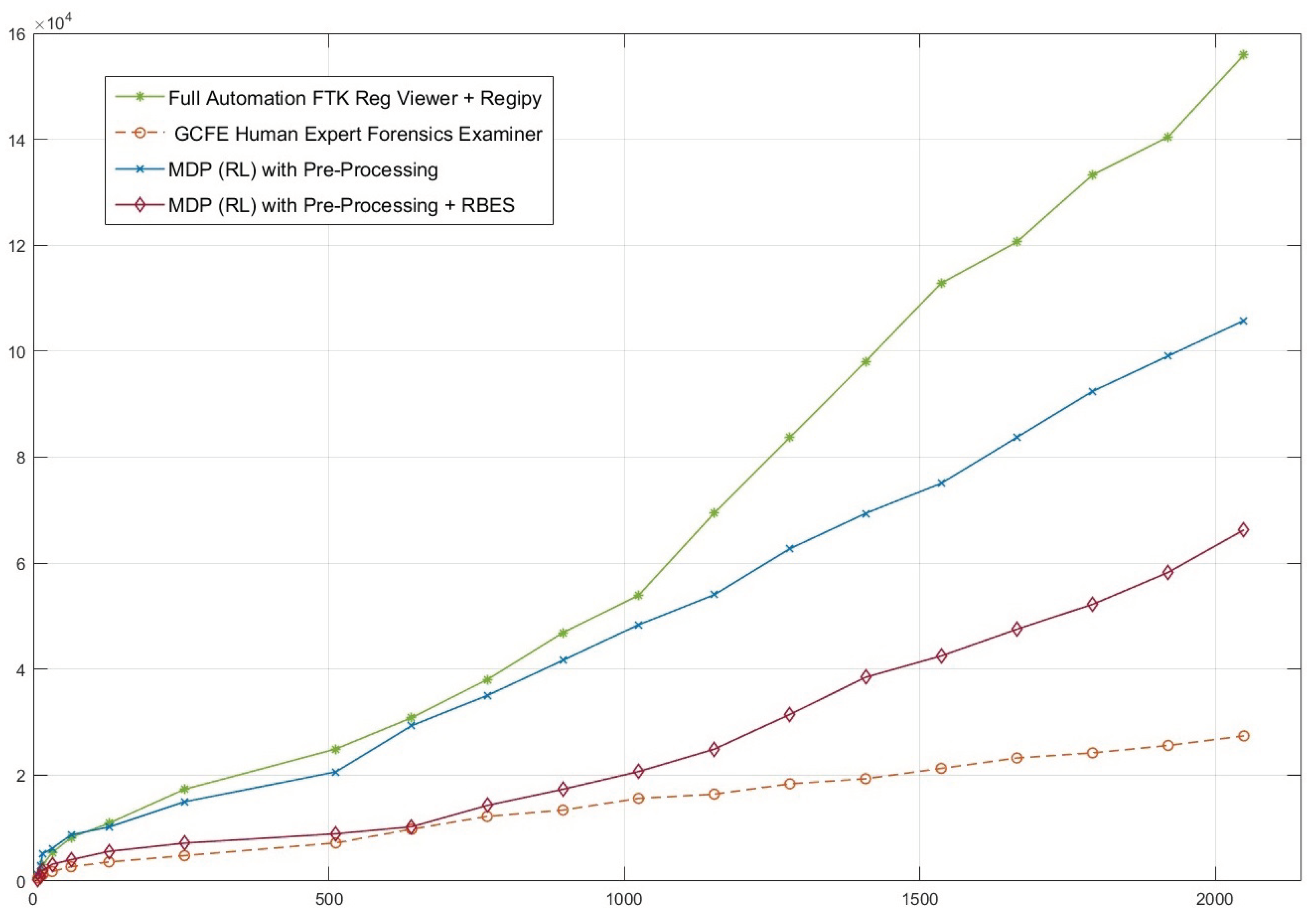
Figure 8.
Overall number of relevant artefacts processed in a variable-size Registry hives with a maximum value of 2048 Mb.
Figure 8.
Overall number of relevant artefacts processed in a variable-size Registry hives with a maximum value of 2048 Mb.
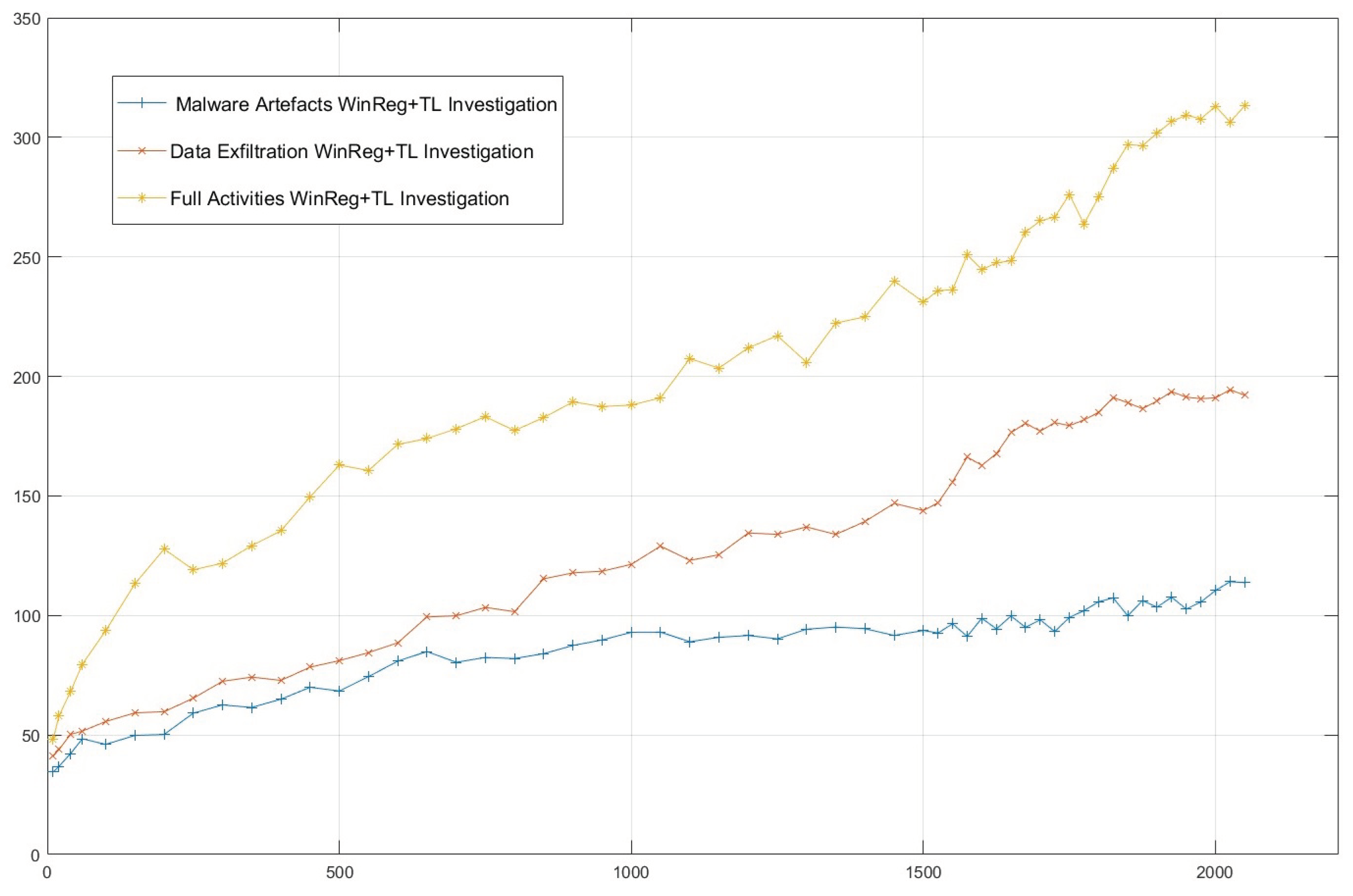
Figure 9.
Execution times of WinRegRL and Human Experts.
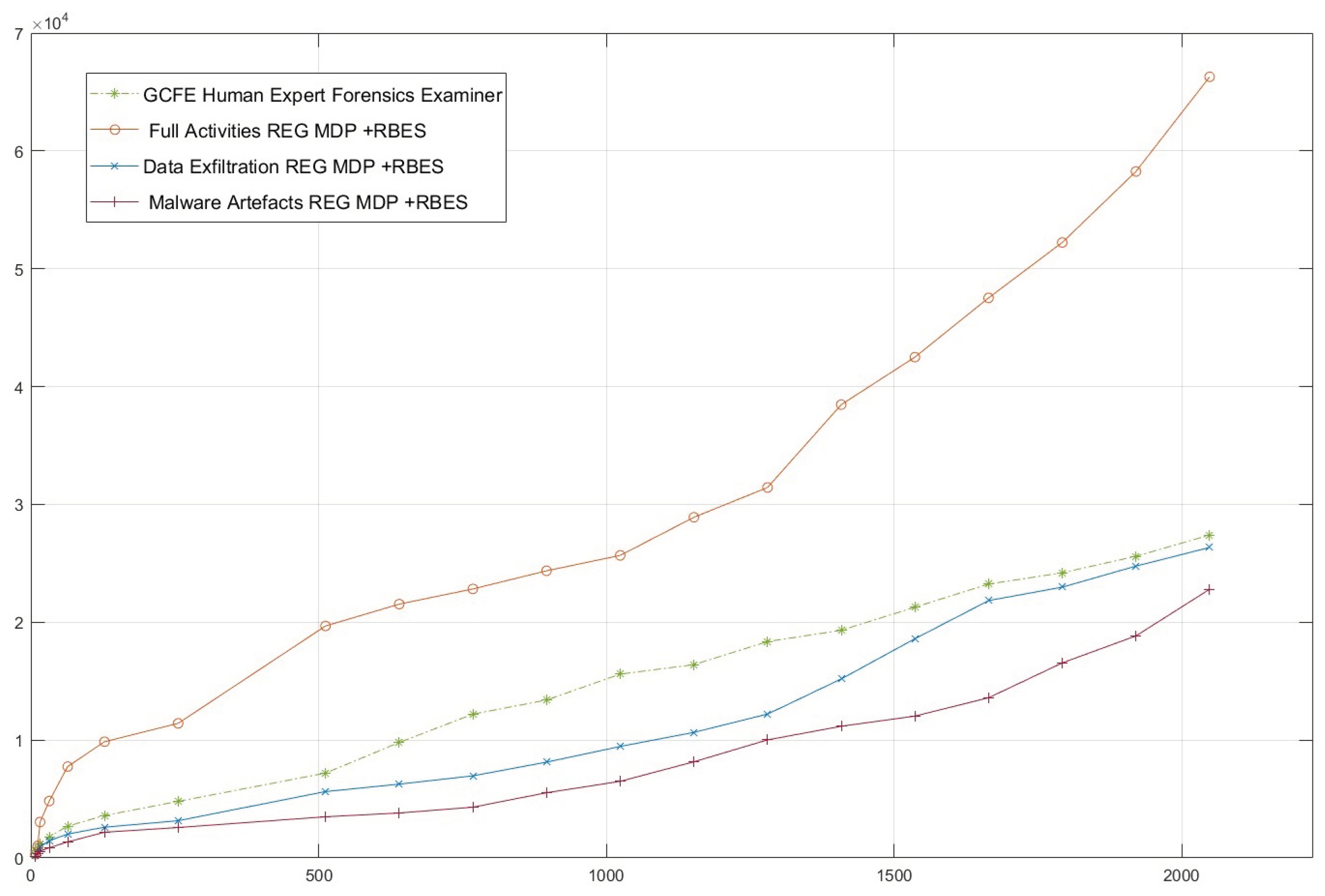
Table 1.
List of abbreviations.
| Abbreviation | Definition |
|---|---|
| AI | Artificial Intelligence |
| BAM | Background Activity Moderator |
| DFIR | Digital Forensics and Incident Response |
| FTK | Exterro Forensic Toolkit |
| GCFA | GIAC Certified Forensic Analyst |
| GCFE | GIAC Certified Forensic Examiner |
| GUI | Graphical User Interface |
| GUID | Globally Unique Identifier |
| IOC | Indicator of Compromise |
| KAPE | Kroll Artefact Parser and Extractor |
| MDP | Markov Decision Process |
| OS | Operating System |
| RB-AI | Rule-Based Artificial Intelligence |
| RL | Reinforcement Learning |
| SAM | System Account Manager |
| SID | Security Identifier |
| USB | Universal Serial Bus |
| WR | Windows Registry |
Table 2.
Windows Registry hives and supporting files [11].
Table 2.
Windows Registry hives and supporting files [11].
| Registry hive | Supporting files |
|---|---|
| HKEY_LOCAL_MACHINE_SAM | SAM, SAM.log, SAM.sav |
| HKEY_LOCAL_MACHINE_Security | Security, Security.log, Security.sav |
| HKEY_USERS_DEFAULT | Default, Default.log, Default.sav |
| HKEY_LOCAL_MACHINE_Software | Software, Software.log, Software.sav |
| HKEY_LOCAL_MACHINE_System | System, System.alt, System.log, System.sav |
| HKEY_CURRENT_CONFIG | System, System.alt, System.log, System.sav, Ntuser.dat, Ntuser.dat.log |
Table 3.
Summary of related works.
| Tool - Framework | Technique and Approach | Output & Description |
|---|---|---|
| ReLOAD [12] | (1) A digital forensic tool used to generate and analyse data. (2) It utilises hardware resources and highlights deleted files | Has the ability to analyse a broad range of data. |
| AXREL [13] | (1) Interactive GUI for WR analysis (2) Extracts data from Eo1 image using NTFSDUMP, and outputs results in a table format. | Filters system info, Program execution, and Installed Software. It is time-efficient, although it requires manual verification. |
| MADIK [14] | (1) Multi-agent toolkit utilising intelligent software agents (ISA) for forensic data analysis. (2) Contains six agents: HashSetAgent, TimelineAgent, FileSignatureAgent, FilePathAgent, KeywordAgent, and WindowsRegistryAgent. | Processes and analyses time zone info, installed software, removable media info, and OS events. |
| RaDaR [15] | (1) Multi-perspective data collection and labelling of malware activity. (2) Contains 7 million network packets, 11.3 million OS system call traces, and 3.3 million events from 10,434 malware samples. | Open real-world datasets for run-time behavioural analysis of Windows malware. The dataset fosters solution comparison and supports malware research. |
| KROLL KAPE [16] | Automates the extraction of key forensic artefacts and supports rapid analysis. | Identification module to collect specific forensic artefacts (e.g., registry keys, logs). The parsing module and processing module support efficient artefact analysis. |
Table 9.
Final WinRegRL solver configuration used for the reported experiments. Parameters formerly shown only as broad ranges are now replaced by the exact instantiated values used during benchmarking.
Table 9.
Final WinRegRL solver configuration used for the reported experiments. Parameters formerly shown only as broad ranges are now replaced by the exact instantiated values used during benchmarking.
| Parameter | Final value used | Description |
|---|---|---|
| 0.99 | Discount factor used in all reported experiments. | |
| H | 200 | Maximum number of decision epochs allowed per episode. |
| Bellman-residual stopping tolerance for value iteration. | ||
| 0.10 | Minimum empirical support threshold below which local Q-learning refinement is triggered. | |
| 0.05 | Learning rate for the local tabular Q-learning refinement stage. | |
| (initial) | 0.10 | Initial exploration probability for low-support local refinement. |
| (final) | 0.02 | Final exploration probability after decay within the bounded local refinement stage. |
| Transition-deviation tolerance used to flag unstable branches for local re-estimation. | ||
| Max Bellman sweeps | 200 | Upper limit on dynamic-programming iterations before forced policy extraction. |
| Bootstrap resamples | 2,000 | Number of resamples used for confidence-interval estimation. |
| Random seeds | 10 | Independent seeds used for repeated WinRegRL runs per dataset. |
| Reward scale | Operational reward interval; exact category-specific assignments are given in the reward schedule table. | |
| MATLAB environment | R2024a MDPtoolbox | Software environment used for value iteration and policy extraction. |
Table 10.
Artefact-level precision and recall benchmarking of WinRegRL against FTK Registry Viewer and KAPE across four forensic scenarios. Reported recall corresponds to coverage against the adjudicated benchmark set for each case.
Table 10.
Artefact-level precision and recall benchmarking of WinRegRL against FTK Registry Viewer and KAPE across four forensic scenarios. Reported recall corresponds to coverage against the adjudicated benchmark set for each case.
| Artefact-level precision | Artefact-level recall (coverage) | |||||
|---|---|---|---|---|---|---|
| Tool or framework | Our | FTK RV | KAPE | Our | FTK RV | KAPE |
| Magnet-CTF 2022 [28] | 98.7±0.6% | 76.4% | 81.4% | 98.9±1.0% | 63.9% | 41.6% |
| IGU-CTF 2024 [29] | 98.5±0.8% | 77.2% | 80.9% | 97.6±1.4% | 53.5% | 46.8% |
| MemLabs-CTF 2019 [30] | 99.5±0.3% | 82.1% | 88.7% | 99.2±0.7% | 66.7% | 50.1% |
| MalVol 2025 [31] | 98.1±1.1% | 90.7% | 93.2% | 98.4±1.2% | 71.2% | 52.5% |
Table 11.
Ablation analysis of WinRegRL across the evaluated datasets.
| Variant | Precision | Recall | F1-score | Mean completion time (s) |
|---|---|---|---|---|
| Full WinRegRL (RL + RB-AI + fusion) | 98.7% | 98.5% | 98.6% | 312 |
| w/o expert-policy initialisation | 95.2% | 96.1% | 95.6% | 381 |
| w/o reward shaping | 94.3% | 94.8% | 94.5% | 397 |
| Registry-only (no memory/timeline fusion) | 96.1% | 89.4% | 92.6% | 286 |
| MDP + rules only (no online RL refinement) | 92.8% | 91.2% | 92.0% | 354 |
| Rule-based triage only | 89.6% | 84.7% | 87.1% | 331 |
Disclaimer/Publisher’s Note: The statements, opinions and data contained in all publications are solely those of the individual author(s) and contributor(s) and not of MDPI and/or the editor(s). MDPI and/or the editor(s) disclaim responsibility for any injury to people or property resulting from any ideas, methods, instructions or products referred to in the content. |
© 2026 by the authors. Licensee MDPI, Basel, Switzerland. This article is an open access article distributed under the terms and conditions of the Creative Commons Attribution (CC BY) license (http://creativecommons.org/licenses/by/4.0/).
Copyright: This open access article is published under a Creative Commons CC BY 4.0 license, which permit the free download, distribution, and reuse, provided that the author and preprint are cited in any reuse.


