

Submitted:
07 January 2025
Posted:
08 January 2025
Read the latest preprint version here
Abstract
The proliferation of Internet of Things (IoT) devices has introduced new challenges for digital forensic investigators due to their diverse architectures, communication protocols, and security vulnerabilities. This research paper presents a case study focusing on the forensic investigation of an IoT device, specifically a Raspberry Pi configured with Kali Linux as a hacker machine. The study aims to highlight differences and challenges in investigating Weaponized IoT as well as establish a comprehensive methodology to analyse IoT devices involved in cyber incidents. The investigation begins with the acquisition of digital evidence from the Raspberry Pi device, including volatile memory, and disk images. Various forensic tools and utilities are utilized to extract and analyse data, tools such as Exterro FTK, Magnet AXIOM and open-source tools such as and Volatility, Wireshark, Autopsy. The analysis encompasses examining system artefacts, log files, installed applications, and network connections to reconstruct the device's activities and identify potential evidence proving that the user perpetuated security breaches or malicious activities. The findings of this research contribute to the advancement of IoT forensic capabilities by providing insights into the methodologies and best practices for investigating IoT devices, particularly those configured as hacker machines. The case study serves as a practical demonstration of the forensic techniques applicable to IoT environments, facilitating the development of protocols, standards, and training programs for IoT forensic investigators. Ultimately, enhancing forensic readiness in IoT deployments is essential for mitigating cyber threats, preserving digital evidence, and ensuring the integrity of IoT ecosystems.
Keywords:
IoT Forensics
; Raspberry Pi
; Single-Board-Computers
; CyberCrime
; Digital Forensics
; Linux
; Kali
; Hacking
; Digital investigation
; Weaponized IoT
; Exterro FTK
; Volatility
; Magnet AXIOM
1. Introduction
The IoT devices continue to proliferate at an unprecedented rate, and it is forecasted that by 2025, they will make up more than two-thirds of an estimated 41.6 billion internet-connected devices [1]. These devices, ranging from smart home gadgets to complex industrial systems, form a core part of modern ecosystems but also pose new challenges for cybersecurity and forensic investigations. Compact, low-cost single-board computers, such as the Raspberry Pi, exemplify this duality. While these devices are in general deployed as central components in IoT environments for the collection, control, and analysis of sensor data, praised for their high processing power, low price, and user-friendliness, they can easily be utilized by cyber-criminals when loaded with tools like Kali Linux as machines for hacking. This dual-purpose nature underscores the requirement for specialist IoT forensic techniques [20].
IoT forensics is a relevant and relatively new area, adding new dimensions in cybercrime that present challenges for digital forensics. IoT forensics refers to the identification, collection, and preservation and analysis of digital evidence from IoT devices. Its importance lies in providing insights into how devices communicate with each other, their network behavior, and user activities—the key elements that can be used to solve incidents such as data breaches, cyberattacks, or even physical crimes. IoT ecosystems generate vast volumes of data, and as the systems become ubiquitous, it will only increase the necessity for robust forensic methodologies in place [3].
IoT forensics includes several important subdomains: device, live, network, and cloud forensics. IoT devices—often, though not always, called "things"—pose challenges to forensics. Some bear permanent storage with recognizable file systems and formats, so traditional forensics works. Yet, others are based on proprietary file systems or do not have permanent memory at all, which complicates evidence collection. Power supply limitations, low RAM, and real-time data transfer worsen the situation for live forensics. The data transferred over the networks can be encrypted. Moreover, IoT data, when processed in cloud environments, often resides at remote and sometimes unknown geographical locations, making retrieval and analysis even more complicated [27].
Forensic investigations of IoT devices are further complicated by the volatility of IoT data, the intricate architectures of IoT ecosystems, and the integration of these devices into larger network infrastructures. There are also legal and ethical issues to contend with, including privacy and ensuring a proper chain of custody.
Figure 1 shows the sub-components of IoT forensics and corresponding sources of artefacts, which include:
- Criminal-operated Linux systems (e.g., command-and-control servers).
- Abused or misused Linux systems (e.g., by suspect users)
- Imaged systems (e.g., dead disks)
- Standalone artefacts from Linux distributions
- Raspberry Pi devices running Kali Linux
- Metapackages from other platforms
The uniqueness of IoT forensic investigations demands specialized techniques and tools tailored to the constraints and complexities of these environments. The diversities of the evidence sources are depicted in Figure 1, showing diversity and complexity, which need to be handled with care to analyze the artefacts for accurate and reliable output [26].
Lastly, even though the defence-in-depth approach is obviously necessary in securing an IoT ecosystem, it opens up new complexities for forensic investigations. This involves the application of different mechanisms to protect against possible attacks. However, these defense layers are often compromised due to human errors, misconfigurations, and built-in system vulnerabilities [5]. Since cyber threats have been diversifying and intensifying, a growing number of security controls and measures compound the challenges faced by forensic analysts [7]. These would require not only technical expertise but also deep knowledge of the peculiarities of IoT environments.
1.1. Research Motivation
IoT forensics presents complex challenges across several dimensions, starting with evidence source identification, as evidence is often distributed across a variety of interconnected devices with different protocols and data storage formats. Evidence acquisition or forensics imaging is also a challenge, given IoT devices’ limited storage, proprietary data formats, and reliance on cloud-based storage, which complicates access [22]. Additionally, traditional forensic tools and techniques are insufficient for IoT-specific needs, as they are not designed to handle the unique architectures and data formats of IoT devices, this necessitates utilising specialised tools. These factors highlight the importance of customized forensic strategies and international legal collaboration to effectively address the complexities of IoT investigations.
1.2. Research Questions
Our Research Questions are formulated as follows:
- RQ1: How do forensic processes differ between conventional computers and IoT Devices such as Raspberry Pi devices?
- RQ2: What are the key differences in terms of meaningful forensics artefacts between conventional computers and IoT Devices?
- RQ3: What are the current challenges and limitations in IoT Forensics and possible best practices to implement to overcome these challenges?
2. Literature Review
As IoT devices proliferate across various domains, understanding the unique characteristics of IoT forensics becomes imperative for effective investigation and incident response. This section highlights the scope of IoT Forensics. IoT forensics encompasses a broad range of activities and challenges related to investigating and analysing digital evidence from Internet of Things (IoT) devices and systems. The scope of IoT forensics extends beyond traditional digital forensics practices to address the unique challenges posed by interconnected, heterogeneous, and pervasive IoT environments [12]. The Internet of Things (IoT) is gaining popularity, and numerous sectors have drawn attention to the topic of IoT security and forensics. Research efforts on IoT security and forensics are extensive and cover a wide range of topics, from the theoretical underpinnings of cybersecurity to the practical challenges of securing and investigating IoT devices [22]. The use of low-cost, portable tools like the Raspberry Pi has emerged as a recurring theme, offering both opportunities and challenges in the field of IoT forensics. Future research should continue to explore these areas, particularly focusing on the development of more robust forensic tools and methodologies tailored to the unique challenges posed by IoT environments. This literature review synthesizes key studies focusing on different aspects of IoT security, digital forensics, and the use of low-cost, portable tools like the Raspberry Pi for these purposes. It also offers a thorough examination of existing research on the use of Raspberry Pi in hacking and forensic analysis. It explores the performance, capabilities, and vulnerabilities of these devices within IoT environments, highlighting the crucial role of IoT forensics in criminal investigations and the importance of strong security measures [25]. The uniqueness of IoT forensics can be summarized in the following points:
- Device Diversity: IoT devices come in various forms, including single-board computers (SBC), sensors, actuators, wearables, smart home appliances, and industrial controllers making the task address the diversity in device types, architectures, communication protocols, and operating systems challenging.
- Data Acquisition: Retrieving data from IoT devices while preserving its integrity and ensuring admissibility in legal proceedings is complex with many challenges such as accessing data stored in volatile memory, retrieving logs and configuration settings, and capturing network traffic.
- Distributed Nature: IoT environments involve numerous geographically distributed devices, making data collection and analysis challenging, especially with real-time data generation.
- Scalability Issues: The vast number of devices and data in IoT systems demands new forensic approaches to efficiently process and analyse large-scale information.
- Heterogeneous Protocols: IoT devices use various communication protocols, requiring forensic experts to understand and analyse diverse and often complex interactions.
- Privacy and Legal Concerns: IoT devices collect sensitive data, raising privacy issues. Forensic investigations must navigate legal frameworks to ensure evidence is admissible without violating privacy rights.
Analysing data obtained from IoT devices involves examining logs, event traces, metadata, communication patterns, and potentially large volumes of sensor data. Therefore, investigators need tools and techniques to process, interpret, and correlate diverse data sources for reconstructing events and identifying evidence. Network Forensics refers to IoT devices’ communication over wireless and wired networks, this presents challenges for capturing, analysing, and reconstructing network traffic [21]. Therefore, investigators must consider encryption, encapsulation, and fragmentation mechanisms used in IoT communication protocols. Many IoT deployments leverage cloud and edge computing platforms for data processing, storage, and analytics. Forensic investigations may involve accessing data stored in remote servers, analysing data streams at the edge, and tracing data flows across distributed architectures [18].
In their 2018 study, [9] explore the topic of cybersecurity and deterrence within IoT environments, focusing on strategies to prevent cyberattacks, particularly those orchestrated by nation-states. They highlight the key differences between cyber weapons and conventional military tools, delving into the motivations that drive cyber operations. Additionally, the authors assess the effectiveness of various deterrence strategies. While their research does not specifically address IoT forensics, it lays the foundation for understanding the broader cybersecurity landscape, which is vital for contextualizing the unique challenges faced in IoT environments. [4] provide a comprehensive survey of the challenges and methodologies in IoT forensics, emphasizing critical areas such as the establishment of data inclusion and exclusion criteria, the automation of forensic processes, and the integration of forensic capabilities into device design referred to as "forensics by design." Their research also addresses the usability of forensic tools, the complexities involved in shutting down IoT devices for analysis, the implications of service level agreements (SLAs) on data access, and the privacy risks associated with encryption and anti-forensics techniques. This study is essential for understanding the intricate landscape of IoT forensics and the various obstacles that practitioners encounter in their investigations [17].
In their 2018 study, [14] explored the field of ethical hacking and penetration testing, highlighting the advantages of using low-cost, portable hardware such as the Raspberry Pi. The authors provide a thorough overview of ethical hacking, covering essential definitions, techniques, and the practical application of various tools, particularly using a Raspberry Pi for tasks like reconnaissance and remote penetration testing. By integrating both theoretical insights and hands-on practices, this study serves as a valuable resource for understanding how portable devices can enhance cybersecurity efforts and forensic investigations. In their 2022 study, [15] investigated the vulnerabilities using a Raspberry Pi 4 running Raspberry Pi OS to simulate attacks using Kali Linux and various automated tools. Their research reveals significant security concerns inherent to IoT devices, emphasising the critical need for robust security measures to prevent potential exploitation. The methodology outlined in their work provides a comprehensive discussion of the practical challenges faced in securing IoT environments, highlighting the complexities involved in protecting these devices from cyber threats.
[16] investigated the creation of a low-cost, portable digital forensic imaging tool using a Raspberry Pi. The primary objective of their research was to develop an affordable imaging solution capable of effectively collecting and analysing digital evidence. This work is especially significant to IoT forensics, where the need for cost-effective tools is critical due to the extensive variety and prevalence of IoT devices in various environments. in [11] and [23], researchers conducted an evaluation and comparison of two open-source intrusion detection systems (IDSs) operating on a Raspberry Pi 2 (Model B). The primary objective of their research is to assess the suitability of these systems for deployment in cost-sensitive network environments [13]. This investigation holds significant importance for IoT forensics, emphasising the need for effective intrusion detection mechanisms in resource-constrained scenarios where affordable hardware plays a crucial role.
The research conducted by [24] examined the security vulnerabilities found in two commercial drones, utilising the Raspberry Pi as an automated tool for their analysis. This study not only highlights the significant security weaknesses inherent in these drones but also demonstrates the potential for exploiting such vulnerabilities. By shedding light on these risks, the research contributes valuable insights to the broader field of IoT forensics by emphasizing the dangers associated with the increasing integration of IoT devices across various [19]. A summary of related work, aspects covered, and techniques used are captured in Table 1.
The literature identifies a notable gap in comparative studies of forensic processes between Raspberry Pi and traditional PCs. While many studies focus on specific aspects of IoT forensics, there is a lack of research that directly compares the forensic capabilities and challenges of these two platforms. The literature also highlights ongoing debates regarding the effectiveness of various forensic tools and methodologies when applied to IoT devices [28].
3. Methodology
The rise of Internet of Things (IoT) devices has introduced significant challenges to traditional forensic investigations, which are often tailored to conventional computing environments. This study addresses these challenges by creating a testbed that simulates environments where conventional PCs and IoT devices, like the Raspberry Pi, coexist. By simulating various cyber-attacks and analysing data such as network traffic, memory dumps, and system logs, the research compares forensic processes between these platforms. The findings highlight the strengths and limitations of existing forensic tools in IoT environments, emphasizing the need for specialized approaches for IoT forensics.
3.1. Testbed Design
The forensic investigation in this study required a meticulously designed testbed to evaluate and compare forensic processes between conventional computers and IoT devices. The testbed included both a traditional PC and a Raspberry Pi, configured to simulate a real-world environment where these devices coexist. The PC used was an Acer Aspire V5, equipped with 8GB RAM and a 120GB SSD, running Kali Linux 2023.3. The Raspberry Pi 5, representing the IoT device, featured 5GB RAM and a 32GB SD card, also running Kali Linux 2023.3. Both devices were connected to a common Wi-Fi network using a Nokia HA-140W-B router. To generate relevant forensic data, four distinct cyber-attack scenarios were simulated on both the PC and the Raspberry Pi. These attacks included Windows 7 – EternalBlue, PowerShell-Empire, Windows 10 – Multi/Handler with Msfvenom payload, and Koadic Framework. Network traffic during these attacks was captured using Wireshark, ensuring comprehensive data for forensic analysis. Figure 2 depicts the key components and processes of Tested design and implementation.
3.2. Dataset Elaboration
Various types of data were collected from both devices during the simulations to ensure a thorough forensic investigation. Network traffic data, including all incoming and outgoing packets, was captured and saved in pcap format for later analysis. Memory dumps were obtained using LiME (Linux Memory Extractor) for the Raspberry Pi and Microsoft AVML for the PC. These memory dumps were crucial for analysing the processes and system states during the attacks.
Additionally, system logs, such as event, application, and security logs, were collected from both devices to provide context to the network traffic and memory data. File system snapshots were also taken before and after the attack simulations, allowing for the identification of any changes made by the attackers.
3.3. Data Capturing
The forensic data capturing process involved both forensic imaging and live RAM dumps. FTK Imager was used to create forensic images of the PC’s hard drive and the Raspberry Pi’s SD card, providing a complete snapshot of the data at the time of acquisition. For live data capture, RAM dumps were obtained using LiME for the Raspberry Pi and Microsoft AVML for the PC. These RAM dumps were essential for analysing active processes and volatile data, which would otherwise be lost once the device was powered off. The collected data, which included system logs, memory dumps, and network traffic data, was then thoroughly analysed to identify traces of the simulated attacks.
3.4. Comparative Forensics Analysis
we conducted a thorough investigation to compare the forensic susceptibility of a standard Personal Computer (PC) and a Raspberry Pi (RPI). The comparative analysis aim to assess the forensics capabilities enabled by each device and how could the data be extracted and analysed in case of forensic investigation. The focus was on several key areas namely:
- Tool compatibility: The comparative forensic analysis highlighted several significant differences and challenges between conventional computers and IoT devices. Traditional PCs demonstrated high compatibility with most forensic tools, which facilitated a more robust forensic investigation. In contrast, the Raspberry Pi analysis faced significant limitations due to its ARM architecture, which is not widely supported by many forensic tools.
- Data Retention: Data retention also varied, with PCs retaining extensive logs and system data, allowing for a detailed forensic investigation. The Raspberry Pi, however, had limited storage and logging capabilities, resulting in fewer retrievable forensic artefacts and challenges in performing a thorough analysis.
- Memory Analysis: Memory analysis was another area where differences were evident. While memory analysis on PCs was effective, with tools like Volatility providing detailed data from memory dumps, the Raspberry Pi’s architecture and limited tool support made this process much more challenging, if not impossible.
- Network traffic analysis: Network traffic analysis was consistent across both devices, with Wireshark effectively capturing relevant data. However, the contextual information provided by logs and memory analysis was more detailed for the PC, offering a more comprehensive view of the attacks.
- System Log Analysis: System log analysis further underscored the differences, with PCs offering comprehensive and detailed logs, enabling deeper forensic examinations. In contrast, the Raspberry Pi provided limited logs, restricting the scope of analysis
- File System Snapshots: Finally. while PCs allowed for detailed file system snapshots before and after the attacks, revealing significant changes, the Raspberry Pi’s limited storage capacity resulted in fewer detectable changes, further constraining forensic analysis.
The discussion below evaluates these differences in different categories of forensic artefacts, highlighting their implications in forensic investigations. Table 2 summarises the comparative forensics analysis
3.4.1. DisPartitions of the File System
The structure of the file system on a device will, to a large degree, define how forensic analysis is done by determining where and how data is stored, accessed, and managed. The PC machine running Kali Linux offers wider support for multiple partition types, such as FAT32, Ext4, Linux Swap, and unpartitioned space, which enhance flexibility in data storage and system configuration. Furthermore, dev/pts and dev/shm partitions create temporary storage for the session and temporary data that is quite handy in the capture of ephemeral artefacts. By contrast, the Raspberry Pi 5 only supports FAT32 and ext4 partitions. This greatly constrains its functionality in regard to swap memory and unpartitioned space due to a lack of Linux Swap, dev/pts, and dev/shm partitions, which makes the Raspberry Pi very limited with respect to how it manages memory. It therefore offers less capability to capture artefacts related to temporary storage or session information. Thus, the forensic investigators who would research or analyze a Raspberry Pi 5 would have fewer artefacts to consider compared to what is available on a PC and hence are very likely to miss some key transient data that may reside in swapped or shared memory areas.
3.4.2. MRBF/EFI/Config/Initramfs Files
Understanding boot and configuration files may be needed in the course of the startup process and system configuration, as both might reveal the tampering or malicious configurations. Grub.cfg, grub.d, conf.d, hooks, modules, update-initramfs.conf among others, on the PC provided a very important record of the events of the boot and configuration process that would assist the investigator in reconstructing the system’s boot sequence.
However, the main configuration file that is responsible for defining the behaviour of the bootloader in a grub.cfg is not present on Raspberry Pi 5, limiting forensic insight into the process of the boot. The rest of the configuration files, hooks, modules, and update initramfs.conf exist. However, without grub.cfg, it is impossible for forensic analysts to reconstruct or analyze the activity of the bootloader. This difference is critical in cases where evidence of bootloader modification which is a common tactic among attackers required as essential to a forensic investigation.
3.4.3. File System: Boot/EFI Logs
Other significant differences are the boot and EFI logs that one can find. On a PC, logs such as efi, boot.log, and dpkg.log summarize the process of booting up and package handling, hence giving the investigator an overview of the system changes and possible tampering. However, the Raspberry Pi 5 does not provide efi and installer logs, and the investigator can use only boot.log and dpkg.log. This diminishes the level of detail concerning the boot process, and some critical logs may be missed that could indicate unauthorized changes or suspicious activities. Moreover, since most of the systems have no efi logs, the forensic analyst loses the ability to track some issues related to firmware or hardware-level tampering, which may be needed in the case of some new sophisticated cyber-attacks.
3.4.4. Systemd Boot/Shutdown
Both systems use /usr/lib/systemd and /etc/systemd for storing Systemd records of boots and shutdowns, respectively. Therefore, no significant difference exists between these systems in regard to this area. This homogeneity ensures that comparable records of boot and shutdown processes are equally available to the investigator on either device, thus reinforcing system start-up and shutdown behaviour auditing on either device or platform. This is one of the limited spaces where the forensic artefact landscape is still equivalent across both systems.
3.4.5. Installed Software and System Logbook
The installed software and system journal provide insight into the applications running on a system and their respective activities. Both systems do have system.journal and user-1000.journal files, important in capturing logs of user activities and events within the system. On the other hand, it should be noticed that both the PC and the Raspberry Pi 5 do not contain any var/log/messages or var/log/syslog, which might be a limitation to forensic visibility with respect to low-level system messages and error logs.
This similarity emphasizes one of the weaknesses of the default logging configuration in Kali Linux for both platforms, whereby important system messages are not captured by the traditional logs. In an investigation, this may mean losing critical error reports, system warnings, or security notices that usually flood these logs.
3.4.6. Network Log Files
Network logs are some of the most critical logs as far as tracking device connectivity for the purpose of forensic investigation and the determination of possible points of compromise. Below are the entries recorded in the Network Manager log file of the PC, reflecting some records of target devices along with network interface activity, for example, Wlan0. In the case of the Raspberry Pi 5, it also contains Wlan0. however, an extra secret_key entry is present that was missing in the PC. This unique log artefact on the Raspberry Pi 5 can hint at particular security settings or authentications, adding an extra network dimension of artefacts that could be relevant within some sorts of investigations.
The presence of the secret_key entry on the Raspberry Pi 5 may raise some questions regarding network configuration security, while absence on the PC shows difference in processing by each device of authentication logs. This, for an investigator, points to the need for knowledge of the specific platform when examining network activity across dissimilar devices.
3.4.7. Cache, Swap, and Persisted Data
The Cache and swap spaces play a big role in forensic analysis, as generally, residual data is left behind. Although both devices record Wlan0 and some network-related records, the Raspberry Pi 5 adds the secret_key entry. This Raspberry Pi reduces the vulnerable storage that could retain useful data, such as unsaved documents or network credentials since the swapping space is not available in it.
This little swap memory will contain the investigations that can be carried out on the Raspberry Pi, especially if the evidence has to be examined with respect to user activity or unsaved session data. Whereas in PC, swap memory may capture transient data and is an extended set of forensic artefacts.
3.4.8. Other Applications Logging
Both platforms use the same application logs for most default cybersecurity applications, empire_client.log, server.log, and MS17(eternalblue). For forensic investigators, this consistency of application logs presents advantages in allowing consistent analysis of the same application-level artefacts across devices.
3.4.9. Volatile Memory (RAM)
Live memory analysis is crucial for capturing volatile data; however, it’s only supported on the PC, which allows complete RAM analysis with tools like Volatility. Due to the architecture of Raspberry Pi 5, it doesn’t support Volatility, thusly live memory analysis isn’t possible. This has really proved a deep handicap because most live memory images usually contain, in real-time, operating processes, encryption keys, and session information which is very valuable during forensic investigation. Without this capability on the Raspberry Pi, forensic investigators may miss volatile artefacts critical to understanding real-time system behaviour.
4. Research Findings and Discussion
4.1. Key Differences Between PC and Raspberry Pi
Our investigation revealed significant differences between the PC and the Raspberry Pi in terms of forensic capabilities. The PC demonstrated a tendency to retain extensive logs, system data, and processes, facilitating a detailed forensic analysis. This is in stark contrast to the Raspberry Pi, which, due to its limited logging capability and smaller storage capacity, offered fewer forensic artefacts, thus limiting the depth of analysis. One of the most critical areas of difference was memory analysis. While acquiring and analysing AM images from a Windows-based PC was straightforward and provided rich data, the process was significantly more complex with Linux-based systems and IoT devices like the Raspberry Pi. The lack of tool compatibility with the RPI’s ARM architecture posed a significant challenge, making it difficult to perform comprehensive forensic analysis.
Table 3 summarizes the differences in forensic capabilities between the PC and Raspberry Pi:
Additionally, a detailed analysis of the file system and other artefacts on both devices further highlighted these differences. Starting with the file system, the PC features multiple partitions, including FAT32, ext4, and Linux Swap, along with unpartitioned space and various directories such as /dev/pts and /dev/shm. In contrast, the RPI5’s file system is more limited, comprising only two partitions (FAT32 and ext4) and lacking additional directories and unpartitioned space. This distinction suggests that the PC has a more complex and detailed file system structure, which may offer more artefacts for forensic analysis.
When examining boot processes, the PC demonstrates detailed boot configuration files, including grub.cfg, various grub.d scripts, and configurations for initramfs. The RPI5, however, shows limited support in this area, with many boot-related files not available. This limitation in the RPI5 indicates potential challenges in performing comprehensive forensic investigations related to the boot process.
In terms of system services and scheduling, both devices utilize systemd for boot and service management, suggesting a common approach in handling these functions despite potential differences in implementation details. However, the PC’s extensive logging capabilities, including directories like /var/log/messages and /var/log/syslog, contrast with the RPI5’s reliance on a journal system (system.journal, user-1000journal). This disparity highlights the PC’s superior capacity for retaining detailed logs, which are crucial for forensic analysis.
Log files and system journals further emphasize the differences, with the PC offering comprehensive logs, including those related to network management. The RPI5’s logs are more focused on network interfaces, such as Wlan0, and lack the breadth found in the PC. This limitation restricts the depth of forensic analysis that can be performed on the RPI5.
When it comes to application logs, both devices capture logs related to various attack tools like PowerShell Empire, multi/handler, and Koadic. However, the specific logs and their availability differ between the platforms, indicating that while both devices can log similar types of activities, the details and accessibility of these logs vary.
Live memory analysis presents a significant challenge for the RPI5, as the Volatility tool does not support its architecture, making live memory analysis difficult or impossible. In contrast, the PC supports live memory analysis with tools like Volatility, providing detailed insights into the system’s state during forensic investigations. This difference underscores the PC’s advantage in forensic memory analysis.
Finally, network traffic analysis is consistent across both devices, with tools like Wireshark effectively capturing relevant data. However, the contextual information provided by logs and memory analysis is more detailed for the PC, offering a more comprehensive view of the attacks. The differences in system log analysis further highlight the PC’s capability to offer detailed forensic examinations, while the RPI5’s limited logs restrict the scope of analysis.
4.2. Challenges with Raspberry Pi
The current forensic examination of hacker-oriented systems, using a traditional PC running Kali Linux and a Raspberry Pi 5, affords an unparalleled opportunity to assess how forensic artefacts will change across platforms with distinct hardware architectures and functionalities. Kali Linux remains the favourite choice for cybercriminals and current trends show an important shift towards the use of SBC such as Raspberry which the Cyber Forensics community is not ready yet to cope with this shift is marked by differences in both the level and type of forensic data available due to their base design, hardware, and software composition.
The most significant challenge encountered during this investigation was related to the analysis of RAM in the context of Raspberry Pi when compared to Desktop PC where acquiring RAM images was a relatively straightforward process. However, when dealing with Raspberry Pi and IoT devices in general, the process became more complex. We tested fourteen different tools to analyse Linux evidence, and only two, Rekall and Volatility, could handle Linux images. Unfortunately, Rekall has not been updated since November 2017, rendering it less effective in producing reliable results. Volatility, on the other hand, encounters issues with Linux symbols, requiring the creation of a symbol table using Dwarf2Jason for each Linux version. This process is problematic because the tool does not keep up with the frequent updates of the Linux operating system, limiting its applicability depending on the version in use. For the Raspberry Pi, the challenge was even more pronounced. The Volatility tool does not support the ARM architecture embedded in the Raspberry Pi, making it impossible to analyse live memory from the device. This limitation severely restricts the ability to perform comprehensive forensic analysis on the Raspberry Pi, highlighting a critical gap in the available forensic tools for IoT devices.
4.3. Addressing Research Questions
For RQ1, the forensic procedures vary considerably between traditional PCs and IoT devices such as Raspberry Pi because of the differences in their hardware designs, operating systems, and data storage capacities. Traditional computers, which usually have stronger hardware and storage capabilities, enable thorough forensic examination utilising a wide variety of tools and procedures [29]. Their logging techniques are comprehensive, facilitating the tracking of user actions and system operations. On the other hand, Raspberry Pi devices present difficulties in forensic investigations because of their simplified designs (ARCH architecture) and restricted storage capacity. A significant number of forensic tools do not have compatibility with IoT devices, and the data stored is often inadequate for doing thorough analysis. Acquiring live memory from IoT devices is a more intricate and less dependable operation compared to traditional PCs.
For RQ2, the significant distinctions in terms of forensic artefacts difference between traditional PCs and Raspberry Pi devices are due to the Data Storage Capacity and hardware architecture. Traditional computers have a greater capacity to store data and maintain more comprehensive records of user actions and system operations. This encompasses comprehensive system logs, application logs, and user-generated data, which are essential for forensic investigations. PCs use logging practices that employ strong systems to capture extensive information about system and network operations. Internet of Things (IoT) devices, such as Raspberry Pi, sometimes possess restricted logging capabilities, leading to a reduced quantity and quality of artefacts. Conventional computers have a far higher capability for doing live memory analysis compared to other devices. Volatility Plugins are capable of extracting intricate information about active processes and system conditions from memory dumps. However, IoT devices have difficulties when it comes to memory analysis because of compatibility concerns with forensic tools.
For RQ3, the current challenges and limitations in weaponized IoT forensics include:
- Tool Compatibility: Many existing forensic tools are not compatible with the diverse architectures and operating systems used by IoT devices, such as the ARCH architecture in Raspberry Pi.
- Data Retention and Storage: IoT devices typically have limited storage capacity and simplified logging mechanisms, which result in insufficient forensic data retention.
- Live Memory Analysis: Acquiring and analysing live memory from IoT devices is challenging due to tool incompatibility and the technical complexity of configuring existing tools for different architectures.
In summary, traditional PCs provided a robust platform for forensic investigations, offering extensive data retention and tool compatibility. In contrast, IoT devices like the Raspberry Pi posed significant challenges due to limited tool support, reduced data retention, and restricted memory analysis capabilities. These findings underscore the need for the development of specialised forensic tools and methodologies tailored to the unique characteristics of IoT devices to enhance their forensic investigation potential.
5. Conclusion and Future Works
In conclusion, our investigation underscores the significant differences in forensic capabilities between traditional PCs and Raspberry Pi devices. While PCs offer a robust basis for logging and extensive data retention capabilities, Raspberry Pi devices are hampered by limited storage, less detailed logs, and poor compatibility with existing forensic tools. These limitations, particularly live memory analysis, highlight the need for more advanced tools that can accommodate the unique architectures of IoT devices like the Raspberry Pi. Overall, Kali Linux running on the PC and Raspberry Pi 5 each potentially provide a wide range of forensic artefacts. However, there are some fundamental differences in several respects: for example, the availability of multiple partitions, full configuration files, and of course, live memory offers a much more textured forensic environment when it comes to the PC. Issues such as incomplete boot files, no swap space, and no support with Volatility diminish the forensic environment on the Raspberry Pi. These differences bring out the PC as a more robust forensic platform, while the simplicity of the Raspberry Pi 5 may be an advantage in focused investigations; it certainly presents some constraints for in-depth forensic analysis.
Funding
No Funding.
Institutional Review Board Statement
This research was deemed as not requiring the University’s Ethical Committee Approval as it doesn’t fall under any of the cases requiring ethical approval.
Data Availability Statement
Disks’ Forensics Images and Volatile data generated for this research are available upon request.
Conflicts of Interest
The authors declare that they have no known competing interests or personal relationships that could have appeared to influence the work reported in this paper.
References
- Wanic, E. and Rowe, N. (2018). Assessing Deterrence Options for Cyber Weapons, in 2018 International Conference on Computational Science and Computational Intelligence (CSCI), pp. 13–18. [CrossRef]
- Torabi, S. , Bou-Harb, E., Assi, C. and Debbabi, M., 2020. A scalable platform for enabling the forensic investigation of exploited IoT devices and their generated unsolicited activities. Forensic Science International: Digital Investigation, 32, p.300922. [CrossRef]
- Kebande, V.R. , 2022. Industrial Internet of Things (IIoT) forensics: The forgotten concept in the race towards industry 4.0. Forensic Science International: Reports, 5, p.100257. [CrossRef]
- Stoyanova, M. , Nikoloudakis, Y., Panagiotakis, S., Pallis, E. and Markakis, E.K., 2020. A survey on the Internet of Things (IoT) forensics: challenges, approaches, and open issues. IEEE Communications Surveys & Tutorials, 22(2), pp.1191-1221. [CrossRef]
- Dunsin, D. , Ghanem, M.C., Ouazzane, K. and Vassilev, V., 2024. A comprehensive analysis of the role of artificial intelligence and machine learning in modern digital forensics and incident response. Forensic Science International: Digital Investigation, 48, p.301675. [CrossRef]
- Cook, M. , Marnerides, A., Johnson, C. and Pezaros, D., 2023. A survey on industrial control system digital forensics: challenges, advances and future directions. IEEE Communications Surveys & Tutorials. [CrossRef]
- Nelufule, N. , Singano, T., Masemola, K., Shadung, D., Nkwe, B., Mokoena, J.2024. An Adaptive Digital Forensic Framework for the Evolving Digital Landscape in Industry 4.0 and 5.0, 2024 2nd International Conference on Intelligent Data Communication Technologies and Internet of Things (IDCIoT), pp.1686-1693, 2024. [CrossRef]
- Case, A. and Richard III, G.G., 2017. Memory forensics: The path forward. Digital investigation, 20, pp.23-33. [CrossRef]
- Wanic, E. and Rowe, N. (2018). Assessing Deterrence Optinos for Cyber Weapons. in 2018 International Conference on Computational Science and Computational Intelligence (CSCI), pp. 13–18. ttps://doi.org/10.1109/CSCI46756.2018.00011.
- Stoyanova, M. , Nikoloudakis, Y., Panagiotakis, S., Pallis, E. and Markakis, E. K. 2020. A Survey on the Internet of Things (IoT) Forensics: Challenges, Approaches, and Open Issues’, IEEE Communications Surveys & Tutorials, 22(2), pp. 1191–1221. [CrossRef]
- Cusack, B. Tian, Z. and Kyaw, A.K., 2017. Identifying DOS and DDOS attack origin: IP traceback methods comparison and evaluation for IoT. In Interoperability, Safety and Security in IoT: Second International Conference, InterIoT 2016 and Third International Conference, SaSeIoT 2016, Paris, France, October 26-27, 2016, Revised Selected Papers 2 (pp. 127-138). Springer International Publishing.
- Ghanem, M.C. , Mulvihill, P., Ouazzane, K., Djemai, R. and Dunsin, D., 2023. D2WFP: a novel protocol for forensically identifying, extracting, and analysing deep and dark web browsing activities. Journal of Cybersecurity and Privacy, 3(4), pp.808-829. [CrossRef]
- Ghanem, M.C. , Chen, T.M., Ferrag, M.A. and Kettouche, M.E., 2023. ESASCF: expertise extraction, generalization and reply framework for optimized automation of network security compliance. IEEE Access, 11, pp.129840-129853. [CrossRef]
- Yevdokymenko, M. , Mohamed, E. and Onwuakpa, P. (2017) ’Ethical hacking and penetration testing using Raspberry PI’, in 2017 4th International Scientific-Practical Conference Problems of Info-communications. Science and Technology (PIC S&T), pp. 179–181. [CrossRef]
- Mohd Bakry, B. B. , Bt Adenan, A. R. and Mohd Yussoff, Y. B. (2022) ‘Security Attack on IoT RelatedDevices Using Raspberry Pi and Kali Linux’, in 2022 International Conference on Computer and Drone Applications (IConDA), pp. 40–45. [CrossRef]
- Yudha, F. , Ramadhani, E. and Komaryan, R. M. (2021) ’A Prototype of Portable Digital Forensics Imaging Tools using Raspberry Device’, IOP Conference Series: Materials Science and Engineering, 1077(1), p. 012064. [CrossRef]
- Ghanem, M. , Mouloudi, A. and Mourchid, M., 2015. Towards a scientific research based on semantic web. Procedia Computer Science, 73, pp.328-335. [CrossRef]
- Ghanem, M. , Dawoud, F., Gamal, H., Soliman, E., El-Batt, T. and Sharara, H., 2022, September. FLoBC: A decentralized blockchain-based federated learning framework. In 2022 Fourth International Conference on Blockchain Computing and Applications (BCCA) (pp. 85-92). IEEE. [CrossRef]
- Hamouda, D. , Ferrag, M.A., Benhamida, N., Seridi, H. and Ghanem, M.C., 2024. Revolutionizing intrusion detection in industrial IoT with distributed learning and deep generative techniques. Internet of Things, 26, p.101149. [CrossRef]
- Dunsin, D. , Ghanem, M.C., Ouazzane, K. and Vassilev, V., 2024. Reinforcement learning for an efficient and effective malware investigation during cyber Incident response. arXiv:2408.01999. [CrossRef]
- Farzaan, M.A.M. , Ghanem, M.C., El-Hajjar, A. and Ratnayake, D.N., 2024. AI-Enabled System for Efficient and Effective Cyber Incident Detection and Response in Cloud Environments.https://arxiv.org/abs/2404.05602.
- Dunsin, D. , Ghanem, M.C. and Quazzane, K., 2022. The use of artificial intelligence in digital forensics and incident response in a constrained environment. International Journal of Information and Communication Engineering, 16(8), pp.280-285. https://repository.londonmet.ac.uk/8678/.
- Kyaw, A. K. , Chen, Y. and Joseph, J. (2015) ’Pi-IDS: evaluation of open-source intrusion detection systems on Raspberry Pi 2’, in 2015 Second International Conference on Information Security and Cyber Forensics (InfoSec). Cape Town: IEEE, pp. 165–170. [CrossRef]
- Westerlund, O. and Asif, R. (2019) ’Drone Hacking with Raspberry-Pi 3 and WiFi Pineapple: Security and Privacy Threats for the Internet-of-Things’, in 2019 1st International Conference on Unmanned Vehicle Systems-Oman (UVS). Muscat, Oman: IEEE, pp. 1–10. [CrossRef]
- T. Bakhshi. Forensic of Things: Revisiting Digital Forensic Investigations in Internet of Things. 2019 4th International Conference on Emerging Trends in Engineering, Sciences and Technology (ICEEST), Karachi, Pakistan, 2019, pp.1-8. [CrossRef]
- Y. Salem, M. Y. Salem, M. Owda and A. Y. Owda. A Comprehensive Review of Digital Forensics Frameworks for Internet of Things (IoT) Devices. 2023 International Conference on Information Technology (ICIT), Amman, Jordan, 2023, pp. 89-96. [CrossRef]
- Mazhar, M.S. , Saleem, Y., Almogren, A., Arshad, J., Jaffery, M.H., Rehman, A.U., Shafiq, M. and Hamam, H., 2022. Forensic analysis on Internet of Things (IoT) device using machine-to-machine (M2M) framework. Electronics, 11(7), p.1126. [CrossRef]
- Alam M., N. and Kabir, M. S. Forensics in the Internet of Things: Application Specific Investigation Model, Challenges and Future Directions, 2023. 4th International Conference for Emerging Technology (INCET), Belgaum, India, 2023, pp. 1-6. [CrossRef]
- Ho, S.M. and Burmester, M. (2021). Cyber Forensics on Internet of Things: Slicing and Dicing Raspberry Pi. International Journal of Cyber Forensics and Advanced Threat Investigations, 2(1). pp.29–49. [CrossRef]
Figure 1.
IoT Forensics Domain and Artefacts Categories [26].
Figure 1.
IoT Forensics Domain and Artefacts Categories [26].
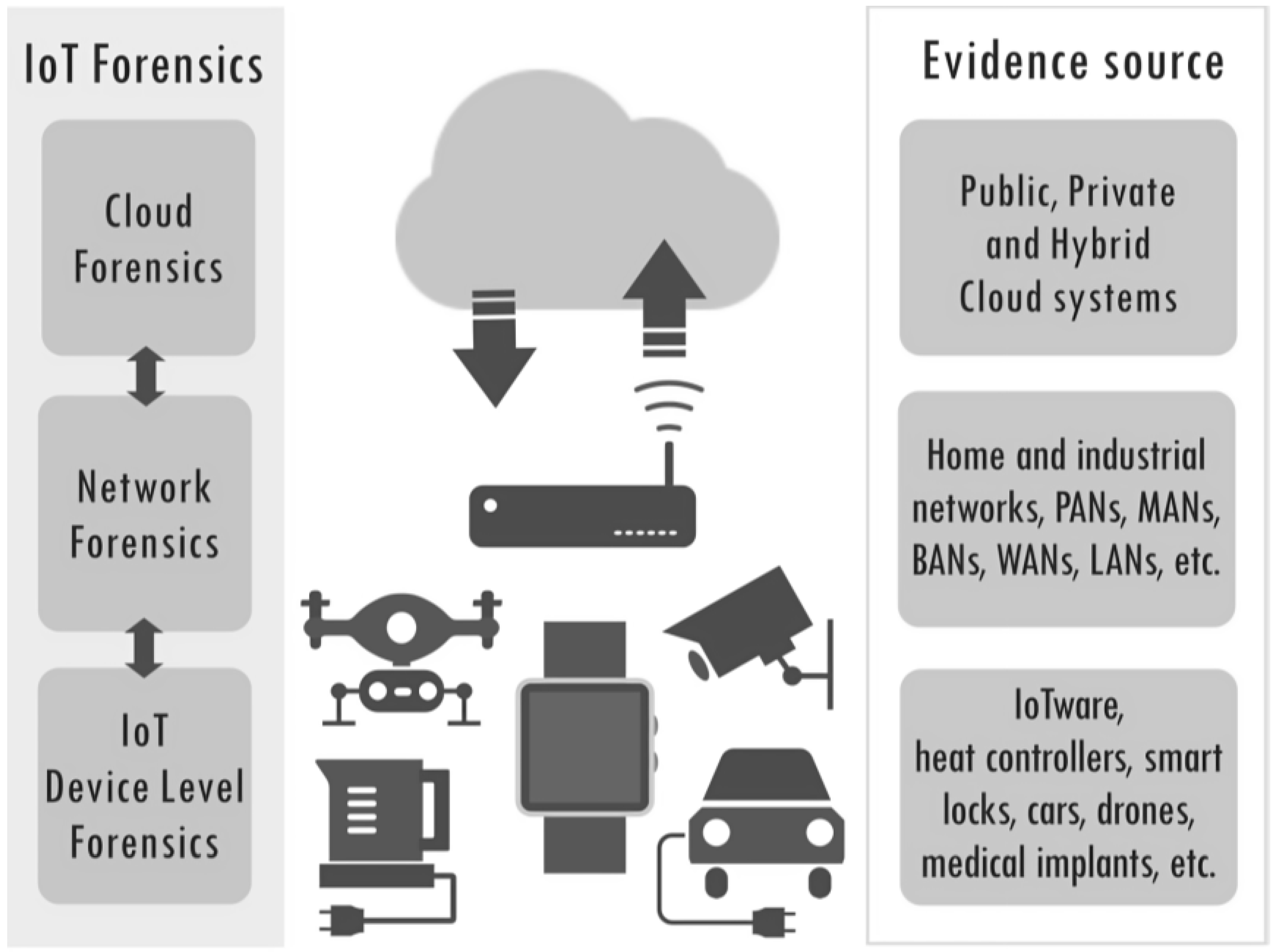
Figure 2.
Test Bed Design and Implementation.
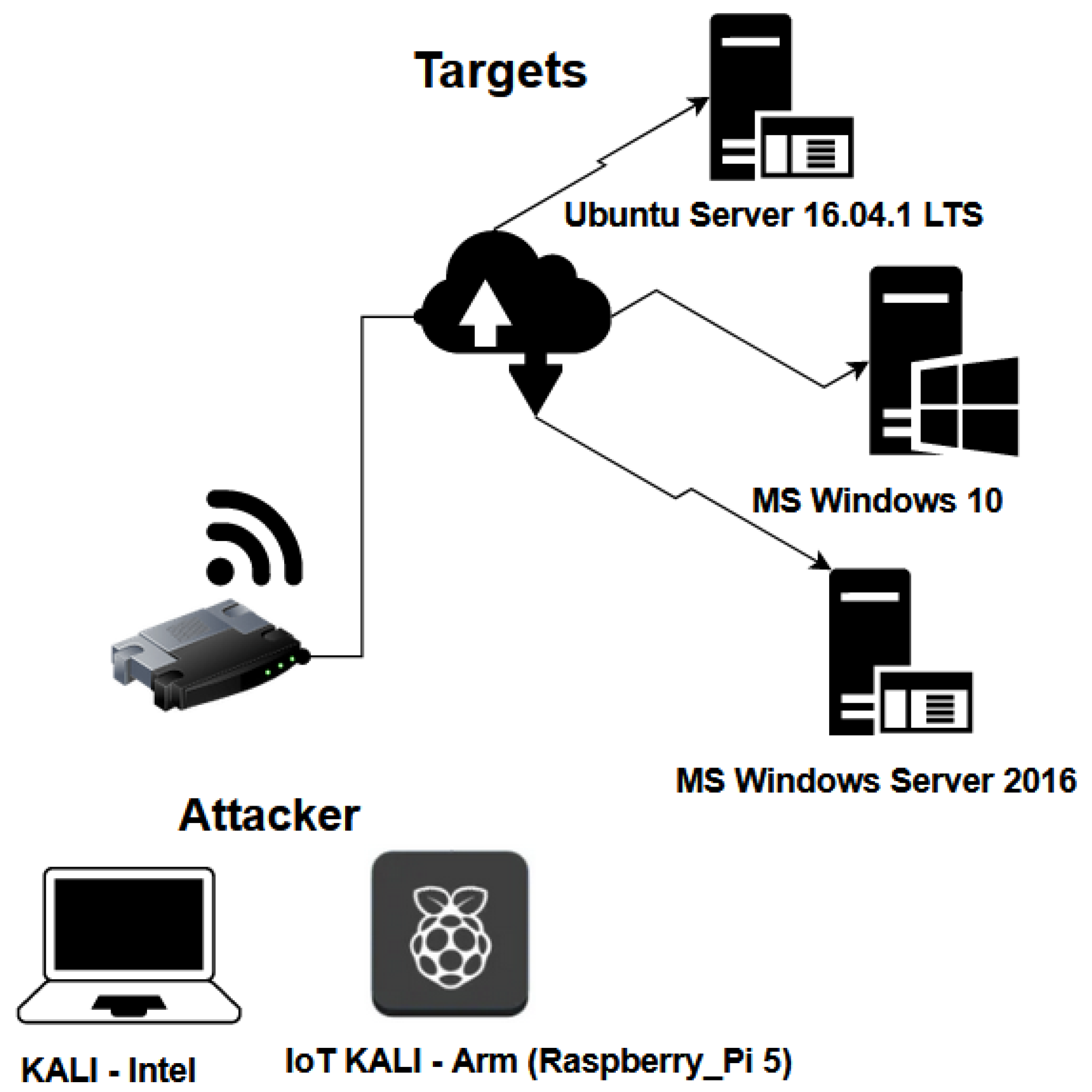

Table 1.
Summary of related works.
| Reference | Year | IoT | Digital Forensics | Offensive Security | Technique & Approach |
|---|---|---|---|---|---|
| [9] | 2018 | ✗ | ✔ | ✗ | Evaluation and proposal for strategies to deter cyber attacks, particularly those initiated by nation-states. Differences between Cyber and Conventional Weapons, motivation and objectives of cyber operations, deterrence methods (evaluation and effectiveness) |
| [10] | 2020 | ✔ | ✔ | ✔ | Surveying challenges, approaches, and open issues in the field of IoT forensic, research broadly highlighted differences and similarities between mobile and IoT forensic, and tackled forensic by design and digital forensic as a service (DFaaS). |
| [14] | 2018 | ✔ | ✗ | ✔ | Comprehensive overview of ethical hacking practices, emphasizing the use of low-cost, portable hardware like the Raspberry Pi. Define Ethical Hacking, penetration testing, reconnaissance techniques, and remote penetration testing with the RPI combining theoretical and practical aspects. |
| [15] | 2022 | ✔ | ✔ | ✗ | The article focuses on demonstrating the vulnerability of IoT devices using a Raspberry Pi 4 with Raspberry Pi OS. Attacks with Kali Linux and automated tools are employed highlighting the security concerns associated with IoT devices. The methodology of executing the attacks is discussed emphasising the importance of securing IoT devices to prevent exploitation. |
| [16] | 2021 | ✔ | ✗ | ✔ | The paper focuses on developing a low-cost, and portable digital forensic imaging tool using the RPI. The goal is to create an image that can be used and analysed as affordable evidence. |
| [23] | 2015 | ✔ | ✔ | ✗ | Focus on evaluating and comparing the performance, efficiency, and efficacy of two open-source intrusion detection systems (IDSs) running in the Raspberry Pi 2 (Model B). Aim to determine their suitability for use in cost-sensitive network environments. |
| [24] | 2019 | ✔ | ✔ | ✗ | Identify and exploit vulnerabilities in two commercial drones. Aim to demonstrate the security weakness present in these drones by using the Raspberry Pi as an automated tool to interact with the drones. |
Table 2.
Comparative Forensics Analysis Highlighting main Similarities and Differences
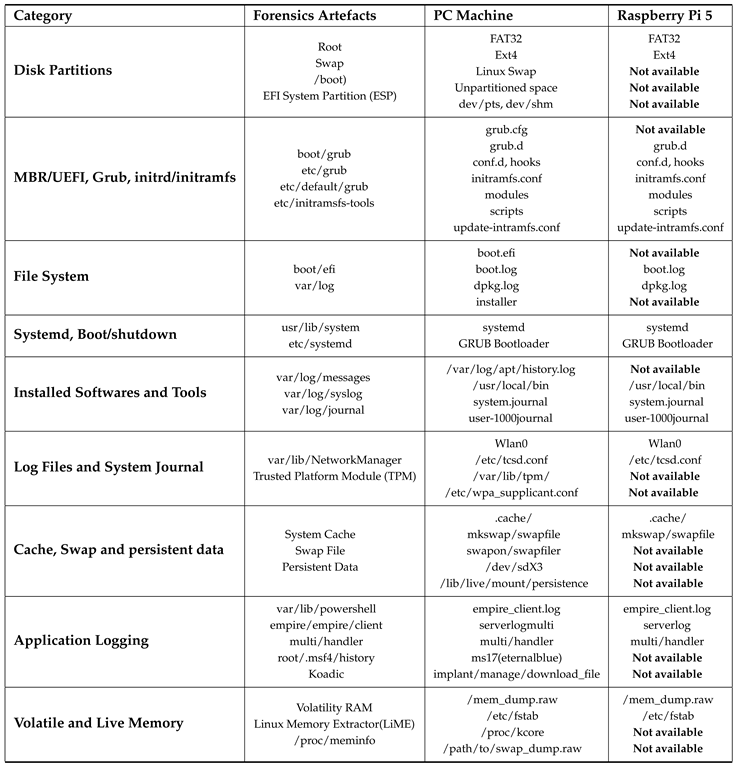 |
Table 3.
Summary of the Overall Forensics Investigation Differences
| Aspect | PC | Raspberry Pi |
|---|---|---|
| Tool Compatibility | High - Most tools work effectively | Low - Many tools face compatibility issues |
| Data Retention | Extensive logs and system data | Limited logs and storage capacity |
| Memory Analysis | Effective with rich data from memory dumps | Challenging due to tool configuration issues |
| Network Traffic Analysis | Detailed and consistent analysis | Similar results but less contextual data |
| System Log Analysis | Comprehensive and detailed | Limited and less detailed |
| File System Snapshots | Detailed snapshots before and after attacks | Limited changes detected due to small storage |
| Overall Forensic Capability | High - Robust forensic analysis possible | Low - Significant limitations in forensic analysis |
Disclaimer/Publisher’s Note: The statements, opinions and data contained in all publications are solely those of the individual author(s) and contributor(s) and not of MDPI and/or the editor(s). MDPI and/or the editor(s) disclaim responsibility for any injury to people or property resulting from any ideas, methods, instructions or products referred to in the content. |
© 2025 by the authors. Licensee MDPI, Basel, Switzerland. This article is an open access article distributed under the terms and conditions of the Creative Commons Attribution (CC BY) license (http://creativecommons.org/licenses/by/4.0/).
Copyright: This open access article is published under a Creative Commons CC BY 4.0 license, which permit the free download, distribution, and reuse, provided that the author and preprint are cited in any reuse.


