

Submitted:
31 December 2024
Posted:
31 December 2024
You are already at the latest version
Abstract
We introduce the media (gaseous and liquid) demonstrating the negative viscosity. Consider the vibrated plate (ω is the frequency of vibrations), which is vertically pulled through the gas, built of the core-shell ”meta-molecules”: the mass of the shell is M, the mass of the core is m, the core is connected to the shell with the ideal spring k. Y is the vertical axis. Vibrating of the vertical plate supplies to the core-shell meta-molecules an excess vertical momentum. If ω<ω0 (ω0=km), this excess momentum coincides with the positive direction of axis Y; if ω>ω0, the excess moment is oriented against axis Y; thus, the effect of negative viscosity becomes possible. No violation of energy conservation is observed; the energy is supplied to the system by the external source vibrating the plate. The effect of the negative viscosity is also possible in liquids. Frequency dependence of the viscosity is addressed. Asymptotic expressions are derived for the frequency-dependent viscosity.
Keywords:
metamaterials
; negative viscosity
; core-shell systems
; frequency
; Newtonian liquid
; drag force
1. Introduction
Development of optical and acoustic metamaterials opened new horizons in the materials science [1,2,3]. Metamaterials supplied to engineers media with the properties, which do not exist in the natural materials and alloys. Metamaterials are usually defined as artificial, periodic structures suited for control/altering mechanic [2] or electromagnetic [1,4] properties of materials to obtain prescribed features that are not observed naturally. The prefix “μετά” (a Greek word meaning ‘beyond, after’) indicates that the properties of the material are outside of the range of properties observed in nature [2,3,4,5,6,7,8,9,10,11,12,13,14]. The structural units of the metamaterials (‘meta-molecules”) are usually macroscopic [2,3,4,5,6,7,8,9,10,11,12,13,14]. These macroscopic meta-molecules can be tailored and dynamically controlled in shape, properties, chirality and size [2,3,4,5,6,7,8,9,10,11,12,13]. The lattice constant and inter-cell interaction can be artificially modified, and useful “defects” can be designed and introduced precisely at desired locations.
Numerous amazing, paradoxical and useful effects such the negative refraction of light [4,5,6,7,8,9] and negative effective mass became possible with the meta-materials [15,16,17,18,19,20,21,22,23,24,25]. The effect of the negative effective mass (also called “negative inertia” [25]”) may be achieved under exploiting the plasma oscillations of the electron gas in metals [21,22]. The negative effective mass materials were already successfully demonstrated experimentally by embedding soft silicon rubber coated heavy spheres in thermosetting polymer, acting as the local mechanical resonators [24]. Development of metamaterials enabled unique engineering applications, including seismic devices, optical and acoustic camouflage, acoustic and thermal cloaking/absorbers [8,9,10,26,27,28,29]. Metamaterials enable achievement of controlled and exotic mechanical properties through the rational design of their microstructures. It was demonstrated recently that when compared with conventional schemes, metamaterials provide an unprecedented potential for governing the mass and energy transport processes [3,12]. We report in this communication that the paradoxical control of the momentum transport resulting in the negative viscosity, emerging from the effect of the negative mass, is possible. A “negative-viscosity” effect in a magnetic fluid was already reported [30,31]. In a Poiseuille flow, a constant magnetic field balances vorticity and impedes the rotation of individual magnetic particles embedded into the liquid [30,31]. Conversely, an alternating magnetic field favors the rotation of the particle [30,31]. The magnetic energy is transformed into the angular momentum of the magnetic particles, which is converted into a hydrodynamic motion of the fluid [30,31]. The entire effect results in a decrease of the total viscosity [30]. Negative viscosity of ferrofluids under alternating magnetic field was reported by other groups [32,33]. Negative effective viscosity also emerges in a large-scale flow maintained by a small-scale periodic force field [34]. If the field is essentially anisotropic, the system of small-scale eddies generated in the liquid is unstable to long-wave disturbances, i.e., the effective viscosity of the corresponding large-scale flow is negative [34]. If the applied periodic field is isotropic, the long-wave instability disappears; thus, the effective viscosity is positive, as reported by Sivashinsky and Yakhot [34]. We introduce the additional possible mechanism of negative viscosity, exploiting the effect of negative mass.
2. Results
Consider ideal gas built of core-shell particles/units, shown in Figure 1. The mass of the shell is M, the mass of the core is m. Particles participate in the random thermal motion (we will restrict the randomness of this motion, below). The core particle m is connected to the spherical shell M with the ideal Hookean, massless spring k. The aforementioned core-shell system (considered in our approach as “meta-molecules”) gives rise to the effect of the negative mass. When the core-shell unit is exerted to the external harmonic/sinusoidal force it may be superseded with an equivalent effective mass denoted , supplied with Eq. 1 (for the details of derivation of Eq. 1 see [15,16,17,18]:
where . It is easily recognized from Eq. 1 that, when the frequency of the external harmonic force approaches from above the effective mass , defined by Eq. (1) will be negative. The effect was also called the “negative inertia” [25]. Of course, actually, neither “negative mas” nor “negative inertia” does not exist, and this should be clearly understood. What does the effect of negative mass mean? It means that the under certain frequencies the entire core-shell system, seen as integral unit moves in the direction opposite to the direction of the external force (in other words, the core-shell unit moves against the applied harmonic force) [15,16,17,18].
Consider the vertical plate pulled vertically upward (along axis Y) through the gas of core-shell particles (i.e. meta-molecules) with the velocity <<, as shown in Figure 1. For a sake of simplicity we assume the vibration of the core mass m occures along axis Y; i.e. the core-shell units are oriented vertically (the springs remain oriented vertically). Vibrating vertical plate supplies to the core-shell units an excess vertical momentum. If this excess momentum coincides with the positive direction of axis Y; however, if , the excess moment is oriented against axis Y<< is adopted); thus, the effect of negative viscosity becomes possible. Consider the case when is true. The vibrated plate supplies to the core-shell meta-molecules the downward momentum; thus, the gas of core-shell units supplies to the plate the excess upward moment. This effect may be described as the negative viscosity of the gas built of the core-shell elements.
Address the ideal gas of the core-shell particles possesing the number concentration n. Particles partcipate in the random thermal motion with a 3D averaged velocity c (the motion of the particles is not completely random: the vertical orientation of the springs remains untouched). Consider the transfer of excess vertical moment supplied by the vertically pulled plate () to the gas, built from the core-shell particles, through the vertical area S, located at the distance x from the plate (see Figure 1) over the time interval . This transfer equals
where is supplied by Eq. 1, and are the velocities of excess, oriented, vertical motion of the core-shell-units before and after passing area S, and are the number of core-shell units, passing the area along and against the positive direction of axis x correspondingly, is a mean free path of core shell-units. The Second Newton Law yields for the viscous stress Eq. (3):
where is the effective viscosity of the core-shell units built gas. Considering Eq. 1 and (T is the temperature of the core-shell units built gas) yields for the effective viscosity:
The effective viscosity is negative when the frequency of the external harmonic force vibrating the plate approaches from above. It should be emphasized that the effective viscosity supplied by Eq. (4) is frequency dependent. Such a behavior is typical for non-Newtonian liquids.[35,36]
Now consider one more possibility of the negative effective viscosity emerging in the situation illustrated with Figure 2. Consider the core-shell system which is oscillated vertically within the ideal gas with the velocity with the velocity ; the mass of the shell is , the mass of the core is ; the core mass is connected to the shell with two ideal, massless, Hookean springs . The core-shell is embedded into the ideal gas of the particles with the mass of and concentration n. The particles move with the averaged velocity . Obviously the transverse transport of momentum occurs with the classical viscosity, given by , where is a mean free path of the particles So this case looks trivial, and does not give rise to the phenomenon of the negative viscosity. However, the actual situation is more complicated. Consider the drag force we address the situation when the Reynolds number is much smaller than unity ( is the density of the gas and is the characteristic dimension of the core-shell system). Thus, the drag force may be expressed as [35]:
where is the dimensionless coefficient; axis Y is vertical (see Figure 2). The second Newton Law yields:
where ; . Considering yields:
Eq. 7 enables introducing of the effective complex viscosity with Eq 8:
Thus, we obtain:
It is instructive to build the graph ; such a graph is schematically shown in Figure 3. It is easy to demonstrate that the function has no extremal points. It is also easy to see that takes place when approaches from above (see Figure 3).
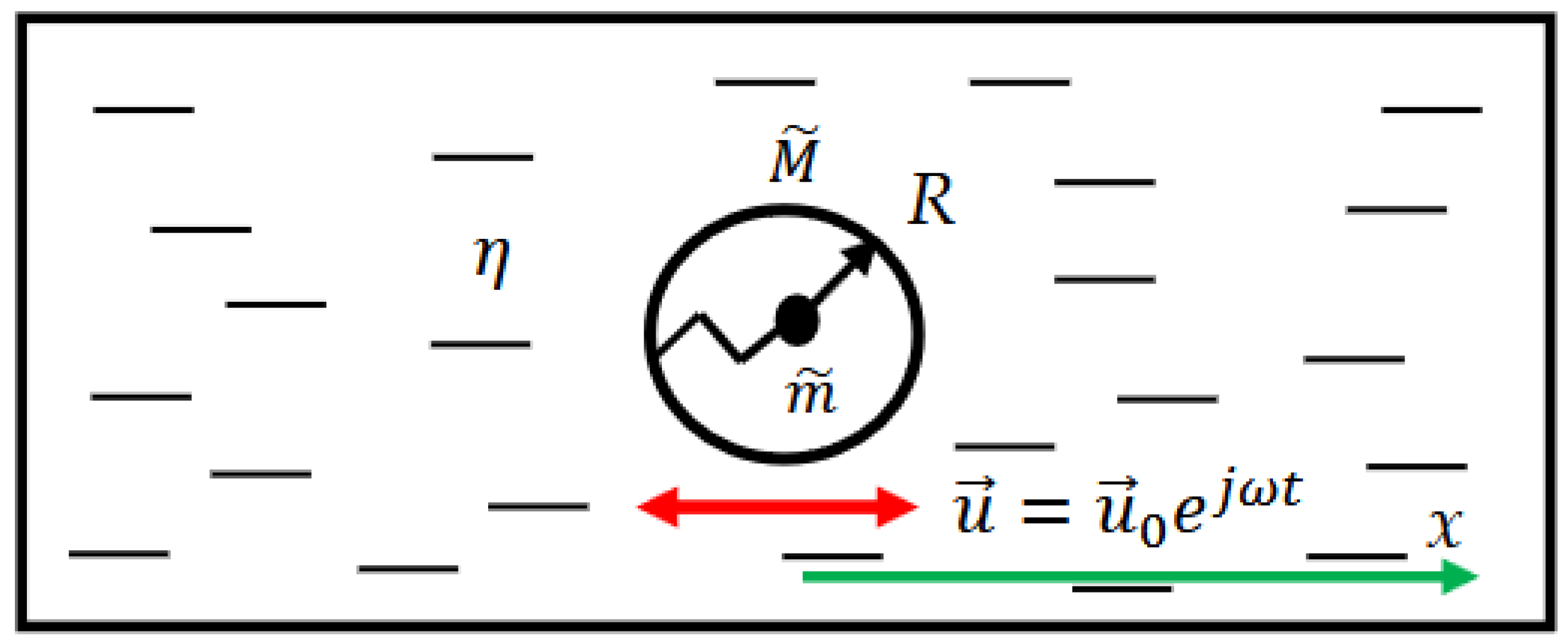
The same approach may be applied for the core-shell system (the mass of the shell is , the mass of the core is , the core is connected to shell with the ideal spring ) embedded into the Newtonian liquid depicted in Figure 4. The core-shell system is oscillated horizontally with the velocity . In this case the second Newton Law yields (we assume that the Reynolds number is much smaller than unity):
where is the Stokes drag force, ; . Considering gives rise to:
Thus, we obtain for the effective viscosity:
The imaginary part of the effective viscosity is supplied with Eq. 13:
Plot coincides qualitatively with that, shown in Figure 4. It should be emphasized, that the expressions (8) and (12) supplying the effective viscosity of the media have nothing to do with the true viscosities of the gas or liquid. Indeed, the viscosity of the media does not depend on the mass of the body, which moves through these media. However, these expressions are useful for understanding the frequency dependence of the drag force, illustrated with Figure 4. It is instructive to supply the asymptotic expressions for . In the limit of high frequencies we calculate:
In the limit of low frequencies, we obtain, in turn:
3. Discussion
Contra-intuitive, paradoxical negative viscosity effect was already discussed in the literature. This effect occurs in in a Poiseuille flow of a ferrofluid, when a constant magnetic field balances vorticity and impedes the rotation of individual magnetic particles embedded into the liquid [30,31]. Negative viscosity emerges also in ferrofluids under alternating magnetic field [32,33]. It is also possible in a large-scale flow maintained by a small-scale periodic force field [34]. We introduce the novel mechanism of negative viscosity, which occurs in the media built of the core-shell systems, introduced in [15,16,18,19]. Consider the vibrated plate, which is pulled through the gas, built of the core-shell systems, seen as meta-molecules The effective viscosity is negative when the frequency of the external harmonic force vibrating the plate approaches from above. It should be emphasized that the negative viscosity does not violate the conservation of energy; indeed, the plate is vibrated by the external source of energy.
4. Conclusions
We introduce the metamaterials demonstrating the negative viscosity. The negative mass emerges when the “quasi-molecules” (i.e. “meta-molecules”) are represented by the core-shell systems, in which the core mass m is connected to the shell M with the ideal massless spring k. We addressed the following model system: consider the vibrated plate, which is vertically pulled through the gas, built of the “meta-molecules”/core-shell systems. Y is the vertical axis. Vibrating of the vertical plate supplies to the core-shell “meta-molecules” an excess vertical momentum. If (), this excess vertical component of the momentum coincides with the positive direction of axis Y, if , the excess moment is oriented against axis Y. Thus, the effect of negative viscosity becomes possible. It should be stressed, that no violation of energy conservation is observed; the energy is supplied to the system by the external source vibrating the plate. The effect of the negative viscosity is also possible in liquids. We considered the core-shell system embedded in the Newtonian liquid in which the Stokes drag force acts on the vibrated core-shell unit. The entire system demonstrates the effect of the negative viscosity. Frequency dependence of the viscosity is addressed. Low- and high-frequency asymptotic expressions for the frequency dependent viscosity are derived.
Author Contributions
Conceptualization, E..B and S.S; methodology, E.B. and S.S; investigation, E. B. and S.S. writing—original draft preparation, E. B. All authors have read and agreed to the published version of the manuscript.
Funding
This research received no external funding.
Data Availability Statement
The data are contained within the article.
References
- Veselago, V.G. The electrodynamics of substances with simultaneously negative values of e and u. Sov. Phys. Usp. 1968, 10, 509–514. [Google Scholar] [CrossRef]
- Cui, T.J.; Smith, D.; Liu, R. Metamaterials. Theory, Design, and Applications, Springer, NY., USA, 2010.
- Jiao, P.; Mueller, J.; Raney, J.R.; Zheng, X.; Alavi, A.H. Mechanical metamaterials and beyond. Nat. Commun, 2023, 14, 6004. [Google Scholar] [CrossRef] [PubMed]
- Yang, F.; Zhang, Z.; Xu, L.; Liu, Z.; Jin, P.; Zhuang, P.; Lei, M.; Liu, J. ; Jiang, J-H. Controlling mass and energy diffusion with metamaterials, Rev. Mod. Phys. 2024, 96, 015002. [Google Scholar]
- Singh, A.K.; Abegaonkar, M.P.; Koul, S.K. Metamaterials for Antenna Applications, CRC Press, Boca Raton, Fl. USA, 2022.
- Felbacq, D.; Bouchitté, G. Metamaterials Modelling and Design, Taylor & Francis, Pan Stanford Publishing, Singapore, 2017.
- Marques, R.; Martin, F.; Sorolla, M. Metamaterials with Negative Parameters: Theory, Design, and Microwave Applications (Wiley Series in Microwave and Optical Engineering Book 183), J. Wiley & Sons, Hoboken, USA, 2008.
- Engheta, N.; Ziolkowski, R.W. Electromagnetic Metamaterials: Physics and Engineering Explorations, IEEE Press, Hoes Lane, NJ, USA, 2006.
- Semouchkina, E. Dielectric Metamaterials and Metasurfaces in Transformation Optics and Photonics, Woodhead Publishing, Cambridge, MA, USA, 2021.
- Cai, W.; Shalaev, V. Optical Metamaterials. Fundamentals and Applications, Chapter 5, Springer, New York, 2010.
- Wu, W.; Hu, W.; Qian, G.; Liao, H.; Xu, H.; Berto, F. Mechanical design and multifunctional applications of chiral mechanical metamaterials: A review. Materials & Design 2019, 180, 107950.
- Kshetrimayum, R.S. A Brief Intro to Metamaterials. IEEE Potentials. 2004, 23, 44–46. [Google Scholar] [CrossRef]
- Bormashenko Ed. Bioinspired Materials and Metamaterials, CRC Press, Boca Raton, USA, 2025.
- Li, Y. , Li, W., Han, T.; Fan, S..; Qui S-W. Transforming heat transfer with thermal metamaterials and devices. Nat. Rev. Mater. 2021, 6, 488–507. [Google Scholar] [CrossRef]
- Milton, G.W.; Willis, J.R. On modifications of Newton’s second law and linear continuum elastodynamics. Proc. R. Soc. A 2007, 463, 855–880. [Google Scholar] [CrossRef]
- Liu, X.N.; Hu, G.K.; Huang, G.L.; Sun, C.T. An elastic metamaterial with simultaneously negative mass density and bulk modulus. Appl. Phys. Lett. 2011, 98, 251907. [Google Scholar] [CrossRef]
- Rodrigues, I.C.; Steele, G.A.; Bothner, D. Photon Pressure with an Effective Negative Mass Microwave Mode, Phys. Rev. Lett. 2024, 132, 203603. [Google Scholar] [CrossRef] [PubMed]
- Chan, C.T.; Li, J.; Fung, K.H. On extending the concept of double negativity to acoustic waves. JZUS A 2006, 7, 24–28. [Google Scholar] [CrossRef]
- Huang, H.H.; Sun, C.T.; Huang, G.L. On the negative effective mass density in acoustic metamaterials. Int. J. Eng. Sci. 2009, 47, 610–617. [Google Scholar] [CrossRef]
- Bhatt, A.; Banerjee, A. Double attenuation peaks in metamaterial with simultaneous negative mass and stiffness, Phys. Lett. A 2022, 443, 128201. [Google Scholar] [CrossRef]
- Bormashenko, Ed.; Legchenkova, I. Negative effective mass in plasmonic systems. Materials 2020, 13, 1890. [Google Scholar] [CrossRef]
- Bormashenko, Ed; Legchenkova, I. ; Frenkel, M. Negative Effective Mass in Plasmonic Systems II: Elucidating the Optical and Acoustical Branches of Vibrations and the Possibility of Anti-Resonance Propagation. Materials 2020, 13, 512. [Google Scholar]
- Golovkin, B.G. High temperature negative mass plasma. Ann. Math. Phys. 2024, 7, 118–137. [Google Scholar]
- Liu, Z.Y.; Zhang, X.X.; Mao, Y.W.; Zhu, Y.Y.; Yang, Z. Y.; Chan, C.N.; Sheng, P. Locally resonant sonic materials, Science, 2000, 289, 1734-1736.
- Lončar, J.; Igrec, B.; Babić, D. Negative-inertia converters: Devices manifesting negative mass and negative moment of inertia. Symmetry 2022, 14, 529. [Google Scholar] [CrossRef]
- Peralta, I.; Fachinotti, V.D.; Álvarez Hostos, J.C. A Brief Review on Thermal Metamaterials for Cloaking and Heat Flux Manipulation, Adv. Eng. Mater. 2020, 22, 1901034. [Google Scholar]
- Liu, J.; Deng, J.; Chen, D.; Huang, Q. ; Pan. G.; Design and performance of ultra-broadband composite meta-absorber in the 200Hz-20kHz range, J. Sound & Vibration, 2024, 574, 118229. [Google Scholar]
- Liao, G.; Luan, C.; Wang, Z.; Liu, J.; Yao, X.; Fu, J. Adv. Mater. Techn. 2021, 6, 2000787. [CrossRef]
- Lim, C.W. From Photonic Crystals to Seismic Metamaterials: A Review via Phononic Crystals and Acoustic Metamaterials. Arch. Computat. Methods Eng. 2022, 29, 1137–1198. [Google Scholar]
- Bacri, J.-C.; Perzynski, R.; Shliomis, M.I.; Burde, G.I. “Negative-Viscosity” Effect in a Magnetic Fluid, Phys. Rev. Lett. 1995, 75, 2128. [Google Scholar] [CrossRef] [PubMed]
- Shliomis, M.I.; Morozov, K.I. Negative viscosity of ferrofluid under alternating magnetic field. Physics Fluids 1994, 6, 2855–2861. [Google Scholar] [CrossRef]
- Li, W.; Li, Z.; Han, W.; Li, Y.; Yan, S.; Zhao, Q.; Chen, F. Measured viscosity characteristics of Fe3O4 ferrofluid in magnetic and thermal fields, Phys. Fluids 2023, 35, 012002. [Google Scholar] [CrossRef]
- Paras, R.; Anupam, B. Negative viscosity effects on ferrofluid flow due to a rotating disk. Int. J. Appl. Electromagnetics & Mechanics 2013, 41, 467–478. [Google Scholar]
- Sivashinsky, G.; Yakhot, V. Negative viscosity effect in large-scale flows. Physics of Fluids 1985, 28, 1040–1042. [Google Scholar] [CrossRef]
- Malkin, A.Ya. , Rheology Fundamentals, Toronto: Canada: ChemTec Publ., 1994.
- Macosco, C.W. Rheology Principles, Wiley-VCH, Weinheim, Germany, 1994.
Figure 1.
Plate is vertically pulled through the ideal gas of the core-shell system with the velocity <<. Axis X is normal to the plate. Transverse transfer of momentum through the cross-section S (shown with a yellow rectangle) is considered.
Figure 1.
Plate is vertically pulled through the ideal gas of the core-shell system with the velocity <<. Axis X is normal to the plate. Transverse transfer of momentum through the cross-section S (shown with a yellow rectangle) is considered.
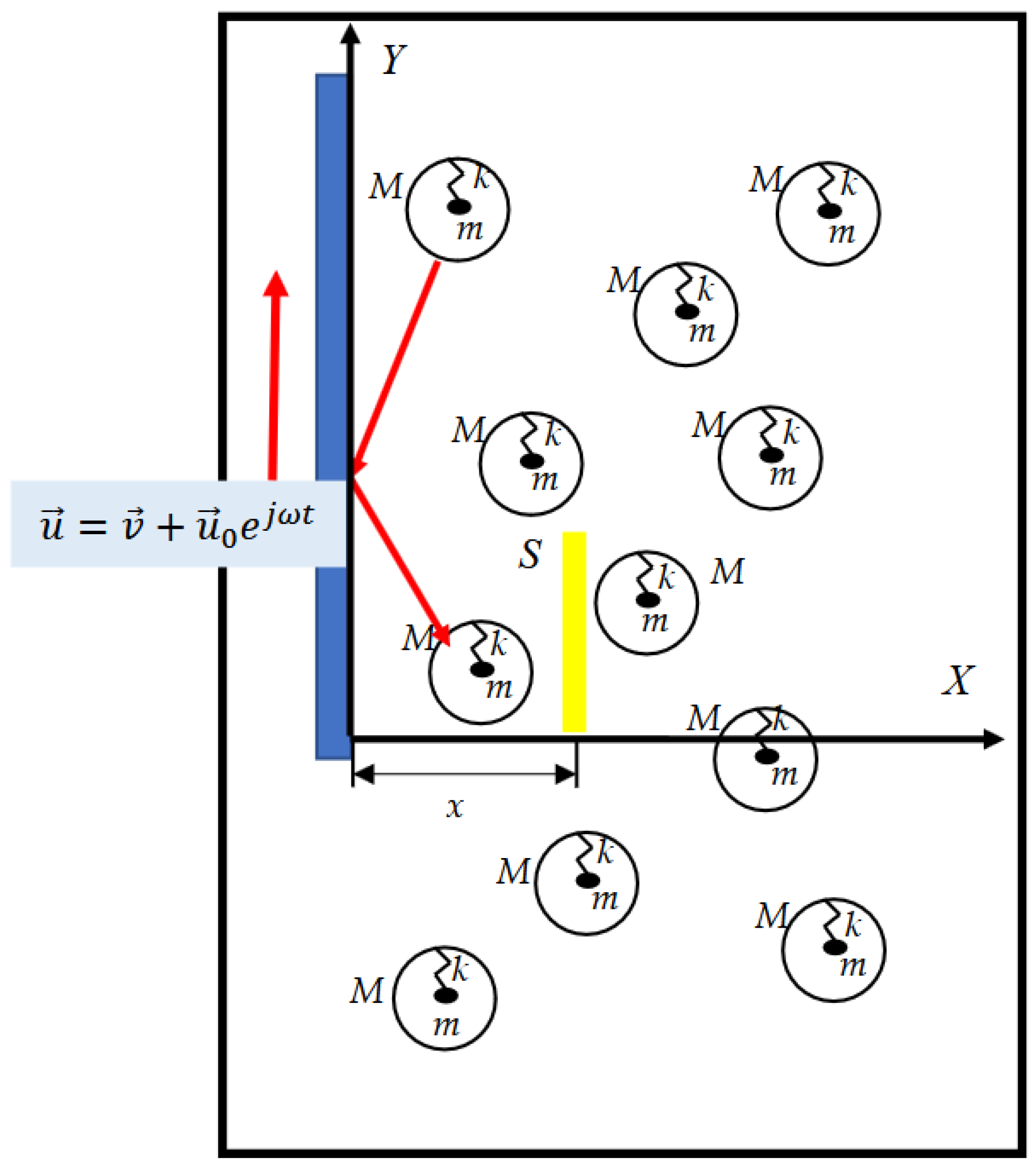
Figure 2.
Core-shell system is oscillated vertically through the ideal gas of the particles with mass .
Figure 2.
Core-shell system is oscillated vertically through the ideal gas of the particles with mass .
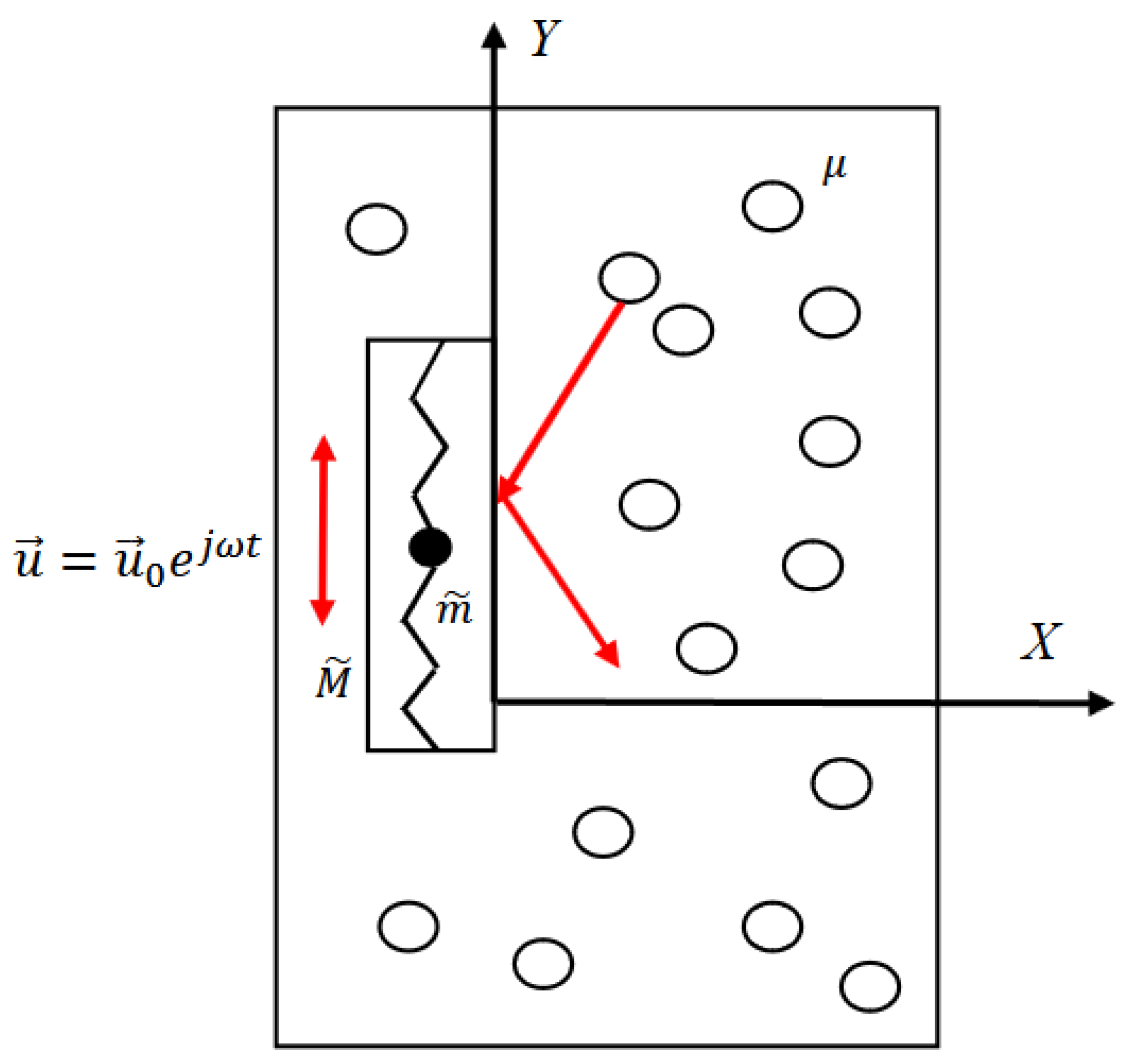
Figure 3.
The dependence established for the system shown in Figure 2 is depicted (see Eq. (9)).
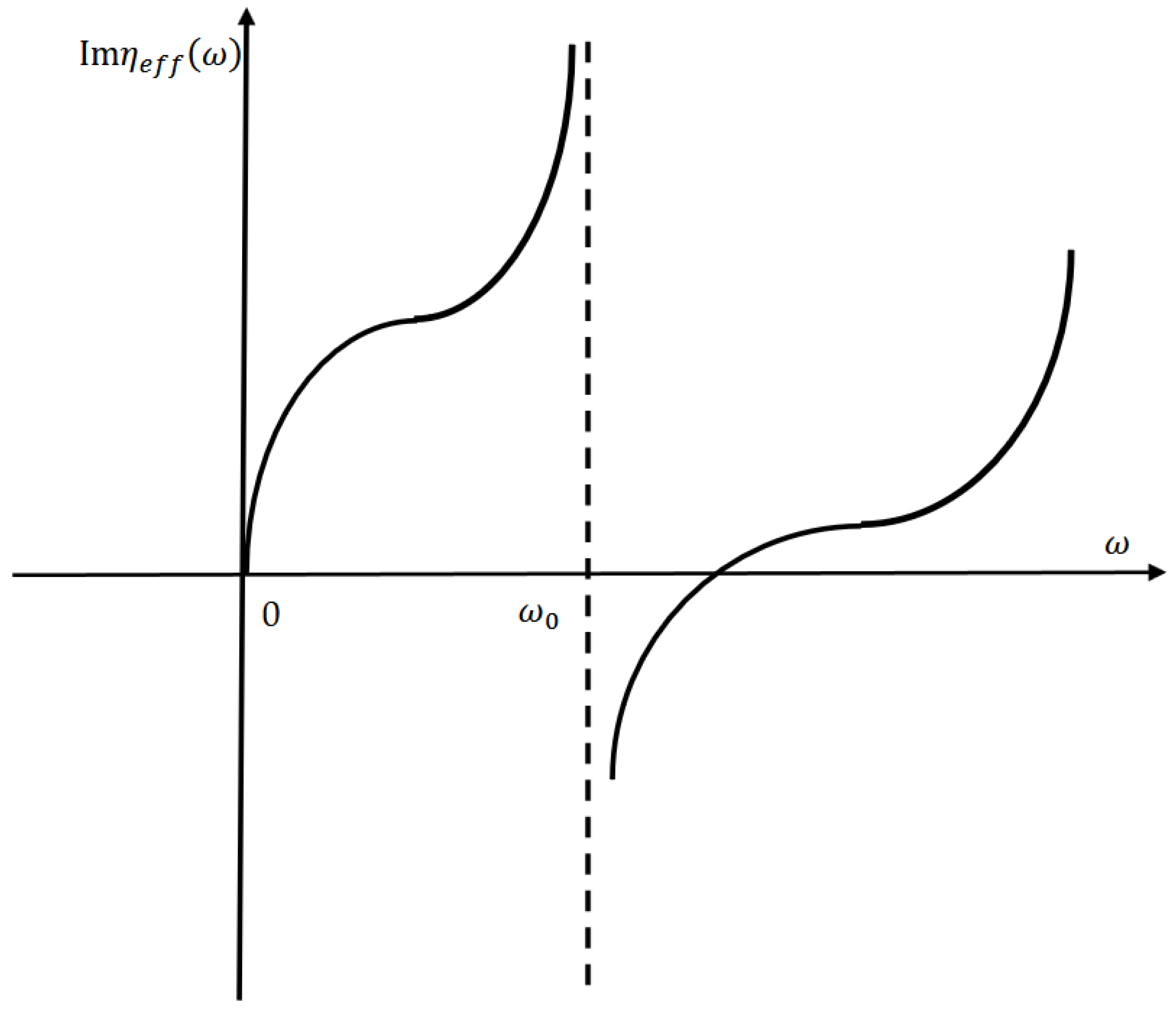
Figure 4.
Core-shell system embedded into the liquid with viscosity . The mass of the shell is , the mass of the core is , the core is connected to shell with the ideal spring The core-shell system is oscillated horizontally within the liquid with the velocity with the velocity .
Figure 4.
Core-shell system embedded into the liquid with viscosity . The mass of the shell is , the mass of the core is , the core is connected to shell with the ideal spring The core-shell system is oscillated horizontally within the liquid with the velocity with the velocity .
Disclaimer/Publisher’s Note: The statements, opinions and data contained in all publications are solely those of the individual author(s) and contributor(s) and not of MDPI and/or the editor(s). MDPI and/or the editor(s) disclaim responsibility for any injury to people or property resulting from any ideas, methods, instructions or products referred to in the content. |
© 2024 by the authors. Licensee MDPI, Basel, Switzerland. This article is an open access article distributed under the terms and conditions of the Creative Commons Attribution (CC BY) license (http://creativecommons.org/licenses/by/4.0/).
Copyright: This open access article is published under a Creative Commons CC BY 4.0 license, which permit the free download, distribution, and reuse, provided that the author and preprint are cited in any reuse.


