

Submitted:
27 December 2024
Posted:
30 December 2024
You are already at the latest version
Abstract
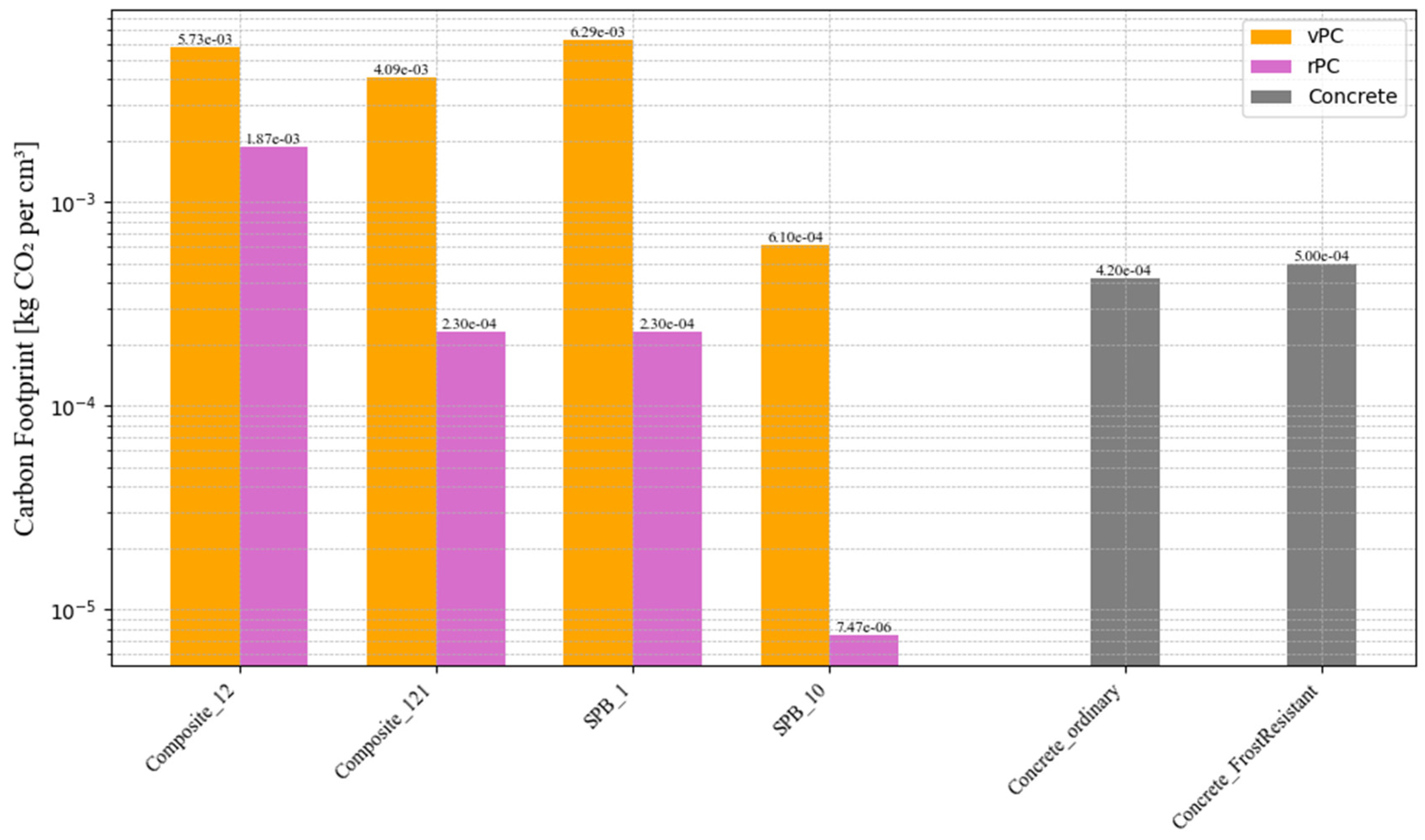
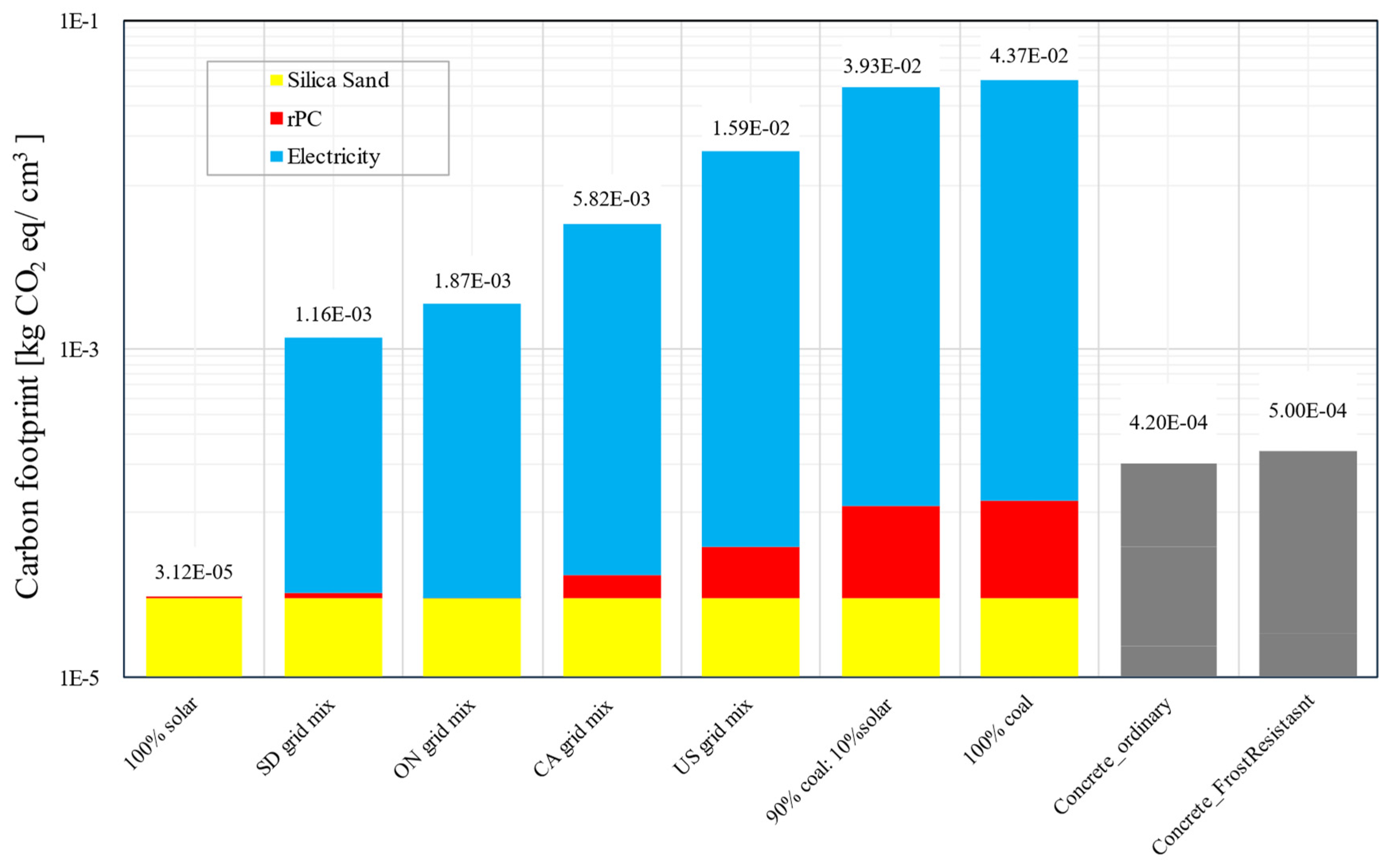
Recent work demonstrated 50:50 sand-recycled polycarbonate (rPC) composites have an average compressive strength of 71MPa, which dramatically exceeds the average offered by commercial concrete (23.3-30.2MPa). Due to the promising technical viability of replacing carbon-intensive concrete with recycled sand plastic composites, this study analyzes the cradle-to-gate environmental impacts with a life cycle assessment (LCA). 50:50 sand-to-plastic composites at different sample sizes were fabricated and the electricity consumption monitored. Cumulative energy demand and IPCC global warming potential 100a were evaluated to quantify energy consumption and greenhouse gas emission associated with sand-plastic brick and two types of concrete, spanning the lifecycle from raw materials extraction to use phase. The results showed that at small sizes using Ontario grid electricity, the composites are more carbon intensive than concrete, but as samples increase to standard brick scale rPC composite bricks demonstrate significantly lower environmental impact, emitting 96% less CO₂/cm³ than sand-virgin PC(vPC) composite, 45% less than ordinary concrete, and 54% less than frost-resistant concrete. Energy sourcing has a significant influence on emissions. Sand-rPC composite achieves a 67%-98% lower carbon footprint compared to sand-vPC composite and a 3%-98% reduction compared to both types of concrete in different production rate. Recycling global polycarbonate production for use in sand-rPC composite although small compared to the total market could annually displace approximately 26 Mt of concrete, saving of 4.5-5.4 Mt of CO₂ emissions. The results showed twin problems of carbon emissions form concrete and poor plastic recycling could be partially solved with sand-rPC building material composites to replace concrete.
Keywords:
1. Introduction
2. Materials and Methods
2.1. Materials
2.2. Life Cycle Assessment
2.2.1. Goal and Scope
2.2.2. Life Cycle Inventory (LCI)
2.2.3. Life Cycle Impact Assessment (LCIA)
3. Results
3.1. Ordinary and Frost-Resistant Concrete
3.2. Sand-Plastic Brick
3.2.1. Case 1: Sensitivity Analysis of CED and CF per cm3 on Scalability for ASTM D695 Composites and Standard Brick Size sand-rPC Composite Compared to the CED and CF of Ordinary and Frost-Resistant Concrete. Electricity Mix: Ontario Grid-Mix
3.2.2. Case 2: Comparative Environmental Analysis Between Sand-rPC Composite (Made from Recycled and Virgin PC) and Concrete
3.2.3. Case 3: Sensitivity Analysis of Sand-rPC Composite Carbon Footprint Based on Electricity Source- 100% Coal to 100% Solar Energy
4. Discussion
5. Conclusions
Acknowledgments
References
- Hansen, J.; Kharecha, P.; Sato, M.; Masson-Delmotte, V.; Ackerman, F.; Beerling, D.J.; Hearty, P.J.; Hoegh-Guldberg, O.; Hsu, S.-L.; Parmesan, C. Assessing “Dangerous Climate Change”: Required Reduction of Carbon Emissions to Protect Young People, Future Generations and Nature. PLOS ONE 2013, 8, 81648. [Google Scholar] [CrossRef] [PubMed]
- Pachauri, R.K.; Allen, M.R.; Barros, V.R.; Broome, J.; Cramer, W.; Christ, R.; Church, J.A.; Clarke, L.; Dahe, Q.; Dasgupta, P.; et al. Synthesis Report. Contrib. Work. Groups II III Fifth Assess. Rep. Intergov. Panel Clim. Change 2014, 151. [Google Scholar]
- Tangney, P. Understanding Climate Change as Risk: A Review of IPCC Guidance for Decision-Making. J. Risk Res. 2020, 23, 1424–1439. [Google Scholar] [CrossRef]
- Stern, N. The Economics of Climate Change: The Stern Review; Cambridge University Press, 2007; ISBN 978-0-521-70080-1.
- The next Generation of Scenarios for Climate Change Research and Assessment. Nature 2010, 463, 747–756. [CrossRef] [PubMed]
- Parncutt, R. The Human Cost of Anthropogenic Global Warming: Semi-Quantitative Prediction and the 1,000-Tonne Rule. Front. Psychol. 2019, 10. [Google Scholar] [CrossRef] [PubMed]
- Pearce, J.M.; Parncutt, R. Quantifying Global Greenhouse Gas Emissions in Human Deaths to Guide Energy Policy. Energies 2023, 16, 6074. [Google Scholar] [CrossRef]
- Allan, R.P.; Arias, P.A.; Berger, S.; Canadell, J.G.; Cassou, C.; Chen, D.; Cherchi, A.; Connors, S.L.; Coppola, E.; Cruz, F.A. Intergovernmental Panel on Climate Change (IPCC). Summary for Policymakers. In Climate change 2021: The physical science basis. Contribution of working group I to the sixth assessment report of the intergovernmental panel on climate change; Cambridge University Press, 2023; pp. 3–32.
- IPCC Global Warming of 1.5°C: IPCC Special Report on Impacts of Global Warming of 1.5°C above Pre-Industrial Levels in Context of Strengthening Response to Climate Change, Sustainable Development, and Efforts to Eradicate Poverty; 1st ed.; Cambridge University Press, 2022; ISBN 978-1-00-915794-0.
- IPCC The Evidence Is Clear: The Time for Action Is Now. We Can Halve Emissions by 2030. — IPCC 2022.
- IPCC AR6 Synthesis Report: Climate Change 2023 — IPCC; 2023.
- IPCC Urgent Climate Action Can Secure a Liveable Future for All — IPCC. Available online: https://www.ipcc.ch/2023/03/20/press-release-ar6-synthesis-report/ (accessed on 21 October 2024).
- Babor, D.; Plian, D.; Judele, L. Environmental Impact of Concrete. Bul. Institutului Politeh. Din Lasi Sect. Constr. Arhit. 2009, 55, 27. [Google Scholar]
- Ellis, L.D.; Badel, A.F.; Chiang, M.L.; Park, R.J.-Y.; Chiang, Y.-M. Toward Electrochemical Synthesis of Cement—An Electrolyzer-Based Process for Decarbonating CaCO3 While Producing Useful Gas Streams. Proc. Natl. Acad. Sci. 2020, 117, 12584–12591. [Google Scholar] [CrossRef] [PubMed]
- Cement Industry Accounts for about 8% of CO2 Emissions. One Startup Seeks to Change That. Available online: https://www.cbsnews.com/news/cement-industry-co2-emissions-climate-change-brimstone/ (accessed on 11 May 2023).
- Monteiro, P.J.M.; Miller, S.A.; Horvath, A. Towards Sustainable Concrete. Nat. Mater. 2017, 16, 698–699. [Google Scholar] [CrossRef] [PubMed]
- Tiseo, I. Global Carbon Dioxide Emissions from Cement Manufacturing 1990-2021, by Country. Available online: https://www.statista.com/statistics/1091672/carbon-dioxide-emissions-global-cement-manufacturing/ (accessed on 10 May 2023).
- Watts, J. Concrete: The Most Destructive Material on Earth. The Guardian 2019.
- Tiseo, I. Global CO₂ Emissions from Cement Manufacturing 1960-2021. Available online: https://www.statista.com/statistics/1299532/carbon-dioxide-emissions-worldwide-cement-manufacturing/ (accessed on 8 May 2023).
- Miller, S.A.; Horvath, A.; Monteiro, P.J.M. Impacts of Booming Concrete Production on Water Resources Worldwide. Nat. Sustain. 2018, 1, 69–76. [Google Scholar] [CrossRef]
- OECD Global Plastics Outlook Database Plastic Pollution Is Growing Relentlessly as Waste Management and Recycling Fall Short, Says OECD. Available online: https://www.oecd.org/environment/plastic-pollution-is-growing-relentlessly-as-waste-management-and-recycling-fall-short.htm (accessed on 8 May 2023).
- Plastics and the Environment; Andrady, A.L., Ed.; 1st ed.; Wiley, 2003; ISBN 978-0-471-09520-0.
- Lim, X. Microplastics Are Everywhere — but Are They Harmful? Nature 2021, 593, 22–25. [Google Scholar] [CrossRef]
- Gu, L.; Ozbakkaloglu, T. Use of Recycled Plastics in Concrete: A Critical Review. Waste Manag. 2016, 51, 19–42. [Google Scholar] [CrossRef] [PubMed]
- Al-Sinan, M.A.; Bubshait, A.A. Using Plastic Sand as a Construction Material toward a Circular Economy: A Review. Sustainability 2022, 14, 6446. [Google Scholar] [CrossRef]
- Suriyaa, M.; Hareharan, P.; Nageshwaran, J.; Nandhini, S.; Sathyamoorthy, R. Experimental Study on Strength Behaviour of Plastic Sand Bricks. 2020, 9.
- Sahani, K.; Joshi, B.; Khatri, K.; Thapa Magar, A.; Chapagain, S.; Karmacharya, N. Mechanical Properties of Plastic Sand Brick Containing Plastic Waste. Adv. Civ. Eng. 2022, 2022, 1–10. [Google Scholar] [CrossRef]
- Bamigboye, G.; Ngene, B.; Ademola, D.; Jolayemi, K. Experimental Study on the Use of Waste Polyethylene Terephthalate (PET) and River Sand in Roof Tile Production. J. Phys. Conf. Ser. 2019, 1378, 042105. [Google Scholar] [CrossRef]
- Yu, Q.L.; Spiesz, P.; Brouwers, H.J.H. Development of Cement-Based Lightweight Composites–Part 1: Mix Design Methodology and Hardened Properties. Cem. Concr. Compos. 2013, 44, 17–29. [Google Scholar] [CrossRef]
- Susila, I.M.; Suardana, N.P.G.; Kencanawati, C.I.P.K.; Thanaya, I.N.A.; Adnyana, I.W.B. THE EFFECT OF COMPOSITION OF PLASTIC WASTE LOW DENSITY POLYETHYLENE (LDPE) WITH SAND TO PRESSURE STRENGTH AND DENSITY OF SAND/LDPE COMPOSITES. IOP Conf. Ser. Mater. Sci. Eng. 2019, 539, 012043. [Google Scholar] [CrossRef]
- Woods, M.C.; Kulkarni, A.; Pearce, J.M. The Potential of Replacing Concrete with Sand and Recycled Polycarbonate Composites: Compressive Strength Testing. J. Compos. Sci. 2023, 7, 249. [Google Scholar] [CrossRef]
- Baechler, C.; DeVuono, M.; Pearce, J.M. Distributed Recycling of Waste Polymer into RepRap Feedstock. Rapid Prototyp. J. 2013, 19, 118–125. [Google Scholar] [CrossRef]
- Woern, A.L.; McCaslin, J.R.; Pringle, A.M.; Pearce, J.M. RepRapable Recyclebot: Open Source 3-D Printable Extruder for Converting Plastic to 3-D Printing Filament. HardwareX 2018, 4, e00026. [Google Scholar] [CrossRef]
- Woods, M.C.; Brooks, C.K.; Pearce, J.M. Open-Source Cold and Hot Scientific Sheet Press for Investigating Polymer-Based Material Properties. HardwareX 2024, 19, e00566. [Google Scholar] [CrossRef]
- Roy, R.; Pearce, J.M. Is Small or Big Solar Better for the Environment? Comparative Life Cycle Assessment of Solar Photovoltaic Rooftop vs. Ground-Mounted Systems. Int. J. Life Cycle Assess. 2024, 29, 516–536. [Google Scholar] [CrossRef]
- Hayibo, K.S.; Mayville, P.; Pearce, J.M. The Greenest Solar Power? Life Cycle Assessment of Foam-Based Flexible Floatovoltaics. Sustain. Energy Fuels 2022, 6, 1398–1413. [Google Scholar] [CrossRef]
- Frankl, P.; Masini, A.; Gamberale, M.; Toccaceli, D. Simplified Life-cycle Analysis of PV Systems in Buildings: Present Situation and Future Trends. Prog. Photovolt. Res. Appl. 1998, 6, 137–146. [Google Scholar] [CrossRef]
- Simonen, K. Life Cycle Assessment; Routledge, 2014.
- Curran, M.A. Life Cycle Assessment. Kirk-Othmer Encycl. Chem. Technol. 2000, 1–28.
- ISO ISO 14044: 2006. Environmental Management—Life Cycle Assessment—Requirements and Guidelines. International Organization for Standardization. 2006.
- Finkbeiner, M.; Inaba, A.; Tan, R.; Christiansen, K.; Klüppel, H.-J. The New International Standards for Life Cycle Assessment: ISO 14040 and ISO 14044. Int. J. Life Cycle Assess. 2006, 11, 80–85. [Google Scholar] [CrossRef]
- Karvinen, H. Life Cycle Assessment and Technical Performance of Recycled and Bio-Based Plastics. 2015.
- Kim, S.Y.; Kang, D.H.; Charoensri, K.; Ryu, J.R.; Shin, Y.J.; Park, H.J. Comparative Life Cycle Assessment of Reusable and Disposable Distribution Packaging for Fresh Food. Sustainability 2023, 15, 16448. [Google Scholar] [CrossRef]
- openLCA Download | openLCA.Org 2022.
- Arzoumanidis, I.; D’Eusanio, M.; Raggi, A.; Petti, L. Functional Unit Definition Criteria in Life Cycle Assessment and Social Life Cycle Assessment: A Discussion. In Perspectives on Social LCA; Traverso, M., Petti, L., Zamagni, A., Eds.; SpringerBriefs in Environmental Science; Springer International Publishing: Cham, 2020; pp. 1–10. ISBN 978-3-030-06564-5. [Google Scholar]
- Sjunnesson, J. Life Cycle Assessment of Concrete. 2005.
- De Schepper, M.; Van den Heede, P.; Van Driessche, I.; De Belie, N. Life Cycle Assessment of Completely Recyclable Concrete. Materials 2014, 7, 6010–6027. [Google Scholar] [CrossRef] [PubMed]
- Hottle, T.; Hawkins, T.R.; Chiquelin, C.; Lange, B.; Young, B.; Sun, P.; Elgowainy, A.; Wang, M. Environmental Life-Cycle Assessment of Concrete Produced in the United States. J. Clean. Prod. 2022, 363, 131834. [Google Scholar] [CrossRef]
- Maia de Souza, D.; Lafontaine, M.; Charron-Doucet, F.; Chappert, B.; Kicak, K.; Duarte, F.; Lima, L. Comparative Life Cycle Assessment of Ceramic Brick, Concrete Brick and Cast-in-Place Reinforced Concrete Exterior Walls. J. Clean. Prod. 2016, 137, 70–82. [Google Scholar] [CrossRef]
- Sjunnesson, J. Life Cycle Assessment of Concrete. 2005.
- Anh, L.H.; Mihai, F.-C.; Belousova, A.; Kucera, R.; Oswald, K.-D.; Riedel, W.; Sekar, N.A.; Schneider, P. Life Cycle Assessment of River Sand and Aggregates Alternatives in Concrete. Materials 2023, 16, 2064. [Google Scholar] [CrossRef]
- Zhou, X.; Zhai, Y.; Ren, K.; Cheng, Z.; Shen, X.; Zhang, T.; Bai, Y.; Jia, Y.; Hong, J. Life Cycle Assessment of Polycarbonate Production: Proposed Optimization toward Sustainability. Resour. Conserv. Recycl. 2023, 189, 106765. [Google Scholar] [CrossRef]
- Preparation of Environmental Friendly Plastic Brick from High-Density Polyethylene Waste. Case Stud. Chem. Environ. Eng. 2023, 7, 100291. [CrossRef]
- Tinz, J.; de Ancos, T.; Rohn, H. Carbon Footprint of Mechanical Recycling of Post-Industrial Plastic Waste: Study of ABS, PA66GF30, PC and POM Regrinds. Waste 2023, 1, 127–139. [Google Scholar] [CrossRef]
- Santos, J.; Pizzol, M.; Azarijafari, H. 14 - Life Cycle Assessment (LCA) of Using Recycled Plastic Waste in Road Pavements: Theoretical Modeling. In Plastic Waste for Sustainable Asphalt Roads; Giustozzi, F., Nizamuddin, S., Eds.; Woodhead Publishing Series in Civil and Structural Engineering; Woodhead Publishing, 2022; pp. 273–302 ISBN 978-0-323-85789-5.
- Earn Tan, A.H.; Ze Chew, A.W.; Wing-Keung Law, A. Deployment of Recyclable Polycarbonate as Alternative Coarse Media in Dual-Media Rapid Filters. Energy Procedia 2017, 143, 475–480. [Google Scholar] [CrossRef]
- US EPA Environmental Factoids | WasteWise | US EPA. Available online: https://archive.epa.gov/epawaste/conserve/smm/wastewise/web/html/factoid.html (accessed on 2 November 2024).
- Kousemaker, T.M.; Jonker, G.H.; Vakis, A.I. LCA Practices of Plastics and Their Recycling: A Critical Review. Appl. Sci. 2021, 11, 3305. [Google Scholar] [CrossRef]
- Heo, Y.; Bae, D.; Oh, C.; Suh, Y.; Lee, K. Life Cycle Assessment of Mobile Phone Charger Containing Recycled Plastics. J. Korean Soc. Environ. Eng. 2017, 39, 698–705. [Google Scholar] [CrossRef]
- Puig, R.; Fullana-i-Palmer, P.; Baquero, G.; Riba, J.-R.; Bala, A. A Cumulative Energy Demand Indicator (CED), Life Cycle Based, for Industrial Waste Management Decision Making. Waste Manag. 2013, 33, 2789–2797. [Google Scholar] [CrossRef]
- Röhrlich, M.; Mistry, M.; Martens, P.N.; Buntenbach, S.; Ruhrberg, M.; Dienhart, M.; Briem, S.; Quinkertz, R.; Alkan, Z.; Kugeler, K. A Method to Calculate the Cumulative Energy Demand (CED) of Lignite Extraction. Int. J. Life Cycle Assess. 2000, 5, 369–373. [Google Scholar] [CrossRef]
- Patel, M. Cumulative Energy Demand (CED) and Cumulative CO2 Emissions for Products of the Organic Chemical Industry. Energy 2003, 28, 721–740. [Google Scholar] [CrossRef]
- Huijbregts, M.A.J.; Hellweg, S.; Frischknecht, R.; Hendriks, H.W.M.; Hungerbühler, K.; Hendriks, A.J. Cumulative Energy Demand As Predictor for the Environmental Burden of Commodity Production. Environ. Sci. Technol. 2010, 44, 2189–2196. [Google Scholar] [CrossRef] [PubMed]
- Frischknecht, R.; Wyss, F.; Büsser Knöpfel, S.; Lützkendorf, T.; Balouktsi, M. Cumulative Energy Demand in LCA: The Energy Harvested Approach. Int. J. Life Cycle Assess. 2015, 20, 957–969. [Google Scholar] [CrossRef]
- Gołasa, P.; Wysokiński, M.; Bieńkowska-Gołasa, W.; Gradziuk, P.; Golonko, M.; Gradziuk, B.; Siedlecka, A.; Gromada, A. Sources of Greenhouse Gas Emissions in Agriculture, with Particular Emphasis on Emissions from Energy Used. Energies 2021, 14, 3784. [Google Scholar] [CrossRef]
- Nuss, P. Life Cycle Assessment Handbook: A Guide for Environmentally Sustainable Products, Edited by MaryAnn Curran. Hoboken, NJ, USA: John Wiley & Sons, Inc., and Salem, MA, USA: Scrivener Publishing LLC, 2012, 611 Pp., ISBN 9781118099728, $199.00 (Paper), $159.99 (E-book). J. Ind. Ecol. 2015, 19, 167–168. [Google Scholar] [CrossRef]
- Verones, F.; Hellweg, S.; Antón, A.; Azevedo, L.B.; Chaudhary, A.; Cosme, N.; Cucurachi, S.; De Baan, L.; Dong, Y.; Fantke, P.; et al. LC-IMPACT: A Regionalized Life Cycle Damage Assessment Method. J. Ind. Ecol. 2020, 24, 1201–1219. [Google Scholar] [CrossRef]
- Füssel, H.-M. An Updated Assessment of the Risks from Climate Change Based on Research Published since the IPCC Fourth Assessment Report. Clim. Change 2009, 97, 469–482. [Google Scholar] [CrossRef]
- Hulme, M.; Mahony, M. Climate Change: What Do We Know about the IPCC? Prog. Phys. Geogr. Earth Environ. 2010, 34, 705–718. [Google Scholar] [CrossRef]
- Mohd Nordin, A.H.; Sulaiman, S.I.; Shaari, S.; Mustapa, R.F. Effect of Photovoltaic (PV) Module Degradation Rate on the Greenhouse Gas Emissions: A Life-Cycle Assessment / Atiqah Hamizah Mohd Nordin …[et Al.]. J. Electr. Electron. Syst. Res. JEESR 2021, 18, 58–62. [Google Scholar] [CrossRef]
- Change, C. Intergovernmental Panel on Climate Change (IPCC). CC BY 1995, 4. [Google Scholar]
- Solomon, S.; Qin, D.; Manning, M.; Chen, Z.; Marquis, M.; Averyt, K.; Tignor, M.; Miller, H. IPCC Fourth Assessment Report (AR4). Clim. Change 2007, 374. [Google Scholar]
- O’neill, B.C.; Oppenheimer, M.; Warren, R.; Hallegatte, S.; Kopp, R.E.; Pörtner, H.O.; Scholes, R.; Birkmann, J.; Foden, W.; Licker, R. IPCC Reasons for Concern Regarding Climate Change Risks. Nat. Clim. Change 2017, 7, 28–37. [Google Scholar] [CrossRef]
- Change, C. The IPCC Scientific Assessment. Contrib. Work. Group First Assess. Rep. Intergov. Panel Clim. Change 1990, 365. [Google Scholar]
- EIA Electric Power Annual -, U.S. Energy Information Administration (EIA). Available online: https://www.eia.gov/electricity/annual/index.php (accessed on 19 October 2024).
- Government of Canada, C.E.R. CER – Provincial and Territorial Energy Profiles – Canada. Available online: https://www.cer-rec.gc.ca/en/data-analysis/energy-markets/provincial-territorial-energy-profiles/provincial-territorial-energy-profiles-canada.html (accessed on 19 October 2024).
- Ali Sadat, S.; Pearce, J.M. The Threat of Economic Grid Defection in the U.S. with Solar Photovoltaic, Battery and Generator Hybrid Systems. Sol. Energy 2024, 282, 112910. [Google Scholar] [CrossRef]
- NREL, U.S. Life Cycle Inventory Database. Available online: https://www.nrel.gov/analysis/lci.html (accessed on 29 April 2024).
- Meyer, T.K.; Tanikella, N.G.; Reich, M.J.; Pearce, J.M. Potential of Distributed Recycling from Hybrid Manufacturing of 3-D Printing and Injection Molding of Stamp Sand and Acrylonitrile Styrene Acrylate Waste Composite. Sustain. Mater. Technol. 2020, 25, e00169. [Google Scholar] [CrossRef]
- Canada, E. and C.C. Plastic Waste and Pollution Reduction. Available online: https://www.canada.ca/en/environment-climate-change/services/managing-reducing-waste/reduce-plastic-waste.html (accessed on 19 October 2024).
- US EPA, O. Plastics: Material-Specific Data. Available online: https://www.epa.gov/facts-and-figures-about-materials-waste-and-recycling/plastics-material-specific-data (accessed on 19 October 2024).
- NREL News Release: NREL Calculates Lost Value of Landfilled Plastic in U.S. Available online: https://www.nrel.gov/news/press/2022/nrel-calculates-lost-value-of-landfilled-plastic-in-us.html (accessed on 19 October 2024).
- Prismane Consulting Polycarbonate Market Analysis by Production, Capacity, Demand & Forecast Report Until 2036; 2022.
- Statista Polycarbonates Global Demand 2022. Available online: https://www.statista.com/statistics/750965/polycarbonates-demand-worldwide/ (accessed on 19 October 2024).
- Flower, D.J.; Sanjayan, J.G. Green House Gas Emissions Due to Concrete Manufacture. Int. J. Life Cycle Assess. 2007, 12, 282–288. [Google Scholar] [CrossRef]
- IEA Technology Roadmap - Low-Carbon Transition in the Cement Industry – Analysis; 2018.
- Global Cement and Concrete Association GCCA Concrete Future – Roadmap to Net Zero 2021.
- Petek Gursel, A.; Masanet, E.; Horvath, A.; Stadel, A. Life-Cycle Inventory Analysis of Concrete Production: A Critical Review. Cem. Concr. Compos. 2014, 51, 38–48. [Google Scholar] [CrossRef]
- IEA. Global Cement Production, 2010-2019 – Charts – Data & Statistics; IEA: Paris, 2020. [Google Scholar]
- Hottle, T.; Hawkins, T.R.; Chiquelin, C.; Lange, B.; Young, B.; Sun, P.; Elgowainy, A.; Wang, M. Environmental Life-Cycle Assessment of Concrete Produced in the United States. J. Clean. Prod. 2022, 363, 131834. [Google Scholar] [CrossRef]
- Ritchie, H.; Roser, M. Forest Area. Our World Data 2024. [Google Scholar]
- Soll, J. Can Planting a Trillion Trees Save Our Planet? Available online: https://www.oregonmetro.gov/news/power-trees (accessed on 24 October 2024).
- Crowther, T.W.; Glick, H.B.; Covey, K.R.; Bettigole, C.; Maynard, D.S.; Thomas, S.M.; Smith, J.R.; Hintler, G.; Duguid, M.C.; Amatulli, G.; et al. Mapping Tree Density at a Global Scale. Nature 2015, 525, 201–205. [Google Scholar] [CrossRef]
- Sedjo, R.A.; Solomon, A.M. Climate and Forests. In Greenhouse Warming; Routledge, 2016; pp. 105–118.
- Akbari, H. Shade Trees Reduce Building Energy Use and CO2 Emissions from Power Plants. Environ. Pollut. 2002, 116, S119–S126. [Google Scholar] [CrossRef] [PubMed]
- Kaul, M.; Mohren, G.M.J.; Dadhwal, V.K. Carbon Storage and Sequestration Potential of Selected Tree Species in India. Mitig. Adapt. Strateg. Glob. Change 2010, 15, 489–510. [Google Scholar] [CrossRef]
- IEA Data Centres & Networks. Available online: https://www.iea.org/energy-system/buildings/data-centres-and-data-transmission-networks (accessed on 23 October 2024).
- EIA Annual Energy Outlook 2023 - U.S. Energy Information Administration (EIA); U.S., 2023.
- Leung, C.K.Y. Concrete as a Building Material. In Encyclopedia of Materials: Science and Technology; Buschow, K.H.J., Cahn, R.W., Flemings, M.C., Ilschner, B., Kramer, E.J., Mahajan, S., Veyssière, P., Eds.; Elsevier: Oxford, 2001; pp. 1471–1479. ISBN 978-0-08-043152-9. [Google Scholar]
- Zabalza Bribián, I.; Valero Capilla, A.; Aranda Usón, A. Life Cycle Assessment of Building Materials: Comparative Analysis of Energy and Environmental Impacts and Evaluation of the Eco-Efficiency Improvement Potential. Build. Environ. 2011, 46, 1133–1140. [Google Scholar] [CrossRef]
- Martínez-Rocamora, A.; Solís-Guzmán, J.; Marrero, M. LCA Databases Focused on Construction Materials: A Review. Renew. Sustain. Energy Rev. 2016, 58, 565–573. [Google Scholar] [CrossRef]
- Stelzer, L.; Hoberg, F.; Bach, V.; Schmidt, B.; Pfeiffer, S.; Meyer, V.; Finkbeiner, M. Life Cycle Assessment of Fungal-Based Composite Bricks. Sustainability 2021, 13, 11573. [Google Scholar] [CrossRef]
- Asman, N.S.A.; Bolong, N.; Mirasa, A.K.; Asrah, H. Life Cycle Assessment of Interlocking Compressed Earth Brick and Conventional Fired Clay Brick for Residential House. J. Phys. Conf. Ser. 2020, 1529, 042012. [Google Scholar] [CrossRef]
- Zhang, C.; Hu, M.; van der Meide, M.; Di Maio, F.; Yang, X.; Gao, X.; Li, K.; Zhao, H.; Li, C. Life Cycle Assessment of Material Footprint in Recycling: A Case of Concrete Recycling. Waste Manag. 2023, 155, 311–319. [Google Scholar] [CrossRef] [PubMed]
- Vieira, D.R.; Calmon, J.L.; Coelho, F.Z. Life Cycle Assessment (LCA) Applied to the Manufacturing of Common and Ecological Concrete: A Review. Constr. Build. Mater. 2016, 124, 656–666. [Google Scholar] [CrossRef]
- Saberian, M.; Zhang, J.; Gajanayake, A.; Li, J.; Zhang, G.; Boroujeni, M. Life Cycle Assessment (LCA) of Concrete Containing Waste Materials. In Handbook of Sustainable Concrete and Industrial Waste Management; Elsevier, 2022; pp. 637–659 ISBN 978-0-12-821730-6.
- Xing, W.; Tam, V.W.; Le, K.N.; Hao, J.L.; Wang, J. Life Cycle Assessment of Recycled Aggregate Concrete on Its Environmental Impacts: A Critical Review. Constr. Build. Mater. 2022, 317, 125950. [Google Scholar] [CrossRef]
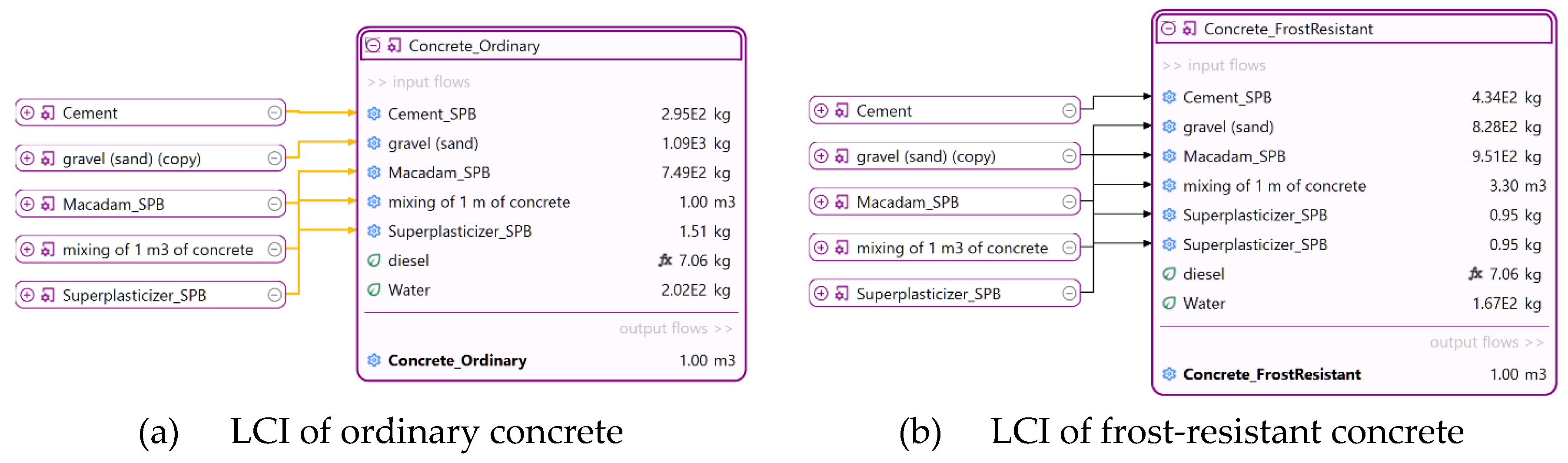
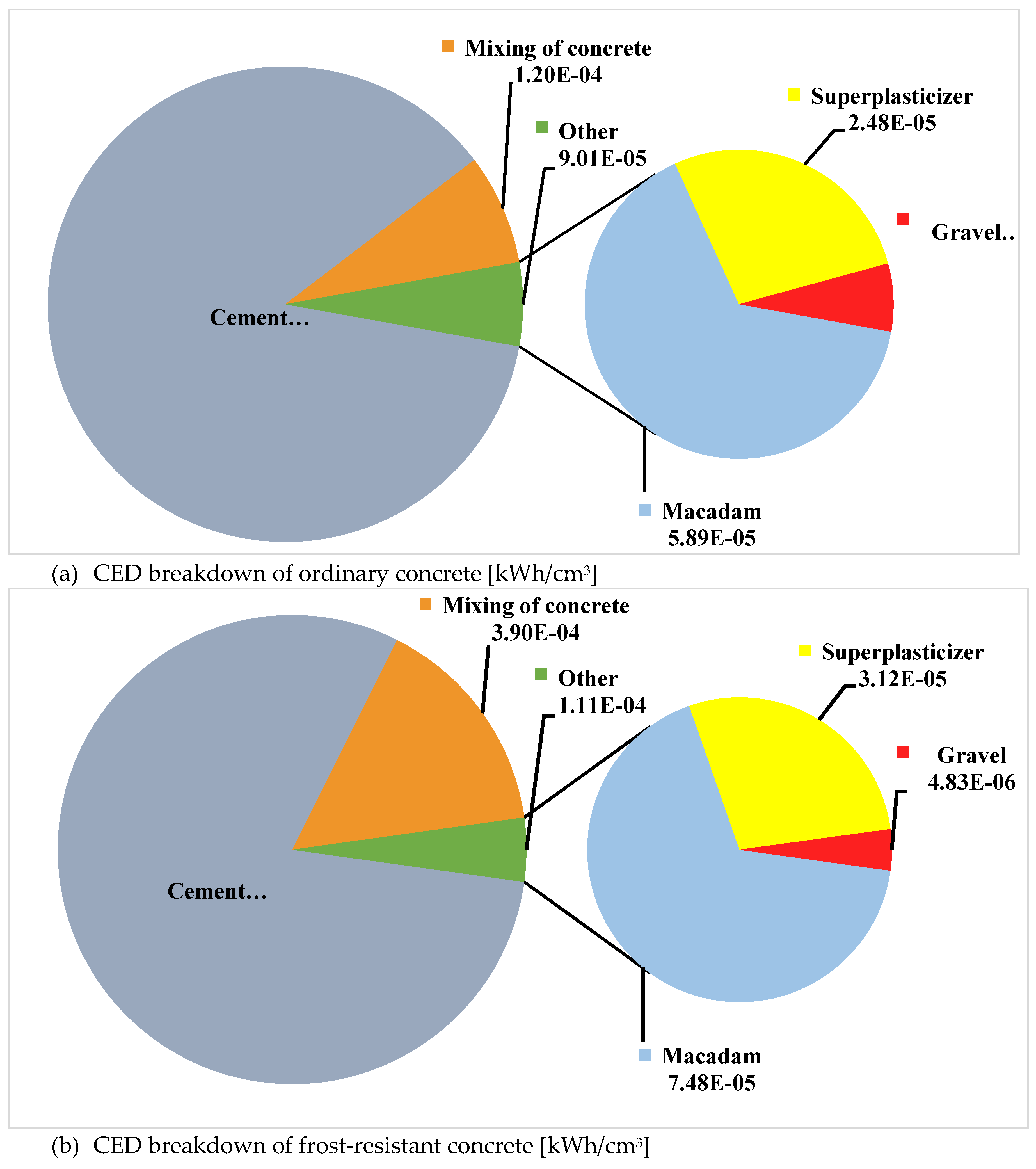
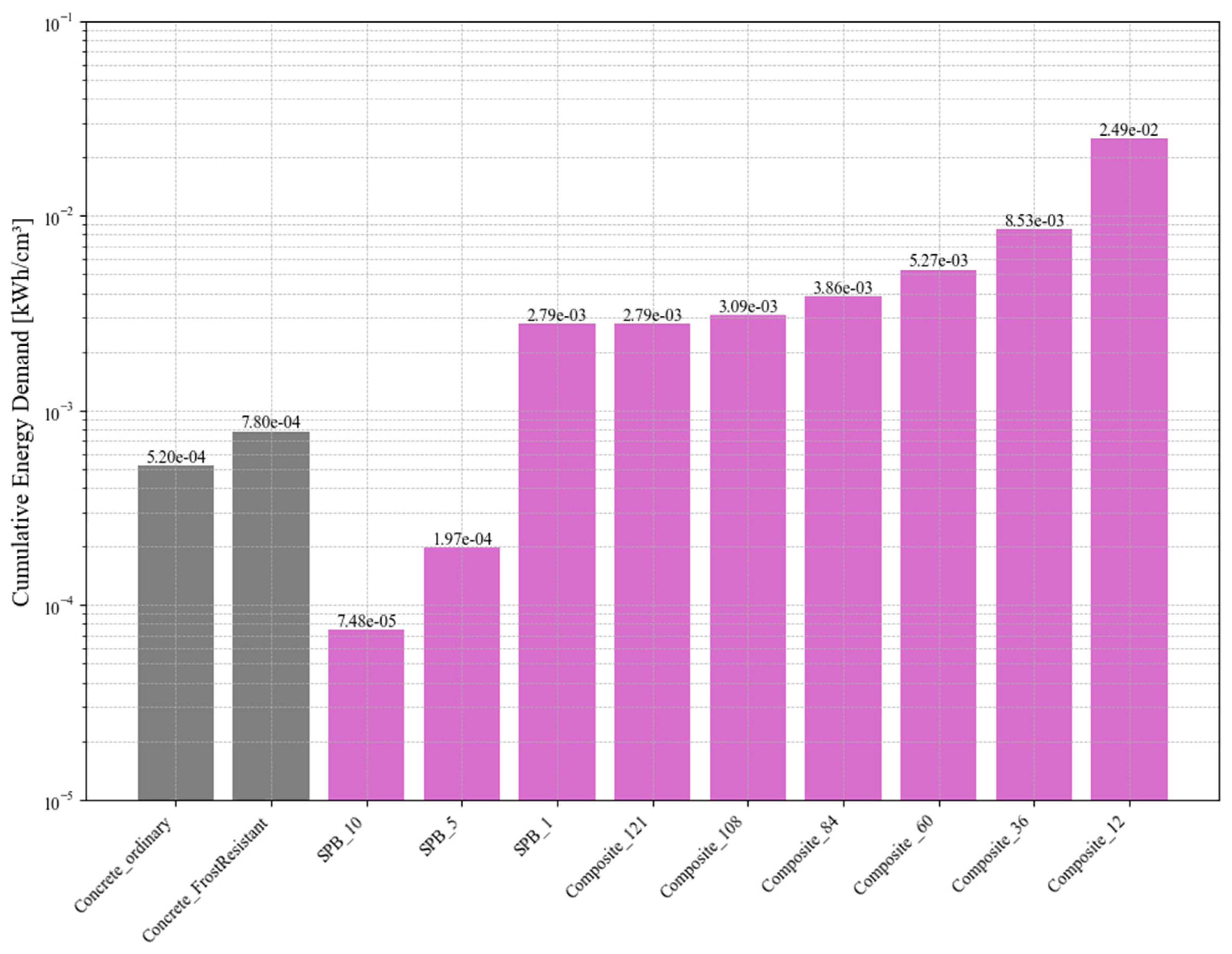
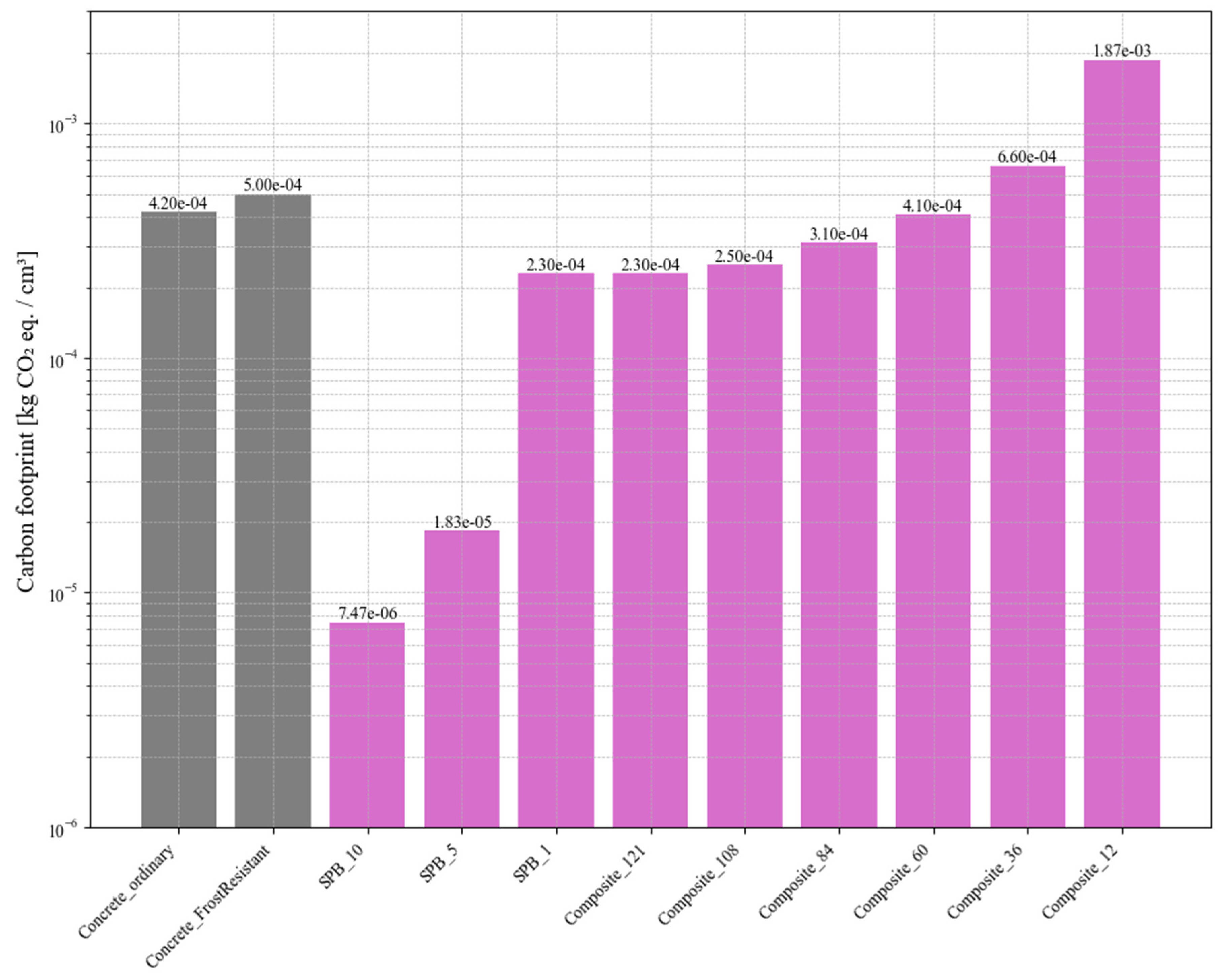

| Material | Small Sample Size Average Amount [31] | Average Amount Standard Construction Brick Size | Unit |
|---|---|---|---|
| Silica sand | 80.4 | 811 | g/batch |
| Recycled polycarbonate | 50.4 | 854.75 | g/batch |
| Energy Consumption | |||
| By hot press | 3.61 | 3.61 | kWh/batch |
| By plastic extruder | .03 | 0.52 | kWh/batch |
| Volume | 8.19 | 1,069.26 | cm3/ sample |
| No. of samples per batch | 12 | 1 | sample/batch |
| Electricity consumption | kWh |
|---|---|
| To reach and maintain the optimum extruder temperature | 0.6 |
| While adding material | 1.98 |
| While baking | 1.27 |
| While extruding rPC to mix the material | .03 |
| To reach and maintain the optimum hot press temperature | 0.51 |
Disclaimer/Publisher’s Note: The statements, opinions and data contained in all publications are solely those of the individual author(s) and contributor(s) and not of MDPI and/or the editor(s). MDPI and/or the editor(s) disclaim responsibility for any injury to people or property resulting from any ideas, methods, instructions or products referred to in the content. |
© 2024 by the authors. Licensee MDPI, Basel, Switzerland. This article is an open access article distributed under the terms and conditions of the Creative Commons Attribution (CC BY) license (http://creativecommons.org/licenses/by/4.0/).