

Submitted:
23 December 2024
Posted:
24 December 2024
You are already at the latest version
Abstract
In this article, some properties of the zero divisor graph Γ(Zn) are investigated when n is a square free positive integer and it is shown that the zero divisor graph Γ(Zn) of the ring Zn is a (2k−2)-partite graph, when the prime decomposition of n contains k distinct square free primes using the method of congruence relation. We present some examples, accompanied by pictorial visualizations, to achieve the desired results. Since Zn is a semisimple ring when n is square-free, the results can be generalized to characterize semisimple rings and modules, as well as rings satisfying Artinian and Noetherian conditions, through the properties of their zero-divisor graphs.
Keywords:
Graphs
; Zero-divisor graphs
; Bi-partite graph
; k-partite graph
; Congruence relation
; Semi-simple rings
MSC: 13A70, 05C25, 05E40
1. Introduction
Graph theory is regarded as one of the most intriguing topics, offering a powerful means to visualize the interconnections between objects. Its applications span various fields in both social and natural sciences, leveraging its inherent visual representation to simplify complex properties. For a more comprehensive exploration of graph theory, we refer readers to [1,11,18,21]. Moreover, graph theory serves as a valuable tool in numerous branches of mathematics, including algebra.
The zero-divisor graph of a commutative ring was first introduced by Beck in 1988 [9] to explore the structure of the underlying ring. Since then, this concept has been extensively studied by various researchers [5,13,15,20]. The study of zero-divisor graphs has also been extended to noncommutative rings [2]. Redmond [19] further generalized this concept to arbitrary rings, demonstrating that for any ring R, any two vertices in ) are connected by a path of length at most 3. It has also been shown that for any ring R, if contains a cycle, the length of the shortest cycle is at most 4. Anderson introduced various structural properties of zero-divisor graphs, proving that is always connected with diam(. Additionally, they discussed conditions under which becomes a complete graph or a star graph [6].
Beck [9] defined zero-divisors graph of a ring R as a graph whose vertex set is the set of all the elements of R and the edge sets is defined by the relation on the elements of R as are adjacent if and only if for distinct , and it is noted that the relation in a zero-divisor graph is always symmetric while R is a commutative ring. If the ring is commutative, then is a simple graph and is an empty graph while R is an integral domain with a slight modification in the definition. The zero divisor graph is slightly different from the definition given by Beck [9] is defined by considering the non-zero zero divisors as vertex sets instead of taking all the elements of the ring as vertex sets [6]. The intention of Anderson and Livingston [6] was to simplify so that it can be visualized in a simple way without losing the relevant pieces of information contained in it. Later on, many properties of were studied, for instance, diameter, girth, and chromatic number (see [6,7]).
A ring R is called simple if it has no proper nonzero two-sided ideals, and an R module M is called simple if M is nontrivial and M has no proper nonzero submodules. A simple ring or module can be treated as the prime number in number theory as is simple while n is a prime. Like primes are the buliding blocks of numbers, the simple submodules are the building blocks of the module. A module is called a semisimple (or completely reducible) module if it is the sum of simple (irreducible) submodules. A ring R with unity is semisimple if is a semisimple module. A square-free prime decomposition of a positive integer n is as simple as the semisimple finite ring , when n is square free. The ring is also a semisimple ring for any prime p. This motivated us to study properties of the zero divisor graphs of while n is square free. As is a semi-simple ring while n is square-free, our investigation becomes a bit interesting. We would like to know the ring-theoretic properties of the semisimple ring in terms of its zero divisor graphs. Our aim is to study the interplay of ring-theoretic properties of semisimple ring R with the graph theoretic properties of connecting through number theoretic aspects. We could able to find a fine relationship between R and while . The Rest of the work is out of the scope of this article and is under investigation and may be an outcome as a sequel of this work.
In this article, effort is given to show that is a partite graph with a certain condition on n and it is also shown that is a complete graph while for a prime p. To prove the results, we took the help of number theoretic congruence relation which grabbed our attention and made the investigation more interesting. We present some illustrative examples to accomplish the results. It is to be noted that is always connected, and this graph’s diameter and girth are small. Some examples of zero divisor graphs are given below (Figure 1).
2. Key Definitions and Notations
Definition 1.
A ring is a non-empty set R together with two binary operation’s addition (+) and multiplication (.) for which is a commutative ring, multiplication is associative and multiplication is distributive over addition from both sides. If multiplication is commutative, then R is called a commutative ring.
Definition 2.
[21] A graph G is a collection of objects in which the objects are pairwise related in some sense. The objects are called vertices and the related or linked vertices are called edges. Formally, it consists of two sets V and E, where E is a set of unordered pairs for some called the edges set of G, and it is denoted by . If V is a finite set, then G is called a finite graph.
Definition 3.
Two integers a and b are congruent modulo m iff they have the same remainder when divided by m [18], denoted by .
Property 1.
[18] The linear congruence equation
has a solution if and only if , where .
A path in a graph is an alternating sequence of distinct vertices and edges such that consecutive vertices in the sequence are adjacent to the graph. For an unweighted graph, the length of a path is the number of edges on the path. The eccentricity of a vertex is defined as the maximum distance of a vertex to all other vertex and it is denoted by . If a path is closed, i.e., starting and end vertices are the same, then the path is called a cycle. A graph is called connected, if always finds a path between any two vertices. A cycle free connected graph is called a tree. A star graph of order n, sometimes simply known as n-star is a tree on n nodes with one node having vertex degree and the other having vertex degree 1.
Definition 4.
[21] The center of a graph is the set of all vertices of minimum eccentricity and the radius of a graph is the minimum eccentricity of any graph vertex in a graph.
Definition 5.
[6] Let R be a commutative ring with 1 and let be its set of non-zero zero-divisors. We associated a simple graph to R with vertex set , the set of non-zero zero divisors of R, and for distinct , the vertices x and y are adjacent if and only if .
A graph is called a bi-partite graph if the vertex set can be partitioned into two sets and for which no two vertices from the same set can be adjacent. A graph is called a k-partite graph if vertices can be partitioned into k disjoint sets so that no two vertices within the same set are adjacent. It is to be noted that if , then the graph is called a bipartite graph.
A complete k- partite graph is a k-partite graph such that every pair of graph vertices in the k sets are adjacent. If there are graph vertices in the k sets, the complete k-partite graph is denoted by . If , then the graph is said to be a complete bi-partite graph.
A graph that is complete k-partite for some k is called a complete multipartite graph. A Turán graph is a complete multipartite graph whose partite sets are as nearly equal in cardinality as possible.
3. Zero Divisor Graph of , for Square Free n
In this section, we the two main results are proved and discussed some properties.
Theorem 1.
If, the product of two distinct primes, then
- (1)
- is a complete bi-partite graph. In particular, if, thenis a star graph and the centre of=.
- (2)
- diameter, i.e., diam(.
- (3)
- radius, rad(, ifand otherwise 2.
Proof.
- 1
-
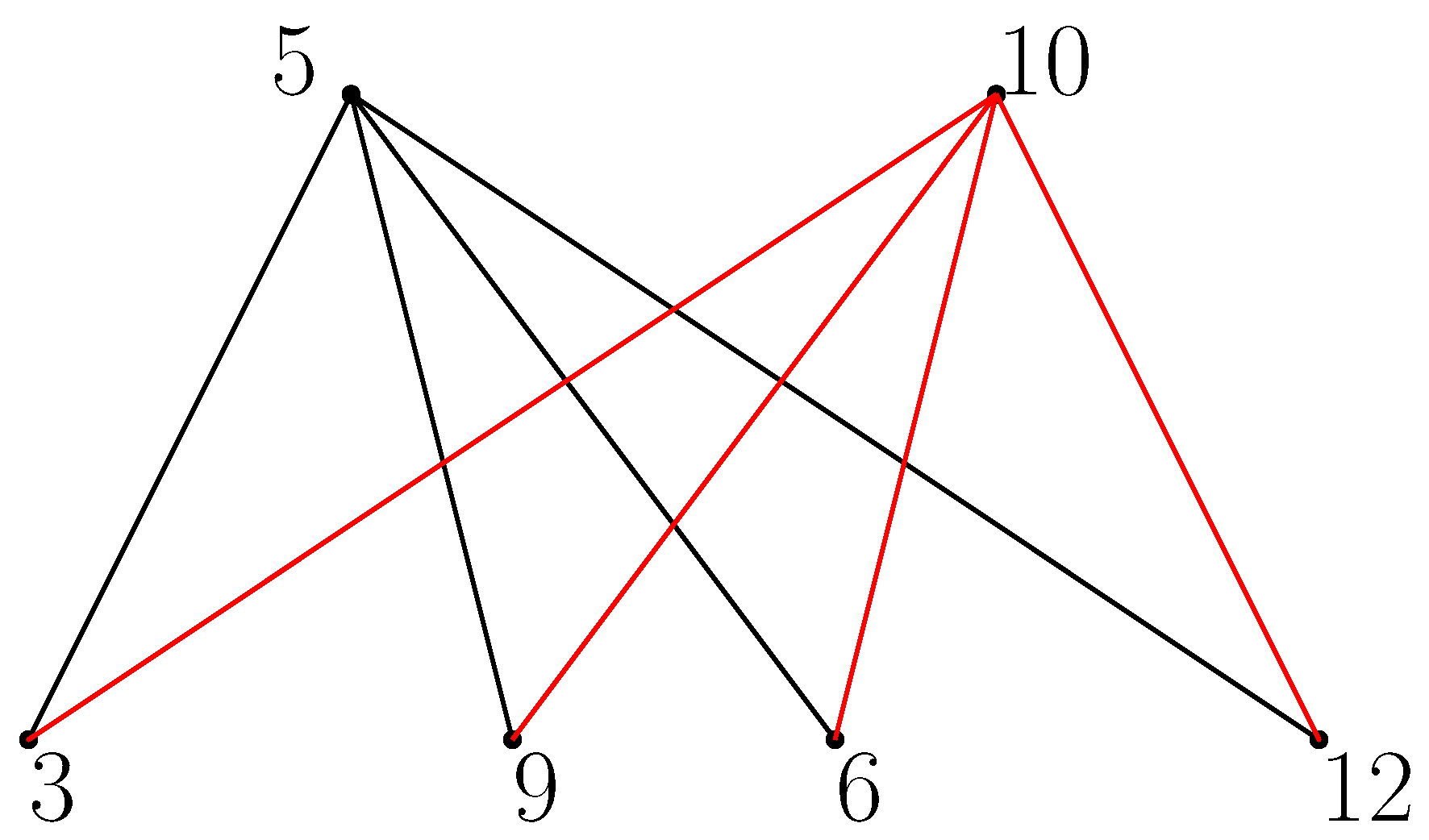
Let us considerbe the set of all non-zero zero divisors of . Then by the properties of zero divisor we know that for each i,Since 0 is always a zero divisor element,where is a Euler’s totient function. It follows thatTherefore,where V is the set of vertices of . Now, one of the way to determine the zero-divisors elements of is to solve for the incongruent solution of the congruent equation.where k is a non-zero zero divisor element of .Now, equation (1) has a solution asWe may assume thatThencan be written asNow, from equation (2)Therefore,for some l. We note that for incongruent solution, l must be less than . It follows thatThus the incongruent solutions of equation (2) are given by those integers which are multiples of and less than . Similarly, the incongruent solutions of equation (3) are given by those integers which are less than and multiples of . For instance, if =3 and =7, then the solutions of these two congruence equations (2) and (3) will be multiples of 7 and 3, i.e., and , respectively. Now, let us consider = all the incongruent solutions of equation (2) and = all the incongruent solutions of equation (3). ThenSince and are distinct primes,Moreover, no two vertices in are connected for each i= and every vertices of are connected to every vertices of . If possible, assumeare connected, then, we haveSincewhere . It follows thatSince is prime and , we have , which is a contradiction that and are distinct primes. Sincewe have is a complete bi-partite graph, i.e.,If any of the prime or is 2, say, , then and the only vertex in must have an edge with every vertex in and so is a star graph.
- 2.
- To prove this we consider an example as shown in the Figure 2. Since = is a bi-partite graph diameter and chromatic number,
- 3.
- Radius, rad( is the minimum eccentricity of all the vertex of which is 2.
Figure 4.
Example of bi-partite graph of , where and .
□
Theorem 2.
If is a square free prime factorisation, then the non-zero zero divisor graph, , is a ()-partite graph.
Proof.
If n is a prime, i.e., , then the non-zero zero divisor graph is a null graph. Hence, in this case, the result is true.
If n=, then by Theorem 1, the non-zero zero divisor graph, is a bipartite graph, i.e., ()-partite graph. Thus the result is true in this case also.
In the proof of Theorem 1, it can be observed that the partition of the vertex set is obtained by taking the incongruent solution of the two congruent equations
respectively.
Now, we assume that n=. Let be the set of non-zero zero divisor elements of . As we know that for each i
It follows that the number of non-zero zero divisor which is also the number of vertices in can be obtained by
For any , we have m is a zero divisor of . It follows that there exists such that . Therefore to list all such zero divisors of , we must solve for the incongruent solution of the congruent equation
Equation (4) is solvable as Since is a product of three distinct primes and , some possible values of m which the m may be any one of the primes or product of primes by taking two primes at a times, namely,
For our convenience, depending upon the choices of m, we may consider the following cases to solve the congruence Equation (4).
Case I: For each i, let . In this case, we shall have three linear congruence equations, namely,
where . These three congruence equations can be thought as number of choices. Now for each i, , whence . In this way we shall get 3 sets of solution for each i, i=. As we are looking for non-zero zero divisors of only, so x must be greater than 0 and less than n, i.e., . Now, for a fixed i, , the equation can be reduced to
Since , we have for each corresponding to choice of . Let us denote these solutions sets by corresponds to each i. We note that then three sets of solution can be thought as 3 = sets of solutions (number of combination of picking 1 member at a time from the set of 3 members).
Case II:
, .
In this case, we shall have sets of solution as we can choose two members from a set of 3 members by ways. Thus the congruence equations reduces to
whence,
For fixed ,
We note that
Since , we get respectively. That is any set of solutions of these congruence equations must be multiples of . Let us denote these sets of solutions by corresponds to and . It is to be noted that there are
sets of solution which may not be mutually disjoint. This process may be continued for n as product of 4, 5,... distinct primes. Suppose
Let,
be set of non-zero zero divisors elements of . Then
Thus, the number of non-zero zero divisors can be obtained by
Let . Since m is a zero divisor, there exists such that
Therefore to list all such zero divisors of , we must solve the congruence equation
Since m and x are both variables, we have to fixed one. For our convenience , we are fixing m by choosing some particular values of m. We would like to note that we are choosing m in such a way so that the totality of such solutions for x provides us the complete set of non-zero zero divisors of the ring and which further leads to a partition to the vertex set of the non-zero zero divisor graph in the formation of a partite graph.
Now, Equation (5) is solvable as . Since is a product of k distinct primes and (). To fix m, we choose those zero-divisors which are products of primes by taking at most primes from at a time. In this way, we shall have the following cases.
- (1)
- (2)
-
and so on. After steps, we have
- (3)
- .
In this way, we shall have
numbers of equations corresponding to which we shall have sets of solution. Now, we solve the equations to get the complete list of non-zero zero divisors of .
Case(1):
If for some (picking one prime at a time), then the Equation (5) reduces to
It follows that
Whence,
Since , we have In this way we shall get k sets of solution for each i, Let us denote these solutions set by corresponds to , We note that k = (Number of combination of picking 1 member at a time from the sets of k members).
Case (2): In this case, we shall have sets of solution as we can choose two members from a set of k members by ways. Thus the congruence equation reduces to
Whence,
For fixed, , (without loss of generality, we assume, ), we have
Since , we get Let us denote these set of solution by corresponds to and . Continue in this manner, we have the following case.
case (picking primes at a time):
In the case, we shall have sets of solutions corresponding to the congruence equations
where Whence,
where
Let us denote this sets of solutions by
For each i, the solution set is given by
Therefore in total, we shall have
sets of solution of the congruence equation,
Construction of ()- partite graph:
We note that these sets of solution may not be a pairwise disjoint but exhausted the set of all non-zero zero divisors, i.e., union of all such sets of solutions give the set of all non-zero zero divisors. In our next step, we would like to re-structure the sets of solutions in such a way that they are pairwise disjoint and their union is the set of all non-zero zero divisors of the ring which infact forms a partition of the vertex set of the zero divisor graph . Now, we shall show that this sets of solution will act as a partition of the vertex set and forms a partite graph. These sets are splitted into number of levels. We shall start with the inner most level. The inner most level corresponds to sets of solutions
Let us denote them by
where
That is, it is the collection of integers which are multiples of (mod n). In this way, we shall have
number of sets of vertices and since are distinct primes, these sets of vertices are pairwise disjoint. In the next outer level, i.e., , we consider those sets of solutions for which each solution m is a multiples of the primes by removing a pair of primes at a time and it is denoted by and constructed the next level of vertices as follows:
where `−’ stands for the difference of sets and repeated use of `−’ is for cumulative difference in the sense that if , then we mean that it is . Then it can be verified that ’s are pair wise disjoint and
Now, the next outer level should be
by considering those sets of solutions for which each solution m is a multiples of the primes by removing three primes at a time. Then
where,
It can be observed that ’s are pairwise disjoint and
Continuing these process, the outermost level would be for which corresponding sets are where . Now, we consider a sets of solutions for which each solution m is a multiple of the primes by removing of primes at a time, and construct the next level of vertices as follows:
where=1,2,3,...,kand
where the sum runs over all combinations by picking k-2 distinct elements from k-1 elements from i1, i2, i3 … ik−1.
Next we claim that no two vertices in the same set of the above partition of the vertex set are connected by an edge.
From the construction of level sets, it can be observed that for an arbitrary , say, we can always find a prime such that for all . For instances, if
then . And if
then and and so on.
Now, if are connected, then
It follows that . Since , we have , which is a contradiction that and Therefore, any two vertices are non-adjacent whenever they are from the same level set.
Edge formation:
If , , , then all ’s are divisor of u except and divisor of v except . Since , it follows that all ’s divides , that is, . Thus {} is an edge of the zero-divisor graph.
Hence, every vertex of an inner most level is adjacent to all vertices of another same level set .
Again, every vertex must have edge with every vertex of the next outer level set
for which i is different from p and q, and no vertex of can have an edge with any vertex of
for which i is either coincides with p or q.
Similarly, it can be observed that every vertex of inner most level must have edge with every vertex of the next outer level set
for which i is different from and r, and no vertex of can have an edge with any vertex of for which any one i is either coincides with p or q or r.
Continuing in this process, we get every vertex must have an edge with every vertex of the outer most level set
only.
Moreover, every vertex must have edge with every vertex of an another set of the same level
for which i and j is different from p and q, and no vertex of can have an edge with any vertex of for which any one i or j is either coincides with p or q.
Similarly, every vertex of must have edge with every vertex of the next outer level set
for which i and j is different from and r, and no vertex of can have an edge with any vertex of for which i or j is either coincides with p or q or r. Continuing in this way, it can be obtained that every vertices of each set of second most inner level have an edge with every vertices of only one set of second outer most level, and no vertex of a set of second inner most level can have an edge to any vertex of any set from the outer most level.
This process will be continued till the outer most level is reached. In the most outer level, vertices of are non-adjacent to vertices of , for .
In this way, we obtain a ()-partite structure of the non-zero zero divisor graph .
□
4. Algorithm to Determine , when n Is Square Free
Step 1:
Find the number of non-zero zero divisors of , which is given by
Step 2:
Find out the number of partitions, which is given by
Step 3:
List all the congruence equations in order to get the non-zero zero divisors by using the equation
Step 4: Find the incongruent solution for all the congruence equations listed in Step 3.
Step 5: Partitioning of the solution set into level sets .
Step 6: Formation of edges, i.e., connecting of vertices to get edges.
5. Illustrated Examples
Example 1.
(3-distinct primes) For 3-distinct primes, and ,
if
then, is a ring in which n is square free. For instance, if , then, using the above algorithm, we can construct a non-zero zero divisor graph of (see Figure 5).
The number of non-zero zero divisor elements will be given by
According to step 1 of the algorithm, the number of partitions should be
Thus, the graph must be a 6 - partite graph. Let us denote V be the set of non-zero zero divisor elements of , Then
The vertex set V can be obtained using the algorithm in terms of solution sets using the method described above. The number of incongruent equations will be and by picking 1 member at a time. Similarly by picking 2 member at a time. Solving the incongruent solution of the given congruence equations, we get 6 disjoint subsets of the vertices which can be denoted by .
i.e., solutions of the above equations are given by
Now, edges can be formed using step 6. Once the edges are formed, we get a 6-partite graph Figure 5. It can be verified that
Remark 1.
For the convenience, the zero-divisor graph has been represented by single connected edge among two level sets in the sense that if elements of a level set is connected to elements of another level set , then the corresponding two level set is connected by a edge. In this way, we can minimize the complexity of drawing the zero divisor graph and it can take the form as shown in (Figure 6). This phenomenon can be thought as merging of vertices and edges.
Example 2.
(4-distinct primes) Let
Then, =. The total number of non-zero zero divisor elements of is given by-
Here, the number of partitions must be
The graph must be a graph. Now, to list out all the vertices of , we must find all the incongruent solutions of the congruence equations according to step 3 and 4. Using step 5, we can construct 14 disjoint subsets of the vertices which partitioned the vertices. Finally, using step 6, a graph can be constructed which is depicted in the simplified form (see Figure 7).
The partitioning the vertex as level subsets of are as follows:
Remark 2.
For our convenience, we denote the level sets as
where r represents the levels and ’s denote the family of distinct primes whose product appears in the congruence relation which particularly means that and and it is to be noted that, . For illustration, is a partition of the vertex set corresponding to solution set (a simple component of ) obtained corresponding to the congruence relation , and is a partition of the vertex set corresponding to solution set (direct sum of two simple components and of ) obtained corresponding to the congruence relation in level 2. This notation conveniently allow us find the edges in such a way that if any suffixes are missing in a particular level set, then vertices in that set must be connected to every vertices of another level set containing only the missing suffixes. In this way, the graph edges can be drawn with the help of Table 1 and Table 2. A similar kind of table can be established in determining the edges and vertices of non-zero zero-divisors graph of a semi-simple ring R as a semi-simple ring is a direct sum of its simple components.
Theorem 3.
[12] For a prime p, is a complete graph.
Proof.
Let
be the set of vertices of non-zero zero divisors of . Then, for each i, Since 0 is always a zero divisor elements of . If k is arbitrary elements V, then . Therefore,
Example 3. The zero divisor graphs of, , and.
That is, total number of vertices in is . Now, in order to list all the vertices of , we shall find all the incongruent solutions of the congruent equation
where k is a non-zero zero divisor of .
Now, the congruence linear equation has solution as
Since k is element of , we have
If , we must get Since, , the zero divisors are Since every vertex is a multiple of p, the product of any two vertices is divisible by . Hence each vertex is connected to every vertex of Therefore is a complete graph , where p is a prime number. □
Remark 3.
It is obtained that when n is square-free is a partite graph. It can be observed that is a complete bipartite graph, while is a complete graph. On the other hand, the semisimple ring is not a complete graph. In particular, it is complete bi- partite graph. In fact, is a Turán graph. This observation leads us to a conjecture that for any finite semisimple ring, the zero divisor graph of them is a partite graph and some of it’s subgraphs are Turán graph. We will take it as a sequel to our current study.
6. Conclusion
The zero-divisor graph of for which n is linearly factored are investigated and it is shown that of the ring is a -partite graph, when ( are k distinct primes). We note that , for , ( distinct primes) are semi-simple ring. We believe the results obtained can be used as tools to investigate the nature and properties of the zero divisor graphs of semi-simple rings and modules. It is to be noted that the results obtained are solely applicable to the ring , but may not be applicable to an arbitrary ring of order n. For example, the ring and are both of order , but and are two different graphs.
Acknowledgments
The second author was partially supported by Ministry of Tribal affairs, Govt. of India via MOTA Award no. 202122-NFST-ARU-00329.
Conflicts of Interest
The author declares no conflict of interest in this paper.
References
- C. O. Aguilar, An Introduction to Algebraic Graph Theory, State University of New York, Geneseo.
- S. Akbari, H. R. Maimani, and S. Yassemi. When a zero-divisor graph is planar or complete r-partite graph. J.Algebra 2004, 274, 847–855. [Google Scholar]
- S. Akbari and A. Mohammadian. Zero-divisor graphs of non-commutative rings. J. Algebra 2006, 296, 462–479. [Google Scholar] [CrossRef]
- D. F. Anderson and A. Badawi. On The Zero-Divisor Graph Of A Ring. Communications in Algebra 2008, 36, 3073–3092. [Google Scholar] [CrossRef]
- D. F. Anderson, J. Fasteen, and J. D. LaGrange. The subgroup graph of a group. Arabian Journal of Mathematics 2012, 1, 17. [Google Scholar] [CrossRef]
- D. F. Anderson and P.S. Livingston. The zero-divisor graph of a commutative ring. Journal of algebra 1999, 217, 434–447. [Google Scholar] [CrossRef]
- D. F. Anderson and S. B. Mulay. On the diameter and girth of a zero-divisor graph. Journal of pure Applied Algebra 2007, 210, 543–550. [Google Scholar] [CrossRef]
- D. D. Anderson and M. Naseer. Beck’s coloring of a commutative ring. J. Algebra 1993, 159, 500–514. [Google Scholar] [CrossRef]
- I. Beck. Coloring of commutative Rings. journal of Algebra 1988, 116, 208–226. [Google Scholar] [CrossRef]
- J. A. Bondy and U. S. R. Murty, Graph Theory with applications, American Elsevier, New York, 1976.
- F. Buckley and M. lewinter, A Friendly Introduction to Graph Theory, Prentic-Hall, (2003).
- S. Chattopadhyay, K. Lochan Patra and B.K. Sahoo. Laplacian eigenvalues of the zero divisor graph of the ring Zn. Linear Algebra and Its Applications, 2020; 584, 267–286. [Google Scholar]
- T. T. Chelvam, P. Vignesh, and G. Kalaimurugan. On zero-divisor graphs of commutative rings without identity. Journal of Algebra and its Application 2020, 12, 226. [Google Scholar]
- F. Demeyer and K. Schneider. Automorphisms and zero divisor graphs of a commutative rings. International J. Commutative Rings 2002, 1, 93–106. [Google Scholar]
- N. Jafari Rad and S. H, Jafari. A Characterization of Bipartite Zero-Divisor Graphs. Canadian Mathematical Society 2014, 57, 188–193. [Google Scholar]
- N. Jafari Rad, S. H. Jafari, and D. A. Mojdeh. On Domination in Zero-Divisor Graphs. N. Jafari Rad, S. H. Jafari, and D. A. Mojdeh 2018. [Google Scholar]
- D. Lu and Tongsuo Wu, On bipartite zero-divisor graphs, Elsevier, Discrete mathematics, 309, 755-762, (2009).
- I. Niven, H. S. Zukerman, and H. L. Montgomery. An introduction to the theory of Numbers; Wiley India(p) Ltd, 1991. [Google Scholar]
- S. P. Redmond. The zero-divisor graph of a non commutative ring. Internat. J. Commutative Rings 2002, 1, 203–211. [Google Scholar]
- D. Sinha and B. Kaur. Beck’s Zero-Divisor Graph in the Realm of signed Graph. National Academy Science Letters 2020, 3, 263. [Google Scholar]
- D. B. West, Introduction To Graph Theory, Prentice Hall of India Pvt. Ltd, (2003).
Figure 1.
Zero divisor graphs.
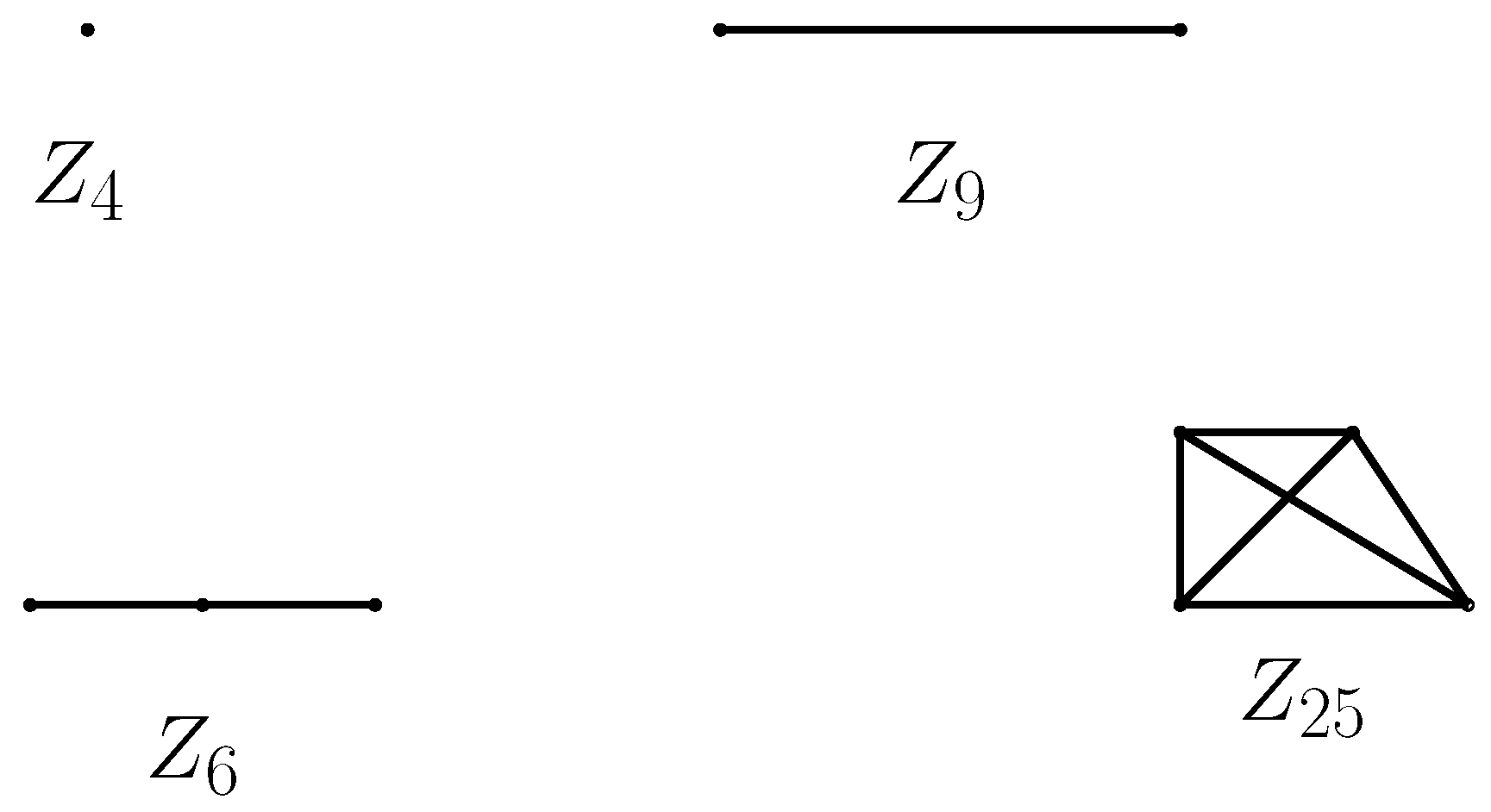
Figure 2.
Example of bi-partite graph of , where and
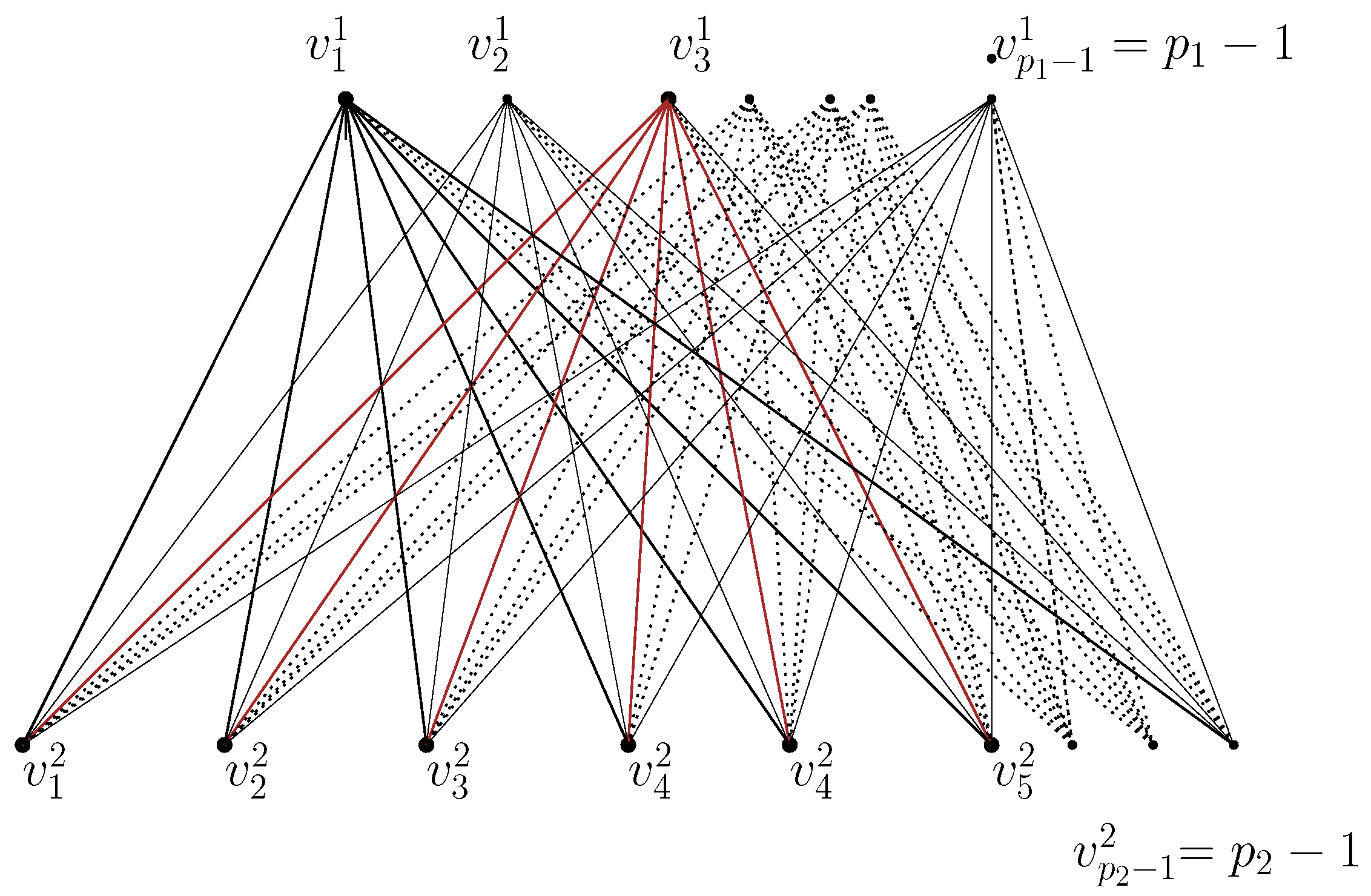
Figure 3.
Figure showing the schematic star graph for and centre as .
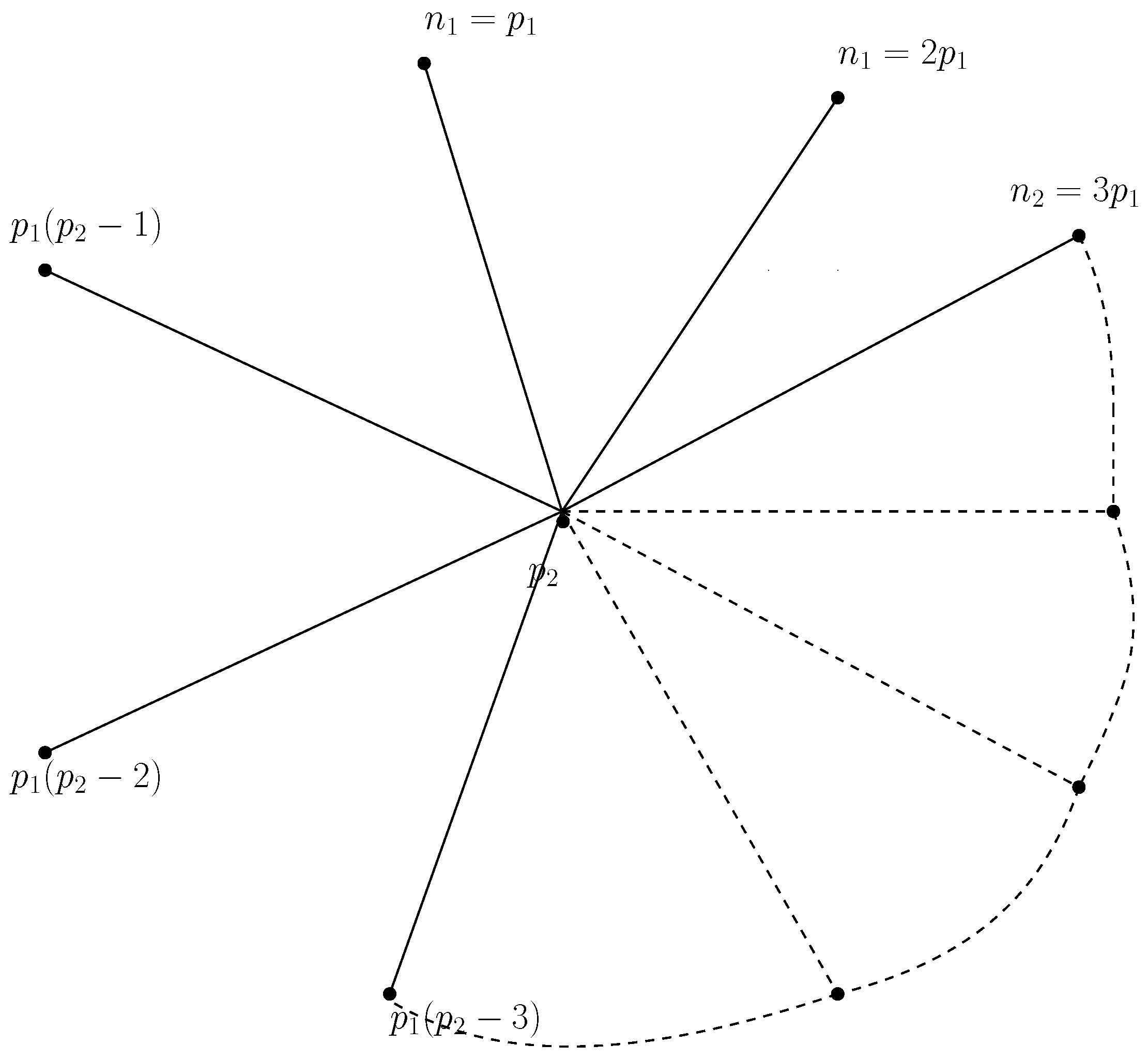
Figure 5.
Zero divisor graph of .
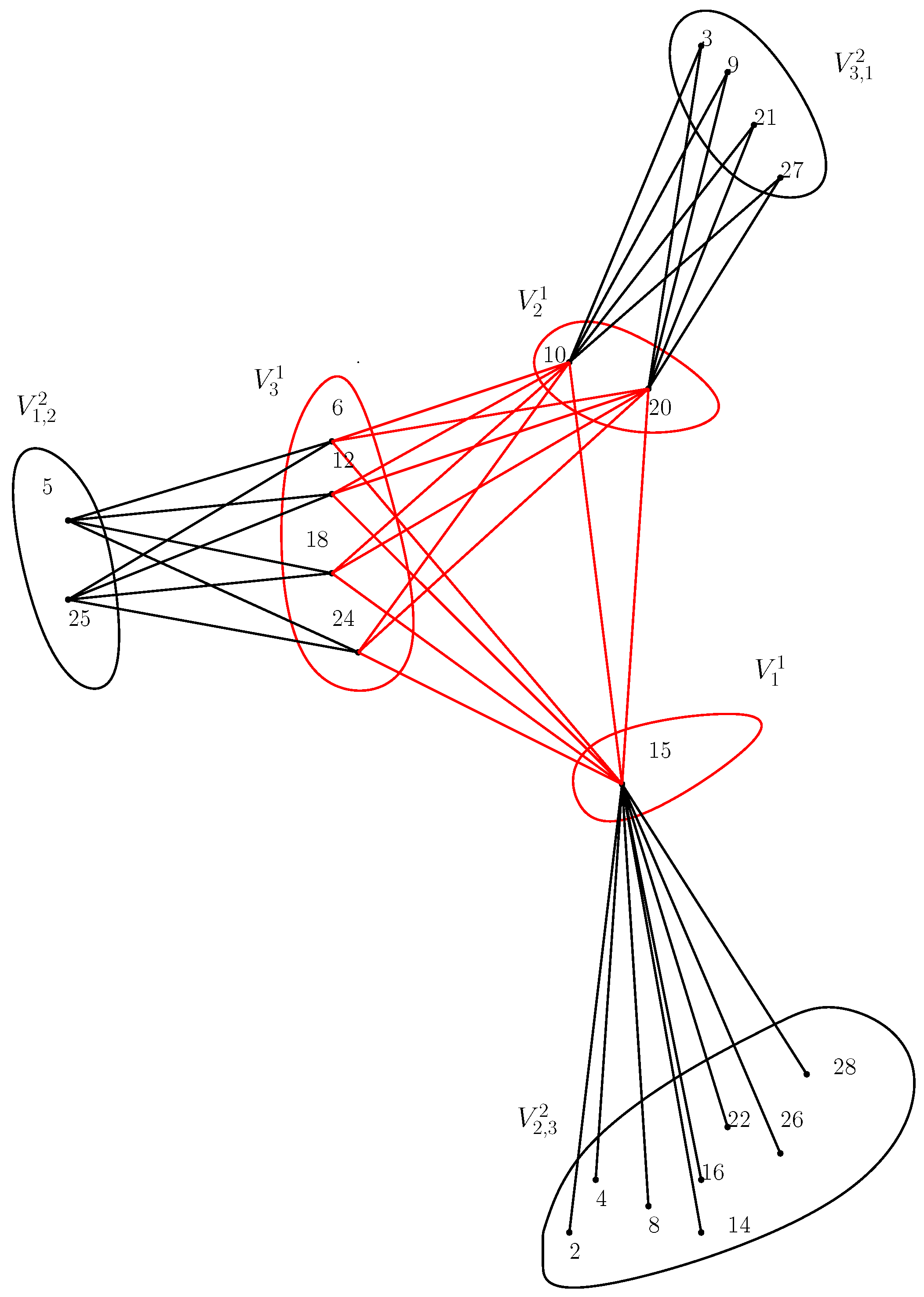
Figure 6.
Simplified form of by merging vertices and edges.
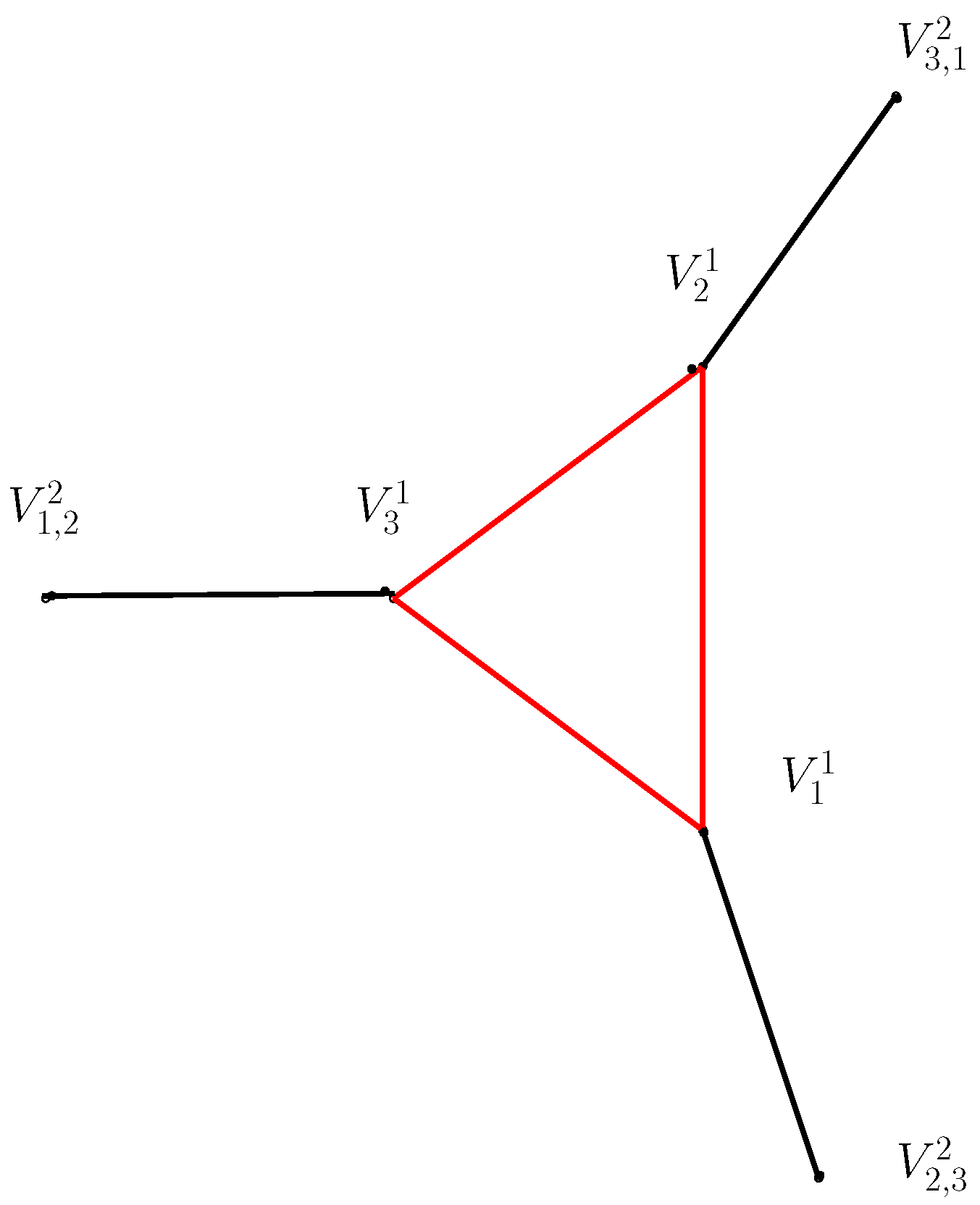
Figure 7.
Simplified form of the zero-divisor graph of .
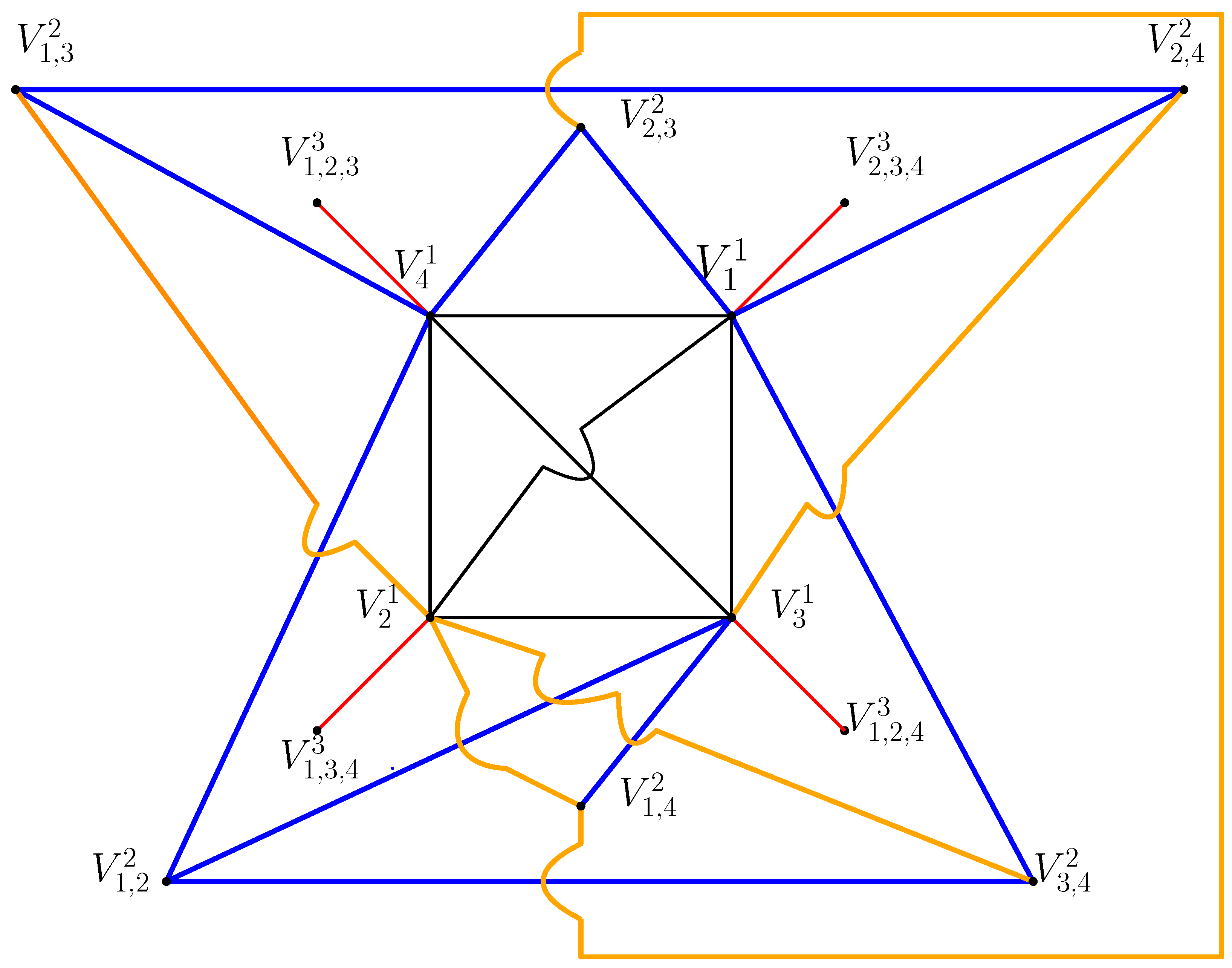
Figure 8.
Zero divisor graphs (a). (b). (c). and (d). .
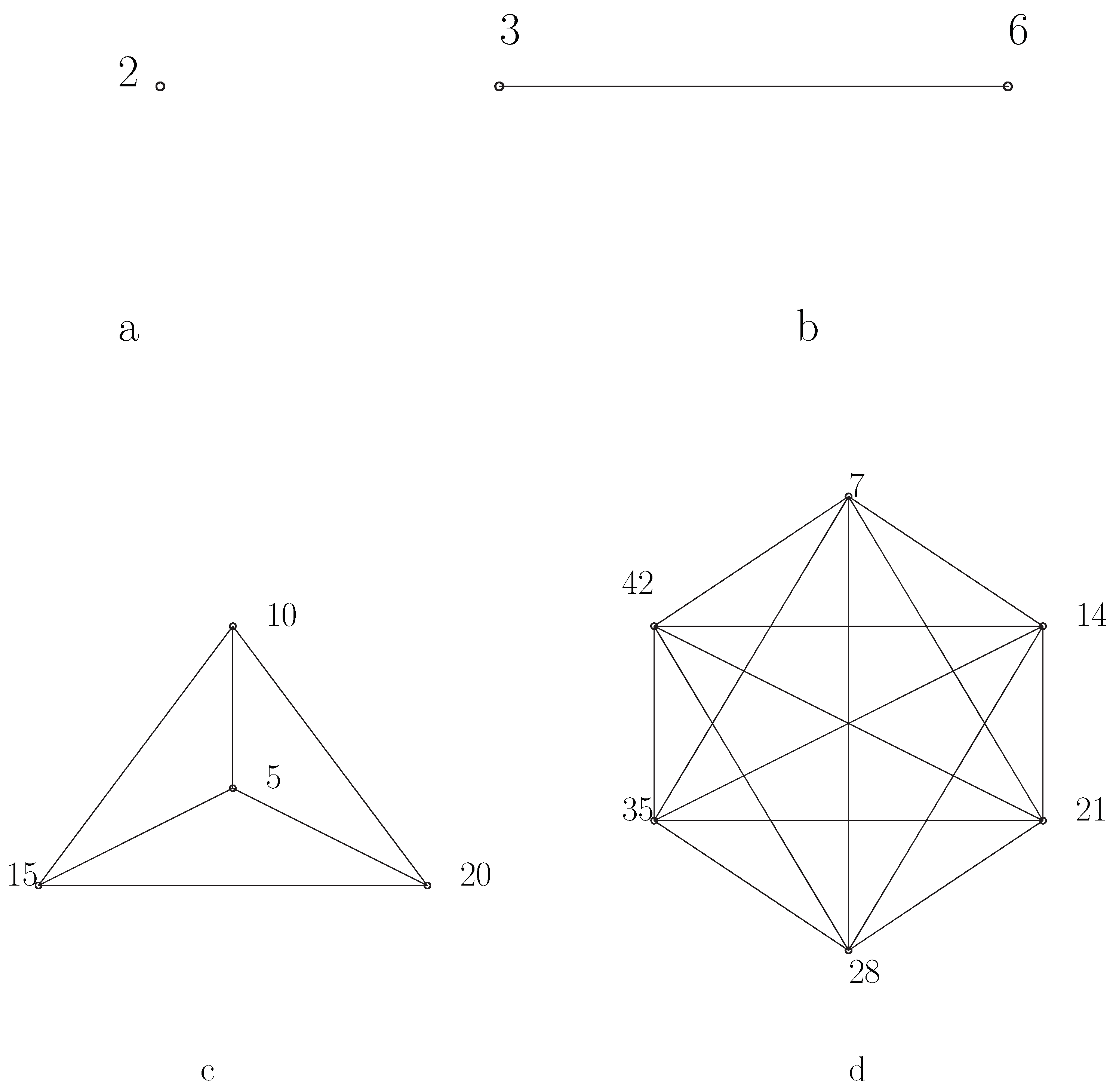

Table 1.
Formation of partite graphs of.
| Equations | Solution sets | Partition sets | Edges formations |
|---|---|---|---|
Table 2.
Formation of partite graphs of.
| Equations | Solution sets | Partition sets | Edges formations |
|---|---|---|---|
Disclaimer/Publisher’s Note: The statements, opinions and data contained in all publications are solely those of the individual author(s) and contributor(s) and not of MDPI and/or the editor(s). MDPI and/or the editor(s) disclaim responsibility for any injury to people or property resulting from any ideas, methods, instructions or products referred to in the content. |
© 2024 by the authors. Licensee MDPI, Basel, Switzerland. This article is an open access article distributed under the terms and conditions of the Creative Commons Attribution (CC BY) license (http://creativecommons.org/licenses/by/4.0/).
Copyright: This open access article is published under a Creative Commons CC BY 4.0 license, which permit the free download, distribution, and reuse, provided that the author and preprint are cited in any reuse.


