

Submitted:
21 December 2024
Posted:
24 December 2024
You are already at the latest version
Abstract
The ceramic and glass industries, integral to the EU Emissions Trading System (EU ETS), face significant challenges in achieving decarbonization despite advancements in energy efficiency. The circular economy offers a promising pathway, emphasizing the reuse and recycling of waste materials into secondary raw materials (SRM) to reduce resource consumption and emissions. This study investigates a standardized waste supply chain framework, developed collaboratively with stakeholders, tailored for the ceramic sector. The Waste Resource Platform (WRP) integrates Industry 4.0 paradigms, utilizing a modular, layered architecture and a process-centric design. The framework includes experimental tests and co-creation methodologies to refine a digital marketplace that connects stakeholders, facilitates SRM exchange, and fosters industrial symbiosis. The WRP demonstrates the potential for SRM to replace virgin materials, reducing environmental impacts and production costs. It enhances supply chain transparency through digital traceability, promotes predictive material sourcing, and streamlines logistics via algorithmic optimization. Challenges such as regulatory gaps and quality standards are addressed through standardized processes, open data governance, and innovative algorithms. The WRP project advances circular economy goals in the ceramic sector, promoting waste reuse, industrial symbiosis, and supply chain resilience. Its standardized, open-access platform offers a scalable model for other industries, fostering sustainable practices and resource efficiency while addressing global climate targets.
Keywords:
ceramics
; data governance
; supply chain digital evidence items
; situational awareness
; system architecture
; data-centric
1. Introduction
The ceramic and glass industries are highly energy-intensive and covered mainly by the EU Emissions Trading System (EU ETS), a cap-and-trade mechanism designed to curb greenhouse gas emissions [1]. The EU ETS allocates or sells emission allowances that companies can trade, incentivizing emission reduction and supporting the shift to a low-carbon economy. Although these industries have enhanced energy efficiency by adopting best practices, achieving full decarbonization remains a significant challenge. Existing studies suggest that incremental changes alone are insufficient; disruptive innovation and circular economy principles should be pursued as complementary strategies.
The circular economy model emphasizes reusing and recycling materials traditionally viewed as waste, transforming them into resources or secondary raw materials (SRM). According to EU and national policies [2], the circular economy aims to preserve product value, conserve resources, and shift away from the linear "take-make-dispose" model. The EU's Circular Economy Action Plan, part of the European Green Deal, promotes resource efficiency and waste reduction. Key policies focus on waste management, extended producer responsibility (EPR), and incentives for sustainable product lifecycles. This initiative targets sectors like electronics, textiles, and construction, encouraging design practices that support repairability and sustainability. Circular economy efforts are a path for reaching climate neutrality by 2050, as a large portion of greenhouse gas emissions results from resource extraction and processing [3].
To tackle logistical and market access challenges, particularly for small and medium-sized enterprises (SMEs) in remote areas, an omnichannel marketplace strategy can establish a digital value chain that supports circularity. The proposed platform offers SMEs a robust marketplace for trading SRM, granting them the integrated benefits typically accessible only to large brands—at no extra cost. Acting as a global mediation gateway, it fosters cross-sector collaboration, advancing the circular economy by enabling SMEs to access secondary resources and forge sustainable partnerships. The final pilot seeks to engage consumers directly in shaping product offerings and customizing packages of eco-sustainable products they value.
With a focus on market needs, the Ceramic and Glassware Industry sector is examined using Portugal as a case study. Developed in close cooperation with stakeholders, such as suppliers, consumers, and regulatory bodies, these partners are crucial in refining the platform's features and participating in validation stages. The following two stakeholders are actively engaged in the co-creation cycle of the proposed solution:
- APICER: Associação Portuguesa das Indústrias de Cerâmica e de Cristalaria is a nationwide association for the ceramics and glassware sector. Its mission is to represent its members, promoting and defending their business interests to enhance the sector's competitiveness and growth. APICER is responsible for managing international promotion activities, analyzing and measuring the impact of industry developments, and running awareness campaigns.
- CTCV: Centro Tecnológico da Cerâmica e do Vidro is a technological center focused on research, innovation, consulting services, and technology transfer in the ceramics and glass sectors. CTCV has extensive experience in developing new materials and processes for these industries. Their work includes developing new combustion solutions, decarbonization initiatives, promoting raw material circularity, creating low-temperature sintering processes, and facilitating the digital transition.
The collaboration with APICER and CTCV has resulted in developing technical specifications for an open-access platform to improve communication flows between ceramic companies, especially SMEs, regarding information sharing and the use of SRM, aiming to establish a new paradigm for managing circularity in the ceramic sector. This research cooperation is conducted as part of the ECP1 project, focusing on potential standardization aspects to establish a marketplace for circularity within the ceramic sector
The methodology included initial studies of potential technologies, experimental tests to validate solutions, co-creation with key stakeholders in the ceramics sector, and the implementation of the Waste Resource Platform (WRP) prototype for early-stage laboratory tests. This will be followed by deployment in a relevant environment to assess the platform's impact and interoperability with existing systems. The study outlines processes to support system development and facilitate information exchange among acquirers, suppliers, and other stakeholders involved in the system's lifecycle. The goal is to develop an efficient process for collecting, tracking, and revalorizing ceramic waste, promoting circular economy actions within the ceramic sector by integrating information about the sector, waste typology, and use/valorization as secondary resources.
The WRP aims to contribute to eco-innovation and sustainability by promoting industrial symbioses for eco-efficiency and economic resilience. It seeks to create a standard data governance approach for SRM, minimizing the consumption of virgin raw materials, increasing the economy's circularity, and developing innovative products from a life cycle perspective. The main objectives of the WRP are: 1) to design and develop an interoperable platform that can act as a marketplace reference with services to identify potential raw materials from subproducts within the value chain, aggregating and sharing information about the availability and provenance of SRM, and 2) to present a standardized open architectural approach for reusing and recycling waste from the ceramics sector and integrating waste from other sectors. This framework ensures the traceability of digital evidence throughout the process, documenting all actions in the digital value chain to enhance transparency and accountability, leading to consistent practices among stakeholders across EU member states.
The paper's structure is as follows: Section 2 reviews relevant work in this field. Section 3 presents the problem description and introduces and derives the proposed architectural approach. Section 4 showcases extensive experimental results and analysis. Conclusions drawn from the experiments are summarized in Section 5.
2. Related Work – The Path Towards Digital Transformation
The ceramic industry has been working and investing in innovations within the scope of the circular economy [4], and various ceramic sectors can innovate and incorporate waste/by-products from their production or generated by other industrial sectors, promoting circular economy strategies. In this domain, the digital transformation of the ceramic sector, framed by the Industry 4.0 paradigm, is one of the paths for enhancing production efficiency, fostering circular economy practices, and ensuring sustainable development [5]. The sector can overcome current challenges and build a resilient, future-ready industry by adopting advanced technologies and innovative design methodologies.
The digital transition within the manufacturing industry is revolutionizing production environments with more connected devices and automated production processes. By leveraging technologies such as the Internet of Things (IoT), Cyber-Physical Systems, and Big Data Analytics, the ceramic sector can harness the generated data to gain deeper insights into production processes, contributing to their optimization and sustainability. By adopting advanced digital technologies, the ceramic industry can reduce inefficiencies, lower costs, and increase productivity [6]. However, to get the maximum value from this myriad of novel technologies and the generated information, leveraging a real disruption in the manufacturing industry, it will be necessary to have a comprehensive knowledge of all processes within the value chain, encompassing information from different agents and integrating a wide diversity of data sources [7]. Only then will it be possible to deliver effective horizontal services, e.g., to achieve product traceability, from raw material to recycling, or to evaluate and minimize its ecological footprint, monitoring greenhouse gas emissions and fostering the circular economy through an industrial symbiosis between the various players in the value chain.
New methodologies in design projects, particularly design for circularity, are decisive for transitioning from a linear economy model to a circular economy framework. This shift emphasizes rethinking product lifecycles and incorporating sustainable practices from the initial design phase to end-of-life recycling. To ensure that ceramic production is sustainable, it must adhere to two fundamental rules: (i) Incorporate the concept of circular economy through the use of waste materials in product formulations, and (ii) reduce emissions by lowering firing temperatures and the total embodied energy. The ceramic industry can minimize environmental impacts and promote long-term sustainability by following these principles.
2.1. The Ceramic and Glassware Industry in Numbers
To grasp the scale of the proposed challenge, Table 1 provides an overview of Portugal's Ceramic and Glassware Industry. In 2022, Portuguese ceramic exports reached 170 international markets. Of these exports, 66.4% went to EU countries, while 33.6% were directed to non-EU markets. France was the leading destination for Portuguese ceramics, followed by Spain, the United States, Germany, and the United Kingdom. Domestically, ceramic exports represented 1.24% of Portugal's total goods exports for the year. Among European countries, Portugal ranked as the 7th largest exporter within the EU, accounting for 3.9% of the EU27's total ceramic export value.
In 2022, the ceramics industry comprised 1,162 companies, of which 458 were corporations, and 704 were individual enterprises. The turnover generated by the ceramics industry amounted to 1,582 million euros, with particular emphasis on flooring, wall tiles, and utilitarian and decorative ceramics.
2.2. Waste Management and Circularity in the Ceramic Industry in Portugal
The ceramics industry generates various types of waste, the majority of which is inert or non-hazardous, with only a tiny portion classified as hazardous, typically related to maintenance or emission treatment processes. Decree-Law No. 102-D/2020, in line with EU Directives 2018/849, 2018/850, 2018/851, and 2018/852, regulates waste management and establishes criteria for specific substances or objects from production processes to be classified as by-products rather than waste. To be recognized as by-products, applications must be submitted to the National Waste Authority (ANR), overseen by the Portuguese Environment Agency [8]. By-products are substances resulting from production processes where their creation is not the primary aim. To qualify these materials as by-products, it was essential to demonstrate their inert nature. CTCV conducted leaching tests on various ceramic waste materials to verify this. Inert waste is defined as waste that does not undergo significant transformations and is neither soluble, flammable, nor reactive. It is not biodegradable and does not adversely impact other substances, preventing environmental pollution or health hazards. Its leachability, pollutant levels, and ecotoxicity are minimal, posing no risk to surface or groundwater quality.
Additionally, potential reuse methods needed to be proven to facilitate future utilization of these by-products. Ceramic waste offers multiple valorization opportunities, with several industries willing to incorporate it into their production processes. For example, ceramic waste can replace sand in ceramic mixtures or serve as ground-inert material for paving extraction sites, roadways, construction fillings, or tennis courts. It may also be used as a by-product in the cement industry, showcasing its versatility in recycling applications.
Considering the general criteria defined for classification as a by-product [9], classifying specific types of ceramic manufacturing waste as by-products under Article 44-A of the General Waste Management Regime (RGR) started to be regulated. This classification applies to waste from stages such as ceramic mixture preparation (e.g., before the thermal process), dust from dedusting systems, and non-conforming ceramic pieces post-thermal process. Following this declaration, APICER collected data from member companies benefiting from the reclassification. As shown in Table 2, the amount of waste reused as by-products exceeded that dispatched as waste, highlighting the ceramics industry's potential for waste reintegration and promoting circular economy practices.
The ceramic and glass sectors have a distinct advantage in their ability to reuse by-products, waste, and residues from other industries, supporting industrial symbiosis. This often involves pre-processing steps like grinding, heat treatment, and developing tailored product formulations to preserve ceramic properties. Boosting productive efficiency through digital transition contributes to both internal processes within companies and the logistics across the ceramic sector's entire supply chain [10]. Studies show that digital transformation is essential for the ceramic and glassware industries to modernize and remain competitive, overcoming low levels of automation and limited cross-sector communication in these industries [11,12]. Integrating digital solutions can enhance resource management, elevate product quality, and drive innovation. This approach aligns with the principles of circular economy by utilizing both ceramic (endogenous circularity) and non-ceramic (exogenous circularity) inorganic waste.
Endogenous circularity refers to a system's internal, self-sustaining processes that promote resource reuse, recycling, and efficient management. It emphasizes how organizations, industries, or even ecosystems can develop closed-loop systems that minimize waste and maximize resource efficiency from within. This concept is particularly relevant in sectors where waste materials or by-products can be reintegrated into the production process, reducing the need for external inputs and fostering sustainability.
Exogenous circularity involves incorporating external materials, processes, or systems into a circular economy framework. Unlike endogenous circularity, which focuses on internal resource reuse, exogenous circularity leverages resources from outside an organization's operations. This may include sourcing recycled materials from other industries, collaborating with external partners for waste management, or engaging in shared resource networks. For instance, a glass manufacturer could use recycled glass sourced from construction waste, while the ceramic industry might incorporate sand waste from other sectors, like foundries. Exogenous circularity highlights cross-sector collaboration, where different industries benefit from each other's waste streams, creating synergies and reducing environmental impact. This approach extends circularity beyond individual companies, building a broader sustainability network. By utilizing external resources, businesses gain access to new materials, reduce production costs, and contribute to a larger circular economy, where one industry's waste serves as another's raw material.
However, the challenges to implementing circular economy strategies and industrial symbioses in the creation of Eco-Innovative solutions (raw materials, ceramic pastes, and glasses) at an industry level are huge and require incremental actions to acquire the knowledge to cover all the required aspects (holistic approach) to design proper solutions.
3. Introduction to the Data Governance Framework
This section presents research findings on implementing a data governance infrastructure designed to keep stakeholders and decision-makers informed on current and future material needs. This approach balances production demands with reusable and recycled materials, ensuring alignment with consumer expectations. The proposed solution adopts a process-centered approach, utilizing global tracking metrics (e.g., business key indicators) to ensure interoperability and promote industrial symbiosis. It employs a modular architecture with an isolation layer orchestrating communication between the software modules in the presentation layer and the application layer subsystems. The solution incorporates an open-access platform for message streaming across the supply chain, connecting suppliers and consumers of SRM and involving intermediaries to facilitate service delivery. It aims to enhance collaboration with high-value-added services, supporting service-level agreements (SLAs) through selectable or confirmable service options. The following sections delve into the operational artifacts that shape the data governance framework, supporting the dynamic nature of modern manufacturing and cross-sector cooperation necessary for a digital transition to a circular economy.
The architectural approach aligns with ISO42010 [13], emphasizing that stakeholder concerns should drive architectural descriptions. Although the current standard version uses the term "entity-of-interest" rather than "system-of-interest" (SoI), this paper retains SoI for simplicity, avoiding deeper technicalities beyond the paper's scope. Here, the SoI represents the SRM supply chain workflow, addressing stakeholder interests and concerns through various viewpoints. Each stakeholder focuses their interaction with the system based on their unique perspective, interests, and expertise.
3.1. System of Interest – Context Diagram
A context diagram in software engineering projects provides an overview of interactions between external entities and the system of interest (SoI). Also called a level 0 data flow diagram, this diagram presents a broad, easy-to-understand view of the system's boundaries and its relationships with external entities. It highlights key components of the system, external actors (like users or other systems), and the data flow between them, clearly delineating the boundaries and relationships between the system and its environment.
The context diagram identifies the actors, system scope, and boundaries, serving as a communication tool to help stakeholders understand and define how the system integrates within an organization's broader processes and infrastructure. By mapping these interactions, stakeholders—such as developers, project managers, and clients—achieve a shared understanding of the system's operational context. This common perspective helps ensure that requirements and dependencies are identified and managed throughout the software development lifecycle. Additionally, context diagrams document interactions and interfaces with different data flows or distinct sources. Figure 1 illustrates the information workflow for operationalizing the SRM supply chain, highlighting interactions among various stakeholders to encourage circular economy practices through digitalized supply chain logistics. It aims to establish traceability to track each order from placement to delivery—a critical requirement across companies in this sector.
Some stakeholders are directly interested in the SoI, and others are impacted by the opportunities the system can provide. When Stakeholders are included in the concept of a SoI, the following concepts emerge: 1) their skills, knowledge, and experience related to the SoI, 2) their perceptions of the current and future state of the system and any systemic problems, 3) their values and beliefs about the system that may shape the purpose and outcomes, 4) their understanding of the system based upon their role when interacting with the SoI. Table 1 briefly introduces the entities (i.e., stakeholders) participating in the digital marketplace deployed by the WRP system. The table also outlines the stakeholders' interests, expressed as concerns about the SoI or the architecture they know.
Concerns arise from stakeholders' perspectives shaped by domain knowledge, experience, training, roles, and authority. They reflect matters of interest or significance for one or more stakeholders, with some concerns shared across multiple parties, while a single stakeholder may have various concerns. These concerns span stakeholders' needs, architecture goals, expectations, responsibilities, requirements, design constraints, and assumptions and may also involve dependencies, quality attributes, architectural decisions, risks, or other issues. In designing the SoI architecture, adversarial concerns, such as political objections, can be addressed through negotiated solutions, while threats may require preventive measures. Concerns may surface at any stage of the SoI lifecycle—from conceptualization, design decisions, and construction to implementation, deployment, operation, and ownership transfer.

Table 3.
List of stakeholders interacting with the SoI.
| Stakeholder | Entity role and type of interest in the system |
|---|---|
| Industry | Role: When reporting an SRM service, an entity can either report a specific need (C – consumption) or provide an availability (S – supply). It can be involved in establishing an SLA.Type of interest: Direct interest and possible promoter of actions to establish a commercial partnership. |
| Carrier | Role: An entity that operates at the level of SRM transport and may simultaneously be an industrial partner. It can be involved in establishing an SLA.Type of interest: Indirect interest |
| Processor | Role: An entity that processes SRM materials by grinding them to the necessary/specified granulometry requested by the consumer entity. It can be involved in establishing an SLA.Type of interest: Indirect interest |
| Intermediate Depositor | Role: An entity that operates solely as a temporary storage for SRM (without processing capacity). It can be involved in establishing an SLA. In some cases (e.g., when the SRM is classified as waste requiring a specific treatment), the entity might need to be a specialized waste treatment eco-recycling center. Type of interest: Indirect interest |
| Quality Analysis Laboratory | Role: An entity that performs analyses on the composition of SRM, identifying potential risk substances that may compromise the quality of the by-product or its intended use. Typically, this is a service contracted by an industry entity.Type of interest: Indirect interest |
| Owner | Role: An entity that manages the WRP platform, ensuring the integrity of membership applications. Responsible for providing community members to use the platform as intended, avoiding situations that could compromise transparency or business requirements relevant to the sector. Has the authority to change the registration status of an entity if non-compliance is detected.Type of interest: Indirect interest, but regulator of ethical behavior compliance within the community |
Stakeholders often develop distinct perspectives shaped by their roles, experiences, beliefs, and other characteristics. These perspectives may stem from domain expertise, professional experience, training, or involvement in various SoI lifecycle stages, such as design, development, manufacturing, supply, and operation. Influencing factors may also include personality traits, cultural background, peer influence, or affiliations. Perspectives represent how stakeholders view the SoI in a particular context, especially concerning their concerns, and are typically subjective. Each perspective may generate one or more concerns. Since concerns stem from these perspectives, architectural viewpoints are often organized according to stakeholder perspectives. Four perspectives (i.e., user profiles) were created within the project scope, each with a specific role in managing the information.
- Owner user (O-User): responsible for the governance of the data reported on the WRP platform, including auditing entity-reported data and validating/approving membership applications. O-Users have read-only (R) access to the platform data but can change the entity's registration status. An O-User can authorize the registration of new O-Users in the WRP.
- Administrator user (A-User): the individual who creates the entity's record is automatically assigned the administrator profile for that entity. Upon O-User approval of the membership application, the A-User has full permissions (CRUD) for entity data management services, including adding new users as A-User, M-User, and S-User. These users are automatically associated with the record of the entity created by the A-User.
- Master user (M-User): similar to the A-User profile but cannot change data of A-User profiles or access the Settings option. M-Users can add new users as M-User or S-User.
- Standard user (S-User): Has read-only (R) access to the entity's data but has full permissions (CRUD) to manage data relating to the SRM record of the entity to which they are associated. S-Users cannot add new users but can edit some attributes of their own records.
The legitimacy and importance of a concern held by a stakeholder can be a consequence of the stakeholder's role (e.g., platform owner, SRM supplier or consumer, SRM carrier or processor), the importance of including these stakeholders in the understanding of the SoI will be shown when gaining a shared understanding of the WRP system.
3.2. Architecture Framework Description
This section presents a framework developed to formally represent the system architecture and establish a structured development process. This framework defines an open-access platform designed to enhance communication and foster partnerships among ceramic companies through information sharing. The architecture concept is a work product that embodies conventions, principles, and best practices relevant to architecture-related activities within a specific application domain or stakeholder community [13]. The architectural model captures the SoI's key concepts or properties. It maps the foundational elements of a system in its environment and sets governing principles for the system's implementation, evolution, and lifecycle processes [14]. The framework aims to produce a product that meets user and stakeholder requirements, supporting effective communication and collaboration among parties involved in creating, using, and managing modern systems, ensuring they function in an integrated, cohesive manner.
Figure 2 illustrates a block diagram of the modular architecture designed to establish a B2B infrastructure accessible to all ceramic sector companies. This infrastructure enhances communication, management, stock control, order tracking, and raw material quality assessment. The aim is to create a marketplace that supports data processing and acquisition throughout the supply chain, automating order fulfillment and delivery processes. An integrated system for identifying and tracking ceramic production needs within a digital circularity chain offers companies insights into production waste valorization, reducing costs through industrial symbiosis, where one company's waste becomes another's resource. As depicted in Figure 2, the WRP platform architecture follows a modular and layered approach, with human interaction limited to the presentation layer, while core business logic and services operate within the application layer.
The software modules at the presentation layer provide a responsive web interface that adjusts dynamically based on the user's access profile and the characteristics of the device screen (e.g., 15" screen or 8" screen). This interconnected organization of software modules facilitates the system's understanding, maintenance, and evolution. Each module is represented as an independent functional unit, which reduces components' maintenance, scalability, and reuse, especially for analogous use cases, allowing for specific updates without globally affecting the system's behavior. Below, we briefly describe the software modules that make up the WRP platform block diagram.
- User Register/Sign-in, this module collects user information (e.g., access credentials or new entity registration). The main scenario addresses validating access to the WRP platform using user credentials. For usability and security reasons, i.e., compliance with ISO 25010 [15], users can recover their password (use case: Forgot Password) or request registration for a new entity (use case: Register New User) by filling out a form indicating whether the registration is for an individual or a collective entity. The system displays error messages for non-compliance situations, logging these events to ensure conformity with the quality and security requirements specified in ISO 25010. The Entity Metadata Manager module verifies and validates metadata associated with an entity's registration in the backend. For a "Collective Entity", it manages metadata characterizing users registered as entity members. It allows the registration status (e.g., Individual User Entity or Entity member) to be checked. An entity member is a user whose registration on the WRP platform is linked to that entity. This addresses functional integrity requirements, ensuring the system's behavior and compliance with security requirements concerning the AAA communication protocol (authentication, authorization, and auditing), mitigating risks such as Non-repudiation, Authenticity, and Accountability [16]. It also logs state change events (e.g., messages reported by O-User, A-User, M-User, and S-User) to enable the auditability of historical events.
- Entity EcoSystem Services, the user profile determines the level of service provided, with the most restrictive applied to an O-User and the most complete to an A-User. The base configuration allows access to data of the entity to which the user is associated (e.g., an entity registered as a collective person). It interacts with the Marketplace module at the backend to compute information about the availability and consumption of SRM Data (supply & intake). When an authenticated user reports an SRM, the registration can be classified as Supply (S – Supply) or Consumption/Intake (C – Consumption). For supply (SRM Data), it presents a marketplace for viewing availabilities and consumptions. Authorized users can manually navigate the reported data to select records to establish an SLA. Registry management (Reported SRM) enables CRUD operations (Create, Update, Read, and Delete) on Marketplace-reported data. The SLA Management module provides services for managing established or prospective contracts, especially concerning collaboration with entities like processors, carriers, laboratories, and intermediate repositories.
- Interactive Dashboard, this interface displays information on SRM management indicators per entity and the information workflow for establishing an SLA. It features a Dashboard with indicators structured by scorecards and a metadata structure for indicator characterization and configuration. It also includes a Dendrogram with information on the custody chain of services contracted via SLA with entities registered on the WRP platform. The Dendrogram is a graph that can be managed using graphical elements. The focus is on Usability (ISO 25010), particularly Operability (ease of operation and control) and Interface Aesthetics (interface appeal).
- Entity Regulator Services, this web-based interface allows the O-User to analyze compliance with the requests for joining the WRP platform. During registration on the platform, the responsible user must indicate the type of entity, specifying whether the request is for an individual entity (i.e., an individual person) or a business entity (i.e., a registration concerning a collective). Once the membership request is approved, the A-User can register affiliated entities (e.g., a group of companies) and manage users reported as members of a specific company or group of companies.
- Data Governance & Analytics, this module processes information flows related to the georeferencing of SRM locations. It triggers contextual notifications based on the event's scope and location, encapsulated in the (geo)Context-Awareness submodule. It implements business rules for establishing SLAs, defines SRM registration criteria, and configures criteria for activating state machines that execute actions on the registration state of entities, entity members, and SRM records—encapsulated in the Business Rules Management submodule. The KPI Manager module orchestrates the governance of indicators related to the SLA process with different entities. The SLA Supply Chain submodule coordinates with the execution of the Matching algorithm based on user-defined selection criteria for establishing an SLA. It interacts with the Dashboard at the presentation layer to present a dendrogram-style graphical interface for visualizing involved entities and the SLA status with each.
- External Source Interoperability Framework, this module encapsulates system behavior regarding interfaces with external systems. It aggregates interaction requirements at the API level, such as interaction with Google Maps and the Interoperability Platform. The focus is on maintenance, which includes the system's ability to be updated and adapted to changing requirements and environments. It aims to enhance test effectiveness (Testability) and system operability in response to changes or adjustments during the development cycle (Modifiability).
The solution employs a layered and modular architecture with an isolation layer between the presentation and application subsystems and integrates software components from other consortium projects. The Facade design pattern [17] is adopted to offer a structural interface that simplifies interactions with complex subsystems, allowing clients to use a unified interface without needing to understand intricate underlying details. The Facade pattern is especially beneficial in systems with multiple interdependent classes, as it decouples clients from subsystems, minimizing dependencies and boosting modularity and maintainability.
The Facade pattern is equally effective in a microservices architecture where independent services handle distinct functions. Although microservices operate independently, they often need to communicate to preserve the system's modularity and support updates or replacements. In this case, the Facade can act as a gateway for inter-microservice communication by providing a unified API, managing calls across services, and delivering consolidated responses to clients [18]. This streamlines client-side code and enhances scalability and maintainability by isolating clients from communication complexities among services. Additionally, the Facade can manage cross-cutting concerns such as logging, authentication, and rate limiting, reducing redundancy and increasing system robustness. However, facades should be used cautiously, as excessive use can add complexity. They are most effective for simplifying complex systems or offering specific, streamlined views of subsystems.
3.3. Technical Overview of the Domain Model
A Domain Model is a conceptual framework representing the data structures and relationships within the SoI, abstracted from specific database storage or management details [19]. Unlike the data storage layer, the Domain Model focuses on the relationships and connections among data elements within the business context. This separation of concerns supports system flexibility and adaptability, as changes in data storage do not impact the domain representation, thereby enhancing system scalability and maintainability.
In a typical Domain Model, entities are depicted as objects or classes, with attributes that define their properties and associations representing relationships between them. This structured approach aids in system analysis and design, facilitating the identification of redundancies, inconsistencies, and opportunities for optimization [20]. The Domain Model details informational entities like SRM reports or established SLAs and their structured interconnections, often called metadata. These data elements serve as inputs for defining the system's behavior, or "function," framing the system's environment and capturing factors that affect system properties and performance while remaining outside its direct control. For instance, consumers and suppliers form part of a company's transactional environment, which influences system behavior as a series of events over time, highlighting the system's function as a core determinant of its behavior.
As illustrated in Figure 3, the Domain Model acts as a blueprint for the system's data architecture, offering a high-level view that enhances communication among stakeholders, such as business analysts, developers, and database administrators [21]. By centering on the domain's fundamental aspects, the Domain Model ensures all team members have a shared understanding of core business concepts and their interactions, which is essential for designing and implementing coherent, efficient systems.
Stakeholders with profiles like A-User, O-User, M-User, and S-User have distinct perspectives and data access restrictions. This structured information workflow, governed by architecture viewpoints, separates concerns among stakeholders while offering an integrated view of the whole entity, fundamental to the system architecture. Each stakeholder perspective represents an aggregation of concerns, and the proposed solution associates each perspective with the corresponding stakeholders. The architecting effort should identify current or future stakeholder perspectives relevant to the SoI.
In this domain, DataOps and Data Governance Frameworks closely align with the principles of the Domain Model. DataOps emphasizes the continuous delivery and automation of data workflows [22]. It benefits from a well-defined Domain Model by ensuring that data pipelines and processes are built on a clear understanding of business entities and their relationships. A robust Domain Model provides a stable foundation for DataOps practices [23], facilitating efficient data integration, quality assurance, and deployment. It allows data engineers and operations teams to automate and manage data flows more effectively, ensuring that the correct data is delivered to the right place at the right time, adhering to predefined business rules and relationships.
A Domain Model is also integral to a comprehensive Data Governance Framework. Data Governance involves managing data availability, usability, integrity, and security across an organization [24]. A clear and well-structured Domain Model aids in defining data ownership, establishing data quality standards, and enforcing data access and usage policies. By mapping out essential domain concepts and their interactions, the Domain Model provides a reference for governance policies, ensuring that data management practices align with business objectives and regulatory requirements. This alignment is crucial for maintaining data integrity, reducing risks, and ensuring compliance, ultimately enhancing the reliability and trustworthiness of organizational data.
4. Discussion
Applying DataOps to develop a data-centric prototype has profound implications, primarily by promoting a culture of continuous delivery and automation of data workflows, secondly because the prototype can achieve a higher level of data quality and consistency, and thirdly because it facilitates the integration and optimization of data pipelines, ensuring that data is collected, processed, and analyzed efficiently and accurately, contributing to improving an informed decision-making process. DataOps' focus on collaboration and communication among data professionals ensures that the system can adapt to changing requirements and continuously improve its performance. These implications are essential for stimulating circular economy practices, enabling real-time monitoring and management of resources, optimizing their use and minimizing waste.
DataOps also helps define proficient use cases by enabling rapid iteration and refinement of data-driven applications. Use cases can be developed to address specific needs within the supply chain, such as tracking the availability and usage of SRM. By leveraging automated data processing and real-time analytics or by triggering situational awareness whenever data inconsistencies are detected, these use cases can provide actionable insights, supporting faster decision-making. For instance, a use case might involve predicting demand for recycled materials, allowing companies to adjust their production schedules and inventory levels accordingly. This agility was explored within the case study for maintaining a circular economy, where the goal is to minimize waste and maximize resource efficiency through continual reuse and recycling.
Establishing laboratory data analysis routines and technical protocols is another area where the case study benefits from the DataOps principles. By standardizing the procedures for evaluating and characterizing ceramic by-products and wastes, DataOps ensures that the data collected is reliable and comparable across different batches and sources. This standardization demonstrates the technical feasibility of using the reported information about SRM as open data, streamlining the data sharing between existing systems. Open data within the scope of the study (i.e., ceramic sector) refers to data available to be accessed, used, and shared without restrictions within the WRP community. In the context of the ceramic industry, implementing open data principles for SRM involves creating a core metadata structure that standardizes how data is described, cataloged, and exchanged.
4.1. Marketplace Business Scenario
Figure 4 showcases a screenshot of the Marketplace layout developed as part of the ECP project. Due to data privacy concerns, the information presented in this study is based on dummy data. The emphasis is on the implemented functionalities and, more importantly, the metadata structure rather than the actual data content. The list of metadata was co-created with stakeholders, including the specification of a standardized procedure to map the digital logistics chain information workflow for SRM reuse in the ceramic sector. Each reported record has a unique identifier (i.e., attribute "Ref. ID" in the form), and a set of icons indicates its status (see Table 2 for more information). Users can expand a specific item to get an overview of the reported data. Interested users can access a brief overview of a particular SRM record by expanding it. To access detailed information, a double-click opens a full-screen form containing technical data for proper assessment. This includes details about the reporting entity, its classification, and comments from other users who have interacted with the entity in various roles within an SLA business interaction.
To streamline user interactions, the Marketplace tab offers standard features such as reordering the list by multiple criteria, filtering by specific keywords, selecting a particular raw material, and switching to a map view for geo-visualization and map-based analysis. The status of the raw data is also displayed, providing visual cues about the availability of the reported information. Table 2 explains the meaning of each status icon. Users can activate the checkbox next to each raw material to mark it. Upon completing the search, clicking the Submit button sends an invitation to the corresponding selected entities, indicating interest in establishing an SLA.
Table 4.
List of icons characterizing the status of an SRM record.
| Icon | Description of the record status |
|---|---|
 |
This status indicates that the reported SRM record is available for analysis and consideration by interested market players (e.g., consumers or suppliers) for establishing an SLA. A - Active (icon in green) |
 |
This status indicates that the reported information is not valid. However, interested users can still analyze the data and contact the corresponding entity for a potential B2B operation. This icon maps the following possibilities (icon in grey): C – Canceled, the entity that reported the SRM record has canceled the reported data. E – Expired, the due date was exceeded; therefore, the SRM record validation has expired. U – Unavailable, the SRM is temporarily unavailable. |
 |
This status indicates that the O-User has classified the SRM record as inconsistent, making it unsuitable for B2B operations. If the inconsistency persists, there is a high likelihood that the entity will be suspended. S – Suspended (icon in red) |
 |
This status indicates that the reported SRM is no longer available, as it has already been assigned to an SLA. Due to commercial confidentiality concerns, the entity that reported the SRM record can choose to either hide the record from the marketplace or keep it visible for contact by interested market players. L – Locked (icon in blue) |
Although only raw materials with an Active status are available from a B2B perspective, displaying information in the marketplace can foster interactions between market players interested in specific SRMs. Due to business data constraints, information on locked status can be omitted. In this case, the record owner must deselect the visibility option. The open nature of the marketplace also ensures transparency regarding entities' compliance with policies or market rules for B2B operations involving SRMs (e.g., compliance with the legislation on Waste Declassification or legal criteria for End-of-Waste classification). Therefore, transparent information is provided whenever the O-User suspends entity-reported information. Additionally, it is possible to check comments from market players who have interacted with the entity commercially.
The marketplace enables interested entities to request analyses from laboratories to ensure SRM are free of contaminants or any other agents that could compromise quality or intended use. Through continuous monitoring and automated reporting, the DataOps approach helps laboratories maintain high-quality data and quickly report deviations, enhancing WRP's situational awareness and supporting the adoption of recycled materials in industrial applications.
DataOps also improves the identification and traceability of recycled materials and related products. By integrating with existing systems like quality control systems, DataOps enables comprehensive tracking throughout the supply chain, ensuring quality metrics are available at every stage, from initial material acquisition to final product delivery. Customers and stakeholders can verify order status and raw material quality in real-time, fostering transparency and trust. Moreover, by maintaining detailed records of material origins and processing histories, DataOps supports regulatory compliance and helps companies demonstrate their commitment to sustainable practices. This holistic approach improves operational efficiency and strengthens supply chain integrity, promoting the principles of a circular economy.
4.2. Marketplace – Reported Data
Each entity member can access their data by clicking the Reported tab, which filters the information to show only records related to their entity (see Figure 5). The WRP system is designed to comply with the ISO 25010 standard for user interaction, ensuring that the solution is user-friendly and efficient for specified users to exchange information and complete tasks within a coherent context. This includes attributes such as appropriateness, recognizability, and learnability, which make the system easy to operate and control, and a standardized layout with graphical elements that help prevent user errors. These features encourage continued interaction and user engagement.
Self-descriptiveness is another relevant aspect, providing users with the necessary information to make the system's capabilities and use immediately apparent without excessive interactions or the need for extensive training. The interface is designed to cater to a wide range of stakeholders, including developers, operational users, and those influenced by regulations and legal procedures. The standardized layout promotes user assistance, making the system accessible to a broad range of users to achieve specified goals. The system's availability and intuitiveness ensure it is operational and accessible when required. The security dimension is of significant concern to ensure that data is accessible only to authorized users, that actions are verifiable, and that entities can be uniquely traced. This ensures that actions and events are non-repudiable and that the identity of entities can be accurately confirmed. Finally, the system is designed for interoperability, allowing it to exchange information with other products and use the exchanged information effectively.
Combining DataOps with service design thinking to create a standardized interface yields numerous benefits. This approach ensures that data workflows are efficient and automated while fostering an intuitive and user-centric design. By aggregating and segmenting multiple information into specific sections, the interface promotes self-descriptiveness, making it immediately clear to users how to interact with the system. The design thinking process emphasizes user engagement, ensuring that the layout is intuitive and that users can quickly achieve their specified goals within the context of use. As presented in Figure 6, this holistic approach not only enhances operational efficiency and data quality but also creates a seamless and engaging user experience, encouraging continuous interaction.
In Figure 6, the SRM section aggregates metadata to characterize the reported SRM, organizing technical attributes in a meaningful way to guide the eye, especially in stressful contexts. To engage industrial stakeholders, such as suppliers or consumers, the platform offers functionalities to dynamically search for marketplace information that aligns with user interests. This is facilitated by a matching algorithm that executes data analytic models based on specified criteria to identify clusters of records that match the selected criteria. For example, to minimize transportation costs, a consumer can determine that the matching algorithm suggests suppliers within a specific radius of the delivery location, sorting the suggestions from most to least economically advantageous. The distance can be measured as a simple radius or as driving/road distance in kilometers.
Figure 6 showcases a scenario where a consumer requires a specific amount of SRM with a particular grain size but is open to options from two-grain sizes. The user can specify if processing is needed to grind the grain scale from ]25, 75] mm to ]1, 25] mm, and if a carrier service is required to transport the SRM from its source to an intermediate destination or processor location. Additionally, a laboratory service can be requested to collect and analyze an SRM sample. The "Search" button triggers the matching algorithm based on these criteria, presenting the results in the "Matching Results" section as grouped combinations of entities.
This core metadata structure ensures consistency and interoperability across different systems and stakeholders within the industry. By adopting a standard metadata framework, companies can more easily share information about SRM sources, properties, and availability, facilitating collaboration and innovation. Such standardization enhances transparency and efficiency in the supply chain, supports regulatory compliance, and promotes the broader adoption of circular economy practices by making valuable data widely accessible and usable.
4.3. The Entity Status Informational Workflow
The WRP platform adheres to a standardized open architectural approach designed to reuse and recycle waste within the ceramics sector while integrating waste from other industries. This framework allows data to be accessed and shared freely within the WRP community, though under a supervised context. This supervision ensures that a qualified entity reviews new member applications and monitors community behavior to prevent deviations from established procedures. Additionally, it ensures that all published information complies with legal requirements and best practices for SRM services reported by WRP members.
The workflow in Figure 7 outlines the process triggered when a new application is submitted. The application is marked as Pending (P) while awaiting O-User review, which may request additional documentation, mainly if the applicant is unknown or not from the Ceramic sector. For instance, when the entity Portuguese Classification of Economic Activities is not from the Ceramic sector, the O-User might request additional documentation/certifications before being able to analyze the request.
If the application is rejected, the entity is notified, and its data is archived. If approved, the entity's status is updated to Active (A), allowing the A-User to add new users. For security, the platform sends an email requesting users to acknowledge their invitations and update their credentials. Once access is confirmed, their status changes to Active, granting full SRM record management capabilities. All Create, Update, and Delete (CUD) operations are logged for historical analysis, ensuring accountability.
A-Users and M-Users can block users within their entity, while O-Users can block any user across the platform. If an entity is blocked, all associated users are also blocked. Justification for blocking must be provided so affected users can address the issue. This procedure allows the supervisor to monitor user behavior and take action if misconduct is detected. The transition from a Blocked to Pending state (B-to-P) may be necessary if the user or entity needs to perform specific actions, such as uploading required certifications, which are then verified by credentialed users like O-Users, A-Users, or M-Users.
5. Conclusions
The case study outlines an architectural framework for a standardized waste supply chain solution featuring online services for exchanging and managing secondary resources and waste. This approach facilitates faster decision-making and promotes the circular economy. The study employs an innovative, process-centric design methodology that supports the planning, managing, and enhancing lifecycle activities within organizations or projects. It utilizes a context diagram to map out the system's key components, external actors (such as users or other systems), and the data flow between them, clearly defining how the system interacts with its environment. The study also details processes that support system development and enable information exchange among stakeholders, including acquirers, suppliers, and other parties involved in the system's lifecycle. The objective is to create an efficient process for collecting, tracking, and revalorizing ceramic waste, thereby advancing circular economy practices within the ceramic industry. This is achieved by integrating sector-specific information, waste typology, and secondary resource utilization.
SRM, such as waste or recycled materials, can replace natural raw materials in manufacturing, offering benefits such as reduced resource use, lower environmental impact, and cost savings. However, challenges persist, including the lack of EU-wide quality standards for certain materials, regulatory issues, market limitations, and the risk of contaminants in recycled inputs. The proposed approach incorporates the Industry 4.0 paradigm to introduce innovations in data governance and algorithmic models, optimizing supply and demand matching within the logistics model. By implementing disintermediation and process automation strategies, the modular architecture enhances the procurement of recycled materials and related products. As system interaction evolves, the understanding of production patterns improves, enabling the use of predictive methods to streamline material sourcing and ordering. This integration simplifies logistics and improves the overall efficiency and sustainability of the ceramic sector supply chain.
The WRP project has made significant progress in advancing the circular economy, particularly within the ceramics sector, by improving the exchange and management of SRM. It addresses key challenges in waste reuse and recycling standardization, aiming to build a robust SRM supply chain logistics framework. This initiative fosters industrial symbiosis—turning one company's waste into another's resource—and opens new business opportunities. A significant achievement of the project is the development of a standardized, open architectural approach that facilitates the integration of waste from various industries into ceramics production. By aggregating and sharing data on SRM availability and origin, the project strengthens supply chain sustainability and resilience while promoting more efficient resource use, social responsibility, and redundancy in times of crisis.
Central to the WRP project is the creation of an open-access platform with a modular, layered architecture that simplifies complex interactions. Using design patterns like the Facade, the platform enhances system usability, adaptability, and scalability, particularly within a microservices environment. The project's collaborative approach, involving stakeholders such as suppliers, consumers, and regulatory bodies, ensures that the platform aligns with user needs and expectations. Ultimately, the WRP project demonstrates the potential of standardized waste reuse strategies to support a circular economy within ceramics and across various industries. Focusing on stakeholder collaboration, open data, and sustainable practices serves as a model for industries seeking to adopt circular economy principles.
References
- Official Journal of the European Union, “Directive - 2023/959 - EN - EUR-Lex,” http://data.europa.eu/eli/dir/2023/959/oj, 2023. [Online]. Available: https://eur-lex.europa.eu/eli/dir/2023/959/oj. [Accessed: 17-Nov-2024].
- European Commission, “A new Circular Economy Action Plan,” EUR-Lex - 52020DC0098, 2020. [Online]. Available: https://eur-lex.europa.eu/legal-content/EN/TXT/?uri=CELEX%3A52020DC0098. [Accessed: 17-Nov-2024].
- European Comission, “Circular economy action plan,” Energy, Climate change, Environment, 2023. .
- M. Vidak Vasić et al., “State and perspectives of sustainable production of traditional silicate ceramics,” Open Ceramics, vol. 17. Elsevier B.V., 01-Mar-2024. [CrossRef]
- M. Vacchi, C. Siligardi, E. I. Cedillo-González, A. M. Ferrari, and D. Settembre-Blundo, “Industry 4.0 and Smart Data as Enablers of the Circular Economy in Manufacturing: Product Re-Engineering with Circular Eco-Design,” Sustainability, vol. 13, no. 18, p. 10366, Sep. 2021. [CrossRef]
- R. E. Bueno, M. N. Pohlmann, H. A. dos Santos, and R. F. Gonçalves, “The Procurement 4.0 Contributions to Circular Economy,” Sustain., vol. 16, no. 14, Jul. 2024. [CrossRef]
- G. Pestana, W. Antunes, and J. Carvalho, “Digital Chain of Custody Operational Framework,” in 2023 IEEE International Workshop on Technologies for Defense and Security (TechDefense), 2023, pp. 417–422. [CrossRef]
- Portuguese Environment Agency, “Portuguese National Inventory Report on Greenhouse Gases, 1990-2021,” 2023.
- Official Journal of the European Union, “Document 32014D0955: amending Decision 2000/532/EC on the list of waste pursuant to Directive 2008/98/EC ,” Official Journal of the European Union, 2014. .
- J. dos S. Silva and M. S. A. Leite, “Analysis of a supply chain in the ceramic sector: a look at business processes,” Gestão & Produção, vol. 31, 2024. [CrossRef]
- C.-H. Hsu, Z.-H. Li, H.-J. Zhuo, and T.-Y. Zhang, “Enabling Industry 5.0-Driven Circular Economy Transformation: A Strategic Roadmap,” Sustainability, vol. 16, no. 22, p. 9954, Nov. 2024. [CrossRef]
- T. Oyungerel, B. Bayarsaikhan, and G. Sainbileg, “Study of the gap in the circular economy practices,” Mong. J. Econ. Rev., vol. 28, no. 17, pp. 64–77, Jun. 2024. [CrossRef]
- ISO/IEC, “ISO/IEC/IEEE 42010:2022 Software, systems and enterprise — Architecture description,” ISO/IEC/IEEE, 2022. .
- J. N. Martin, “Overview of the Revised Standard on Architecture Description – ISO/IEC 42010,” INCOSE Int. Symp., vol. 31, no. 1, pp. 1363–1376, Jul. 2021. [CrossRef]
- M. Islam, R. Imran, and S. Hosain, “The Evaluation of Enterprise Resource Planning using ISO 25010 Based Quality Model,” in 2021 2nd International Informatics and Software Engineering Conference (IISEC), 2021, pp. 1–6. [CrossRef]
- G. Pestana and S. Sofou, “Data Governance to Counter Hybrid Threats against Critical Infrastructures,” Smart Cities, vol. 7, no. 4, pp. 1857–1877, Jul. 2024. [CrossRef]
- N. D. Kulkarni and S. Bansal, “Utilizing the Facade Design Pattern in Practical Phone Application Scenario,” J. Artif. Intell. Cloud Comput., pp. 1–5, Mar. 2022. [CrossRef]
- A. Lercher, J. Glock, C. Macho, and M. Pinzger, “Microservice API Evolution in Practice: A Study on Strategies and Challenges,” J. Syst. Softw., vol. 215, p. 112110, Sep. 2024. [CrossRef]
- O. Shvets, K. Murtazin, M. Meeter, and G. Piho, “Towards a Domain Model for Learning and Teaching,” in Proceedings of the 12th International Conference on Model-Based Software and Systems Engineering, 2024, pp. 288–296.
- R. Deckers and P. Lago, “Systematic literature review of domain-oriented specification techniques,” J. Syst. Softw., vol. 192, p. 111415, Oct. 2022. [CrossRef]
- A. Zafar, F. Azam, A. Latif, M. W. Anwar, and A. Safdar, “Exploring the Effectiveness and Trends of Domain-Specific Model Driven Engineering: A Systematic Literature Review (SLR),” IEEE Access, vol. 12, pp. 86809–86830, 2024. [CrossRef]
- S. Nadal, P. Jovanovic, B. Bilalli, and O. Romero, “Operationalizing and automating Data Governance,” J. Big Data, vol. 9, no. 1, p. 117, Dec. 2022. [CrossRef]
- M. Rodriguez, L. J. P. de Araújo, and M. Mazzara, “Good practices for the adoption of DataOps in the software industry,” J. Phys. Conf. Ser., vol. 1694, no. 1, p. 012032, Dec. 2020. [CrossRef]
- A. I. Torre-Bastida, G. Gil, R. Miñón, and J. Díaz-de-Arcaya, “Technological Perspective of Data Governance in Data Space Ecosystems,” in Data Spaces, Cham: Springer International Publishing, 2022, pp. 65–87.
Figure 1.
Context diagram of the supply chain for secondary raw materials.
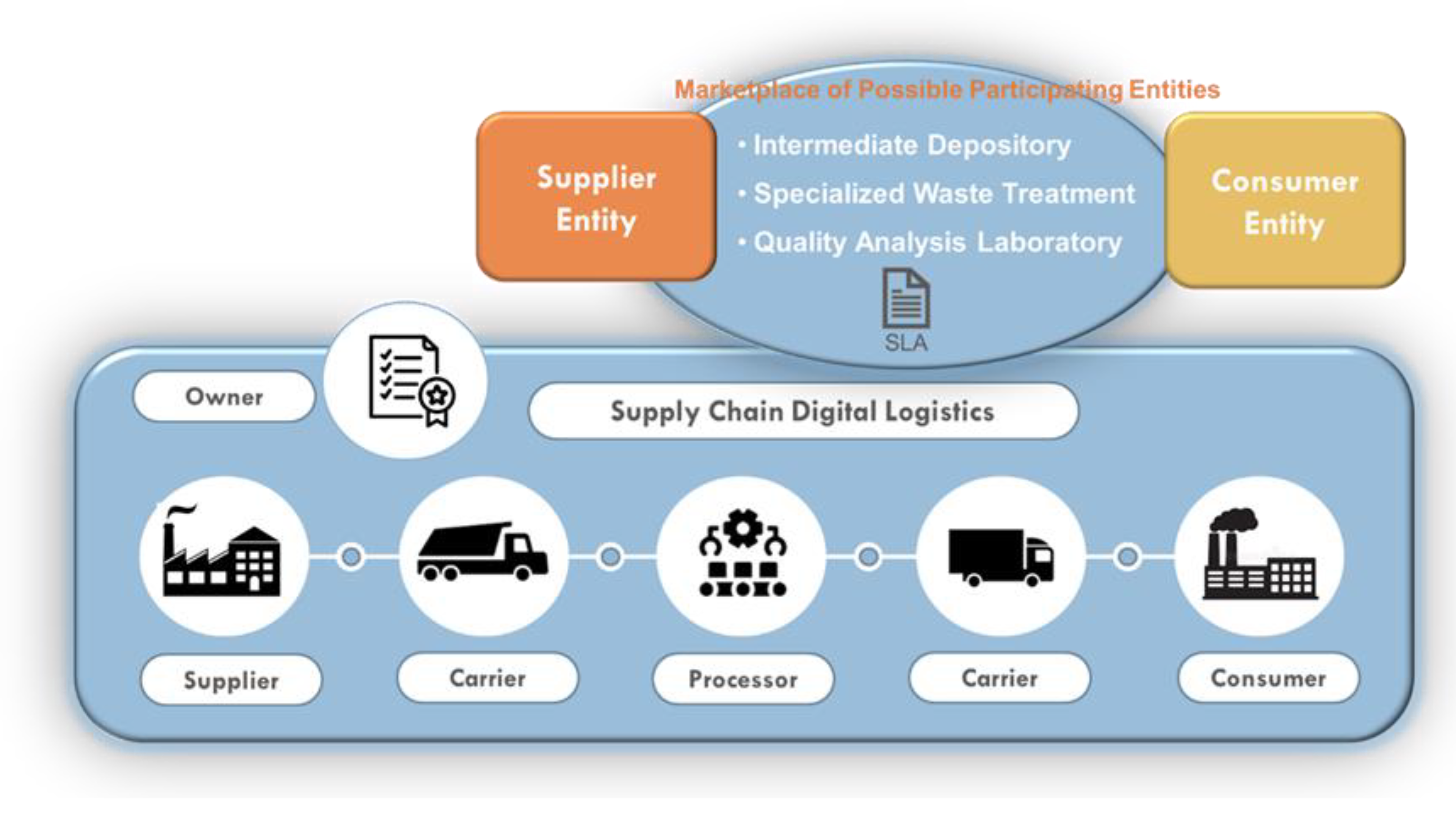
Figure 2.
Block diagram of the architecture approach.
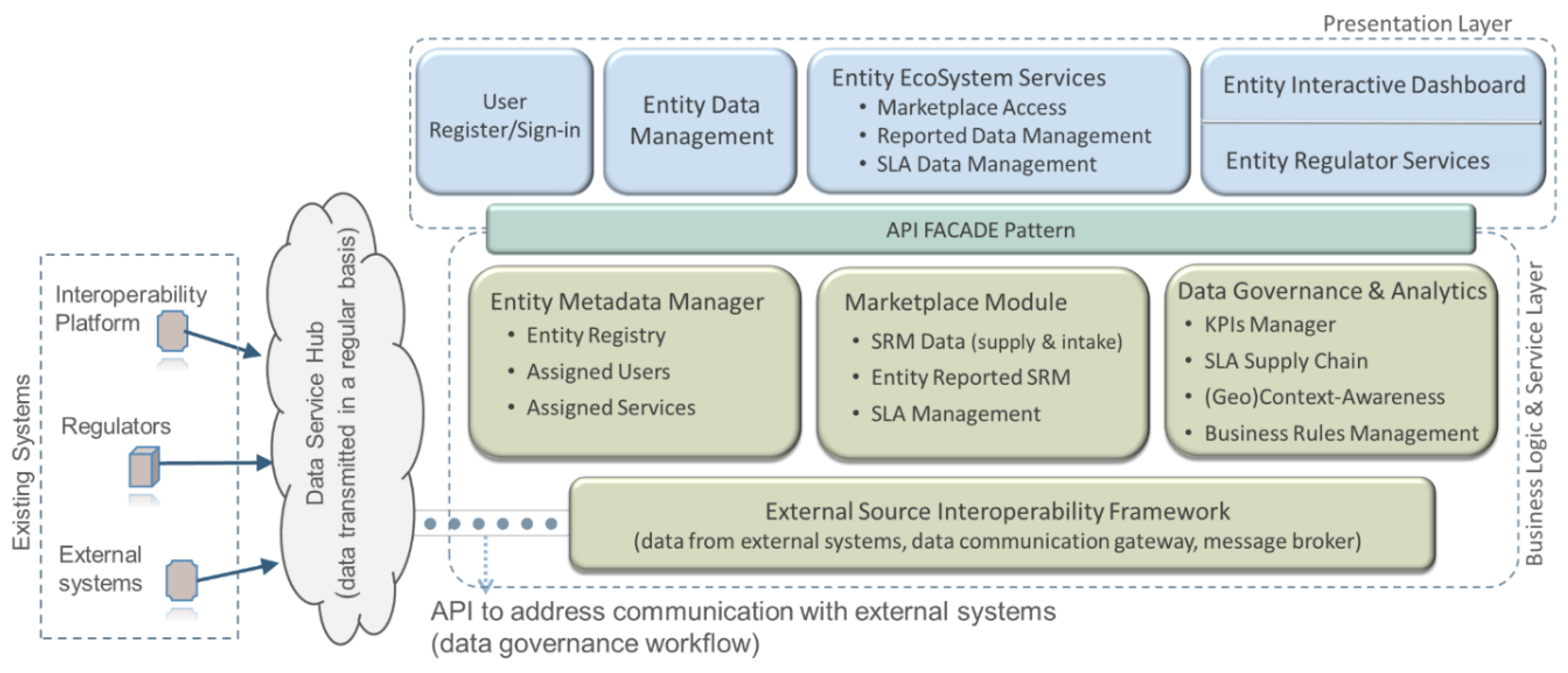
Figure 3.
The domain model of the WRP Platform – collapsed view.
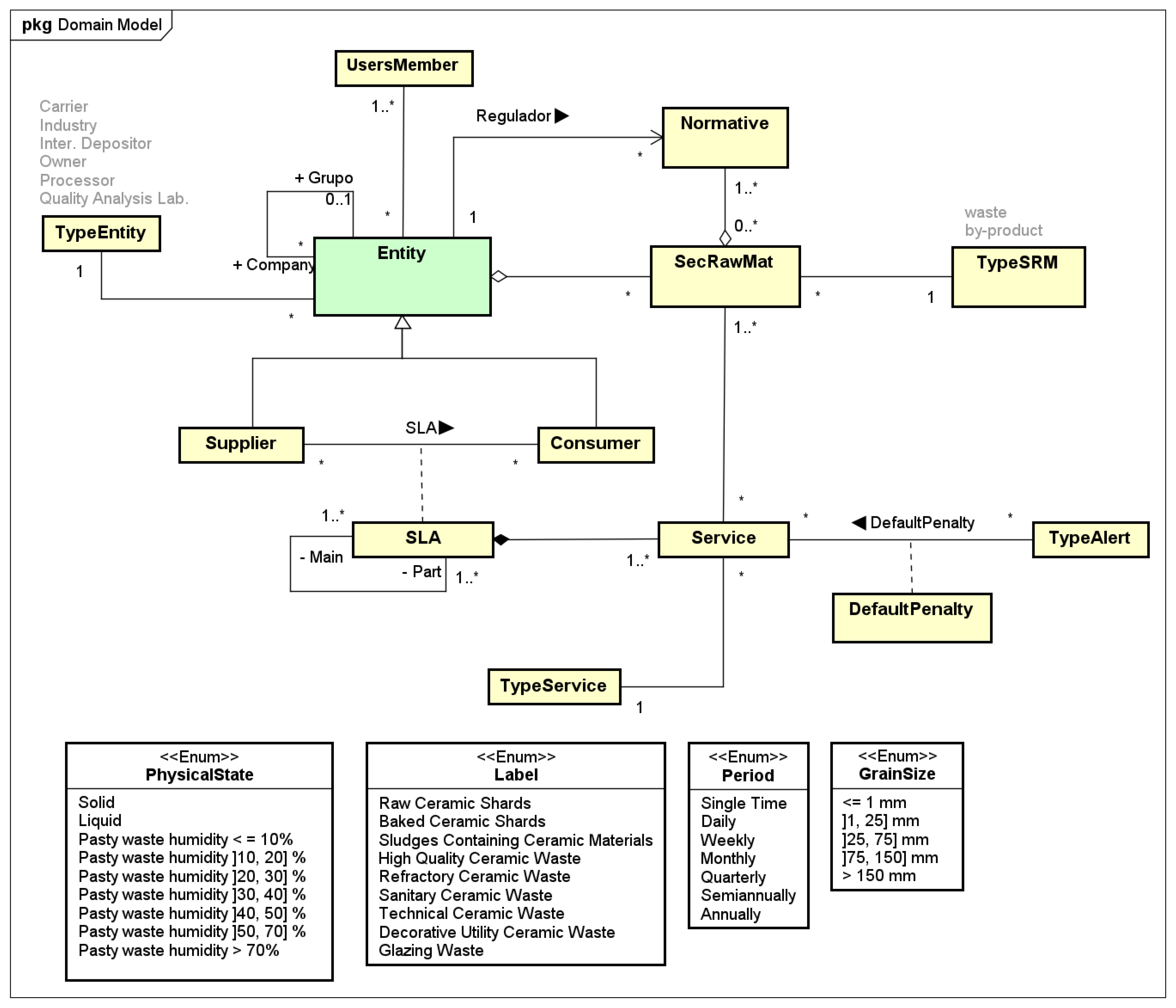
Figure 4.
Marketplace tab with a specific SRM record overview.
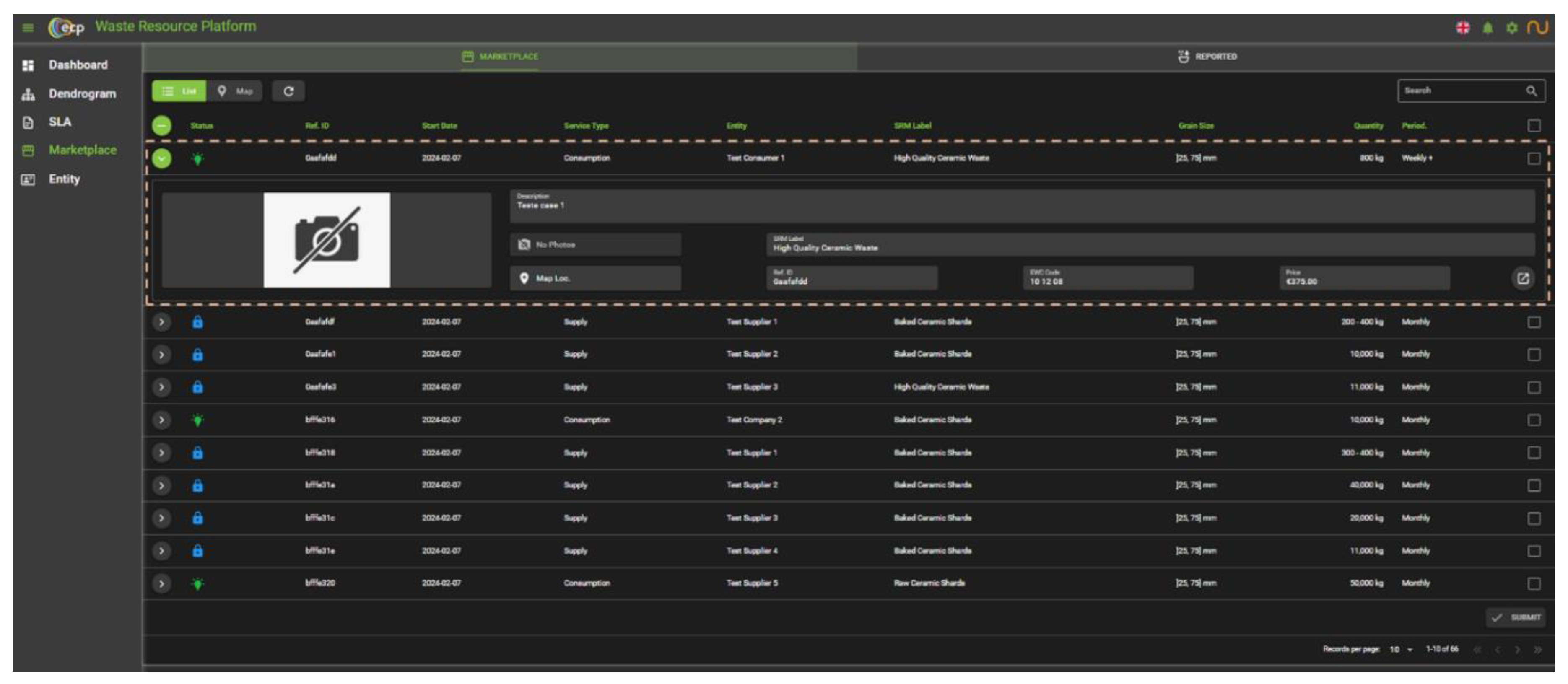
Figure 5.
The list of SRM data reported by an entity. 1) the Reported tab filters the information to list only the records related to the entity to which the logged-in user belongs; 2) the available actions allow the user to delete, edit, or clone a record.
Figure 5.
The list of SRM data reported by an entity. 1) the Reported tab filters the information to list only the records related to the entity to which the logged-in user belongs; 2) the available actions allow the user to delete, edit, or clone a record.
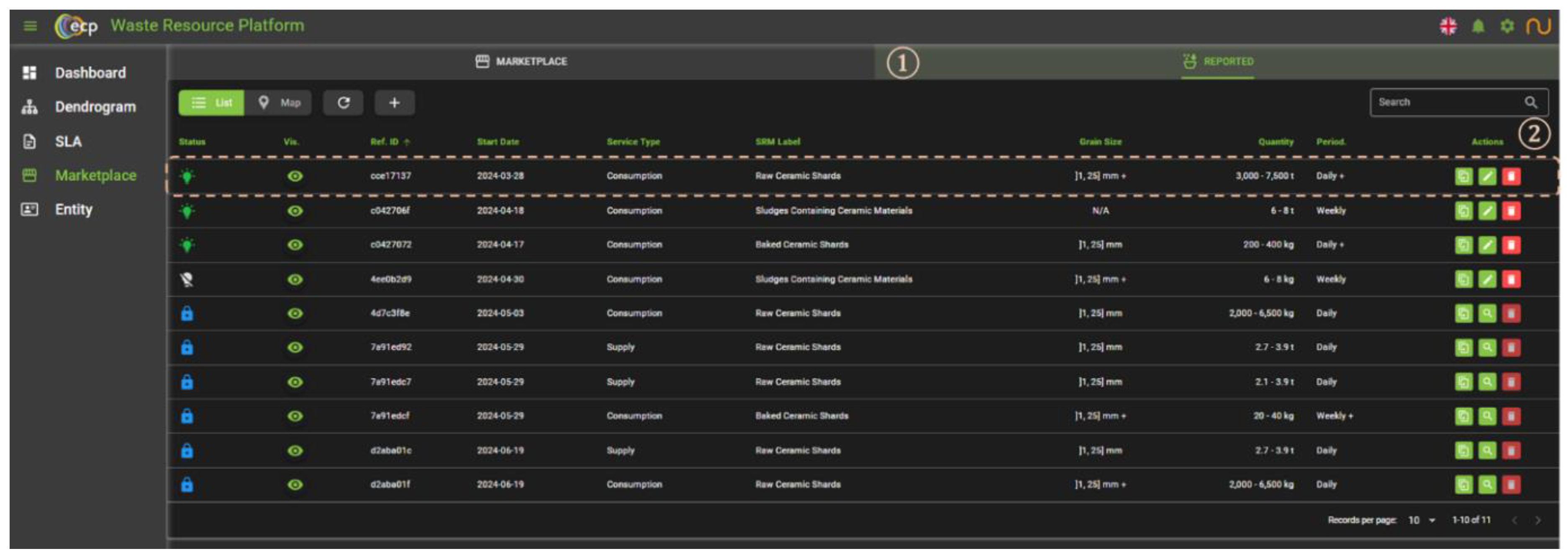
Figure 6.
The layout for adding a new record to the marketplace. 1) this section presents the collapsed view of the SRM form, displaying attributes such as status, identifier, type of service, start/due date, and SRM record visibility; 2) this section provides a detailed view of the metadata used to characterize an SRM record; 3) this section outlines the elements that users can configure to set preferences for the matching algorithm to use as filtering criteria.
Figure 6.
The layout for adding a new record to the marketplace. 1) this section presents the collapsed view of the SRM form, displaying attributes such as status, identifier, type of service, start/due date, and SRM record visibility; 2) this section provides a detailed view of the metadata used to characterize an SRM record; 3) this section outlines the elements that users can configure to set preferences for the matching algorithm to use as filtering criteria.
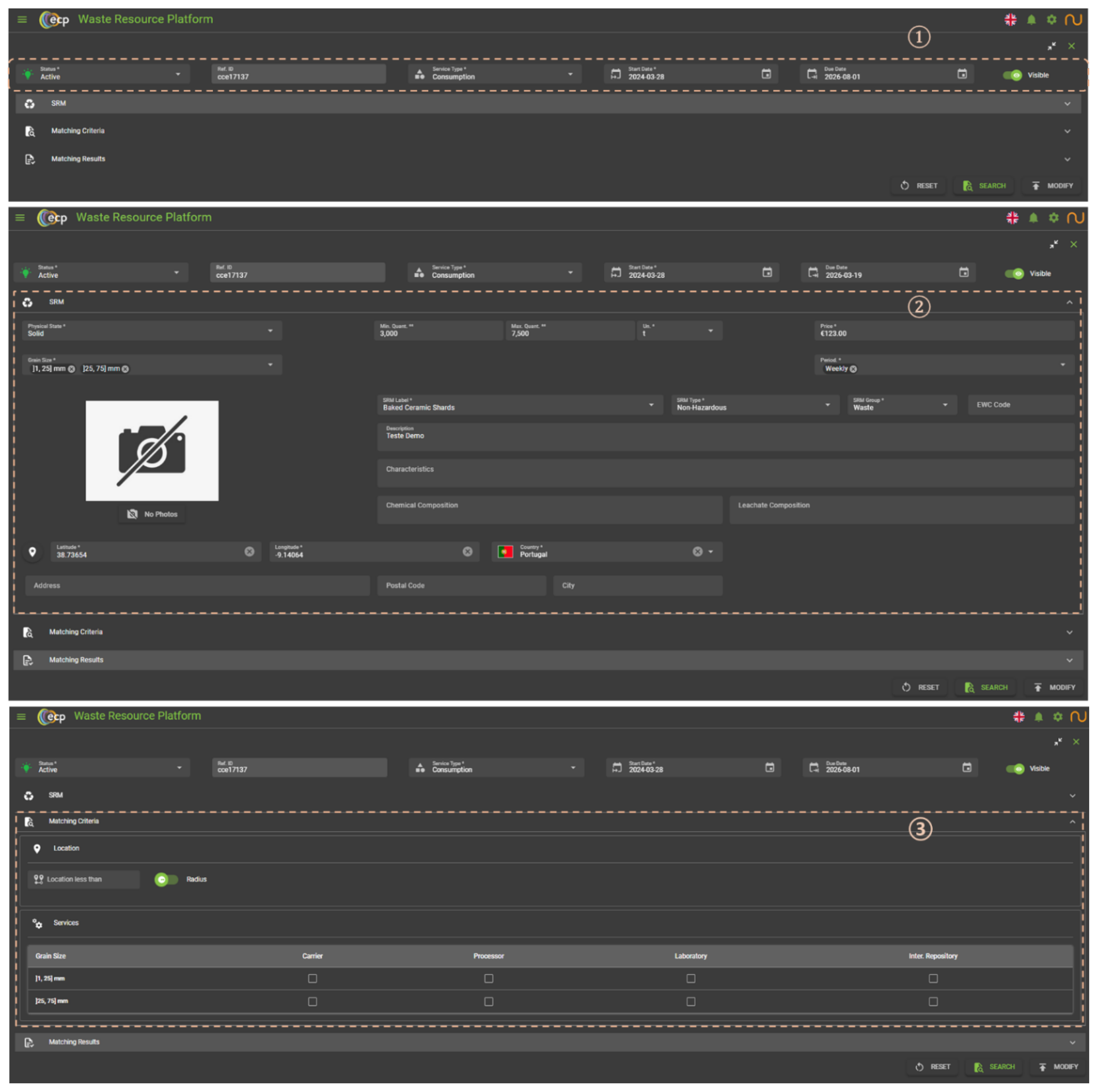
Figure 7.
Diagram showing the sequence of states that an entity's record can assume.
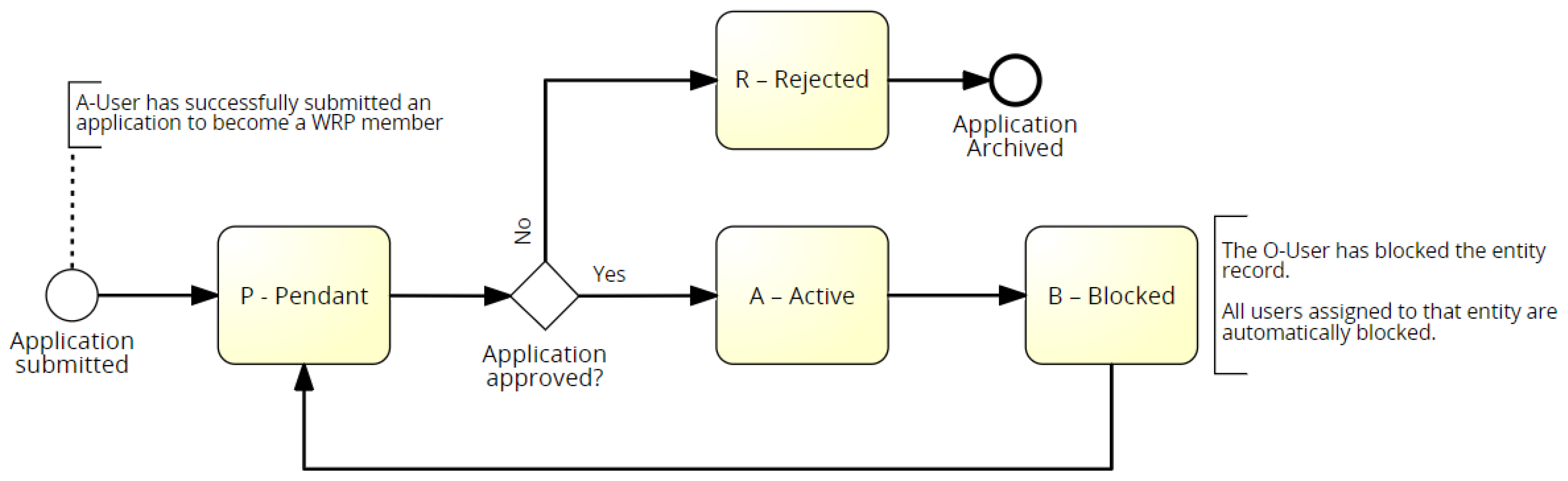
Table 1.
Ceramic Sector main indicators in Portugal.
| Ceramics | 2019 | 2020 | 2021 | 2022 |
|---|---|---|---|---|
| Total Number of Companies (*) | 1,168 | 1,092 | 1,12 | 1,162 |
| Companies with 10 or more employees (*) | 179 | 175 | 175 | 180 |
| Number of Employees (*) | 18,458 | 18,196 | 18,591 | 19,505 |
| Production (€) (*) | 1,101,412,441 | 983,214,244 | 1,218,858,985 | 1,501,171,987 |
| Turnover (€) (*) | 1,187,822,504 | 1,101,714,459 | 1,322,381,279 | 1,564,680,787 |
| GVA (€) (*) | 459,091,229 | 430,610,114 | 530,354,186 | 551,891,471 |
| Apparent Labor Productivity (€) | 24,872 | 23,665 | 28,527 | 28,295 |
| Exports (€) (**) | 707,743,607 | 661,424,935 | 813,181,081 | 964,123,218 |
| Imports (€) (**) | 202,262,289 | 196,149,511 | 226,946,672 | 290,537,330 |
| Coverage Ratio of Imports by Exports | 350% | 337% | 358% | 332% |
| Number of Export Markets (**) | 163 | 159 | 158 | 170 |
| Energy Consumption (tep) (***) | 299,709 | 276,441 | 296,157 | 282,583 |
| (*): Source: INE, Integrated Business Accounts System (final data) | ||||
| (**): Source: INE, International Trade in Goods Statistics (final data from 2018 to 2022) | ||||
| (***): Source: Directorate-General for Energy and Geology | Energy Balances | ||||
Table 2.
Ceramic Waste Routed as By-Products (tons) – APICER Members (benefiting from the by-product reclassification decision).
Table 2.
Ceramic Waste Routed as By-Products (tons) – APICER Members (benefiting from the by-product reclassification decision).
| Year | 2018 | 2019 | 2020 | 2021 | ||||
|---|---|---|---|---|---|---|---|---|
| Nº of Companies | 20 | 19 | 20 | 23 | ||||
| Quantity Routed as By-Product | Quantity Routed as Waste | Quantity Routed as By-Product | Quantity Routed as Waste | Quantity Routed as By-Product | Quantity Routed as Waste | Quantity Routed as By-Product | Quantity Routed as Waste | |
| 101208 Waste form the manufacture of ceramic pieces, bricks, tiles, and construction products (after the thermal process) - fired Waste | ||||||||
| Quantity (Ton) | 22 344,93 | 20 881,84 | 30 576,24 | 23 325,36 | 18 116,63 | 21 304,86 | 35 968,26 | 27 619,96 |
| 101203 Waste from the manufacture of ceramic pieces, bricks, tiles, and construction products - Particles and Dust | ||||||||
| Quantity (Ton) | 2 198,97 | 980,70 | 3 858,87 | 2 407,10 | 2 502,42 | 1 804,42 | 6 056,54 | 1 993,42 |
| 101201 Waste from the preparation of the mixture (before the thermal process) - Greenware | ||||||||
| Quantity (Ton) | 3 705,77 | 820,72 | 7 466,25 | 5 692,63 | 9 471,51 | 2 753,84 | 9 386,67 | 776,09 |
| Total (ton) | 28 249,67 | 22 683,26 | 41 901,36 | 31 425,09 | 30 090,56 | 25 863,12 | 51 411,47 | 30 389,47 |
| 1 |
Ecocerâmica e Cristalaria de Portugal (ECP), https://agendaecp.pt/en
Green Agenda for Business Innovation, financed by the RRP - Recovery and Resilience Plan, within the scope of the European Union's Next Generation EU | Project nº 76.
 |
Disclaimer/Publisher’s Note: The statements, opinions and data contained in all publications are solely those of the individual author(s) and contributor(s) and not of MDPI and/or the editor(s). MDPI and/or the editor(s) disclaim responsibility for any injury to people or property resulting from any ideas, methods, instructions or products referred to in the content. |
© 2024 by the authors. Licensee MDPI, Basel, Switzerland. This article is an open access article distributed under the terms and conditions of the Creative Commons Attribution (CC BY) license (http://creativecommons.org/licenses/by/4.0/).
Copyright: This open access article is published under a Creative Commons CC BY 4.0 license, which permit the free download, distribution, and reuse, provided that the author and preprint are cited in any reuse.