
Submitted:
22 December 2024
Posted:
23 December 2024
You are already at the latest version
Abstract
Artificial intelligence (AI) is reshaping employment and industrial patterns globally with its significant impact on productivity. However, its impact on employment quality, as well as its potential to displace traditional jobs or cause skill polarization, remains contentious. This study examines the influence of AI on employment quality in China by using data from its prefecture-level cities to empirically assess its regional variations. The study's findings first imply that, even in the face of AI's productivity improvements, regional differences may affect the quality of employment. Second, reducing AI's detrimental effects on the labor market requires strong government regulations. Thirdly, combining policy actions with AI development could be a way to promote sustainable employment. Lastly, helpful suggestions are made to deal with the difficulties encountered in the AI-driven economy.
Keywords:
Artificial intelligence
; Sustainable employment
; Employment quality
; Economic transition
; Regional disparities
; AI-driven economic changes
1. Introduction
With the rise of a new industrial revolution characterized by digitalization, artificial intelligence (AI) has emerged as a key driver of continuous productivity growth. Countries around the world are actively developing AI industries, with initiatives such as Germany’s Industry 4.0, Japan’s Society 5.0, and the UK’s new AI policies all focused on promoting AI development [1]. Through intelligent transformation and industrial upgrading, these programs seek to change the global division of labor.
The impact of AI technology on the labor market has recently been a heated topic of concern. In a number of developed countries, the employment structure has begun to shift, owing to an increase in highly skilled roles in low-skilled industries [2]. Finally, this can impact the quality of the work. China's employment structure is especially crucial considering the country's current economic instability and technological growth. The Chinese government has given significant attention to the development of AI technology and has aggressively promoted its spread through official programs. The emergence of AI has had a significant impact on society today, and the Chinese government's sustainable development policy is one key strategic objective [3]. Strategic use of AI technologies can help China move closer to its sustainable development goals.
Nonetheless, the government recognizes that new technological breakthroughs provide problems to society, particularly in terms of employment. Numerous official publications underline the significance of enhancing employment-first policies and upgrading job-creation procedures to counteract technology's harmful consequences [4,5,6,7,8,9,10]. Furthermore, they ensure that work quality and technology innovation improve concurrently.
The authors seek to find out how AI influences employment quality and how its relationship with the economy grow. Therefore, Data from cities in China from 2011 to 2019 at the prefecture level are investigated. The main goals of the project are to find out how the quality of jobs in different areas will differ from AI application. How the government might respond to these challenges are interesting to be explored as well. The goal is to offer policymakers some clues on how to carefully create relevant jobs and boost technological progress.
2. Literature Review, Theoretical Analysis and Research Hypotheses
2.1. Global Trends and Debates on AI and Employment
The nature of work is being transformed by demographic shifts, globalization, and digitization as regional labor markets compete globally for highly skilled and specialized workers [3,4,7]. Despite the fact that AI adoption is still in its infancy, with less than 10% of organizations having made substantial investments in AI technology, it has already had a substantial impact on labor dynamics [4,7]. The disruptive influence of AI on worldwide employment markets underscores both concerns, including job displacement in regular positions, and opportunities in burgeoning sectors such as data science and AI development [8]. Anticipated regional variances in AI adoption underscore the necessity for customized methods to alleviate disruptions and highlight the significance of education and training to meet growing demands [3]. Ethical considerations, such as bias and responsible AI utilization, are also examined, highlighting the responsibilities of legislators, businesses, and educators in fostering an inclusive and equitable AI-driven future [3,4]. AI is expected to cause employment displacement in specific industries while concurrently creating new opportunities in others, therefore prompting a reallocation of labor towards positions that prioritize analytical, creative, and interpersonal abilities [3,4]. This change may exacerbate prevailing inequities and discriminatory practices in the workplace.
Certain scholars argue that claims of significant net employment losses due to AI adoption are overstated, and the likelihood of a "Robo-Apocalypse" is low. They underscore the imperative of addressing wider technology influences beyond AI to adequately adapt to changing skill demands [7,11]. However, it is certain that there will be substantial skill disruption in the upcoming decades [7]. Researchers underscore the complexity and uncertainty of current and future trends through a political-economic and sociological perspective, despite the fact that recent advancements in artificial intelligence and robotics are driving economic and social transformation [7,11]. They also challenge technological determinism.
The use of robots has transitioned from being perceived as a menace to being used as a tool. A wide variety of enabling technologies is gradually emerging as the cost of mass-producing technological devices decreases. Technological advancements have enabled us to confront a diverse array of novel obstacles [2]. The primary concern at present is the manner in which ethics can be used to guide human behavior in order to ensure the responsible and appropriate use of this powerful new technology [4,8,11]. The assimilation of AI technologies continues to be below 10%. Some organizations predict that the implementation of AI technologies will result in a decrease in employment, while others anticipate that labor growth or reorganization will occur [7,11]. This reallocation trend encourages a transition in talent toward more analytical, creative, and interaction-focused skills. Employment dynamics are influenced by spillover effects to product markets, as evidenced by econometric results on employment changes. Although negative automation effects on employment dynamics may occur, they can be counterbalanced by increased competition and increased expectations of market share expansion [2,4].
2.2. Studies Focused on Employment Quality and AI in China
Recent research has investigated the influence of artificial intelligence (AI) on employment in China, with a particular emphasis on the manufacturing and service sectors. Research suggests that the development of AI has generally had a positive impact on the quality and quantity of employment [10,11,12]. Research on the influence of AI on the service industry suggests that it has both direct and indirect effects on employment in the sector. Direct effects, such as job creation and substitution, and indirect effects, which are the product of competition, collectively contribute to job growth, employment structure optimization, and increased income [13]. Subregional analysis emphasizes the regional heterogeneity in AI's impact, thereby reducing disparities in the service industry's development. Cross-industry analysis has demonstrated that the development of AI has led to increased employment competition for medium-skilled workers and improved labor mobility across industries [9,13]. These findings underscore the necessity of enhancing employment policies within China's service industry, refining talent development frameworks, advancing service sector modernization, and fostering integrated regional growth. The employment within the manufacturing industry has been profoundly affected by AI technology, as the amalgamation of AI and manufacturing progresses [10,12]. The adoption of industrial robotics has led to a rise in employment, enhanced worker productivity, and a fortification of capital [2,5,9]. The advancement of AI has stimulated employment in service sectors by increasing income, optimizing employment frameworks, and generating new roles [9,12]. Nonetheless, the impact of AI on employment is characterized by regional variability [3,9,10,14]. The emergence of the digital economy has resulted in the significant enhancement of employment through virtual agglomeration [9,14].
2.3. Theoretical Analysis
High-quality employment is an all-encompassing notion that includes several elements such as the work environment, compensation, social security, and institutional structures. The academic community lacks a consensus on a singular definition of high-quality employment. Nonetheless, prior research generally identifies two principal dimensions when addressing this subject [6,15,16].
It is common practice for researchers to assess the quality of employment at the macro level, the first dimensional, by looking at factors including the fairness of job opportunities, the logic of employment frameworks, and the preferability of working conditions [16,17,18]. In the second part, we look at things on a smaller scale, at the circumstances of single professions. In this regard, job stability, income levels, and work environment are critical indicators of employment quality.
Therefore, based on the above analysis, this study will construct the concept of high-quality employment from both the macro and micro perspectives. The application of artificial intelligence will bring about an increase in productivity, and change the employment structure, income distribution and psychology of the employed in society. Consequently, there are three main ways to look at how AI affects the quality of employment: by looking at how it boosts productivity, how it changes the structure of employment, how it changes the distribution of wealth, and how it affects the workforce psychologically within society [13,16].
To start, studies show that by improving one's skill set, one can make better use of the resources they have, leading to higher production [4]. Improving organizational structures, labor distribution, and control mechanisms, leading to greater industrial productivity, is one-way AI could boost a nation's economic development and open up new frontiers of production. Innovations in AI also provide workers with useful tools for learning on the job, which increases productivity [4,9].
Employment quality can be influenced by changes in employment structure, which can result in a shift in the demand for labor. The demand for AI-related labor has increased significantly in comparison to other categories of labor in the job market as a result of the application of AI [5]. While there are substantial variations in the impact of AI on the labor demand of various industries, the aggregate impact is negligible from the perspective of the labor demand of small and medium-sized enterprises [6]. In some instances, AI replaces specific production processes in traditional industries, resulting in surplus labor.For example, people who are adaptable may feel unsteady due to worries about losing their jobs or money due to AI [7]. Still, AI creates new job categories that make use of some of the extra workers. More satisfying work experiences and greater job satisfaction are the outcomes of the creation of new roles and expansion of current ones [8,10]. Whether AI's ability to create jobs outweighs its negative effects on job loss will determine the overall impact on employment.
A further critical component of employment quality is the changes in income distribution that AI brings about. The problem of wealth inequality is only one of many new possibilities and threats that AI poses as a key driver of industrial transformation [9]. Although AI increases efficiency in the service sector, it eliminates jobs for low-skilled individuals, which alters the labor market and lowers the contribution of labor income to GDP. This is due to the fact that the labor share is reduced as a result of capital income gaining an advantage over labor income during distribution [10]. As a result, the disparity in household income is likely to widen. Nonetheless, there are academics who hold the view that AI has enhanced manufacturing jobs and raised wages across the board and in most regions. They also note that rural residents' per capita net income is growing faster than urban residents' per capita disposable income, which bodes well for the development of urban-rural integration [11]. The effect of AI progress on the income distribution of residents is, hence, a matter of debate.
The application of AI will also have social and psychological implications for the workforce. The spread of AI tends to have different reactions to different workers, with some workers developing a fear of being replaced [12], and some workers may have both positive (about improved working conditions) and negative (worry about decision-making) attitudes [13]. Some employees can just have an optimistic and enthusiastic outlook [14]. If employees have faith in AI and make good use of technology, it will boost productivity and enhance working conditions. However, if workers are confused about its benefits, it will cause resistance to grow and reduce workers' autonomy and motivation. The prospect of AI technology taking over low-skilled workers' solely manual tasks makes them even more resistant to AI and makes them feel down and out.
A shining example of the digital economy is artificial intelligence since it automates processes and creates new chances for automation, so improving manufacturing efficiency. By influencing creation, pay, and substitution, it can quickly change the labor market and improve the quality of employment and so promoting economic development. The utilization of AI in specific domains has the potential to liberate up human labor resources, which could subsequently be redirected to other industries [9,10,13,15]. As this process deepens, AI contributes to changing the overall employment quality of society.
There is no consensus in the academic community regarding AI’s impact on employment. Some researchers have found an inverse relationship between the rise of AI and big data and the rate of unemployment. By boosting productivity and capital accumulation, these technologies bolster AI's "substitution effect" [15], which causes enterprises to hire more people and generates more jobs. Nearly half of all employment in China could be eliminated by AI in the near future, especially those involving processing, auxiliary, or regular work [16]. AI is a prime example of the digital economy since it greatly increases production efficiency and automates even more tasks. Through its effects on creation, compensation, and substitution, it has the ability to quickly alter the labor market, which could improve employment quality and contribute to economic development. The application of AI in certain fields could free up human workers, who could then be employed in other sectors.
Two significant implications of industrial robots are the creation effect, which increases demand for highly skilled positions, particularly in R&D [18] and the substitution effect, which influences lower- and medium-skilled employment. While the evolution of artificial intelligence affects high-risk, high-data employment more obviously, it has less effect on professions in the service sector including emotional and interpersonal interaction [19]. As long as AI’s job creation effect outweighs its substitution effect, AI has the potential to expand total employment and lay a foundation for improving employment quality. Additionally, AI drives up the demand for highly trained individuals, which in turn motivates them to acquire more advanced skills and aim for more prestigious job titles. It also eliminates the need for workers to do mundane, repetitive tasks, freeing them up to take on more creative, social, and complex duties.
2.4. Research Hypotheses
The first hypothesis is that industries that use AI will see an improvement in income stability, workplace efficiency, and the availability of higher-skilled jobs as a result of the productivity benefits from AI.
Second Hypothesis: Adoption of AI worsens existing regional economic and employment gaps, which in turn reduces demand for middle-skilled positions, increases income inequality, and exacerbates skill polarization, all of which have a negative effect on employment quality.
3. Material and Method
3.1. Research Sample and Data Sources
Based on data availability, this study uses a sample of 195 prefecture-level cities in China from 2011 to 2019 to empirically examine the impact of artificial intelligence on employment quality. The core explanatory variable, related to AI, is sourced from two main datasets: (1) Industrial robot installation data from the International Federation of Robotics (IFR) report, which includes information on industrial robot installations in 50 countries. The six main sectors into which the covered industries are divided are as follows: agriculture, forestry, animal husbandry, and fishery; mining; manufacturing; electricity, heat, gas, and water production and supply; construction; and education. (2) The Second National Economic Census's industrial enterprise module data is employed to determine the number of employees in a variety of industries in prefecture-level communities (regions, autonomous prefectures, leagues). Combining this with IFR data is a typical strategy in the existing literature to compute the robot installation density in each city.
A number of sources are used to produce the dependent and control variables. These include the following: the CSMAR and WIND databases; the China Urban Statistical Yearbook; the China Regional Economic Statistical Yearbook; and the National Economic and Social Development Statistical Bulletins of each city. Missing values have been filled in using interpolation methods, and some data has been meticulously calculated and sorted.
3.2. Definition of Variables
3.2.1. Dependent Variable: Employment Quality
Employment quality serves as the dependent variable in this study. However, employment quality is a broad concept that cannot be measured by a single data point, necessitating the construction of a reasonable evaluation system for employment quality indicators. Many researchers have proposed research models on employment quality, some scholars have taken the minimum level of welfare and social support provided to workers as the criterion when constructing employment quality indicators [20], some scholars have defined the concept of employment quality including employment stability, employment opportunities and other aspects [21], and some scholars have summarized the factors affecting employment quality into external, objective, and subjective influences in the design of employment quality evaluation index system [22]. They all agreed that a metric for quality of employment should be established using a number of different characteristics of the workforce. According to the International Labor Organization (ILO), job quality is "decent work," which includes fair pay, a safe workplace, social support, equal opportunity, and fair treatment of all employees. Additionally, labor standards establish the basis for the enhancement of working conditions, including the elimination of workplace discrimination and the restriction of excessively lengthy working hours. In the same vein, the United Nations Economic and Social Council underscores the fundamental rights of workers with respect to equitable compensation and job security.
Building on previous research and considering the availability and scientific rigor of prefecture-level data, this study constructs an indicator system from two perspectives: the macro-level employment environment and the micro-level labor compensation. The entropy weighting method is employed to assign values to each indicator, allowing for the calculation of employment quality scores for each city, thereby measuring employment quality at the prefecture level. Specific measurement details are presented in Table 1.
3.2.2. Core Explanatory Variable: Artificial Intelligence
The core explanatory variable in this study is the level of artificial intelligence (AI) application at the prefecture-level cities. Following most existing studies, the density of robot installations at the city level is used as a proxy variable for AI technology. This is primarily calculated using the IFR dataset and the industrial enterprise data from China’s Second National Economic Census.
First, we matched the IFR data with the industry categories in China’s Second Economic Census to obtain the data on industrial robot installations for various industries in China. Next, we selected a base year to calculate the weight of robot density for each industry in different cities. Based on these weights, we further computed the industrial robot installation density at the city level. The specific calculation method is as follows: (detailed calculation formula would follow).
Here, S represents the collection of all industries, Robotj,t is the robot installation density in city j in year t, and Robots,t refers to the number of robot installations in industry s in year t. The year 2008 is used as the base year. Employs,t=2008 is the number of employees in industry s in 2008, employj,t=2008 is the total number of employees in city j in 2008, and employs,j,t=2008 is the number of employees in industry s in city j in 2008. Once the calculations are complete, the industrial robot penetration rate for each city can be determined.
3.2.3. Control Variables
In order to reduce the error of these variables on the research results, this paper selects the following control variables with reference to existing studies: urbanization rate (Urb), which is measured by the ratio of urban population to the total resident population of the region, urbanization has a positive impact on employment, and urbanization can reduce the disadvantaged employment rate and improve the quality of employment [23]; The degree of fiscal expenditure (Gov) is measured by the ratio of local fiscal expenditure to regional GDP, and the increase in fiscal expenditure can create a large number of jobs, and the cost of creating jobs is relatively low, which in turn affects the quality of employment [24]; The degree of trade openness (Ope), measured by the ratio of total import and export trade to regional GDP, will change the employment structure of the society, which will further affect the quality of employment [25]; The level of financial development (Tra) is measured by the ratio of the year-end loan balance of financial institutions to the year-end loan balance of financial institutions to the year-end deposit balance of financial institutions in each region, and the development of finance will lead to more financing for SMEs and thus create more employment opportunities [26].
3.3. Descriptive Statistics of Variables

Table 2.
Descriptive Statistics of Variables.
| the variable names | Variable symbol | average value | standard deviation | maximum | minimum |
|---|---|---|---|---|---|
| Employment Quality | Emp | 0.1636 | 0.0727 | 0.5669 | 0.0622 |
| Artificial Intelligence | Csmd | 88.2098 | 243.1382 | 4848.112 | 1.9951 |
| Urbanization Rate | Urb | 0.5608 | 0.1488 | 1 | 0.21 |
| Fiscal Expenditure Level | Gov | 0.1915 | 0.0941 | 0.7044 | 0.0439 |
| Trade Openness | Ope | 0.2127 | 0.3242 | 2.4913 | 0.0006 |
| Financial Development Level | Tra | 0.6870 | 0.2777 | 6.2050 | 0.0846 |
3.4. Trend Analysis
Based on the data collected on AI and employment quality, the average of all cities in each year is calculated and plotted as a trend graph, as shown in Figure 1. Looking at the overall trend on average, the use of AI and the quality of employment are generally positively correlated, which was more pronounced before 2017, which may be due to the creation of new high-skilled jobs in which AI may have better wages and working conditions, leading to improved employment quality. While average AI use dropped between 2017 and 2019, job quality improved gradually throughout that period. The outcome can show either a weak or negative link between the two. Concerns over the future of employment quality in this sector are raised by the possible loss of income and job security for persons engaged in low-skilled, repetitious jobs brought about by automation. Although we shall still need to do an empirical test to be sure, we will start our research of the link between the two using this basic average trend analysis.
3.4. Model Specification
To empirically test the impact of artificial intelligence (AI) technology application on employment quality, the following econometric model is constructed:
Empi,t = α0 + α1Csmdi,t + α2Xi,t + λi + ηi + μi,t
In this model, Empi,t represents the employment quality in city i during year t, Csmdi,t reflects the level of artificial intelligence application in city i during year t, and Xi,t represents the control variables. λi , ηi , μi,t represent the individual fixed effects, time fixed effects, and the random disturbance term, respectively.
4. Empirical Results and Analysis
4.1. Baseline Regression
Table 3 shows the results of the baseline regression aiming at investigating the effect of artificial intelligence applications on employment quality using a two-way fixed effects model. When control variables are neglected, the results reveal that artificial intelligence applications negatively affect employment quality even at the 5% significant level. The likelihood of automation replacing specific professions indicates that adoption of artificial intelligence could have negative effects on job security and pay levels.
Table 3's column (2) shows that including controlling variables helps one to statistically significantly show how negatively artificial intelligence affects work quality at the 1% level. Nevertheless, the effect magnitude is still rather tiny, suggesting that the negative consequences of AI applications are statistically strong but have limited practical relevance. These results are in line with what has been seen in other emerging markets, such the BRICS nations, where changes in government and artificial intelligence have also had a moderate impact on job prospects.
The two-way fixed effects regression results assessing the impact of AI applications on employment quality are summarized in Table 3 and Table 4. To mitigate the influence of outliers on the analysis, the data was winsorized. Table 3 highlights the progression of results: column (1) reports the regression outcomes without control variables, while column (2) includes the results after accounting for control variables, offering a more comprehensive view of the relationship:
Table 3 reveals that the application of AI has a negative impact on employment quality, significant at the 5% level, when control variables are excluded. This indicates that adoption of artificial intelligence could somewhat reduce employment quality, perhaps because some jobs are replaced by automation or work is changed in nature. This may compromise income levels and job stability. Apart from statistical relevance, the small effect size indicates that artificial intelligence has little practical impact even if it reduces job quality. Adoption of artificial intelligence seems not to significantly affect the nature of employment.
Examining the BRICS nations reveals a similar tendency; all of them have undergone economic transformations akin to those of China. Employment in these nations has somewhat but noticeably changed in response to artificial intelligence and better governance. Small-scale technological and governance changes can thus show how much employment can be raised. These results are in strong agreement with what this study found.
To further estimate the effect of the principal explanatory variable—AI application—on the dependent variable—employment quality—Table 5 shows the regression results after including control variables. This stage helps to consider any confusing factors. After considering these elements, the study next finds whether artificial intelligence still has a notable impact and, if so, to what degree.
Table 5 shows, considering controlled variables, artificial intelligence has a 1% negative effect on employment quality. Still with that exception, the impact size is minimal and meaningless. Whether control variables are used or not does not alter the reality that work quality has no statistically meaningful correlation with AI use.
4.2. Heterogeneity Tests
To account for variations in the penetration and impact of artificial intelligence (AI) development across industries and the disparities between China's eastern and western regions, we divided the sample cities into two groups: eastern and central/western regions. Due to limited data availability, the northeast region was excluded from the heterogeneity analysis. Based on the baseline regression, the impact of AI on employment quality does not differ significantly between the two regions. Table 4 presents the regression results for eastern cities, while column (2) displays the results for central and western cities.
Table 3 illustrates that whilst artificial intelligence improves the central and western re-gions, its implementation reduces employment quality in the eastern region. Still, the total impact is modest; the influence in the western and central areas is more obvious.
Different industry structure, labor market flexibility, regulatory backing, and degree of technology adoption help to explain the different effects of artificial intelligence on employment quality throughout China's central, western, and eastern regions. Examining these four elements helps one to grasp the fundamental mechanisms:
First of all, the function of structural adjustment and industrial transformation is Traditional manufacturing, agriculture, and low value-added sectors dominate the central and western economies mostly. Adoption of artificial intelligence can improve technical capacity and manufacturing efficiency, so encouraging indus-trial upgrading in related fields. In some industries this change enhances job skill requirements and boosts worker productivity. Consequently, artificial intelligence can help to create highly qualified jobs in conventional sectors or enhance working conditions in current positions, so raising the general employment quality. Eastern area employment has become of worse quality. With its very developed industrial framework, the eastern part has seen numerous businesses and employment change into high-end, technologically advanced positions. Particularly in man-manufacturing, where automation can directly replace some conventional low-skilled, labor-intensive jobs, greater acceptance of artificial intelligence technologies could lead to their eradication. This "substitution effect" is more noticeable in the eastern part, which reduces employment quality particularly for low-skilled individuals.
Secondly, there are differences in the adaptability of labor markets. Specifically, when it comes to changes led by AI technology, the central and western labor markets are more flexible. These regions have an opportunity to improve the quality of their workforce by attracting new companies and jobs. Workers in less-technological fields can upskill and enter more-AI-related fields; at the same time, AI-led new industrial chains have the potential to increase both wages and skill requirements, leading to better career prospects overall. In contrast, "competitive pressure" defines the labor market in the eastern region. With an abundance of highly skilled personnel, the introduction of AI may intensify competition, particularly for low-skilled workers. Automation and intelligent systems could reduce employment opportunities or degrade job quality, thereby negatively affecting the overall quality of employment.
The third point is the variances in regional policy and investment. Western and central policy support for development of the economy Early phases of artificial intelligence development's policy makers and investors often lean toward the central and western spheres. Governments in these areas most likely provide labor market flexibility and industrial upgrading a priority using technology recommendations and infrastructure building. By means of smart use of artificial intelligence, initiatives to upgrade historically labor-intensive sectors could enhance job prospects in these fields. The struggle of the eastern area between industrial upgrading and technology substitution: Conversely, the east's established industrial structure is causing problems even while it leads front stage in technological innovation and artificial intelligence application. Particularly in more traditional, low-value businesses, artificial intelligence is rapidly improving in many fields and potentially result in "technology substitution." Either a rise in unemployment or a decline of salaries could have a major effect on the employment quality of low-skilled workers.
Lastly, variations at the corporate level: Flexibility for Midwestern businesses: There is a greater need for a highly trained labor force in the Midwest since businesses there are more inclined to use AI to boost efficiency. The quality of employment may improve as a result of this change. If more businesses apply artificial intelligence to boost operational efficiency and production, overall employment standards and labor market could be raised. Modifying East-based companies' technology investment strategy On the other hand, eastward businesses are more likely to deploy artificial intelligence to replace jobs, particularly in more traditional manufacturing sectors, since their staff members there are better used to dealing with innovative technologies. This approach can result in job losses rather than generating fresh opportunities. Some workers failing to meet the new criteria could lead to declining quality of employment.
4.3. Robustness Tests
To ensure the dependability of the baseline results, two approaches for conducting robustness evaluations were implemented. Initially, the number of AI companies in each city served as the key explanatory variable, replacing the AI application. Despite being positive, the regression coefficient is statistically insignificant, in accordance with the baseline results. Second, lagged by one period, the AI application variable addressed possible reverse causation. The results validated the baseline results by displaying a steady nega-tive coefficient with a modest effect magnitude. These robustness tests show that the negative effect of artificial intelligence on employment quality is a consistent outcome over several model settings, therefore strengthening the validity of the conclusions.
4.4. Subregional Analys
Further investigation indicated considerable regional differences in AI's impact on employment quality. Coastal regions, which have advanced industrial development and greater AI adoption rates, saw a steeper loss in middle-skilled jobs than inland places. This emphasizes the uneven distribution of AI's benefits and challenges, as well as the impact of regional economic structures on its outcomes. Higher degrees of urbanization and well-developed service sectors produced somewhat favorable results; artificial intelligence helped to generate jobs in highly skilled areas. On the other side, less developed areas reliant on existing businesses had more upheavals, rising employment disparity, and polarizing skill sets.
4.5. Interpretation of Result
Studies indicate that AI mostly influences productivity in three ways. First, the deployment of artificial intelligence would widen the skills gap since highly educated people will gain most and middle- and low-skilled employment will be replaced. Secondly, regional heterogeneity highlights how different areas' industry structures, technological capabilities, and labor market dynamics significantly affect the impact of artificial intelligence. Third, income redistribution reveals that, even if artificial intelligence increases productivity, low-skilled workers view their salaries either rise or decline as a result of it. Based on these findings, using artificial intelligence might not always raise job quality; unless specific actions are done to minimize its negative effects.
Table 4 shows via a heterogeneity test how artificial intelligence (AI) affect employment quality (Emp). Representing two models in columns (1) and (2), the following important components show:
Table 4 reveals some significant conclusions on the influence of artificial intelligence and other elements on employment quality. The favorable coefficient for artificial intelligence in column (2) is the most amazing result. Statistically significant, it comes at 0.000116. This implies, in contrast to statistically negligible or negative findings reported elsewhere, AI adoption can favorably affect employment quality under general settings. This result suggests that, with suitable regulations and structures, artificial intelligence could help to improve employment quality.
Apart from this, urbanization (Urb) also shows fascinating effects albeit it follows averaged trends. Under some conditions, urbanization can negatively affect employment quality; the coefficient for urbanization in column (1) is negative (-0.1025268) and statistically significant at the *** level. In contrast to column (2), the coefficient becomes positive (0.06569) and remains statistically significant, suggesting that, given the right conditions, urbanization can have a beneficial effect. These variations point to the multifaceted role of urbanization in defining the nature of work.
Overall, these results indicate that AI’s impact on employment quality has a context-dependent nature. Additionally, regional and structural factors play an important role in shaping these outcomes.
5. Discussion
5.1. Key Findings
Several critical findings of this study are revealed. Initially, the results indicate that in the absence of control variables, AI generally has a negative effect on employment quality. That may suggest that automation driven by AI possibly reduces certain jobs and alters income levels by replacing certain types of jobs. Nevertheless, when control variables such as urbanization, openness, fiscal expenditure, and transportation infrastructure are included, the negative impact of AI becomes significant but remains minimal in magnitude, which suggests that its practical effect is limited. These findings highlight AI’s influence on employment quality has context-dependent nature.
Apart from that, it is emphasized that regional disparities are evident in the disparate effects of AI. In the eastern regions of China, where industries are more advanced and reliant on low-skilled and labor-intensive jobs, it is noted that AI affects employment quality by eliminating traditional roles. Conversely, in the central and western regions, AI adoption not only promotes industrial upgrading, but also in-creases labor productivity, and creates high-skilled jobs. In this way, employment quality is then enhanced. AI’s impact across regions is varied according to industrial structure, labor market adaptability, policy support, and levels of technological adoption.
Furthermore, AI's impact on employment quality is complex and involves multiple mechanisms. Adoption of AI has the potential to benefit highly skilled professionals at the expense of middle- and low-skilled individuals. It appears that the disparity in skills has grown, leading to a more polarized skill set. Since various economic systems and technological capacities greatly influence AI's impact, it is clear that these effects display regional variety.
Moreover, AI’s influence may lead to uneven income distribution, with low-skilled workers experiencing wage stagnation or decline, while high-skilled workers benefit from productivity bonuses.
Nevertheless, the robustness of these findings is confirmed through various tests. Even though the proxy for AI is replaced with the number of AI companies, the results remain consistent. Similarly, the results from the baseline are confirmed when we address lag variables to account for possible reverse causality. Consistent negative coefficients with tiny impact sizes provide additional support for the results' credibility. These tests of robustness confirm that the results of the study are reliable.
5.2. Robustness Test
The robustness test is included to provide empirical validation of the baseline re-gression findings in this study to interpret, and explain their implications in this study. It is conducted to verify the reliability of the baseline regression results regarding the impact of AI on employment quality, as shown in Table 5.
The density of city-level robot installations from past research served as a stand-in for artificial intelligence technology. An artificial intelligence infrastructure was simulated by the clustering of robots in metropolitan environments. Regression analysis was carried out once the number of artificial intelligence companies in every city annually replaced the explanatory variable to prevent the impact of different proxy variables on the outcomes. As illustrated in column (1), the value stays rather tiny and closely corresponds with the baseline regression results even as the regression coefficient of artificial intelligence goes positive.
Regression analysis was done once the explanatory variable—the number of AI companies in every city annually—was substituted in place of other proxy variables to prevent their impact on the outcomes.
5.3. Comparison with Literature
Numerous interesting results that add unique contributions to the body of knowledge of AI's effects on the quality of employment [16,20,21,22,27]. Above all, it highlights how important policy support is for reducing regional inequities. Government initiatives encouraging technological adoption and industry upgrading greatly improve the quality of jobs in central and western China. This point of view is not as often mentioned in the literature; hence it offers a significant addition. Moreover, the research reveals how complicated and context-dependent artificial intelligence is, and solid empirical validation over several tests validates its conclusions.
The results emphasize skill polarization and regional variability in line with earlier studies. In line with previous research, it implies that adoption of artificial intelligence disproportionately advantages highly trained individuals while displacing middle- and low-skilled labor, hence widening the skills gap [23,24]. By pointing out that automation has a negative impact on industrially developed eastern regions while boosting productivity and creating jobs in less developed central and western regions, it also supports studies on developing economies, including that conducted in Brazil and India [25,26]. Moreover, it supports findings about income inequality, which show that the adoption of AI results in productivity gains for highly trained individuals and salary stagnation or fall for low-skilled workers.
Nevertheless, this study deviates from a large portion of the literature by concluding that AI has a negligible practical impact on the quality of employment [27,28]. This study presents a fair view that helps to explain the little effect size of structural and geographical traits exclusive to China, even if the general conversation usually predicts disruptive changes in labor markets [29,30,31,32,33]. This disparity highlights the need of context in assessing the larger effects of artificial intelligence. Results on AI's overall effect on job quality, including its statistically significant but limited practical implications, were found to be average, in contrast to more disruptive estimations in the literature. This well-rounded perspective lends credence to the idea that politics and geography greatly influence the implications of AI, which are not always revolutionary.
In summary, this study stands out for its focus on policy’s mitigating role and its robust validation of results. It aligns with key themes in the literature on skill polariza-tion and regional disparities while diverging with a more measured view of AI’s over-all impact. These contributions offer a useful, situation-specific understanding of how AI affects the caliber of jobs.
5.4. Recommendations
AI and jobs require coordination. Regionally relevant training from surrounding companies offers employees an edge. Data analysis and artificial intelligence may aid industry-focused locales, but intelligent manufacturing and automation training may help service-oriented areas like the Pearl River Delta. Collaboration between businesses and technical colleges can improve training programs to better address the demands of certain industries. A skills development fund, which operates on a "pay-for-results" premise, is one type of financial aid that could help low-skilled people to gain credentials and find high-skilled professions.
Comparable to skill development, reducing workforce transfers is absolutely vital. Policies supporting industrial upgrading—such as tax incentives and financial support—can create more highly skilled job opportunities in newly developing industries such smart manufacturing and green economy.While regional talent networks can help eligible individuals find high-skilled jobs, reducing information asymmetries, low-skilled people can approach these opportunities with the help of career planning and employment counseling services. Worker success in transferring and upskilling is enhanced by bolstering social security nets, which include better coverage for occupational injuries and medical diseases, greater unemployment insurance, and transitional subsidies.
5.5. Limitations and Further Research
While it may not comprehensively illustrate the effects of AI on various enterprises, robot density serves as a proxy for AI adoption. Various regional policies may potentially introduce biases absent from our research. To alleviate these hazards, subsequent research should delineate the impact of AI on certain sectors and investigate how technology may augment employment prospects. Examination of the prospective applications of technical advancements in generating innovative business prospects across several sectors. Enhanced and precise responses could be achievable if we comprehended the influence of regional economic and regulatory frameworks on the effects of AI.
6. Conclusion
To conclude, although AI may have the capability on increasing productivity and generate high-skilled jobs, its effects on the quality of employment significantly vary by location. The factors are highly context-dependent. To address these discrepancies and guarantee long-term employment outcomes, it is relevant to target policy interventions and support for industrial transformation. Legislators should consider implementing reasonable rules to help to minimize the effect of artificial intelligence on employment. Both social protection for affected workers and workforce skill training could use some work. to inspire employees to go from low-skill to creative fields. One can offer other examples.
Author Contributions
Conceptualization, C.Z. and S.C. C.; methodology, C.Z.; software, C.Z.; validation, C.Z., S.C. C. and C.M.O.; formal analysis, C.Z..; resources, C.M.O.; data curation, C.Z.; writing—original draft preparation, C.Z.; writing—review and editing, S.C. C.; visualization, C.C.; supervision, S.C. C. funding acquisition, S.C. C. and C.M.O.. All authors have read and agreed to the published version of the manuscript.
Funding
This research was supported by Qingdao University under grant number DC2100001487, and by the project "Financial Technology Security and Regulatory Planning System Based on RSA Encryption Algorithm" under grant number RH2200003783.
Institutional Review Board Statement
Not applicable.
Informed Consent Statement
Not applicable.
Data Availability Statement
Data is available upon request.
Conflicts of Interest
The authors declare no conflicts of interest.
References
- U. Awan.; R. Sroufe.; M. Shahbaz. Industry 4.0 and the circular economy: a literature review and recommendations for future research. Bus. Strat. Environ 2021, 30, 2038–2060. [Google Scholar] [CrossRef]
- D. Acemoglu.; P. Restrepo. Robots and jobs: evidence from US labor markets. J. Polit. Econ 2020, 128, 2188–2244. [Google Scholar] [CrossRef]
- Subin Liengpunsakul. Artificial Intelligence and Sustainable Development in China. The Chinese Economy 2021, 54, 235–248. [Google Scholar] [CrossRef]
- Néstor Duch-Brown. ; Estrella Gomez-Herrera.; Frank Mueller-Langer.; Songül Tolan. Market power and artificial intelligence work on online labour markets. Research Policy 2022, 51, 104446. [Google Scholar] [CrossRef]
- Gan, Xu.; Yue Qiu. ; Jingyu Qi. Artificial intelligence and labor demand: An empirical analysis of Chinese small and micro enterprises. Heliyon 2024, 10, e33893. [Google Scholar]
- Ting Wang. ; Shiqing Li.; Di Gao. What factors have an impact on the employment quality of platform-based flexible workers? An evidence from China. Heliyon 2024, 10, e24654. [Google Scholar] [CrossRef]
- Hasraddin Guliyev. Artificial intelligence and unemployment in high-tech developed countries: New insights from dynamic panel data model. Research in Globalization 2023, 7, 100140. [Google Scholar] [CrossRef]
- A. Korinek.; J.E. Stiglitz. Artificial intelligence and its implications for income distribution and unemployment. NBER Working Papers 2018, 24174. [Google Scholar]
- Kaiming Chen. ; Xiaoqian Chen.; Zhan-ao Wang.; Roman Zvarych. Does artificial intelligence promote common prosperity within enterprises? —Evidence from Chinese-listed companies in the service industry. Technological Forecasting and Social Change 2024, 200, 123180. [Google Scholar] [CrossRef]
- Qingqing Huo. ; Jing Ruan.; Yan Cui. “Machine replacement” or “job creation”: How does artificial intelligence impact employment patterns in China's manufacturing industry? Frontiers Artif. 2024, 7. [Google Scholar]
- Guangming Cao. ; Yanqing Duan.; John S. Edwards.; Yogesh K. Dwivedi. Understanding managers’ attitudes and behavioral intentions towards using artificial intelligence for organizational decision-making. Technovation 2021, 106, 102312. [Google Scholar] [CrossRef]
- Xian, Fu. Quantifying the Impact of Artificial Intelligence Technology on High Quality Employment. In Proceedings of the 3rd International Conference on Bigdata Blockchain and Economy Management, ICBBEM 2024, Wuhan, China, 29–31 March 2024. [Google Scholar]
- Chengzhang Wang.; Min Zheng.; Xiaoming Bai.; Youwei Li.; Wei Shen. Future of jobs in China under the impact of artificial intelligence. Finance Research Letters 2023, 55 Pt A, 103798. [CrossRef]
- P. Schneider.; F.J. Sting. Employees' perspectives on digitalization-induced change: exploring frames of industry 4.0. Academy of Management Discoveries 2020, 6, 406–435. [Google Scholar]
- Ting-ting, Gu.; Sanfeng Zhang. ; R. Cai. Can Artificial Intelligence Boost Employment in Service Industries? Empirical Analysis Based on China. Applied Artificial Intelligence 2022, 36. [Google Scholar]
- Yanlin Yang. ; Xu Shao. Understanding industrialization and employment quality changes in China: Development of a qualitative measurement. China Economic Review 2018, 47, 274–281. [Google Scholar] [CrossRef]
- Karen Van Aerden. ; Guy Moors.; Katia Levecque.; Christophe Vanroelen. The relationship between employment quality and work-related well-being in the European Labor Force. Journal of Vocational Behavior 2015, 86, 66–76. [Google Scholar] [CrossRef]
- Xianhui, Gu.; Xiaokan Wang. ; Shuang Liang. Employment Quality Evaluation Model Based on Hybrid Intelligent Algorithm. Computers, Materials and Continua 2022, 74, 131–139. [Google Scholar]
- Hasraddin Guliyev. ; Natiq Huseynov.; Nasimi Nuriyev. The relationship between artificial intelligence, big data, and unemployment in G7 countries: New insights from dynamic panel data model. World Development Sustainability 2023, 3, 100107. [Google Scholar] [CrossRef]
- Brougham, D.; Haar, J.; Smart Technology. Artificial Intelligence, Robotics, and Algorithms (STARA): Employees’ perceptions of our future workplace. Journal of Management & Organization 2018, 24, 239–257. [Google Scholar]
- Yang Shen. ; Xiuwu Zhang. The impact of artificial intelligence on employment: the role of virtual agglomeration. Humanities and Social Sciences Communications 2024, 11, 122. [Google Scholar] [CrossRef]
- Xinchun Zhang. ; Murong Sun.; Jianxu Liu.; Aijia Xu. The nexus between industrial robot and employment in China: The effects of technology substitution and technology creation. Technological Forecasting and Social Change 2024, 202, 123341. [Google Scholar] [CrossRef]
- Mingxing Chen. ; Xinrong Huang.; Jiafan Cheng.; Zhipeng Tang.; Gengzhi Huang. Urbanization and vulnerable employment: Empirical evidence from 163 countries in 1991–2019. Cities 2023, 135, 104208. [Google Scholar] [CrossRef] [PubMed]
- Yanchi Zou. The impact of fiscal stimulus on employment: Evidence from China’s four-trillion RMB package. Economic Modelling 2024, 131, 106598. [Google Scholar] [CrossRef]
- Wolfgang Keller. ; Hale Utar. International trade and job polarization: Evidence at the worker level. Journal of International Economics 2023, 145, 103810. [Google Scholar] [CrossRef]
- Zuzana Brixiová. ; Thierry Kangoye.; Thierry Urbain Yogo. Access to finance among small and medium-sized enterprises and job creation in Africa. Structural Change and Economic Dynamics 2020, 55, 177–189. [Google Scholar] [CrossRef]
- Charles Shaaba Saba. ; Nicholas Ngepah. The impact of artificial intelligence (AI) on employment and economic growth in BRICS: Does the moderating role of governance Matter? Research in Globalization 2024, 8, 100213. [Google Scholar] [CrossRef]
- Zhang, Yu, Ruizhi Chen, and Jing Huang. The Impact of Artificial Intelligence on Current Social Employment and Structure: Empirical Evidence from Provincial Industrial Robots. International Journal of Global Economics and Management 2024, 2, 485–491. [Google Scholar]
- Acemoglu, D. , & Restrepo, P. Artificial Intelligence, Automation, and Work. Journal of Economic Perspectives 2018, 33, 193–210. [Google Scholar]
- Zeng, M. , Bathelt, H., & Li, P. Regional Innovation Systems in Emerging Markets: The Role of Government Support for Industrial Upgrading. Regional Studies 2021, 55, 380–394. [Google Scholar]
- Rodrik, D. New Technologies, Global Value Chains, and Developing Economies." NBER Working Paper No. 25164. 2018.
- Chen, X. , & Zhang, Z. Policy Support and Technological Upgrading: A Study of China's Regional Development. China Economic Review 2022, 73, 101798. [Google Scholar]
- Xu, R.; Kim, Y.-G.; Liang, C. The Effect of Digitization on Economic Sustainable Growth in Shandong Province of China. Sustainability 2024, 16, 6798. [Google Scholar] [CrossRef]
Figure 1.
Trend Analysis.
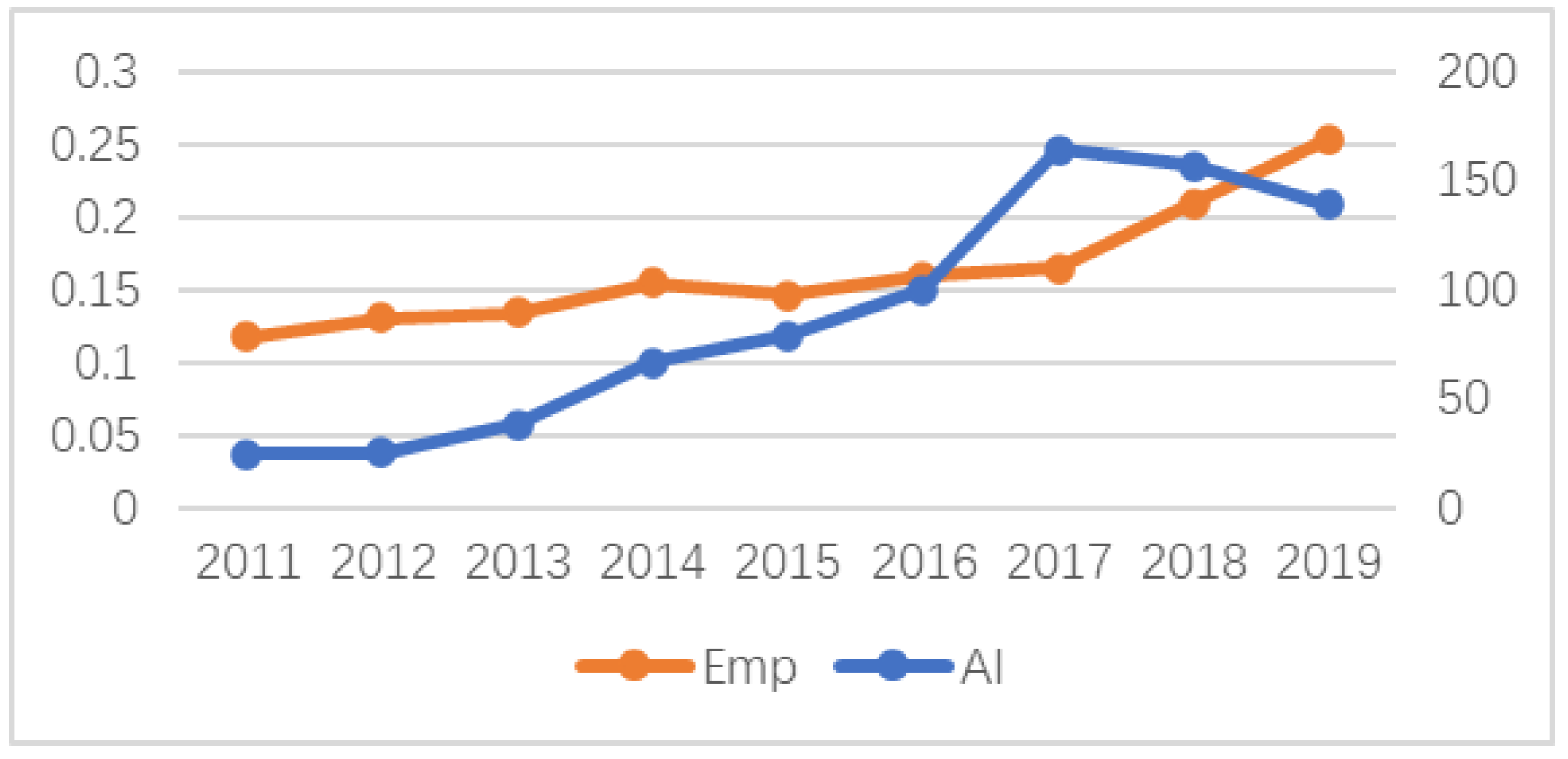
Table 1.
Employment Quality Indicator Evaluation System.
| Primary Indicator | Secondary Indicator | Indicator Explanation | Indicator Type |
|---|---|---|---|
| Employment Environment | Per capita GDP | Per capita GDP | Positive (+) |
| Regional GDP growth rate | Regional GDP growth rate | Positive (+) | |
| Proportion of employees in the tertiary sector | Proportion of employees in the tertiary industry | Positive (+) | |
| Regional employment rate | Urban unit employees / (urban unit employees + registered urban unemployed) | Positive (+) | |
| Regional unemployment rate | Registered urban unemployed / (urban unit employees + registered urban unemployed) | Negative (-) | |
| Degree of transportation accessibility | Per capita postal service volume | Positive (+) | |
| Labor Compensation | Absolute wage level | Average wage | Positive (+) |
| Relative wage level | Average wage growth rate | Positive (+) | |
| Healthcare insurance coverage | Number of urban employees enrolled in basic medical insurance / permanent population | Positive (+) | |
| Pension insurance coverage | Number of urban employees enrolled in basic pension insurance / permanent population | Positive (+) | |
| Urban-rural income gap | Urban residents’ average disposable income / rural residents’ average disposable income | Negative (-) |
Table 3.
Baseline Regression.
| (1) | (2) | |
|---|---|---|
| Emp | Emp | |
| AI | -0.0000291** | -0.0000355*** |
| Gov | -0.1195794*** | |
| Ope | -0.0170889*** | |
| Tra | 0.0251705*** | |
| Urb | 0.0036482 | |
| City FE | Yes | Yes |
| Year FE | Yes | Yes |
| N | 195 | 195 |
| R2 | 0.9269 | 0.9297 |
Table 4.
Heterogeneity Test.
| (1) | (2) | |
|---|---|---|
| Emp | Emp | |
| AI | -0.0000583* | 0.0000116*** |
| Gov | -0.3007269*** | -0.0394055 |
| Ope | -0.0324078*** | 0.0069442 |
| Tra | 0.0571042*** | 0.001245 |
| Urb | -0.1025268*** | 0.0656932*** |
| City FE | Yes | Yes |
| Year FE | Yes | Yes |
| N | 70 | 100 |
| R2 | 0.9170 | 0.9297 |
Table 5.
Robustness Tests.
| (1) | (2) | |
|---|---|---|
| Emp | Emp | |
| AI | 0.0000171*** | -0.0000292** |
| Gov | -0.0672*** | -0.0684*** |
| Ope | 0.0071 | -0.0225*** |
| Tra | 0.0220*** | 0.0088 |
| Urb | 0.0378*** | 0.0132 |
| City FE | Yes | Yes |
| Year FE | Yes | Yes |
| N | 195 | 195 |
| R2 | 0.9388 | 0.9280 |
Disclaimer/Publisher’s Note: The statements, opinions and data contained in all publications are solely those of the individual author(s) and contributor(s) and not of MDPI and/or the editor(s). MDPI and/or the editor(s) disclaim responsibility for any injury to people or property resulting from any ideas, methods, instructions or products referred to in the content. |
© 2024 by the authors. Licensee MDPI, Basel, Switzerland. This article is an open access article distributed under the terms and conditions of the Creative Commons Attribution (CC BY) license (http://creativecommons.org/licenses/by/4.0/).
Copyright: This open access article is published under a Creative Commons CC BY 4.0 license, which permit the free download, distribution, and reuse, provided that the author and preprint are cited in any reuse.


