

Submitted:
19 December 2024
Posted:
23 December 2024
You are already at the latest version
Abstract
We present preliminary work leading to feasibility study for the construction of a shield of a space probe to cosmic radiation as based on magnetic deviation by mean of neodymium permanent magnets. The choice of permanent magnets is the main novelty of our project. The first aim is to protect the health of astronauts inhabiting the space probe by the almost unidirectional ‘wind’ of charged particles emitted by the Sun. To reach this aim we will exploit an extensive theoretical and simulation work after which we will create a prototype to be tested on earth and, later, mounted on cube sats to test in space.
Keywords:
spacecrafts
; radiation
; particle
; shields: magnetic
1. Introduction
It is well known that the human missions in space pose significant health hazards, especially associated with cosmic radiation. The viability of human expeditions hinges on our ability to mitigate these radiation hazards. Space radiation in the vicinity of the Moon’s orbit and interplanetary space primarily consists of energetic particles, i.e. Solar Particle Events (SPEs) and Galactic Cosmic Rays (GCRs). These energetic particles can penetrate spacecraft, habitats, equipment and spacesuits, with significant risks for astronauts. One of these risks is the potential for acute (short-term, e.g., radiation sickness) and late (e.g., cancer) health effects. Acute radiation syndromes are primarily caused by intense SPEs, particularly in the absence of adequate shielding. Conversely, late health issues, including cancer and age-related diseases, are linked to a long exposure to GCRs, which substantially differ from Earth’s natural background radiation both qualitatively and quantitatively. Due to these qualitative differences and the complex nature of the space radiation spectrum, the estimation of radiation risks – particularly for carcinogenesis, central nervous system (CNS) damage and late cardiovascular damage– carries a high degree of uncertainty. Actually, early assessments indicated that, despite extensive ground-based experiments, the space radiation impact on cancer mortality risk is still highly uncertain ([6,15]). Additionally, practical countermeasures remain elusive.
The space radiation spectrum behind usual shielding materials comprises a diverse mix of particles, including protons, neutrons, and heavy ions, with energy per nucleon spanning from a few MeV/n to TeV/n. Each of these components carries a significantly different Relative Biological Effectiveness (RBE), which quantifies the doses required for different types of particles to produce the same biological effects as gamma rays. When it comes to space radiation protection, commonly used quantities include the dose equivalent (measured in sievert, Sv), using a radiation quality factor (Q) as a continuous function of linear energy transfer (LET), the effective dose equivalent, atomic number, etc., according to the new NASA risk model. It is the calculation of the quality factor, Q, itself the primary source of uncertainty in assessing the space radiation risk [10]. Clearly, space missions involve exposure to radiation at rates higher than those on Earth, albeit still within the low-dose range. Dose equivalent rates are typically below 1 mSv (1 mSv = 1 millisievert) per day in Low Earth Orbit (LEO), ranging from 100 to 200 mSv per year on Mars [7], depending on solar cycle and altitude on martian soil, and reaching approximately 350 mSv per year on the Moon. Consequently, astronauts in various mission scenarios would experience radiation exposures significantly greater than those faced by terrestrial workers, and so exposed to an enhanced radiation risk.
As a response to these challenges, NASA has implemented an approach to establish radiation limits that can accommodate uncertainties with a 95% confidence level [5] and are based on a 3% risk of radiation-induced cancer mortality.
2. The Space Radiation Environment
As we said, the space radiation environment in the Solar System is a complex mix of particles from both solar and galactic sources, encompassing a wide range of energies (Fig. Figure 1). While the solar wind, composed of low-energy particles, does not significantly contribute to radiation exposure, it does play a role in modulating the flux of galactic cosmic rays. This modulation occurs in an 11-year cycle, where periods of heightened solar activity push GCR particles away from the Solar System. However, during phases of higher solar activity, SPEs become more frequent, increasing the risk of potentially harmful radiation events. This raises the question of whether missions should be planned during periods of solar maximum or minimum to optimize the risk from SPEs or GCR exposure, respectively. Earth’s magnetic field and atmospheric shielding reduce cosmic radiation exposure to almost zero at the surface, but astronauts leaving Earth would rely on the spacecraft structure and the Earth’s magnetosphere for protection. In low Earth orbit (LEO), the magnetosphere shields astronauts from solar energetic particles, but SPEs remain a significant hazard to be addressed for interplanetary missions [8].
2.1. Galactic Cosmic Rays and Solar Particle Events
Galactic Cosmic Rays, originating beyond our solar system, represent a homogeneous and isotropic source of radiation. These high-energy particles, reaching up to eV, likely arise from supernova explosions, pulsars, and other highly energetic sources [3]. The detected GCR particles are predominantly baryons (98%) and electrons (2%). Within the baryonic component, approximately 85% are protons, 14% are helium nuclei, and 1% are heavier nuclei. GCRs contribute to more than 80% of the effective radiation doses to International Space Station (ISS) crews, primarily due to their deep penetration capabilities and large quality factors [4].
As we said above, in addition to GCRs, the Sun emits a continuous particle radiation, primarily in the form of protons and electrons, known as the solar wind. However, the energies of these particles are so low (e.g., protons are between 100 eV and 3.5 keV) that they are stopped within the first few hundred nanometers of skin and do not pose a significant concern for radiation protection.
On occasion, the Sun releases substantial energy in sudden outbursts of hard and soft X-rays and radio waves corresponding to SPEs as produced by Solar flares and corona mass ejections. These events result from the acceleration of solar matter by large currents and moving magnetic fields in the solar corona. SPEs predominantly consist of protons [12], along with a smaller fraction of heavier nuclei, with energies reaching several GeVs. The intensity, energy spectrum, and duration of SPEs can vary widely, but the most severe events have the potential to expose unshielded space crews to life-threatening doses of radiation [11].
3. Space Radiation Protection
The space radiation environment outside Earth’s protective magnetosphere is severe and poses significant challenges for radiation protection and shielding design. A typical Mars mission’ s cumulative radiation exposure would likely exceed permissible limits for carcinogenesis and is associated with other non-cancer related effects [9].
For radiation protection, it is crucial to predict the flux, energy, and duration of SPEs. In general, the energies per nucleon of SPEs are lower than those of GCRs (although incoming at a higher rate), making shielding a relatively easy and feasible solution. Spacecraft are equipped with storm shelters, small areas with thick shields, and planetary stations can be constructed with suitable shielding. The highest risk of exposure occurs during extra-vehicular activities (EVAs) with minimal shielding, particularly during planetary exploration when astronauts may venture far from the Moon or Mars base [8]. GCRs are particularly challenging to shield against due to their high energy and then highly penetrating power. The chronic exposure to GCRs in interplanetary missions demands more advanced radiation protection technology than currently exists for human spacecrafts and stations. Radiation protection strategies on Earth are generally categorized into three groups: increasing the distance from the radiation source, minimizing the time of exposure, and employing radiation shielding. However, these strategies face unique challenges in the context of space exploration. Distance from the source has limited impact since Galactic Cosmic Rays are omnidirectional, and Solar Particle Events become isotropic within hours of occurrence along magnetic field lines. Reducing exposure time is often infeasible for long-duration space missions, such as those to Mars, which can last up to 1100 days using conventional propulsion methods. Cumulative GCR exposure on a Mars mission can reach approximately 1 Sv [9], exceeding NASA’s permissible exposure career limits. Mitigating radiation exposure is therefore a priority for the major space agencies. Strategies include advanced propulsion, pharmaceutical and dietary countermeasures, astronauts’ selection criteria, advanced materials for passive shielding, and active shielding methods. Low atomic mass materials are often the most efficient shields against both GCR and SPE particles. Polyethylene has emerged as a valuable structural polymer to spacecraft shielding [13], and various fabrication strategies have been developed to optimize its effectiveness. Instead, active shielding involves the generation of electromagnetic fields to deflect the space radiation’s charged particles. Several approaches have been proposed in the last years [17], including electrostatic shields, plasma shields, confined and unconfined magnetic fields. The effectiveness of these methods, as well as their power and mass requirements, must be carefully considered in respect to passive shielding. Potential adverse biological effects, such as the impact of strong magnetic fields on humans, as well as secondary products generated from the interaction of the primaries with high-Z materials of which magnets and the support structures are made, also require evaluation.
To date, developments in superconducting magnets are critical for effective active shielding against GCRs and remains primarily in the conceptual stages. However, the use of cryogenic superconducting magnets, while promising, present high reliability challenges for spaceflight [1,2]. Future advancement in cryogen-free superconductors, such as High-Temperature superconductors (HTS), may offer improved solutions. As an example, magnetic lenses built from superconducting magnets have been described by [16] for protection from directional SPE-type radiation. An angular cone ° could protect a several cubic meter volumes against protons with energies up to about 200 MeV using a so-called D-shaped toroidal field with a mass of about 1100 kg, which is in the range of the mass required by a passive shielding storm shelter to protect the same volume. Additionally, there has been renewed interest in electrostatic shielding designs, opening new avenues for research. Further research is needed to advance the feasibility of active shielding for space radiation protection.
4. A Possible Magnetic Shield
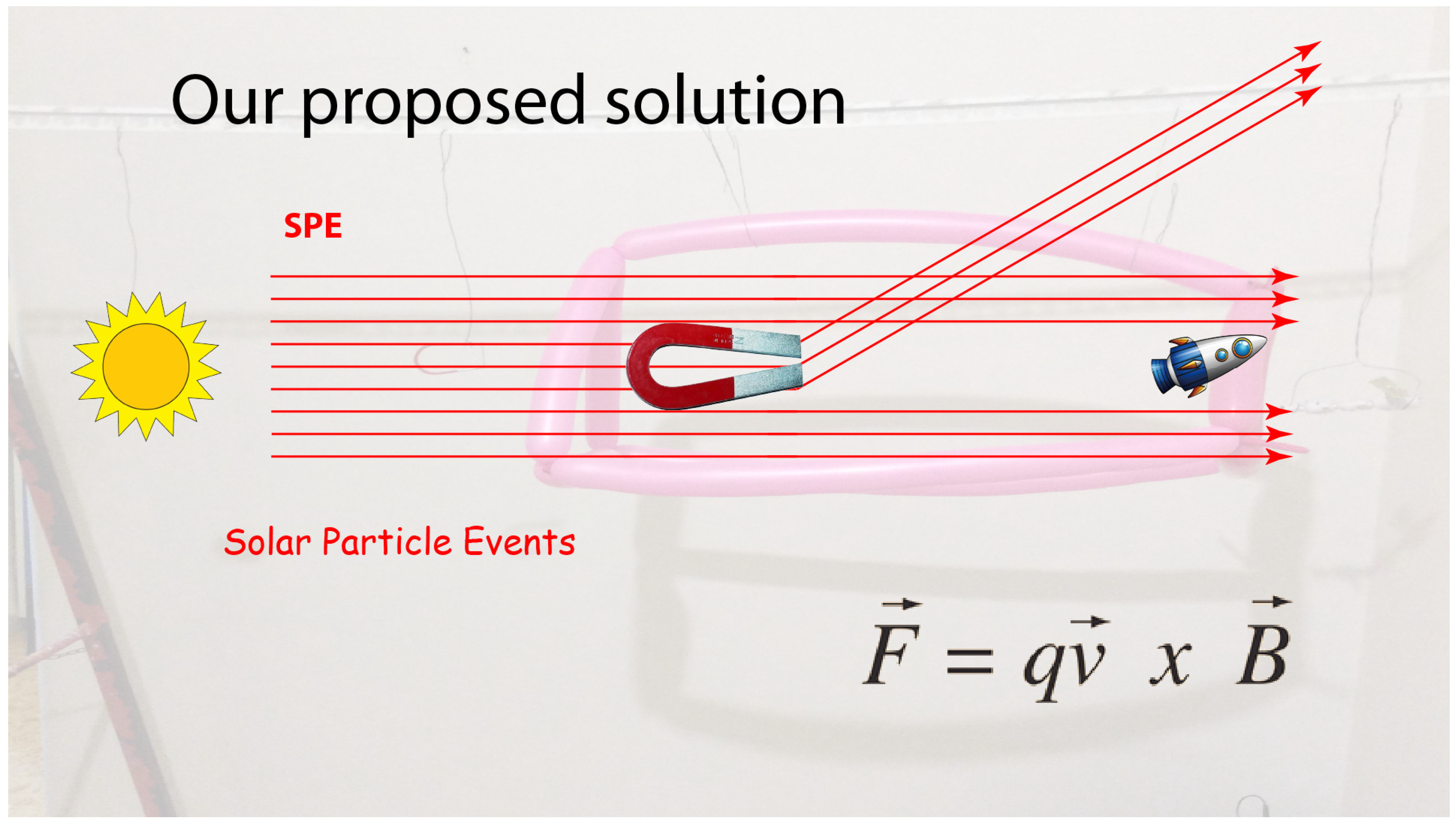
As we said above, a possible and promising, way to protect astronauts during a space mission from dangerous radiation is via a shielding system based on deviation of at least a part of the incoming energetic particles. Our proposed solution is via an active magnetic shielding based on the use of permanent magnets (see Fig. Figure 2). This choice has the advantage of avoiding the huge load of a passive material absorbing shield and of an active electro-magnetic deviating shield. The latter would be demanding for a space mission because of the huge pay load necessary to produce the energy required to produce the electric power for the electromagnets in the frame of conventional conductors or, when using super conductors, to keep them at cryogenic temperatures. Of course this active, purely magnetic approach cannot act on neutral particles and carries a natural difficulty when aiming to protect the space probe from an isotropic bombardment of charged particles. Anyway, in our opinion, it deserves a theoretical (first) approach, followed by a set of practical simulations, both numerical and laboratory-based and via specific space mission scaled at level of cube-sats missions, in order to check properly its capability in terms of reliability, efficiency and estimated costs, in view of a possible practical use for manned space missions.
The detailed description of our proposed solution is the subject of a forthcoming paper [14]; here we limit to say that our idea is to design a device based on cylindrical permanent magnets able to deviate charged particles coming from a definite direction in an interval of energies (essentially SPEs). This would be a first step toward a more complete active protection able to shield from charged particles of energies over a huge range and coming from a huge solid angle. The first step is essentially devoted to an active protection against Solar particles, the complete protection supposedly being able to protect from Galactic, isotropic, particles.
5. Conclusions
In this short note we sketched our idea to protect astronauts in interplanetary travels via a structure comprised of permanent (neodymium) magnets. The aim is the deviation of both the `unidirectional´ Solar particles and the isotropic fountain of Galactic cosmic particles, whose energies and characteristic are widely different. The first application of our idea would be the realization and testing in laboratory of a simple prototype apt to deviate SPEs when mounted on a space probe. Second step would be its testing in orbit, as mounted on cube sats. After these successful tests we will deep our attention to the realization of a magnetic device which will be practically useful to protect astronauts traveling in a space probe by such kinds of radiation. In the mean time we will attack the problem to generalize our technique to produce `isotropic’ magnetic shielding from GCRs.
References
- Roberto Battiston. The antimatter spectrometer (ams-02): A particle physics detector in space. Nuclear Instruments and Methods in Physics Research Section A: Accelerators, Spectrometers, Detectors and Associated Equipment 2008, 588, 227–234. [Google Scholar] [CrossRef]
- Roberto Battiston, Tipei Li, and Paolo Zuccon. Spacepart 2006. Nuclear Physics B (Proc. Suppl.) 2007, 166. [Google Scholar]
- James W Cronin. Cosmic rays: the most energetic particles in the universe. Reviews of Modern Physics 1999, 71, S165. [Google Scholar] [CrossRef]
- FA Cucinotta, H Nikjoo, and DT Goodhead. Model for radial dependence of frequency distributions for energy imparted in nanometer volumes from hze particles. Radiation research 2000, 153, 459–468. [Google Scholar] [CrossRef]
- Francis A Cucinotta, Shaowen Hu, Nathan A Schwadron, K Kozarev, Lawrence W Townsend, and Myung-Hee Y Kim. Space radiation risk limits and earth-moon-mars environmental models. Space Weather 2010, 8. [Google Scholar]
- M Durante and FA Cucinotta. Nature rev. cancer. Cancer 2008, 8, 465. [Google Scholar]
- Marco Durante and C Bruno. Impact of rocket propulsion technology on the radiation risk in missions to mars. The European Physical Journal D 2010, 60, 215–218. [Google Scholar] [CrossRef]
- Marco Durante and Francis A Cucinotta. Physical basis of radiation protection in space travel. Reviews of modern physics 2011, 83, 1245. [Google Scholar] [CrossRef]
- Kristine Ferrone, Charles Willis, Fada Guan, Jingfei Ma, Leif Peterson, and Stephen Kry. A review of magnetic shielding technology for space radiation. Radiation 2023, 3, 46–57. [Google Scholar] [CrossRef]
- editor J.Valentin. The 2007 recommendations of the international commission on radiological protection. Ann ICRP 2007, 37, 2. [Google Scholar]
- Myung-Hee Y Kim, Matthew J Hayat, Alan H Feiveson, and Francis A Cucinotta. Prediction of frequency and exposure level of solar particle events. Health physics 2009, 97, 68–81. [Google Scholar] [CrossRef] [PubMed]
- RE McGuire, TT Von Rosenvinge, and FB McDonald. The composition of solar energetic particles. Astrophysical Journal, Part 1 (ISSN 0004-637X) 1986, 301, 938–961. [Google Scholar]
- Livio Narici, Marco Casolino, Luca Di Fino, Marianna Larosa, Piergiorgio Picozza, Alessandro Rizzo, and Veronica Zaconte. Performances of kevlar and polyethylene as radiation shielding on-board the international space station in high latitude radiation environment. Scientific reports 2017, 7, 1644. [Google Scholar] [CrossRef]
- Capuzzo-Dolcetta F. Parisi, V. and L. Lunati. Towards protection form cosmic radiation via permanent magnets. in preparation 2024. [Google Scholar]
- W Schimmerling, JW Wilson, F Cucinotta, and MH Kim. Requirements for simulating space radiation with particle accelerators. 2004. [Google Scholar]
- P Spillantini, M Casolino, Marco Durante, R Mueller-Mellin, Günther Reitz, L Rossi, V Shurshakov, and M Sorbi. Shielding from cosmic radiation for interplanetary missions: Active and passive methods. Radiation measurements 2007, 42, 14–23. [Google Scholar] [CrossRef]
- LW Townsend. Overview of active methods for shielding spacecraft from energetic space radiation. Physica Medica 2001, 17, 84–85. [Google Scholar]
Figure 1.
Simple schematization of the cosmic bombardment onto a space probe.
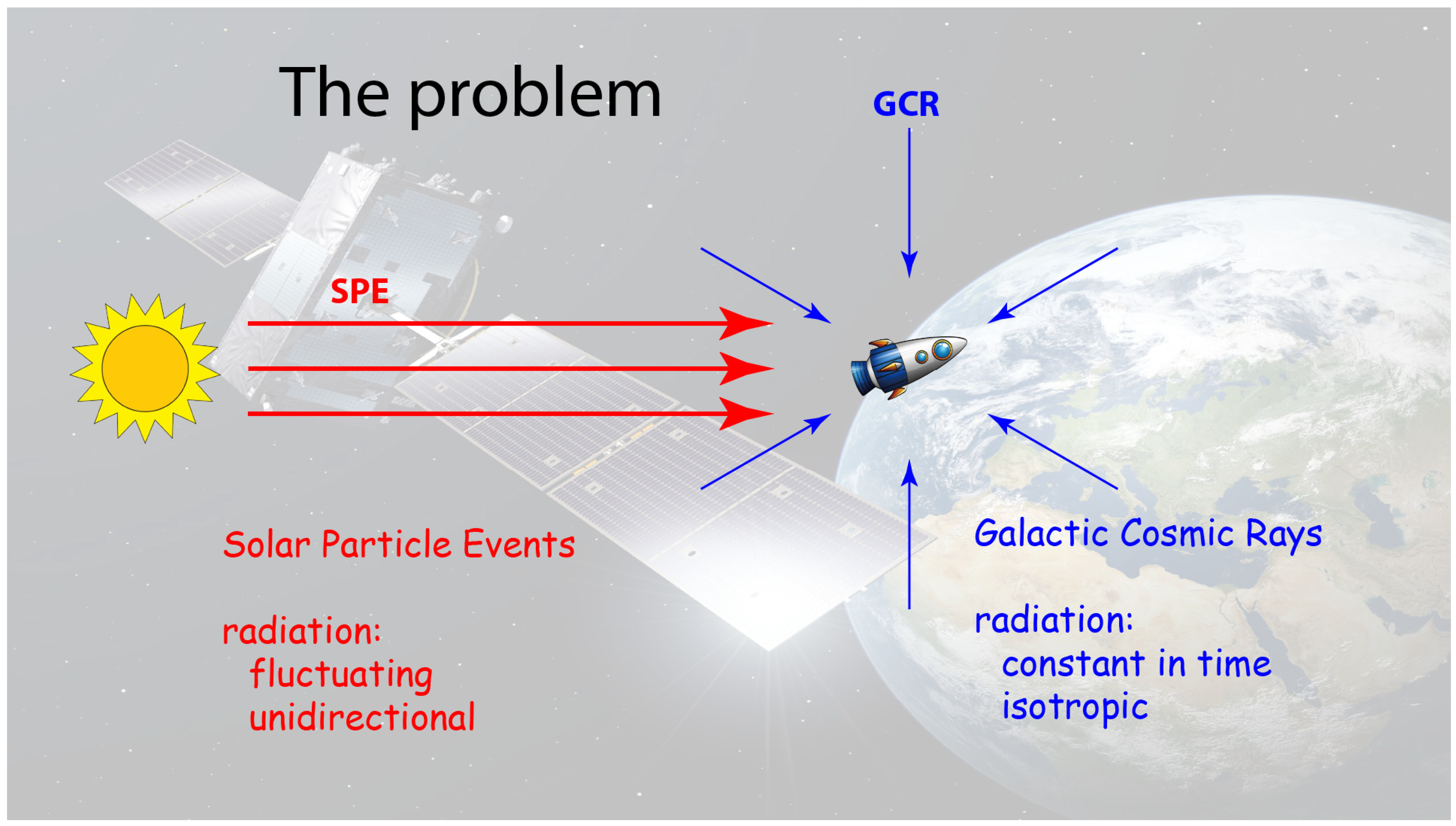
Figure 2.
Hypothetic solar particle deviation by a magnet via Lorentz force.
Disclaimer/Publisher’s Note: The statements, opinions and data contained in all publications are solely those of the individual author(s) and contributor(s) and not of MDPI and/or the editor(s). MDPI and/or the editor(s) disclaim responsibility for any injury to people or property resulting from any ideas, methods, instructions or products referred to in the content. |
© 2024 by the authors. Licensee MDPI, Basel, Switzerland. This article is an open access article distributed under the terms and conditions of the Creative Commons Attribution (CC BY) license (http://creativecommons.org/licenses/by/4.0/).
Copyright: This open access article is published under a Creative Commons CC BY 4.0 license, which permit the free download, distribution, and reuse, provided that the author and preprint are cited in any reuse.


