Preprint
Review

This version is not peer-reviewed.

The Current State of Virtual Reality in the Management of Musculoskeletal Conditions and Chronic Pain: Terminology, Technology, and Associations

A peer-reviewed article of this preprint also exists.

Submitted:

18 December 2024

Posted:

20 December 2024

You are already at the latest version

Abstract

Virtual reality (VR) demonstrates significant potential to improve rehabilitation outcomes for musculoskeletal conditions and chronic pain. However, the field faces notable challenges, including inconsistent terminology, a lack of specialized/comprehensive software solutions, and an overwhelming variety of hardware options, which can make it difficult for healthcare professionals without technical expertise to identify the most suitable tools for clinical use. This article explores the current state of VR in the rehabilitation of musculoskeletal conditions and chronic pain, focusing on terminology discrepancies, available hardware and software solutions, and key professional associations shaping the field. A review of the current state of terminology is essential to address inconsistencies that risk perpetuating misuse and limiting the applicability of research findings. Building on this review, we propose a conceptual framework for understanding VR that aligns more closely with the capabilities of current VR technology. A comprehensive overview of VR hardware and software can assist healthcare professionals in selecting appropriate technologies for clinical practice, guide researchers in designing interventions, and inform developers on unmet needs in the field. Furthermore, understanding key professional associations provides valuable direction for those engaged in virtual rehabilitation, enabling them to access resources, foster collaboration, and stay informed about the latest advancements in the domain.

Keywords: 
;  ;  ;  ;  ;  

1. Introduction

Initially, virtual reality (VR) applications in healthcare predominantly focused on pain distraction during acute procedures, such as managing burn patients [1]. Its use for chronic pain received less attention, likely due to the persistent nature of chronic pain, making continuous VR use seem impractical [2]. This may explain why VR research for chronic pain lags behind its application for acute pain. Similarly, the development of VR for musculoskeletal rehabilitation has progressed more slowly compared to its adoption in neurological rehabilitation [3]. One potential reason is that VR was initially considered more suitable for neurological patients due to its ability to facilitate cortical reorganization and potentially restoring motor function [4]. In musculoskeletal rehabilitation, however, it initially appears that common goals for this population (such as improving range of motion or muscle strength) would not significantly benefit from VR compared to non-VR interventions, making it less cost-effective for widespread adoption.
However, meta-analyses have increasingly highlighted the significant benefits of VR in managing chronic pain and musculoskeletal conditions [5,6,7,8,9,10]. Furthermore, for patients with these conditions, the use of VR goes beyond mere distraction from immediate pain, as it can also be applied to achieve reduction of kinesiophobia [11], improvement of body image [12], enhancement of pain self-efficacy [13], promotion of better patient adherence [14] and increase in motivation for exercise [15].
Likely due to the relatively recent expansion of VR research in healthcare, particularly in the rehabilitation of musculoskeletal conditions, the field faces notable challenges. These challenges include inconsistent terminology, a lack of specialized software solutions, and an overwhelming variety of hardware options, most of which are not primarily designed for healthcare use. Such factors can make it difficult for healthcare professionals without technical expertise to identify the most suitable tools for clinical practice. This article explores the current state of VR in the rehabilitation of musculoskeletal conditions and chronic pain, focusing on terminology discrepancies, available hardware and software solutions, and key professional associations shaping the field. A review of the terminology is essential to address inconsistencies that risk perpetuating incorrect use and limiting the applicability of research findings. Building on this review, we propose a conceptual framework for understanding VR that not only aligns more closely with the capabilities of current VR technology but also aims to contribute to a modern understanding of the term and its appropriate use in research and practice. Furthermore, a comprehensive overview of VR hardware and software can assist healthcare professionals in selecting appropriate technologies for clinical practice, guide researchers in designing interventions, and inform developers on unmet needs in the field. Understanding the role of key professional associations also provides valuable direction for those engaged in virtual rehabilitation, enabling them to access resources, foster collaboration, and stay informed about the latest advancements in the domain.

2. The Ambiguity of Virtual Reality Terminology in Healthcare and Beyond

Not only in the field of VR, but also within the broader spectrum of related technologies such as augmented reality (AR) and mixed reality (MR), a significant issue arises due to the lack of consensus on definitions and the meaning of terms. Numerous authors who have explored terminology in this area point to discrepancies in the use and interpretation of terms, leading to confusion among researchers, practitioners and users, with this inconsistency also evident in the use of VR in healthcare [16,17,18,19]. The lack of clarity is reflected not only in the scientific literature, but also in the definitions provided by various dictionaries [16,19]. It also extends to the marketing of these technologies, where professional news agencies have been observed describing the same product as an example of MR, AR, and VR, and instances have been noted where companies promote their immersive devices in ways inconsistent with common definitions, presenting them as something they are not [17,20]. In response to the confusion around definitions, some companies (such as Apple) strategically avoid specific terminology related to immersive technologies in their marketing and instead emphasize the use and capabilities of their technology [17,21].
The reasons for the lack of uniform terminology can be attributed to several factors. On one hand, the rapid development of technology means that new innovations are constantly emerging, often outpacing the adoption of updated definitions [17,19]. Some researchers suggest that this confusion arises from the exploration of VR-related concepts across diverse fields, where varying disciplinary perspectives lead to inconsistent applications of technology and thus inconsistent interpretations of the terms [17]. Cultural differences influencing the understanding of these terms and technology providers redefining terms to position their products more favourably, further contribute to the inconsistency [17,22].
The lack of uniformity in the definitions of VR is evident in the varying criteria they use: some define VR based on the type of hardware employed (e.g., head-mounted displays, HMDs), others on the nature of the experience (e.g., the level of immersiveness), and some on the forms of interaction [17,19]. Such discrepancies can also be observed in research on the use of VR in the rehabilitation of patients with musculoskeletal disorders and chronic pain. For example, in a randomized controlled trial of older adults with chronic musculoskeletal pain, Ditchburn et al., (2020) cite a definition of VR that describes VR as “an environment generated by artificial means or computer simulations akin to real-life situations”. In contrast, Gava et al., (2022) in a meta-analysis focusing on patients with chronic musculoskeletal pain, refers to a definition of VR that explicitly specifies the hardware required: “Virtual reality is a goal-focused computer simulated reality, acting on the user’s experience of their perceived world through head-mounted displays, headphones, and motion tracking systems”. Similarly to Gava et al., (2022), whose definition limits VR technology to immersive experiences (i.e. those using HMDs), Darnall et al., (2020) defines VR as an "immersive 3D environment" in a pilot study on patients with chronic pain. Fu et al., (2021) in a study on cancer patients with chronic pain, also emphasize that VR involves a 3D environment and explicitly point out that it differs from “...watching an image on a typical computer or video display...”. Despite the tendency of some authors to limit the definition of VR to immersive environments, numerous studies in the same field — musculoskeletal rehabilitation and chronic pain — report interventions where participants interact with a digital environment viewed on a 2D computer screen, which they also refer to as VR interventions. Interventions classified by authors as VR, where participants performed exercises while observing a virtual environment on computer screens and interacting with it through motion tracking systems, have been documented in studies conducted on patients with conditions such as low back pain [26,27,28], neck pain [29], and knee osteoarthritis [30]. Furthermore, numerous meta-analyses evaluating the effectiveness of VR include both, interventions involving HMDs and 2D computer screens, such as Wii games. These analyses have been conducted in the context of low back and neck pain [9,31], rehabilitation of orthopedic ankle injuries [32], rehabilitation following total hip arthroplasty [33], and anterior cruciate ligament (ACL) injuries [6]. Notably, meta-analysis on ACL rehabilitation by Cortés-Pérez et al., (2024) did not include any studies that examined immersive VR interventions using HMDs. This highlights the inconsistency in understanding what constitutes VR even within a single field of application. Such discrepancies can pose significant challenges, as they limit the understanding and applicability of research findings, restrict researchers in finding relevant studies, and raise unrealistic expectations about these novel solutions [19,34].

2.1. Modern Definitions and Concepts of Virtual Reality and Related Technologies

The inconsistency in terminology surrounding VR and related technologies has led authors to propose modern definitions and concepts intended to align with current technological advancements and the use of VR systems. However, even up-to-date definitions lack uniformity, despite being published within a span of just one to two years [16,18,19]. This lack of consensus can even be seen in the definition of the appropriate umbrella term for VR and related technologies (the most frequently mentioned besides VR are AR and MR).
In the literature, the abbreviation "XR" is widely accepted as an umbrella term, but its interpretation varies. Some attribute XR to "extended reality" [35], others to “cross reality” [36], and some to “X-reality” [37], which is occasionally described as a variaton of “eXtended reality” [38,39]. Although it is widely agreed that XR encompasses VR, AR, and MR [40,41,42], the relationships between these technologies are often not clearly defined, except for MR, which is typically described as a blend of VR and AR [19].
Recently, Rauschnabel et al., (2022) raised concerns about the term "extended reality," emphasizing that it fails to include VR, where the real environment is replaced rather than extended. As an alternative, the authors proposed "X-reality" as an umbrella term, with "X" functioning as a placeholder for any form of new reality. Within their framework, an AR continuum was introduced, extending from assisted reality, where virtual content appears clearly artificial, to MR, where the integration of virtual and real objects becomes seamless and indistinguishable. The concept also incorporates diminished reality, which ranges from the application of unrealistic overlays to the undetectable removal of real objects [16]. Additionally, they further outlined a VR continuum that spans from atomistic VR, prioritizing specific goals over user experience, to holistic VR, characterized by an immersive experience nearly indistinguishable from real-world interactions [16]. In contrast, Milgram and Kishino, (1994) proposed the reality-virtuality continuum, anchored at one end by a purely real environment and at the other by a purely virtual environment. In their model, MR is defined as the umbrella term for environments that combine real and virtual elements, excluding fully virtual environments, which are positioned at the far right of the continuum. Critics, however, argue that the virtual environment endpoint, defined by Milgram and Kishino, (1994) as "consisting solely of virtual objects" and "completely synthetic," can be fully virtual only for extroceptive senses, but not for interoceptive ones [18]. Consequently, they propose that all VR experiences should be categorized under the umbrella term “mixed reality”, as they inherently blend virtual elements with real-world sensations (e.g., computer-generated stimuli combnined with physical sensations such as gravity) [18]. Recently proposed frameworks and the present understanding of VR and related technologies are illustrated in Figure 1.
In the field of healthcare, the term “XR” is widely used, with some researchers expanding its scope to include video games and related applications, in addition to VR, MR, and AR [35]. This further underscores the tendency of some researchers in this field to classify VR alongside 3D games displayed on a flat 2D screen. Accordingly, in their literature review, Abbas et al., (2023) examined how the term VR is defined in the medical literature and proposed the following definition of VR, which avoids the term “immersion” and the explicit use of HMD devices: “VR is a three-dimensional computer-generated simulated environment, which attempts to replicate real-world or imaginary environments and interactions, thereby supporting work, education, recreation, and health.”. Based on the up-to-date definition by Abbas et al., (2023), any interaction with a 3D environment appears to qualify as VR, regardless of whether it is displayed on a 2D computer screen or through HMD goggles. In contrast, modern definitions developed outside of healthcare, such as the one proposed by Rauschnabel et al., (2022), limit VR to experiences where the user “does not see the physical environment and is, at least visually, sealed off from the physical environment.”. This suggests that the understanding of VR in healthcare somewhat diverges from how VR is interpreted in other fields.

2.2. Categorization of Virtual Reality in Healthcare: Subtypes Based on Levels of Immersion

In the field of healthcare, researchers often include a range of technologies under the VR term. These are typically categorized by the level of immersion, which determines the user's sensory and psychological engagement within the virtual environment [42]. Within this context, VR in healthcare is commonly divided into three categories: non-immersive, semi-immersive, and (fully) immersive VR (see Figure 1).
Although studies uniformly describe the categorization of VR based on levels of immersion, there is inconsistency in how these terms are defined. For instance, non-immersive VR is commonly described as a virtual environment projected onto a 2D display screen [4,40,44,45,46]. Some authors state that such environments allow users to interact with it [44], while others do not mention interaction at all, instead defining non-immersive VR as the user observing or viewing computer-generated images of a virtual environment on a screen [4,45] or as a virtual environment “presented on a flat screen” [47]. This lack of clarity is problematic, as such definitions could classify activities where the user remains entirely passive (e.g., watching television) as non-immersive VR. Furthermore, the concept of a 2D screen requires more precise definition. Some virtual environments projected onto 2D screens that entirely surround the user and block their view of the real world—commonly referred to as VR caves—are classified as immersive VR by certain authors [16]. However, according to other definitions, VR caves could be classified as semi-immersive VR environments, which are described as environments that “integrate a large display screen for projecting the virtual environment” [44]. Based on the definition proposed by Wei et al., (2024), the distinction between non-immersive and semi-immersive environments appears to hinge on the size of the display screen. However, it remains unclear where the threshold for screen size lies.
In the field of rehabilitation, non-immersive VR is often referred to as “exergames” or “active video games” which represents a combination of exercise and gaming [48]. This terminology likely arises because VR is frequently used in rehabilitation for exercise-based interventions. Additionally, exergames often rely on technologies such as Nintendo Wii, Xbox, and PlayStation, which many authors in healthcare classify as "non-immersive VR" [48,49]. It therefore seems that exergames are a subcategory of less immersive VR experiences that require patients to perform physical exercises. However, since some researchers state that exergames occur within less immersive environments [48,49], this raises the question of how to classify immersive VR experiences that also require patients to perform exercises. Alternatively, it may be necessary to revise the definition of exergaming to additionally include experiences involving immersive technology. Another term frequently used to describe VR interventions in healthcare is “serious games”. Serious games are defined as games designed with a purpose beyond entertainment and are utilized to promote users' mental, physical, and social well-being [50]. It can be summarized that serious games represent a subcategory of VR, which can be further divided into exergames—a specific type of serious game focusing on exercise-based activities.
In the context of the treatment of musculoskeletal disorders and chronic pain, immersive VR appears to be predominantly limited to the use of HMDs. For example, immersive VR in this field is described as: “achieved through HMDs..." [44]; “involves the use of HMDs..." [45]; “involves utilizing an HMD” [4]; and “VR is considered immersive when an HMD is used” [51]. It seems that in addressing musculoskeletal issues, researchers primarily classify immersive VR as technology that engages vision, without incorporating other sensory modalities, such as touch, which could be facilitated by additional equipment like haptic technology. This may be due to the limited availability or high cost of such equipment, which makes its inclusion in studies less feasible. Another possible reason is that, particularly for patients with chronic pain who have a reduced capacity to process information, additional haptic technologies may not be used because some authors highlight the risk of information overload caused by excessive multisensory input [52]. Sensory overstimulation could result in negative outcomes such as increased stress, frustration, or even trigger kinesiophobia or catastrophizing in this population group [52].
In contrast to the approach in healthcare, which often categorizes VR based on the level of immersion, some authors from other fields argue that VR is inherently immersive and involves experiences where the physical environment is at least visually replaced [16]. These definitions exclude activities such as “looking at 3D content on a 2D screen and browsing through it with a mouse” [16]. Others contend that a fully immersive VR experience, where no real-world stimuli are perceived, does not exist. Such an experience, they argue, would only be possible in a Matrix-like VR scenario, where both interoceptive and exteroceptive senses are entirely stimulated by technology [18].
Furthermore, according to some definitions, non-immersive experiences classified as VR in healthcare might be more appropriately categorized as AR. For example, Milgram and Kishino, (1994) define AR as “an environment that is primarily real but includes virtual elements.”. Definitions which do not describe AR as an environment that overlaps or blends the virtual and real worlds, suggest that AR could also encompass situations where an individual perceives reality (e.g., themselves and the surrounding physical world) while simultaneously viewing a virtual world. This could include scenarios where an individual is positioned in front of a 2D computer screen, observing a virtual environment—commonly referred to as non-immersive environments in healthcare.
In summary, the lack of consensus on the definition of VR in the various application areas remains a problem. It can be said that the understanding of VR in the healthcare sector is somewhat different compared to other sectors. Although it appears that most researchers in healthcare categorize VR based on levels of immersion, notable discrepancies remain within the healthcare field itself, particularly regarding whether the observation of and/or interaction with 3D environments displayed on 2D computer screens should be classified as VR. This inconsistency poses risks as it can lead to the comparison of interventions that are labelled as the same but are fundamentally heterogeneous in nature. Overall, the inconsistency in VR terminology highlights the need for researchers and practitioners to define the terms they use given the absence of a universally shared understanding of the terminology [17].

2.3. Rethinking the Meaning of Virtual Reality: A Proposed Framework

Given the discrepancies in understanding what is included within the scope of VR, we believe there is a need to reconceptualize which experiences and technologies should be classified as VR and which should not. Based on our review of the field, we present the proposed framework below.
Proposition 1: VR begins when visual field is entirely occupied with virtual information.
In line with certain authors [16], we argue that VR experiences should be limited to so-called immersive VR experiences, where the individual cannot see the real world and is thus visually completely detached from it. According to this understanding, VR cave technologies would not fall under VR, as individuals using this technology can still see their own body and the physical surface they are standing on. The only technology currently capable of achieving such visual detachment from the real world are HMDs.
Proposition 2: What is currently referred to as "non-immersive VR" should be distinguished from VR and excluded from the umbrella term encompassing VR and related technologies.
Non-immersive VR experiences, commonly categorized as virtual environments that individuals observe or interact with via computer screens, should not be considered part of VR or related technologies and should not fall under the XR umbrella (or mixed reality, which some propose as an umbrella term). Evidence from healthcare further supports the validity of this distinction, with studies demonstrating that immersive and non-immersive experiences have varying effects [53,54].
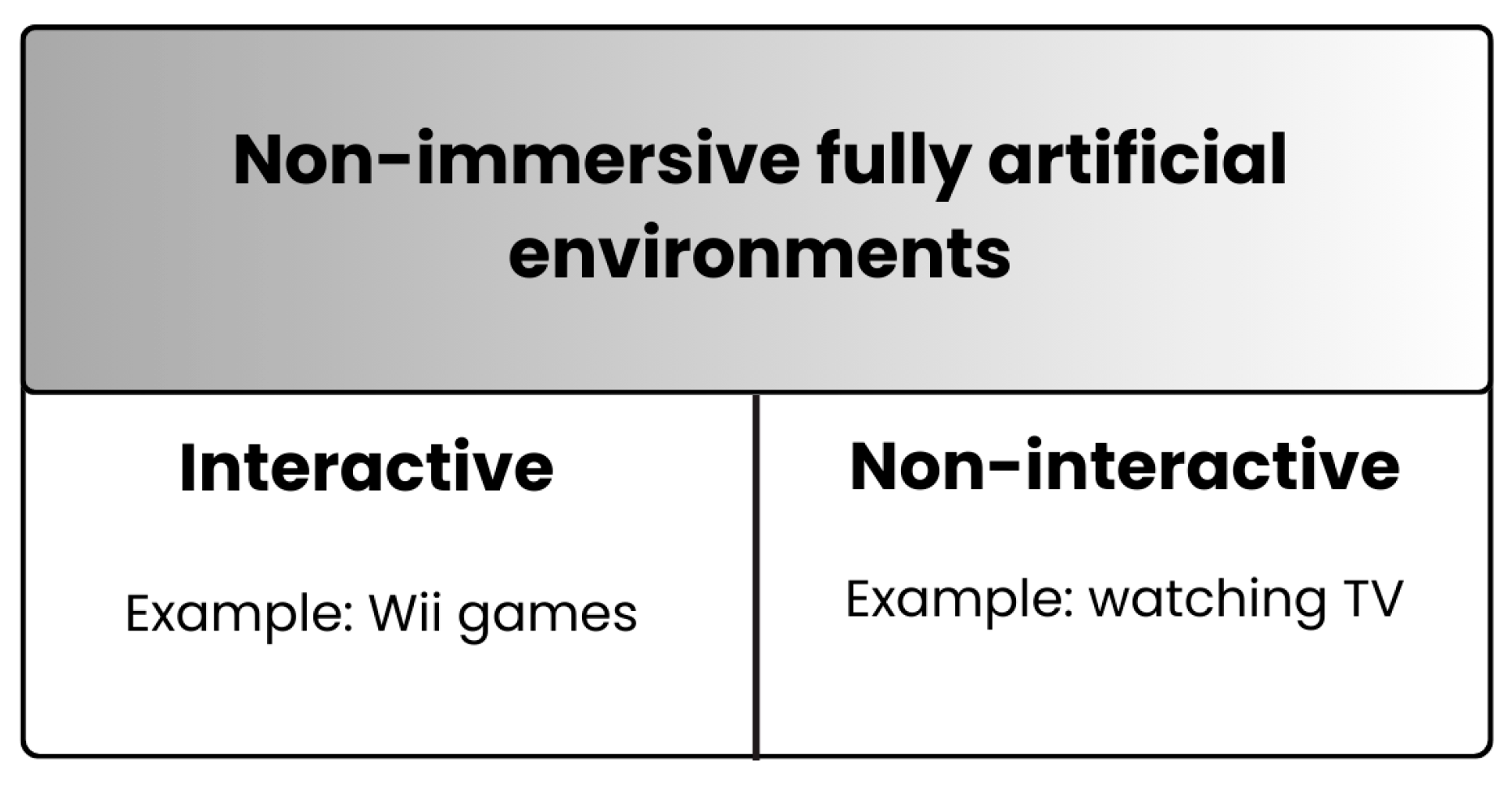
For VR in healthcare currently labeled as "non-immersive," which typically involves the projection of artificial environments on a computer or television screen (e.g., Wii games), regardless of whether these environments are interactive or non-interactive, we propose the term "non-immersive fully artificial environments". The term "non-immersive" distinctly separates these environments from VR, which, according to our proposal, begins only when an individual's entire visual field is occupied by virtual information. Thus, VR can never truly be "non-immersive" (as it always involves at least visual immersion), making "non-immersive" a suitable term to differentiate these environments. The term "fully artificial" further clarifies the distinction from environments where virtual objects are integrated into the real world, a feature commonly included in definitions of AR or MR. This distinction is illustrated in Figure 2.
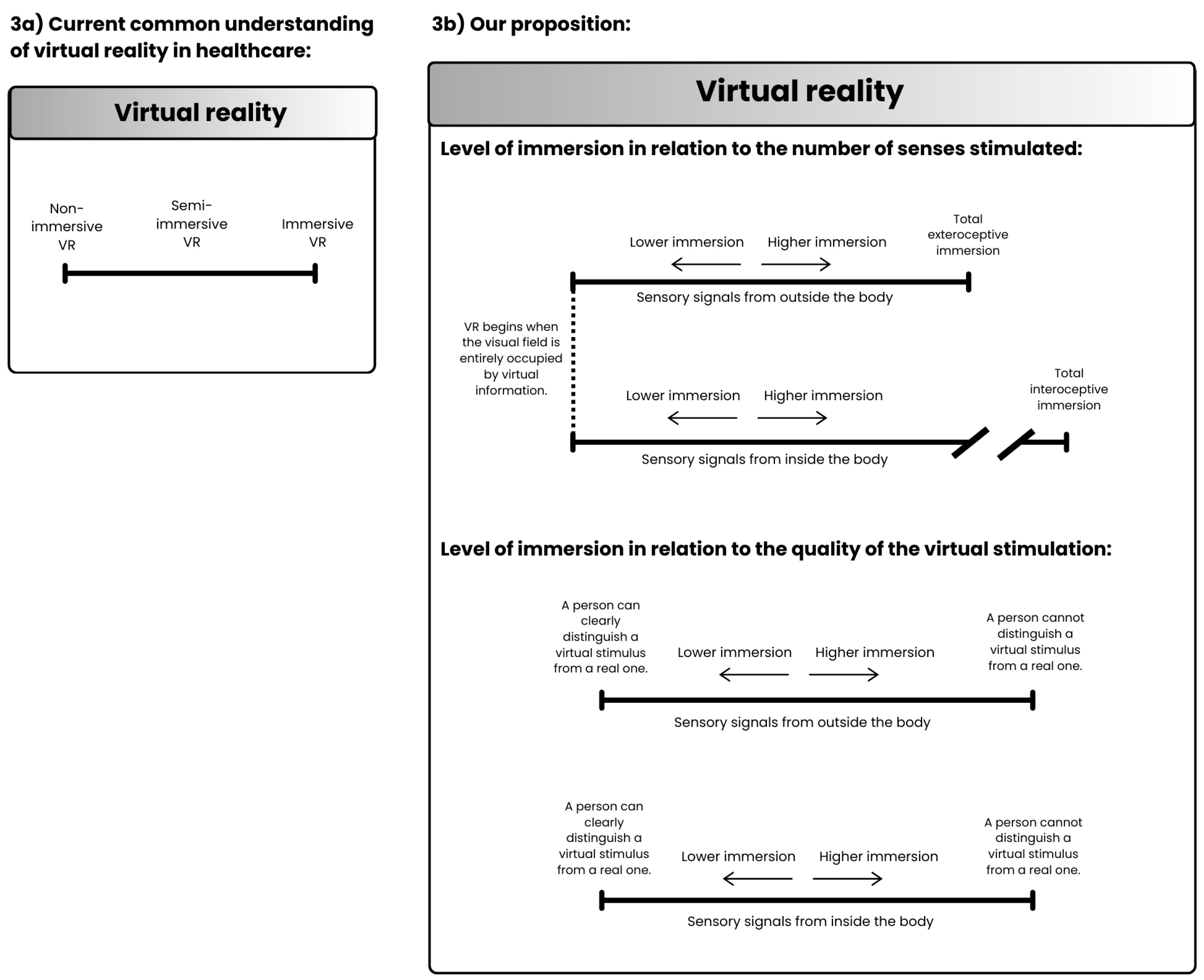
Proposition 3: VR should be divided into two continua of immersion depth based on exteroceptive and interoceptive system involvement.
The level of immersion in VR should be categorized based on the involvement of the exteroceptive system (i.e., sensory signals from outside the body) and the interoceptive system (i.e., sensory signals from inside the body). Such a classification has likely not been introduced previously due to the limited research on interoceptive system stimulation until recent years. However, evidence in this field is growing. For instance, Lernia et al., (2023) demonstrated the ability to artificially manipulate interoceptive cortical signaling using a non-invasive stimulation technique called Sonoception. They showed that auditory synthetic stimulation (Sonoception) could prime insular activity (a key component of the interoceptive system that processes and integrates signals from within the body), either enhancing impulsivity or promoting inhibitory control, depending on the specific area of the insula targeted. Other interoceptive technologies are also emerging in research. These include methods that produce direct modulation of interoceptive signals, such as C-fiber stimulation [57,58], as well as tools that create illusions by providing individuals with false feedback about their physiological states [59].
Proposition 4: Immersion should be categorized based on the number of stimulated senses and the quality of virtual stimulation.
We propose that the level of immersion should be categorized based on the number of senses stimulated and the quality of virtual stimulation. In the case of exteroception, it is possible to virtually stimulate all senses quantitatively, making this continuum continuous. In contrast, the immersion of the interoceptive system is inherently limited, as technology cannot fully simulate all interoceptive signals. The level of immersion also increases not only with the number of virtually stimulated senses but also with the quality of virtual stimulation. Immersion will be lower if the virtual stimulation is of lower quality, as the individual can easily distinguish between real and virtual stimuli. Conversely, immersion will be higher if the virtual stimulation is of higher quality. The more realistic and high-quality the virtual stimulus, the harder it becomes for an individual to distinguish between real and virtual stimuli.
Figure 3 illustrates the proposed understanding of VR based on the level of immersion.

3. Immersive Virtual Reality: Hardware and Software Perspectives

3.1. Overview of Immersive Virtual Reality Hardware

In healthcare, the most immersive experiences are often associated with the use of HMD devices. Therefore, this hardware overview will primarily focus on HMDs and accessories that can be utilized to enhance immersion.
The leading companies currently offering VR hardware for immersive experiences are primarily targeting entertainment, business applications and areas such as education and training [21,60,61,62,63]. Their focus is on providing devices that serve the general consumer and enterprise market, rather than specifically addressing the needs of patients. Nevertheless, researchers are increasingly using these companies' hardware to perform therapeutic interventions with patients and support the treatment of various health conditions. It appears that Meta's headset series are one of the most widely used immersive VR devices in chronic pain and musculoskeletal research. For example, Meta's headsets have been used in studies involving experimental groups of patients with various chronic pain conditions, including those with chronic low back pain [13,64,65,66,67], chronic neck pain [68,69], knee osteoarthritis [70] as well as participants experiencing different types of chronic pain across various body regions [71,72,73]. In studies conducted on patients with chronic pain, researchers have also used the Pico [74,75], HTC Vive [25,76,77,78], Samsung [71,79,80], and Vuzix [81] headsets. These companies typically offer a range of headset options rather than a single model, each tailored to different use needs and experiences [60,61,63]. Each VR headset varies across numerous specifications, significantly impacting the user experience. For instance, higher resolution per eye contributes to clearer and more detailed visuals, while refresh rate affects the smoothness and responsiveness of the display. The field of view (FOV), which represents the observable extent of the virtual environment influences the level of immersion. Headsets also differ in their ability to adjust interpupillary distance (IPD) to accommodate various users' eye spacing. Weight and comfort of headsets are critical considerations, as heavier devices increase discomfort and pressure loads [82]. Battery performance is another important factor, varying between devices and determining their suitability for prolonged use without interruptions. Tracking capabilities also differ significantly, with some headsets supporting full-body, eye, face, or hand tracking through integrated sensors and cameras within the headset, meaning they can track body movements without the need for additional external sensors [60,63]. VR headsets can be categorized as either standalone or wired. Standalone models offer portability and freedom of movement due to integrated hardware, while wired headsets deliver higher performance but are limited by a direct connection to a PC [83].
Along with the purchase of VR headsets, companies often provide handheld controllers to facilitate interaction within the virtual environment. Additionally, a variety of optional accessories are available for separate purchase, enhancing the VR experience. For example, some devices provide optimized haptic feedback to the torso, enhancing tactile sensations during VR use [84]. For precise body tracking, accessories are available to monitor facial expressions and eye movement [85], hand tracking [86,87], tracking of orientation and rotation of the legs for control of locomotion [88] and even full body tracking [89,90,91]. Muscle-movement detectors such as FirstVR [92], feature optical sensors that detect arm and hand movements while providing vibration feedback. All-in-one solutions like the Tesla Suit integrate multiple functionalities, offering comprehensive body tracking with haptic feedback, motion capture, and biometric monitoring [93]. Some external sensors, require the installation of base stations to monitor sensor movements, a process known as outside-in tracking [94]. Others use built-in cameras for self-contained tracking, referred to as inside-out tracking, which provides greater mobility [89]. There are also products that enable motion tracking without the use of wearable sensors, utilizing motion-tracking cameras instead. Orbbec offers such solutions, like the Femto Bolt [95], which serves a similar purpose to the former Kinect. Some accessories are particularly useful in healthcare settings, such as facial interface with silicone facial pad, designed for easier sanitation [96], or UV-C disinfection cabinet for mobile headsets [97]. Limited physical space for VR use can be mitigated with devices like VR walkers, which enable locomotion within a confined area, allowing users to walk, run, or engage in movement-based actions without physically moving through the real-world environment [98]. Accessory compatibility varies – some are exclusive to headsets from the same manufacturer [90], while others are third-party compatible, functioning across multiple brands [99]. These various accessories allow users to tailor their VR setup to their specific needs, enhancing realism and interaction in virtual environments, whether for gaming, professional applications, or therapeutic use.
Currently, VR hardware appears to be fairly accessible for general consumers, with entry-level headsets available at relatively affordable prices. More affordable options include the DPVR P1 Personal for $198, Meta Quest 3S starting at approximately $300, HTC Vive Focus Plus at $450, Sony’s PlayStation VR2 at $550, and Steam’s Valve Index at $540, making these devices feasible options for many users interested in experiencing VR. However, the cost spectrum varies widely, with some mid- and high-tier models priced at thousands of euros. For instance, the Pimax Crystal series ranges from €860 to €1200, Lenovo’s ThinkReality VRX is offered at $1300, DPVR PRO-4K at $1099, VR TierOne's at $1800, Apple's Vison Pro at $3500, and HTC Vive’s Focus Vision and Focus 3 models are priced at $1000 and $1300, respectively. At the high end, Varjo stands out as an enterprise-grade option, with models such as the XR-4 starting around $5990 or XR-4 Focal Edition, starting at $9990. Unlike consumer-focused companies like Meta and Sony, which primarily target the entertainment sector, Varjo caters to professional fields, including healthcare, aerospace, marine and heavy industry, and government defense. Its key strength lies in its photorealistic image quality, making it exceptionally suited for developing VR environments that closely replicate real-world scenarios. This wide price range of immersive VR hardware allows VR to reach both casual users and those needing advanced, industry-specific features.

3.2. Overview of Immersive Virtual Reality Software

The market for immersive VR software specifically tailored to musculoskeletal rehabilitation appears to be relatively underrepresented compared to offerings for neurological rehabilitation. This trend could be due to the higher research activity in the field of VR for neurorehabilitation, as a quick search in the PubMed database shows. Using a search string designed to capture VR applications for various neurological conditions (including terms such as: “VR",” “virtual reality",” “neuro*",” “stroke",” “Parkinson*",” “multiple sclerosis",” “brain injury",” “brain damage",” “CVA",” “cerebrovascular accident",” “spinal cord injury",” and “cerebral palsy”), number of the results are almost four times higher than those for musculoskeletal applications (the search string for the use of VR for musculoskeletal disorders included the following terms: “VR”, “virtual reality”, “musculoskeletal”, “orthopaedic”, “neck”, “back”, “knee”, “hip”, “ankle”, “shoulder”, “joint replacement”, “arthroplasty”). This discrepancy may reflect the growing interest in VR’s potential to support recovery in neurological patients, leaving musculoskeletal VR applications as a smaller, still developing field.
In the treatment of patients with musculoskeletal disorders and chronic pain, a variety of VR software is used in research, with the same software rarely appearing in more than one study. Both commercially available applications and custom-developed programs are used in these studies. Examples of commercially available software used in research include: RelieveVRx (initially named EaseVRx) by AppliedVR [13,100,101], guided meditation VR app by Cubicle Ninjas [25,70], Karuna Virtual Embodiment Training [76], the COOL! app by DeepStreamVR [102], VR TierOne [77], Ocean Rift and Gala 360 [69], Creed: Rise to Glory, The Avengers Powers Unite and The Climb [12]. These VR applications differ in the experiences and actions they require of users. Some software programs focus on meditation, education, and/or relaxation. RelieVRx, for example, is an immersive, multimodal, skills-based pain self-management program that incorporates evidence-based principles of cognitive behavioral therapy, mindfulness, and pain-neuroscience education. Other applications promote physical movement in a VR environment. Ocean Rift and Gala 360, for example, promote neck movement by engaging the user in observing marine animals, while Karuna Virtual Embodiment Training promotes physical movement in patients with upper-extremity chronic pain and is based on the principles of graded motor imagery. On the other hand, applications such as: Creed: Rise to Glory, The Avengers: Powers Unite, and The Climb, have been used in research to facilitate the embodiment of superhero-like avatars with the goal of improving body image dimensions such as perceptions of strength and vulnerability [12].
Studies indicate that using commercially available software can yield positive results in treating musculoskeletal conditions. For example, a study by Cetin et al., (2022) demonstrated that, for patients with chronic neck pain, VR interventions using Ocean Rift and Gala 360 software were more effective than traditional motor control exercises in reducing joint position sense error, functional limitations, and increasing pain pressure thresholds. In another study, Garcia et al., (2021) found that EaseVRx led to high user satisfaction and produced clinically meaningful reductions in average pain intensity and pain-related interference with activities, mood, and stress for patients with chronic low back pain when compared to a sham VR intervention. Similarly, Sarkar et al., (2022) explored the effects of VR meditation using the Guided Meditation VR app by Cubicle Ninjas on knee osteoarthritis, showing significant moderate to large analgesic effects on knee pain intensity both during and post-VR, with some pain relief lasting into the following day.
To achieve specific research objectives, some studies design their own software programs. For example, in the study by Sarig Bahat et al., (2015) researchers developed a custom software for kinematic training tailored for patients with chronic neck pain. In another study, Stamm et al., (2022) created an application called ViRST VR, designed for patients with chronic lower back pain, where participants perform interactive tasks on a virtual farm—such as rowing, turning on light bulbs, or sorting vegetables—to promote movement and engagement.
Since there is currently a limited availability of VR software on the market that addresses the specific needs of patients with diverse musculoskeletal disorders, some authors emphasize that caution is needed when adapting commercially available applications (particularly those originally developed for the entertainment industry) for use in patient care settings. Zhou et al., (2023) argue that highly vivid and realistic virtual environments, which transmit substantial sensory information through visuals, sounds and touch can overwhelm the senses, particularly if designed as fast-paced, high-stimulation video games. Additionally, Zhou et al., (2023) note that many video games are structured with levels that require completing tasks to advance. For chronic pain patients, prolonged immersion in VR environments designed as never-ending level-based games may counteract therapeutic goals, potentially overstimulating the brain rather than promoting the desired calming effects [52]. Other authors emphasize that commercially available VR games often promote nonspecific, and at times undesirable, movements, lack patient-specific customization options, and may lead to frustration for individuals with motor impairments [104].
The limitations of commercially available VR games also extend to their restricted utilization of specific VR mechanisms. Most off-the-shelf games are primarily applied in studies for purposes such as education, relaxation, distraction from pain and enhancing patient engagement. However, these applications fall short of achieving the more targeted therapeutic effects that VR has the potential to offer. For instance, when using VR for pain distraction during exercise, a common challenge is that many commercially available games promote only single-joint movements or repetitive actions. This limitation makes it difficult to replace a comprehensive exercise program with a single VR game that adequately supports the diverse range of movements necessary for individual patients. Consequently, VR can often supplement only a portion of the exercise regimen, with additional exercises needing to be performed outside the VR environment to ensure a complete therapeutic approach. Furthermore, VR technology allows for manipulation of somatosensory input, enabling therapists to display movements in the VR environment that a patient may be unable to perform in reality, or to adjust the perceived range of movement by making it appear understated or exaggerated, as demonstrated in studies with neck pain patients by Kragting et al., (2023) and Harvie et al., (2020). Creating bodily illusions through VR can be especially beneficial in modifying patients' movement, body or pain perceptions, offering therapeutic advantages for individuals with musculoskeletal conditions, particularly those with kinesiophobia, altered body perception or chronic pain [105,106,107]. However, we have not encountered any applications on the market that incorporate body illusions specifically for patients with musculoskeletal conditions or chronic pain. Although Mirage Lab offers tools for creating bodily illusions, these experiences are not fully immersive but rather fall within AR, primarily aimed at research purposes and focused on illusions for the hand, as described on their website [108]. Companies that market VR software for therapy and rehabilitation in chronic pain and musculoskeletal conditions tend to focus on VR for exercise interventions (e.g., cardio, range of motion improvement, strength training, or graded exposure therapy), with examples including, but not limited to, Corpus VR, XRHealth, SyncVRMedical, KineQuantum, Neuro Rehab VR, Dynamics VR, KarunaHOME and Virtualis. Others concentrate on pain education, such as XRHealth, Reality Health, Dynamics VR, RelieveVRx, KarunaHOME and Reducept, while some provide programs for meditation, relaxation, or stress management, including Neuro Rehab VR, Corpus VR, XRHealth, VRelax, RelieveVRx, and Dynamics VR. Some applications, such as RelieveVRx are designed to help patients develop the skill of shifting their focus away from pain.
It appears that there is still considerable opportunity for the VR software market in musculoskeletal rehabilitation to expand, as it is currently underrepresented and lacks comprehensive solutions tailored to specific health conditions. Therefore, it would be beneficial for future development efforts to focus on creating more specialized, integrated software solutions that address the unique therapeutic needs of musculoskeletal patients.
It is important to note that many companies offering software for patients, and advertising their programs as suitable for specific musculoskeletal conditions, often do not provide detailed information about the software content (e.g., the specific movements patients perform during use). Companies identified on the market typically offer demo versions of their software, but access to these demos generally requires contacting each company individually. This lack of detailed information from companies about their software content limits the ability to obtain a comprehensive overview of the market offerings. For the purpose of this market review, we did not reach out to each company individually to inquire about specific software details; instead, we relied on information available on company websites and descriptions provided in studies that utilize these programs. Consequently, there may be gaps in our overview, and certain relevant details might have been unintentionally overlooked.

4. Key Organizations Advancing Virtual Reality in Healthcare and Rehabilitation

In our exploration of VR associations within the healthcare and rehabilitation sector, XR4REHAB [109] and the International Society for Virtual Rehabilitation (ISVR) [110] emerge as leading organizations dedicated to advancing VR specifically in the fields of rehabilitation and physiotherapy. XR4REHAB focuses on optimizing rehabilitation protocols for patients and their therapists. Researchers and clinical personnel at XR4REHAB work together to create VR interventions that offer patients challenging experiences designed to improve rehabilitation protocols, speed up recovery, encourage adherence to treatment, and facilitate reintegration into daily life. Their goal is to stimulate the development of VR-based rehabilitation tools by uniting relevant stakeholders and facilitating knowledge exchange. Similarly, ISVR has a mission to encourage research, education, advocacy, and enhanced collaboration among researchers, clinicians, industry, and policymakers within the fields of virtual rehabilitation and tele-rehabilitation. ISVR aims to achieve its goals through scientific meetings, tutorials, publications, web postings, awards, sponsored pilot research, and various information exchange opportunities.
Other associations are also engaged in healthcare and therapeutic VR applications. The American Medical Extended Reality Association’s (AMXRA) [111] mission is to advance the science and practice of medical XR through advancing care delivery, scientific investigation, innovation, education, advocacy, and community. Similarly, the International Industry Society in Advanced Rehabilitation Technology (IISART) [112] is dedicated to advancing and promoting modern healthcare technology in rehabilitation for the benefit of patients and society. IISART represents the interests of developers, manufacturers, and marketers of medical devices and equipment, as well as healthcare providers in the fields of robotics, virtual rehabilitation, and therapeutic electrical stimulation. Additionally, the International Virtual Reality and Healthcare Association (IVRHA) [113] is a member-driven organization comprising entities throughout the healthcare ecosystem, including technology companies, teaching hospitals, universities, healthcare providers, and insurance companies. IVRHA's mission is to facilitate and support the growth of VR in healthcare as this emerging platform impacts practitioners and patients alike.
Other organizations include healthcare within their scope but maintain a broader focus. EuroXR Association [114] is an umbrella organization that brings together individuals, national chapters, associations, large companies, small-to-medium enterprises, research institutions, universities, and laboratories, all with a strong interest in XR. The XR Association (XRA) [115] advocates for XR’s responsible development and adoption, representing the global XR ecosystem, from hardware manufacturers to enterprise solution providers. The VR/AR Association (VRARA) [116] facilitates collaboration between XR providers and end-users, supporting growth and innovation across various sectors, including healthcare, as seen through their events.
VR for Health [117] stands out as a unique content platform rather than a traditional association. This platform is dedicated to raising awareness about wellness and therapeutic VR applications, providing educational resources, curated videos, and articles that make it a valuable resource for patients and healthcare providers. Similarly, the Virtual Reality Society (VRS) [118] is a source of VR information, from comprehensive material for beginners, to interesting and deep discussions of VR’s problems, implications and applications. Additionally, Virtual Reality Marketing (VRM) [119] functions as a platform connecting brands with skilled XR creators.

5. Conclusions and Future Directions

In this article, we explored the challenges in VR terminology and the current state of hardware and software for immersive VR, particularly in the context of its application in musculoskeletal rehabilitation and chronic pain management. We identified considerable confusion in the terminology surrounding VR and related technologies, highlighting the need for authors to clearly define what they include under the term VR and how they interpret it in their studies. To contribute to a clearer understanding of VR, we proposed a framework categorizing VR immersion based on exteroceptive and interoceptive system involvement, as well as the quality and number of senses stimulated, aligning the concept of VR with modern technology. Additionally, we advocated for excluding "non-immersive VR" experiences from the VR category and proposed renaming them "non-immersive fully artificial environments." While reviewing hardware and software, we identified a lack of solutions specifically tailored for healthcare, emphasizing the need for future development. Current software solutions often fail to leverage VR's full potential mechanisms, such as its impact on kinesiophobia and body image through the use of body illusions or body-swapping techniques. Lastly, we highlighted the contributions of key associations in advancing VR in healthcare, noting that healthcare professionals have access to numerous organizations they can rely on for information, collaboration, and support.

Author Contributions

Conceptualization, M.O.Z. and N.Š.; investigation, M.O.Z.; resources, N.Š.; writing—original draft preparation, M.O.Z.; writing—review and editing, N.Š. and M.O.Z.; visualization, M.O.Z.; supervision, N.Š.; project administration, N.Š.; funding acquisition, N.Š. All authors have read and agreed to the published version of the manuscript.

Institutional Review Board Statement

Not applicable.

Informed Consent Statement

Not applicable.

Data Availability Statement

No new data were generated for this paper (review).

Acknowledgments

The authors used AI tools (ChatGPT, version 4o, OpenAI, San Francisco, CA) to correct minor grammatical errors. The tool was not used to analyze the literature or draw insights from papers as part of the review process. After using this tool/service, the author(s) reviewed and edited the content as needed and take(s) full responsibility for the content of the publication. The study was supported by the Slovenian Research Agency through the research program KINSPO - Kinesiology for the effectiveness and prevention of musculoskeletal injuries in sports (P5-0443).

Conflicts of Interest

The authors declare no conflicts of interest.

References

  1. Hoffman, H.G.; Chambers, G.T.; Meyer, W.J.; Arceneaux, L.L.; Russell, W.J.; Seibel, E.J.; Richards, T.L.; Sharar, S.R.; Patterson, D.R. Virtual Reality as an Adjunctive Non-Pharmacologic Analgesic for Acute Burn Pain during Medical Procedures. Ann Behav Med 2011, 41, 183–191. [CrossRef]
  2. Noble, T.; Boone, L.; El Helou, A. The Role of Virtual Reality as Adjunctive Therapy to Spinal Cord Stimulation in Chronic Pain: A Feasible Concept? Frontiers in Pain Research 2023, 4. [CrossRef]
  3. Padilla-Castañeda, M.A.; Sotgiu, E.; Barsotti, M.; Frisoli, A.; Orsini, P.; Martiradonna, A.; Laddaga, C.; Bergamasco, M. An Orthopaedic Robotic-Assisted Rehabilitation Method of the Forearm in Virtual Reality Physiotherapy. J Healthc Eng 2018, 2018, 7438609. [CrossRef]
  4. Chaplin, E.; Karatzios, C.; Benaim, C. Clinical Applications of Virtual Reality in Musculoskeletal Rehabilitation: A Scoping Review. Healthcare 2023, 11, 3178. [CrossRef]
  5. Opara, M.; Kozinc, Ž. Which Muscles Exhibit Increased Stiffness in People with Chronic Neck Pain? A Systematic Review with Meta-Analysis. Front Sports Act Living 2023, 5. [CrossRef]
  6. Cortés-Pérez, I.; Desdentado-Guillem, J.M.; Camacho-Delgado, M.S.; Del Rocío Ibancos-Losada, M.; Obrero-Gaitán, E.; Lomas-Vega, R. Virtual Reality-Based Therapy after Anterior Cruciate Ligament Injury Effectively Reduces Pain and Improves Knee Function, Movement Patterns, and Dynamic Balance: A Systematic Review and Meta-Analysis. Knee Surg Sports Traumatol Arthrosc 2024. [CrossRef]
  7. Su, S.; Wang, R.; Chen, Z.; Zhou, F.; Zhang, Y. The Effectiveness of Extended Reality on Relieving Pain after Total Knee Arthroplasty: A Systematic Review and Meta-Analysis of Randomized Controlled Trials. Arch Orthop Trauma Surg 2024, 144, 3217–3226. [CrossRef]
  8. Kumar, V.; Vatkar, A.J.; Kataria, M.; Dhatt, S.S.; Baburaj, V. Virtual Reality Is Effective in the Management of Chronic Low Back Ache in Adults: A Systematic Review and Meta-Analysis of Randomized Controlled Trials. Eur Spine J 2024, 33, 474–480. [CrossRef]
  9. Li, R.; Li, Y.; Kong, Y.; Li, H.; Hu, D.; Fu, C.; Wei, Q. Virtual Reality-Based Training in Chronic Low Back Pain: Systematic Review and Meta-Analysis of Randomized Controlled Trials. J Med Internet Res 2024, 26, e45406. [CrossRef]
  10. Ye, G.; Koh, R.G.L.; Jaiswal, K.; Soomal, H.; Kumbhare, D. The Use of Virtual Reality in the Rehabilitation of Chronic Nonspecific Neck Pain: A Systematic Review and Meta-Analysis. Clin J Pain 2023, 39, 491–500. [CrossRef]
  11. Wang, S.; Sun, J.; Yin, X.; Li, H. Effect of Virtual Reality Technology as Intervention for People with Kinesiophobia: A Meta-Analysis of Randomised Controlled Trials. J Clin Nurs 2023, 32, 3074–3086. [CrossRef]
  12. Harvie, D.S.; Kelly, J.; Kluver, J.; Deen, M.; Spitzer, E.; Coppieters, M.W. A Randomized Controlled Pilot Study Examining Immediate Effects of Embodying a Virtual Reality Superhero in People with Chronic Low Back Pain. Disabil Rehabil Assist Technol 2024, 19, 851–858. [CrossRef]
  13. Darnall, B.D.; Krishnamurthy, P.; Tsuei, J.; Minor, J.D. Self-Administered Skills-Based Virtual Reality Intervention for Chronic Pain: Randomized Controlled Pilot Study. JMIR Form Res 2020, 4, e17293. [CrossRef]
  14. Annesi, J.J.; Mazas, J. Effects of Virtual Reality-Enhanced Exercise Equipment on Adherence and Exercise-Induced Feeling States. Percept Mot Skills 1997, 85, 835–844. [CrossRef]
  15. Hosseini, M.; Thomas, R.; Pilutti, L.; Fallavollita, P.; Jutai, J.W. Acceptance of Physical Activity Virtual Reality Games by Residents of Long-Term Care Facilities: A Qualitative Study. PLoS One 2024, 19, e0305865. [CrossRef]
  16. Rauschnabel, P.A.; Felix, R.; Hinsch, C.; Shahab, H.; Alt, F. What Is XR? Towards a Framework for Augmented and Virtual Reality. Comput Human Behav 2022, 133, 107289. [CrossRef]
  17. Laato, S.; Xi, N.; Spors, V.; Thibault, M.; Hamari, J. Making Sense of Reality: A Mapping of Terminology Related to Virtual Reality, Augmented Reality, Mixed Reality, XR and the Metaverse. In Proceedings of the Proceedings of the 57th Hawaii International Conference on System Sciences; Hawaii International Conference on System Sciences, 2024; pp. 6625–6634.
  18. Skarbez, R.; Smith, M.; Whitton, M.C. Revisiting Milgram and Kishino’s Reality-Virtuality Continuum. Front Virtual Real 2021, 2. [CrossRef]
  19. Abbas, J.R.; O’Connor, A.; Ganapathy, E.; Isba, R.; Payton, A.; McGrath, B.; Tolley, N.; Bruce, I.A. What Is Virtual Reality? A Healthcare-Focused Systematic Review of Definitions. Health Policy Technol 2023, 12, 100741. [CrossRef]
  20. Fijačko, N.; Štiglic, G.; Gsaxner, C.; Chang, T.P.; Greif, R. Rethinking Realities: A Call for Accurate Terminology in EXtended Reality Studies. Resusc Plus 2024, 17, 100558. [CrossRef]
  21. Apple Vision Pro Available online: https://www.apple.com/apple-vision-pro/ (accessed on 10 December 2024).
  22. Kordyaka, B.; Park, S.; Krath, J.; Laato, S. Exploring the Relationship Between Offline Cultural Environments and Toxic Behavior Tendencies in Multiplayer Online Games. ACM Transactions on Social Computing 2023, 6, 1–20. [CrossRef]
  23. Ditchburn, J.-L.; van Schaik, P.; Dixon, J.; MacSween, A.; Martin, D. The Effects of Exergaming on Pain, Postural Control, Technology Acceptance and Flow Experience in Older People with Chronic Musculoskeletal Pain: A Randomised Controlled Trial. BMC Sports Sci Med Rehabil 2020, 12, 63. [CrossRef]
  24. Gava, V.; Fialho, H.R.F.; Calixtre, L.B.; Barbosa, G.M.; Kamonseki, D.H. Effects of Gaming on Pain-Related Fear, Pain Catastrophizing, Anxiety, and Depression in Patients with Chronic Musculoskeletal Pain: A Systematic Review and Meta-Analysis. Games Health J 2022, 11, 369–384. [CrossRef]
  25. Fu, H.; Garrett, B.; Tao, G.; Cordingley, E.; Ofoghi, Z.; Taverner, T.; Sun, C.; Cheung, T. Virtual Reality–Guided Meditation for Chronic Pain in Patients With Cancer: Exploratory Analysis of Electroencephalograph Activity. JMIR Biomed Eng 2021, 6, e26332. [CrossRef]
  26. Nambi, G.; Abdelbasset, W.K.; Alsubaie, S.F.; Saleh, A.K.; Verma, A.; Abdelaziz, M.A.; Alkathiry, A.A. Short-Term Psychological and Hormonal Effects of Virtual Reality Training on Chronic Low Back Pain in Soccer Players. J Sport Rehabil 2021, 30, 884–893. [CrossRef]
  27. Fatoye, F.; Gebrye, T.; Mbada, C.E.; Fatoye, C.T.; Makinde, M.O.; Ayomide, S.; Ige, B. Cost Effectiveness of Virtual Reality Game Compared to Clinic Based McKenzie Extension Therapy for Chronic Non-Specific Low Back Pain. Br J Pain 2022, 16, 601–609. [CrossRef]
  28. Afzal, M.W.; Ahmad, A.; Mohseni Bandpei, M.A.; Gillani, S.A.; Hanif, A.; Sharif Waqas, M. Effects of Virtual Reality Exercises and Routine Physical Therapy on Pain Intensity and Functional Disability in Patients with Chronic Low Back Pain. J Pak Med Assoc 2022, 72. [CrossRef]
  29. Rezaei, I.; Razeghi, M.; Ebrahimi, S.; Kayedi, S.; Rezaeian Zadeh, A. A Novel Virtual Reality Technique (Cervigame®) Compared to Conventional Proprioceptive Training to Treat Neck Pain: A Randomized Controlled Trial. J Biomed Phys Eng 2018. [CrossRef]
  30. Oliveira, L.K.R.; Marques, A.P.; Andrade, K.F.A.; Assis, J.C.S. de; Brito, A.L.; Souza, G.S.; Callegari, B. Virtual Reality in Improving Anticipatory Postural Adjustments to Step Initiation in Individuals with Knee Osteoarthritis: A Randomized Controlled Trial. Games Health J 2024, 13, 100–108. [CrossRef]
  31. Henríquez-Jurado, J.M.; Osuna-Pérez, M.C.; García-López, H.; Lomas-Vega, R.; López-Ruiz, M. del C.; Obrero-Gaitán, E.; Cortés-Pérez, I. Virtual Reality-Based Therapy for Chronic Low Back and Neck Pain: A Systematic Review with Meta-Analysis. EFORT Open Rev 2024, 9, 685–699. [CrossRef]
  32. Elaraby, A.E.R.; Shahien, M.; Jahan, A.M.; Etoom, M.; Bekhet, A.H. The Efficacy of Virtual Reality Training in the Rehabilitation of Orthopedic Ankle Injuries: A Systematic Review and Meta-Analysis. Advances in rehabilitation science and practice 2023, 12, 11795727231151636. [CrossRef]
  33. García-Sánchez, M.; Obrero-Gaitán, E.; Piñar-Lara, M.; Osuna-Pérez, M.C.; Díaz-Fernández, Á.; Cortés-Pérez, I. Early Rehabilitation Using Virtual Reality-Based Therapy Can Enhance Hip Function and Self-Perception of Improvement Following Total Hip Arthroplasty: A Systematic Review and Meta-Analysis. Geriatr Nurs 2024, 60, 593–601. [CrossRef]
  34. Skarbez, R.; Smith, M.; Whitton, M. It Is Time to Let Go of “Virtual Reality.” Commun ACM 2023, 66, 41–43. [CrossRef]
  35. Schuermans, J.; Van Hootegem, A.; Van den Bossche, M.; Van Gendt, M.; Witvrouw, E.; Wezenbeek, E. Extended Reality in Musculoskeletal Rehabilitation and Injury Prevention - A Systematic Review. Physical Therapy in Sport 2022, 55, 229–240. [CrossRef]
  36. Ziker, C.; Truman, B.; Dodds, H. Cross Reality (XR): Challenges and Opportunities Across the Spectrum. In; 2021; pp. 55–77.
  37. Yang, Y.; Keivanpour, S.; Imbeau, D. Integrating X-Reality and Lean into End-of-Life Aircraft Parts Disassembly Sequence Planning: A Critical Review and Research Agenda. The International Journal of Advanced Manufacturing Technology 2023, 127, 2181–2210. [CrossRef]
  38. Gaballa, A.; Cavalcante, R.S.; Lamounier, E.; Soares, A.; Cabibihan, J.-J. Extended Reality “X-Reality” for Prosthesis Training of Upper-Limb Amputees: A Review on Current and Future Clinical Potential. IEEE Trans Neural Syst Rehabil Eng 2022, 30, 1652–1663. [CrossRef]
  39. Cheung, J.C.-W.; Cheung, D.S.K.; Ni, M.; Chen, K.-W.; Mao, Y.-J.; Feng, L.; Lam, W.-K.; Wong, D.W.-C.; Leung, A.K.-L. X-Reality for Phantom Limb Management for Amputees: A Systematic Review and Meta-Analysis. Engineered Regeneration 2023, 4, 134–151. [CrossRef]
  40. Combalia, A.; Sanchez-Vives, M. V.; Donegan, T. Immersive Virtual Reality in Orthopaedics—a Narrative Review. Int Orthop 2024, 48, 21–30. [CrossRef]
  41. Favre, J.; Cantaloube, A.; Jolles, B.M. Rehabilitation for Musculoskeletal Disorders: The Emergence of Serious Games and the Promise of Personalized Versions Using Artificial Intelligence. J Clin Med 2023, 12, 5310. [CrossRef]
  42. Moreau, S.; Thérond, A.; Cerda, I.H.; Studer, K.; Pan, A.; Tharpe, J.; Crowther, J.E.; Abd-Elsayed, A.; Gilligan, C.; Tolba, R.; et al. Virtual Reality in Acute and Chronic Pain Medicine: An Updated Review. Curr Pain Headache Rep 2024, 28, 893–928. [CrossRef]
  43. Milgram, P.; Kishino, F. A Taxonomy of Mixed Reality Visual Displays. IEICE Trans Inf Syst 1994, 12, 1321–1329.
  44. Wei, W.; Tang, H.; Luo, Y.; Yan, S.; Ji, Q.; Liu, Z.; Li, H.; Wu, F.; Yang, S.; Yang, X. Efficacy of Virtual Reality Exercise in Knee Osteoarthritis Rehabilitation: A Systematic Review and Meta-Analysis. Front Physiol 2024, 15. [CrossRef]
  45. Brady, N.; Dejaco, B.; Lewis, J.; McCreesh, K.; McVeigh, J.G. Physiotherapist Beliefs and Perspectives on Virtual Reality Supported Rehabilitation for the Management of Musculoskeletal Shoulder Pain: A Focus Group Study. PLoS One 2023, 18, e0284445. [CrossRef]
  46. Thuilier, E.; Carey, J.; Dempsey, M.; Dingliana, J.; Whelan, B.; Brennan, A. Virtual Rehabilitation for Patients with Osteoporosis or Other Musculoskeletal Disorders: A Systematic Review. Virtual Real 2024, 28, 93. [CrossRef]
  47. Chirico, A.; Lucidi, F.; De Laurentiis, M.; Milanese, C.; Napoli, A.; Giordano, A. Virtual Reality in Health System: Beyond Entertainment. A Mini-Review on the Efficacy of VR During Cancer Treatment. J Cell Physiol 2016, 231, 275–287. [CrossRef]
  48. Manlapaz, D.G.; Sole, G.; Jayakaran, P.; Chapple, C.M. Exergaming to Improve Balance and Decrease the Risk of Falling in Adults with Knee Osteoarthritis: A Mixed-Methods Feasibility Study. Physiother Theory Pract 2022, 38, 2428–2440. [CrossRef]
  49. Mete, E.; Sari, Z. The Efficacy of Exergaming in Patients with Knee Osteoarthritis: A Randomized Controlled Clinical Trial. Physiotherapy Research International 2022, 27. [CrossRef]
  50. Abd-Alrazaq, A.; Al-Jafar, E.; Alajlani, M.; Toro, C.; Alhuwail, D.; Ahmed, A.; Reagu, S.M.; Al-Shorbaji, N.; Househ, M. The Effectiveness of Serious Games for Alleviating Depression: Systematic Review and Meta-Analysis. JMIR Serious Games 2022, 10, e32331. [CrossRef]
  51. Hadjiat, Y.; Marchand, S. Virtual Reality and the Mediation of Acute and Chronic Pain in Adult and Pediatric Populations: Research Developments. Frontiers in Pain Research 2022, 3. [CrossRef]
  52. Zhou, S.; Gromala, D.; Wang, L. Ethical Challenges of Virtual Reality Technology Interventions for the Vulnerabilities of Patients With Chronic Pain: Exploration of Technician Responsibility. J Med Internet Res 2023, 25, e49237. [CrossRef]
  53. Franze, A.; Loetscher, T.; Gallomarino, N.C.; Szpak, A.; Lee, G.; Michalski, S.C. Immersive Virtual Reality Is More Effective than Non-immersive Devices for Developing Real-world Skills in People with Intellectual Disability. Journal of Intellectual Disability Research 2024, 68, 1358–1373. [CrossRef]
  54. Hao, J.; He, Z.; Yu, X.; Remis, A. Comparison of Immersive and Non-Immersive Virtual Reality for Upper Extremity Functional Recovery in Patients with Stroke: A Systematic Review and Network Meta-Analysis. Neurological Sciences 2023, 44, 2679–2697. [CrossRef]
  55. Google Cardboard Available online: https://arvr.google.com/cardboard/ (accessed on 11 December 2024).
  56. Di Lernia, D.; Zaccaro, A.; Herman, A.M.; Villani, V.; Finotti, G.; Costantini, M.; Ferri, F.; Tsakiris, M.; Riva, G. Sonoception: Synthetic Auditory Stimulation of the Insula Alters Proxies of Interoceptive Processing at Behavioral and Cortical Levels. 2023.
  57. Di Lernia, D.; Lacerenza, M.; Ainley, V.; Riva, G. Altered Interoceptive Perception and the Effects of Interoceptive Analgesia in Musculoskeletal, Primary, and Neuropathic Chronic Pain Conditions. J Pers Med 2020, 10, 201. [CrossRef]
  58. Björnsdotter, M.; Morrison, I.; Olausson, H. Feeling Good: On the Role of C Fiber Mediated Touch in Interoception. Exp Brain Res 2010, 207, 149–155. [CrossRef]
  59. Iodice, P.; Porciello, G.; Bufalari, I.; Barca, L.; Pezzulo, G. An Interoceptive Illusion of Effort Induced by False Heart-Rate Feedback. Proceedings of the National Academy of Sciences 2019, 116, 13897–13902. [CrossRef]
  60. Meta Platforms Available online: https://www.meta.com/ (accessed on 10 December 2024).
  61. PICO Interactive Available online: https://www.picoxr.com/global (accessed on 10 December 2024).
  62. Varjo Technologies Oy Available online: https://varjo.com/ (accessed on 10 December 2024).
  63. HTC Corporation Available online: https://www.vive.com/eu/ (accessed on 10 December 2024).
  64. Brown, L.; DiCenso-Fleming, T.; Ensign, T.; Boyd, A.J.; Monaghan, G.; Binder, D.S. Chronic Pain Education Delivered with a Virtual Reality Headset in Outpatient Physical Therapy Clinics: A Multi-Site Exploratory Trial. Am J Transl Res 2023, 15, 3500–3510.
  65. Liikkanen, S.; Mäkinen, M.; Huttunen, T.; Sarapohja, T.; Stenfors, C.; Eccleston, C. Body Movement as a Biomarker for Use in Chronic Pain Rehabilitation: An Embedded Analysis of an RCT of a Virtual Reality Solution for Adults with Chronic Pain. Frontiers in Pain Research 2022, 3. [CrossRef]
  66. Eccleston, C.; Fisher, E.; Liikkanen, S.; Sarapohja, T.; Stenfors, C.; Jääskeläinen, S.K.; Rice, A.S.C.; Mattila, L.; Blom, T.; Bratty, J.R. A Prospective, Double-Blind, Pilot, Randomized, Controlled Trial of an “Embodied” Virtual Reality Intervention for Adults with Low Back Pain. Pain 2022, 163, 1700–1715. [CrossRef]
  67. Groenveld, T.D.; Smits, M.L.M.; Knoop, J.; Kallewaard, J.W.; Staal, J.B.; de Vries, M.; van Goor, H. Effect of a Behavioral Therapy-Based Virtual Reality Application on Quality of Life in Chronic Low Back Pain. Clin J Pain 2023, 39, 278–285. [CrossRef]
  68. Sarig Bahat, H.; Croft, K.; Carter, C.; Hoddinott, A.; Sprecher, E.; Treleaven, J. Remote Kinematic Training for Patients with Chronic Neck Pain: A Randomised Controlled Trial. European Spine Journal 2018, 27, 1309–1323. [CrossRef]
  69. Cetin, H.; Kose, N.; Oge, H.K. Virtual Reality and Motor Control Exercises to Treat Chronic Neck Pain: A Randomized Controlled Trial. Musculoskelet Sci Pract 2022, 62, 102636. [CrossRef]
  70. Sarkar, T.D.; Edwards, R.R.; Baker, N. The Feasibility and Effectiveness of Virtual Reality Meditation on Reducing Chronic Pain for Older Adults with Knee Osteoarthritis. Pain Practice 2022, 22, 631–641. [CrossRef]
  71. Fowler, C.A.; Ballistrea, L.M.; Mazzone, K.E.; Martin, A.M.; Kaplan, H.; Kip, K.E.; Ralston, K.; Murphy, J.L.; Winkler, S.L. Virtual Reality as a Therapy Adjunct for Fear of Movement in Veterans With Chronic Pain: Single-Arm Feasibility Study. JMIR Form Res 2019, 3, e11266. [CrossRef]
  72. Garrett, B.; Taverner, T.; McDade, P. Virtual Reality as an Adjunct Home Therapy in Chronic Pain Management: An Exploratory Study. JMIR Med Inform 2017, 5, e11. [CrossRef]
  73. Brown, P.; Powell, W.; Dansey, N.; Al-Abbadey, M.; Stevens, B.; Powell, V. Virtual Reality as a Pain Distraction Modality for Experimentally Induced Pain in a Chronic Pain Population: An Exploratory Study. Cyberpsychol Behav Soc Netw 2022, 25, 66–71. [CrossRef]
  74. Matthie, N.; Higgins, M.; Doorenbos, A.; Maddox, T.; Jenerette, C. Feasibility of In-Home Virtual Reality for Chronic Pain in Sickle Cell Disease. Pain Management Nursing 2024, 25, 425–431. [CrossRef]
  75. Safy, O.; Rousseaux, F.; Faymonville, M.-E.; Libbrecht, D.; Fontaine, R.; Raaf, M.; Staquet, C.; Tasset, H.; Bonhomme, V.; Vanhaudenhuyse, A.; et al. Virtual Reality Hypnosis Prior to Radiofrequency Thermocoagulation for Patients with Chronic Pain: An Exploratory Clinical Trial. Front Psychol 2024, 15. [CrossRef]
  76. Saby, A.; Alvarez, A.; Smolins, D.; Petros, J.; Nguyen, L.; Trujillo, M.; Aygün, O. Effects of Embodiment in Virtual Reality for Treatment of Chronic Pain: Pilot Open-Label Study. JMIR Form Res 2024, 8, e34162. [CrossRef]
  77. Mazurek, J.; Cieślik, B.; Wrzeciono, A.; Gajda, R.; Szczepańska-Gieracha, J. Immersive Virtual Reality Therapy Is Supportive for Orthopedic Rehabilitation among the Elderly: A Randomized Controlled Trial. J Clin Med 2023, 12, 7681. [CrossRef]
  78. Yalfani, A.; Abedi, M.; Raeisi, Z. Effects of an 8-Week Virtual Reality Training Program on Pain, Fall Risk, and Quality of Life in Elderly Women with Chronic Low Back Pain: Double-Blind Randomized Clinical Trial. Games Health J 2022, 11, 85–92. [CrossRef]
  79. Harvie, D.S.; Smith, R.T.; Moseley, G.L.; Meulders, A.; Michiels, B.; Sterling, M. Illusion-Enhanced Virtual Reality Exercise for Neck Pain. Clin J Pain 2020, 36, 101–109. [CrossRef]
  80. Fuchs, L.; Kluska, A.; Novak, D.; Kosashvili, Y. The Influence of Early Virtual Reality Intervention on Pain, Anxiety, and Function Following Primary Total Knee Arthroplasty. Complement Ther Clin Pract 2022, 49, 101687. [CrossRef]
  81. Sarig Bahat, H.; Takasaki, H.; Chen, X.; Bet-Or, Y.; Treleaven, J. Cervical Kinematic Training with and without Interactive VR Training for Chronic Neck Pain – a Randomized Clinical Trial. Man Ther 2015, 20, 68–78. [CrossRef]
  82. Yan, Y.; Chen, K.; Xie, Y.; Song, Y.; Liu, Y. The Effects of Weight on Comfort of Virtual Reality Devices. In; 2019; pp. 239–248.
  83. Primax Innovation Inc. Available online: https://pimax.com/ (accessed on 10 December 2024).
  84. BHaptics Inc Available online: https://www.bhaptics.com/tactsuit/ (accessed on 10 December 2024).
  85. HTC Corporation VIVE Full Face Tracker Available online: https://www.vive.com/us/accessory/vive-full-face-tracker/ (accessed on 10 December 2024).
  86. MANUS Technology Group Metagloves Pro Available online: https://www.manus-meta.com/products/metagloves-pro (accessed on 10 December 2024).
  87. HaptX Inc HaptX Gloves G1 Available online: https://haptx.com/gloves-g1/ (accessed on 10 December 2024).
  88. Mechatech Ltd. AGILEVR Available online: https://www.mechatech.co.uk/agilevr (accessed on 10 December 2024).
  89. HTC Corporation VIVE Ultimate Tracker Available online: https://www.vive.com/eu/accessory/vive-ultimate-tracker/ (accessed on 10 December 2024).
  90. PICO Interactive PICO Motion Tracker.
  91. Sony Electronics Inc Mobile Motion Capture for VR and 3D Contents Creation Available online: https://electronics.sony.com/more/mocopi/all-mocopi/p/qmss1-uscx?srsltid=AfmBOoqRW7frPogXXWVl-ZFNG4s-oiSLNs8c7YI8OewzdIzged0TrYjq (accessed on 10 December 2024).
  92. Knoxlabs FirstVR - Muscle Displacement Controller Available online: https://www.knoxlabs.com/products/firstvr-muscle-input-controller?srsltid=AfmBOopW335YC1EWb7D64W5_1QP2cxOmKmbzohjPIbVdnLarES042P4x (accessed on 10 December 2024).
  93. TESLASUIT TESLASUIT Dev Kit Available online: https://teslasuit.io/products/teslasuit-4/ (accessed on 10 December 2024).
  94. HTC Corporation VIVE Tracker 3.0 Available online: https://www.vive.com/us/accessory/tracker3/ (accessed on 10 December 2024).
  95. Orbbec Inc Femto Bolt Available online: https://www.orbbec.com/products/tof-camera/femto-bolt/ (accessed on 10 December 2024).
  96. Meta Meta Quest 3S Breathable Facial Interface Available online: https://www.meta.com/quest/accessories/quest-3s-breathable-facial-interface/?srsltid=AfmBOooPYEOcHGd0rxIzWlN8W1t3ISU_o25t4WT32pXS8lMFO3zG20-d (accessed on 10 December 2024).
  97. VR TierOne UV-C Disinfection Cabinet for VR TierOne GO Headsets Available online: https://vrtierone.com/products/uv-c-disinfection-cabinet-for-vr-tierone-go-headsets/ (accessed on 10 December 2024).
  98. Cyberith GmbH Virtualizer ELITE 2 Available online: https://www.cyberith.com/virtualizer-elite/ (accessed on 10 December 2024).
  99. HTC Vive The VIVE Ultimate Tracker Is Now Third-Party Compatible! Available online: https://www.youtube.com/watch?v=3GXKXCTgNzI (accessed on 10 December 2024).
  100. Dy, M.; Olazo, K.; Lyles, C.R.; Lisker, S.; Weinberg, J.; Lee, C.; Tarver, M.E.; Saha, A.; Kontson, K.; Araojo, R.; et al. Usability and Acceptability of Virtual Reality for Chronic Pain Management among Diverse Patients in a Safety-Net Setting: A Qualitative Analysis. JAMIA Open 2023, 6. [CrossRef]
  101. Garcia, L.M.; Birckhead, B.J.; Krishnamurthy, P.; Sackman, J.; Mackey, I.G.; Louis, R.G.; Salmasi, V.; Maddox, T.; Darnall, B.D. An 8-Week Self-Administered At-Home Behavioral Skills-Based Virtual Reality Program for Chronic Low Back Pain: Double-Blind, Randomized, Placebo-Controlled Trial Conducted During COVID-19. J Med Internet Res 2021, 23, e26292. [CrossRef]
  102. Jones, T.; Moore, T.; Choo, J. The Impact of Virtual Reality on Chronic Pain. PLoS One 2016, 11, e0167523. [CrossRef]
  103. Stamm, O.; Dahms, R.; Reithinger, N.; Ruß, A.; Müller-Werdan, U. Virtual Reality Exergame for Supplementing Multimodal Pain Therapy in Older Adults with Chronic Back Pain: A Randomized Controlled Pilot Study. Virtual Real 2022, 26, 1291–1305. [CrossRef]
  104. Krepkovich, E.; Kaur, M.; Mangum, L.C.; Saliba, S.; Lichter, M.; Olowin, A.; Richardson, N.; Hart, J. Feasibility of a Novel Video Game-Based Electromyography Biofeedback System in Patients With Knee Osteoarthritis. J Sport Rehabil 2022, 31, 937–942. [CrossRef]
  105. Kragting, M.; Voogt, L.; Coppieters, M.W.; Pool-Goudzwaard, A.L. Visual Feedback Manipulation in Virtual Reality to Influence Pain-Free Range of Motion. Are People with Non-Specific Neck Pain Who Are Fearful of Movement More Susceptible? PLoS One 2023, 18, e0287907. [CrossRef]
  106. Stanton, T.R.; Gilpin, H.R.; Edwards, L.; Moseley, G.L.; Newport, R. Illusory Resizing of the Painful Knee Is Analgesic in Symptomatic Knee Osteoarthritis. PeerJ 2018, 6, e5206. [CrossRef]
  107. Lewis, J.S.; Newport, R.; Taylor, G.; Smith, M.; McCabe, C.S. Visual Illusions Modulate Body Perception Disturbance and Pain in Complex Regional Pain Syndrome: A Randomized Trial. European Journal of Pain 2021, 25, 1551–1563. [CrossRef]
  108. MIRAGE Lab About MIRAGE Available online: https://miragemultisensoryillusions.wordpress.com/about/ (accessed on 10 December 2024).
  109. XR4REHAB Available online: https://vr4rehab.org/ (accessed on 12 December 2024).
  110. International Society for Virtual Rehabilitation Available online: https://isvr.org/ (accessed on 12 December 2024).
  111. The American Medical Extended Reality Association Available online: https://amxra.org/ (accessed on 12 December 2024).
  112. International Industry Society in Advanced Rehabilitation Technology Available online: https://iisart.org/ (accessed on 12 December 2024).
  113. International Virtual Reality Healthcare Association Available online: https://ivrha.org/ (accessed on 12 December 2024).
  114. EuroXR Association Available online: https://www.euroxr-association.org/ (accessed on 12 December 2024).
  115. XR Association Available online: https://xra.org/ (accessed on 12 December 2024).
  116. The VR/AR Association Available online: https://www.thevrara.com/ (accessed on 12 December 2024).
  117. VR for Health Available online: https://vrforhealth.com/ (accessed on 12 December 2024).
  118. Virtual Reality Society Available online: https://www.vrs.org.uk/ (accessed on 12 December 2024).
  119. Virtual Reality Marketing Available online: https://go.virtualrealitymarketing.com/ (accessed on 12 December 2024).
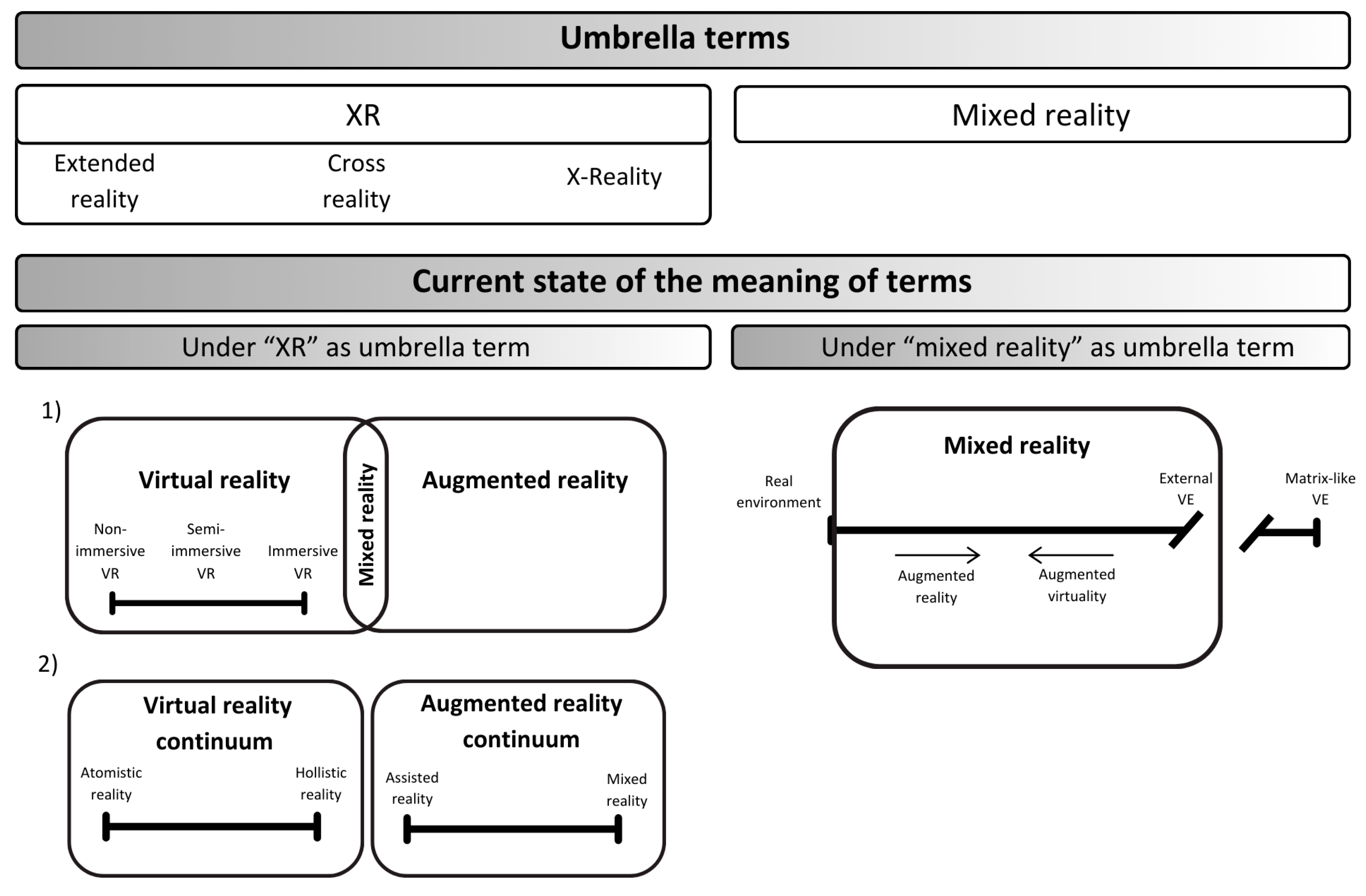
Figure 1. The current state of umbrella terms with the most common understanding and contemporary proposals for the meaning of VR and related technologies. VR and related technologies, such as augmented reality (AR) and mixed reality (MR), are commonly grouped under the umbrella term XR. This abbreviation refers to “extended reality”, “cross reality”, or “X-reality”, with no significant difference in meaning between these terms. Under the umbrella of XR, VR and AR are the most frequently included components, with their combination forming MR (as shown in point 1 in Figure 1). In healthcare, this understanding of the relationships between VR, AR, and MR is the most widely accepted, where VR is further categorized based on the level of immersion, ranging from non-immersive to immersive VR. Recently, Rauschnabel et al., (2022) distinguished VR and AR across two separate continua (see point 2 in Figure 1). According to their framework, VR spans from atomistic VR, which prioritizes specific goals over user experience, to holistic VR, characterized by immersive experiences that are indistinguishable from real-world interactions. In contrast, AR is described as ranging from assisted AR, where virtual objects are clearly artificial overlays on real-world objects, to MR, where the integration of virtual and real objects becomes indistinguishable. In contrast, Skrabez et al., (2021) proposed “mixed reality” as the umbrella term, building upon and updating the framework introduced by Milgram and Kishino in 1994. According to their understanding, MR encompasses environments where real-world and virtual objects and stimuli are presented together within a single percept. MR environments where the real world is augmented with virtual content are referred to as AR, while environments where most content is virtual but there is some inclusion of real-world elements are termed augmented virtuality (AV). Under this interpretation, MR also encompasses VR, which they term an "external virtual environment (VE)" that includes only the stimulation of exteroceptive senses. At the far-right end of the continuum lies “Matrix-like VE”, which is excluded from MR (along with the purely real environment on the left end) and represents a simulation of both exteroceptive and interoceptive senses, a level of immersion that cannot be achieved in the real world.
Preprints 143373 g001
Figure 2. Our proposal for naming environments currently defined as ''non-immersive VR''. We propose that such environments be referred to as “non-immersive fully artificial environments''. Additionally, we propose “non-immersive fully artificial environments” should neither be classified as VR nor included under the XR umbrella (or mixed reality, which some propose as an umbrella term for VR and related technologies). “Non-immersive fully artificial environments” can be interactive (e.g., Wii games) or non-interactive (e.g., watching television). Typically, they are accessed through devices such as computers, televisions, or smartphones. According to the proposed term, so-called VR caves would also fall under "non-immersive fully artificial environments" (moreover, their name should no longer include the term VR).
Preprints 143373 g002
Figure 3. (3a) Representation of the most commonly mentioned categorization of VR based on immersion in healthcare. Currently, in healthcare, VR is classified on a single continuum of immersion depth, ranging from non-immersive VR (often involving systems such as Wii games) to immersive VR, typically associated with the use of HMDs. (3b) Our proposed categorization of virtual reality based on immersion levels. We propose that the depth of immersion should be divided into two dimensions: the immersion depth of the exteroceptive and interoceptive systems. Additionally, immersion depth should also account for whether it is influenced by the number of senses stimulated or the quality of virtual stimulation.
Preprints 143373 g003
Disclaimer/Publisher’s Note: The statements, opinions and data contained in all publications are solely those of the individual author(s) and contributor(s) and not of MDPI and/or the editor(s). MDPI and/or the editor(s) disclaim responsibility for any injury to people or property resulting from any ideas, methods, instructions or products referred to in the content.
Copyright: This open access article is published under a Creative Commons CC BY 4.0 license, which permit the free download, distribution, and reuse, provided that the author and preprint are cited in any reuse.
Prerpints.org logo

Preprints.org is a free preprint server supported by MDPI in Basel, Switzerland.

Subscribe

Disclaimer

Terms of Use

Privacy Policy

Privacy Settings

© 2025 MDPI (Basel, Switzerland) unless otherwise stated