

Submitted:
13 December 2024
Posted:
16 December 2024
You are already at the latest version
Abstract
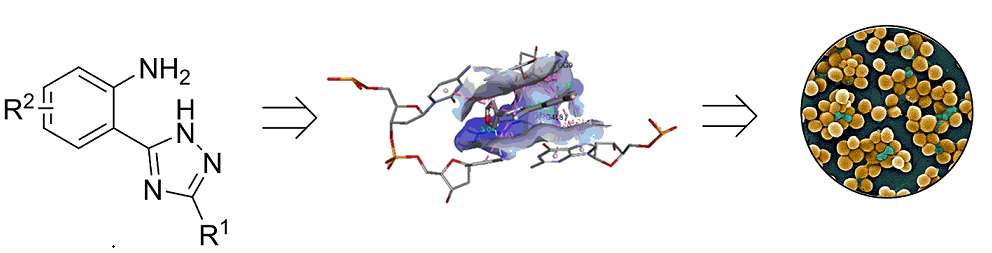
Background: In the era of resistance, the design and search for new "small" molecules with a narrow spectrum of activity, which would target a protein or enzyme specific to a certain bacterium, with high selectivity and minimal side effects, remains an urgent problem of medicinal chemistry. In this regard, we have developed and successfully implemented a strategy for the search for new hybrid molecules, namely the not broadly known [2-(3-R-1H-[1,2,4]-triazol-5-yl)phenyl]amines. They can act as "building blocks" and allow the introduction of certain structural motifs into the desired final products in order to enhance the anti-staphylococcal effect. Methods: "One-pot" synthesis of the latter is based on the conversion of substituted 4-hydrazinoquinazolines or substituted 2-aminobenzonitriles and carboxylic acid derivatives to the target products. The purity, and structure of the synthesized compounds were proven using elemental analysis, LC-MS, 1H and 13C NMR spectra, and X-ray diffraction. The possible molecular mechanism of the synthesized compounds (DNA gyrase inhibitors) was investigated and discussed by molecular docking, and their further study for anti-staphylococcal activity was substantiated. Results. A significant part of the obtained compounds showed high antibacterial activity against Staphylococcus aureus (MIC 10.1-62.4 µM), and 5-bromo-2-(3-(furan-3-yl)-1H-1,2,4-triazol-5-yl)aniline and 5-fluoro-2-(3-(thiophen-3-yl)-1H-1,2,4-triazol-5-yl)aniline with MICs of 5.2 and 6.1 µM, respectively, approaching the strength of the effect to the reference drug "Ciprofloxacin" (MIC 4.7 µM). The conducted SAR- and ADME-analysis confirm the prospects of further structural modification of these compounds. Conclusions: Obtained [2-(3-R-1H-[1,2,4]-triazol-5-yl)phenyl]amines reveal significant antimicrobial activity and deserve further structural modification and detailed study as effective anti-staphylococcal agents.
Keywords:
triazole
; «one-pot» synthesis
; molecular docking
; anti-staphylococcal activity
1. Introduction
Globalization of all human activities is a feature of modern society’s development Among the singularities of globalization is the ongoing urbanization, which leads to significant changes in the social and demographic structure of society. These processes and climate changs have led to a significant spread of infectious diseases. Despite the progress of antibiotic therapy, the sensitivity of microorganisms to existing antimicrobials is significantly decreasing from year to year, and antibiotic-resistant strains of microorganisms are emerging among as hospital, so non-hospital infections. This is due, to the limited number of effective medicines used to treat infections [1,2], and to their uncontrolled use, which leads to synergistic combinations of known and new resistance mechanisms [3,4].
Specially dangerous are infections caused by Staphylococcus aureus, which is primarily associated with many virulence factors, including toxins, superantigens and exoproteins that are associated with the cell membrane. In addition, the emergence of methicillin-resistant Staphylococcus aureus (MRSA) strains both in health care settings and in the community has increased the risk of infections, as they usually have multiple drug resistance. This results in serious health problems for patients, increased morbidity and mortality, increased length of hospital stay, and a significant economic burden on the health care sector. At the same time, a wide arsenal of natural antibiotics, their constant replenishment with new semi-synthetic and synthetic antimicrobial drugs [5,6], did not solve the mentioned problem, despite the fact that the design and search for antibacterial agents underwent significant changes [7,8]. The problem of treating infections caused by MRSA is further complicated by the fact that MRSA acquires antibiotic resistance genes in various ways [1,4,6]. It became particularly acute after the registration of strains resistant to Vancomycin, which was the drug of choice for the treatment of MRSA [9].
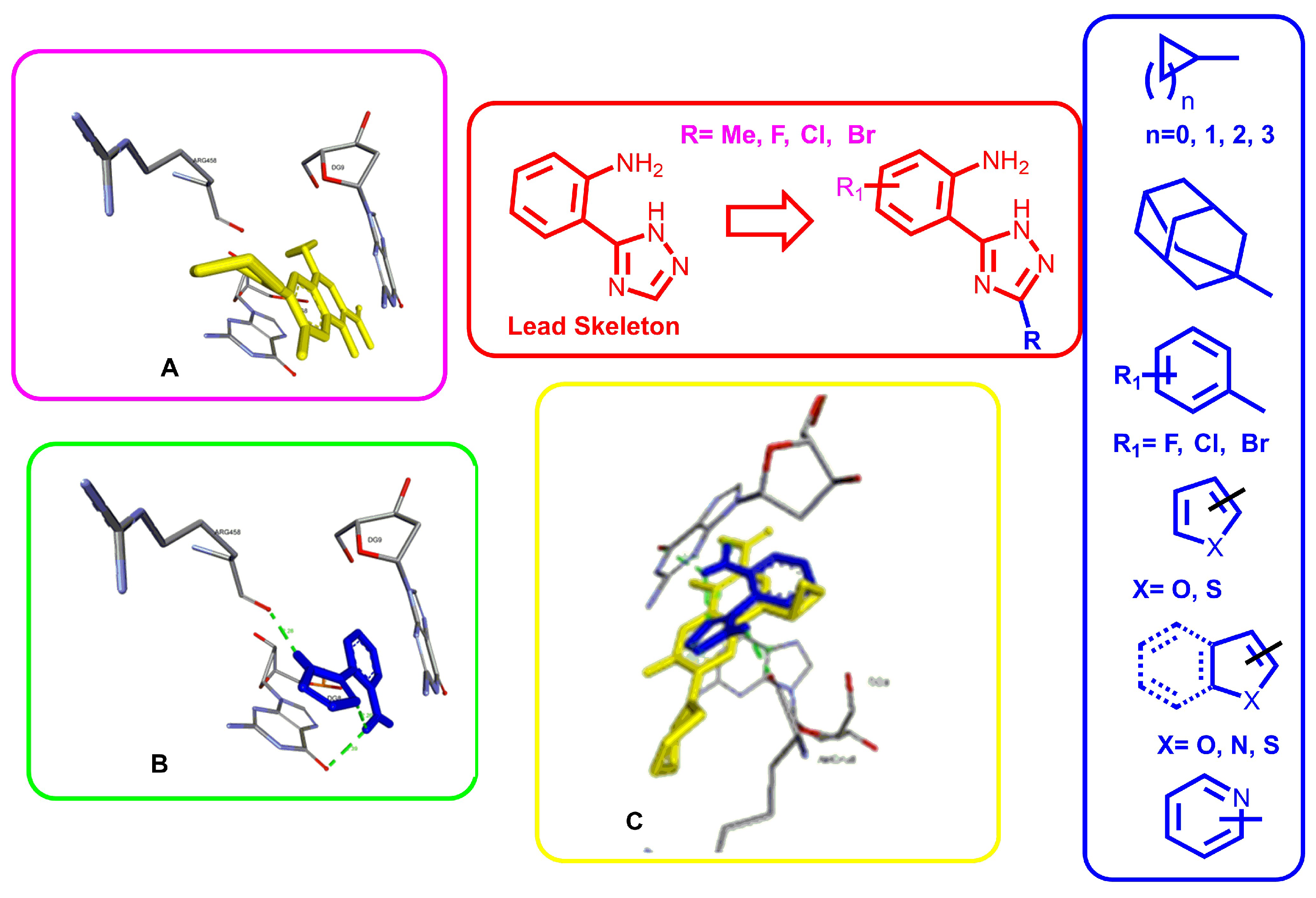
An important strategy for the search for effective anti-staphylococcal agents is research aimed at inhibiting the growth of bacteria by blocking the transmission of information from bacterial DNA and RNA [10,11,12,13,14,15]. Essential enzymes for DNA replication and transcription in this case are DNA gyrase, topoisomerase IIA and topoisomerase IV - important targets for bacterial inhibitors [16,17]. To date, a significant number of noted inhibitors have been synthesized, but attempts to introduce new antimicrobial agents of DNA gyrase inhibitors were unsuccessful (Novobiocin) [10,12], and the latest development (Gepotidacin, GSK2140944) is in the third phase of clinical trials [18]. Therefore, the complexity and variety of resistance mechanisms remains the main factor that prompts scientists to further develop new antibacterial drugs. In most cases, the design is aimed at the modification of known antibiotics and antibacterial drugs [15,19,20,21], the synthesis of new “small” molecules with a narrow spectrum of activity [15,22,23], the development of antibacterial polypeptides [24], antibacterial complexes with transition metals [25], etc. An important class among “small” molecules are also new hybrid structures based on 1,2,4-triazole, which have a significant potential for the realization of a polytargeted mechanism of activity and promising broad-spectrum antibacterial activity against a number of clinically important pathogens, including resistant strains of MRSA [26,27,28,29,30]. In particular, it is shown that 1,2,4-triazole-azoles, 1,2,4-triazole-coumarins, 1,2,4-triazole-β-lactams, 1,2,4-triazole-pyrimidines, 1,2,4-triazole-quinolines and 1,2,4-triazole-quinazolines are highly active against both sensitive and resistant pathogens and were not inferior in effectiveness to first-line antibacterial drugs. So, interesting objects in the direction of this research can be substituted 2-(3-R-1,2,4-triazol-5-yl)anilines, and their choice is not accidental and, first of all, is related to the peculiarity of the structure [31,32]. Thus, the specified structures are characterized by conformational and configurational isomerism, in most cases they have a low molecular weight, they can have the required number of donors and acceptors in the molecule due to structural modification of the benzene ring and 3rd position of the triazole ring. It is also important to be able to change several physicochemical parameters, such as solubility and lipophilicity. Another important selection criterion was a small topological polar surface area, which indicates a high ability to easily penetrate the blood-brain barrier and flexibly interact with the biological target. In addition, the performed molecular docking gave us a general idea of the interactions and similar arrangement in the active site of DNA gyrase (2XCT) of 2-(1,2,4-triazol-5-yl)aniline (TA) and the standard ligand Ciprofloxacin (Figure 1).
Therefore, in this study, we aim to develop methods of synthesis, to evaluate the anti-staphylococcal effect of little-known hybrid molecules created by combining 2-(1,2,4-triazol-5-yl)anilines with various molecular “pharmacophore” fragments (Figure 1), to conduct molecular docking, qualitative and quantitative analysis of the “structure-activity” relationship, to understand their potential as effective anti-staphylococcal agents.
2. Results and Discussion
2.1. Chemical Studies
Within the framework of this work, we were interested in the development of a “one-pot” synthesis of [2-(3-R-1H-[1,2,4]-triazol-5-yl)phenyl]amines (2), which, in addition, would allow their further application as building blocks for the formation of new biologically active heterocycles and the study of potential anti-staphylococcal activity. Moreover, the methods of their synthesis are multistep [33,34,35] or based on the degradation of triazolo[c]quinazoline systems [36]. In search of a convenient method for the synthesis of new [2-(3-R-1H-[1,2,4]triazol-5-yl)phenyl]amines (2), we drew attention to the ease of Dimroth rearrangement and nucleophilic opening of the pyrimidine ring in a series of triazolo[c]quinazolines [37]. Theoretical calculations of the mechanisms of these reactions showed that acid-catalytic hydrolysis with the participation of an equimolecular amount of water is necessary for the Dimroth rearrangement, and for the opening of the pyrimidine cycle, the same acid hydrolysis with an excess of water [37].
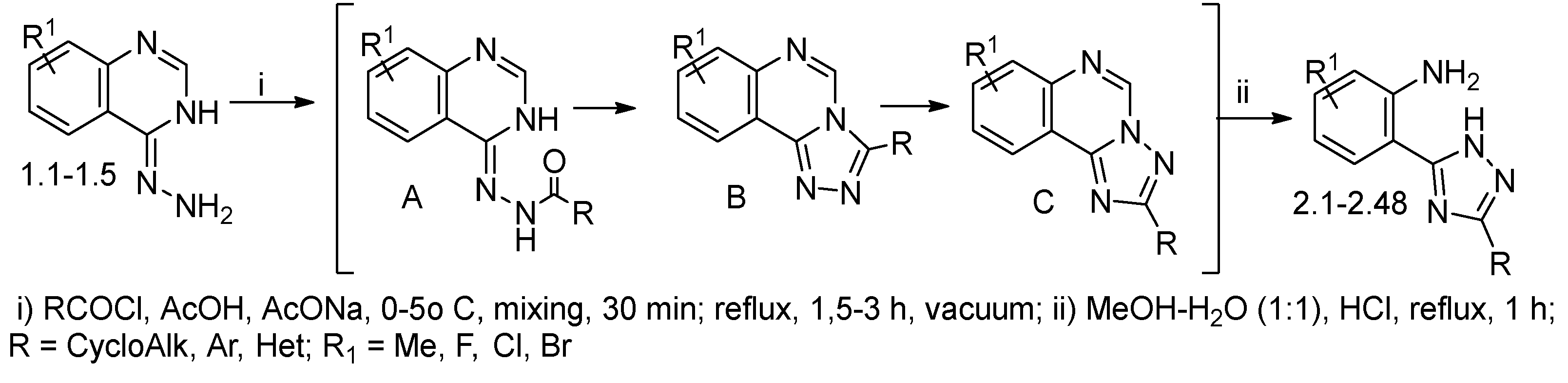
Our attempt to conduct a “one-pot” synthesis of 2-(3-cyclopropyl-1H-1,2,4-triazol-5-yl)-aniline (2.1) was successful (Scheme 1). Indeed, the acylation of compound 1.1 by cyclopropanecarbonyl chloride in acetic acid in the presence of sodium acetate quantitatively gave hydrazide (A), which was subjected to heterocyclization without isolation (Method A). The subsequent process of nucleophilic opening of the triazolo[c]quinazoline ring (C) requires the removal of the solvent and the addition of a methanol-water mixture (5:1) acidified with a mineral acid. At the same time, compound 2.1 is formed with an almost quantitative yield (98%). Inspired by these results, we carried out a “one-pot” synthesis of compounds 2.2-2.48 (Scheme 1). Developed procedure has some peculiarities including the commercial unavailability of some acyl halides, which led to certain modifications of the method, namely in situ preparation of acyl chlorides.
Another, alternative “one-pot” synthesis of compounds 2 was tested by us starting from 2-aminobenzonitrile (3.1, Scheme 2). Thus, the latter under the action of DMF/DMA was transformed into N’-(2-cyanophenyl)-N,N-dimethylformimidamides (A), which after removing the excess reagent and solvent were subjected to heterocyclization with hydrazides of carboxylic acids in acetic acid (method B). At the same time, triazolo[c]quinazoline cycle (C) is quantitatively formed after removal of the solvent. The last technological process completely repeated the previous method A. At the same time, the target products 2.22-2.27, 2.32, 2.38, 2.46, 2.47 are formed with almost quantitative yields.
The structure and purity of obtained compounds were verified by complex of physicochemical methods including elemental analysis, LC/MS, 1H and 13C NMR, X-Ray. It was shown that in LC-MS spectra of all synthesized compounds signals with m/z values that correspond to the proposed structures were present.
The formation of [2-(3-R-1H-[1,2,4]-triazol-5-yl)phenyl]amines (2) drastically changes the pattern of 1H NMR spectra in comparison with intermediate [1,2,4]triazolo [1,5-c]quinazolines (C) [38]. Firstly, it is the absence in the 1H NMR spectra of the singlet signal of the 5th position proton of the tricyclic system (C) in a low field (9.70-9.25 ppm). Whereas, in the 1H NMR spectra of compounds 2, there are signals of protons of the NH2 group of the aniline fragment, which are registered in the spectrum in the form of a broadened singlet or a doubled singlet at 6.72-5.97 ppm (2.1, 2.2, 2.4-2.6, 2.8-2.14, 2.16-2.18, 2.20-2.23, 2.26, 2.28, 2.30, 2.31, 2.33-2.42, 2.45, 2.46), in the form of a multiplet together with aromatic protons (2.3, 2.7, 2.15, 2.19, 2.24, 2.25, 2.27, 2.29, 2.32, 2.47, 2.48) or absent from the spectrum (2.43, 2.44,). The broadening and doubling of the noted protons in the 1H NMR spectrum can be explained by the azole-azole (prototropic) tautomerism of compounds 2 [31,36]. In favor of tautomeric transitions in molecules, the broadening, doubling, or absence (2.24, 2.25, 2.27, 2.32, 2.38, 2.43) of the singlet NH-proton signal of the triazole ring in a low magnetic field is also indicated. In addition, the 1H NMR spectra of compounds 2 are characterized by the signals of the aromatic protons of the aniline fragment, which undergo a diamagnetic shift due to the electron-donating effect of the amino group. Synthesized compounds are additionally characterized by signals of protons of substituents at the 3rd position of the triazole ring, the chemical shift and multiplicity of which are determined by the nature of the substituent [39]. The 13C NMR spectra of compounds 2 are characterized by a significant paramagnetic shift of the C1 atom of the aniline fragment (147.7-141.4 ppm) compared to other carbon atoms of the aromatic system, due to the donor effect of the amino group, which indicates hydrolytic cleavage of the pyrimidine ring. The signals of C3 and C5 atoms of the triazole ring in compounds 2 are registered as broadened singlets at 162.8 - 153.7 ppm and 171.5 - 154.1 ppm (2.17, 2.22-2.26) or absent (2.1, 2.13, 2.32, 2.46) in the spectra, which also confirms tautomeric transitions in DMSO-d6 solutions.
To unambiguously confirm the “one-pot” synthesis of compounds 2.1 we performed an X-ray crystallographic study of compound 2.1. The single crystal for X-ray studies was grown by crystallization of compound 2.1 from methanol. The triazole ring is not coplanar to the phenyl moiety (the C11–C6–C5–N2 torsion angle is 16.0(6)°) due to opposite influence of two factors: 1) the intramolecular hydrogen bond N4–H…N2’ (the H…N distance is 2.02 Å, the N–H…N angle is 142°) and 2) steric repulsion between two aromatic rings (the short intramolecular contact H7…N1 2.57 Å compared to the van der Waals radii sum [40] 2.67 Å). The amino group has pyramidal configuration, the sum of bond angles centered at the N4 atom is 328°. The cyclopropyl fragment is turned in such a way that the C2–H bond is sin-periplanar to the C1–N3 endocyclic bond (the N3–C1–C2–H2 torsion angle is 11.6°). In the crystal phase, molecules of compound 2.1 form chains in the crystallographic direction (Figure 2) due to the intermolecular hydrogen bonds N3–H…N1’ (symmetry operation 0.5+x,1.5-y,z; the H…N distance is 2.01 Å, the N–H…N angle is 172°).
2.2. Molecular Docking Studies
To optimize further in vitro studies on the anti-staphylococcal activity of the synthesized derivatives, as well as to determine the possible molecular mechanism of their action, a procedure of molecular docking to the active site of DNA-gyrase inhibitors was carried out. The results of the affinity calculation in kcal/mol and the details of interactions with respect to the reference ligand - “Ciprofloxacin” are shown in Table 1 and Table S1. It was established that almost all studied ligands (except for compounds 2.17-2.21) demonstrated a high degree of affinity for the site of the DNA gyrase enzyme inhibitor, the affinity ranged from -5.6 to -9.2 kcal/mol compared to -6.7 kcal/mol in “Ciprofloxacin”.
As visualized in Figure 3A, standard ligand “Ciprofloxacin” has hydrogen bonds -COOH group of 3rd position with SER1048 (2.51 Å), NH group of piperazine ring with ARG458 (3.20 Å), fluorine atom with nucleotide base DC13 (2.85 Å) and van der Waals interactions with nucleotides DG9 (2.96; 3.01; 3.25 Å), G:DC12 (3.47 Å). In addition, the standard ligand is characterized by a number of hydrophobic π-π-shaped and π-alkyl interactions with nucleotide bases DG8 (4.11; 4.33; 5.05; 5.50 Å), G:DC13 (5.56 Å) and DG9 (3.43; 4.10 ; 4.18; 4.33 Å) of DNA, which stabilize it within the active site. (Table 1, Table S1, Figure 4.A1, A2).
The conformation of the key 2-(1,2,4-triazol-5-yl)anilines fragment in all studied ligands in the active site is practically the same and occupies a place similar to the quinoline cycle (Table S1, Figure 3, Figure 4). In our opinion, this is related to a small topological polar surface area, which outlines a large number of similar interactions with experimentally determined amino acids or nucleotides in the active site (Table S1). A significant difference from the standard ligand is that the studied ligands do not interact with the SER1048 residue, which was provided by the -COOH group of “Ciprofloxacin”.
At the same time, 2-(1,2,4-triazol-5-yl)anilines with acceptor substituents and, as a result, high affinity, are fixed in the active site of DNA-gyrase due to a much larger number of hydrogen bonds with ARG458 and nucleotide bases (DG8, DG9, DC12 and DC13) (Table S1). For example (Figure 3B), the stable “ligand-receptor” conformation for 2.31 is fixed due to the predicted five hydrogen bonds with ARG458 (2.26; 3.04; 3.43 Å) and DG9 nucleotides (2.30 Å), G:DC13 (3.51 Å), as well as hydrophobic π-π-stacked interactions with DG8 (4.21; 4.36 Å), DG9 (3.74; 4.05; 4.15; 4 .71 Å), DC12 (5.69 Å) and DC13 (4.63 Å) (Figure 4B1,B2). In addition, ligand 2.31 has an intramolecular hydrogen bond N4-NH2 (1.85 Å), which is also predicted in other compounds (Figure 2, Table S1), and which apparently stabilizes the molecule in a certain more favorable conformational form.
Thus, the detailed conformational analysis of the investigated ligands 2 and “Ciprofloxacin”, exemplified by 2.31 (Table S1, Figure 4), which exhibit high affinity, demonstrates similarity in spatial arrangement. This confirms their ability to penetrate the hydrophilic pocket of DNA gyrase and form stable conformations within the active site. The aforementioned observations indicate a high probability that the synthesized ligands will manifest anti-staphylococcal activity through DNA gyrase inhibition. For the in vitro investigation, all synthesized compounds have been selected to gain a more comprehensive understanding of the structure-activity relationship.
2.3. Anti-Staphylococcal Activity of Synthesized Compounds
The anti-staphylococcal activity of compounds 2 was studied against the Staphylococcus aureus ATCC 25923 strain (Table 2). Most of the synthesized compounds showed antibacterial activity against S. aureus (MIC 5.2-933.4 μM and MBC 10.4-933.4 μM). Thus, among the cycloalkyl-substituted (2.1-2.21) compounds 2.1, 2.5, 2.9, 2.12, 2.17 and 2.18 show a high antibacterial effect, their MIC is in the range of 10.1-438.0 μM, and MBC is 20.2-438.0 μM. The highest anti-staphylococcal activity is characteristic of compounds 2.17 and 2.18, namely their MIC is 10.1-10.6 μM and MBC – 20.2-21.2 μM and is closest in effect to the reference drug “Ciprofloxacin” (MIC 4.7 μM; MBC 9.6 μM). 2-(3-Aryl-1H-1,2,4-triazol-5-yl)anilines (2.22-2.26) also exhibit anti-staphylococcal activity (MIC 12.4-317.3 μM, MBC 24.8-786.6 μM) and, importantly, compound 2.26 showed the highest antibacterial activity (MIC 12.4 μM, MBC 24.8 μM). Among 2-(3-hetaryl-1H-1,2,4-triazol-5-yl)anilines (2.27-2.48) high anti-staphylococcal activity (MIC 5.5-25.6 μM; MBC 10.4-52.8 μM) showed compounds 2.28-2.31, 2.33-2.35, 2.39, 2.41 and 2.46, and all other compounds showed slightly lower activity (MIC 42.5-221.0 μM; MBC 84.9-442.0 μM).
The most active among the investigated compounds against the S. aureus strain were found to be 5-bromo-2-(3-(furan-3-yl)-1H-1,2,4-triazol-5-yl)aniline (2.31) and 5-fluoro-2-(3-(thiophen-3-yl)-1H-1,2,4-triazol-5-yl)aniline (2.35) with MICs of 5.2 and 6.1 μM, respectively, approaching in potency to the reference drug “Ciprofloxacin” (Table 2). In addition, based on the MBC/MIC ratio (Table 2), it was established that all these compounds (except 2.9, 2.13) exhibit bactericidal activity, which has a certain advantage over bacteriostatic activity.
2.4. SAR-Analysis
On the basis of molecular docking and the obtained results of synthesized compounds` antibacterial activity (Table 2) against S. aureus “structure-activity” could be generalized as follows:
- introduction of cyclopropane fragment to the 3rd position of the triazole fragment of the 2-(1H-1,2,4-triazol-5-yl)aniline leads to the appearance of an antibacterial effect against St. aureus. The extension of the aliphatic cycle by one or more homologous units increases the antibacterial effect, and the presence of the classic “pharmacophoric” fragment of adamantane in the molecule leads to a high anti-staphylococcal effect. Conversely, modification of the aniline moiety of the molecule through the introduction of halogens results in a loss of antibacterial activity in nearly all instances. This phenomenon is likely associated with alterations in the “ligand-receptor” conformation.
- replacing the cycloalkyl fragment at the 3rd position of triazole cycle with phenyl fragment does not lead to a loss of anti-staphylococcal activity. Whereas the introduction of a halogen to the phenyl fragment in 3rd position leads to its reduction, the relocation of fluorine to the ortho position results in a significant increase thereof.
- introduction of 5 or 6 membered heterocyclic fragments to the 3rd position of triazole cycle, which are electron donors due to the heteroatom (O, N, S) unambiguously leads to high anti-staphylococcal activity. The aforementioned phenomenon is associated with an increase in π-electron interactions with nucleotides and, consequently, a greater similar content in the active site of the enzyme. Notably, the introduction of donor (methyl group) or acceptor (halogens) substituents to the aniline moiety leads to an enhancement of activity.
Thus, the emergence of anti-staphylococcal activity in the synthesized compounds can be attributed to their structural features, which are responsible for interactions with the active center of DNA gyrase. It can be observed that the H-bonding domain of 2-(1,2,4-triazol-5-yl)anilines is similar to that of the standard ligand “Ciprofloxacin”. Certain differences, such as the absence of the -COOH group, are compensated for by acceptor substituents at positions 3 and 4(5) of the molecule.
2.5. SwissADME Analysis
The criteria for “drug-likeness” are crucial in the process of discovering new medicinal agents, providing valuable recommendations in the early stages of drug discovery and increasing the chances of success in clinical trials [41]. The aforementioned characteristics influence pharmacokinetics (absorption, distribution, metabolism, and excretion), and consequently, the pharmacological activity and efficacy of the investigated medicinal agents. The “drug-likeness” criteria for the most active compounds (2.17, 2.18, 2.26, 2.28, 2.30, 2.31, 2.34, 2.35, 2.39, 2.46) and “Ciprofloxacin” are presented in Table 3.
The results of virtual screening demonstrated that the compounds, as well as the reference drug, comply with the “drug-likeness” requirements according to the criteria of MW (Da) (< 500), n-HBA (< 10), n-HBD (≤ 5), TPSA (< 140 Ų), and logP (≤ 5). The satisfactory TPSA value (> 140 Ų) correlates well with passive molecular transport across membranes, and the compounds exhibit a high capacity to penetrate the blood-brain barrier and flexibly interact with the macromolecular target. The investigated structures also showed favorable results in bioavailability assessment [47], with an index of 0.55. Furthermore, the compounds were evaluated using five different filters (Lipinski, Veber, Muegge, Ghose, Egan) [42,43,44,45,46] employed by pharmaceutical companies to analyze molecules with the aim of enhancing the quality of their chemical collections. As observed, the calculated/predicted physicochemical descriptors indicate that the investigated compounds, in most cases, meet the requirements of all filters without deviations. Finally, the majority of the compounds demonstrate a high level of drug-likeness and are suitable for further optimization. Thus, the satisfactory parameters from the SwissADME analysis allow for subsequent modification of promising compounds in this class to achieve the desired parameters.
3. Materials and Methods
3.1. Synthetic Section
Melting points were determined in open capillary tubes in a «Mettler Toledo MP 50» (Columbus, USA) apparatus and were uncorrected. The elemental analyses (C, H, N) were performed using the ELEMENTAR vario EL cube analyzer (Langenselbold, Germany). Analyses were indicated by symbols of the elements or functions within ±0.3% of the theoretical values. 1H NMR spectra (500 MHz) were recorded on a Varian Mercury 500 (Varian Inc., Palo Alto, USA) spectrometers with TMS as an internal standard in DMSO-d6 solution. LC-MS was recorded using a chromatography/mass spectrometric system which consists of high-performance liquid chromatography «Agilent 1100 Series» (Agilent, Palo Alto, USA) equipped with diode-matrix and mass-selective detector «Agilent LC/MSD SL» (Agilent, Palo Alto, USA) (atmospheric pressure chemical ionization—APCI). The purity of all obtained compounds was checked by 1H-NMR and LC-MS.
Method A. 0.82 g (0.01 M) of sodium acetate was added to a suspension of 0.01 M of substituted 4-hydrazinoquinazolines (1.1-1.5) in 15 ml of glacial acetic acid and the formed mixture was cooled to 0-5oC. 0.01 M of commercially available acyl chlorides in 5 ml of glacial acetic acid (or a freshly prepared solution of 0.01 mol of the corresponding acyl chloride in 15 ml of dioxane) were added dropwise and reactional mixture was stirred continuously for 30 minutes. After that, the reaction mixture was refluxed for 1.5-3 hours. While refluxing water (or water-dioxane azeotrope) was removed by distillation with Dean-Stark trap. After the completion of the reaction, the solvent was completely removed under vacuum, 10 ml of methanol, 10 ml of water, 1 ml of concentrated hydrochloric acid were added to the residue and refluxed for 1 hour. After cooling, the reaction mixture was poured into a saturated solution of sodium acetate, controlling the pH to 4-5. The resulting precipitate was filtered off and dried. The compounds were crystallized from methanol or propan-2-ol.
Method B. To the solution of 1.18 g (0.01 M) of 2-aminobenzonitrile (3.1) in 5 ml of toluene, add 2.38 g (0.02 M) of N,N-dimethylformamide dimethyl acetal (DMF-DMA) and acetic acid (0.10 mL) and heated at 60°C for 60 min. Toluene and excess of DMF-DMA were completely removed under vacuum [48]. 0.01 M of the corresponding carboxylic acid hydrazide and 10 ml of glacial acetic acid were added to the residue. The reaction mixture was refluxed for 1.5-3 hours with removal of water by Dean-Stark trap. After the procedure, the solvent was removed under vacuum to dryness, 10 ml of methanol, 10 ml of water, 1 ml of concentrated hydrochloric acid were added to the residue and refluxed for 1 hour. After cooling, the reaction mixture was poured into a saturated solution of sodium acetate, controlling the pH to 4-5. The resulting precipitate was filtered off and dried. The compounds were crystallized from methanol or propan-2-ol.
2-(3-Сyclopropyl-1H-1,2,4-triazol-5-yl)aniline (2.1); Yield: 98.0 % (Method A), mp 209-211 °C; 1Н NMR, δ = 1.16-0.81 (m, 4H, cyclopropyl H-2,2,3,3), 2.13 – 1.97 (m, 1H, cyclopropyl H-1), 6.26 (br.s, 2Н, NH2), 6.52 (t, J = 7.5 Hz, 1H, H-4), 6.69 (d, J = 8.1 Hz, 1H, H-6), 7.00 (t, J = 7.8 Hz, 1H, H-5), 7.76 (d, J = 6.9 Hz, 1H, H-3), 13.46 (br.s, 1Н, NH); 13C NMR, δ 147.1 (aniline C-1), 130.1 (aniline C-3), 127.9 (aniline C-5), 116.2 (aniline C-4), 115.6 (aniline C-6), 101.7 (aniline C-2), 39.6 (cyclopropyl C-1), 8.2 (cyclopropyl C-2,3); LC-MS, m/z = 201 [M+1]; Calculated for: C11H12N4: C, 65.98; H, 6.04; N, 27.98; Found: C, 65.96; H, 6.05; N, 27.97.
2-(3-Сyclopropyl-1H-1,2,4-triazol-5f-yl)-6-methylaniline (2.2); Yield: 90.1 % (Method A), mp 158-160 °C; 1Н NMR, δ = 0.92/1.05 (d, J = 6.7 Hz, 4H, cyclopropane H-2,2,3,3), 2.11 – 1.96 (m, 1H, cyclopropyl H-1), 2.15 (s, 3H, CH3), 6.30/5.93 (bs, 2Н, NH2), 6.61 – 6.41 (m, 1H, H-4), 6.98/6.91 (d, J = 7.1 Hz, 1H, H-5), 7.79/7.51 (d, J = 7.9 Hz, 1H, H-3), 13.51/13.43 (br.s, 1Н, NH); Calculated for: C12H14N4: C, 67.27; H, 6.59; N, 26.15; Found: C, 67.26; H, 6.60; N, 26.15.
2-(3-Сyclopropyl-1H-1,2,4-triazol-5-yl)-5-fluoroaniline (2.3); Yield: 97.7 % (Method A), mp 242-244 °C; 1Н NMR, δ = 1.04/0.91 (d, J = 6.7Hz, 4H, cyclopropyl H-2,2,3,3), 2.12 – 1.91 (m, 1H, cyclopropyl H-1), 6.33 – 6.16 (m, 1H, H-4), 6.53 – 6.33 (m, 3H, NH2, H-6), 6.86 – 6.77 (m, 1H, H-6), 7.87/7.63 (d, J = 7.8 Hz, 1H, H-3), 13.48 /13.40 (br.s, 1Н, NH); LC-MS, m/z = 219 [M+1]; Calculated for: C11H11FN4: C, 60.54; H, 5.08; N, 25.67; Found: C, 60.51; H, 5.09; N, 25.66.
4-Сhloro-2-(3-cyclopropyl-1H-1,2,4-triazol-5-yl)aniline (2.4); Yield: 98.7 % (Method A), mp 237-239 °C; 1Н NMR, δ = 1.05/0.91 (d, J = 6.8 Hz, 4H, cyclopropyl H-2,2,3,3), 2.14 – 1.95 (m, 1H, cyclopropyl H-1), 6.28 (bs, 2Н, NH2), 6.81 – 6.55 (m, 2H, H-6), 7.07 – 6.84 (m, 1H, H-5), 7.84/7.70 (s, 1H, H-3), 13.60/13.52 (br.s, 1Н, NH); LC-MS, m/z = 235 [M+1]; Calculated for: C11H11ClN4: C, 56.30; H, 4.72; N, 23.87; Found: C, 56.28; H, 4.74; N, 23.86.
2-(3-Сyclobutyl-1H-1,2,4-triazol-5-yl)aniline (2.5); Yield: 77.1 % (Method A), mp 147-149 °C; 1Н NMR, δ = 2.18 – 1.88 (m, 2H, cyclobutyl H-3,3), 2.47 – 2.23 (m, 4H, H-2,2,4,4), 3.74 – 3.55 (m, 1H, cyclobutyl H-1), 6.27 (br. s, 2Н, NH2), 6.54 (t, J = 7.5 Hz, 1H, H-4), 6.71 (d, J = 8.2 Hz, 1H, H-6), 7.13 – 6.94 (m, 1H, H-5), 7.92/7.66 (m, 1H, H-3), 13.58/13.45 (br.s, 1Н, NH); LC-MS, m/z = 215 [M+1]; Calculated for: C12H14N4: C, 67.27; H, 6.59; N, 26.15; Found: C, 67.26; H, 6.60; N, 26.15.
2-(3-Сyclobutyl-1H-1,2,4-triazol-5-yl)-6-methylaniline (2.6); Yield: 92.2 % (Method A), mp 127-129 °C; 1Н NMR, δ = 2.12 – 1.90 (m, 2H, cyclobutyl H-3,3), 2.17 (s, 3H, CH3), 2.47 – 2.26 (m, 4H, cyclobutyl H-2,2,4,4), 3.82 – 3.49 (m, 1H, cyclobutyl H-1), 6.39/5.99 (bs, 2Н, NH2), 6.52 (t, J = 7.6 Hz, 1H, H-4), 6.98/6.93 (m, 1H, H-5), 7.81/7.55 (m, 1H, H-3), 13.58/13.45 (bs, 1Н, NH); LC-MS, m/z = 229 [M+1]; Calculated for: C13H16N4: C, 68.39; H, 7.06; N, 24.54; Found: C, 68.38; H, 7.07; N, 24.55.
2-(3-Сyclobutyl-1H-1,2,4-triazol-5-yl)-5-fluoroaniline (2.7); Yield: 94.8 % (Method A), mp 165-167 °C; 1Н NMR, δ = 2.17 – 1.86 (m, 2H, cyclobutyl H-3,3), 2.46 – 2.29 (m, 4H, cyclobutyl H-2,2,4,4), 3.76 – 3.47 (m, 1H, cyclobutyl H-1), 6.26 (d, J = 8.3 Hz, 1H, H-4), 6.61 - 6.33 (m, 3Н, NH2, H-6), 7.07 – 6.79 (m, 1H, H-6), 7.93/7.65 (t, J = 8.0 Hz, 1H, H-3), 13.55/13.42 (bs, 1Н, NH); LC-MS, m/z = 233 [M+1]; Calculated for: C12H13FN4: C, 62.06; H, 5.64; N, 24.12; Found: C, 62.04; H, 5.65; N, 24.11.
4-Chloro-2-(3-cyclobutyl-1H-1,2,4-triazol-5-yl)aniline (2.8); Yield: 99.3 % (Method A), mp 176-178 °C; 1Н NMR, δ = 2.21 – 1.86 (m, 2H, cyclobutyl H-3,3), 2.49 – 2.20 (m, 4H, cyclobutyl H-2,2,4,4), 3.78 – 3.52 (m, 1H, cyclobutyl H-1), 6.33 (bs, 2Н, NH2), 6.72 (d, J = 8.6 Hz, 1H, H-6), 6.96 (d, J = 8.7 Hz, 1H, H-5), 7.90/7.73 (s, 1H, H-3), 13.65/13.53 (bs, 1Н, NH); LC-MS, m/z = 249 [M+1]; Calculated for: C12H13ClN4: C, 57.95; H, 5.27; N, 22.53; Found: C, 57.93; H, 5.29; N, 22.51.
2-(3-Cyclopentyl-1H-1,2,4-triazol-5-yl)aniline (2.9); Yield: 65.7 % (Method A), mp 100-102 °C; 1Н NMR, δ = 2.19 – 1.55 (m, 8H, cyclopentyl H-2,2,3,3,4,4,5,5), 3 3.34 – 2.96 (m, 1H, cyclopentyl H-1), 6.18 (bs, 2Н, NH2), 6.54 (t, J = 7.5 Hz, 1H, H-4), 6.79 – 6.65 (m, 1H, H-6), 7.15 – 6.85 (m, 1H, H-5), 7.92/7.63 (m, 1H, H-3), 13.55/13.42 (bs, 1Н, NH); LC-MS, m/z = 229 [M+1]; Calculated for: C13H16N4: C, 68.39; H, 7.06; N, 24.54; Found: C, 68.38; H, 7.08; N, 24.53.
2-(3-Cyclopentyl-1H-1,2,4-triazol-5-yl)-6-methylaniline (2.10); Yield: 85.8 % (method A), mp 124-126 °C; 1Н NMR, δ = 2.12 – 1.13 (m, 8H, cyclopentyl H-2,2,3,3,4,4,5,5), 2.16 (s, 3H, CH3) 3.34 – 3.10 (m, 1H, cyclopentyl H-1), 6.37/5.97 (s, 2H, NH2), 6.55 – 6.45 (m, 1H, H-4), 6.98/6.92 (d, J = 6.8 Hz, 1H, H-5), 7.84/7.54 (d, J = 6.8 Hz, 1H, H-3), 13.52/13.40 (s, 1Н, NH); LC-MS, m/z = 243 [M+1]; Calculated for: C14H18N4: C, 69.39; H, 7.49; N, 23.12; Found: C, 69.38; H, 7.50; N, 23.13.
2-(3-Cyclopentyl-1H-1,2,4-triazol-5-yl)-5-fluoroaniline (2.11); Yield: 80.8 % (method A), mp 112-114 °C; 1Н NMR, δ = 2.18 – 1.54 (m, 8H, cyclopentyl H-2,2,3,3,4,4,5,5), 3.20 (p, J = 8.2 Hz, 1H, cyclopentyl H-1), 6.26 (t, J = 8.5 Hz, 1H, Н-4), 6.46 (d, J = 8.5 Hz, 1H, H-6), 6.72 (bs, 2H, NH2), 8.02 – 7.65 (m, 1H, H-3), 13.39 (bs, 1Н, NH); LC-MS, m/z = 247 [M+1]; Calculated for: C13H15FN4: C, 63.40; H, 6.14; N, 22.75; Found: C, 63.38; H, 6.15; N, 22.76.
4-Chloro-2-(3-cyclopentyl-1H-1,2,4-triazol-5-yl)aniline (2.12); Yield: 96.3 % (method A), mp 161-163 °C; 1Н NMR, δ = 2.19 – 1.51 (m, 8H, cyclopentyl H-2,2,3,3,4,4,5,5), 3.21 (p, J = 8.4 Hz, 1H, cyclopentyl H-1), 6.33 (bs, 2Н, NH2), 6.72 (d, J = 8.8 Hz, 1H, H-6), 6.96 (d, J = 8.6 Hz, 1H, H-5), 7.88 (s, 1H, H-3), 13.51 (bs, 1Н, NH); LC-MS, m/z = 263 [M+1]; Calculated for: C13H15ClN4: C, 59.43; H, 5.75; N, 21.32; Found: C, 59.42; H, 5.76; N, 21.31.
2-(3-Cyclohexyl-1H-1,2,4-triazol-5-yl)aniline (2.13); Yield: 89.3 % (method A), mp 152-154 °C; 1Н NMR, δ = 1.78 – 1.22 (m, 6H, cyclohexyl H-3eq, 4eq, 5eq, 3ax, 4ax, 5ax), 1.91 – 1.78 (m, 2H, cyclohexyl H-2ax, 6ax), 2.10 – 1.95 (m, 2H, cyclohexyl H-2eq, 6eq), 2.90 - 2.63 (m, 1H, cyclohexyl H-1), 6.17 (bs, 1H, NH2), 6.63 – 6.42 (m, 2H, H-4, NH2), 6.81 – 6.63 (m, 1H, H-6), 7.12 – 6.90 (m, 1H, H-5), 7.91/7.62 (d, J = 7.9 Hz, 1H, H-3), 13.53/13.37 (bs, 1Н, NH); 13C NMR δ 147.1 (aniline C-1), 130.0 (aniline C-3), 127.9 (aniline C-5), 116.2 (aniline C-4), 115.6 (aniline C-6), 98.3 (aniline C-2), 36.2 (сyclohexane C-1), 31.6 (сyclohexane C-2,6), 25.9 (сyclohexane C-3,5), 25.8 (сyclohexane C-4); Calculated for: C14H18N4: C, 69.39; H, 7.49; N, 23.12; Found: C, 69.37; H, 7.51; N, 23.13.
2-(3-Cyclohexyl-1H-1,2,4-triazol-5-yl)-6-methylaniline (2.14); Yield: 91.3% (method A), mp 135-137 °C; 1Н NMR, δ = 1.79 – 1.16 (m, 6H, cyclohexyl H-3eq, 4eq, 5eq, 3ax, 4ax, 5ax), 1.92 – 1.79 (m, 2H, cyclohexyl H-2ax, 6ax), 2.10 – 1.95 (m, 2H, cyclohexyl H-2eq, 6eq), 2.17 (s, 3H, CH3), 2.85 - 2.73 (m, 1H, cyclohexyl H-1), 6.20 (bs, 2Н, NH2), 6.51 (t, J = 7.5 Hz, 1H, H-4), 6.95 (d, J = 7.2 Hz, 1H, H-5), 7.93-7.55 (m, 1H, H-3), 13.50 (bs, 1Н, NH); LC-MS, m/z = 257 [M+1]; Calculated for: C15H20N4: C, 70.28; H, 7.86; N, 21.86; Found: C, 70.26; H, 7.88; N, 21.85.
2-(3-Cyclohexyl-1H-1,2,4-triazol-5-yl)-5-fluoroaniline (2.15); Yield: 89.0 % (method A), mp 151-153 °C; 1Н NMR, δ = 1.77 – 1.20 (m, 6H, cyclohexyl H-3eq, 4eq, 5eq, 3ax, 4ax, 5ax), 1.93 – 1.78 (m, 2H, cyclohexyl H-2ax, 6ax), 2.14 – 1.93 (m, 2H, cyclohexyl H-2eq, 6eq), 2.89 – 2.62 (m, 1H, cyclohexyl H-1), 6.33-6.13 (m, 1H, H-4), 6.66 – 6.33 (m, 2Н, NH2, H-6), 6.91 (bs, 1H, NH), 7.91/7.65 (d, J = 10.3 Hz, 1H, H-3), 13.50/13.36 (s, 1H, NH); LC-MS, m/z = 261 [M+1]; Calculated for: C14H17FN4: C, 64.60; H, 6.58; N, 21.52; Found: C, 64.59; H, 6.59; N, 21.51.
4-Chloro-2-(3-cyclohexyl-1H-1,2,4-triazol-5-yl)aniline (2.16); Yield: 93.9 % (method A), mp 200-202 °C; 1Н NMR, δ = 1.77 – 1.16 (m, 6H, cyclohexyl H-3eq, 4eq, 5eq, 3ax, 4ax, 5ax), 1.92 – 1.78 (m, 2H, cyclohexyl H-2ax, 6ax), 2.15 – 1.92 (m, 2H, cyclohexyl H-2eq, 6eq), 2.90 – 2.62 (m, 1H, cyclohexyl H-1), 6.33 (bs, 2Н, NH2), 6.71 (d, J = 8.6 Hz, 1H, H-6), 6.95 (d, J = 8.6 Hz, 1H, H-5), 7.88/7.73 (s, 1H, H-3), 13.62/13.47 (bs, 1Н, NH); LC-MS, m/z = 277 [M+1]; Calculated for: C14H17ClN4: C, 60.76; H, 6.19; N, 20.24; Found: C, 60.75; H, 6.21; N, 20.23.
2-(3-(Adamantan-1-yl)-1H-1,2,4-triazol-5-yl)aniline (2.17); Yield: 94.1 % (Method A), 73.4 % (method B), mp 150-152 °C; 1Н NMR: δ 1.81 – 1.71 (m, 6H, adamantyl-4,4,6,6,10,10), 2.09 – 1.98 (m, 9H, adamantyl-2,2,3,5, 7,8,8,9,9), 5.49 (bs, 2Н, NH2), 6.90 (t, J = 7.4 Hz, 1H, H-4), 7.04 (d, J = 7.8 Hz, 1H, H-6), 7.24 (d, J = 7.2 Hz, 1H, H-5), 7.97 (d, J =7.4 Hz, 1H, H-3); 13C NMR, δ = 171.5 (triazole C-5), 158.1 (triazole C-3), 141.4 (aniline C-1), 132.1 (aniline C-3), 131.4 (aniline C-5), 120.2 (aniline C-4), 119.3 (aniline C-6), 40.9 (adamantane С-2, 8, 9), 38.9 (adamantane С-6), 36.4 (adamantane С-4, 6, 10), 28.0 (adamantane С-3, 5, 7); LC-MS, m/z = 295 [M+1]; Calculated for: C18H22N4: C, 73.44; H, 7.53; N, 19.03; Found: C, 73.42; H, 7.55; N, 19.05.
2-(3-(Adamantan-1-yl)-1H-1,2,4-triazol-5-yl)-6-methylaniline (2.18); Yield: 96.3% (Method A), mp 197-199 °C; 1Н NMR, δ = 1.91 – 1.70 (m, 6H, adamantyl-4,4,6,6,10,10), 2.14 – 1.94 (m, 9H, adamantyl-2,2,3,5, 7,8,8,9,9), 2.17 (s, 3H, adamantyl-СН3), 6.20 (bs, 2Н, NH2), 6.52 (t, J = 7.5 Hz, 1H, H-4), 6.95 (d, J = 7.2 Hz, 1H, H-5), 7.75 (d, J = 7.5 Hz, 1H, H-3), 13.45 (br.s, 1Н, NH); LC-MS, m/z = 309 [M+1]; Calculated for: C19H24N4: C, 73.99; H, 7.84; N, 18.17; Found: C, 73.98; H, 7.85; N, 18.17.
2-(3-(Adamantan-1-yl)-1H-1,2,4-triazol-5-yl)-5-fluoroaniline (2.19); Yield: 97.9 % (Method A), mp 274-276 °C; 1Н NMR: δ = 1.92 – 1.68 (m, 6H, adamantyl-4,4,6,6,10,10), 2.21 – 1.92 (m, 9H, adamantyl-2,2,3,5, 7,8,8,9,9), 6.23 (d, J = 8.7 Hz, 1H, H-4), 6.94 – 6.33 (m, 3Н, NH2, H-6), 8.02 – 7.73 (m, 1H, H-3), 13.33 (s, 1H, NH); LC-MS, m/z = 313 [M+1]; Calculated for: C18H21FN4: C, 69.21; H, 6.78; N, 17.94; Found: C, 69.20; H, 6.79; N, 17.94.
2-(3-(Adamantan-1-yl)-1H-1,2,4-triazol-5-yl)-4-chloroaniline (2.20); Yield: 96.4 % (Method A), mp 243-245 °C; 1Н NMR: δ = 1.90-1.66 (m, 6H, adamantyl-4,4,6,6,10,10), 2.20-1.91 (m, 9H, adamantyl-2,2,3,5, 7,8,8,9,9), 6.32 (bs, 2Н, NH2), 6.71 (d, J = 8.9 Hz, 1H, H-6), 6.95 (d, J = 8.6 Hz, 1H, H-5), 7.90/7.73 (s, 1H, H-3), 13.61/13.46 (s, 1H, NH); LC-MS, m/z = 329 [M+1]; Calculated for: C18H21ClN4: C, 65.74; H, 6.44; N, 17.04; Found: C, 65.73; H, 6.44; N, 17.03.
2-(3-(Adamantan-1-yl)-1H-1,2,4-triazol-5-yl)-4-bromoaniline (2.21); Yield: 88.9 % (Method A), mp 249-251 °C; 1Н NMR: δ = 1.89 – 1.69 (m, 6H, adamantyl-4,4,6,6,10,10), 2.22 – 1.92 (m, 9H, adamantyl-2,2,3,5, 7,8,8,9,9), 6.36 (br.s, 2Н, NH2), 6.68 (d, J = 8.7 Hz, 1H, H-6), 7.07 (d, J = 8.6 Hz, 1H, H-5), 8.01 (s, 1H, H-3), 13.45 (bs, 1H, NH); LC-MS, m/z = 373 [M+1]; Calculated for: C18H21BrN4: C, 57.92; H, 5.67; N, 15.01; Found: C, 57.90; H, 5.69; N, 15.03.
2-(3-Phenyl-1H-1,2,4-triazol-5-yl)aniline (2.22); Yield: 96.9 % (Method A), 94.9 % (Method B); mp 189-191 °C; 1Н NMR: δ = 6.63 (t, J = 7.4 Hz, 1H, H-4), 6.72 (br s, 2Н, NH2), 6.83 (d, J = 7.7 Hz, 1H, H-6), 7.14 (t, J = 7.5, 1H, H-5), 7.49 (m, 3H, 3-Ar H-3,4,5), 7.78 (d, J = 7.7 Hz, 1H, H-3), 8.09 (d, J = 7.0 Hz, 2H, 3-Ar H-2,6), 14.48/14.20 (br.s, 1H, NH); 13C NMR: δ 160.7 (triazole C-3), 154.1 (triazole C-5), 147.4 (aniline C-1), 131.4 (phenyl C-1, 3, 4, 5), 129.2 (aniline C-5), 127.4 (phenyl C-2,6), 126.4 (aniline C-3), 116.5 (aniline C-4), 115.2 (aniline C-6), 108.9 (aniline C-2); LC-MS, m/z = 237 [M+1]; Calculated for: C14H12N4: C, 71.17; H, 5.12; N, 23.71; Found: C, 71.23; H, 5.19; N, 23.75.
2-(3-(4-Fluorophenyl)-1H-1,2,4-triazol-5-yl)aniline (2.23); Yield: 93.6 % (Method A), 90.6 % (method B); mp 209-211 °C; 1Н NMR: δ = 6.64 (t, J = 7.0 Hz, 1H, H-4), 6.85 (d, J = 7.8 Hz, 1H, H-6), 7.15 (t, J = 7.3 Hz, 1H, H-5), 7.34 (t, J = 7.7 Hz, 2H, 3-Ar H-3,5), 7.92-7.75 (d, J = 7.3 Hz, 1H, H-3), 8.13 (t, J = 6.7 Hz, 2H, 3-Ar H-2,6), 14.36 (bs, 1H, NH); 13C NMR: δ = 162.7 (d, J = 253.4 Hz, phenyl C-4), 159.4 (triazole C-3), 155.6 (triazole C-5), 146.7 (aniline C-1), 130.5 (phenyl C-1), 130.0 (aniline C-5), 128.0 (d, J = 7.7 Hz, phenyl C-2,6), 127.2 (aniline C-3), 116.1 (aniline C-4), 115.7 (d, J = 22.3 Hz, phenyl C-3,5), 115.2 (aniline C-6), 108.0 (aniline C-2); LC-MS, m/z = 255 [M+1]; Calculated for: C14H11FN4: C, 66.13; H, 4.36; N, 22.03; Found: C, 66.17; H, 4.41; N, 22.27.
2-(3-(4-Chlorophenyl)-1H-1,2,4-triazol-5-yl)aniline (2.24); Yield: 92.6 % (method A), 93.2 % (Method B); mp 289-291 °C; 1Н NMR: δ = 6.99-6.51 (m, 3H, H-4, NH2), 7.16 (m, 1H. H-6), 7.57 (d, J = 6.3 Hz, 1H, H-5), 7.98 – 7.77 (m, 2H, 3-Ar H-3,5), 8.11 (d, J = 7.0 Hz, 1H, H-3), 8.30 (d, J = 7.1 Hz, 2H, 3-Ar H-2,6; 13C NMR: δ = 161.9 (triazole C-3), 157.5 (triazole C-5), 146.9 (aniline C-1), 134.1 (phenyl C-4), 130.5 (aniline C-5), 128.8 (phenyl C-3,5), 126.4 (phenyl C-2,6), 125.7 (aniline C-3), 116.0 (aniline C-4), 115.1 (aniline C-6), 108.7 (aniline C-2); LC-MS, m/z = 271 [M+1]; Calculated for: C14H11ClN4: C, 62.11; H, 4.10; N, 20.70; Found: C, 62.19; H, 4.16; N, 20.77.
2-(3-(4-Bromophenyl)-1H-1,2,4-triazol-5-yl)aniline (2.25); Yield: 95.5 % (method A), 96.2 % (Method B); mp 216-218 °C; 1Н NMR: δ = 6.63 (t, J = 7.3 Hz, 1H, H-4); 6.85 (d, J = 8.0 Hz, 1H, H-6), 7.15 (t, J = 7.3 Hz, 1H, H-5), 7.62 (d, J = 8.0 Hz, 1H, H-3), 7.66 (d, J = 7.9 Hz, 2H, 3-Ar H-3,5), 7.85 (d, J = 8.0 Hz, 2H, 3-Ar H-2,6); 13C NMR: δ = 162.6 (triazol C-3), 158.8 (triazol C-5), 146.7 (aniline C-1), 131.5 (phenyl C-3,5), 131.1 (phenyl C-2,6), 130.9 (aniline C-5), 129.8 (phenyl C-1), 124.8 (aniline C-3), 122.0 (phenyl C-4), 116.1 (aniline C-4), 115.2 (aniline C-6), 110.9 (aniline C-2); LC-MS, m/z = 316 [M+1]; Calculated for: C14H11BrN4: C, 53.35; H, 3.52; N, 17.78; Found: C, 53.41; H, 3.57; N, 17.82.
2-(3-(2-Fluorohenyl)-1H-1,2,4-triazol-5-yl)aniline (2.26). Yield: 91.3 % (Method A), 89.6 % (method B), mp 195-197 °C; 1Н NMR: δ = 6.65 (t, J = 7.3 Hz, 1H, H-4), 6.75 (bs, 2H, NH2), 6.85 (d, J = 8.1 Hz, 1H, H-6), 7.15 (t, J = 7.2 Hz, 1H, H-5), 7.41-7,30 (m, 2H, 3-Ar H-3, 5), 7.55 – 7.46 (m, 1H, 3-Ar H-4), 7.93 – 7.81 (m, 1H, H-3), 8.11 (t, J = 7.3 Hz, 1H, 3-Ar H-6), 14.36 (bs, 1H, NH); 13C NMR: δ = 162.8 (triazol C-3), 159.3 (d, J = 253.2 Hz, phenyl C-2), 154.7 (triazol C-5), 146.8 (aniline C-1), 131.1 (aniline C-5), 130.3 (phenyl C-4), 129.7 (d, J = 2.6 Hz, phenyl C-5), 127.2 (phenyl C-6), 124.6 (aniline C-3), 116.4 (d, J = 21.2 Hz, phenyl C3), 116.0 (aniline C-4), 115.2 (aniline C-6), 109.3 (aniline C-2); LC-MS, m/z = 255 [M+1]; Calculated for: C14H11FN4: C, 66.13; H, 4.36; N, 22.03; Found: C, 66.19; H, 4.39; N, 22.17.
2-(3-(Furan-2-yl)-1H-1,2,4-triazol-5-yl)aniline (2.27). Yield: 86.3 % (Method A), 73.10 % (method B); mp 206-208 °C; 1Н NMR: δ = 6.71 – 6.61 (m, 2H, H-4, furan, H-4), 6.85 (d, 1H, J = 8.2 Hz, Н-6), 7.10 – 6.99 (m, 1Н, furan, Н-3), 7.17 (t, 1H, J = 8.2 Hz, Н-5), 7.94 – 7.80 (m, 2H, Н-6, furan Н-3); Calculated for: C12H10N4O: C, 63.71; H, 4.46; N, 24.76; Found: C, 63.70; H, 4.47; N, 24.75.
2-(3-(Furan-3-yl)-1H-1,2,4-triazol-5-yl)-6-methylaniline (2.28). Yield: 72.25 % (Method B), mp 182-184 °C; 1Н NMR: δ = 2.19 (s, 3H, CH3), 6.42/6.02 (br. s, 2Н, NH2), 6.55 (t, J = 7.2 Hz, 1H, H-4), 7.09 – 6.81 (m, 2H, H-5, furan, H-4), 7.73 – 7.50 (m, 2H, H-3, furan, H-5), 7.91 (d, J = 7.9 Hz, 1H, H-3), 8.25/8,03 (bs, 1H, furan, H-2), 14.07/13.93 (s, 1Н, NH); LC-MS, m/z = 241 [M+1]; Calculated for: C13H12N4O: C, 64.99; H, 5.03; N, 23.32; Found: C, 64.97; H, 23.33
5-Fluoro-2-(3-(furan-3-yl)-1H-1,2,4-triazol-5-yl)aniline (2.29). Yield: 79.98 % (Method A), mp 204-206 °C; 1Н NMR: δ = 6.66-6.15 (m, 3Н, H-4, NH2), 7.11 – 6.79 (m, 2H, H-6, furan H-4), 7.64/7.57 (m, 1H, H-5), 7.99/7.72 (t, J = 7.8 Hz, 1H, H-3), 8.21/8.08 (s, 1H, furan, H-2), 14.04/13.90 (s, 1Н, NH); LC-MS, m/z = 245 [M+1]; Calculated for: C12H9FN4O: C, 59.02; H, 3.71; N, 22.94; Found: C, 59.00; H, 3.71; N, 22.95.
4-Chloro-2-(3-(furan-3-yl)-1H-1,2,4-triazol-5-yl)aniline (2.30). Yield: 77.99 % (Method A), mp 248-250 °C; 1Н NMR: δ = 6.38 (s, 2Н, NH2), 6.85-6.70 (m, 1H, H-6), 7.10 – 6.86 (m, 2H, H-5, furan, H-4), 7.66/7.58 (m, 1H, furan, H-5), 7.96/7.79 (s, 1H, H-3), 8.24/8.08 (m, 1H, furan H-2), 14.15/14.01 (s, 1H, NH); LC-MS, m/z = 261 [M+1]; Anal. Calcd for C12H9ClN4O: C, 55.29; H, 3.48; N, 21.49; Found: C, 55.27; H, 3.49; N, 21.50.
4-Bromo-2-(3-(furan-3-yl)-1H-1,2,4-triazol-5-yl)aniline (2.31). Yield: 56.00 % (Method A), mp 228-230 °C; 1Н NMR: δ = 6.51 (s, 2Н, NH2), 6.73 (d, J = 8.8 Hz, 1H, H-6), 7.06 – 6.84 (m, 1H, H-5), 7.12 (d, J = 8.2 Hz, 1H, furan H-4), 7.63 (d, J = 7.8 Hz, 1H, furan, H-5), 8.37 – 7.86 (m, 2H, H-3, furan H-2), 14.18 (s, 1Н, NH); Calculated for: C12H9BrN4O: C, 47.24; H, 2.97; N, 18.36; Found: C, 47.21; H, 2.98; N, 18.37.
2-(3-(Thiophen-2-yl)-1H-1,2,4-triazol-5-yl)aniline (2.32). Yield: 98.63 % (Method A), 92.3 % (Method B); mp 189-191 °C; 1Н NMR, δ = 6.65 (t, 1H, J = 8.3 Hz, Н-4), 6.85 (d, 1H, J = 8.3 Hz, H-6), 7.19 (m, 2H, H-4, thiophen, H-5), 7.66 (d, 1H, thiophen, Н-3), 7.72 (d, 1H, thiophen, Н-5), 7,81 (d, 1H, Н-3); 13C NMR, δ = 147.6 (aniline C-1), 134.4 (thiophen C-2), 131.5 (aniline C-3), 128.4 (aniline C-5), 127.4 (thiophen C-5), 127.3 (thiophen C-4), 126.3 (thiophen C-3), 116.8 (aniline C-4), 115.7 (aniline C-6), 107.9 (aniline C-2); LC-MS, m/z = 243 [M+1]; Calculated for: C12H10N4S: C, 59.48; H, 4.16; N, 23.12; Found: C, 59.46; H, 4.18; N, 20.85.
5-Fluoro-2-(3-(thiophen-2-yl)-1H-1,2,4-triazol-5-yl)aniline (2.33). Yield: 96.76 % (Method A), mp 233-235 °C; 1H NMR, δ = 6.31 (bs, 2H, NH2), 6.69 – 6.42 (m, 1H, H-4), 7.01 – 6.81 (m, 1H, H-6), 7.19-7.05 (m, 1H, thiophene, H-4), 7.47-7.27 (m, 1H, thiophene, H-3), 7.63/7.56 (m, 1H, thiophene, H-5), 8.01/7.73 (m, 1H, H-3), 14.26/13.99 (s, 1H, NH); LC-MS, m/z = 261 [M+1]; Calculated for: C12H9FN4S: C, 55.37; H, 3.49; N, 21.53; Found: C, 55.35; H, 3.49; N, 21.50.
6-Methyl-2-(3-(thiophen-3-yl)-1H-1,2,4-triazol-5-yl)aniline (2.34). Yield: 98.75 % (Method A), mp 168-170 °C; 1Н NMR: δ = 2.20 (s, 3H, CH3), 6.35 (s, 2H, NH2), 6.56 (t, J = 7.4 Hz, 1H, H-4), 7.00 (d, J = 5.6 Hz, 1H, thiophene H-4), 7.59 – 7.42 (m, 1H, H-5), 7.78 -7.60 (m, 2H, H-2, 5 thiophene), 8.09-7.80 (bs, 3H, H-3), 13.97 (s, 1H, NH); LC-MS, m/z = 257 [M+1]; Calculated for: C13H12N4S: C, 60.92; H, 4.72; N, 21.86; Found: C, 60.91; H, 4.74; N, 21.86.
5-Fluoro-2-(3-(thiophen-3-yl)-1H-1,2,4-triazol-5-yl)aniline (2.35). Yield: 80.18 % (Method A), mp 212-214 °C; 1Н NMR: δ = 6.30 (bs, 1H, NH2), 6.69 – 6.41 (m, 2H, H-4, NH), 7.11-6.92 (m, 1H, H-6), 7.66 – 7.33 (m, 2H, H-4.5 thiophene), 8.01/ 7.71 (m, 1H, H-3), 8.11/7.93 (m, 1H, H-2 thiophene), 14.12/13.91 (s, 1H, NH); LC-MS, m/z = 261 [M+1]; Calculated for: C12H9FN4S: C, 55.37; H, 3.49; N, 21.53; Found: C, 55.35; H, 3.52; N, 21.54.
4-Chloro-2-(3-(thiophen-3-yl)-1H-1,2,4-triazol-5-yl)aniline (2.36). Yield: 75.28 % (Method A), mp 240-242 °C; 1Н NMR: δ = 6.41 (bs, 2H, NH2), 6.90-6.66 (m, 1H, H-6), 7.10-6.92 (m, 1H, H-5), 7.55/7.46 (m, 1H, H-4 thiophene), 7.71/7.64 (m, 1H, H-5 thiophene), 7.97 (s, 1H, H-3), 8.14 (s, 1H, H-2 thiophene), 14.24/14.03 (s, 1H, NH); LC-MS, m/z = 277 [M+1]; Calculated for: C12H9ClN4S: C, 52.08; H, 3.28; N, 20.25; Found: C, 52.06; H, 3.30; N, 20.26.
4-Bromo-2-(3-(thiophen-3-yl)-1H-1,2,4-triazol-5-yl)aniline (2.37). Yield: 77.13 % (Method A), mp 235-236 °C; 1Н NMR: δ = 6.44 (s, 2H, NH2), 6.97-6.60 (m, 1H, H-6), 7.24-7.02 (m, 1H, H-5), 7.55/7.46 (m, 1H, H-4 thiophene), 7.71/7.63 (m, 1H, H-5 thiophene), 7.94 (s, 1H, H-3), 8.12 (s, 1H, H-2 thiophene), 14.23/14.02 (s, 1H, NH); LC-MS, m/z = 322 [M+1]; Calculated for: C12H9BrN4S: C, 44.87; H, 2.82; N, 17.44; Found: C, 44.86; H, 2.85; N, 17.45.
2-(3-(Benzofuran-2-yl)-1H-1,2,4-triazol-5-yl)aniline (2.38). Yield: 65.21 % (Method A), 71.3 % (Method B), mp 235-237 °C; 1Н NMR, δ = 5.45 (bs, 2H, NH2), 6.71 (t, 1H, J = 8.3 Hz, Н-4), 6.90 (d, 1H, J = 8.3 Hz, Н-6), 7.45-7.12 (m, 3H, H-5, benzofuran, Н-5, H-6), 7.56 (s, 1H, benzofuran, Н-3), 7.76 – 7.64 (m, benzofuran, H-4,7), 7.91 (d, J = 7.1 Hz, 1H, H-3), 13C NMR, δ = 158.4 (triazole C-5), 154.9 (benzofuran C-7a), 154.7 (triazole C-3), 148.9 (benzofuran C-2), 147.6 (aniline C-1), 131.5 (aniline C-3), 128.4 (aniline C-5), 127.8 (benzofuran C-3a), 124.1 (benzofuran C-6), 123.1 (benzofuran C-5), 122.2 (benzofuran C-4), 116.7 (aniline C-4), 115.8 (aniline C-6), 111.9 (benzofuran C-7), 109.2 (benzofuran C-3), 106.0 (aniline C-2); LC-MS, m/z = 277 [M+1]; Calculated for: C16H12N4O: C, 69.55; H, 4.38; N, 20.28; Found: C, 69.55; H, 4.40; N, 20.29.
2-(3-(Benzofuran-2-yl)-1H-1,2,4-triazol-5-yl)-6-methylaniline (2.39). Yield: 92.50 % (Method A), mp 200-201 °C; 1Н NMR: δ = 2.21 (s, 3H, CH3), 6.57 (m, 3H, H-4, NH2), 7.05 (d, J = 7.2 Hz, 1H, H-5), 7.48 – 7.16 (m, 3H, H-3, 5, 6 benzofuran), 7.84-7.48 (m, 3H, H-3, benzofuran, H-4,7), 14.72/14.31 (s, 1H, NH); LC-MS, m/z = 291 [M+1]; Anal. Calcd for C17H14N4O: C, 70.33; H, 4.86; N, 19.30; Found: C, 70.30; H, 4.88; N, 19.31.
2-(3-(Benzofuran-2-yl)-1H-1,2,4-triazol-5-yl)-5-fluoroaniline (2.40). Yield: 50.78 % (Method A), mp 251-253 °C; 1Н NMR: δ = 6.32 (s, 2H, NH2), 6.55 (t, J = 8.0 Hz, 1H, H-4), 7.09-6.99 (m, 1H, H-6), 7.44 – 7.12 (m, 3H, H-3,5,6 benzofuran), 8.07-7.88 (m, 2H, H-4,7 benzofuran), 8.17 (dt, J = 8.9, Hz, 1H, H-3), 12.21 (s, 1H, NH); LC-MS, m/z = 295 [M+1]; Calculated for: C16H11FN4O: C, 65.30; H, 3.77; N, 19.04; Found: C, 65.29; H, 3.79; N, 19.05.
2-(3-(Benzofuran-2-yl)-1H-1,2,4-triazol-5-yl)-4-chloroaniline (2.41). Yield: 75.72 % (Method A), mp 245-246 °C; 1H NMR, δ = 6.43 (bs, 2H, NH2), 6.88-6.74 (m 1H, H-6), 7.13-6.93 (m, 1H, H-5), 7.46 – 7.18 (m, 3H, H-3,5,6 benzofuran), 7.72 – 7.50 (m, 2H, H-4,7 benzofuran), 7.84 (s, 1H, H-3), 14.81/14.42 (s, 1H, NH); LC-MS, m/z = 311 [M+1]; Anal. Calcd for C16H11ClN4O: C, 61.84; H, 3.57; N, 18.03; Found: C, 61.84; H, 3.59; N, 18.04.
2-(3-(Benzofuran-2-yl)-1H-1,2,4-triazol-5-yl)-4-bromoaniline (2.42). Yield: 90.58 % (Method A), mp 224-226 °C; 1H NMR, δ = 6.47 (bs, 2H, NH2), 6.84-6.66 (d, 1H, H-6), 6.97-6.81 (m, 1H, H-5), 7.20-7.04 (m, 1H, H-5 benzofuran), 7.29-7.22 (t, 1H, H-6 benzofuran), 7.38-7.28 (m, 1H, H-3 benzofuran), 7.87 – 7.50 (m, 2H, H-4,7 benzofuran), 7.98 (s, 1H, H-3), 14.80/14.39 (s, 1H, NH); LC-MS, m/z = 356 [M+1]; Calculated for: C16H11BrN4O: C, 54.10; H, 3.12; N, 15.77; Found: C, 54.08; H, 3.14; N, 15.78.
2-(3-(Benzo[b]thiophen-2-yl)-1H-1,2,4-triazol-5-yl)aniline (2.43). Yield: 98.6 % (Method A), mp 192-196 °C; 1H NMR, δ = 6.70 (t, 1H, J = 8.3 Hz, Н-5), 6.90 (d, 1H, J = 8.3 Hz, Н-3), 7.21 (t, 1H, J = 8.3 Hz, Н-4), 7.44 (m, 2H, Н-5 H6 benzo[b]thiophen), 7.83 (d, 1H, J = 8,3 Hz, H-6), 7.97 (d, J = 5.0 Hz, 1H, Н-4 benzo[b]thiophen ), 8,03 (d, J = 5.0 Hz, 1H, Н-7 benzo[b]thiophen), 8,08 (s, 1H, H-3 benzo[b]thiophen); LC-MS, m/z = 293 [M+1]; Calculated for: C16H12N4S: C, 65.73; H, 4.14; N, 19.16; Found: C, 65.78; H, 4.19; N, 19.22.
2-(3-(1H-Indol-2-yl)-1H-1,2,4-triazol-5-yl)aniline (2.44). Yield: 61.70 % (Method A), mp 242-244 °C; 1Н NMR: δ = 6.70 (t, J = 8.1 Hz, 1H, H-5), 6.91 (d, J = 8.1 Hz, 1H, H-3), 7.07 (m, 2H, indol, H-5, H-6), 7.23 (m, 2H, indol, H-3, H-4), 7.48 (d, 1H, indol, H-4), 7.62 (d, 1H, indol, H-7), 7.89 (d, 1Н, J = 7.8 Hz, Н-6), 11.86 (s, 1H, NH), 12.14 (s, 1H, NH); LC-MS, m/z = 276 [M+1]; Calculated for: C16H13N5: C, 69.80; H, 4.76; N, 25.44; Found: C, 69.78; H, 4.77; N, 25.45.
2-(3-(Pyridin-2-yl)-1H-1,2,4-triazol-5-yl)aniline (2.45). Yield: 86.21 % (Method A), mp 185-186 °C; 1Н NMR: δ = 6.28 (s, 2H, NH2), 6.59 (t, J = 7.5 Hz, 1H, H-4), 6.75 (m, 1H, H-6), 7.05 (t, J = 7.8 Hz, H-5), 7.46/7.35 (m, 1H, H-3), 7.95 (t, J = 7.7 Hz, 1H, pyridine, H-5), 8.04 (d, J = 7.8 Hz, 1H, pyridine, H-3), 8.23 (d, J = 7.8 Hz, 1H, pyridine, H-6), 8.69 (m, 1H, pyridine, H-4), 14.58/14.23 (s, 1H, NH); 13C NMR, δ = 162.8 (triazole C-5), 153.7 (triazole C-3), 150.1 (pyridine C-6), 147.1 (aniline C-1), 146.6 (pyridine C-2), 138.4 (pyridine C-4), 131.5 (aniline C-3), 128.5 (aniline C-5), 125.7 (pyridine C-5), 122.0 (pyridine C-3), 116.7 (aniline C-4), 115.8 (aniline C-6), 112.9 (aniline C-2); LC-MS, m/z = 238 [M+1]; Calculated for: C13H11N5: C, 65.81; H, 4.67; N, 29.52; Found: C, 65.82; H, 4.68; N, 29.54.
2-(3-(Pyridin-3-yl)-1H-1,2,4-triazol-5-yl)aniline (2.46). Yield: 81.3 % (Method A), 90.3 % (Method B), mp 245-246 °C; 1Н NMR, δ = 6.59 (t, J = 7.4 Hz, 1H, H-4), 6.67 (s, 1H, NH2), 6.81 (d, J = 8.2 Hz, 1H, H-6), 7.11 (t, J = 7.6 Hz, 1H, H-5), 7.41 (t, J = 6.3, Hz, 1H, pyridine, H-5), 7.72 (d, J = 7.5 Hz, 1H, H-3), 8.39 (d, J = 8.2 Hz, 1H, pyridine, H-4), 8.57 (d, J = 8.4 Hz, 1H, pyridine, H-6), 9.26 (s, 1H, pyridine, H-2), 14.51/14.20 (s, 1H, NH); 13C NMR, δ = 150.5 (pyridine C-6), 147.6 (pyridine C-2), 147.5 (aniline C-1), 133.7 (pyridine C-4), 131.1 (aniline C-3), 127.7 (aniline C-5), 126.8 (pyridine C-3), 124.4 (pyridine C-5), 116.6 (aniline C-4), 115.7 (aniline C-6), 109.4 (aniline C-2); LC-MS, m/z = 238 [M+1]; Calculated for: C13H11N5: C, 65.81; H, 4.67; N, 29.52; Found: C, 65.80; H, 4.68; N, 29.55.
2-(3-(Pyridin-4-yl)-1H-1,2,4-triazol-5-yl)aniline (2.47). Yield: 88.93 % (Method A), 91.8 % (Method B), mp 261-263 °C; 1H NMR, δ = 6.69 – 6.52 (m, 3H, H-4, NH2), 6.81 (d, J = 8.2 Hz, 1H, H-6), 7.11 (t, J = 7.8 Hz, 1H, H-5), 7.83-7.70 (d, 1H, H-3), 7.99 (d, J = 5.0 Hz, 2H, pyridine, H-3,5 ), 8.63 (d, J = 5.1 Hz, 2H, pyridine, H-2,6), 14.35 (s, 1H, NH); 13C NMR, δ = 150.9 (pyridine C-3,5), 147.7 (aniline C-1), 131.4 (aniline C-3), 127.6 (aniline C-5), 120.6 (pyridine C-2,6), 116.8 (aniline C-4), 115.7 (aniline C-6); LC-MS, m/z = 238 [M+1]; Calculated for: C13H11N5: C, 65.81; H, 4.67; N, 29.52; Found: C, 65.78; H, 4.69; N, 29.54.
4-Bromo-2-(3-(pyridin-4-yl)-1H-1,2,4-triazol-5-yl)aniline (2.48). Yield: 81.82 % (Method A), mp 277-279 °C; 1Н NMR: δ = 6.88-6.65 (m, 3H, H-6, NH2), 7.17 (t, J = 8.8 Hz, 1H, H-4), 7.99 (m, 3H, H-3, pyridine, H-3,5), 8.64 (m, 2H, pyridine, H-2.6), 14.50 (s, 1H, NH); LC-MS, m/z = 317 [M+1]; Calculated for: C13H10BrN5: C, 49.39; H, 3.19; N, 22.15; Found: C, 49.44; H, 3.23; N, 22.18.
3.2. X-Ray Crystallographic Study of 2-(3-cyclopropyl-1H-1,2,4-triazol-5-yl)aniline (2.1)
The yellow crystals of compound 2.1 (C11H12N4) are orthorhombic. At 173 K a = 9.6093(7), b = 19.1643(12), c = 5.3530(4) Å, V = 985.78(12) Å3, Mr = 200.25, Z = 4, space group Pna21, dcalc= 1.349 g/сm3, μ(MoKα) = 0.086 mm-1, F(000) = 424. Intensities of 13137 reflections (1742 independent, Rint=0.078) were measured on the Bruker APEX II diffractometer (Billerica, Massachusetts, USA) (graphite monochromated MoKα radiation, CCD detector, φ- and ω-scanning, 2Θmax = 50o). The structure was solved by direct method using SHELXTL package [49]. Positions of the hydrogen atoms were located from electron density difference maps and refined using “riding” model with unrestricted Uiso. Full-matrix least-squares refinement against F2 in anisotropic approximation for non-hydrogen atoms using 1742 reflections was converged to wR2 = 0.1053 (R1 = 0.0511 for 1420 reflections with F>4σ(F), S = 1.094). The final atomic coordinates, and crystallographic data for molecule 2.1 have been deposited to with the Cambridge Crystallographic Data Centre, 12 Union Road, CB2 1EZ, UK (fax: +44-1223-336033; e-mail: deposit@ccdc.cam.ac.uk) and are available on request quoting the deposition numbers CCDC 2352489).
3.3. Molecular Docking
Research was conducted by flexible molecular docking, as an approach for finding molecules with affinity to a specific biological target. Macromolecules from Protein Data Bank (PDB) were used as biological targets, namely of DNA gyrase (PDB ID - 2XCT) [50]. The choice of biological targets was due to the literature about the mechanism of anti-staphylococcal activity [16,17].
Ligand preparation. Substances were drawn using MarvinSketch 20.21.0 and saved in mol format [51]. After that they were optimized by program Chem3D, using molecular mechanical MM2 algorithm and saved as pdb-files. Molecular mechanics was used to produce more realistic geometry values for most organic molecules, owing to the fact of being highly parameterized. Using AutoDockTools-1.5.6 pdb-files were converted into PDBQT, number of active torsions was set as default [52].
Protein preparation. PDB files were downloaded from the protein data bank. Discovery Studio v21.1.0.20298 was used to delete water molecules and ligands. Structures of proteins were saved as pdb-files [53]. In AutoDockTools-1.5.6 polar hydrogens were added and saved as PDBQT. Grid box was set as follows: center_x = -12.436, center_y = 34.791, center_z = 67.712, size_x = 8, size_y = 8, size_z = 12. Vina was used to carry docking [52]. For visualization Discovery Studio v21.1.0.20298 was used.
To validate the docking method by the value of root-mean-squared deviation (RMSD), which characterizes the degree of reliable docking probability, the reference ligand was extracted and then reused for the redocking process. [54]. If the found pose has a RMSD less than 2Å relative to the X-ray conformation, then it is generally considered a docking success. [55]. RSMD value between the experimental and the reference conformation ligand was calculated to be 1.268 Å via DockRMSD available online. [56] Therefore, the studies are considered as reliable.
3.4. Antimicrobial Activity
The sensitivity of the microorganisms to the synthesized compounds was evaluated according to the described methods. [57]. The assay was conducted on Mueller-Hinton agar by two-fold serial dilution of the compound in 1 ml. After which, 0.1 ml of microbial seeding (150 * 106 CFU/mL (CFU – colony forming units)) was added. Minimal inhibition concentration of the compound was determined by the absence of visual growth in the test tube with a minimal concentration of the substance. Minimal bactericide concentration was determined by the absence of growth on agar medium after inoculation of the microorganism from the transparent test-tubes. DMSO was used as a solvent, initial solution concentration was 1 mg/ml. For preliminary screening of the abovementioned standard test cultures were used: Staphylococcus aureus ATCC 25923 and against the isolated MRSA strains. Additional quality control of the culture media and solvents was conducted by commonly used methods [57]. In order to take into consideration, the molar mass of respective derivatives, MIC and MBC values were presented in the form of molar concentrations (μM). All test strains were received from bacteriological laboratory in Zaporizhzhia Regional Laboratory Center of State Sanitary and Epidemiological Service of Ukraine.
3.5. SwissADME-Analysis
The virtual laboratory of the SwissADME site was used to calculate physicochemical descriptors, as well as to predict ADME parameters, pharmacokinetic properties, and drug similarity. The basic approaches and basic methodology of SwissADME, as a free web-based tool for evaluating pharmacokinetics and drug-likeness, are described in scientific publications [58,59,60].
4. Conclusions
Thus, this work presents a “one-pot” synthesis of 48 compounds of [2-(3-R-1H-[1,2,4]-triazol-5-yl)phenyl]amines, which is based on the transformation of substituted of 4-hydrazinoquinazoline or substituted 2-aminobenzonitriles and carboxylic acid derivatives to the target products. The reactions show regioselectivity and good reproducibility, giving the desired products in high yields. The evaluation of the synthesized compounds by in silico and in vitro methodology made it possible to identify promising antibacterial agents against S. aureus ATCC 25923, which compete with the reference drug “Ciprofloxacin”. The research results indicate a significant dependence of antibacterial activity on the “pharmacophore” fragment at the 3rd position of 1,2,4-triazole and substituents in the aniline fragment of the molecule. Thus, the structure-activity relationship requires additional studies in this series of compounds. Summarizing the above screening results, we can say that the synthesized [2-(3-R-1H-[1,2,4]-triazol-5-yl)phenyl]amines deserve further structural modification and detailed study as effective anti-staphylococcal agents.
Supplementary Materials
The following supporting information can be downloaded at the website of this paper posted on Preprints.org, Table S1: The results of the docking studies of the ligands 2 and the native inhibitor to the active site of DNA gyrase (2XCT); HPLC-MS data, 1H NMR data and 13C NMR data.
Author Contributions
Conceptualization, K.S. and S.K.; methodology, K.S. and S.K.; software, O.A. and S.S.; validation, K.S., O.G. and Sv.K.; formal analysis, K.S., A.F. and Sv.K.; investigation, K.S., A.F., O.A., O.G., Sv.K., S.S. and O.V.; resources, K.S., A.F. and O.V.; data curation, S.O. and S.K.; writing—original draft preparation, K.S.; writing—review and editing, O.V. and S.K.; visualization, O.A and S.S.; supervision, S.O. and S.K.; project administration, V.O. and O.K.; funding acquisition, S.K., V.O. and O.K. All authors have read and agreed to the published version of the manuscript.
Funding
This research was funded by MINISTRY OF EDUCATION AND SCIENCE OF UKRAINE, grant number 0122U000584, project name «Synthesis of the most active ligands based on the inclusion of a dirhenium fragment and the study of the reactions of the obtained compounds with various DNA fragments».
Data Availability Statement
All the data generated during this research are included in the manuscript and Supplementary Materials.
Acknowledgments
Authors gratefully acknowledge Armed Forces of Ukraine and Territorial Defense Forces of the Armed Forces of Ukraine for preparing this paper in the safe conditions of Zaporizhzhia and Dnipro, Ukraine. The synthetic work was performed with the technical support of Enamine Ltd. (Kyiv, Ukraine).
Conflicts of Interest
The authors declare no conflicts of interest.
References
- El-Aleam, R. H. A.; George, R. F.; Georgey, H. H.; Abdel-Rahman H. M. Bacterial virulence factors: a target for heterocyclic compounds to combat bacterial resistance. RSC Adv. 2021, 11, 36459-36482. [CrossRef]
- Koulenti, D.; Xu, E.; Mok, I. Y. S.; Song, A.; Karageorgopoulos, D.E.; Armaganidis, A.; Lipman, J.; Tsiodras S. Novel Antibiotics for Multidrug-Resistant Gram-Positive Microorganisms. Microorganisms 2019, 7(8), 270. ttps://doi.org/10.3390/microorganisms7080270.
- Theuretzbacher U. Resistance drives antibacterial drug development. Current Opinion in Pharmacology 2011, 11(5), 433–438. [CrossRef]
- Vimalah, V.; Getha, K.; Mohamad, Z. N.; Mazlyzam, A. L. A Review on Antistaphylococcal Secondary Metabolites from Basidiomycetes. Molecules 2020, 25, 5848. [CrossRef]
- Brown, E.; Wright, G. Antibacterial drug discovery in the resistance era. Nature, 2016, 529, 336–343. [CrossRef]
- Esposito, S.; Blasi, F.; Curtis, N.; Kaplan, S.; Lazzarotto, T.; Meschiari, M.; Mussini, C.; Peghin, M.; Rodrigo, C.; Vena, A.; Principi, N.; Bassetti M. New Antibiotics for Staphylococcus aureus Infection: An Update from the World Association of Infectious Diseases and Immunological Disorders (WAidid) and the Italian Society of Anti-Infective Therapy (SITA). Antibiotics 2023, 12, 742. [CrossRef]
- Wright, P. M.; Seiple, I. B.; Myers, A. G. The evolving role of chemical synthesis in antibacterial drug discovery. Angew. Chem. Int. Ed. 2014, 53(34), 8840-69. [CrossRef]
- Doytchinova, I. Drug Design-Past, Present, Future. Molecules 2022, 27(5), 1496. [CrossRef]
- Anstead, G.M.; Cadena, J.; Javeri, H. Treatment of infections due to resistant Staphylococcus aureus. Methods Mol Biol. 2014, 1085, 259-309. [CrossRef]
- Bisacchi, G. S.; Manchester, J. I. A New-Class Antibacterial–Almost. Lessons in Drug Discovery and Development: A Critical Analysis of More than 50 Years of Effort toward ATPase Inhibitors of DNA Gyrase and Topoisomerase IV. ACS Infect. Dis. 2015, 1(1), 4–41. [CrossRef]
- Khan, T.; Sankhe, K.; Suvarna, V.; Sherje, A.; Patel, K.; Dravyakar, B. DNA gyrase inhibitors: Progress and synthesis of potent compounds as antibacterial agents. Biomed Pharmacother. 2018, 103, 923-938. [CrossRef]
- Durcik, M.; Tomašič, T.; Zidar, N.; Zega, A.; Kikelj, D.; Mašič, L. P.; Ilaš, J. ATP-competitive DNA gyrase and topoisomerase IV inhibitors as antibacterial agents. Expert Opinion on Therapeutic Patents 2019, 29(3), 171–180. [CrossRef]
- Dighe, S. N.; Collet, T. A. Recent advances in DNA gyrase-targeted antimicrobial agents. Eur. J. Med. Chem. 2020, 199, 112326. [CrossRef]
- Ruo-Jun, M.; Xu-Ping, Z.; Yu-Shun, Y.; Ai-Qin, J.; Hai-Liang Z. Recent Progress in Small Molecular Inhibitors of DNA Gyrase. Curr. Med. Chem. 2021, 28(28), 5808-5830. [CrossRef]
- Poonam, P.; Ajay, K.; Akanksha, K.; Tamanna, V.; Vritti P. Recent Development of DNA Gyrase Inhibitors: An Update. Mini-Rev. Med. Chem. 2024, 24(10), 1001-1030. [CrossRef]
- Ashley, R.E.; Dittmore, A.; McPherson, S.A.; Turnbough, C.L., Jr; Neuman, K.C.; Osheroff, N. Activities of gyrase and topoisomerase IV on positively supercoiled DNA. Nucleic Acids Res. 2017, 45(16), 9611-9624. [CrossRef]
- Hiasa H. (2018). DNA Topoisomerases as Targets for Antibacterial Agents. Methods Mol Biol, 1703: 47-62. [CrossRef]
- Watkins, R. R.; Thapaliya, D.; Lemonovich, T. L.; Bonomo R. A. Gepotidacin: a novel, oral, «first-in-class’ triazaacenaphthylene antibiotic for the treatment of uncomplicated urinary tract infections and urogenital gonorrhoea. J. Antimicrob Chemother, 2023, 78(5), 1137-1142. [CrossRef]
- Terreni, M.; Taccani, M.; Pregnolato, M. New Antibiotics for Multidrug-Resistant Bacterial Strains: Latest Research Developments and Future Perspectives. Molecules 2021, 26, 2671. [CrossRef]
- Naeem, A.; Badshah, S.L.; Muska, M.; Ahmad, N.; Khan, K. The Current Case of Quinolones: Synthetic Approaches and Antibacterial Activity. Molecules 2016, 21, 268. [CrossRef]
- Millanao, A.R.; Mora, A.Y.; Villagra, N.A.; Bucarey, S.A.; Hidalgo, A.A. Biological Effects of Quinolones: A Family of Broad-Spectrum Antimicrobial Agents. Molecules 2021, 20, 26, 7153. [CrossRef]
- Fesatidou, M.; Anthi, P.; Geronikaki, A. Heterocycle Compounds with Antimicrobial Activity. Curr. Pharm. Des. 2020, 26(8), 867-904. [CrossRef]
- Murugaiyan, J.; Kumar, P.A.; Rao, G.S.; Iskandar, K.; Hawser, S.; Hays, J.P.; Mohsen, Y.; Adukkadukkam, S.; Awuah, W.A.; Jose, R.A.M.; et al. Progress in Alternative Strategies to Combat Antimicrobial Resistance: Focus on Antibiotics. Antibiotics 2022, 11, 200. [CrossRef]
- Boparai, J.K.; Sharma, P.K. Mini Review on Antimicrobial Peptides, Sources, Mechanism and Recent Applications. Protein Pept Lett. 2020, 27(1), 4-16. [CrossRef]
- Nasiri Sovari, S.; Zobi F. Recent Studies on the Antimicrobial Activity of Transition Metal Complexes of Groups 6–12. Chemistry 2020, 2, 418-452. [CrossRef]
- Feng, G.; Tengfei, W.; Jiaqi, X.; Gang, H. Antibacterial activity study of 1,2,4-triazole derivatives. Eur. J. Med. Chem. 2019, S022352341930358-. [CrossRef]
- Strzelecka, M.; Świątek, P. 1,2,4-Triazoles as Important Antibacterial Agents. Pharmaceuticals 2021. 14(3), 224. [CrossRef]
- Kazeminejad, Z.; Marzi, M.; Shiroudi, A.; Kouhpayeh, S.A.; Farjam, M.; Zarenezhad, E. Novel 1, 2, 4-Triazoles as Antifungal Agents. Biomed Res Int. 2022, 22, 4584846. [CrossRef]
- Xuemei, G.; Zhi, X. 1,2,4-Triazole hybrids with potential antibacterial activity against methicillin-resistant Staphylococcus aureus. Arch. Pharm. 2020, e2000223. [CrossRef]
- Jie, L.; Junwei, Z. The Antibacterial Activity of 1,2,3-triazole- and 1,2,4-Triazole-containing Hybrids against Staphylococcus aureus: An Updated Review (2020- Present). Curr. Top. Med. Chem. 2022, 22(1), 41-63. [CrossRef]
- Sergeieva, T.; Bilichenko, M.; Kholodnyak, S.; Monaykina, Yu.; Okovytyy, S.; Kovalenko, S.; Voronkov, E.; Leszczynski, J. (). Origin of Substituent Effect on Tautomeric Behavior of 1,2,4-Triazole Derivatives. Combined Spectroscopic and Theoretical Study. J. Phys. Chem. A 2016, 120, 10116−10122. [CrossRef]
- Pylypenko, O.O.; Okovytyy, S.I.; Sviatenko, L.K.; Voronkov, E.O.; Shabelnyk, K.Р.; Kovalenko S.I. Tautomeric behavior of 1,2,4-triazole derivatives: combined spectroscopic and theoretical study. Struct Chem. 2023, 34, 181–192. [CrossRef]
- Francis, J. E.; Cash, W. D.; Psychoyos, S.; Ghai, G.; Wenk, P.; Friedmann, R. C.; Atkins, C.; Warren, V.; Furness, P.; Hyun, J. L.; Stone, G. A.; Desai, M.; Williams, M. Structure-activity profile of a series of novel triazoloquinazoline adenosine antagonists. J. Med. Chem. 1988, 31, 1014-1020. [CrossRef]
- Balo, C.; López, C.; Brea, J. M.; Fernánde, F.; Caamaño, O. Synthesis and Evaluation of Adenosine Antagonist Activity of a Series of [1,2,4]Triazolo [1,5-c]quinazolines. Chem. Pharm. Bull. 2007, 55(3), 372–375. [CrossRef]
- Khan, G.; Sreenivasa, S.; Govindaiah, S.; Chandramohan, V.; Shetty, P. R. Synthesis, biological screening, in silico study and fingerprint applications of novel 1,2,4-triazole derivatives. J Het. Chem. 2020, 57, 2010– 2023. [CrossRef]
- Kholodnyak, S.V.; Schabelnyk, K.P.; Zhernova, G.О.; Sergeieva, T.Yu.; Ivchuk, V.V.; Voskoboynik, O.Yu.; Kovalenko, S.І.; Trzhetsinskii, S.D.; Okovytyy, S.I.; Shishkina, S.V. (). Hydrolytic cleavage of pyrimidine ring in 2-aryl-[1,2,4]triazolo [1,5-c]-quinazolines: physico-chemical properties and hypoglycemia activity of the synthesized compounds. News of pharmacy 2015, 3(83), 9-17. [CrossRef]
- Pylypenko, O. O.; Sviatenko, L. K.; Shabelnyk, K. P.; Kovalenko, S. I.; Okovytyy, S. I. Synthesis and hydrolytic decomposition of 2-hetaryl [1,2,4]triazolo [1,5-c]quinazolines: DFT Study. Struct Chem. 2024, 35, 97–104. [CrossRef]
- Kovalenko, S. I.; Antypenko, L. M.; Bilyi, A. K.; Kholodnyak, S. V.; Karpenko, O. V.; Antypenko, O. M.; Mykhaylova, N. S.; Los, T. I.,; Kolomoets, O. S. Synthesis and Anticancer Activity of 2-(Alkyl-, Alkaryl-, Aryl-, Hetaryl-)-[1,2,4]triazolo [1,5-c]quinazolines. Sci. Pharm. 2013, 81(2), 359-391. [CrossRef]
- Breitmaier E. Structure elucidation by NMR in organic chemistry: a practical guide, third edition, Wiley 2002, 270р. ISBN: 978-0-470-85007-7.
- Zefirov, Y.V. Reduced intermolecular contacts and specific interactions in molecular crystals. Crystallogr. Rep. 1997, 42, 865–886. https://inis.iaea.org/search/searchsinglerecord.aspx?recordsFor=SingleRecord&RN=30003683.
- Tao, L., Zhang, P., Qin, C., Chen, S.Y., Zhang, C., Chen, Z., Zhu, F., Yang, S.Y., Wei, Y.Q., Chen, Y.Z. Recent progresses in the exploration of machine learning methods as in-silico ADME prediction tools Adv. Drug Deliv. Rev. 2015, 86, 83-100. [CrossRef]
- Lipinski, C.A., Lombardo, F., Dominy, B.W., Feeney, P.J. Experimental and computational approaches to estimate solubility and permeability in drug discovery and development settings. Adv. Drug Deliv. Rev. 2001, 46, 3–26. [CrossRef]
- Veber, D.F.; Johnson, S.R.; Cheng, H.-Y.; Smith, B.R.; Ward, K.W.; Kopple, K.D. Molecular properties that influence the oral bioavailability of drug candidates. J. Med. Chem. 2002, 45, 2615–2623. [CrossRef]
- Muegge, I.; Heald, S.L.; Brittelli, D. Simple selection criteria for drug-like chemical matter. J. Med. Chem. 2001, 44, 1841–1846. [CrossRef]
- Ghose, A.K.; Viswanadhan, V.N.; Wendoloski, J.J. A knowledge-based approach in designing combinatorial or medicinal chemistry libraries for drug discovery. 1. A qualitative and quantitative characterization of known drug databases. J. Combin. Chem. 1999, 1, 55–68. [CrossRef]
- Egan, W.J.; Merz, K.M.; Baldwin, J.J. Prediction of drug absorption using multivariate statistics. J. Med. Chem. 2000, 43, 3867–3877. [CrossRef]
- Martin, Y.C. A bioavailability score. J. Med. Chem. 2005, 48, 3164–3170. [CrossRef]
- Zhang, Y.; Chen, L.; Xu, H.; Li, X.; Zhao, L.; Wang, W.; Li, B.; Zhang, X. 6,7-Dimorpholinoalkoxy quinazoline derivatives as potent EGFR inhibitors with enhanced antiproliferative activities against tumor cells. Eur J Med Chem. 2018, 147, 77-89. [CrossRef]
- Sheldrick, G.M. () A Short History of SHELX. Acta Crystallogr. 2008, A64, 112-122. [CrossRef]
- Kumar, H.S.S.; Kumar, S.R.; Kumar, N.N.; Ajith, S. Molecular docking studies of gyrase inhibitors: weighing earlier screening bedrock. In Silico Pharmacol. 2021, 9, 2. [CrossRef]
- MarvinSketch version 20.21.0, ChemAxon http://www.chemaxon.com.
- Trott, O.; Olson ,A.J. AutoDock Vina: improving the speed and accuracy of docking with a new scoring function, efficient optimization, and multithreading. J Comput Chem. 2010, 31(2), 455–61. [CrossRef]
- Discovery Studio Visualizer v21.1.0.20298. Accelrys Software Inc., https://www.3dsbiovia.com.
- Baber, J. C.; Thompson, D.C.; Cross J. B.; Humblet C. GARD: A Generally Applicable Replacement for RMSD. J. Chem. Inf. Model. 2009, 49(8), 1889–1900. [CrossRef]
- Warren, G. L.; Andrews, C. W.; Capelli, A.; Clarke, B.; LaLonde, J. M.; Lambert, M. H.; Head, M. S. et al. (). A critical assessment of docking programs and scoring functions. J. Med. Chem. 2005, 49(20), 5912-5931. [CrossRef]
- DockRMSD. Docking Pose Distance Calculation. 2022. https://seq.2fun.dcmb.med.umich.edu//DockRMSD.
- CLSI. Performance Standards for Antimicrobial Susceptibility Testing. 30th ed. CLSI supplement M100. Wayne, PA: Clinical and Laboratory Standards Institute 2020. ISBN 978-1-68440-066-9 [Print]; ISBN 978-1-68440-067-6 [Electronic]).
- SwissADME. http://www.swissadme.ch/index.php#. (Accessed 27 October 2024) accessed.
- Bilyi AK, Antypenko LM, Ivchuk VV, Kamyshnyi OM, Polishchuk NM, Kovalenko SI. 2-Heteroaryl-[1,2,4]triazolo [1,5-c]quinazoline-5(6 H)-thiones and Their S-Substituted Derivatives: Synthesis, Spectroscopic Data, and Biological Activity. ChemPlusChem. 2015;80(6):980-9.
- Nosulenko IS, Voskoboynik OY, Berest GG, Safronyuk SL, Kovalenko SI, Kamyshnyi OM, et al. Synthesis and Antimicrobial Activity of 6-Thioxo-6,7-dihydro-2H-[1,2,4]triazino [2,3-c]-quinazolin-2-one Derivatives. Scientia pharmaceutica. 2014;82(3):483-500.
Figure 1.
The designed structures of the target compounds and conformations of standard ligand Ciprofloxacin (A) and 2-(1,2,4-triazol-5-yl)aniline (B) and their combined conformation (C) in the active site of 2XCT DNA gyrase.
Figure 1.
The designed structures of the target compounds and conformations of standard ligand Ciprofloxacin (A) and 2-(1,2,4-triazol-5-yl)aniline (B) and their combined conformation (C) in the active site of 2XCT DNA gyrase.
Scheme 1.
Synthesis of target compounds 2 using substituted 4-hydrazinoquinazoline as initial compounds.
Scheme 1.
Synthesis of target compounds 2 using substituted 4-hydrazinoquinazoline as initial compounds.
Scheme 2.
Synthesis of target compounds 2 using 2-aminobenzonitrile as initial compounds.
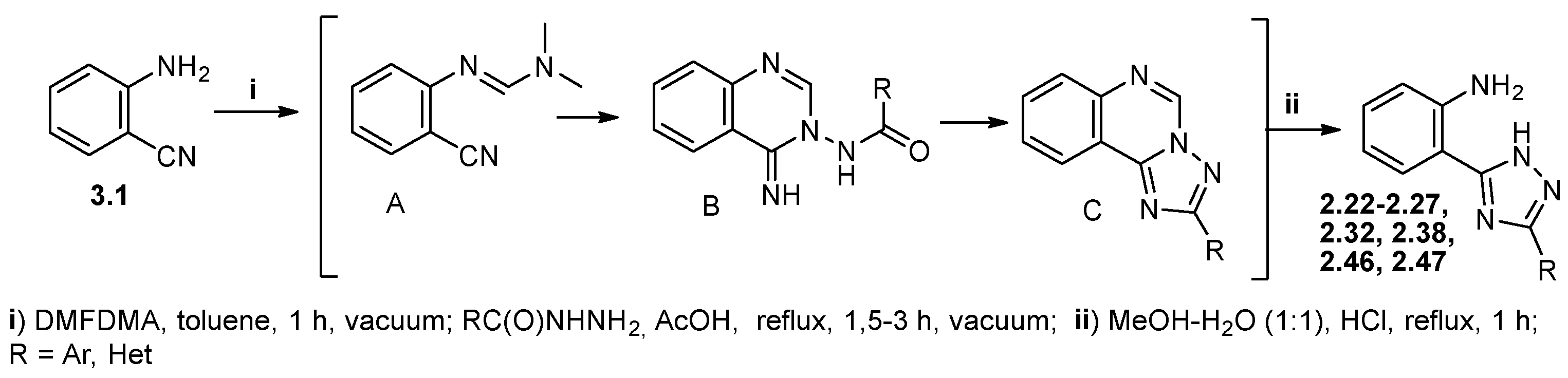
Figure 2.
Molecular structure of compound 2.1 according to the X-ray diffraction data (thermal ellipsoids of non-hydrogen atoms are shown at 50 % probability level) and hydrogen bonded chain of molecules 2.1 in the crystal phase.
Figure 2.
Molecular structure of compound 2.1 according to the X-ray diffraction data (thermal ellipsoids of non-hydrogen atoms are shown at 50 % probability level) and hydrogen bonded chain of molecules 2.1 in the crystal phase.
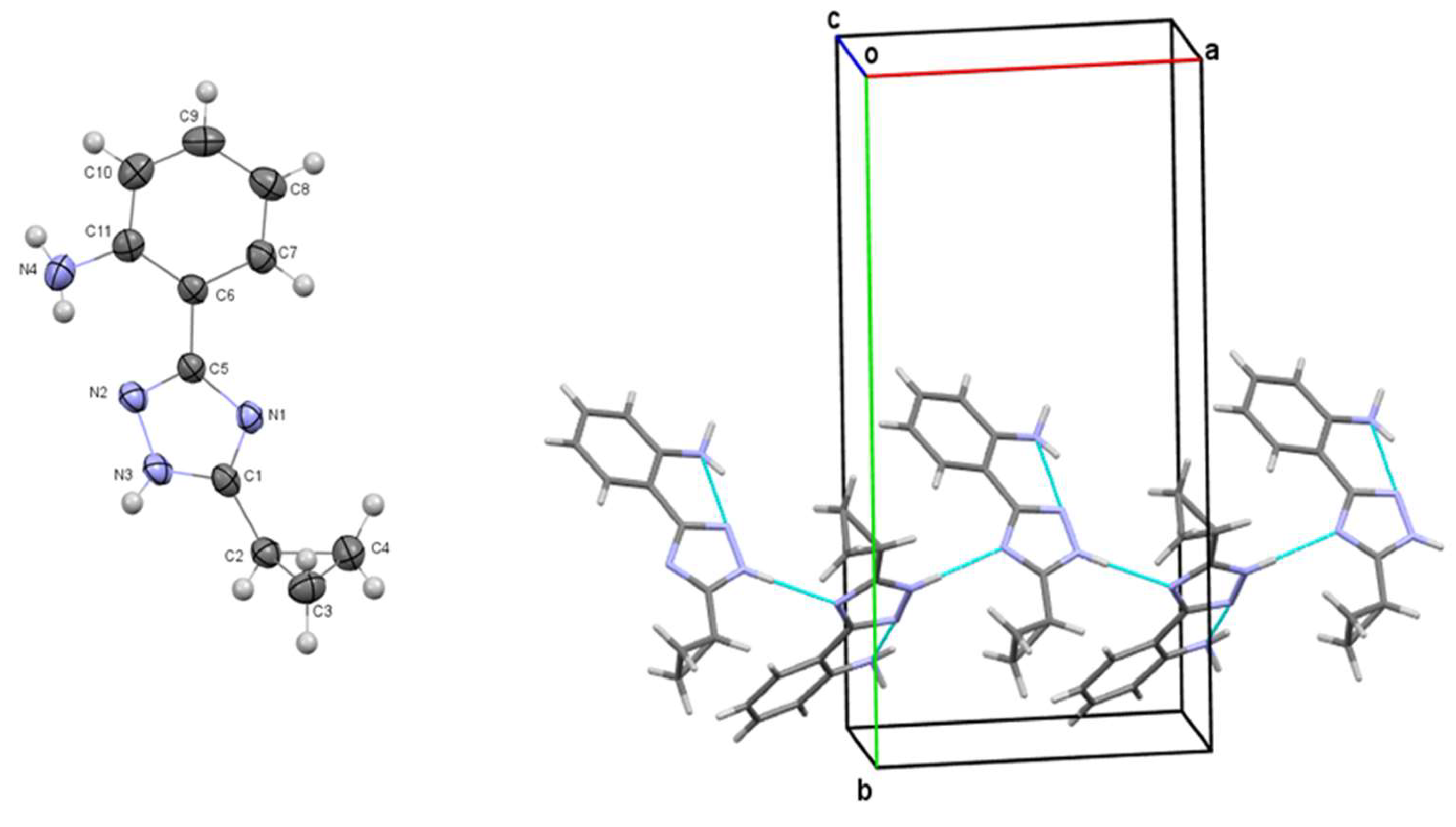
Figure 3.
Interactions of “Ciprofloxacin” (A) and compound 2.31 (B) with amino acid residues and nucleotides of the active site of DNA gyrase in 2D conformation.
Figure 3.
Interactions of “Ciprofloxacin” (A) and compound 2.31 (B) with amino acid residues and nucleotides of the active site of DNA gyrase in 2D conformation.
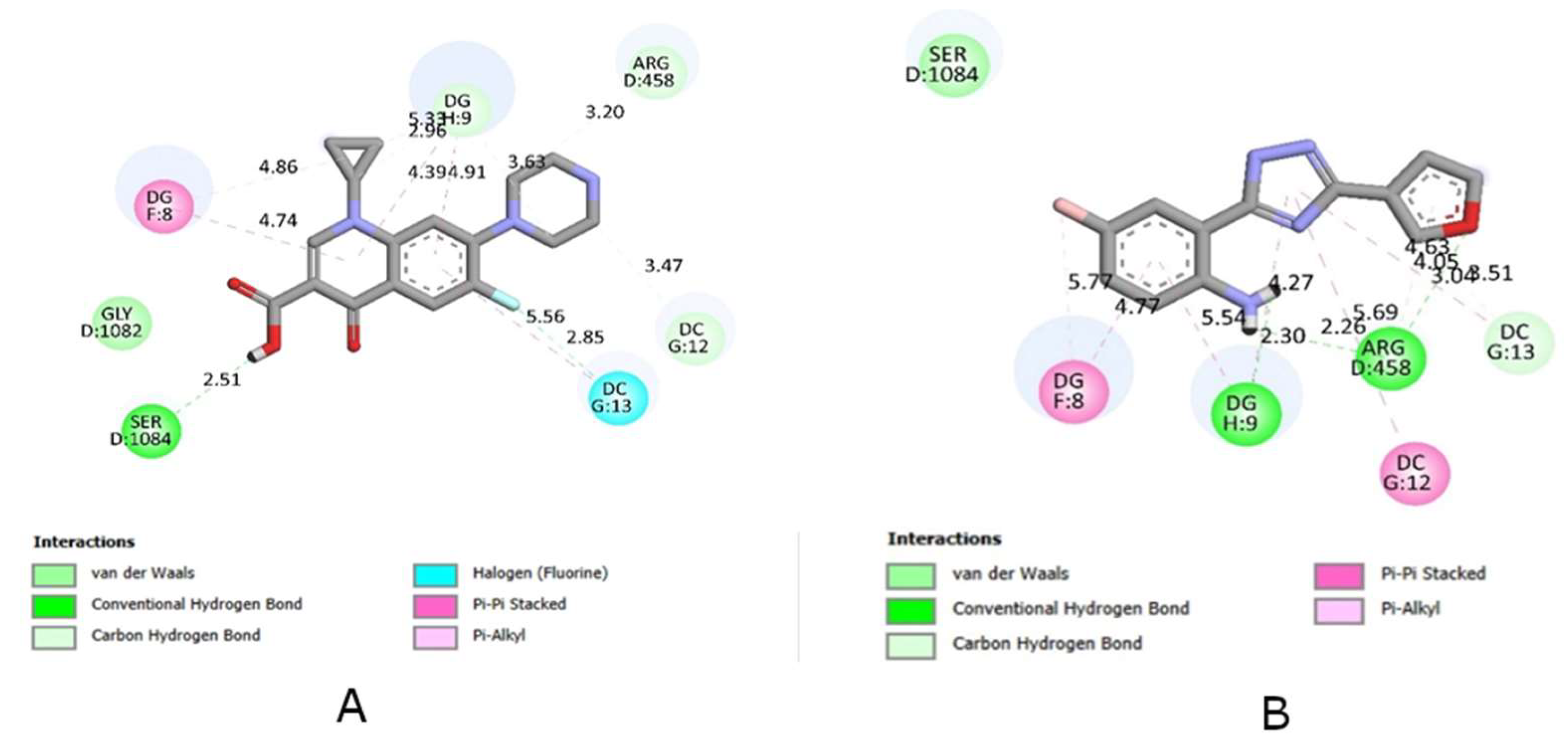
Figure 4.
Interaction of “Ciprofloxacin” (A1, A2) and compound 2.31 (B1, B2) with amino acid residues and nucleotides of the active site of DNA-gyrase in 3D conformation.
Figure 4.
Interaction of “Ciprofloxacin” (A1, A2) and compound 2.31 (B1, B2) with amino acid residues and nucleotides of the active site of DNA-gyrase in 3D conformation.
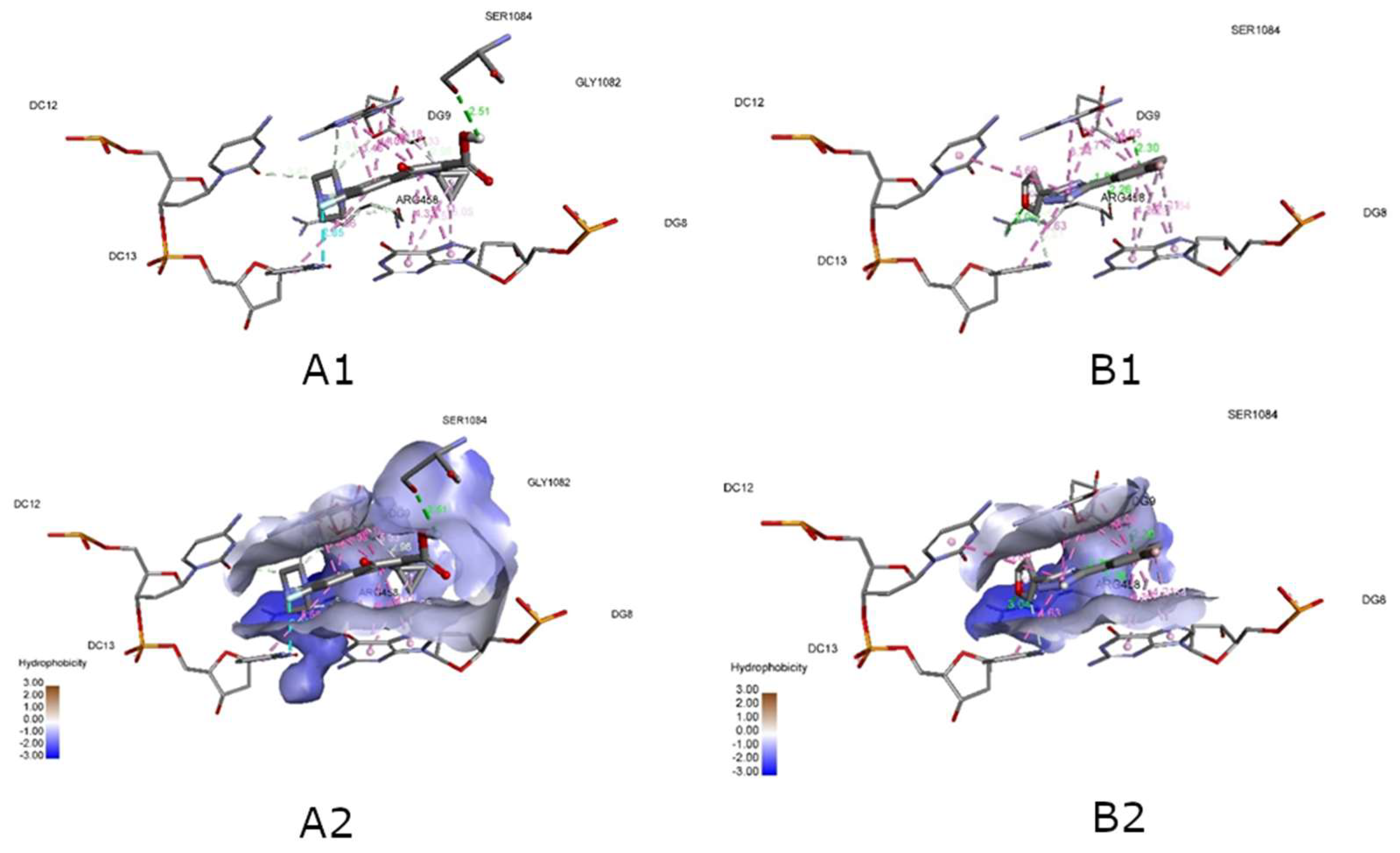

Table 1.
The results of the docking studies of the ligand 2 and the native inhibitor to the active site of DNA gyrase (2XCT).
Table 1.
The results of the docking studies of the ligand 2 and the native inhibitor to the active site of DNA gyrase (2XCT).
| Compounds | Affinity (kcal/mol) | Compounds | Affinity (kcal/mol) | Compounds | Affinity (kcal/mol) |
|---|---|---|---|---|---|
| TA1 | -6.3 | 2.17 | -5.5 | 2.34 | -8.1 |
| 2.1 | -6.7 | 2.18 | -5.6 | 2.35 | -7.9 |
| 2.2 | -7.4 | 2.19 | -6.1 | 2.36 | -8.3 |
| 2.3 | -8.4 | 2.20 | -6.3 | 2.37 | -8.3 |
| 2.4 | -7.1 | 2.21 | -6.0 | 2.38 | -8.9 |
| 2.5 | -7.1 | 2.22 | -7.9 | 2.39 | -8.5 |
| 2.6 | -7.6 | 2.23 | -8.3 | 2.40 | -7.9 |
| 2.7 | -7.4 | 2.24 | -8.4 | 2.41 | -9.2 |
| 2.8 | -7.6 | 2.25 | -8.0 | 2.42 | -8.1 |
| 2.9 | -7.5 | 2.26 | -8.5 | 2.43 | -8.6 |
| 2.10 | -8.6 | 2.27 | -8.2 | 2.44 | -8.9 |
| 2.11 | -8.4 | 2.28 | -8.6 | 2.45 | -8.5 |
| 2.12 | -7.8 | 2.29 | -8.9 | 2.46 | -8.0 |
| 2.13 | -8.1 | 2.30 | -8.6 | 2.47 | -7.8 |
| 2.14 | -8.3 | 2.31 | -8.7 | 2.48 | -8.7 |
| 2.15 | -7.8 | 2.32 | -7.5 | Ciprofloxacin | -6.7 |
| 2.16 | -8.1 | 2.33 | -7.8 | - | - |
1 TA - (2-(1,2,4-triazol-5-yl)aniline.
Table 2.
Antimicrobial activity of compounds 2 against Staphylococcus aureus ATCC 25923 strains.
| Compounds | R | R1 | MIC, μM | MBC, μM | MBC/MIC |
|---|---|---|---|---|---|
| 2.1 | cyclopropyl | H | 62.4 | 124.8 | 2 |
| 2.2 | cyclopropyl | 6-Me | 933.4 | 933.4 | 1 |
| 2.3 | cyclopropyl | 5-F | 458.2 | 916.5 | 2 |
| 2.4 | cyclopropyl | 4-Cl | 852.2 | 852.2 | 1 |
| 2.5 | cyclobutyl | H | 14.6 | 23.3 | 1.5 |
| 2.6 | cyclobutyl | 6-Me | 876.1 | 876.1 | 1 |
| 2.7 | cyclobutyl | 5-F | 430.6 | 861.2 | 2 |
| 2.8 | cyclobutyl | 4-Cl | 402.1 | 804.2 | 2 |
| 2.9 | cyclopentyl | H | 27.4 | 438.0 | 16 |
| 2.10 | cyclopentyl | 6-Me | 825.4 | 825.4 | 1 |
| 2.11 | cyclopentyl | 5-F | 203.0 | 406.0 | 2 |
| 2.12 | cyclopentyl | 4-Cl | 47.6 | 47.6 | 1 |
| 2.13 | cyclohexyl | H | 26.8 | 206.3 | 7.7 |
| 2.14 | cyclohexyl | 6-Me | 390.1 | 390.1 | 1 |
| 2.15 | cyclohexyl | 5-F | 192.1 | 768.3 | 4 |
| 2.16 | cyclohexyl | 4-Cl | 361.3 | 723.6 | 2 |
| 2.17 | adamantyl-1 | H | 10.6 | 21.2 | 2 |
| 2.18 | adamantyl-1 | 6-Me | 10.1 | 20.2 | 2 |
| 2.19 | adamantyl-1 | 5-F | 320.1 | 640.2 | 2 |
| 2.20 | adamantyl-1 | 4-Cl | 304.1 | 608.2 | 2 |
| 2.21 | adamantyl-1 | 4-Br | 267.9 | 535.7 | 2 |
| 2.22 | Ph | H | 26.4 | 211.6 | 8 |
| 2.23 | 4-FC6H4 | H | 196.6 | 786.6 | 4 |
| 2.24 | 4-ClC6H4 | H | 92.3 | 184.6 | 2 |
| 2.25 | 4-BrC6H4 | H | 317.3 | 634.6 | 2 |
| 2.26 | 2-FC6H4 | H | 12.4 | 24.8 | 2 |
| 2.27 | furan-2-yl | H | 221.0 | 442.0 | 2 |
| 2.28 | furan-3-yl | 6-Me | 13.0 | 52.0 | 4 |
| 2.29 | furan-3-yl | 5-F | 25.6 | 51.2 | 2 |
| 2.30 | furan-3-yl | 4-Cl | 11.9 | 23.8 | 2 |
| 2.31 | furan-3-yl | 4-Br | 5.2 | 10.4 | 2 |
| 2.32 | thiophen-2-yl | H | 103.2 | 206.4 | 2 |
| 2.33 | thiophen-2-yl | 5-F | 24.0 | 48.0 | 2 |
| 2.34 | thiophen-3-yl | 6-Me | 12.2 | 12.2 | 1 |
| 2.35 | thiophen-3-yl | 5-F | 6.1 | 48.0 | 8 |
| 2.36 | thiophen-3-yl | 4-Cl | 45.2 | 180.8 | 4 |
| 2.37 | thiophen-3-yl | 4-Br | 77.8 | 311.3 | 4 |
| 2.38 | benzofuran-2-yl | H | 180.9 | 361.8 | 2 |
| 2.39 | benzofuran-2-yl | 6-Me | 10.7 | 21.4 | 2 |
| 2.40 | benzofuran-2-yl | 5-F | 42.5 | 84.9 | 2 |
| 2.41 | benzofuran-2-yl | 4-Cl | 20.1 | 40.2 | 2 |
| 2.42 | benzofuran-2-yl | 4-Br | 140.7 | 140.7 | 1 |
| 2.43 | benzothiophen-2-yl | H | 171.0 | 342.0 | 2 |
| 2.44 | indol-2-yl | H | 181.6 | 363.2 | 2 |
| 2.45 | pyridin-2-yl | H | 105.3 | 210.6 | 2 |
| 2.46 | pyridin-3-yl | H | 13.2 | 52.8 | 4 |
| 2.47 | pyridin-4-yl | H | 105.3 | 210.6 | 2 |
| 2.48 | pyridin-4-yl | Br | 79.1 | 158.2 | 2 |
| Ciprofloxacin | 4.7 | 9.6 | 2 |
Table 3.
Physicochemical descriptors and pharmacokinetic properties of compounds 2 provided by SwissADME.
Table 3.
Physicochemical descriptors and pharmacokinetic properties of compounds 2 provided by SwissADME.
| Physicochemical descriptors & predicted pharmacokinetic properties* | Compounds | ||||||||||
|---|---|---|---|---|---|---|---|---|---|---|---|
| 2.17 | 2.18 | 2.26 | 2.28 | 2.30 | 2.31 | 2.34 | 2.35 | 2.39 | 2.46 | CF** | |
| MW (Da) (< 500) | 294.39 | 308.42 | 252.27 | 240.26 | 260.68 | 305.13 | 256.33 | 260.29 | 290.32 | 237.26 | 331.34 |
| n-ROTB (< 10) | 2 | 2 | 2 | 2 | 2 | 2 | 2 | 2 | 2 | 2 | 3 |
| n-HBA (< 10) | 2 | 2 | 2 | 3 | 3 | 3 | 2 | 3 | 3 | 3 | 5 |
| n-HBD (≤ 5) | 2 | 2 | 2 | 2 | 2 | 2 | 2 | 2 | 2 | 3 | 2 |
| TPSA (< 140, Ų) | 67.59 | 67.59 | 87.82 | 80.73 | 80.73 | 80.73 | 95.83 | 95.83 | 80.73 | 80.48 | 74.57 |
| logP (≤ 5) | 3.21 | 3.54 | 2.05 | 2.06 | 2.30 | 2.34 | 2.74 | 2.69 | 3.07 | 1.66 | 1.10 |
| Molar refractivity | 88.11 | 93.08 | 73.68 | 68.89 | 68.94 | 71.63 | 74.50 | 69.49 | 86.40 | 69.45 | 95.25 |
| Gastrointestinal absorption | High | High | High | High | High | High | High | High | High | High | High |
| Blood–brain barrier permeation | yes | yes | no | no | no | no | no | no | no | no | no |
| Druglikeness | |||||||||||
| Lipinski (Pfizer) filter [42] | yes | yes | yes | yes | yes | yes | yes | yes | yes | yes | yes |
| Veber (GSK) filter [43] | yes | yes | yes | yes | yes | yes | yes | yes | yes | yes | yes |
| Muegge (Bayer) filter [44] | yes | yes | yes | yes | yes | yes | yes | yes | yes | yes | yes |
| Ghose filter [45] | yes | yes | yes | yes | yes | yes | yes | yes | yes | yes | yes |
| Egan filter [46] | yes | yes | yes | yes | yes | yes | yes | yes | yes | yes | yes |
| Bioavailability Score [47] | 0.55 | 0.55 | 0.55 | 0.55 | 0.55 | 0.55 | 0.55 | 0.55 | 0.55 | 0.55 | 0.55 |
| Lead-likeness | no | no | yes | no | yes | yes | yes | yes | yes | no | yes |
* – MW: molecular weight, n-ROTB: number of rotatable bonds, n-HBA: number of hydrogen bond acceptors, n-HBD: number of hydrogen bonds donors, TPSA: topological polar surface area, ** – CF (Ciprofloxacin).
Disclaimer/Publisher’s Note: The statements, opinions and data contained in all publications are solely those of the individual author(s) and contributor(s) and not of MDPI and/or the editor(s). MDPI and/or the editor(s) disclaim responsibility for any injury to people or property resulting from any ideas, methods, instructions or products referred to in the content. |
© 2024 by the authors. Licensee MDPI, Basel, Switzerland. This article is an open access article distributed under the terms and conditions of the Creative Commons Attribution (CC BY) license (http://creativecommons.org/licenses/by/4.0/).
Copyright: This open access article is published under a Creative Commons CC BY 4.0 license, which permit the free download, distribution, and reuse, provided that the author and preprint are cited in any reuse.


