

Submitted:
12 December 2024
Posted:
13 December 2024
You are already at the latest version
Abstract
The increasing adoption of digital technologies by young people (opens the door to a field of development of tools that can be used for different purposes and applications at the same time. This coexistence of applications and objectives, known as ambidexterity, allows a larger objective to be pursued through the hook that represents the smaller objective and that is more evident to the user. In the case of the use of young people, the use of serious games, with the obvious primary purpose of entertaining the user, gives the option to promote and develop the socio-emotional skills. In order to contextualize the field of knowledge, the studies registered in the Web Of Science (WOS) have been quantified since its first appearance in 2012 until the third quarter of 2024. The bibliometric methodology followed to carry out this study has provided tabulated information on the quantification of the productivity and the level of influence of the different actors who have generated content in this area of knowledge. The main conclusion is the relative youth of the subject within the field of scientific research, the high potential for development that it has, and the relevance of Spanish universities (specifically the Universitat Politècnica de València and the Universitat de València) and their affiliated researchers.
Keywords:
Serious games
; socio-emotional skills
; socio-emotional learning
; children
; adolescents
1. Introduction
In today's digital and social environment, young people are exposed to a significant volume of stimuli, both through voluntary engagement and involuntary exposure. These stimuli influence their socio-emotional development beyond the foundational role of family and home environments, shaping responses and adaptive capacities based on individual maturity and learned coping mechanisms [1]. Socio-emotional education is often deprioritized in standard academic curricula [2], and family discussions on such topics can be challenging, with barriers to open communication about socio-emotional growth [3]. All of this makes it difficult for young people to acquire the tools and resources needed to handle situations requiring socio-emotional maturity, leaving them with unmet needs in managing the concerns and challenges they regularly face.
Play is widely recognized as a crucial aspect of the personal and socio-emotional development of children and young people, fostering creativity and social relationships [4]. Indeed, some academics, such as [5], have proposed the integration of structured play into early education activities to enhance developmental outcomes. In light of the necessity to equip young people with robust socio-emotional skills, serious games have emerged as a promising tool for engaging young people in meaningful, skill-building experiences. In contrast to traditional games, serious games aim not only to entertain, but also to promote the development of competencies by the user [6], [7].
In contemporary societies, the fostering of Socio-Emotional Learning (SEL) through early childhood interventions represents a fundamental aspect of healthy psychological and emotional development [8]. [9] defines SEL as the discipline that "involves individuals acquiring the ability to develop their social and emotional intelligence". The objective of the research in SEL is to identify tools that foster the development of durable and resilient socio-emotional skills in young people, thereby enabling them to manage stress and challenges effectively over the long term.
Extensive work has been conducted on the development of skills in children and adolescents [10], [11]. However, [12] identify potential obstacles to the efficacy of SEL initiatives, including deficiencies in planning and the misalignment of objectives and scope. Furthermore, the succession of global crises in recent decades, including the COVID-19 pandemic and natural disasters such as hurricanes and tsunamis, has highlighted the necessity of fostering socio-emotional skills from early childhood [13]. Developed societies, previously characterized by relative stability, now face successive climatic and health disruptions, underscoring the importance of emotional preparedness in youth people.
Among the tools identified as valuable for promoting mental well-being, serious games have gained significant attention, particularly for their effectiveness with younger populations [14]. These games engage users through entertainment while implicitly fostering skills for managing complex situations [15]. While numerous studies have explored the role of serious games in mental health treatment [16], there remains a significant gap in the literature concerning their use as preventive tools for developing socio-emotional skills in youth. This study is designed to address this gap.
[17] highlights the role of digital technologies in facilitating widespread access to serious games, with the near-universal availability of devices such as smartphones and computers among children and adolescents. Empirical evidence indicates that serious games can serve as effective preventive tools, raising awareness about mental health and empowering youth to develop personal resources and skills [18].
In conclusion, the widespread accessibility of digital technologies highlights the relevance of studying the potential of serious games to address a pressing societal need: the development of socio-emotional skills from an early age. The development of socio-emotional skills from the earliest existential and formative stages of young people is a crucial aspect of their upbringing and education.
In this study, a bibliometric analysis is conducted as an important step to contextualize research on serious games for the development of socio-emotional skills in adolescents. By identifying influential research agents (authors, institutions, countries, journals, etc.), this analysis provides an overview of the current state of knowledge, productivity and research impact in the field. The following sections include comprehensive explanation of the methodology and an analysis of the findings, concluding with implications for future research in the area of socio-emotional skill development through serious games.
2. Materials and Methods
2.1. Bibliometric Analysis
This study employs bibliometric analysis, a quantitative technique for the assessment and classification of scientific literature. Defined by [19] as "a new tool for classifying and quantitatively assessing bibliographic material (publications, citations, authors, institutions, etc.) of a scientific discipline", bibliometric analysis identifies the most productive and influential contributors (e.g., authors, institutions, countries) within a research domain, facilitating the quantification of these key agents. This enables the identification of emerging trends and new avenues for research.
The origins of bibliometric studies can be traced back to the 1980s [20]. Since then, the methodology has evolved significantly, particularly with advancements in computing technologies that facilitate enhanced reference management and data analysis [21]. [19] establishes that bibliometric analysis "are increasingly accepted in the medical literature to identify the most influential papers/authors/institutions on a given topic".
Bibliometric studies have been widely applied across diverse scientific disciplines, including accounting, technological innovation, and sustainability [22]. These studies are also extensively utilized in enterprise information management [23]-[24], demonstrating their versatility in generating actionable insights across various domains.
[25] and [26] outline key parameters for bibliometric analysis, which include: (1) productivity, gauged by the number of studies published by individual or collective research agents in reference databases; (2) influence, evaluated by the number of citations received, classified to identify agents with notable relevance; (3) the h-index, a composite metric that combines publication volume and citation counts to provide a balanced measure of impact; (4) the impact factor, a metric that indicates the relevance of an agent within its research field, with the five-year Impact Factor supplementing this to account for temporal variations.
Following the framework outlined by [27], the bibliometric analysis in this study was conducted in five stages: (1) defining the scope: the research objective, time span, and keywords were established to delineate the study's focus; (2) database selection: a trusted and widely recognized database within the research community was chosen to ensure reliable results; (3) query construction and execution: a tailored query was formulated to retrieve relevant data for analysis; (4) classification and categorization: results were analyzed to identify key metrics such as publication volume, citation counts, h-index, and impact factors; (5) discussion and conclusions: the findings were interpreted to assess the current state of research, identify potential gaps, and propose future research efforts.
This study is consistent with the principles of bibliometric analysis, with the objective of identifying and quantifying the influence of key research contributors on the development of socio-emotional skills through serious games. By means of a systematic analysis of productivity, influence and impact metrics, this study aims to provide a comprehensive overview of the research landscape in this field
2.2. Search and Screening Strategy
The search strategy aimed to identify the key contributors to the study of serious games as tools for developing socio-emotional skills in children and adolescents. The focus was to identify authors, institutions, and publications that have made significant contributions to this field while excluding sources lacking substantive relevance. To quantify and highlight the most productive and influential elements in this research area, key metrics were employed, including publication count, citation count, h-index, and the analysis of the distribution of these publications based on the number of citations (classified into ranges) that each of them received [28].
In order to achieve the study’s objectives, the following keywords were selected: "serious games", "socio-emotional", "adolescents", and "children". The timespan covered all records available in the database, with no restriction on publication dates. Given the manageable number of results, it was not necessary to narrow the timespan.
The Web of Science (WOS) database, which is widely recognised for its reliability and acceptance within the research community [26], was selected as the source for this study. In order to ensure the coherence and consistency of the results, each author, institution, journal, and country was assigned a value of one for each publication registered in the WOS [27]. To ensure comprehensive coverage of relevant publications, the 'All Databases' option within WOS was chosen.
The following query was constructed to identify relevant results:
- TOPIC: ("serious game" OR "serious games") AND ("socio-emotional" OR "social" OR "emotional") AND ("adolescents" OR "children")
- Timespan: 1900–2024 (third trimester of 2024)
- Database: Web of Science (WOS) – All Databases
The application of this query yielded 181 results. This is a substantial dataset for conducting a bibliometric study in this emerging area of research [26], particularly given its relatively recent origins, with the earliest records on this topic dating back to 2012.
An initial analysis revealed duplications, documents of limited scientific relevance, and studies that were not directly focused on the research area. To refine the sample, a detailed review of the documents was conducted to eliminate duplicates, exclude those with relative scientific significance, and ensure the selection of studies specifically centered on the topic of serious games and socio-emotional skills. Additionally, filters were applied to include only documents categorized as ‘Article’ or ‘Article Review’ [27]. This comprehensive process reduced the dataset to 119 studies, which were free of duplications and met the criteria for scientific relevance and focus.
Accordingly, the final sample of 119 studies constitutes the working database for this bibliometric analysis, providing a comprehensive foundation for evaluating productivity and influence in this field.
The following sections present the analysed data in tabular format, followed by a discussion of the findings and conclusions derived from these results.
3. Results
This section presents the key findings of the study, highlighting the most productive and influential contributors in the scientific research field relevant to this study. The results are organized into tabular formats, consistent with standard practices in bibliometric studies, and are accompanied by commentary and discussion of the most significant insights derived from the data.
3.1. Evolution and Trends of Published and Cited Articles
The evolution of the number of publications and citations within the study’s field has been analyzed and visually represented to assess its current stage in the research lifecycle. This analysis seeks to determine how established the topic is as a focus of academic interest and its potential for future growth.
The first analysis examines the progression of annual publication counts in the analyzed databases, as illustrated in Figure 1.
Figure 1, indicates that publications related to the topic began emerging in 2012, indicating that this is a relatively "young" research field. The upward slope of the curve connecting the peaks of annual publication bars suggests that the topic remains in the growth phase of its life cycle. This implies an encouraging trajectory, with significant potential for further development and the expansion of knowledge in this area.
It is notable that the growth pattern is characterised by a cyclical nature. A curve tracing the annual publication peaks reveals the existence of three distinct cycles. The initial cycle is relatively brief, spanning the period from 2012 to 2014. A second, longer cycle with wider oscillations was observed between 2014 and 2017. A third, even longer cycle, spanning from 2017 to 2024, is characterised by greater amplitude, including a maximum in 2023. This third cycle marks the definitive take-off of interest in the research area, reflecting its consolidation as a growing field of academic inquiry.
In recent years, the general trend has been one of continued growth, with a steady increase in the number of publications. However, a preliminary analysis of the data for 2024 suggests a potential reduction in the number of publications. It is important to note that this reduction may be due to the incomplete nature of the 2024 dataset, as the year has not yet concluded.
The principal conclusion to be drawn from this analysis is that the research topic is currently in an expansionary and growth phase, characterised by cyclical yet steadily increasing publication trends. Consequently, it may be considered a relatively young and evolving field, offering substantial opportunities for future research and knowledge generation.
The following graphic illustrates the progression of annual citations received by studies on this topic, based on data from the analyzed databases. Figure 2 presents the trend from the initial emergence of results in 2012 through to the present study.
A clear upward trend is evident in the annual number of citations, mirroring the growth observed in the number of publications. This increasing slope supports the hypothesis that the topic is in the growth phase of its research lifecycle—young in its development yet with significant potential for future exploration and expansion of knowledge.
Although the curve for 2024 appears to have a lower slope than in previous years, this is likely attributable to the incomplete nature of the data for that year. It is noteworthy that 2023 represents the highest number of citations in a full year, with 372 citations recorded. Despite 2024 being an unfinished year, it has already surpassed 2023, reaching 381 citations, thereby further affirming the growing academic interest and impact of this research area.
The analysis of Figure 1 and Figure 2 reveals a notable surge in interest and activity within this research domain, particularly from 2016 onwards, with consistent growth since that time. The increased research output and citation activity related to serious games for developing socio-emotional skills in children and adolescents can be attributed to several converging factors.
One significant factor has been the increasing acknowledgement of SEL as a crucial element of education, coupled with a heightened awareness of mental health issues among young people [11]. These developments have prompted educators and researchers to pursue innovative, evidence-based strategies, with serious games emerging as a promising solution.
Advancements in game design and technology have played a pivotal role in enhancing the effectiveness and appeal of serious games. Simultaneously, the increasing integration of gamification into various domains, policy shifts emphasizing SEL in educational curricula, and expanded funding for SEL-related technology have contributed to a surge in interest in this area. The widespread availability of digital devices among youth has further facilitated the adoption of these tools.
The COVID-19 pandemic in 2020 marked a significant turning point, as the shift to remote learning highlighted the pressing necessity for digital resources to support SEL. During this period, there was a notable surge in demand for tools such as serious games, which could bridge the gap in socio-emotional development during disrupted learning environments. Futhermore, interdisciplinary collaborations have brought together diverse perspectives and expertise, contributing to the gradual increase in publications and citations in this field.
Thirdly, Table 1 presents the distribution of papers across citation ranges as a representative measure of the influence of the topic under study. This analysis covers both the entire timespan of the study and the last five years (2020–2024).
This section of the analysis serves to reinforce the preceding conclusions, while also underscoring the growing interest in the subject matter under examination. This is evidenced by the rising number of publications and citations. However, it also emphasizes the topic's relative youth within its research lifecycle.
Of the total publications analyzed, only 31.09% have garnered more than 10 citations, and this figure drops to 22.35% when examining the last five years. Additionally, only two publications have surpassed 100 citations over the entire period. These findings suggest that while the field is still in its early stages of research development, the observed growth trends indicate substantial potential for future advancements.
The relatively low number of highly cited papers indicates that the field offers significant potential for further exploration and academic contributions. This growing interest, coupled with the increasing volume of publications and citations, suggests a promising trajectory for research in this area.
3.2. Publishing Journals
A crucial element in grasping the subject matter under examination is to identify the journals in which researchers have concentrated their efforts to disseminate findings. These journals serve as key repositories of specialized knowledge, hosting conclusions and insights from previous studies that contribute to the foundation of the current research. Table 2 presents the journals with the highest productivity (number of publications) related to this topic, alongside relevant metrics such as citation counts and h-index values, which help evaluate their influence in the field.
The data obtained from the selected databases was analyzed to identify journals with two or more publications on the topic under study. Those with only one publication were excluded from the analysis. This criterion resulted in a list of 21 journals, as presented in Table 2. The journals are ranked in the "Rank" column according to their number of publications related to the topic under study.
The journal ranked first, JMIR SERIOUS GAMES, has the highest number of publications (8). This is consistent with its primary focus on the study of serious games, aligning with one of the central themes of this research. However, it is noteworthy that no journal features a particularly high number of publications on this topic, which reflects the field’s relatively recent emergence and its limited establishment as a concentrated area of research.
In terms of citation counts, the journal ranked seventh, NEUROSCIENCE AND BIOBEHAVIORAL REVIEWS, leads with the highest number of citations. This is followed by the journal ranked eighth, COMPUTERS IN HUMAN BEHAVIOR, which has citation counts three times higher than journals ranked fourth (UNIVERSAL ACCESS IN THE INFORMATION SOCIETY), first (JMIR SERIOUS GAMES), and second (APPLIED SCIENCES).
The Impact Factor (IF) values of the journals hosting papers on SEL reflect varying degrees of influence and relevance in their respective fields. Among the analyzed journals, IEEE TRANSACTIONS ON AFFECTIVE COMPUTING stands out with the highest 2023 IF of 9.6 and a five-year IF of 11, underscoring its prominence in publishing high-impact research on affective computing, an area closely related to socio-emotional skills. Similarly, COMPUTERS IN HUMAN BEHAVIOR and NEUROSCIENCE AND BIOBEHAVIORAL REVIEWS also demonstrate strong influence, with 2023 IFs of 9 and 7.6, respectively, and five-year IFs of 9.5 and 8.7, reflecting their significant contribution to behavioral and neuroscience studies intersecting with socio-emotional learning. In contrast, journals with a narrower focus on serious games, such as JMIR SERIOUS GAMES and APPLIED SCIENCES, exhibit good but more modest IF values, with 2023 IFs of 3.8 and 2.5, respectively, suggesting their specialized yet emerging role in advancing this field. Overall, the diversity in IF values highlights the interdisciplinary nature of SEL research, with contributions spanning high-impact generalist journals and more specialized platforms.
The TC/TP ratio provides insight into the impact of journals publishing on the topic of SEL. The journals NEUROSCIENCE AND BIOBEHAVIORAL REVIEWS (83.5) and COMPUTERS IN HUMAN BEHAVIOR (70.5) have the highest average citation impact, reflecting a substantial level of academic interest despite the relatively low number of publications. The TC/TP ratios for specialized journals such as JMIR SERIOUS GAMES (7) and APPLIED SCIENCES (8.83) are comparatively lower, indicating a growing but concentrated influence.
In conclusion, the results highlight that, in absolute terms, JMIR SERIOUS GAMES is the most productive journal in the field, whereas NEUROSCIENCE AND BIOBEHAVIORAL REVIEWS stands out as the most influential based on citation metrics. However, the relative significance of these findings may vary depending on the specific parameters deemed most relevant by future researchers, such as productivity, citation impact, or the interdisciplinary focus of the journals. These insights provide a useful reference point for identifying key publication venues within the SEL domain
3.3. The Most Influential Articles
This section presents a selection of the most influential studies in the research area addressed by this study. Based on the query performed in the databases outlined in the Methodology section, the 25 most-cited papers were identified. These represent just over 20% of the total 119 studies retrieved through the base query, offering a focused overview of the works that have had the greatest impact and visibility in the field.
As shown in Table 3, two studies significantly stand out in terms of citation count and influence within this research area. [29] has been cited 160 times, making it the most-cited work in the field. Similarly. [30] follows closely with 120 citations. In contrast, no other studies have exceeded 90 citations, and only nine studies have received 40 or more citations, highlighting the relatively limited number of highly influential works in this emerging area.
In terms of the Citations per Year ratio, the study ranked first in total citations [29] also leads with the highest annual citation rate. Following this, the study ranked sixth [31] holds the second-highest Citations per Year ratio. The study ranked second in total citations [30] ranks third in this metric. These results serve to further emphasize the influence and sustained relevance of these key studies within the field.
Among the 25 most-cited papers, two journals stand out by appearing with two publications each: “JOURNAL OF AUTISM AND DEVELOPMENTAL DISORDERS” and “COMPUTERS IN HUMAN BEHAVIOR.” The remaining journals are represented by a single publication each. While this suggests a degree of relevance for these two journals within the field, the small difference in representation does not appear to be a decisive indicator of dominance or influence.
Regarding the distribution of the identified studies over time, among the 25 most-cited papers, the year 2021 stands out with six publications, followed by 2019 with five papers and 2016 with four. In the remaining years, the number of highly cited papers is more evenly distributed, with no more than three publications per year. It is important to note that studies from more recent years are expected to accumulate additional citations in the coming years as they gain visibility and influence within the academic community, potentially altering the current distribution of highly cited works.
In conclusion, it can be observed that none of the studies have an exceptionally high number of citations, likely reflecting the relatively young stage of development of this research field, as noted in the conclusions of previous sections. Furthermore, the analysis reveals a greater disparity in citation counts—and consequently in influence—among individual studies compared to the differences observed between journals or publication years. The variation in citations and Citations per Year ratios between studies underscores the diverse impact of individual works within this emerging area of research.
3.4. The Most Prolific and Influential Authors
The most productive authors (those with the highest number of publications) and the most influential authors (those with the highest number of citations) in the subject under study are identified in Table 4. The authors are ordered in the "Rank" column according to the number of their publications. Additional columns present data on the number of citations and the overall influence of the researchers in this field. For this analysis, only authors with a minimum of three publications have been considered.
The number of publications among the identified authors within the scope of the analysed field exhibits minimal variation. However, Sven Bölte is identified as the most influential author, with a citation count that is twice that of a group of four researchers affiliated with the Universitat Politècnica de València (M. Alcañiz, B. Rey, A. Rodríguez Ortega, and M. Wrzeisen). Moreover, Bölte's citations per publication ratio is approximately three times higher than that of the aforementioned group, thereby underscoring his considerable impact within the field.
It is also noteworthy that among the eight most productive authors (i.e., those with the highest number of publications), four are affiliated with the Universitat Politècnica de València. Additionally, one author is from the University of Valencia, bringing the total to five authors from Spain—which constitutes over half of the most productive researchers identified in this analysis.
In conclusion, the findings once again highlight the relative youth of the research field, as evidenced by the relatively low number of publications and citations. Additionally, the analysis reveals that a significant portion of the research interest in this area is concentrated in Spain, particularly within Valencian universities, with the Universitat Politècnica de València emerging as a key hub of productivity and influence in the field
3.5. The Most Productive and Influential Institutions
This section identifies the institutions with the highest productivity, measured by the number of publications, and the greatest influence, measured by citation counts, within the field of study. Table 5 presents the identified institutions, with a particular focus on those with three or more publications during the analyzed period. This selection resulted in the identification of nine institutions as the most productive contributors to this research area.
The nine institutions identified as the most productive in the field have collectively published a relatively low number of articles. However, two Spanish universities, Universitat Politècnica de València and Universitat de Valencia, stand out as particularly prominent contributors in comparison to the others. Spain is the country with the highest number of institutions represented, with three of the nine most productive entities originating from this country.
When considering citation counts as a measure of influence, the two Swedish institutions—Karolinska Institutet and Stockholm County Council—are the most notable, collectively accumulating 138 citations. These are followed by the Spanish universities Universitat Politècnica de València and Universitat de Valencia, each with just over 80 citations. In terms of the TC/TP (Total Citations per Total Publications) ratio, the Swedish institutions again take the lead, followed by the Spanish universities, reflecting their strong relative impact within this emerging research area.
The conclusions drawn in previous sections are reinforced in this block, confirming that the research field under study is relatively young and has a limited presence within research databases. Furthermore, the analysis once again highlights that a significant portion of research interest and activity is concentrated in Spanish universities, particularly the Universitat Politècnica de València and the Universitat de València, which emerge as key contributors to this field. Additionally, the findings underscore the importance of Swedish institutions, notably the Karolinska Institutet and the Stockholm County Council, which demonstrate significant influence.
3.6. Country Analysis
Finally, the countries with the highest number of publications on the analyzed topic have been identified. Table 6 presents these results, using the same criteria as in previous sections, and includes countries with four or more studies published in this area of knowledge.
Spain occupies the top position in the ranking of countries with the highest number of publications, despite being only the sixth most populous country on the list. In the context of the most populous countries, the USA and Brazil are positioned second and eighth, respectively, in terms of the number of publications. It is noteworthy that the USA is the country with the second highest number of citations.
The Netherlands emerges as a prominent player in terms of citation counts, with the USA, Spain, and the UK following relatively closely. Other countries fall significantly behind in this metric. Regarding the TC/TP (Total Citations per Total Publications) ratio, the Netherlands is clearly the leader, aligning with its status as the country with the highest number of citations despite its relatively small population.
An analysis of the TP/Pop (Total Publications per Population) ratio indicates that Greece has the highest number of publications per capita, followed by Portugal and Austria. In contrast, the USA and Brazil rank lowest on this measure due to their large populations. For the TC/Pop (Total Citations per Population) ratio, the Netherlands again takes the lead, followed by Greece, with other countries trailing significantly behind.
3.7. Title and Abstrat Co-Ocurrence
Taking advantage of the quantitative analysis carried out, and the graphical power of the VosViewer tool, Figure 4 has been generated, which shows the co-occurrence of keywords in the title and abstract.
On the other hand, Figure 3 shows the most relevant cores of representativeness in both titles and abstracts, identified through the co-occurrence graph of title and abstract. the most relevant expressions in the titles of the publications: serious game, children, child, adolescent and game (coincident with the keywords used in the study query). The terms systematic review, development, effect, autism, mental health and intervention appear with less relevance, but are nevertheless highlighted; these elements seem to indicate that the published studies cover both the descriptive and analytical area as well as the call to action and intervention to measure the effect on different factors relevant to autism and mental health. None of the keywords stands out significantly over the others, and there are a large number of identifiable cores of knowledge that should lead future researchers to select and delve deeper into any of them as future lines of research. In summary, the most relevant keywords could be classified into two large groups: those that refer to the type of study (action, efficiency, analysis, review, assessment, etc.) and those that refer to the field of action (autism, education, anxiety, mental health, attention deficit hyperactivity, etc.).
4. Discussion
This study has undertaken a comprehensive analysis of the key focal points of interest in terms of productivity (as measured by the number of publications) and influence (as measured by citation counts and the h-index) within the field of knowledge addressed. Among the results, certain actors emerge as noteworthy, some excelling in productivity, others in influence. However, no single entity holds an overwhelmingly dominant position. Despite this, the analysis highlights Spain, particularly its universities in Valencia, as the most significant hub of productivity in this field.
Furthermore, the tables demonstrate that the overall volume of records is relatively modest, with low values in both the number of publications and citations. This reinforces the conclusion that the research area remains in its early stages of development.
Nevertheless, these results provide a valuable point of reference for future researchers, enabling them to identify and analyze the most relevant prior studies. As such, the study has successfully quantified and mapped the existing knowledge in this area, offering a foundational perspective on productivity and influence within this emerging field.
5. Conclusions
This study successfully identified and quantified the most productive and influential sources and research foci related to the subject of serious games for children or adolescents designed to develop socio-emotional skills. The utilisation of bibliometric analysis methodology enables the presentation of a structured quantitative perspective on the generation and dissemination of content within this field.
The analysis revealed a growing interest in this subject as a research target, as evidenced by the evolutionary graphs which demonstrate an upward trend in both the number of publications and citations. This trend, in conjunction with the general citation structure, indicates that the research field is in the growth phase of its life cycle. While still in its early stages, the field’s youth suggests significant potential for expansion and development in the coming years.
The journals publishing studies on this topic were identified, with the most productive and influential journals highlighted. Although differences between the journals in terms of productivity and influence were minimal, the identification of these key venues is valuable for potential researchers, as they serve as hubs where much of the existing work is concentrated.
The most influential studies, measured by citation count, were analyzed quantitatively. Although the differences between them were modest, these studies represent essential starting points for researchers aiming to contribute to this field, providing foundational insights and a roadmap for further exploration.
The analysis of productivity and influence among authors, institutions, and countries led to the conclusion that, while no single research entity dominates, Spain—particularly the Universitat Politècnica de València and the Universitat de València—emerges as a leader in content generation and dissemination. This result is particularly noteworthy, given that Spain is not traditionally among the most influential countries in other research areas, yet it has positioned itself as a leader of this emerging field.
Based on these findings, a proposed future line of research involves conducting a systematic review of the most relevant and influential studies identified in this analysis. Such a review would offer a qualitative perspective to complement the current quantitative approach, facilitating the development of a comprehensive conceptual framework. This framework could then serve as a foundation for empirical studies and the creation of research models focusing on the use of serious games to develop socio-emotional skills in young people.
Finally, it is important to acknowledge the main limitation of this study: the selection of the database and the keywords used. Alternative choices in databases or parameters might have yielded different, potentially complementary conclusions, offering insights into related topics. Future studies could explore such variations to broaden the understanding of this research field.
Author Contributions
All the authors have contributed equally to tis research, regarding Conceptualization, methodology, validation, formal analysis, investigation, writing, and supervision.
Data Availability Statement
Data is contained within the article.
Acknowledgments
This study has been supported by project TED2021-131070B funded by MICIU/AEI /10.13039/501100011033 and by the European Union NextGenerationEU/ PRTR.
Conflicts of Interest
The authors declare no conflicts of interest.
References
- Gergely, G. , & Watson, J. S. Early socio-emotional development: Contingency perception and the social-biofeedback model. Early social cognition: Understanding others in the first months of life, 1999, 60, 101–136. [Google Scholar]
- Espoz-Lazo, S., Rodríguez Huete. Emotional education for the development of primary and secondary school students through physical education: Literature review. Education Sciences 2020, 10, 192. [Google Scholar] [CrossRef]
- Sánchez-Núñez, M. T., García-Rubio. Emotional intelligence and mental health in the family: The influence of emotional intelligence perceived by parents and children. International Journal of Environmental Research and Public Health 2020, 17, 6255. [Google Scholar] [CrossRef] [PubMed]
- Youell, B. (2018). The importance of play and playfulness. In Childhood, well-being and a therapeutic ethos (pp. 183-194). Routledge.
- Stone, S. J. The essential role of play in school contexts for the well-being of children. LEARNing Landscapes 2017, 10, 305–318. [Google Scholar] [CrossRef]
- Ávila-Pesántez, D. , Rivera, L. A., & Alban, M. S. (2017). Approaches for serious game design: A systematic literature review. Computers in education journal, 8(3).
- Lameras, P., Arnab. Essential features of serious games design in higher education: Linking learning attributes to game mechanics. British journal of educational technology, 2017, 48, 972–994. [Google Scholar] [CrossRef]
- Mondi, C. F., Giovanelli. Fostering socio-emotional learning through early childhood intervention. International Journal of Child Care and Education Policy, 2021, 15, 1–43. [Google Scholar] [CrossRef]
- Foster, M. D. (2021). Socio-Emotional learning. Springer, 10, 978-3.
- McClelland, M. M. , Tominey, S. L., Schmitt, S. A., & Duncan, R. SEL interventions in early childhood. The Future of Children, 2017, 27, 33–47. [Google Scholar]
- Váradi, J. A review of the literature on the relationship of music education to the development of socio-emotional learning. Sage Open, 2022, 12, 21582440211068501. [Google Scholar] [CrossRef]
- Boncu, A., Costea, I., & Minulescu, M. (2017). A meta-analytic study investigating the efficiency of socio-emotional learning programs on the development of children and adolescents. Romanian Journal of Psychology, 19(2).
- Yorke, L., Rose, P., Bayley, S., Wole, D., & Ramchandani, P. (2021). The importance of students’ socio-emotional learning, mental health and wellbeing in the time of COVID-19. Rise Insights, 25, 1-11.
- Fleming, T. M. , Bavin, L., Stasiak, K., Hermansson-Webb, E., Merry, S. N., Cheek, C.,... & Hetrick, S. Serious games and gamification for mental health: current status and promising directions. Frontiers in psychiatry, 2017, 7, 215. [Google Scholar] [PubMed]
- Dewhirst, A. , Laugharne, R., & Shankar, R. Therapeutic use of serious games in mental health: scoping review. BJPsych open, 2022, 8, e37. [Google Scholar] [PubMed]
- Yusof, N. , Mohd Rias, R., & Yusoff, E. H. (2014). Serious games in mental health treatment: Review of literature.
- Laamarti, F. , Eid, M., & El Saddik, A. An overview of serious games. International Journal of Computer Games Technology, 2014, 2014, 358152. [Google Scholar]
- Cangas, A. J. , Navarro, N., Aguilar-Parra, J. M., Trigueros, R., Gallego, J., Zárate, R., & Gregg, M. Analysis of the usefulness of a serious game to raise awareness about mental health problems in a sample of high school and university students: relationship with familiarity and time spent playing video games. Journal of clinical medicine, 2019, 8, 1504. [Google Scholar]
- Lazarides, M. K., Lazaridou, I. Z., & Papanas, N. (2023). Bibliometric analysis: Bridging informatics with science. The International Journal of Lower Extremity Wounds, 15347346231153538. [CrossRef]
- Broadus, R. Toward a definition of “bibliometrics” Scientometrics. 1987, 12, 373–379.
- Bar-Ilan, J. Informetrics at the beginning of the 21st century—A review. Journal of informetrics, 2008, 2, 1–52. [Google Scholar] [CrossRef]
- Guerola-Navarro, V. , Oltra-Badenes, R., Gil-Gomez, H., & Gil-Gomez, J. A. Customer relationship management (CRM): a bibliometric analysis. International Journal of Services Operations and Informatics, 2020, 10, 242–268. [Google Scholar] [CrossRef]
- Donthu, N. , Kumar Badhotiya, G., Kumar, S., Soni, G., & Pandey, N. A retrospective overview of Journal of Enterprise Information Management using bibliometric analysis. Journal of Enterprise Information Management, 2022, 35, 504–529. [Google Scholar] [CrossRef]
- Ribeiro-Navarrete, S. , Palacios-Marqués, D., Lassala, C., & Ulrich, K. Key factors of information management for crowdfunding investor satisfaction. International Journal of Information Management, 2021, 59, 102354. [Google Scholar] [CrossRef]
- Podsakoff, P. M. , MacKenzie, S. B., Podsakoff, N. P., & Bachrach, D. G. Scholarly influence in the field of management: A bibliometric analysis of the determinants of university and author impact in the management literature in the past quarter century. Journal of Management, 2008, 34, 641–720. [Google Scholar] [CrossRef]
- Merigo, J. M. , Miranda, J., Modak, N. M., Boustras, G., & De La Sotta, C. Forty years of Safety Science: A bibliometric overview. Safety science, 2019, 115, 66–88. [Google Scholar]
- Gil-Gomez, H., Oltra-Badenes, R., Guerola-Navarro, V. & Zegarra Saldaña, P. Crowdfunding: a bibliometric analysis. International Entrepreneurship and Management Journal, 2021, 19, 27–45. [CrossRef]
- Hirsch, J. E. An index to quantify an individual's scientific research output. Proceedings of the National academy of Sciences, 2005, 102, 16569–16572. [Google Scholar] [CrossRef] [PubMed]
- Nijhof, S. L. , Vinkers, C. H., van Geelen, S. M., Duijff, S. N., Achterberg, E. M., Van Der Net, J.,... & Lesscher, H. M. Healthy play, better coping: The importance of play for the development of children in health and disease. Neuroscience & Biobehavioral Reviews, 2018, 95, 421–429. [Google Scholar]
- Schoneveld, E. A. , Malmberg, M., Lichtwarck-Aschoff, A., Verheijen, G. P., Engels, R. C., & Granic, I. A neurofeedback video game (MindLight) to prevent anxiety in children: A randomized controlled trial. Computers in Human Behavior, 2016, 63, 321–333. [Google Scholar]
- Kaimara, P. , Oikonomou, A., & Deliyannis, I. Could virtual reality applications pose real risks to children and adolescents? A systematic review of ethical issues and concerns. Virtual Reality, 2022, 26, 697–735. [Google Scholar]
Figure 1.
Number of Annual publications. Font: Web of Science.
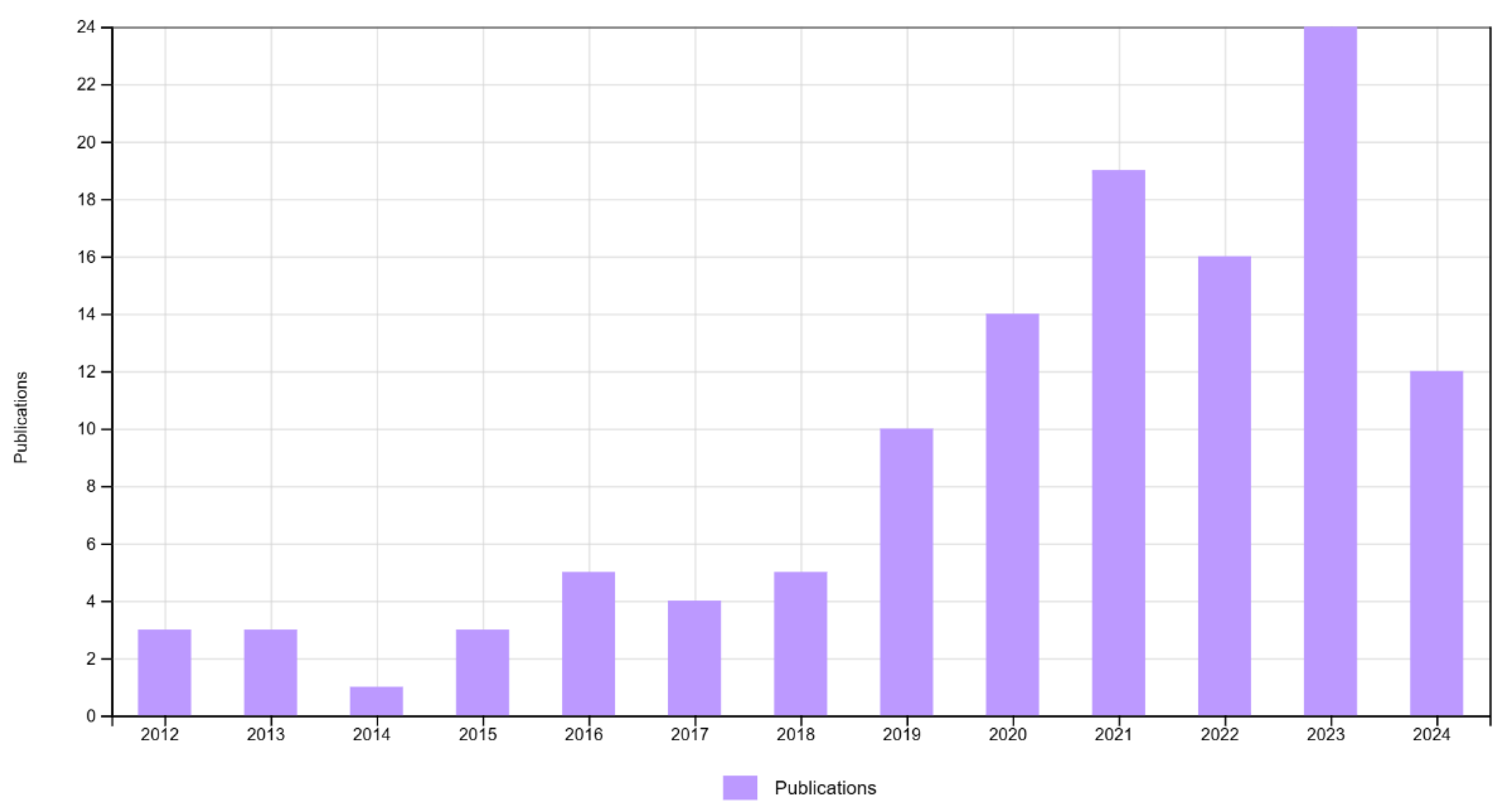
Figure 2.
Number of Annual citations. Font: Web of Science.
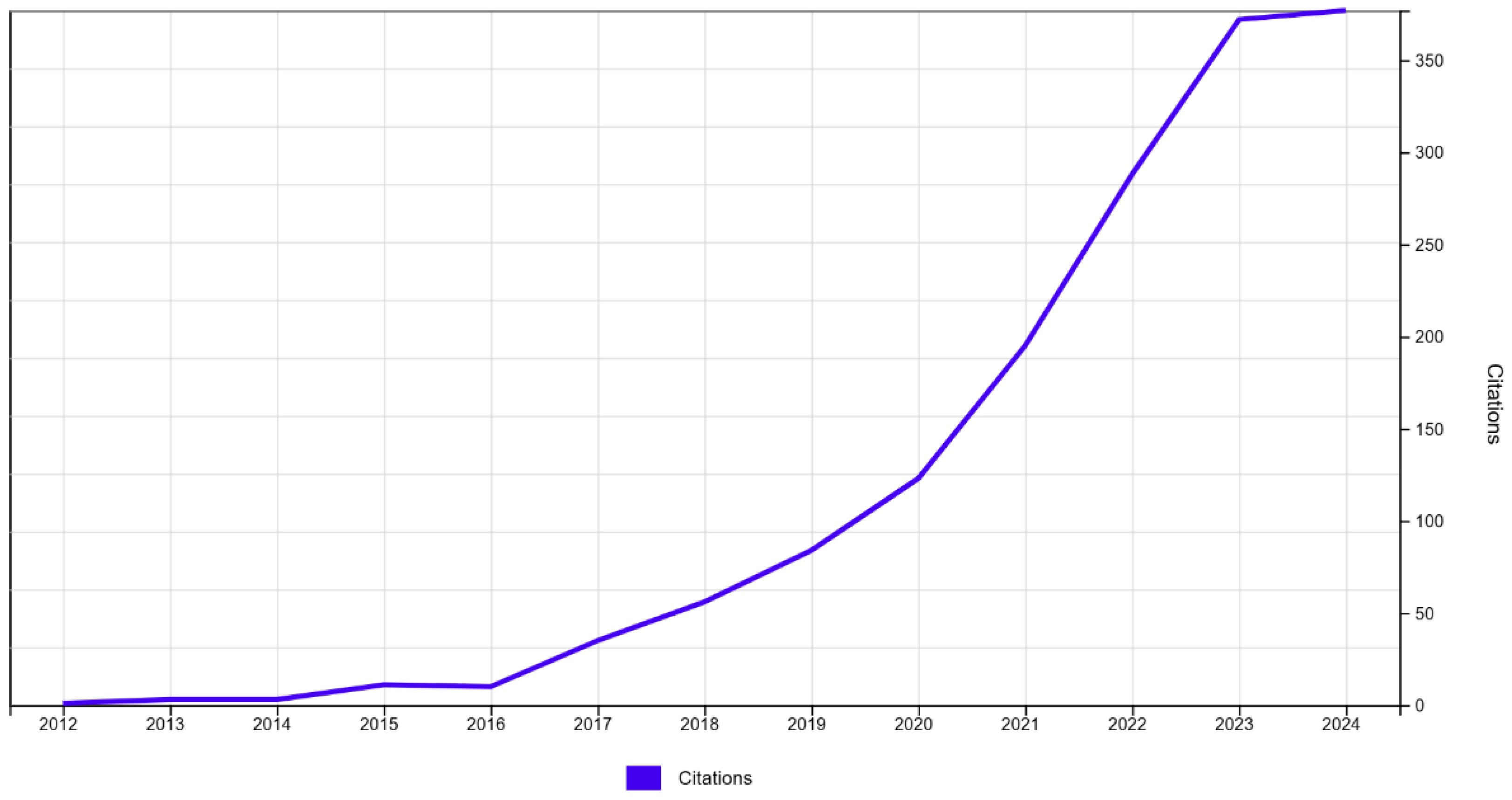
Figure 3.
Title and abstract fields co-ocurrence. Font: VosViewer.
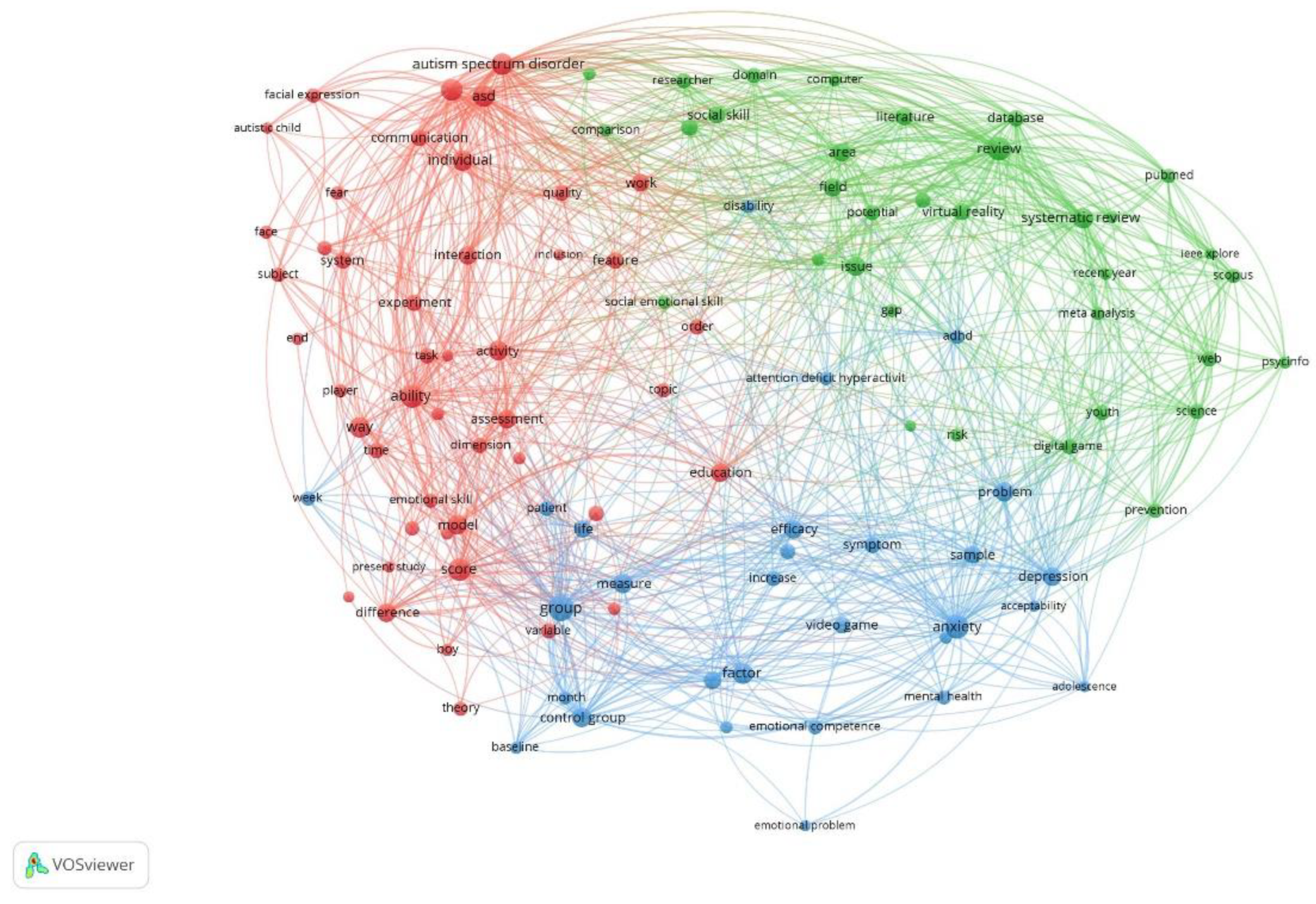

Table 1.
General citation structure. Font: self-elaborate.
| Citations | All time | 2020 - 2024 | ||
|---|---|---|---|---|
| Number of papers | % Papers | Number of papers | % Papers | |
| > 100 citations | 2 | 1,68% | 0 | 0,00% |
| > 50 citations | 6 | 5,04% | 1 | 1,18% |
| > 25 citations | 15 | 12,61% | 7 | 8,24% |
| > 10 citations | 37 | 31,09% | 19 | 22,35% |
| <= 10 citations | 82 | 68,91% | 66 | 77,65% |
| Total | 119 | 100% | 85 | 100% |
Table 2.
Most Influential Journals. Font: self-elaborate.
| Rank | Name | h-index | TC | TP | TC/TP | >50 | >20 | >10 | >5 | IF (2023) | 5-IF |
|---|---|---|---|---|---|---|---|---|---|---|---|
| 1 | JMIR SERIOUS GAMES | 4 | 56 | 8 | 7,00 | 0 | 0 | 2 | 4 | 3.8 | 3.9 |
| 2 | APPLIED SCIENCES | 4 | 53 | 6 | 8,83 | 0 | 1 | 1 | 3 | 2.5 | 2.7 |
| 3 | Journal of The Korean Society for Computer Game | 0 | 0 | 4 | 0,00 | 0 | 0 | 0 | 0 | --- | --- |
| 4 | UNIVERSAL ACCESS IN THE INFORMATION SOCIETY | 3 | 64 | 3 | 21,33 | 0 | 1 | 2 | 3 | 2.1 | 2.8 |
| 5 | BRITISH JOURNAL OF EDUCATIONAL TECHNOLOGY | 3 | 37 | 3 | 12,33 | 0 | 0 | 1 | 1 | 6.7 | 7.2 |
| 6 | IEEE TRANSACTIONS ON AFFECTIVE COMPUTING | 2 | 13 | 3 | 4,33 | 0 | 0 | 0 | 1 | 9.6 | 11 |
| 7 | NEUROSCIENCE AND BIOBEHAVIORAL REVIEWS | 2 | 167 | 2 | 83,50 | 1 | 1 | 1 | 2 | 7.6 | 8.7 |
| 8 | COMPUTERS IN HUMAN BEHAVIOR | 2 | 141 | 2 | 70,50 | 1 | 2 | 2 | 2 | 9 | 9.5 |
| 9 | VIRTUAL REALITY | 2 | 69 | 2 | 34,50 | 1 | 1 | 1 | 2 | 4.4 | 5.4 |
| 10 | JOURNAL OF AUTISM AND DEVELOPMENTAL DISORDERS | 2 | 55 | 2 | 27,50 | 0 | 2 | 2 | 2 | 3.1 | 4.2 |
| 11 | EDUCATION AND INFORMATION TECHNOLOGIES | 2 | 23 | 2 | 11,50 | 0 | 0 | 1 | 2 | 4.8 | 4.8 |
| 12 | CHILDREN-BASEL | 2 | 22 | 2 | 11,00 | 0 | 0 | 1 | 1 | 2 | 2.1 |
| 13 | PLOS ONE | 2 | 21 | 2 | 10,50 | 0 | 0 | 1 | 1 | 2.9 | 3.3 |
| 14 | FRONTIERS IN PSYCHIATRY | 2 | 15 | 2 | 7,50 | 0 | 0 | 0 | 1 | 3.2 | 3.9 |
| 15 | IEEE ACCESS | 2 | 10 | 2 | 5,00 | 0 | 0 | 0 | 1 | 3.4 | 3.7 |
| 16 | MULTIMEDIA TOOLS AND APPLICATIONS | 1 | 7 | 2 | 3,50 | 0 | 0 | 0 | 1 | 3 | 2.9 |
| 17 | MULTIMODAL TECHNOLOGIES AND INTERACTION | 1 | 6 | 2 | 3,00 | 0 | 0 | 0 | 1 | 2.4 | |
| 18 | INTERNATIONAL JOURNAL OF ADVANCED COMPUTER SCIENCE AND APPLICATIONS | 1 | 5 | 2 | 2,50 | 0 | 0 | 0 | 0 | 0.7 | 0.8 |
| 19 | INTERNATIONAL JOURNAL OF ENVIRONMENTAL RESEARCH AND PUBLIC HEALTH | 2 | 5 | 2 | 2,50 | 0 | 0 | 0 | 0 | 4.6 | 4.8 |
| 20 | FRONTIERS IN PSYCHOLOGY | 1 | 2 | 2 | 1,00 | 0 | 0 | 0 | 0 | 2.6 | 3.3 |
| 21 | INTERNATIONAL JOURNAL OF ONLINE AND BIOMEDICAL ENGINEERING | 1 | 1 | 2 | 0,50 | 0 | 0 | 0 | 0 | 1.7 | 1.3 |
Abbreviations: R = Rank; Name = Name of the Journal or Source Title; h = h-index; TC = Total Citations; TP = Total Papers; TC/TP = ratio total Citations per Published Paper; >100, >50, >25, >10 = number of papers with more than 100, 50, 25, 10 citations; IF = Impact Factor 2023; 5-IF = five-year Impact Factor 2023.
Table 3.
The most cited papers. Font: self-elaborate.
| Journal | Rank | TC | Title | Author/s | Year | C/Y |
|---|---|---|---|---|---|---|
| NEUROSCIENCE AND BIOBEHAVIORAL REVIEWS | 1 | 160 | Healthy play, better coping: The importance of play for the development of children in health and disease | Nijhof, SL; Vinkers, CH; (...); Lesscher, HMB | 2018 | 22,86 |
| COMPUTERS IN HUMAN BEHAVIOR | 2 | 120 | A neurofeedback video game (MindLight) to prevent anxiety in children: A randomized controlled trial | Schoneveld, EA; Malmberg, M; (...); Granic, I | 2016 | 13,33 |
| EUROPEAN CHILD & ADOLESCENT PSYCHIATRY | 3 | 89 | Emotiplay': a serious game for learning about emotions in children with autism: results of a cross-cultural evaluation | Fridenson-Hayo, S; Berggren, S; (...); Golan, O | 2017 | 11,13 |
| AGGRESSION AND VIOLENT BEHAVIOR | 4 | 80 | Anti-bullying programs and Information and Communication Technologies (ICTs): A systematic review | Nocentini, A; Zambuto, V and Menesini, E | 2015 | 8,00 |
| ETR&D-EDUCATIONAL TECHNOLOGY RESEARCH AND DEVELOPMENT | 5 | 64 | Supporting struggling readers with digital game-based learning | Ronimus, M; Eklund, K; (...); Lyytinen, H | 2019 | 10,67 |
| VIRTUAL REALITY | 6 | 59 | Could virtual reality applications pose real risks to children and adolescents? A systematic review of ethical issues and concerns | Kaimara, P; Oikonomou, A and Deliyannis, I | 2022 | 14,75 |
| CURRENT PEDIATRIC REVIEWS | 7 | 48 | Serious Game-based Intervention for Children with Developmental Disabilities | Kokol, P; Vosner, HB; (...); Peinemann, F | 2020 | 9,60 |
| TELEMEDICINE AND E-HEALTH | 8 | 40 | Time for a Change: College Students' Preference for Technology-Mediated Versus Face-to-Face Help for Emotional Distress | Lungu, A and Sun, M | 2016 | 4,44 |
| UNIVERSAL ACCESS IN THE INFORMATION SOCIETY | 9 | 39 | Inclusion of third-person perspective in CAVE-like immersive 3D virtual reality role-playing games for social reciprocity training of children with an autism spectrum disorder | Tsai, WT; Lee, IJ and Chen, CH | 2021 | 7,80 |
| IEEE COMPUTER GRAPHICS AND APPLICATIONS | 10 | 36 | A VR-Based Serious Game for Studying Emotional Regulation in Adolescents | Rodríguez, A; Rey, B; (...); Pérez-López, D | 2015 | 3,60 |
| PSYCHNOLOGY JOURNAL | 11 | 34 | LIFEisGAME Prototype: A Serious Game about Emotions for Children with Autism Spectrum Disorders | Alves, S; Marques, A; (...); Orvalho, V | 2013 | 2,83 |
| ENTERTAINMENT COMPUTING | 12 | 33 | Serious games to improve social and emotional intelligence in children with autism | Hassan, A; Pinkwart, N and Shafi, M | 2021 | 8,25 |
| APPLIED SCIENCES | 13 | 33 | SoundFields: A Virtual Reality Game Designed to Address Auditory Hypersensitivity in Individuals with Autism Spectrum Disorder | Johnston, D; Egermann, H and Kearney, G | 2020 | 6,60 |
| JOURNAL OF AUTISM AND DEVELOPMENTAL DISORDERS | 14 | 30 | Pilot Study of an Attention and Executive Function Cognitive Intervention in Children with Autism Spectrum Disorders | Macoun, SJ; Schneider, I; (...); Sung, A | 2021 | 6,00 |
| SUSTAINABILITY | 15 | 28 | Virtual Reality and Metacognition Training Techniques for Learning Disabilities | Drigas, A; Mitsea, E and Skianis, C | 2022 | 9,33 |
| JOURNAL OF AUTISM AND DEVELOPMENTAL DISORDERS | 16 | 25 | Designing a Serious Game for Youth with ASD: Perspectives from End-Users and Professionals | Tang, JSY; Falkmer, M; (...); Girdler, S | 2019 | 4,17 |
| RESEARCH IN AUTISM SPECTRUM DISORDERS | 17 | 24 | A systematic review and meta-analysis of social emotional computer based interventions for autistic individuals using the serious game framework | Tang, JLSY; Chen, NTM; (...); Girdler, S | 2019 | 4,00 |
| DEVELOPMENTAL NEUROPSYCHOLOGY | 18 | 23 | Interventions with Serious Games and Entertainment Games in Autism Spectrum Disorder: A Systematic Review | Silva, GM; Souto, JJD; (...); Santos, NA | 2021 | 5,75 |
| BRITISH JOURNAL OF EDUCATIONAL TECHNOLOGY | 19 | 22 | Children like it more but don't learn more: Effects of esthetic visual design in educational games | Javora, O; Hannemann, T; (...); Brom, C | 2019 | 3,67 |
| INTERNATIONAL JOURNAL OF ENGINEERING PEDAGOGY | 20 | 22 | Games for Empathy for Social Impact | Papoutsi, C and Drigas, AS | 2016 | 2,44 |
| COMPUTERS IN HUMAN BEHAVIOR | 21 | 21 | A game for emotional regulation in adolescents: The (body) interface device matters | Vara, MD; Baños, RM; (...); Alcañiz, M | 2016 | 2,33 |
| JMIR SERIOUS GAMES | 22 | 20 | Awareness, Prevention, Detection, and Therapy Applications for Depression and Anxiety in Serious Games for Children and Adolescents: Systematic Review | Martinez, K; Menéndez-Menéndez, MI and Bustillo, A | 2021 | 5,00 |
| SENSORS | 23 | 19 | Augmented Reality, Serious Games and Picture Exchange Communication System for People with ASD: Systematic Literature Review and Future Directions | Almurashi, H; Bouaziz, R; (...); Kammoun, S | 2022 | 6,33 |
| INTERNET INTERVENTIONS-THE APPLICATION OF INFORMATION TECHNOLOGY IN MENTAL AND BEHAVIOURAL HEALTH | 24 | 19 | Effectiveness of the REThink therapeutic online video game in promoting mental health in children and adolescents | David, OA; Predatu, R and Cardos, RAI | 2021 | 4,75 |
| CHILDREN | 25 | 19 | Digital Attention-Related Augmented-Reality Game: Significant Correlation between Student Game Performance and Validated Clinical Measures of Attention-Deficit/Hyperactivity Disorder (ADHD) | Keshav, NU; Vogt-Lowell, K; (...); Sahin, NT | 2019 | 3,17 |
Abbreviations are available in Table 2 except for C/Y = Citations per Year.
Table 4.
The most productive and influential authors. Font: self-elaborate.
| Rank | Name / Author | Institution / Affiliation | Country | TP | TC | TC/TP | h-index | > 50 | > 20 | > 10 | >5 |
|---|---|---|---|---|---|---|---|---|---|---|---|
| 1 | Alcañiz, Mariano | Universitat Politècnica de València | Spain | 4 | 63 | 15,75 | 3 | 0 | 1 | 2 | 3 |
| 2 | Rey, Beatriz | Universitat Politècnica de València | Spain | 4 | 63 | 15,75 | 3 | 0 | 1 | 2 | 3 |
| 3 | Rodríguez Ortega, Alejandro | Universitat Politècnica de València | Spain | 4 | 63 | 15,75 | 3 | 0 | 1 | 2 | 2 |
| 4 | Wrzesien, Maja | Universitat Politècnica de València | Spain | 4 | 63 | 15,75 | 3 | 0 | 1 | 2 | 3 |
| 5 | David, Oana | University Cluj-Napoca | Romania | 4 | 34 | 8,50 | 3 | 0 | 0 | 1 | 2 |
| 6 | Drigas, Athanasios | National Centre of Scientific Research "Demokritos" | Greece | 4 | 50 | 12,50 | 2 | 0 | 2 | 2 | 2 |
| 7 | Bölte, Sven | Karolinska Institutet | Sweden | 3 | 138 | 46,00 | 3 | 1 | 1 | 3 | 3 |
| 8 | Rasal, Paloma | Universitat de Valencia | Spain | 3 | 27 | 9,00 | 2 | 0 | 0 | 1 | 2 |
Table 5.
The most productive and influential institutions. Font: self-elaborate.
| R | Institution | Country | TP | TC | TC/TP | H-index | > 50 | > 20 | > 10 | > 5 | ARWU | QS |
|---|---|---|---|---|---|---|---|---|---|---|---|---|
| 1 | Universitat Politècnica De València | Spain | 7 | 88 | 12,57 | 5 | 0 | 2 | 3 | 5 | 401-500 | 436 |
| 2 | Universitat de Valencia | Spain | 6 | 82 | 13,67 | 4 | 0 | 2 | 3 | 4 | 201-300 | 445 |
| 3 | Babes Bolyai University From Cluj | Romania | 4 | 34 | 8,50 | 3 | 0 | 0 | 1 | 2 | --- | 781-790 |
| 4 | Ciber Centro De Investigacion Biomedica En Red | Spain | 4 | 34 | 8,50 | 3 | 0 | 1 | 1 | 3 | --- | --- |
| 5 | National Centre Of Scientific Research Demokritos | Greece | 4 | 50 | 12,50 | 2 | 0 | 2 | 2 | 2 | --- | --- |
| 6 | Karolinska Institutet | Sweden | 3 | 138 | 46,00 | 3 | 1 | 3 | 3 | 3 | 43 | --- |
| 7 | Stockholm County Council | Sweden | 3 | 138 | 46,00 | 3 | 1 | 3 | 3 | 3 | --- | --- |
| 8 | Ludwig Boltzmann Institute | Austria | 3 | 16 | 5,33 | 2 | 0 | 0 | 1 | 1 | --- | --- |
| 9 | University Of Birmingham | UK | 3 | 21 | 7,00 | 2 | 0 | 0 | 1 | 2 | 151-200 | 80 |
Table 6.
The most productive and influential countries. Font: self-elaborate.
| Rank | Country | TP | TC | TC/TP | H-index | Population | TP/Pop | TC/Pop | > 50 | > 20 | > 10 | >5 |
|---|---|---|---|---|---|---|---|---|---|---|---|---|
| 1 | Spain | 22 | 187 | 8,50 | 7 | 48.373,34 | 0,45 | 3,87 | 0 | 2 | 7 | 13 |
| 2 | USA | 12 | 217 | 18,08 | 7 | 334.914,89 | 0,04 | 0,65 | 1 | 2 | 7 | 7 |
| 3 | Greece | 11 | 126 | 11,45 | 5 | 10.361,29 | 1,06 | 12,16 | 1 | 3 | 3 | 4 |
| 4 | UK | 10 | 180 | 18,00 | 6 | 68.350,00 | 0,15 | 2,63 | 1 | 2 | 4 | 6 |
| 5 | Italy | 9 | 138 | 15,33 | 5 | 58.761,15 | 0,15 | 2,35 | 1 | 1 | 3 | 5 |
| 6 | Portugal | 8 | 77 | 9,63 | 5 | 10.525,34 | 0,76 | 7,32 | 0 | 1 | 2 | 5 |
| 7 | Austria | 5 | 33 | 6,60 | 3 | 9.132,38 | 0,55 | 3,61 | 0 | 0 | 2 | 2 |
| 8 | Brazil | 5 | 50 | 10,00 | 4 | 212.422,45 | 0,02 | 0,24 | 0 | 1 | 2 | 3 |
| 9 | Germany | 5 | 111 | 22,20 | 4 | 84.482,27 | 0,06 | 1,31 | 0 | 2 | 3 | 4 |
| 10 | Netherlands | 5 | 306 | 61,20 | 4 | 17.879,49 | 0,28 | 17,11 | 2 | 2 | 3 | 4 |
| 11 | Romania | 4 | 34 | 8,50 | 3 | 19.056,12 | 0,21 | 1,78 | 0 | 0 | 1 | 2 |
Disclaimer/Publisher’s Note: The statements, opinions and data contained in all publications are solely those of the individual author(s) and contributor(s) and not of MDPI and/or the editor(s). MDPI and/or the editor(s) disclaim responsibility for any injury to people or property resulting from any ideas, methods, instructions or products referred to in the content. |
© 2024 by the authors. Licensee MDPI, Basel, Switzerland. This article is an open access article distributed under the terms and conditions of the Creative Commons Attribution (CC BY) license (http://creativecommons.org/licenses/by/4.0/).
Copyright: This open access article is published under a Creative Commons CC BY 4.0 license, which permit the free download, distribution, and reuse, provided that the author and preprint are cited in any reuse.


