

Submitted:
11 December 2024
Posted:
12 December 2024
You are already at the latest version
Abstract
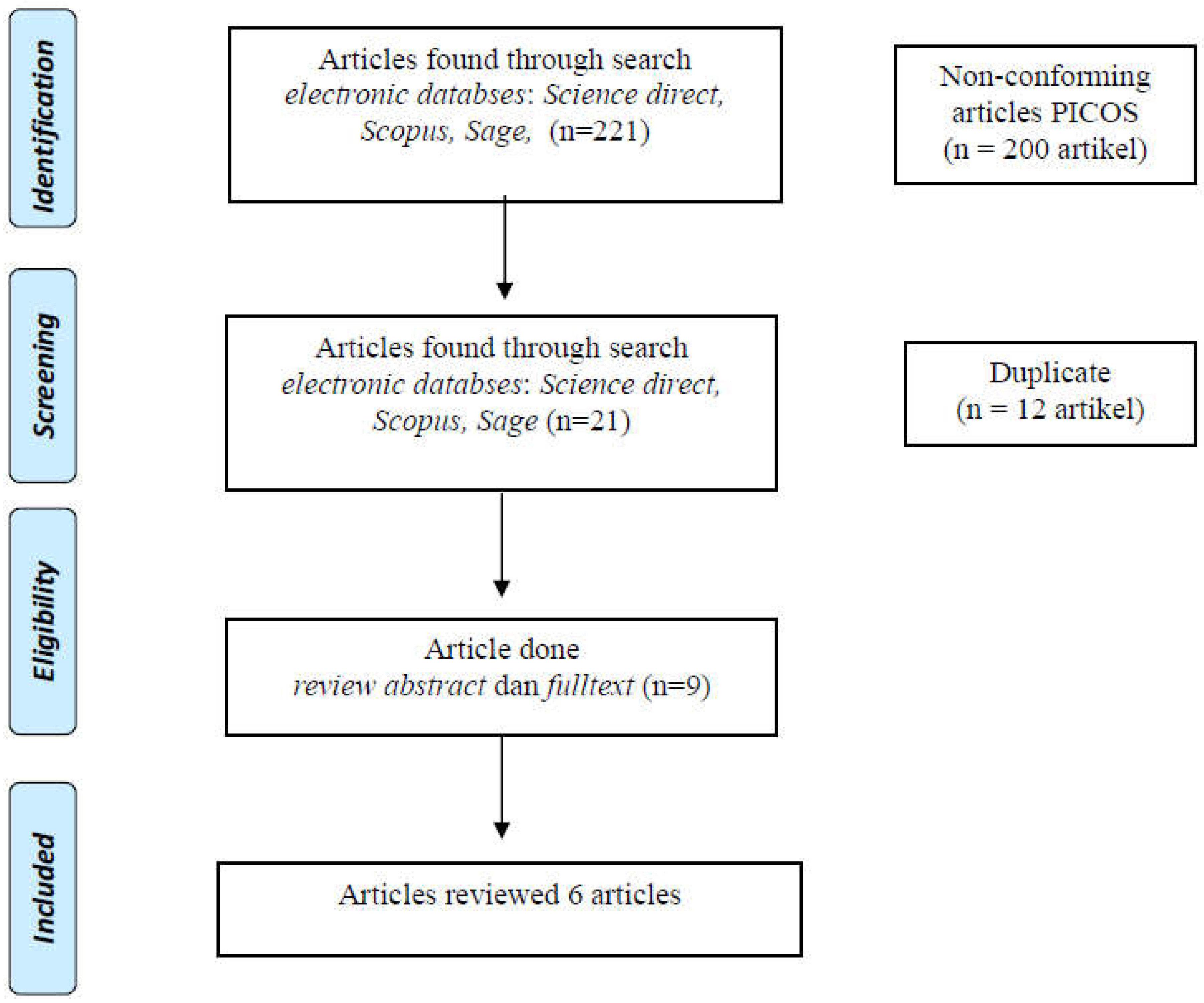
Introduction: Parental acceptance of children with special needs is an important factor that influences child development and family well-being. However, many parents have difficulty accepting their child's condition, which can have a negative impact on interactions and support. This study aims to explore the relationship between parents' self-efficacy and their acceptance of children with disabilities and analyze it through philosophical studies.Research method: this research uses a literature review using the PICOS framework. Articles were searched from 3 databases namely Scopus, Sciencedirect, Sage. The keywords used in the literature search are self-efficacy AND parental acceptance AND philosophical approach, especially existentialism. The search was limited to publications in 2019-2024, complete articles. Starteginyang used to search for articles using the PICOS framework, then selected using the PRISMA diagram and obtained six articles. Results: The results of the analysis show that parents with high levels of self-efficacy tend to be more able to accept and adapt to the conditions of children with special needs, which has a positive impact on their support and interactions. In addition, the existentialism philosophy approach provides insight into the search for meaning and understanding in the face of challenges faced by parents.Conclusion: this study confirms that increasing parental self-efficacy can be an effective strategy to build better acceptance of children with special needs, which in turn can improve the quality of support provided to children. By understanding and meeting the specific needs of parents, we can promote better outcomes for families with children with special needs.
Keywords:
Introduction
Materials and Methods

| No | Title, Author, and Year | Research Methods | Results |
| 1. |
Title: Parenting self-efficacy mediates the effect of parental acceptance on the social-emotional abilities of children with special needs. Author: Wirza F. Rahayu & Frieda M. Mangunsong. Year: 2019 |
Design: This study used a quantitative design with a survey approach. Variabel: Independent Variable: Parental acceptance. Mediator Variable: Self-efficacy in parenting. Dependent Variable: Social-emotional skills of children with special needs. Instruments: A questionnaire measuring parental acceptance, parenting self-efficacy, and children's social-emotional abilities. The questionnaire consists of several items that were translated and adapted to the Indonesian context. Analysis: The mediation model was tested using a Structural Equation Model (SEM) to analyze the relationship between the variables. |
The study involved 291 parents of children with special needs, of which 86.9% were mothers and 13.1% were fathers. The average age of mothers was 40 years and fathers 42 years. The results showed that the relationship between parental acceptance and social-emotional abilities of children with special needs was fully mediated by self-efficacy in parenting. This means that high parental acceptance can increase parental confidence in parenting, which in turn contributes to the development of children's social-emotional abilities. The importance of parents' role in supporting the social-emotional development of children with special needs, and how acceptance and emotional support from parents can affect their confidence in parenting. |
| 2 |
Title : The Relations Between the Acceptance and Child-Rearing Attitudes of Parents Of Children With Mental Disabilities Author: Ay dan Aydin, Ali YAMAÇ. Year: 2024. |
Design: This study used a relational scanning model that aimed to investigate the relationship between parental acceptance-rejection behaviors and parenting attitudes of parents who have a child with a mental disability, in relation to the variable sosiodemografis. Variables: The variables studied included parental acceptance-rejection behavior (PARI) and parenting attitudes (PARQ/C), as well as parental sociodemographic factors. Instruments: Data was collected using a Demographic Information Form that included information on parental acceptance and gender of the parents and child. Analysis: Analyses were conducted to identify the relationship between PARI subscale scores and PARQ/C, with results showing significant positive correlations between most PARI subscales and total PARQ/C scores, except for the egalitarianism subscale. |
The study found that non-accepting parents had higher scores on the subscales of dependency, rejection of household roles, marital conflict, and assertiveness and authoritarianism compared to parents who had higher self-acceptance. In addition, non-accepting parents also showed higher scores in the nonseparate rejection and control subscales, as well as the total PARQ/C score compared to accepting parents. Results showed that an increase in the education level of parents, especially mothers, was associated with a more accepting attitude towards their children, while a decrease in education was associated with an increase in rejection behavior. This research provides important insights into how parental acceptance can influence parenting attitudes and acceptance of children with mental disabilities. |
| 3 |
Title: Parenting Stress and Parenting Efficacy of Parents Having Children with Disabilities in China: The Role of Social Support Author: Wangqian Fu, Rui Li, Yaqian Zhang and Ke Huang. Year: 2023 |
Design: This study used a survey design with the participation of parents of children with disabilities enrolled in special education schools and rehabilitation institutions in 14 provinces in China. Variables: Parenting Stress: Measured using the Chinese version of the Parental Stress Index-Short Form (PSI-SF) which includes three subscales: parental distress, dysfunctional parent-child interaction, and difficult child. Parenting Efficacy: Measured using the Child Adjustment and Parent Efficacy Scale-Developmental Disability (CAPES-DD) which assesses caregiver confidence in coping with child behavioral problems. Social Support: Measured by the Social Support Scale which consists of three sub-dimensions: subjective support, objective support, and utilization of support. Instruments: An online questionnaire that included the PSI-SF, CAPES-DD, and Social Support Scale. Analysis: Descriptive statistical analysis and correlation analysis were conducted to evaluate the relationship between parenting stress, parenting efficacy, social support, and child problem behaviors. |
Results show that: Parenting stress has a significant positive relationship with child problem behavior (r = 0.59, p < 0.01). Parenting stress is negatively correlated with parenting efficacy (r = −0.31, p < 0.01) Social support acts as a mediator between parenting stress and parenting efficacy, where increased social support can reduce parenting stress and increase parenting efficacy. The average level of parenting efficacy of parents of children with disabilities in China is moderate. This study emphasizes the importance of social support in reducing parenting stress and improving parenting efficacy for parents of children with disabilities in China. |
| 4 |
Title: The Impact of Parenting Style on Early Childhood Learning: The Mediating Role of Parental Self-Efficacy Author: Shamash, E R Hinman, J A Year: 2022 |
Design: This study used a cross-sectional design, in which data were collected at one time from parents of early childhood school students in China. Variables: Independent Variable: Parenting style (measured by a 30-item scale) Mediator Variable: Parental self-efficacy (measured by an 8-item scale) Dependent Variable: Child learning outcomes (measured by a 20-item scale). Instrument: A questionnaire consisting of 58 items, using a five-point Likert scale to measure all variabel Analysis: Data were analyzed using Smart Partial Least Squares-Structural Equation Modeling (PLS-SEM) software. |
The research found that authoritative parenting style has a positive relationship with children's learning outcomes in China. Parental self-efficacy was shown to be a significant mediator between parenting style and children's learning outcomes, suggesting that parents with high self-efficacy tend to implement better parenting practices, such as responsiveness to children's needs and warm behavior. The R² for parental self-efficacy was 53.5%, indicating that 53.5% of changes in self-efficacy could be predicted by parenting style. Meanwhile, the R² for child learning outcomes was 87.5%, indicating that 87.5% of changes in learning outcomes could be predicted by parenting style and parental self-efficacy. This study highlights the importance of parenting style and parental self-efficacy in influencing early childhood learning outcomes, as well as providing insights for future parenting programs. |
| 5 |
Title: Parental Self-Efficacy and Intra-and Extra-Familial Relationships Author: Anne-Elina Salo , Niina Junttila, Marja Vaura. Year: 2022 |
Design: This study used latent profile analysis to identify configurations of parental self-efficacy in families. Variables: Parental self-efficacy (PSE) measured in nurturance, discipline, recreation, and participation subscales. Intra- and extra-family relationships, and parents' and children's experiences of loneliness. Instruments: Questionnaires measuring parental self-efficacy and family communication patterns. Evaluation of children's prosocial and antisocial behavior by parents, teachers, and peers. Analysis: Descriptive statistical analysis and t-test to compare differences between mothers' and fathers' evaluations. Use of additional Mplus functions to explore relationship characteristics in the identified profiles |
The study included 249 families with preteen children aged 10-11 years. The mean age of mothers was 40.2 years and fathers 42.0 years. Four family profiles of parental self-efficacy were identified: 1.Low-low 2.Low-average 3.High-average 4.High-high Families with a low balanced parental self-efficacy profile experience vulnerability in intra- and extra-family relationships, with the highest levels of social and emotional loneliness and less open family communication. Mothers evaluated their self-efficacy higher than fathers, with significant differences on all subscales except discipline, which showed only a small effect. Parents' evaluations of children's prosocial behavior were significantly higher than those of teachers and peers, with large effect differences. The study concludes that improving parental self-efficacy can be a promising way to improve the well-being of all family members' relationships. This research demonstrates the importance of understanding the dynamics of parental self-efficacy in the context of family relationships and its impact on child well-being |
| 6 |
Title: "An analysis of the relationship between parenting self-efficacy, the quality of parenting, and parental and child emotional health" Author: Emily K. Hamovitch, MSW, MPH, Mary C. Acri, PhD, Lindsay A. Bornheimer, LCSW, PhD Year: 2020 |
Design: This study used a quantitative design with measurements taken at baseline before the intervention began. This study focuses on high-risk families, specifically ethnic minority families who experience challenges in parenting and mental health. Variables: Independent Variables: Parenting self-efficacy, positive parenting practices, consistent discipline, and good supervision. Dependent Variables: Child behavioral problems (such as ODD) and parent and child emotional health. Instruments: This study used a sociodemographic questionnaire to collect data on demographic characteristics and family contextual factors. Self-efficacy was measured with one item, although it is recommended to use a more complete scale in future studies Analysis: Data was analyzed using SPSS 24. Initial analysis included univariate and bivariate exploration, followed by linear regression models to explore the relationship between variables. A one-way ANOVA analysis was also conducted to look at differences in parental depression scores by self-efficacy category |
The study found that there was a significant difference in parents' depression scores based on their perceived self-efficacy. Parents who perceived themselves as below average parents had higher depression scores compared to those who perceived themselves as average or above average. Results also showed that high self-efficacy was related to more positive parenting practices and more consistent discipline, which in turn was related to fewer child behavior problems. This research provides important insights into how self-efficacy in parenting can influence the quality of parenting and the emotional health of both parents and children. |
Results and Discussion
Philosophical Analysis
Ontology Study
Epistemology Study
Axiological Study
Conclusion
References
- Bates, G. (2020). What impact does the child development assessment process have on parental self-efficacy? Advances in Mental Health, 18(1), 27–38. [CrossRef]
- Datu, J., Tai, A., Valdez, J., To, P., Fung, W., Poon, K., Leung, M.-K., & Lau, W. (2024). Stress Mindset Relates to Better Mental Health in Parents of Children With Special Needs: A Path Analysis Study. Child and Family Social Work. [CrossRef]
- Fu, W., Li, R., Zhang, Y., & Huang, K. (2023). Parenting Stress and Parenting Efficacy of Parents Having Children with Disabilities in China: The Role of Social Support. International Journal of Environmental Research and Public Health, 20(3). [CrossRef]
- Hamovitch, E. K., Acri, M. C., Bornheimer, L. A., & Arbor, A. (2020). HHS Public Access. 22, 337–351. [CrossRef]
- Hassall, R., Rose, J., & McDonald, J. (2005). Parenting stress in mothers of children with an intellectual disability: The effects of parental cognitions in relation to child characteristics and family support. Journal of Intellectual Disability Research, 49(6), 405–418. [CrossRef]
- Huus, K., Olsson, L. M., Elgmark Andersson, E., Granlund, M., & Augustine, L. (2017). Perceived needs among parents of children with a mild intellectual disability in Sweden. Scandinavian Journal of Disability Research, 19(4), 307–317. [CrossRef]
- Pertiwi, C. E., Armini, N. K. A., & Has, E. M. M. (2021). Relationship of Family Support and Self-Efficacy with Postpartum Depression among Postpartum Mothers. Pediomaternal Nursing Journal, 7(1), 33. [CrossRef]
- Rahayu, W. F.; Mangunsong, F. M. Parenting self-efficacy mediates the effect of parental acceptance on the social-emotional abilities of children with special needs. Life Span and Disability 2020, 23(2), 211–238. https://www.scopus.com/inward/record.uri?eid=2-s2.0-85102085411&partnerID=40&md5=20ed89f6cdf2cb5235f5995832f7980c.
- Salo, A. (2022). Parental Self-Ef fi cacy and Intra- and Extra-Familial Relationships. 2714–2729. [CrossRef]
- Sarimski, K.; Hintermair, M.; Lang, M. Parental self-efficacy in family-centered early intervention. Praxis Der Kinderpsychologie Und Kinderpsychiatrie 2012, 61(3), 183–197. [Google Scholar] [CrossRef]
- Shamash, E.R.; Hinman, J. A. Assessing Caregiver Stress and Coping at Time of Autism Spectrum Disorder Diagnosis. Early Childhood Education Journal 2022, 50(1), 97–106. [Google Scholar] [CrossRef]
- Stephenson, K. G., Fenning, R. M., Macklin, E. A., Lu, F., Norris, M., Steinberg-Epstein, R., & Butter, E. M. (2023). Child Behavior Problems and Parenting Stress in Underserved Families of Children with ASD: Investigation of Family Resources and Parenting Self-efficacy. Journal of Autism and Developmental Disorders, 53(10), 3787–3798. [CrossRef]
- Yazicioğlu, T.; Sardohan Yildirim, A.E.; Altindağ Kumaş, Ö. Family stress and self-efficacy in parents of children with special needs: The regulatory role of perceived social support. Children and Youth Services Review 2024, 163. [Google Scholar] [CrossRef]
Disclaimer/Publisher’s Note: The statements, opinions and data contained in all publications are solely those of the individual author(s) and contributor(s) and not of MDPI and/or the editor(s). MDPI and/or the editor(s) disclaim responsibility for any injury to people or property resulting from any ideas, methods, instructions or products referred to in the content. |
© 2024 by the authors. Licensee MDPI, Basel, Switzerland. This article is an open access article distributed under the terms and conditions of the Creative Commons Attribution (CC BY) license (http://creativecommons.org/licenses/by/4.0/).


