

Submitted:
07 December 2024
Posted:
10 December 2024
You are already at the latest version
Abstract
Chebyshev polynomials define a rather canonical chaotic cryptosystem and some rather strong attacks have been found. We report the numerical experiments within this cryptosystem and we point out the relevance of the length of plaintexts and the precision of the arithmetical calculations in the cryptosystem robustness.
Keywords:
chaotic encryption
; chebyshev polynomials
; Bergamo’s attack
; multiple precision arithmetic
1. Introduction
The sequence of Chebyshev polynomials provides a typical example of a chaotic system and it was used to obtain a well known and exhaustively analyzed public-key encryption scheme based on chaos [1,2,3]. For any index r, has degree r and its restriction to the open real interval has as image this interval, namely it is an onto map , hence the corresponding cryptosystem has I as the space of both plaintexts and ciphertexts. Since the sequence of Chebyshev polynomials forms a semigroup, namely for any , the sequence has served as basis of several chaotic cryptosystems:
- for encryption, a public key has the form for and is the private key. Then for a message the ciphertext is , where is a random index selected by the sender of the message, and for decryption the owner of the private key calculates ,
- for key agreement (KA), the classic Diffie-Hellman KA scheme can be translated quite directly by the semigroup property [4],
- for authentication, a general scheme is introduced in [5] in which servers should authenticate client using a central registry (RC). Each server has a key and each client an index and the corresponding Chebyshev polynomials are evaluated on secret numbers owned by the RC hence the servers and the clients just know the values of their polynomials at the secret points. Also there is an interesting application of the sequence of Chebyshev polynomials for Radio Frequency IDentification (RFID), where the index s is broadcasted by a transceiver and each transponder selects a particular index r and codifies it in order to form an identification label [6], and
In [9] the behaviour Chebyshev sequence in modular arithmetic, as well as its impact on the security of cryptosystems have been analyzed within the context of Number Theory.
In 2005 the most common attack to this cryptosystem was introduced [10] (see [4,11] as well). The attack strategy is based in solving equations of the form for with respect to index r. To this end there are considered just real numbers in I with a finite length decimal representation. For any , let be the collection of numbers in I whose decimal representation consists of m digits. Thus, by multiplying the involved real numbers by the power the stated problem gives rise to congruence relations on the integers solvable by Number Theory techniques.
We performed several experiments in order to test Bergamo’s attack [10] using multiple precision arithmetic provided by the already conventional software tools gmp [12] and mpfr [13], we report here the results. We consider a length for the specification of plaintexts and a precision, with , for the number of significant digits in decimal representation. The space of plaintexts is coded as the set of words of length ℓ with symbols in , with cardinality , and the space of ciphertexts is the set of words of length m with symbols in .
Bergamo’s attack [10] is effective whenever ℓ is known by the attacker. This attack technique would produce several possible solutions for the recovering secret key depending on the assumed value of the length ℓ. An exhaustive search of the right secret key may be still rather costly. The length ℓ may be part of the private key in the chaotic crypto-scheme.
The purpose of the current report is to illustrate the importance to fix the length of the plaintexts ℓ and the precision m among the participants in the crypto scenario.
It is worth to mention that some similar remarks related to the difficulties in making effective the attack in [10] have been pointed out in [5] and there the authors consider attacks based on impersonation. In [14] it is pointed also the importance to limit the numerical domains of Chebyshev polynomials.
In section 2 we recall the Chebyshev polynomials and in section 3 we recall the corresponding chaotic cryptosystem and the attack in [10]. In section 4 we present the performed experiments. Our contribution consists in testing the effectiveness of Bergamo’s attack. We have concluded that it is essential for the attacker to know the length of plaintexts and certainly the arithmetical precision should be greater than this length.
2. Chebyshev Polynomials
Notation.
We will write for any two integers , , . For any , with we may consider open, semiclosed or closed intervals:
For a radix , , let be the collection of Rdigits, then for each , will denote the set of real numbers in that can be written as polynomial expressions in terms of with coefficients in , in other words is the set of fractional numbers than can be written with exactly m digits in radix R.
As a very basic trigonometric identity we recall that for any and any :
Besides, and . With the change of variable , (see Figure 1), the sequence of Chebyshev polynomials follows:
Remark 1.
The sequence is asemigroup, namely
Indeed, using the above mentioned change of variables, :
From the definition of the Chebyshev polynomials,
hence
where and
Let us write the powers of matrix as
Then
Hence,
From here, it follows that : .

Algorithm 1.
Square-and-product procedure
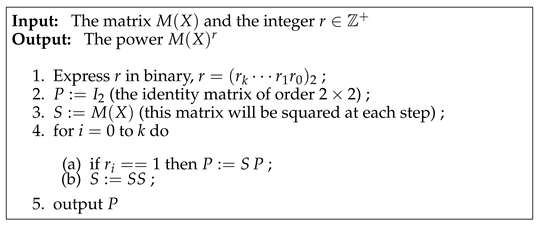 |
The powers of the matrix can be calculated via square-and-product:
namely, by the procedure sketched in Algorithm 1.
The Chebyshev polynomials are defined in the interval , the absolute values of the points in this domain are in the unit interval .
Consider the conventional decimal radix, . Suppose that is such that for some , then there is an integer such that , or . Consequently, from relations (1) and (2) it follows that
Besides,
and
On the other hand, from step 4(a) of the procedure in Table 1
as well as, from step 4(b),
Through these relations, the square-and-product algorithm can be performed within multiple precision arithmetic in using a multiple precision arithmetic on the integers.
Remark 2.
In the current experiments we calculate the Chebyshev polynomials through the above “square-and-product” method in order to maintain the multiple precision of the calculations through additions and products and to avoid the dependency of implementations of the maps cos and arccos.
3. The Cryptosystem Based on Chebyshev Polynomials
3.1. The General Scheme
The following is a public-key encryption scheme where the plaintext space and the ciphertext space are both the real interval :
- Key generation
- Choose and large enough. The public key is and the private key is s.
- Encryption
- For a plaintext , choose a random index , and calculate , , . The ciphertext is .
- Decryption
- Given the ciphertext recover the message as .
Hence the time complexity of the encryption procedure is
where is the time complexity of the chosen algorithm for multiplication in , m is the precision of calculations and r is the chosen random number.
With respect to the Decryption Procedure let us make a remark:
Suppose that a number x in the open interval is written in radix R as , with digits , namely . Then for any :
where is the decimal number expressed by the first digits of x and . Thus
besides
Assume now that there are given two numbers , . By expressing them as in (5),
thus by division there are quotients and remainders , such that
From Equation (7),
by substracting (8) from (6)
hence from (4)
and this last inequality entails , consequently the radix-R expression of q and coincide up to the -digit.
In summary:
Lemma 1.
If , , for any the quotients and coincide up to the -digit.
Thus, in Chebyshev encryption scheme the precision m, which is the number of significant digits in the arithmetical calculations within the interval , shall be greater than the length ℓ of plaintexts since in the decryption process a division is involved. However, due to Lemma 1, for any the recovered plaintext is plaussible up to the -th digit. In order to determine the original plaintext the decipherer should know ℓ.
In an attack to the cryptosystem, given a public key and the ciphertext , the random index such that should be recovered and the plaintext should be consisting of m digits where m is the precision of calculations. The original plaintext shall be the ℓ-length prefix of . Thus a bruteforce procedure to recover ℓ is to look for the first length ℓ such that . According to (3) the cost in time of this procedure is
It is worth to mention that in this consecutive search, for some tested lengths Bergamo’s attack, presented below, fails because the conditions stated in Section 3.2.1 are not satisfied.
3.2. Bergamo’s Attack
Let us recall first some basic facts of number theory.
3.2.1. Solving Linear Equations in Remainder Rings
Let be a modulus greater than 1 and consider the equation , with .
- If then the solution is unique.
- If and , the equation has a solution if and only if . In this case, express , then for we havehence is a solution and all residues of the form , are solutions as well.
3.2.2. A number Theory Problem
Consider the following
We consider in particular the case in which the following condition holds:
Assume that with . Then , and this last equation is stated over . By writing and the equation is equivalent to
In fact:
Hence the sign in the right side of (11) is not relevant and just an equation in (9) may be considered.
As mentioned in Section 3.2.1, if then the unique solution of (11) is in . If and , only when the Equation (11) can be solved and its d solutions are given as , .
In summary:
Remark 3.
With above notation, eq. (11) has solutions if where , and d is the number of solutions.
If we deal just with rational numbers in then for any radix any such rational number has a periodic R-representation. But for any pair of rational numbers there is a radix such that those numbers have finite representations for that radix.
Remark 4.
Whenever , a radix R may be found such that for the main problem, for some length .
Proof.
For a rational number , with , , and a radix , let and . For any current index i let be the minimum power such that and . Then with and . Thus, the radix-R expression of the rational number consists of 0’s except that at each entry there appears the digit . Since the remainder sequence takes values on the finite set , it is eventually periodic and so is the digit sequence . Clearly, the length of the period will be bounded by the denominator b; and if there is an index i such that then . Obviously, for such an index exists. □
3.2.3. The Attack
Each Chebyshev polynomial may be written as .
Given the public key of Alice, the attacker, Eve, looks for such that , then she evaluates and she recovers the plaintext as .
Consider the sequence
Remark 5.
Proof.
Indeed, let .
Assume and that for some , (the case in which is similar because cos is an even function). Then
Assume , then and necessarily . □
Let and . We may calculate arccos by its Taylor series [15]:
Eve’s goal consists in recovering such that
or in an equivalent form we have:
Thus, Eve’s goal (13) is an instance of the main problem (9) and it can be solved, by the method seen in Section 3.2.2.
As a final remark in this section we point out that if are solutions of (12), then for a sign ,
4. Experiments
We have used the Multiple Precision Arithmetic provided by gmp: the gnu Multiple Precision Arithmetic Library, operating on signed integers, rational numbers, and floating-point numbers. The main used function categories and data structures are mpz, the high-level signed integer arithmetic structure, and mpf, the high-level floating-point arithmetic structure. The used version is gmp 6.3.0.
When dealing with Bergamo’s attack, we used the High Performed Trigonometric Function provided by mpfr: the gnu Multiple Precision Floating-Point Reliable Library. The used version is mpfr 4.2.1.
The platform was a computer with a processor intel(r) core(tm) i7-10750H cpu @ 2.60ghz 2.59 ghz and 64-bit operating system ubuntu 22.04.3 lts.
The precision of any mpf structure from gmp, namely the number of digits in the decimal part of floating numbers, can be fixed in advance. Since , N digits precision shall be required by the built-in function mpf_set_default_prec(), where the function only supports argument with N a multiple of 20. Alternatively, N digits precision may be required by the built-in function mpfr::mpreal::set_default_prec(), for any integer N. Nevertheless, the arithmetic still loses digits beyond the specified precision.
In our experiments we use two precision parameters:
- ℓ: number of digits to codify plaintexts, we will refer to this parameter as length, and
- m: precision of arithmetical calculations in gmp and mpfr, we will refer to this parameter as precision by itself.
In order to get correct crypto operations, for any given length ℓ, the secret keys s and the random indices r shall be bounded from above and the precision m shall be bounded from below (see Table 1 below).
4.1. A Numerical Example for Symmetric Block Ciphering
Let be the ascii simple message:
Hi! I’m Xiaoqi.
Nice to meet you! ^_^
consisting of 38 characters (there is a Line Feed at the end of each row). We take , and as we discussed above in this example. Since , we can split the message into 4 sections, 3 consisting of 12 characters and the last of 2 characters. Each ascii symbol is a byte and we write it in bits. By concatenating these bit strings we codify the message by the following real numbers expressed in radix 10 with “significant digits”:
With secret key:
we calculate the public key where
In order to cipher, we consider the index
then
and by making , for , we obtain the following values for the second entries of the ciphertexts:
In order to decipher, we calculate the values , for , and we obtain the following values:
The original plaintexts are obtained by cutting at length .
Remark 6.
In the stated Cryptographic Scheme based on Chebyshev polynomials two parameters are essential: ℓ which is thelength, or the number of significant digits of plaintexts, and m which is theprecision, or the number of correct digits in arithmetical calculations.
A rough estimation from Table 1 is that for integer k and secret key , the precision m must be greater or equal than
4.2. Using an Enveloping Technique for Large Plaintexts
Evidently a block ciphering of long plaintexts by this method is excessively inefficient. We may compose symmetric block ciphering with this method through the OpenSSL library EVP in order to envelop large plaintexts. We take , and in this example. For the private key:
we calculate the public key where
and consider an envelope_key
Then by selecting
we get the cipher of ek as with
and effectively
The envelope key can be obtained by cutting the decimal representations up to the ℓ-th decimal digit.
4.3. A Numerical Example for Bergamo’s Attack
We try here the same example that illustrates the attack in [1]. It is proposed to take:
- Secret key.
- Public key. For , takehence is the public key.
- Random exponent for ciphering.. Hence
- Ciphertext. For any plaintext the ciphertext is
However these calculations are purely symbolic. All angles involved in above calculations are irrational numbers, hence when dealing with them with a computer we just have approximations to their values. For instance, up to 8 digits, we have
then consequently is comparable with . Indeed, for the current example
obviously the calculation of Chebyshev polynomials is highly sensitive to small errors, they are ill-conditioned. In this situation using the numerical approximations we have
- Secret key.
- Public key.
- Ciphering. Take . Then for any plaintext , the ciphertext is
Then the attacker Eve should solve the problem (13) with
in decimal representation, namely with radix , where those coefficients are obtained according to the relations stated before problem (13).
Suppose that the values (15) and (16) are cut up to the m-th digit. According to the method described in Section 3.2.2, condition (10) does hold and consequently the problem is reduced to solve Equation (11), which, by Remark 3, has solutions only when
We proposed 2 cases of different precision covering the 2 situations listed in the Bergamo’s algorithm that resulting the correct , such that
Case . In this case the coefficients in Equation (11) are
and with
The unique solution of the corresponding instance of Equation (11) is
Hence, the corresponding iteration r such that is
Comparing with the original index , we get
Case . In this case the coefficients in Equation (11) are
and with
and the solutions of the corresponding instance of Equation (11) are
and .
Hence, there are four corresponding iterations such that and they are Take
Comparing with the original index , we get
While applying the symbolic compuation to , yields it is indeed a correct solution:
Thus, for different values of m it may happen that either there are no solutions of Equation (11) () or there are several solutions ( and ). And as m increases, the solution increases as well. However, when is much larger than r, the calculations of Chebyshev polynomials may differ from that of the original index due to precision error propagation.
However, as reported in [10], Bergamo’s attack succeeds by considering symbolic, not numerical, calculations:
Suppose that for some rational number , . Then according to the selection of coefficients a, b, as in Equation (12), , for a sign , and . Then by selecting a radix R such that both a and b have finite R-radix representation, as stated in Remark 4, Bergamo’s attack would succeed in recovering the index r.
Besides the above example in which Bargamo’s attack may fail to recover the original index r, which is the random index when ciphering in Chebyshev chaotic cryptosystem, we also remark the following:
By considering the relation (14), we have that the left side lies in the real interval while the right side is the difference of two big numbers , of the same order of magnitude. Depending on the chosen precision m of the computing platform this difference can be great when the true values of the operands are approximated. Hence this difference may differ too much from the right side and that may provoke that for the alleged recovered index r, and consequently .
5. Conclusions
Due to the chaotic behaviour of Chebyshev polynomials, the breaking attack in [10] may fail if the length ℓ, the number of significant digits, in plaintexts is unknown. Hence, ℓ must be a part of the secret key. The precision m, the number of significant digits in arithmetical calculations, may be part of the public key.
Author Contributions
G.M. proposed the experiments, X.L. made the implementations and performed the experiments. Writing the report was a joint task.
Funding
This research received no external funding.
Data Availability Statement
All c/c++ programs developed for the current experimentation are available https://github.com/ChillingLiu/Chebyshev-Polynomial-based-Cryptosystem.
Acknowledgments
These experiments were realized during the stay at the Guangdong Technion Israel Institute of Technology (GTIIT) of the second author as visiting professor. Dr. Morales-Luna kindly acknowledges the academic and administrative authorities of GTIIT for their hospitality and the great teaching and research environment in GTIIT.
Conflicts of Interest
The authors declare no conflicts of interest.
References
- Kocarev, L. Chaos-based cryptography: a brief overview. IEEE Circuits and Systems Magazine 2001, 1, 6–21. [CrossRef]
- Kocarev, L.; Makraduli, J.; Amato, P. Public-Key Encryption Based on Chebyshev Polynomials. Circuits, Systems and Signal Processing 2005, 24, 497–517. [CrossRef]
- Mishkovski, I.; Kocarev, L., Chaos-Based Public-Key Cryptography. In Chaos-Based Cryptography: Theory,Algorithms and Applications; Kocarev, L.; Lian, S., Eds.; Springer Berlin Heidelberg: Berlin, Heidelberg, 2011; pp. 27–65. [CrossRef]
- Xiao, D.; Liao, X.; Deng, S. A novel key agreement protocol based on chaotic maps. Information Sciences 2007, 177, 1136–1142. [CrossRef]
- Ryu, J.; Kang, D.; Won, D. Improved Secure and Efficient Chebyshev Chaotic Map-Based User Authentication Scheme. IEEE Access 2022, 10, 15891–15910. [CrossRef]
- Kardaş, S.; Genç, Z.A. Security Attacks and Enhancements to Chaotic Map-Based RFID Authentication Protocols. Wireless Personal Communications 2018, 98, 1135–1154. [CrossRef]
- Jiang, M.; Yang, H. Image Encryption Algorithm Using Multi-Level Permutation and Improved Logisticc-Chebyshev Coupled Map. Information 2023, 14. [CrossRef]
- Jiang, M.; Yang, H. Image Encryption Using a New Hybrid Chaotic Map and Spiral Transformation. Entropy 2023, 25. [CrossRef]
- Chen, F.; Liao, X.; Xiang, T.; Zheng, H. Security analysis of the public key algorithm based on Chebyshev polynomials over the integer ring ZN. Information Sciences 2011, 181, 5110–5118. [CrossRef]
- Bergamo, P.; D’Arco, P.; De Santis, A.; Kocarev, L. Security of public-key cryptosystems based on Chebyshev polynomials. IEEE Transactions on Circuits and Systems I: Regular Papers 2005, 52, 1382–1393. [CrossRef]
- Yoshioka, D. Security of Public-Key Cryptosystems Based on Chebyshev Polynomials over Z/pkZ. IEEE Transactions on Circuits and Systems II: Express Briefs 2019, PP, 1–1. [CrossRef]
- Free Software Foundation. GMP: The GNU Multiple Precision Arithmetic Library. https://gmplib.org/, Viewed at 2024/12.
- Fousse, L.; Hanrot, G.; Lefèvre, V.; Pélissier, P.; Zimmermann, P. MPFR: A multiple-precision binary floating-point library with correct rounding. ACM Trans. Math. Softw. 2007, 33, 13?es. [CrossRef]
- Cheong, K.Y. One-way Functions from Chebyshev Polynomials. Cryptology ePrint Archive, Paper 2012/263, 2012.
- WolframAlpha. ArcCos Taylor Series. https://www.wolframalpha.com/input/?i=taylor+series+arccos&lk=3, Viewed at 2024/12.
Figure 1.
Change of variable.
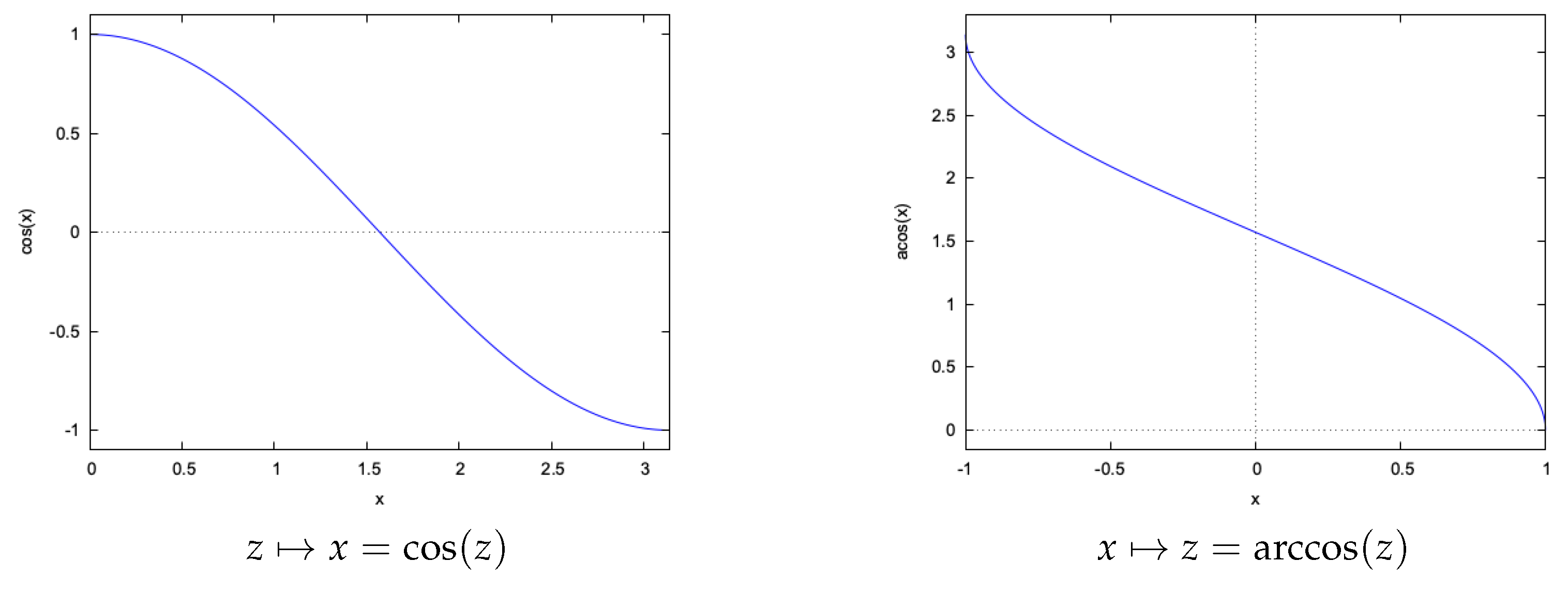
Table 1.
Relations between length ℓ, precision m and secret key s
| ℓ | m | s | NO | AvDisc | AvTime (sec) |
|---|---|---|---|---|---|
| 100 | 120 | 1815 | 0.00090 | ||
| 140 | 6306 | 0.00335 | |||
| 180 | 24582 | 0.01414 | |||
| 240 | 103427 | 0.07522 | |||
| 380 | 380561 | 0.46595 | |||
| 640 | 1589338 | 3.92343 | |||
| 1180 | 6091120 | 39.40116 | |||
| 200 | 220 | 1815 | 0.00113 | ||
| 240 | 6306 | 0.00457 | |||
| 280 | 24582 | 0.02075 | |||
| 340 | 103427 | 0.11672 | |||
| 480 | 380561 | 0.64108 | |||
| 740 | 1589338 | 5.00373 | |||
| 1280 | 6091120 | 43.47840 | |||
| 300 | 320 | 418 | 0.00045 | ||
| 340 | 1815 | 0.00202 | |||
| 340 | 6306 | 0.00696 | |||
| 380 | 24582 | 0.03044 | |||
| 440 | 103427 | 0.15059 | |||
| 580 | 380561 | 0.78394 | |||
| 840 | 1589338 | 6.22619 | |||
| 1380 | 6091120 | 46.61281 | |||
| 400 | 420 | 418 | 0.00049 | ||
| 440 | 1815 | 0.00259 | |||
| 460 | 6306 | 0.00933 | |||
| 480 | 24582 | 0.04019 | |||
| 560 | 103427 | 0.20285 | |||
| 680 | 380561 | 1.03725 | |||
| 940 | 1589338 | 6.52374 | |||
| 1480 | 6091120 | 50.79987 |
NO: Number of operations (multiplications). Disc: Discrepancy between plaintext and recovered text: Each row displays averaged statistics corresponding to 20 iterations for random selections of the index r in the interval .
Disclaimer/Publisher’s Note: The statements, opinions and data contained in all publications are solely those of the individual author(s) and contributor(s) and not of MDPI and/or the editor(s). MDPI and/or the editor(s) disclaim responsibility for any injury to people or property resulting from any ideas, methods, instructions or products referred to in the content. |
© 2024 by the authors. Licensee MDPI, Basel, Switzerland. This article is an open access article distributed under the terms and conditions of the Creative Commons Attribution (CC BY) license (http://creativecommons.org/licenses/by/4.0/).
Copyright: This open access article is published under a Creative Commons CC BY 4.0 license, which permit the free download, distribution, and reuse, provided that the author and preprint are cited in any reuse.


