Preprint
Article

This version is not peer-reviewed.

Influence of Different Electrode Materials on Bipolar Switching Characteristics for Neodymium Oxide Films Resistance Random Access Memory Devices

Submitted:

09 December 2024

Posted:

09 December 2024

You are already at the latest version

Abstract

The present study observed and discussed the bipolar resistance switching behavior and electrical conduction transport properties of the neodymium oxide films resistive random access memory (RRAM) devices for the different thickness top electrode materials. Especially in ITO (Indium tin oxide) electrode materials, the conduction mechanism of neodymium oxide films RRAM devices for ITO electrode exhibits ohmic conduction behavior with 1 mA and 10 mA compliance currents in the set state for low operating voltages and low/high resistance values. In addition, at elevated operating voltages, the conduction mechanism displays hopping conduction behavior with 1 mA and 10 mA compliance currents. The observed increase in reset voltage indicates that oxygen ions have diffused into the vicinity of the ITO electrode during the set operation. Three hypothetical physical models are proposed, based on the relationship between different ITO electrode thicknesses and the oxygen concentration distribution effect. In conclusion, the neodymium oxide films RRAM devices exhibited high memory window properties, exemplary bipolar resistance switching characteristics, and non-volatile properties, rendering them suitable for incorporation into next-generation non-volatile memory applications.

Keywords: 
;  ;  ;  ;  

1. Introduction

Memory types can be broadly divided into volatile and non-volatile memory. Volatile memory refers to memory in which stored data is erased when the external power supply is removed. The most common examples are SRAM and DRAM. SRAM has a faster read speed and low power consumption. In contrast to the six transistors required for each bit of data in SRAM, DRAM can process each bit using only one capacitor and one transistor. This implies that DRAM has greater capacity and density per unit volume, which results in a lower manufacturing cost [1,2,3,4,5,6,7,8,9,10,11,12,13,14].
Non-volatile memory is commonly used to store information because the stored data is not erased when the external power supply is removed. Traditional non-volatile memory includes flash memory and ROM. However, traditional non-volatile memory has the disadvantages of slow read/write speed and slower reading speed. In recent years, new types of non-volatile memory have been developed that combine the advantages of volatile memory with non-volatile characteristics to improve their disadvantages. These memories feature faster read and write speeds, lower power consumption, and better read endurance. To date, the following four types of emerging volatile memories have been developed: magnetoresistive random access memory (MRAM), phase change random access memory (PCRAM), ferroelectric random access memory (FeRAM), and resistive random access memory (RRAM) [15,16,17].
RRAM is currently the focus of much research attention because its structure uses a metal/insulator/metal (MIM) sandwich structure. The way this structure is overlapped can reduce the finished area and thus increase the memory capacity. Compared with other emerging memories, RRAM has the advantages of lower write voltage, faster read speed, and higher integration density. Another study indicates that the Al/Nd2O3/ITO structure can also facilitate the operation of Nd2O3 resistive memory at a high frequency and improve the switching ratio [18]. In addition to the study of the dielectric layer, the contact between the metal and the dielectric layer in the MIM structure of the RRAM is also a key point of investigation, as it directly affects the characteristics of the RRAM. Currently, there is a significant body of research focusing on the effect of different electrode materials on the characteristics of RRAMs.
Recently, the supercapacitors exhibited two main categories concerning the charge storage devices mechanism, for the electric double-layer capacitors and pseudo-capacitors [19,20]. The high conductive and surface area carbonaceous materials were widely used as electrode materials in electric double-layer capacitors. Metal oxides exhibited the conducting polymers were tested for pseudocapacitive electrode materials. These were the electrode materials that determine the electrochemical performance of the supercapacitors. The neodymium element is an important rare earth material for applications in the electric vehicles, mobile phones, permanent magnets, windmills, high-speed rail, medical scanners, lasers, optical fiber data transmission, screen phosphors, banknote protection, catalysts for everything that supports our daily life. Additionally, the neodymium oxide (Nd2O3) material was an important naturally abundant and highly reactive element in rare earth metal oxides materials. It was widely also applications in the magnetic devices, the catalysts, and the dielectrics capacitor material. The neodymium oxide material were used for the conductive filler and to enhance the electrical properties in relation materials [21]. Therefore, the neodymium oxide (Nd2O3) material has the opportunity to be used in supercapacitor applications, it was also might the opportunity to be used for same capacitor structure of RRAM memory devices in the future.
Because the neodymium oxide (Nd2O3) material was the characteristics of a high dielectric constant material, it might be opportunity used in CMOS integration circuit in the future. According to the latest 1T1R RRAM process integration technology, there was the opportunity that materials was able to applied to components in the same metal-insulator-metal (MIM) structure of the RRAM devices. There were still opportunities to integrate neodymium oxide materials integrated the CMOS manufacturing processes in the future.
Generally, for neodymium oxide (Nd2O3) thin films, the films of various material have defects, oxygen vacancies, and other problems after preparation as-deposited processing to be RRAM devices . Additionally, a rapid thermal annealing process and a general furnace tube annealing process were usually to improve the electrical and relation properties. However, the annealing process requires a long cost and high temperature time. In our previous research, we successfully proposed a low-temperature supercritical technology method to improve defects in neodymium oxide (Nd2O3) film processing. The defects and oxygen vacancies of non-treated neodymium oxide thin films for different oxygen concentration parameters were also effectively achieved and improved by the of supercritical carbon dioxide fluid treatment. Therefore, to choice the different top/bottom electrodes and electrical transferred conduction mechanisms will be the focus and direction of our research.
To discuss the oxygen concentration distribution effect in oxygen-rich ITO electrode, the ser/reset voltage of neodymium oxide films RRAM devices for different ITO electrode thickness were discussed and investigated. Additionally, the extremely different set voltage might be discussed form the electric field concentration effect at the tip of the RRAM resistance wire and the oxygen ion concentration distribution effect. Finally, we varied the different thickness ITO electrode to illustrate the influence of different electrode materials on bipolar switching characteristics for neodymium oxide films resistance random access memory devices on the set voltage mechanism [22].

2. Experiment

In this study, the neodymium oxide (Nd2O₃) films of the metal-insulator-metal (MIM) resistance random access memory devices was synthesized using the radio frequency (RF) sputtering method. Furthermore, the neodymium oxide target was positioned at a distance of approximately 5 cm from the substrate. In order to eliminate the defects inherent to the oxide target and to ensure the stability of the plasma during the deposition process, a pre-sputtering time of 20 minutes was maintained under an argon atmosphere for the as-deposited films. The radio frequency (RF) sputtering power applied to the neodymium oxide targets was 160 watts. Following the pre-deposition process at room temperature, the as-deposited neodymium oxide films was subjected to rapid temperature annealing (RTA) processing. Subsequently, the as-deposited neodymium oxide films underwent a post-treatment process, which involved annealing and a 500°C, 30-second treatment.
The metal-insulator-metal (MIM) structure sample devices, which were prepared using different top electrode materials, were divided for the purpose of discussing the potential for bipolar switching properties of the TiN/neodymium oxide/ITO, Al/neodymium oxide/ITO, and ITO/neodymium oxide/ITO RRAM devices. These devices were prepared by means of dc and rf sputtering technology, and their structures are illustrated in Figure 1. The DC sputtering power was set to 200 W for titanium nitride. Subsequently, the aluminum films was deposited as the top electrode using thermal evaporation technology.
Moreover, the surface microstructure of the neodymium oxide films was examined using field emission scanning electron microscopy (FE-SEM). The preferred orientation of the films was determined and observed through X-ray diffraction (XRD) analysis. The I-V switching characteristics of neodymium oxide films RRAM devices were determined and observed using an Agilent B1500 semiconductor parameter analyzer. Additionally, the electrical properties of precision power measurement equipment were employed to assess the I-V curves of the various compliance currents and different top electrode materials for the oxygen ion concentration distribution effect on the resistive random access memory device.

3. Results and Discussion

Figure 1 depicts the X-ray diffraction (XRD) patterns of the (101) and (103) preferred peaks of the as-deposited neodymium oxide films subjected to different annealing temperatures. It can be observed that all the films exhibited a polycrystalline structure irrespective of the annealing temperature applied.
The smallest full width at half maximum (FWHM) value for the (101) and (103) preferred peaks of the neodymium oxide films at different annealing temperatures was measured. The crystallinity and grain size of the neodymium oxide films prepared using an annealing temperature of 450°C exhibited the smallest FWHM value relative to the other temperature treatments. In addition, a smaller peak FWHM exhibits better crystallinity. FWHM(101) was 0.18 for an annealing temperature of 450°C. After calculation, the crystallinity was found to be 97.02% and grain size of 30nm. Comparing the those results, the crystallinity of the annealing temperature of 450°C is better. The grain size was then calculated by the Debye–Scherrer formula equation, the error of the measured parameters was about 3–5%. The grain size and the crystallinity of the neodymium oxide films was also proved in Figure 2. Rapid thermal processing (RTP) was a semiconductor manufacturing process which heating relation material films to temperatures above 1,000°C for not more than a few seconds. These processes were used for a wide variety of applications in integrated circuit manufacturing including dopant activation, thermal oxidation, defect structure, oxygen vacancy concentration, and device performance.
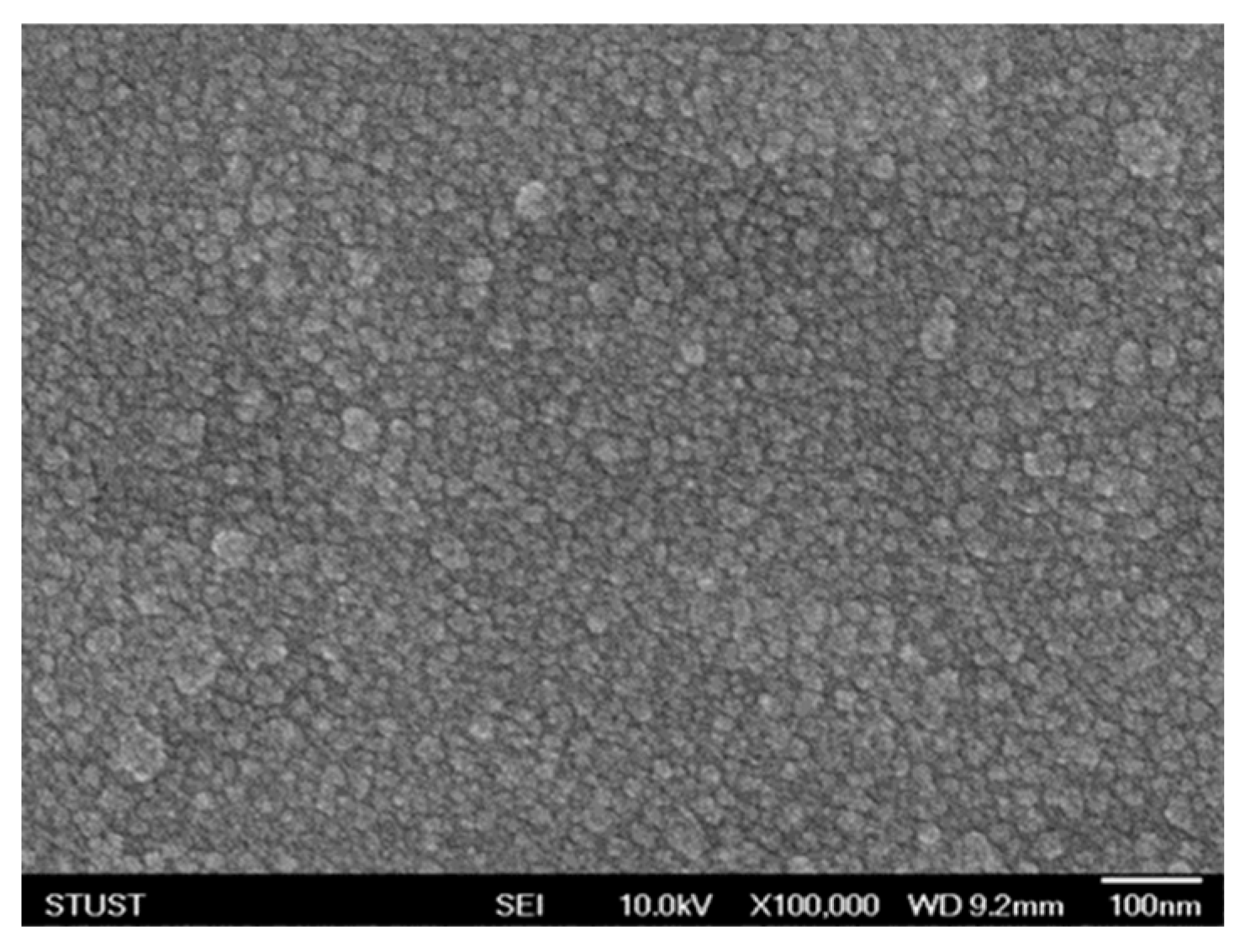
The microstructure of the neodymium oxide films of the RRAM devices was observed using scanning electron microscopy (SEM) to examine the surface morphology. The specimens of films exhibited a thickness of approximately 15 nm and displayed a dense and uniform grain structure. Additionally, circular plates and oval grains were observed. As illustrated in Figure 2, the microstructure and grain size of the neodymium oxide films subjected to annealing at 450°C exhibited a predominantly round or circular morphology. The grain size of the neodymium oxide films was found to be approximately 30 nm. In a previous study, the grain growth, dielectric loss, and leakage current properties of non-treated films exhibited notable improvement when subjected to different oxygen annealing treatments. Moreover, the annealing process led to a reduction in the number of traps and vacancies in the films, which in turn resulted in a notable decrease in the leakage current density.
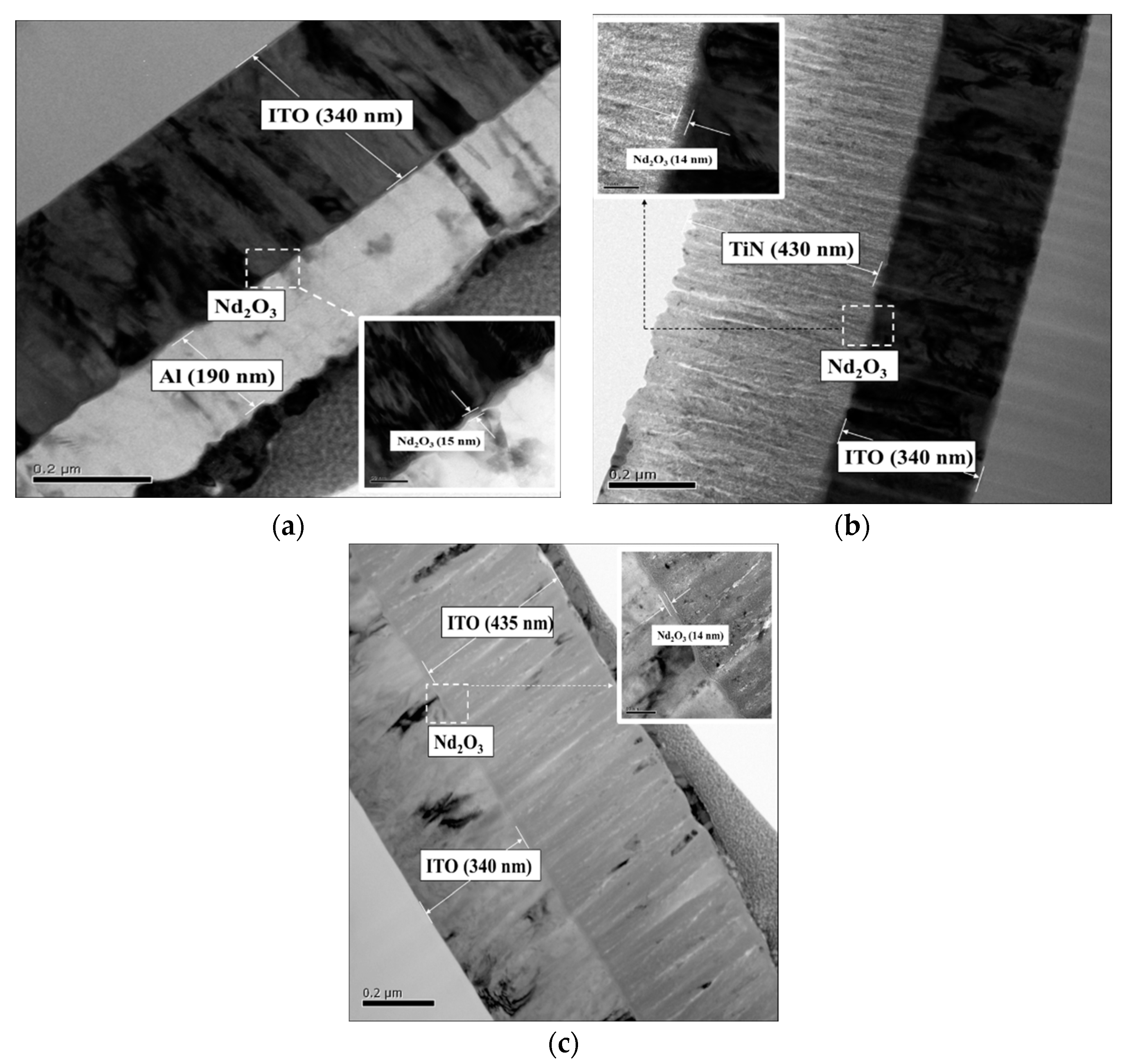
Figure 3 presented the images and cross-sectional structure obtained by the transmission electron microscope(TEM), the Philips Tecnai G2 F20 (FEG-STEM). Figure 3 depicts the cross-section of the neodymium oxide films of the RRAM devices for the various top electrode materials (Al, TiN, and ITO). The thicknesses of the Al (top electrode), the neodymium oxide films, and the ITO substrate of the RRAM devices were approximately 190 nm, 15 nm, and 340 nm, respectively (Top left). The TiN and ITO top electrodes of the RRAM devices exhibited thicknesses of approximately 430 nm and 340 nm, respectively (top right and bottom left). Subsequent observations and measurements of the I-V curves to determine the electrical conduction mechanism of the neodymium oxide films revealed their significance for applications in nonvolatile RRAM devices (bottom right).
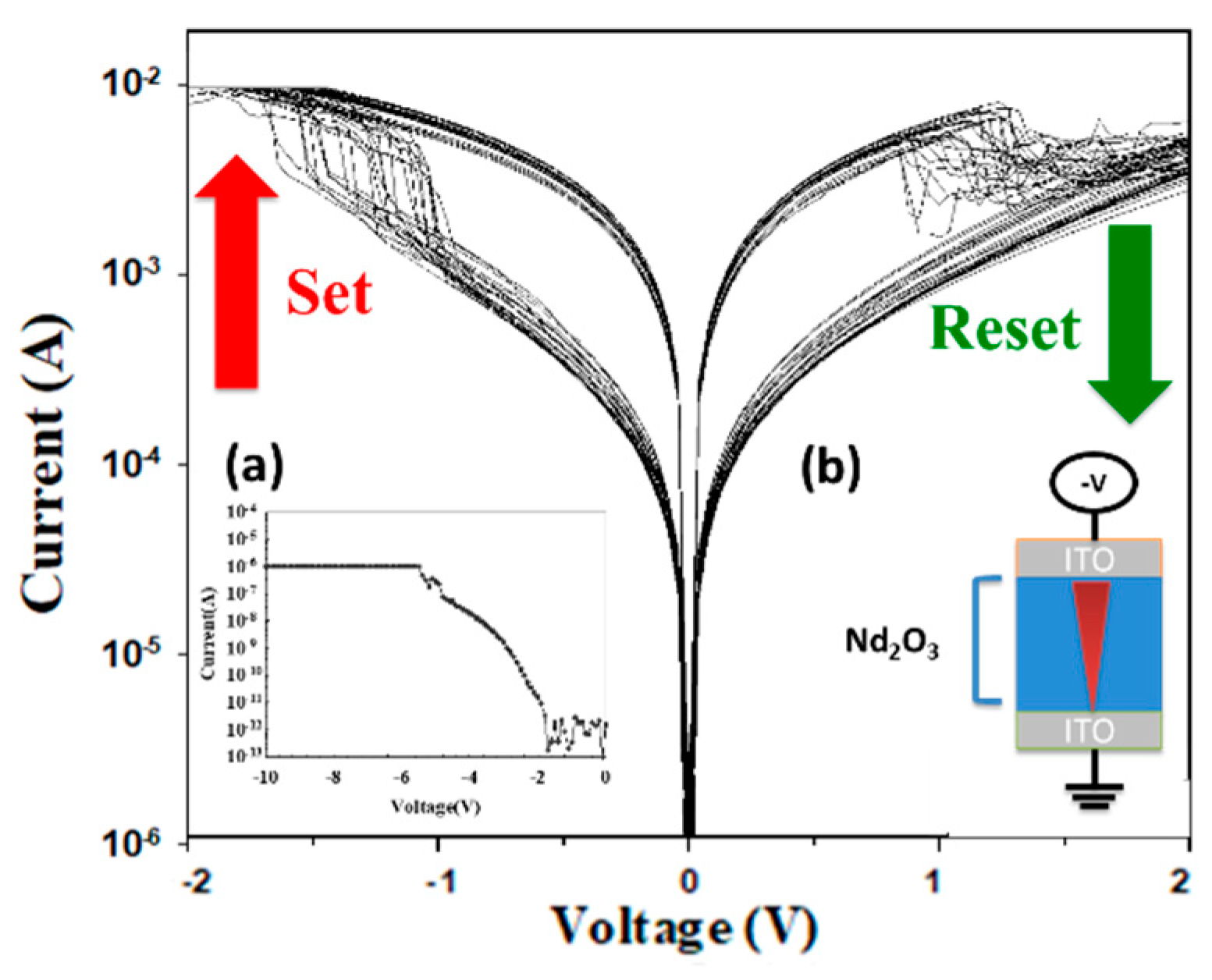
The properties of the neodymium oxide films RRAM devices with the initial forming process at the set and reset states are illustrated in Figure 4. As illustrated in Figure 4a, the current compliance was 10 mA. The initial forming process was conducted at a voltage of approximately 6 V. In the set process, the neodymium oxide films RRAM device was transferred to the low resistance state (LRS), whereby a high positive bias was applied in excess of the set voltage during set and reset processing. In the reset process, the operation current exhibited a continuous decrease from the low resistance state (LRS) to the high resistance state (HRS) when a negative bias was applied over the reset voltage. To obtain a stable I-V operating switching condition, the set and reset processes of the neodymium oxide films of the RRAM devices were repeated 100 times.
Figure 4 shows the I-V curves of the neodymium oxide films RRAM devices with the initial forming process or an ITO/films/ITO structure, based on 100 measurements. The set and reset voltages of the neodymium oxide films RRAM device for a 10mA compliance current were approximately 1.5V and -1.5V, respectively. As illustrated in Figure 4(a), the breakdown voltage of the initial forming process was -6V.
To explore the electrical conduction behavior of the initial metallic filament forming conduction, the Ohmic conduction and hopping conduction mechanism were determined by I-V and lnI–V1/2 curve fitting. To calculate the I-V curve, the Ohmic conduction mechanism equation was transformed from the I-V curves fitting the RRAM devices. For the Ohmic conduction,
J = q u n E e x p Δ E a c k T
where Eac is electron activation energy, q is the carrier mobility, E is applied electrical field, n is the electronic concentration, k is the Boltzmann constant, T is absolute temperature.
In addition, to calculate the ln 1 T 2 V curve, the hopping conduction mechanism equation was transformed to the I-V curves fitting the RRAM devices. For the hopping conduction,
J = q N a v o e q Φ T / k T e q a V / 2 d k T
where d, ΦT, v0, N and a are films thickness, barrier height of hopping, intrinsic vibration frequency, the density of space charge, and mean hopping distance, respectively [12,18].
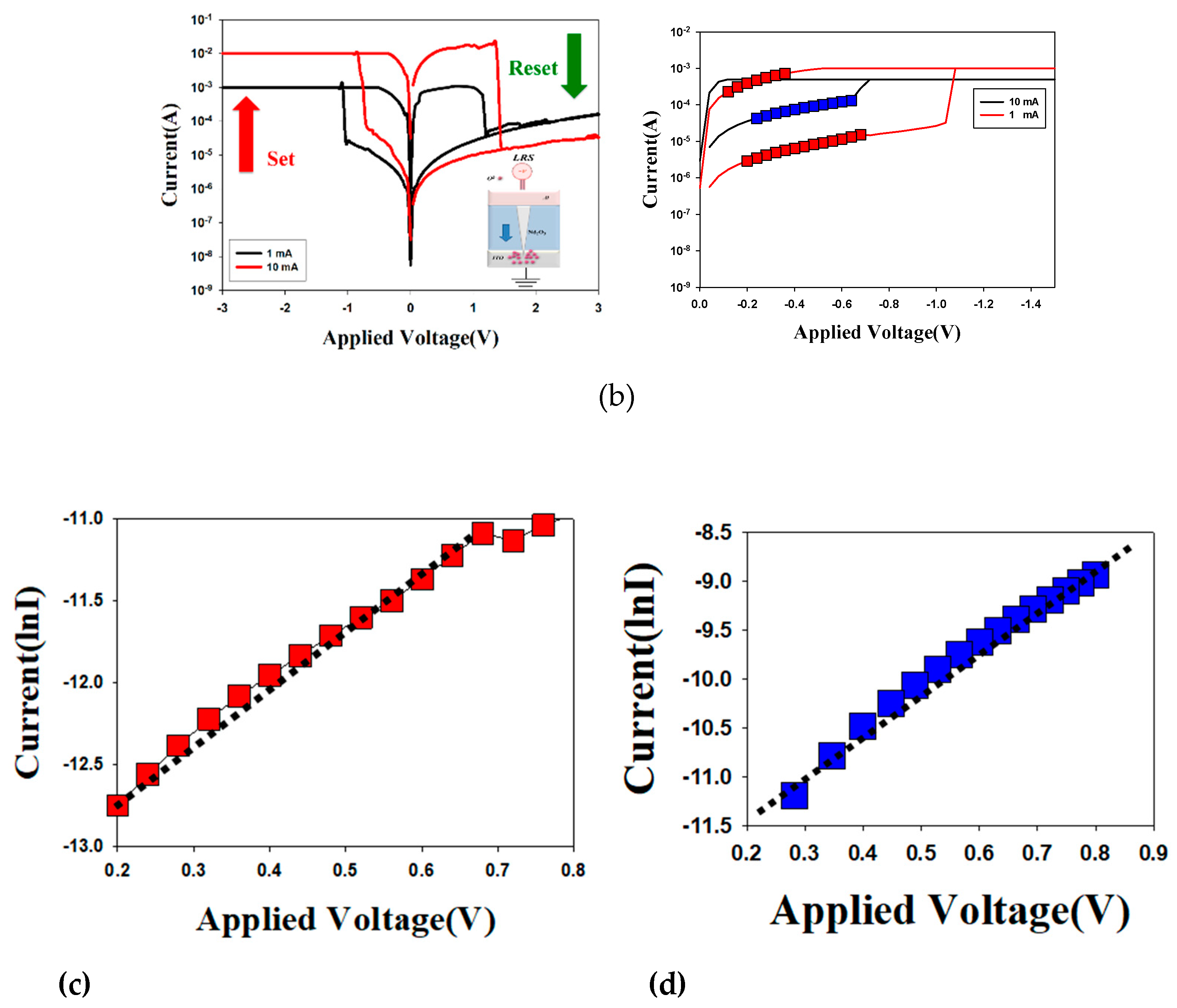
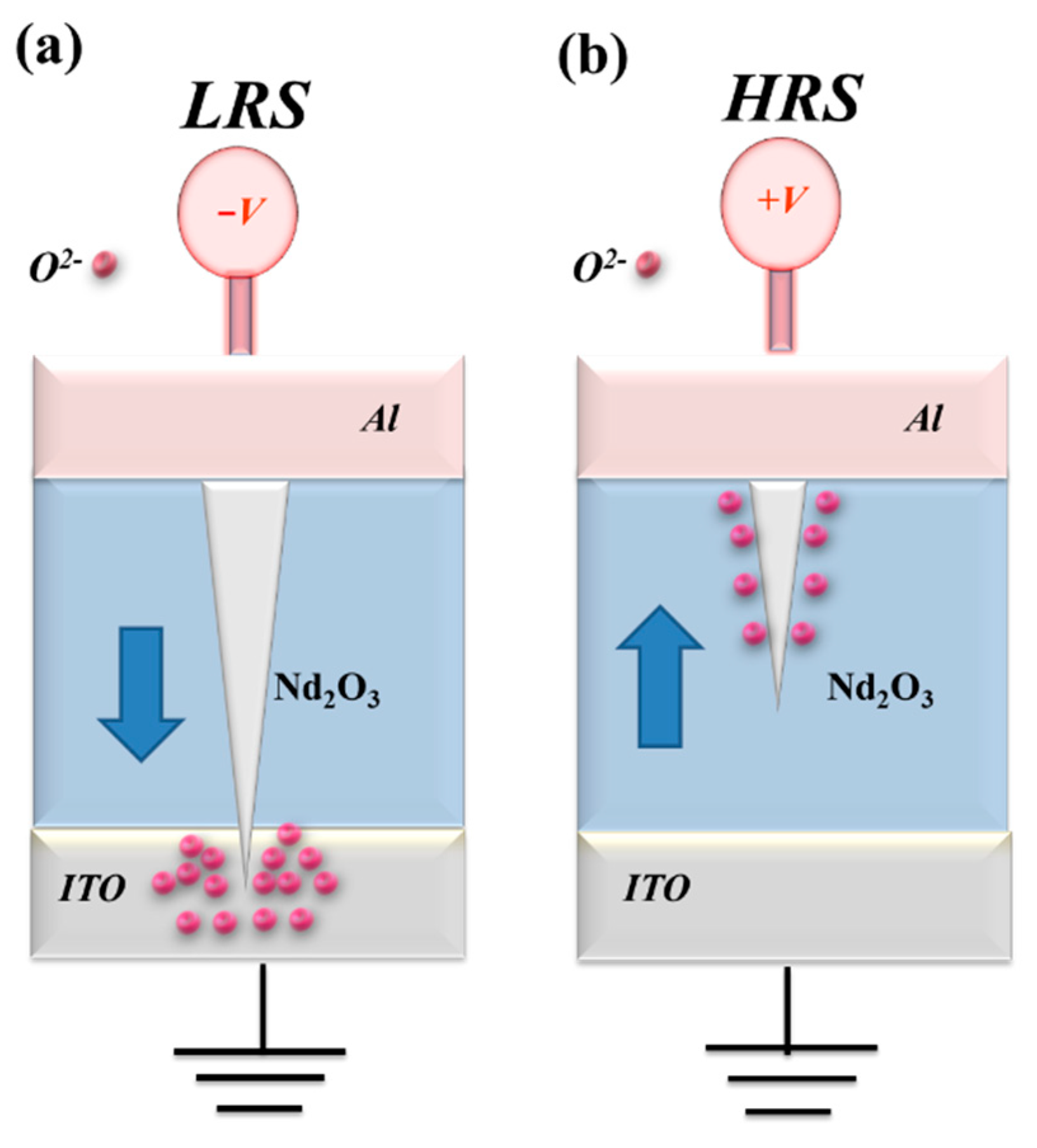
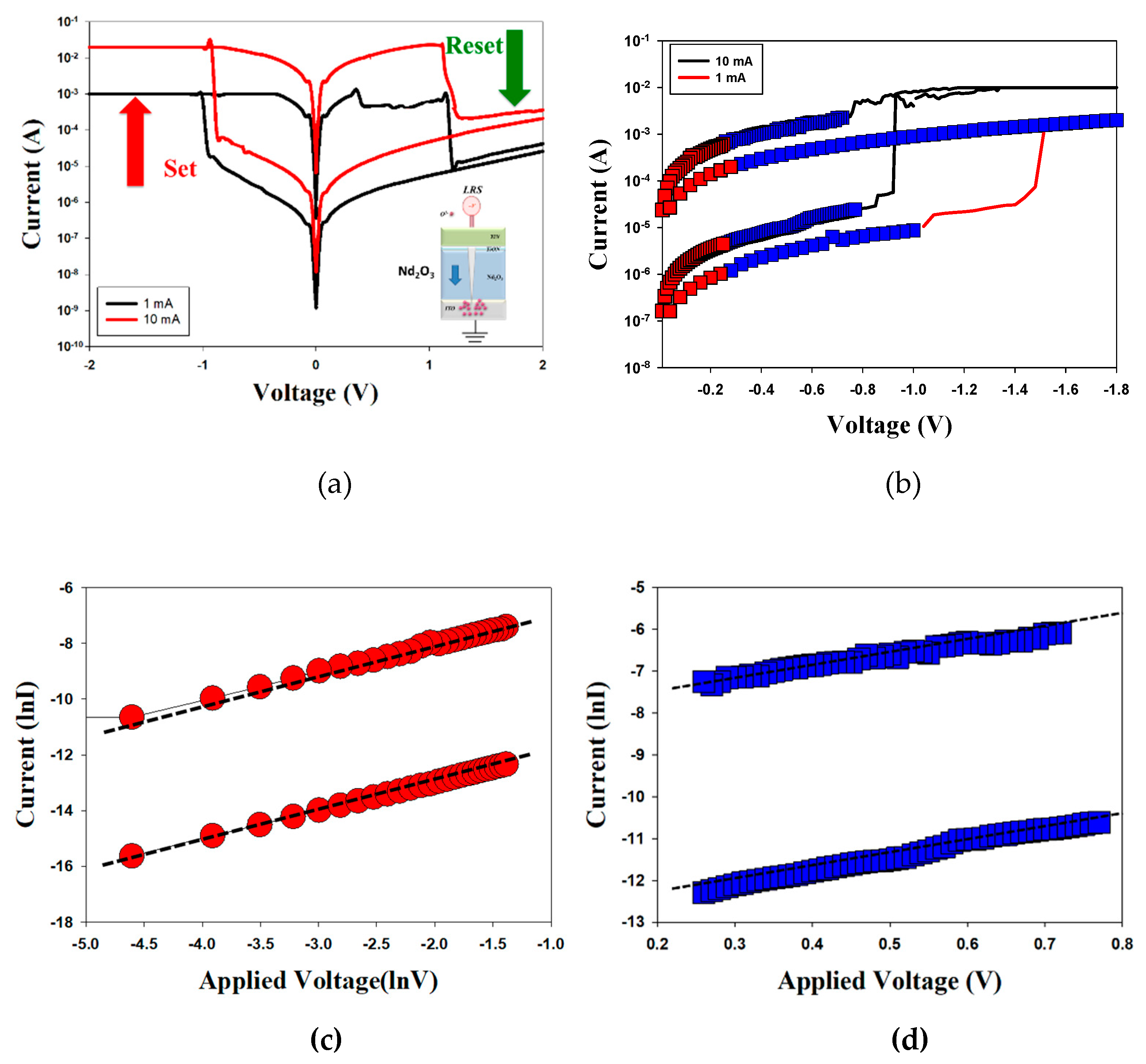
Figure 5 presented the I-V curves of the neodymium oxide films RRAM device using aluminum top electrode under different (a) compliance current processes and (b) conduction mechanisms. The applied compliance current for the neodymium oxide films RRAM device was 1mA and 10mA, respectively. The set and reset voltages of the RRAM device for a compliance current of 1mA were approximately 1V and -1V, respectively. For a compliance current of 10mA, the memory windows exhibited a high 104 ratio and a low set voltage. This result may be indicative of the low set voltage of high switch cycles induced by the high compliance current. Figure 5(b) depicts the I-V curves of the neodymium oxide films RRAM device with an aluminum top electrode for different conduction mechanisms. The neodymium oxide films RRAM device for 1mA and 10mA compliance currents both exhibited the hopping conduction mechanism in low set voltage, as illustrated in Figure 5(b). In addition, the electrical conduction mechanism of films RRAM devices of 10mA compliance current exhibited the hopping conduction behavior for all LRS/HRS in Figure 5 (c) and (d). The electrical transfer mechanisms and initial metallic filament path model of the neodymium oxide films RRAM devices for aluminum electrode in the set/reset state also presented and described in Figure 6.
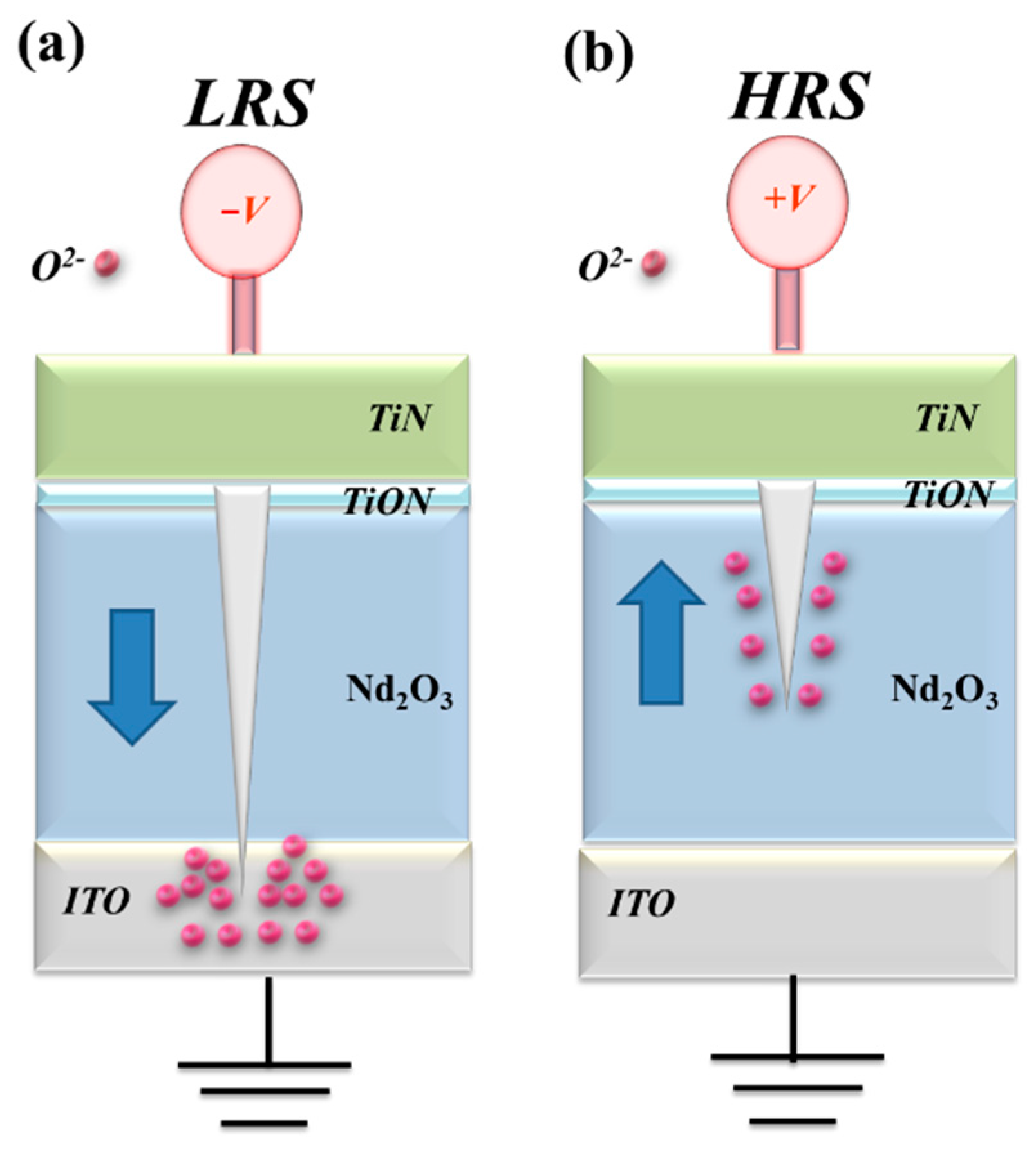
Figure 7 presented the I-V curves of the neodymium oxide films RRAM device with a TiN top electrode under different (a) compliance current processes and (b) conduction mechanisms. The set and reset voltages of the RRAM device with a TiN top electrode for 1mA compliance current were approximately 1V and -1V, respectively. At the 10 mA compliance current, the memory windows exhibited a high 10³ ratio and a low set voltage. The result may also be indicative of a low set voltage resulting from high switch cycles induced by a high compliance current. Figure 7(b) depicts the I-V curves of the neodymium oxide films RRAM device with a TiN top electrode under different conduction mechanisms. The neodymium oxide films RRAM device with 1mA and 10mA compliance currents both exhibited a hopping conduction mechanism at low set voltages and an ohmic conduction mechanism at high applied voltages in Figure 7 (c) and (d). The oxygen vacancies exist in the interface region between the TiN bottom/film of the RRAM device and gradually accumulate for LRS states. The physical conduction model provided the continuing oxidation reaction of the thin metal metallic filament path in high positive voltage later. Thin metal metallic filament were affected by oxygen atoms near the bottom electrode area. The electrical transfer mechanisms and initial metallic filament path model of the films RRAM devices for TiN electrode in the set/reset state clearly described in Figure 8 [23,24].
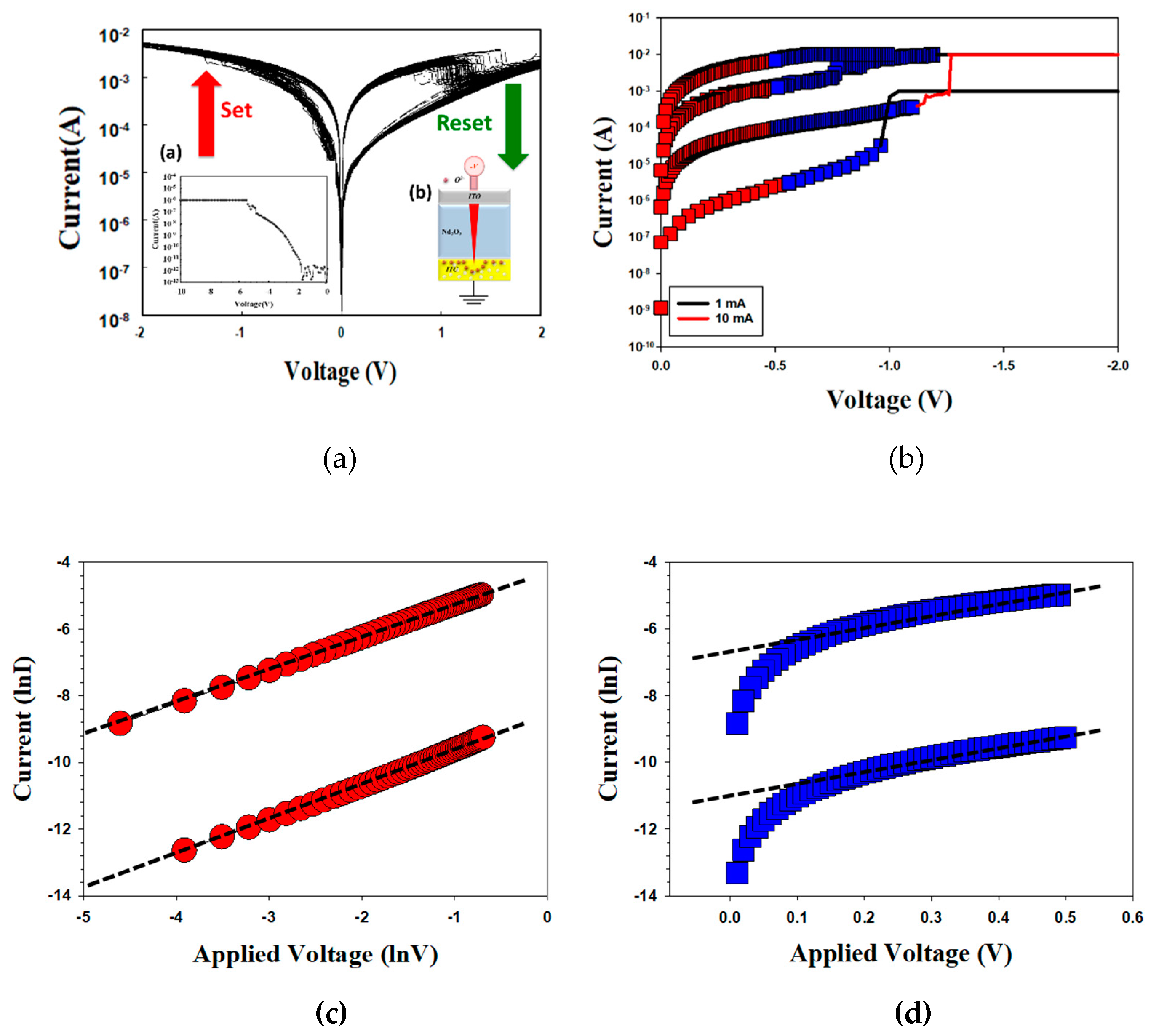
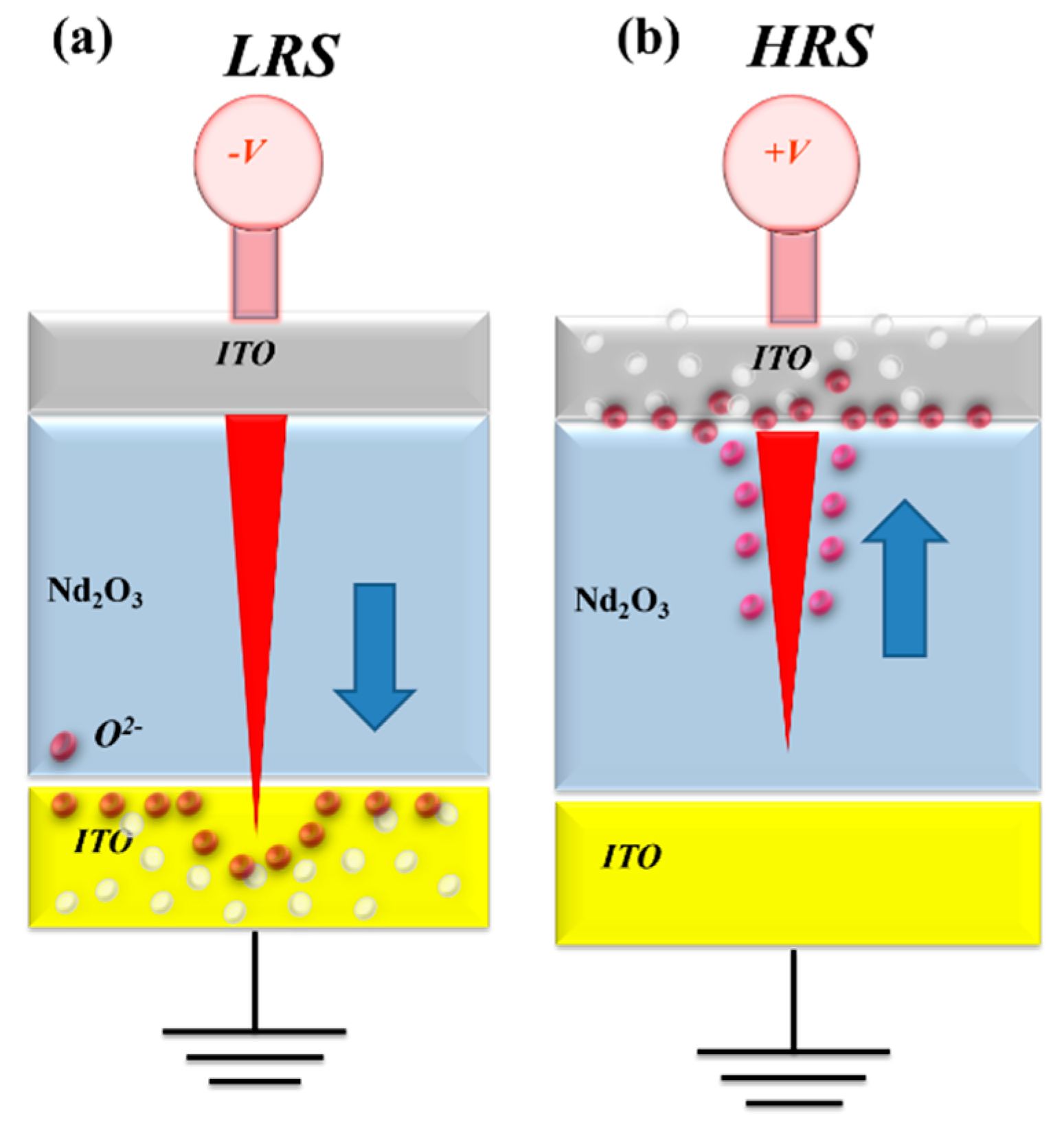
Figure 9 also presented the I-V curves of the neodymium oxide films RRAM device with an ITO top electrode under different (a) compliance current processes and (b) conduction mechanisms. The set and reset voltages of the RRAM device with an ITO top electrode and a 1mA compliance current were approximately 1V and -1.2V, respectively. At a compliance current of 1 mA, the memory windows demonstrated a high 103 ratio and a low set voltage. However, the memory windows exhibited a low 102 ratio with a 10mA compliance current. This result may also indicate the involvement of oxygen ions from the ITO electrode in the electron conduction path of the films. Figure 9(b) depicts the I-V curves of the neodymium oxide films RRAM device with an ITO top electrode under different conduction mechanisms. The neodymium oxide films RRAM device exhibited the hopping conduction mechanism at low set voltages and the ohmic conduction mechanism at high applied voltages when tested with 1mA and 10mA compliance currents in Figure 9 (c) and (d), respectively. The physical conduction model also provided the elliptical pattern of the depletion region formed by oxygen ions and vacancies gradually accumulates in the ITO top electrode of films RRAM device for LRS later. Additionally, the conductive metal continuously and sharply adsorbs oxygen atoms and vacancies in ITO electrode in HRS. In Figure 10, the electrical transfer mechanisms and initial metallic filament path model of the films RRAM devices for ITO electrode were also clearly described [23,24].
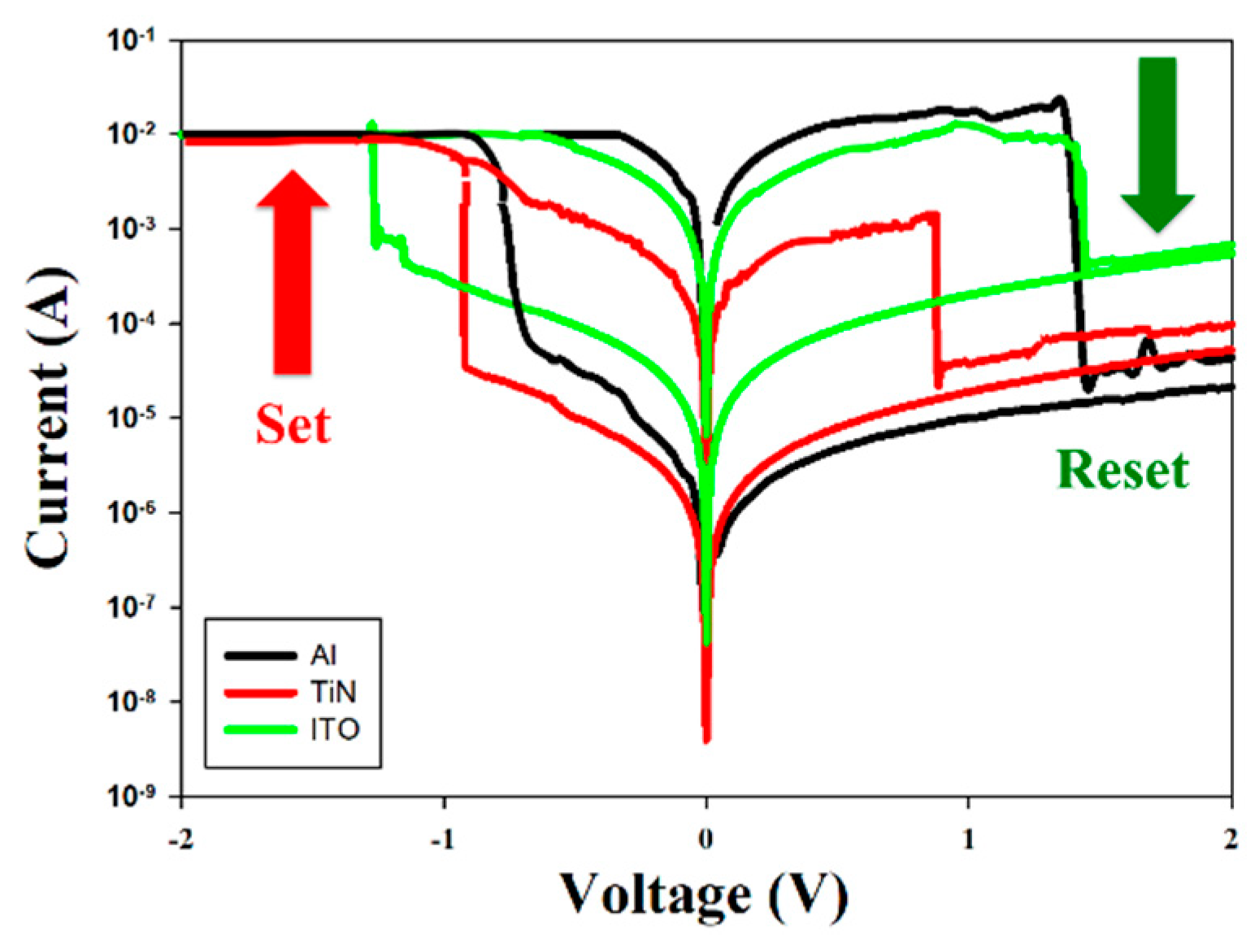
The above I-V curves of the neodymium oxide films RRAM device with different top electrode materials, including aluminum, TiN, and ITO, are presented in Figure 11. At a compliance current of 10mA, the I-V curves of the neodymium oxide films RRAM device with an ITO electrode exhibited a symmetry memory window within the set/reset voltage range. The observed symmetry of the I-V curves may be attributed to the barrier height at the interface between the films and the ITO electrode in the RRAM device, which employs the same top and bottom ITO electrode materials. In contrast, the top electrode of the RRAM device using aluminum or TiN exhibited asymmetric I-V curves. The asymmetry of the I-V curves in the set/reset voltage ranges may be attributed to the disparate barrier heights of the films and the ITO electrode interface. As illustrated in Figure 11, the memory window ratios of the neodymium oxide films RRAM devices were approximately 10², 10³, and 10³, respectively.
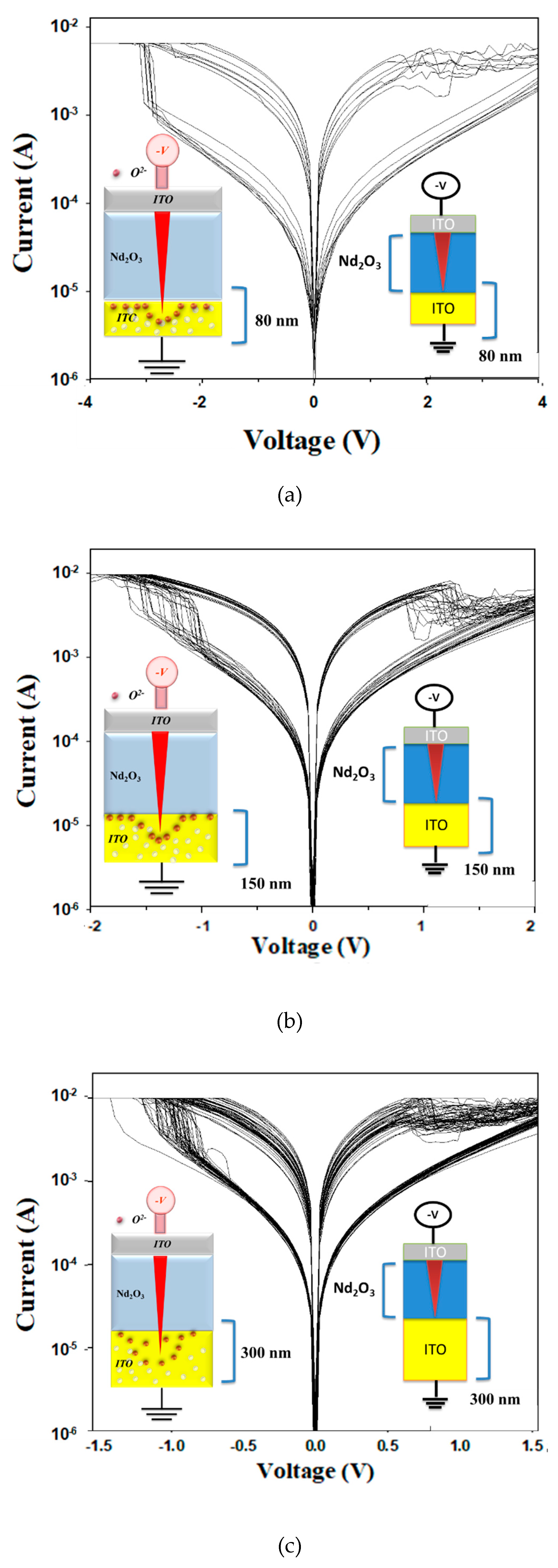
Figure 12 presented the 100 trace I-V curves of the neodymium oxide films RRAM device using ITO as the top electrode materials with thicknesses of (a) 80 nm, (b) 150 nm, and (c) 300 nm from 100 measurements. In the insert of Figure 12(a)-(c), the left image depicts the electron transfer model, while the right image represents the MIM structure of the neodymium oxide films RRAM device.
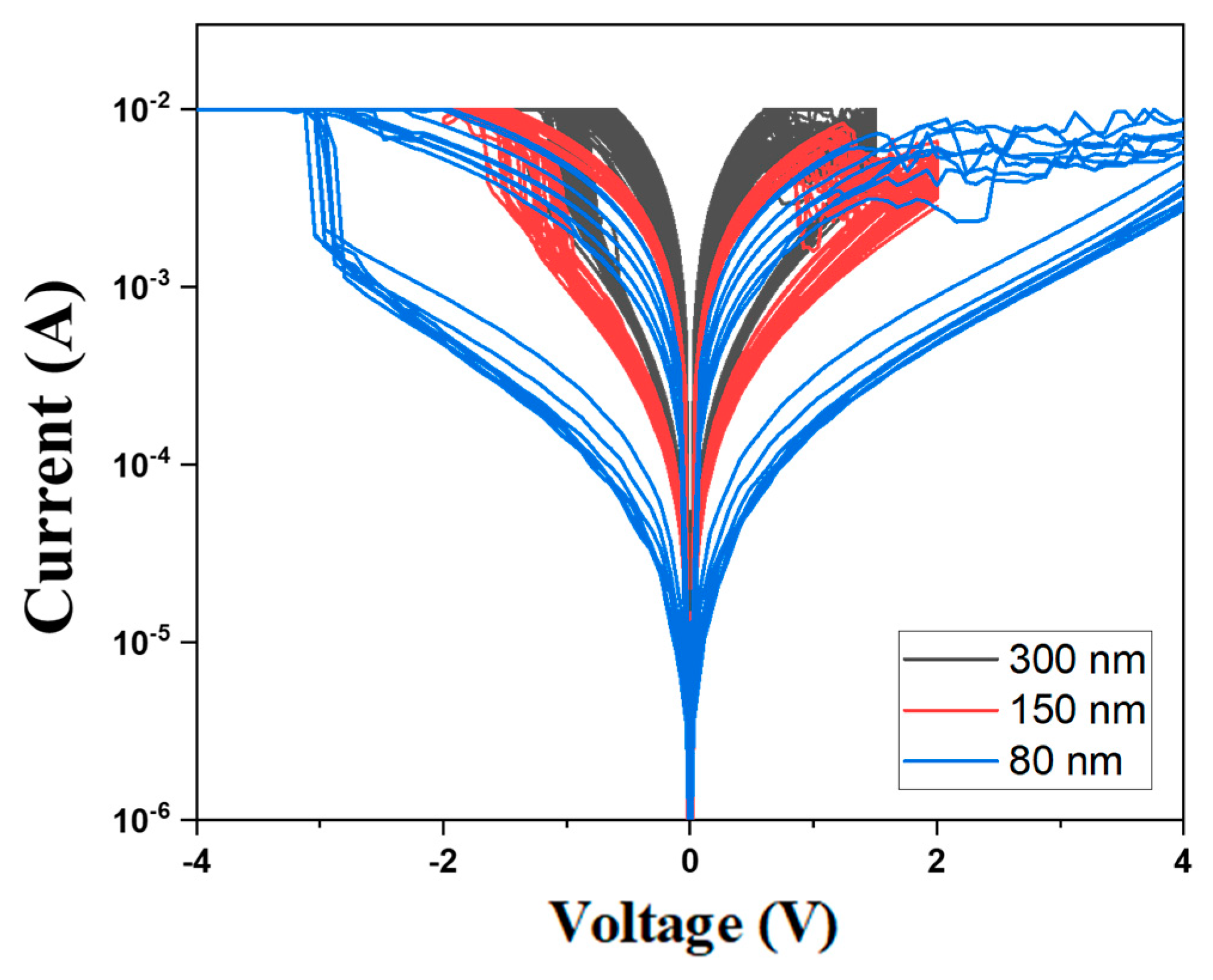
Figure 13 presents the I-V curves of the neodymium oxide films RRAM device using ITO as the top electrode materials with different thicknesses from 100 cycle times measurements. The neodymium oxide films RRAM device with a thickness of 300nm exhibited the maximum memory window in the order of 102 in both set and reset states. However, the neodymium oxide films RRAM device with a thickness between 80 and 150 nm exhibited a relatively narrow memory window, in the order of 102. As shown in Figure 13, the set and reset voltage of RRAM devices decreased from ±3V to ±1.5V as the thickness increased from 80 nm to 300 nm.
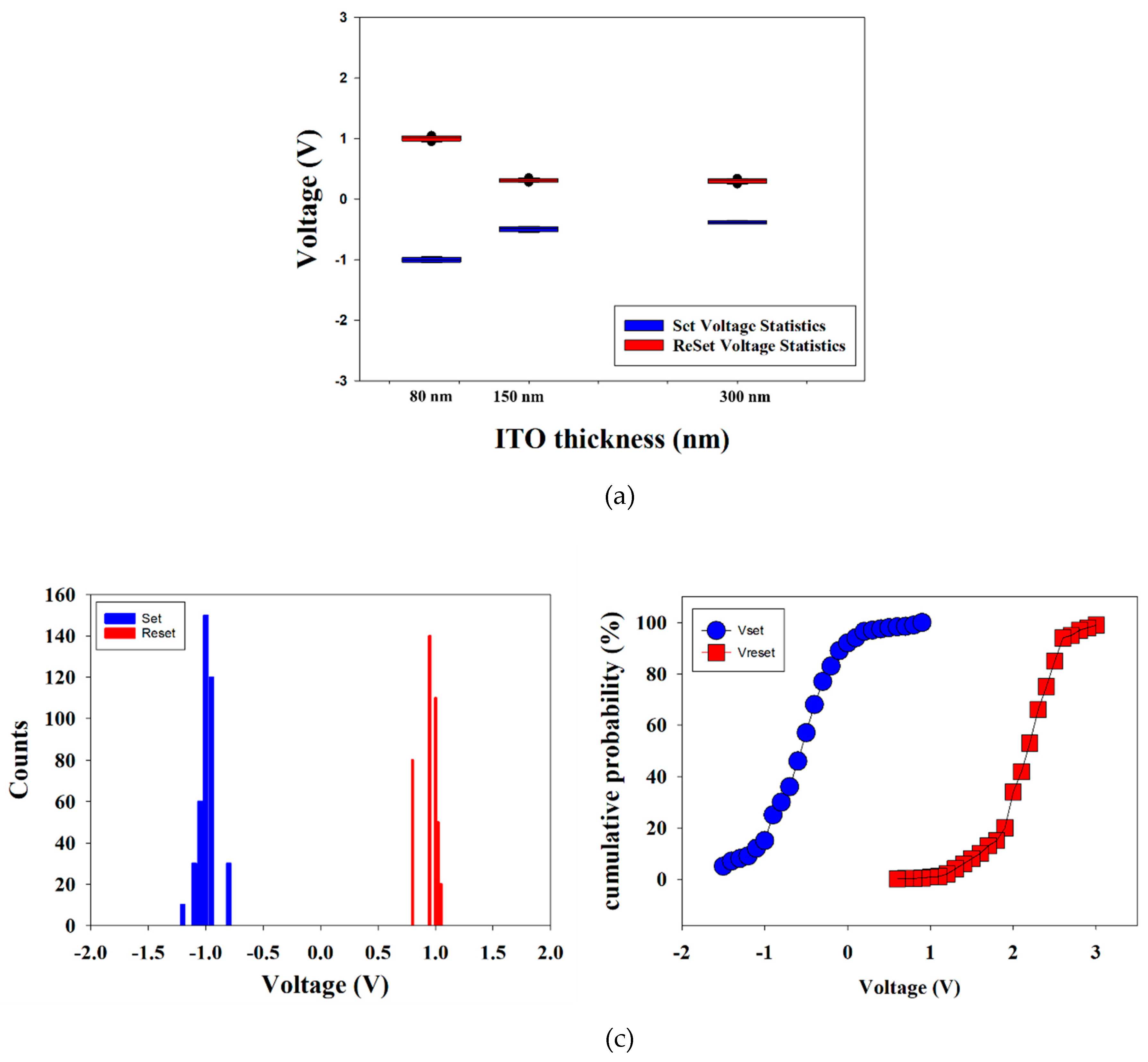
Figure 14 shows the set and reset voltages of neodymium oxide films RRAM devices using ITO as the top electrode materials with different thicknesses. Figure 14b and Figure 14c presents the statistical results of distribution of the set/reset voltage measured in RRAM devices for 400 times measured. In Figure 11b, the set and reset voltage value was found for the range of applied voltage of −1 to 1 V in counts distribution results. In addition, the statistical results of cumulative probability for the resistive switching properties of the RRAM devices were also observed in Figure 14c.
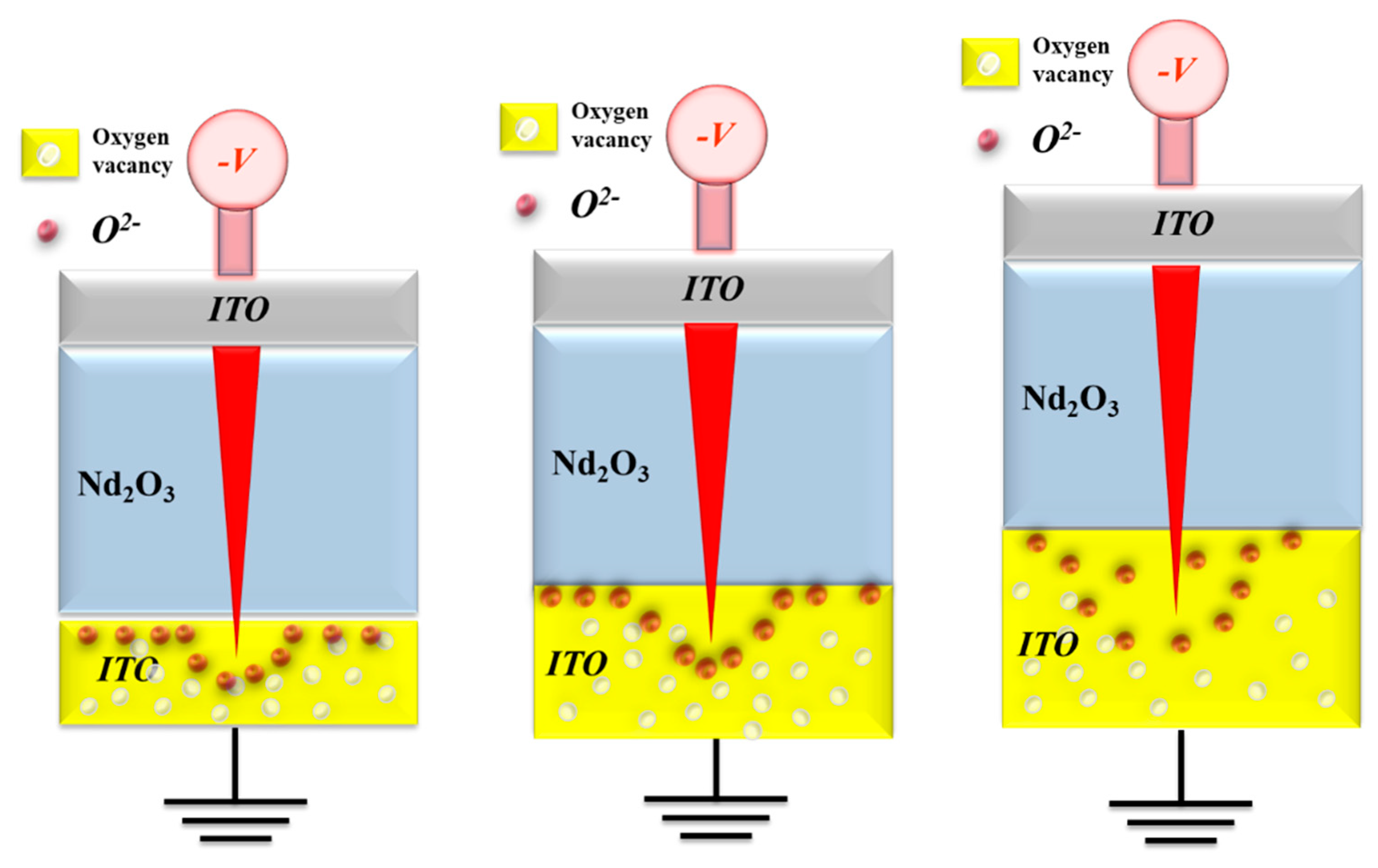
As illustrated in Figure 13 and Figure 14, the set voltage exerts a significant influence on the set process, while the oxygen concentration distribution effect also plays a pivotal role. In this study, three ITO electrodes with different thicknesses were used: 80 nm, 150 nm and 300 nm. The switching layer was a 15 nm thick neodymium oxide films under the same conditions, as shown in Figure 15.
As shown by the set statistical results in Figure 14, an increase in thickness correlates with a reduction in the set voltage. This suggests that oxygen ions are driven into the ITO films electrode, resulting in the creation of additional oxygen vacancies during the set process. As the thickness of the ITO continues to increase, the oxygen concentration distribution expands over a larger area of the ITO electrode. This may be a contributing factor to the low set voltage operation of the neodymium oxide films RRAM in the set process.
On the other hand, the reset statistical results indicates that the reset voltage increases as the thickness of the neodymium oxide films increases. The increasing reset voltage may be due to the diffuse of oxygen ions into the range of the ITO electrode in the set operation process as explained in Figure 15. When the high reverse bias was applied in the reset process, the oxygen ions must be driven back to the neodymium oxide films switching layer. The physical model depicting the effect of oxygen concentration distribution effect in relation to different ITO electrode thicknesses is shown in Figure 15.
To discuss the oxygen ion concentration distribution effect in oxygen-rich ITO electrode, the ser/reset voltage of neodymium oxide films RRAM devices for different ITO electrode thickness were discussed and investigated. The set operating voltage at the Al electrode was about 0.8V, and the minimum set voltage to form the conduction path of RRAM is about 1V, so the concentration distribution potential energy of oxygen in RRAM was about -0.2V. The set operating voltage of the ITO electrode was about 1.2V. Therefore, the oxygen ions fill the vacancies in ITO and attract oxygen ions to form a concentration distribution with a potential energy of 1.4V.
In addition, the set operating voltage at the TiN electrode was about 1V, and the minimum set voltage to form the conduction path of RRAM was about 1.1V, so the concentration distribution potential energy of oxygen in RRAM was about -0.1V. The set operating voltage of the ITO electrode was about 1.2V. Therefore, the oxygen ions fill the vacancies in ITO and attract oxygen ions to form a concentration distribution with a potential energy of 1.3V [22]. Above the experimental results for infer the oxygen concentration distribution effect calculated, the set voltage of the RRAM devices in oxygen-rich ITO electrode was more less than those of other Al/TiN material electrode. Especially in different oxygen-rich ITO electrode thickness for 80nm, 150nm, and 300nm, the thick thickness ITO electrode exhibited the low set voltage. We suggested this reason might be attributed form the different oxygen concentration distribution effect close the interface for different oxygen-rich ITO electrode thickness, as shown in Figure 15.
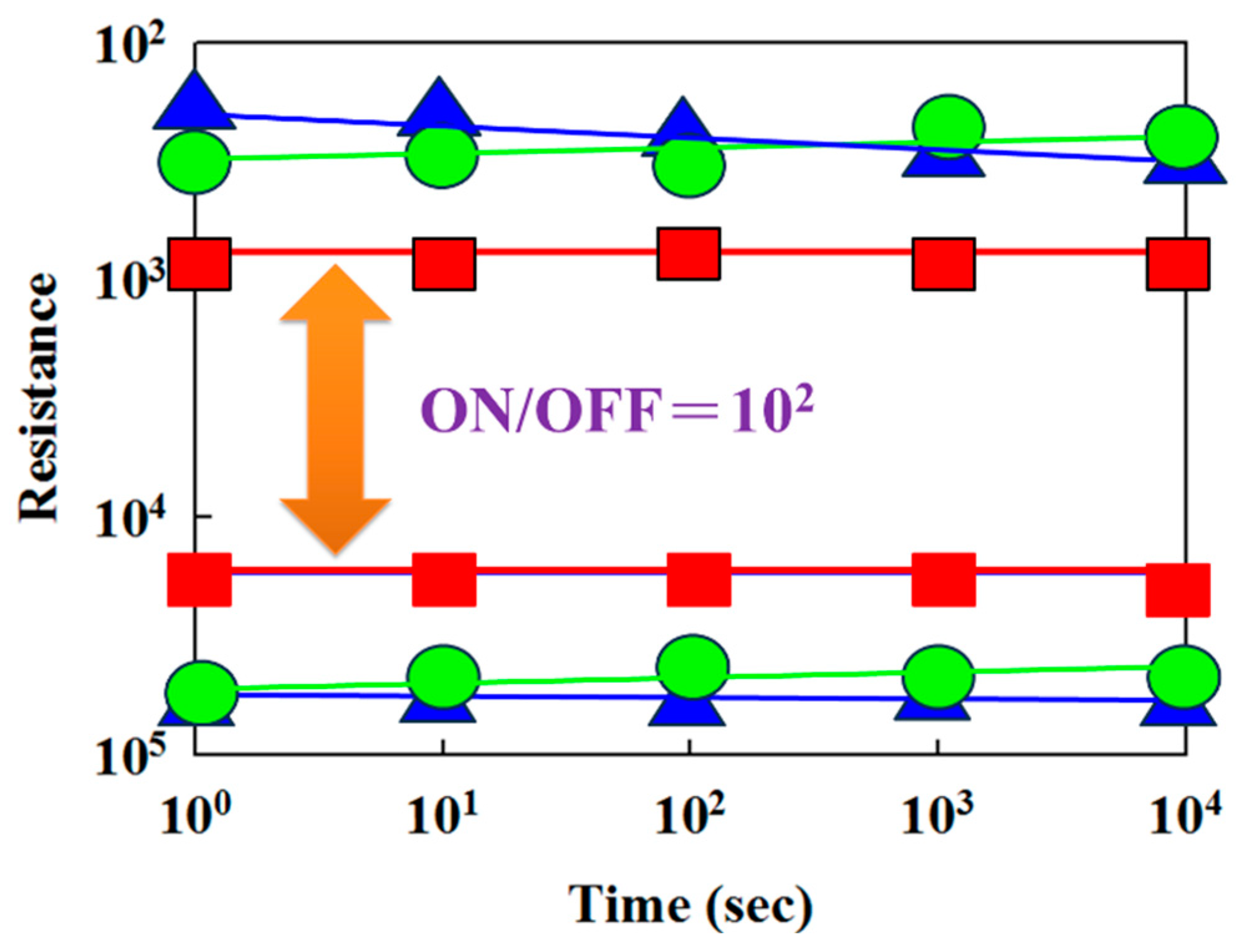
Figure 16 shows the switching cycling versus resistance value curves, determined by the retention and endurance measurement properties. The retention properties of the neodymium oxide films RRAM devices with different top electrode materials (Al, TiN, ITO) were measured to investigate their reliability for applications in non-volatile memory RRAM devices. There were no significant changes in the ON/OFF ratio switching resistance cycling versus testing time curves in the neodymium oxide films RRAM devices for more than 102 seconds in the extrapolation calculation anticipation measured.
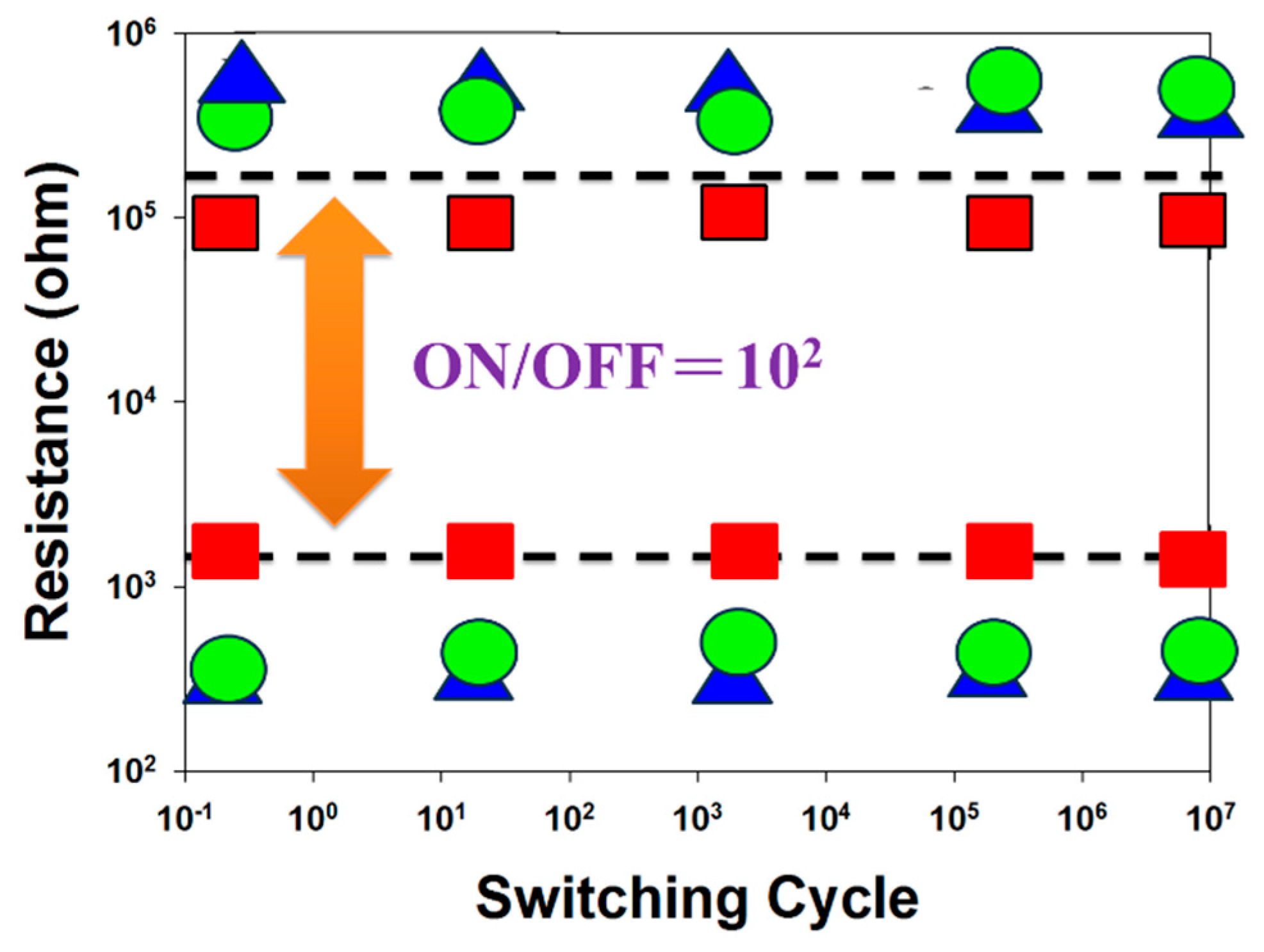
Figure 17 presents the resistance value versus switching cycle curves of the neodymium oxide films RRAM devices with ITO (red), TiN (green), and aluminum (blue) as the top electrode materials. The neodymium oxide films RRAM device showed no significant changes in the ON/OFF ratio switching behavior cycling versus the time curves for more than 102 seconds in the extrapolation calculation anticipation.
Table 1 presented the compared on the film RRAM structure, the VSET/VRESET properties, the On/Off ratio properties, and the endurance cycles properties for the various films RRAM devices. In our work, the VSET/VRESET of the ITO/Nd2O3/ITO the film RRAM structure was about 1/-1V, the On/Off ratio of 102, and the endurance cycles of 107. Comparison those film RRAM devices, the ITO/Nd2O3/ITO the film RRAM structure also exhibited the excellent the resistance switching and endurance properties in our work.

4. Conclusions

In conclusion, the bipolar switching behavior and electrical conduction transport properties of the neodymium oxide films resistive random access memory (RRAM) devices with different top electrodes were observed and discussed. At low operating voltages and high resistance values, the conduction mechanism exhibits the hopping conduction behavior for 1mA or 10mA compliance currents in the set states. In contrast, at high operating voltages, the conduction mechanisms all exhibited the ohmic conduction current mechanism with 1mA or 10mA compliance current. Additionally, we explored the two main factors underlying the extremely small set voltage: the electric field affect at the tip of the RRAM resistance wire and the oxygen ion concentration distribution effect. We assumed the thickness of the ITO electrode to illustrate the effect of the oxygen concentration distribution on the set voltage effect. Similarly, we found that these neodymium oxide films RRAM devices with ITO electrodes of different thicknesses exhibited asymmetric I-V curves. The low reset voltages are probably mainly due to the fact that the LRS electric field was more concentrated at the tip of the electron conduction resistance path. Meanwhile, the high electric field was applied to more dispersed in the elliptical region of the semiconductor state in the reset state. The neodymium oxide films RRAM device for the ITO, Al, and TiN electrode materials showed no significant changes in the ON/OFF ratio retention and endurance measurement properties for more than 102 seconds in the extrapolation calculation anticipation.

Author Contributions

K.-H.C. conceived and designed the experiments; M.-C.K. performed the experiments; H.-C.C., and Y.-C. W. analyzed the data; K.-H.C. contributed reagents/materials/analysis tools; K.-H.C. wrote the paper. All authors have read and agreed to the published version of the manuscript.

Funding

This work was performed at the National Science Council Core Facilities Laboratory for Nano-Science and Nano-Technology in the Kaohsiung-Pingtung area and was supported by the National Science Council of the Republic of China under Contract No. NSTC 113-2622-E-230-001.

Data Availability Statement

Availability Statements are available in section “MDPI Research Data Policies” at https://www.mdpi.com/ethics.

Conflicts of Interest

The founding sponsors had no role in the design of the study; in the collection, analyses, or interpretation of data; in the writing of the manuscript, and in the decision to publish the results.

References

  1. Li, L., Dai, T.J., Liu, K., Chang, K.C., Zhang, R., Lin, X., Liu, H.J.; Lai, Y.C.; Kuo, T.P. “Achieving Complementary Resistive Switching and Multi-Bit Storage Goals by Modulating the Dual-Ion Reaction through Supercritical Fluid-Assisted Ammonization”, Nanoscale 2021, 13, 14035–14040. [CrossRef]
  2. Li, L.; Chang, K.-C.; Lin, X.; Lai, Y.-C.; Zhang, R.; Kuo, T.-P. Variable-temperature activation energy extraction to clarify the physical and chemical mechanisms of the resistive switching process. Nanoscale 2020, 12, 15721–15724. [CrossRef]
  3. Li, L.; Chang, K.-C.; Ye, C.; Lin, X.; Zhang, R.; Xu, Z.; Zhou, Y.; Xiong, W.; Kuo, T.-P. An indirect way to achieve comprehensive performance improvement of resistive memory: when hafnium meets ITO in an electrode. Nanoscale 2019, 12, 3267–3272. [CrossRef]
  4. Chang, K.-C.; Dai, T.; Li, L.; Lin, X.; Zhang, S.; Lai, Y.-C.; Liu, H.-J.; Syu, Y.-E. Unveiling the influence of surrounding materials and realization of multi-level storage in resistive switching memory. Nanoscale 2020, 12, 22070–22074. [CrossRef]
  5. Chang, K.C.; Zhang, R.; Chang, T.C.; Tsai, T.M.; Chu, T.J.; Chen, H.L.; Shih, C.C.; Pan, C.H.; Su, Y.T.; Wu, P.J.; “ High Performance, Excellent Reliability Multifunctional Graphene Oxide Doped Memristor Achieved by Self-Protective Compliance Current Structure”, In Proceedings of the IEEE International Electron Devices Meeting (IEDM), San Francisco, CA, USA, 15–17 Dec. 2014; pp. 33–34. [CrossRef]
  6. Ye, C.; Xu, Z.; Chang, K.-C.; Li, L.; Lin, X.; Zhang, R.; Zhou, Y.; Xiong, W.; Kuo, T.-P. Hafnium nanocrystals observed in a HfTiO compound film bring about excellent performance of flexible selectors in memory integration. Nanoscale 2019, 11, 20792–20796. [CrossRef]
  7. Lanza, M.; Waser, R.; Ielmini, D.; Yang, J.J.; Goux, L.; Suñe, J.; Kenyon, A.J.; Mehonic, A.; Spiga, S.; Rana, V.; et al. Standards for the Characterization of Endurance in Resistive Switching Devices. ACS Nano 2021, 15, 17214–17231. [CrossRef]
  8. Sebastian, A.; Le Gallo, M.; Khaddam-Aljameh, R.; Eleftheriou, E. Memory devices and applications for in-memory computing. Nat. Nanotechnol. 2020, 15, 529–544. [CrossRef]
  9. Sebastian, A.; Le Gallo, M.; Khaddam-Aljameh, R.; Funck, C.; Menzel, S. “Comprehensive Model of Electron Conduction in Oxide-Based Memristive Devices”, ACS Appl. Electron. Mater. 2021, 3, 3674–3692.
  10. Dalgaty, T.; Castellani, N.; Turck, C.; Harabi, K.-E.; Querlioz, D.; Vianello, E. In situ learning using intrinsic memristor variability via Markov chain Monte Carlo sampling. Nat. Electron. 2021, 4, 151–161. [CrossRef]
  11. Lanza, M.; Wong, H.-S.P.; Pop, E.; Ielmini, D.; Strukov, D.; Regan, B.C.; Larcher, L.; Villena, M.A.; Yang, J.J.; Goux, L.; et al. Recommended Methods to Study Resistive Switching Devices. Adv. Electron. Mater. 2018, 5, 1800143. [CrossRef]
  12. Chen, K.-H.; Cheng, C.-M.; Wang, N.-F.; Hung, H.-W.; Li, C.-Y.; Wu, S. First Order Rate Law Analysis for Reset State in Vanadium Oxide Thin Film Resistive Random Access Memory Devices. Nanomaterials 2023, 13, 198. [CrossRef]
  13. Tsai, T.-M.; Chang, K.-C.; Chang, T.-C.; Zhang, R.; Wang, T.; Pan, C.-H.; Chen, K.-H.; Chen, H.-M.; Chen, M.-C.; Tseng, Y.-T.; et al. Resistive Switching Mechanism of Oxygen-Rich Indium Tin Oxide Resistance Random Access Memory. IEEE Electron Device Lett. 2016, 37, 408–411. [CrossRef]
  14. Zhang, R.; Young, T.-F.; Chen, M.-C.; Chen, H.-L.; Liang, S.-P.; Syu, Y.-E.; Sze, S.M.; Chang, K.-C.; Chang, T.-C.; Tsai, T.-M.; et al. Characterization of Oxygen Accumulation in Indium-Tin-Oxide for Resistance Random Access Memory. IEEE Electron Device Lett. 2014, 35, 630–632. [CrossRef]
  15. Yang, C.; Zou, S.; Chen, X.; Gao, J.; Liu, W.; Yang, M.; Xu, J.; Kang, J.; Bu, W.; Zheng, K.; et al. The fabrication of spin transfer torque-based magnetoresistive random access memory cell with ultra-low switching power. Jpn. J. Appl. Phys. 2024, 63, 05SP10. [CrossRef]
  16. Rong, N.; Liu, X.; Zhang, J.; Xu, P.; Zhang, B.; Song, W.; Song, S.; Song, Z.; Wu, L. High performance antimony-rich RexSb3Te for phase-change random access memory applications. J. Non-Crystalline Solids 2024, 635. [CrossRef]
  17. Chen, K.-H.; Cheng, C.-M.; Kao, M.-C.; Kao, Y.-H.; Lin, S.-F. Study of the Characteristics of Ba0.6Sr0.4Ti1-xMnxO3-Film Resistance Random Access Memory Devices. Micromachines 2024, 15, 1143. [CrossRef]
  18. Chen, K.-H.; Kao, M.-C.; Huang, S.-J.; Li, J.-Z. Bipolar Switching Properties of Neodymium Oxide RRAM Devices Using by a Low Temperature Improvement Method. Materials 2017, 10, 1415. [CrossRef]
  19. H.R. Naderi, H.R. Mortaheb, A. Zolfaghari, “Supercapacitive properties of nanostructured MnO2/exfoliated graphite synthesized by ultrasonic vibration”, J. Electroanal. Chem., 719 (2014), pp. 98-105. [CrossRef]
  20. Pandolfo, A.; Hollenkamp, A.F. Carbon properties and their role in supercapacitors. J. Power Sources 2006, 157, 11–27. [CrossRef]
  21. Khadija Tul Kubra, Rehana Sharif, Bebi Patil, Atif Javaid, Shamaila Shahzadi, Ayesha Salman, Sofia Siddique, Ghulam Ali,” Hydrothermal synthesis of neodymium oxide nanoparticles and its nanocomposites with manganese oxide as electrode materials for supercapacitor application”, Journal of Alloys and Compounds, 815, 30, 2020, 152104. [CrossRef]
  22. Y.E. Syu, T.C. Chang, “Redox Reaction Switching Mechanism in RRAM Device With Pt/CoSiO X /TiN Structure”, Elect. Dev. Lett.32, 545 (2011). [CrossRef]
  23. Chen, K.-H.; Cheng, C.-M.; Chen, M.-L.; Pan, Y.-Y. Bipolar Switching Properties of the Transparent Indium Tin Oxide Thin Film Resistance Random Access Memories. Nanomaterials 2023, 13, 688. [CrossRef]
  24. Chen, K.-H.; Cheng, C.-M.; Wang, N.-F.; Kao, M.-C. Activation Energy and Bipolar Switching Properties for the Co-Sputtering of ITOX:SiO2 Thin Films on Resistive Random Access Memory Devices. Nanomaterials 2023, 13, 2179. [CrossRef]
  25. Chen, K.-H.; Kao, M.-C.; Huang, S.-J.; Li, J.-Z. Bipolar Switching Properties of Neodymium Oxide RRAM Devices Using by a Low Temperature Improvement Method. Materials 2017, 10, 1415. [CrossRef]
  26. Hsu, C.-C.; Wang, S.-Y.; Lin, Y.-S.; Chen, Y.-T. Self-rectifying and interface-controlled resistive switching characteristics of molybdenum oxide. J. Alloy. Compd. 2018, 779, 609–617. [CrossRef]
  27. Lee, D.; Seong, D.-J.; Jo, I.; Xiang, F.; Dong, R.; Oh, S.; Hwang, H. Resistance switching of copper doped MoOx films for nonvolatile memory applications. Appl. Phys. Lett. 2007, 90, 122104. [CrossRef]
  28. Rasool, A.; Amiruddin, R.; Mohamed, I.R.; Kumar, M.S. Fabrication and characterization of resistive random access memory (ReRAM) devices using molybdenum trioxide (MoO3) as switching layer. Superlattices Microstruct. 2020, 147. [CrossRef]
  29. Yang, C.-S.; Shang, D.-S.; Chai, Y.-S.; Yan, L.-Q.; Shen, B.-G.; Sun, Y. Moisture effects on the electrochemical reaction and resistance switching at Ag/molybdenum oxide interfaces. Phys. Chem. Chem. Phys. 2016, 18, 12466–12475. [CrossRef]
  30. Xue, Q.; Wang, Y.-C.; Wei, X.-H. Synaptic plasticity of room-temperature fabricated amorphous MoO film based memristor. Appl. Surf. Sci. 2019, 479, 469–474. [CrossRef]
  31. Fatheema, J.; Shahid, T.; Mohammad, M.A.; Islam, A.; Malik, F.; Akinwande, D.; Rizwan, S. A comprehensive investigation of MoO3based resistive random access memory. RSC Adv. 2020, 10, 19337–19345. [CrossRef]
  32. Arita, M.; Kaji, H.; Fujii, T.; Takahashi, Y. Resistance switching properties of molybdenum oxide films. Thin Solid Films 2012, 520, 4762–4767. [CrossRef]
  33. J. Zhao,C. Ma,W. Mi,Di W. Yu Zhang,Liwei Zhou “Optimizing molybdenum oxide based RRAM with vacuum rapid thermal annealing and carbon quantum dots”,Vacuum,225, 2024,113266. [CrossRef]
  34. Wiśniewski, P.; Mazurak, A.; Jasiński, J.; Beck, R.B. Study of silicon-oxide RRAM devices based on complex impedance spectroscopy. Solid-state Electron. 2023, 208. [CrossRef]
  35. Qin, S.; Ma, Y.; Wang, Q.; Zhang, J.; Zhang, G.; Yang, L.; Liu, R. Study on ion dynamics of hafnium oxide RRAM by electrode thermal effect. Energy Rep. 2022, 9, 1036–1043. [CrossRef]
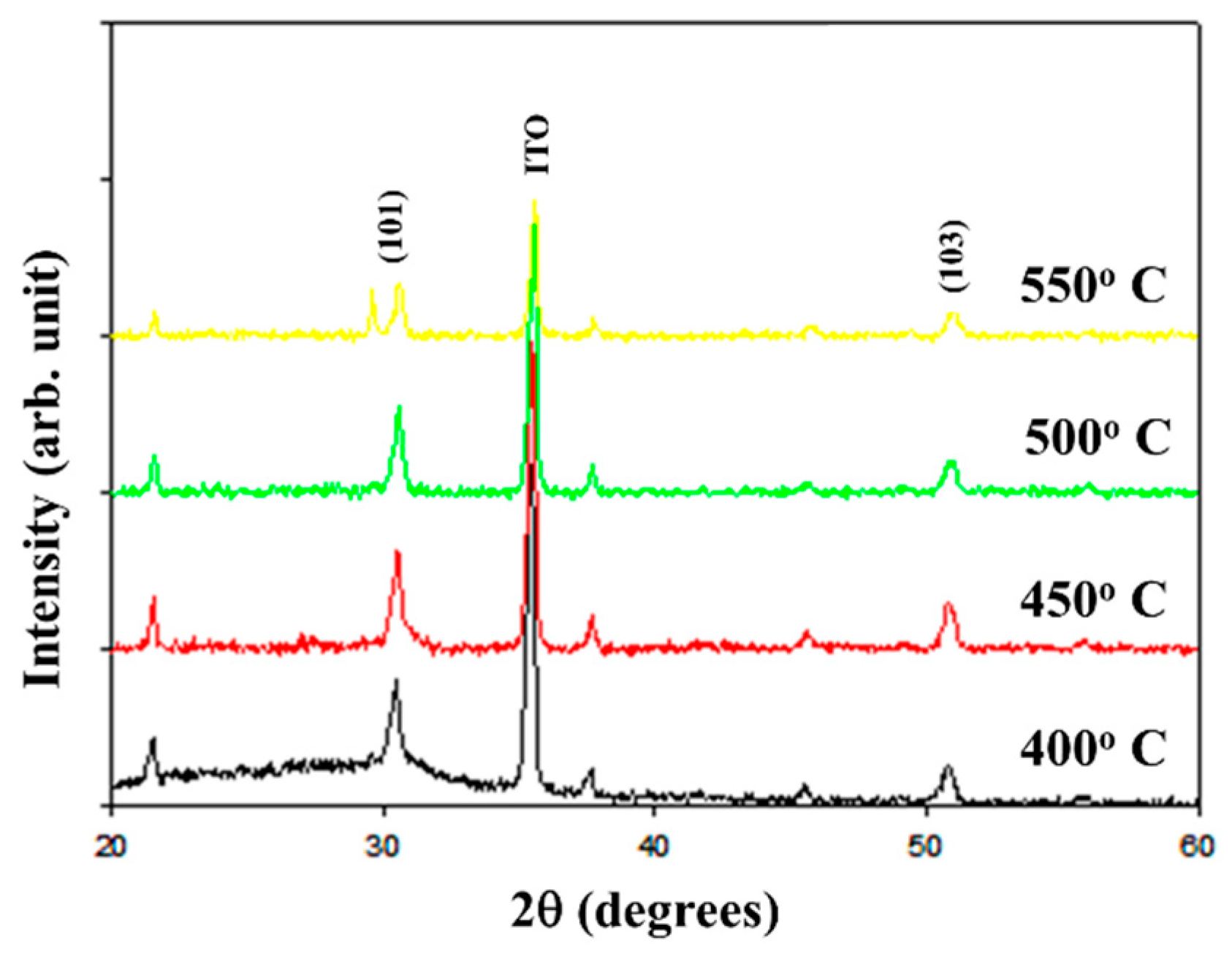
Figure 1. The X-ray diffraction (XRD) patterns of the neodymium oxide films were examined at varying annealing temperatures, ranging from 400°C to 550°C.
Preprints 142268 g001
Figure 2. The micro-structure of the neodymium oxide films RRAM device with an Al/Nd/ITO structure.
Preprints 142268 g002
Figure 3. The cross-section structure of the neodymium oxide films RRAM devices with different top electrode materials for (a)Al (b) TiN, and (c) ITO material.
Preprints 142268 g003
Figure 4. The I-V curves of the neodymium oxide thin-films RRAM devices with (a) the initial forming process and (b) the ITO/films/ITO structure from 100 measurements.
Preprints 142268 g004
Figure 5. The I-V curves of the neodymium oxide films RRAM device with aluminum top electrode under different (a)compliance current processes, and (b) conduction mechanisms (c) hopping conduction of LRS, and (d) hopping conduction of HRS.
Preprints 142268 g005
Figure 6. The electrical transfer mechanisms and initial metallic filament path model of the neodymium oxide films RRAM devices for aluminum electrode in the set/reset state.
Preprints 142268 g006
Figure 7. The I-V curves of the neodymium oxide films RRAM device with a TiN electrode under different (a) compliance current processes and (b) conduction mechanisms (c) ohmic conduction for low electrical voltage, and (d) hopping conduction for high electrical voltage.
Preprints 142268 g007
Figure 8. The electrical transfer mechanisms and initial metallic filament path model of the neodymium oxide films RRAM devices for TiN electrode in the set/reset state.
Preprints 142268 g008
Figure 9. The I-V curves of the neodymium oxide films RRAM device with an ITO electrode under different (a) compliance current processes and (b) conduction mechanisms (c) ohmic conduction, and (d) hopping conduction.
Preprints 142268 g009
Figure 10. The electrical transfer mechanisms and initial metallic filament path model of the neodymium oxide films RRAM devices for ITO electrode in the set/reset state.
Preprints 142268 g010
Figure 11. The I-V curves of the neodymium oxide films RRAM device under different compliance current processes.
Preprints 142268 g011
Figure 12. The I-V curves of the neodymium oxide films RRAM device using ITO as the top electrode materials with thicknesses of (a) 80 nm, (b) 150 nm, and (c) 300 nm.
Preprints 142268 g012
Figure 13. The I-V curves of the neodymium oxide films RRAM device using ITO as the top electrode materials with different thicknesses.
Preprints 142268 g013
Figure 14. The set/reset voltage statistics of the neodymium oxide films RRAM device using ITO as the top electrode materials with (a) different thicknesses, (b) counts distribution, and (c) cumulative probability.
Preprints 142268 g014
Figure 15. The electrical transfer mechanisms and initial metallic filament path model of the neodymium oxide films RRAM devices in the reset state.
Preprints 142268 g015
Figure 16. The resistance value versus time curves of the neodymium oxide films RRAM devices (red: ITO, green: TiN, blue: aluminum).
Preprints 142268 g016
Figure 17. The resistance value versus switching cycle curves of the neodymium oxide films RRAM devices (red color: ITO, green color: TiN, blue color: aluminum).
Preprints 142268 g017
Table 1. The compared on the structure, the VSET/VRESET, the On/Off ratio, and the endurance cycles for the various films RRAM devices.
ROW STRUCTURE VSET/VRESET (V) On/Off RATIO ENDURANCE $(CYCLES) REF
1 Al/MoOx/Pt 3/-3 ∼160 500 [26]
2 Cu/Cu doped MoOx/Pt 0.5/-1.5 ∼23 106 [27]
3 Ag/MoO3/ITO 8/-8 ∼1.28 25 [28]
4 Ag/MoO3-x/FTO 1.8/-1.1 ∼8 10 [29]
5 Ag/MoOx/ITO 0.4/-0.067 >10 [30]
6 Ni/MoO3/Mo 3.3/-2.3 <10 17 [31]
7 Pt–Ir/MoOx/Pt 3/-0.7 ∼10 35 [32]
8 Ag/MoOx/CQDs/Pt 0.36/-0.25 ∼70 107 [33]
9 Al/SiO2/Si 1/-2 ∼10 10 [34]
10 TiN/HfO2/TiN 0.4/-0/4 <10 10 [35]
11 ITO/Nd2O3/ITO 1/-1 >102 107 This work
Disclaimer/Publisher’s Note: The statements, opinions and data contained in all publications are solely those of the individual author(s) and contributor(s) and not of MDPI and/or the editor(s). MDPI and/or the editor(s) disclaim responsibility for any injury to people or property resulting from any ideas, methods, instructions or products referred to in the content.
Copyright: This open access article is published under a Creative Commons CC BY 4.0 license, which permit the free download, distribution, and reuse, provided that the author and preprint are cited in any reuse.
Prerpints.org logo

Preprints.org is a free preprint server supported by MDPI in Basel, Switzerland.

Subscribe

Disclaimer

Terms of Use

Privacy Policy

Privacy Settings

© 2025 MDPI (Basel, Switzerland) unless otherwise stated