

Submitted:
06 December 2024
Posted:
09 December 2024
You are already at the latest version
Abstract
The SEA LIFE Trust Beluga Whale Sanctuary (BWS) has been in operation for over five years and serves as a unique case study to evaluate the effectiveness of marine sanctuaries for cetaceans. While cetacean sanctuaries are often regarded as a middle-ground solution between captivity and release, evidence from the BWS highlights complexities in adapting cetaceans to these environments. Despite initial assumptions that natural conditions would inherently improve welfare, the belugas at BWS spent the majority of the operational period (92.6%) in a conventional indoor pool due to health and welfare concerns. Repeated delays, challenges in acclimatization, and stress-related conditions observed during periods in the bay suggest that natural environments alone may not guarantee improved welfare. Additionally, the lack of publicly accessible data on health and welfare outcomes hinders comprehensive evaluation of the sanctuary’s success and raises questions about transparency and evidence-based practices. This review underscores the need for refined sanctuary models, improved infrastructure, and structured adaptation programs tailored to species and individual cetaceans. It highlights the importance of robust planning, ongoing research, and transparency to meet the ambitious goals of marine sanctuaries in the best interest of well-being of cetaceans under human care. These considerations also raise concerns about the decision to relocate captive cetaceans to marine sanctuaries, as the available evidence suggests that such environments may not inherently guarantee better welfare outcomes.
Keywords:
Cetacean Sanctuaries
; Marine mammal welfare
; Beluga whale adaptation
; Captive cetaceans
; Sanctuary effectiveness
1. Introduction
Since the 1960s, marine mammal parks (MMPs), aquariums, and swim-with-the-dolphins attractions have expanded globally, resulting in thousands of cetaceans being maintained under human care in managed facilities [1,2]. However, in recent decades, a growing movement has emerged opposing the maintenance of cetaceans in managed care, often generalizing that such enclosures hinder the animals’ physical and psychological development, leading to stress, disease, and aggression toward conspecifics and humans [2,3,4]. In many cases, these critiques rely on generalized assumptions that are not supported by evidence, often using outdated information from sub-standard or older facilities and antiquated animal management practices to unfairly criticize all MMPs without distinction [5]. In this context, the rise of social media, combined with the release of influential documentaries such as The Cove and Blackfish, has fueled the growth of anti-captivity activism. This movement has significantly shaped public opinion, prompting increased scrutiny and debate over the ethical implications of maintaining cetaceans in professional care [2,5,6,7].
Initially, this activism actively promoted and facilitated the release of cetaceans from Marine Mammal Parks (MMPs). However, it became evident that the release process was fraught with significant stress and an increased risk of mortality, often surpassing the risks experienced by cetaceans under professional care [8,9,10,11]. As a result, activists advocating for the liberation of cetaceans began facing increasing doubts and ethical concerns regarding the risks associated with full release. In response, they shifted their focus toward promoting the relocation of cetaceans to sanctuaries, modeled after those established for terrestrial species. Consequently, the concept of cetacean sanctuaries, particularly netted sea pens designed to house cetaceans from traditional managed care facilities, has gained significant public support over the past decade as a perceived middle-ground solution between complete captivity and full release into the wild [3,5]. The general belief, widely shared by the public, is that simply allowing captive cetaceans access to a more "natural" marine environment will inherently improve their welfare [2]. This assumption stems from the intuitive appeal that contact with the sea, even within enclosed areas, offers a better quality of life compared to the confines of artificial tanks [2,12]. Indeed, initiatives like the Whale Sanctuary Project have promoted the idea that such sanctuaries can offer a safer and more enriching environment for cetaceans previously kept in MMPs [3].
However, no scientific evidence supports the hypothesis that merely transferring cetaceans from concrete tanks to netted pens in natural waters automatically leads to improved welfare. Currently, it remains speculative and aligns closely with wishful thinking often expressed by segments of the public opposed to zoos and aquariums. Some members of the scientific community have expressed concerns about the potential risks associated with introducing a cetacean that has spent its entire life in a sterile, concrete tank into an ocean environment filled with unfamiliar organisms and conditions [3]. These risks could affect not only the well-being of the whale but also the balance of the ecosystem it enters. These animals may encounter new stressors in sea pens, including variable water quality, exposure to pathogens, and challenging weather conditions, which could undermine their health and well-being [5].
Several cetacean sanctuaries have been proposed or developed in recent years (see [5] for details). Among these is The Whale Sanctuary (TWS), which project was officially launched in early 2015. However, as of now, the facility consists only of a shop and an interpretation center [5], with no authorizations or clear plans for the construction of the animal habitat. Similarly, in 2014, the National Aquarium in Baltimore announced a plan to relocate its dolphins to a sanctuary. However, this initiative was publicly abandoned in 2019, citing climate change as a barrier to finding secure locations for relocation [13]. A decade later, the National Aquarium appears to have revived the idea. According to their website, they are now exploring potential sanctuary sites within the United States, although no specific location or detailed plans have been disclosed [14]. A similar situation exists with the Aegean Marine Life Sanctuary on Lipsi Island, Greece, which was conceived in 2015 and has been publicly promoted on multiple occasions by the Archipelagos Institute of Marine Conservation [15]. However, to date, the project only includes inland offices, veterinary, and warehouse facilities, with no holding pools. Additionally, there are no clear plans or authorizations to construct sea pens or accommodate dolphins from Marine Mammal Parks [16]. By contrast, the SeaLife Trust Beluga Whale Sanctuary (BWS) in Iceland stands out as the only fully operational cetacean sanctuary. Established in 2019, it provides a dedicated care facility for two female belugas, Little White and Little Grey, who were transferred from an aquarium in China to a netted bay in Klettsvik, Iceland [5]. With over five years of operation, the SeaLife Trust Beluga Whale Sanctuary has become a critical source of evidence for evaluating the potential positive impacts of natural conditions offered by sanctuaries on cetaceans’ welfare.
In light of the ongoing debate between proponents and critics of sanctuaries as a viable solution for improving the welfare of cetaceans under human care, the authors believe it is essential to critically evaluate the only available evidence from the sole operational sanctuary with more than five years of experience. The data generated from this facility offers a valuable foundation for understanding the potential benefits and challenges of sanctuary environments. Therefore, the primary goal of this review is to synthesize and present this evidence, making it accessible not only to the scientific community but also to policymakers and managers tasked with decisions regarding the relocation of cetaceans from marine mammal parks and aquariums to sanctuaries or conventional managed care facilities.
2. Background and Context
Since its foundation in 1979, Merlin Entertainments has maintained a clear policy against the captivity of cetaceans, asserting that marine mammals such as whales and dolphins should not be held in confined environments. This commitment was underscored when Merlin acquired the Living and Leisure Australia Group in 2012, which included Shanghai Changfeng Ocean World—home to two captive beluga whales. Recognizing that the belugas, raised in captivity, could not be released into the wild, Merlin sought an ethical, sustainable solution for their long-term care [17].
In collaboration with its partner charity, the Sea Life Trust, and Whale and Dolphin Conservation, Merlin developed plans to create a pioneering ocean sanctuary in Iceland. Announced in 2019, the sanctuary in Klettsvik Bay, Heimaey Island, provides the belugas with a more natural, sub-Arctic environment, spanning 32,000 square meters of protected marine habitat. This initiative reflects Merlin’s broader philosophy and marks a significant step in the global movement toward phasing out cetacean captivity. Merlin’s CEO, Nick Varney, expressed hope that this project would inspire other operators to consider similar rehabilitative efforts for cetaceans in human care [5,17].
In June 2019, the Sea Life Trust completed the relocation of the two beluga whales, Little Grey and Little White, from Changfeng Ocean World in Shanghai, China, to the newly established Beluga Whale Sanctuary on Heimaey Island. From the aquarium in Shanghai, the whales were transported by truck to Pudong International Airport, where they boarded a specially chartered cargo plane. This flight brought them to Keflavik Airport in Iceland [5]. From there, they continued by truck to a ferry port, and the final leg involved a short ferry crossing to Heimaey Island. Upon their arrival on Heimaey Island, Little Grey and Little White were placed in a small indoor quarantine pool(<400 sqm, see Figure 1a).
The initial relocation of the belugas to the smaller intermediate sea pen within Klettsvik Bay in 2020 was marked by a highly publicized event(see Figure 1b). The transfer was accompanied by dramatic footage and widely distributed press releases, heralding the move as a groundbreaking achievement in cetacean care. Andy Bool, then head of the Sea Life Trust, underscored the importance of this milestone with the following statement: “Little White and Little Grey really are ambassadors for the 300 other beluga whales that are in human care across the world. Do you know it was 1400 meters out here today, the last leg of this journey into the bay, but is a giant leap forward for how we can care for these animals in a natural setting. So we hope to show that Little White and Little Grey thrive in this bay and we’re conducting a welfare study, the research study, alongside this whole journey they’ve been on, that will hopefully show that there’s a welfare benefit to being in a natural environment like this. We hope that then persuade others that maybe their beluga whales might be better off in a different environment and being cared for in a different environment” [18]. The operations of the BWS over its more than five years of existence are crucial for assessing the extent to which these highly ambitious goals have been achieved.
2.1. Existing Evidence
Regrettably, the results of the welfare monitoring project announced by the head of the Sea Life Trust in 2020, along with the ongoing monitoring checks mentioned in several Instagram publications [18], have not been made publicly accessible. This limitation applies to scientific publications and specialist symposiums. Attempts to obtain detailed information about the welfare monitoring directly from the Beluga Sanctuary staff or their consultants have been hindered by non-disclosure agreements that restrict the sharing of data.
Consequently, the only accessible source of information about the transition and adaptation of belugas comes from the Beluga Sanctuary’s social media channels. Although these updates do not provide detailed insight into the animal’s specific welfare status, they do offer essential information about their adaptation process. This information indirectly sheds light on their welfare, as their movements between different enclosures can serve as indicators of their well-being. For example, if the belugas’ welfare had been consistently positive and improving, it would be reasonable to expect that they would remain in the natural bay of the sanctuary. However, instances of relocation back to the smaller conventional quarantine pool could suggest challenges in adapting to the more natural habitat and potential welfare concerns. Thus, while limited, this evidence provides critical clues about the complex dynamics of their transition to the sanctuary environment.
According to the SEA LIFE Trust Beluga Whale Sanctuary’s Instagram account [18] (see Table 1 for reference), Little Grey and Little White arrived in Vestmannaeyjar, Iceland, on June 19, 2019. They were initially housed in a conventional indoor concrete pool near the harbor to acclimate to their new environment. Between April and June 2019, the pool housing Little White and Little Grey was referred to as their "temporary home" or "care pool" and served both quarantine purposes and acclimatization to cooler temperatures. In an Instagram post on July 4, 2020 [18], the Sea Life Trust Beluga Whale Sanctuary discussed potential future uses for this facility once the belugas moved permanently to the bay, suggesting it could serve as a refuge during severe weather or emergencies, or as a quarantine space for any future belugas rehomed at the sanctuary.
Following their quarantine period, Instagram updates from the Beluga Whale Sanctuary [18] detailed that Little White and Little Grey were gaining weight to develop the necessary blubber layer for acclimation to the bay’s temperatures. On August 27, 2019, approximately two months after their arrival at the indoor care pool, the sanctuary announced [18] that preparations for a more natural life were taking longer than anticipated, postponing the belugas’ transfer to the bay until spring 2020.
In September 2019, the care pool’s temperature was maintained at 13 °C, with plans to gradually lower it to 10 °C to match the sanctuary’s annual average. This acclimatization process was considered essential for preparing the belugas for the colder bay environment. Concurrently, the SEA LIFE Trust Beluga Whale Sanctuary (BWS) implemented training using a pinger device to condition the belugas to return for general checks, health assessments, and emergency situations. Additionally, BWS actively promoted the sanctuary as a viable alternative for improving the welfare of cetaceans under human care. On February 15, 2020, BWS launched "The 300" campaign, aiming to relocate belugas from unsuitable facilities to more natural homes [18].
In early 2020, the SEA LIFE Trust Beluga Whale Sanctuary (BWS) reported that Little Grey and Little White were undergoing regular health and welfare assessments, all yielding positive results. On May 6, 2020 [18], BWS announced plans to relocate the belugas to their natural habitat in Klettsvik Bay in June 2020. Subsequent posts detailed the belugas’ successful adaptation to 8 °C water temperatures by May 19, 2020, indicating sufficient blubber development for proper thermoregulation. Additional acclimation efforts included exposing the belugas to new sounds, such as simulated rain, and introducing novel objects to familiarize them with diverse stimuli in a controlled environment. On June 20, 2020, BWS reduced the filtration in the care pool to mimic the bay’s water conditions, further aiding the belugas’ transition. The care team emphasized that support would continue in their new home, with routines adjusted in consultation with welfare and veterinary experts.
In July 2020, during final health assessments prior to their relocation to Klettsvík Bay, Little Grey and Little White were diagnosed with mild bacterial stomach infections, necessitating a delay in their move. By August 7, 2020, both belugas were transferred to the sea sanctuary care pools(see Figure 1b Figure 1)—a netted area constructed with pontoons within the bay—to acclimate to their new environment before full release into the wider bay [18]. Between August 10 and mid-September, the SEA LIFE Trust Beluga Whale Sanctuary’s Instagram updates reported positive adaptation signs, including monitoring of vocalizations, dietary intake, respiration rates, and swim patterns to determine the completion of the acclimatization process. On September 28, 2020, the sanctuary released the first video of Little Grey and Little White exploring the bay(see Figure 1d Figure 1), marking the initiation of the "Little Steps" program—a gradual introduction to their new habitat.
On October 16, 2020, the SEA LIFE Trust Beluga Whale Sanctuary announced that Little Grey and Little White had successfully adapted to the bay’s 8 °C temperature, a critical milestone in their acclimatization process. However, seven weeks later, the sanctuary decided to move the belugas back to the indoor care facility due to the approaching winter storm season. According to a declaration from the SEA LIFE Trust Beluga Whale Sanctuary, this relocation was part of the long-term management plan to ensure the whales’ safety and health during harsh weather conditions, with intentions to return them to the bay in early 2021 [18]. In subsequent Instagram posts following the relocation to the indoor conventional pool, it was referred to as the ’winter care pool.
Between December 2020 and July 2021, the SEA LIFE Trust Beluga Whale Sanctuary (BWS) shared updates on Instagram about the positive status of Little Grey and Little White, reporting that the belugas were vocalizing, eating, and behaving normally, with regular welfare and health checks continuing. On July 27, 2021, BWS announced the creation of an intermediate habitat within the bay, referred to as ’The Halo’(see Figure 1c Figure 1) designed to serve as a transitional step for the belugas from the sea care pools (netted pontoons) to the wider bay [18]. The delays in constructing this habitat, attributed to the COVID-19 pandemic, were cited as the reason for postponing the belugas’ transfer to the bay during the summer months. As a result, their relocation was rescheduled for spring 2022 to ensure their welfare and a safe adaptation process.
Between July 2021 and August 2022, the SEA LIFE Trust Beluga Whale Sanctuary (BWS) shared Instagram updates highlighting positive welfare assessments, regular health checkups, and the successful construction and placement of the new intermediate structure, referred to as ’The Halo,’ within the bay [18]. These updates emphasized the progress achieved through the gradual adaptation process to the bay’s natural conditions, known as the ’Little Steps’ program. In preparation for the belugas’ return to the sanctuary, initially planned for spring 2022, final veterinary checks were successfully completed and shared on Instagram. However, three weeks later, on August 24, 2022, BWS announced an unprecedented incident: the accidental sinking of a contractor’s diving boat in the bay. This accident, which caused delays due to cleanup and safety concerns, led to the rescheduling of the belugas’ movement to the bay for spring 2023.
Between September 2022 and April 2023, the SEA LIFE Trust Beluga Whale Sanctuary (BWS) provided updates on Instagram regarding cleaning operations and environmental monitoring in Klettsvik Bay following the accidental sinking of a contractor’s boat [18]. By September 22, 2022, the bay was deemed safe for use. Additionally, posts highlighted positive welfare and health checks for the belugas, noting that both animals had developed an appropriate thickness of their blubber layers.
On April 28, 2023, Little Grey and Little White were successfully moved to the sea sanctuary care pools (netted pontoons) as a preparatory step before their transition to the intermediate seapen (’The Halo’) and eventually to the wider bay. Over the next five weeks, BWS shared progress updates on their adaptation to the care pools, anticipating a smooth transition to the intermediate seapen [18]. However, on June 3, 2023, BWS announced that Little Grey had shown decreased appetite in recent days. In the interest of their welfare, both belugas were transferred back to the indoor care facility, where veterinarians discovered stomach ulcers in Little Grey, likely causing her reduced appetite. Subsequent health updates reported steady improvement in Little Grey’s condition following veterinary treatment.
On September 29, 2023, BWS announced that the return of the belugas to the outdoor care pools would be postponed until the following year, citing their commitment to the ’Little Steps’ program to ensure proper preparation for their return to the bay. From then until July 2024, Instagram posts about the belugas were infrequent, with only one update in December 2023 confirming the complete healing of Little Grey’s stomach ulcers [18]. Finally, on July 30, 2024, BWS communicated that further enhancements to the infrastructure at Klettsvik Bay were required to ensure the belugas could receive proper veterinary care upon their return. As a result, the return to the bay was postponed to early 2025. Since this announcement, no further updates have been provided regarding the belugas or the planned upgrades to the sanctuary’s structures.
Figure 2.
Timeline showing the duration of time the belugas spent in different environments.The red segment represents the inland indoor conventional pool (referred to by BWS as the temporary care pools or winter pools), the yellow segment represents the netted pontoon (referred to by BWS as the sea care pools), and the green segment represents the time the belugas had access to the entire bay.
Figure 2.
Timeline showing the duration of time the belugas spent in different environments.The red segment represents the inland indoor conventional pool (referred to by BWS as the temporary care pools or winter pools), the yellow segment represents the netted pontoon (referred to by BWS as the sea care pools), and the green segment represents the time the belugas had access to the entire bay.
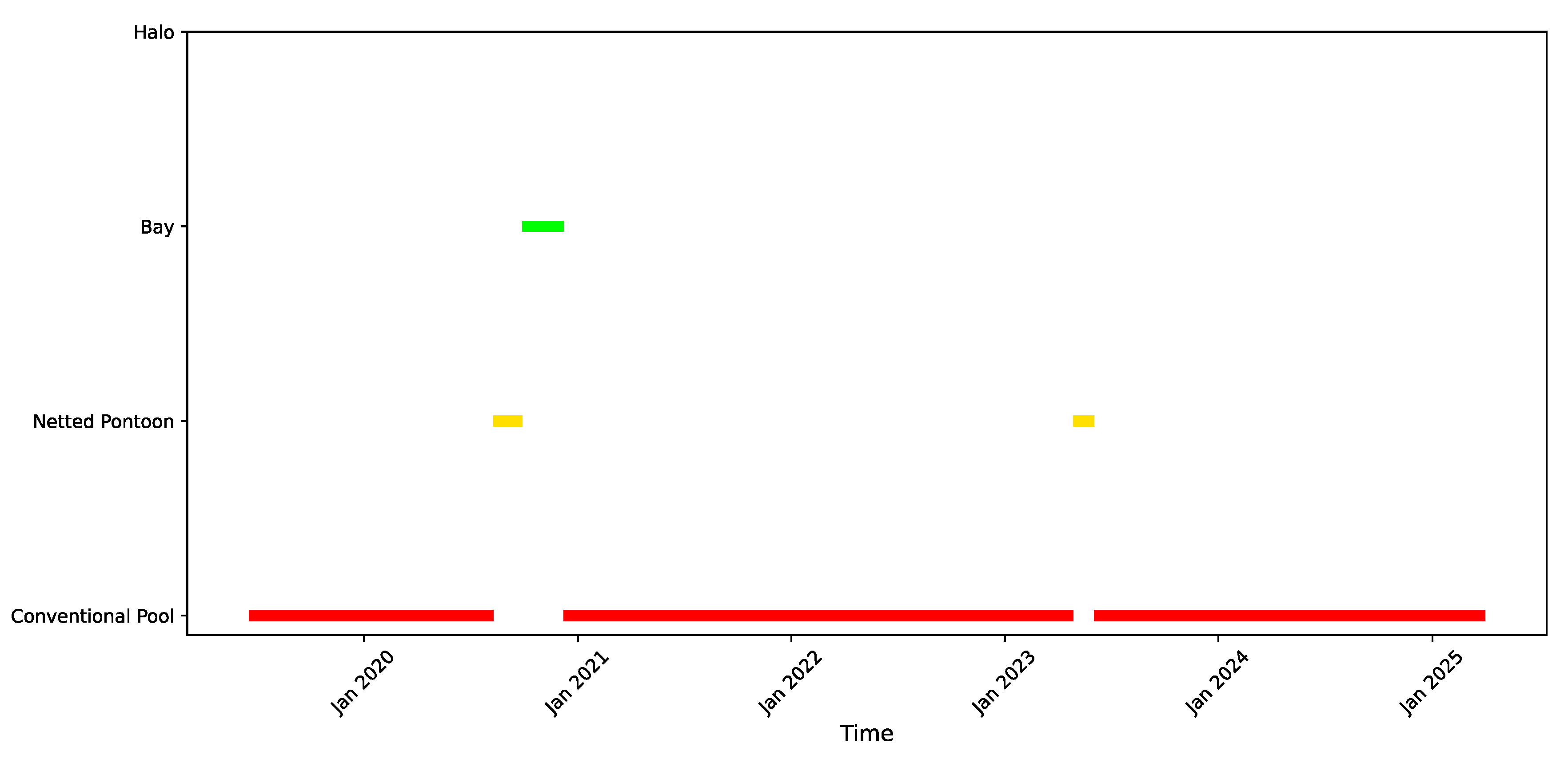
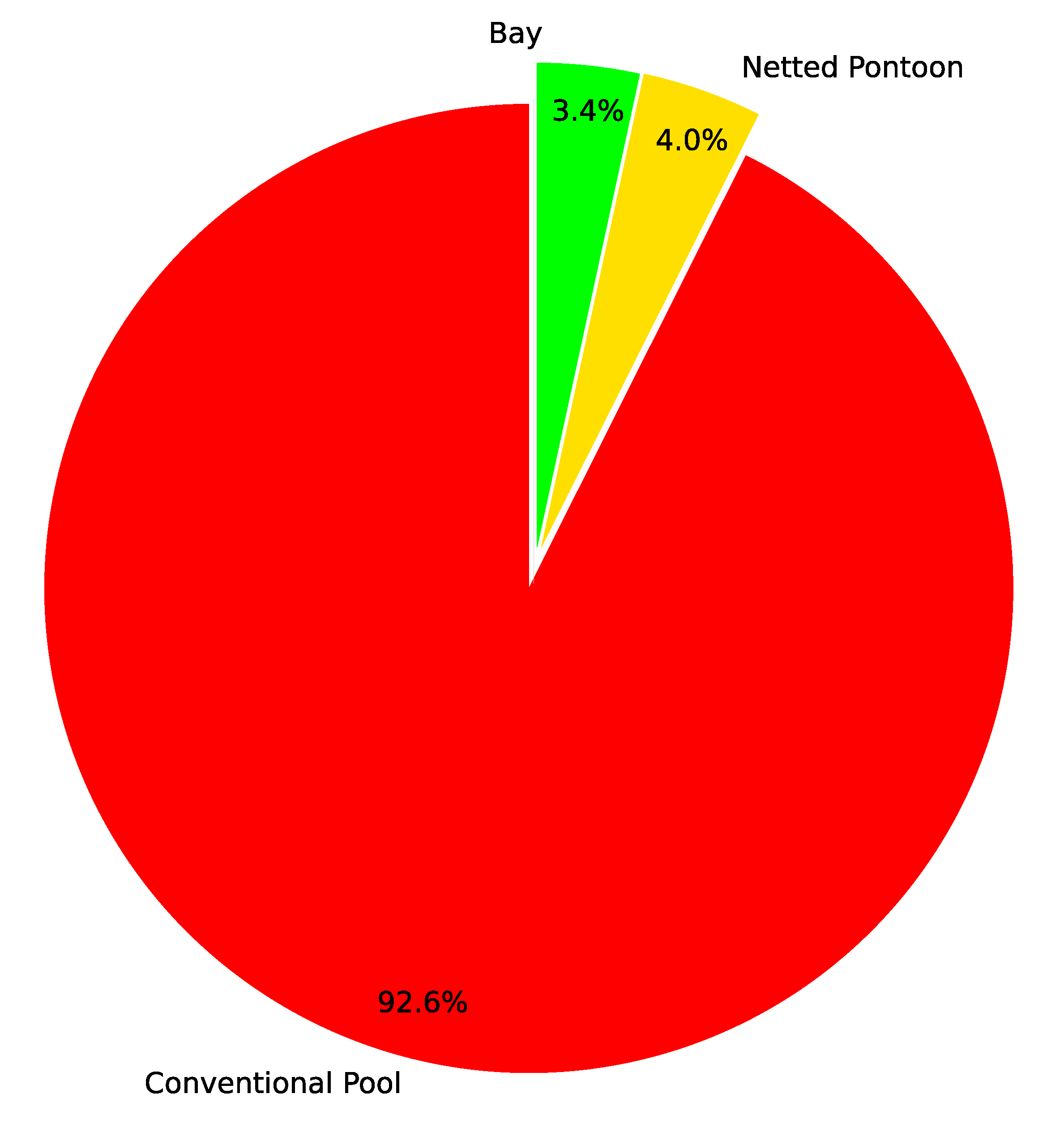
Figure 3.
Pie chart illustrating the percentage of time the belugas spent in different settings. Colours correspond with the description in the previous figure.
Figure 3.
Pie chart illustrating the percentage of time the belugas spent in different settings. Colours correspond with the description in the previous figure.
3. Discussion
The available evidence from nearly six years of operation at the SEA LIFE Trust Beluga Whale Sanctuary does not appear to substantiate the foundational concept, supported by some experts, that a more ’natural’ marine environment inherently enhances the welfare of cetaceans housed in sanctuaries. In all instances where the removal of the belugas from the sanctuary or delays in their return were announced, welfare or health reasons were consistently cited [18]. This implies that the decision-makers had evidence suggesting that the welfare of the belugas might decrease in the sanctuary environment. Such considerations challenge the hypothesis that sanctuaries inherently improve cetacean welfare and suggest that, if there are welfare benefits, they are neither as straightforward nor as direct as initially assumed.
The fact that the belugas have spent only 3.4% of the last five years in the bay raises significant doubts about the practicality and effectiveness of the sanctuary model as initially presented. Furthermore, the grandiose rhetoric surrounding the paradigm shift in cetacean care has noticeably diminished over time, along with campaigns to relocate up to 10 belugas to the sanctuary [18]. The emphasis on epic narratives tends to occur primarily before and after transportation events or associated to fund-raising campaigns, but this enthusiasm is conspicuously absent when the belugas are returned to the indoor pool. For instance, after the ulcers discovered in 2023, the tone became far less celebratory. This shift highlights inconsistencies in the communication and messaging around the sanctuary’s objectives and outcomes.
On several occasions, the BWS team opted to keep the belugas in the conventional indoor pool rather than transferring them to the netted pontoons in the bay. For instance, in July 2021, the belugas were not relocated to the bay due to the sudden necessity of an additional intermediate adaptation structure (the Halo). However, this justification contrasts with their earlier decision to house the belugas in the netted sea pontoons before the onset of the storm season in December. If being exposed to natural conditions in the bay inherently improved the whales’ welfare compared to the conventional pool, why was the opportunity to provide potentially better welfare for 5–6 months overlooked?.
A similar situation arose in September 2023. Despite the limited window for acclimatizing the belugas to the bay before winter, there was no attempt to move them to the intermediate netted pontoon or the Halo to allow them to experience the natural conditions of the bay for 3–4 months. These decisions suggest that simply being in the intermediate holding structures within the bay may not confer significant welfare benefits to the belugas. Alternatively, it raises the possibility that the acclimatization process itself could temporarily challenge or even diminish the animals’ welfare, warranting further investigation into the complexities of cetacean adaptation in such settings. Similarly, in 2024, there was no attempt to move the belugas to the netted sea pontoons at any point during the year, despite their availability and the long window of opportunity following the conclusion of the storm season early in the year.
The conventional inland indoor pool, often referred to by BWS as the ’temporary care pool’ or ’winter pool’ does not appear to have been detrimental to the welfare or health of the belugas, based on the consistently positive welfare and health assessments reported during their time there [18]. Despite the perception that such facilities are inherently stressful for cetaceans [2], no decline in the welfare of Little Grey and Little White was ever communicated while they were housed in the pool. On the contrary, a welfare assessment announced in May 2022, after the belugas had spent nearly a year and a half in the conventional pool, highlighted positive health and welfare outcomes.
This observation becomes particularly striking when compared to their time in the netted pontoons within the bay, where Little Grey developed stomach ulcers—an issue commonly associated with stress in managed care environments [2]. Additionally, prior to the diagnosis of ulcers, a significant loss of appetite was noted in one of the Instagram posts. Loss of appetite is another condition often linked to stress in captive cetaceans [2], yet in this case, it emerged while the belugas were in the netted pontoons within the bay. It seems counterintuitive that such stress-related conditions developed in what is considered a more natural environment and required treatment in the conventional pool. This raises a critical question: could the adaptation process to natural conditions in the bay itself be a source of stress for the belugas? Furthermore, during the initial release in 2020, a mild bacterial stomach infection was detected, coinciding with a reduction in the pool’s filtration to mimic bay-like conditions. This suggests that deviations from the controlled environment of the conventional pool may introduce additional challenges, potentially impacting the animals’ welfare.
The evidence gathered from the SEA LIFE Trust Beluga Whale Sanctuary (BWS) strongly suggests that the adaptation of cetaceans to the natural conditions of a sanctuary is far more complex and challenging than initially anticipated by proponents of such facilities. Similar to the difficulties observed during the time the orca Keiko was in the Klettsvik Bay [19], the adaptation process within sanctuaries appears to depend on multiple factors, including individual differences, varying capacities to adjust, and differences in the pace of adaptation. Some cetaceans may be better suited to adapt to these conditions, while others struggle, leading to highly variable outcomes similarly to what occurs with cetacean released to the wild [8,20].
Initially, the primary concern for Little Grey and Little White was thermoregulation, as efforts focused on thickening their blubber layer to handle the colder temperatures of Klettsvik Bay. However, as the process unfolded, additional challenges began to emerge. Issues such as sensitization to environmental stimuli became apparent, leading to the introduction of the ’Little Steps’ program, a structured and gradual adaptation plan aimed at easing the transition to the natural conditions of the bay [18]. The emphasis on ’Little Steps’ grew significantly after 2023, when both belugas had to be returned to the conventional indoor pool due to gastric ulcers, further highlighting the difficulties associated with sanctuary adaptation.
Both in the case of Keiko and with Little Grey and Little White, it is clear that adaptation to a more natural environment requires a complex process that does not progress linearly. Recurrent delays, revisions to plans, and increasingly intricate adaptation needs have been consistently reflected in the BWS’s updates. The growing emphasis on adaptation, particularly through programs like ’Little Steps,’ underscores the challenges of transitioning cetaceans to natural conditions. This directly contradicts the fundamental hypothesis underpinning sanctuaries: if natural conditions were inherently better for cetaceans, the transition would be expected to occur naturally, rapidly, and with minimal intervention. Instead, the necessity for structured adaptation programs suggests that the benefits of these conditions are not immediate or self-evident and that the process is anything but straightforward.
The evidence gathered over more than five years of operation highlights significant gaps in the planning and execution of the SEA LIFE Trust Beluga Whale Sanctuary project. It appears that the initial concept relied on the simplistic assumption that the belugas could be left to adapt to the sanctuary’s natural environment at their own pace, without accounting for the necessity of ongoing behavioral modification and management. However, such an approach has proven to be incompatible with the long-term health and welfare needs of the animals. A structured behavioral program and training plan should have been in place from the outset to ensure that the belugas could be properly cared for over the long term, particularly for conducting health checks, administering treatments, and maintaining welfare standards.
The most recent communication from the BWS team, announcing yet another postponement of the belugas’ adaptation to the sanctuary until 2025, underscores the challenges of diagnosing and treating health issues while the animals are in the bay. This reflects a critical lack of planning and highlights the need to rethink the sanctuary’s infrastructure to better accommodate the medical and welfare needs of the belugas. Although the team has expressed intentions to modify the sanctuary structures to address these concerns, no concrete plans or timelines have been shared, mirroring the ad hoc introduction of the Halo as an unanticipated requirement in 2021. The issues surrounding the inland conventional pool and the intermediate holding structures also reveal inconsistencies in the sanctuary’s management. Originally referred to as a ’temporary home,’ the conventional pool was later repurposed as a ’winter care pool,’ signaling a lack of foresight in its role within the sanctuary. Similarly, the decision to introduce the Halo in 2021 indicates that existing facilities were deemed insufficient for the belugas’ adaptation, yet this structure has never been used. This recurring pattern of improvisation suggests a project largely driven by reactive decisions and public relations considerations rather than proactive planning focused on the welfare improvement of Little Grey and Little White.
4. Conclusions
The evidence from more than five years of operation at the SEA LIFE Trust Beluga Whale Sanctuary (BWS) suggests that the adaptation of cetaceans to natural marine sanctuary environments may be more complex and challenging than initially anticipated. The foundational hypothesis that natural environments inherently improve cetacean welfare does not appear to hold in practice. The repeated need to return the belugas to the conventional pool for health or welfare reasons, along with the limited time spent in the bay (only 3.4% of the operational period), suggests that natural conditions alone could not be sufficient to ensure improved welfare.
These findings call into question the practicality and effectiveness of the current sanctuary model for cetaceans. While the concept of sanctuaries as a middle ground between captivity and release is appealing, the challenges encountered suggest that the model requires significant research and refinement. More research, better planning, and a nuanced understanding of cetacean adaptation are necessary to develop sanctuaries that can reliably deliver on their welfare promises.
Furthermore, the lack of publicly available data on welfare monitoring and health outcomes has hindered a comprehensive evaluation of the sanctuary’s success. Transparency and evidence-based decision-making are essential for improving sanctuary operations and building public trust. Future initiatives must prioritize the publication of results and open communication about challenges and outcomes.
These considerations raise concerns about the decision to relocate captive cetaceans to marine sanctuaries, as the available evidence suggests that such environments may not inherently guarantee better welfare outcomes.
Funding
This research did not receive specific financial support.
Data Availability Statement
All the data used is publicly available in the SEA LIFE TRUST Beluga Whale Sanctuary Instagram account [18].
Conflicts of Interest
The authors declare no conflicts of interest.
References
- Jiang, Y.; Lück, M.; Parsons, E.C.M. Public Awareness , Education , and Marine Mammals in Captivity 2008. 11, 237–249.
- Lott, R.; Williamson, C. , Cetaceans in Captivity; Springer International Publishing, 2017; pp. 161–181. [CrossRef]
- Grimm, D. An oasis for orcas. Science 2016, 352, 641–644. 2016, 352, 641–644.
- Wassermann, S.N.; Hind-Ozan, E.J.; Seaman, J. Reassessing public opinion of captive cetacean attractions with a photo elicitation survey. PeerJ 2018, 6, e5953. [Google Scholar] [CrossRef] [PubMed]
- Bruck, J.N. The Cetacean Sanctuary: A Sea of Unknowns, 2024. [CrossRef]
- Parsons, E.C.; Rose, N.A. The Blackfish Effect: Corporate and policy change in the face of shifting public opinion on captive cetaceans. Tourism in Marine Environments 2018, 13, 73–83. [Google Scholar] [CrossRef]
- Clegg, I.L. What Does the Future Hold for the Public Display of Cetaceans? Journal of Applied Animal Ethics Research. [CrossRef]
- Gales, N.; Waples, K.A. The rehabilitation and release of bottlenose dolphins from Atlantis Marine Park, Western Australia, 1993.
- Waples, K.A. Whale of a Business: The Atlantis Marine Park Project., 1997.
- Simon, M.; Hanson, M.B.; Murrey, L.; Tougaard, J.; Ugarte, F. From captivity to the wild and back: An attempt to release keiko the killer whale. Marine Mammal Science 2009, 25, 693–705. [Google Scholar] [CrossRef]
- Wells, R.S.; Bassos-Hull, K.; Norris, K.S. EXPERIMENTAL RETURN TO THE WILD OF TWO BOTTLENOSE DOLPHINS. Marine Mammal Science 1998, 14, 51–71. [Google Scholar] [CrossRef]
- Corkeron, P. , Marine Mammal Captivity, an Evolving Issue; 2022. [CrossRef]
- Cronin, D.; García-Navarro, L. At Baltimore’s National Aquarium, Climate Change Presents Challenges Inside And Out, 2019.
- Baltimore, N.A. Sanctuary State, 2024.
- Kokkinidis, T. World’s First Dolphin Sanctuary Founded in Greece, 2022.
- Archipelagos. Aegean Marine Life Sanctuary, 2024.
- Anstey, T. Varney reiterates cetacean stance as Merlin closes in on world first whale sanctuary, 2018.
- Trust, S. Beluga Whale Sanctuary Instagram channel, 2024.
- Simmons, M.A. Killing Keiko: The True Story of Free Willy’s Return to the Wild; Callinectes Press, 2014.
- Waples, K.A.; Stagoll, C.S. Ethical Issues in the Release of Animals from Captivity. BioScience 1997, 47, 115–121. [Google Scholar] [CrossRef]
Figure 1.
Photographs of the different environments available for the belugas at the SEA LIFE Trust Beluga Whale Sanctuary: (a) the inland indoor conventional pool (referred to by BWS as the temporary care pools or winter pools), (b) the netted pontoon (referred to by BWS as the sea care pools), (c) the second intermediate sea pen, also known as the Halo, and (d) the entire bay. Photo Credits: SEA LIFE Trust Beluga Whale Sanctuary Instagram account (a,b,c) and Robin de Vries (d).
Figure 1.
Photographs of the different environments available for the belugas at the SEA LIFE Trust Beluga Whale Sanctuary: (a) the inland indoor conventional pool (referred to by BWS as the temporary care pools or winter pools), (b) the netted pontoon (referred to by BWS as the sea care pools), (c) the second intermediate sea pen, also known as the Halo, and (d) the entire bay. Photo Credits: SEA LIFE Trust Beluga Whale Sanctuary Instagram account (a,b,c) and Robin de Vries (d).
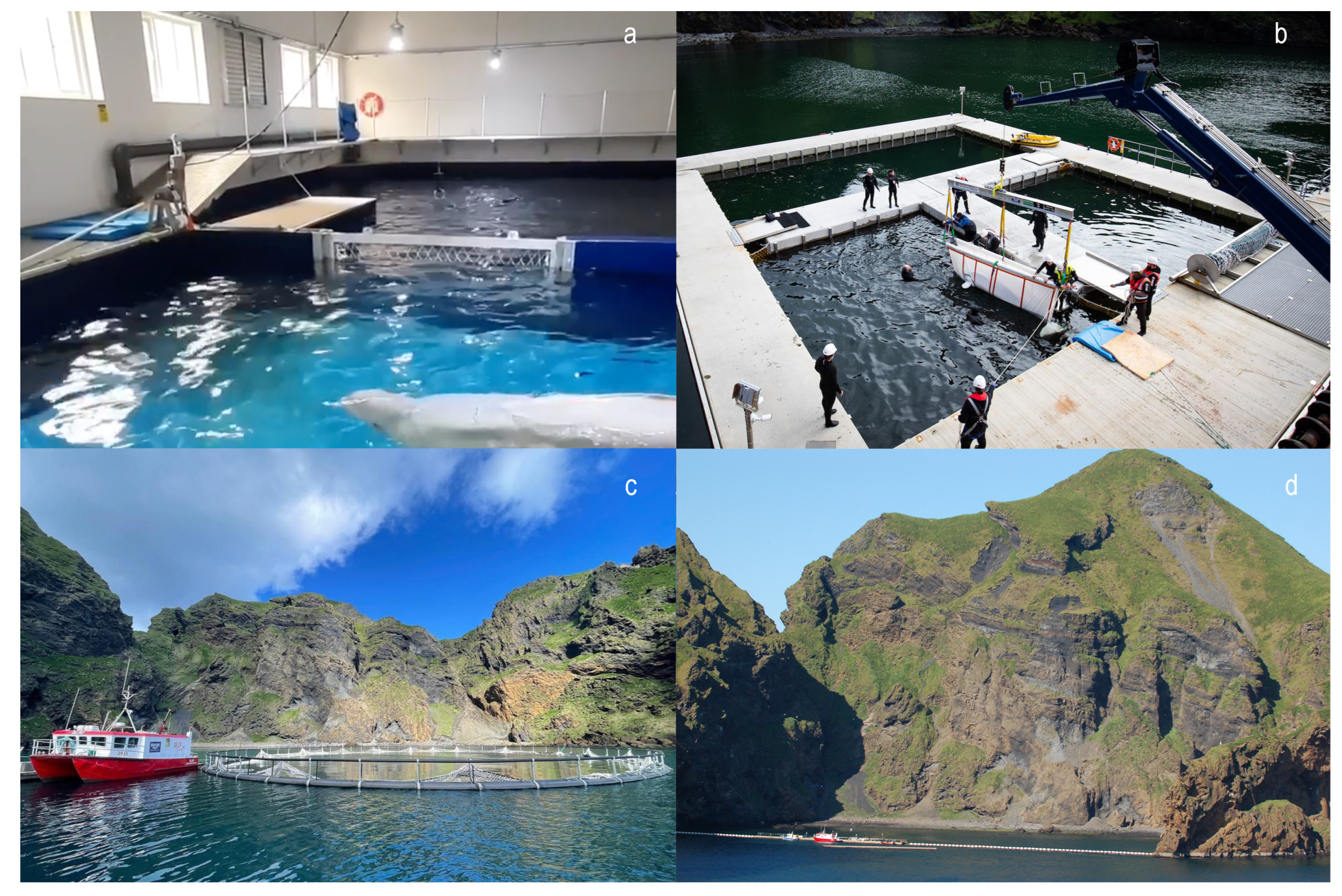

Table 1.
Summary of relevant Instagram content from BWS [18].
Table 1.
Summary of relevant Instagram content from BWS [18].
| Date | Content Summary |
| 3 Feb 2019 | The average winter water temperature of the sanctuary in Heimaey Island is 6.4 °C, ideal for Little Grey and Little White. |
| 29 Mar 2019 | Welfare study initiated in October 2018 in Shanghai, assessing behavior, health, cognition, and personality of the belugas as part of a comparative welfare analysis pre- and post-relocation. |
| 19 Jun 2019 | Little Grey and Little White arrived safely in Iceland after their flight from China; their health was assessed upon arrival, and ongoing well-being evaluations are being conducted by the care team. |
| 25 Jun 2019 | Little Grey and Little White adapted well to their care pool during quarantine, eating well and preparing for their eventual move to the open-water sanctuary after a 40+ day period. |
| 15 Aug 2019 | Welfare assessments for Little Grey and Little White continued on Heimaey, with comparisons being made to data collected in China to evaluate their progress. |
| 27 Aug 2019 | Little Grey and Little White are progressing well, but their preparation for life in the sanctuary is taking longer than expected; their release into the open-water sanctuary has been rescheduled for spring 2020 to allow for gradual adaptation. |
| 23 Sep 2019 | Little Grey and Little White are being prepared for colder conditions by gaining blubber, with the care pool temperature gradually lowered from 13 °C to 10 °C to help them acclimate to the conditions in Klettsvik Bay. |
| 18 Dic 2019 | Recent veterinary health checks showed positive progress for Little Grey and Little White, with both whales gaining an excellent Body Blubber Index (BBI) measured via ultrasound, in preparation for their move to Klettsvik Bay. |
| 27 Apr 2020 | New welfare evaluations were conducted to monitor Little Grey and Little White’s progress. |
| 6 May 2020 | Little Grey and Little White were announced ready to move to their new natural habitat in Klettsvik Bay in June. |
| 19 May 2020 | Little Grey and Little White successfully adapted to colder waters, lowering from 15 °C to 8 °C, while maintaining their body weight in preparation for their move to Klettsvik Bay. |
| 5 Jun 2020 | Cortisol levels were measured to monitor stress and ensure the well-being of Little Grey and Little White. |
| 1 Jul 2020 | Relocation of Little Grey and Little White to the sea sanctuary was delayed due to a mild bacterial stomach infection discovered during final health assessments; both are being treated and continue to feed and interact normally. |
| 10 Aug 2020 | Little Grey and Little White have been safely moved to the sea sanctuary care pools in Klettsvik Bay for acclimatization before transitioning to the wider bay. |
| 29 Aug 2020 | Little Grey and Little White are fed up to six times daily by the care team, with live fish available in the bay for optional hunting, while maintaining their established diet for proper nutrition. |
| 28 Sep 2020 | Little Grey and Little White began exploring Klettsvik Bay as part of the ’Little Steps’ program, with careful health and well-being monitoring during their gradual introduction to the wider bay. |
| 16 Oct 2020 | The belugas successfully adapted to the bay’s 8 °C temperature over months of preparation, a crucial step for their transition to the open-water habitat. |
| 8 Dic 2020 | Little Grey and Little White were moved back to the landside care facility as part of long-term planning to ensure their safety and health during the Icelandic winter storm season, with plans to return them to the bay in early 2021. |
| 21 Dic 2020 | The care team shared that Little Grey and Little White have quickly settled into what is now referred to as the ’winter pool,’ previously known as the ’temporary care pool’. |
| 6 Jan 2021 | New welfare evaluations were conducted to monitor Little Grey and Little White’s progress. |
| 27 Jul 2021 | An intermediate habitat is being constructed within the bay to facilitate Little Grey and Little White’s transition from the sea care pools to the main bay. While their return to the bay was initially planned for spring 2021, COVID-related supply chain delays have postponed the necessary adaptations to the sanctuary, with their move now scheduled for spring 2022, weather permitting. |
| 29 Apr 2022 | Recent welfare assessments for Little Grey and Little White were conducted virtually, utilizing photos, videos, and CCTV footage to evaluate their behavior and rest patterns as part of the regular monitoring process. In-person assessments will continue once they return to the sea sanctuary later this year. |
| 26 May 2022 | The construction of the Intermediate Habitat reached a milestone as it was towed into position in Klettsvik Bay. This habitat features an underwater framework with undersea anchors to secure the structure and manage the net enclosure across tidal changes, marking significant progress in the sanctuary’s development. |
| 24 Aug 2022 | Little Grey and Little White’s return to the sea sanctuary has been postponed due to a contractor’s boat sinking in Klettsvik Bay, causing significant oil and fuel contamination. Cleanup and repairs are ongoing, and combined with the approaching winter, the whales’ return is now planned for next spring to ensure their safety and well-being. |
| 6 March 2023 | Another regular welfare check was conducted to assess Little Grey and Little White’s interactions, behavior, and pool use, as part of ongoing monitoring to track welfare changes from indoor to outdoor facilities. |
| 27 March 2023 | Another regular veterinary check was conducted to assess the health of the belugas before the transfer to the sanctuary |
| 28 Apr 2023 | Little Grey and Little White have successfully moved to the outdoor sea pools in their Sea Sanctuary as part of their preparation for transitioning to the Intermediate ‘Halo’ Habitat this spring. |
| 15 May 2023 | Little Grey and Little White are progressing well in the sea care pools, eating regularly and engaging with the care team, while their adaptation to the bay is closely monitored 24/7. |
| 3 Jun 2023 | Little Grey and Little White were moved back to the indoor care facility after a decrease in Little Grey’s appetite led to the discovery of stomach ulcers during a veterinary examination. This precautionary move ensures close monitoring and treatment for Little Grey, whose appetite is now slowly improving, while Little White remains in good health and active. |
| 29 Sep 2023 | Little Grey is recovering well from stomach ulcers diagnosed earlier this year, with ongoing treatment showing positive results. However, due to the continued care required and the time needed to rebuild both whales’ fitness and stamina, the decision has been made to postpone their return to the outdoor care pools until next year. This ensures sufficient preparation time before winter and prioritizes their welfare as part of the ongoing Little Steps programme. |
| 19 Dic 2023 | Little Grey has fully recovered from her stomach ulcers, thanks to the dedicated care of the animal care team and veterinary partners, ensuring her welfare remains the top priority. |
| 30 Jul 2023 | Little Grey and Little White are doing well, swimming, resting, and interacting daily with the care team. Following Little Grey’s illness last year, plans to enhance Klettsvik Bay’s infrastructure, including better access for treatment and a respite area to shield against currents and extreme weather, have postponed their return to early 2025 to prioritize their welfare. |
Disclaimer/Publisher’s Note: The statements, opinions and data contained in all publications are solely those of the individual author(s) and contributor(s) and not of MDPI and/or the editor(s). MDPI and/or the editor(s) disclaim responsibility for any injury to people or property resulting from any ideas, methods, instructions or products referred to in the content. |
© 2024 by the authors. Licensee MDPI, Basel, Switzerland. This article is an open access article distributed under the terms and conditions of the Creative Commons Attribution (CC BY) license (http://creativecommons.org/licenses/by/4.0/).
Copyright: This open access article is published under a Creative Commons CC BY 4.0 license, which permit the free download, distribution, and reuse, provided that the author and preprint are cited in any reuse.


