

Submitted:
05 December 2024
Posted:
06 December 2024
You are already at the latest version
Abstract
The gas (or plastron) trapped between micro/nano-scale surface textures, such as that on superhydrophobic surface, is crucial for many engineering applications, including drag reduction, heat and mass transfer enhancement, anti-biofouling, anti-icing, and self-cleaning. However, the longevity of plastron is significantly affected by gas diffusion, a process where gas molecular slowly diffuses into ambient liquid. In this work, we demonstrated that plastron longevity can be extended using a gas soluble and gas permeable polydimethylsiloxane (PDMS) surface. Two types of surface textures: micro-posts and micro-holes, were fabricated on PDMS. The textured PDMS surfaces were immersed in an undersaturated liquid, and the longevity of plastron trapped on the PDMS was measured using an optical method. Our results showed that the plastron longevity increased with increasing the thickness of PDMS surface, suggesting that gas initially dissolved between the polymer chains was transferred to the liquid and delayed the wetting transition. Numerical simulations confirmed that a thicker PDMS material released more gas across the PDMS-liquid interface and resulted in a higher gas concentration near the plastron. Furthermore, we found that the plastron longevity increased with increasing pressure difference across the PDMS material, indicating that the plastron was replenished by the gas injected through PDMS. With increasing pressure, the mass flux caused by gas injection exceeded the mass flux caused by the diffusion of gas from plastron to liquid. Overall, our results provided new solutions to extend the plastron longevity and will have significant impacts to applications where a stable plastron is desired.
Keywords:
Plastron longevity
; gas diffusion
; polydimethylsiloxane (PDMS) surface
; superhydrophobic surface
; plastron recovery
; wetting transition
1. Introduction
The bio-inspired superhydrophobic surface has a wide range of engineering applications, including reducing hydrodynamic friction drag [1], enhancing heat and mass transfer [2], protecting engineering surface from biofouling [3,4], icing [5] and corrosion [6]. However, one main challenge that limits the broad application of superhydrophobic surface is the gas diffusion issue [7]. When submerged in a liquid, the superhydrophobic surface traps a thin layer of gas (or plastron) between the surface textures, forming the so-called Cassie-Baxter state [8]. Many of the desired properties of superhydrophobic surface depends on the presence of plastron [9,10]. For example, the plastron supports an effective slip boundary [11,12], which results in the friction drag reduction. The plastron is also the key for the reduction of bacterial adhesion [3,13]. However, when the liquid is undersaturated with gas, the beneficial gas can be dissolved into the ambient liquid [14,15,16,17,18,19,20,21,22,23,24,25,26,27,28,29,30], leading to the so-called Wenzel state [31]. The transition from Cassie-Baxter state to Wenzel state is known as wetting transition [32]. In addition to gas diffusion, other factors such as turbulent flows [33,34,35,36,37] and pressure [38,39] could also trigger the wetting transition. Currently, understanding and extending the plastron longevity is crucial for the broad application of superhydrophobic surface.
In the past two decades, various techniques have been developed to extend the plastron longevity on superhydrophobic surface. For example, Lee and Kim [40] and Lloyd et al. [41] developed a technique to restore the gas layer based on the electrolysis of water. Lee and Kim used an Au-coated superhydrophobic surface as the electrodes and applied a voltage between the liquid and the surface to induce the water splitting. Similar, Lee and Yong [42] restored the plastron based on the solar water splitting. Panchanathan et al. [43] recovered the plastron based on the decomposition reaction of hydrogen peroxide on a superhydrophobic surface prepared with a catalytic coating. Vakarelski et al. [44] and Saranadhi et al. [45] sustained a stable Leidenfrost vapor layer on superhydrophobic surface by heating. Several authors [46,47,48] restored the plastron by injecting and spreading a gas bubble on superhydrophobic surface. A few researchers [49,50,51] also extended the plastron longevity by controlling the dissolved gas concentration in ambient liquid. Last, fabricating superhydrophobic surface on a porous material and injecting gas through the porous surface was also frequently used to sustain the plastron [52,53,54,55,56,57].
The goal of this study is to examine a new method to extend the plastron longevity by taking advantage of the gas soluble and gas permeable properties of polydimethylsiloxane (PDMS). Many different approaches have been developed to manufacture superhydrophobic PDMS surfaces, including coating PDMS with a highly fluorinated monolayer [58], plasma etching [59,60,61,62], laser texturing [63,64,65], and soft-lithography [66,67]. Extending the plastron longevity on superhydrophobic PDMS surfaces has a significant impact since PDMS is widely applied in tissue engineering and microfluidic devices due to its biocompatibility, thermal stability, nontoxicity and flexibility [68]. However, the plastron longevity on the superhydrophobic PDMS surface has received less attention. Previous studies mostly focused the plastron longevity on a non-gas soluble and non-gas permeable surface [14,15,16,17,18]. Although the gas soluble and gas permeable properties of the PDMS were well documented in the literature [69,70,71], their impact on the plastron longevity has not been well investigated [53]. A few studies showed that the gas soluble and gas permeable properties of the PDMS can be applied to design vacuum-driven power-free microfluidics [72]. It is likely that such properties could also be applied to extend the plastron longevity.
To examine the plastron longevity on superhydrophobic PDMS surface, we performed an experimental study where the sample was submerged in an undersaturated liquid. The plastron longevity was determined by measuring the percentage of surface area covered by gas. The effect of gas soluble property on the plastron longevity was examined by testing samples with different thickness, considering that a sample with infinitely small thickness is similar to non-gas soluble material. We will show that by increasing the sample thickness (i.e., increasing the total amount of gas dissolved in the PDMS sample), the plastron longevity increased. We will explain this trend by numerically solving the mass transfer between PDMS surface and liquid. Moreover, we will show that injecting gas through the PDMS material extended the plastron longevity. In summary, our results demonstrated that plastron longevity can be extended by developing superhydrophobic surface on gas soluble and gas permeable materials.
2. Materials and Methods
As shown in Figure 1a,b, PDMS surfaces with two texture geometries (micro-holes and micro-posts) were used in this study. The micro-holes had a radius of r=30 µm, a depth of h=46 µm, and a wavelength of λ=100 µm. The micro-posts had a radius of r=30 µm, a height of h=61 µm, and a wavelength of λ=100 µm. The texture parameters were summarized in Table 1. In addition, Table 1 provided the surface energy difference between Cassie-Baxter state and Wenzel state per unit surface area and per surface tension, expressed as [73]:
where rw was the Wenzel roughness defined as the ratio of total surface area to project surface area, φs is the solid fraction (the fraction of surface area covered by solid), and θ0 is water contact angle on an ideally flat surface of the same material (here for PDMS, θ0=105° [74]). As shown in Table 1, for PDMS with micro-holes, ΔE>0, suggesting that the Cassie-Baxter state had a lower energy than Wenzel state and thus was thermodynamically stable. While for PDMS with micro-posts, ΔE<0, indicating that the plastron was thermodynamically unstable.
ΔE = (φs − rW) cosθ0 – 1 + φs,
These PDMS surfaces were created by a standard soft-lithography procedure involving following steps. First, the base and curing agents of PDMS (Dow SYLGARD 184) were mixed at a mass ratio of 10:1. Then, the mixture was degassed under vacuum for 10 minutes, gently poured on a SU8 template, and crosslinked at 60 °C for 4 h. Last, the PDMS surface was peeled off from the SU8 template, and the surface texture was transferred to the PDMS. Since the PDMS was hydrophobic, no additional coatings were applied to modify the surface chemistry. As shown later, when submerged in water, gas was trapped within the surface texture, forming the plastron. According to the literature, the prepared PDMS had a solubility for oxygen and nitrogen of 0.18 cm3/(cm3 atm) and 0.09 cm3/(cm3 atm) at standard temperature and pressure (STP) condition [72], respectively. Prior to the experimental tests, the PDMS samples were stored at atmosphere pressure for at least 2 days with an aim to reaching an equilibrium condition.
To examine the effect of gas soluble property of PDMS surface on the plastron longevity, we used an experimental setup illustrated in Figure 2a. This setup was also used in our previous work [14]. A PDMS surface (diameter 12.5 mm) was installed at the top of a tube, which was filled with water. To examine the effect of gas soluble property of PDMS, we varied the thickness of PDMS surface d from 0.9 to 6.0 mm: an infinitely thin sample can be approximated as a non-gas soluble surface, and a thicker sample stored more gas due to larger volume and was expected to have a larger plastron longevity. The textured side of the PDMS surface faced downward and contacted with water. The tube had a length of 270 mm, which was long enough for the gas molecules to diffuse freely in the direction perpendicular to PDMS surface. To induce gas transfer from the plastron to the liquid, the air concentrations in ambient water and at air-water interface had a value of c∞=0.3Patm/kH and ci=Patm/kH>c∞, respectively, where Patm=1 atm was the atmosphere pressure and kH was the Henry’s law constant of air. Low air concentration in water was obtained by leaving a beaker of water under vacuum for a certain duration, and then pouring this degassed water into the tube. The ci at the air-water interface was achieved since the sample was located above the water surface and the hydrostatic pressure is close to Patm.
Furthermore, to investigate whether the gas permeable property of PDMS surface can be utilized to extend the plastron longevity, we performed experiments in setup shown in Figure 2b. A PDMS surface (diameter 25.4 mm, thickness of d=2 mm) was submerged in a tank filled with water. The tank had an inner dimension of 13 mm×75 mm×150 mm. Plastron on PDMS surface slowly decayed since the air concentrations in ambient water (c∞=0.3Patm/kH) was lower than that at the air-water interface (ci≈Patm/kH>c∞). To extend the plastron longevity and sustain the plastron, gas was injected through the PDMS surface by connecting an air compressor to the back of PDMS surface. The pressure at the back of PDMS surface was varied between 1 to 3.1 atm and was measured by a high precision pressure gauge (Omega Engineering, #DPG108–030 G, range 30 psi, precision 0.25 %). The pressure inside the tube was maintain close to 1 atm. Therefore, the pressure difference (∆P) on two sides of the PDMS surface varied in the range of 0<∆P<2.1 atm.
In both setups shown in Figure 2a,b, the air concentration in ambient water was monitored throughout the experiment by an optical oxygen sensor (FirestingO2, Pyro Science). To determine the plastron longevity, the status of plastron on PDMS surface was measured by a non-intrusive optical method. An LED light was used to illuminate the sample. The light beams reflected from the air-water interface and PDMS-water interface were recorded by a CMOS camera (FLIR Grasshopper 3, pixel size of 5.5 mm, 2048×2048 pixels). In the setup of Figure 2(a), the field of view is 13 mm×13 mm, just large enough to cover the entire PDMS surface. In the setup of Figure 2(b), the field of view is 1.2 mm×1.2 mm due to the use of a 10× objective lens. As will be shown later, the recorded image transitioned from bright to dark as the plastron slowly decayed. This was because intensity of light reflected from the air-water interface was much larger than that reflected from the PDMS-water interface. The plastron longevity was determined based on the time when percentage of surface area covered by gas was below a certain value. All experiments were performed at room temperature of 20 ± 1°C.
3. Results and Discussion
- (a)
- Effect of PDMS surface thickness on plastron longevity
To examine the effect of gas soluble property of PDMS surface on plastron longevity, we performed experiments for PDMS surfaces with thicknesses varying in the range of 0.9<d<6 mm using the setup shown in Figure 2a. Figure 3a,b showed the effect of d on the time-variation of plastron status for PDMS with micro-holes and micro-posts, respectively. With increasing time (t), due to the transfer of gas from the plastron to the surrounding liquid, the surface area covered by gas (i.e., bright regions on the image) reduced. Specifically, for PDMS with micro-holes, the gas was trapped within isolated micro-holes creating numerous isolated plastrons. With increasing time, the number of bright dots (or the number of plastron) reduces. For PDMS with micro-posts, the gas was trapped between the space of different posts, forming a single large plastron. With increasing time, the bright region (or the plastron) shrunk in the horizontal direction along the surface. Furthermore, with increasing d, the wetting process was greatly delayed, indicating that a thicker PDMS surface had a longer plastron longevity.
To quantify the impact of d on the wetting processes, we processed the recorded images following a method used in previous work. Briefly, the recorded images were binarized based on the intensity, and the regions covered by gas were identified. We calculated the surface area covered by gas and defined it as ϕg. We also defined ϕg0=ϕg(t=0) as the surface area covered by gas at beginning of wetting process. Figure 4a,b showed the effect of d on time-variations of ϕg/ϕg0 for PDMS with micro-holes and micro-posts, respectively. Clearly, with increasing time, ϕg monotonically reduced to 0. However, the trends of ϕg for different textures were different: for micro-holes, ϕg decreased very slowly at the beginning and then decreased dramatically; for micro-posts, ϕg decreased very quick at the beginning and the decreasing rate reduced with time. The possible reason for these difference trends at the beginning of wetting transition was that: for micro-holes, the air-water interface mainly moved in the direction perpendicular to the surface (i.e., a hole fully filled with gas changed to a hole partially filled with gas); while for micro-posts, the air-water interface moved in the direction parallel to the surface (i.e., plastron shrunk size in the horizontal direction). Although different textures had different trends of ϕg, both textures had a smaller decaying rate of ϕg with increasing d.
To estimate the time scale of wetting processes, we defined the plastron longevity (tf) as the time when ϕg/ϕg0=0.05. Figure 4c,d showed tf as a function of d for PDMS with micro-holes and micro-posts, respectively. First, the PDMS surface with micro-posts had a larger plastron longevity than the PDMS surface with micro-holes. The reason was because the plastron volume on PDMS with micro-posts was larger than that on PDMS with micro-holes. Second, regardless of the surface texture, the plastron longevity increased with increasing the sample thickness. As d increased from 1 to 5 mm, tf increased by ~5 times from 160 s to 700 s for PDMS with micro-holes, and by ~2 times from 1740 s to 3890 s for PDMS with micro-posts. More interestingly, for PDMS with micro-holes, tf increased almost linearly with d. The effect of d on plastron longevity is larger for PDMS with micro-holes than PDMS with micro-posts. This was probably because the PDMS with micro-holes had a larger contact area between PDMS and liquid, and thus enhanced the transfer of gas dissolved between the polymer chain of PDMS material to the undersaturated liquid.
To understand the mechanism of the extension of plastron longevity due to the increased thickness of PDMS surface, we performed a simplified numerical simulation as shown in Figure 5a. We assumed a flat, smooth PDMS surface with a thickness d exposed to liquid with a height 10d. To match the air concentration in experiments, the initial air concentration in the PDMS surface was set as cPDMS=4.83 mol/m3, which corresponded to a PDMS material saturated with air at atmosphere pressure and room temperature. The initial air concentration in water was set as c∞=0.3Patm/kH=0.238 mol/m3. Furthermore, the diffusion coefficients of air in PDMS and water was set as D=3.4×10⁻⁹ m2/s [72] and 2.0×10⁻⁹ m2/s, respectively. Due to the difference between cPDMS and c∞, air molecular diffused from the PDMS to the water, and the air concentration, c(t, y), varied in both space and time. We defined y as the vertical coordinate and y=0 as the position of the PDMS-water interface. We numerically solved c(t, y) using COMSOL multi-physics simulations. Figure 5b,c showed the concentration profiles at t=200 s and the time-evolution of mass flux at the PDMS-water interface, respectively. Results for two different values of d=1 and 5 mm were shown. Clearly, for the case with larger d, both the gas concentration and the mass flux near the PDMS-liquid interface were larger, suggesting that a thicker PDMS surface released more air to water and reduced the degree of undersaturation level near the plastron. These results explained that a thicker PDMS surface extended the plastron longevity.
- (b)
- Effect of gas injection through PDMS on plastron longevity
To examine the effect of gas permeable property of PDMS surface on the plastron longevity, we performed experiments for PDMS surfaces using the setup shown in Figure 2b. The pressure on two sides of the PDMS surface varied in the range of 0<∆P<2.1 atm. The PDMS thickness was kept as a constant of d=2.0 mm. The steady-state mass flux JS (mol/m2/s) through the PDMS surface due to the pressure and gas injection could be expressed by the following equation [69]:
where ∆P was the pressure difference on two sides of the PDMS surface, d is the sample thickness, p was the gas permeability of PDMS material (p=1.34×10⁻¹³ mol/(Pa s m) for nitrogen [69]). According to Equ. (2), we expected that JS increases linearly with increasing ∆P. It was expected that the plastron can be sustained or grew when JS>JD, where JD denoted the mass flux of gas transferred from the plastron to the liquid due to diffusion. According to our previous work [14,15], during the wetting process, JD reduced with time following a power-law relation as:
where D denoted the diffusion coefficient of gas in water, and LD denoted the diffusion length. The power-law exponent of −0.5 was because the diffusion length increased with time as LD~(Dt)0.5, following a typical one-dimension gas diffusion process.
JS=p ∆P/d,
JD(t)~D(ci−c∞)/LD ~ t−0.5.
Figure 6a,b showed the time-variations of plastron status on PDMS with micro-holes and micro-posts, respectively. For each texture, results for three different ∆P were shown. Clearly, with increasing ∆P, the wetting process was significantly delayed, confirming that gas injection through the PDMS surface extended the plastron longevity. For micro-holes and for ∆P=2.1 atm, the plastron grew with increasing time, suggesting that JS exceeded JD. Plastron longevity for this case was defined as the time when plastron start to grow. As increasing ∆P, a steady state where the plastron was kept as a constant shape was not observed. This was probably because for any given ∆P, JS was a constant while JD decreased in time following Equ. (3). For micro-post, although plastron longevity was extended due to gas injection, the plastron decayed even at the highest-pressure case. The reason was probably because the plastron on micro-posts was not thermodynamical stable as shown in Table 1.
To better quantify the effect ∆P on the plastron longevity, we processed the images using the methods discussed in previous section and calculated ϕg. Figure 7a,b showed the time-variations of ϕg/ϕg0 for PDMS with micro-holes and micro-posts, respectively. For each texture, results for three different ∆P were shown. Clearly, with increasing ∆P, it took a longer time for ϕg to decrease to zero, indicating a longer plastron longevity. We defined the plastron longevity (tf) as the time when ϕg/ϕg0=0.05. As shown in Figure 7c,d, as ∆P increased from 0 to 2.1 atm, tf increased by ~20 times from 35 s to 660 s for micro-holes and increased by ~3 times from 1430 s to 4340 s for micro-posts. Furthermore, to confirm that at high pressure the mass flux due to gas injection through PDMS material was sufficiently large to extend plastron longevity (i.e., to confirm JS>JD), we estimated the time-averaged mass flux of gas transferred from the plastron to the liquid as:
where m was the total mass of gas trapped within the plastron, and A was the projected surface area (e.g., for holes with radius r, A=πr2). Figure 7c,d showed the variations of Ji/JD,ave as a function of ∆P for micro-holes and micro-posts, respectively. As expected, with increasing ∆P, Ji/JD,ave increased. Moreover, for large ∆P, Ji/JD,ave>1, confirming that the rate of gas replenishment was sufficiently large to combat the plastron decay for PDMS with holes.
JD,ave=m/tfA,
4. Conclusions
In summary, we performed an experimental study of the longevity of plastron on PDMS surfaces consisting of micro-holes and micro-posts when the surfaces were exposed to undersaturated liquid. The plastron longevity was determined by measuring the percentage of surface area covered by gas. First, we examined the effect of PDMS surface thickness on the plastron longevity. We found that the plastron longevity increased with increasing the sample thickness, suggesting that gas initially dissolved between the polymer chains of PDMS transferred into the ambient liquid and delayed the wetting transition. Numerical simulations validated that a PDMS sample with a larger thickness released more gas from polymer chains to the ambient liquid and resulted in a higher gas concentration near the PDMS-liquid interface. Second, we investigated the effect of gas injection across the PDMS material on the plastron longevity. We found that plastron longevity increased with increasing the pressure difference across the PDMS sample, indicating that the gas permeable property of PDMS material allowed the plastron to be replenished by gas injection. By calculating the mass flux caused by the gas injection across the PDMS material, we confirmed that it exceeded the mass flux caused by the diffusion of gas from the plastron to the surrounding liquid. In conclusion, our results demonstrated that plastron longevity could be extended by utilizing a gas soluble and gas permeable material. Our results will have significant impacts to various applications where maintaining a stable plastron is essential, for example, the reduction of hydrodynamic friction drag by superhydrophobic surfaces.
Data Availability Statements
The original contributions presented in this study are included in the article/supplementary material. Further inquiries can be directed to the corresponding author(s).
Conflicts of Interest statement
The authors declare that they have no known competing financial interests or personal relationships that could have appeared to influence the work reported in this paper.
Acknowledgments
We thank the support of National Science Foundation under Grant No. 2041479 and 2339606, UMass Dartmouth’s Marine and Undersea Technology (MUST) Research Program funded by the Office of Naval Research (ONR) under Grant No. N00014-20-1-2170, and University of Massachusetts OTCV Technology Development Fund. We also thank Paul Sousa for the assistance of fabricating the experimental setup.
References
- Hu, J.; Yao, Z. Drag reduction of turbulent boundary layer over sawtooth riblet surface with superhydrophobic coat. Physics of Fluids 2023, 35, 015104. [Google Scholar] [CrossRef]
- Gao, S.; Wu, S.; Gulfam, R.; Deng, Z.; Chen, Y. Dropwise condensation heat transfer on vertical superhydrophobic surfaces with fractal microgrooves in steam. Int J Heat Mass Transf 2023, 217, 124641. [Google Scholar] [CrossRef]
- Elius, M.; Richard, S.; Boyle, K.; Chang, W.S.; Moisander, P.H.; Ling, H. Impact of gas bubbles on bacterial adhesion on super-hydrophobic aluminum surfaces. Results in Surfaces and Interfaces 2024, 15. [Google Scholar] [CrossRef]
- Murugan, U.; Gusain, D.; Balasubramani, B.; Srivastava, S.; Ganesh, S.; Ambattu Raghavannambiar, S.; Ramaraj, K. A comprehensive review of environment-friendly biomimetic bionic superhydrophobic surfaces. Biofouling 2024, 1–23. [Google Scholar] [CrossRef]
- Chu, F.; Hu, Z.; Feng, Y.; Lai, N.-C.; Wu, X.; Wang, R. Advanced Anti-Icing Strategies and Technologies by Macrostructured Photothermal Storage Superhydrophobic Surfaces. Advanced Materials 2024, 36, 2402897. [Google Scholar] [CrossRef]
- Song, Z.; Xie, Z.-H.; Ding, L.; Zhang, S. Progress in superhydrophobic surfaces for corrosion protection of Mg alloys – a mini-review. Anti-Corrosion Methods and Materials 2024, 71, 124–131. [Google Scholar] [CrossRef]
- Xue, Y.; Lv, P.; Lin, H.; Duan, H. Underwater Superhydrophobicity: Stability, Design and Regulation, and Applications. Appl Mech Rev 2016, 68. [Google Scholar] [CrossRef]
- Cassie, A.B.D.; Baxter, S. Wettability of porous surfaces. Trans. Faraday Soc. 1944, 40, 546–551. [Google Scholar] [CrossRef]
- Xu M, Yu N, Kim J, Kim C-J “CJ”. Superhydrophobic drag reduction in high-speed towing tank. J Fluid Mech 2021, 908, A6. [Google Scholar] [CrossRef]
- Vajdi Hokmabad, B.; Ghaemi, S. Turbulent flow over wetted and non-wetted superhydrophobic counterparts with random structure. Physics of Fluids 2016, 28, 015112. [Google Scholar] [CrossRef]
- Rothstein, J.P. Slip on Superhydrophobic Surfaces. Annu Rev Fluid Mech 2010, 42, 89–109. [Google Scholar] [CrossRef]
- Ling, H.; Srinivasan, S.; Golovin, K.; McKinley, G.H.; Tuteja, A.; Katz, J. High-resolution velocity measurement in the inner part of turbulent boundary layers over super-hydrophobic surfaces. J Fluid Mech 2016, 801, 670–703. [Google Scholar] [CrossRef]
- Hwang, G.B.; Page, K.; Patir, A.; Nair, S.P.; Allan, E.; Parkin, I.P. The Anti-Biofouling Properties of Superhydrophobic Surfaces are Short-Lived. ACS Nano 2018, 12, 6050–6058. [Google Scholar] [CrossRef]
- Nosrati, A.; Mohammadshahi, S.; Raessi, M.; Ling, H. Impact of the Undersaturation Level on the Longevity of Superhydrophobic Surfaces in Stationary Liquids. Langmuir 2023, 39, 18124–18131. [Google Scholar] [CrossRef]
- Bourgoun, A.; Ling, H. A General Model for the Longevity of Super-Hydrophobic Surfaces in Under-Saturated, Stationary Liquid. J Heat Transfer 2022, 144, 042101. [Google Scholar] [CrossRef]
- Kim, H.; Park, H. Diffusion characteristics of air pockets on hydrophobic surfaces in channel flow: Three-dimensional measurement of air-water interface. Phys Rev Fluids 2019, 4, 074001. [Google Scholar] [CrossRef]
- Bobji, M.S.; Kumar, S.V.; Asthana, A.; Govardhan, R.N. Underwater Sustainability of the “Cassie” State of Wetting. Langmuir 2009, 25, 12120–12126. [Google Scholar] [CrossRef]
- Lv, P.; Xue, Y.; Shi, Y.; Lin, H.; Duan, H. Metastable States and Wetting Transition of Submerged Superhydrophobic Structures. Phys Rev Lett 2014, 112, 196101. [Google Scholar] [CrossRef]
- Mayer, M.D.; Kadoko, J.; Hodes, M. Two-Dimensional Numerical Analysis of Gas Diffusion-Induced Cassie to Wenzel State Transition. J Heat Transfer 2021, 143, 103001. [Google Scholar] [CrossRef]
- Arunachalam, S.; Ahmad, Z.; Das, R.; Mishra, H. Counterintuitive Wetting Transitions in Doubly Reentrant Cavities as a Function of Surface Make-Up, Hydrostatic Pressure, and Cavity Aspect Ratio. Adv Mater Interfaces 2020, 7, 1–13. [Google Scholar] [CrossRef]
- Hemeda, A.A.; Tafreshi, H.V. General formulations for predicting longevity of submerged superhydrophobic surfaces composed of pores or posts. Langmuir 2014, 30, 10317–10327. [Google Scholar] [CrossRef]
- Li, X.; Wang, Y.; Zeng, B.; Li, Y.; Tan, H.; Zandvliet, H.J.W.; Zhang, X.; Lohse, D. Entrapment and Dissolution of Microbubbles Inside Microwells. Langmuir 2018, 34, 10659–10667. [Google Scholar] [CrossRef]
- Kadoko, J.; Karamanis, G.; Kirk, T.; Hodes, M. One-Dimensional Analysis of Gas Diffusion-Induced Cassie to Wenzel State Transition. J Heat Transfer 2017, 139, 1–10. [Google Scholar] [CrossRef]
- Emami, B.; Hemeda, A.A.; Amrei, M.M.; Luzar, A.; Gad-el-Hak, M.; Vahedi Tafreshi, H. Predicting longevity of submerged superhydrophobic surfaces with parallel grooves. Physics of Fluids 2013, 25, 062108. [Google Scholar] [CrossRef]
- Samaha, M.A.; Tafreshi, H.V.; Gad-el-Hak, M. Influence of Flow on Longevity of Superhydrophobic Coatings. Langmuir 2012, 28, 9759–9766. [Google Scholar] [CrossRef]
- Xu, M.; Sun, G.; Kim, C.-J. Infinite Lifetime of Underwater Superhydrophobic States. Phys Rev Lett 2014, 113, 136103. [Google Scholar] [CrossRef]
- Poetes, R.; Holtzmann, K.; Franze, K.; Steiner, U. Metastable Underwater Superhydrophobicity. Phys Rev Lett 2010, 105, 166104. [Google Scholar] [CrossRef]
- Xiang, Y.; Xue, Y.; Lv, P.; Li, D.; Duan, H. Influence of fluid flow on the stability and wetting transition of submerged superhydrophobic surfaces. Soft Matter 2016, 12, 4241–4246. [Google Scholar] [CrossRef]
- Hokmabad, B.V.; Ghaemi, S. Effect of Flow and Particle-Plastron Collision on the Longevity of Superhydrophobicity. Sci Rep 2017, 7, 41448. [Google Scholar] [CrossRef]
- Arunachalam, S.; Mishra, H. Collective wetting transitions of submerged gas-entrapping microtextured surfaces. Droplet 2024, 3, e135. [Google Scholar] [CrossRef]
- Wenzel, RN. RESISTANCE OF SOLID SURFACES TO WETTING BY WATER. Ind Eng Chem 1936, 28, 988–994. [Google Scholar] [CrossRef]
- Patankar, N.A. Transition between superhydrophobic states on rough surfaces. Langmuir 2004, 20, 7097–7102. [Google Scholar] [CrossRef] [PubMed]
- Mohammadshahi, S.; O’Coin, D.; Ling, H. Impact of sandpaper grit size on drag reduction and plastron stability of super-hydrophobic surface in turbulent flows. Physics of Fluids 2024, 36. [Google Scholar] [CrossRef]
- Yu N, Li ZR, McClelland A, del Campo Melchor FJ, Lee SY, Lee JH, Kim C-J “CJ”. Sustainability of the plastron on nano-grass-covered micro-trench superhydrophobic surfaces in high-speed flows of open water. J Fluid Mech 2023, 962, A9. [Google Scholar] [CrossRef]
- Reholon, D.; Ghaemi, S. Plastron morphology and drag of a superhydrophobic surface in turbulent regime. Phys Rev Fluids 2018, 3, 1–21. [Google Scholar] [CrossRef]
- Seo, J.; García-Mayoral, R.; Mani, A. Pressure fluctuations and interfacial robustness in turbulent flows over superhydrophobic surfaces. J Fluid Mech 2015, 783, 448–473. [Google Scholar] [CrossRef]
- Seo, J.; García-Mayoral, R.; Mani, A. Turbulent flows over superhydrophobic surfaces: Flow-induced capillary waves, and robustness of air-water interfaces. J Fluid Mech 2018, 835, 45–85. [Google Scholar] [CrossRef]
- Yu N, Kiani S, Xu M, Kim C-J “CJ”. Brightness of Microtrench Superhydrophobic Surfaces and Visual Detection of Intermediate Wetting States. Langmuir 2021, 37, 1206–1214. [Google Scholar] [CrossRef] [PubMed]
- He, Y.; Zhou, Q.; Wang, S.; Yang, R.; Jiang, C.; Yuan, W. In Situ Observation of Dynamic Wetting Transition in Re-Entrant Microstructures. Langmuir 2017, 33, 3949–3953. [Google Scholar] [CrossRef]
- Lee, C.; Kim, C.J. Underwater restoration and retention of gases on superhydrophobic surfaces for drag reduction. Phys Rev Lett 2011, 106, 1–4. [Google Scholar] [CrossRef]
- Lloyd, B.P.; Bartlett, P.N.; Wood, R.J.K. Active gas replenishment and sensing of the wetting state in a submerged superhydrophobic surface. Soft Matter 2017, 13, 1413–1419. [Google Scholar] [CrossRef]
- Lee, J.; Yong, K. Combining the lotus leaf effect with artificial photosynthesis: Regeneration of underwater superhydrophobicity of hierarchical ZnO/Si surfaces by solar water splitting. NPG Asia Mater 2015, 7, 1–9. [Google Scholar] [CrossRef]
- Panchanathan, D.; Rajappan, A.; Varanasi, K.K.; McKinley, G.H. Plastron Regeneration on Submerged Superhydrophobic Surfaces Using In Situ Gas Generation by Chemical Reaction. ACS Appl Mater Interfaces 2018, 10, 33684–33692. [Google Scholar] [CrossRef] [PubMed]
- Vakarelski, I.U.; Patankar, N.A.; Marston, J.O.; Chan, D.Y.C.; Thoroddsen, S.T. Stabilization of Leidenfrost vapour layer by textured superhydrophobic surfaces. Nature 2012, 489, 274–277. [Google Scholar] [CrossRef]
- Saranadhi, D.; Chen, D.; Kleingartner, J.A.; Srinivasan, S.; Cohen, R.E.; McKinley, G.H. Sustained drag reduction in a turbulent flow using a low-Temperature Leidenfrost surface. Sci Adv 2016, 2. [Google Scholar] [CrossRef] [PubMed]
- Zhao, Y.; Xu, Z.; Gong, L.; Yang, S.; Zeng, H.; He, C.; Ge, D.; Yang, L. Recoverable underwater superhydrophobicity from a fully wetted state via dynamic air spreading. iScience 2021, 24, 103427. [Google Scholar] [CrossRef]
- Du, P.; Wen, J.; Zhang, Z.; Song, D.; Ouahsine, A.; Hu, H. Maintenance of air layer and drag reduction on superhydrophobic surface. Ocean Engineering 2017, 130, 328–335. [Google Scholar] [CrossRef]
- Sung, H.; Choi, H.; Ha, C.; Lee, C.; Park, H. Plastron replenishment on superhydrophobic surfaces using bubble injection. Physics of Fluids 2022, 34, 103323. [Google Scholar] [CrossRef]
- Xiang, Y.; Huang, S.; Lv, P.; Xue, Y.; Su, Q.; Duan, H. Ultimate Stable Underwater Superhydrophobic State. Phys Rev Lett 2017, 119, 134501. [Google Scholar] [CrossRef]
- Dilip, D.; Jha, N.K.; Govardhan, R.N.; Bobji, M.S. Controlling air solubility to maintain “Cassie” state for sustained drag reduction. Colloids Surf A Physicochem Eng Asp 2014, 459, 217–224. [Google Scholar] [CrossRef]
- Ling, H.; Katz, J.; Fu, M.; Hultmark, M. Effect of Reynolds number and saturation level on gas diffusion in and out of a superhydrophobic surface. Phys Rev Fluids 2017, 2, 124005. [Google Scholar] [CrossRef]
- Li, Z.; Marlena, J.; Pranantyo, D.; Nguyen, B.L.; Yap, C.H. A porous superhydrophobic surface with active air plastron control for drag reduction and fluid impalement resistance. J Mater Chem A Mater 2019, 7, 16387–16396. [Google Scholar] [CrossRef]
- Cho, W.; Heo, S.; Lee, S.J. Effects of surface air injection on the air stability of superhydrophobic surface under partial replenishment of plastron. Physics of Fluids 2022, 34, 122115. [Google Scholar] [CrossRef]
- Qin, S.; Fang, H.; Sun, S.; Wang, X.; Cao, L.; Wu, D. Fabrication of air-permeable superhydrophobic surfaces with excellent non-wetting property. Mater Lett 2022, 313, 131783. [Google Scholar] [CrossRef]
- Zhu, D.; Song, Y.; Gao, F.; Dong, S.; Xu, C.; Liu, B.; Zheng, J.; Zhou, X.; Liu, Q. Achieving underwater stable drag reduction on superhydrophobic porous steel via active injection of small amounts of air. Ocean Engineering 2024, 308, 118329. [Google Scholar] [CrossRef]
- Chen, X.; Perlin, M. Drag reduction in turbulent channel flow by gas perfusion through porous non-hydrophobic and hydrophobic interfaces: Part II. Ocean Engineering 2024, 297. [Google Scholar] [CrossRef]
- Breveleri, J.; Mohammadshahi, S.; Dunigan, T.; Ling, H. Plastron restoration for underwater superhydrophobic surface by porous material and gas injection. Colloids Surf A Physicochem Eng Asp 2023, 676, 132319. [Google Scholar] [CrossRef]
- de Givenchy ET, Amigoni S, Martin C, Andrada G, Caillier L, Géribaldi S, Guittard F. Fabrication of Superhydrophobic PDMS Surfaces by Combining Acidic Treatment and Perfluorinated Monolayers. Langmuir 2009, 25, 6448–6453. [Google Scholar] [CrossRef]
- Tserepi, A.D.; Vlachopoulou, M.-E.; Gogolides, E. Nanotexturing of poly(dimethylsiloxane) in plasmas for creating robust super-hydrophobic surfaces. Nanotechnology 2006, 17, 3977. [Google Scholar] [CrossRef]
- Tropmann, A.; Tanguy, L.; Koltay, P.; Zengerle, R.; Riegger, L. Completely Superhydrophobic PDMS Surfaces for Microfluidics. Langmuir 2012, 28, 8292–8295. [Google Scholar] [CrossRef]
- Cortese, B.; D’Amone, S.; Manca, M.; Viola, I.; Cingolani, R.; Gigli, G. Superhydrophobicity Due to the Hierarchical Scale Roughness of PDMS Surfaces. Langmuir 2008, 24, 2712–2718. [Google Scholar] [CrossRef] [PubMed]
- Ebert, D.; Bhushan, B. Transparent, superhydrophobic, and wear-resistant surfaces using deep reactive ion etching on PDMS substrates. J Colloid Interface Sci 2016, 481, 82–90. [Google Scholar] [CrossRef] [PubMed]
- Jin, M.; Feng, X.; Xi, J.; Zhai, J.; Cho, K.; Feng, L.; Jiang, L. Super-Hydrophobic PDMS Surface with Ultra-Low Adhesive Force. Macromol Rapid Commun 2005, 26, 1805–1809. [Google Scholar] [CrossRef]
- Yong, J.; Yang, Q.; Chen, F.; Zhang, D.; Du, G.; Bian, H.; Si, J.; Yun, F.; Hou, X. Superhydrophobic PDMS surfaces with three-dimensional (3D) pattern-dependent controllable adhesion. Appl Surf Sci 2014, 288, 579–583. [Google Scholar] [CrossRef]
- Zhang, W.; Yan, W.; Zheng, H.; Zhao, C.; Liu, D. Laser-Engineered Superhydrophobic Polydimethylsiloxane for Highly Efficient Water Manipulation. ACS Appl Mater Interfaces 2021, 13, 48163–48170. [Google Scholar] [CrossRef]
- Stanton, M.M.; Ducker, R.E.; MacDonald, J.C.; Lambert, C.R.; Grant McGimpsey, W. Super-hydrophobic, highly adhesive, polydimethylsiloxane (PDMS) surfaces. J Colloid Interface Sci 2012, 367, 502–508. [Google Scholar] [CrossRef] [PubMed]
- Liu, B.; Wang, W.; Jiang, G.; Mei, X.; Wang, Z.; Wang, K.; Cui, J. Study on hierarchical structured PDMS for surface super-hydrophobicity using imprinting with ultrafast laser structured models. Appl Surf Sci 2016, 364, 528–538. [Google Scholar] [CrossRef]
- Miranda, I.; Souza, A.; Sousa, P.; Ribeiro, J.; Castanheira, E.M.S.; Lima, R.; Minas, G. Properties and Applications of PDMS for Biomedical Engineering: A Review. J Funct Biomater 2022, 13. [Google Scholar] [CrossRef]
- Merkel, T.C.; Bondar, V.I.; Nagai, K.; Freeman, B.D.; Pinnau, I. Gas sorption, diffusion, and permeation in poly(dimethylsiloxane). J Polym Sci B Polym Phys 2000, 38, 415–434. [Google Scholar] [CrossRef]
- Markov, D.A.; Lillie, E.M.; Garbett, S.P.; McCawley, L.J. Variation in diffusion of gases through PDMS due to plasma surface treatment and storage conditions. Biomed Microdevices 2014, 16, 91–96. [Google Scholar] [CrossRef]
- Lamberti A, Marasso SL, Cocuzza M. PDMS membranes with tunable gas permeability for microfluidic applications. RSC Adv 2014, 4, 61415–61419. [Google Scholar] [CrossRef]
- Xu, L.; Lee, H.; Jetta, D.; Oh, K.W. Vacuum-driven power-free microfluidics utilizing the gas solubility or permeability of polydimethylsiloxane (PDMS). Lab Chip 2015, 15, 3962–3979. [Google Scholar] [CrossRef] [PubMed]
- Mohammadshahi, S.; Breveleri, J.; Ling, H. Fabrication and characterization of super-hydrophobic surfaces based on sandpapers and nano-particle coatings. Colloids Surf A Physicochem Eng Asp 2023, 666, 131358. [Google Scholar] [CrossRef]
- Byun, D.; Kim, J.; Ko, H.S.; Park, H.C. Direct measurement of slip flows in superhydrophobic microchannels with transverse grooves. Physics of Fluids 2008, 20, 113601. [Google Scholar] [CrossRef]
Figure 1.
Microscope images of the surface texture on PDMS surface with (a) micro-holes and (b) micro-posts.
Figure 1.
Microscope images of the surface texture on PDMS surface with (a) micro-holes and (b) micro-posts.
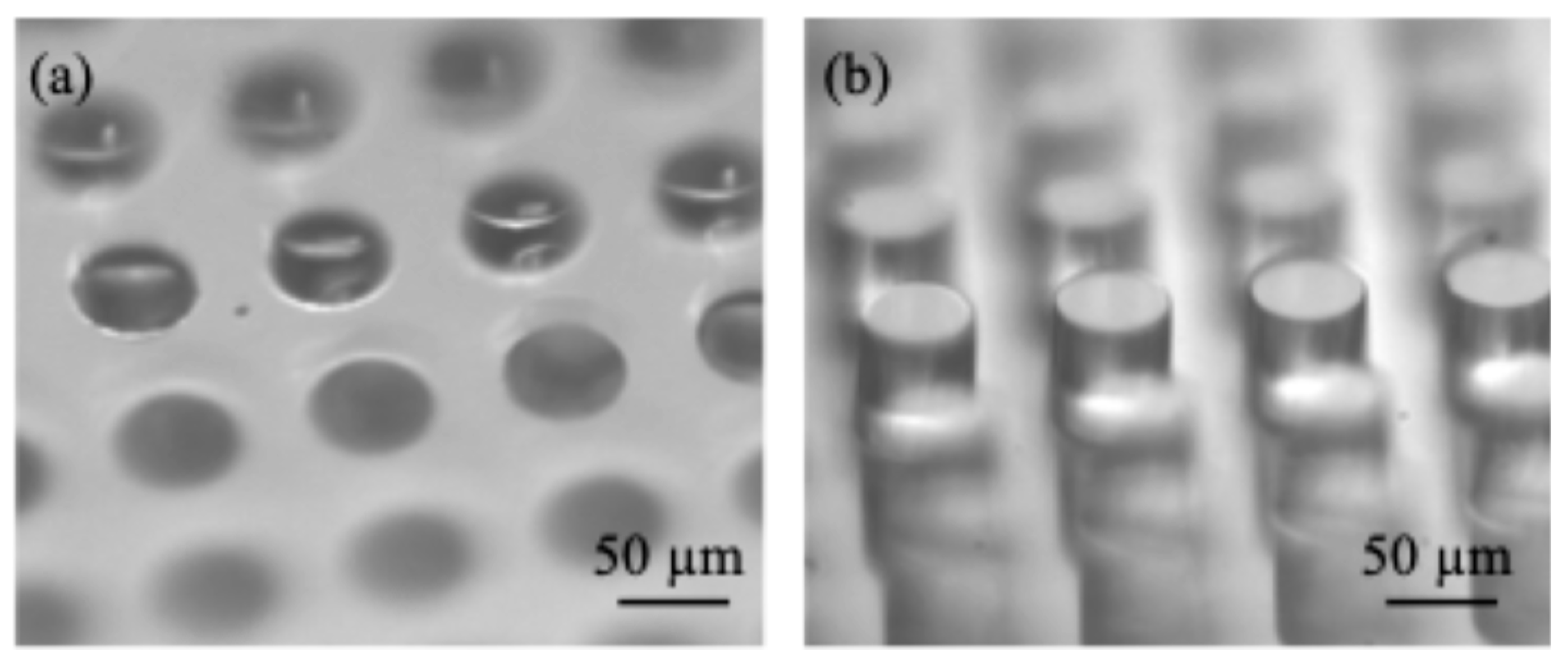
Figure 2.
Experimental setups for: (a) measuring the longevity of plastron in undersaturated liquid; and (b) investigating the effect gas injection on the longevity of plastron in undersaturated liquid.
Figure 2.
Experimental setups for: (a) measuring the longevity of plastron in undersaturated liquid; and (b) investigating the effect gas injection on the longevity of plastron in undersaturated liquid.

Figure 3.
Effect of surface thickness (d) on the time-evolutions of plastron status for PDMS surface with micro-holes (a) and micro-posts (b) during the wetting process induced by gas diffusion. Results for three different surface thickness d=1, 3, and 5 mm are shown. Results were obtained using the experimental setup shown in Figure 2a.
Figure 3.
Effect of surface thickness (d) on the time-evolutions of plastron status for PDMS surface with micro-holes (a) and micro-posts (b) during the wetting process induced by gas diffusion. Results for three different surface thickness d=1, 3, and 5 mm are shown. Results were obtained using the experimental setup shown in Figure 2a.
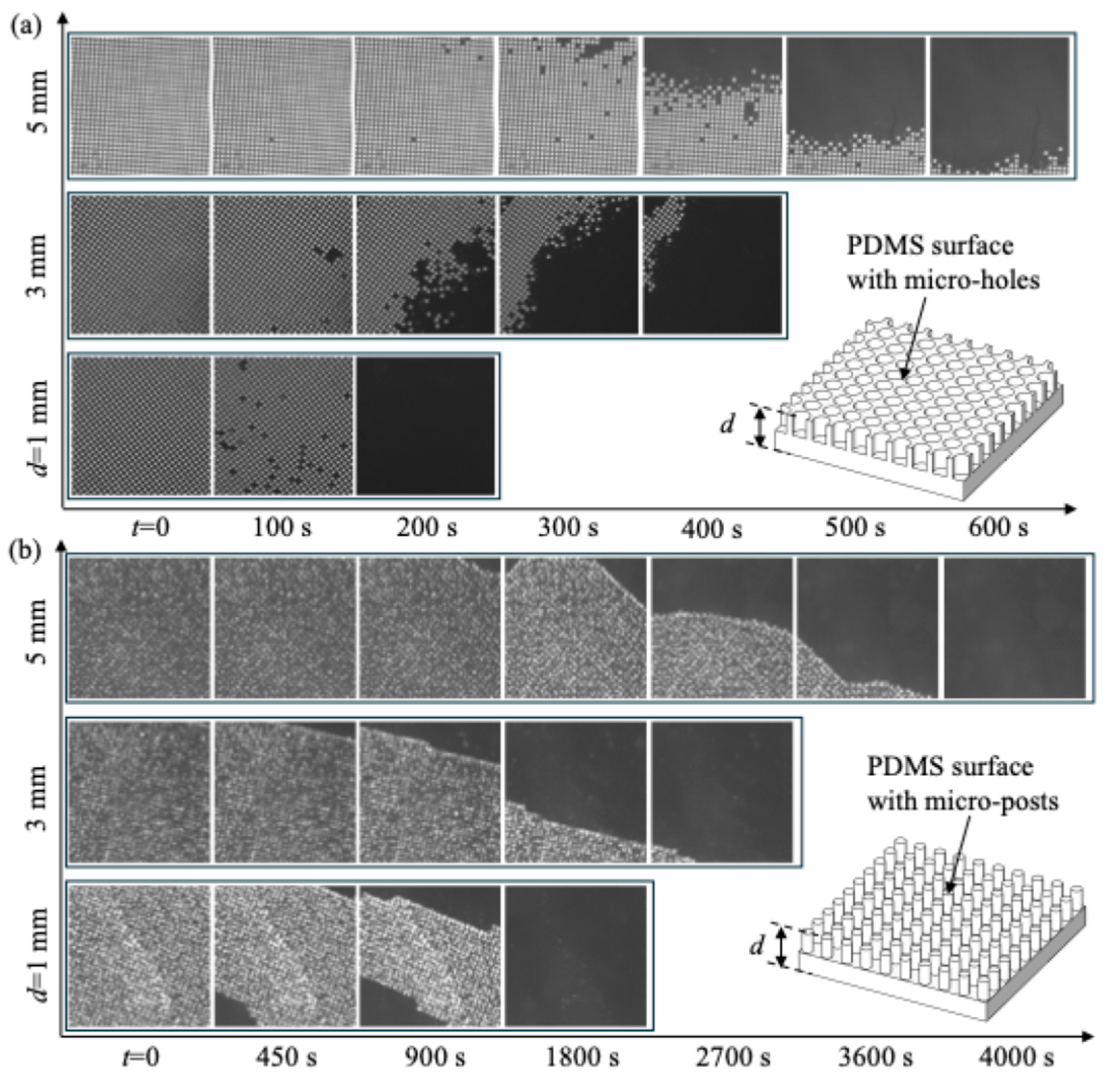
Figure 4.
(a-b) Time-evolutions of surface area coverage by gas (ϕg/ϕg0) for PDMS surface with micro-holes (a) and micro-posts (b) during the wetting process induced by gas diffusion; (c-d) Plastron longevity as a function of surface thickness for PDMS surface with micro-holes (c) and micro-posts (d).
Figure 4.
(a-b) Time-evolutions of surface area coverage by gas (ϕg/ϕg0) for PDMS surface with micro-holes (a) and micro-posts (b) during the wetting process induced by gas diffusion; (c-d) Plastron longevity as a function of surface thickness for PDMS surface with micro-holes (c) and micro-posts (d).
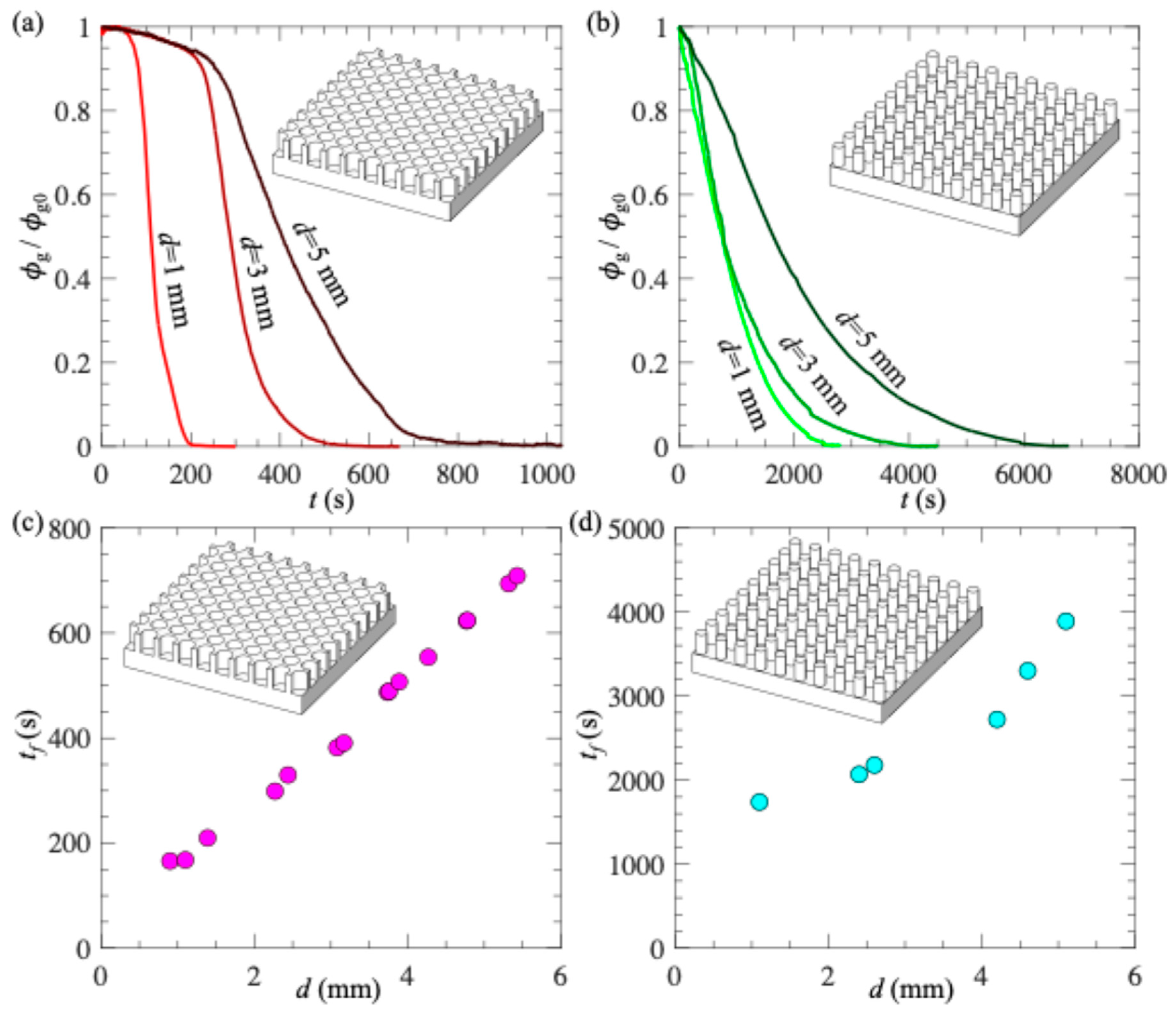
Figure 5.
(a) A numerical model consisting of a PDMS surface with a thickness d immersed in water with a height of 10d; (b) Gas concentration profiles at t=200 s; and (c) Time-variations of mass flux across the PDMS-water interface Ji. Results for d=1 and 5 mm were shown.
Figure 5.
(a) A numerical model consisting of a PDMS surface with a thickness d immersed in water with a height of 10d; (b) Gas concentration profiles at t=200 s; and (c) Time-variations of mass flux across the PDMS-water interface Ji. Results for d=1 and 5 mm were shown.
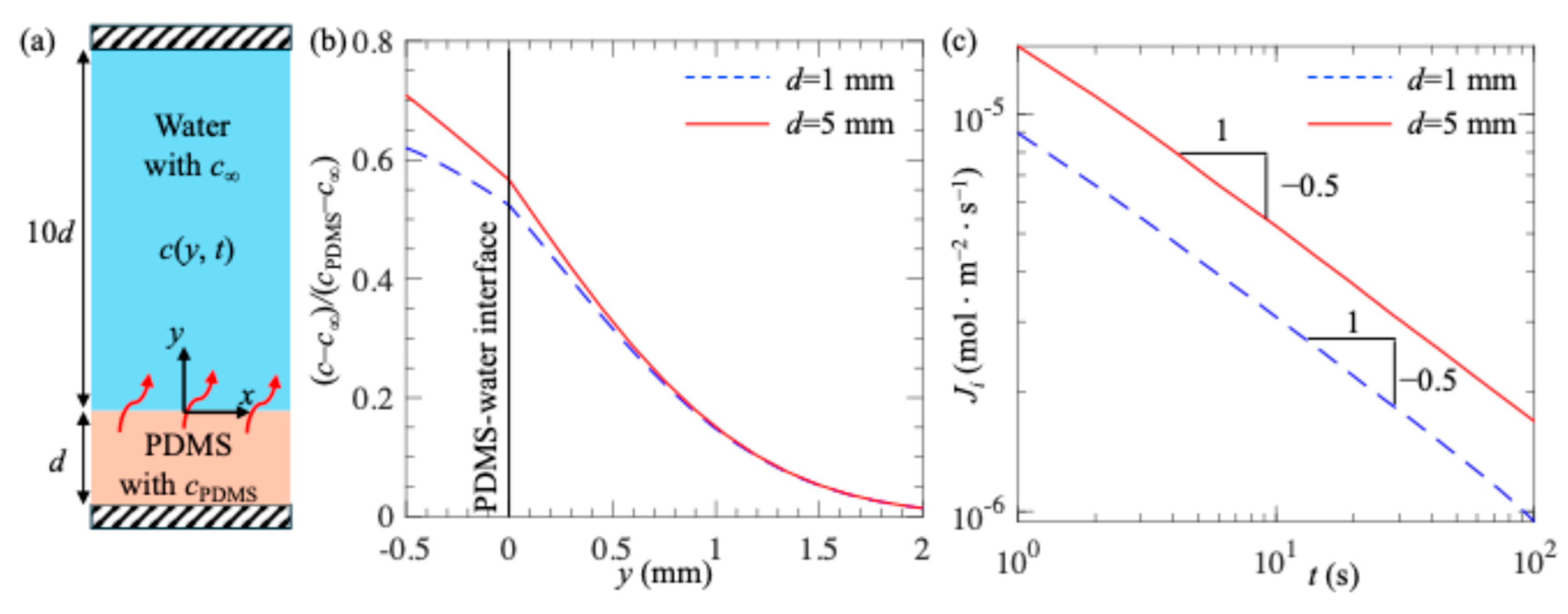
Figure 6.
Effect of gas injection on the time-evolutions of plastron status for PDMS surface with micro-holes (a) and micro-posts (b) during the wetting process induced by gas diffusion. Results were obtained using the experimental setup shown in Figure 2b.
Figure 6.
Effect of gas injection on the time-evolutions of plastron status for PDMS surface with micro-holes (a) and micro-posts (b) during the wetting process induced by gas diffusion. Results were obtained using the experimental setup shown in Figure 2b.
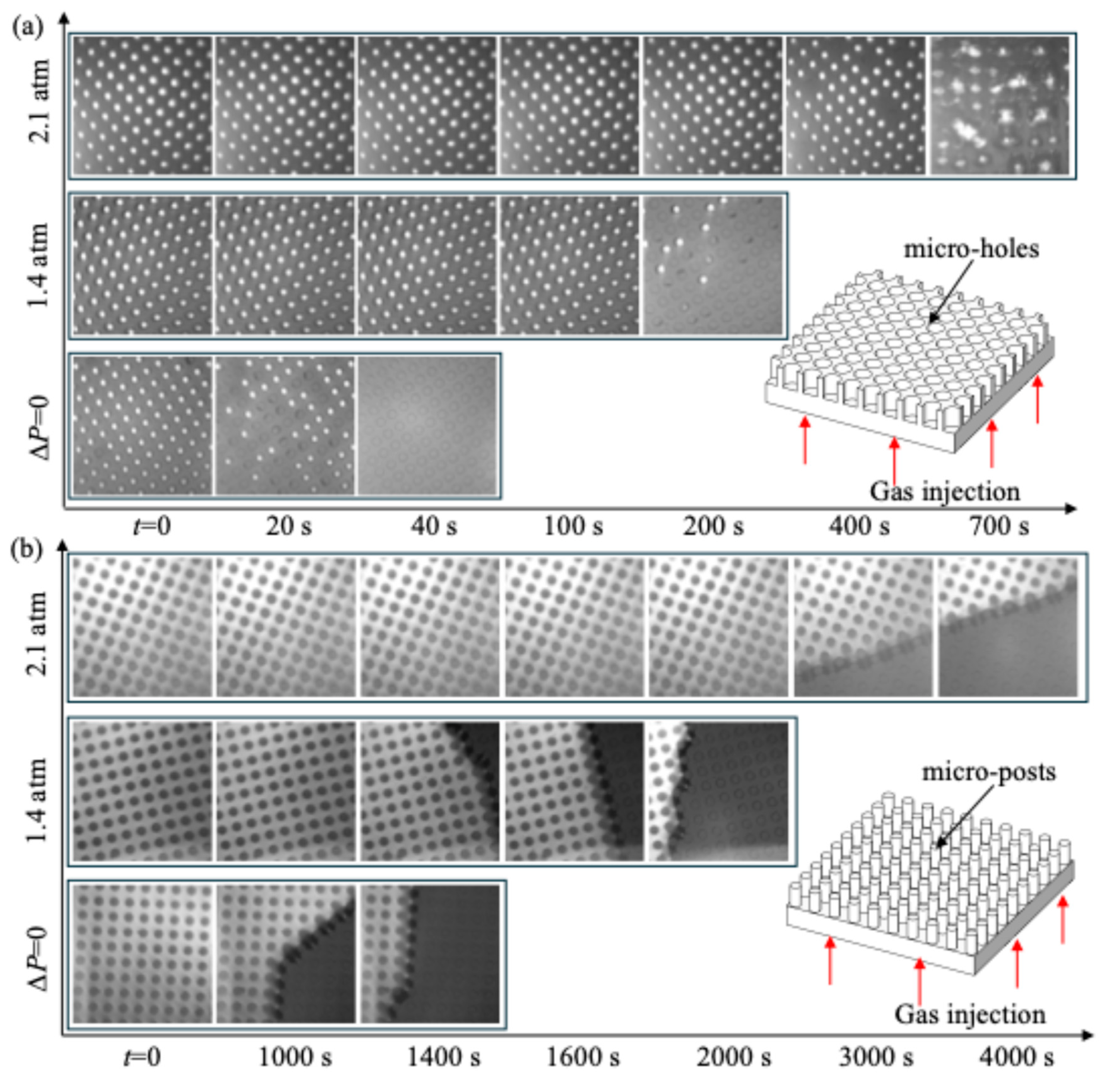
Figure 7.
(a-b) Time-evolutions of surface area coverage by gas (ϕg/ϕg0) for PDMS surface with micro-holes (a) and micro-posts (b) during the wetting process induced by gas diffusion; (c-d) Plastron longevity as a function of gas injection pressure (Pg) for PDMS surface with micro-holes (c) and micro-posts (d).
Figure 7.
(a-b) Time-evolutions of surface area coverage by gas (ϕg/ϕg0) for PDMS surface with micro-holes (a) and micro-posts (b) during the wetting process induced by gas diffusion; (c-d) Plastron longevity as a function of gas injection pressure (Pg) for PDMS surface with micro-holes (c) and micro-posts (d).
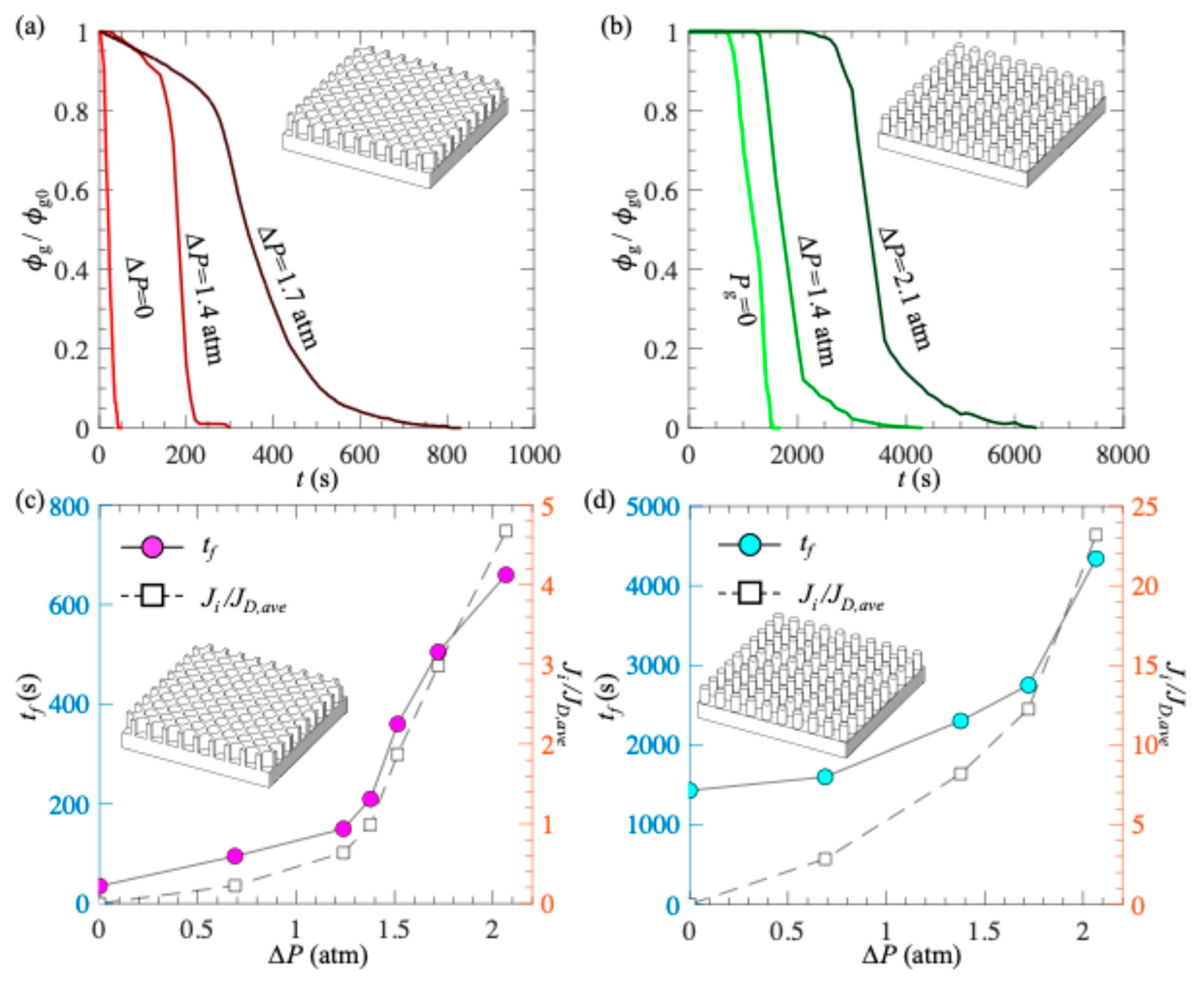

Table 1.
Texture parameters of micro-holes and micro-posts created on PDMS. ΔE>0 means that the Wenzel state has a higher surface energy compared to the Cassie-Baxter state.
Table 1.
Texture parameters of micro-holes and micro-posts created on PDMS. ΔE>0 means that the Wenzel state has a higher surface energy compared to the Cassie-Baxter state.
| Samples | Radius (µm) | Depth or height (µm) | Wavelength (µm) | ΔE |
|---|---|---|---|---|
| Micro-holes | 30 | 46 | 100 | 0.015 |
| Micro-posts | 30 | 61 | 100 | −0.45 |
Disclaimer/Publisher’s Note: The statements, opinions and data contained in all publications are solely those of the individual author(s) and contributor(s) and not of MDPI and/or the editor(s). MDPI and/or the editor(s) disclaim responsibility for any injury to people or property resulting from any ideas, methods, instructions or products referred to in the content. |
© 2024 by the authors. Licensee MDPI, Basel, Switzerland. This article is an open access article distributed under the terms and conditions of the Creative Commons Attribution (CC BY) license (http://creativecommons.org/licenses/by/4.0/).
Copyright: This open access article is published under a Creative Commons CC BY 4.0 license, which permit the free download, distribution, and reuse, provided that the author and preprint are cited in any reuse.


