

Submitted:
05 December 2024
Posted:
06 December 2024
You are already at the latest version
Abstract
Climate change is a critical concern for public health. Its impact on human and animal health is becoming increasingly evident each year, as extreme weather events and the expansion of vectors to new areas increase the risk of transmission of zoonoses. These changes have far-reaching consequences, affecting not only human health but also the environment and the global economy. As such, it is essential that we take collective action to mitigate the effects of climate change and protect public health for future generations. This study aimed to investigate the level of perception, knowledge, and practices of Portuguese citizens regarding vector-borne zoonoses and their association with climate change. A descriptive cross-sectional study was conducted by distributing a survey to 147 individuals. The results showed that, on average, 80% of the respondents had knowledge about zoonoses and that the vector-borne zoonoses least recognized by the sample were Chikungunya virus and West Nile virus. About 93% of the study’s population reported feeling that, with each passing year, temperatures in the warmer months are getting higher, with more than half of the respondents reporting that they have felt an increase in the prevalence of vectors in the country in these months in recent years. The results also show that most of the participants, about 93%, considered that veterinarians did not provide sufficient information about vector-borne zoonoses. The results also showed that the sampled population was not prepared for the reality that is increasingly felt in Europe and Portugal, since only 42% of respondents used preventive measures for vectors, such as the use of repellents. Therefore, there is a need for increased education and awareness campaigns, as well as for veterinarians to play a more active role in the dissemination of information and prevention strategies.
Keywords:
climate
; global warming
; knowledge
; One Health
; perceptions
; Portugal
; zoonoses
1. Introduction
The concepts of “global warming”, “climate change”, and “emerging pandemics” are now well-known to humanity. There is a growing concern in the scientific community about global warming and the potential consequences it could bring in the coming years. Factors such as environmental changes due to human activity, increased international mobility, insufficient public health systems, and microbiological adaptations in pathogens are some of the key contributors to this problem [1,2].
According to recent data from the Portuguese Institute for the Sea and Atmosphere (IPMA), the average maximum temperature in Portugal during the summer months of June, July, and August 2022 was observed to be 3-5°C higher than the data collected between 1971 and 2000 [3]. These figures are not just numbers; they represent a harsh reality felt throughout Europe in the summer of 2022, particularly in Mediterranean countries such as Portugal, Spain and Italy. The increased temperatures have led to severe droughts, wildfires, and other environmental challenges. The Mediterranean basin is considered one of the most vulnerable regions to climate change worldwide [4]. It has been identified as one of the most sensitive geographical areas according to various future predictions of environmental change [5]. According to the Intergovernmental Panel on Climate Change (IPCC), precipitation will increase in most northern European countries and decrease in the countries bordering the Mediterranean Sea. The average annual temperature increase will vary between 2.2 and 5.1°C in southern Europe and the Mediterranean area, causing hotter summers and more temperate winters [6,7]. It is becoming increasingly evident in political circles that Portugal is highly vulnerable to the impacts of climate change. In fact, during the European Council meeting in December 2019, European Commission President Ursula von der Leyen emphasized that "Portugal is one of the countries most affected by climate change" [8]. Portugal has been severely affected by forest fires when compared to other countries with a Mediterranean climate. In the last 30 years, Portugal has accounted for 35% of incidents and 39% of the area affected each year in the Mediterranean region. On average, about 3% of forests in Portugal burn every year [9].
One of the major consequences of the temperature rise and low precipitation is the heightened risk of wildfires [10]. As a result, the increasing temperature trends will likely lead to an increase in the number, duration, and intensity of heatwaves and forest fires, ultimately resulting in severe consequences [11].
Climatic conditions have a significant impact on the life cycle and distribution of vectors, as well as the reproductive rate of parasites, bacterial and viral particles within vectors and humans [12,13]. Increases in temperature can reduce the incubation period of these pathogens, which in turn can increase the risk of disease transmission due to the high population density of vectors [14]. Recent research indicates that vectors are colonizing new regions of the planet, leading to an increase in the incidence of endemic diseases [15].
Malaria, Zika fever, West Nile virus (WNV), Chikungunya viral disease, yellow fever, Japanese encephalitis, and Rift Valley fever are some examples of mosquito-borne zoonoses that are emerging [15]. Additionally, tick-borne diseases encompass babesiosis, anaplasmosis, Crimean-Congo haemorrhagic fever, Lyme disease, and other tick fevers. Disease agents such as leishmaniasis are transmitted by phlebotomine sand flies [16].
Despite the emergence and re-emergence of vector-borne zoonoses influenced by climate change being a relevant topic for the scientific community, public awareness and understanding of this issue remain inadequate. Therefore, a survey about vector-borne zoonoses and global warming knowledge in Portugal was performed to provide an overview of the current state of knowledge and practices on this subject among the Portuguese citizens.
2. Materials and Methods
A cross-sectional voluntary study was conducted from February 2023 to March of 2023 among a convenience sample of the Portuguese population. Individuals were eligible to participate if they were at least 18 years old. Participants, through social networks, were asked to complete an anonymous, confidential 15-min self-administered written questionnaire on-site. The sample size of this study was calculated according to the formula for survey sample size [17]. Assuming a 10% default prevalence, a 95% confidence level, and a 5% absolute error, the study required 138 participants. To allow for a 5% non-response, the smallest sample size required was 147 participants. The questionnaire was based on a literature review [2,15,18] and designed by the authors (veterinarians and epidemiologists) to obtain information about global warming and vector-borne zoonoses. The questionnaire consisted of closed or short-answer questions that were previously pre-tested to improve validity and reliability. Before the study began, it was given to 30 non-participant pet owners to ensure the questions were clear and that the estimated time needed to complete the survey (approximately 15 min) was accurate. The questionnaire included 32 questions about demographic characteristics, knowledge of vectors and zoonoses, perceptions about climate change and global warming in Portugal, as well as the role of the veterinarian in providing information and preventive measures against vectors. A 5-point scale answer ranked from 1 to 5 to analyse the level of concern about zoonoses (1 = extremely irrelevant; 2 = irrelevant; 3 = neutral; 4 = worrying; 5 = very concerning) was used.
The study received ethical approval from the Ethics Commission of University of Trás-os-Montes e Alto Douro (Doc11-CE-UTAD-2023). Written informed consent was obtained from each participant at the start of the survey and all data was kept anonymous and confidential throughout the study.
Data was entered into an Excel® database (Microsoft Corp., Redmond, WA, USA) and exported and analysed using SPSS®27.0 (SPSS, IBM Corporation, New York, NY, USA). For descriptive purposes, Pearson χ2 test was conducted for each variable in the study looking at socio-demographic differences. Statistical significance was based on a p-value < 0.05.
3. Results
3.1. Demographics
The study included 147 participants, out of which 63.3% (n=93) were aged between 18-29 years. In terms of gender, most of respondents were female. When it comes to educational background, only 13.7% (n=20) of individuals did not have higher education. In terms of residence, 88.4% (n=130) belonged to the North region of the country (Table 1).
When asked about their pets, around 44% of the participants (n=64) reported having one pet at home, while 20.4% (n=30) reported having two pets. On the other hand, 14.3% of the participants (n=21) reported not having any pets. Dogs were the most popular pets, with 37.4% of the participants (n=55), reporting to have them, followed by cats with 27.2% of participants (n=40). In 21.1% (n =31) of the cases, both dogs and cats lived together. Only 7.5% (n =11) of the participants reported owning an exotic pet such as parrots, rodents, reptiles, among others.
3.2. General Knowledge of Vector-Borne Zoonoses
Most participants reported that they used to vaccinate and deworm their pets as often as recommended. Out of all the participants, only 8.2% (n=12) recalled their pets having been treated for a vector-borne disease or zoonosis. Those were asked to name the disease that had affected their pet. Eleven participants provided an answer, and the diseases mentioned along with their frequency were as follows: leishmaniasis (n=6), tick (n=2), dermatophytosis (n=2), parasites in the digestive system (n=1).
Participants were asked about the recommended frequency of ectoparasiticides for adult dogs or cats. They could choose multiple options and were informed that one or more options could be correct depending on the product used. The most selected option was deworming treatment every three months (34.7%, n=51), followed by twice a year (22.4%, n=33).
In this study, individuals were asked if they knew the meaning of vector, and at least 81.6% (n=120) answered affirmatively. They were then asked if a vector could transmit viruses, and 118 individuals (80.3%) answered positively. Most participants (65.3%; n=96) knew that leishmaniasis was a vector-borne zoonosis. There was a significant association between participants who knew this and those who were 18-29 years old (p=0.007) and those who were from the North (p=0.046).
Seventy percent of the respondents (n=104) stated that they were unaware of the fact that WNV is a zoonosis present in Portugal. The study also found an association between lack of knowledge about WNV being a zoonosis present in Portugal and being from the North (p=0.033) or being in the age group of 18-29 years (p=0.046). All these results are shown in Table 2.
Participants were asked to identify from a list of diseases some of them zoonotic, which ones were familiar to them, regardless of the source of knowledge origin (internet, radio,…). They could select multiple options. The most known diseases were Mediterranean spotted fever (95.2%), leishmaniasis (87.8%), Dengue fever (77.6%), and malaria (76.9%). However, the least recognized diseases by the participants were Chikungunya, filariasis, and WNV, as shown in Figure 1.
3.3. Promotion of Knowledge in the Field of Zoonoses by Veterinarians
In this study, 62.6% of pet owners reported that their veterinarian had informed them about vector-borne zoonoses (such as transmitted by ticks and fleas). Those who answered affirmatively were asked if their veterinarian had also discussed prevention measures or existing treatments for such diseases. The study found an association between respondents' age and whether their veterinarian had discussed these issues, with those aged 18-29 more likely to have received information (p=0.043). However, most respondents (93.2%; n=137) felt that veterinarians should provide even more information about the transmission of zoonoses by vectors (Table 3).
Participants (n=92) were asked to rate their satisfaction with information provided by their assistant veterinarian about vector-borne diseases on a 1 to 5 scale. The majority answered Level 3 (50.0%; n=46).
3.4. Level of Concern on Vector-Borne Zoonoses
All participants were asked to rate their level of concern for each vector-borne zoonosis on a scale of 1 to 5 (1 = extremely irrelevant, 5 = very concerning), as shown in the Table 4. Regarding leishmaniasis, it is worth mentioning that most respondents expressed a high level of concern, specifically level (40.1%; n=59). On the other hand, when asked to rate their concern about WNV on a scale of 1 to 5, the most popular answer was Level 3 (neutral), chosen by 21.1% (n=31) of respondents. It is noteworthy that 33.3% (n=49) reported not being familiar with the disease or having never heard of it before. The survey participants were asked about their level of concern regarding Lyme disease. The results showed that Level 4 (worrying) was selected by 24.5% (n=36) of the respondents, while Level 5 (very concerning) was selected by 23.1% (n=34) of the respondents. It is worth noting that 26.5% (n=39) of the respondents either did not know about the disease or had never heard of it. The study also found a significant association between being worried or very worried about Lyme disease and being between the ages of 18 and 29 (p=0.014). It was found that 46.9% (n=69) of the participants were very concerned about malaria and rated it at Level 5, which was the highest level of concern. The participants were also asked to rate their level of concern about filariasis. It was observed that Level 4 (worrying) was the most selected option by 26.5% (n=39) of the respondents. However, it should be noted that 30.6% (n=45) of the participants either did not know about the disease or had never heard of it.
When respondents were asked about the level of concern for yellow fever, 34.7% (n=51) of them selected Level 5 (which indicates high concern). Similarly, for Dengue, 42.2% (n=62) of the respondents selected Level 5 as their level of concern. For Zika, 31.3% (n=46) of the respondents selected Level 5 as their level of concern. However, it is worth noting that 16.3% (n=24) of the respondents either did not know or had never heard of the disease. Regarding Chikungunya, most respondents (17.7%; n=26) selected Level 3 (neutral). However, it is important to note that 54.4% (n=80) of the participants answered that they were not familiar with the disease or had never heard of it before. Then, participants were asked to rate their level of concern about Mediterranean spotted fever on a scale of 1 to 5. The most selected responses were Level 4 (worrying) (37.4%; n=55) and Level 5 (very concerning) (42.2%; n=62).
Participants were asked to rate their level of concern about vector-borne zoonoses in Portugal on a scale of 1 to 5, where 1 corresponded to “extremely irrelevant” and 5 corresponded to “very concerning”. Approximately 52.4% (n=77) of the respondents chose Level 4, which indicates that they found the issue worrying. Moreover, there was a statistically significant association between being aged between 18-29 and having a Level 4 concern about the problem of vector-borne zoonoses in Portugal (p=0.028).
3.5. Global Warming in Portugal
Participants were asked about their opinion on climate change and measures taken for preventing vectors (Table 5). Out of the total number of participants, 42.2% (n=62) replied that they took some preventive measures for their pets against vectors during the warmer months of the year. When asked about the measures taken, the use of repellents, deworming, or anti-parasite collars were the most common answers. Interestingly, more than half of the participants (57.8%; n=85) reported noticeable changes in Portugal's vector prevalence in recent years. This personal observation was further supported by the vast majority (92.5%; n=136) who felt that temperatures during the warmer months were increasing every year. These personal experiences and perceptions provide valuable insights into the impact of climate change on vector populations.
The survey results showed that almost all respondents (96.6%; n=142) believe that Portugal is already or could be affected by the emergence of zoonotic diseases in the next decade. The majority of participants (80.3%; n=118) were aware that the rise in global temperatures could lead to an increase in vector-borne diseases. Interestingly, there was an association between knowledge of the impact of temperature rise on the frequency of vector-borne diseases and age group, with those aged 18-29 showing better understanding (p=0.018). Furthermore, most respondents felt that the media in Portugal is not addressing the issue of emerging vector-borne zoonoses (83.7%; n=123).
4. Discussion
Climate change has a significant impact on the spread and transmission of vector-borne diseases in Europe. The Earth's warming, which is a result of human-induced greenhouse gas emissions, is already affecting the dynamics of these diseases, and is expected to worsen their effects in the future. Vectors such as mosquitoes and ticks, thrive in warmer climates, which leads to an increase in disease transmission [14,19,20]. The importance of integrating climate data with epidemiological information to develop early warning systems for vector-borne diseases has been emphasized by recent research. Collaborative efforts between various disciplines, such as educators, ecologists, virologists, and entomologists, are essential for effective prevention and control strategies [14,20]. The effects of climate change on vector-borne diseases in Europe have been projected to result in an expansion of disease transmission areas towards the north. According to models, regions in southern Europe, for instance, could experience higher risks of dengue due to the invasion of disease-carrying vectors like Aedes aegypti. These projections highlight the importance of taking urgent action to address climate change through mitigation strategies and adapting public health measures. This may include increasing public health education and health literacy to combat the growing threat of vector-borne zoonoses [21,22].
The purpose of this study was to evaluate the knowledge, practices, and preparedness of Portuguese citizens concerning the potential impact of global warming on the country and Europe. In particular, the study focused on the possible increase of vector-borne zoonoses in Portugal and Europe due to rising temperatures. The questionnaire helped to identify areas where veterinarians could improve information and advice to pet owners to prevent vector-borne diseases.
In this study, we found that most of the respondents were already familiar with the primary concepts of global warming and zoonoses and were taking preventive measures to deworm and/or vaccinate their pets (roughly 80% of respondents). However, only 42% of respondents took measures against vectors during the hottest months of the year. Most participants answered that they felt that the temperatures in the warmer months were getting higher every year. Different scenarios for Europe predict that temperatures will continue to rise and that the duration, frequency, and intensity of heatwaves will be exacerbated [23]. Furthermore, the temperature differences are expected to increase in northwestern Europe and Scandinavia in winter and in southwestern and southeastern Europe in summer, according to the European Environment Agency [24]. In Europe, there will be less rainfall during the summer season, and the rise in temperature will lead to more frequent and severe droughts, which will exacerbate water scarcity. Furthermore, heavy rains and floods, like the ones that occurred in western Europe in July 2021, are expected to occur more frequently [25].
The sample under study were aware of the impact of climate change. Most respondents believe that temperatures in the warmer months are increasing every year. Around 80% of the sample surveyed acknowledges that Portugal is already or could be affected by the emergence or re-emergence of vector-borne zoonoses. However, despite this awareness, the Portuguese population lacks sufficient information about the risks and vulnerabilities that may arise in the future.
Most respondents felt that the subject of vector-borne zoonoses was not covered by the media in Portugal (approximately 84%), and the level of satisfaction with the information provided by veterinarians on zoonoses was only reasonable, a 3 on a scale of 1 to 5, according to most respondents (33%).
Regarding the various diseases that can be transmitted through vectors and affect Europe and Portugal, the results showed that the top three most recognized diseases were Mediterranean spotted fever, leishmaniasis, and malaria. In addition, a high proportion of respondents, expressed concern over the spread of leishmaniasis, which has been observed to be advancing across Portugal and may even become endemic in regions outside the Mediterranean basin, such as Central and Eastern Europe, according to some studies [7,26,27]. However, a recent survey done in the north of Portugal about leishmaniosis awareness revealed that although 62.5% of the respondents had heard about the disease, 56.0% were not aware of its zoonotic potential [27].
It is important to note that Mediterranean spotted fever is widely recognized by the general population due to people's exposure to ticks during the hotter months. Most cases of infection occur during the summer season when the prevalence of ticks is higher [28]. Therefore, as exposure to ticks’ increases owing to the expansion of rodent and deer populations and global warming, the number of people and animals exposed to tick-associated rickettsioses will also increase [29].
Many individuals are highly concerned about malaria, as the number of cases is expected to increase due to global warming. Although malaria was once present in Europe, the World Health Organization (WHO) successfully launched a malaria eradication program in the 20th century, which resulted in eradication in 79 countries worldwide [16]. The disease was officially eradicated from Europe in 1975 through measures such as the installation of standing water drainage systems, chemical treatment of patients, and improved sewage systems [30]. These measures allowed for better control of the vectors responsible for malaria transmission, namely mosquitoes of the Anopheles genus. However, there is still a risk of reemergence of the disease in Europe as there has been an increase in resistance to antiplasmodic drugs and insecticides [31,32]. It is concerning that diseases such as Chikungunya, filariasis, and WNV are not well-known by the Portuguese population. In the present study, 54%, 30%, and 33% of respondents had never heard of these diseases, respectively. This lack of awareness is particularly worrying given that WNV was recently introduced in the country [33]. Only 14% of respondents were aware of this situation, indicating a need for increased education and awareness about these zoonotic diseases in Portugal. It is forecasted that by the year 2025, due to climate change, the number of areas in Europe at risk of WNV infection is expected to increase. Depending on the level of CO₂ emissions, Western Europe could experience significant outbreaks of the virus later in this century. The emergence of this disease in new regions, such as Portugal, has direct and indirect implications for public health. For example, WNV can also be transmitted through blood transfusions and the high proportion of asymptomatic infected individuals raises concerns about the safety of blood banks. Although there were cases of infection in horses, Portugal did not report any human infections in 2022, unlike other countries in the Mediterranean region affected by WNV. In 2022, WNV caused 104 human deaths across Europe [34].
The fact that there is a low percentage of knowledge about Chikungunya is a cause for concern, as models predict that the transmission of this disease could be moderately adaptable to the climate of European countries [18]. This virus is spread by mosquitoes belonging to the genus Aedes, and the introduction of the Asian tiger mosquito, Aedes albopictus, into Europe over the last decade has increased the risk of Chikungunya outbreaks in southern European countries, including Portugal [35]. Since 2004, outbreaks of Chikungunya have become more frequent and widespread, due to the virus's adaptations, which make it easier to spread with the help of its vectors [36]. The same applies to diseases such as Dengue and Zika that are transmitted by the same vectors. Due to this circumstance, an increase in climate adaptability is projected in southern Europe and the Mediterranean basin in the coming decades [18]. Worldwide, Ae. aegypti was established in 61 countries, but there is no documentation of autochthonous transmission of Zika. On the other hand, countries with populations of Ae. albopictus are capable of transmitting infection, but on a smaller scale than the Ae. aegypti species. Therefore, it is less likely to be a promoter of large-scale Zika outbreaks [37]. When it comes to Dengue, around half of the world's population is at risk of contracting the disease. It is estimated that there are around 100-400 million cases of infection every year [38,39]. Dengue is an endemic disease in more than 100 countries, with the Asian continent being the hardest hit, responsible for 70% of the world's cases [39]. Although all the data collected is valuable for this study, it is important to note that most respondents believe that veterinarians need to provide more information about vector-borne zoonoses. They are only relatively satisfied with the information provided by their veterinarians. When asked about their satisfaction level with the information provided, the majority (31%) rated it as 3 on a scale of 1-5, and 93% of the participants thought that veterinarians should provide more information about zoonoses. Therefore, it is essential for veterinarians to take a stronger stance on preventative measures, such as the use of mosquito nets, repellents, and anti-parasitic drugs during consultations with pet owners. A One Health approach should be adopted, where veterinarians run awareness-raising campaigns about these diseases and ways to combat them, through information leaflets and vaccination drives, among others. This will help reduce health illiteracy among the Portuguese population.
The survey conducted might not have accurately represented the animal-owning population, as it was a convenience sample that primarily reflected the opinions and knowledge of individuals from the North region (around 88% of respondents belonged to this region). Therefore, it is recommended to conduct further studies in other cities across the country to understand geographical and cultural differences. On the other hand, there was also a higher response rate from females (around 73.5%) and those with a high level of education (only 13.7% of respondents did not have higher education), which does not represent an accurate sample of the Portuguese population.
This study has a cross-sectional design, which means that the conclusions that can be drawn are limited to associations and causality cannot be clearly determined. There is a possibility of biased results due to self-reported preventive behaviours, which could not be verified. Moreover, only climatic factors that cause the spread of these vectors were considered, and it was impossible to address all the existing vector-borne zoonoses.
5. Conclusions
In recent decades, there has been an increase in epidemic outbreaks of vector-borne zoonoses, caused by socio-economic and environmental factors and climate change. This reality will be increasingly present in the daily lives of the Portuguese. This study has shown that there is still a long way to go, since the Portuguese population is not well informed, either by veterinarians or the media, about vector-borne zoonoses and their emergence caused by climate change.
In this regard, we should prioritise reinforcing a One Health approach, with the implementation of vaccination campaigns and the distribution of information leaflets on preventative measures against these vectors, among others, to improve communication between veterinarians and owners.
Author Contributions
Conceptualization, D.P.; methodology, D.P., L.C. and A.C.C.; validation, D.P., L.C. and A.C.C.; investigation, D.P., L.C. and A.C.C.; writing—original draft preparation, D.P., A.P.L., T.L.M. L.C. and A.C.C.; writing—review and editing, D.P., A.P.L., F.L., T.L.M. L.C. and A.C.C. All authors read and approved the final manuscript. All authors have read and agreed to the published version of the manuscript.
Funding
This research was supported by projects UIDB/00772/2020 (doi:10.54499/UIDB/00772/2020) and LA/P/0059/2020, funded by the Portuguese Foundation for Science and Technology (FCT).
Institutional Review Board Statement
Not applicable.
Informed Consent Statement
Not applicable.
Conflicts of Interest
The authors declare that they have no known competing interests or personal relationships that could have appeared to influence the work reported in this paper.
References
- Howard, C.R.; Fletcher, N.F. Emerging virus diseases: Can we ever expect the unexpected? Emerg Microbes Infect 2012, 1, e46. [Google Scholar] [CrossRef]
- do Vale, B.; Lopes, A.P.; Fontes, M.d.C.; Silvestre, M.; Cardoso, L.; Coelho, A.C. A Cross-Sectional Study of Knowledge on Ownership, Zoonoses and Practices among Pet Owners in Northern Portugal. Animals 2021, 11, 3543. [Google Scholar] [CrossRef]
- IPMA, Instituto Português do Mar e da Atmosfera, 2022. IPMA – Mapas. Available online: https://www.ipma.pt/pt/oclima/monitorizacao/. (accessed on 14 January 2024).
- Schröter, D.; Cramer, W.; Leemans, R.; Prentice, I.C.; Araújo, M.B.; Arnell, N.W.; Bondeau, A.; Bugmann, H.; Carter, T.R.; Gracia, C.A.; de la Vega-Leinert, A.C.; Erhard, M.; Ewert, F.; Glendining, M.; House, J.I.; Kankaanpää, S.; Klein, R.J.T.; Lavorel, S.; Lindner, M.; Metzger, M.J.; Meyer, J.; Mitchell, T.D.; Reginster, I.; Rounsevell, M.; Sabaté, S.; Sitch, S.; Smith, B.; Smith, J.; Smith, P.; Sykes, M.T.; Thonicke, K.; Thuiller, W.; Tuck, G.; Zaehle, S.; Zierl, B. Ecosystem service supply and vulnerability to global change in Europe. Science 2005, 310, 1333–1337. [Google Scholar] [CrossRef] [PubMed]
- Giorgi, F.; Lionello, P. Climate change projections for the Mediterranean region. Glob Planet Change 2008, 63, 90–104. [Google Scholar] [CrossRef]
- Solomon, S.; Qin, D.; Manning, M.; Chen, Z.; Marquis, M., Averyt, K.B., Tignor, M.; Miller, H.L., Eds. AR4 Climate change 2007: The physical science basis – Report. In Contribution of Working Group I to the Fourth Assessment Report of the Intergovernmental Panel on Climate Change. Cambridge University Press; Cambridge, United Kingdom and New York, USA, 2007.
- Chalghaf, B.; Chemkhi, J.; Mayala, B.; Harrabi, M.; Benie, G.B.; Michael, E.; Ben Salah, A. ; Ecological niche modeling predicting the potential distribution of Leishmania vectors in the Mediterranean basin: Impact of climate change. Parasites Vectors 2018, 11, 461. [Google Scholar] [CrossRef] [PubMed]
- Schleussner, C.-F.; Menke, I.; Theokritoff, E.; van Maanen, N.; Lanson, A. Climate impacts in Portugal. Climate analytics. 2019. Available online: https://youth4climatejustice.org/wp-content/uploads/2021/01/Climate-Analytics-Climate-Impacts-in-Portugal-min.pdf. (accessed on 23 October 2023).
- WWF, 2019. The Mediterranean burns—WWF’s Mediterranean proposal for the prevention of rural fires. World Wildlife Fund. Available online: https://www.wwf.es/?51162/The-Mediterranean-burns-2019. (accessed on 2 November 2023).
- Turco, M.; Jerez, S.; Augusto, S.; Tarín-Carrasco, P.; Ratola, N.; Jiménez-Guerrero, P.; Trigo, R.M. Climate drivers of the 2017 devastating fires in Portugal. Sci Rep 2019, 9, 13886. [Google Scholar] [CrossRef] [PubMed]
- Parente, J.; Pereira, M.G.; Amraoui, M.; Fischer, E.M. Heat waves in Portugal: Current regime, changes in future climate and impacts on extreme wildfires. Sci Total Environ 2018, 631–632, 534–549. [Google Scholar] [CrossRef] [PubMed]
- Semenza, J.C.; Menne, B. Climate change and infectious diseases in Europe. Lancet Infect Dis 2009, 9, 365–375. [Google Scholar] [CrossRef] [PubMed]
- WHO. A global brief on vector-borne diseases (WHO/DCO/WHD/2014.1). World Health Organization 2014. Available online: https://apps.who.int/iris/handle/10665/111008 (accessed on day month year).
- Semenza, J.C.; Suk, J.E. Vector-borne diseases and climate change: A European perspective. FEMS Microbiol Lett 2018, 365, fnx244. [Google Scholar] [CrossRef]
- Chala, B.; Hamde, F. Emerging and re-emerging vector-borne infectious diseases and the challenges for control: A review. Front Public Health 2021, 9, 715759. [Google Scholar] [CrossRef]
- El-Sayed, A.; Kamel, M. Climatic changes and their role in emergence and re-emergence of diseases. Environ Sci Pollut Res Int 2020, 27, 22336–22352. [Google Scholar] [CrossRef]
- Hajian-Tilaki, K. Sample size estimation in epidemiologic studies. Casp J Intern Med 2011, 2, 289–298. [Google Scholar]
- Semenza, J.C.; Paz, S. Climate change and infectious disease in Europe: Impact, projection and adaptation. Lancet Reg Health Eur 2021, 9, 100230. [Google Scholar] [CrossRef]
- Rocklöv, J.; Dubrow, R. Climate change: an enduring challenge for vector-borne disease prevention and control. Nat Immunol 2020, 21, 479–483. [Google Scholar] [CrossRef] [PubMed]
- Rupasinghe, R.; Chomel, B.B.; Martínez-López, B. Climate change and zoonoses: A review of the current status, knowledge gaps, and future trends. Acta Trop 2022, 226, 106225. [Google Scholar] [CrossRef] [PubMed]
- Paz, S. Climate change impacts on vector-borne diseases in Europe: Risks, predictions and actions. Lancet Reg Health Eur 2020, 1, 100017. [Google Scholar] [CrossRef] [PubMed]
- Adepoju, O.A.; Afinowi, O.A.; Tauheed, A.M.; Danazumi, A.U.; Dibba, L.B.S.; Balogun, J.B.; Flore, G.; Saidu, U.; Ibrahim, B.; Balogun, O.O.; Balogun, E.O. Multisectoral perspectives on global warming and vector-borne diseases: a focus on southern europe. Curr Trop Med Rep 2023, 10, 47–70. [Google Scholar] [CrossRef] [PubMed]
- Martinez, G.S.; Linares, C.; Ayuso, A.; Kendrovski, V.; Boeckmann, M.; Diaz, J. Heat-health action plans in Europe: Challenges ahead and how to tackle them. Environ Res 2019, 176, 108548. [Google Scholar] [CrossRef] [PubMed]
- EEA, 2017. Climate change, impacts and vulnerability in Europe 2016. European Environment Agency [Publication]. Available online: https://www.eea.europa.eu/publications/climate-change-impacts-and-vulnerability-2016. (accessed on 25 October 2023).
- EEA, 2020. Trends and projections in Europe 2020. European Environment Agency [Publication]. Available online: https://www.eea.europa.eu/publications/trends-and-projections-in-europe-2020. (accessed on 25 October 2023).
- Maia, C.; Altet, L.; Serrano, L.; Cristóvão, J.M.; Tabar, M.D.; Francino, O.; Cardoso, L.; Campino, L.; Roura, X. Molecular detection of Leishmania infantum, filariae and Wolbachia spp. in dogs from southern Portugal. Parasites Vectors 2016, 9, 170. [Google Scholar] [CrossRef] [PubMed]
- Mateus, T.L.; Moreira, S.; Maia, R.L. Unawareness about vector-borne diseases among citizens as a health risk consequence of climate change—A case study on leishmaniosis in northwest Portugal. In Climate Change and Health Hazards; Leal Filho, W., Vidal, D.G., Eds.; Springer Cham: Switzerland, 2023; pp. 197–208. [Google Scholar] [CrossRef]
- MacConnachie, K.; Tishkowski, K. Boutonneuse Fever. In StatPearls. StatPearls Publishing: Florida, USA, 2023.
- Karim, S.; Kumar, D.; Budachetri, K. Recent advances in understanding tick and rickettsiae interactions. Parasite Immunol 2021, 43, e12830. [Google Scholar] [CrossRef] [PubMed]
- Talapko, J.; Škrlec, I.; Alebić, T.; Jukić, M.; Včev, A. Malaria: The past and the present. Microorganisms 2019, 7, 179. [Google Scholar] [CrossRef] [PubMed]
- Gunda, R.; Chimbari, M.J.; Shamu, S.; Sartorius, B.; Mukaratirwa, S. Malaria incidence trends and their association with climatic variables in rural Gwanda, Zimbabwe, 2005–2015. Malar J 2017, 16, 393. [Google Scholar] [CrossRef]
- Ssempiira, J.; Kissa, J.; Nambuusi, B.; Mukooyo, E.; Opigo, J.; Makumbi, F.; Kasasa, S.; Vounatsou, P. Interactions between climatic changes and intervention effects on malaria spatio-temporal dynamics in Uganda. Parasite Epidemiol Control 2018, 3, e00070. [Google Scholar] [CrossRef] [PubMed]
- WHO, 2015. West Nile virus – Portugal. World Health Organization. Available online: https://www.who.int/emergencies/disease-outbreak-news/item/17-september-2015-wnv-en. (accessed on 15 June 2024).
- ECDC, 2023. Epidemiological update: West Nile virus transmission season in Europe, 2022. Available online: https://www.ecdc.europa.eu/en/news-events/epidemiological-update-west-nile-virus-transmission-season-europe-2022 (accessed on 22 May 2024).
- Tilston, N.; Skelly, C.; Weinstein, P. Pan-European Chikungunya surveillance: Designing risk stratified surveillance zones. Int J Health Geogr 2009, 8, 61. [Google Scholar] [CrossRef] [PubMed]
- WHO, 2022. Chikungunya fact sheet. World Health Organization. Available online: https://www.who.int/news-room/fact-sheets/detail/chikungunya. (accessed on 2 November 2023).
- Tham, H.-W.; Balasubramaniam, V.; Ooi, M.K.; Chew, M.-F. Viral determinants and vector competence of Zika virus transmission. Front Microbiol 2018, 9, 1040. [Google Scholar] [CrossRef] [PubMed]
- Brady, O.J.; Gething, P.W.; Bhatt, S.; Messina, J.P.; Brownstein, J.S.; Hoen, A.G.; Moyes, C.L.; Farlow, A.W.; Scott, T.W.; Hay, S.I. Refining the global spatial limits of dengue virus transmission by evidence-based consensus. PLoS Negl Trop Dis 2012, 6, e1760. [Google Scholar] [CrossRef] [PubMed]
- WHO, 2023. Dengue and severe dengue. World Health Organization. Available online: https://www.who.int/news-room/fact-sheets/detail/dengue-and-severe-dengue. (accessed on 2 November 2023).
Figure 1.
Identification of potentially zoonotic diseases by the participants (n=147).
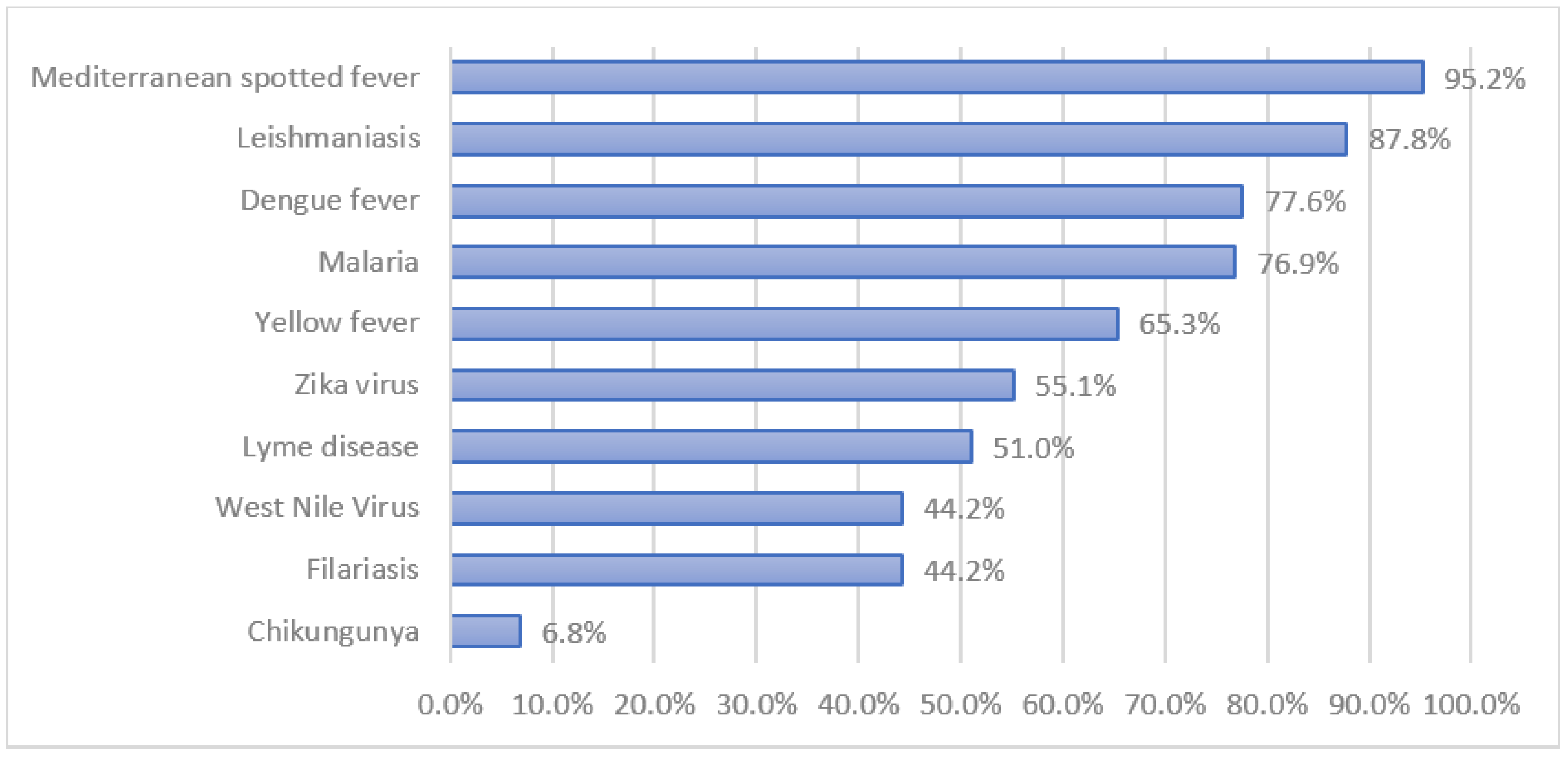

Table 1.
Demographics of respondents who participated in the survey (n=147).
| Variable | n (%) | |
| Age (years) | 18-29 | 93 (63.3) |
| 30-50 | 19 (12.9) | |
| >50 | 35 (23.8) | |
| Gender | Female | 108 (73.5) |
| Male | 39 (26.5) | |
| Region | North | 130 (88.4) |
| Centre | 13 (8.8) | |
| South | 4 (2.7) | |
| Education | 2nd cycle of Basic Education | 1 (0.7) |
| 3rd cycle of Basic Education | 2 (1.4) | |
| Secondary school | 17 (11.6) | |
| Degree | 82 (55.8) | |
| Master’s degree | 44 (29.9) | |
| Doctorate | 1 (0.7) |
Table 2.
General knowledge of vector-borne zoonoses (n=147).
| Questions and answer options | n(%) | |
| Do you know what a vector is? | Yes | 120 (81.6) |
| No | 27 (18.4) | |
| Can a vector transmit viruses? | Yes | 118 (80.3) |
| No | 0 (0.0) | |
| I don’t know | 29 (19.7) | |
| Is a mosquito a vector? | Yes | 123 (83.7) |
| No | 0 (0.0) | |
| I don’t know | 24 (16.3) | |
| Is leishmaniasis a vector-borne zoonosis? | Yes | 96 (65.3) |
| No | 4 (2.7) | |
| I don’t know | 47 (32.0) | |
| Is West Nile virus present in Portugal? | Yes | 20 (13.6) |
| No | 23 (15.6) | |
| I don’t know | 104 (70.7) | |
Table 3.
Promotion of knowledge in the field of zoonoses by veterinarians.
| Questions and answer options | n (%) | |
| Has your pet's veterinarian enlightened you about vector-borne zoonoses (e.g. transmitted by ticks, fleas, etc.)? | Yes | 92 (62.6) |
| No/ I do not know/I do not remember/I am not sure/Not applicable | 55 (37.4) | |
| Has the veterinarian informed you about existing preventive measures or treatments that combat vector-borne zoonoses? | Yes | 89 (60.5) |
| No/ I do not know/I do not remember/I am not sure/Not applicable | 58 (39.5) | |
| Do you think that veterinarians should provide more information about the transmission of zoonoses by vectors? | Yes | 137 (93.2) |
| No | 10 (6.8) | |
Table 4.
Level of concern on vector-borne zoonoses.
| Level of concern | 1 - Extremely Irrelevant (n; %) |
2 - Irrelevant (n; %) |
3 - Neutral (n; %) |
4 - Worrying (n; %) |
5 - Very Concerning (n; %) |
Don’t know / Never heard of (n; %) |
|---|---|---|---|---|---|---|
| Leishmaniasis | 5 (3.4) | 5 (3.4) | 19 (12.9) | 53 (36.1) | 59 (40.1) | 6 (4.1) |
| West Nile virus | 8 (5.4) | 8 (5.4) | 31 (21.1) | 25 (17.0) | 26 (17.7) | 49 (33.3) |
| Lyme disease | 9 (6.1) | 6 (4.1) | 23 (15.6) | 36 (24.5) | 34 (23.1) | 39 (26.5) |
| Malaria | 10 (6.8) | 2 (1.4) | 21 (14.3) | 40 (27.2) | 69 (46.9) | 5 (3.4) |
| ilariasis | 6 (4.1) | 7 (4.8) | 22 (15.0) | 39 (26.5) | 28 (19.0) | 45 (30.6) |
| Yellow fever | 7 (4.8) | 3 (2.0) | 29 (19.7) | 39 (26.5) | 51 (34.7) | 18 (12.2) |
| Dengue fever | 9 (6.1) | 3 (2.0) | 29 (19.7) | 33 (22.4) | 62 (42.2) | 11 (7.5) |
| Zika virus | 8 (5.4) | 7 (4.8) | 27 (18.4) | 35 (23.8) | 46 (31.3) | 24 (16.3) |
| Chikungunya | 9 (6.1) | 6 (4.1) | 26 (17.7) | 17 (11.6) | 9 (6.1) | 80 (54.4) |
| Mediterranean spotted fever | 5 (3.4) | 3 (2.0) | 17 (11.6) | 55 (37.4) | 62 (42.2) | 5 (3.4) |
Table 5.
Participants' view on global warming in Portugal.
| Questions and answer options | n(%) | |
| Do you take any preventative measures against vectors for your pet during the warmer months of the year? | Yes | 62 (42.2) |
| No | 50 (34.0) | |
| I don’t know | 35 (23.8) | |
| In recent years, have you noticed significant changes in Portugal regarding the prevalence of vectors (e.g. ticks, fleas, etc.) in the warmer months? | Yes | 85 (57.8) |
| No | 62 (42.2) | |
| Despite global warming being widely covered in the media, do you personally feel that the temperatures in the warmer months are getting higher and higher every year? | Yes | 136 (92.5) |
| No | 11 (7.5) | |
| Many vector-borne zoonoses can arise due to rising environmental temperatures. Do you think that Portugal is already or could be affected by this problem in the next 10 years? | Yes | 142 (96.6) |
| No | 5 (3.4) | |
| Did you know that the rise in the planet's temperature will lead to an increase in the frequency of vector-borne zoonoses? | Yes | 118 (80.3) |
| No | 29 (19.7) | |
| Do you think that this issue of the emergence of vector-borne zoonoses is addressed by the media in Portugal? | Yes | 24 (16.3) |
| No | 123 (83.7) | |
Disclaimer/Publisher’s Note: The statements, opinions and data contained in all publications are solely those of the individual author(s) and contributor(s) and not of MDPI and/or the editor(s). MDPI and/or the editor(s) disclaim responsibility for any injury to people or property resulting from any ideas, methods, instructions or products referred to in the content. |
© 2024 by the authors. Licensee MDPI, Basel, Switzerland. This article is an open access article distributed under the terms and conditions of the Creative Commons Attribution (CC BY) license (http://creativecommons.org/licenses/by/4.0/).
Copyright: This open access article is published under a Creative Commons CC BY 4.0 license, which permit the free download, distribution, and reuse, provided that the author and preprint are cited in any reuse.


