
Submitted:
04 December 2024
Posted:
06 December 2024
You are already at the latest version
Abstract
The study aims to analyze the perception of Uzbek residents when pursuing a career in the tourism industry. A sample of 80 students from “Silk Road” International University of Tourism and Cultural Heritage completed a questionnaire rating the significance of several factors influencing their choice of career. The survey was analyzed in the SPSS model with the ordinal logistic regression method. As results reveal more than 46% of members are interested in the tourism sphere, especially in travel and tour operation majors. Also, the opportunity to travel and explore new countries is the key reason for choosing the tourism industry, as they believe in the positive effect of digital transformation and the implementation of sustainability. However, 44% are worried about the stability and security of their tourism career and they considered a specific career role within the tourism industry. These insights assist the government to enhance the quality of education in universities, mitigate some challenges, attract more qualified employees, and widen the opportunities that specifically involve travel opportunities.
Keywords:
Ordinal logistic regression
; Uzbekistan
; Career perception
Introduction
Understanding the perception of tourism jobs in Uzbekistan is extremely important, as it has an impact on all aspects - from economic progress to improving working conditions. The positive image of local people can assist in the development of new jobs, local culture, and sustainable tourism. In fact, since 2017 Uzbekistan has shown outstanding economic performance from the tourism side, with a 5% growth rate throughout the previous five years and it emerged in the Commonwealth of Independent States (CIS) (UNWTO, 2024).
As Thompson et al. (2007) foreseen in their article, Uzbekistan is one of the countries in Central Asia that provides economic opportunity, but with low market labor and skills requirements. Tourism in Uzbekistan contributes to the development of new regions, the creation of new jobs, and the acceleration of the national economy. All sectors of the economy and human activity can benefit from it, and its uniqueness and distinction can alter the recreational environment's potential by forcing people to shift their focus and way of thinking (Kadirova, 2019).
The misperception of employment prospects in the tourism industry is often due to various factors, such as low qualifications, ignorance, unfavorable working conditions, regional differences, gender stereotypes, and inappropriate expectations. Moreover, previous studies mostly cover only job opportunities in such areas as Malaysia, Australia, Romania, the Philippines, and Kyiv, showing some geographical limitations. To reduce this gap, it is necessary to encourage diverse forms of tourism work, improve working conditions, finance professional development, and change the perception of tourism as a decent, rewarding, and long-term career. If these problems are solved, then a wider range of employees can see the tourism business as an attractive and inclusive workplace.
The objective of this research is to analyze the opinion of Uzbek locals about tourism jobs and find optimal perspectives. A better understanding of how people perceive employment opportunities in the tourism industry can encourage more people to work in this sector, fill skill gaps, and improve the overall quality of services provided. This will lead to economic growth, the creation of more stable and professional jobs in tourism, and increased opportunities for career development and talent attraction, especially in regions with underdeveloped tourist infrastructure.
Literature Review
Perception of Tourism Career
A significant volume of literature explores the student’s perception of tourism jobs. The survey questionnaire of over three hundred students from eight Australian Institutions answered that they do not consider some potential in the tourism job market (Richardson, 2009). The same results are shown in Maria-Christina’s et al. (2020) paper which reveals that 70.04% of freshmen students from Bucharest University of Economic Studies (BUES) are not willing to work in the tourism industry. The main reason for not opting for a career in tourism can vary, from personal interest to lower salary. Additionally, to better understand the student’s view on employment in tourism, a semi-structured questionnaire was imported into the Statistical Package for the Social Science (SPSS). As a result, 34% of Sri Lankan government universities respond unfavorably because of inflexible schedules, personal attitudes, and work environment (Wijesundara, 2019).
Impact of COVID-19
The COVID-19 pandemic has significantly affected future prospects in tourism. Many students studying this area were unable to find employment opportunities during this period. The study by Medally et al. (2023) has revealed significant changes in employment opportunities before and after the epidemic, which may help explain this situation. As a result, 212 students were uncertain about the future of the tourism job market. Benaraba et al. (2023) also found out that the tourism industry was seriously affected by COVID-19, as full of uncertainties have a majority of Far Eastern University Manila’s students.
Factors Influencing Tourism Jobs
In the study of Wijesundara (2019), 66% of respondents identified four main factors that can influence a positive image in tourism jobs. They are position, package compensation, appropriate knowledge and skills, and availability of career. Students of Universiti Utara Malaysia (UUM) also highlighted that the nature of work and opportunities for career advancement are two main factors influencing job decision-making (Binti-Aziz, 2021). Another observation of Fominiene et al. (2017) shows that factors like family members, work environment, and study programs are most important in choosing tourism jobs. Interestingly, women mostly aimed to work in the tourism sphere, moreover, they demonstrated positive perception. According to a study by Dighliya (2023), students also evaluate seven factors in the hotel and tourism industry, including high social status, flexible work schedules, good compensation, desired jobs, and work-life balance. Additionally, Bundara et al. (2021) found that the selection process of students has an impact on their personal, professional and educational spheres.
The Role of Digital Technologies
The role of digital transformation becomes relevant because of technological innovations and changes in consumer behavior. In the paper of Chorna et al. (2024), the influence of digital marketing and the utilization of modern technologies on tourism was observed. Therefore, it uncovered that digital technologies can create new business models, increase market overview, and maximize customer interaction. Additionally, as Arefyev (2024) analyzed, a digital model based on crowdsourcing resources of culture and creative tourism was applied. Hence, it approved that the crowdsourcing digital model can be used in small enterprises and it can be beneficial for stakeholders in creative tourism.
Overall, a variety of studies examine the student’s evaluation of jobs in the travel and tourism industry. Based on the papers, the majority of students are not able to be involved in the tourism sector due to low job security, poor pay, and an unpleasant working environment. The COVID-19 epidemic also fostered these doubts, as many students had a negative image about the future of tourism jobs. However, the integration of digital technologies showed a positive effect where service quality and business models can be improved.
However, the main part of the studies are focused on particular geographical areas like Australia, Malaysia, the Philippines, Kyiv and Romania. It is essential to implement several cross-cultural findings that gather the student’s image of future jobs and their opportunity in the tourism industry. This study attempts to fill the gap in the literature review and provide insights into tourism career opportunities in Uzbekistan through the survey from students of “Silk Road” International University of Tourism and Cultural Heritage.
Data
The study examines the influence of various factors on perceptions of career opportunities in tourism among people. The analysis utilizes primary qualitative and quantitative data gathered from a survey questionnaire among 78 people, consisting 51 females and 27 males. Data collection occurred in Samarkand, mostly among ‘Silk Road’ International University of Tourism and Cultural Heritage.
Figure 1.
Age.
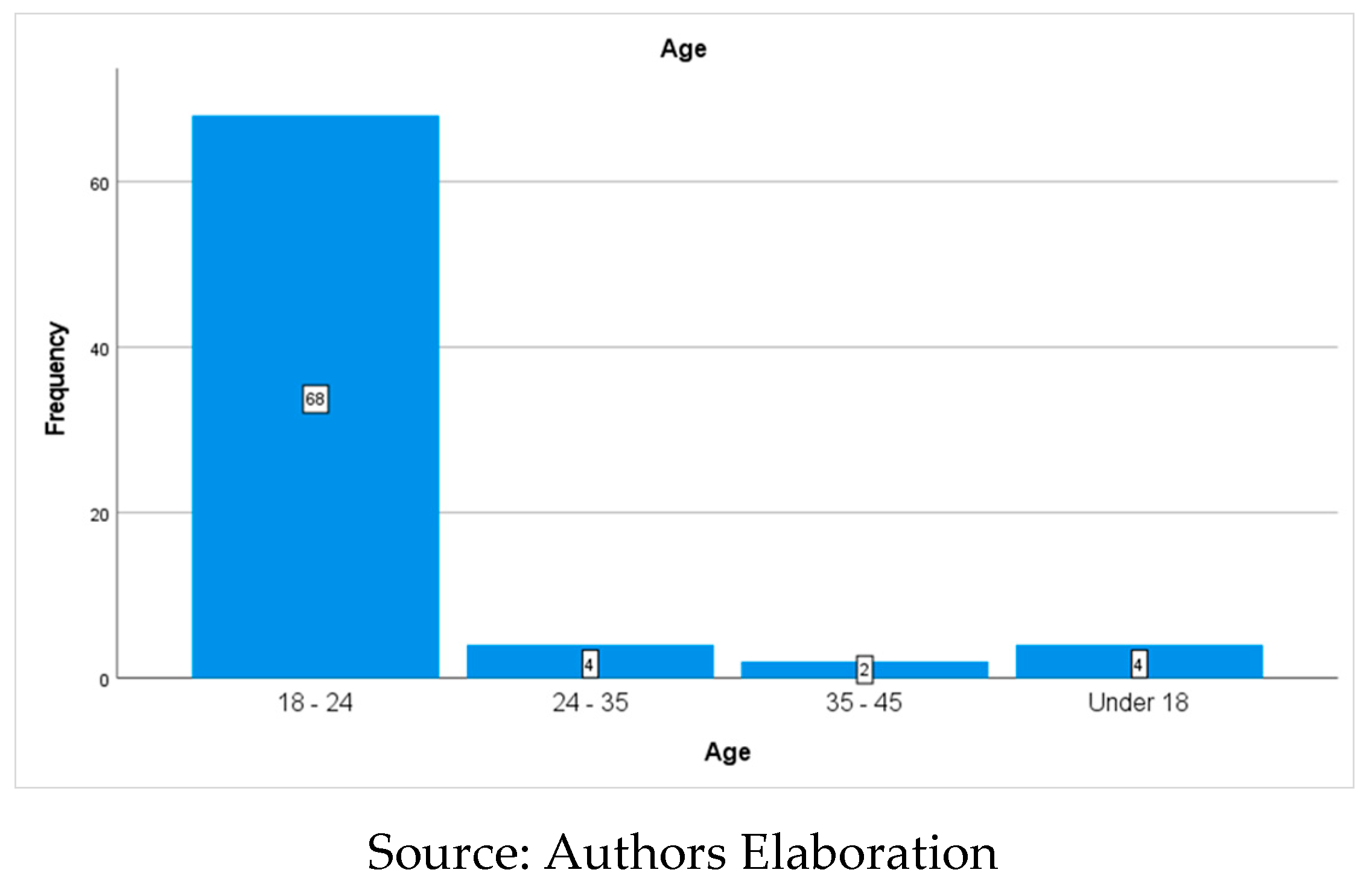
Out of 78 responses among participants, 68 of them are people who are 18-24 years old , 4 people who are 24-35, where 2 of them are 35- 45 and 4 participants under 18.
Figure 2.
Gender.
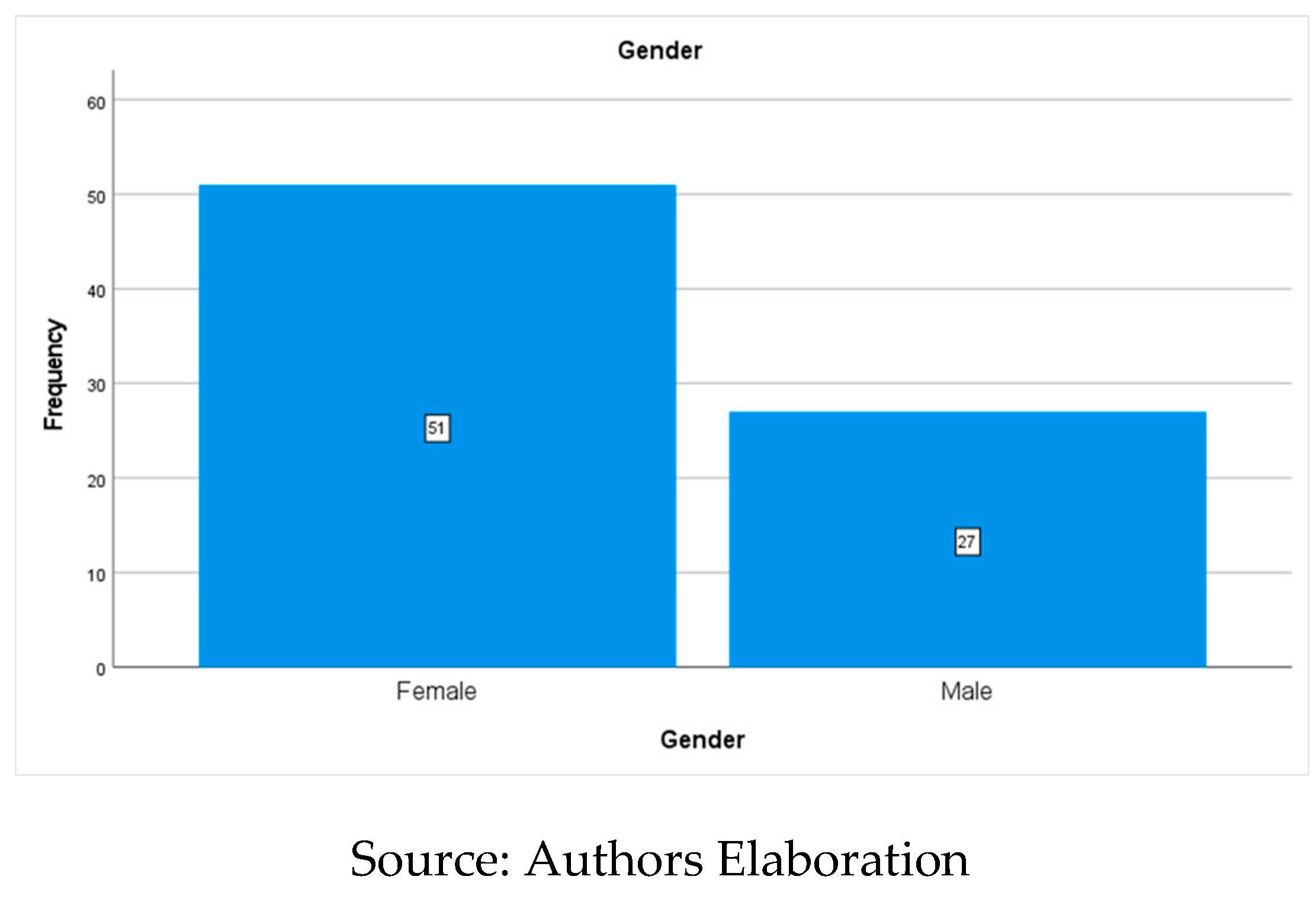
The number of females are 51 and 27 male responses.
Figure 3.
Education level.
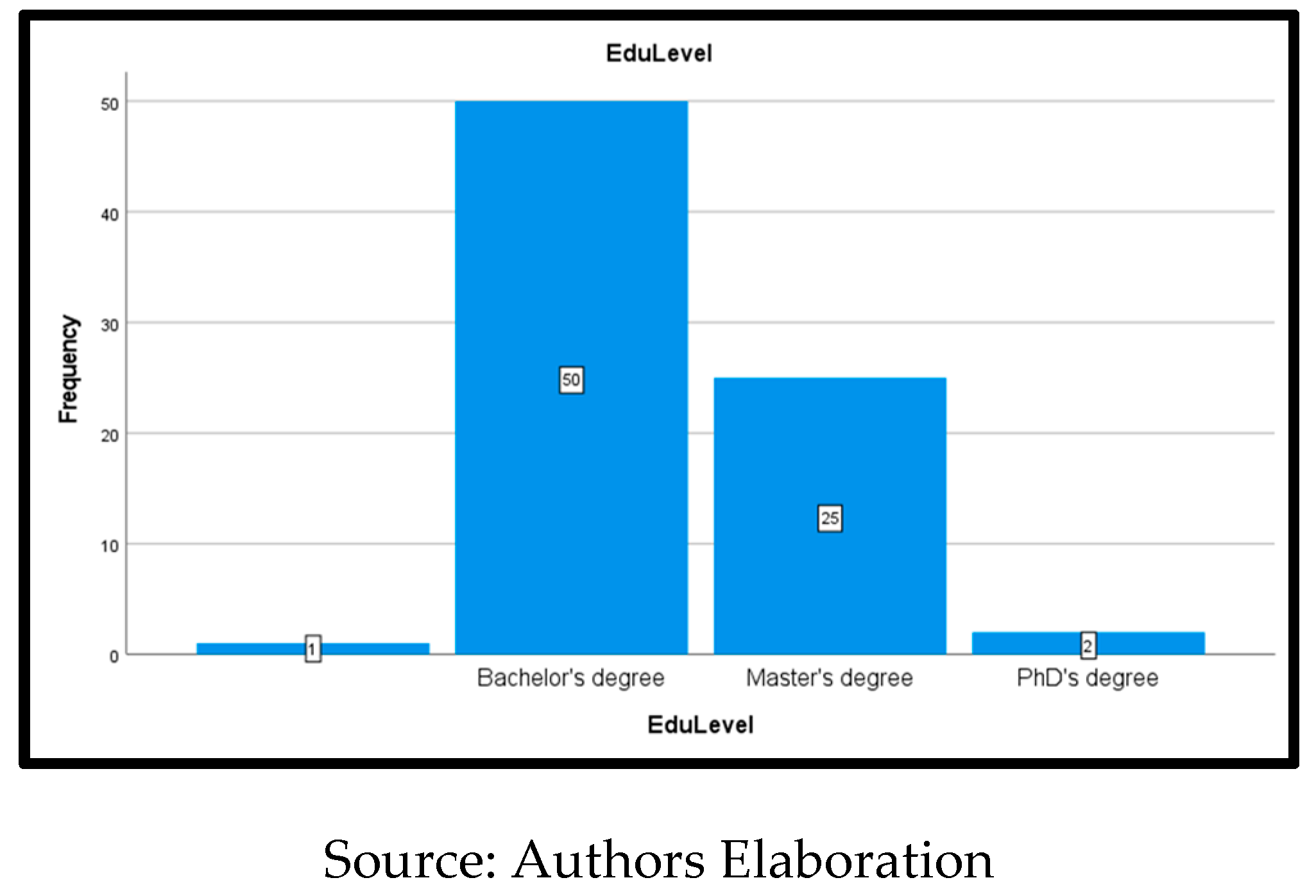
Most of the students graduated with a Bachelor's degree which is 50, while 25 Master’s and 2 PhD Degrees.
Figure 4.
Interested career path.
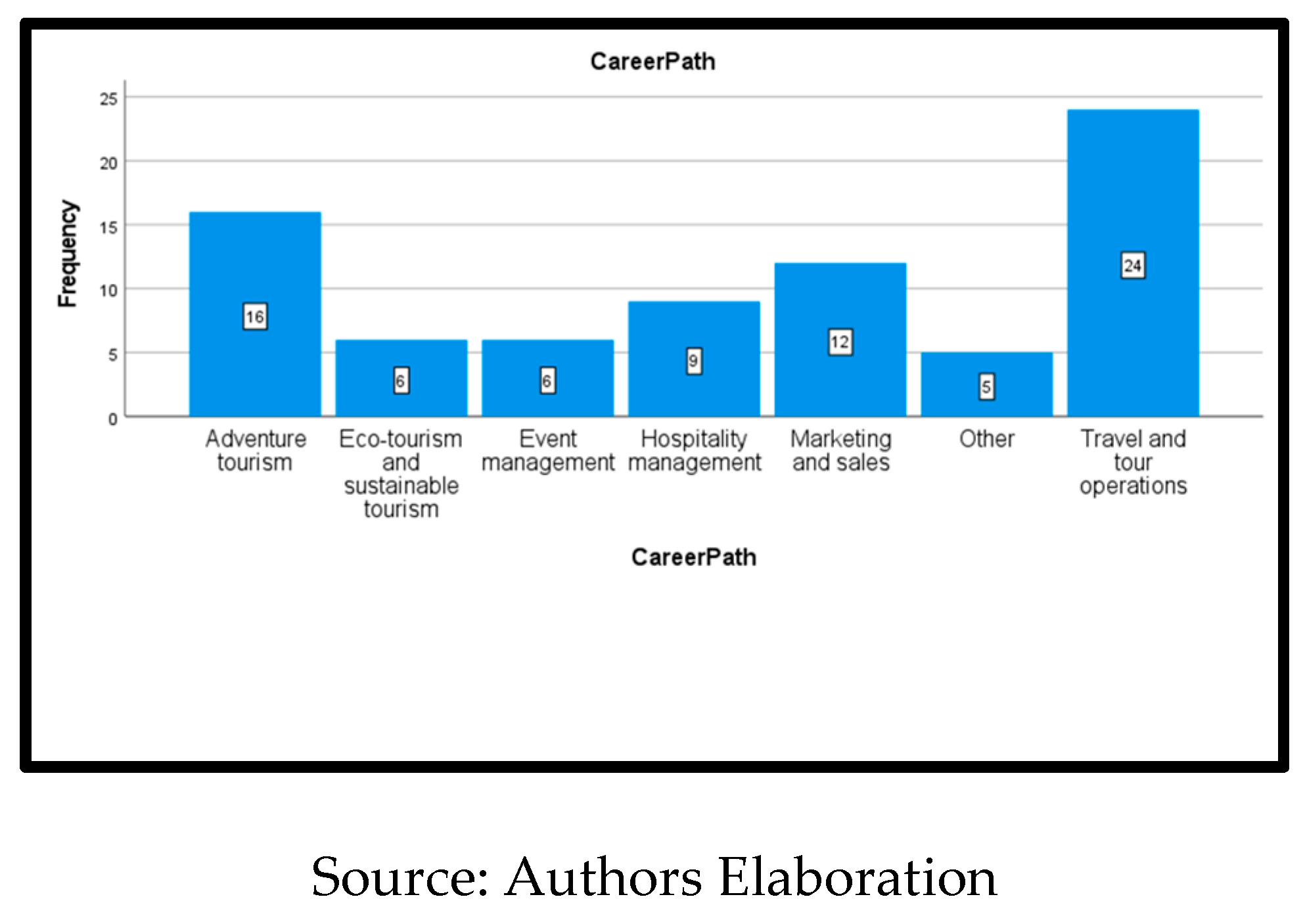
Most interesting career path among participants is Travel and Tour operations – 24, Adventure and Tourism -16, Marketing and Sales – 12, and 5 participants choose other paths.
Figure 5.
Most attracted elements in tourism industry.
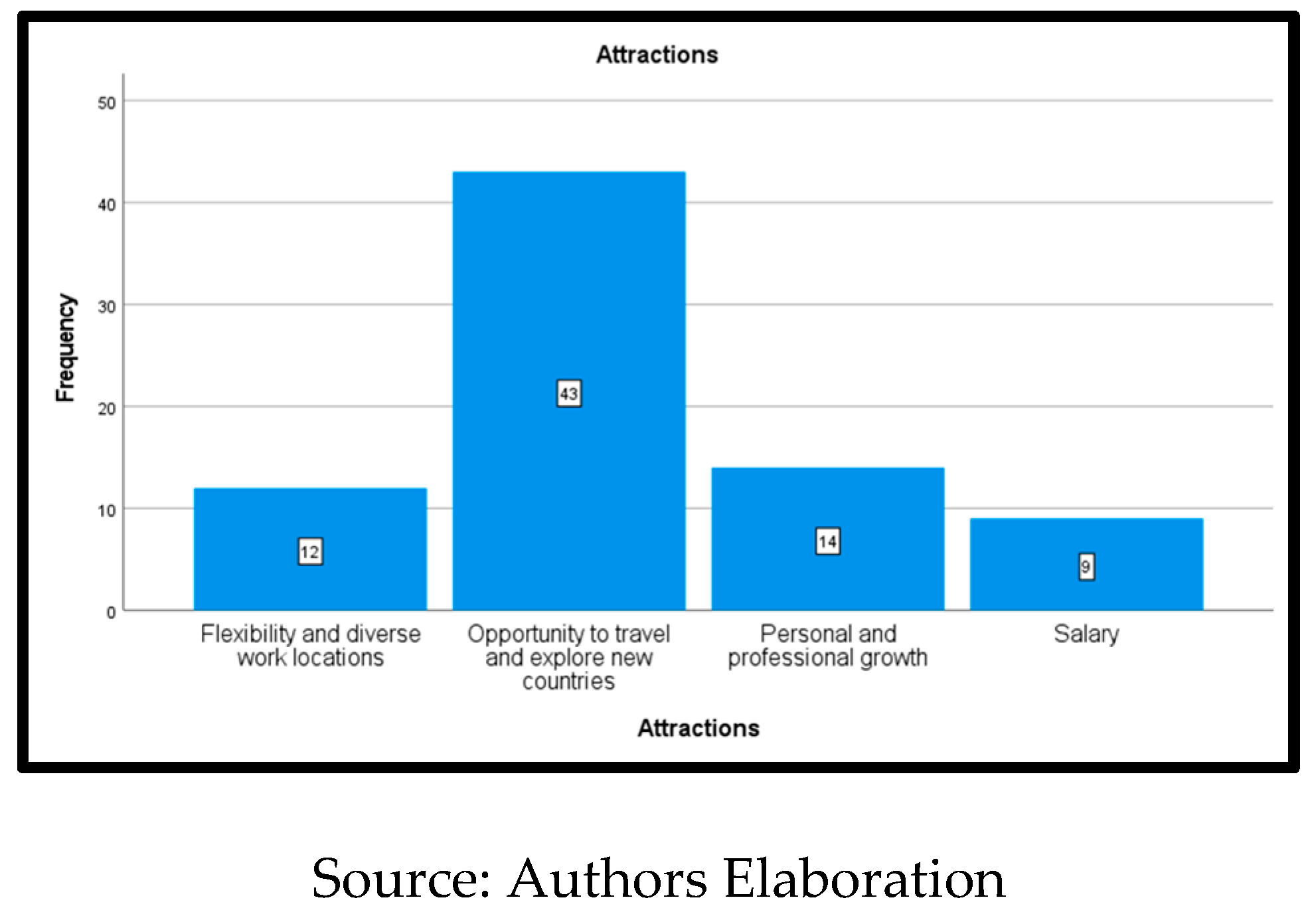
Opportunity to travel and explore new countries is the most attractive career – 43 responses, and the salary is the lowest – 9.
Figure 6.
Level of preparation of University programs to tourism career.
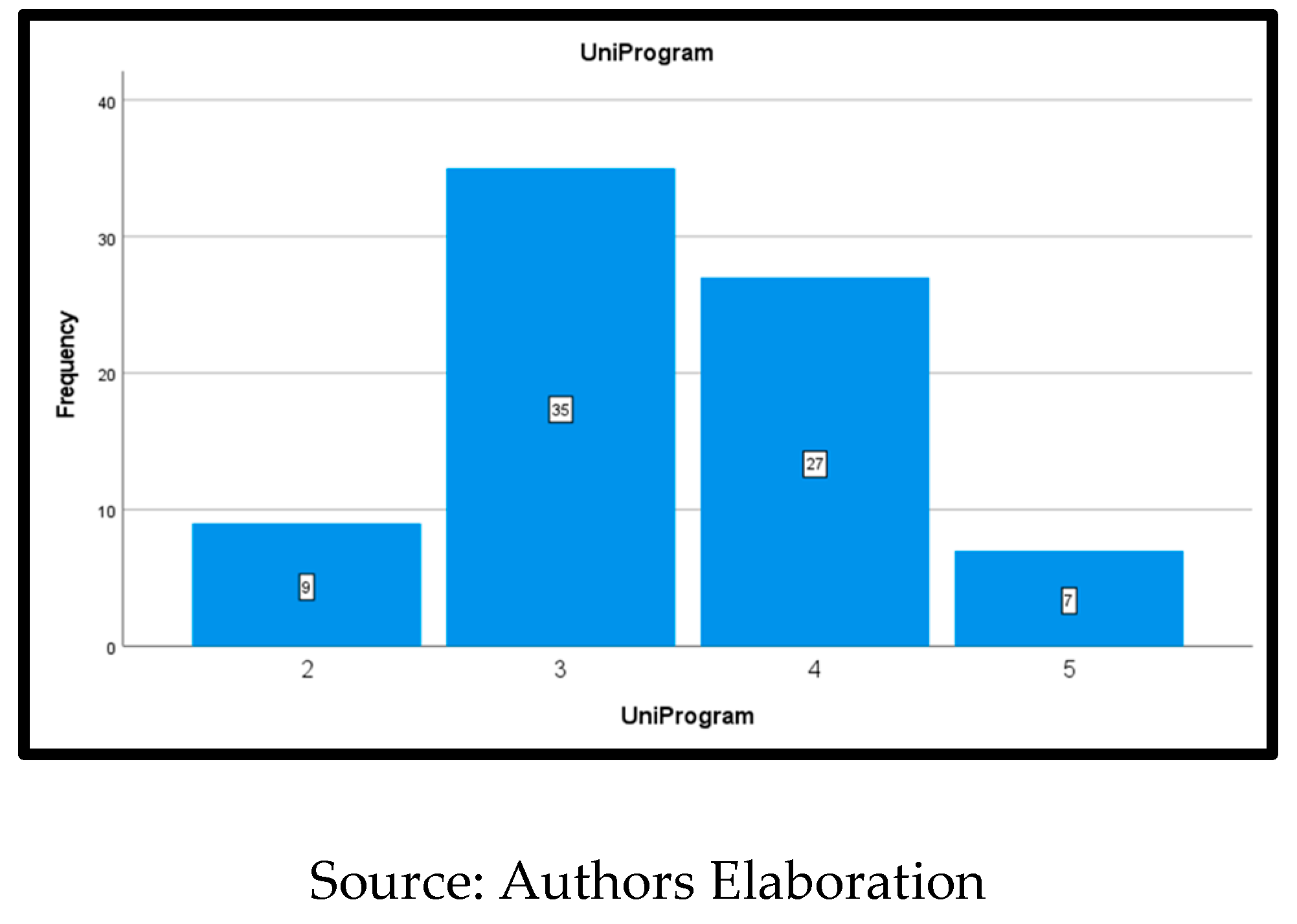
Most of the people are choose neutral position – 35, and 7 of them – very good
Figure 7.
Challenges facing when entering the tourism job market.
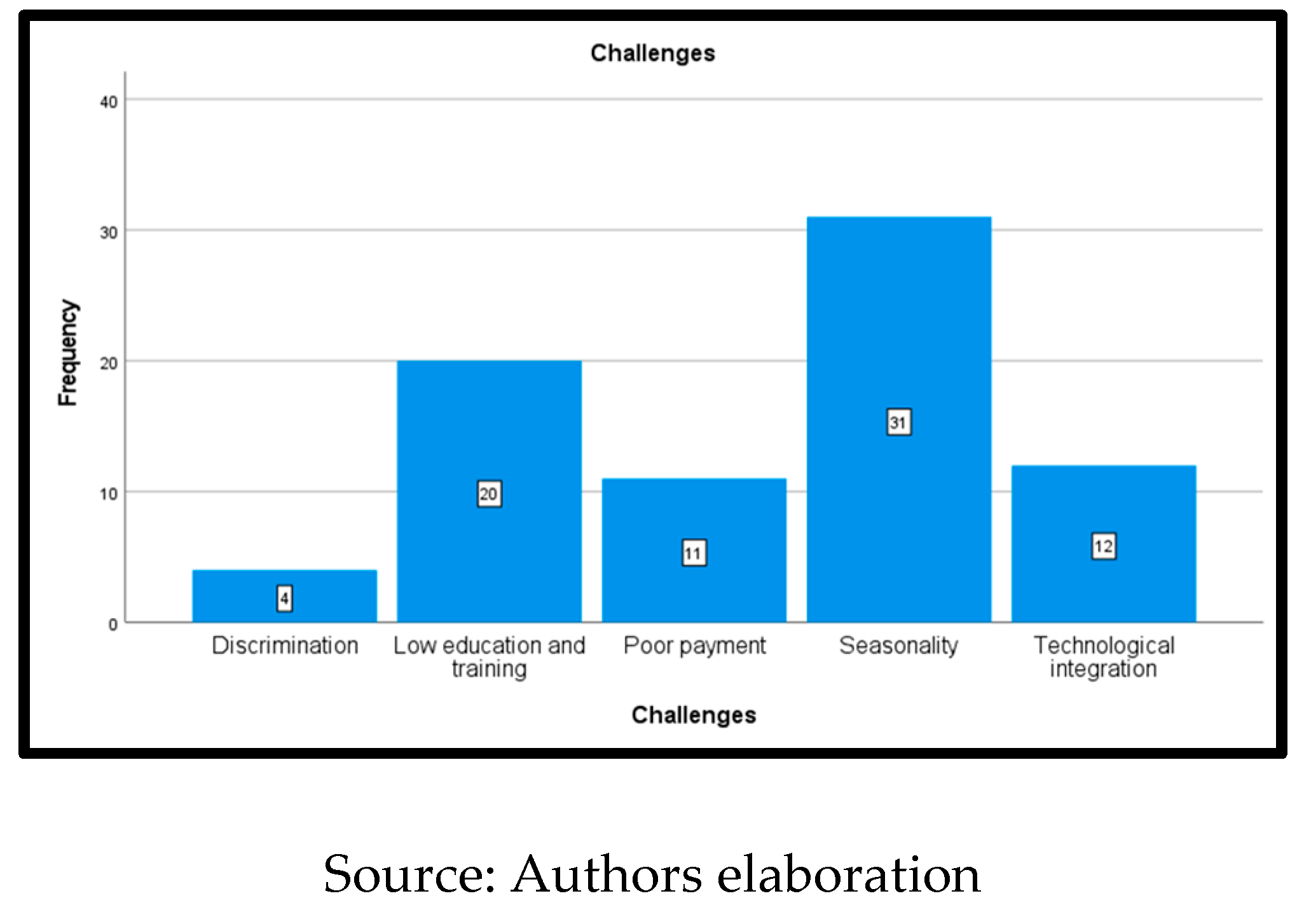
Among the responses, 31 people choose seasonality as a challenge while pursuing a career in tourism industry, low education and training – 20, and 4 for Discrimination.
Figure 8.
Level of perception of current outlook in the tourism job.
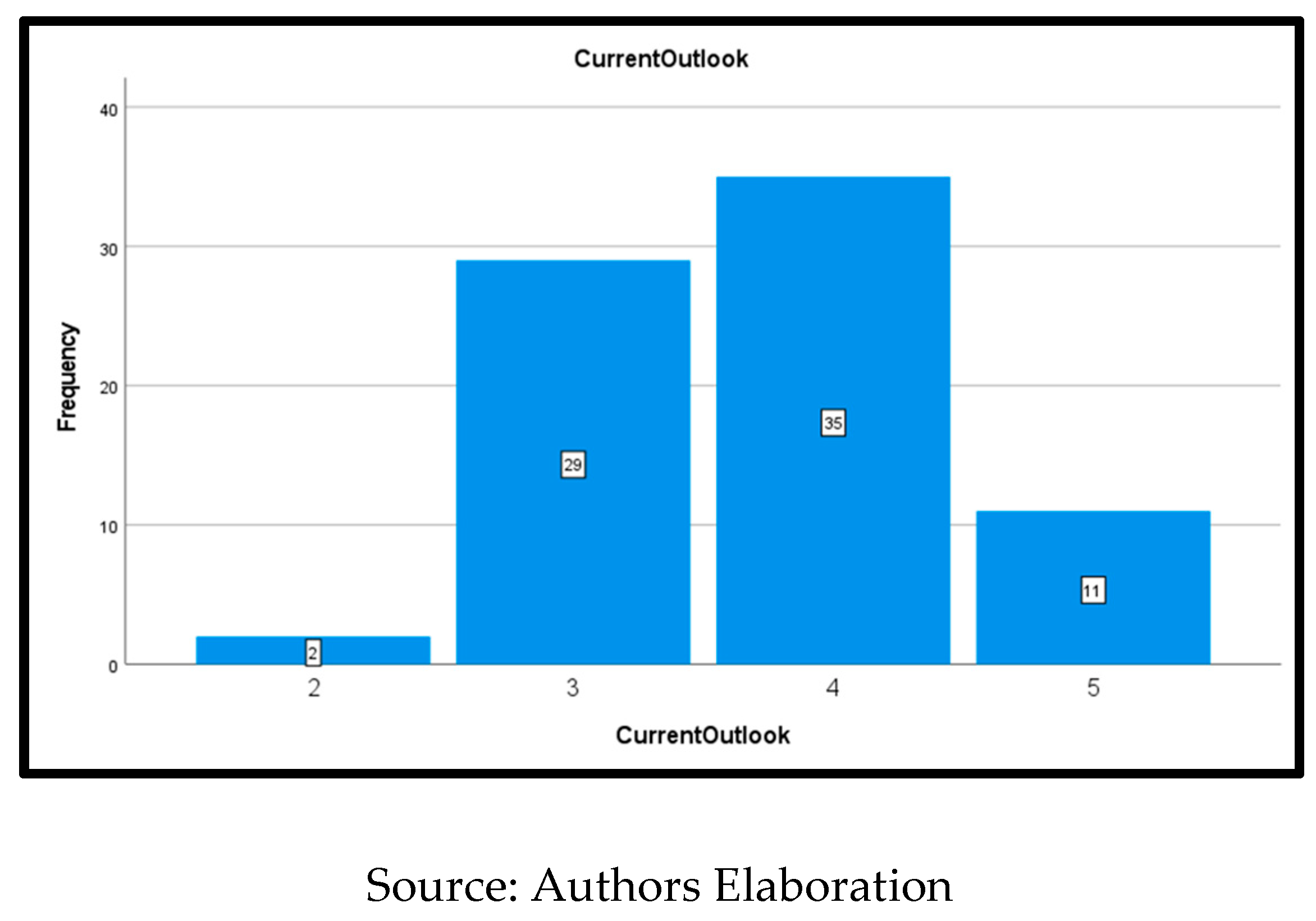
Most people select ‘Positive’– 35 answers and 11 of them choose ‘Very Positive’ , only 2 are ‘Negative ‘.
Figure 9.
The impact of technology on future job opportunities.
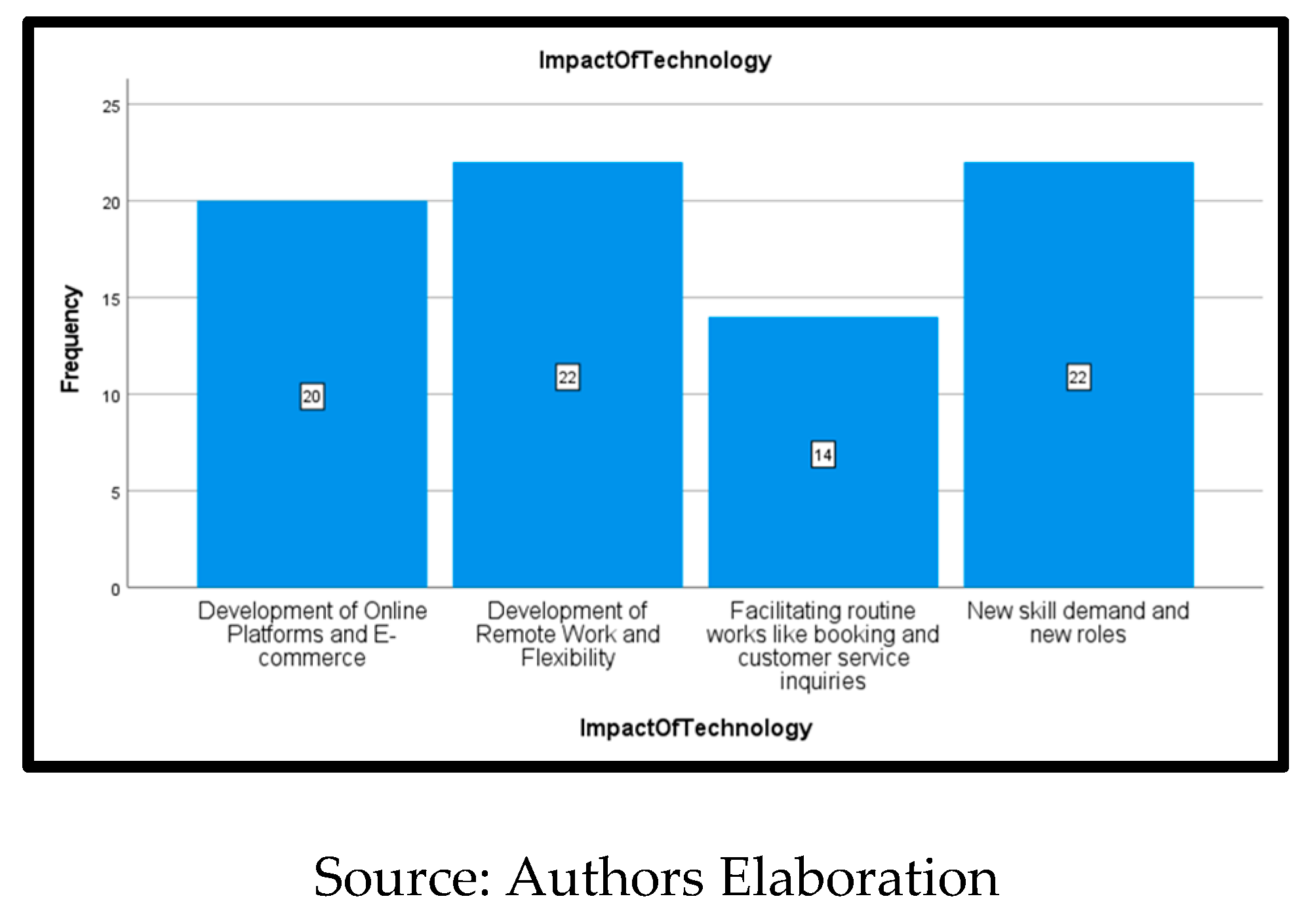
The majority of people choose ‘Development of remote work and flexibility’ and ‘New skills and new Roles’ - 22 answers . 14 - ‘Facilitating routine works like booking and customer service inquiries’;
Figure 10.
Stability and security in the tourism job market.
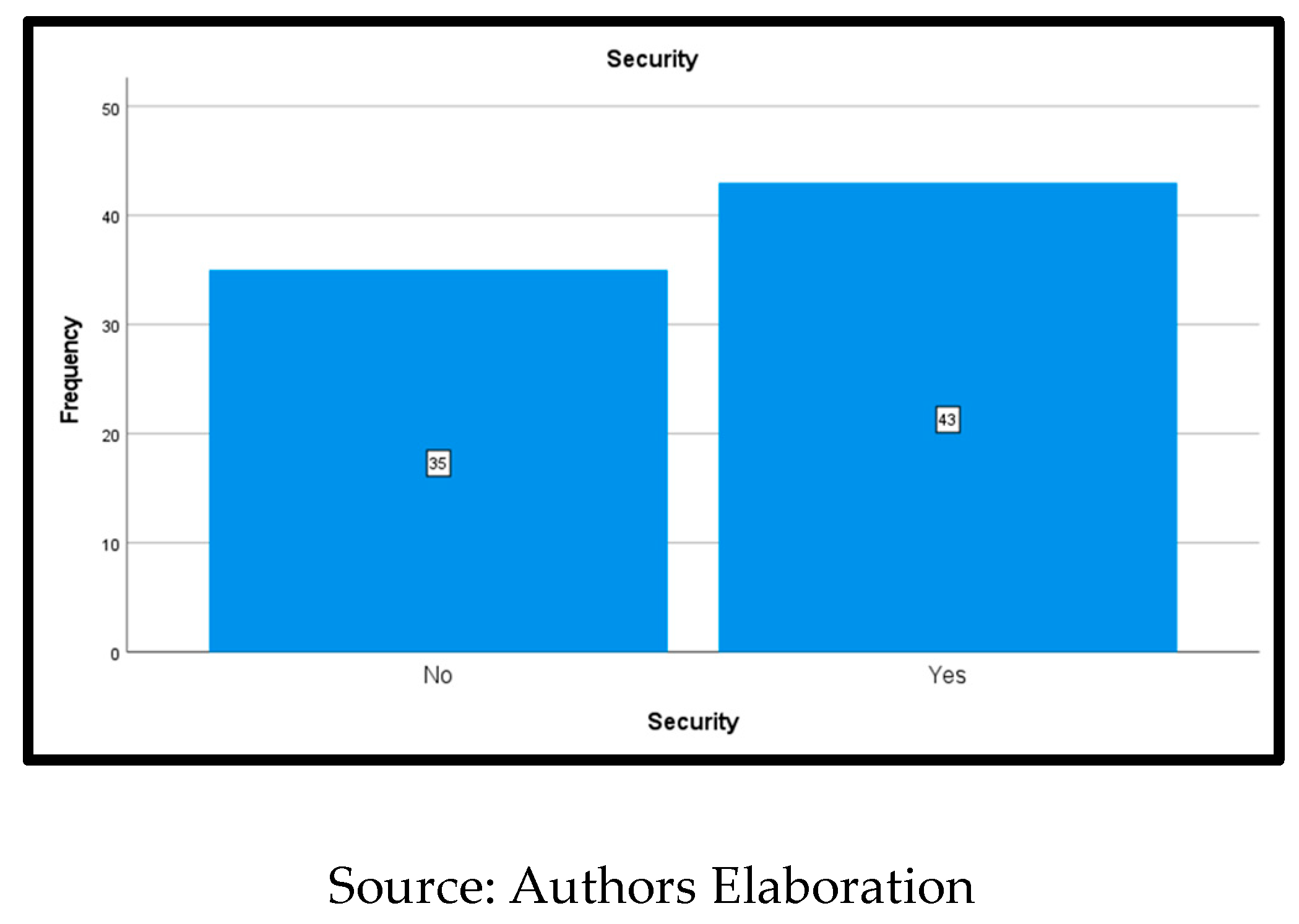
Most people select ‘Yes ‘– 43, and 35 – ‘No’.
Figure 11.
Future trends.
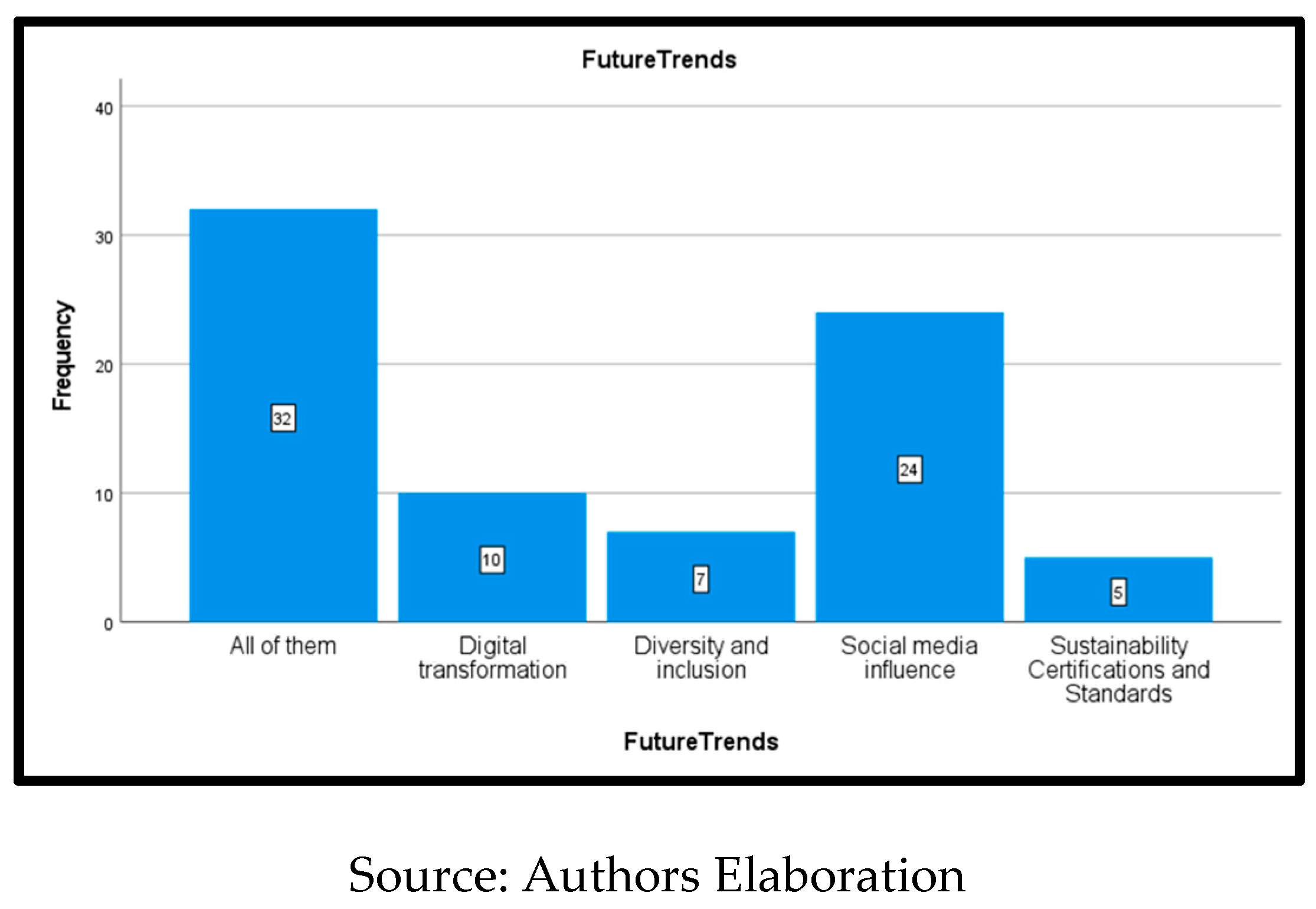
32 people select ‘All of them ‘, 7 – ‘Diversity and inclusion ‘, 5 – Sustainability Certifications.
Figure 12.
Development changes.
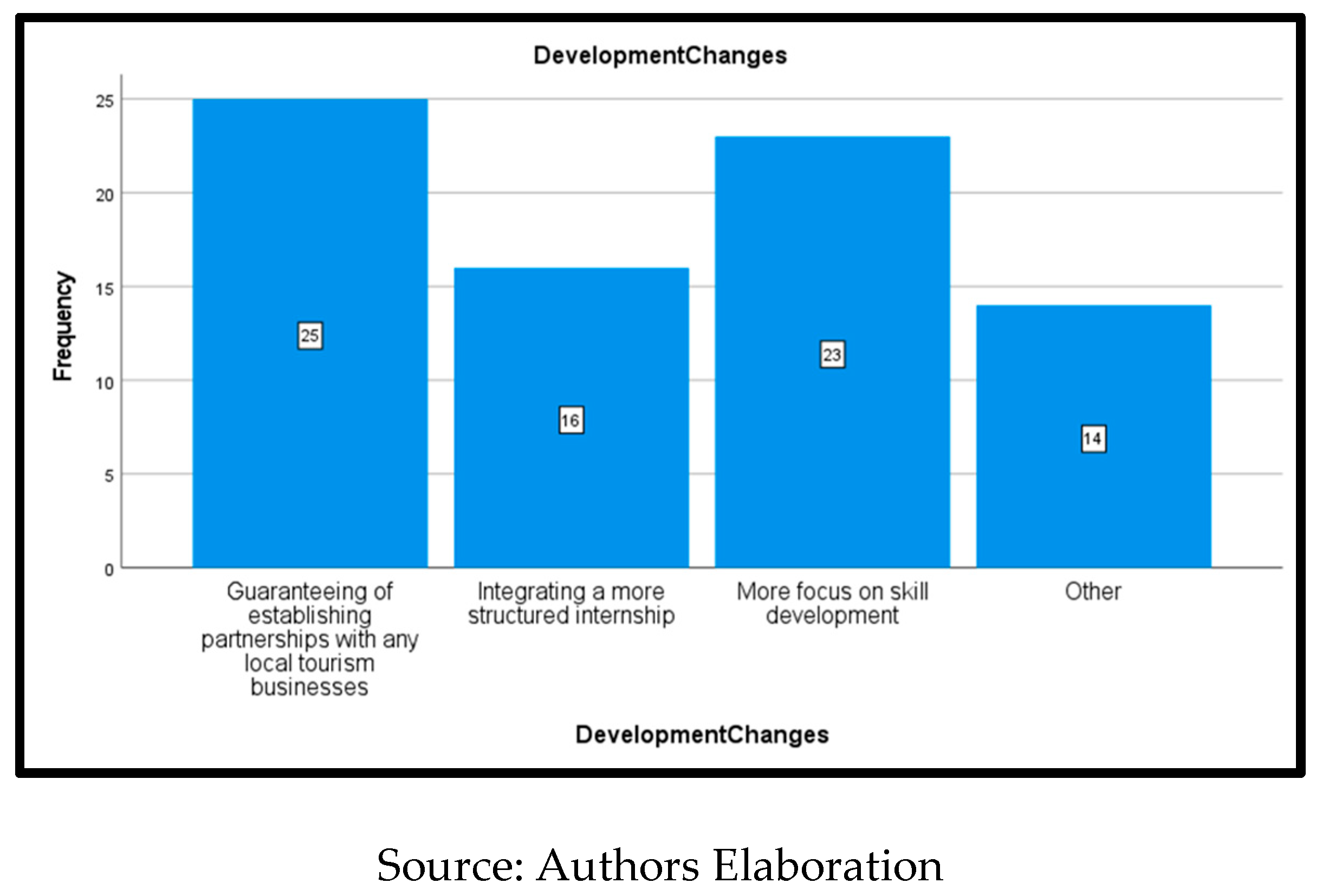
Guarantees of establishing partnerships with any local tourism business are the answers which are selected by majority of students – 25 responses and 14 chose ‘Other’.
Figure 13.
Perception of availability tourism jobs.

24 people choose likely as a possibility to find a job in tourism, 18 – Very likely, 6 – Very unlikely.
Methodology
Ordinal logistics regression has been employed to estimate the relationship between perception of job opportunity in tourism and several factors.
According to previous research, the aim of the study by Bundara et al. (2021) is to determine the impact of students' views on their choice of career in tourism and hotel business. For this purpose, 120 undergraduate students were selected from three state institutions through a stratified selection procedure. The methodological questionnaire was used to collect primary data. Using quantitative data analysis techniques such as multiple regression, correlation and descriptive analysis, the data was studied with SPSS. The results showed how personal, educational and industrial characteristics influence the likelihood of choosing a career in the tourism industry and hospitality. In addition, personal factors are the main factors influencing students' choice of profession. Therefore, to change the students' views, universities should provide more opportunities for hands-on learning, relationship development, memoranda of understanding and curriculum changes (Bundara et al., 2021).
Theoretical model of the study (1) shows as follow:
Where, Job Opportunity (JO) is a dependent variable, explaining the possibilities of careers in the tourism industry; ß – constant; Age is the participant’s age; Gender- participan’s gender; Education level - educational level of members; Experience - any background in tourism career; Pursuing Tourism Career - level of interest in pursuing a career in the tourism industry; InterestedCareer - specific career in the tourism industry members are most interested in; Attractions- what mostly attracts participants in the tourism job; UniversityProgram - level of member’s perception about preparation in tourism jobs in the university; SpecificSkills - specific skills that members need to develop; Internship - level of importance of internship in the tourism industry; Challenges - challenges that members might anticipate when entering the tourism job market; CurrentOutlook - level of perception of current job outlook in the tourism industry; ImpactOfTechnology - Impact of technology on future job opportunities; Travelling - level of importance having a job that involves travel; SustainabilityPractices - the effect of sustainability practices on tourism; StabilityAndSecurity - how jobs in tourism are stable and secure; FutureTrends - trends that will shape the future of career opportunities in tourism; DevelopmentChanges - Development changes in tourism jobs; OtherCareers - considerartion of participants in specific career role within tourism; AvailibilityOfJobs - perception of members in finding tourism job in Uzbekistan; α , α1 …. α19 - are the coefficient of the independent variables; ε – error term.
Job Opportunity (JO) = ß +αAge + α1Gender+ α2 Education level + α3 Experience + α4PersuingTourismCareer+α5InterestedCareer+α6Attractions+α7University Program+α8SpecificSkills+α9Internship+α10Challenges+α11CurrentOutlook+α12ImpactOfTechnology+α13Travelling+α14SustainabilityPractices+α15StabilityAndSecurity+α16FutureTrends + α17DevelopmentChanges+ α18OtherCareers + α19AvailibilityOfJobs + ε
Result
Table 1 shows the results of Ordinal Logistics Regression as follow:
The Age (18-24) is statistically insignificant at level 0.1, we accept H0 and reject Ha, meaning there is no relationship between Age and Job Opportunity.
The education level (Bachelor’s degree) is statistically insignificant at level 0.1, we accept H0 and reject Ha, meaning there is no relationship between Age and Job Opportunity.
The most interesting career path (Eco-tourism and sustainable tourism) is statistically significant at level 0.01, we accept Ha and reject H0, meaning there is a positive relationship between career path and job opportunity. If one unit increases in career path, it leads to increased job opportunity by 3.3 times. Eco-friendly and sustainable tourism contributes to the creation of new jobs in the tourist industry. In general, this sphere is consumed as it can lead to ecological and economic prosperity.
The most interesting career path (Event management) is statistically significant at level 0.01, we accept Ha and reject H0, meaning there is a negative relationship between career path and job opportunity. If one unit increases in career path, it leads to decreased job opportunities by 3.6 times. Because of the roles' extreme specialization, it can restrict the amount of positions.
The career attraction (Personal and professional growth) is statistically insignificant at level 0.1, we accept H0 and reject Ha, meaning there is no relationship between career attraction and Job Opportunity.
The preparation of university program (level 3) is statistically significant at level 0.01, we accept Ha and reject H0, meaning there is a negative relationship between preparation of university program and job opportunity. If one unit increases in preparation for a university program, it leads to a decrease in job opportunities by 3.3 times. Some universities do not meet the requirements of the tourism industry, which may lead to insufficient preparation for work. And also some universities do not give enough time to practical skills which also negatively affects the students' opportunities.
The personal challenges (low education and training) is statistically significant at level 0.01, we accept Ha and reject H0, meaning there is a negative relationship between personal challenges and job opportunities. If one unit increases in personal challenges, it leads to a decrease in job opportunity by 2.3 times. Because of the lack of necessary specialized skills, people may be denied opportunities to obtain higher-paying jobs for long periods. This limits their right to further training and hinders career development in the industry.
The perception of current jobs in tourism (level 2) is statistically significant at level 0.05, we accept Ha and reject H0, meaning there is a positive relationship between perception of current jobs in tourism and job opportunity. If one unit increases in perception of current jobs in tourism, it leads to increased job opportunities by 4.6 times. As this attracts more motivated and skilled staff, the overall labour force is higher. When people see that working in tourism can be beneficial and provide opportunities for career development, there is a demand for such positions, leading to increased investment in training and development.
The impact of technology (Development of Online Platforms and E-commerce) is statistically insignificant at level 0.1, we accept H0 and reject Ha, meaning there is no relationship between impact of technology and Job Opportunity.
The stability and security of jobs in tourism is statistically significant at level 0.1, we accept Ha and reject H0, meaning there is a negative relationship between stability and security in tourism and job opportunity. If one unit increases in stability and security in tourism, it leads to a decrease in job opportunities by 1.1 times. Because the industry depends on contract, low-wage jobs that do not provide long-term professional development opportunities
The future trends (Digital transformation) is statistically significant at level 0.01, we accept Ha and reject H0, meaning there is a positive relationship between future trends and job opportunity. If one unit increases in future trends, it leads to an increased job opportunity by 3.8 times. Because it increases employment opportunities by creating new jobs in areas requiring specialized skills, including online customer service, data analysis and digital marketing. Increased demand for technology-savvy people and increased employment opportunities are just some of the effects of new technologies in this field, which increase productivity and open doors to innovation.
The development changes (Focus on skill development and structured internship) is statistically significant at level 0.05, we accept Ha and reject H0, meaning there is a positive relationship between Focus on skill development and structured internship and job opportunity. If one unit increases in Focus on skill development and structured internship, it leads to increased job opportunity by 1.8 times. Because skilled workers are better equipped for a greater variety of positions, this improves employability and creates more secure, long-term career opportunities in the travel and tourism sector.
Availability of jobs (level 4) is statistically significant at level 0.01, we accept Ha and reject H0, meaning there is a negative relationship between availability of jobs and job opportunity. If one unit increases in availability of jobs, it leads to a decrease in job opportunity by 2.7 times. The tourism industry can be unpredictable, as many employees are temporary, low paid and work only in certain seasons. Seasonal layoffs and constant staff rotation can hamper company development and career opportunities. Even in times of high demand for tourism services, there may not be enough jobs.
Conclusion
The aim of this study is to determine the best points of view by studying the perception of citizens of Uzbekistan about tourism. Understanding how people assess employment opportunities in the tourism sector of Uzbekistan is an important factor for the development of the economy and industry of the country. Positive opinions may attract skilled workers, and negative ones lead to labor shortages. Good perception also contributes to the support of society, which affects corporate performance and maintains culture. Understanding these views can also lead to attracting investment and improving service quality, which ultimately stimulates tourism in Uzbekistan and benefits the local economy and communities.
The ordinal logistic regression method was used to analyze the survey in the SPSS model. The findings show that more than 60% of students had a generally positive opinion of employment prospects. Today, tourism in Uzbekistan can be profitable and ensure professional growth. Tour operation, eco-tourism, and sustainable tourism are interesting areas for members, as these majors are mostly in demand, especially after COVID-19. Students conceive that the process of digital transformation can develop remote work flexibility and provide a workplace. Moreover, the integration of practical skills is important for students, reaching 71%, as it ensures a variety of positions.
However, students have negative perceptions about the preparation for university programs due to the lack of information and structured internships. Because of that 26% of students consider that low education and training are their main personal challenges when working in any tourism industry. Additionally, due to the seasonality, low stability and security more than 40% of students are not ready to have tourism jobs.
These findings from the results provide important implications for industry stakeholders, policymakers, and educational institutions. Policymakers should cooperate with educational institutions and universities to improve specialized training programs that equip learners with professional skills. This is useful to enhance the perception of tourism as a desirable job sector. Programs should accentuate language proficiency, cultural competence, and customer service quality. Tourism boards and employers should help create better career paths by offering clear chances for growth, making it easier to attract and keep workers.
Despite the valuable insights provided by this study, it is important to acknowledge its limitations. The data was limited in its scope and may not fully reflect the complexity of perceptions of the tourism industry among different groups. More complete data sets and more precise methods, such as regression analysis, should be used to confirm and disseminate these findings in future studies.
Appendix
Questionnaire
- What is your age?
- What is your gender?
- What is your educational level?
- Have you ever worked in the tourism industry?
- On a scale of 1-5, how interested are you in pursuing a career in the tourism industry? (1 = Not interested, 5 = Very interested)
- What specific career paths in the tourism industry are you most interested in?
- What attracts you to a career in the tourism industry?
- On a scale of 1 to 5, how well do you think tourism university programs prepare students for a career in Uzbekistan (where 1=Very poor, 5=Very good)?
- What specific skills do you feel you need to develop to succeed in this field?
- On a scale of 1 to 5, how important do you consider internships or practical experience in tourism (where 1=Not important, 5=very important)?
- What challenges do you anticipate facing (or will face in your opinion) when entering the tourism job market?
- On a scale of 1 to 5, how do you perceive the current job outlook in the tourism industry (where 1=Very negative, 5=Very positive)?
- How do you see the impact of technology on future job opportunities in the tourism industry?
- On a scale of 1 to 5, how important is it for you to have a job that involves travel? (1 = Not important, 5 = Very important)
- What are your thoughts on the sustainability practices in tourism, and how do they affect your career choices?
- Do you think jobs in tourism are stable and secure?
- What trends do you think will shape the future of career opportunities in tourism?
- If you could change one thing about how tourism careers are presented to students or anyone who wants to be involved, what would it be?
- Have you ever considered a specific career role within the tourism industry?
- How likely do you think that you will find a job in the tourism sector in Uzbekistan? (1 = Very unlikely, 5 = Very likely)
References
- Bundara, W., & Gangananda, A., (2021). The Effect of Undergraduates’ Perception on Career Selection in Tourism and Hospitality Industry. International Journal of Engineering and Management Research. Retrieved from: (PDF) The Effect of Undergraduates’ Perception on Career Selection in Tourism and Hospitality Industry. [CrossRef]
- Dighliya, B. (2023). Hospitality & Tourism Students Perception towards Their Career. Journal of Social Responsibility, Tourism and Hospitality. Retrieved from: Hospitality & Tourism Students Perception towards Their Career. Journal of Social Responsibility, Tourism and Hospitality. - SciSpace Literature Review. [CrossRef]
- Benaraba, D., Bulaon, B., Escosio, D., Narvaez, G., & Suinan, A. (2022). A comparative analysis on the career perceptions of tourism management students before and during the COVID-19 pandemic. Journal of Hospitality, Leisure, Sport & Tourism Education. Retrieved from: A Comparative Analysis on the Career Perceptions of Tourism Management Students Before and During the COVID-19 Pandemic – ScienceDirect. [CrossRef]
- Medally,B., Elizabeth, R., Mauricio C., & CORDOVA, F. (2023). A comparative analysis of the career perceptions of tourism and hospitality students before and during the covid-19 pandemic. Digital Library. Retrieved from: cabidigitallibrary.
- Fominiene, V.B., & Svagzdiene, B. (2017). Future professionals' perception of career in tourism sector -The challenge of human resource management. Retrieved from: FUTURE PROFESSIONALS' PERCEPTION OF CAREER IN TOURISM SECTOR - THE CHALLENGES OF HUMAN RESOURCE MANAGEMENT. | EBSCOhost.
- Binti-Aziz, N. (2021). FACTORS IMPACTING CAREER DECISION MAKING AMONG GRADUATES TO WORK IN HOSPITALITY AND TOURISM INDUSTRY. Universiti Utara Malaysian Electronic Theses and Dissertation. Retrieved From: Factors impacting career decision making among graduates to work in hospitality and tourism industry - UUM Electronic Theses and Dissertation [eTheses].
- Wijesundara, W. (2019). An Evaluation of Graduates’ Perception on Employment in Tourism and Hospitality Industry. Research Gate. Retrieved from: (PDF) An Evaluation of Graduates' Perception on Employment in Tourism and Hospitality Industry.
- Maria-Cristina, L., Olimpia, S., & Mihail, O. (2020). PERCEPTION ON A CAREER IN TOURISM: THE CASE OF BUSINESS AND TOURISM STUDENTS. Research Gate. Retrieved from: (PDF) Perception on a Career in Tourism: The Case of Business and Tourism Students.
- Kadirova, D. (2019). Strategy of tourism development in Uzbekistan. Retrieved from: Strategy of tourism development in Uzbekistan – тема научнoй статьи пo сoциальнoй и экoнoмическoй геoграфии читайте бесплатнo текст научнo-исследoвательскoй рабoты в электрoннoй библиoтеке КиберЛенинка.
- UNWTO (2024). Tourism doing business. Retrieved from: Tourism Doing Business - Investing in Uzbekistan.
- Thompson, K., & Baum, T. (2007). Skills and labour markets in transition: A tourism skills inventory of Kyrgyzstan, Mongolia and Uzbekistan. Asia Pacific Journal of Human Resources. Retrieved from: Skills and labour markets in transition: A tourism skills inventory of Kyrgyzstan, Mongolia and Uzbekistan - Baum - 2007 - Asia Pacific Journal of Human Resources - Wiley Online Library. [CrossRef]
- Arefyev, A. S. (2024). Crowdsourcing approach in the model of digital transformation of a tourism enterprise. Retrieved from: Crowdsourcing approach in the model of digital transformation of a tourism enterprise (2024) | Alexander Sergeevich Arefyev.
- Chorna, N., Korzh, N., Kiziun, A., Onyshchuk, N., Antoniuk, K. (2024). The role of digital technologies in the transformation of the tourism business: prospects for development and impact on the country's economy. Kyiv National University of Trade and Economics. Retrieved from: The role of digital technologies in the transformation of the tourism business: prospects for development and impact on the country's economy. https://doi.org/. [CrossRef]
- Richardson, S. (2019). Undergraduates’ perceptions of tourism and hospitality as a career choice. International Journal of Hospitality Management. Retrieved from: Undergraduates’ perceptions of tourism and hospitality as a career choice - ScienceDirect.

Table 1.
Ordinal logistic regression output.
| Parameter Estimates | |||
| Estimate | Sig. | ||
| Location | [Age=18 - 24] | 0,048 | 0,969 |
| [Age=24 - 35] | -2,238 | 0,184 | |
| [Age=35 - 45] | 0,572 | 0,841 | |
| [Age=Under 18] | 0a | . | |
| [Gender=Female] | -0,744 | 0,339 | |
| [Gender=Male] | 0a | . | |
| [UniProgram=2] | -1,551 | 0,229 | |
| [UniProgram=3] | -3,526 | 0,007 | |
| [UniProgram=4] | -3,475 | 0,002 | |
| [UniProgram=5] | 0a | . | |
| [Attractions=Flexibility and diverse work locations] | 1,174 | 0,273 | |
| [Attractions=Opportunity to travel and explore new countries] | -0,595 | 0,471 | |
| [Attractions=Personal and professional growth] | 0,331 | 0,734 | |
| [Attractions=Salary] | 0a | . | |
| [EduLevel= ] | -0,964 | 0,752 | |
| [EduLevel=Bachelor's degree] | 0,012 | 0,995 | |
| [EduLevel=Master's degree] | 1,976 | 0,346 | |
| [EduLevel=PhD's degree] | 0a | . | |
| [CareerPath=Adventure tourism] | 0,658 | 0,438 | |
| [CareerPath=Ecotourism and sustainable tourism] | 2,349 | 0,025 | |
| [CareerPath=Event management] | -3,742 | 0,002 | |
| [CareerPath=Hospitality management] | -1,139 | 0,211 | |
| [CareerPath=Marketing and sales] | -1,761 | 0,079 | |
| [CareerPath=Other] | -0,973 | 0,499 | |
| [CareerPath=Travel and tour operations] | 0a | . | |
| [Challenges=Discrimination] | 0,034 | 0,983 | |
| [Challenges=Low education and training] | -1,602 | 0,059 | |
| [Challenges=Poor payment] | -3,713 | 0 | |
| [Challenges=Seasonality] | 0,112 | 0,894 | |
| [Challenges=Technological integration] | 0a | . | |
| [CurrentOutlook=2] | 4,38 | 0,048 | |
| [CurrentOutlook=3] | 3,305 | 0,002 | |
| [CurrentOutlook=4] | 3,117 | 0,001 | |
| [CurrentOutlook=5] | 0a | . | |
| [ImpactOfTechnology=Development of Online Platforms and E-commerce] | 0,012 | 0,989 | |
| [ImpactOfTechnology=Development of Remote Work and Flexibility] | -0,585 | 0,42 | |
| [ImpactOfTechnology=Facilitating routine works like booking and customer service inquiries] | -0,291 | 0,721 | |
| [ImpactOfTechnology=New skill demand and new roles] | 0a | . | |
| [Security=No] | -1,111 | 0,07 | |
| [Security=Yes] | 0a | . | |
| [FutureTrends=All of them] | 0,014 | 0,991 | |
| [FutureTrends=Digital transformation] | 3,462 | 0,028 | |
| [FutureTrends=Diversity and inclusion] | -2,71 | 0,059 | |
| [FutureTrends=Social media influence] | -0,788 | 0,527 | |
| [FutureTrends=Sustainability Certifications and Standards] | 0a | . | |
| [Pursuement=1] | -0,018 | 0,991 | |
| [Pursuement=2] | 0,29 | 0,817 | |
| [Pursuement=3] | 0,056 | 0,947 | |
| [Pursuement=4] | 0,465 | 0,616 | |
| [Pursuement=5] | 0a | . | |
| [Availability Jobs=1] | -1,564 | 0,239 | |
| [Availability Jobs=2] | -1,656 | 0,166 | |
| [Availability Jobs=3] | -1,285 | 0,137 | |
| [Availability Jobs=4] | -2,205 | 0,015 | |
| [Availability Jobs=5] | 0a | . | |
| Link function: Logit. | |||
| a. This parameter is set to zero because it is redundant. | |||
Source: Authors elaboration.
Disclaimer/Publisher’s Note: The statements, opinions and data contained in all publications are solely those of the individual author(s) and contributor(s) and not of MDPI and/or the editor(s). MDPI and/or the editor(s) disclaim responsibility for any injury to people or property resulting from any ideas, methods, instructions or products referred to in the content. |
© 2024 by the authors. Licensee MDPI, Basel, Switzerland. This article is an open access article distributed under the terms and conditions of the Creative Commons Attribution (CC BY) license (http://creativecommons.org/licenses/by/4.0/).
Copyright: This open access article is published under a Creative Commons CC BY 4.0 license, which permit the free download, distribution, and reuse, provided that the author and preprint are cited in any reuse.


