

Submitted:
04 December 2024
Posted:
05 December 2024
You are already at the latest version
Abstract
Climate action represents the most comprehensive of the 2015 United Nations 17 Sustainable Development Goals (SDGs) in that climate change impacts all other goals. Urban overpopulation is a primary cause, as energy consumption is a significant source of carbon dioxide emissions directing climate change. The population increase origin is attributable to the agricultural/urban developments that became geographically widespread approximately 6,000 years ago. Simultaneously, religious belief stressed multiple children, with women obligated to produce them. This female duty created gender inequality and reduced the health and well-being of women, as pregnancy is a noted risk factor for decreased lifetime health. Regardless of the detrimental risk to their health and well-being, the gender inequality, and the adverse effects of birthing multiple children regarding climate action, women today continue to feel obliged to reproduce appropriately. This burden requires change to meet the three sustainable development goals of good health and well-being (SDG 3), gender equality (SDG 5), and climate action (SDG 13). A mindfulness intervention of an author-developed psychoanalytic narrative research method presents a means for promoting such change through a qualitative analysis of the responses of several participants regarding its success in clarifying the values of these women in overcoming career-related burnout.
Keywords:
Sustainable Development Goals
; climate action
; overpopulation
; urban development
; women
; gender equality
; good health and well-being
; reproduction
; mindfulness
; psychoanalytic narrative research
1. Introduction
Development is sustainable when it meets present needs without compromising future generations to satisfy theirs [1]. Although they are not the first global standards, building on the earlier Millennium Development Goals (MDG) [2], the 2015 UN Sustainable Development Goals (SDG) are considered the most comprehensive and detailed by the United Nations to promote sustainable development [3]—they number seventeen. Groupable in several ways [1,4,5,6], one way is to move from interpersonal connections to macro relationships encompassing the planet. In this regard, Table 1 divides the seventeen SDGs. Whether all of the SDGs pertain to the four categories of Human interaction, Standard of living, Organizational structure, and Planetary care, the purpose of categorizing them is to identify the most salient feature of a particular SDG. Those involving planetary care represent the macro relationships concerning the earth. In making this division, climate action—where “climate” is defined as the average weather associated with many years’ observations [7]—can be singled out among the other three goals listed under Planetary care. Although numbered far along the list at thirteen, climate action represents the goal on which all the other goals depend as the current planetary climate change is considered unequivocal [8] and is recognized to undermine each of the other sixteen goals [9].
Weather represents a system of deterministic chaos with finite predictability [11], with its chaotic aspects arising from the large dimensionality of the climate system[12]. The chaotic element means that weather is predictable only by comparing and contrasting multiple years over an extended time based on a surrounding environment's comprehensive temperature and precipitation trends and pressure and humidity levels [13]. Regarding these multiple-year comparisons, climate is changing [14], and the most detrimental change is the rise in abundant carbon dioxide in the environment, with its concentration growing at a rate of more than two ppm/y [15].
The effect of this rise in CO2 is multifaceted and primarily the result of burning carbon-based [16] fossil fuels [17] to meet the energy needs of humans [18]. Consequently, human activities from increased population result in higher energy demand, increasing CO2 emissions [19,20]. A common concern is that continued human population growth requires increased energy consumption, nullifying any gains from renewable energy production use and expansion [21,22].
Figure 1 [23] demonstrates the growth of the human population since 10,000 BCE, representing a super-exponential curve—hockey stick behavior with a sharp jump at finite times [24]. The hypothesis regarding this curve is that this super-exponential growth has resulted from energy availability keeping pace with or exceeding the population growth rate [25]. As a mathematical curve, it is describable by an equation—one found to represent a curve with a best-fit estimated growth speed of 12% faster than exponential [26]. As describable by a mathematical formula, the seeds for this growth are found at its beginning in 10,000 BCE [27,28] with the start of agriculture [29,30], but particularly in the changes noticeable with the wide-spread development of agriculture and urbanization approximately 6,000 years ago at 4,000 BCE [31,32].
With the spread of agriculture and urbanization around 4,000 BCE simultaneously came the socially prescribed requirement to populate the world specified in what would become religious text [33,34]. As such, following the prescribed order convinced women to provide the means to large families [35]. It is with this necessity for women to use their bodies to create large families that gender inequality was institutionalized by society [36].
Various problems arise from the increased stress on women’s bodies from pregnancy. Hypertension leading to preeclampsia is a leading cause of maternal morbidity and maternal mortality, affecting up to 5% of pregnant women [37], as maternal mortality is high in women who develop heart disease during pregnancy [38]. Valvular heart disease with severe mitral stenosis or aortic stenosis is associated with significant maternal morbidity and mortality [39]. Pregnancy can also see the development of gestational diabetes [40], which converts to either or both cardiovascular disease and diabetes mellitus as the woman ages [41,42]. In that the increased caloric intake associated with pregnancy can lead to obesity [43], this is considered the perfect metabolic storm for future metabolic disorders later in life [44]. Childbirth-related perineal trauma from vagina birth is exceedingly common [45]. Both it and the pressure on the pelvic area can lead to persistent urinary and fecal incontinence as well as pelvic organ prolapse [46,47], including entire utero vaginal prolapse [48]. Beyond the physical body, pregnancy often results in postpartum depression [49], further exacerbated by weight gain [50]. In all, the desire created 6,000 years ago for women to produce large families would ultimately lead to calls by the UN for good health and well-being (SDG 3), gender equality (SDG 5), and climate action (SDG 13).
With the lessening of religiosity worldwide [51,52] has come a reconsideration of the value of women producing multiple children [53]. Nevertheless, the desire of women to give birth to several children persists [35], including current opposition to active population reduction policies [54]. Women rarely consider whether they want to become mothers and, if so, why [55]. However, women must be encouraged by society to reconsider their reproductive expectations regarding multiple children if there is to be support for good health and well-being, gender equality, and climate action simultaneously.
Reconsidering is a conscious act. As a conscious act, it is mindful, meaning fully engaged—differing from the lay understanding of the term that conflates mindful acceptance with disengagement [56]. Yet, mindfulness is well-cited as elusive to capture in studies [57]. In psychological research, mindfulness is a purposeful awareness of accepting stressful thoughts and feelings to facilitate engaged identification and exploration of adaptive responses [56]. However, studies often limit the definition to non-judgmental present awareness of physical, emotional, and mental states without identifying an adapted response as the purpose [58]. Mindfulness training then focuses on attentional control of internal conditions [59]. What is lacking from these mindfulness interventions is the added dimension of creating adaptive responses. In this regard, for an intervention to be mindful to help women reconsider their reproductive expectations, it must encourage their acceptance of themselves apart from a duty to reproduce. The need for creative solutions to support women regarding mindfulness in reconsidering their reproductive expectations is apparent [60].
This study examines one mindfulness-based intervention to help women consider their fertility by providing a structure to their thinking concerning their life goals. This narrative research process designed to reenergize researchers experiencing burnout permits the participant to understand what is of value to them in their life’s work. Presented are the responses of women who have engaged in the process and considered their research in a broader life context, reestablishing their research interest. Revealed is the method and how it can be adapted to help women concerning their perspective on pregnancy. Women become mindful of their reasons for reproducing by undertaking such a process. It is this type of mindfulness that can support the good health and well-being of women, reduce gender inequality, and lead to climate action by questioning the current social preference of women to give birth to several children. This work is significant because it is the first to examine the need to reconsider women’s perceived social obligation to reproduce from the perspective of the three UN Social Development Goals of good health and well-being (SDG 3), gender equality (SDG 5), and climate action (SDG 13).
2. Materials and Methods
The method to gather the materials for this study is a unique author-developed narrative research process comparable to recent narrative research directions [61,62] that examines varying perspectives of what a participant values in their life to make their experience understandable [63]. In this way, data-inspection is as stories regarding the relationship of the participant’s actions to their occurrence in a social context [64]. It represents a history taking in the psychoanalytic narratology tradition noted by Fludernik [65] as originating in the mid-1980s with works by Brooks [66] and Chambers and Godzich [67]. The aim is to investigate concealed aspects of the data to portray an individual’s history [68] by creating a structure to the thinking process. Narratology is a recognized humanities discipline studying the practices, principles, and logic of narrative [69]. It continues its relevance today as “chrononarratology” [70]. Although it has a history stretching back to the 1980s, significant contemporary work continues using the method of psychoanalytic narratology [71,72,73,74].
2.1. The Narrative Process
The Health Narratives Research Process (HeNReP) represents a longitudinal author-developed University of Toronto-affiliated one-on-one intervention for those self-identifying as experiencing research burnout [75]. The researcher experiencing burnout seeks out the intervention after becoming aware of it—previously through Department of Psychiatry advertising, currently through personal contact with the author, the facilitator of the intervention. One-on-one since the 2022/2023 academic year, the HeNReP evolved from the author-developed Health Narratives Research Group (HeNReG), a free-of-charge in-person group offering at the Toronto Mount Sinai Hospital from 2015–2020. COVID-19 restrictions were the cause of the group moving online to a yearly private Facebook group—the platform for the weekly group process from March 2020 until the end of the 2021/2022 academic year. Previous publications by the author regard the positive effect of the group process on reducing burnout [76,77,78,79,80]. The results of the one-on-one HeNReP over the last two years are available in a recent publication [81]. Historical analysis of the relevant documents associated with the two years of the one-on-one online process determines these results.
The HeNReP provides a structured questioning method to help those researchers who self-identify as experiencing burnout reconsider their relationship to their perception of themselves as a researcher. Commencing with asking a participant to describe themselves as researchers, the prompts that follow in the one-on-one online sessions as they proceed begin with the most objective and specific to those becoming increasingly subjective and general by following a set order of question-asking—when, where, who, what, how, and why. This technique has value because the perspective developed by the participant answering the questions represents their beliefs [82]. Answers given by the participant regarding the “when” questions relate to time. Answers to the ”where” questions come from identifying locations. “Who” questions elicit answers concerning people who affect the research endeavor of the participant. The answers to “what” questions offer the narrative story related to the organized knowledge of the participant [61]. “How” questions provide the techniques involved regarding the research process of the participant. Finally, “why” questions reveal the values that guide the decisions concerning the research program of the participant.
Participants can complete this mindful activity without facilitated help once they understand the process and structure of questioning. Those most likely to be able to self-direct through this narrative research process are optimistic, possess emotional intelligence, and are resilient [82]. However, most participants who seek out this intervention self-identify as burned out and are less likely to have these traits as a result [83,84]. For those unable to approach this process alone, the role of an empathetic and supportive facilitator in a private group is imperative [85]. Such facilitators demonstrate six facets in their relationship with participants. They (1) build trust, (2) enable, (3) inquire, (4) set the direction of the discussion, (5) identify the value focus, and (6) act as advocates for participants [86].
Table 2 provides an example of the types of questions asked of participants throughout the intervention. In the group form that was that HeNReG, each week brought a new question in a twenty-eight-session in-person meeting. Questions were asked verbally by the facilitator, and participants responded in writing. Once the group process moved online, resulting from COVID-19 limitations, the weekly process of one question per week persisted; however, all aspects of the process were written and online. Afterthe group process became the one-on-one online intervention of the HeNReP, the process timing depended on participant preference. This preference might mean completing several questions and answers in a day, or a question asked might not be answered for several weeks—all questions and answers remained written and online. Some participants opted to use Messenger as the app for the process rather than a facilitator-created private Facebook group.
There are several points regarding the questions asked in Table 2. The first is that the answer to the initial prompt by the participant—asking them to describe themselves as a health researcher—provides the context for answers that will follow. As such, one role of the facilitator is to remind the participants when answering the questions to do so in the context of their description of themselves. The next point is the questions develop from those that ask for objective answers to those that require increasingly subjective answers. Thirdly, the themes of the questions return to a reconsideration of the more objective answers from a more subjective point of view as the participant moves along in the process. For example, there is a relationship among questions 2, 6, 14, 18, and 23, as all of these questions concern time-related issues. Questions 3, 7, 15, 19, and 24 concern space-related matters. Questions 4, 8, 16, 20, and 25 regard the effect that others have on the participant research. What the participant is researching is the topic of questions 5, 9, 17, 21, and 26. There are four questions of those posed that number four—only “how” questions, and “why” questions number more. There are additional questions for “how” and “why” because they require increasingly subjective answers. It is these answers that are the most relevant to potentially decreasing the burnout of the participant; yet, they are the most challenging to answer for the participant in being burned out, requiring that they come later in the process and build up in their number slowly—providing the reason “how” questions are five and “why” questions six. Subjective questions are the most difficult for these participants because of emotional mismanagement in those identifying as burned out [87]. The final thing to note regarding these questions is specific to women who consider themselves burned out as researchers. The process provides various opportunities for them to reconsider whether they want to continue their research careers.
Women who have felt burned out regarding their research have been participants in both the HeNReG and the HeNReP over the years. Partially, this burnout has been because of a lack of belief that they should be researching if they are mothers already or considering becoming mothers. Although the development of this psychoanalytic narratology process was not to help women reconsider their reproductive aims, regarding several participants over the years, it has done just that.
The results to follow concern the comments made by various female researchers over the years that, rather than focusing on being a researcher, have led the participant to think of why they are not a researcher (if already a mother), how being a mother has affected their research career or questions that might be related to motherhood have become prominent in the answers provided. What these results demonstrate is that a method developed to reenergize researchers who feel burned out is one that indirectly permits women to reconsider their expectations regarding reproduction.
All participants in both the HeNReG and the HeNReP were provided with information regarding the group operation when they first contacted the facilitator to participate. Part of the information provided was that the process could stop whenever the participant desired. Sending an email to the facilitator to start the process gives the informed consent to participate. They agree in writing that by participating, the answers and yearly feedback they provide are usable by the facilitator anonymously in academic presentations and publications.
3. Results
The results regard comments that over the years women participants in both the HeNReG and the HeNReG have made relevant to a wider consideration of their role as researchers. These comments are from the records the author has kept as the facilitator of these processes. They are from two sources, the online Google feedback forms the participants completed after finishing the process, and the private Facebook group comments made by these women while engaging in the process.
3.1. Reconsidering Being a Researcher
One result that can come from a mother participating in this process is that she can decide that the way to reduce her burnout related to research is to stop identifying a researcher. In the first year of the operation of the HeNReG, 2015, this was feedback provided on the feedback form by one such mother.
The group was a good introduction to get me thinking on many topics and how to approach any given topic without it bogging me down. I have learned it requires patience and in research, one can never come up with 100% hard and fast conclusions on anything. I have also learned I am not really a “researcher” but the group has helped me to grasp that with any topic, research is very important. Learning to approach topics that have personally impacted me, objectively has been of great value. If a person can overcome how one particular topic/issue has emotionally impacted them and become clear thinking and grounded on their experience, they can communicate better on how to help themselves and others who go through a like experience. Or simply use it as a teaching method. Writing narratives are also useful to sort out information and experiences. They are a great tool to use when approaching many subjects/situations. They help to solve puzzles and they surprisingly offer solutions and/or inspirations for the next chapter.
3.2. Recognizing a Deeper Problem
Another type of reconsideration that happened for a mother, this time while participating in the HeNReP in October 2023, was realizing that her research suffered after the birth of her first child because of the sadness she was experiencing. This answer came in response to the second “when” prompt designed specifically for her by the facilitator—When did you start to witness a connection between your mind and your body regarding your research related to health?
Sometime after having my first child, my husband tried to gently broach the topic of my “fatigue” and irritability being more a result of unexpressed sadness rather than simply an issue of lack of sleep. I would often blame my moodiness and lack of energy on late bedtimes. In truth, he was right but it took many years to be able to acknowledge and understand the unresolved trauma and its impact on my physical state. This was not the first time he had tried to point this out, but by this time I had done several years of intensive therapy and trained as trauma therapist, so had gained tools to be able to receive his words and perspective and process them in a forward moving way.
3.3. Negative Advice From a Counselor
In one instance, in February 2023, a “who” prompt brought to light that the researcher had been advised not to concentrate on research—presumably because having a family was likely her ultimate choice. The question asked was, Who do you wish you hadn't met regarding your research related to health?
A person I wish I hadn’t met is a counselor I met with in my first year at U of T. In my first year, I was not doing well at all mentally and academically; which is something I think a lot of students go through, but I did not know that. I decided to try and pick myself up the best way I could, and started reaching out to faculty members, counselors, and taking appointments with them. I met with a counselor who I asked for advice about my first year, when I was still in the beginning of my second semester. She was very nice and considerate, however; it felt like the chat was not personal, and that she was just reciting a same conversation she says to every student she meets with. At this time, I needed encouragement and comfort, as it was just the beginning of my health related journey, yet she did not provide that, but instead told me in a way that I could not get where I wanted to be, and that it is too late for me, which was not true. After the conversation, I thought what I liked doing was not for me. I wish she had let me know that it was just the beginning of my journey, and that if I put the effort in, I could have picked myself up and done better academically.
3.4. Confronting Self-Doubt
More than one woman researcher who had not birthed children commented on their self-doubt regarding their ability to be a researcher when providing feedback during the 2023-2024 academic year as part of a HeNReP. Responding to how the HeNReP might be of help to them in the future, one answered, “It helped me remind myself that I am much more capable than I think, and know that I have written down what I am interested in health research, it will be nice to be able to go back to that response when I am doubting myself.” Another, when offering her comments on the experience of participating in the HeNReP, stated, ”This has been really helpful, some grief popped up before as learning this way feels natural and would have been wonderful in high school to do things a bit different. Thank you 🙂”. Both these women were burned out as researchers because they didn’t know if they had a right to continue as researchers. In Spring 2019, Regarding how the HeNReP was able to help women reflect on why they have a right to be researchers when responding to how the HeNReG was valuable to them as a researcher, one shared, “ It provided me with a platform to be critical about my research and get feedback from the outside.” Another stated, “It helped me ask the difficult questions pertaining to myself and what drives me (confront the challenges).” A third stressed, “This group has allowed me to sharpen my thoughts and interests around my research. Being questioned also forces me to address my biases and other blind spots, and that is an invaluable thing.” Finally, a woman shared, “It helped me to reflect on what I want to do”. Even during the pandemic, Fall 2021, similar points were shared by women about their experience participating in the HeNReG and why it was valuable to them: “It helps me get out of my head and see new perspectives.” “Forced me to make time to think about what direction I want to take in future research.” ”Allowed me to realize why I care about this work and what I have to bring to it.” Especially during the pandemic, without the process provided, one woman commented, “I would probably forget to do my research otherwise.” A final comment made Fall 2021 provides an overall summary of the value of the process, particularly in helping this woman respondent.
COVID-19 and the isolation and anxiety it brought highlighted a lot of very negative attitudes I had towards my education and my future. Even prior to the pandemic I found it difficult to look forward, ask myself questions, and prioritize my health and wellbeing. With isolation I realized I had been so intensely geared towards producing that I had neglected every aspect of myself that I had not deemed useful in whatever I was doing at the time. It got rough. Although I still do struggle with that, finding time and understanding the importance of asking myself why and how and where do I as a person with history and heart fit, I do think that HeNReG has helped illustrate the importance of that. Putting the person back into the researcher. I think it's really cool and I believe it has really helped me understand that it takes conscious effort to unlearn all of the harmful ideas that have been injected into a lot of us.
3.5. The Influence of Why Questions
As the prompts that are the most subjective, the “why” questions are those that are inclined to lead to reconsideration by researchers. One woman, who left her husband at the end of the HeNReG process, had this to say, April 2022, in response to Why have you been searching for an additional reason to continue with your research related to health? “Because I thought there must be a deeper reason than just being interested in what I research. I wanted to understand in a more profound way why I am doing what I'm doing. Where this interest stems from and how it informs and is being informed by my values.”
4. Discussion
Neither the original HeNReG developed for in-person group meetings nor the one-on-one online HeNReP were created for women to reconsider their reproductive expectations. However, found over the eleven years of this question-asking process representing psychoanalytic narratology is that women who self-identify as experiencing research burnout are reconsidering what they value in life more generally. In doing so, these women may come to decisions regarding their reproductive choices.
The suggestion is that this process in either form is the type of mindful activity to meet the conditions for encouraging a reconsideration of reproductive expectations. This reconsideration has led in the past in various directions.
For one mother who participated early in the offering’s history, her reconsideration meant that she reduced her burnout by admitting she was not a researcher—and returning to her family as a full-time mother. For another mother, participating in the process allowed her to accept that she experienced sadness resulting from the birth of her first child. The process also revealed in other years that women researchers might focus their efforts in more socially acceptable directions merely because they had no support in their aim to become researchers. In receiving the opportunity to engage in this narrative process, they could recognize that they had a right to be researchers and had the potential to succeed. In that these women have returned reenergized to their research after engaging in this mindful psychoanalytic narratology, some may decide to forego motherhood. Of all the questions in this process, the “why” questions provide the most significant opportunity for women to think deeply about their commitment to research in looking for a substantial reason for following their chosen path.
The importance of mindfulness in women making decisions regarding their fertility to reduce gender inequality has been noted [87]. This mindfulness must extend to considerations regarding the health and well-being of women—particularly concerning cardiovascular health—across the lifespan related to “female reproductive milestones” [88]. Perhaps even more importantly, mindfulness is necessary regarding reconsidering reproduction expectations of women concerning climate action. As one researcher has noted, “There are plausibly too many sexist, racist, classist and eugenic outcomes in demanding people limit their procreation to one child” [89]. The suggestion by the author of this statement is that people require help to develop their ability to think through procreation rather than putting limits on fertility.
4.1. A Health Narratives Pregnancy Process
A mindful approach to fertility considerations has been presented as the preferred way to meet each of the three SDGs of good health and well-being (SDG 3), gender equality (SDG 5), and climate action (SDG 13). The author-developed psychoanalytic narratology process of the HeNReG for groups and the HeNReP for one-on-one interventions is specific to researchers experiencing burnout. However, from the results, this questions-asking method can create the conditions for women to consider their overall goals in life. As such, it is reasonable to suppose a similar process specifically for women to be mindful regarding their fertility would be relevant for responding to the three SDGs.
Table 3 presents an example of possible questions during the 28 sessions of such a Health Narratives Pregnancy Process (HeNPreP). Regarding these pregnancy-related questions, the woman would begin by describing herself as someone with the potential to be pregnant. The answers that follow would concern her view of herself in this regard. The initial questions regarding time, space, people, and content are the type of concerns the woman would need to face if she were pregnant or desired to be so. The “how” questions direct the woman to take a more comprehensive look at her potential pregnancy regarding problem-solving techniques. Finally, the “why” questions bring to the woman’s notice the concerns of the three SDGs, providing the opportunity to consider pregnancy from a broader perspective of health and psychosocial matters. Similar to the questions provided in Table 2, the first four questions of all six types of questions follow the order of (1) a time-related question, (2) one concerning space, (3) one involving people, and (4) a question on what represents the potential pregnancy. For both the “how” and the “why” prompts, an additional question concerns how to approach the pregnancy. Finally, for the “why” questions alone, there is a meta question regarding the purpose of this mindfulness endeavor for the woman about her reconsidering her reproductive expectations.
This structured method is offered here to all women during their reproductive years to help them understand what they value concerning their ability to reproduce without the expectation that they must to the extent they believe socially acceptable. Unlike either the HeNReG or HeNReP, intended for researchers experiencing burnout, this HeNPreP is valuable to any woman of reproductive age. As such, women without burnout have a greater likelihood of completing the process on their own, without the aid of a facilitator [82] than women who self-identify as burned out [83,84]. For women who recognize themselves as burned out and unable to complete the process alone, an empathetic facilitator [86] who would supportively pose the questions is the suggestion [85].
4.2. Limitations
The proposed mindfulness intervention is psychoanalytic narratology—a method depending on empathy for its success [90]— from the facilitator (if used) and the woman reconsidering her reproductive expectations. Without the required level of empathy, this form of intervention is not likely to succeed. As such, the necessary mindfulness regards answering the questions posed and concerns an empathetic acceptance by the woman of the answers she provides. This double layer of mindfulness is why facilitation of the process may be required beyond its need when the woman self-identifies as burned out. With the necessary empathy, a psychoanalytic method productively broadens horizons in confronting challenges concerning future-related problems and processes [91].
5. Conclusions
Meeting the challenges of good health and well-being (SDG 3), gender equality (SDG 5), and climate action (SDG 13) fundamentally requires that women reconsider their reproductive expectations as the overpopulation of urban areas is a primary reason for the climate changes that affect each of these goals. However, rather than placing limits on procreation, this study has presented a mindfulness-based, psychoanalytic narratology method for helping women make an informed choice regarding their reasons for reproducing. By considering the broad implications of pregnancy on their lives, their bodies, their relationships, and on the earth, women can make the type of decisions regarding their fertility that improve on all three of these SDGs. Suggested future research directions are for researchers to examine the outcome of women who use the structured narrative process offered, including a comparison of those women who undertake this process alone with the outcomes of those collaborating with a facilitator.
Funding
This research received no external funding.
Institutional Review Board Statement
Ethical review and approval were waived for this study due to it being retrospective, historical research.
Informed Consent Statement
Written informed consent was obtained from all participants in the HeNReG and in the HeNReP to use their quotations anonymously for academic publication purposes.
Data Availability Statement
No new data were created.
Conflicts of Interest
The author declares no conflicts of interest.
References
- Halkos, G.; Gkampoura, E.-C. Where Do We Stand on the 17 Sustainable Development Goals? An Overview on Progress. Economic Analysis and Policy 2021, 70, 94–122. [Google Scholar] [CrossRef]
- Janoušková, S.; Hák, T.; Moldan, B. Global SDGs Assessments: Helping or Confusing Indicators? Sustainability 2018, 10, 1540. [Google Scholar] [CrossRef]
- Biermann, F.; Hickmann, T.; Sénit, C.-A.; Beisheim, M.; Bernstein, S.; Chasek, P.; Grob, L.; Kim, R.E.; Kotzé, L.J.; Nilsson, M.; et al. Scientific Evidence on the Political Impact of the Sustainable Development Goals. Nat Sustain 2022, 5, 795–800. [Google Scholar] [CrossRef]
- Montiel, I.; Cuervo-Cazurra, A.; Park, J.; Antolín-López, R.; Husted, B.W. Implementing the United Nations’ Sustainable Development Goals in International Business. J Int Bus Stud 2021, 52, 999–1030. [Google Scholar] [CrossRef] [PubMed]
- Davarpanah, A.; Babaie, H.; Dhakal, N. Semantic Modeling of Climate Change Impacts on the Implementation of the U.N. Sustainable Development Goals Related to Poverty, Hunger, Water, and Energy. Earth Sci Inform 2023, 16, 929–943. [Google Scholar] [CrossRef]
- Tremblay, D.; Fortier, F.; Boucher, J.; Riffon, O.; Villeneuve, C. Sustainable Development Goal Interactions: An Analysis Based on the Five Pillars of the 2030 Agenda. Sustainable Development 2020, 28, 1584–1596. [Google Scholar] [CrossRef]
- Koutsoyiannis, D. Rethinking Climate, Climate Change, and Their Relationship with Water. Water 2021, 13, 849. [Google Scholar] [CrossRef]
- Climate Change: Observed Impacts on Planet Earth; Letcher, T.M., Ed.; Third edition.; Elsevier: Amsterdam, Netherlands, 2021; ISBN 978-0-12-821575-3.
- Fuso Nerini, F.; Sovacool, B.; Hughes, N.; Cozzi, L.; Cosgrave, E.; Howells, M.; Tavoni, M.; Tomei, J.; Zerriffi, H.; Milligan, B. Connecting Climate Action with Other Sustainable Development Goals. Nat Sustain 2019, 2, 674–680. [Google Scholar] [CrossRef]
- Nash, C. Naturalistic Decision-Making in Intentional Communities: Insights from Youth, Disabled Persons, and Children on Achieving United Nations Sustainable Development Goals for Equality, Peace, and Justice. Challenges 2024, 15, 38. [Google Scholar] [CrossRef]
- Shen, B.-W.; Pielke, R.A.; Zeng, X.; Baik, J.-J.; Faghih-Naini, S.; Cui, J.; Atlas, R.; Reyes, T.A.L. Is Weather Chaotic? Coexisting Chaotic and Non-Chaotic Attractors Within Lorenz Models. In 13th Chaotic Modeling and Simulation International Conference; Skiadas, C.H., Dimotikalis, Y., Eds.; Springer Proceedings in Complexity; Springer International Publishing: Cham, 2021; pp. 805–825. ISBN 978-3-030-70794-1. [Google Scholar]
- Palmer, T.N. Predicting Uncertainty in Forecasts of Weather and Climate. Rep. Prog. Phys. 2000, 63, 71–116. [Google Scholar] [CrossRef]
- Abbass, K.; Qasim, M.Z.; Song, H.; Murshed, M.; Mahmood, H.; Younis, I. A Review of the Global Climate Change Impacts, Adaptation, and Sustainable Mitigation Measures. Environ Sci Pollut Res 2022, 29, 42539–42559. [Google Scholar] [CrossRef] [PubMed]
- Merlis, T.M.; Cheng, K.-Y.; Guendelman, I.; Harris, L.; Bretherton, C.S.; Bolot, M.; Zhou, L.; Kaltenbaugh, A.; Clark, S.K.; Vecchi, G.A.; et al. Climate Sensitivity and Relative Humidity Changes in Global Storm-Resolving Model Simulations of Climate Change. Sci. Adv. 2024, 10, eadn5217. [Google Scholar] [CrossRef]
- Ramirez-Corredores, M.M.; Goldwasser, M.R.; Falabella De Sousa Aguiar, E. Carbon Dioxide and Climate Change. In Decarbonization as a Route Towards Sustainable Circularity; SpringerBriefs in Applied Sciences and Technology; Springer International Publishing: Cham, 2023; pp. 1–14. ISBN 978-3-031-19998-1. [Google Scholar]
- Wood, G. Fossil Fuels in a Carbon-Constrained World. In The Palgrave Handbook of Managing Fossil Fuels and Energy Transitions; Wood, G., Baker, K., Eds.; Springer International Publishing: Cham, 2020; pp. 3–23. ISBN 978-3-030-28075-8. [Google Scholar]
- Chaudhry, S.; Sidhu, G.P.S. Climate Change Regulated Abiotic Stress Mechanisms in Plants: A Comprehensive Review. Plant Cell Rep 2022, 41, 1–31. [Google Scholar] [CrossRef]
- Wang, J.; Azam, W. Natural Resource Scarcity, Fossil Fuel Energy Consumption, and Total Greenhouse Gas Emissions in Top Emitting Countries. Geoscience Frontiers 2024, 15, 101757. [Google Scholar] [CrossRef]
- Le, H.P.; Ozturk, I. The Impacts of Globalization, Financial Development, Government Expenditures, and Institutional Quality on CO2 Emissions in the Presence of Environmental Kuznets Curve. Environ Sci Pollut Res 2020, 27, 22680–22697. [Google Scholar] [CrossRef] [PubMed]
- Rahman, M.M.; Husnain, M.I.U.; Azimi, M.N. An Environmental Perspective of Energy Consumption, Overpopulation, and Human Capital Barriers in South Asia. Sci Rep 2024, 14, 4420. [Google Scholar] [CrossRef] [PubMed]
- Holechek, J.L.; Geli, H.M.E.; Sawalhah, M.N.; Valdez, R. A Global Assessment: Can Renewable Energy Replace Fossil Fuels by 2050? Sustainability 2022, 14, 4792. [Google Scholar] [CrossRef]
- Friedemann, A.J. Life after Fossil Fuels: A Reality Check on Alternative Energy; Lecture notes in energy; Springer: Cham, Switzerland, 2021; ISBN 978-3-030-70335-6. [Google Scholar]
- Roser, M.; Ritchie, H. How Has World Population Growth Changed over Time? Our World in Data 2023. [Google Scholar]
- Villani, M.; Serra, R. Super-Exponential Growth in Models of a Binary String World. Entropy 2023, 25, 168. [Google Scholar] [CrossRef] [PubMed]
- DeLong, J.P.; Burger, O. Socio-Economic Instability and the Scaling of Energy Use with Population Size. PLoS ONE 2015, 10, e0130547. [Google Scholar] [CrossRef]
- Gao, F.; Keinan, A. Inference of Super-Exponential Human Population Growth via Efficient Computation of the Site Frequency Spectrum for Generalized Models. Genetics 2016, 202, 235–245. [Google Scholar] [CrossRef] [PubMed]
- Wells, S. Pandora’s Seed: The Unforseen Cost of Civilization; 1st ed.; Random House: New York, 2010; ISBN 978-1-4000-6215-7. [Google Scholar]
- Sinclair, T.R.; Sinclair, C.J. Bread, Beer, and the Seeds of Change: Agriculture’s Impact on World History; CABI: Wallingford, Oxfordshire, UK ; Cambridge, MA, 2010; ISBN 978-1-84593-705-8. [Google Scholar]
- Bellwood, P.S. First Farmers: The Origins of Agricultural Societies; Second edition.; Wiley Blackwell: Hoboken, NJ, 2023; ISBN 978-1-119-70637-3. [Google Scholar]
- Sustainable Agriculture for Food Security: A Global Perspective; Bālakr̥shṇa, Ed.; First edition.; Apple Academic Press: Palm Bay, FL, USA, 2022; ISBN 978-1-77463-756-2.
- Sanford, T. Agricultural Revolution. In A Whirlwind History of the Universe and Mankind; Springer Nature Singapore: Singapore, 2024; pp. 41–55. ISBN 978-981-9726-73-8. [Google Scholar]
- Riehl, S. Archaeobotanical Evidence for the Interrelationship of Agricultural Decision-Making and Climate Change in the Ancient Near East. Quaternary International 2009, 197, 93–114. [Google Scholar] [CrossRef]
- Jensen, O. Reading Genesis 1.28 with a Plea for Planetary Responsibility. In Market, Ethics and Religion; Kærgård, N., Ed.; Ethical Economy; Springer International Publishing: Cham, 2023; Vol. 62, pp. 159–170. ISBN 978-3-031-08461-4. [Google Scholar]
- Cohen, J. “Be Fertile and Increase, Fill the Earth and Master It”: The Ancient and Medieval Career of a Biblical Text; Cornell paperbacks; 1. print. Cornell Pb.; Cornell Univ. Press: Ithaca, N.Y., 1992; ISBN 978-0-8014-8053-9. [Google Scholar]
- Günther, I.; Harttgen, K. Desired Fertility and Number of Children Born Across Time and Space. Demography 2016, 53, 55–83. [Google Scholar] [CrossRef]
- Polgar, S. Population History and Population Policies from an Anthropological Perspective. Current Anthropology 1972, 13, 203–211. [Google Scholar] [CrossRef]
- Brown, H.L.; Smith, G.N. Pregnancy Complications, Cardiovascular Risk Factors, and Future Heart Disease. Obstetrics and Gynecology Clinics of North America 2020, 47, 487–495. [Google Scholar] [CrossRef]
- Ramlakhan, K.P.; Johnson, M.R.; Roos-Hesselink, J.W. Pregnancy and Cardiovascular Disease. Nat Rev Cardiol 2020, 17, 718–731. [Google Scholar] [CrossRef]
- Lewey, J.; Andrade, L.; Levine, L.D. Valvular Heart Disease in Pregnancy. Cardiology Clinics 2021, 39, 151–161. [Google Scholar] [CrossRef]
- Choudhury, A.A.; Devi Rajeswari, V. Gestational Diabetes Mellitus - A Metabolic and Reproductive Disorder. Biomedicine & Pharmacotherapy 2021, 143, 112183. [Google Scholar] [CrossRef]
- Panaitescu, A.M.; Popescu, M.R.; Ciobanu, A.M.; Gica, N.; Cimpoca-Raptis, B.A. Pregnancy Complications Can Foreshadow Future Disease—Long-Term Outcomes of a Complicated Pregnancy. Medicina 2021, 57, 1320. [Google Scholar] [CrossRef] [PubMed]
- Täufer Cederlöf, E.; Lundgren, M.; Lindahl, B.; Christersson, C. Pregnancy Complications and Risk of Cardiovascular Disease Later in Life: A Nationwide Cohort Study. JAHA 2022, 11, e023079. [Google Scholar] [CrossRef]
- Grieger, J.A.; Hutchesson, M.J.; Cooray, S.D.; Bahri Khomami, M.; Zaman, S.; Segan, L.; Teede, H.; Moran, L.J. A Review of Maternal Overweight and Obesity and Its Impact on Cardiometabolic Outcomes during Pregnancy and Postpartum. Clin Med�Insights�Reprod�Health 2021, 15, 2633494120986544. [Google Scholar] [CrossRef] [PubMed]
- Corrales, P.; Vidal-Puig, A.; Medina-Gómez, G. Obesity and Pregnancy, the Perfect Metabolic Storm. Eur J Clin Nutr 2021, 75, 1723–1734. [Google Scholar] [CrossRef]
- Man, R.; Morton, V.H.; Morris, R.K. Childbirth-Related Perineal Trauma and Its Complications: Prevalence, Risk Factors and Management. Obstetrics, Gynaecology & Reproductive Medicine 2024, 34, 252–259. [Google Scholar] [CrossRef]
- Hage-Fransen, M.A.H.; Wiezer, M.; Otto, A.; Wieffer-Platvoet, M.S.; Slotman, M.H.; Nijhuis-van Der Sanden, M.W.G.; Pool-Goudzwaard, A.L. Pregnancy- and Obstetric-related Risk Factors for Urinary Incontinence, Fecal Incontinence, or Pelvic Organ Prolapse Later in Life: A Systematic Review and Meta-analysis. Acta Obstet Gynecol Scand 2021, 100, 373–382. [Google Scholar] [CrossRef] [PubMed]
- Moossdorff-Steinhauser, H.F.A.; Berghmans, B.C.M.; Spaanderman, M.E.A.; Bols, E.M.J. Prevalence, Incidence and Bothersomeness of Urinary Incontinence in Pregnancy: A Systematic Review and Meta-Analysis. Int Urogynecol J 2021, 32, 1633–1652. [Google Scholar] [CrossRef]
- Lalawmpuii, A.; Taksande, V.; Mahakarkar, M. Grade IV Utero Vaginal Prolapse (Procidentia): A Case Report. JPRI 2021, 187–191. [Google Scholar] [CrossRef]
- Liu, X.; Wang, S.; Wang, G. Prevalence and Risk Factors of Postpartum Depression in Women: A Systematic Review and Meta-analysis. Journal of Clinical Nursing 2022, 31, 2665–2677. [Google Scholar] [CrossRef]
- Zanardo, V.; Giliberti, L.; Giliberti, E.; Grassi, A.; Perin, V.; Parotto, M.; Soldera, G.; Straface, G. The Role of Gestational Weight Gain Disorders in Symptoms of Maternal Postpartum Depression. Intl J Gynecology & Obste 2021, 153, 234–238. [Google Scholar] [CrossRef]
- Inglehart, R. Religion’s Sudden Decline: What’s Causing It, and What Comes Next? Oxford University press: New York (N.Y.), 2021; ISBN 978-0-19-754704-5. [Google Scholar]
- Inglehart, R.F. Giving Up on God. Foreign Affairs 2020, 99, 110–118. [Google Scholar]
- Schneider-Mayerson, M.; Leong, K.L. Eco-Reproductive Concerns in the Age of Climate Change. Climatic Change 2020, 163, 1007–1023. [Google Scholar] [CrossRef]
- Norrman, K.-E. World Population Growth: A Once and Future Global Concern. World 2023, 4, 684–697. [Google Scholar] [CrossRef]
- Donath, O.; Berkovitch, N.; Segal-Engelchin, D. “I Kind of Want to Want”: Women Who Are Undecided About Becoming Mothers. Front. Psychol. 2022, 13, 848384. [Google Scholar] [CrossRef]
- Choi, E.; Farb, N.; Pogrebtsova, E.; Gruman, J.; Grossmann, I. What Do People Mean When They Talk about Mindfulness? Clinical Psychology Review 2021, 89, 102085. [Google Scholar] [CrossRef] [PubMed]
- Chiesa, A. The Difficulty of Defining Mindfulness: Current Thought and Critical Issues. Mindfulness 2013, 4, 255–268. [Google Scholar] [CrossRef]
- Shim, M.; Tilley, J.L.; Im, S.; Price, K.; Gonzalez, A. A Systematic Review of Mindfulness-Based Interventions for Patients with Mild Cognitive Impairment or Dementia and Caregivers. J Geriatr Psychiatry Neurol 2021, 34, 528–554. [Google Scholar] [CrossRef] [PubMed]
- Chin, B.; Lindsay, E.K.; Greco, C.M.; Brown, K.W.; Smyth, J.M.; Wright, A.G.C.; Creswell, J.D. Mindfulness Interventions Improve Momentary and Trait Measures of Attentional Control: Evidence from a Randomized Controlled Trial. Journal of Experimental Psychology: General 2021, 150, 686–699. [Google Scholar] [CrossRef] [PubMed]
- Adelian, H.; Khodabandeh Shahraki, S.; Miri, S.; Farokhzadian, J. The Effect of Mindfulness-Based Stress Reduction on Resilience of Vulnerable Women at Drop-in Centers in the Southeast of Iran. BMC Women’s Health 2021, 21, 255. [Google Scholar] [CrossRef] [PubMed]
- Silva, M.; Cain, K. The Use of Questions to Scaffold Narrative Coherence and Cohesion. Journal Research in Reading 2019, 42, 1–17. [Google Scholar] [CrossRef]
- De Fina, A. Doing Narrative Analysis from a Narratives-as-Practices Perspective. NI 2021, 31, 49–71. [Google Scholar] [CrossRef]
- Ntinda, K. Narrative Research. In Handbook of Research Methods in Health Social Sciences; Liamputtong, P., Ed.; Springer Singapore: Singapore, 2018; pp. 1–13. ISBN 978-981-10-2779-6. [Google Scholar]
- Renjith, V.; Yesodharan, R.; Noronha, J.A.; Ladd, E.; George, A. Qualitative Methods in Health Care Research. Int J Prev Med 2021, 12, 20. [Google Scholar] [CrossRef] [PubMed]
- Fludernik, M. The Diachronization of Narratology: Dedicated to F. K. Stanzel on His 80th Birthday. Narrative 2003, 11, 331–348. [Google Scholar] [CrossRef]
- Brooks, P. Psychoanalytic Constructions and Narrative Meanings. Paragraph 1986, 7, 53–76. [Google Scholar] [CrossRef]
- Chambers, R.; Godzich, W. Story and Situation: Narrative Seduction and the Power of Fiction; University of Minnesota Press: Minneapolis, 1984; ISBN 978-0-8166-8204-1. [Google Scholar]
- Guerra, A.M.C.; De Oliveira Moreira, J.; De Oliveira, L.V.; E Lima, R.G. The Narrative Memoir as a Psychoanalytical Strategy for the Research of Social Phenomena. PSYCH 2017, 08, 1238–1253. [Google Scholar] [CrossRef]
- Harding, S.-A. Narratology and Narrative Theory. In The Routledge Handbook of Translation History; Routledge: London, 2021; pp. 54–69. ISBN 978-1-315-64012-9. [Google Scholar]
- Birke, D.; Von Contzen, E.; Kukkonen, K. Chrononarratology: Modelling Historical Change for Narratology. Narrative 2022, 30, 26–46. [Google Scholar] [CrossRef]
- Zekri Masson, S. Autobiography and the Autobiographical Mode as Narrative Resistances. An Interdisciplinary Perspective. EJLW 2022, 11, AN1–AN10. [Google Scholar] [CrossRef]
- Baroni, R.; Paschoud, A. Introduction: Time and Narrative, the Missing Link between the “Narrative Turn” and Postclassical Narratology? Poetics Today 2021, 42, 327–340. [Google Scholar] [CrossRef]
- Civitarese, G. Does It Appear to ‘Resemble’ Reality? On the Ethics of Psychoanalytic Writing. The Psychoanalytic Quarterly 2024, 93, 105–134. [Google Scholar] [CrossRef] [PubMed]
- Havron, E. In Search of the Empty Moment in Psychoanalysis. Psychoanalysis, Self and Context 2024, 19, 49–62. [Google Scholar] [CrossRef]
- Nash, C. A Narrative Development Process to Enhance Mental Health Considering Recent Hippocampus Research. Arch Psychiatry 2024, 2, 6–19. [Google Scholar] [CrossRef]
- Nash, C. Team Mindfulness in Online Academic Meetings to Reduce Burnout. Challenges 2023, 14, 15. [Google Scholar] [CrossRef]
- Nash, C. Report on Digital Literacy in Academic Meetings during the 2020 COVID-19 Lockdown. Challenges 2020, 11, 20. [Google Scholar] [CrossRef]
- Nash, C. Online Meeting Challenges in a Research Group Resulting from COVID-19 Limitations. Challenges 2021, 12, 29. [Google Scholar] [CrossRef]
- Nash, C. Enhancing Hopeful Resilience Regarding Depression and Anxiety with a Narrative Method of Ordering Memory Effective in Researchers Experiencing Burnout. Challenges 2022, 13, 28. [Google Scholar] [CrossRef]
- Nash, C. Maintaining a Focus on Burnout in Medical Students. Journal of Mental Health Disorders 2023, 3, 4–5. [Google Scholar] [CrossRef]
- Nash, C. Historical Study of an Online Hospital-Affiliated Burnout Intervention Process for Researchers. J Hosp Manag Health Policy 2023, 0, 0–0. [Google Scholar] [CrossRef]
- Hwang, E.H.; Kim, K.H. Relationship between Optimism, Emotional Intelligence, and Academic Resilience of Nursing Students: The Mediating Effect of Self-Directed Learning Competency. Front. Public Health 2023, 11, 1182689. [Google Scholar] [CrossRef]
- Adnan, N.B.B.; Dafny, H.A.; Baldwin, C.; Jakimowitz, S.; Chalmers, D.; Aroury, A.M.A.; Chamberlain, D. What Are the Solutions for Well-Being and Burn-out for Healthcare Professionals? An Umbrella Realist Review of Learnings of Individual-Focused Interventions for Critical Care. BMJ Open 2022, 12, e060973. [Google Scholar] [CrossRef]
- Ozdemir, N. The Relationship Between Social Intelligence, Self-Esteem With Psychological Resilience For Healthcare Professionals And Affecting Factors. Psi Hem Derg 2020. [Google Scholar] [CrossRef]
- Marshall, T.; Keville, S.; Cain, A.; Adler, J.R. Facilitating Reflection: A Review and Synthesis of the Factors Enabling Effective Facilitation of Reflective Practice. Reflective Practice 2022, 23, 483–496. [Google Scholar] [CrossRef]
- Dahl, Y.; Sharma, K. Six Facets of Facilitation: Participatory Design Facilitators’ Perspectives on Their Role and Its Realization. In Proceedings of the CHI Conference on Human Factors in Computing Systems; ACM: New Orleans LA USA, April 29 2022. pp. 1–14.
- Camussi, E.; Meneghetti, D.; Rella, R.; Sbarra, M.L.; Calegari, E.; Sassi, C.; Annovazzi, C. Life Design Facing the Fertility Gap: Promoting Gender Equity to Give Women and Men the Freedom of a Mindful Life Planning. Front. Psychol. 2023, 14, 1176663. [Google Scholar] [CrossRef]
- Stuenkel, C.A. Reproductive Milestones across the Lifespan and Cardiovascular Disease Risk in Women. Climacteric 2024, 27, 5–15. [Google Scholar] [CrossRef]
- Stanbury, C. Population, Climate Change and the Philosopher’s Message. Aust. J. environ. educ. 2024, 40, 503–514. [Google Scholar] [CrossRef]
- Kaluzeviciute, G. The Role of Empathy in Psychoanalytic Psychotherapy: A Historical Exploration. Cogent Psychology 2020, 7, 1748792. [Google Scholar] [CrossRef]
- Salvatore, S.; De Luca Picione, R.; Vincenzo, B.; Mannino, G.; Langher, V.; Pergola, F.; Velotti, P.; Venuleo, C. The Affectivization of the Public Sphere: The Contribution of Psychoanalysis in Understanding and Counteracting the Current Crisis Scenarios. Subject, Action, & Society: Psychoanalytical Studies and Practices 2021, 1, 3–30. [Google Scholar] [CrossRef]
Figure 1.
Mathematical Curve of Super Exponential World Population Growth Since the Beginning of Agriculture/Urbanization Published by Our World in Data: [23].
Figure 1.
Mathematical Curve of Super Exponential World Population Growth Since the Beginning of Agriculture/Urbanization Published by Our World in Data: [23].
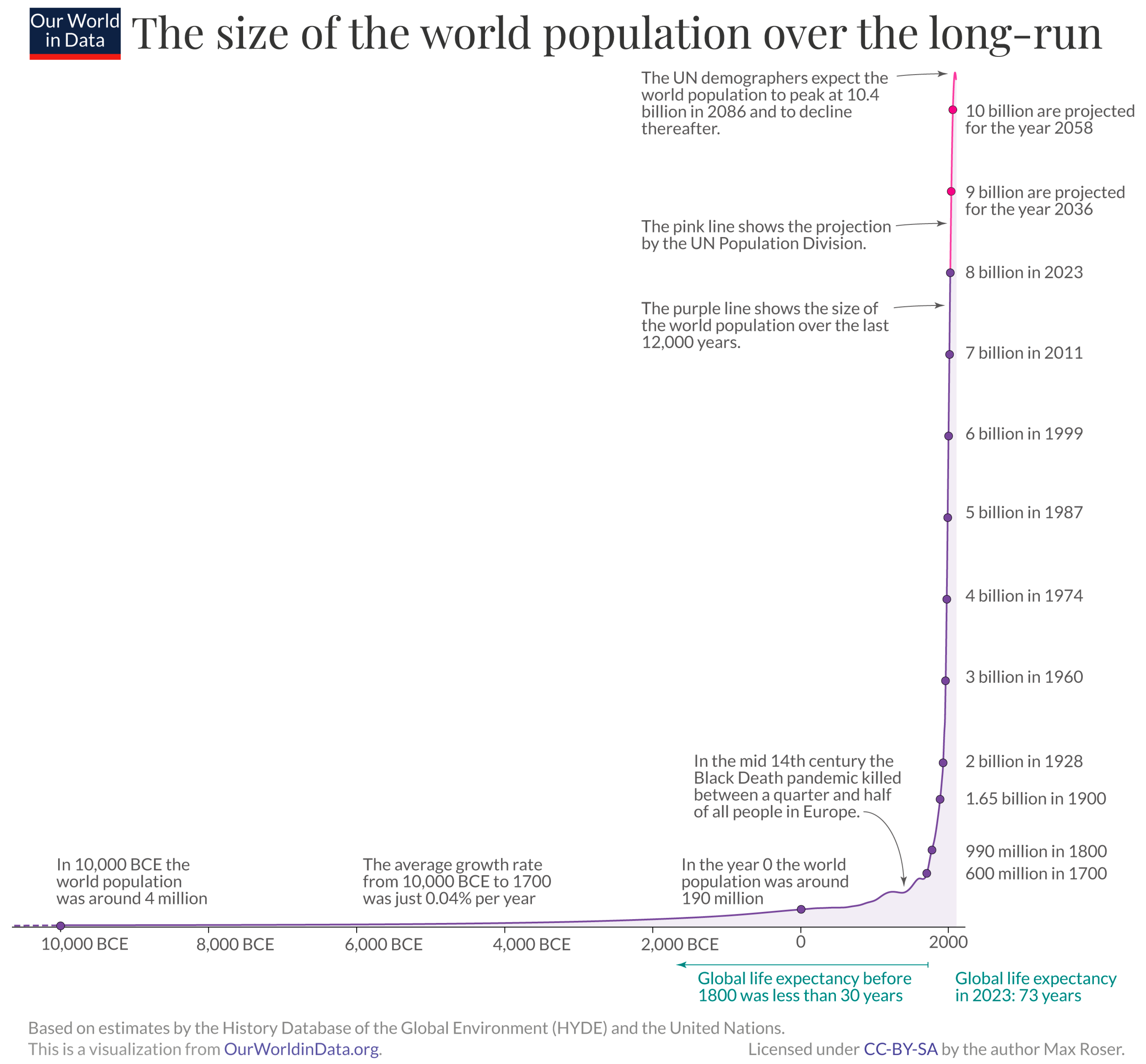

Table 1.
Numbered UN Sustainable Goals Conceptually Divided into Four Categories. A Table Created by the Author Published in [10].
Table 1.
Numbered UN Sustainable Goals Conceptually Divided into Four Categories. A Table Created by the Author Published in [10].
| # | UN Sustainable Goals | HumanInteraction | Standard of Living | Organizational Structures | Planetary Care |
| 1 | No poverty | ⬜️ | |||
| 2 | Zero hunger | ⬜️ | |||
| 3 | Good health and well-being | ⬜️ | |||
| 4 | Quality education | ⬜️ | |||
| 5 | Gender equality | ⬜️ | |||
| 6 | Clean water and sanitation | ⬜️ | |||
| 7 | Affordable and clean energy | ⬜️ | |||
| 8 | Decent work and economic growth | ⬜️ | |||
| 9 | Industry, innovation and infrastructure | ⬜️ | |||
| 10 | Reduced inequalities | ⬜️ | |||
| 11 | Sustainable cities and communities | ⬜️ | |||
| 12 | Responsible consumption and production | ⬜️ | |||
| 13 | Climate action | ⬜️ | |||
| 14 | Life below water | ⬜️ | |||
| 15 | Life on land | ⬜️ | |||
| 16 | Peace, justice, and strong institutions | ⬜️ | |||
| 17 | Partnerships | ⬜️ |
Table 2.
The Asking Order of Questions and the First Word of Each Type of Question Asked Regarding Examples of the Body of Twenty-Eight Questions Posed to Participants of the Narrative Research Process of both the HeNReG and HeNReP.
Table 2.
The Asking Order of Questions and the First Word of Each Type of Question Asked Regarding Examples of the Body of Twenty-Eight Questions Posed to Participants of the Narrative Research Process of both the HeNReG and HeNReP.
| Order | First Word | Body of Question |
|---|---|---|
| 1 | Describe | yourself regarding your research related to health |
| 2 | When | were you first interested in your research topic |
| 3 | When | did you start to feel distanced from your research |
| 4 | When | did you think you might need help with your research |
| 5 | When | did you wonder if you were pursuing the right research topic |
| 6 | Where | do you go to devote time to your research |
| 7 | Where | are you most comfortable discussing your research |
| 8 | Where | do you feel supported for working on your research |
| 9 | Where | are you most frustrated in accomplishing your research |
| 10 | Who | has devoted time to helping you pursue your research |
| 11 | Who | has kept you away from your research |
| 12 | Who | do you want to impress with your work on your research |
| 13 | Who | has provided you with the most inspiration in your research |
| 14 | What | holds you back from finding time for your research |
| 15 | What | place gives you the most joy in conducting your research |
| 16 | What | could you do to inform others of your research |
| 17 | What | significant thing do you want to accomplish in your research |
| 18 | How | has time gotten away from you as a researcher |
| 19 | How | have you found a productive place to research |
| 20 | How | would you improve to reach others as a researcher |
| 21 | How | do you organize yourself to be most effective as a researcher |
| 22 | How | would you do things differently restarting as a researcher |
| 23 | Why | have you not spent enough time as a researcher |
| 24 | Why | do you think you need a new location to research |
| 25 | Why | are people not understanding you as a researcher |
| 26 | Why | is your research valuable |
| 27 | Why | do you need to find a new approach to your research |
| 28 | Why | are you reconsidering the reason you research |
Table 3.
The Asking Order of Questions and the First Word of Each Type of Question Asked Regarding Examples of the Body of Twenty-Eight Questions Posed to Women Participants of a HeNPreG Devoted to Reconsidering Their Reproductive Expectations.
Table 3.
The Asking Order of Questions and the First Word of Each Type of Question Asked Regarding Examples of the Body of Twenty-Eight Questions Posed to Women Participants of a HeNPreG Devoted to Reconsidering Their Reproductive Expectations.
| Order | First Word | Body of Question |
|---|---|---|
| 1 | Describe | yourself regarding your potential to become pregnant |
| 2 | When | have you thought about how long pregnancy lasts |
| 3 | When | did you consider where you would live if pregnant |
| 4 | When | did you visualize the ideal man to impregnate you |
| 5 | When | have you worried about the possibility of pregnancy |
| 6 | Where | could you get help most quickly if you were pregnant |
| 7 | Where | would you go to determine if you were pregnant |
| 8 | Where | is the healthcare provider you would go to if pregnant |
| 9 | Where | do you go online to get information about pregnancy |
| 10 | Who | has spent time with you talking about pregnancy |
| 11 | Who | would give you a place to live if you were pregnant |
| 12 | Who | would tell others about your pregnancy |
| 13 | Who | has offered you valuable information about pregnancy |
| 14 | What | would you do during the nine months of pregnancy |
| 15 | What | would be comfortable in your home if you were pregnant |
| 16 | What | support would the father provide if you were pregnant |
| 17 | What | would you do if you were pregnant |
| 18 | How | would you organize your time commitments if pregnant |
| 19 | How | would you meet with your healthcare provider if pregnant |
| 20 | How | much would you tell the father about your pregnancy |
| 21 | How | would you know if you wanted to be pregnant |
| 22 | How | do you decide what information is relevant about pregnancy |
| 23 | Why | is this not the right time to be pregnant |
| 24 | Why | do concerns about the earth matter regarding pregnancy |
| 25 | Why | is there tension between men and women about pregnancy |
| 26 | Why | does it matter what you would do if you were pregnant |
| 27 | Why | should you know the health-related issues of pregnancy |
| 28 | Why | are you reconsidering your responsibility to be pregnant |
Disclaimer/Publisher’s Note: The statements, opinions and data contained in all publications are solely those of the individual author(s) and contributor(s) and not of MDPI and/or the editor(s). MDPI and/or the editor(s) disclaim responsibility for any injury to people or property resulting from any ideas, methods, instructions or products referred to in the content. |
© 2024 by the authors. Licensee MDPI, Basel, Switzerland. This article is an open access article distributed under the terms and conditions of the Creative Commons Attribution (CC BY) license (http://creativecommons.org/licenses/by/4.0/).
Copyright: This open access article is published under a Creative Commons CC BY 4.0 license, which permit the free download, distribution, and reuse, provided that the author and preprint are cited in any reuse.


