

Submitted:
02 December 2024
Posted:
04 December 2024
You are already at the latest version
Abstract
The tooling industry develops solutions year by year seeking operational efficiency improvement. Resources consumption in construction sites has attention paid when costs reduction is the way to achieve competitiveness for residential and commercial units which face a market even more demanding. Customers and shareholders are asking beyond best prices and gains, they definitely want to have tangibility for what was qualitative benefit. Safety at work is no more merely number of accidents, it is severe days off expenses and loss of reputation. Guaranteed delivery is no longer unique efficiency variable, where doing more with less is a must. Recipes can be deferred and profits maximized if what the plan was carried out within less time and resources. Taking a typical metal support element for infrastructure utilities (water, electricity, compressed air, gas, among others) as an example, this article aims to demonstrate the significant potential for reducing energy consumption when modular system replaces welded one, mainly if considered battery powered tools. Elements fixed with screws, washers, sliders and nuts reduce the complexity of assembly with 72% less time and up to 83% less material, using less and 42% cheaper labor. With an investment in tooling about 1/5 to 1/3 lower than conventional welded solution, the work becomes safer and more ergonomic. Thanks to the structure’s lower mass, the modular system saves CO2 emissions in transportation by 50% compared to the traditional solution.
Keywords:
Resumo
1. Introduction
2. Objective
3. Methodology
3.1. Design Model – Materials, Specifications, Assembly and Maintenance
3.2. Manpower – Skills, Rates, Availability and Cost
3.3. Sustainability – Manufacturing and Transportation Carbon Emissions
- − GGE is the calculated GHG emission (in g CO2 eq)
- − D is the distance to be transported (in km or miles)
- − W is the mass to be transported (in kg or t)
- − EF is the emission factor of the chosen mode of transport (in g/t.km)
4. Results and Discussions
5. Conclusion
References
- CAGED; E-SOCIAL; EMPREGADOR WEB. Construção Civil - Salários 2024, Tabela Salarial, Quanto Ganh. Available online: https://www.salario.com.br/tabela-salarial/construcao-civil/ (accessed on 22 July 2024).
- De Freitas, F.G. Elevação do custo da energia continua a restringir o crescimento econômico e a expansão da produção industrial Editora Brasil Energia. Available online: https://brasilenergia.com.br/energia/elevacao-do-custo-da-energia-continua-a-restringir-o-crescimento-economico-e-a-expansao-da-producao-industrial (accessed on 25 July 2024).
- Ghena, M.-F.; Iamandi, A.-M.; Ghiculescu, L.-D. Ghena, M.-F.; Iamandi, A.-M.; Ghiculescu, L.-D. Methods used to gain a competitive advantage in the power tool industry. Acta Tech. Napoc. 2022, 65, 1139–1146. [Google Scholar]
- GHG. About Us GHG Protocol. Available online: https://ghgprotocol.org/about-us (accessed on 22 July 2024).
- Greene, S. Freight Transportation MIT Climate Portal. Available online: https://climate.mit.edu/explainers/freight-transportation (accessed on 22 July 2024).
- Hasan, S.; Sacks, R. Integrating BIM and Multiple Construction Monitoring Technologies for Acquisition of Project Status Information. J. Constr. Eng. Manag. 2023, 149. [Google Scholar] [CrossRef]
- IEA. Iron and Steel Technology Roadmap – Analysis - IEA. Available online: https://www.iea.org/reports/iron-and-steel-technology-roadmap (accessed on 22 July 2024).
- Innella, F.; Arashpour, M.; Bai, Y. Lean Methodologies and Techniques for Modular Construction: Chronological and Critical Review. J. Constr. Eng. Manag. 2019, 145. [Google Scholar] [CrossRef]
- IPCC. Mitigation Pathways Compatible with 1.5°C in the Context of Sustainable Development. Intergovernmental Panel on Climate Change, p. IPCC. Mitigation Pathways Compatible with 1.5°C in the Context of Sustainable Development. Intergovernmental Panel on Climate Change, p. 93–174, 24 maio 2022.
- ISO. ISO 14404-1:2013 - Calculation Method of Carbon Dioxide Emission Intensity from Iron and Steel Production — Part 1: Steel Plant with Blast Furnace. Available online: https://www.iso.org/standard/57298.html (accessed on 22 July 2024).
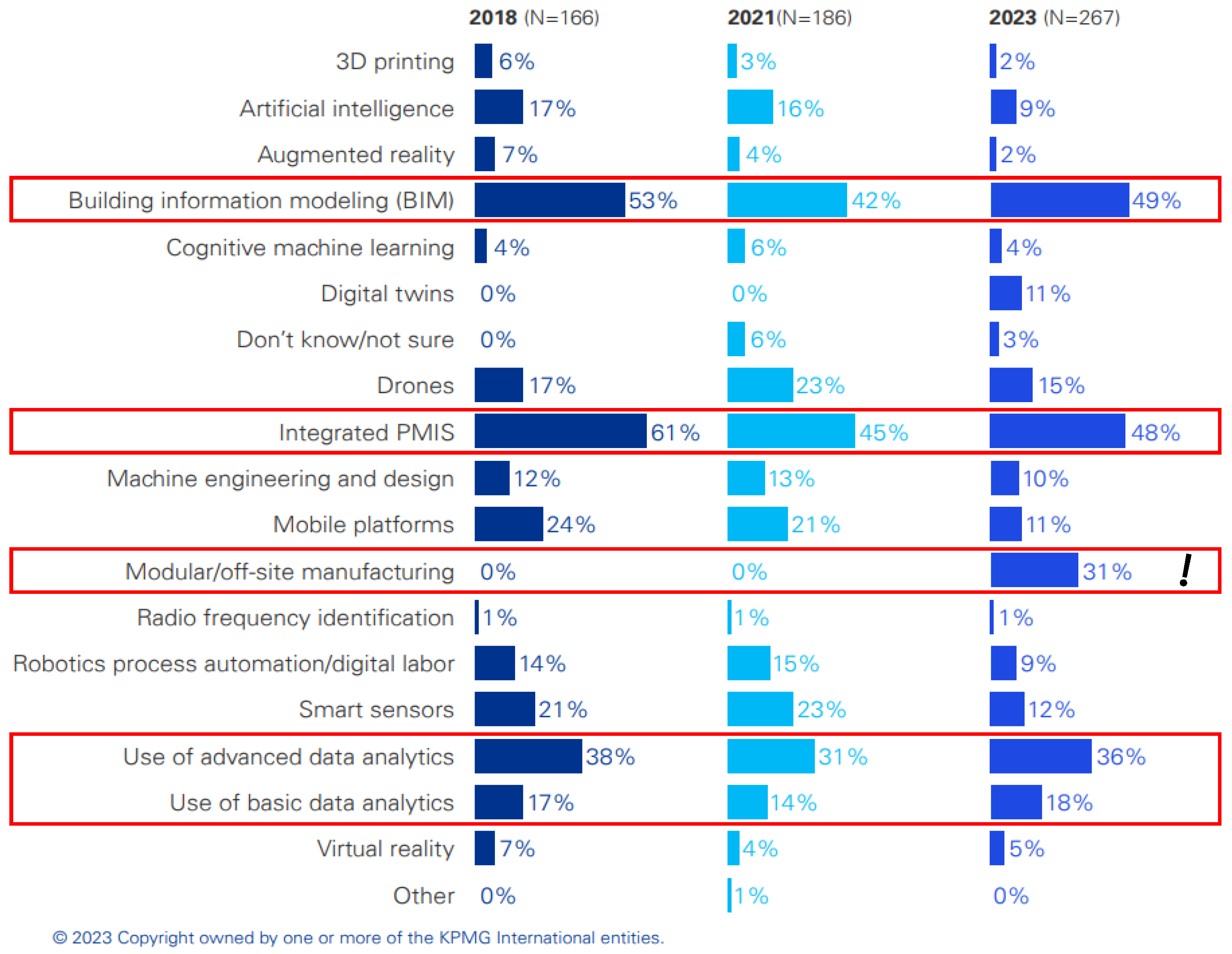
- KPMG. Familiar Challenges-New Approaches. Available online: https://kpmg.com/xx/en/home/insights/2023/05/2023-global-construction-survey.html (accessed on 7 May 2024).
- MATHERS, J. Green Freight Math: How to Calculate Emissions for a Truck Move. Environmental Defense Fund, 2015. Available online: https://business.edf.org/insights/green-freight-math-how-to-calculate-emissions-for-a-truck-move (accessed on 22 July 2024).
- OECD. OECD. Regional; Rural and Urban Development. Available online: https://www.oecd.org/en/topics/regional-rural-and-urban-development.html (accessed on 22 July 2024).
- Regmi, M.; Hanaoka, S. A framework to evaluate carbon emissions from freight transport and policies to reduce CO2 emissions through mode shift in Asia. The 3rd International Conference on Transportation and Logistics (T-LOG 2010), p. 1–16, 2010.
- Soliman, A.; et al. Innovative construction material technologies for sustainable and resilient civil infrastructure. Mater. Today Proc. 2022, 60, 365–372. [Google Scholar] [CrossRef]
- Zhao, S.; Zhang, H.; Wang, J. Cognition and system construction of civil engineering innovation and entrepreneurship system in emerging engineering education. Cogn. Syst. Res. 2018, 52, 1020–1028. [Google Scholar] [CrossRef]

| TOOL (*) |
TENSION (V) CURRENT (A) POWER (kVA) |
DIMENSION (mm) | MASS (kg) | CONSUMPTION (kWh) (**) | RELATIVE VALUE (***) |
|---|---|---|---|---|---|
Welding Machine MIG/TIG/MMA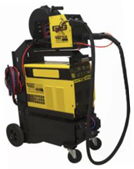
|
220 to 380 V 500A 25 kVA |
990 x 490 x 1360 | 82 | 200 | 1,0 |
Compressor for Painting
|
220 to 380 V 12 A (estimated) 10 HP (7,5 kW) |
1310 x 690 x 1630 | 275 | 60 | 0,63 |
Battery-Powered Screwdriver
|
21,6 V (screwdriver) 220 V (charger) 4 A 90 W |
147 x 93 x 224 (screwdriver) 169 x 122 x 70 (charger) |
0,95 | 0,72 | 0,32 |
| (*) The data refer to market tools manufactured by LYNUS, MOTOMIL and HILTI. (**) Theoretical consumption based on working with the power supplied and 8 hours of continuous work. (***) Relative value of equipment based on average market prices. | |||||
| SYSTEM | TYPICAL (SHAPE) | MASS | PREPARATION | PRE-ASSEMBLY | ON-SITE ASSEMBLY | TOTAL |
|---|---|---|---|---|---|---|
| Conventional Welded | 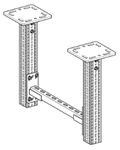 |
18 kg | 10’ | 30’ | 25’ | 65’ |
| Modular Screwed |
9 kg | 5’ | 4’ | 11’ | 20’ | |
| SAVING (1) | -50% | -50% | -87% | -56% | -69% | |
| Conventional Welded | 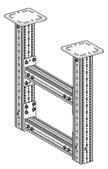 |
70 kg | 26’ | 66’ | 1h26’ | 2h58’ |
| Modular Screwed |
12 kg | 8’ | 10’ | 26’ | 44’ | |
| SAVING (2) | -83% | -69% | -85% | -70% | -75% | |
| SYSTEM | TYPICAL (SHAPE) | PREPARATION | PRE-ASSEMBLY | ON-SITE ASSEMBLY | PAINTING |
|---|---|---|---|---|---|
| Conventional Welded | 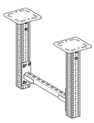 |
 |
 |
||
| Modular Screwed |
 |
- | |||
| SAVING (1) | 1 | ||||
| Conventional Welded | 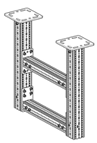 |
 |
 |
||
| Modular Screwed |
 |
- | |||
| SAVING (2) | 1 | ||||
| CBO (*) | JOB |
ROLE (hours per week) |
AVRG WAGE 2024 (R$** per month) |
TOP WAGE 2024 (R$** per month) |
|---|---|---|---|---|
| 724215 | Mechanical Welder | 44 | 2.916,10 | 5.262,28 |
| 724205 | Steel Structure Assembler | 44 | 2.209,26 | 3.738,63 |
| 723315 | Metal Structure Painter | 44 | 2.390,57 | 4.037,83 |
| DELTA (Welder/Assembler) | + 32% | + 41% | ||
| DELTA (Painter/Assembler) | + 8% | + 8% | ||
| DELTA [(Welder + Assembler + Painter) / (2x Assembler)] | +57% | + 61% | ||
| MODE | DEEC (g/t.km) |
|---|---|
| Road LGV | 400.1 |
| HGV | 118.6 |
| Rail | 28.3 |
| Small tanker | 20 |
| Large container | 13 |
| Source: IPPC emission factors for road transportation (REGMI; HANAOKA, 2010) | |
| FEATURED VARIABLES | TREND | ESTIMATE |
|---|---|---|
| ASSEMBLY Complexity |  |
- |
| Assembly MASS |  |
50 to 83% |
| Execution TIME | |
69 to 75% |
| Amount and cost of LABOR | |
41 to 43% |
| ENERGY Consumption | |
99,6% |
| Adherence to the concept of SUSTAINABILITY |  |
50% cut in GHG emissions |
| INVESTMENT level | |
1/5 a 1/3 |
| Legend: |
 More More
|
 Less Less
|
Disclaimer/Publisher’s Note: The statements, opinions and data contained in all publications are solely those of the individual author(s) and contributor(s) and not of MDPI and/or the editor(s). MDPI and/or the editor(s) disclaim responsibility for any injury to people or property resulting from any ideas, methods, instructions or products referred to in the content. |
© 2024 by the authors. Licensee MDPI, Basel, Switzerland. This article is an open access article distributed under the terms and conditions of the Creative Commons Attribution (CC BY) license (http://creativecommons.org/licenses/by/4.0/).


