
Submitted:
02 December 2024
Posted:
03 December 2024
You are already at the latest version
Abstract
Ischemic stroke is one of the types of strokes related to the low oxygen supply to the brain cells. It is subdivided into cardioembolic stroke, large artery atherosclerosis stroke, small vessel occlusion and cryptogenic stroke. The stroke is symptomized by body weakness or paralysis on one side. Its development is correlated to the genetic variations of the SERPINA1 gene that produces variants such as Z-allele variant where glutamic acid is replaced with lysine , S-allele variant where glutamic is replaced by valine and the normal M-allele variant which leads to the synthesis of less amount of AAT coupled with its deficiency (AATD) and lowering of AAT activity against the neutrophil elastase that degrades elastin in the lung tissue reducing the permeation of oxygen to the blood stream. In this study, various computational tools such as Heartbio portal, genotype-tissue expression platforms have been employed to retrieve data that relates to the stroke. The pathways in which SERPINA1 participates are identified and the genes involved in them with a regulation activity relating to the stroke were analyzed. The identified genes can be applied as biomarkers to trace the potential development of the stroke in patients with cardiovascular diseases, diabetes, obesity and others. Additionally, the genes can be employed in the therapeutical treatments of the stroke patients.
Keywords:
SERPINA1
; AAT
; Cardioembolism
; large artery atherosclerosis
; Alpha-1 Antitrypsin Deficiency (AATD)
1. Introduction
An ischemic stroke involves a blockage in blood flow in human brain. If blood flow doesn’t return quickly enough, an ischemic stroke will cause permanent brain damage or even cause death.
The blockage of blood flow is raised by a blood clot or a piece of fatty plaque which is broken off from the inside of a blood vessel. Ischemic stroke may have symptoms like drooping muscles on one side of the face, numbness on one side of the face or in one arm or leg, weakness or paralysis in one arm, leg, or side of the body, loss of sensation and abnormal sensations on one side of the body and also neck stiffness. Ischemic stroke can be caused by atherosclerosis, clotting disorders, atrial fibrillation, high cholesterol (hyperlipidemia), Type 2 diabetes and also microvascular ischemic disease. Medications and treatments used for ischemic stroke are thrombolytic drugs, endovascular mechanical thrombectomy, stroke rehabilitation [1].
1.1. Sub Types of Ischemic Strokes
Ischemic stroke is subdivided into four categories as [3]:
Large artery atherosclerosis: This describes the progressive building of plaque in the largest artery of body (aorta). This occurs in the neck and the head region responsible for approximately 15% of ischemic stroke. Plaque is a sticky substance made up of cholesterol, fat, calcium and other material that builds up in the walls of arteries leading to the hardening of the blood vessel. It is caused by factors such as smoking, unhealthy diet, or genetic predisposition. Patients with high blood pressure, high cholesterol level, high fat content, obesity, diabetes and some forms of inflammation are subjective to large artery atherosclerosis while the factor of genetic predisposition describes the tendency of physical or mental cords or disorder to be able to be inherited by the next generation. This usually results from specific genetic variations that are often inherited from a parent. These genetic changes contribute to stroke development but do not cause it directly. This explains why some people with genetic predisposition can contract the stroke while others, even in same family may not.
Cardioembolism: This is a type of stroke that involves blood clot in the brain that occurs when the heart pumps rejected materials such as cell tissue debris, blood clot to the brain where they get stuck causing the blockage of blood vessels. This is approximately 30% of ischemic stroke. The main factors that can tribute to this kind of stroke are; fragments of calcifications that grow due to small deposits of calcium in the tissues, tumor tissue where by the tissue cells divide abnormally leading to blockage of the blood vessel or decrease in the diameter of blood vessels, tumors can be benign (not cancerous) or malignant (cancerous) and other factors such as fragment from vegetarian (septic or aseptic).
Small vessel occlusion: It refers to as subcortical stroke caused by the blockage or leaking of a small, deeply located branch of a large artery in the brain, initially due to high blood pressure. This results into movement and /or sensation difficulties in some sides of body. With eventual deprivation of oxygen supply and nutrients to the brain, the brain cells will die off.
Cryptogenic stroke: This refers to stroke caused by other factors besides cardioembolism, large artery atherosclerosis and small vessel occlusion. This kind of stroke is further divided into two: stroke with determined etiology and stroke with undetermined etiology. It is a stroke that is identified as cerebral stroke of obscure or unknown origin. The main cause of this stroke is not quantifiable neither is identifiable and it contributes to around 25–40% of all ischemic strokes. It can be symptomized by body weakness or paralysis on one side, dizziness, speaking difficulties and also confusion.
1.2. Alpha-1 Antitrypsin Role in Ischemic Stroke
Alpha-1 antitrypsin (AAT) is a protein belonging to the serpin superfamily encoded by the SERPINA1 gene in human, located on the long arm of chromosome 14 (14q32.1). The SERPINA1 gene provides instructions for preparing a protein called alpha-1 antitrypsin, which is a type of serine protease inhibitor (serpin). Alpha-1 antitrypsin is produced in the liver and then it is transported throughout the body through the blood [19].
AAT inhibits the enzyme neutrophil elastase which is released from white blood cells to fight infections providing protection to the lung tissue from neutrophil elastase. Neutrophil elastase, an enzyme, which can damage lung tissue if not properly controlled through its digestive activity of the elastin found in the alveolar region of the lungs. Regulation of neutrophil elastase activity is critical to main tissue homeostasis and preventing tissue damage [19].
1.3. Serpina1 Variants (Modified from MedlinePlus [Internet]. Bethesda (MD): National Library of Medicine (US)
Figure 1.
represents the serpina1 variants due to substitution mutation at positions of 342 for Glu to Lys and 264 for Glu to Val. M- variant is a normal variant of AAT [19].
Figure 1.
represents the serpina1 variants due to substitution mutation at positions of 342 for Glu to Lys and 264 for Glu to Val. M- variant is a normal variant of AAT [19].
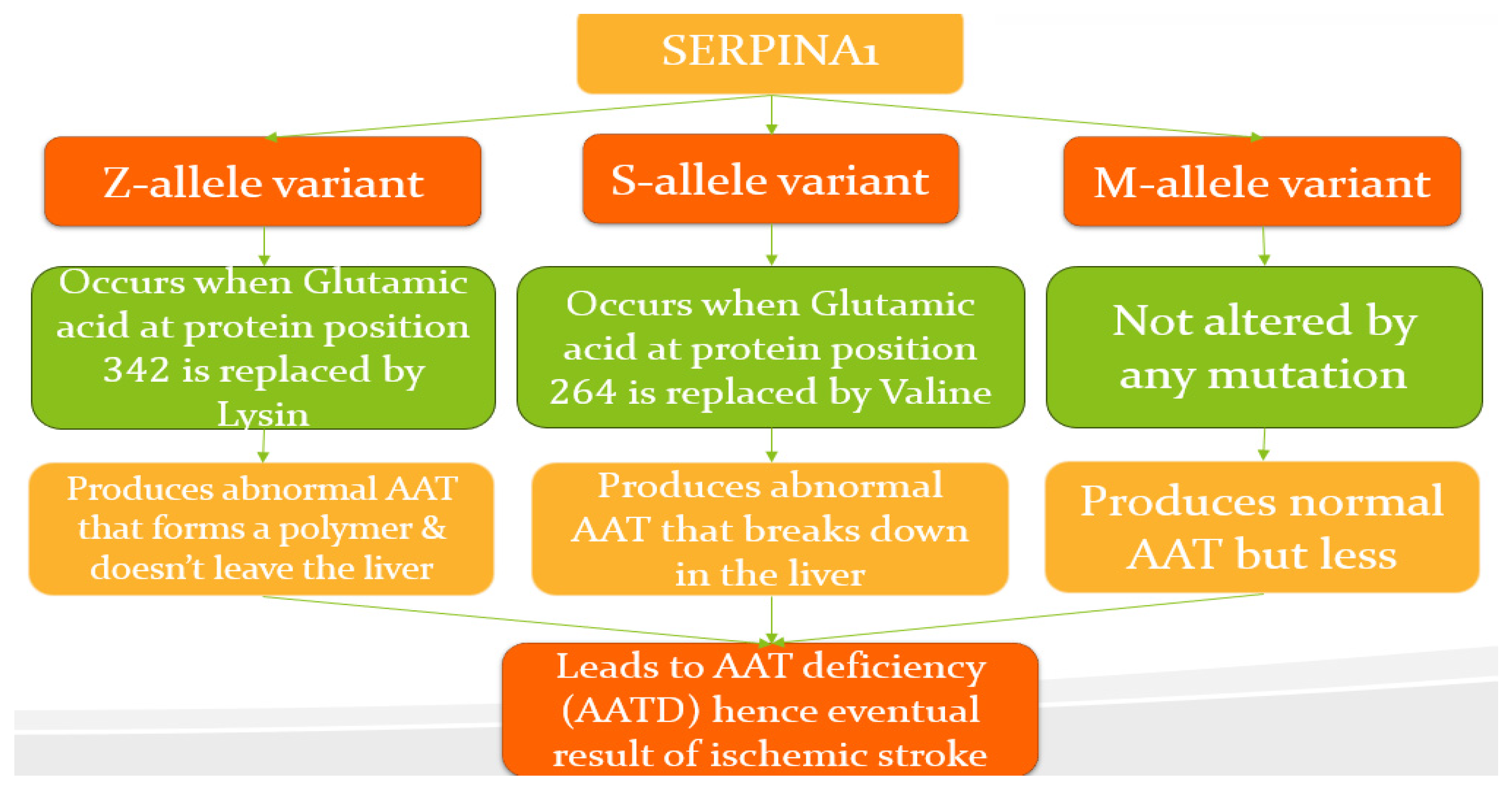
Mutations in the SERPINA1 gene [23] are associated with alpha-1 antitrypsin deficiency, which is a genetic disorder distinguished by low levels of alpha-1 antitrypsin in the blood. This protein also functions as a part of innate antiviral immunity. Any Defects in this gene can cause the deficiency of plasminogen activator inhibitor-1 (PAI-1 deficiency), and high concentrations of this gene product are connected with thrombophilia.
More than 100 variants of SERPINA gene have been connected with a condition, Alpha 1 Antitrypsin deficiency. AAT deficiency results in the development of lung diseases such as Emphysema, Chronic Obstructive Pulmonary Disease (COPD), Bronchiectasis and it can also predispose individual to liver diseases like Liver cirrhosis, Liver failure. Diagnosis of AAT deficiency involves blood tests to measure the levels of AAT and identifying any genetic mutations in the SERPINA1 gene [19].
2. Literature Review
Ischemic stroke occurs when the blood supply to the part of the brain is blocked or reduced, this will cut down the supply of oxygen and nutrients supply to the brain which will leads to the brain death, ischemic stroke is caused by the blocked artery in the brain where the blood vessel is narrowed or blocked which will reduce the blood flow.
Andrei & Balaji, (2023), found out that ischemic stroke is a sudden neurologic deficit that result from focal cerebral ischemia associated with permanent brain infarction, Common causes are atherothrombotic occlusion of large arteries; cerebral embolism, non-thrombotic occlusion of small, deep cerebral arteries. Normal variations in the circle of Willis and in the caliber of various collateral vessels, atherosclerosis, and other acquired arterial lesions can interfere with collateral flow, increasing the chance that blockage of one artery will cause brain ischemia.
Zhang, Ka et al. (2023) found out that ischemic stroke is a heterogeneous condition influenced by a combination of genetic and environmental factors. Ischemic stroke involves two critical stages including the disruption of cerebral blood supply, and the subsequent development of cerebral tissue hypoxia and necrosis. Cerebral small vessel disease (CSVD) contributes to approximately 20% of all strokes, including 25% of ischemic strokes Cerebral autosomal-dominant arteriopathy with stroke and ischemic leukoencephalopathy (CADASIL) is the first and most common inherited CSVD syndrome described in the literature. CADASIL arises from mutations in the NOTCH3 gene located on Chromosome 19p13, and is inherited in an autosomal-dominant manner.
Aleksandra Ekkerte et al. (2021), found out that Cerebral Autosomal Dominant Arteriopathy with Subcortical Infarcts and Leukoencephalopathy (CADASIL) is most common monogenic cause of ischemic stroke. It is caused by a pathogenic variant of NOTCH3 gene. Fabry’s disease is caused by GLA gene mutation resulting in lysosomal enzyme α galactosidase A deficiency. Retinal vasculopathy with cerebral leukodystrophy (RVCL) is an autosomal dominant disorder caused by mutation in the TREX1 gene. Other genes related to small-vessel disease resulting in lacunar ischemic and hemorrhagic stroke are COL4A1 and COL4A2; both are located on 13 chromosome (13q34 locus) and encode α1 and α2 chains of type IV collage. Two genes (PITX2 and ZFHX3), located in chromosomes 4q25 and 16q22 were identified to be significant risk factors of cardio embryonic CE stroke.
Ilaria Ferrarotti et al. (2024), found out that low alpha 1 antitrypsin level (AAT)serum level, resulting from variations in SERPINA1 causes alpha-1 antitrypsin deficiency (AATD), the most frequently found variants in AATD, with the Z variant present in most individuals diagnosed with AATD. However, there are many other less frequent variants known to contribute to lung and/or liver disease in AATD. This article identified a total of 7631 rare variants and 216 types of rare variant across 80 counties.
Gabriela Santos and Alice M Turner (2020) found that the alpha-1 antitrypsin (AAT) protein is encoded by the SERPINA1 gene on chromosome 14, and its main function is to inactivate neutrophil elastase (NE) upon insult to the lungs, such as smoking. During the absence of AAT, there is an imbalance of proteinases and anti-proteinases, which leads to the progression of emphysema and deterioration of lung function, resulting in chronic obstructive pulmonary disease (COPD). In some mutations, polymerization of AAT in alveolar macrophages and the presence of pro-inflammatory AAT polymers, previously reported to be obtained in bronchoalveolar lavage in Pi∗ZZ patients, contribute to the pathogenesis in AATD lungs.
Steven K. Feske (2021), found out that ischemic stroke is a cerebral infraction, with inadequate supply of blood to cerebral tissue. first there is a reversible loss of tissue function and, given enough time, infarction with loss of neurons and supportive structures. These events start with the loss of electrical function and progresses to disturbance of membrane function with calcium influx leading to calcium-dependent excitotoxicity, generation of reactive oxygen species.
3. Methodology and Tools Used
3.1. Materials
The materials that were required for retrieval of datasets about the stroke included alpha-1 antitrypsin protein sequence as well as Serpina1 gene sequence.
3.2. Tools Used
PDB: The Protein data Bank database is a world-wide database maintained by the consortium of global organizations that include RCSB (Research Collaboration for Structural Bioinformatics) in United states, PDBe in Europe, PDBj in Japan and Electron Microscopy Data Bank (EMDB) and others. The database provides global access to the user to observe and retrieve data concerning various proteins. The PDB provides three-dimensional data about proteins such as their three-dimensional structures for large biological molecules like proteins and nucleic acids. The information/data uploaded to the database is first verified authentic scientifically and mostly obtained from experiments using methods such as X-ray crystallography, Nuclear Magnetic Resonance (NMR) spectroscopy, cryo-electron microscopy and others. The database is accessed through its website http://www.rcsb.org/ and all data can be accessed by use of keywords or accession numbers through search or advanced search options.
GenBank Database: This is a DNA database that provides open access to annotated collection of all publicly available nucleotide sequences and their protein translations on the GenBank result page. The database is part of the International Nucleotide Sequence Database Collaboration that comprises of DNA Data Bank of Japan (DDBJ), European Nucleotide Archive (ENA), and GenBank itself. It is maintained by National Centre for Biotechnology Information (NCBI) at the National Library of Medicine under National Institute of Health in the United States. It provides all information about genes and their proteins which can be accessed through use of keywords especially gene names. GenBank is accessed through its website address http://www.ncbi.nlm.nih.gov/genbank.
GTEx: Genotype-Tissue Expression abbreviated for GTEx is a database project that utilizes state-of-the-art protocols to study and analyses the human gene expression and regulation. The database provides all kind of information about the gene expression in various tissues, sex of people, gender, and also age brackets to provide the activity track of the gene activity and any of the genetic variations can be studied and determined. It also exploits the use of WGS, WES and RNAseq methods for the obtaining of molecular data of the genes. The database can be accessed through its website address https://www.gtexportal.org/
UniProt: The Universal Protein database (UniProt) is a freely accessible protein database that avails its users with information about the protein. This information involves the protein sequence, function and others derived from the genome sequencing projects. It is maintained by the UniProt consortium comprising of European Bioinformatics Institute (EBI) in United Kingdom., Swiss Institute of Bioinformatics (SIB) in Switzerland, Protein Information Resource (PIR) in the United States. The database can also be accessed through https://www.uniprot.org/
PathCards: This database is found under the collection of Pathway Unification database. It is an integrated database of human biological pathways and their annotations. Human pathways are clustered into Super Paths based on the genes involved and their similarity in function/activity. It allows the user to view pathway networks connectivity within a superpath along with the genes involved. The pathways information is consolidated from around twelve (12) databases that are providing a comprehensive streamlined analysis of experiments. It can be accessed through the website address https://pathcards.genecards.org/ using the names of the genes inserted into the search option provided.
Heartbio Portal: This is a data collection of all cardiovascular disease genetics data that provides computational infrastructural platform for visualizing, analyzing and downloading publicly available cardiovascular disease datasets. The datasets comprise of gene expression, genetic association as well as ancestry information extracted from different organizations such as Ensembl, ClinVar, NHGRI-EBI GWAS catalog, OMIM, GTEx and others. The GWAS datasets are filtered to a p-value less than 0.05. The portal employs limma to determine genes that are expressed differently across experimental conditions and variants found in known protein product correlated with various phenotypes. All the available data can be accessed and downloaded freely for publishing without restrictions. The database is accessed through its website address https://www.heartbio.portal.com/ and results are retrieved with use of a keyword search.
3.3. Methods and Protocol
UniProt: The website is accessed through its address and the name of the protein—Alpha-1 antitrypsin—was used as a query keyword in the search box. On the results page, the result card with A1AT_HUMAN of entry number P01009 and sequence length 418 amino acids was selected. On the next page, the gene responsible for the synthesis of alpha-1 antitrypsin protein was identified, observed and analyzed. The protein sequence was retrieved and stored in FASTA format for use in next steps.
PDB: This database was accessed also and the protein name was used as the search term and the structural data of entry 1HP7 derived from Homo sapiens using X-ray crystallography was selected, observed and analyzed.
GenBank: The data about the SERPINA1 gene was obtained from the database through use of the gene name in the search box and the information about the gene including its location in the Homo sapiens species was retrieved and analyzed.
GTEx: In the search box of the database, the gene name was inserted and the gene was selected from the result table. The gene expression in bulk and single tissue was observed and analyzed. Using the Expression PCA (Principal Component Analysis), the expression of the gene the liver was observed for the sample traits that included age bracket, autolysis score, Hardy scale, ischemic time and sex.
PathCards: On the website homepage, the gene name was also used in the Search PathCards box as the search term. On the result page, the pathways in which SERPINA1 is related, connected or present were noted and the genes in those pathways were used to obtain information in the Heartbio portal in the next steps.
Heartbio Portal: The datasets from this portal were retrieved through use of the genes’ names from the pathways in PathCards. On the result page, the results were obtained for the p-value set to less than 0.05 in all traits [18]. The genetic association datasets, differential expression of genes in relation the stroke and genetic variants were downloaded, observed and analyzed.
4. Results
Figure 2.
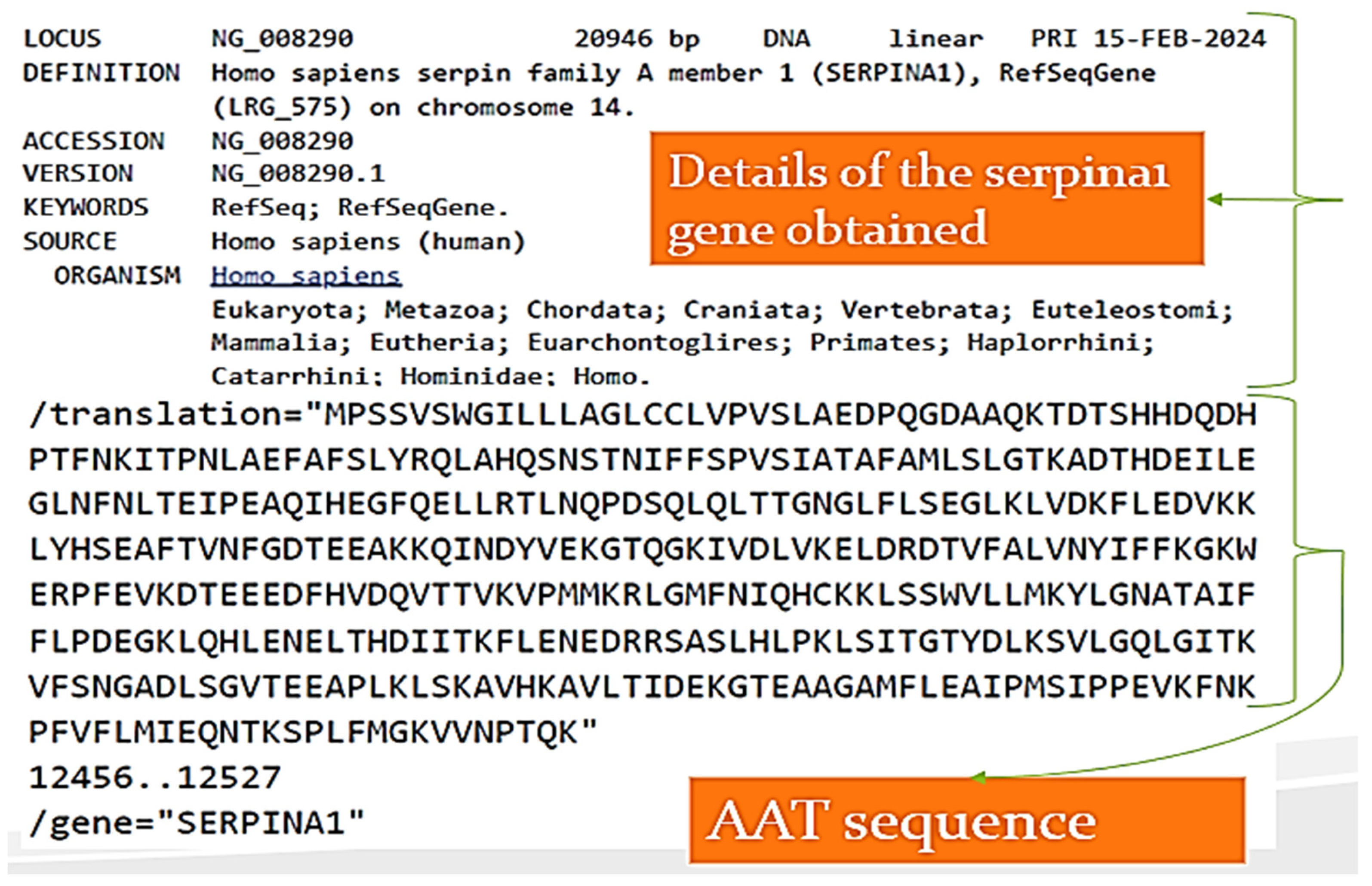
represents the FASTA format of the alpha-1 antitrypsin protein retrieved from the UniProt database. The sequence corresponds to the UniProt entry number P01009 and has a total of 418 amino acids long [31].
Figure 2.
represents the FASTA format of the alpha-1 antitrypsin protein retrieved from the UniProt database. The sequence corresponds to the UniProt entry number P01009 and has a total of 418 amino acids long [31].
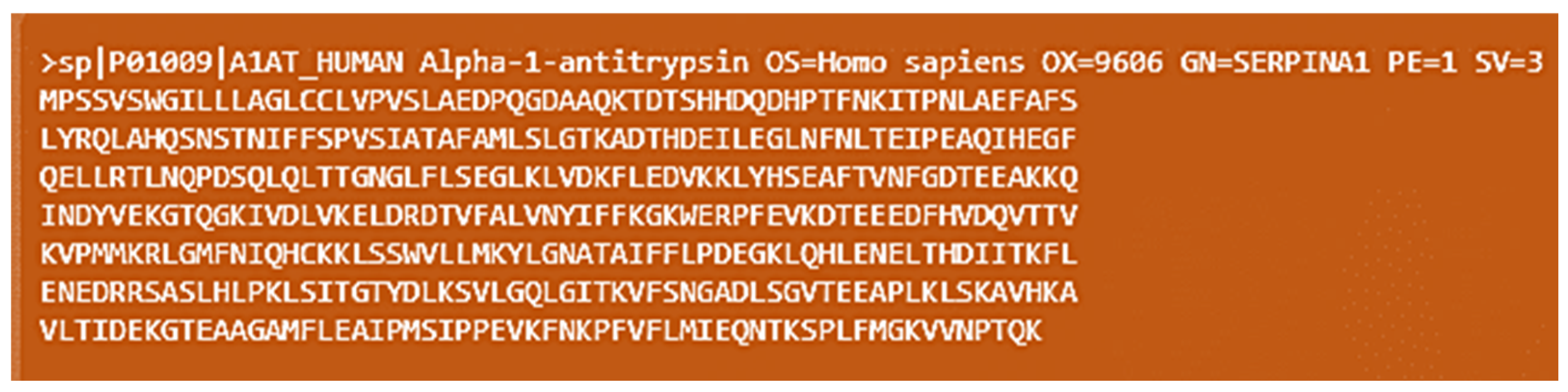
Figure 3.
represents the three-dimensional structure of the alpha-1 antitrypsin protein. The protein consists of only one chain. On the right-side, protein AAT structure is visualized in PyMol with a retrieval code as 1HP7. It consists of both alpha helices and beta strands that are connected by turns and loops. (Kim et. al, 2021).
Figure 3.
represents the three-dimensional structure of the alpha-1 antitrypsin protein. The protein consists of only one chain. On the right-side, protein AAT structure is visualized in PyMol with a retrieval code as 1HP7. It consists of both alpha helices and beta strands that are connected by turns and loops. (Kim et. al, 2021).
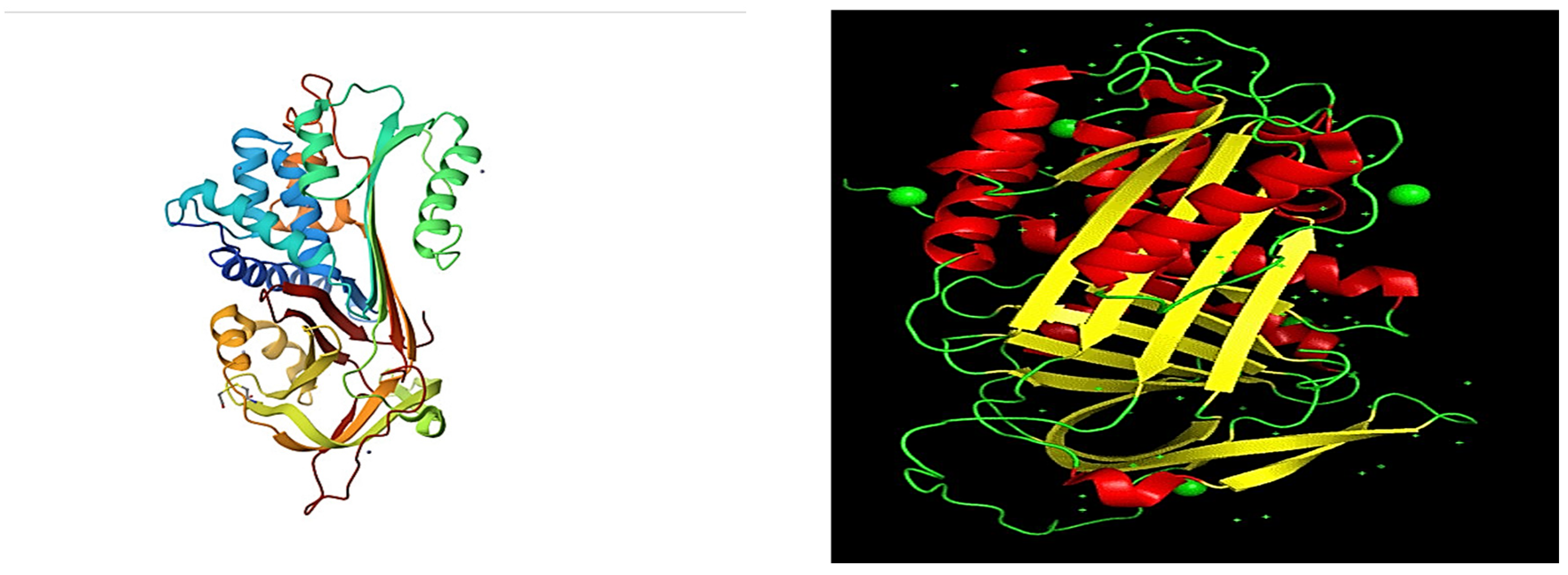
Figure 4.
represents the basic information retrieved about the Serpina1 gene. It is found on chromosome 14 with 20946 base pairs. Below in FASTA format is the sequence of the AAT protein synthesized from the three exons of the gene (Data is extracted from GenBank with Accession number NG_008290).
Figure 4.
represents the basic information retrieved about the Serpina1 gene. It is found on chromosome 14 with 20946 base pairs. Below in FASTA format is the sequence of the AAT protein synthesized from the three exons of the gene (Data is extracted from GenBank with Accession number NG_008290).
The data presented in the Figure 5, Figure 6 and Figure 7 were respectively obtained from Bulk & Single tissue expression for SERPINA1, Liver expression principal component analysis with accession number ENSG00000197249.13 on the GTEx Portal on 02/03/24
The graphical figure below represents the expression of the serpina1 gene with regard to various traits such as sex variations, ischemic time and age bracket.
From the PathCards database, thirteen (13) pathways were identified to have involvement and participation of the serpina1 gene or its protein. These pathways included the following;
- 1)
- Embryonic and induced pluripotent stem cells and lineage markers pathway.
- 2)
- P73 transcription factor network pathway.
- 3)
- Nuclear receptors meta pathway.
- 4)
- FOXA1 transcription factor network pathway.
- 5)
- Vesicle mediated transport pathway.
- 6)
- Metabolism of proteins pathway.
- 7)
- Lung fibrosis pathway.
- 8)
- Response to elevated platelet cytosolic Ca2+ pathway.
- 9)
- Transport to the golgi and subsequent modification pathway.
- 10)
- Diseases of hemostasis pathway.
- 11)
- Regulation of insulin-like growth factors (IGF) transport and uptake by insulin-like growth factors binding proteins (IGFBPs) pathway.
- 12)
- Innate immune system pathway that included the neutrophil degranulation pathway.
- 13)
- COPII-mediated vesicle transport pathway.
Out of these pathways, genes related to the stroke in terms of differential expression have been analyzed with help of Heartbio portal and around 1800 genes have been identified to have relation to stroke either pre- or post-stroke occurrence.
These genes in their respective pathways have been clustered into tables presenting the gene name, the kind of ischemic stroke to which it is involved/related, the genetic variants and the protein identification numbers or accession numbers that can avail complete information about the gene and its protein as well as the variants in existence.
Keywords words used in the tables below;
- ❖ Cardioembolic
- ❖ Large artery atherosclerosis
- ❖ Small vessel—this means small vessel occlusion stroke
- ❖ Others—these include those with determined etiology other than cardioembolic, large artery atherosclerosis or small vessel and those with undetermined etiology
- ❖ Variants—in the gene
- ❖ Protein ID—given in form of nucleotide data ID because the gene can be accessed in GenBank and its protein translation is provided on the GenBank file.
- ❖ NA—for “Not Available” represents that the particular data about the gene is not available at the moment of writing.

Table 1.
represents the genes that are involved in lung fibrosis pathway that are connected to the regulation of ischemic stroke [12,18].
| Genetic Association and Differential expression with stroke | ||||
| Gene | Regulation |
Stroke subtype (phenotype) | Variants | Protein ID |
| Lung fibrosis pathway | ||||
| SERPINA1 | Up | Cardioembolic, Large artery atherosclerosis & others | intron variant | NM_001002235.2 NM_000295.4 NM_001002235.2 |
| CCR2 | Up | Others Cardioembolic, Large artery atherosclerosis |
synonymous variant, Upstream gene variant | NM_001123396.1 NM_001123041.2 NM_001123041.2 |
| CCR3 | Down | cardioembolic | Intron variant | NM_178328.1 |
| CEBPB | Up & down | Others | Downstream gene variant | NM_005194.3 |
| FAM13A | Up & down | Cardioembolic, Small-vessel occlusion | Intron variant, downstream gene variant | NM_000589.3 NM_172348.2 NM_000589.3 |
| FGF1 | Up | NA | Missense | NM_000800.4 |
| GREM1 | Up | Cardioembolic, large artery atherosclerosis, & others | Intron & upstream variant | NM_013372.6 NM_001191322.1 NM_001191323.1 |
| PDGFB | Down | Large artery atherosclerosis & others | Intron & upstream variant | NM_002608.3 NM_033016.3 |
| PLAU | Up | Cardioembolic, large artery atherosclerosis, small vessel and others | Downstream, intron, splice and 3′ UTR variants | NM_002658.4 NM_001145031.2 NM_001319191.1 |
| TGFB1 | Up | Others | Intron variant | NM_000660.6 |
| TIMP1 | Up | NA | NA | NA |
The genes such as FAM13A, CCR2, CCR3 and others in this pathway have participation roles in the repair of the lung tissue and any sort of dysregulation leads to the scarring of the alveolar region reducing the permeability of oxygen in to blood for supply.
Table 2.
represents the embryonic and induced pluripotent stem cells and linear markers which included genes responsible for embryogenesis and development. Genes like CXCR4, LMO2, and others have advanced roles in strokes such as small vessel and large artery atherosclerosis [12,18].
| Embryonic and induced pluripotent stem cells and linear marker pathway | ||||
| Gene | regulation | Stroke subtype (phenotype) | Variants | Protein ID |
| ATF2 | Up | Cardioembolic, large artery atherosclerosis, small vessel & others | Synonymous, intron, splice-region, & sequence feature variants | NM_005171.4 NM_001256090.1 NM_001256091.1 NM_001256092.1 |
| CXCR4 | Up | Small vessel | Synonymous variant | NM_001008540.1 |
| FGF18 | Up & down | Cardioembolic & large artery atherosclerosis | Intron variant | NM_003862.2 |
| GATA2 | Down | Small vessel, large artery atherosclerosis & others | 5′ UTR, intron, missense, upstream variants | NM_001145661.1 NM_032638.4 |
| HNF1B | Down | Small vessel, Cardioembolic, large artery atherosclerosis & others | 3′ UTR, intron & upstream variants | NM_001165923.3 NM_000458.3 NM_001304286.1 |
| ITGB1 | Up | Small vessel, Cardioembolic, large artery atherosclerosis & others | 5′ UTR, intron, downstream, & upstream gene variants | NM_133376.2 NM_033668.2 NM_002211.3 |
| KDR | Up | Cardioembolic, large artery atherosclerosis & others | Intron, missense, & structural interaction variants | NM_002253.2 |
| KLF5 | Up | Cardioembolic, large artery atherosclerosis, small vessel & others | Upstream, intron & downstream gene variants | NM_001286818.1 NM_001730.4 |
| LGR4 | Down | Cardioembolic, large artery atherosclerosis & others | Intron variant | NM_018490.2 |
| LMO2 | Up | Large artery atherosclerosis & others | Synonymous, intron & upstream gene variant | NM_001142315.1 NM_005574.3 NM_001142316.1 |
| LMO4 | Up & down | Small vessel & others | Intron variant | NM_006769.3 |
| LRIG1 | Down | Cardioembolic, Large artery atherosclerosis & others | Intron & missense variants | NM_015541.2 |
| ONECUT2 | Up & down | Cardioembolic, large artery atherosclerosis & others | 3′ UTR & intron variants | NM_004852.2 |
| PAX4 | Up | NA | Missense & synonymous | NM_006193.2 |
| PROX1 | Down | Cardioembolic, large artery atherosclerosis, small vessel & others | Upstream, downstream, 3′ UTR & intron variant | NM_001270616.1 NM_002763.4 |
| SLC2A2 | Up | Cardioembolic, large artery atherosclerosis & others | Downstream, upstream, intron, synonymous & missense variants | NM_001278658.1 NM_000340.1 |
| SOX9 | Down | Others | Intron variant | NM_000346.3 |
| TCF3 | Down | Cardioembolic, large artery atherosclerosis, small vessel & others | Upstream, downstream, synonymous, splice-region, intron, 3′ UTR & missense | NM_003200.3 NM_001136139.2 |
| THPO | Up | Cardioembolic, small vessel & others | Upstream, downstream & intron variants | NM_001290003.1 NM_000460.3 NM_001177597.2 NM_001290026.1 |
Table 3.
shows the genes having connected activities to the p73 gene. These activities involve cell cycle arrest, apoptosis and others as discussed further in findings and discussions [12,18].
| p73 transcription factor pathway | ||||
| Gene | regulation | Stroke subtype (phenotype) | Variants | Protein ID |
| ADA | Up | Cardioembolic, large artery atherosclerosis, small vessel & others | Downstream, intron, structural interaction, missense, 5′ UTR, upstream, noncoding transcript variant | NM_000022.3 NM_001322050.1 NM_001322051.1 |
| BAK1 | Down | Large artery atherosclerosis | Intron variant | NM_001188.3 |
| BAX | Up | Cardioembolic, large artery atherosclerosis, small vessel | Intron, downstream, upstream gene variant | NM_001291428.1 NM_001291429.1 NM_001291430.1 NM_004324.3 NM_138761.3 |
| BIN1 | Down | NA | Missense & synonymous | NM_139343.2 |
| BUB1 | Up | Cardioembolic, small vessel & others | Intron, sequence feature, upstream, downstream, splice-region variants | NM_001278616.1 NM_004336.4 NM_001278617.1 |
| CCNA2 | Up | Large artery atherosclerosis | Intron & 5′ UTR variant | NM_001237.3 |
| CDK2 | Up | Small vessel | Downstream gene variant | NM_001798.4 NM_001290230.1 |
| CDKN1A | Up | Cardioembolic, large artery atherosclerosis, small vessel & others | Upstream, intron, 5′ UTR, synonymous, missense, 3′ UTR, sequence feature & downstream gene variant | NM_078467.2 NM_000389.4 NM_001220777.1 NM_001291549.1 |
| FBXO45 | Up | Others | Intron variant | NM_00105573.1 |
| GDF15 | Up | NA | Missense, synonymous & conservative in-frame insertion variant | NM_004864.2 |
| HSF1 | Down | Large artery atherosclerosis | Intron variant | NM_005526.2 |
| IL1RAP | Up | NA | Missense, synonymous, & splice region variants | NM_001167931.1NM_001167928.1 |
| IL4R | Up | Cardioembolic, large artery atherosclerosis, small vessel & others | 3′ UTR, downstream, upstream, splice region, sequence feature & intron | NM_000418.3 NM_001257406.1 NM_001257407.1 |
| JAK1 | Up | NA | Missense & synonymous | NM_001320923.1 NM_001321857.1 |
| MAPK14 | Up | Cardioembolic, large artery atherosclerosis, small vessel & others | Upstream, 3′ prime, intron, downstream & sequence feature variants | NM_139013.2 NM_139012.2 NM_001315.2 |
| NSG1 | Down | Small vessel, cardioembolic & others | Intron, upstream & downstream gene variants | NM_001040101.1 NM_001287763.1 NM_001287764.1 |
| PEA15 | Down | Large artery atherosclerosis, cardioembolic & others | Splice-region, intron, 3′ UTR, 5′ UTR, downstream & upstream gene variants | NM_001297576.1 NM_001297577.1 NM_001297578.1 NR_123724.1 |
| PML | Up & down | NA | Missense variants | NM_033239.2 NM_033250.2 NM_033238.2 NM_033249.2 |
| RAD51 | Up | Large artery atherosclerosis & cardioembolic | Intron, upstream downstream, 3′ UTR & 5′ UTR variants | NM_001164269.1 NM_001164270.1 NM_002875.4 NM_133487.3 |
| RB1 | Up | Large artery atherosclerosis, cardioembolic & others | Intron variant | NM_000321.2 |
| RELA | Down | Small vessel, large artery atherosclerosis & others | Downstream, intron & upstream variants | NM_001145138.1 NM_001243984.1 NM_021975.3 |
| SFN | Up | NA | Synonymous variant | NM_006142.3 |
| SP1 | Up | Cardioembolic, large artery atherosclerosis & others | Downstream, intron & upstream variants | NM_138473.2 NM_001251825.1 NM_003109.1 |
| TP63 | Up | NA | Synonymous variant | NM_0061422.4 NM_001329964.1 NM_001114982.1 NM_001329146.1 NM_001329148.1 NM_001114980.1 |
| TUBA1A | Up | Large artery atherosclerosis | Intron variant | NM_001270399.1 NM_001270400.1 |
Table 4.
represents the nuclear receptors that shows relatedness to the stroke regulation in terms of their gene’s expression during pre- or post-stroke development [12,18].
| Nuclear receptors meta-pathway | ||||
| Gene | regulation | Stroke subtype (phenotype) | Variants | Protein ID |
| ABCB1 | Down | Large artery atherosclerosis, cardioembolic & others | Intron, 5′ UTR & 3′ UTR variants | NM_000927.4 |
| ABCC3 | Down | Cardioembolic, large artery atherosclerosis & small vessel | Upstream & intron variants | NM_003786.3 NM_001144070.1 |
| ABCG8 | Up | Large artery atherosclerosis, small vessel, cardioembolic & others | Upstream, intron, synonymous & missense variants | NM_022437.2 |
| ACKR3 | Down | Large artery atherosclerosis & cardioembolic | Intron & synonymous variants | NM_020311.2 |
| ALAS1 | Up | Cardioembolic | Upstream, intron & downstream gene variants | NM_001304444.1 NM_001304443.1 NM_000688.5 NM_199166.2 |
| APOA2 | Up | NA | Missense & synonymous | NM_001643.1 |
| APOA5 | Up | Cardioembolic, small vessel & others | Downstream & upstream gene variants | NM_001166598.1 |
| ARL5B | Up | NA | Splice region & synonymous | NM-178815.3 |
| ARNT | Up | Cardioembolic & large artery atherosclerosis | Upstream, downstream, intron, 3′ UTR variants | NM_001668.3 NM_001197325.1 NM_001286035.1 NM_001286036.1 |
| BIRC2 | Up | Cardioembolic, small vessel & large artery atherosclerosis | Intron, sequence feature, upstream, 5′ UTR, downstream gene variants | NM_001256163.1 NM_001166.4 NM_001256166.1 |
| BLVRB | Down | NA | Missense & synonymous | NM_000713.2 |
| CAP2 | Down | Large artery atherosclerosis, small vessel & others | Intron variant | NM_006366.2 |
| CBR3 | Down | Cardioembolic | Structural interaction variant | NM_001236.3 |
| CCL20 | Down | Large artery atherosclerosis & cardioembolic | Upstream & downstream variant | NM_004591.2 |
| CPT1A | Up | Cardioembolic, small vessel & others | Upstream, downstream, intron, missense, synonymous, splice region | NM_001876.3 NM_001031847.2 |
| CPT2 | Up | Small vessel & others | Intron & downstream | NM_000098.2 |
| CYP1A2 | Down | Others | Intron & synonymous | NM_000761.4 |
| CYP1B1 | Up | Others | Intron variant | NM_000104.3 |
| CYP2C9 | Up & down | Cardioembolic, large artery atherosclerosis, small vessel & others | Intron & sequence feature variants | NM_000771.3 |
| CYP3A5 | Down | Large artery atherosclerosis, small vessel & others | Intron, splice acceptor, downstream gene variants | NM_000777.4 NR_033807.2 NM_001291829.1 NM_001291830.1 |
| DNAJB1 | Up | Cardioembolic & large artery atherosclerosis | Upstream & 3′ UTR variant | NM_006145.2 NM_001300914.1 |
| EPB41L4B | Up & down | Cardioembolic, large artery atherosclerosis, small vessel & others | Intron, missense, splice region, upstream, | NM_019114.4 |
| EPHA3 | Down | NA | Missense, synonymous & splice region variant | NM_005233.5 |
| ETNK2 | Down | Cardioembolic, large artery atherosclerosis, small vessel & others | Missense, intron, upstream & downstream gene variants | NM_018208.3 NM_001297760.1 NM_001297761.1 NM_001297762.1 |
| FGD4 | Up | NA | Missense & synonymous variants | NM_001304480.1 NM_001304481.1 NM_139241.3 NM_001304484.1 NM_001304483.1 |
| FTH1 | Up | NA | Missense & synonymous | NM_002032.2 |
| GADD45B | Up | NA | Missense & intron variant | NM_015675.3 |
| GCLM | Up | Cardioembolic, large artery atherosclerosis & others | Downstream, upstream & intron variants | NM_002061.3 NM_001308253.1 |
| GPR153 | Up | Others | Downstream, intron, missense & synonymous | NM_207370.2 |
| GSR | Up | Small vessel, cardioembolic & others | Intron, upstream, 3′ UTR, synonymous & missense variants | NM_000637.3 NM_001195102.1 NM_001195103.1 NM_001195104.1 |
| GSTP1 | Down | Small vessel | Missense, synonymous & intron variants | NM_000852.3 |
| GSTT2 | Up | NA | NA | NA |
| IP6K3 | Down | Cardioembolic, large artery atherosclerosis, small vessel & others | Downstream, intron, synonymous, 5′ UTR & upstream gene variants | NM_001142883.1 NM_054111.4 |
| IRS2 | Up | Cardioembolic, large artery atherosclerosis & others | Intron & 3′ UTR variants | NM_003749.2 |
| KTN1 | Up | NA | Missense, synonymous & splice region variants | NM_001079521.1 NM_001079522.1 NM_004986.3 NM_001271014.1 |
| MAFF | Up | Cardioembolic, large artery atherosclerosis, small vessel & others | Upstream, downstream, intron, 5′ UTR & 3′ UTR variants | NM_001161572.1 NM_012323.3 |
| MGST1 | Up | Small vessel & others | Upstream, sequence feature, intron, downstream gene variants | NM_001260511.1 NM_145792.2 NM_001260512.1 NM_020300.4 NR_048545.1 |
| MGST2 | Up | Cardioembolic, large artery atherosclerosis, small vessel & others | Upstream, intron, downstream gene variants | NM_001204366.1 NM_001204368.1 NM_002413.4 |
| MYOF | Up | NA | Missense, synonymous, splice region & frameshift | NM_013451.3 NM_133337.2 |
| NAV3 | Up | NA | Missense, synonymous & splice region variant | NM_001024383.1 NM_014903.5 |
| NCOA2 | Up | NA | Missense & synonymous variant | NM_001321703.1 NM_001321712.1 NM_001321713.1 |
| NR1H3 | Up | Cardioembolic, large artery atherosclerosis, small vessel & others | Upstream, downstream, intron, 5′ UTR & synonymous | NM_001251934.1 NM_001251935.1 NM_005693.3 NM_001130102.2 |
| NR1H4 | Up | NA | Missense, synonymous & splice region variant | NM_001206993.1 NM_001206977.1 NM_005123.3 NM_001206992.1 |
| NR3C1 | Up | NA | Missense & synonymous | NM_001024094.1 |
| PLK2 | Up | Cardioembolic, large artery atherosclerosis, small vessel & others | Downstream, intron, synonymous, 5′ UTR, 3′ UTR, sequence feature & splice region variants | NM_006622.3 NM_001252226.1 |
| PMP2 | Down | NA | Missense & synonymous | NM_002677.3 |
| POLK | Up | Small vessel & large artery atherosclerosis | Intron variant | NM_016218.2 |
| PRDX6 | Up | Cardioembolic | Intron variant | NM_004905.2 |
| PTGS2 | Up | Missense & synonymous | NM_000963.3 | |
| SERPINB2 | Up | Cardioembolic & small vessel | Missense, intron & downstream gene variant | NM_001143818.1 NM_002575.2 |
| SLC2A11 | Down | Cardioembolic, large artery atherosclerosis, small vessel & others | Upstream, intron, missense, non-coding transcript exon, 3′ UTR, downstream, 5′ UTR & synonymous | NM_001282864.1 NR_104248.1 NM_001024938.3 NM_030807.4 |
| SLC2A12 | Up | Large artery atherosclerosis, small vessel & others | Intron variant | NM_145176.2 |
| SLC2A2 | Up | Cardioembolic, large artery atherosclerosis & others | Downstream, intron, missense, synonymous, upstream variants | NM_000340.1 NM_001278658.1 |
| SLC2A3 | Up | Large artery atherosclerosis | Intron, synonymous, sequence feature, | NM_006931.2 |
| SLC2A9 | Up | NA | Missense & synonymous | NM_020041.2 NM_001001290.1 |
| SLC39A1 | Up | Cardioembolic, large artery atherosclerosis & others | 3′ UTR & upstream gene variant | NM_001271957.1 NM_001271959.1 NM_001271958.1 NM_001271961.1 NM_014437.4 |
| SLC39A4 | Up | NA | Missense, synonymous & splice region variants | NM_017767.2 NM_130849.3 NM_001280557.1 |
| SLC39A6 | Up & down | Cardioembolic, large artery atherosclerosis, small vessel & others | Downstream, upstream, intron, synonymous, | NM_012319.3 NM_001099406.1 |
| SLC39A9 | Up | Small vessel & large artery atherosclerosis | Upstream, intron & 3′ UTR variant | NM_018375.4 NM_001252151.1 NM_001252152.1 NM_001252148.1 NM_001252150.1 |
| SLC5A1 | Up | Cardioembolic & large artery atherosclerosis | Downstream, upstream, intron, synonymous, missense & 3′ UTR variants | NM_001256314.1 NM_000343.3 |
| SLC5A8 | Up | Cardioembolic, large artery atherosclerosis & small vessel | Intron variant | NM_145913.3 |
| SLC5A9 | Up | Cardioembolic, large artery atherosclerosis & others | Synonymous, intron, upstream & missense variant | NM_001135181.1 NM_001011547.2 |
| SLC6A1 | Up | Cardioembolic, large artery atherosclerosis, small vessel & others | Intron variant | NM_003042.3 |
| SLC6A2 | Up | Cardioembolic, large artery atherosclerosis & others | Upstream, downstream, 5′ UTR, missense, intron, | NM_001172504.1 NM_001172501.1 NM_001043.3 NM_001172502.1 |
| SLC7A11 | Up | Cardioembolic, large artery atherosclerosis & others | Intron & sequence feature variant | NM_014331.3 |
| SNAI2 | Up | NA | Intron variant | NM_003068.4 |
| SP1 | Up | Cardioembolic, large artery atherosclerosis & others | Upstream, downstream & intron variant | NM_138473.2 NM_001251825.1 NM_003109.1 |
| SQSTM1 | Up & down | Cardioembolic, large artery atherosclerosis & others | Upstream, downstream, 5′ UTR, intron, synonymous & sequence feature variant | NM_001142298.1 NM_003900.4 |
| SRC | Down | Cardioembolic, large artery atherosclerosis, small vessel & others | Intron, 5′ UTR & upstream gene variants | NM_005417.4 NM_198291.2 |
| SREBF1 | Up | Cardioembolic, large artery atherosclerosis & others | 5′ UTR, 3′ UTR, downstream, upstream & intron variant | NM_001005291.2 NM_001321096.2 NM_004176.4 |
| SRGN | Up | Cardioembolic, large artery atherosclerosis, small vessel & others | Downstream, upstream, 3′ UTR, intron variants | NM_001321053.1 NM_001321054.1 NM_002727.3 |
| TGFBR3 | Up | NA | Synonymous, missense & splice region variants | NM_003243.4 NM_001195683.1 |
| TNFAIP3 | Up | Small vessel, large artery atherosclerosis & others | Downstream, upstream & intron variants | NM_001270507.1 NM_001270508.1 NM_006290.3 |
| TSC22D3 | Down | NA | NA | NA |
| TXNRD1 | Up | Cardioembolic, large artery atherosclerosis, small vessel & others | Synonymous, upstream, intron, downstream, 3′ UTR variants | NM_001093771.2 NM_001261445.1 NM_001261446.1 NM_003330.3 NM_182729.2 NM_182742.2 NM_182743.2 |
| VDR | Up | Large artery atherosclerosis, small vessel & others | Downstream & intron variants | NM_001017536.1 NM_001017535.1 NM_000376.2 |
| FOXA1 transcription factor pathway | ||||
| Gene | regulation | Stroke subtype (phenotype) | Variants | Protein ID |
| AR | Down | NA | Missense & synonymous | NM_000044.3 NM_001011645.2 NM_00112707.2 |
| NR2F2 | Up & down | NA | Synonymous variant | NM_021005.3 NM_001145155.1 |
| POU2F1 | Up | NA | Missense & synonymous | NM_002697.3 NM_001198786.1 NM_001198783.1 |
| PRDM15 | Down | NA | Missense, synonymous & splice region variant | NM_022115.4 NM_00104042.2 NM_001282934.1 |
Table 6.
illustrates the genes involve in the hemostasis diseases pathway and thus these genes can be used as markers to depict the possibility of ischemic stroke in patients with disorders such as hemophilia, factor V Leiden thrombophilia and others [12,18].
| Disease of hemostasis pathway | ||||
| Gene | regulation | Stroke subtype (phenotype) | Variants | Protein ID |
| C3AR1 | Up | Cardioembolic & large artery atherosclerosis | Downstream gene variant | NM_001326477.1 NM_001326475.1 |
| C8G | Up | NA | Missense, synonymous & splice region variant | NM_000606.2 |
| CD46 | Up | NA | Missense, synonymous & splice region variant | NM_172359.2 NM_153826.2 NM_172350.2 NM_172361.2 |
| CFD | Up | Cardioembolic, small vessel & others | Upstream & 3′ UTR variant | NM_001317335.1 NM_001928.3 |
| CR2 | Down | Cardioembolic & small vessel | 3′ UTR, upstream, downstream & intron variants | NM_001006658.2 NM_001877.4 |
| F11 | Up | Cardioembolic, large artery atherosclerosis & others | Intron & sequence feature variants | NM_000128.3 |
| F12 | Up | NA | Missense, synonymous & splice region variant | NM_000505.3 |
| F5 | Up | Cardioembolic, small vessel, large artery atherosclerosis & others | Intron, synonymous, missense & 3′ UTR variant | NM_000130.4 |
| F8 | Up | NA | Missense & synonymous variant | NM_000132.2 NM_019863.2 |
| FGA | Up | Cardioembolic, large artery atherosclerosis & others | 3′ UTR, missense, intron, downstream, 5′ UTR, upstream, | NM_000508.4 |
| GP5 | Down | Large artery atherosclerosis | 3′ UTR variant | NM_004488.2 |
| GP9 | Down | NA | Missense & synonymous | NM_000174.4 |
| KLK1 | Up | NA | Missense & synonymous | NM_002257.3 |
| LMAN1 | Up | Cardioembolic, large artery atherosclerosis & small vessel | 3′ UTR, synonymous & intron variant | NM_005570.3 |
| MASP1 | Up | Cardioembolic, small vessel, large artery atherosclerosis & others | 3′ UTR, downstream, upstream, sequence feature, non-coding transcript & intron variant | NM_001879.5 NM_001031849.2 NM_139125.3 |
| PLAUR | Up | Cardioembolic, large artery atherosclerosis, small vessel & others | Upstream, 5′ UTR & intron variants | NM_002659.3 NM_001005376.2 NM_001301037.1 |
| PRCP | Up | Cardioembolic, large artery atherosclerosis, small vessel & others | Downstream, upstream & intron variants | NM_199418.3 NM_005040.3 NM_001319214.1 |
| PROCR | Down | Cardioembolic & others | Missense & intron variant | NM_006404.4 |
| TFPI | Up | NA | Missense variant | NM_001032281.3 NM_001329239.1 |
Table 7.
displays the various genes such as Sec13, Sec24 that are involved in the transport of the AAT protein from production cell to target cell or region. It is important for the intracellular trafficking of the proteins including alpha-1 antitrypsin [12,18].
| COPII-mediated vesicle transport pathway | ||||
| Gene | regulation | Stroke subtype (phenotype) | Variants | Protein ID |
| ANKRD28 | Up & down | NA | Missense & synonymous variants | NM_015199.3 NM_00119099.1 |
| AREG | Up | NA | NA | NA |
| CD59 | Up | Large artery atherosclerosis & others | Downstream, intron & 3′ UTR variants | NM_000611.5 NM_001127223.1 NM_001127225.1 NM_001127226.1 NM_001127227.1 NM_203329.2 |
| CNIH1 | Up | Others | Intron & 3′ UTR variants | NM_005776.2 |
| CSNK1D | Up | Large artery atherosclerosis | Intron variants | NM_001893.4 NM_139062.2 NR_110578.1 |
| CTSC | Up | Cardioembolic, large artery atherosclerosis, small vessel & others | Upstream, downstream, 3′ UTR & intron variants | NM_001814.5 NM_001114173.2 NM_148170.4 |
| FOLR1 | Up | Cardioembolic, large artery atherosclerosis, small vessel & others | Upstream, downstream, 5′ UTR & intron variants | NM_000802.3 NM_016729.2 NM_016724.2 NM_016725.2 |
| GOLGA2 | Up | Large artery atherosclerosis & others | Intron variants | NM_004486.4 |
| GOSR2 | Up | Cardioembolic, large artery atherosclerosis, small vessel & others | Upstream, missense, 5′ UTR, 3′ UTR, downstream & intron variant | NM_001321133.1 NM_001012511.2 NM_001321134.1 NM_004287.4 |
| SEC13 | Down | Large artery atherosclerosis, small vessel & others | Sequence feature, downstream, 5′ UTR & intron variants | NM_001136026.2 NM_001136232.2 NM_030673.3 NM_183352.2 |
| SEC22C | Up | Cardioembolic, large artery atherosclerosis & others | Downstream, 3′ UTR, upstream, synonymous, missense & intron variants | NM_032970.3 NM_001201584.1 NM_004206.3 |
| SEC23IP | Up | Cardioembolic, large artery atherosclerosis, small vessel & others | Upstream, 5′ UTR, non-coding transcript, synonymous, 3′ UTR, downstream, missense, sequence feature & intron | NM_007190.3 |
| SEC24A | Up | Cardioembolic, large artery atherosclerosis & others | Downstream, upstream & intron variants | NM_021982.2 NM_001252231.1 |
| SEC24C | Down | Cardioembolic, large artery atherosclerosis, small vessel & others | Upstream, synonymous, downstream, 3′ UTR & intron variants | NM_004922.3 NM_198597.2 |
| SEC16A | Up | Cardioembolic, large artery atherosclerosis, small vessel & others | Downstream, 3′ UTR, missense, synonymous, 5′ UTR, upstream & intron | NM_014866.1 NM_001276418.1 |
| STX17 | Up | Cardioembolic, small vessel & others | Intron & 3′ UTR variants | NM_017919.2 |
| TRAPPC10 | Down | Cardioembolic, small vessel & large artery atherosclerosis | Intron variant | NM_003274.4 |
| TRAPPC2L | Up | Cardioembolic, large artery atherosclerosis & others | Downstream, upstream, 3′ UTR, non-coding transcript & intron variants | NM_001318524.1 NR_134671.1 NM_001318525.1 NM_001318526.1 NM_001318527.1 NM_001318528.1 NM_001318529.1 NM_001318530.1 NM_001318532.1 NM_016209.4 |
Table 8.
represents the genes that participate in the regulation of insulin as well as stroke that impacts various physiological processes, including growth, development, and tissue repair [12,18].
| Regulation of insulin-like growth factor (IGF) transport and uptake by insulin-like binding factors binding proteins (IGFBPs) pathway. | ||||
| Gene | regulation | Stroke subtype (phenotype) | Variants | Protein ID |
| AHSG | Up | Large artery atherosclerosis, small vessel & others | Synonymous & intron variants | NM_001622.2 |
| ALB | Up | Cardioembolic & small vessel | Synonymous & intron | NM_000477.6 |
| CALU | Up | Cardioembolic, large artery atherosclerosis, small vessel & others | Upstream, intron, 3′ UTR, non-coding transcript, downstream gene variants | NM_001199671.1 NM_001130674.2 NM_001199672.1 NM_001199673.1 NM_001219.4 NR_074086.1 |
| DNAJC3 | Up | Large artery atherosclerosis, small vessel & others | 3′ UTR & intron variants | NM_006260.4 |
| ENAM | Down | Small vessel & others | Missense, 3′ UTR & intron | NM_031889.2 |
| EVA1A | Up | Cardioembolic, large artery atherosclerosis, small vessel & others | Synonymous, 5′ UTR, upstream & intron variants | NM_001135032.1 NM_032181.2 |
| FAM20A | Up | Cardioembolic, large artery atherosclerosis, small vessel & others | Intron, synonymous, 5′ UTR, upstream, downstream & 3′ UTR gene variants | NR_027751.1 NM_001243746.1 NM_017565.3 |
| FN1 | Up | NA | Synonymous, missense & splice region variants | NM_212482.2 NM_002026.3 NM_212476.2 |
| FSTL3 | Up | NA | Synonymous variant | NM_005860.2 |
| FUCA2 | Up | Cardioembolic | Missense & intron variants | NM_032020.4 |
| MATN3 | Up | Large artery atherosclerosis & small vessel | Intron variant | NM_002381.4 |
| MGAT4A | Up & down | Cardioembolic, large artery atherosclerosis & others | Downstream & intron variants | NM_012214.2 NM_001160154.1 |
| NUCB1 | Down | Large artery atherosclerosis | Intron variant | NM_006184.5 |
| P4HB | Up & down | Cardioembolic, small vessel & others | Synonymous, intron & missense variants | NM_000918.3 |
| PAPPA | Down | Cardioembolic, large artery atherosclerosis, small vessel & others | Intron & 5′ UTR variants | NM_002581.4 |
| PDIA6 | Up | NA | Missense & synonymous variants | NM_005742.3 NM_001282704.1 NM_001282706.1 NM_001282705.1 NM_001282707.1 |
| RCN1 | Down | NA | Synonymous & missense | NM_002901.2 |
| SERPINA10 Down | Cardioembolic & others | Sequence feature, downstream, 3′ UTR, missense & upstream variants | NM_001100607.2 NM_016186.2 | |
| SPARCL1 | Up | NA | Missense & synonymous variants | NM_001128310.2 NM_001291976.1 |
| STC2 | Up | Large artery atherosclerosis & others | Intron variant | NM_003714.2 |
| TGOLN2 | Up | Cardioembolic, large artery atherosclerosis & others | Missense, downstream, 3′ UTR & intron | NM_001206840.1 NM_001206841.1 NM_001206844.1 NM_006464.3 |
Table 9.
depicts the genetic information of gene expression during the transport of the protein AAT from the hepatocytes to the blood stream [12,18].
| Transport to the Golgi pathway | |||||
| Gene | regulation | Stroke subtype (phenotype) | Variants | Protein ID | |
| ACTR10 | Up | Others | Sequence feature variant | NM_018477.2 | |
| ALG2 | Up | Large artery atherosclerosis | Upstream & downstream | NM_033087.3 | |
| ALG5 | Up | Cardioembolic & large artery atherosclerosis | Intron & upstream variant | NM_001142364.1 NM_013338.4 | |
| ALG6 | Up | Cardioembolic, large artery atherosclerosis & others | Intron variant | NM_013339.3 | |
| ALG8 | Up | Cardioembolic, large artery atherosclerosis & others | Stop lost, stop retained, upstream, intron & downstream variants | NM_024079.4 NM_001007027.2 | |
| AMFR | Up | Cardioembolic & small vessel | Upstream, intron & sequence feature variants | NM_001144.5 NM_001323512.1 NM_001323511.1 | |
| ANK2 | Up | NA | Missense, synonymous & splice region variants | NM_001148.4 NM_001127493.1 NM_02097.3 | |
| ARF3 | Up | Small vessel | Intron variant | NM_001659.2 | |
| ASGR1 | Down | Cardioembolic & others | Downstream, intron & synonymous variants | NM_001671.4 NM_001197216.2 | |
| B4GALT1 | Up | Cardioembolic & large artery atherosclerosis | 3′ UTR & intron variants | NM_001497.3 | |
| B4GALT3 | Up & down | Cardioembolic & large artery atherosclerosis | Downstream & intron variants | NM_001199874.1 NM_001199873.1 | |
| BET1L | Up | Cardioembolic, large artery atherosclerosis & others | Upstream & downstream variants | NM_001098787.1 | |
| CALR | Up | NA | Missense, intron & synonymous variants | NM_004343.3 NM_145046.4 | |
| COG5 | Up | NA | Missense, splice region & synonymous variants | NM_006348.3 NM_181733.2 | |
| COPA | Up | Cardioembolic, large artery atherosclerosis & others | Intron, upstream & downstream gene variants | NM_001098398.1 NM_004371.3 | |
| COPG1 | Up | Others | Missense & intron | NM_016128.3 | |
| DCTN2 | Up | Cardioembolic & others | Upstream & intron variants | NM_001261412.1 NM_001261413.1 NM_006400.4 | |
| DCTN3 | Up | Cardioembolic & others | Upstream, downstream & intron variants | NM_007234.4 NM_001281425.1 NM_001281426.1 NM_001281427.1 | |
| DCTN5 | Down | Others | Intron variants | NM_032486.3 NM_001199011.1 NM_001199743.1 | |
| DCTN6 | Up | Cardioembolic, small vessel & others | Intron variant | NM_006571.3 | |
| DERL2 | Up | Cardioembolic, large artery atherosclerosis, small vessel & others | Intron, upstream & downstream gene variants | NM_016041.4 NM_001304777.1 NM_001304779.1 NR_130905.1 | |
| DHDDS | Up | Cardioembolic & large artery atherosclerosis | Intron, 3′ UTR, downstream & missense variants | NM_024887.3 NM_001243564.1 NM_001243565.1 NM_205861.2 NM_001319959.1 | |
| DYNLL2 | Up & down | NA | Intron variant | NM_080677.2 | |
| EDEM1 | Down | Large artery atherosclerosis, small vessel & others | Synonymous, intron, 3′ UTR variants | NM_014674.2 | |
| FUOM | Down | Others | Upstream gene variants | NM_001098483.2 NM_001301827.1 NM_001301828.1 | |
| GMPPA | Up | Cardioembolic | Upstream, downstream, 5′ UTR & intron variants | NM_013335.3 NM_205847.2 | |
| GOSR1 | Up & down | Large artery atherosclerosis & others | Intron variants | NM_004871.2 NM_001007024.1 | |
| MAN1C1 | Down | Cardioembolic, large artery atherosclerosis, & others | Intron, upstream, synonymous & 3′ UTR variants | NM_020379.3 NM_001289010.1 | |
| MGAT3 | Down | Cardioembolic, large artery atherosclerosis & small vessel | Downstream, upstream, 3` UTR & intron variants | NM_002409.4 NM_001098270.1 | |
| MPDU1 | Down | Cardioembolic & others | Downstream, upstream, 3′ UTR & intron variants | NM_001330073.1 NM_004870.3 | |
| MPI | Down | Small vessel & others | Intron, synonymous & downstream gene variants | NM_002435.2 NM_001289155.1 NM_001289156.1 NM_001289157.1 | |
| NANS | Up | Large artery atherosclerosis | Intron variant | NM_018946.3 | |
| NEU1 | Up | NA | NA | NA | |
| NEU3 | Up | Large artery atherosclerosis | Intron & missense variants | NM_006656.5 | |
| OS9 | Up | NA | Missense, synonymous & splice region variants | NM_006812.3 NM_001261420.1 | |
| PMM2 | Up | Cardioembolic, large artery atherosclerosis & small vessel | Sequence feature & intron | NM_000303.2 | |
| PSMC1 | Up | Cardioembolic, large artery atherosclerosis & others | Upstream & intron variants | NM_002802.2 | |
| RENBP | Down | NA | Missense variant | NM_002910.3 | |
| RNF103 | Up | Large artery atherosclerosis & small vessel | Upstream, downstream, missense, 5′ UTR & intron | NM_005667.3 NM_001198951.1 | |
| RNF185 | Up | NA | Missense & synonymous variants | NM_152267.3 NM_001135825.1 | |
| RPN1 | Up | Cardioembolic, large artery atherosclerosis, small vessel & others | Synonymous, 3′ UTR & intron variants | NM_002950.3 | |
| RPN2 | Up | NA | Missense & synonymous | NM_001324301.1 NM_0011355771.2 | |
| RPS27A | Up | Others | Intron variants | NM_001135592.2 NM_002954.5 | |
| SPTBN1 | Up & down | NA | Missense & synonymous variants | NM_003128.2 NM_178313.2 | |
| SRP54 | Up | Large artery atherosclerosis, small vessel & others | Upstream, downstream, 5′ UTR, sequence feature, 3′ UTR & intron variants | NM_003136.3 NM_001146282.1 | |
| ST6GALNAC2 | Up | Others | Intron & 5′ UTR variants | NM_006456.2 | |
| ST6GALNAC4 | Down | Cardioembolic, large artery atherosclerosis & others | Upstream & intron variants | NM_175039.3 NM_175040.3 | |
| ST6GALNAC5 Up | NA | Missense & synonymous | NM_030965.2 | ||
| ST6GALNAC6 | Down | Cardioembolic, large artery atherosclerosis, small vessel & others | Upstream, downstream & intron variants | NM_001286999.1 NM_001287001.1 NM_001287003.1 NM_001287000.1 NM_013443.4 NR_104629.1 | |
| ST8SIA2 | Up | Cardioembolic, large artery atherosclerosis, small vessel & others | Synonymous, splice region, 3′ UTR & intron variants | NM_006011.3 | |
| ST8SIA5 | Up | Large artery atherosclerosis, cardioembolic & small vessel | Sequence feature, downstream & intron variants | NM_001307986.1 NM_001307987.1 NM_013305.5 | |
| STT3A | Up | Cardioembolic, large artery atherosclerosis & others | Synonymous, sequence feature, downstream, 3′ UTR, splice region, intron, upstream gene variants | NM_001278503.1 NM_152713.4 NM_001278504.1 | |
| TRIM13 | Up | Cardioembolic, large artery atherosclerosis & small vessel | 5′ UTR, upstream, 3′ UTR, downstream & intron variants | NM_001007278.2 NM_005798.4 NM_052811.3 NM_213590.2 | |
| TUBA1B | Up | NA | Synonymous variant | NM_006082.2 | |
| TUBA4A | Up | Cardioembolic, large artery atherosclerosis, small vessel & others | Downstream, upstream & intron variants | NM_006000.2 NM_001278552.1 | |
| TUBB1 | Down | Others | Missense & synonymous | NM_030773.3 | |
| TUBB2B | Down | NA | |||
| TUBB4A | Up | Cardioembolic, large artery atherosclerosis, small vessel & others | Upstream, 3′ UTR & intron variants | NM_001289123.1 NM_001289130.1 NM_001289131.1 NM_006087.3 NM_001289127.1 NM_001289129.1 | |
| TUBB6 | Up | Others | Upstream, downstream & intron variants | NM_001303524.1 NM_001303526.1 NM_001303527.1 NM_001303528.1 NM_001303529.1 NM_001303530.1 NM_032525.2 | |
Table 10.
represents the various gene markers that get expressed due to the increased level of cytosolic platelet concentration. This activity has advance events that can lead to stroke [12,18].
| s | ||||||
| Gene | regulation | Stroke subtype (phenotype) | Variants | Protein ID | ||
| A1BG | Up | NA | Missense & synonymous | NM_130786.3 | ||
| AAMP | Down | Small vessel | Intron variant | NM_001302545.1 | ||
| ABHD12 | Up & down | Cardioembolic, small vessel & large artery atherosclerosis | Downstream & intron variants | NM_015600.4 NM_001042472.2 | ||
| ANGPT2 | Down | NA | Missense, synonymous & splice region variants | NM_001147.2 NM_001118887.1 NM_001118888.1 | ||
| ANXA5 | Up | Cardioembolic, small vessel & others | Intron variant | NM_001154.3 | ||
| APBB1IP | Up | Cardioembolic, large artery atherosclerosis, small vessel & others | Intron variant | NM_019043.3 | ||
| ARRB2 | Up | Cardioembolic, large artery atherosclerosis & others | Upstream & downstream gene variants | NM_001257329.1 NM_001257330.1 NM_001257331.1 NM_001330064.1 NM_004313.3 NM_199004.1 | ||
| ATP1B3 | Up | Cardioembolic, large artery atherosclerosis & others | Intron variant | NM_001679.3 | ||
| BRPF3 | Up | Others | Sequence feature & intron | NM_015695.2 | ||
| CBX5 | Up & down | Cardioembolic, large artery atherosclerosis & others | Downstream, 3′ UTR, 5′ UTR, sequence feature and intron variants | NM_001127322.1 NM_012117.2 NM_001127321.1 | ||
| CD36 | Up | NA | Missense, synonymous & splice region variants | NM_000072.3 NM_001289911.1 NM_001289909.1 NM_001289908.1 | ||
| CD48 | Up | Cardioembolic, small vessel, large artery atherosclerosis & others | Upstream, synonymous & intron variants | NM_001256030.1 NM_001778.3 | ||
| CD58 | Up | Cardioembolic, large artery atherosclerosis & others | Downstream, 3′ UTR & intron variants | NM_001779.2 NM_001144822.1 NR_026665.1 | ||
| CD63 | Up | NA | Missense, synonymous & frameshift variants | NM_001257389.1 NM_001257401.1 NM_001257392.1 | ||
| CDC42 | Up | Large artery atherosclerosis & others | Downstream, upstream & intron variants | NM_001039802.1 NM_044472.2 NM_001791.3 | ||
| CEACAM3 Up | NA | Missense & synonymous variants | NM_00185.4 NM_001277163.2 | |||
| CEACAM6 Up | Cardioembolic & others | Sequence feature & intron | NM_002483.6 | |||
| CFD | Up | Cardioembolic, small vessel & others | Upstream & 3′ UTR variants | NM_001317335.1 NM_001928.3 | ||
| CFL1 | Up & down | NA | Synonymous variant | NM_005507.2 | ||
| DGKB | Up & down | NA | Synonymous, missense & splice region variants | NM_004080.2 | ||
| DGKE | Up | Small vessel | 3′ UTR variant | NM_003647.2 | ||
| DOCK1 | Up | NA | Synonymous, missense & splice region variants | NM_001290223.1 NM_001380.4 | ||
| DOCK2 | Up | NA | Synonymous, missense & splice region variants | NM_004946.2 | ||
| DOCK4 | Up | Cardioembolic, small vessel, large artery atherosclerosis & others | Intron variant | NM_014705.3 | ||
| DOK2 | Down | Cardioembolic & others | Missense, upstream & intron variants | NM_003974.3 NM_001317800.1 NM_201349.2 | ||
| EHD3 | Down | Cardioembolic, large artery atherosclerosis & others | 3′ UTR & intron variants | NM_014600.2 | ||
| ENDOD1 | Up | Cardioembolic, small vessel, large artery atherosclerosis & others | 3′ UTR & intron variants | NM_015036.2 | ||
| FCER1G | Up | NA | Missense variant | NM_004106.1 | ||
| FERMT3 | Up | Small vessel & others | Upstream, downstream, synonymous & intron variant | NM_178443.2 | ||
| FGR | Up | NA | Missense & synonymous | NM_001042729.1 | ||
| GNA13 | Up | Cardioembolic, small vessel & large artery atherosclerosis | Downstream, upstream & intron variants | NM_006572.5 NM_001282425.1 | ||
| GNAI3 | Up | Cardioembolic, small vessel, large artery atherosclerosis & others | Upstream, intron, 3′ UTR & 5′ UTR variants | NM_006496.3 | ||
| GNB5 | Down | Cardioembolic, small vessel, large artery atherosclerosis & others | Downstream, upstream & intron variants | NM_016194.3 | ||
| GNG10 | Up | Small vessel & others | Upstream, downstream, 5′ UTR & intron variant | NM_001017998.3 | ||
| GNG2 | Up | Cardioembolic, small vessel, large artery atherosclerosis & others | 3′ UTR, upstream & intron variants | NM_001243773.1 NM_001243774.1 NM_053064.4 | ||
| GNG4 | Up | Cardioembolic, large artery atherosclerosis & others | Intron variant | NM_001098721.1 NM_001098722.1 | ||
| GNG5 | Up | Small vessel, large artery atherosclerosis & others | 5′ UTR & intron variant | NM_005274.2 | ||
| GNGT2 | Up | Others | Upstream & intron variants | NM_031498.2 NM_001198755.1 NM_001198756.1 NM_001198754.1 | ||
| GRB2 | Up | Cardioembolic, small vessel, large artery atherosclerosis & others | Downstream, upstream, 5′ UTR, 3′ UTR & intron variants | NM_002086.4 | ||
| GTPBP2 | Up & down | Small vessel & others | Intron variant | NM_019096.4 | ||
| GUCY1A2 | Up | NA | Missense & synonymous variants | NM_000855.2 NM_001256424.1 | ||
| GYPB | Up | Large artery atherosclerosis & others | Downstream, upstream & intron variants | NM_002100.5 NM_001304382.1 | ||
| GYPC | Down | Large artery atherosclerosis & others | Downstream & intron variants | NM_002101.4 NM_001256584.1 | ||
| HBE1 | Up | NA | NA | NA | ||
| HRAS | Down | Cardioembolic, small vessel & others | Upstream, downstream & intron variants | NM_001130442.2 NM_001318054.1 NM_005343.3 | ||
| IRF2 | Up | Cardioembolic, small vessel, large artery atherosclerosis & others | Intron variant | NM_002199.3 | ||
| ITGA2 | Up | NA | Synonymous, missense & splice region variants | NM_002203.3 | ||
| ITGA2B | Up | Cardioembolic, small vessel & others | Splice region & intron variant | NM_000419.4 | ||
| ITGA5 | Up | NA | Missense & synonymous | NM_002205.4 | ||
| ITGAX | Up | Large artery atherosclerosis & others | Upstream & intron variants | NM_001286375.1 NM_000887.4 | ||
| ITPR1 | Down | NA | Missense & synonymous variants | NM_002222.5 NM_001099952.2 NM_001168272.1 | ||
| ITPR2 | Up & down | NA | Synonymous, missense, frameshift & splice region | NM_002223.3 | ||
| ITPR3 | Down | Cardioembolic, small vessel, large artery atherosclerosis & others | Splice region, synonymous, downstream & intron | NM_002224.3 | ||
| JMJD1C | Up | NA | Synonymous, missense & disruptive in-frame deletion. | NM_032776.2 NM_001282948.1 NM_001318153.1 NM_001322254.1 | ||
| KIF1C | Up & down | NA | Missense & synonymous variants | NM_006612.5 | ||
| KIF20A | Up | NA | Missense & synonymous | NM_005733.2 | ||
| KIF26A | Down | Cardioembolic, large artery atherosclerosis & others | 3′ UTR, missense, synonymous & intron variant | NM_015656.1 | ||
| KIF26B | Down | NA | Missense & synonymous | NM_018012.3 | ||
| KIF27 | Up | Cardioembolic, large artery atherosclerosis & others | Intron variants | NM_017576.2 NM_001271927.1 NM_001271928.1 | ||
| KIF2C | Up | Cardioembolic, small vessel, large artery atherosclerosis & others | Sequence feature, upstream & intron variants | NM_006845.3 NM_001297655.1 NM_001297656.1 NM_001297657.1 |
||
| KIF3A | Down | Cardioembolic, small vessel & large artery atherosclerosis | 3′ UTR, upstream, downstream & intron variant | NM_001300791.1 NM_001300792.1 NM_007054.6 | ||
| KIF3C | Up | Cardioembolic, large artery atherosclerosis & others | Synonymous & intron variants | NM_007054.6 NM_002254.6 | ||
| KIF5A | Up & down | Cardioembolic, small vessel & others | Intron variant | NM_004984.2 | ||
| KIF6 | Up | NA | Missense & synonymous variants | NM_145027.4 NM_001289024.1 NM_001289020.1 NM_001289021.1 | ||
| KIF9 | Up | Cardioembolic, small vessel & others | Downstream, sequence feature, upstream, synonymous & intron | NM_001134878.1 NM_022342.4 | ||
| KLC1 | Up | Cardioembolic, small vessel, large artery atherosclerosis & others | Intron, downstream & upstream gene variants | NM_001130107.1 NM_005552.4 NM_182923.3 | ||
| KRAS | Up | Cardioembolic, large artery atherosclerosis & others | 3′ UTR & intron variants | NM_033360.3 NM_004985.4 | ||
| LHFPL2 | Up | Cardioembolic, small vessel, large artery atherosclerosis & others | 5′ UTR & intron variant | NM_005779.2 | ||
| MAGED2 | Down | NA | NA | NA | ||
| MANF | Down | NA | Missense variant | NM_006010.5 | ||
| MGLL | NA | Missense & synonymous variants | NM_007283.6 NM_001256585.1 NM_001003794.2 | |||
| MMRN1 | Up | Cardioembolic, small vessel & others | Intron variant | NM_007351.2 | ||
| MPL | Up | Cardioembolic & others | Sequence feature & intron | NM_005373.2 | ||
| NOS1 | Up & down | NA | Missense & synonymous variants | NM_001204218.1 NM_001204213.1 NM_000620.4 NM_001164757.2 NM_014697.3 | ||
| NOS3 | Down | Cardioembolic, small vessel & others | Upstream, missense, synonymous, 3′ UTR, downstream & intron variant | NM_001160109.1 NM_001160110.1 NM_001160111.1 NM_000603.4 | ||
| NRAS | Down | Large artery atherosclerosis, small vessel & others | Intron variant | NM_002524.4 | ||
| ORAI2 | Up & down | Cardioembolic & others | 3′ UTR variant | NM_001126340.2 NM_001271818.1 NM_001271819.1 NM_032831.3 | ||
| P2RX5 | Down | Large artery atherosclerosis | Downstream, upstream & intron variants | NM_001204519.1 NM_001204520.1 NM_002561.3 | ||
| PCDH7 | Down | NA | Missense & synonymous variants | NM_032457.3 NM_032456.2 NM_001173523.1 | ||
| PDE10A | Up | NA | Missense & synonymous variants | NM_006661.3 NM_001130690.2 | ||
| PDE11A | Up | NA | Missense, synonymous, frameshift, conservative in-frame insertion variants | NM_016953.3 NM_001077197.1 NM_001077196.1 NM_001077358.1 | ||
| PDPN | Up | Cardioembolic, large artery atherosclerosis & others | Intron, upstream, downstream, sequence feature & 3′ UTR variants | NM_006474.4 NM_198389.2 NM_001006624.1 NM_001006625.1 | ||
| PECAM1 | Up | Others | Intron & 3′ UTR variant | NM_000442.4 | ||
| PHF21A | Up | Cardioembolic, large artery atherosclerosis & others | Downstream, 3′ UTR, upstream & intron variants | NM_001101802.1 NM_016621.3 | ||
| PIK3R1 | Up | Cardioembolic, large artery atherosclerosis & others | Upstream, 5′ UTR, 3′ UTR, downstream & intron | NM_181523.2 | ||
| PIK3R5 | Up | Cardioembolic, large artery atherosclerosis & others | Upstream, downstream & intron variants | NM_001142633.2 NM_001251851.1 NM_001251852.1 NM_001251853.1 NM_001251855.1 NM_014308.3 | ||
| PLA2G4A | Up | Cardioembolic, small vessel, large artery atherosclerosis & others | Intron variants | NM_024420.2 NM_001311193.1 | ||
| PLCG1 | Down | Cardioembolic, small vessel, large artery atherosclerosis & others | Upstream, downstream, synonymous & intron variant | NM_002660.2 NM_182811.1 | ||
| PLEK | Up | Cardioembolic, small vessel & others | Sequence feature, 3′ UTR & intron variants | NM_002664.2 | ||
| PPP2CB | Up | Small vessel & others | Intron & 5′ UTR variant | NM_001009552.1 | ||
| PPP2R5B | Down | NA | Missense & synonymous | NM_006244.3 | ||
| PPP2R5D | Up & down | Cardioembolic, small vessel, large artery atherosclerosis & others | Upstream, downstream & intron variants | NM_001270476.1 NM_180976.2 NM_006245.3 | ||
| PPP2R5E | Up | NA | Synonymous variant | NM_001282179.1 NM_001282181.1 | ||
| PRCP | Up | Cardioembolic, small vessel, large artery atherosclerosis & others | Downstream, upstream & intron variants | NM_199418.3 NM_005040.3 NM_001319214.1 | ||
| PRKCB | Up & down | NA | Synonymous & missense variants | NM_002738.6 NM_212535.2 | ||
| PSAP | Up | Cardioembolic, small vessel, large artery atherosclerosis & others | Downstream, 3′ UTR & intron variants | NM_001042465.2 NM_001042466.2 | ||
| PSG11 | Up | Cardioembolic, small vessel, large artery atherosclerosis & others | Upstream, downstream & intron variants | NM_002785.2 NM_001113410.1 NM_203287.1 | ||
| PTGIR | Up & down | Small vessel | 3′ UTR & intron variants | NM_000960.3 | ||
| RBSN | Up | Cardioembolic, large artery atherosclerosis & others | Downstream & intron variants | NM_001302378.1 NM_022340.3 NR_126155.1 | ||
| RHOA | Up & down | NA | Synonymous variant | NM_001313943.1 | ||
| RHOB | Up | NA | Synonymous & missense | NM_004040.3 | ||
| RHOG | Up | Cardioembolic, large atherosclerosis & others | Intron variant | NM_001665.3 | ||
| S100A10 | Up | Cardioembolic & large artery atherosclerosis | Intron variant | NM_002966.2 | ||
| SCCPDH | Up | Cardioembolic & large artery atherosclerosis | 3′ UTR & intron variant | NM_016002.2 | ||
| SELP | Up | Cardioembolic, large artery atherosclerosis & others | Intron variant | NM_003005.3 | ||
| SERPINA3 Up | Cardioembolic, large artery atherosclerosis & others | Missense, synonymous & intron variants | NM_001085.4 | |||
| SERPINB6 | Up | Small vessel & others | Downstream, 5′ UTR, upstream & intron variants | NM_001271823.1 NM_001271825.1 NM_001271822.1 NM_001195291.2 NM_001271824.1 NM_001297699.1 NM_001297700.1 NM_001271823.1 | ||
| SERPINB8 | Up | Cardioembolic, small vessel, large artery atherosclerosis & others | Upstream, downstream, 3′ UTR, missense & intron variants | NM_002640.3 NM_001031848.1 NM_001276490.1 | ||
| SH2B1 | Down | Others | Intron variants | NM_001145795.1 NM_001308293.1 NM_001145796.1 NM_001145797.1 NM_001308294.1 NM_001145812.1 | ||
| SH2B3 | Down | Cardioembolic, small vessel, large artery atherosclerosis & others | Intron, upstream, missense, 3′ UTR & downstream variants | NM_005475.2 NM_001291424.1 | ||
| SRI | Up | Cardioembolic & large artery atherosclerosis | Intron, upstream & downstream gene variants | NM_001256892.1 NM_001256891.1 NM_003130.3 NM_198901.1 | ||
| STX4 | Up | Cardioembolic, small vessel & large artery atherosclerosis | Upstream, 5′ UTR, downstream & intron variants | NM_004604.4 NM_001272096.1 NM_001272095.1 | ||
| STXBP2 | Up | Large artery atherosclerosis, small vessel & others | Sequence feature, downstream, upstream & intron variants | NM_001272034.1 NM_001127396.2 NM_006949.3 | ||
| TFPI | Up | NA | Missense variant | NM_001032281.3 NM_001329239.1 | ||
| TLN1 | Up | Cardioembolic | Intron & 3′ UTR variant | NM_006289.3 | ||
| TNFRSF10D | Up & down | Cardioembolic, large artery atherosclerosis & others | 3′ UTR & intron | NM_003840.4 | ||
| TOR4A | Up | Small vessel | Upstream variant | NM_017723.2 | ||
| TREM1 | Up | Others | Downstream, upstream & intron variant | NM_001242589.2 NM_018643.4 NR_136332.1 NM_001242590.2 | ||
| TRPC3 | Up | Large artery atherosclerosis & others | Downstream & intron variants | NM_001130698.1 NM_003305.2 | ||
| VTI1B | Up | Cardioembolic | Sequence feature & intron | NM_006370.2 | ||
| WDR1 | Up & down | Cardioembolic, small vessel, large artery atherosclerosis & others | Sequence feature, 5′ UTR, upstream, downstream & intron variants | NM_017491.3 NM_005112.4 | ||
| YWHAZ | Up | Cardioembolic & others | Downstream & intron variants | NM_001135699.1 NM_001135702.1 NM_001135700.1 NM_001135701.1 NM_145690.2 | ||
There are various genes such as TUBA1A, COG5, KLC1 as well as SERPINA1 that span more than one pathway, in this case, the gene has been annotated once since its genetic differential expression in relation to the stroke still remains the same.
The stroke has been classified into cardioembolic, large artery atherosclerosis, small vessel occlusion and others which include those with determined etiology and those with undetermined etiology. There have been genetic variants identified in relation to the stroke as explained below;
- ➢
- Downstream and Upstream gene variants
Downstream variants are found after the 3-prime (3′) end of a gene while upstream variants are found before the 5-prime (5′) end. They are found outside the gene and potentially may affect the gene expression.
- ➢
- 3′ UTR and 5′ UTR variants
UTR describes the untranslated regions of a gene and they may flank the coding region of a gene but, not into translated protein and this may affect gene regulation.
- ➢
- Sequence feature variants
This term exploits any variation that affects a recognizable sequence element in DNA sequence such as enhancers, promoters, and regulatory motifs.
- ➢
- Intron variants
These are variations that occur in the non-coding regions of a gene when being spliced out of the mature messenger RNA (mRNA) molecule.
- ➢
- Synonymous variant
This is a kind of variant in which the single nucleotide polymorphisms (SNPs) do not affect the amino acid sequence of encoded protein to change.
- ➢
- Missense variants
Here, the SNPs change the amino acid sequence of the protein and the protein function can vary depending on the specific amino acid changed
- ➢
- Frameshift variants
It involves the insertion and/or deletions of nucleotides which disrupts the reading frame of a gene leading to the production of a non-functional protein.
- ➢
- Splice region variants
These variations occur near the splice junctions of the gene between the exons and introns and they can affect fate of a pre-mRNA splicing, potentially leading to formation of an abnormal protein.
- ➢
- Conservative in-frame insertions & Disruptive in-frame deletion variants
The insertions or deletions of nucleotides which do not change the reading frame of the gene but, can still affect the protein function and sequence. Conservative insertions are when nucleotide bases are added in the multiples of three while the adding or deleting of nucleotides not in multiples of three is the disruptive.
4.1. Discussion
Lung fibrosis pathway. The regenerative process following the damage of epithelial cells of the lung tissue especially at the alveolar region can lead to conditions known as pulmonary fibrosis (Yue et. al.,2010). These are usually induced by environmental and smoking-related activities. The process of replacing the damaged cells in order to maintain a barrier function and integrity as well as prevent blood loss involves clotting factors under a clotting cascade such as thrombin. With repeated cycles of damage and repair, there is development of chronic inflammation due to the neutrophilic response as was identified by (Gaggar et. al, 2015) that neutrophil elastase promotes pro-MMP9 and inhibits the TIMP1 hence disrupting the balancing of protease and antiprotease equilibrium. The occurrence of lung fibrosis is due to increased and over-activation of parenchymal cells that act to elucidate wound healing, but eventually form excessive matrix at the alveolar region distorting the lung tissue architecture.
The genes such as Family with sequence 13 member A (FAM13A) gene that participates in cell proliferation due to its isoform 1 and 2. Isoform 2 is down-regulated by the Interleukin-1 Beta (IL-1B) and transforming growth factor (TGF-B1) where it is involved in the regulation of mesenchymal transition. The CEBPB gene expressed in parenchymal and mesenchymal cells has a transcriptional role to regulate between anti-inflammatory and pro-inflammatory signals during tissue repair, through the regulation of extracellular matrix degradation [16]. The CC chemokines such as eosinophil chemotactic factor CCL11 that binds to its cognate receptors CCR3 highly expressed in eosinophils and neutrophils have been associated with progressive pulmonary infiltration [9]. Similarly, CCR2 expression correlates with the increased fibrosis since its attenuation exhibits reduced fibrosis as evidenced [21].
Embryonic and induced pluripotent stem cells and lineage-markers pathway. In this pathway, genes such as Activating Transcription Factor 2 (ATF2) which is a cAMP-dependent factor can translocate to the cytosol due to exposure to genotoxic stress thus impairing with mitochondrial-based cells leading to their death especially due to hypoxic stress [13]. The activity of ATF2 is regulated by the SOX family that includes SOX9, SOX1, SOX5 and others. The oncogenic LIM-Only transcription factor 2 (LMO2) expression in T-cells especially those still immature leads to the initiation of leukemia by providing self-renewal property through which the reactivation of hematopoietic stem cells-specific gene [5], reducing the number of oxygen-carrying cells (red blood cells), white blood cells and/or platelets eventually decreasing the oxygen supply to body tissues and brain, in particular.
On the other hand, LIMO4 has a regulation activity of lung epithelial cells proliferation especially in adults, however, it should be regulated also as it might contribute to cancer development [26]. GATA2 (Zhou et al.,2019) enhances the endothelial-to-hematopoietic transition (EHT) and also generation of hematopoietic stem cells (HSCs), therefore acting as a regulator of normal and leukemia cells. It also mediates the formation of more red blood cells. CXCR4 gene [20], upon expression, provides instructions for making receptor proteins that bind with ligands to stimulate multiple signaling pathways that elucidate hematopoiesis. The receptor disrupts the blood-brain barrier and its down regulation inhibits brain metastasis formation. Hepatocyte nuclear factor 1-beta (HNF-1B) provides instructions for the formation and development of the kidney, pancreas and liver of an embryo (Yu et al., 2015). Any implications relating to liver’s failure to produce normal AAT may have relation to HNF-1B expression.
P73 transcription factor network pathway involves a number of genes that coordinate with p73 to regulate its activity. It is a complex network that involves regulation of cellular activities/processes such as cell cycle arrest, injured/damaged cells. The genes interacting with p73 have, among other functions, signaling duties, cell cycle regulation and therefore when the cell growth is not controlled to normal extent, there might develop cancer. Genes like HSF1 [8,25] act to protect brain cells through promoting expression of heat shock proteins that safeguard the cell against stress-induced damage while RELA contributes to the regulation of inflammation in the brain regions [2], which also promote cell survival, unlike genes such as BAK1, BAX and others that participate in cell’s apoptosis.
Nuclear receptors meta-pathway includes proteins that regulate expression of genes, usually activated by specific molecules such as hormones, lipids and xenobiotics binding. These are so important for cell development and differentiation [22]. Any sort of dysfunction may lead to metabolic syndrome, cancer and most importantly to our topic, neurological disorders. The ALAS1 gene responsible for heme synthesis [11], an essential molecule for oxygen transport in red blood cells and therefore low level of heme molecule correlates to low levels of oxygen supply to tissues, and if this happens in the brain region, ischemic stroke can be induced. APOA gene family also has an indirect regulation of the risk of stroke due to their role in metabolism of triglycerides including cholesterol. Mutations in these genes such as APOA5, APOA2 can result to increased cholesterol levels which hinder vascular transport of blood and oxygen [17].
Diseases of hemostasis pathway involves the genes whose expression can regulate hemostasis diseases occurrences that can increase the risk of stroke through affecting the blood clotting process. When the blood vessel gets injured, and there is a rapid formation of blood clots due to inherited or acquired factors, the clots may potentially block blood vessels leading to reduced blood flow towards the brain and consequential low oxygen supply hence stroke occurrence. Additionally, disorders/diseases like sickle cell disease and thrombocytosis may lead to abnormal functioning of platelets that block the cerebral arteries spearheading stroke outbreak [7].
(Coat Protein complex II) COPII-mediated vesicle pathway as well as transport to the golgi and subsequent modification pathway [10] are not directly connected to the stroke, however, the proteins of genes such as Sec24, Sec23 and others are involved in protein trafficking from the production cell to the target cells—in this case alpha-1 antitrypsin is formed in the liver and transported to the bloodstream. Common issues that might happen during transport of the proteins such as protein unfolding that may lead to loss of function due to post translational modifications, impaired targeting of protein that helps it to be easily recognized, blockage of transport vesicles due to mutations in vesicle-forming proteins, all can contribute to the improper functioning of the protein–if not reduced function levels/activity [6]. And the moment the functioning levels of AAT are reduced in the body, the risks of ischemic stroke are increased.
Response to elevated platelet cytosolic Ca2+ pathway exhibits the role of increased platelet cytosolic Ca2+ in activation of clotting process whereby platelets undergo shape change releasing clotting factors, then clump together to form an aggregate that prevents bleeding [24]. When the abnormal blood clot is formed within the vessels supplying the brain, they tend to block those arteries leading to a decrease in blood flow as well as reduced oxygen supply leading to increased potentiality of ischemic stroke occurrence.
Insulin-like growth factors (IGFs) and their binding proteins [15] are essential in the regulation of the cell survival, growth, and also differentiation of cells providing neuroprotection since the IGFBPs bind to IGFs to influence their transport through the body to the target tissue. The decrease in levels of IGFs and signaling might lead to death of neural cells and brain tissue damage that may result into stroke.
Neutrophil degranulation pathway describes the process in which neutrophils release granules containing various substances. Among the granules, are the azurophil granules that contain the neutrophil elastase enzyme, and their release leads to subsequential discharge of the enzymes into the bloodstream [13]. The enzymes digest the elastin of the lung tissue decreasing the permeability of oxygen leading to less oxygen supply to body cells, and in particular to the brain cells which in the due course may die contributing to the stroke.
5. Conclusions
The ischemic stroke occurs when blood clot blocks the blood flow to the parts of the brain leading to cell death and tissue damage. The genes involved in inflammation, cell death and tissue repair have a connection to the regulation of the stroke either upwards or downwards. These genes might be either involved in promoting cell survival due to low levels by limiting brain tissue damage or influence genes that are involved in repairing damaged brain tissue and/or promoting growth of new neurons to express themselves. They also may be involved in anti-inflammatory processes that induce stroke-based inflammation.
The variations that happen in the SERPINA1 gene lead to the formation of less normal and more abnormal alpha-1 antitrypsin which leads to deficiency of the protein that eventually results in the increased activity of the neutrophil elastase on the elastin of lung tissues making the permeation of oxygen to bloodstream reduced, and eventually stroke outcome. The studies indicate that people who have relatives with a background of stroke might, though to a lesser extent, contract the stroke and therefore, their continuous health checkup about the stroke traits is highly advisable.
6. Scope of Future Work
Our future prospective suggests the invention of nano-biosensors that can track the activity of various genes that relate to stroke in real time that the person can easily be identified of any potential development of stroke earlier so that the necessary medical attention can be accorded to prevent the outbreak of the stroke.
In medical settings of future prospectives, these identified gene markers can be employed to diagnosis, track or even treat the stroke patients. Considerations of therapeutical or endogenous regulatory mechanisms such as endogenous attenuators of fibrosis like IL-13Rα2 and LAP (latency-associated protein) that regulate (through deactivation) the fibrosis pathway thereby acting as a negative feedback mechanism, once the desired outcome has been attained. It also regulates the expression of TGF-βs.
List of Figures
| S.NO | TITLE | PAGE NO |
| 1 | Serpina1 variants due to substitution mutations | 9 |
| 2 | Alpha-1 Antitrypsin sequence in FASTA format | 12 |
| 3 | Three-dimensional structure of the AAT protein | 12 |
| 4 | Basic information retrieved about serpina1 gene from GenBank | 13 |
| 5 | Graphical statistics data of serpina1 gene expression in bulk tissue | 13 |
| 6 | Serpina1 gene expression in single tissues | 14 |
| 7 | Various Serpina1 gene expression in principal component analysis (PCA) | 14 |
List of Tables
| S.NO | TITLE | PAGE NO |
| Genes in various pathways associated with ischemic stroke | ||
| 1 | Lung Fibrosis pathway | 15–16 |
| 2 | Embryonic and induced pluripotent stem cells and lineage markers pathway | 17–18 |
| 3 | P73 transcription factor network pathway | 18–20 |
| 4 | Nuclear receptors meta pathway | 20–24 |
| 5 | FOXA1 transcription factor network pathway | 24–25 |
| 6 | Disease of hemostasis pathway | 25–26 |
| 7 | COPII-mediated vesicle transport pathway | 26–27 |
| 8 | Regulation of insulin-like growth factor (IGF) transport and uptake by insulin-like growth factor binding proteins (IGFBPS) pathway | 27–29 |
| 9 | Transport to the golgi and subsequent modifications pathway | 29–32 |
| 10 | Response to elevated platelet cytosolic Ca2+ pathway | 33–40 |
All figures (expect Figure 1) and all tables fall under the results section and should be placed there respectively.
References
- Cleveland Clinic medical. “Ischemic Stroke (Clots)” ClevelandClinic, 22 Sept. 2022, https://my.clevelandclinic.org/health/diseases/24208-ischemic-stroke-clots.Accessed on 08 Feb. 2024.
- DeLong, Jonathan Howard et al. “Inflammatory Responses After Ischemic Stroke.” Seminars in immunopathology vol. 44,5 (2022): 625-648. [CrossRef]
- Ekkert A, et. al. Ischemic Stroke Genetics: What Is New and How to Apply It in Clinical Practice? Genes (Basel). 2021 Dec 24;13(1):48. [CrossRef] [PubMed]
- Ferrarotti, Ilaria et al. “Rare variants in alpha 1 antitrypsin deficiency: a systematic literature review.” Orphanet journal of rare diseases vol. 19,1 82. 22 Feb. 2024. [CrossRef]
- García-Ramírez, Idoia et al. “Lmo2 expression defines tumor cell identity during T-cell leukemogenesis.” The EMBO journal vol. 37,14 (2018): e98783. [CrossRef]
- Gissen, Paul, and Eamonn R Maher. “Cargos and genes: insights into vesicular transport from inherited human disease.” Journal of medical genetics vol. 44,9 (2007): 545-55. [CrossRef]
- Hart, R G, and M C Kanter. “Hematologic disorders and ischemic stroke. A selective review.” Stroke vol. 21,8 (1990): 1111-21. [CrossRef]
- He, Yi-Fu et al. “HSF1 Alleviates Brain Injury by Inhibiting NLRP3-Induced Pyroptosis in a Sepsis Model.” Mediators of inflammation vol. 2023 2252255. 27 Jan. 2023. [CrossRef]
- Huaux, Francois et al. “Role of Eotaxin-1 (CCL11) and CC chemokine receptor 3 (CCR3) in bleomycin-induced lung injury and fibrosis.” The American journal of pathology vol. 167,6 (2005): 1485-96. [CrossRef]
- Jiyoon Kim, Heon Yung Gee, Min Goo Lee; Unconventional protein secretion—new insights into the pathogenesis and therapeutic targets of human diseases. J Cell Sci 15 June 2018; 131 (12): jcs213686. [CrossRef]
- Ju, Yunfeng et al. “Nuclear receptor 5A (NR5A) family regulates 5-aminolevulinic acid synthase 1 (ALAS1) gene expression in steroidogenic cells.” Endocrinology vol. 153,11 (2012): 5522-34. [CrossRef]
- Khomtchouk et. al., HeartBioPortal 2019, Circulation: Genomic and Precision Medicine e002426124. https://www.ahajournals.org/doi/abs/10.1161/CIRCGEN.118.002426. G. [CrossRef]
- Lacy, P. Mechanisms of Degranulation in Neutrophils. All Asth Clin Immun 2, 98 (2006). [CrossRef]
- Lau, Eric, and Ze’ev A Ronai. “ATF2—at the crossroad of nuclear and cytosolic functions.” Journal of cell science vol. 125, Pt 12 (2012): 2815-24. [CrossRef]
- Lewitt, Moira S, and Gary W Boyd. “The Role of Insulin-Like Growth Factors and Insulin-Like Growth Factor-Binding Proteins in the Nervous System.” Biochemistry insights vol. 12 1178626419842176. 17 Apr. 2019. [CrossRef]
- Lexun Wang et. al., “CCAAT/Enhancer-Binding Proteins in Fibrosis.” Research. 2022;2022. 2022;2022. [CrossRef]
- Luo, Fei et al. “Estrogen lowers triglyceride via regulating hepatic APOA5 expression.” Lipids in health and disease vol. 16,1 72. 4 Apr. 2017. [CrossRef]
- Malik, Rainer et al. “Multiancestry genome-wide association study of 520,000 subjects identifies 32 loci associated with stroke and stroke subtypes.” Nature genetics vol. 50,4 (2018): 524-537. [CrossRef]
- MedlinePlus [Internet]. Bethesda (MD): National Library of Medicine (US); SERPINA1 gene; [updated Sept 15, 2021; cited 2024 May 3]; Available from: https://medlineplus.gov/genetics/gene/serpina1/#conditions.
- Miller, Richard J et al. “CXCR4 signaling in the regulation of stem cell migration and development.” Journal of neuroimmunology vol. 198,1-2 (2008): 31-8. [CrossRef]
- Okuma, Toshiyuki et al. “C-C chemokine receptor 2 (CCR2) deficiency improves bleomycin-induced pulmonary fibrosis by attenuation of both macrophage infiltration and production of macrophage-derived matrix metalloproteinases.” The Journal of pathology vol. 204,5 (2004): 594-604. [CrossRef]
- Robert, J. (2015). Nuclear Receptor Pathways. In: Textbook of Cell Signaling in Cancer. Springer, Cham. [CrossRef]
- Seixas, S., & Marques, P. I. (2021). Known Mutations at the Cause of Alpha-1 Antitrypsin Deficiency an Updated Overview of SERPINA1 Variation Spectrum. The Application of Clinical Genetics, 14, 173–194. [CrossRef]
- Tsai, Nai-Wen et al. “Dysregulation of Ca2+ movement in platelets from patients with acute ischemic stroke.” Clinical and experimental pharmacology & physiology vol. 36,4 (2009): 380-5. [CrossRef]
- Tucker NR, Middleton RC, Le QP, Shelden EA (2011) HSF1 Is Essential for the Resistance of Zebrafish Eye and Brain Tissues to Hypoxia/Reperfusion Injury. PLoS ONE 6(7): e22268. [CrossRef]
- Visvader, J E et al. “The LIM domain gene LMO4 inhibits differentiation of mammary epithelial cells in vitro and is overexpressed in breast cancer.” Proceedings of the National Academy of Sciences of the United States of America vol. 98,25 (2001): 14452-7. [CrossRef]
- Yu, Dan-Dan et al. “A review on hepatocyte nuclear factor-1beta and tumor.” Cell & bioscience vol. 5 58. 13 Oct. 2015. [CrossRef]
- Yue, Xinping et al. “TGF-β: Titan of Lung Fibrogenesis.” Current enzyme inhibition vol. 6,2 (2010): 10.2174/10067.
- Zhang, Ka et al. “Genetics in Ischemic Stroke: Current Perspectives and Future Directions.” Journal of cardiovascular development and disease vol. 10,12 495. 13 Dec. 2023. [CrossRef]
- Zhou, Ya et al. “Overexpression of GATA2 Enhances Development and Maintenance of Human Embryonic Stem Cell-Derived Hematopoietic Stem Cell-like Progenitors.” Stem cell reports vol. 13,1 (2019): 31-47. [CrossRef]
- The UniProt Consortium, UniProt: the Universal Protein Knowledgebase in 2023, Nucleic Acids Research, Volume 51, Issue D1, 6 January 2023, Pages D523–D531. [CrossRef]
Figure 5.
represent the graphical statistics data of the serpina1 gene expression in various tissues and organs. The liver happens to have the high gene expression of the serpina1 and this explains why AAT is synthesized in the liver cells and transported to the bloodstream by golgi transport pathway.
Figure 5.
represent the graphical statistics data of the serpina1 gene expression in various tissues and organs. The liver happens to have the high gene expression of the serpina1 and this explains why AAT is synthesized in the liver cells and transported to the bloodstream by golgi transport pathway.
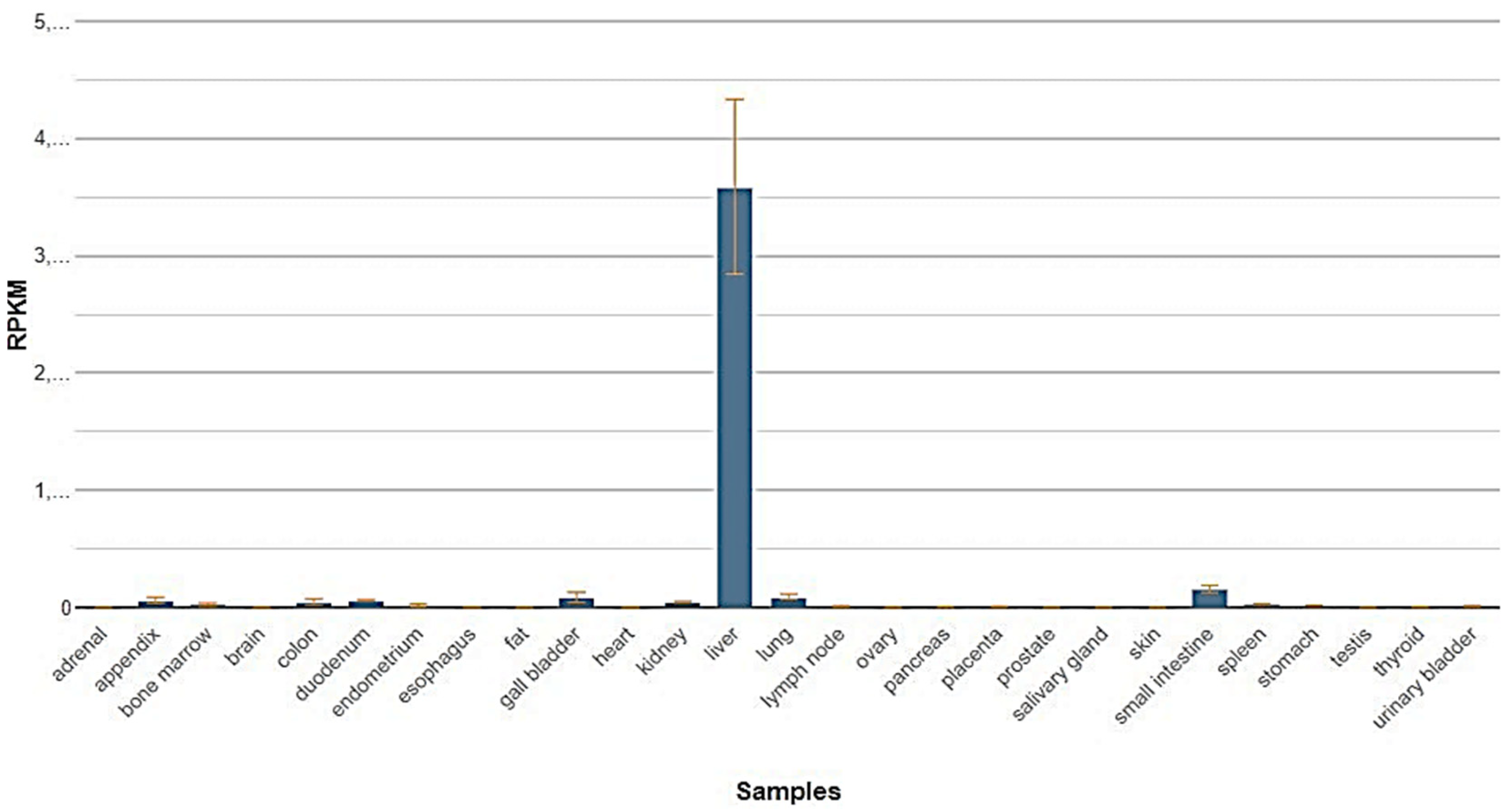
Figure 6.
depicts the expression of the serpina1 gene in single tissue. It can be observed that bars corresponding to epithelial cell (alveolar region) around lungs and also in Dendritic cells (DC) / macrophages of the immune system due to the immune participation of the protein product (AAT) of the serpina1 gene.
Figure 6.
depicts the expression of the serpina1 gene in single tissue. It can be observed that bars corresponding to epithelial cell (alveolar region) around lungs and also in Dendritic cells (DC) / macrophages of the immune system due to the immune participation of the protein product (AAT) of the serpina1 gene.
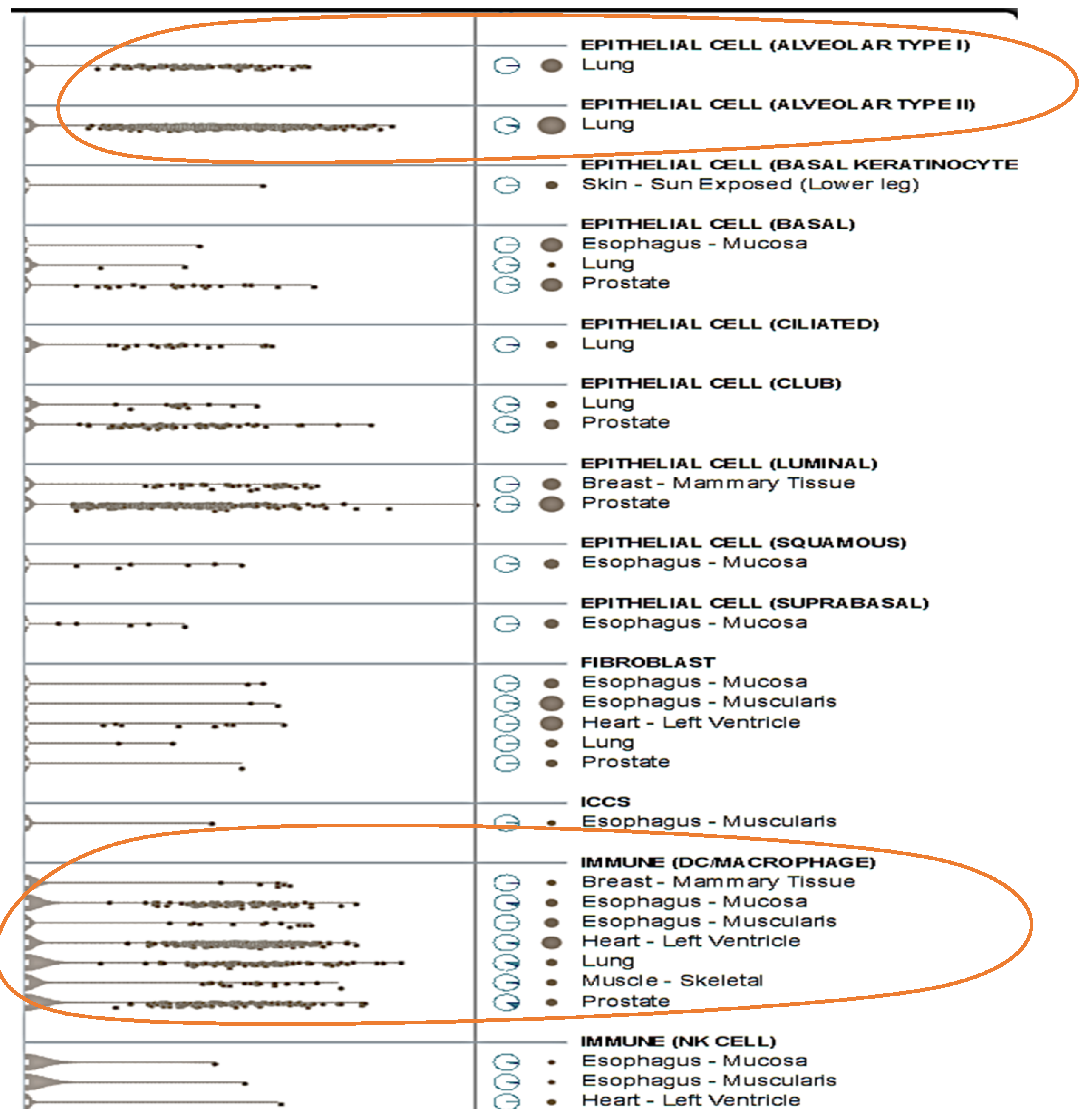
Figure 7.
showing the various serpina1 expression in sex for male and female, ischemic time, and age bracket.
Figure 7.
showing the various serpina1 expression in sex for male and female, ischemic time, and age bracket.
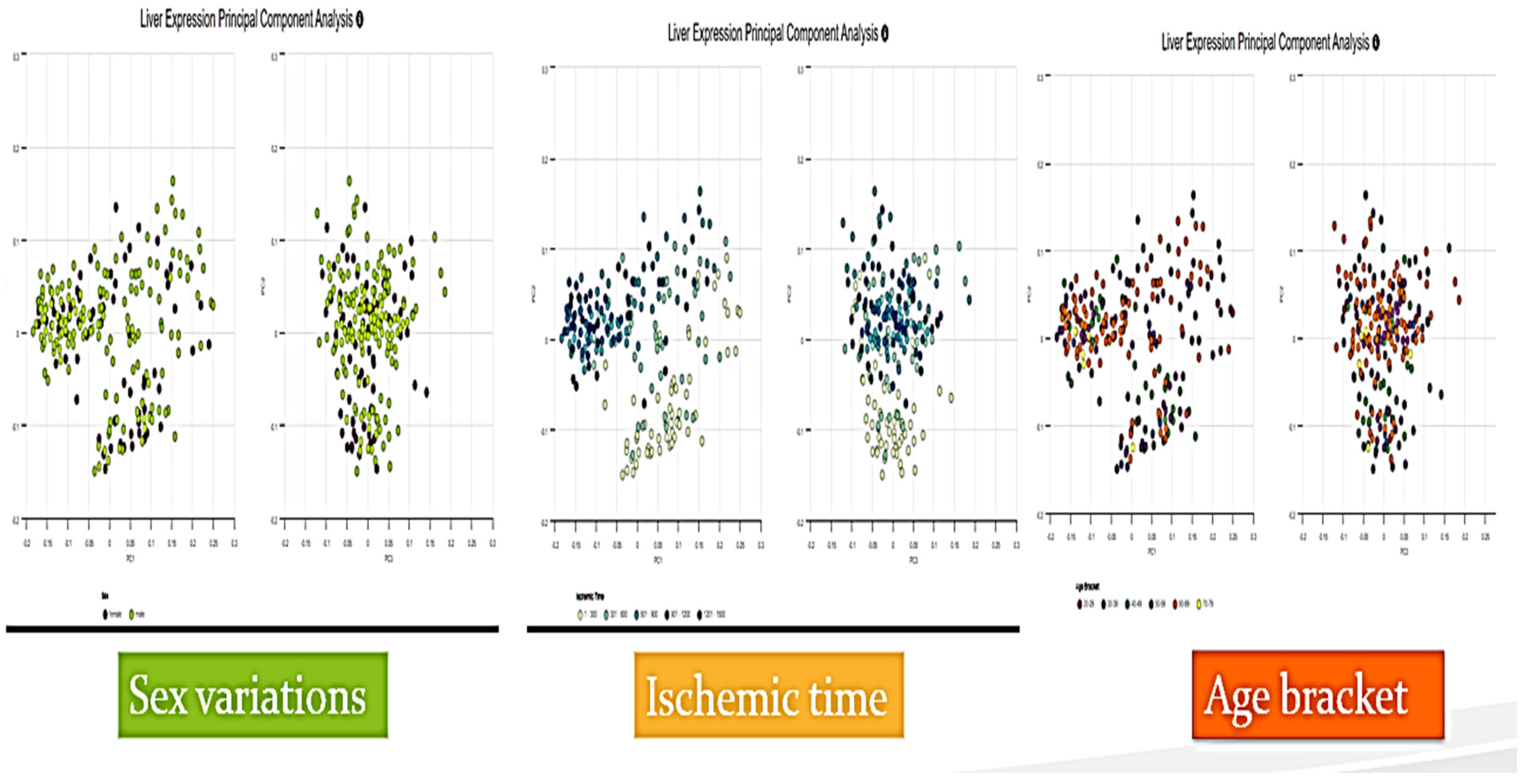
Disclaimer/Publisher’s Note: The statements, opinions and data contained in all publications are solely those of the individual author(s) and contributor(s) and not of MDPI and/or the editor(s). MDPI and/or the editor(s) disclaim responsibility for any injury to people or property resulting from any ideas, methods, instructions or products referred to in the content. |
© 2024 by the authors. Licensee MDPI, Basel, Switzerland. This article is an open access article distributed under the terms and conditions of the Creative Commons Attribution (CC BY) license (http://creativecommons.org/licenses/by/4.0/).
Copyright: This open access article is published under a Creative Commons CC BY 4.0 license, which permit the free download, distribution, and reuse, provided that the author and preprint are cited in any reuse.


