

Submitted:
30 November 2024
Posted:
02 December 2024
You are already at the latest version
Abstract
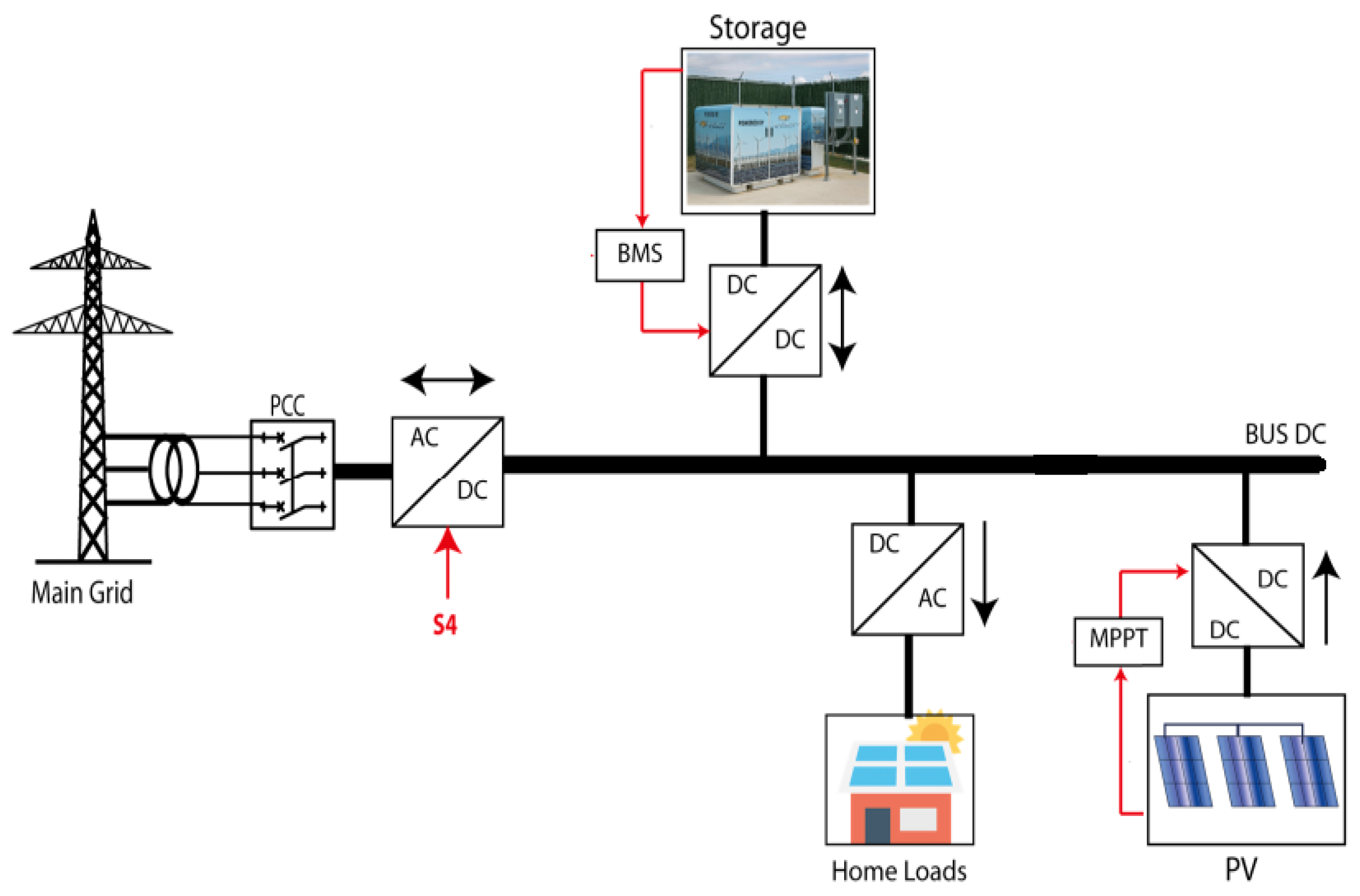
A Reinforcement Neural Network-Based Grid Integrated PV System with a Battery Management System (BMS) aims to enhance the efficiency and reliability of renewable energy systems. In such a setup, the photovoltaic (PV) system generates electricity, which can be used immediately, stored in batteries, or fed into the grid. The challenge lies in dynamically optimizing the power flow between these components to minimize energy costs, maximize the use of renewable energy, and maintain grid stability. Reinforcement learning (RL), combined with neural networks, offers a powerful solution by enabling the system to learn and adapt its energy management strategy in real time. The RL agent interacts with the environment (i.e., the grid, PV system, and battery), continuously improving its decisions on when to store energy, draw from the battery, and supply power to the grid. This intelligent control approach ensures optimal performance, contributing to a more sustainable and resilient energy system.
Keywords:
1. Introduction
2. Related Works
3. Discussion and Methods
3.1. Solar Neural Network System:
3.2. Fuzzy Controller System


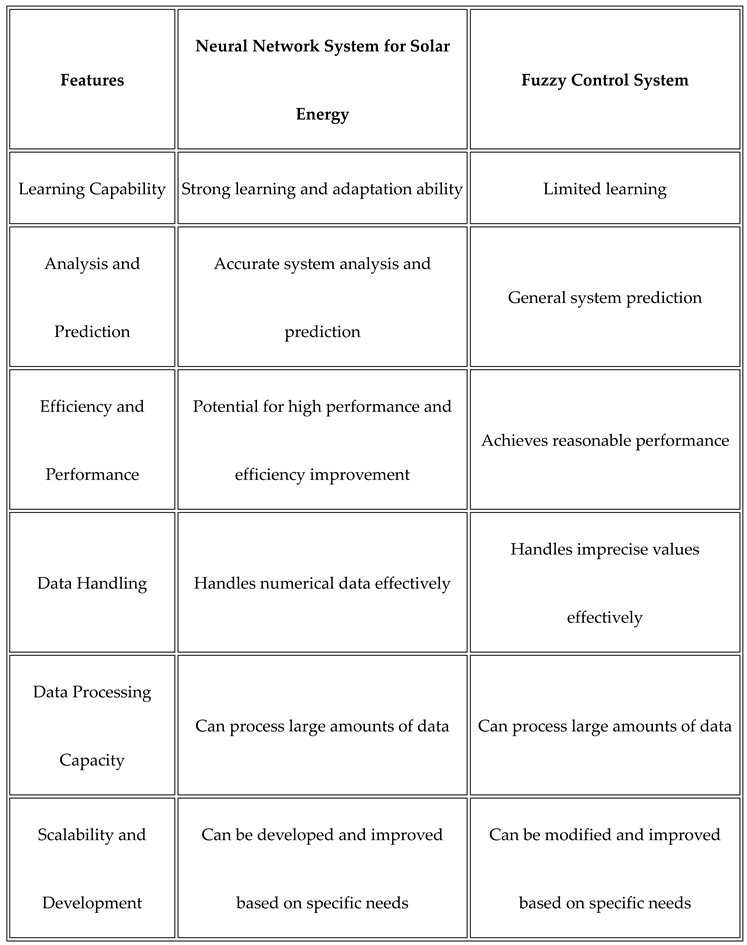
- Overwhelming logical principles: The mysterious logic allows a more like human being in making decisions by looking at concepts such as' very hot 'and' cold 'cold' or 'very bright' instead of accurate numerical values.
- The mysterious reasoning: The essence of a mysterious control unit lies in its ability to make decisions based on mysterious reasoning. These rules are defined based on experts' knowledge and used to set input variables for output procedures.
- Dealing with inaccuracy: The mysterious control units excel in the processing of systems that may be difficult to obtain accurate or noisy numerical data. Using linguistic variables and mysterious groups, the unit can absorb inaccurate inputs and provide meaningful outputs.
- Non -linear systems: Mental controllers are especially useful for dealing with non -linear systems as traditional control methods may be struggled. The elasticity of the mysterious logic allows effective control in systems with complex behaviors.
- Data processing: Mental units can process large amounts of data and complex decision -making operations effectively. It is ideal for systems that require actual time amendments based on varying input conditions.
- Performance: While mysterious control units may not always provide the best performance in terms of speed compared to some other control methods, they provide a good balance between accuracy and mathematical efficiency of many applications.
3.3. Neural Network
4. Results
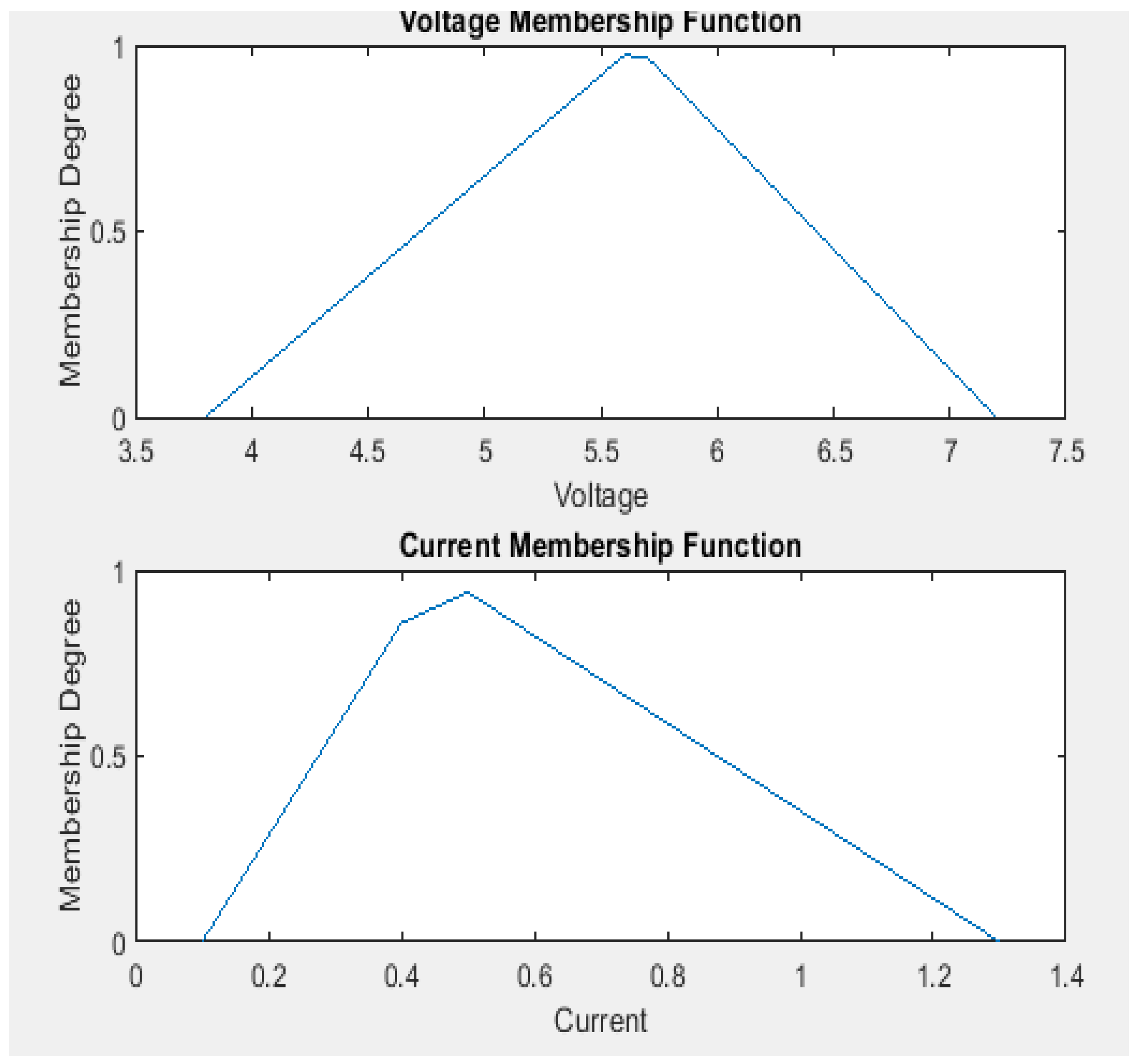
4.1. MPPT Fuzzy when 1 Is Pressed
4.2. MPPT Ann when 2 Is Pressed
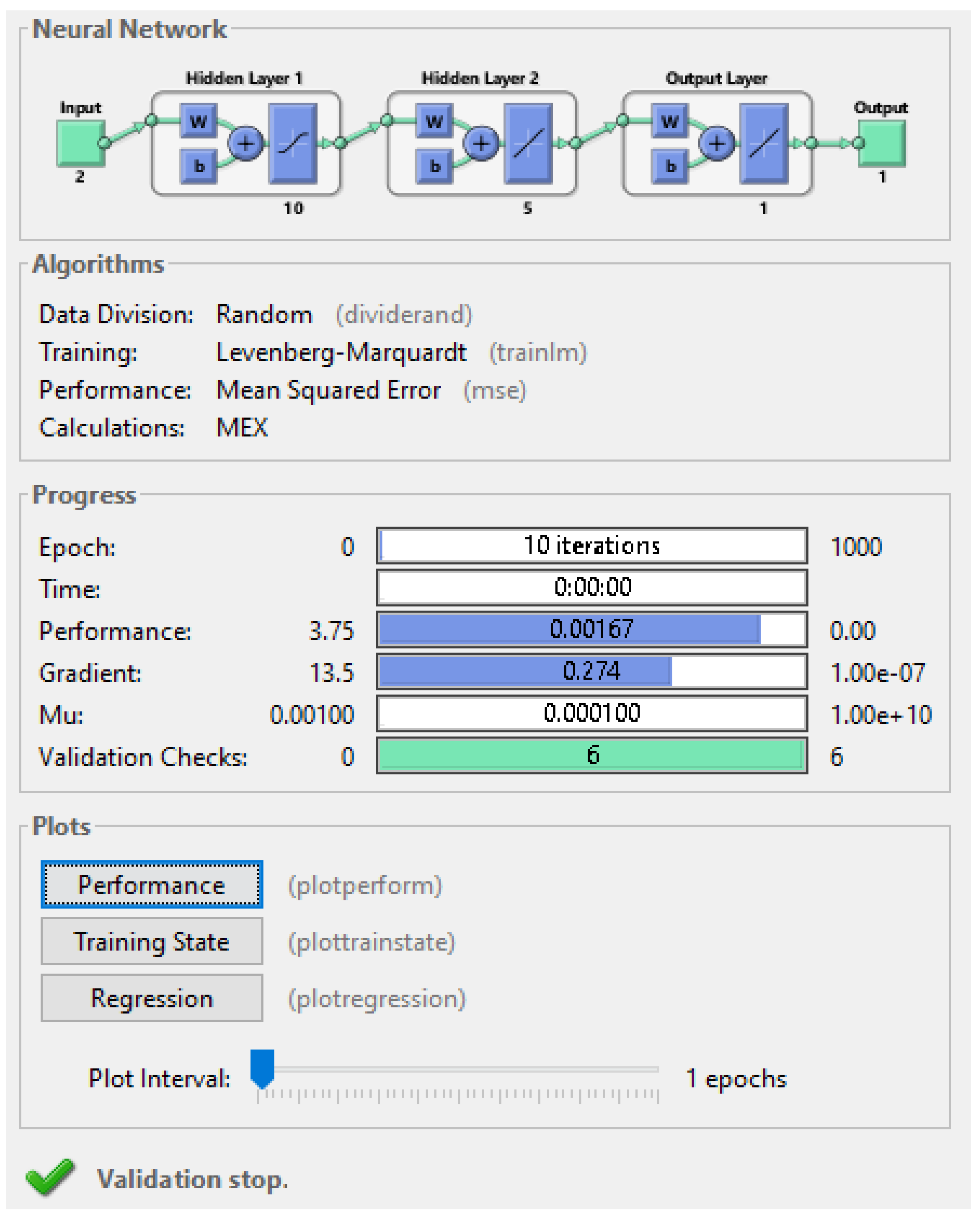
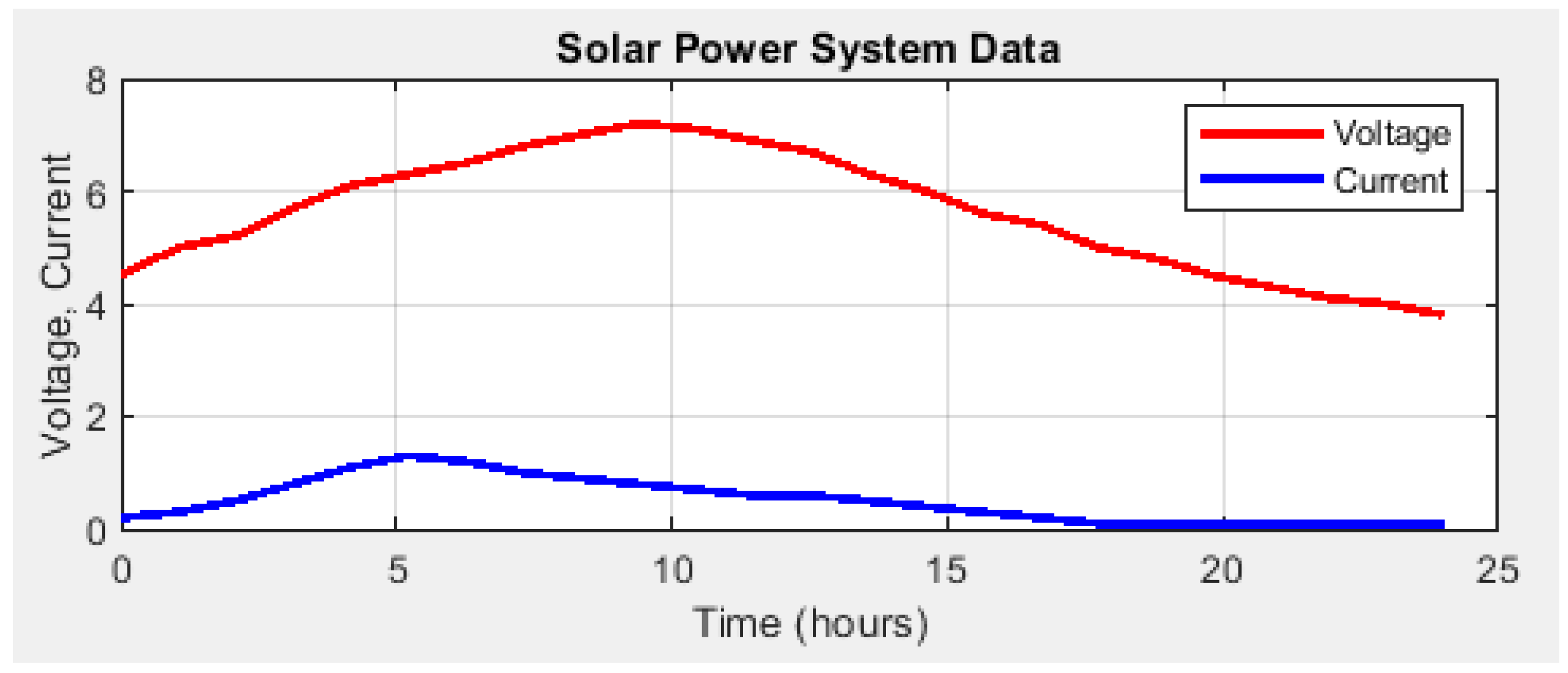
- Determine the number of data points based on 24 hours and hourly data reading frequency.
- Input voltage and current data for solar energy system.
- Convert the data into a format suitable for the artificial neural network.
- Convert values to desired range (eg -1 to 1) using mapminmax function.
- Set target values for the MPPT (optimum duty cycle) system and convert them to the desired range.
- Create an artificial neural network using newff and specify the number of layers and active functions for each layer.
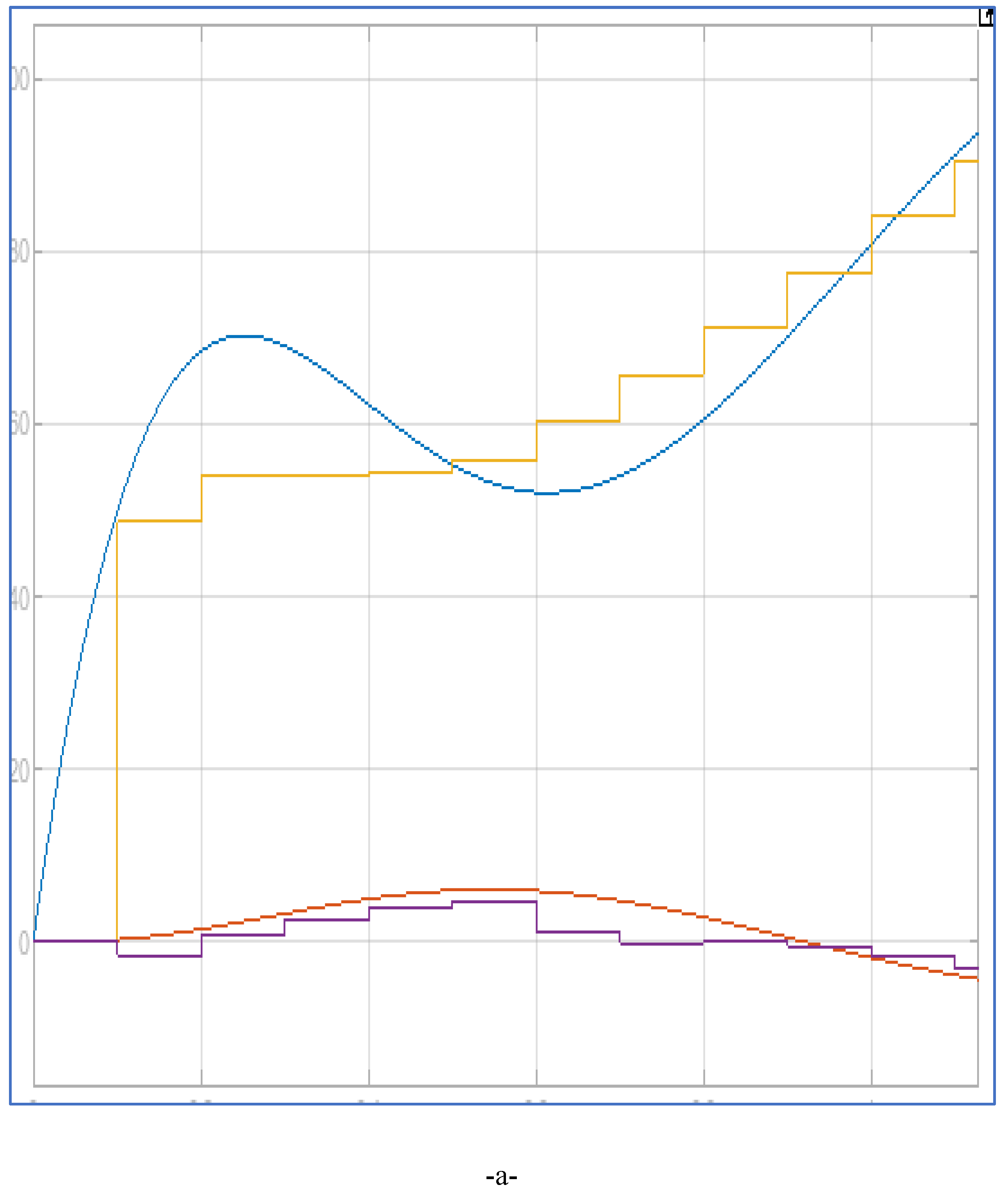
- Train the artificial neural network using trainlm and specify the number of trainings fields.as Figure 2
- Applying artificial neural network to voltage and current data using SIM.
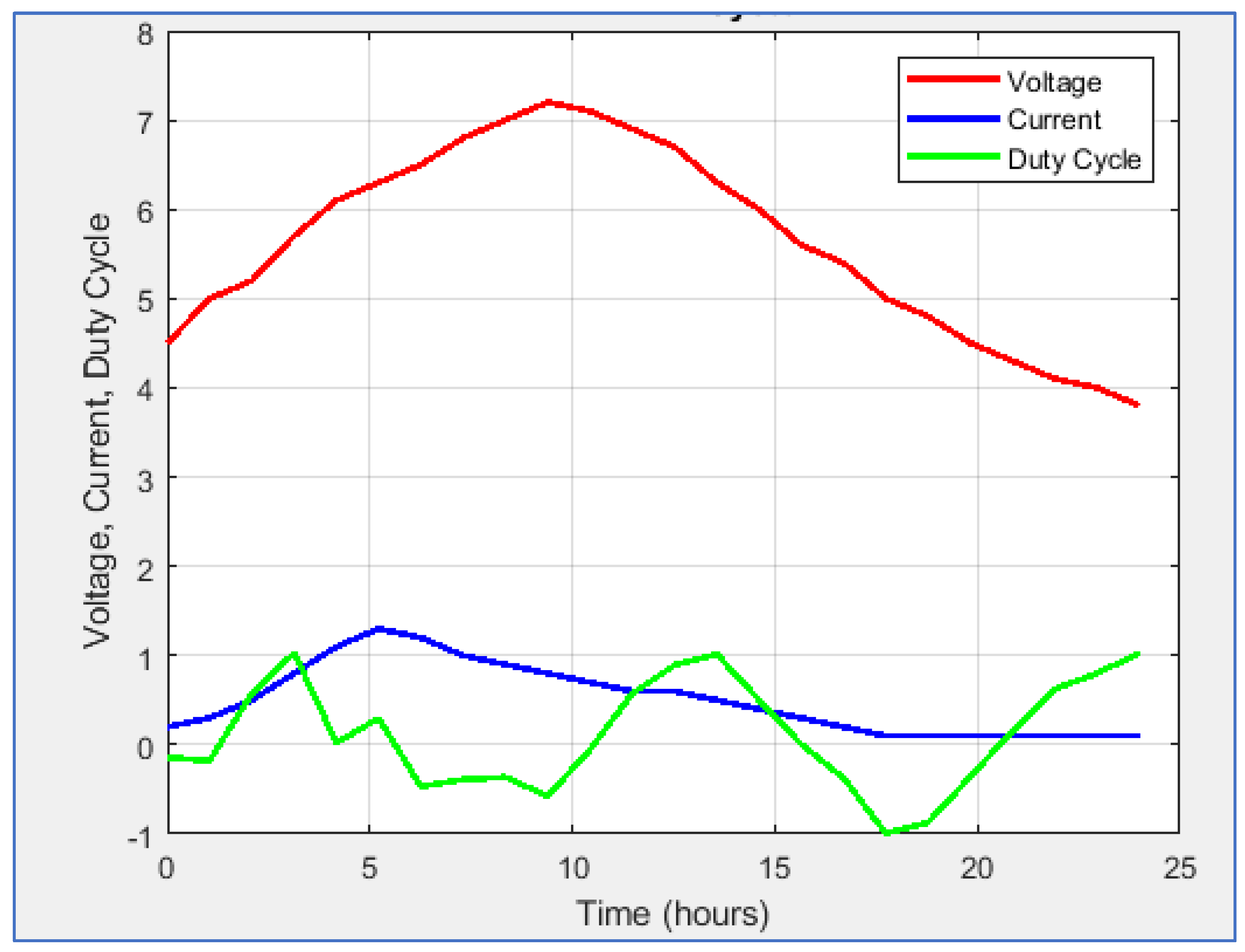
- Display the results with a graph, where the actual voltage, current and results of the artificial nerve network are displayed.
4.3. Hybrid System MPPT when 3 Is Pressed
5. Simulation
5.1. Simulation System MPPT
5.2. Fuzzy MPPT
5.3. ANN MPPT
5.3.1. Results of the First Section: MPPT Simulation System
5.3.2. Results of the Second Section: Fuzzy MPPT
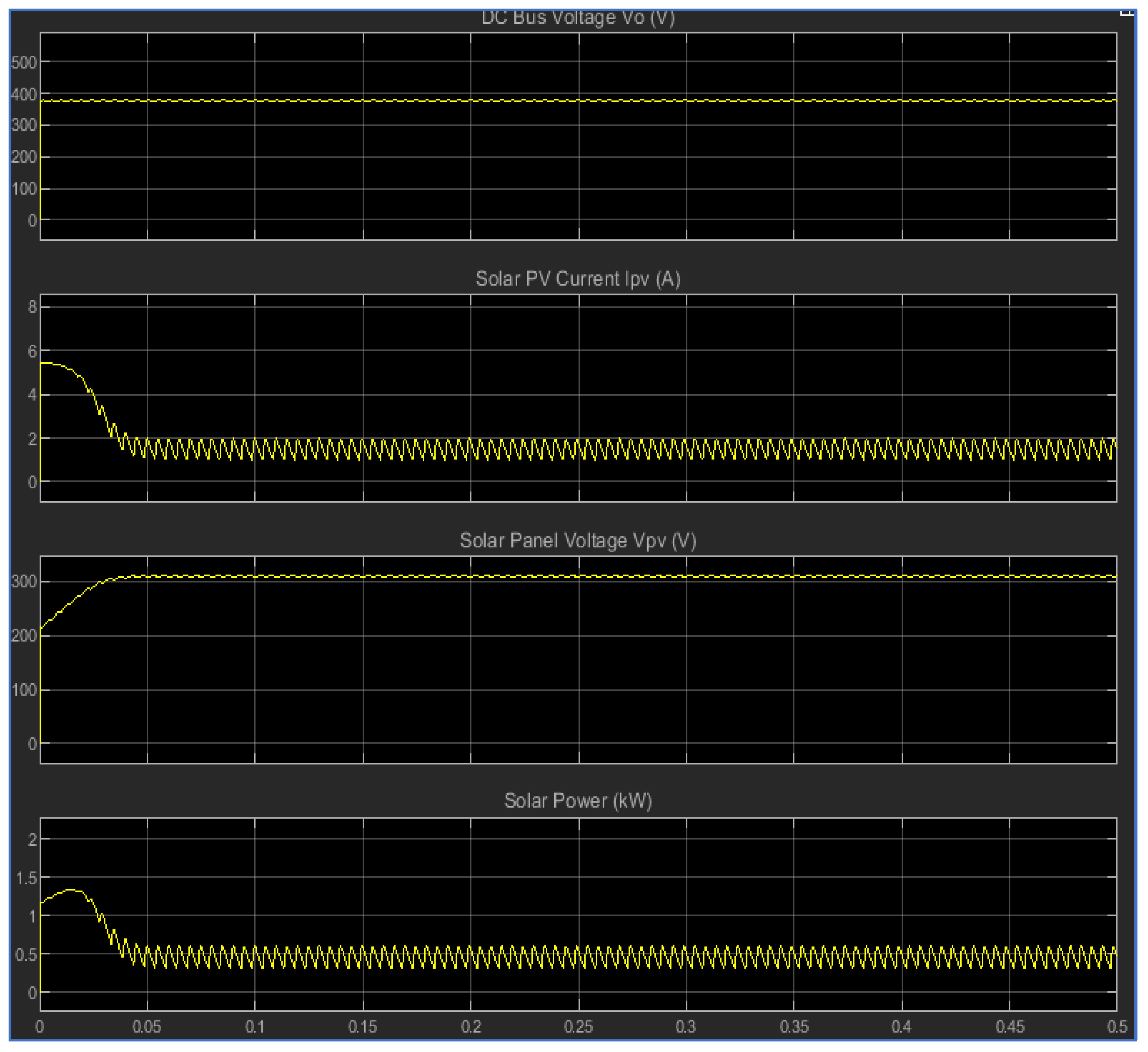
5.3.3. ANN MPPT
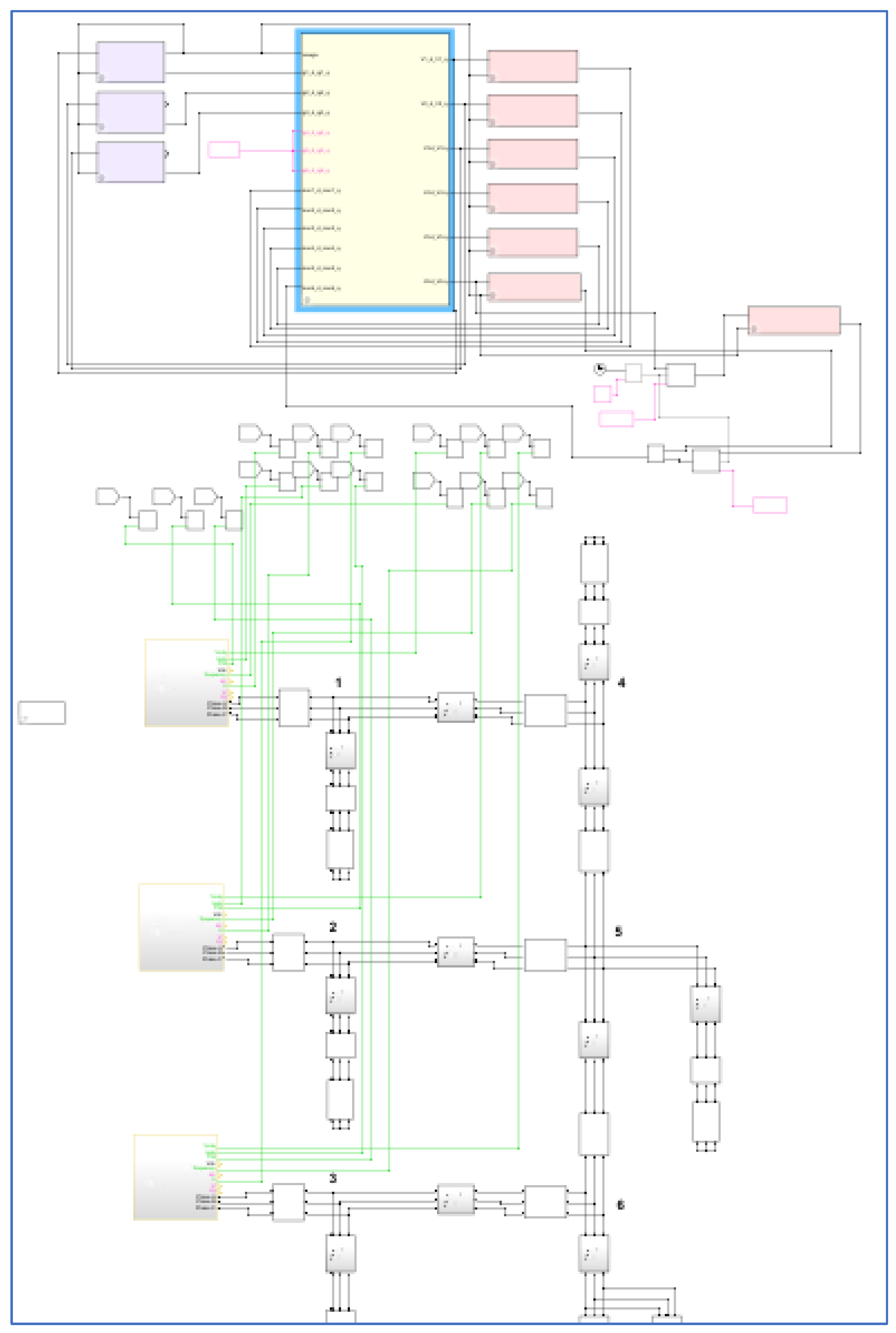
5.4. Results of the First Section: MPPT Simulation System
5.5. Results of the Second Section: Fuzzy MPPT
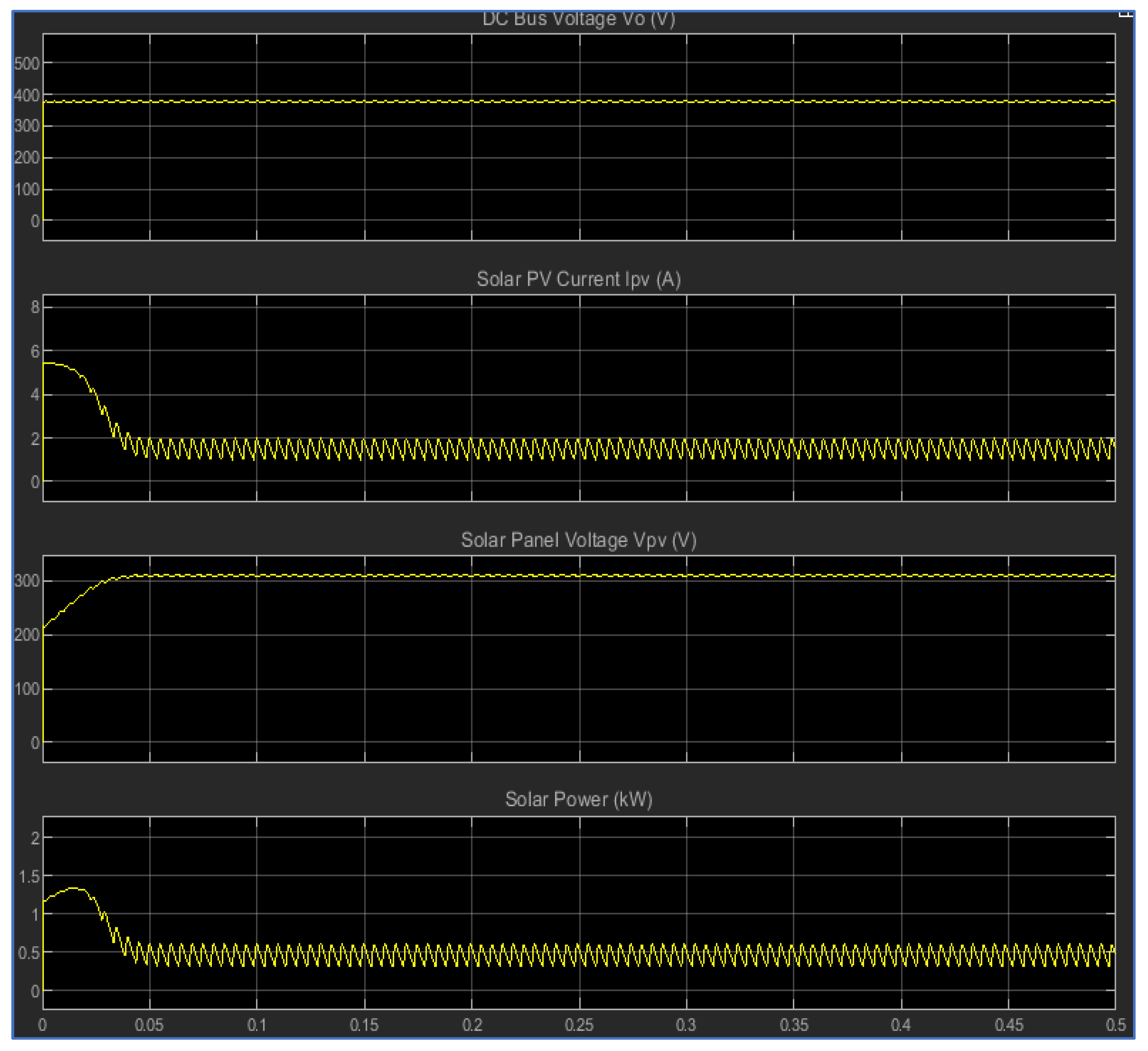
5.6. Results of the Second Section: ANN MPPT
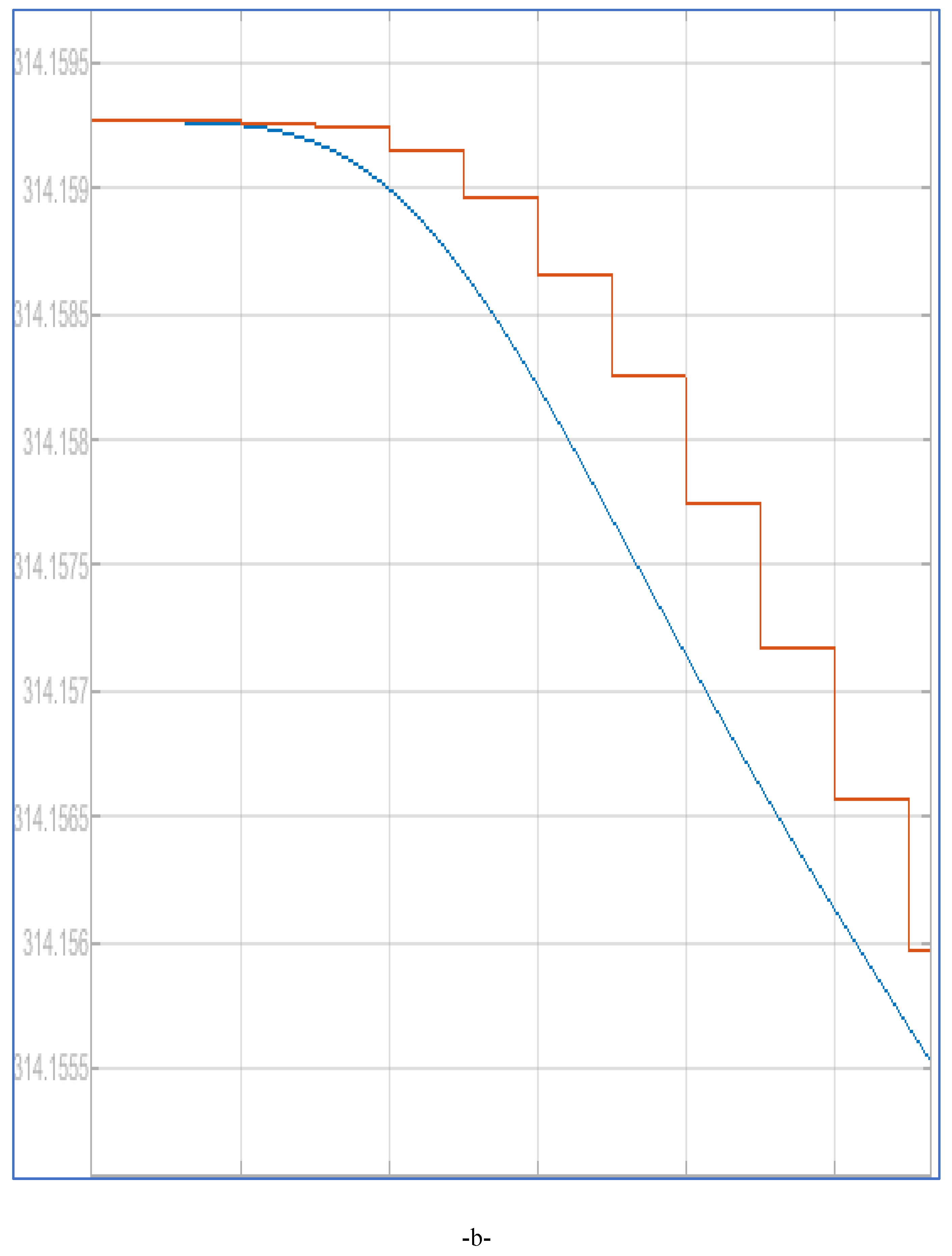
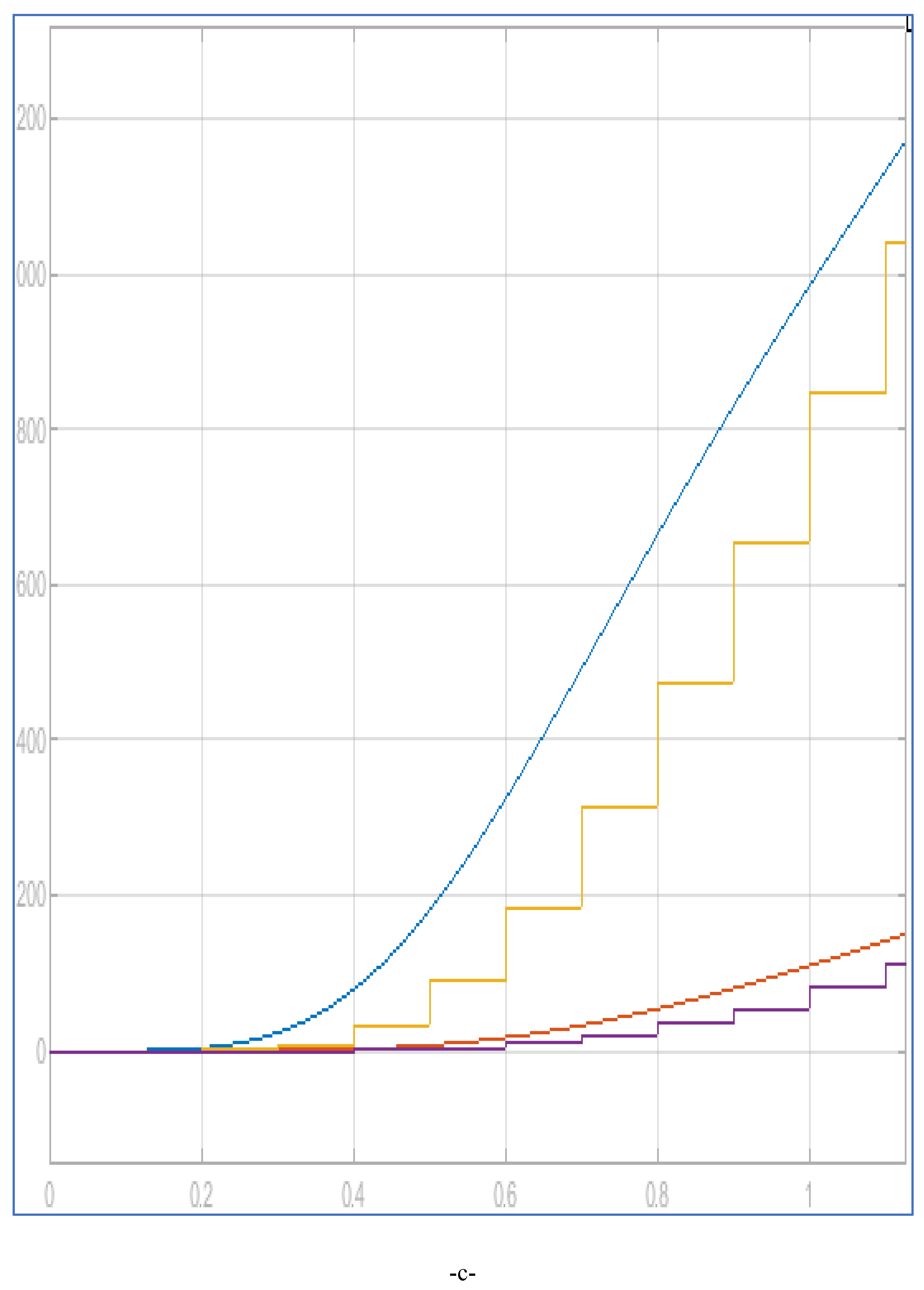
6. Conclusions
References
- Marlin, S.; Jebaseelan, S. A comprehensive comparative study on intelligence based optimization algorithms used for maximum power tracking in grid-PV systems. Sustain. Comput. Informatics Syst. 2023, 41. [Google Scholar] [CrossRef]
- Sarang, S.A.; Raza, M.A.; Panhwar, M.; Khan, M.; Abbas, G.; Touti, E.; Altamimi, A.; Wijaya, A.A. Maximizing solar power generation through conventional and digital MPPT techniques: a comparative analysis. Sci. Rep. 2024, 14, 1–18. [Google Scholar] [CrossRef] [PubMed]
- Bilal, M.; Algethami, A.A.; Imdadullah, S.; Hameed, S. Review of Computational Intelligence Approaches for Microgrid Energy Management. IEEE Access 2024. [Google Scholar] [CrossRef]
- Husin, H.; Zaki, M. Muhibbuddin A critical review of the integration of renewable energy sources with various technologies. Prot. Control Mod. Power Syst. 2021, 6, 1–18. [Google Scholar] [CrossRef]
- Blesslin, S.T.; Wessley, G.J.J.; Kanagaraj, V.; Kamatchi, S.; Radhika, A.; Janeera, D.A. Microgrid optimization and integration of renewable energy resources: innovation, challenges and prospects. Integr. Renew. Energy Sources with Smart Grid 2021, 239–262. [Google Scholar]
- Liu, Y.; Feng, C. Promoting renewable energy through national energy legislation. Energy Econ. 2023, 118, 106504. [Google Scholar] [CrossRef]
- Østergaard, P.A.; Duic, N.; Noorollahi, Y.; Kalogirou, S. Renewable energy for sustainable development. Renew. Energy 2022, 199, 1145–1152. [Google Scholar] [CrossRef]
- Olabi, A.G.; Abdelkareem, M.A. Renewable energy and climate change. Renew. Sustain. Energy Rev. 2022, 158, 112111. [Google Scholar] [CrossRef]
- Breyer, C.; Khalili, S.; Bogdanov, D.; Ram, M.; Oyewo, A.S.; Aghahosseini, A.; Gulagi, A.; Solomon, A.A.; Keiner, D.; Lopez, G.; et al. On the History and Future of 100% Renewable Energy Systems Research. IEEE Access 2022, 10, 78176–78218. [Google Scholar] [CrossRef]
- Javed, M.R.; Waleed, A.; Virk, U.S.; Hassan, S.Z.U. Comparison of the adaptive neural-fuzzy interface system (ANFIS) based solar maximum power point tracking (MPPT) with other solar MPPT methods. In Proceedings of the 2020 IEEE 23rd international multitopic conference (INMIC); 2020; pp. 1–5. [Google Scholar]
- Shang, L.; Guo, H.; Zhu, W. An improved MPPT control strategy based on incremental conductance algorithm. Prot. Control. Mod. Power Syst. 2020, 5, 1–8. [Google Scholar] [CrossRef]
- Baatiah, A.O.; Eltamaly, A.M.; Alotaibi, M.A. Improving Photovoltaic MPPT Performance through PSO Dynamic Swarm Size Reduction. Energies 2023, 16, 6433. [Google Scholar] [CrossRef]
- Gupta, A.; Singh, O. Grid connected PV system with MPPT scheme using particle swarm optimization technique. Int. J. Intell. Netw 2021, 2. [Google Scholar]
- Ibrahim, M.H.; Ang, S.P.; Dani, M.N.; Rahman, M.I.; Petra, R.; Sulthan, S.M. Optimizing Step-Size of Perturb & Observe and Incremental Conductance MPPT Techniques Using PSO for Grid-Tied PV System. IEEE Access 2023, 11, 13079–13090. [Google Scholar] [CrossRef]
- Khan, M.J.; Mathew, L.; Alotaibi, M.A.; Malik, H.; Nassar, M.E. Fuzzy-Logic-Based Comparative Analysis of Different Maximum Power Point Tracking Controllers for Hybrid Renewal Energy Systems. Mathematics 2022, 10, 529. [Google Scholar] [CrossRef]
- Khan, M.J.; Mathew, L. Artificial neural network-based maximum power point tracking controller for real-time hybrid renewable energy system. Soft Comput. 2021, 25, 6557–6575. [Google Scholar] [CrossRef]
- Al-Majidi, S.D.; Abbod, M.F.; Al-Raweshidy, H.S. Maximum power point tracking technique based on a neural-fuzzy approach for stand-alone photovoltaic system. In Proceedings of the 2020 55th International Universities Power Engineering Conference (UPEC); 2020; pp. 1–6. [Google Scholar]
- Ali, Z.; Abbas, S.Z.; Mahmood, A.; Ali, S.W.; Javed, S.B.; Su, C.-L. A Study of a Generalized Photovoltaic System with MPPT Using Perturb and Observer Algorithms under Varying Conditions. Energies 2023, 16, 3638. [Google Scholar] [CrossRef]
- Reddy, M.M.V.; Sivanantham, S. DC MICROGRID USING PHOTOVOLTAIC IMPROVED INCREMENTAL CONDUCTANCE ALGORITHM FOR TRACKING THE MPP IN A STAND-ALONE MINIMIZING ENERGY STORAGE UTILIZATION. 2023.
- Katche, M.L.; Makokha, A.B.; Zachary, S.O.; Adaramola, M.S. A Comprehensive Review of Maximum Power Point Tracking (MPPT) Techniques Used in Solar PV Systems. Energies 2023, 16, 2206. [Google Scholar] [CrossRef]
- Annam, S.; Srikrishna, S.; Prabandhankam, S.R.; Sivarajan, G. A Prospective Study on Perturb Observe MPPT Methods for Photovoltaic Systems. Instrumentation Mes. Metrol. 2023, 22, 73. [Google Scholar] [CrossRef]
- Danyali, S.; Babaeifard, M.; Shirkhani, M.; Azizi, A.; Tavoosi, J.; Dadvand, Z. A new neuro-fuzzy controller based maximum power point tracking for a partially shaded grid-connected photovoltaic system. Heliyon 2024, 10, e36747. [Google Scholar] [CrossRef]
- Derbeli, M.; Napole, C.; Barambones, O. A Fuzzy Logic Control for Maximum Power Point Tracking Algorithm Validated in a Commercial PV System. Energies 2023, 16, 748. [Google Scholar] [CrossRef]
- Al Sumarmad, K.A.; Sulaiman, N.; Wahab, N.I.A.; Hizam, H. Energy management and voltage control in microgrids using artificial neural networks, PID, and fuzzy logic controllers. Energies 2022, 15, 303. [Google Scholar] [CrossRef]
- Sudarshan, B.S.; Chitra, A.; Sultana, W.R.; Chandrasekhar, P.R.; Ganguli, T.; Sahu, I. Maximum Power Point Tracking Techniques for Photovoltaic Systems—A Comprehensive Review From Real-Time Implementation Perspective. Smart Grids Green Energy Syst. 2022, 159–196. [Google Scholar]
- Mensah, A.A.; Wei, X.; Otuo-Acheampong, D.; Mbuzi, T. Maximum power point tracking techniques using improved incremental conductance and particle swarm optimizer for solar power generation systems. Energy Harvest. Syst. 2023, 11, 20220120. [Google Scholar] [CrossRef]
- Kumar, M.; Panda, K.P.; Rosas-Caro, J.C.; Valderrabano-Gonzalez, A.; Panda, G. Comprehensive Review of Conventional and Emerging Maximum Power Point Tracking Algorithms for Uniformly and Partially Shaded Solar Photovoltaic Systems. IEEE Access 2023, 11, 31778–31812. [Google Scholar] [CrossRef]
- Bhukya, L.; Kedika, N.R.; Salkuti, S.R. Enhanced Maximum Power Point Techniques for Solar Photovoltaic System under Uniform Insolation and Partial Shading Conditions: A Review. Algorithms 2022, 15, 365. [Google Scholar] [CrossRef]
- Li, J.; Wu, Y.; Ma, S.; Chen, M.; Zhang, B.; Jiang, B. Analysis of photovoltaic array maximum power point tracking under uniform environment and partial shading condition: A review. Energy Rep. 2022, 8, 13235–13252. [Google Scholar] [CrossRef]
- Rizzo, S.A.; Scelba, G. A hybrid global MPPT searching method for fast variable shading conditions. J. Clean. Prod. 2021, 298, 126775. [Google Scholar] [CrossRef]
- Worku, M.Y.; Hassan, M.A.; Maraaba, L.S.; Shafiullah; Elkadeem, M. R.; Hossain, I.; Abido, M.A. A Comprehensive Review of Recent Maximum Power Point Tracking Techniques for Photovoltaic Systems under Partial Shading. Sustainability 2023, 15, 11132. [Google Scholar] [CrossRef]
- Awais, M.; Khan, L.; Ahmad, S.; Mumtaz, S.; Badar, R. Nonlinear adaptive NeuroFuzzy feedback linearization based MPPT control schemes for photovoltaic system in microgrid. PLOS ONE 2020, 15, e0234992. [Google Scholar] [CrossRef]
- Jasim, A.M.; Jasim, B.H.; Bures, V.; Mikulecky, P. A Novel Cooperative Control Technique for Hybrid AC/DC Smart Microgrid Converters. IEEE Access 2023, 11, 2164–2181. [Google Scholar] [CrossRef]
- Alipour, E.; Dejamkhooy, A.; Hosseinpour, M.; Vahidnia, A. Enhanced frequency control of a hybrid microgrid using RANFIS for partially shaded photovoltaic systems under uncertainties. Sci. Rep. 2024, 14, 1–30. [Google Scholar] [CrossRef] [PubMed]
- Basha, C.H.; Palati, M.; Dhanamjayulu, C.; Muyeen, S.M.; Venkatareddy, P. A novel on design and implementation of hybrid MPPT controllers for solar PV systems under various partial shading conditions. Sci. Rep. 2024, 14, 1–21. [Google Scholar] [CrossRef]
- Zhou, G.; Bi, Q.; Tian, Q.; Leng, M.; Xu, G. Single Sensor Based Global Maximum Power Point Tracking Algorithm of PV System With Partial Shading Condition. IEEE Trans. Ind. Electron. 2021, 69, 2669–2683. [Google Scholar] [CrossRef]
- Xie, Z.; Wu, Z. A flexible power point tracking algorithm for photovoltaic system under partial shading condition. Sustain. Energy Technol. Assessments 2022, 49. [Google Scholar] [CrossRef]
- Eshete, F.A.; Samajdar, D.P.; Kumar, A. Implementation of modified P&O and an adaptive fuzzy logic controller based MPPT tracking system under partial shading and variable environmental conditions. Phys. Scr. 2024, 99, 065212. [Google Scholar] [CrossRef]
- Rao, S.N.V.B.; Kumar, Y.V.P.; Amir, M.; Ahmad, F. An Adaptive Neuro-Fuzzy Control Strategy for Improved Power Quality in Multi-Microgrid Clusters. IEEE Access 2022, 10, 128007–128021. [Google Scholar] [CrossRef]
- Kumar, A.S.; Ramesh, S.; Arukula, P.; Parveen, M.S. Analyzing PV power systems using MPPT based on Artificial Neural Networks. Nanotechnol. Perceptions 2024, 20, 797–792. [Google Scholar] [CrossRef]
- Ali, M.N.; Mahmoud, K.; Lehtonen, M.; Darwish, M.M.F. An Efficient Fuzzy-Logic Based Variable-Step Incremental Conductance MPPT Method for Grid-Connected PV Systems. IEEE Access 2021, 9, 26420–26430. [Google Scholar] [CrossRef]
- Allahabadi, S.; Iman-Eini, H.; Farhangi, S. Fast Artificial Neural Network Based Method for Estimation of the Global Maximum Power Point in Photovoltaic Systems. IEEE Trans. Ind. Electron. 2021, 69, 5879–5888. [Google Scholar] [CrossRef]
- Bhoj, N.; Bhadoria, R.S. Time-series based prediction for energy consumption of smart home data using hybrid convolution-recurrent neural network. Telematics Informatics 2022, 75. [Google Scholar] [CrossRef]
- Merai, M.; Naouar, M.; Slama-Belkhodja, I.; Monmasson, E. A systematic design methodology for DC-link voltage control of single phase grid-tied PV systems. Math. Comput. Simul. 2020, 183, 158–170. [Google Scholar] [CrossRef]
- Srinivasan, R.; Balamurugan, C.R. Deep neural network based MPPT algorithm and PR controller based SMO for grid connected PV system. Int. J. Electron. 2021, 109, 576–595. [Google Scholar] [CrossRef]
- Ullah, Z.; Al-Turjman, F.; Mostarda, L.; Gagliardi, R. Applications of Artificial Intelligence and Machine learning in smart cities. Comput. Commun. 2020, 154, 313–323. [Google Scholar] [CrossRef]
- Vanti, S.; Bana, P.R.; D'Arco, S.; Amin, M. Single-Stage Grid-Connected PV System With Finite Control Set Model Predictive Control and an Improved Maximum Power Point Tracking. IEEE Trans. Sustain. Energy 2021, 13, 791–802. [Google Scholar] [CrossRef]
- Kapur, I.; Jain, D.; Jain, A.; Garg, R. Adaptive Neuro Fuzzy Inference System for MPPT in Standalone Solar Photovoltaic System. In Proceedings of the 2020 IEEE 17th India Council International Conference (INDICON); 2020; pp. 1–6. [Google Scholar]
- Khan, M.; Raza, M.A.; Jumani, T.A.; Mirsaeidi, S.; Ali, A.; Abbas, G.; Touti, E.; Alshahir, A. Modeling of intelligent controllers for solar photovoltaic system under varying irradiation conditions. Front. Energy Res. 2023, 11, 1288486. [Google Scholar] [CrossRef]
Disclaimer/Publisher’s Note: The statements, opinions and data contained in all publications are solely those of the individual author(s) and contributor(s) and not of MDPI and/or the editor(s). MDPI and/or the editor(s) disclaim responsibility for any injury to people or property resulting from any ideas, methods, instructions or products referred to in the content. |
© 2024 by the authors. Licensee MDPI, Basel, Switzerland. This article is an open access article distributed under the terms and conditions of the Creative Commons Attribution (CC BY) license (http://creativecommons.org/licenses/by/4.0/).


