

Submitted:
26 November 2024
Posted:
27 November 2024
You are already at the latest version
Abstract
This study examined the ethical challenges and implications of generative AI in journalism, focusing on the impact of AI-generated content on traditional journalistic practices. The primary research questions addressed the transparency, accountability, and trust issues surrounding AI in journalism, as well as the perceptions of audiences regarding AI-generated content. Using a mixed-methods approach, the study combined qualitative data from interviews with journalists, editors, and AI ethics experts, along with quantitative data from surveys measuring audience attitudes. The outcome include insights into the ethical concerns of AI in journalism, the development of best practices for transparency and accountability, and recommendations for improving media literacy and audience trust in AI-generated content. The findings will contribute to advancing ethical frameworks for AI usage in journalism, ensuring that the integration of AI technology enhances, rather than diminishes, journalistic integrity.
Keywords:
1. Introduction
Background
Problem Statement
Research Objectives:
- Develop a framework for ethical accountability in AI journalism.
- Propose strategies to maintain audience trust and media integrity.
Significance of Study:
2. Literature Review
Literature Review
History and Evolution of AI in Journalism
Existing Ethical Frameworks
Research Gaps
3. Research Questions
4. Methodology
4.1. Research Design
4.2. Data Collection Methods
4.3 Sampling Strategy
4.4. Data Analysis
5. Results

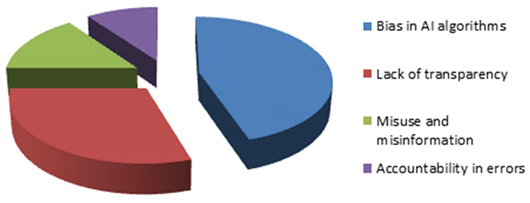
| Ethical Concern | Frequency (%) |
|---|---|
| Bias in AI algorithms | 45% |
| Lack of transparency | 30% |
| Misuse and misinformation | 15% |
| Accountability in errors | 10% |
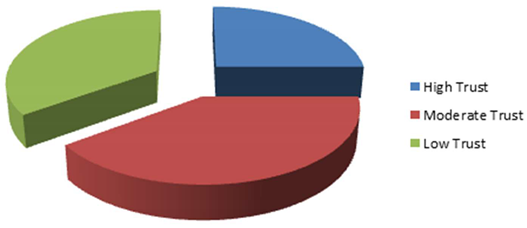
| Trust Level | Percentage (%) |
| High Trust | 25% |
| Moderate Trust | 40% |
| Low Trust | 35% |
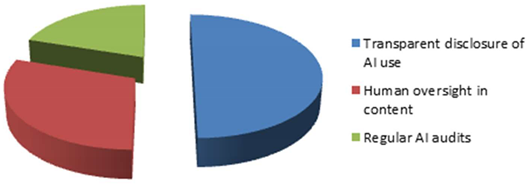
| Best Practice | Frequency (%) |
|---|---|
| Transparent disclosure of AI use | 50% |
| Human oversight in content | 30% |
| Regular AI audits | 20% |
| Outcome | Frequency (%) |
|---|---|
| Improved efficiency | 60% |
| Reduced operational costs | 25% |
| Compromised content quality | 15% |
6. Discussion
7. Proposed Framework
8. Conclusion
References
- Shi, Y.; Sun, L. How Generative AI Is Transforming Journalism: Development, Application and Ethics. Journalism and Media. https://www.mdpi.com/2673-5172/5/2/39/pdf. 2024, 5, 582–594. [Google Scholar] [CrossRef]
- Arguedas, A. R. & Simon, F. M. (2023). Automating democracy: Generative AI, journalism, and the future of democracy. https://ora.ox.ac.uk/objects/uuid:0965ad50-b55b-4591-8c3b-7be0c587d5e7/download_file?file_format=application%2Fpdf&safe_filename=Arguedas_and_Simon_2023_Automating_democracy__Generative.pdf&type_of_work=Report&utm_medium=email&utm_source=govdelivery.
- Saleh, H. F. (). AI in media and journalism: Ethical challenges. Prof. Hanaa Farouk Saleh. joa.journals.ekb.eg. https://joa.journals.ekb.eg/article_334084_c8ea3031f6736bcda644879d7374a0e1.pdf??lang=en.
- Al-Kfairy, M.; Mustafa, D.; Kshetri, N.; Insiew, M.; Alfandi, O. Ethical Challenges and Solutions of Generative AI: An Interdisciplinary Perspective. Informatics 2024, 11, 58. [Google Scholar] [CrossRef]
- Cools, H.; Diakopoulos, N. Uses of Generative AI in the Newsroom: Mapping Journalists’ Perceptions of Perils and Possibilities. J. Pract. 2024, 1–19. [Google Scholar] [CrossRef]
- Bayer, J. Legal implications of using generative AI in the media. Inf. Commun. Technol. Law 2024, 33, 310–329. [Google Scholar] [CrossRef]
- Pavlik, J.V. Collaborating With ChatGPT: Considering the Implications of Generative Artificial Intelligence for Journalism and Media Education. J. Mass Commun. Educ. 2023, 78, 84–93. [Google Scholar] [CrossRef]
- Gondwe, G. CHATGPT and the Global South: how are journalists in sub-Saharan Africa engaging with generative AI? Online Media Glob. Commun. 2023, 2, 228–249. [Google Scholar] [CrossRef]
- Marconi, F. (2020). Newsmakers: Artificial intelligence and the future of journalism. [HThttps://www.tandfonline.com/doi/pdf/10.1080/17512786.2024.2394558ML]. 2394. [Google Scholar]
- Jamil, S. (2021). Artificial intelligence and journalistic practice: The crossroads of obstacles and opportunities for the Pakistani journalists. Journalism Practice. https://www.researchgate.net/profile/Sadia-Jamil-4/publication/342749870_Artificial_Intelligence_and_Journalistic_Practice_The_Crossroads_of_Obstacles_and_Opportunities_for_the_Pakistani_Journalists/links/606b1af8a6fdccad3f7525f4/Artificial-Intelligence-and-Journalistic-Practice-The-Crossroads-of-Obstacles-and-Opportunities-for-the-Pakistani-Journalists.pdf. [CrossRef]
- Simon, F.M. Uneasy Bedfellows: AI in the News, Platform Companies and the Issue of Journalistic Autonomy. Digit. Journal. 2022, 10, 1832–1854. [Google Scholar] [CrossRef]
- Chow, J.C.L.; Sanders, L.; Li, K. Impact of ChatGPT on medical chatbots as a disruptive technology. Front. Artif. Intell. 2023, 6. [Google Scholar] [CrossRef] [PubMed]
- Dwivedi, Y. K. , Kshetri, N., Hughes, L., Slade, E. L., Jeyaraj, A., Kar, A. K.,... & Wright, R. (2023). Opinion Paper:“So what if ChatGPT wrote it?” Multidisciplinary perspectives on opportunities, challenges and implications of generative conversational AI for research, practice and policy. Int. J. Inf. Manag. 2023, 71, 102642. [Google Scholar]
- Getchell, K.M.; Carradini, S.; Cardon, P.W.; Fleischmann, C.; Ma, H.; Aritz, J.; Stapp, J. Artificial Intelligence in Business Communication: The Changing Landscape of Research and Teaching. Bus. Prof. Commun. Q. 2022, 85, 7–33. [Google Scholar] [CrossRef]
- Perkins, M. & Roe, J. (2024). Academic publisher guidelines on AI usage: A ChatGPT supported thematic analysis. F1000Research. https://pmc.ncbi.nlm.nih.gov/articles/PMC10844801/. [CrossRef]
Disclaimer/Publisher’s Note: The statements, opinions and data contained in all publications are solely those of the individual author(s) and contributor(s) and not of MDPI and/or the editor(s). MDPI and/or the editor(s) disclaim responsibility for any injury to people or property resulting from any ideas, methods, instructions or products referred to in the content. |
© 2024 by the authors. Licensee MDPI, Basel, Switzerland. This article is an open access article distributed under the terms and conditions of the Creative Commons Attribution (CC BY) license (http://creativecommons.org/licenses/by/4.0/).