

Submitted:
25 November 2024
Posted:
27 November 2024
You are already at the latest version
Abstract
This article examines artificial intelligence's (AI) evolution in marketing, tracing its journey from early data-driven approaches to its current transformative role. Beginning with the rise of data analysis and CRM systems, the article highlights how AI has progressively reshaped marketing practices, leading to hyper-personalization, marketing automation, and the emergence of autonomous marketing platforms. While acknowledging the significant benefits of AI in enhancing efficiency, personalisation, and data-driven decision-making, the article also critically analyses the potential challenges, including privacy concerns, job displacement, algorithmic bias, and the need for transparency in AI-driven decisions. Through case studies of AI marketing tools like Persado and Albert.ai, the article illustrates these technologies' capabilities and limitations. Ultimately, the article argues that the future of AI in marketing hinges on a collaborative approach, where marketers leverage AI's strengths while preserving the essential human elements of creativity, empathy, and ethical judgment.
Keywords:
AI
; personalization
; auto driven
; AI tools
; marketing
; platform
; automation
; Technology
Introduction
The marketing landscape is undergoing a profound transformation driven by the relentless advancement of artificial intelligence (AI). While early applications focused on data analysis and automation, AI is now poised to fundamentally reshape marketers' roles and redefine the very nature of customer engagement. This article moves beyond the hype and anxieties surrounding AI to present a balanced perspective on its evolving role in marketing.
Much of the existing literature focuses on AI's utopian potential to revolutionise marketing, the dystopian fear of job displacement, and ethical concerns. This article bridges this gap by presenting a nuanced view of AI as a collaborative partner for marketers, highlighting both the transformative benefits and the challenges that require careful navigation.
In the context of marketing, AI encompasses a range of technologies that enable machines to perform tasks that typically require human intelligence, such as:
- Data analysis and pattern recognition: Identifying trends and insights from large datasets.
- Predictive modelling: Forecasting future outcomes based on historical data.
- Natural language processing (NLP): Understanding and generating human language.
- Computer vision: Interpreting and responding to visual information.
This article is structured as follows:
- The Rise of Data-Driven Marketing: Traces the historical evolution of AI in marketing, from early data analysis techniques to the emergence of CRM systems and programmatic advertising.
- The Two Sides of AI in Marketing: Examines the benefits and challenges of AI adoption and addresses key ethical considerations such as privacy, bias, and transparency.
- Deep Dive: Case Studies of AI Marketing Tools: This section analyses two specific AI marketing tools, Persado and Albert.ai, to illustrate their practical applications and limitations.
- The Future of AI in Marketing: This chapter explores emerging trends such as conversational AI, predictive modelling, and the evolving relationship between AI and marketing creativity.
By embracing a collaborative approach, prioritising ethical considerations, and continuously adapting to AI's evolving capabilities, marketers can unlock unprecedented opportunities for growth, innovation, and meaningful customer engagement.
The Rise of Data-Driven Marketing
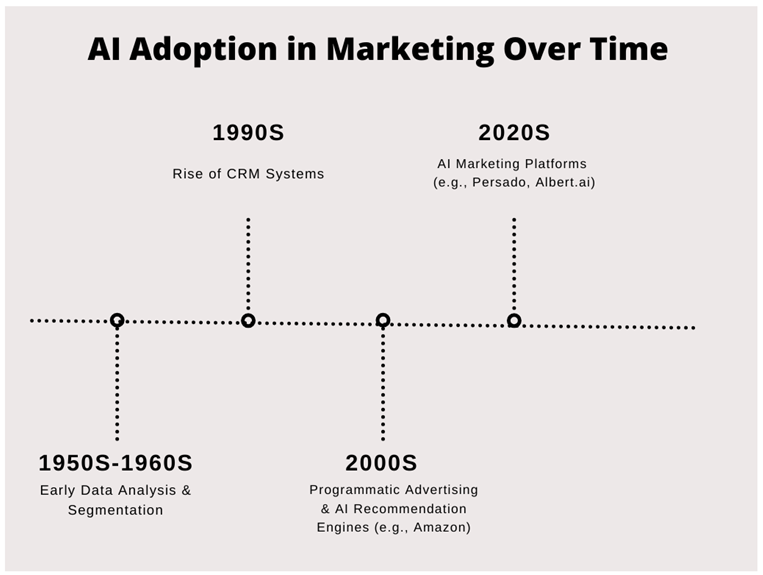
The journey of AI in marketing began not with sophisticated algorithms but with a fundamental shift towards data-driven decision-making. As early as the 1950s and 1960s, marketers began exploring the potential of data analysis and customer segmentation to enhance marketing effectiveness. (Winer, 1964). This nascent stage laid the groundwork for what would become a defining characteristic of modern marketing.
The 1990s witnessed a significant leap forward with the advent of Customer Relationship Management (CRM) systems. CRM systems provide marketers with a centralised platform to manage and track customer interactions, enabling a more personalised and targeted approach to marketing (Darrell K. Rigby, 2002). This era also saw the rise of data mining techniques, empowering marketers to extract valuable insights from increasingly large and complex datasets. A notable example is the Apriori algorithm, introduced in 1994, which enabled businesses to identify patterns in customer behaviour and optimise marketing strategies accordingly. (Rakesh Agrawal, 1994).
Personalisation and the Shift to Customer-Centricity
The dawn of the 21st century marked a turning point in the relationship between AI and marketing, with a pronounced shift towards personalisation and customer-centricity. AI-powered recommendation engines, pioneered by companies like Amazon, emerged as a powerful tool for understanding and predicting customer preferences (Joseph A. Konstan, 2001). By analysing vast customer data, these systems could recommend products and services tailored to individual tastes, significantly enhancing customer engagement and sales.
The late 2000s saw the rise of programmatic advertising, a game-changer that leveraged AI to automate the buying and selling of ad space in real time (Sweeney, 2024). This technology enabled marketers to target specific audiences with unprecedented precision, optimising ad campaigns for maximum impact and ROI.
AI and the Transformation of the Marketing Function
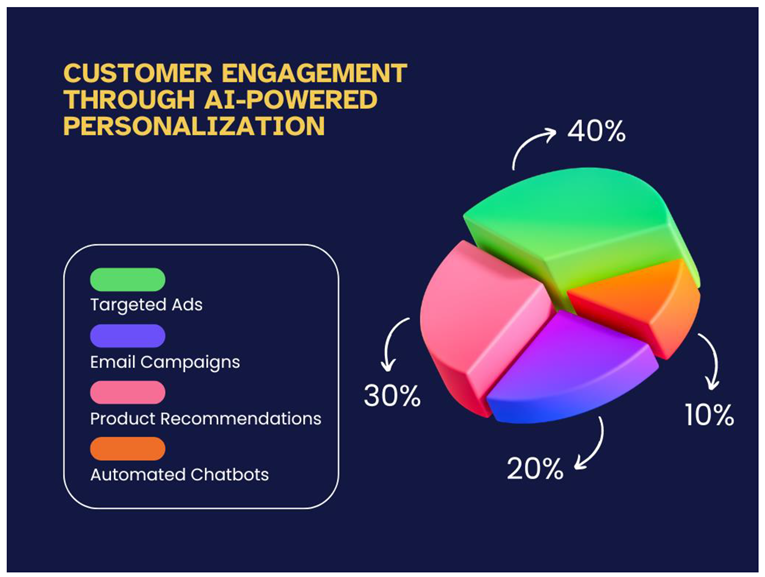
Today, AI is no longer merely a tool for data analysis or automation; it fundamentally transforms marketers' role and the marketing function's very nature. As AI systems become increasingly sophisticated, they are taking on tasks that were once the exclusive domain of human marketers, such as content creation, campaign optimisation, and even customer interaction through AI-powered chatbots. (Thomas Davenport, 2020)
This shift towards AI-driven marketing necessitates evaluating the skills required for success in the field. Marketers must now possess a deep understanding of marketing principles and a firm grasp of data analytics, AI technologies, and the ethical implications of their use. The challenge for marketers in the age of AI is finding the optimal balance between leveraging the power of automation and preserving the human touch essential for creativity, empathy, and building meaningful customer relationships.
The Two Sides of AI in Marketing: Balancing Benefits and Challenges
While AI's potential to revolutionise marketing is undeniable, it is crucial to approach its adoption with a balanced perspective, acknowledging its transformative benefits and inherent challenges. This section explores this duality, highlighting the ethical considerations paramount for responsible AI implementation.
Hyper-Personalization: Enhanced Engagement vs. Privacy Concerns
Benefit: AI empowers marketers to deliver hyper-personalized experiences, moving beyond traditional segmentation to tailor content, recommendations, and offers to individual customer preferences and behaviours (V. Kumar, 2019). This granular level of personalisation can significantly enhance customer engagement, foster loyalty, and drive conversions.
Challenge: This degree of personalisation necessitates collecting and analysing vast amounts of customer data, raising significant privacy concerns (Martin, 2019). Striking a balance between delivering personalised experiences and respecting customer privacy is crucial. Transparency in data collection practices, obtaining informed consent, and providing opt-out options are essential for building trust and ensuring ethical data usage.
Automation: Efficiency Gains vs. Job Displacement and Creativity
Benefit: AI-powered tools automate repetitive marketing tasks, freeing marketers to focus on strategic initiatives requiring human creativity and decision-making (Marr, 2019). This increased efficiency can lead to cost savings, improved productivity, and faster campaign execution.
Challenge: Automating marketing tasks raises concerns about job displacement and the potential devaluation of human skills (McAfee, 2014). Additionally, while AI excels at optimisation, it needs more genuine creativity and innovation capacity. Finding the right balance between AI-driven efficiency and human ingenuity is crucial for developing marketing campaigns that are both effective and engaging.
Advanced-Data Analysis: Data-Driven Insights vs. Data Dependency and Bias
Benefit: AI excels at processing and analysing massive datasets, uncovering hidden patterns and providing marketers with actionable insights to optimise campaigns, predict consumer behaviour, and make informed decisions (Kaplan, 2019).
Challenge: The effectiveness of AI-driven insights depends entirely on the quality and quantity of data available. Biased or incomplete data can lead to inaccurate predictions and discriminatory outcomes (Welser, 2017). Marketers must prioritise data quality, address potential algorithm biases, and avoid over-reliance on AI-generated insights without considering the broader context.
Dynamic Optimization: Real-Time Adaptability vs. Lack of Transparency
Benefit: AI enables real-time optimisation of marketing campaigns, adjusting targeting, content, and timing based on performance data and changing market conditions (Sterne, 2017). This dynamic approach ensures that campaigns remain relevant and practical, maximising ROI.
Challenge: The complexity of AI algorithms can make it challenging for marketers to understand decisions, leading to a lack of transparency and control (Burrell, 2016). Explainable AI (XAI) is an emerging field that aims to address this challenge by making AI decision-making processes more transparent and understandable.
Enhanced Customer Experience: 24/7 Support vs. Impersonal Interactions
Benefit: AI-powered chatbots and virtual assistants provide instant, round-the-clock support to customers, answering queries, offering personalised recommendations, and guiding them through the purchase process (Rust, 2018).
Challenge: Over-reliance on automated customer service can lead to impersonal interactions that fail to address complex issues or provide genuine human empathy. Finding the right balance between AI-driven efficiency and human-centred customer service is crucial for building strong customer relationships.
Ethical Considerations: Navigating the Responsible Use of AI in Marketing
The increasing integration of AI in marketing necessitates a thoughtful and ethical approach to its implementation. Critical ethical considerations include:
- Data Privacy and Security: Marketers must prioritise the responsible collection, storage, and use of customer data, ensure compliance with relevant regulations, and obtain informed consent.
- Algorithmic Bias and Fairness: Addressing potential biases in AI algorithms is crucial to prevent discriminatory outcomes in targeting, personalisation, and other marketing decisions.
- Transparency and Accountability: Marketers should strive for transparency in how AI systems are used in their marketing practices, providing clear explanations to customers and stakeholders.
- Consumer Autonomy and Manipulation: AI should not be used to manipulate or exploit consumers. Marketers must respect consumer autonomy and ensure that AI-driven personalisation does not infringe on individual choice and freedom.
By acknowledging the potential pitfalls alongside the advantages and prioritising ethical considerations, marketers can harness the power of AI to create more effective, responsible, and human-centred marketing practices.
Deep Dive: Case Studies of AI Marketing Tools
This section delves into two specific AI marketing tools, Persado and Albert.ai, to illustrate AI's practical applications and impact in contemporary marketing.
Persado: AI-Powered Copywriting
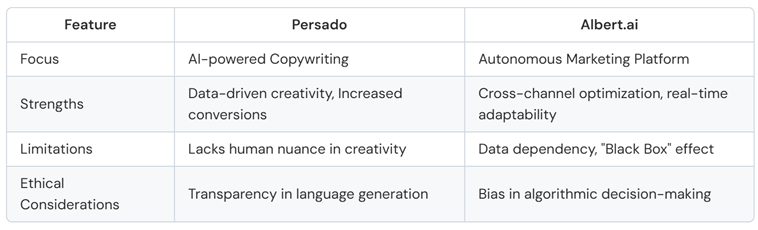
Persado leverages machine learning and computational linguistics to generate high-performing marketing copy. Instead of relying on human intuition, it analyses vast amounts of language data to identify the most effective words, phrases, and emotional triggers for specific target audiences.
Strengths:
- Data-Driven Creativity: Persado moves beyond subjective interpretations of effective copywriting by using data to identify language patterns that resonate with specific audiences. This data-driven approach can lead to more impactful and persuasive messaging.
- Increased Conversion Rates: Case studies have shown that Persado's AI-generated copy can significantly outperform human-written copy regarding click-through rates, conversion rates, and overall campaign performance (Persado, 2024). For example, a campaign for a major credit card company saw a 41% increase in conversions after implementing Persado's AI-generated copy.
- Scalability and Efficiency: Persado enables marketers to generate high-quality copy across multiple channels and formats with speed and efficiency, freeing up human copywriters to focus on more strategic tasks.
Limitations:
- Lack of Nuance and Creativity: While Persado excels at optimising language for specific outcomes, it may not always capture the nuance, creativity, or brand voice that can be achieved through human copywriting.
- Over-Reliance on Data: Overreliance on data-driven insights could lead to formulaic or generic copy lacking originality or emotional depth.
Ethical Considerations:
- Transparency and Control: As with any AI system, transparency in how Persado's algorithms make decisions is crucial. Marketers must retain control over the messaging and ensure it aligns with their brand values and ethical standards.
Albert.ai: Autonomous Marketing Platform
Albert.ai represents a significant step towards autonomous marketing. This platform uses AI to manage and optimise digital marketing campaigns across multiple channels, including search, social media, and display advertising.
Strengths:
- Cross-Channel Optimization: Albert.ai analyses data across all digital channels to identify the most effective strategies and allocate marketing budgets accordingly. This holistic approach ensures that campaigns are optimised for maximum impact.
- Real-Time Adaptability: The platform continuously monitors campaign performance and makes real-time adjustments based on changing market conditions, audience behaviour, and other relevant factors.
- Improved ROI and Efficiency: By automating many time-consuming tasks and optimising performance campaigns, Albert.ai can significantly improve marketing ROI and free marketers to focus on strategic planning and creative initiatives.
Limitations:
- Data Dependency: Albert.ai's effectiveness highly depends on the quality and quantity of data it receives. Insufficient or inaccurate data can lead to suboptimal campaign performance.
- Black Box Effect: Albert.ai's algorithms' complexity can make it challenging for marketers to understand decisions, potentially leading to a lack of trust or control.
Ethical Considerations:
- Bias and Discrimination: As with any AI system, Albert.ai's algorithms are subject to bias, potentially leading to discriminatory outcomes in ad targeting or campaign optimisation. Marketers must be vigilant in monitoring for and mitigating bias.
- Job Displacement: The increasing automation of marketing tasks raises concerns about job displacement. Marketers must adapt their skills and embrace new roles focusing on strategy, creativity, and human-centred marketing.
The Future of AI in Marketing: Beyond Automation, Towards Collaboration
While AI has already begun to reshape the marketing landscape, its most transformative impacts are yet to come. Rather than simply predicting increased automation, examining the nuanced ways in which AI will redefine the role of marketers and the nature of customer engagement is crucial.
The Rise of Conversational AI: Humanizing the Customer Journey
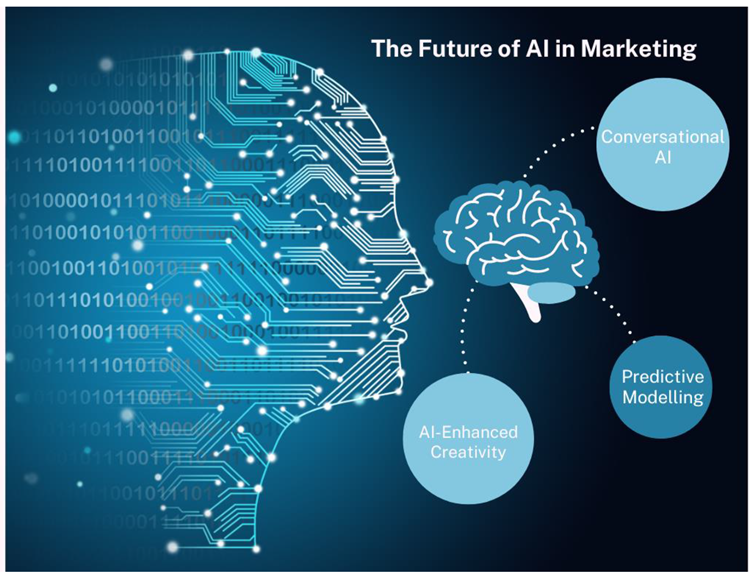
Conversational AI, powered by natural language processing (NLP) and machine learning, is poised to revolutionise customer service and reshape the customer journey. Chatbots and virtual assistants will evolve beyond essential query resolution to provide personalised recommendations, anticipate customer needs, and offer proactive support. This shift will require marketers to develop new skills in conversational design, ensuring that AI-powered interactions are efficient, empathetic, and engaging. (Chu, 2024).
Future Research Direction: Investigate the impact of conversational AI on customer satisfaction, brand loyalty, and the overall customer experience. Explore the ethical considerations of using AI to simulate human interaction and build emotional connections with customers (edc, 2024).
Predictive Modelling: Anticipating Needs, Respecting Boundaries
AI's ability to analyse vast datasets and identify patterns will enable marketers to predict consumer behaviour with unprecedented accuracy. This predictive power has profound implications for targeting, personalisation, and product development. However, it also raises ethical concerns about data privacy, algorithmic bias, and the potential for manipulation (Phukan, 2024).
Future Research Direction: Examine the ethical implications of using AI for predictive modelling in marketing. Develop guidelines and best practices for ensuring transparency, fairness, and consumer privacy in AI-driven predictive marketing.
The Evolving Relationship Between AI and Marketing Creativity
The fear that AI will replace human creativity in marketing is misguided. Instead, AI will augment and enhance human creativity by automating tedious tasks, providing data-driven insights, and expanding the possibilities for personalised and interactive experiences. Marketers must embrace AI as a collaborative partner, leveraging its strengths while harnessing their unique creative vision and strategic thinking (Thewritecure, 2024).
Future Research Direction: Explore the evolving relationship between AI and marketing creativity. Investigate how AI can foster innovation, enhance storytelling, and create engaging and impactful marketing campaigns.
The future of AI in marketing is not about replacing human marketers but about empowering them to achieve more. By embracing a collaborative mindset, prioritising ethical considerations, and continuously adapting to AI's evolving capabilities, marketers can unlock unprecedented opportunities for growth, innovation, and meaningful customer engagement.
Conclusion
This article explored AI's evolving role in marketing, tracing its journey from data-driven strategies to its current transformative potential. While AI offers undeniable benefits like hyper-personalization, automation, and data-driven insights, it also presents privacy, job displacement, algorithmic bias, and transparency challenges.
Key Takeaways:
- AI is shifting from a tool to a partner: Marketers must evolve from simply using AI tools to strategically collaborating with AI systems.
- Ethical considerations are paramount: Responsible AI adoption requires addressing privacy concerns, mitigating bias, and ensuring transparency.
- Human skills remain essential: Creativity, empathy, ethical judgment, and strategic thinking will be increasingly vital in an AI-driven marketing landscape.
Recommendations for Marketers:
- Embrace lifelong learning: Continuously update skills to stay ahead of AI advancements and leverage new tools effectively.
- Prioritize data quality and ethics: Ensure data accuracy, address potential biases, and be transparent about data usage.
- Focus on strategic and creative roles: Delegate routine tasks to AI and focus on high-level strategy, creative campaign development, and building authentic customer relationships.
Recommendations for Policymakers:
- Develop ethical guidelines for AI in marketing: Establish clear regulations regarding data privacy, algorithmic transparency, and responsible AI use.
- Support workforce transition: Provide resources and training programs to help marketers adapt their skills for an AI-driven future.
- Foster collaboration between industry and academia: Encourage research and development of ethical and responsible AI applications in marketing.
The future of marketing hinges on a collaborative approach to AI, where human ingenuity and ethical considerations guide its development and deployment. By embracing this collaborative vision, we can unlock AI's full potential to create a more efficient, engaging, and ethical marketing landscape.
Conflicts of Interests
The authors declare that they have no known competing financial interests or personal relationships that could have appeared to influence the work reported in this paper.
References
- Burrell, J. How the Machine ‘Thinks’: Understanding Opacity in Machine Learning. journal Big Data & Society 2016. [Google Scholar] [CrossRef]
- Chu, L. (2024, August 14). The Impact of Conversational AI on Customer Experience. From innovative dev: https://www.smartdev.com/the-impact-of-conversational-ai-on-customer-experience/.
- Darrell, K.; Rigby, F. F. Avoid the Four Perils of CRM. Harvard Business Review 2002, 80, 101–109. [Google Scholar]
- etc. (2024, July 25). Improved Customer Satisfaction With Advanced Conversational AI. From EDC: https://edc.ae/blog/improved-customer-satisfaction-with-advanced-conversational-ai/.
- Hoffman, C. v. (2023, February 22). How can bias in AI damage marketing data, and what can you do about it? From martech: https://martech.org/bias-in-ai-chatgpt-marketing-data/.
- Joseph, A.; Konstan, J. T. E-commerce recommendation applications. Data Mining and Knowledge Discovery 2001, 5, 115–153. [Google Scholar] [CrossRef]
- Kaplan, M. H. A Brief History of Artificial Intelligence: On Messages and Messengers. California Management Review 2019, 61, 5–14. [Google Scholar]
- Lee, J. (2024). The future of marketing in the era of AI: 2024 outlook. From out: https://owdt.com/article/the-future-of-marketing-in-the-era-of-ai-2024-outlook/.
- Marr, B. (2019). Marketing Automation: Explained. Bernard Marr & Co.
- Martin, K. Ethical Implications of Artificial Intelligence. Journal of Business Ethics 2019, 155, 937–948. [Google Scholar]
- McAfee, E. B. (2014). The Second Machine Age: Work, Progress, and Prosperity in a Time of Brilliant Technologies. W. W. Norton & Company.
- Persado. (2024, Jun 18). Persado case studies. From Persado: https://www.persado.com/resource-library/articles/.
- Phukan, P. (2024, February 20). AI Overdose in Marketing: How to Balance AI and Human Creativity. From species: https://www.specbee.com/blogs/ai-overdose-marketing-how-to-balance-ai-and-human-creativity.
- Rakesh Agrawal, R. S. (1994). Fast algorithms for mining association rules. Proceedings of the 20th International Conference on Very Large Data Bases, VLDB, 1215, pp. 487–499. From https://www.vldb.org/conf/1994/P487.PDF#:~:text=Proceedings%20of%20the%2020th%20VLDB%20Conference%20and%20AprioriTid,%20that%20differ.
- Rust, M.-H. H. Artificial Intelligence in Service. Journal of Service Research, 2018, 21, 155–172. [Google Scholar]
- Sterne, J. (2017). Artificial Intelligence for Marketing: Practical Applications. Wiley.
- Sweeney, M. (2024). What is Programmatic Advertising? The Definitive Guide for 2024. From clear code: https://clearcode.cc/blog/programmatic-advertising/.
- Thewritecure. (2024). How is AI Impacting Marketing Strategies? From Write Cure: https://www.writecure.com/marketing-in-the-age-of-ai.
- Thomas Davenport, A. G. How artificial intelligence will change the future of marketing. Journal of the Academy of Marketing Science 2020, 48, 24–42. Available online: https://onwork.edu.au/bibitem/2020-Davenport,T-Guha,A-etal-How+artificial+intelligence+will+change+the+future+of+marketing/. [CrossRef]
- V. Kumar, B. R. I understand the Role of Artificial Intelligence in Marketing. Journal of the Academy of Marketing Science 2019, 47, 157–161. [Google Scholar]
- Welser, O. a. (2017). An Intelligence in Our Image: The Risks of Bias and Errors in Artificial Intelligence. Rand Corporation.
- Winer, R. S. Mathematical programming for profitable marketing decisions. Marketing Science 1964, 3, 52–62. [Google Scholar]
Disclaimer/Publisher’s Note: The statements, opinions and data contained in all publications are solely those of the individual author(s) and contributor(s) and not of MDPI and/or the editor(s). MDPI and/or the editor(s) disclaim responsibility for any injury to people or property resulting from any ideas, methods, instructions or products referred to in the content. |
© 2024 by the authors. Licensee MDPI, Basel, Switzerland. This article is an open access article distributed under the terms and conditions of the Creative Commons Attribution (CC BY) license (http://creativecommons.org/licenses/by/4.0/).
Copyright: This open access article is published under a Creative Commons CC BY 4.0 license, which permit the free download, distribution, and reuse, provided that the author and preprint are cited in any reuse.


