

Submitted:
13 January 2025
Posted:
14 January 2025
You are already at the latest version
Abstract

Purpose in systems is considered to be beyond the purview of science, since it is thought to be intrinsically personal. However, just as Claude Shannon was able to define an impersonal measure of information, so we formally define the (impersonal) ‘entropic purpose’ of an information system (using the theoretical apparatus of Quantitative Geometrical Thermodynamics) as the line integral of an entropic “purposive” Lagrangian defined in hyperbolic space across the complex temporal plane. We verify that this Lagrangian is well-formed: it has the appropriate variational (Euler-Lagrange) behaviour. We also discuss the teleological characteristics of such variational behaviour (featuring both thermodynamically reversible and irreversible temporal measures), so that a “Principle of Least (entropic) Purpose” can be adduced for any information-producing system. We show that entropic purpose is (approximately) identified with the information created by the system: an empirically measurable quantity. Exploiting the relationship between the entropy production of a system and its energy Hamiltonian, we also show how Landauer’s principle also applies to the creation of information; any purposive system that creates information will also dissipate energy. Finally, we discuss how ‘entropic purpose’ might be applied in artificial intelligence contexts (where degrees of system ‘aliveness’ need to be assessed), and in cybersecurity (where this metric for ‘entropic purpose’ might be exploited to help distinguish between people and bots).
Keywords:
1. Introduction
A. Entropic Purpose and Complex Time
B. Life and Artificial Intelligence
C. Aristotelian Teleology
D. Shannon Information
E. Entropic Purpose
F. Teleonomy
G. Non-Technical Overview
2. Technical Background
A. Holomorphism and the Lagrangian-Hamiltonian representation
B. Shannon Information and Info-Entropy
C. The QGT Equations of State
D. Irreversibility in QGT
E. Other Comments
3. A Formal Expression for a System with a Non-Zero Entropic Purpose
A. Overview
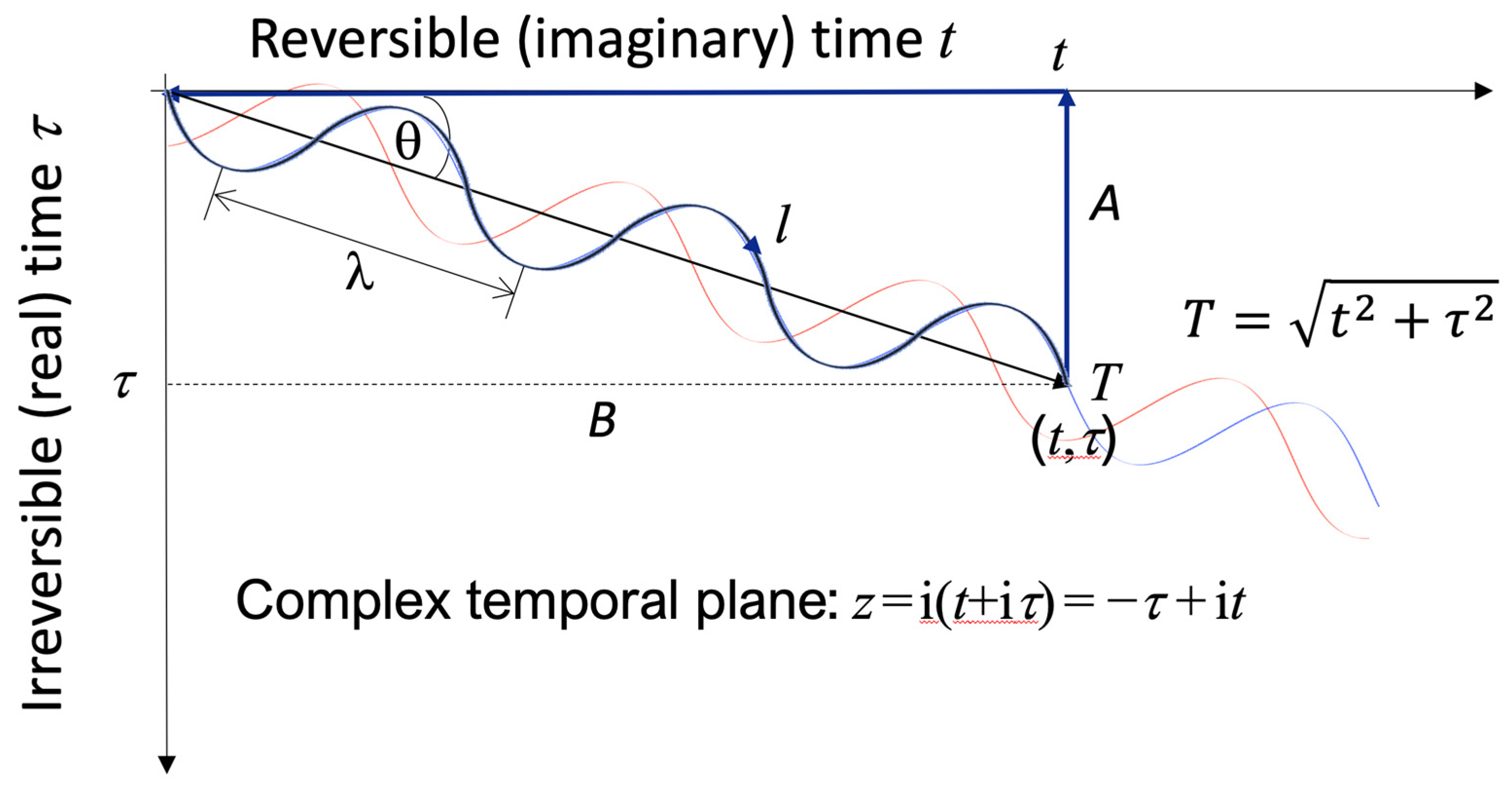
B. The Purposive Lagrangian LP
C. Calculating LP
D. Calculating the Entropic Purpose P
E. Calculating the Information
F. Communication Systems Power Requirements
4. Discussion
5. Summary and Conclusions
Author Contributions
Funding
Data Availability Statement
Conflicts of Interest
Appendix A: Principle of Least (Entropic) Purpose
A. Conjugate Parameters in Hyperbolic Space
B. Obtaining the Purposive Lagrangian
C. Confirming the Variational Properties on the Reversible t Axis
D. Confirming the Variational Properties on the Irreversible τ Axis
Appendix B: Analyticity of the Purposive Lagrangian in the Complex Temporal Plane
Appendix C: The Legitimacy of Teleology
A. Life is Purposive
B. Aristotelian Teleology
C. Background to Entropic Purpose
D. Information, Entropy and Noise
E. Emergence and Downward Causation
F. Time & Chirality
G. Black Holes
References
- Jennifer Coopersmith, The Lazy Universe: an Introduction to the Principle of Least Action (Oxford University Press, 2017).
- Michael Stöltzner, The Principle of Least Action as the Logical Empiricist’s Shibboleth, Studies in History and Philosophy of Modern Physics 34 (2003) 285-318; [CrossRef]
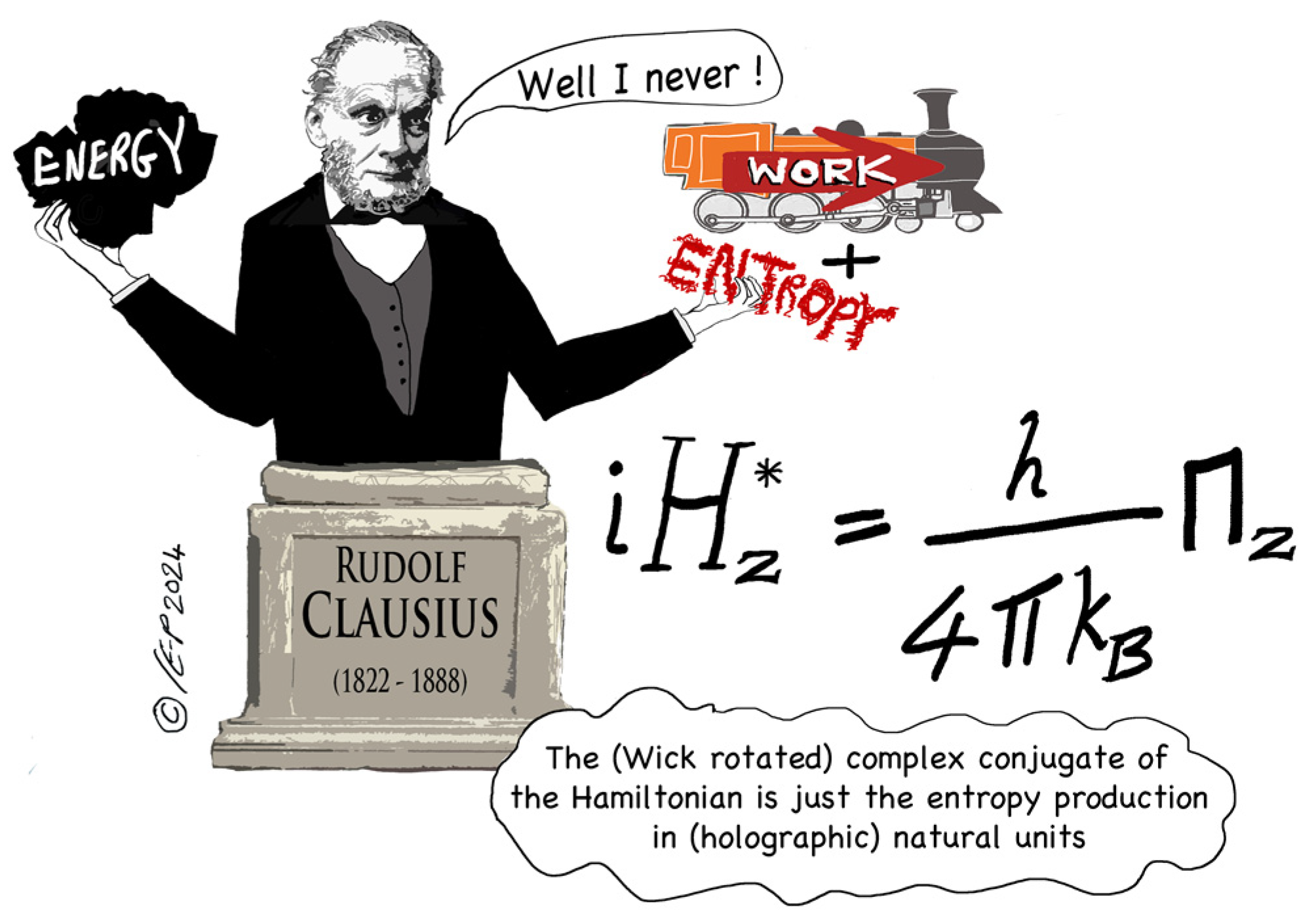
- M.C.Parker, C.Jeynes, Relating a system’s Hamiltonian to its Entropy Production using a Complex-Time approach, Entropy 25 (2023) 629 (19pp); [CrossRef]
- Raymond Noble, Denis Noble, Understanding Living Systems (Cambridge University Press, 2023).
- Srecko Joksimovic, Dirk Ifenthaler, Rebecca Marrone, Maarten De Laat, George Siemens, Opportunities of artificial intelligence for supporting complex problem-solving: Findings from a scoping review, Computers and Education: Artificial Intelligence 4 (2023) 100138 (12pp); [CrossRef]
- Bert Wang-Chak Chan, Lenia - Biology of Artificial Life, Complex Systems 28 (2019) 251-286; [CrossRef]
- Roman V Yampolskiy, On the origin of synthetic life: attribution of output to a particular algorithm, Physica Scripta 92 (2017) 013002; [CrossRef]
- Edward N. Trifonov, Vocabulary of Definitions of Life Suggests a Definition, Journal of Biomolecular Structure & Dynamics 29 (2011) 259-266 (pp); [CrossRef]
- Chris Jeynes, Michael C.Parker, Margaret Barker, The Poetics of Physics, Philosophies 8 (2023) 3 (54pp); [CrossRef]
- Alexander Fürst von Lieven and Marcel Humar, A Cladistic Analysis of Aristotle's Animal Groups in the "Historia animalium", History and Philosophy of the Life Sciences 30 (2008) 227-262; https://www.jstor.org/stable/23334371.
- Claude E. Shannon, A Mathematical Theory of Communication, The Bell System Technical Journal 27 (1948) 379–423, 623–656; [CrossRef]
- Hermann A. Haus, Electromagnetic noise and quantum optical measurements (Springer Verlag, Berlin, 2000).
- M.C.Parker, C.Jeynes, Maximum Entropy (Most Likely) Double Helical and Double Logarithmic Spiral Trajectories in Space-Time, Scientific Reports 9 (2019) 10779 (10 pp, 44 pp Appendices); [CrossRef]
- P.A.Corning et al., Evolution “On Purpose”: Teleonomy in Living Systems (Cambridge, Massachusetts: The MIT Press, 2023; eds. Peter A. Corning, Stuart A. Kauffman, Denis Noble, James A. Shapiro, Richard I. Vane-Wright, Addy Pross).
- Roger Penrose, The Road to Reality (London: Jonathan Cape, 2004).
- Michael C Parker, Stuart D Walker, Information transfer and Landauer’s principle. Optics Communications 229 (2004) 23–27; [CrossRef]
- M.C. Parker, S.D. Walker, A Dynamic Model of Information and Entropy, Entropy 12 (2010) 80-88; [CrossRef]
- Raymond E.A.C. Paley, Norbert Wiener, Fourier transforms in the complex domain, American Mathematical Society Colloquium Public 19 (1934); [CrossRef]
- D. Hestenes, “Oersted Medal Lecture 2002: Reforming the Mathematical Language of Physics”, American Journal of Physics 71 (2003) 104–121; [CrossRef]
- Michael C. Parker, Chris Jeynes, A Relativistic Entropic Hamiltonian–Lagrangian Approach to the Entropy Production of Spiral Galaxies in Hyperbolic Spacetime, Universe 7 (2021) 325 (15pp); [CrossRef]
- E. T. Jaynes, The Minimum Entropy Production Principle, Annual Review of Physical Chemistry 31 (1980) 579-601; [CrossRef]
- Michael C. Parker, Christopher Jeynes, Jaynes’ “Caliber” is proportional to “Exertion” in Quantitative Geometrical Thermodynamics, AIP Conference Proceedings 2731 (2023) 020007 (8pp); [CrossRef]
- P.A.M. Dirac, The Lagrangian in Quantum Mechanics, Physikalische Zeitschrift der Sowjetunion, Band 3, Heft 1 (1933) 64-72.
- Richard Feynman, The Principle of Least Action in Quantum Mechanics (Princeton University: PhD Thesis, 1942; republished in L.M. Brown, Feynman’s Thesis- A New Approach to Quantum Theory, World Scientific, 2005).
- N.D. Hari Dass, Dirac and the Path Integral. [CrossRef]
- Michael C Parker, Stuart D Walker, A Unified Carnot Thermodynamic and Shannon Channel Capacity Information-Theoretic Energy Efficiency Analysis, IEEE Transactions on Communications 62 (2014) 3552-3559; [CrossRef]
- M.C.Parker, C.Jeynes, Entropic Uncertainty Principle, Partition Function and Holographic Principle derived from Liouville's Theorem, Physics Open 7 (2021) 100068 (11pp); [CrossRef]
- M.C.Parker, C.Jeynes, Fullerene Stability by Geometrical Thermodynamics, ChemistrySelect 5 (2020) 5-14; [CrossRef]
- M.C.Parker, C.Jeynes, W.N.Catford, Halo Properties in Helium Nuclei from the Perspective of Geometrical Thermodynamics, Annalen der Physik 534 (2022) 2100278 (11pp); [CrossRef]
- M.C.Parker, C.Jeynes, ab initio thermodynamics calculation of beta decay rates, Annalen der Physik 535 (2023) 2300259 (11pp); [CrossRef]
- Yuxin Wang, Yueyang Shen, Daxuan Deng, Ivo D. Dinov (2022), Determinism, well-posedness, and applications of the ultrahyperbolic wave equation in spacekime, Partial Differential Equations in Applied Mathematics 5 (2022) 100280 (13pp); [CrossRef]
- Charles Auffray, Laurent Nottale, Scale relativity theory and integrative systems biology: 1: Founding principles and scale laws, Progress in Biophysics and Molecular Biology 97 (2008) 79-114; [CrossRef]
- S. Pressé, K. Ghosh, J. Lee, and K. A. Dill, Perspective: Maximum caliber is a general variational principle for dynamical Systems, Rev. Mod. Phys 85 (2013) 1115–1141; [CrossRef]
- Rolf Landauer, Information is a physical entity, Physica A: Statistical Mechanics and its Applications 263 (1999) 63-67; [CrossRef]
- Rolf Landauer (1991), Information is Physical, Physics Today 44 (1991) 23-29; [CrossRef]
- Iulia Georgescu, 60 years of Landauer’s principle, Nature Reviews Physics 3 (2021) 770; [CrossRef]
- C.Jeynes, How “Berry Phase” analysis of non-adiabatic non-Hermitian systems reflects their geometry, Entropy 25 (2023) 390 (10pp); [CrossRef]
- Kyriaki-Evangelia Aslani, Efstratios Tzirtzilakis, Ioannis E. Sarris, On the mechanics of conducting micropolar fluids with magnetic particles: Vorticity–microrotation difference, Physics of Fluids 36 (2024) 102006 (19pp); [CrossRef]
- Jonathan Asher Pachter, Ying-Jen Yang, Ken A. Dill, Entropy, irreversibility and inference at the foundations of statistical physics. Nature Reviews Physics (2024); [CrossRef]
- Olivier Darrigol, Boltzmann’s reply to the Loschmidt paradox: a commented translation. European Physical Journal H 46 (2021) 29; [CrossRef]
- Sara Imari Walker, Origins of life: a problem for physics, a key issues review, Reports on Progress in Physics 80 (2017) 092601 (41pp); [CrossRef]
- E. D. Schneider, J. J. Kay, Life as a Manifestation of the Second Law of Thermodynamics, Mathematical and Computer Modelling 19 (1994) 25-48; [CrossRef]
- E. Schrödinger, What is Life? (Cambridge University Press, 1944).
- Lynn Margulis, Dorion Sagan, “Sentient Symphony”, Ch.27 in: M. A. Bedau and C. E. Cleland (eds), The Nature of Life: Classical and Contemporary Perspectives from Philosophy and Science (Cambridge University Press 2010).
- Mark A. Bedau, “Four puzzles about life”, Ch.31 in: M. A. Bedau and C. E. Cleland (eds), The Nature of Life: Classical and Contemporary Perspectives from Philosophy and Science (Cambridge University Press 2010).
- Peter A. Corning, Stuart A. Kauffman, Denis Noble, James A. Shapiro, Richard I. Vane- Wright, Addy Pross, Introduction (Ch.1 in Evolution “On Purpose” Teleonomy in Living Systems, MIT 2023 [ref.14]).
- Johnjoe McFadden, Jim al-Khalili, A quantum mechanical model of adaptive mutation, Biosystems 50 (1999) 203-211; [CrossRef]
- Orly Shenker, Information vs. entropy vs. probability, European Journal for Philosophy of Science 10 (2020) 1-25; [CrossRef]
- M.C.Parker, C.Jeynes, S.D.Walker, A hyperbolic sum rule for probability: solving recursive (“Chicken & Egg”) problems; preprint 22/7/2024: . [CrossRef]
- L.Brillouin, Science & Information Theory (Academic, 1956).
- Mariska Leunissen (ed.), Aristotle’s Physics: A Critical Guide (Cambridge University Press, 2015).
- Sara I. Walker, N. Packard and G. D. Cody, Re-conceptualizing the origins of life, Philosophical Transactions of the Royal Society A 375 (2017) 20160337 (11pp); [CrossRef]
- Carlo Rovelli, Reality is not what it seems (first published in Italian as La realità non è come si appare, 2014; Penguin 2017).
- George F. R. Ellis, Efficient, Formal, Material, and Final Causes in Biology and Technology, Entropy 25 (2023) 1301 (28pp); [CrossRef]
- James Allen, ch.4 in Mariska Leunissen [ref.51].
- Charlotte Witt, ch.6 in Mariska Leunissen [ref. 51].
- Margaret Scharle, ch.5 in Mariska Leunissen [ref. 51].
- George F. R. Ellis, How purposeless physics underlies purposeful life, Nature 622 (2023) 247-249; [CrossRef]
- Abhishek Sharma, Dániel Czégel, Michael Lachmann, Christopher P. Kempes, Sara I. Walker, Leroy Cronin, Assembly theory explains and quantifies selection and evolution, Nature 622 (2023) 321–328; [CrossRef]
- James Hannam, God's Philosophers: How the Medieval World Laid the Foundations of Modern Science (UK: Icon Books, 2009).
- David Atkinson, Jeanne Peijnenburg, Galileo and prior philosophy, Studies in History and Philosophy of Science A35 (2004) 115-136; [CrossRef]
- Stillman Drake, A further reappraisal of impetus theory: Buridan, Benedetti, and Galileo, Studies in History and Philosophy of Science A7 (1976) 319-336; [CrossRef]
- Ori Belkind, Unnatural acts: The transition from Natural Principles to Laws of Nature in Early Modern science, Studies in History and Philosophy of Science A81 (2020) 62-73; [CrossRef]
- James G. Lennox, ch.1 in Mariska Leunissen [ref. 51].
- Chris Jeynes, Michael C. Parker, The Integral Nature of the Scientific Enterprise; submitted to Philosophies 22/8/2024; Preprint https://www.preprints.org/manuscript/202408.1674/v1.
- Annie L. Crawford, Metaphor and Meaning in the Teleological Language of Biology, Communications of the Blyth Institute 2 (2020) 5-24; [CrossRef]
- Philip Ball, How Life Works: A User’s Guide to the New Biology (University of Chicago Press, 2023; London: Picador, 2023; page numbers are for the UK edition).
- Iris Murdoch, The Sovereignty of Good over Other Concepts (The Leslie Stephen Lecture; Cambridge University Press, 1967; reprinted in The Sovereignty of Good, Routledge & Kegan Paul: Abingdon, Oxon, 1970).
- Henry D. Potter, Kevin J. Mitchell, Naturalising Agent Causation, Entropy 24 (2022) 472 (18pp); [CrossRef]
- Karen Barad, Meeting the Universe Halfway: Quantum Physics and the Entanglement of Matter and Meaning (Duke University Press: Durham, NC, USA, 2007).
- George F R Ellis, Emergence in Solid State Physics and Biology, Foundations of Physics 50 (2020) 1098–1139; https://doi.org/10.1007/s10701-020-00367-z; arXiv: 30 Jun 2020. [CrossRef]
- S.V. Prants, Marine life at Lagrangian fronts, Progress in Oceanography 204 (2022) 102790 (24pp); [CrossRef]
- W. James Grecian, Jude V. Lane, Théo Michelot, Helen M. Wade, Keith C. Hamer, Understanding the ontogeny of foraging behaviour: insights from combining marine predator bio-logging with satellite-derived oceanography in hidden Markov models, Journal of the Royal Society Interface 15 (2018) 20180084 (9pp); [CrossRef]
- Melinda G. Conners, Théo Michelot, Eleanor I. Heywood, Rachael A. Orben, Richard A. Phillips, Alexei L. Vyssotski, Scott A. Shaffer & Lesley H. Thorne, Hidden Markov models identify major movement modes in accelerometer and magnetometer data from four albatross species, Movement Ecology 9 (2021) 7 (16pp); [CrossRef]
- Denis Noble, A theory of biological relativity: no privileged level of causation, Interface Focus 6 (2012) 55-64; [CrossRef]
- Ilya Prigogine, Time, Structure and Fluctuations; Royal Swedish Academy of Sciences: Lecture accepting the Nobel Prize for Chemistry 1977, Science 201 (1978) 777–785; [CrossRef]
- Olimpia Lombardi, Federico Holik & Leonardo Vanni, What is Shannon information? Synthese 193 (2016) 1983–2012; [CrossRef]
- Oliver Sacks, The Man who Mistook his Wife for a Hat (Gerald Duckworth, 1985).
- J.S.Toll, Causality and the Dispersion Relation: Logical Foundations. Physical Review, 104 (1956) 1760–1770; [CrossRef]
- Amin Jaber, Murat Kocaoglu, Karthikeyan Shanmugam, Elias Bareinboim, Causal Discovery from Soft Interventions with Unknown Targets: Characterization and Learning, 34th Conference on Neural Information Processing Systems (NeurIPS 2020), Vancouver, Canada; NeurIPS2020 - 2.pdf (accessed 23rd November 2023).
- Peter Spirtes, Kun Zhang, Causal discovery and inference: concepts and recent methodological advances, Applied Informatics 3 (2016) 3 (28pp); [CrossRef]
- Dominik Janzing, Rafael Chaves, Bernhard Schölkopf, Algorithmic independence of initial condition and dynamical law in thermodynamics and causal inference, New Journal of Physics 18 (2016) 093052 (13pp); [CrossRef]
- Christopher J. Quinn, Negar Kiyavash, Todd P. Coleman, Directed Information Graphs, IEEE Transactions on Information Theory 61 (2015) 6887-6909 (pp); [CrossRef]
- James L. Massey, Causality, Feedback and Directed Information, Proceedings of the International Symposium on Information Theory and its Applications (1990) 303-305; http://www.isiweb.ee.ethz.ch/archive/massey_pub/pdf/BI532.pdf (accessed 1 Dec. 2023).
- Olimpia Lombardi, Cristian López, What Does ‘Information’ Mean in Integrated Information Theory? Entropy 20 (2018) 894 (18pp); [CrossRef]
- Mariana Lenharo, Consciousness theory slammed as ‘pseudoscienceʼ, Nature News (20th September 2023); [CrossRef]
- Jonathan C. G. Jeynes, Matthew Corney, Tim James, A large-scale evaluation of NLP-derived chemical-gene/protein relationships from the scientific literature: Implications for knowledge graph construction, PLoS ONE 18 (2023) e0291142 (18pp); [CrossRef]
- Geoffrey W. Grime, Oliver B. Zeldin, Mary E. Snell, Edward D. Lowe, John F. Hunt, Gaetano T. Montelione, Liang Tong, Edward H. Snell, Elspeth F. Garman, High-Throughput PIXE as an Essential Quantitative Assay for Accurate Metalloprotein Structural Analysis: Development and Application, Journal of the American Chemical Society 142 (2020) 185–197; [CrossRef]
- Paul Nurse, Life, logic and information, Nature 454 (2008) 424–426; [CrossRef]
- Hyunju Kim, Gabriele Valentini, Jake Hanson, Sara Imari Walker, Informational architecture across non-living and living collectives, Theory in Biosciences 140 (2021) 325–341; [CrossRef]
- Andrzej Bielecki, Michael Schmittel, The Information Encoded in Structures: Theory and Application to Molecular Cybernetics, Foundations of Science 27 (2022) 1327–1345; [CrossRef]
- Philip Goff, Why? The purpose of the Universe (Oxford University Press, 2023).
- Felipe Olivares, Angelo Plastino, Osvaldo A. Rosso, Contrasting chaos with noise via local versus global information quantifiers, Physics Letters A 376 (2012) 1577–1583; [CrossRef]
- Abicumaran Uthamacumaran, Felipe S. Abrah, Narsis A. Kiani, Hector Zenil, On the Salient Limitations of the Methods of Assembly Theory and their Classification of Molecular Biosignatures, arXiv:2210.00901v6 [cs.IT] 10 Jan 2024; [CrossRef]
- Hector Zenil, Jean-Paul Delahaye, On the Algorithmic Nature of the World (Ch.1 in: Information and Computation, World Scientific 2010; eds: Gordana Dodig-Crnkovic and Mark Burgin); [CrossRef]
- Fernando Soler-Toscano, Hector Zenil, Jean-Paul Delahaye, Nicolas Gauvrit, Calculating Kolmogorov Complexity from the Output Frequency Distributions of Small Turing Machines, PLoS ONE 9 (2014) e96223 (18pp); [CrossRef]
- Hector Zenil, Santiago Hernández-Orozco, Narsis A. Kiani, Fernando Soler-Toscano, Antonio Rueda-Toicen, Jesper Tegnér, A Decomposition Method for Global Evaluation of Shannon Entropy and Local Estimations of Algorithmic Complexity, Entropy 20 (2018) 605 (34pp); [CrossRef]
- Hector Zenil, Narsis A. Kiani, Ming-Mei Shang, Jesper Tegnér, Algorithmic Complexity and Reprogrammability of Chemical Structure Networks, Parallel Processing Letters 28 (2018) 1850005 (18pp); [CrossRef]
- Santiago Hernández-Orozco, Narsis A. Kiani, Hector Zenil, Algorithmically probable mutations reproduce aspects of evolution, such as convergence rate, genetic memory and modularity, Royal Society open science 5 (2018) 180399 (22pp); [CrossRef]
- C.R.Frith, “Free Will and Top-Down Control in the Brain”; Ch.12 in Nancey Murphy, George F.R. Ellis, and Timothy O’Connor (Eds.): Downward Causation and the Neurobiology of Free Will (Springer-Verlag Berlin, 2009).
- Nikolay Perunov, Robert A. Marsland, and Jeremy L. England, Statistical Physics of Adaptation, Physical Review X 6 (2016) 021036 (11pp); https://link.aps.org/doi/10.1103/PhysRevX.6.021036.
- Francesca Bellazzi, The emergence of the postgenomic gene, European Journal for Philosophy of Science 12 (2022) 17 (pp); [CrossRef]
- Dan Graur, Yichen Zheng, Nicholas Price, Ricardo BR Azevedo, Rebecca A Zufall, Eran Elhaik, On the Immortality of Television Sets: “Function” in the Human Genome According to the Evolution-Free Gospel of ENCODE, Genome Biology and Evolution 5 (2013) 578–590; [CrossRef]
- Carlo Rovelli, Relational quantum mechanics, International Journal of Theoretical Physics 35 (1996) 1637–1678; [CrossRef]
- Augustine of Hippo, Confessiones (c.398 CE, Confessions, transl. R.S.Pine-Coffin, Penguin 1961; Latin text from Pius Knöll's editio minor of 1898; https://faculty.georgetown.edu/jod/latinconf/latinconf.html accessed 4th Dec. 2023).
- Augustine of Hippo, de Trinitate (c.420 CE, Latin text from William L. Carey, http://thelatinlibrary.com/august.html accessed 4th Dec. 2023; The Trinity, transl. Edmund Hill, New City Press New York 1991).
- John Skilling, Kevin H. Knuth, The Symmetrical Foundation of Measure, Probability, and Quantum Theories, Annalen der Physik 531 (2019) 1800057 (9pp); [CrossRef]
- Yong Chen, Wentao Ma, The origin of biological homochirality along with the origin of life, PLoS Computational Biology 16 (2020) e1007592 (20pp); [CrossRef]
- Alicia Juarrero, “Top-Down Causation and Autonomy in Complex Systems”; Ch.5 in Nancey Murphy, George F.R. Ellis, and Timothy O’Connor (Eds.): Downward Causation and the Neurobiology of Free Will (Springer-Verlag Berlin, 2009).
- Pablo Razeto-Barry, Autopoiesis 40 years Later. A Review and a Reformulation, Origins of Life and Evolution of Biospheres 42 (2012) 543–567; [CrossRef]
Disclaimer/Publisher’s Note: The statements, opinions and data contained in all publications are solely those of the individual author(s) and contributor(s) and not of MDPI and/or the editor(s). MDPI and/or the editor(s) disclaim responsibility for any injury to people or property resulting from any ideas, methods, instructions or products referred to in the content. |
© 2025 by the authors. Licensee MDPI, Basel, Switzerland. This article is an open access article distributed under the terms and conditions of the Creative Commons Attribution (CC BY) license (http://creativecommons.org/licenses/by/4.0/).


