

Submitted:
23 November 2024
Posted:
25 November 2024
You are already at the latest version
Abstract
The development of naturalistic approaches to complexity of life continues a lineage of thought from Prigogine’s thermodynamics to contemporary complexity science. The paper highlights the central themes of self-organization, emergence, and the interplay between physical, informational, and biological processes. Prigogine’s concept of dissipative structures and irreversibility provided a foundation for understanding complexity in physical systems, which later expanded into biology through Kauffman’s models of creativity and evolution. Margulis's endosymbiosis theory illuminate the cooperative dynamics underpinning life’s complexity, while Walker's work integrates thermodynamics and information theory to bridge the gap between chemistry and biology through multiscale interactions and adaptive dynamics. By synthesizing these perspectives, this article situates life as an emergent phenomenon shaped by interactions across scales, proposing a unified framework for understanding complexity in the natural world.
Keywords:
Origins of Life
; Life and Complexity
; Self-Organization
; Dissipative Structures
; Multiscale Interactions
; Biological Complexity
1. The Contributions of Ilya Prigogine
Ilya Prigogine demonstrated that open thermodynamic systems, particularly those far from equilibrium, exhibit remarkable properties such as pattern formation and the emergence of order from apparent disorder. His work delves into the concepts of time, complexity, and the transition from being to becoming, highlighting the critical role of uncertainty in scientific inquiry.
Order Out of Chaos: Man’s New Dialogue with Nature
In this seminal work, Prigogine and Isabelle Stengers challenge the deterministic view of classical science by illustrating how non-linear processes and instabilities can lead to new forms of order. The concept of dissipative structures—systems that self-organize far from equilibrium—underscores how interactions with the environment foster complexity and unpredictability (Prigogine & Stengers, 1984).
From Being to Becoming: Time and Complexity in the Physical Sciences
Prigogine redefines the nature of time by proposing irreversibility as a fundamental aspect of physical reality. This book critiques classical mechanics for its emphasis on reversibility and deterministic laws, introducing the arrow of time as an essential component linked to entropy (Prigogine, 1980).
The End of Certainty
Here, Prigogine challenges the classical deterministic framework by presenting a probabilistic view of reality. He explores the interplay of quantum mechanics, thermodynamics, and uncertainty, proposing that unpredictability is inherent to natural processes (Prigogine, 1997).
2. Ideas of Kauffman and Roli’s “A Third Transition in Science?”
Kauffman and Roli’s paper critiques classical physics’ limitations in describing the creative, evolving dynamics of living systems. They argue that classical paradigms, like Newtonian and quantum physics, rely on fixed phase spaces, which fail to account for the continuous emergence of novel biological possibilities. In contrast, living systems generate new constraints and phenomena that elude deterministic or mathematical models.
Prigogine and Kauffman/Roli share a vision of transcending deterministic frameworks. Prigogine’s focus is on the role of entropy, instability, and far-from-equilibrium dynamics in physical systems. Kauffman and Roli extend these principles to biological systems, emphasizing biospheres’ creativity and unpredictability.
Biological Dissipative Structures and Creativity
Prigogine introduced dissipative structures, systems operating far from equilibrium that maintain order by exchanging energy and information with their environment. Biological systems, from cells to ecosystems, embody these principles. They metabolize nutrients, regulate internal states, and adapt dynamically, driving evolution and diversification.
Kauffman and Roli expand this notion by highlighting biospheres’ capacity to construct new constraints and possibilities. They argue that the creative evolution of life continuously expands phase spaces, introducing forms and adaptations beyond deterministic frameworks.
3. Extending Complexity Science: Contributions from Other Key Researchers
Numerous researchers, including Brian Goodwin, Humberto Maturana, Jeremy England, Lynn Margulis, Terrence Deacon, Denis Noble and others, have contributed significant insights that complement the ideas of Prigogine and Kauffman/Roli. Their work affirms the role of complexity, emergence, and adaptability in understanding life, offering diverse perspectives that enrich the naturalistic approach to complexity.
Brian Goodwin
Brian Goodwin emphasized how patterns and structures in biology arise through self-organization rather than solely from genetic determinism. In his book How the Leopard Changed Its Spots (1994), Goodwin explores the role of intrinsic dynamical properties in creating biological forms, focusing on morphogenesis—the process by which organisms develop their shapes. He demonstrated how nonlinear interactions at the cellular and molecular levels could give rise to emergent patterns, such as the spots on a leopard or the spirals in flowers. Goodwin’s work challenges reductionist views by showing how developmental processes are shaped by internal dynamics, not just external selection pressures. His vision advocates a shift from gene-centric biology to a holistic understanding of emergent order in living systems.
Stuart Kauffman
Stuart Kauffman’s earlier works, including The Origins of Order (1993) and At Home in the Universe (1995), independently expanded on themes of emergence and creativity in biology. He introduced the concept of the “adjacent possible,” describing how biological systems continually expand their "space of possibilities" through creative evolution. Kauffman’s models of simple networks demonstrated how self-organized criticality—the tendency of systems to naturally evolve toward a critical state—underpins biological complexity. His work illustrates how ecosystems, genetic networks, and biochemical systems explore the adjacent possible, creating novel forms and behaviors that drive evolution. By emphasizing the interplay of order and chaos, Kauffman provided a framework for understanding how life’s complexity emerges through self-organization. He presents those ideas in the books “The Origins of Order: Self-Organization and Selection in Evolution” and “At Home in the Universe: The Search for Laws of Self-Organization and Complexity”, see Kauffman (1993, 1995, 2000, 2008).
Humberto Maturana and Francisco Varela
Humberto Maturana and Francisco Varela introduced the concept of autopoiesis, defining living systems as self-maintaining, self-producing entities. In their seminal work Autopoiesis and Cognition (1992), they explore how living organisms maintain their integrity through continuous self-regulation and interaction with their environment. Autopoiesis places circularity and autonomy at the heart of life’s definition, arguing that living systems are both products and producers of their environments. Their insights challenge reductionist approaches by focusing on the dynamic interplay between internal processes and external influences. This perspective aligns with complexity science’s emphasis on feedback loops and self-organization as key drivers of biological systems.
Jeremy England
Jeremy England proposed a thermodynamic explanation for life’s emergence, suggesting that systems exposed to energy flows naturally evolve toward greater complexity. His theory, detailed in Every Life Is on Fire (2018), argues that energy dissipation plays a central role in driving the self-organization of matter into living systems. England demonstrated that molecular systems subjected to sustained energy gradients, such as sunlight, tend to organize themselves in ways that optimize energy dissipation. This thermodynamic perspective bridges physics and biology, offering a unifying explanation for the transition from non-living to living systems. England’s work complements Prigogine’s ideas by emphasizing how physical principles govern the emergence of life’s complexity.
John Holland
John Holland developed the concept of complex adaptive systems (CAS), emphasizing how interactions between individual agents give rise to emergent, global behaviors. In Emergence: From Chaos to Order (1998), Holland explores how systems as diverse as ecosystems, economies, and neural networks exhibit adaptability and resilience through self-organization. His work provided a computational framework for studying emergence, particularly through genetic algorithms and agent-based models. Holland demonstrated that adaptability is a defining feature of complex systems, enabling them to evolve and coalesce into higher-order structures. His ideas have profoundly influenced fields ranging from biology to artificial intelligence, highlighting the universality of complexity science principles.
Simon Levin
Simon Levin’s research on the self-organization of ecosystems shows how individual behaviors aggregate to produce emergent ecological properties. In Fragile Dominion (1999), Levin examines how interactions between species, resources, and environmental conditions create complex, adaptive ecosystems. He highlights the delicate balance between stability and change, showing how ecosystems maintain resilience in the face of disturbances. Levin’s work underscores the importance of diversity and decentralized decision-making in ecological systems, aligning with complexity science’s focus on emergent order and collective behavior. His insights into the adaptive dynamics of ecosystems contribute to understanding life’s broader organizational principles.
Lynn Margulis
Margulis made groundbreaking contributions to the understanding of complexity and the origins of life through her endosymbiosis theory, which demonstrated that symbiotic relationships drive the evolution of complex life forms. According to her theory, eukaryotic cells, which contain nuclei, originated from a symbiotic merger between primitive prokaryotic organisms. This process emphasized how collaboration and integration, rather than competition alone, foster evolutionary innovation. Margulis’s work highlighted the significance of networks and interdependence in the emergence of biological complexity, positioning cooperation as a fundamental driver of life.
In her book with Dorian Sagan What is Life? (1995), Margulis explores the interconnectedness of life, arguing that living systems cannot be understood in isolation from their environments. The book bridges biology, philosophy, and complexity science, offering a holistic view of life as a cooperative and adaptive phenomenon. The authors emphasize how symbiosis, at all levels of biological organization, has been central to the emergence of life’s complexity.
Her contributions extended beyond the cellular level. She collaborated with James Lovelock on the Gaia hypothesis, which proposed that the Earth functions as a self-regulating system, with living organisms and their environments interacting to maintain conditions conducive to life. Margulis’s perspective challenged traditional Darwinian views by focusing on the cooperative dynamics that underpin evolution. This approach aligns closely with the principles of complexity science, particularly the role of interdependence and emergent order in shaping systems.
Her contributions extended beyond the cellular level. She collaborated with James Lovelock on the Gaia hypothesis, which proposed that the Earth functions as a self-regulating system, with living organisms and their environments interacting to maintain conditions conducive to life. Margulis’s perspective challenged traditional Darwinian views by focusing on the cooperative dynamics that underpin evolution. This approach aligns closely with the principles of complexity science, particularly the role of interdependence and emergent order in shaping systems.
Terrence Deacon
Terrence Deacon explored the emergence of life and consciousness, focusing on how self-organization and thermodynamic constraints lead to higher-order structures. In Incomplete Nature (2012), Deacon introduced the concept of teleodynamics, describing how goal-directed behavior emerges from interactions among physical and chemical systems. His work bridges the gap between non-living and living systems, proposing that life and mind arise through the interplay of self-organization and emergent constraints. Deacon argues that the dynamics of living systems are shaped by both intrinsic tendencies and external influences, creating a framework for understanding how complexity and purpose co-evolve. His contributions extend complexity science into the domains of cognition.
Denis Noble
Denis Noble challenged reductionist views of biology by advocating for a systems-level understanding of life. His books The Music of Life (2006) and Dance to the Tune of Life (2018) present a vision of biology where functions emerge from networks of interactions rather than being dictated by individual genes. Noble emphasizes the role of feedback loops and multilevel interactions in shaping biological processes, arguing that life’s complexity cannot be fully explained by linear causation. His perspective highlights the interconnectedness of physiological systems, positioning life as an emergent phenomenon shaped by both bottom-up and top-down dynamics. Noble’s ideas resonate with complexity science by emphasizing holism and adaptability in biological systems.
4. Sara Imari Walker: Integrating Information and Complexity
In this context the recent work of physicist Sara Imari Walker, active in complexity science, is of interest, particularly understanding biological systems and the origins of life. Walker’s work connects thermodynamics, information theory, and evolution to explain life’s emergence. She argues that life is characterized by the causal closure between informational and physical processes, which enables self-organization and adaptability.
The following are her contributions related to complexity science, and biological systems.
Information as a Key Driver of Biological Systems
Walker focuses on the role of information and computation in biological systems, suggesting that the emergence of life is fundamentally tied to the flow and organization of information. She proposes that biological systems are unique because they exhibit causal closure across informational and physical domains. Biological systems not only process information but use it to control and influence their physical environment. This feedback loop between information and physical processes is central to life’s complexity.
Origins of Life and Complexity
One of Walker’s key research areas is understanding how life originated from non-living matter. Her work integrates complexity science with thermodynamics and information theory to argue that the transition from chemistry to biology involves emergent properties that arise from the interaction of chemical and physical systems far from equilibrium with critical thresholds where the system begins to process and act on information in a life-like manner. Walker explores how prebiotic chemistry might self-organize into systems capable of storing and propagating information—a concept closely tied to Prigogine’s dissipative structures.
Life as a Computational Process
Walker suggests that life represents a new kind of complexity, where information processing plays a central role. She emphasizes the algorithmic nature of life, proposing that living systems can be understood as information-processing networks that adapt and evolve over time. This builds on complexity science by integrating computational principles with biological evolution, extending traditional thermodynamic models.
Emergent Causal Structures
Walker’s research highlights the importance of causal emergence in biological systems. In living systems, higher-level processes (e.g., cellular function) can shape lower-level dynamics (e.g., molecular interactions). This contrasts with reductionist views, where causation flows only from lower to higher levels. Her work aligns with complexity science by emphasizing the multilevel organization of living systems and the feedback between levels.
Walker’s Approach and Complexity Science
Walker’s research represents a clear application of complexity science principles to biological systems. Walker emphasizes emergence as central to understanding life. She explores how life’s properties—such as self-replication, metabolism, and evolution—emerge from the interaction of non-living chemical systems. This mirrors the broader goals of complexity science: understanding how higher-level behaviors arise from lower-level interactions. Nonlinearity is a core feature of the systems Walker studies, from the self-organization of prebiotic chemistry to the evolution of biological networks. These dynamics explain how small changes in molecular interactions can lead to major evolutionary innovations.
Information Theory
Walker integrates information theory with complexity science to argue that life’s complexity cannot be understood solely in terms of energy and matter; it also depends on the flow and organization of information. Her use of information theory complements the thermodynamic focus of figures like Prigogine, extending complexity science into new domains.
Multiscale Interactions
Complexity science often focuses on systems with interactions across multiple scales (e.g., atoms to cells to ecosystems). Walker’s work highlights how these interactions drive the emergence of life and its ability to process information.
Summary
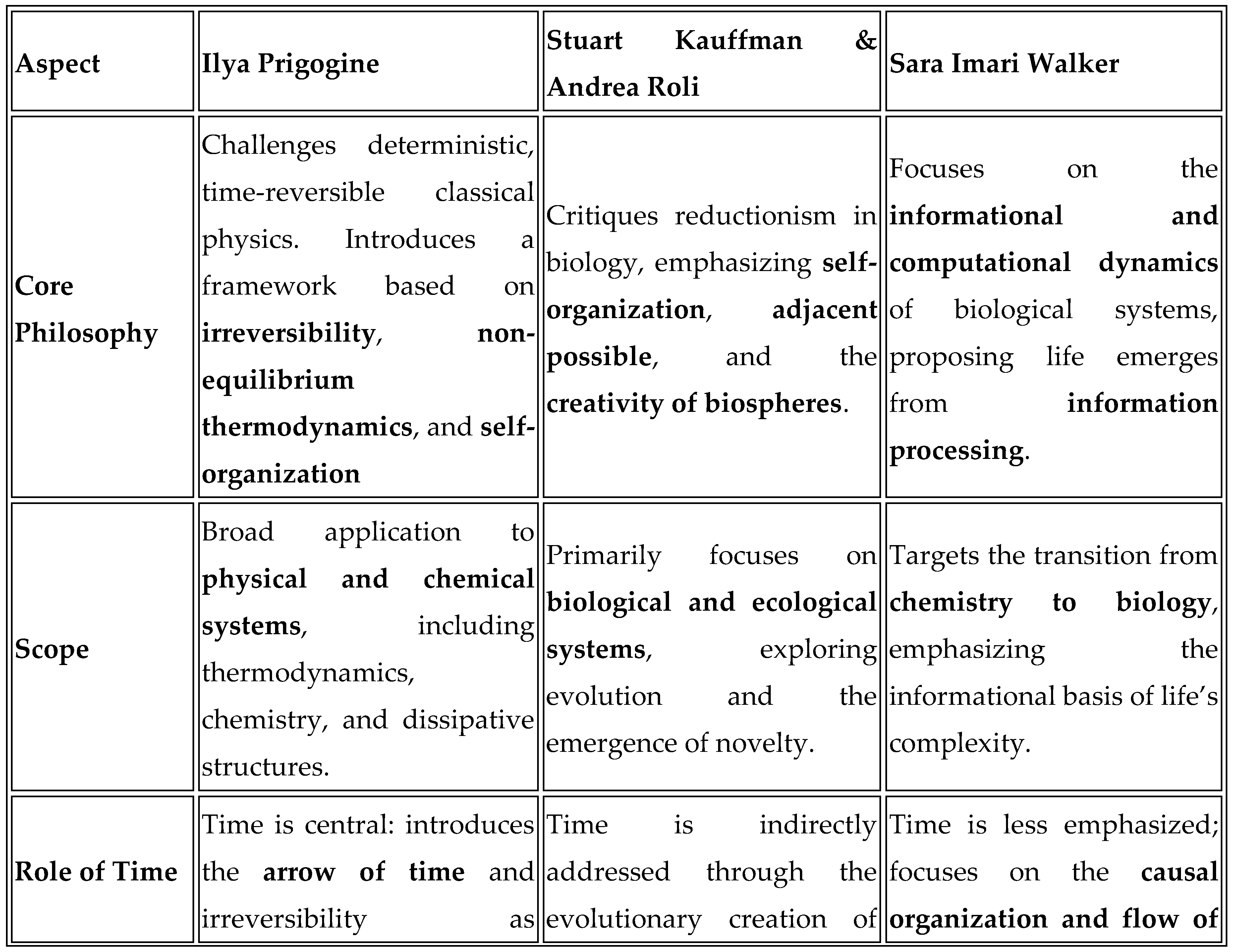
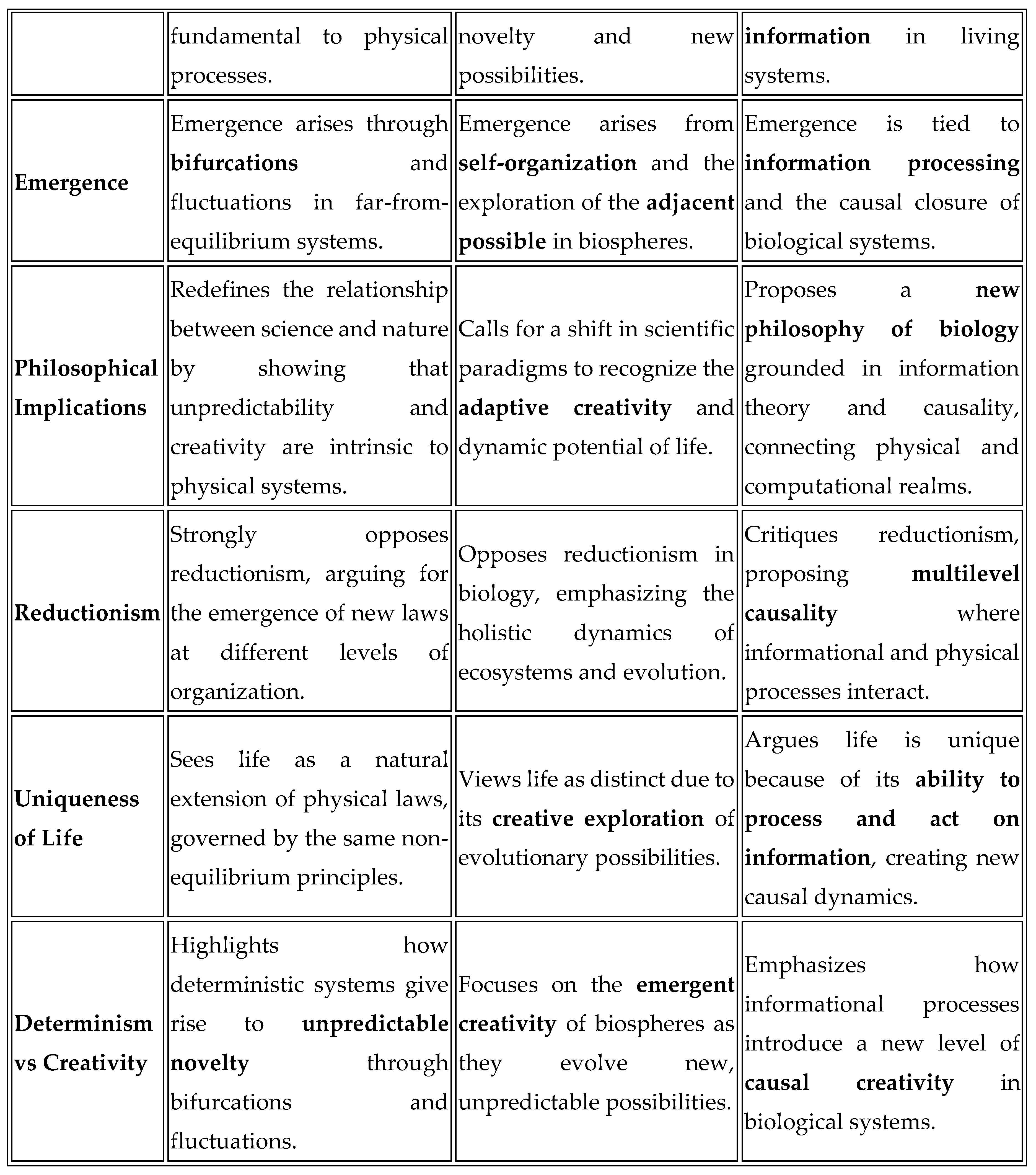
As a way of summary, I provide three tables that outline the contributions of several key researchers to the development of naturalistic approaches to complexity and life. These tables encapsulate their perspectives on emergence, self-organization, and the interplay of physical, informational, and biological systems, showcasing the evolution of thought in this interdisciplinary domain.

Table 1.
Comparing Prigogine, Kauffman, and Walker.
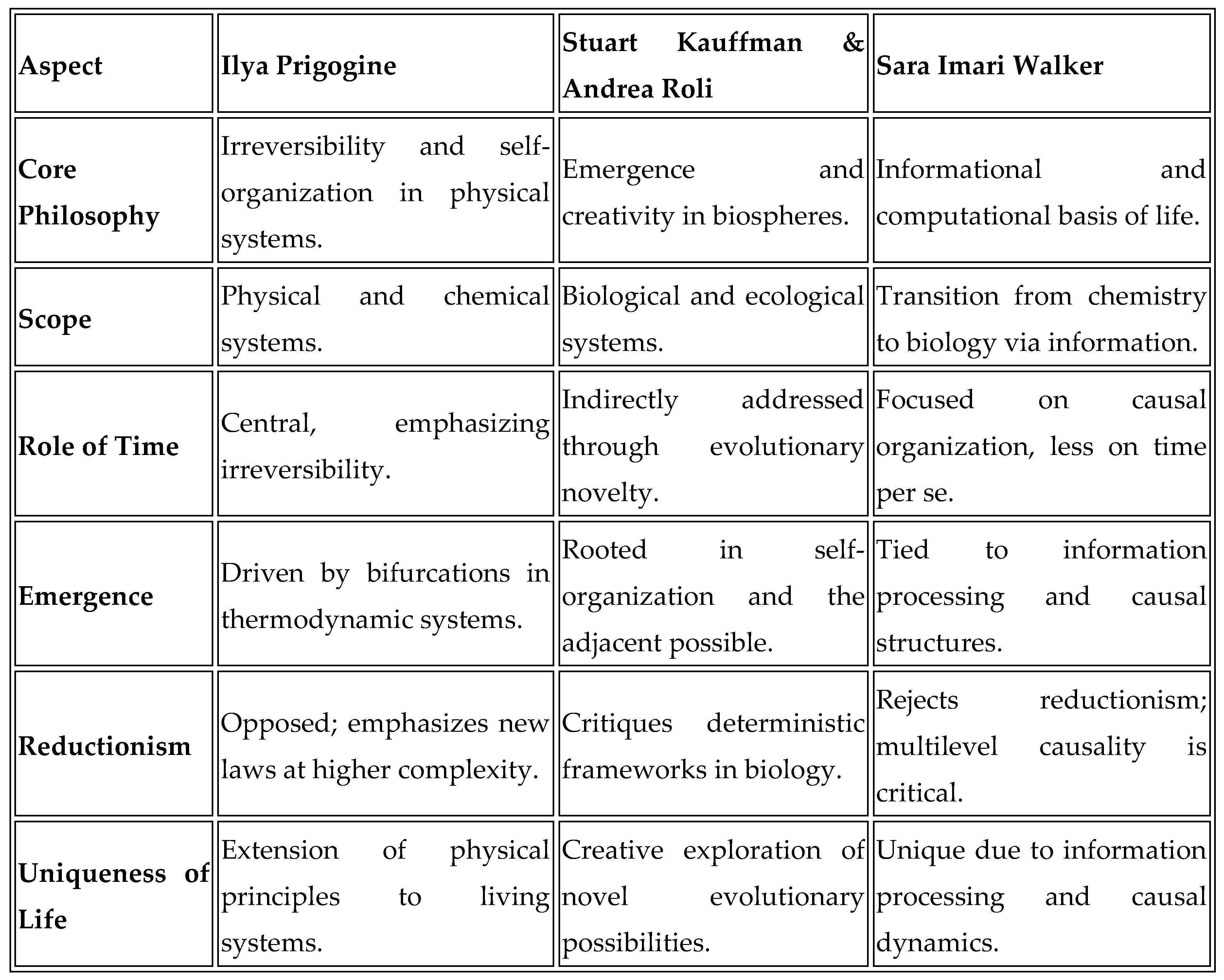
Table 2.
Contributions of Other Key Researchers.
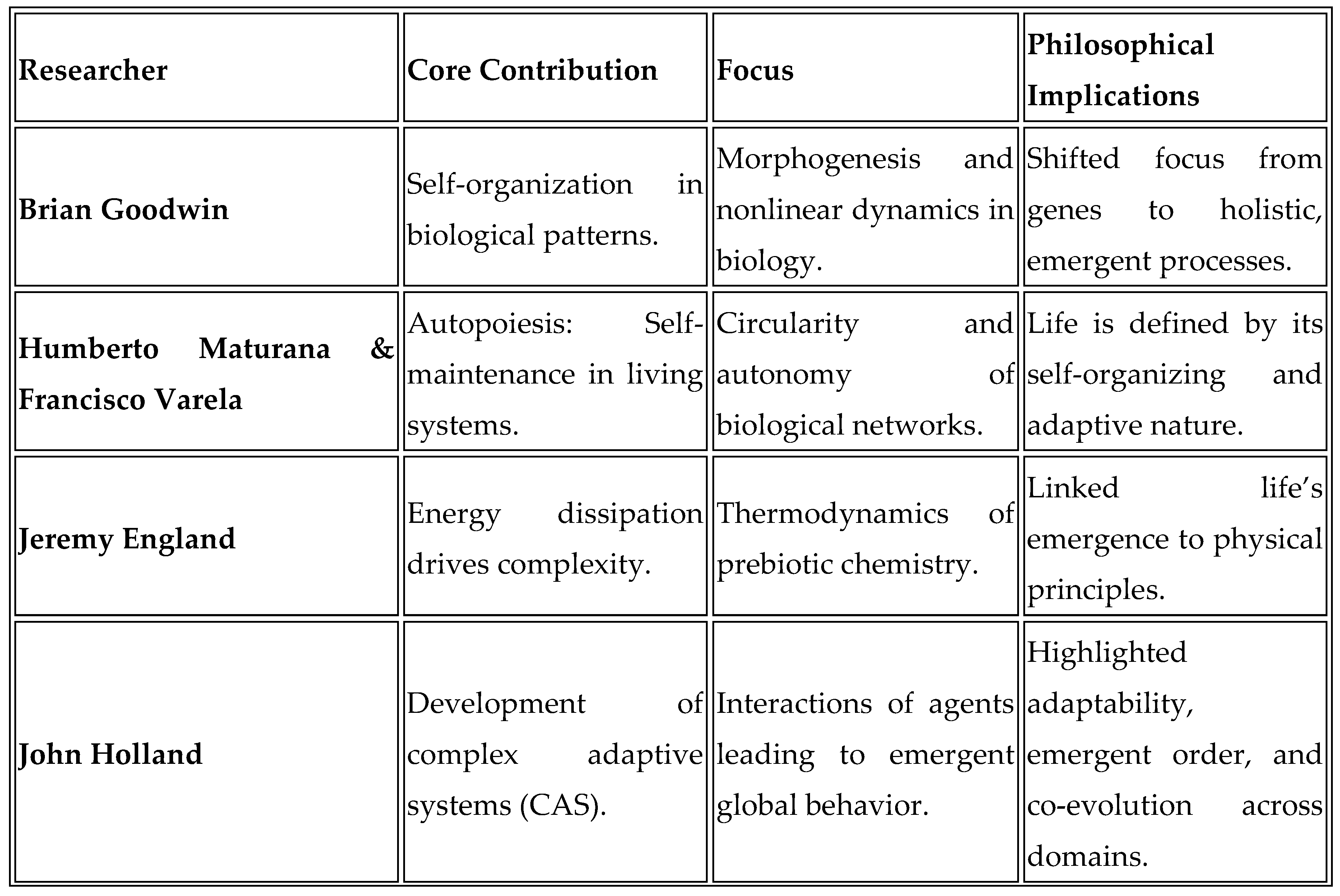
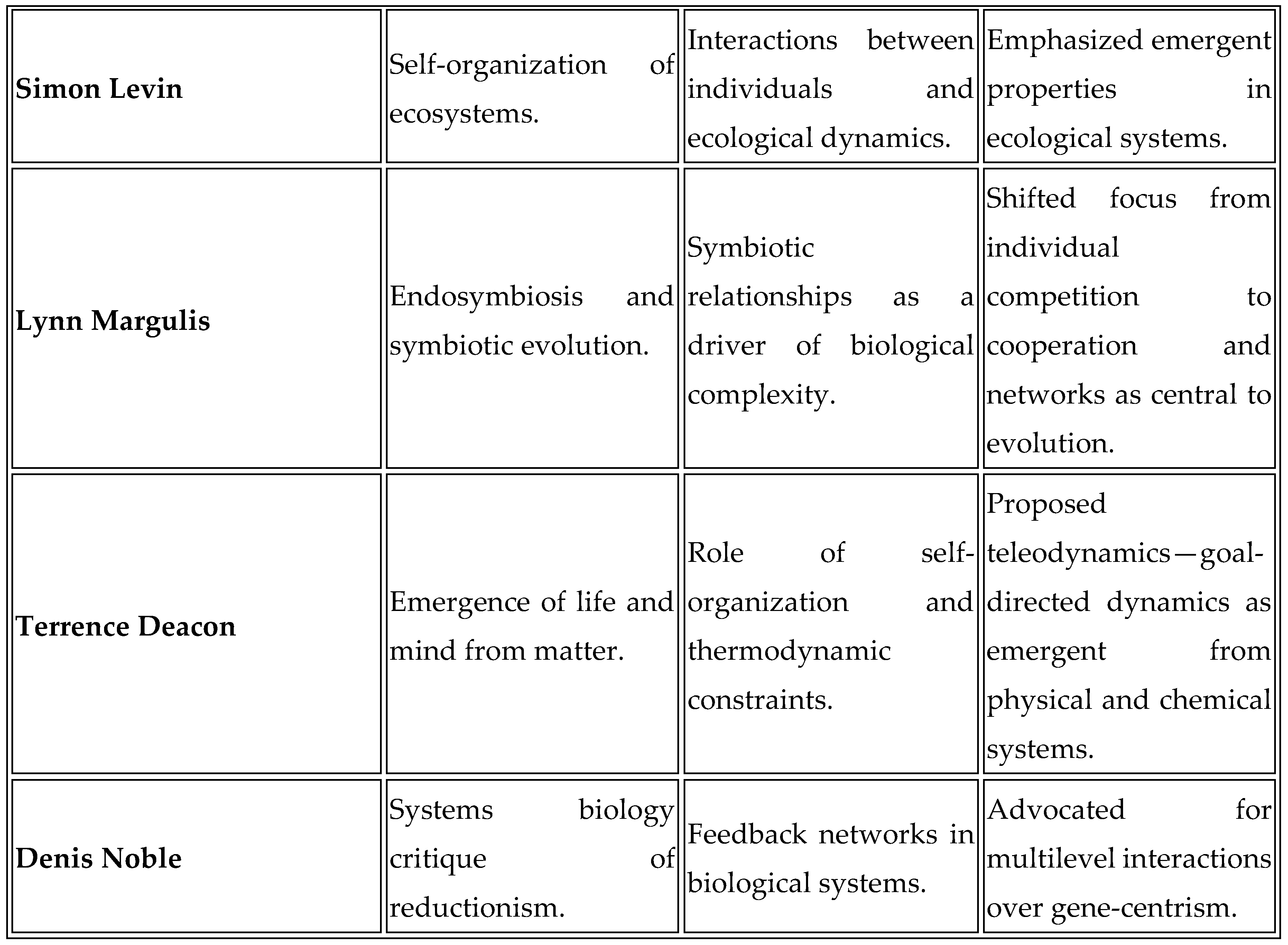
Table 3.
A more detailed comparison of the philosophical implications of Ilya Prigogine, Stuart Kauffman & Andrea Roli, and Sara Imari Walker.
Table 3.
A more detailed comparison of the philosophical implications of Ilya Prigogine, Stuart Kauffman & Andrea Roli, and Sara Imari Walker.
5. Conclusion. Toward a Unified Paradigm of Complexity
From Prigogine’s thermodynamics to Walker’s information theory, these thinkers collectively advance our understanding of life and complexity. Their contributions converge on the rejection of reductionism, emphasizing the active properties of matter—such as self-assembly and self-organization—along with emergence, creativity, and the dynamic interplay between physical and informational processes that shape life in the natural world.
References
- Corning, P. A., Kauffman, S. A., Noble, D., Shapiro, J. A., Vane-Wright, R. I., & Pross, A. (2023). Evolution "on purpose": Teleonomy in living systems. MIT Press.
- Deacon, T. W. (2012). Incomplete nature: How mind emerged from matter. W.W. Norton & Company.
- England, J. L. (2018). Every life is on fire: How thermodynamics explains the origins of living things. Riverhead Books.
- Goodwin, B. (1994). How the leopard changed its spots: The evolution of complexity. Princeton University Press.
- Holland, J. H. (1998). Emergence: From chaos to order. Addison-Wesley.
- Kauffman, S. A. (1993). The origins of order: Self-organization and selection in evolution. Oxford University Press.
- Kauffman, S. A. (1995). At home in the universe: The search for the laws of complexity. Oxford University Press.
- Kauffman, S. A. (2000). Investigations. Oxford University Press.
- Kauffman, S. A. (2008). Reinventing the sacred: A new view of science, reason, and religion. W.W. Norton & Company.
- Kauffman, S. A., & Roli, A. (2024). A third transition in science? Journal of the Royal Society Interface.
- Levin, S. (1999). Fragile dominion: Complexity and the commons. Perseus Books.
- Margulis, L., & Sagan, D. (1995). What is life?. University of California Press.
- Maturana, H. R., & Varela, F. J. (1987). The tree of knowledge: The biological roots of human understanding. Shambhala.
- Maturana, H. R., & Varela, F. J. (1992). Autopoiesis and cognition: The realization of the living. Kluwer Academic Publishers.
- Noble, D. (2006). The music of life: Biology beyond the genome. Oxford University Press.
- Noble, D. (2018). Dance to the tune of life: Biological rhythms, evolutionary origins, and the mysteries of mind. Oxford University Press.
- Prigogine, I., & Stengers, I. (1984). Order out of chaos: Man’s new dialogue with nature. Bantam Books.
- Prigogine, I. (1980). From being to becoming: Time and complexity in the physical sciences. W.H. Freeman.
- Prigogine, I. (1997). The end of certainty: Time, chaos, and the new laws of nature. Free Press.
- Walker, S. I., & Davies, P. C. W. (2013). The algorithmic origins of life. Journal of the Royal Society Interface, 10(81), 20130593. [CrossRef]
- Walker, S. I., & Davies, P. C. W. (2016). The ‘hard problem’ of life. Philosophical Transactions of the Royal Society A: Mathematical, Physical, and Engineering Sciences, 374(2089), 20150079. [CrossRef]
- Walker, S. I., & Packard, N. H. (2021). Transitions beyond the paradigm of mechanism. Entropy, 23(12), 1633. [CrossRef]
- Walker, S. I., Packard, N. H., & Cody, G. D. (2017). Re-conceptualizing the origins of life. Philosophical Transactions of the Royal Society A: Mathematical, Physical, and Engineering Sciences, vol. 375, no. 2109, Dec. 2017.
Disclaimer/Publisher’s Note: The statements, opinions and data contained in all publications are solely those of the individual author(s) and contributor(s) and not of MDPI and/or the editor(s). MDPI and/or the editor(s) disclaim responsibility for any injury to people or property resulting from any ideas, methods, instructions or products referred to in the content. |
© 2024 by the authors. Licensee MDPI, Basel, Switzerland. This article is an open access article distributed under the terms and conditions of the Creative Commons Attribution (CC BY) license (http://creativecommons.org/licenses/by/4.0/).
Copyright: This open access article is published under a Creative Commons CC BY 4.0 license, which permit the free download, distribution, and reuse, provided that the author and preprint are cited in any reuse.