

Submitted:
20 November 2024
Posted:
22 November 2024
You are already at the latest version
Abstract
Saprotrophism is a life mode exhibited by microfungi. Saprobes are cosmopolitan and occur in various habitats and ecological niches dwelling on diverse substrates and this contributes to the high numbers of fungi. Being abundant in litter, soil and decaying matter, they play crucial roles specifically towards mediating carbon and nutrient fluxes. Saprobic fungi in forest ecosystems may be host-specific or have host preferences and revealing this phenomenon will provide insights towards predicting global fungal numbers. In recent years, elucidation of saprobic fungi has been revolutionized through advances in molecular phylogenetics and the availability of genomic data, particularly in the Asean region. High-throughput sequencing and metagenomic approaches have revealed that the mycota are more diverse than previously established in samples in tropical forest ecosystems. This review discusses the role of fungi as saprobes, their host-specificity and host preference, their importance in litter decomposition and nutrient recycling, and their global dispersal. Approaches to establish fungal prevalence in the current genomic era are also discussed.
Keywords:
Forest saprobes
; Fungal diversity
; High-throughput sequencing
; Leaf litter
; Recurrence
1. Leaf Litter
Leaf litter comprises the natural layer of fallen, senescent, dry, partially flat, or folded leaves accumulated on the ground under trees [1,2,3]. In tropical forests, leaf litter accounts for 70% of litter resulting in a total litterfall of up to 1.53 thousand kg/ha/yr [4], while 30% is contributed through twigs, seeds, flowers and other woody debris [5]. Litter is the leading and quickest deposited source of organic matter [6], and leaf litter contains substantial nutrients essential for fungal growth. In tropical forests, most of the nutrient stock is biomass, and relatively little is present in the soil [2]. Nutrients available in the plant litter that falls during the dry season are rapidly mineralized in the following monsoon and taken up by roots in the wet season. In contrast, forest floor litter is an integral part of the ecosystem, adding nutrients to form the humus layer in the soil [7], thereby enhancing soil productivity. Leaf litter likewise enters stream ecosystems, being subjected to microbial decomposition and physical leaching adding available nutrients to the streams [8,9,10,11].
Considering the different types of litter, broadleaf litter, which contains higher nutrients and lower levels of lignin and polyphenols in contrast to conifers leaf litter [12,13,14,15], undergoes rapid decomposition rates and mass loss due to higher content of soluble and leachable compounds. Due to this, broadleaf forests tend to have a rich litter forest floor inhabited by macro and microfauna [12,14,15]. In the soil, litter has multiple functions, such as a barrier to soil erosion, preventing soil aggregate destruction due to heavy rainfall, microclimate fluctuations, and soil compaction protection [16]. The litter layer provides nesting and shelter for organisms such as birds and small animals [17,18,19]. Rainwater is filtered into the ground via the leaf litter layer, whereas litter decomposition is essential for nourishing the soil [1,16,18,20,21,22].
Microorganisms play a vital role in terrestrial ecosystems, acting as the major decomposers of plant litter [23]. Among them, fungal saprobes are instrumental in breaking down the organic compounds in plant litter, trapping the released elements in the fungal bodies, and preventing the elements from leaching [24,25,26], thereby supporting nutrient recycling and maintaining balance within forest ecosystems [27,28,29]. Leaf litter contains various nutrients; therefore, different fungal niches are colonized [30]. Litter fungi grow on substrates until they are completely decomposed. This entails a succession of fungal species throughout the decomposition process as early intermediate and late colonizers [31,32], dynamically changing their fungal community. This creates considerable diversity within the litter fungi, exhibiting high variations within the fungal community [30,33]. Consequently, elucidating the leaf litter dwelling saprobes unravels the hidden fungal diversity and builds up sexual-asexual relationships, providing insights to their ecological function in forest ecosystems.
2. Factors Affecting the Leaf Litter Decomposition Process
Many factors are responsible for the litter decomposition process. Among them, exogenous factors such as altitudinal gradient, temperature, and/or precipitation, nutrient availability, and endogenous factors such as leaf litter chemistry, nutrient content and secondary metabolites were reported to affect subsequent decomposition and mineralization [34,35,36,37]. Considering the fungal-mediated decomposition, for example, the rainy season facilitates a supportive environment for many leaf-litter inhabiting fungal mycelia to grow through highly porous, succulent, and moist leaf-litter layers [2,38,39], thereby increasing enzyme activity and fungal biomass. These conditions contribute to high litter decomposition rates in the wet season compared to the dry season, and leaf litter being the most significant part of the overall litter, provides a major contribution to converting into high biomass [40,41,42,43,44]. Further, the importance of humidity and suitable temperature regimes towards higher litter decomposition rates was discussed by [40,45]. Additional proof was provided by [46] that high-temperature regimes supported faster decomposition of holo-cellulose and lignin compared to low-temperature levels [47,48,49,50,51,52]. Given the provided facts, [53] further stated that the ability of saprobes to decompose leaf litter is more significant in warmer compared to cooler climates. These statements and results suggest that climatic variations considerably affect the litter decomposition process as well as the fungal-mediated litter decomposition.
Considering the endogenous factors, plant secondary metabolites and phenolic compounds are important in affecting leaf-litter decomposition by reducing and inhibiting microbial colonization [54,55,56]. The nutrient content of leaf litter, such as high levels of C and N, supports the increase in microbial colonization and subsequent decomposition rates, determining the fungal communities dominating during each stage of the decomposition process [57,58,59,60]. Leaf litter chemistry has more effect on variable compositions of fungal communities dominating different litter types [26,30]. On similar enzyme profiles, fungal communities harboured in two litter types of Quercus petraea were found to be distinct [26]. Consequently, this research evidence was able to validate the initial findings of [61] that different litter traits such as leaf toughness, nitrogen, lignin and polyphenol concentrations control the differential decomposition rates in leaf litter. Correspondingly, endogenous factors influence the differential dominance of fungal communities occupying a particular type of leaf litter influencing the decomposition process.
3. Role of Saprobes in Leaf Litter Decomposition and Nutrient Recycling
Leaf litter is a dynamic substratum where different stages of fungal colonization can be observed until its complete decomposition [31,32]. Throughout the decomposition period, the leaf litter composition alters, facilitating different groups of saprobic fungi to occupy and degrade different litter substrates, entailing succession [3]. These fungal communities are identified as early, intermediate, and late colonizers due to their progressive involvement in the complete decomposition of leaf litter [31,32].
Leaf litter succession increases fungal species richness and has been confirmed through molecular identification studies [62]. Factors such as decomposition stage, type of litter, moisture content, and substrate size were reported to affect the community and structure of leaf litter fungi [63,64]. Accordingly, fresh litter harbours a lower number of fungi. In contrast, a wide range of fungi were observed on half-decomposed litter and subsequently fewer fungi on well-decomposed litter [30,65]. Coelomycetes are vital in litter decomposition, and their population tends to decrease with increased decomposition [2]. Further insight into fungal succession was provided by [30]. In the early stages of decomposition, foliicolous epiphytes such as Appendiculella sp., Ceramothyrium longivolcaniforme, Longihyalospora ampeli, Meliola spp., Micropeltis fici, M. ficinae, Mycoleptodiscus alishanense, Neophyllachora fici, and Zeloasperisporiales sp. were found to be dominant. Despite being fewer in number, these species continued to colonize on the litter substrates. As the decomposition process moved into the intermediate stages, a diverse and higher number of saprobic Ascomycetes were reported. These included Alternaria pseudoeichhorniae, Arthrinium sacchari, Hermatomyces biconisporus, Leptospora macarangae, Neodictyosporium macarangae, Nigrospora macarangae, Parawiesneriomyces chiayiense, and Periconia alishanica. Towards the final stages of decomposition, the number of species reduced, with Cladosporium spp., Penicillium sp., and Stachybotrys aloeticola as dominantly reported taxa. These observations were made from the decomposition of Macaranga tanarius leaf litter [30]. Many asexual fungi were observed to be in higher frequencies during later stages of decay [66] mainly due to their competitive tolerance on litter substrates, which was also evident in the study [30].
Apart from the most recent study, studies conducted by [67] and [33] were found to be significant. Leaf litter succession on Ficus pleurocarpa observed similar trends with four noticeable colonization stages of saprobes while more similar taxa were abundant in advanced stages of decay. Species recorded in freshly fallen leaves were Colletotrichum sp., Gaeumannomyces sp., Meliola sp., Pestalotiopsis sp., Phomopsis sp., Zygosporium echinosporum and Z. mansonii followed by late colonizers such as Volutella ramkurii, Selenodriella fertilis, Phomopsis sp., Ophiognomonia elasticae, Lanceispora amphibia, and Discomycete sp. on leaf litter attributed to advanced decay. Fungal succession on leaf litter of Manglietia garrettii elucidated three successional communities reporting Volutella sp. as early colonizers, Bionectria ochroleuca, Cylindrocladium floridanum, Dactylaria longidentata, Gliocladium sp., Hyponectria manglietiae and Lasiosphaeria sp. as intermediate colonizers with a decline of species numbers with Hyponectria manglietiae and Sporidesmium crassisporum as late colonizers completing the decomposition [67].
Fungi are considered the main contributors to decomposing leaf litter due to their significant potential to reduce organic matter [56,68,69,70] by secreting a wide range of extracellular enzymes [60,71,72,73,74] including lignocellulose [75]. Most significant enzymes produced by leaf litter-dwelling saprobes, including Alternaria, Aspergillus, Chaetomium, Fusarium, Myrothecium, and Penicillium support the degradation of cellulases and hemicellulases, while Arthrobotrys, Cephalosporium, Clavaria, Collybia, Fusarium, Verticillium, Absidia, Thamnidium, and Trichoderma assist towards the degradation of lignin, chitin, and pectinases [69,76,77,78,79]. Phenol oxidases, peroxidases and laccases help catalyze lignin degradation [80], further disintegrating leaf litter. As aforementioned, different communities of fungi can be observed on each stage of litter decay, suggesting scope towards the discovery of obscure fungal taxa yet observing a more common assortment of fungal genera specifically dominating on leaf litter.
4. Host-Specificity, -Recurrence and -Preference
Host-preference, host-recurrence, and host-specificity were found to be standard terms associated among mycologists describing the differential abundance or, more often, the occurrence of microfungi in a particular host in comparison to the surrounding hosts [58,81,82,83]. Multiple studies have reported mycorrhizal fungi, plant pathogenic and endophytic life modes, and saprobic fungal taxa with affinity towards certain host species [84,85]. The underlying reason for a fungus to exhibit host-preference towards a particular host may be due to several factors [30,83,86].
Focusing on the leaves, foliar structure and chemical composition, leaf surface characteristics (waxes, hairy structures), thickness and toughness, phenolic compounds and secondary metabolites will preferentially act for fungal attachment and successful colonization [83,87,88,89]. The presence of endophytic fungi on living leaves, which supports initial decomposition during senescence, will subsequently have an influential effect towards fungal host-preference [90,91,92,93,94]. Several studies have been conducted building supporting evidence towards fungal host-preference and host-specificity focusing on succession and diversity on various hosts [67,86,87,95,96,97,98].
Multiple theories and hypotheses have been built up based on evidence from leaf litter fungi and their host-preference [67,83,87,95,96]. Stroma of Pemphidium nypicolum developed throughout the senescence of Nypa palm, transitioning from endophytic to saprobic life mode was reported by [99]. Many of the saprobes occurring on dead leaves and petioles of palms (Astrosphaeriella, Myelosperma, Oxydothis) have also been isolated as endophytes [48,100,101]. Endophytic fungi thrive on living leaves and persist as saprobes during senescence was suggested by [102]. Studies have stated that endophytic and saprobic taxa reported from these studies are the same species [103,104]. A discussion detailed by [90] has shown that most fungi have endophytic life stages and become saprobes or even pathogens when the leaves die, or the plant is stressed.
Preferential specificity of saprobes towards certain host species has been observed in tropical forest ecosystems by [95], stating many of the reported Beltrania rhombica, Chaetospermum artocarpi, Dictyochaeta sp., Dictyosporium zeylanicum, Ellisiopsis gallesiae, Gliocladium cylindrospermum, Lanceispora sp., Lophiodermum sp. and Ophioceras fusiforme taxa happens to be unique to a single host. Host species such as Agathis australis, Eucalyptus globulus, Nypa fruticans, grasses, sedges and rushes, Pandanus furcatus and host genera including Agathis, Metrosideros, Nothofagus, Eucalyptus and palms such as Arenga, Livistona, Oraniopsis, Oncosperma and Salacca are reported to harbour multiple fungal taxa [75,99,105,106,107,108,109,110,111,112,113,114,115,116,117,118]. Saprobic fungi show specificity towards leaf or tissue types. For instance, Dermataceae taxa are found on the petioles and midribs of identified Ficus hosts [87]. Similarly, fruiting bodies of Gnomonia queenslandica have been observed on the petioles and midribs of Elaeocarpus angustifolius [116]. Preferential occurrence of fungi on leaves, rachis-tips, mid-rachides, and rachis-bases of palms were reported by [117]. Additionally, [118] noted a unique composition of fungal taxa on the senescent flowerheads of Protea. A possible reason for saprobe and tissue preferences can be the adaptation to tissues with latex and phenolic compounds acting as hostile environments for decomposer taxa [87]. Dominant groups of fungi in each host can be phylogenetically related to host species, preferring physical structure or chemistry in different leaf types, building a source and substratum relationship as suggested by [89].
Tropical rainforests harbour a diversity of plants, producing higher levels of litter masses [95]. Simultaneously, the variety of fungal communities in leaf litter decomposition is also high [102,116,119,120,121]. This matter was previously discussed by [83] to build up evidence towards host-recurrence and -specificity of decomposer taxa. Yet less evidence on host-specificity could be recorded within such ecosystems, given that colonization and frequencies of saprobic fungi might be limited [122]. In contrast, [102] and [123] stated leaf litter saprobes can be recurrent and specific towards selected hosts and stages of decomposition. This observation was further supported by the study conducted by [67] on different decomposition stages of leaf litter of Manglietia garrettii. It was also described that the host-recurrence of saprobes can be strongly influenced by leaf characteristics rather than host phylogeny, unlike host-pathogen relationships [102]. Evidence from [89] highlighted that microfungal overlap is higher in distantly related host species than in closely related ones. Contradicting this statement, [30] reported that even the phylogenetically closely associated hosts harbour different compositions of saprobic fungi. Yet, the closely related host genera accommodate a higher similarity of dominant fungal taxa than the concerned host families (Figure 1).
Understanding the host-preference of saprobic microfungi needs elucidation through different levels of taxonomic hierarchy occupying single to multiple hosts [91,124,125]. Host-preference and recurrence of fungi towards a host family, genus, tissue, geographical distributions, and tree phylogeny have exemplified evidence towards this matter [30,91,123,124]. These studies provide evidence towards saprobic fungi and their preferential occurrence on hosts, substrata or tissues indicating possible host-preference, -recurrence or -specificity. Further studies occupying multiple host species with phylogenetic relatedness simultaneously considering their occurrence in different localities can be utilized to reveal the undescribed and poorly described saprobic fungal taxa to a greater extent.
5. Global Scenario of Leaf Litter-Inhabiting Microfungi
According to estimates by [126] and [127], 2 to 11 million fungi occur worldwide [25]. The documentation of fungi in each region contributes towards predicting the global fungal numbers [25]. Leaf-litter is a dynamic substratum harbouring a range of saprobes throughout the decomposition process, resulting in higher levels of fungal diversity and simultaneously increasing the fungal numbers [59,87,98,116,128]. The majority of studies focused on single hosts and a few hosts, mainly in tropical regions, including Australia, Brazil, Hong Kong, India, Thailand, and China with host species ranging from Manglietia garrettii, Neolitsea dealbata, Ficus pleurocarpa, Castanopsis diversifolia, Magnolia liliifera, Shorea obtusa, Hevea brasiliensis, Anacardium occidentale, Clusia nemorosa, Vismia guianensis, Pavetta indica, Celtis formosana, Ficus ampelas, F. septica, Macaranga tanarius, and Morus australis [67,87,98,129,130,131,132,133,134,135,136,137]. Sub-tropical to temperate region studies on leaf litter-inhabiting microfungi were mainly documented in Japan by [138], focusing on Camellia japonica and on Fagus sylvatica [103], Quercus petrea, Picea abies, Pseudotsuga menziesii [139] from France, on Quercus petraea [39] in Czech Republic and on Fagus sylvatica [94] in Germany. Further adding, fungal diversity was documented in New Zealand on Agathis australis leaf-litter by [107], on grasses and sedges of Poaceae and Cyperaceae hosts in Hong Kong by [111] and [140]. Studies representing the southern hemisphere were mainly carried out in South Africa on two plant families Proteaceae and Restionaceae as exemplified by [141] and [142], respectively. As the previous evidence suggests, most of the leaf litter inhabiting fungal studies have been carried out in tropical regions rather than temperate regions and might be due to the abundance of tropical forests with high litter fall and favourable climate conditions for fungal prevalence. In Table 1 we compare 260 fungal taxa reported on ten hosts in tropical regions [30,87,97,98,119] and present the overlap. The fungal taxa were reported in fungal species and fungal genus levels in these studies therefore the overlap was calculated in fungal species and fungal generic levels. The results indicate that each host species harbours a unique fungal community. Out of the 260 fungal taxa, 18 fungal taxa are unique to Neolitsea dealbata (Lauraceae), 33 Ficus pleurocarpa (Moraceae), 22 Ficus ampelas (Moraceae), 27 Celtis formasana (Lauraceae), 21 Macaranga tanarius (Euphorbiaceae), and Cryptocarya mackinnoniana (Lauraceae), 3 Darlingia ferruginea (Proteaceae), 7 Elaeocarpus angustifolius (Elaeocarpaceae), 1 Ficus destruens (Moraceae), and 12 Opisthiolepis heterophylla (Proteaceae). The number of overlapping taxa among ten hosts varied from 1 to 20 with the highest overlap recorded between F. pleurocarpa (Moraceae) and C. mackinnoniana (Lauraceae) followed by Ficus pleurocarpa (Moraceae) and O. heterophylla (Proteaceae) with an overlap of 18 fungal taxa, whereas lower overlap was recorded between the other hosts, respectively. Most overlapping fungal taxa among the 10 hosts are Acremonium sp., Aspergillus sp., Beltrania rhombica, Beltraniella portoricensis, Chaetospermum sp., Cladosporium sp., Dictyochaeta simplex, Dictyochaeta sp., Helicosporium sp., Idriella cagnizarii, Parasympodiella elongata, Penicillium sp., Pestalotiopsis sp., Phoma sp., and Selenosporella species. However, only four of these were identified to species level indicating that they might not be overlapping species. Subsequent evidence suggests the presence of fungal recurrence/preference or specificity among the studied hosts where the fungal overlap is lower compared to the number of unique fungal taxa recorded from each host species thus indicating that litter fungi are far more diverse than realized. A recent study provides similar results with lower fungal overlap on leaf litter across five different hosts [30] further corroborating the topic under concern.
In Table 2 we compare the fungi in 10 different families which include Anacardiaceae, Dipterocarpaceae, Eleocarpaceae, Euphorbiaceae, Fagaceae, Lauraceae, Magnoliaceae, Moraceae, Proteaceae, and Rubiaceae [87,97,98,131,133,135,136,137]. Accordingly, the fungal consortium specifically on leaf litter found to be quite similar which means that litter as a substrate facilitates a common group of fungi that can be present in variable degrees across different hosts and related families. Focused families in Table 2 show different numbers of fungal taxa, ranging from 91 taxa on Fagaceae and 54 taxa on Rubiaceae as the highest and the lowest number of taxa reported on Dipterocarpaceae and Proteaceae (25 and 27 taxa, respectively). Different numbers suggest that the capacity of each host family can vary in harboring litter saprobes. The tree species, leaf litter chemistry, and seasonal variations can be influential towards the number, composition and diversity of litter saprobes dwelling upon each host [30,132].
Estimating the current number of fungi has always been topical; thus, the latest working estimate is 2.2–3.8 million species [126], whereas [143] discussed the potential of elucidating higher numbers of undescribed species compared to the 6.8% to 3.9% of currently known or described species [143,144,145]. Estimating the fungal numbers can be supported by further studies related to fungal hosts or tissue specificity at various levels in host phylogeny, along with adapting appropriate methodologies in taxonomic elucidations unaltering the diversity estimates [91].
Evaluating the previous studies on leaf litter fungi as discussed above, it is evident that number of unique fungi within each host/family are much higher than the initially proposed ratio of 6:1 (fungal taxa per one plant) by [146] and the recently extrapolated 9.8:1 (fungal taxa per one plant) [126]. As per the comparisons made herein across 10 different hosts, a ratio of 47:1 (470 fungi and 10 plants) is suggested for redefining the host fungal ratios. This value is extrapolated by reviewing the previous work elucidating saprobic fungi specifically on leaf litter mainly in the tropics. Further, the ratio extrapolated herein is specified to saprobes dwelling on leaf litter therefore an overall estimate for host-to-fungal ratio can go much higher considering a summation of pathogens, endophytes, leaf and woody litter saprobes dwelling on a specific host. Relying on the proposed ratio herein, future estimates for global fungal numbers can be extrapolated much more accurately.
6. Methods of Studying Leaf Litter Inhabiting Microfungi
Currently, litter fungal research primarily uses culture-dependent and culture-independent approaches [33,39,67,87,97,116,131,132,137,147,148,149,150]. Culture-dependent methods follow the traditional flow of observing fruiting structures [Conidiomata (pycnidial or acervuli) ascomata, hyphomycetes] on leaf litter with successive steps of sectioning or picking and mounting on slides for photomicrographs followed by single germinated spore isolation in obtaining axenic cultures through a spore suspension on PDA within 24 hours [149]. Most recent taxonomic elucidations associated with litter fungi followed the single spore isolation method [98,151,152].
Culture-dependent methods result in pure cultures of fungal taxa, which will be a source of DNA, in turn supporting PCR amplification of fungal-specific primers and molecular phylogenetics [153,154]. Moreover, a physical sample can be linked to ecology and host substrates, a source for storage and reproducibility, as a preservation method as a dried culture is found to be advantageous in a taxonomic sense [155,156,157,158,159,160,161,162,163,164]. Despite the stated advantages, fungal isolations are challenging given the fact that many litter fungi are non-culturable or dormant, thereby underestimating the real fungal numbers colonizing the substrates [33,116,158,165]. Culture-independent methods involve direct extraction of DNA from leaf-litter substrates identified as eDNA or environmental DNA in revealing unculturable fungal taxa [154], and the generated data pass through vigorous analysis pipelines, including metagenetic, metagenomics (DNA-based), and meta-transcriptomics (RNA-based) approaches [166,167]. Presently, high-throughput sequencing (HTS) is the current most up-to-date third-generation sequencing (TGS) technique that utilizes eDNA-based fungal data in profiling taxonomic communities on environmental samples [168,169,170,171,172,173]. This method was found to be quite advantageous in revealing unculturable and hidden fungal taxa, unveiling sexual-asexual relationships, delimiting taxa in higher taxonomic levels, evolutionary relationships, and chemotaxonomy [163,166,170,171,172,173,174,175,176,177].
Relatively fewer studies have highlighted elaborating the leaf litter inhabiting fungi through HTS and metabarcoding. 1,874 operational taxonomic units (OTUs) belonging to 387 fungal genera from oak leaves were revealed by [39] unravelling the leaf-litter fungal diversity. A study revealing the fungal composition of alder leaves in Finland classified the fungal OTUs at the genus and species level, resulting in 21 and 32 OTUs, respectively. The composition is dominated by Basidiomycetes taxa followed by Mycosphaerellaceae taxa, Aspergillus sp., Aureobasidium sp., Cryptococcus sp, Dioszegia sp., Glomeromycota sp., Tremellomycetes sp., and Wallemia sebi [178]. Documenting the senescent leaf microbiome and their substrate affinity in the USA on Carya ovata and Acer rubrum leaf litter resulted in 421 OTUs with a dominance of Colletotrichum sp. Xylariales sp., Codinaea lambertiae, Ascomycota sp., Coleophoma sp., Lophiostoma sp., and Amorocoelophoma species [179]. Acer rubrum fungal profile included Lareunionomyces, Dothiora, Ampelomyces and Saitozyma. Comparably, Carya ovata resulted in Periconia sp., Plectosphaerella sp., and Mycosphaerella taxa.
Overlapping taxa for both hosts were Exobasidium sp., Seimatosporium sp., Inocybe sp., Mortierella sp., and Russula sp., providing evidence for possible fungal host preference [179]. The presence of litter saprobes on Castanopsis sieboldii (Fagaceae) documented through metabarcoding revealed dominant OTUs as Nemania diffusa, Nemania bipapillata, Gymnopus sp., Nodulisporium sp. belonged to Xylaria, Hypoxylon, Nemania, Astrocystis, Biscogniauxia, and Nodulisporium within Xylariaceae (Sordariomycetes) apart from the Basidiomycetes taxa [180]. In review, some taxa recovered through HTS were rarely documented through culture-based studies of leaf litter fungi by [30,33,87,95,97,104,116] as Nemania diffusa, Nemania bipapillata, Plectosphaerella sp., Gymnopus sp., Wallemia sebi thus, HTS-based fungal elucidations were able to reveal poorly characterized taxa which are difficult to isolate and maintain as cultures [39,160,173,182].
Limitations of HTS in leaf-litter successional studies are noteworthy to mention, including inadequate species identifications (only up to genus and family), only short regions being amplified with higher variability causing less reliable sequences and in a taxonomic sense causing an increased number of taxa with inconsistent and incomplete data [153,175,181,182]. Given these facts, it can be concluded that occupying culture-independent as well as culture-dependent techniques in equal proportions will be successful in unravelling the hidden fungal taxa on environmental samples including leaf litter.
7. Conclusions and Future Perspectives
Leaf litter inhabiting saprobes is essential in decomposition and subsequent nutrient recycling [183,184]. Exploring and documenting the complete fungal numbers on litter substrates is challenging [30,185]. Most of the litter fungal studies concentrated on single or multiple hosts together with fungal succession studies yet elucidating the host preference, specificity, or recurrence of saprobes in phylogenetically related hosts is scarce [30,67,87,95,96,116] and subsequent knowledge on levels of diversity generated by studying these factors is still vague. It is imperative that host fungal associations could provide understanding towards predicting global fungal numbers [25,143,144,145].
Utilizing integrative approaches of culture-dependent and independent methods will be more appropriate in elucidating hidden fungal taxa and diversity in a promising manner [153,154]. Furthermore, extending research on functional associations and chemical profiling, life mode transition, host jumps, and host shifting of microfungi, assessing cryptic species in mostly overlooked or less studied ecological niches would be appropriate research-driven advancements for science and its sustainable utilization in the current omics era [154,186].
Author Contributions
“Conceptualization, N.P.S and A.R.G.F resources, S.L. writing—original draft preparation, N.P.S writing—review and editing, A.R.G.F; C.S.B.; J.M.; S.L. visualization, J.V.S.A; supervision, A.R.G.F; S.L. funding acquisition, J.M.; S.L. All authors have read and agreed to the published version of the manuscript.”
Funding
This work was supported by grants from Chiang Mai University and the National Research Center of Thailand. Chitrabhanu S. Bhunjun would like to thank the National Research Council of Thailand (NRCT) grant ‘Total fungal diversity in a given forest area with implications towards species numbers, chemical diversity and biotechnology’ (grant number N42A650547). Chitrabhanu S. Bhunjun thanks Thailand Science and Innovation (TSRI) and National Science and Innovation Fund (NSRF) Fundamental fund grant (Grant no. 662A1616047), entitled ‘Biodiversity, ecology, and applications of plant litter-inhabiting fungi for waste degradation’ for partially funding this research.
Acknowledgments
Nethmini P. Samaradiwakara would like to thank the Chiang Mai University Presidential Scholarship (2020) for providing financial support. Antonio Roberto Gomes de Farias was collaborating with this work during his affiliation with the Center of Excellence in Fungal Research. All the staff and colleagues at Center of Excellence in Fungal Research, Mae Fah Luang University, Center of Excellence in Microbial Diversity and Sustainable Utilization, Faculty of Science, Chiang Mai University are acknowledged.
Conflicts of Interest
Authors declare no conflicts of interest.
References
- Johnson, E.A.; Catley, K.M.; Wynne, P.J. Life in the Leaf Litter; American Museum of Natural History,: New York, USA, 2002; pp. 1–32. [Google Scholar]
- Soni, K.K.; Pyasi, A.V.R. Litter Decomposing Fungi in Sal (Shorea Robusta) Forests of Central India. Nusant. Biosci. 2011, 3, 136–144. [Google Scholar] [CrossRef]
- Tennakoon, D.; Gentekaki, E.; Jeewon, R.; Kuo, C.H.; Promputtha, I.; Hyde, K.D. Life in Leaf Litter: Fungal Community Succession during Decomposition. Mycosphere 2021, 12, 406–429. [Google Scholar] [CrossRef]
- Burges, N.A. Microorganism in the Soil; Hutchinson University Library,: Hutchinson, London, 1958; pp. 1–188. [Google Scholar]
- Robertson, G.P.; Paul, E. Decomposition and Soil Organic Matter Dynamics. In Methods of ecosystem science; Sala, O.E.; Jackson, R.B.; Mooney, H.A.; Howarth, R., Ed.; Springer, New York, 1999; pp 104–116.
- Hossain, M.; Siddique, M.R.H.; Rahman, M.S.; Hossain, M.Z.; Hasan, M. Nutrient Dynamics Associated with Leaf Litter Decomposition of Three Agroforestry Tree Species (Azadirachta Indica, Dalbergia Sissoo, and Melia Azedarach) of Bangladesh. J. For. Res. 2011, 22, 577–582. [Google Scholar] [CrossRef]
- Bani, A.; Pioli, S.; Ventura, M.; Panzacchi, P.; Borruso, L.; Tognetti, R.; Tonon, G.; Brusetti, L. The Role of Microbial Community in the Decomposition of Leaf Litter and Deadwood. Appl. Soil Ecol. 2018, 126, 75–84. [Google Scholar] [CrossRef]
- Palmer, M.A.; Covich, A.P.; Finlay, B.J.; Gilbert, J.; Hyde, K.D.; Johnson, R.K.; Kairesala, T.; Lake, P.S.; Lovell, C.R.; Naiman, R.J.; et al. Biodiversity and Ecosystem Processes in Freshwater Sediments. Ambio 1997, 26, 571–577. [Google Scholar]
- Abelho, M. From Litterfall to Breakdown in Streams: A Review. Scientific World Journal. 2001, 1, 656–680. [Google Scholar] [CrossRef]
- Mahmood, H.; Siddique, M.R.H.; Abdullah, S.M.R. Nutrient Dynamics Associated with Leaching and Microbial Decomposition of Four Abundant Mangrove Species Leaf Litter of the Sundarbans, Bangladesh. Wetlands 2014, 34, 439–448. [Google Scholar] [CrossRef]
- Hyde, K.D.; Fryar, S.; Tian, Q.; Bahkali, A.H.; Xu, J. Lignicolous Freshwater Fungi along a North-South Latitudinal Gradient in the Asian/Australian Region; Can We Predict the Impact of Global Warming on Biodiversity and Function? Fungal Ecol. 2016, 19, 190–200. [Google Scholar] [CrossRef]
- Kavvadias, V.A.; Alifragis, D.; Tsiontsis, A.; Brofas, G.; Stamatellos, G. Litterfall, Litter Accumulation and Litter Decomposition Rates in Four Forest Ecosystems in Northern Greece. For. Ecol. Manag. 2001, 144, 113–127. [Google Scholar] [CrossRef]
- Manzoni, S.; Trofymow, J.A.; Jackson, R.B.; Porporato, A. Stoichiometric Controls on Carbon, Nitrogen, and Phosphorus Dynamics in Decomposing Litter. Ecol. Monogr. 2010, 80, 89–106. [Google Scholar] [CrossRef]
- Prescott, C.; Blevins, L.; Staley, C.L. Effects of Clear-Cutting on Decomposition Rates of Litter and Forest Floor in Forests of British Columbia. Can. J. For. Res. 2000, 30, 1751–1757. [Google Scholar] [CrossRef]
- Prescott, C.; Zabek, L.; Staley, C.L.; Kabzems, R. Decomposition of Broadleaf and Needle Litter in Forests of British Columbia: Influences of Litter Type, Forest Type, and Litter Mixtures. Can. J. For. Res. 2000, 30, 1742–1750. [Google Scholar] [CrossRef]
- Sayer, E.J. Using Experimental Manipulation to Assess the Roles of Leaf Litter in the Functioning of Forest Ecosystems. Biol. Rev. Camb. Philos. Soc. 2006, 81, 1–31. [Google Scholar] [CrossRef]
- Olson, D.M. The Distribution of Leaf Litter Invertebrates along a Neotropical Altitudinal Gradient. J. Trop. Ecol. 1994, 10, 129–150. [Google Scholar] [CrossRef]
- Graça, M.A. The Role of Invertebrates on Leaf Litter Decomposition in Streams. Int. Rev. Hydrobiol. 2001, 86, 383–393. [Google Scholar] [CrossRef]
- Vasconcelos, H.L.; Laurance, W. Influence of Habitat, Litter Type, and Soil Invertebrates on Leaf-Litter Decomposition in a Fragmented Amazonian Landscape. Oecologia 2005, 144, 456–462. [Google Scholar] [CrossRef]
- Burghouts, T.; Ernsting, G.; Korthals, G.D.; Vries, T. Litter Fall, Leaf Litter Decomposition and Litter Invertebrates in Primary and Selectively Logged Dipterocarp Forest in Sabah, Malaysia. Philos. Trans. Biol. Sci. 1992, 335, 407–416. [Google Scholar] [CrossRef]
- Chauvet, E.; Giani, N.; Gessner, M. Breakdown and Invertebrate Colonization of Leaf Litter in Two Contrasting Streams, Significance of Oligochaetes in a Large River. Can. J. Fish. Aquat. Sci. 1993, 50, 488–495. [Google Scholar] [CrossRef]
- Donald, J.; Weir, I.; Bonnett, S.M.; Maxfield, P.; Ellwood, F. The Relative Importance of Invertebrate and Microbial Decomposition in a Rainforest Restoration Project. Restor. Ecol. 2018, 26, 220–226. [Google Scholar] [CrossRef]
- Sahu, A.; Bhattacharjya, S.; Mandal, A.; Thakur, J.K.; Atoliya, N.; Sahu, N.; Patra, A. Microbes: A Sustainable Approach for Enhancing Nutrient Availability in Agricultural Soils. Role of Rhizospheric Microbes in Soil. Nutr. Manag. Crop Improv. 2018, 47–75. [Google Scholar] [CrossRef]
- Witkamp, M. Environmental Effects on Microbial Turnover of Some Mineral Elements. Part II- Biotic Factors. In Soil Biology Biochem; 1969; pp 178–184.
- Hyde, K.D.; Bussaban, B.; Paulus, B.; Crous, P.; Lee, S.; Mckenzie, E.; Nuangmek, W.; Lumyong, S. Diversity of Saprobic Microfungi. Biodivers. Conserv. 2007, 16, 7–35. [Google Scholar] [CrossRef]
- Maillard, F.; Leduc, V.; Viotti, C.; Gill, A.; Morin, E.; Reichard, A.; Ziegler-Devin, I.; Zeller, B.; Buée, M. Fungal Communities Mediate but Do Not Control Leaf Litter Chemical Transformation in a Temperate Oak Forest. Plant Soil 2023, 489, 573–591. [Google Scholar] [CrossRef]
- Swift, M.J.; Heal, O.W.; Anderson, M. Decomposition in Terrestrial Ecosystems; Blackwell Scientific Publications: Oxford, UK, 1979; pp. 1–272. [Google Scholar]
- Baldrian, P.; Lindahl, B. Decomposition in Forest Ecosystems: After Decades of Research Still Novel Findings. Fungal Ecol. 2011, 4, 359–361. [Google Scholar] [CrossRef]
- Tifcakova, L.; Dobiasova, P.; Kolarova, Z.; Koukol, O.; Baldrian, P. Enzyme Activities of Fungi Associated with Picea Abies Needles. Fungal Ecol. 2011, 4, 427–436. [Google Scholar] [CrossRef]
- Tennakoon, D.S.; Kuo, C.-H.; Purahong, W.; Gentekaki, E.; Pumas, C.; Promputtha, I.; Hyde, K.D. Fungal Community Succession on Decomposing Leaf Litter across Five Phylogenetically Related Tree Species in a Subtropical Forest. Fungal Divers. 2022, 115, 73–103. [Google Scholar] [CrossRef]
- Frankland, J.C. Fungal Succession – Unraveling the Unpredictable. Mycol. Res. 1998, 102, 1–15. [Google Scholar] [CrossRef]
- Dickie, I.A.; Fukami, T.; Wilkie, J.P.; Allen, R.B.; Buchanan, P.K. Do Assembly History Effects Attenuate from Species to Ecosystem Properties? A Field Test with Wood-inhabiting Fungi. Ecol. Lett. 2012, 15, 133–141. [Google Scholar] [CrossRef]
- Paulus, B.; Gadek, P.; Hyde, K. Successional Patterns of Microfungi in Fallen Leaves of Ficus Pleurocarpa (Moraceae) in an Australian Tropical Rain Forest 1. Biotropica 2006, 38, 42–51. [Google Scholar] [CrossRef]
- Melin, E. Biological Decomposition of Some Types of Litter from North American Forest. Ecology 1930, 11, 72–101. [Google Scholar] [CrossRef]
- Koukoura, Z.; Mamolos, A.; Kalburtji, K. Decomposition of Dominant Plant Species Litter in a Semi-Arid Grassland. Appl. Soil Ecol. 2003, 23, 13–23. [Google Scholar] [CrossRef]
- Van Maanen, A.; Debouzie, D.; Gourbiere, F. Distribution of Three Fungi Colonising Fallen Pinus Sylvestris Needles along Altitudinal Transects. Mycol. Res. 2000, 104, 1133–1138. [Google Scholar] [CrossRef]
- Cortez, J.; Demard, J.M.; Bottner, P.J.; Monrozier, J. Decomposition of Mediterranean Leaf Litters: A Microcosm Experiment Investigating Relationships between Decomposition Rates and Litter Quality. Soil Biol. Biochem. 1996, 28, 443–452. [Google Scholar] [CrossRef]
- Cannon, P.F.; Sutton, B. Microfungi on Wood and Plant Debris. In Biodiversity of Fungi Inventory and Monitoring Methods; Mueller, G.M., Bills, G.F., Foster, M.S., Ed.; 2004; pp. 217–239. [CrossRef]
- Voriskova, J.; Baldrian, P. Fungal Community on Decomposing Leaf Litter Undergoes Rapid Successional Changes. ISME J. 2013, 7, 477–486. [Google Scholar] [CrossRef] [PubMed]
- Pande, P.K. Litter Decomposition in Tropical Plantation: Impact of Climate and Substrate Quality. Indian For. 1999, 125, 599–608. [Google Scholar]
- Criquet, S.; Farnet, A.; Tagger, S.; Le Petit, J. Annual Variations of Phenoloxidase Activities in an Evergreen Oak Litter: Influence of Certain Biotic and Abiotic Factors. Soil Biol. Biochem. 2000, 32, 1505–1513. [Google Scholar] [CrossRef]
- Fioretto, A.; Papa, S.; Curcio, E.; Sorrentino, G.; Fuggi, A. Enzyme Dynamics on Decomposing Leaf Litter of Cistus Incanus and Myrtus Communis in a Mediterranean Ecosystem. Soil Biol. Biochem. 2000, 32, 1847–1855. [Google Scholar] [CrossRef]
- Fioretto, A.; Papa, S.; Sorrentino, G.; Fuggi, A. Decomposition of Cistus Incanus Leaf Litter in a Mediterranean Maquis Ecosystem: Mass Loss, Microbial Enzyme Activities and Nutrient Changes. Soil Biol. Biochem. 2001, 33, 311–321. [Google Scholar] [CrossRef]
- Barajas-Aceves, M.; Vera-Aguilar, E.; Bernal, M. Carbon and Nitrogen Mineralization in Soil Amended with Phenanthrene, Anthracene and Irradiated Sewage Sludge. Bioresour. Technol. 2002, 85, 217–223. [Google Scholar] [CrossRef]
- Soni, K.K.; Jamaluddin. Eucalyptus Litter Decomposition in Tropical Dry Deciduous Forest of Madhya Pradesh. Indian For. 1990, 116, 286–291. [Google Scholar]
- Tian, X.; Takeda, H.; Azuma, J. Dynamics of Organic-Chemical Components in Leaf Littersduring a 3.5-Year Decomposition. Eur. J. Soil Biol. 2000, 36, 81–89. [Google Scholar] [CrossRef]
- Bissett, J.; Parkinson, D. Long-Term Effects of Fire on the Composition and Activity of the Soil Micro Flora Of a Subalpine Coniferous Forest. Can. J. Bot. 1980, 58, 1704–1721. [Google Scholar] [CrossRef]
- Taylor, J.E.; Hyde, K.D.; Jones, E.B.G. The Biogeographical Distribution of Microfungi Associated with Three Palm Species from Tropical and Temperate Habitats. J. Biogeogr. 2000, 27, 297–310. [Google Scholar] [CrossRef]
- Nakatsubo, T.; Uchina, M.; Horikoshi, T.; Nakane, K. Comparative Study of the Mass Loss Rate of Moss Litter in Boreal and Subalpine Forests in Relation to Temperature. Ecol. Res. 1997, 12, 47–54. [Google Scholar] [CrossRef]
- Reichstein, M.; Bednorz, F.; Broll, G.; Kätterer, T. Temperature Dependence of Carbon Mineralisation: Conclusions from a Long-Term Incubation of Subalpine Soil Samples. Soil Biol. Biochem. 2000, 32, 947–958. [Google Scholar] [CrossRef]
- Uchida, M.; Nakatsubo, T.; Kasai, Y.; Nakane, K.; Horikoshi, T. Altitudinal Differences in Organic Matter Mass Loss and Fungal Biomass in a Subalpine Coniferous Forest, Mt. Fuji, Japan. Arctic, Antarct. Alp. Res. 2000, 32, 262. [Google Scholar] [CrossRef]
- Gonzalez, G.; Seastedt, T.R. Soil Fauna and Plant Litter Decomposition in Tropical and Subalpine Forests. Ecology, 2001, 82, 955. [Google Scholar] [CrossRef]
- Osono, T.; To-Anun, C.; Hagiwara, Y.; Hirose, D. Decomposition of Wood, Petiole and Leaf Litter by Xylaria Species from Northern Thailand. Fungal Ecol. 2011, 4, 210–218. [Google Scholar] [CrossRef]
- Anderson, J.M. The Breakdown and Decomposition of Sweet Chestnut (Castanea Sativa Mill.) and Beech (Fagus Sylvatica L.) Leaf Litter in Two Deciduous Woodland Soils. Oecologia 1973, 12, 275–288. [Google Scholar] [CrossRef]
- Hättenschwiler, S.; Vitousek, P.M. The Role of Polyphenols in Terrestrial Ecosystem Nutrient Cycling. Trends Ecol. Evol. 2000, 15, 238–243. [Google Scholar] [CrossRef]
- Isidorov, V.; Jdanova, M. Volatile Organic Compounds from Leaves Litter. Chemosphere 2002, 48, 975–979. [Google Scholar] [CrossRef]
- Graça, M.; Baerlocher, F.; Gessner, M. Methods to Study Litter Decomposition; A Practical Guide, 2nd ed.; Bärlocher, F., Gessner, M.O., Graça, M.A.S., Eds.; Springer International Publishing: Dordrecht, 2020; pp. 1–581. [CrossRef]
- Hou, P.-C. L.; Zou, X.; Huang, C.-Y.; Chien, H.-J. Plant Litter Decomposition Influenced by Soil Animals and Disturbance in a Subtropical Rainforest of Taiwan. Pedobiologia (Jena). 2005, 49, 539–547. [Google Scholar] [CrossRef]
- Purahong, W.; Kapturska, D.; Pecyna, M.J.; Schulz, E.; Schloter, M.; Buscot, F.; Hofrichter, M.; Krüger, D. Influence of Different Forest System Management Practices on Leaf Litter Decomposition Rates, Nutrient Dynamics and the Activity of Ligninolytic Enzymes: A Case Study from Central European Forests. PLoS One 2014, 9, e93700. [Google Scholar] [CrossRef] [PubMed]
- Osono, T. Leaf Litter Decomposition of 12 Tree Species in a Subtropical Forest in Japan. Ecol. Res. 2017, 32, 413–422. [Google Scholar] [CrossRef]
- Berg, B.; Berg, M.P.; Bottner, P.; Box, E.; Breymeyer, A.; de Anta, R.C.; Couteaux, M.; Escudero, A.; Gallardo, A.; Kratz, W.; et al. Litter Mass Loss Rates in Pine Forests of Europe and Eastern United States: Some Relationships with Climate and Litter Quality. Biogeochemistry 1993, 20, 127–159. [Google Scholar] [CrossRef]
- Hoppe, B.; Purahong, W.; Wubet, T.; Kahl, T.; Bauhus, J.; Arnstadt, T.; Hofrichter, M.; Buscot, F.; Krüger, D. Linking Molecular Deadwood-Inhabiting Fungal Diversity and Community Dynamics to Ecosystem Functions and Processes in Central European Forests. Fungal Divers. 2016, 77, 367–379. [Google Scholar] [CrossRef]
- Abrego, N.; Salcedo, I. Variety of Woody Debris as the Factor Influencing Wood-Inhabiting Fungal Richness and Assemblages: Is It a Question of Quantity or Quality? For. Ecol. Manage. 2013, 291, 377–385. [Google Scholar] [CrossRef]
- Rajala, T.; Peltoniemi, M.; Pennanen, T.; Mäkipää, R. Fungal Community Dynamics in Relation to Substrate Quality of Decaying Norway Spruce (Picea Abies [L.] Karst.) Logs in Boreal Forests. FEMS Microbiol. Ecol. 2012, 81, 494–505. [Google Scholar] [CrossRef]
- Hudson, H.J. The Ecology of Fungi on Plant Remains Above the Soil. New Phytol. 1968, 67, 837–874. [Google Scholar] [CrossRef]
- Shukla, A.N. Studies on Litter Inhabiting Fungi in the Chakia Forest of Varanasi. PhD Dissertation, Banaras Hindu University, Varanasi, India., 1976. [Google Scholar]
- Promputtha, I.; Lumyong, S.; Lumyong, P.; McKenzie, E.H.C.; Hyde, K.D. Fungal Succession on Senescent Leaves of Manglietia Garrettii in Doi Suthep-Pui National Park, Northern Thailand. Fungal Divers. 2002, 10, 89–100. [Google Scholar]
- Holden, S.R.; Gutierrez, A.; Treseder, K.K. Changes in Soil Fungal Communities, Extracellular Enzyme Activities, and Litter Decomposition Across a Fire Chronosequence in Alaskan Boreal Forests. Ecosystems 2013, 16, 34–46. [Google Scholar] [CrossRef]
- Bucher, V.V.C.; Pointing, S.B.; Hyde, K.D.; Reddy, C.A. Production of Wood Decay Enzymes, Loss of Mass, and Lignin Solubilization in Wood by Diverse Tropical Freshwater Fungi. Microb. Ecol. 2004, 48, 331–337. [Google Scholar] [CrossRef] [PubMed]
- Osono, T. Ecology of Ligninolytic Fungi Associated with Leaf Litter Decomposition. Ecol. Res. 2007, 22, 955–974. [Google Scholar] [CrossRef]
- Dilly, O.; Bartsch, S.; Rosenbrock, P.; Buscot, F.; Munch, J.C. Shifts in Physiological Capabilities of the Microbiota during the Decomposition of Leaf Litter in a Black Alder ( Alnus Glutinosa (Gaertn.) L.) Forest. Soil Biol. Biochem. 2001, 33, 921–930. [Google Scholar] [CrossRef]
- Dilly, O.; Bloem, J.; Vos, A.; Munch, J.C. Bacterial Diversity in Agricultural Soils during Litter Decomposition. Appl. Environ. Microbiol. 2004, 70, 468–474. [Google Scholar] [CrossRef]
- Zhang, N.; Li, Y.; Wubet, T.; Bruelheide, H.; Liang, Y.; Purahong, W.; Buscot, F.; Ma, K. Tree Species Richness and Fungi in Freshly Fallen Leaf Litter: Unique Patterns of Fungal Species Composition and Their Implications for Enzymatic Decomposition. Soil Biol. Biochem. 2018, 127, 120–126. [Google Scholar] [CrossRef]
- Mapook, A.; Hyde, K.D.; McKenzie, E.H.C.; Jones, E.B.G.; Bhat, D.J.; Jeewon, R.; Stadler, M.; Samarakoon, M.C.; Malaithong, M.; Tanunchai, B.; et al. Taxonomic and Phylogenetic Contributions to Fungi Associated with the Invasive Weed Chromolaena Odorata (Siam Weed). Fungal Divers. 2020, 101, 1–175. [Google Scholar] [CrossRef]
- Boer, W. de; Folman, L.B.; Summerbell, R.C.; Boddy, L. Living in a Fungal World: Impact of Fungi on Soil Bacterial Niche Development. FEMS Microbiol. Rev. 2005, 29, 795–811. [Google Scholar] [CrossRef]
- Berg, B. Litter Decomposition and Organic Matter Turnover in Northern Forest Soils. For. Ecol. Manage. 2000, 133, 13–22. [Google Scholar] [CrossRef]
- Lynd, L.R.; Weimer, P.J.; van Zyl, W.H.; Pretorius, I.S. Microbial Cellulose Utilization: Fundamentals and Biotechnology. Microbiol. Mol. Biol. Rev. 2002, 66, 506–577. [Google Scholar] [CrossRef]
- Berg, B.; McClaugherty, C. Plant Litter; Springer Berlin Heidelberg: Berlin, Heidelberg, 2003; pp. 1–9. [Google Scholar] [CrossRef]
- Krishna, M.P.; Mohan, M. Litter Decomposition in Forest Ecosystems: A Review. Energy, Ecol. Environ. 2017, 2, 236–249. [Google Scholar] [CrossRef]
- Romaní, A.M.; Fischer, H.; Mille-Lindblom, C.T.L. Interactions of Bacteria and Fungi on Decomposing Litter: Differential Extracellular Enzyme Activities. Ecology 2006, 87, 2559–2569. [Google Scholar] [CrossRef] [PubMed]
- Pearson, C.A.S.; Lesline, J.F.; Schwenk, F. Host Preference Correlated with Chlorate Resistance in Macrophomina phaseolina. Plant Dis. 1987, 71, 828–831. [Google Scholar] [CrossRef]
- Augustin, C.; Ulrich, K.; Ward, E.; Werner, A. RAPD-Based Inter- and Intravarietal Classification of Fungi of the Gaeumannomyces-Phialophora Complex. J. Phytopathol. 1999, 147, 109–117. [Google Scholar] [CrossRef]
- Zhou, D.; Hyde, K.D. Host-Specificity, Host-Exclusivity, and Host-Recurrence in Saprobic Fungi. Mycol. Res. 2001, 105, 1449–1457. [Google Scholar] [CrossRef]
- Singh, R.S. Pathogenesis and Host-Parasite Specificity in Plant Diseases. In Experimental and Conceptual Plant Pathology; Gordon & Breach: New York, NY, USA, 1988; pp. 1–139. [Google Scholar]
- Shivas, R.G.; Hyde, K.D. Biodiversity of Plant Pathogenic Fungi in the Tropics. In Biodiversity of Tropical Microfungi; K. D. Hyde, E., Ed.; Hong Kong University Press: Hong Kong, 1997; pp. 47–56. [Google Scholar]
- Duong, L.M.; Lumyong, S.; Hyde, K.D. Fungi on Leaf Litter. In Thai Fungal Diversity; Jones, E.B.G., Tanticharoen, M.H.K., Eds.; Biotec Publishing: Pathum Thani, 2004; pp. 163–171. [Google Scholar]
- Paulus, B.C.; Kanowski, J.; Gadek, P.A.; Hyde, K.D. Diversity and Distribution of Saprobic Microfungi in Leaf Litter of an Australian Tropical Rainforest. Mycol. Res. 2006, 110, 1441–1454. [Google Scholar] [CrossRef]
- Varma, A.; Abbott, L.; Werner, D.H.R. Plant Surface Microbiology, 4th ed.; Springer: New York, NY, USA, 2004; pp. 1–663. [Google Scholar]
- Santana, M.E.; Lodge, D.J.; Lebow, P. Relationship of Host Recurrence in Fungi to Rates of Tropical Leaf Decomposition. Pedobiologia (Jena). 2005, 49, 549–564. [Google Scholar] [CrossRef]
- Bhunjun, C.S.; Phukhamsakda, C.; Hyde, K.D.; McKenzie, E.H.C.; Saxena, R.K.; Li, Q. Do All Fungi Have Ancestors with Endophytic Lifestyles? Fungal Divers. 2023, 125, 73–98. [Google Scholar] [CrossRef]
- Hyde, K.D.; Bussaban, B.; Paulus, B.; Crous, P.W.; Lee, S.; Mckenzie, E.H.C.; Photita, W.; Lumyong, S. Diversity of Saprobic Microfungi. Biodivers. Conserv. 2007, 16, 7–35. [Google Scholar] [CrossRef]
- Promputtha, I.; Hyde, K.D.; McKenzie, E.H.C.; Peberdy, J.F.; Lumyong, S. Can Leaf Degrading Enzymes Provide Evidence That Endophytic Fungi Becoming Saprobes? Fungal Divers. 2010, 41, 89–99. [Google Scholar] [CrossRef]
- Allegrucci, N.; Bucsinszky, A.M.; Arturi, M.; Cabello, M.N. Communities of Anamorphic Fungi on Green Leaves and Leaf Litter of Native Forests of Scutia buxifolia and Celtis tala: Composition, Diversity, Seasonality and Substrate Specificity. Rev. Iberoam. Micol. 2015, 32, 71–78. [Google Scholar] [CrossRef]
- Unterseher, M.; Peršoh, D.; Schnittler, M. Leaf-Inhabiting Endophytic Fungi of European Beech (Fagus Sylvatica L.) Co-Occur in Leaf Litter but Are Rare on Decaying Wood of the Same Host. Fungal Divers. 2013, 60, 43–54. [Google Scholar] [CrossRef]
- Parungao, M.M.; Fryar, S.C.; Hyde, K.D. Diversity of Fungi on Rainforest Litter in North Queensland, Australia. Biodivers. Conserv. 2002, 11, 1185–1194. [Google Scholar] [CrossRef]
- Promputtha, I.; Lumyong, S.; Dhanasekaran, V.; McKenzie, E.H.C.; Hyde, K.D.; Jeewon, R.A. Phylogenetic Evaluation of Whether Endophytes Become Saprotrophs at Host Senescence. Microb. Ecol. 2007, 53, 579–590. [Google Scholar] [CrossRef] [PubMed]
- Promputtha, I.; McKenzie, E.H.C.; Tennakoon, D.S.; Lumyong, S.; Hyde, K.D. Succession and Natural Occurrence of Saprobic Fungi on Leaves of Magnolia liliifera in a Tropical Forest. Cryptogam. Mycol. 2017, 38, 213–225. [Google Scholar] [CrossRef]
- Tennakoon, D.S.; Kuo, C.-H.; Maharachchikumbura, S.S.N.; Thambugala, K.M.; Gentekaki, E.; Phillips, A.J.L.; Bhat, D.J.; Wanasinghe, D.N.; de Silva, N.I.; Promputtha, I.; et al. Taxonomic and Phylogenetic Contributions to Celtis formosana, Ficus ampelas, F. septica, Macaranga tanarius and Morus australis Leaf Litter Inhabiting Microfungi. Fungal Divers. 2021, 108, 1–215. [Google Scholar] [CrossRef]
- Hyde, K.D.; Alias, S. Biodiversity and Distribution of Fungi Associated with Decomposing Nypa fruticans. Biodivers. Conserv. 2000, 9, 393–402. [Google Scholar] [CrossRef]
- Guo, L.D.; Hyde, K.D.; Liew, E.C.Y. A Method to Promote Sporulation in Palm Endophytic Fungi. Fungal Divers. 1998, 1, 109–113. [Google Scholar]
- Guo, L.D.; Hyde, K.D.; Liew, E.C.Y. Identification of Endophytic Fungi from Livistona chinensis Based on Morphology and rDNA Sequences. New Phytol. 2000, 147, 617–630. [Google Scholar] [CrossRef]
- Polishook, J.D.; Bills, G.F.; Lodge, D.J. Microfungi from Decaying Leaves of Two Rain Forest Trees in Puerto Rico. J. Ind. Microbiol. Biotechnol. 1996, 17, 284–294. [Google Scholar] [CrossRef]
- Osono, T.; Mori, A. Colonization of Japanese Beech Leaves by Phyllosphere Fungi. Mycoscience 2003, 44, 437–441. [Google Scholar] [CrossRef]
- Promputtha, I.; Jeewon, R.; Lumyong, S.; McKenzie, E.H.C.; Hyde, K.D. Ribosomal DNA Fingerprinting in the Identification of Non-Sporulating Endophytes from Magnolia liliifera (Magnoliaceae). Fungal Divers. 2005, 20, 167–186. [Google Scholar]
- McKenzie, E.H.C.; Buchanan, P.K.; Johnston, P.R. Checklist of Fungi on Nothofagus Species in New Zealand. New Zeal. J. Bot. 2000, 38, 635–720. [Google Scholar] [CrossRef]
- McKenzie, E.H.C.; Buchanan, P.K.; Johnston, P.R. Fungi on Pohutukawa and Other Metrosideros Species in New Zealand. New Zeal. J. Bot. 1999, 37, 335–354. [Google Scholar] [CrossRef]
- McKenzie, E.H.C.; Whitton, S.R.; Hyde, K.D. The Pandanaceae - Does It Have a Diverse and Unique Fungal Biota? In Tropical mycology: volume 2, micromycetes; CABI Publishing: UK, 2002; pp. 51–61. [Google Scholar] [CrossRef]
- Whitton, S.R. Microfungi on the Pandanaceae. PhD Thesis, The University of Hong Kong, Hong Kong, 1999. [Google Scholar]
- Whitton, S.R.; McKenzie, E.H.C.; Hyde, K.D. Microfungi on the Pandanaceae: Two New Species of Camposporium, and a Key to the Genus. Fungal Divers. 2002, 11, 177–187. [Google Scholar]
- Whitton, S.R.; McKenzie, E.H.C.; Hyde, K.D. Microfungi on the Pandanaceae: Paraceratocladium seychellarum Sp. Nov. and a Review of the Genus. Fungal Divers. 2001, 7, 175–180. [Google Scholar]
- Wong, M.K.M.; Hyde, K.D. Diversity of Fungi on Six Species of Gramineae and One Species of Cyperaceae in Hong Kong. Mycol. Res. 2001, 105, 1485–1491. [Google Scholar] [CrossRef]
- Yanna, WH.; Hyde, K.D. Fungal Succession on Fronds of Phoenix hanceana in Hong Kong. Fungal Divers. 2002, 10, 185–211. [Google Scholar]
- Crous, PW. Taxonomy and Pathology of Cylindrocladium (Calonectria) and Allied Genera.; The American Phytopathological Society: Minnesota, USA, 2002; pp. 1–294. [Google Scholar]
- Crous, P.W.; Groenewald, J.Z.; Pongpanich, K.; Himaman, W.; Arzanlou, M.W.M. Cryptic Speciation and Host Specificity among Mycosphaerella Spp. Occurring on Australian Acacia Species Grown as Exotics in the Tropics. Stud. Mycol. 2004, 50, 457–469. [Google Scholar]
- Crous, P.W.; Verkley, G.J.M.; Groenewald, J.Z. Eucalyptus Microfungi Known from Culture. 1. Cladoriella and Fulvoflamma Genera Nova, with Notes on Some Other Poorly Known Taxa. Stud. Mycol. 2006, 55, 53–63. [Google Scholar] [CrossRef]
- Paulus, B.; Gadek, P.; Hyde, K.D. Estimation of Microfungal Diversity in Tropical Rainforest Leaf Litter Using Particle Filtration: The Effects of Leaf Storage and Surface Treatment. Mycol. Res. 2003, 107, 748–756. [Google Scholar] [CrossRef]
- Yanna Ho, W.H.; Hyde, K.D. Fungal Communities on Decaying Palm Fronds in Australia, Brunei and Hong Kong. Mycol. Res. 2001, 105, 1458–1471. [Google Scholar]
- Lee, S.; Mel’nik, V.; Taylor, J.E.; Crous, P. Diversity of Saprobic Hyphomycetes on Protaceae and Restionaceae. Fungal Divers. 2004, 17, 91–114. [Google Scholar]
- Bills, G.F.; Polishook, J.D. Microfungi from Decaying Leaves of Heliconia mariae (Heliconiaceae). Brenesia 1994, 41–42, 27–43. [Google Scholar]
- Bills, G.F.; Polishook, J.D. Abundance and Diversity of Microfungi in Leaf Litter of a Lowland Rain Forest in Costa Rica. Mycologia 1994, 86, 187–198. [Google Scholar] [CrossRef]
- Cornejo, F.H.; Varela, A.; Wright, S. Tropical Forest Litter Decomposition under Seasonal Drought: Nutrient Release, Fungi and Bacteria. Oikos 1994, 70, 183–190. [Google Scholar] [CrossRef]
- Lodge, D.J.; Cantrell, S. Fungal Communities in Wet Tropical Forests: Variation in Time and Space. Can. J. Bot. 1995, 73, 1391–1398. [Google Scholar] [CrossRef]
- Lodge, D.J. Factors Related to Diversity of Decomposer Fungi in Tropical Forests. Biodivers. Conserv. 1997, 6, 681–688. [Google Scholar] [CrossRef]
- Carroll, G. Forest Endophytes: Pattern and Process. Can. J. Bot. 1995, 73, 1316–1324. [Google Scholar] [CrossRef]
- Carroll, G.C. Fungal Endophytes in Stems and Leaves: From Latent Pathogen to Mutualistic Symbiont. Ecology 1988, 69, 2–9. [Google Scholar] [CrossRef]
- Hawksworth, D.L.; Lücking, R. Fungal Diversity Revisited: 2.2 to 3.8 Million Species. Microbiol. Spectr. 2017, 5. [Google Scholar] [CrossRef]
- Lücking, R.; Aime, M.C.; Robbertse, B.; Miller, A.N.; Aoki, T.; Ariyawansa, H.A.; Cardinali, G.; Crous, P.W.; Druzhinina, I.S.; Hawksworth, G.D.L.; et al. Fungal Taxonomy and Sequence-Based Nomenclature. Nat. Microbiol. 2021, 6, 540–548. [Google Scholar] [CrossRef] [PubMed]
- Prakash, C.P.; Thirumalai, E.; Govinda Rajulu, M.B.; Thirunavukkarasu, N.; Suryanarayanan, T.S. Ecology and Diversity of Leaf Litter Fungi during Early-Stage Decomposition in a Seasonally Dry Tropical Forest. Fungal Ecol. 2015, 17, 103–113. [Google Scholar] [CrossRef]
- Costa, L.A.; Gusmão, L.F.P. Characterization Saprobic Fungi on Leaf Litter of Two Species of Trees in the Atlantic Forest, Brazil. Brazilian J. Microbiol. 2015, 46, 1027–1035. [Google Scholar] [CrossRef] [PubMed]
- Purahong, W.; Wubet, T.; Lentendu, G.; Schloter, M.; Pecyna, M.J.; Kapturska, D.; Hofrichter, M.; Krüger, D.; Buscot, F. Life in Leaf Litter: Novel Insights into Community Dynamics of Bacteria and Fungi during Litter Decomposition. Mol. Ecol. 2016, 25, 4059–4074. [Google Scholar] [CrossRef]
- Duong, L.M.; McKenzie, E.H.C.; Lumyong, S.; Hyde, K.D. Fungal Succession on Senescent Leaves of Castanopsis diversifolia in Doi Suthep-Pui National Park, Thailand. Fungal Divers. 2008, 30, 23–36. [Google Scholar]
- Kodsueb, R.; Mckenzie, E.; Lumyong, S.; Hyde, K.D. Fungal Succession on Woody Litter of Magnolia Liliifera (Magnoliaceae). Fungal Divers. 2008, 30, 55–72. [Google Scholar]
- Osono, T.; Ishii, Y.; Takeda, H.; Khamyong, S.; Hirose, D.; Tokumasu, S.; Kakishima, M.; Khamyong, T.H.C. Fungal Succession and Lignin Decomposition on Shorea obtusa Leaves in a Tropical Seasonal Forest in Northern Thailand. Fungal Divers. 2009, 36. [Google Scholar]
- Seephueak, P.; Petcharat, V.; Phongpaichit, S. Fungi Associated with Leaf Litter of Para Rubber (Hevea brasiliensis). Mycology 2010, 1, 213–227. [Google Scholar] [CrossRef]
- Shanthi, S.; Vittal, B. Fungi Associated with Decomposing Leaf Litter of Cashew (Anacardium Occidentale). Mycol. An Int. J. Fungal Biol. 2010, 1, 121–129. [Google Scholar] [CrossRef]
- Shanthi, S.; Vittal, B. Biodiversity of Microfungi Associated with Litter of Pavetta indica. Mycosphere 2010, 1, 23–37. [Google Scholar]
- Shanthi, S.; Vittal, B. . Fungal Diversity and the Pattern of Fungal Colonization of Anacardium occidentale Leaf Litter. Mycology, 2012, 3, 132–146. [Google Scholar] [CrossRef]
- Koide, K.; Osono, T.T.H. Fungal Succession and Decomposition of Camellia Japonica Leaf Litter. Ecol. Res. 2005, 20, 599–609. [Google Scholar] [CrossRef]
- Kubartová, A.; Ranger, J.; Berthelin, J.B.T. Diversity and Decomposing Ability of Saprophytic Fungi from Temperate Forest Litter. Microb. Ecol. 2009, 58, 98–107. [Google Scholar] [CrossRef] [PubMed]
- Kohlmeyer, J.; Volkmann-Kohlmeyer, B. The Biodiversity of Fungi on Juncus roemerianus. Mycol. Res. 2001, 105, 1411–1412. [Google Scholar] [CrossRef]
- Crous, P.W.; Rong, I.H.; Wood, A.; Lee, S.; Glen, H.; Botha, W.; Slippers, B.; de Beer, W.Z.; Wingfield, M.J.; Hyde, K.D. How Many Species of Fungi Are There at the Tip of Africa? Stud. Mycol. 2006, 55, 13–33. [Google Scholar] [CrossRef]
- Lee, S.; Crous, P.W.; Wingfield, M. Pestalotioid Fungi from Restionaceae in the Cape Floral Kingdom. Stud. Mycol. 2006, 55, 175–187. [Google Scholar] [CrossRef]
- Hyde, K.D.; Jeewon, R.; Chen, Y.-J.; Bhunjun, C.S.; Calabon, M.S.; Jiang, H.-B.; Lin, C.-G.; Norphanphoun, C.; Sysouphanthong, P.; Pem, D.; et al. The Numbers of Fungi: Is the Descriptive Curve Flattening? Fungal Divers. 2020, 103, 219–271. [Google Scholar] [CrossRef]
- Phukhamsakda, C.; Nilsson, R.H.; Bhunjun, C.S.; de Farias, A.R.G.; Sun, Y.-R.; Wijesinghe, S.N.; Raza, M.; Bao, D.-F.; Lu, L.; Tibpromma, S.; et al. The Numbers of Fungi: Contributions from Traditional Taxonomic Studies and Challenges of Metabarcoding. Fungal Divers. 2022, 114, 327–386. [Google Scholar] [CrossRef]
- Bhunjun, C.S.; Niskanen, T.; Suwannarach, N.; Wannathes, N.; Chen, Y.-J.; McKenzie, E.H.C.; Maharachchikumbura, S.S.N.; Buyck, B.; Zhao, C.-L.; Fan, Y.-G.; et al. The Numbers of Fungi: Are the Most Speciose Genera Truly Diverse? Fungal Divers. 2022, 114, 387–462. [Google Scholar] [CrossRef]
- Hawksworth, D.L. The Fungal Dimension of Biodiversity: Magnitude, Significance, and Conservation. Mycol. Res. 1991, 95, 641–655. [Google Scholar] [CrossRef]
- Liu, Y.; Chen, X.; Liu, J.; Liu, T.; Cheng, J.; Wei, G.; Lin, Y. Temporal and Spatial Succession and Dynamics of Soil Fungal Communities in Restored Grassland on the Loess Plateau in China. L. Degrad. Dev. 2019, 30, 1273–1287. [Google Scholar] [CrossRef]
- Vivelo, S.; Bhatnagar, J.M. An Evolutionary Signal to Fungal Succession during Plant Litter Decay. FEMS Microbiol. Ecol. 2019, 95. [Google Scholar] [CrossRef] [PubMed]
- Senanayake, I.C.; Rathnayaka, A.R.; Marasinghe, D.S.; Calabon, M.S.; Gentekaki, E.; Lee, H.B.; Hurdeal, V.G.; Pem, D.; Dissanayake, L.S.; Wijesinghe, S.N.; Bundhun, D.; Nguyen, T.T.; Goonasekara, I.D.; et al. Morphological Approaches in Studying Fungi: Collection, Examination, Isolation, Sporulation and Preservation. Mycosphere 2020, 11, 2678–2754. [Google Scholar] [CrossRef]
- Zhou, D.Q.; Hyde, K.D. Fungal Succession on Bamboo in Hong Kong. Fungal Divers. 2002, 10, 213–227. [Google Scholar]
- Samaradiwakara, N.P.; de Farias, A.R.G.; Tennakoon, D.S.; Aluthmuhandiram, J.V.S.; Bhunjun, C.S.; Chethana, K.W.T.; Kumla, J.; Lumyong, S. Appendage-Bearing Sordariomycetes from Dipterocarpus alatus Leaf Litter in Thailand. J. Fungi 2023, 9, 625. [Google Scholar] [CrossRef] [PubMed]
- Samaradiwakara, N.P.; Gomes de Farias, A.R.; Tennakoon, D.S.; Bhunjun, C.S.; Hyde, K.D.; Lumyong, S. Sexual Morph of Allophoma tropica and Didymella coffeae-arabicae (Didymellaceae, Pleosporales, Dothidiomycetes), Including Novel Host Records from Leaf Litter in Thailand. New Zeal. J. Bot. 2024, 62, 192–215. [Google Scholar] [CrossRef]
- Dissanayake, A.J.; Purahong, W.; Wubet, T.; Hyde, K.D.; Zhang, W.; Xu, H.; Zhang, G.; Fu, C.; Liu, M.; Xing, Q.; et al. Direct Comparison of Culture-Dependent and Culture-Independent Molecular Approaches Reveal the Diversity of Fungal Endophytic Communities in Stems of Grapevine (Vitis vinifera). Fungal Divers. 2018, 90, 85–107. [Google Scholar] [CrossRef]
- Wijayawardene, N.; Boonyuen, N.; Ranaweera, C.; de Zoysa, H.; Padmathilake, R.; Nifla, F.; Dai, D.-Q.; Liu, Y.; Suwannarach, N.; Kumla, J.; et al. OMICS and Other Advanced Technologies in Mycological Applications. J. Fungi 2023, 9, 688. [Google Scholar] [CrossRef]
- Mueller, G.M.; Bills, G.F.; Foster, M. Biodiversity of Fungi: Inventory and Monitoring Methods.; Elsevier Academic Press: San Diego, 2004; pp. 1–777. [Google Scholar]
- Guimarães, L.H.S.; Peixoto-Nogueira, S.C.; Michelin, M.; Rizzatti, A.C.S.; Sandrim, V.C.; Zanoelo, F.F.; Aquino, A.C.M.M.; Junior, A.B.; Polizeli, M. de L.T.M. Screening of Filamentous Fungi for Production of Enzymes of Biotechnological Interest. Brazilian J. Microbiol. 2006, 37, 474–480. [Google Scholar] [CrossRef]
- Collado, J.; Platas, G.; Paulus, B.; Bills, G.F. High-Throughput Culturing of Fungi from Plant Litter by a Dilution-to-Extinction Technique. FEMS Microbiol. Ecol. 2007, 60, 521–533. [Google Scholar] [CrossRef]
- Jeewon, R.; Hyde, K.D. Detection and Diversity of Fungi from Environmental Samples: Traditional Versus Molecular Approaches; 2007; pp 1–15. [CrossRef]
- Kaewchai, S.; Soytong, K.; Hyde, K.D. Mycofungicides and Fungal Biofertilizers. Fungal Divers. 2009, 38, 25–50. [Google Scholar]
- Dorhout, D.L.; Sappington, T.W.; Lewis, L.C.; Rice, M.E. Flight Behaviour of European Corn Borer Infected with Nosema pyrausta. J. Appl. Entomol. 2011, 135, 25–37. [Google Scholar] [CrossRef]
- Qiu, M.; Zhang, R.; Xue, C.; Zhang, S.; Li, S.; Zhang, N.; Shen, Q. Application of Bio-Organic Fertilizer Can Control Fusarium Wilt of Cucumber Plants by Regulating Microbial Community of Rhizosphere Soil. Biol. Fertil. Soils 2012, 48, 807–816. [Google Scholar] [CrossRef]
- Rao, S.; Hyde, K.D.; Pointing, S.B. Comparison of DNA and RNA, and Cultivation Approaches for the Recovery of Terrestrial and Aquatic Fungi from Environmental Samples. Curr. Microbiol. 2013, 66, 185–191. [Google Scholar] [CrossRef]
- Tedersoo, L.; Bahram, M.; Puusepp, R.; Nilsson, R.H.; James, T.Y. Novel Soil-Inhabiting Clades Fill Gaps in the Fungal Tree of Life. Microbiome 2017, 5, 42. [Google Scholar] [CrossRef]
- Aime, M.C.; Miller, A.N.; Aoki, T.; Bensch, K.; Cai, L.; Crous, P.W.; Hawksworth, D.L.; Hyde, K.D.; Kirk, P.M.; Lücking, R.; et al. Schoch How to Publish a New Fungal Species, or Name, Version 3.0. IMA Fungus 2021, 12, 11. [Google Scholar] [CrossRef]
- Jeewon, R.; Wanasinghe, D.N.; Rampadaruth, S.; Puchooa, D.; Li-Gang, Z.; AiRong, L.; Hong-Kai, W. Nomenclatural and Identification Pitfalls of Endophytic Mycota Based on DNA Sequence Analyses of Ribosomal and Protein Genes Phylogenetic Markers: A Taxonomic Dead End? Mycosphere 2017, 8, 1802–1817. [Google Scholar] [CrossRef]
- Semenov, M.V. Metabarcoding and Metagenomics in Soil Ecology Research: Achievements, Challenges, and Prospects. Biol. Bull. Rev. 2021, 11, 40–53. [Google Scholar] [CrossRef]
- Gutleben, J.; Chaib De Mares, M.; van Elsas, J.D.; Smidt, H.; Overmann, J.; Sipkema, D. The Multi-Omics Promise in Context: From Sequence to Microbial Isolate. Crit. Rev. Microbiol. 2018, 44, 212–229. [Google Scholar] [CrossRef]
- O’Brien, H.E.; Parrent, J.L.; Jackson, J.A.; Moncalvo, J.-M.; Vilgalys, R. Fungal Community Analysis by Large-Scale Sequencing of Environmental Samples. Appl. Environ. Microbiol. 2005, 71, 5544–5550. [Google Scholar] [CrossRef]
- Carvalhais, L.C.; Dennis, P.G.; Tyson, G.W.; Schenk, P.M. Application of Metatranscriptomics to Soil Environments. J. Microbiol. Methods 2012, 91, 246–251. [Google Scholar] [CrossRef] [PubMed]
- Schmidt, P.-A.; Bálint, M.; Greshake, B.; Bandow, C.; Römbke, J.; Schmitt, I. Illumina Metabarcoding of a Soil Fungal Community. Soil Biol. Biochem. 2013, 65, 128–132. [Google Scholar] [CrossRef]
- Raja, H.A.; Miller, A.N.; Pearce, C.J.; Oberlies, N.H. Fungal Identification Using Molecular Tools: A Primer for the Natural Products Research Community. J. Nat. Prod. 2017, 80, 756–770. [Google Scholar] [CrossRef] [PubMed]
- Sudhakar, N.; Shanmugam, H.; Kumaran, S.; Coelho, A.; Nunes, R.; Carvalho, I.S. Omics Approaches in Fungal Biotechnology. In Omics Technologies and Bio-Engineering; Elsevier, 2018; pp 53–70. [CrossRef]
- Wu, B.; Hussain, M.; Zhang, W.; Stadler, M.; Liu, X.; Xiang, M. Current Insights into Fungal Species Diversity and Perspective on Naming the Environmental DNA Sequences of Fungi. Mycology, 2019, 10, 127–140. [Google Scholar] [CrossRef]
- Tedersoo, L.; Bahram, M.; Põlme, S.; Kõljalg, U.; Yorou, N.S.; Wijesundera, R.; Ruiz, L.V.; Vasco-Palacios, A.M.; Thu, P.Q.; Suija, A.; et al. Global Diversity and Geography of Soil Fungi. Science (80-. ). 2014, 346. [CrossRef]
- Tedersoo, L.; Anslan, S.; Bahram, M.; Kõljalg, U.; Abarenkov, K. Identifying the ‘Unidentified’ Fungi: A Global-Scale Long-Read Third-Generation Sequencing Approach. Fungal Divers. 2020, 103, 273–293. [Google Scholar] [CrossRef]
- Tedersoo, L.; Mikryukov, V.; Anslan, S.; Bahram, M.; Khalid, A.N.; Corrales, A.; Agan, A.; Vasco-Palacios, A.-M.; Saitta, A.; Antonelli, A.; et al. The Global Soil Mycobiome Consortium Dataset for Boosting Fungal Diversity Research. Fungal Divers. 2021, 111, 573–588. [Google Scholar] [CrossRef]
- Yang, C.; Liu, N.; Zhang, Y. Soil Aggregates Regulate the Impact of Soil Bacterial and Fungal Communities on Soil Respiration. Geoderma 2019, 337, 444–452. [Google Scholar] [CrossRef]
- Koivusaari, P.; Tejesvi, M.V.; Tolkkinen, M.; Markkola, A.; Mykrä, H.; Pirttilä, A.M. Fungi Originating From Tree Leaves Contribute to Fungal Diversity of Litter in Streams. Front. Microbiol. 2019, 10. [Google Scholar] [CrossRef]
- Liber, J.A.; Minier, D.H.; Stouffer-Hopkins, A.; Van Wyk, J.; Longley, R.; Bonito, G. Maple and Hickory Leaf Litter Fungal Communities Reflect Pre-Senescent Leaf Communities. PeerJ, 2022, 10, e12701. [Google Scholar] [CrossRef]
- Osono, T. Functional Diversity of Ligninolytic Fungi Associated with Leaf Litter Decomposition. Ecol. Res. 2020, 35, 30–43. [Google Scholar] [CrossRef]
- Hongsanan, S.; Jeewon, R.; Purahong, W.; Xie, N.; Liu, J.-K.; Jayawardena, R.S.; Ekanayaka, A.H.; Dissanayake, A.; Raspé, O.; Hyde, K.D.; et al. Can We Use Environmental DNA as Holotypes? Fungal Divers. 2018, 92, 1–30. [Google Scholar] [CrossRef]
- Jayawardena, R.S.; Purahong, W.; Zhang, W.; Wubet, T.; Li, X.; Liu, M.; Zhao, W.; Hyde, K.D.; Liu, J.; Yan, J. Biodiversity of Fungi on Vitis vinifera L. Revealed by Traditional and High-Resolution Culture-Independent Approaches. Fungal Divers. 2018, 90, 1–84. [Google Scholar] [CrossRef]
- Hayer, M.; Wymore, A.S.; Hungate, B.A.; Schwartz, E.; Koch, B.J.; Marks, J.C. Microbes on Decomposing Litter in Streams: Entering on the Leaf or Colonizing in the Water? ISME J. 2022, 16, 717–725. [Google Scholar] [CrossRef] [PubMed]
- Osono, T. Role of Phyllosphere Fungi of Forest Trees in the Development of Decomposer Fungal Communities and Decomposition Processes of Leaf Litter. Can. J. Microbiol. 2006, 52, 701–716. [Google Scholar] [CrossRef]
- Aleklett, K.; Ohlsson, P.; Bengtsson, M.; Hammer, E.C. Fungal Foraging Behaviour and Hyphal Space Exploration in Micro-Structured Soil Chips. ISME J. 2021, 15, 1782–1793. [Google Scholar] [CrossRef]
- Gautam, A.K.; Verma, R.K.; Avasthi, S.; Sushma; Bohra, Y.; Devadatha, B.; Niranjan, M.; Suwannarach, N. Current Insight into Traditional and Modern Methods in Fungal Diversity Estimates. J. Fungi 2022, 8, 226. [Google Scholar] [CrossRef]
Figure 1.
The illustration provides a detailed depiction of the host-preference of leaf litter inhabiting fungi on different host species with relation to host phylogeny. It highlights that taxonomically related hosts harbour more similar fungal communities than those that are far-related. On the left side of the diagram, three distinct host plants belong to three different host genera and two different host families are represented. The right side features the fungal species, each uniquely symbolized by a distinct shape and colour. The first host tree at the top is inhabited by fungal species a, b, and c. The second host tree in the middle harbours fungal species a, b, and d. The third host tree at the bottom is inhibited by fungal species d, e, f, and g.
Figure 1.
The illustration provides a detailed depiction of the host-preference of leaf litter inhabiting fungi on different host species with relation to host phylogeny. It highlights that taxonomically related hosts harbour more similar fungal communities than those that are far-related. On the left side of the diagram, three distinct host plants belong to three different host genera and two different host families are represented. The right side features the fungal species, each uniquely symbolized by a distinct shape and colour. The first host tree at the top is inhabited by fungal species a, b, and c. The second host tree in the middle harbours fungal species a, b, and d. The third host tree at the bottom is inhibited by fungal species d, e, f, and g.
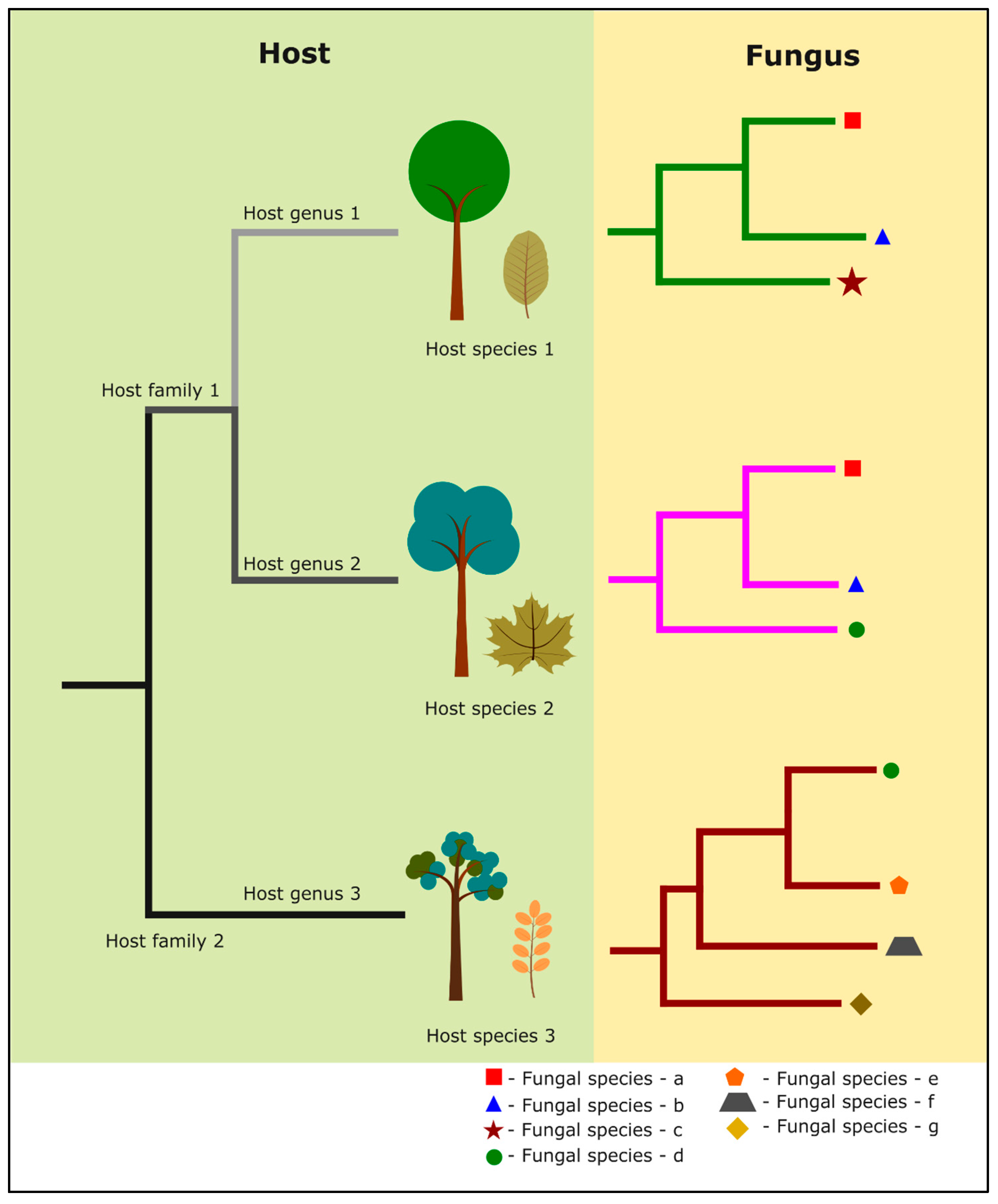

Table 1.
Fungal taxa reported on ten different host species and their overlap. Grey highlights the overlapped taxa.
Table 1.
Fungal taxa reported on ten different host species and their overlap. Grey highlights the overlapped taxa.
| Taxon name | ND (Lauraceae) |
FP (Moraceae) |
FA (Moraceae) | CF (Lauraceae) | MT (Euphorbiaceae) | CM (Lauraceae) | DF (Proteaceae) | EA (Elaeocarpaceae) | FD (Moraceae) | OH (Proteaceae) |
| Acremonium sp. | ✓ | ✓ | ✓ | ✓ | ✓ | ✓ | ||||
| Acrocalymma ampeli | ✓ | |||||||||
| Alternaria burnsii | ✓ | |||||||||
| Alternaria pseudoeichhorniae | ✓ | |||||||||
| Anthostomella clypeata | ✓ | |||||||||
| Anthostomella reniformis | ✓ | |||||||||
| Appendiculella sp. | ✓ | |||||||||
| Arthrinium hydei | ✓ | |||||||||
| Arthrinium sacchari | ✓ | |||||||||
| Arthrinium sp. | ✓ | |||||||||
| Arxiella celtidis | ✓ | |||||||||
| Aspergillus sp. | ✓ | ✓ | ✓ | ✓ | ||||||
| Asteridiella sp. | ✓ | |||||||||
| Asterina sp. | ✓ | ✓ | ||||||||
| Auxarthron sp. | ✓ | |||||||||
| Backusella sp. | ✓ | |||||||||
| Bartalinia robillardoides | ✓ | |||||||||
| Taxon name | ND (Lauraceae) |
FP (Moraceae) |
FA (Moraceae) | CF (Lauraceae) | MT (Euphorbiaceae) | CM (Lauraceae) | DF (Proteaceae) | EA (Elaeocarpaceae) | FD (Moraceae) | OH (Proteaceae) |
| Beltrania concurvispora | ✓ | ✓ | ✓ | |||||||
| Beltrania rhombica | ✓ | ✓ | ✓ | ✓ | ✓ | ✓ | ||||
| Beltrania sp. | ✓ | |||||||||
| Beltraniella portoricensis | ✓ | ✓ | ✓ | ✓ | ✓ | ✓ | ||||
| Beltraniella sp. | ✓ | ✓ | ||||||||
| Botryodiplodia theobromae | ✓ | |||||||||
| Brooksia tropicalis | ✓ | ✓ | ✓ | |||||||
| Camposporium sp. | ✓ | |||||||||
| Catenosubulispora sp. | ✓ | |||||||||
| Cephalosporiopsis sp. | ✓ | ✓ | ✓ | |||||||
| Ceramothyrium longivolcaniforme | ✓ | |||||||||
| Cercophora fici | ✓ | |||||||||
| Chaetopsina fulva | ✓ | ✓ | ||||||||
| Chaetospermum camelliae | ✓ | |||||||||
| Chaetospermum sp. | ✓ | ✓ | ✓ | ✓ | ✓ | |||||
| Chaetosphaeria sp. | ✓ | |||||||||
| Taxon name | ND (Lauraceae) |
FP (Moraceae) |
FA (Moraceae) | CF (Lauraceae) | MT (Euphorbiaceae) | CM (Lauraceae) | DF (Proteaceae) | EA (Elaeocarpaceae) | FD (Moraceae) | OH (Proteaceae) |
| Chaetospermum camelliae | ||||||||||
| Chaetospermum sp. | ||||||||||
| Chaetosphaeria sp. | ||||||||||
| Chalara cf.nigricollis | ✓ | ✓ | ||||||||
| Cylindrocarpon cf.orthosporum | ✓ | |||||||||
| Cylindrocladiella elegans | ✓ | |||||||||
| Cylindrocladiella sp. | ✓ | ✓ | ||||||||
| Cylindrocladium colhounii | ✓ | |||||||||
| Cylindrocladium coulhouniivar.coulhounii | ✓ | ✓ | ✓ | ✓ | ||||||
| Cylindrocladium floridanum | ✓ | ✓ | ||||||||
| Cylindrocladium ilicola | ✓ | |||||||||
| Cylindrocladium retaudii | ✓ | |||||||||
| Cylindrocladium sp. | ✓ | ✓ | ||||||||
| Cylindrosympodium cryptocaryae | ✓ | ✓ | ✓ | |||||||
| Cylindrosympodium sp. | ✓ | |||||||||
| Cylindrosympodium variabile | ✓ | |||||||||
| Taxon name | ND (Lauraceae) |
FP (Moraceae) |
FA (Moraceae) | CF (Lauraceae) | MT (Euphorbiaceae) | CM (Lauraceae) | DF (Proteaceae) | EA (Elaeocarpaceae) | FD (Moraceae) | OH (Proteaceae) |
| Chalara sp. | ✓ | ✓ | ✓ | |||||||
| Circinotrichum falcatisporum | ✓ | |||||||||
| Circinotrichum maculiforme | ✓ | |||||||||
| Circinotrichum sp. | ✓ | |||||||||
| Cladosporium cladosporoides | ✓ | |||||||||
| Cladosporium sp. | ✓ | ✓ | ✓ | ✓ | ✓ | ✓ | ||||
| Cladosporium tenuissimum | ✓ | |||||||||
| Coccomyces cf.limitatus | ✓ | |||||||||
| Coelomycete sp. | ✓ | ✓ | ✓ | |||||||
| Colletotrichum celtidis | ✓ | |||||||||
| Colletotrichum fici | ✓ | |||||||||
| Colletotrichum sp. | ✓ | ✓ | ✓ | |||||||
| Coniella quercicola | ✓ | ✓ | ||||||||
| Conioscypha sp. | ✓ | |||||||||
| Cryptophiale cf.guadalcanensis | ✓ | |||||||||
| Cryptophiale kakombensis | ✓ | ✓ | ✓ | |||||||
| Curvularia sp. | ✓ | ✓ | ||||||||
| Taxon name | ND (Lauraceae) |
FP (Moraceae) |
FA (Moraceae) | CF (Lauraceae) | MT (Euphorbiaceae) | CM (Lauraceae) | DF (Proteaceae) | EA (Elaeocarpaceae) | FD (Moraceae) | OH (Proteaceae) |
| Gnomonia elaeocarpa | ✓ | |||||||||
| Gnomonia queenslandica | ✓ | |||||||||
| Dischloridium sp. | ✓ | ✓ | ✓ | |||||||
| Discosia celtidis | ✓ | |||||||||
| Discosia querci | ✓ | |||||||||
| Meliola sp. | ✓ | ✓ | ||||||||
| Memnoniella alishanensis | ✓ | |||||||||
| Myrothecium lachastrae | ✓ | |||||||||
| Parasympodiella laxa | ✓ | ✓ | ||||||||
| Paraceratocladium sp. | ✓ | |||||||||
| Parasympodiella elongate | ✓ | ✓ | ✓ | ✓ | ✓ | |||||
| Phoma sp. | ✓ | ✓ | ✓ | ✓ | ✓ | ✓ | ✓ | |||
| Phomopsis sp. | ✓ | ✓ | ||||||||
| Taxon name | ND (Lauraceae) |
FP (Moraceae) |
FA (Moraceae) | CF (Lauraceae) | MT (Euphorbiaceae) | CM (Lauraceae) | DF (Proteaceae) | EA (Elaeocarpaceae) | FD (Moraceae) | OH (Proteaceae) |
| Dematiocladium celtidicola | ✓ | |||||||||
| Dendrosporium lobatum | ✓ | ✓ | ||||||||
| Diaporthe celtidis | ✓ | |||||||||
| Diaporthe limonicola | ✓ | |||||||||
| Diaporthe millettiae | ✓ | |||||||||
| Diaporthe pseudophoenicicola | ✓ | |||||||||
| Diaporthosporella macarangae | ✓ | |||||||||
| Dictyoarthrinium africanum | ✓ | |||||||||
| Dictyochaeta cf.novae-guineensis | ✓ | ✓ | ||||||||
| Dictyochaeta sp. | ✓ | ✓ | ✓ | ✓ | ||||||
| Dictyocheirospora garethjonesii | ✓ | |||||||||
| Dictyosporium cf.australiense | ✓ | |||||||||
| Dimorphiseta acuta | ✓ | |||||||||
| Dinemasporium parastrigosum | ✓ | |||||||||
| Dinemasporium sp. | ✓ | |||||||||
| Taxon name | ND (Lauraceae) |
FP (Moraceae) |
FA (Moraceae) | CF (Lauraceae) | MT (Euphorbiaceae) | CM (Lauraceae) | DF (Proteaceae) | EA (Elaeocarpaceae) | FD (Moraceae) | OH (Proteaceae) |
| Gnomonia sp. | ✓ | ✓ | ||||||||
| Goidanichiella sp. | ✓ | |||||||||
| Guignardia sp. | ✓ | ✓ | ||||||||
| Gyrothrix circinata | ✓ | |||||||||
| Gyrothrix pediculata | ✓ | |||||||||
| Hansfordia pulvinata | ✓ | ✓ | ✓ | ✓ | ||||||
| Harpographium sp. | ✓ | ✓ | ||||||||
| Helicosporium griseum | ✓ | ✓ | ✓ | |||||||
| Helicosporium sp. | ✓ | ✓ | ✓ | ✓ | ✓ | |||||
| Hermatomyces biconisporus | ✓ | |||||||||
| Hermatomyces sp. | ✓ | |||||||||
| Hyponectria sp. | ✓ | ✓ | ✓ | |||||||
| Idriella acerosa | ✓ | ✓ | ✓ | |||||||
| Idriella cagnizarii | ✓ | ✓ | ✓ | ✓ | ✓ | |||||
| Idriella lunata | ✓ | ✓ | ✓ | |||||||
| Idriella ramosa | ✓ | |||||||||
| Idriella sp. | ✓ | ✓ | ✓ | ✓ | ||||||
| Ijuhya sp. | ✓ | |||||||||
| Taxon name | ND (Lauraceae) |
FP (Moraceae) |
FA (Moraceae) | CF (Lauraceae) | MT (Euphorbiaceae) | CM (Lauraceae) | DF (Proteaceae) | EA (Elaeocarpaceae) | FD (Moraceae) | OH (Proteaceae) |
| Discostroma ficusicola | ✓ | |||||||||
| Falcocladium sp. | ✓ | |||||||||
| Flabellocladia sp. | ✓ | |||||||||
| Fusarium sp. | ✓ | ✓ | ✓ | |||||||
| Geotrichum sp. | ✓ | ✓ | ||||||||
| Gliocephalotrichum simplex | ✓ | |||||||||
| Gliocephalotrichum sp. | ✓ | |||||||||
| Gliocladiopsis sp. | ✓ | ✓ | ✓ | ✓ | ||||||
| Gliocladiopsis tenuis | ✓ | ✓ | ||||||||
| Gliocladium solani | ✓ | |||||||||
| Gliocladium sp. | ✓ | ✓ | ✓ | |||||||
| Gliomastix elasticae | ✓ | |||||||||
| Gliomastix murorum | ✓ | ✓ | ||||||||
| Gliomastix luzulae | ✓ | |||||||||
| Gliomastix macrocerealis | ✓ | |||||||||
| Gliomastix sp. | ✓ | |||||||||
| Taxon name | ND (Lauraceae) |
FP (Moraceae) |
FA (Moraceae) | CF (Lauraceae) | MT (Euphorbiaceae) | CM (Lauraceae) | DF (Proteaceae) | EA (Elaeocarpaceae) | FD (Moraceae) | OH (Proteaceae) |
| Ijuhya aquifolii | ✓ | |||||||||
| Ijuhya leucocarpa | ✓ | |||||||||
| Iodosphaeria phyllophila | ✓ | |||||||||
| Iodosphaeria sp. | ✓ | ✓ | ||||||||
| Isthmolongispora intermedia | ✓ | |||||||||
| Kramasamuha cf. sibika | ✓ | ✓ | ||||||||
| Kylindria sp. | ✓ | |||||||||
| Lachnum sp. | ✓ | ✓ | ||||||||
| Lanceispora amphibia | ✓ | ✓ | ||||||||
| Lasiodiplodia thailandica | ✓ | |||||||||
| Lasiodiplodia theobromae | ✓ | |||||||||
| Lauriomyces helicocephala | ✓ | |||||||||
| Leptospora macarangae | ✓ | |||||||||
| Leptothyrium sp. | ✓ | |||||||||
| Longihyalospora ampeli | ✓ | |||||||||
| Marasmius sp. | ✓ | ✓ | ✓ | |||||||
| Taxon name | ND (Lauraceae) |
FP (Moraceae) |
FA (Moraceae) | CF (Lauraceae) | MT (Euphorbiaceae) | CM (Lauraceae) | DF (Proteaceae) | EA (Elaeocarpaceae) | FD (Moraceae) | OH (Proteaceae) |
| Myrothecium sp. | ✓ | |||||||||
| Neoanthostomella fici | ✓ | |||||||||
| Neodictyosporium macarangae | ✓ | |||||||||
| Neofusicoccum moracearum | ✓ | |||||||||
| Neopestalotiopsis asiatica | ✓ | |||||||||
| Niesslia sp. | ✓ | |||||||||
| Nigrospora macarangae | ✓ | |||||||||
| Nigrospora panici | ✓ | |||||||||
| Nodulisporium sp. | ✓ | |||||||||
| Oblongihyalospora macarange | ✓ | |||||||||
| Ochroconis humicola | ✓ | |||||||||
| Oidiodendron tenuissimum | ✓ | |||||||||
| Ophioceras chiangdaoense | ✓ | |||||||||
| Ophiognomonia elasticae | ✓ | ✓ | ||||||||
| Ophiognomonia sp. | ✓ | ✓ | ✓ | ✓ | ||||||
| Strigula multiformis | ✓ | |||||||||
| Taxon name | ND (Lauraceae) |
FP (Moraceae) |
FA (Moraceae) | CF (Lauraceae) | MT (Euphorbiaceae) | CM (Lauraceae) | DF (Proteaceae) | EA (Elaeocarpaceae) | FD (Moraceae) | OH (Proteaceae) |
| Memnoniella celtidis | ✓ | |||||||||
| Memnoniella echinata | ✓ | |||||||||
| Menisporopsis theobromae | ✓ | ✓ | ||||||||
| Microdochium phragmites | ✓ | |||||||||
| Microdochium sp. | ✓ | ✓ | ||||||||
| Micropeltis fici | ✓ | |||||||||
| Micropeltis ficinae | ✓ | |||||||||
| Minimidochium microsporum | ✓ | |||||||||
| Mollisia sp. | ✓ | |||||||||
| Mortierella sp. | ✓ | |||||||||
| Mucor racemosus | ✓ | |||||||||
| Mucor sp. | ✓ | ✓ | ||||||||
| Muyocopron celtidis | ✓ | |||||||||
| Muyocopron dipterocarpi | ✓ | |||||||||
| Muyocopron lithocarpi | ✓ | |||||||||
| Mycena sp. | ✓ | ✓ | ||||||||
| Mycosphaerella sp. | ✓ | |||||||||
| Taxon name | ND (Lauraceae) |
FP (Moraceae) |
FA (Moraceae) | CF (Lauraceae) | MT (Euphorbiaceae) | CM (Lauraceae) | DF (Proteaceae) | EA (Elaeocarpaceae) | FD (Moraceae) | OH (Proteaceae) |
| Parasympodiella sp. | ✓ | |||||||||
| Parawiesneriomyces chiayiense | ✓ | |||||||||
| Penicillium sp. | ✓ | ✓ | ✓ | ✓ | ✓ | ✓ | ||||
| Periconia alishanica | ✓ | |||||||||
| Periconia byssoides | ✓ | |||||||||
| Periconia celtidis | ✓ | |||||||||
| Periconia sp. | ✓ | ✓ | ||||||||
| Pestalotiopsis versicolor | ✓ | |||||||||
| Pestalotiopsis breviseta | ✓ | |||||||||
| Pestalotiopsis dracaenea | ✓ | |||||||||
| Pestalotiopsis papuana | ✓ | |||||||||
| Pestalotiopsis sp. | ✓ | ✓ | ✓ | ✓ | ✓ | |||||
| Pestalotiopsis trachycarpicola | ✓ | |||||||||
| Phaeoisaria sp. | ✓ | |||||||||
| Phaeosphaeria ampeli | ✓ | |||||||||
| Phialocephala bactrospora | ✓ | |||||||||
| Taxon name | ND (Lauraceae) |
FP (Moraceae) |
FA (Moraceae) | CF (Lauraceae) | MT (Euphorbiaceae) | CM (Lauraceae) | DF (Proteaceae) | EA (Elaeocarpaceae) | FD (Moraceae) | OH (Proteaceae) |
| Phyllosticta capitalensis | ✓ | |||||||||
| Phyllosticta sp. | ✓ | ✓ | ✓ | |||||||
| Polyscytalum sp. | ✓ | |||||||||
| Pseudobeltrania sp. | ✓ | |||||||||
| Pseudomicrodochium antillarum | ✓ | ✓ | ||||||||
| Pseudoneottiospora cannabina | ✓ | |||||||||
| Pseudopestalotiopsis camelliae-sinensis | ✓ | |||||||||
| Pseudopithomyces chartarum | ✓ | |||||||||
| Pseudorobillarda phragmitis | ✓ | |||||||||
| Pseudospiropes pinarensis | ✓ | |||||||||
| Pyricularia sp. | ✓ | |||||||||
| Rhinocladiella cristaspora | ✓ | |||||||||
| Rhinocladiella sp. | ✓ | ✓ | ||||||||
| Rhizopus stolonifer | ✓ | |||||||||
| Roumeguerilla sp. | ✓ | |||||||||
| Scolecobasidium cf.fusiforme | ✓ | |||||||||
| Scolecobasidium sp. | ✓ | ✓ | ||||||||
| Selenodriella fertilis | ✓ | |||||||||
| Taxon name | ND (Lauraceae) |
FP (Moraceae) |
FA (Moraceae) | CF (Lauraceae) | MT (Euphorbiaceae) | CM (Lauraceae) | DF (Proteaceae) | EA (Elaeocarpaceae) | FD (Moraceae) | OH (Proteaceae) |
| Selenodriella sp. | ✓ | ✓ | ||||||||
| Selenosporella curvispora | ✓ | |||||||||
| Selenosporella cristata | ✓ | ✓ | ✓ | ✓ | ✓ | |||||
| Selenosporella sp. | ✓ | ✓ | ✓ | ✓ | ✓ | |||||
| Sirastachys pandanicola | ✓ | |||||||||
| Speiropsis pedatospora | ✓ | |||||||||
| Speiropsis sp. | ✓ | ✓ | ||||||||
| Sphaeridium pilosum | ✓ | ✓ | ||||||||
| Sphaeridium sp. | ✓ | |||||||||
| Spiropes sp. | ✓ | |||||||||
| Sporidesmium cf.ponapense | ✓ | |||||||||
| Sporidesmium sp.nov. | ✓ | |||||||||
| Sporodesmiella garciniae | ✓ | |||||||||
| Stachybotrys aloeticola | ✓ | |||||||||
| Stachybotrys cf.parvispora | ✓ | |||||||||
| Taxon name | ND (Lauraceae) |
FP (Moraceae) |
FA (Moraceae) | CF (Lauraceae) | MT (Euphorbiaceae) | CM (Lauraceae) | DF (Proteaceae) | EA (Elaeocarpaceae) | FD (Moraceae) | OH (Proteaceae) |
| Subulispora procurvata | ✓ | ✓ | ||||||||
| Thozetella falcata | ✓ | ✓ | ||||||||
| Thozetella gigantea | ✓ | ✓ | ||||||||
| Thozetella queenslandica | ✓ | ✓ | ||||||||
| Thozetella boonjiensis | ✓ | |||||||||
| Thozetella radicata | ✓ | |||||||||
| Thozetella sp. | ✓ | ✓ | ||||||||
| Thysanophora sp. | ✓ | |||||||||
| Torula fici | ✓ | |||||||||
| Torula sp. | ✓ | |||||||||
| Trichoderma sp. | ✓ | ✓ | ✓ | |||||||
| Trichoderma viride | ✓ | ✓ | ✓ | |||||||
| Trichothecium sp. | ✓ | |||||||||
| Verticillium sp. | ✓ | ✓ | ✓ | |||||||
| Verticimonosporium ellipticum | ✓ | |||||||||
| Volutella ramkurii | ✓ | |||||||||
| Taxon name | ND (Lauraceae) |
FP (Moraceae) |
FA (Moraceae) | CF (Lauraceae) | MT (Euphorbiaceae) | CM (Lauraceae) | DF (Proteaceae) | EA (Elaeocarpaceae) | FD (Moraceae) | OH (Proteaceae) |
| Wiesneriomyces javanicus | ✓ | ✓ | ✓ | |||||||
| Wiesneriomyces laurinus | ✓ | |||||||||
| Wiesneriomyces sp. | ✓ | ✓ | ||||||||
| Yunnanomyces pandanicola | ✓ | |||||||||
| Zygosporium echinosporium | ✓ | ✓ | ✓ | |||||||
| Zygosporium mansonii | ✓ | ✓ | ||||||||
| Zygosporium sp. | ✓ | ✓ | ✓ | |||||||
| Xylaria sp. | ✓ | |||||||||
| Dactylaria ficusicola | ✓ | ✓ | ||||||||
| Dictyochaeta simplex | ✓ | ✓ | ✓ | ✓ | ✓ | |||||
| Dactylaria belliana | ✓ | ✓ | ||||||||
| Dactylaria section Mirandina sp. | ✓ | |||||||||
| Dactylaria sp. | ✓ | ✓ | ✓ | |||||||
| Dactylella sp. | ✓ | |||||||||
| Cylindrocarpon cf.ianthothele | ✓ | |||||||||
| Stachybotrys sp. | ✓ | ✓ | ||||||||
| Stilbella sp. | ✓ | ✓ | ||||||||
| Taxon name | ND (Lauraceae) |
FP (Moraceae) |
FA (Moraceae) | CF (Lauraceae) | MT (Euphorbiaceae) | CM (Lauraceae) | DF (Proteaceae) | EA (Elaeocarpaceae) | FD (Moraceae) | OH (Proteaceae) |
| Wiesneriomyces javanicus | ✓ | ✓ | ✓ | |||||||
| Wiesneriomyces laurinus | ✓ | |||||||||
| Wiesneriomyces sp. | ✓ | ✓ | ||||||||
| Yunnanomyces pandanicola | ✓ | |||||||||
| Zygosporium echinosporium | ✓ | ✓ | ✓ | |||||||
| Zygosporium mansonii | ✓ | ✓ | ||||||||
| Zygosporium sp. | ✓ | ✓ | ✓ | |||||||
| Xylaria sp. | ✓ | |||||||||
| Dactylaria ficusicola | ✓ | ✓ | ||||||||
| Dictyochaeta simplex | ✓ | ✓ | ✓ | ✓ | ✓ | |||||
| Dactylaria belliana | ✓ | ✓ | ||||||||
| Dactylaria section Mirandina sp. | ✓ | |||||||||
| Dactylaria sp. | ✓ | ✓ | ✓ | |||||||
| Dactylella sp. | ✓ | |||||||||
| Cylindrocarpon cf.ianthothele | ✓ | |||||||||
| Volutella sp. | ✓ | ✓ | ||||||||
| Wardomyces sp. | ✓ |
ND = Neolitsea dealbata, FP = Ficus pleurocarpa, FA = Ficus ampelas, CF = Celtis formasana, MT = Macaranga tanarius, CM = Cryptocarya mackinnoniana, DF = Darlingia ferruginea, EA = Elaeocarpus angustifolius, FD = Ficus destruens, OH = Opisthiolepis heterophylla. Dataset was adopted from the previous studies conducted by [87] and [30].
Table 2.
Comparison of the fungi reported on 10 different host families.
| Family | Species | Recorded fungal taxa | Country | Number of fungal taxa | References | |
| 1 | Anacardiaceae | Anacardium occidentale | Dactylaria biseptata, Dicyma vesiculifera, Emericella nidulans, Fusarium dimerum, Fusarium oxysporum, Gibberella bacata, Gloeosporium musarum, Glomerella tucumanensis, Gyrothrix circinata, Gyrothrix podosperma, Hansfordia pulvinata, Henicospora coronata, Idriella lunata, Khuskia oryzae, Lasiodiplodia theobromae, Leptosphaerulina chartarum, Meliola sp., Memnoniella echinata, Metulocladosporiella musae, Paecilomyces carneus, Parasympodiella laxa, Penicillium citrinum, Penicillium funiculosum, Penicillium oxalicum, Penicillium verruculosum, Pestalotiopsis theae, Phaeotrichoconis crotalariae, Pithomyces maydicus, Polyscytalum fecundissimum, Pseudobeltrania penzigii, Pseudocochliobolus eragrostidis, Scolecobasidium tshawytschae, Selenodriella fertilis, Selenosporella curvispora, Setosphaeria rostrata, Stachybotrys chartarum, Staphylotrichum coccosporum, Subramaniomyces fusisaprophyticus, Thozetella tocklaiensis, Torula herbarum, Trichoderma harzianum, Trichoderma viride, Trichothecium roseum, Volutella ciliata, Wiesneriomyces laurinus, Zygosporium gibbum, Zygosporium masonii, Zygosporium oscheoides | India | 48 | [135,137 |
| Family | Species | Recorded fungal taxa | Country | Number of fungal taxa | References | |
| 2 | Magnoliaceae | Magnolia liliifera | Albonectria rigidiuscula, Anthostomella monthadoia, Anthostomella tenacis, Bionectria ochroleuca, Bionectria palmicola, Bionectria sp., Colletotrichum gloeosporioides, Colletotrichum sp., Corynespora cassiicola, Cylindrocladium floridanum, Dactylaria dimorphospora, Dactylaria longidentata, Dokmaia monthadangii, Fusarium sp., Giugnardia sp., Gliocladium sp., Guignardia mangiferae, Haematonectria haematococca, Hyponectria manglietiae, Hyponectria manglietiagarrettii, Hyponectria sp., Hyponectria suthepensis, Hypoxylon sp., Ijuhya parilis, Leptosphaeria sp., Munkovalsaria appendiculata, Hyponectria manglietiagarrettii, Hyponectria sp., Hyponectria suthepensis, Hypoxylon sp., Ijuhya parilis, Leptosphaeria sp., Munkovalsaria appendiculata, Munkovalsaria magnoliae, Nectria haematococca, Nectria sp., Periconia jabalpurensis, Phaeosphaeria sp., Phoma sp., Phomopsis sp., Phyllosticta capitaliensis, Physalospora sp., Pseudohalonectria suthepensis, Rhytisma sp., Sporidesmium crassisporum, Stachybotrys parvispora, Volutella sp. | Thailand | 47 | [97] |
| Family | Species | Recorded fungal taxa | Country | Number of fungal taxa | References | |
| 3 | Fagaceae | Castanopsis diversifolia | Acremonium sp., Albonectria albosuccinea, Alternaria sp., Annulatascaceae sp., Ardhachandra cristaspora, Arthrinium sp., Aspergillus sp., Asterina sp., Bacillispora aquatica, Beltrania mangiferae, Beltrania rhombica, Beltraniella odinae, Beltraniella portoricensis, Beltraniella sp., Bipolaris cynodontis, Cercosporula sp., Chaetendophragmia triangularia, Chaetosphaeria sp., Chalara pteridina, Cladosporium cladosporioides, Cladosporium oxysporum, Cladosporium sp., Cladosporium sphaerospermum, Cladosporium tenuissimum, Clonostachys candelabrum, Clonostachys compactiuscula, Coelomycete sp., Cryptophiale udagawae, Cylindrocladium gracile, Cylindrocladium pseudogracile, Cylindrum griseum, Dendrodochium cylindricum, Dictyochaeta cylindrospora, Dictyochaeta heteroderae, Dictyochaeta simplex, Dictyochaeta sp., Dictyochaeta stipiticolla, Emarcea castanopsidicola, Endophragmiella sp., Fusarium sp., Geotrichum candidum, Gnomonia gnomon, Hansfordia sp., Haplographium sp., Helicosporium talbotii, Hyponectria buxi, Idriella fertilis, Idriella sp., Kionochaeta spissa, Kramasamuha sibika, Lachnum sp., Lauriomyces bellulus,Lecanicillium lecanii, Lichenopeltella salicis, Lophodermium australiense, Lophodermium sp., Marasmius sp., Menisporopsis novaezelandiae, Microdochium phragmitis, Microthyrium sp., Monochaetia sp., Mycena sp., Mycosphaerella sp., Oedocephalum sp., Ophioceras commune, Parasympodiella laxa, Penicillium sp., Periconia cookei, Periconia paludosa, Periconia sp., Pestalosphaeria hansenii, Pestalotiopsis tecomicola, Phaeoisaria sp., Phomopsis sp., Pithomyces karoo, Pseudobotrytis terrestris, Pseudohalonectria phialidica, Ramularia gei, Stemonitis sp., Stictis sp., Stomiopeltis sp., Subramaniomyces fusisaprophyticus, Subulispora procurvata Thozetella sp., Thysanophora sp., Tritirachium bulbophorum, Verticillium sp., Wiesneriomyces javanieus, Xenocylindrocladium sp., Zygosporium gibbum, Zygosporium minus | Thailand | 91 | [131] |
| Family | Species | Recorded fungal taxa | Country | Number of fungal taxa | References | |
| 4 | Rubiaceae | Pavetta indica | Acremonium sp., Alternaria alternata, Ardhachandra selenoides, Aspergillus flavus, Aspergillus japonicus, Bartalinia robillardoides, Beltrania rhombica, Beltraniella portoricensis, Beltraniella sp., Botryodiplodia theobromae, Chaetomium seminudam, Chaetomium spirale, Circinotrichum falcatisporum, Circinotrichum fertile, Circinotrichum maculiforme, Circinotrichum papakurae, Cladosporium cladosporioides, Cladosporium oxysporum, Colletotrichum falcatum, Corynespora cassiicola, Curvularia brachyspora, Curvularia intermedia, Curvularia lunata, Cylindrocladium parvum, Cylindrocladium quinqueseptatum, Drechslera halodes, Euantennaria sp., Fusarium lateritium, Fusarium oxysporum, Gyrothrix podosperma, Gyrothrix circinata, Harknessia sp., Helicosporium helicosporum, Helicosporium vegetum, Hermatomyces sphaericus, Idriella sp., Leptoxyphium sp., Meliola sp., Penicillium sp., Pestalotiopsis theae, Selenosporella curvispora, Sesquicillium setosum, Stachybotrys parvispora, Thysanophora assymetrica, Torula herbarum, Tretopileus sp., Trichoderma viride, Verticillium sp., Volutella ciliata, Wiesneriomyces javanicus, Zygosporium echinosporum, Zygosporium gibbum, Zygosporium masonii, Zygosporium oscheoides | India | 54 | [136] |
| 5 | Dipterocarpaceae | Shorea obtusa | Amphisphaeriaceae sp., Aspergillus sp., Beltrania rhombica, Beltraniella portoricensis, Chaetomium globosum, Cladosporium cladosporioides, Cladosporium oxysporum, Clonostachys rosea, Coelomycete sp., Colletotrichum gloeosporioides, Eupenicillium cf. senticosum, Eurotium sp., Geniculospolium sp., Geniculosporium sp., Gliocephalotrichum sp., Gliocladium virens, Lachnocladiaceae sp., Mucor sp., Nigrospora sp., Nodulisporium sp., Pestalotiopsis sp., Talaromyces sp., Trichoderma asperellum, Trichoderma hamatum, Xylaria sp. | Thailand | 25 | [133] |
| Family | Species | Recorded fungal taxa | Country | Number of fungal taxa | References | |
| 6 | Lauraceae | Neolitsea dealbata | Acremonium sp., Anthostomella clypeata, Arthrinium sp., Aspergillus sp., Beltrania rhombica, Beltrania sp., Beltraniella portoricensis, Beltraniella sp., Camposporium sp., Chalara sp., Cladosporium cladosporoides, Coelomycete sp., Colletotrichum sp., Cylindrosympodium sp., Dactylaria sp., Dictyoarthrinium africanum, Dictyochaeta sp., Fusarium sp., Geotrichum sp., Gliocephalotrichum sp., Gliocladium sp., Gyrothrix circinata, Gyrothrix pediculata, Helicosporium sp., Idriella sp., Iodosphaeria phyllophila, Menisporopsis theobromae, Mucor sp., Myrothecium sp., Penicillium sp., Periconia sp., Pestalotiopsis versicolor, Pestalotiopsis sp., Phoma sp., Phomopsis sp., Phyllosticta sp., Rhinocladiella sp., Selenosporella curvispora, Speiropsis sp., Stachybotrys sp., Thozetella radicata, Thozetella sp., Thysanophora sp., Torula sp., Trichoderma sp., Wardomyces sp., Wiesneriomyces javanicus, Wiesneriomyces sp. | Australia | 48 | [87] |
| 7 | Moraceae | Ficus ampelas | Acrocalymma ampeli, Aspergillus sp., Backusella sp., Beltrania rhombica, Ceramothyrium longivolcaniforme, Cercophora fici, Colletotrichum fici, Coniella quercicola, Cylindrocladium sp., Diaporthe limonicola, Diaporthe pseudophoenicicola, Discosia querci, Fusarium sp., Lasiodiplodia thailandica, Longihyalospora ampeli, Micropeltis fici, Micropeltis ficinae, Mortierella sp., Mycosphaerella sp., Neoanthostomella fici, Neofusicoccum moracearum, Penicillium sp., Periconia sp., Phaeosphaeria ampeli, Phoma sp., Phyllosticta sp., Pseudopestalotiopsis camelliae-sinensis, Rhizopus stolonifer, Torula fici, Volutella sp., Wiesneriomyces laurinus, Yunnanomyces pandanicola, Zygosporium sp. | China | 34 | [30] |
| 8 | Euphorbiaceae |
Macaranga tanarius |
Alternaria burnsii, Alternaria pseudoeichhorniae, Arthrinium sacchari, Aspergillus sp., Asteridiella sp., Cladosporium sp., Cladosporium tenuissimum, Diaporthosporella macarangae, Dictyocheirospora garethjonesii, Hermatomyces biconisporus, Hermatomyces sp., Idriella sp., Leptospora macarangae, | China | 30 | [30] |
| Family | Species | Recorded fungal taxa | Country | Number of fungal taxa | References | |
| Meliola sp., Memnoniella alishanensis, Memnoniella echinata, Neodictyosporium macarangae, Nigrospora macarangae, Oblongihyalospora macarangae, Parawiesneriomyces chiayiense, Penicillium sp., Periconia alishanica, Periconia byssoides, Periconia celtidis, Phoma sp., Phyllosticta sp., Pseudopithomyces chartarum, Stachybotrys aloeticola, Zygosporium sp. | ||||||
| 9 | Proteaceae | Darlingia ferruginea | Acremonium sp., Beltraniella portoricensis, Botryodiplodia theobromae, Brooksia tropicalis, Chaetospermum sp., Cryptophiale cf.guadalcanensis, Cryptophiale kakombensis, Cylindrocladium coulhouniivar.coulhounii, Dictyochaeta simplex, Gliocladiopsis sp., Harpographium sp., Helicosporium sp., Hyponectria sp., Ijuhya aquifolii, Kramasamuha cf. sibika, Lachnum sp., Marasmius sp., Mycena sp., Ophiognomonia sp., Parasympodiella elongata, Pestalotiopsis sp., Pseudobeltrania sp., Selenosporella cristata, Selenosporella sp., Stilbella sp., Thozetella gigantea, Thozetella sp. | Australia | 27 | [87] |
| 10 | Elaeocarpaceae | Elaeocarpus angustifolius | Acremonium sp., Beltrania rhombica, Beltraniella portoricensis, Cephalosporiopsis sp., Chaetospermum sp., Chalara sp., Cladosporium sp., Coccomyces cf.limitatus, Cylindrocladium coulhouniivar.coulhounii, Cylindrocladium floridanum, Dactylaria sp., Dictyochaeta cf.novae-guineensis, Dictyochaeta simplex, Dictyochaeta sp., Dischloridium sp., Gliocephalotrichum simplex, Gliocladiopsis tenuis, Gnomonia elaeocarpa, Gnomonia queenslandica, Guignardia sp., Hansfordia pulvinata, Harpographium sp., Idriella acerosa, Idriella cagnizarii, Iodosphaeria sp., Kramasamuha cf. sibika, Lauriomyces helicocephala, Parasympodiella elongata, Penicillium sp., Pestalotiopsis sp., Phialocephala bactrospora, Phoma sp., Scolecobasidium cf.fusiforme, Scolecobasidium sp., Selenodriella sp., Selenosporella cristata, Selenosporella sp., Stachybotrys sp., Trichoderma viride | Australia | 39 | [87] |
Disclaimer/Publisher’s Note: The statements, opinions and data contained in all publications are solely those of the individual author(s) and contributor(s) and not of MDPI and/or the editor(s). MDPI and/or the editor(s) disclaim responsibility for any injury to people or property resulting from any ideas, methods, instructions or products referred to in the content. |
© 2024 by the authors. Licensee MDPI, Basel, Switzerland. This article is an open access article distributed under the terms and conditions of the Creative Commons Attribution (CC BY) license (http://creativecommons.org/licenses/by/4.0/).
Copyright: This open access article is published under a Creative Commons CC BY 4.0 license, which permit the free download, distribution, and reuse, provided that the author and preprint are cited in any reuse.


