

Submitted:
18 November 2024
Posted:
19 November 2024
You are already at the latest version
Abstract
This study explores the relationship between thermodynamic principles and the temporal dynamics of brain wave configurations, focusing on the processes underlying thought, sensation, and motor acts. By conceptualizing brain activity as a dynamic system that minimizes free energy, we analyze how energy landscapes govern transitions between cognitive states. Brain wave oscillations, including alpha, beta, theta, and gamma rhythms, are modeled as time-dependent attractors that reflect neural efficiency in processing sensory input and generating motor output. Additionally, we explore the thermodynamic time scales of thought (milliseconds to seconds), sensation (milliseconds), and motor acts (tens to hundreds of milliseconds), revealing how neural systems optimize energy dissipation during these processes. This interdisciplinary approach integrates neural dynamics, thermodynamic laws, and cognitive neuroscience to offer insights into the energetic constraints that shape mental and physical actions.
Keywords:
Section 1. Introduction
Section 1.1. Thermodynamic Framework and Neural Systems
Section 1.2 Brain Waves as Oscillatory Dynamics
Section 1.3 Thermodynamic Insights into Neural Oscillations
Section 1.4 Temporal Dynamics of Thought, Sensation, and Motor Acts
- Sensation: Sensory input is processed on millisecond time scales, involving rapid gamma oscillations that integrate sensory information across cortical regions. For example, visual processing engages gamma-band synchronization in the primary visual cortex and higher-order areas (Bosman et al., 2012).
- Thought: Cognitive processes, such as problem-solving and decision-making, occur over milliseconds to seconds and are primarily associated with beta oscillations. These oscillations facilitate the coordination of neural circuits responsible for attention and working memory (Siegel, Donner, & Engel, 2012). Patients with Attention Deficit Disorder, for example can be diagnosed by elevated theta/beta rates (Montgomery, 2023)
- Motor Acts: Motor planning and execution involve both beta and gamma oscillations, operating on tens to hundreds of milliseconds. Beta oscillations are implicated in maintaining the motor plan, while gamma oscillations contribute to the precision and timing of movements (Kilavik et al., 2013).
- Time Scales and Energy Landscapes
- Thought Processes: Thought can be viewed as a transition between attractors on the energy landscape, mediated by beta and gamma oscillations. The speed and efficiency of these transitions depend on the energy barriers separating attractors, reflecting the cognitive load of the task at hand (Deco et al., 2013).
- Sensation: Sensory input induces shifts in the energy landscape, stabilizing attractors corresponding to the processing of specific stimuli. Gamma oscillations, by rapidly synchronizing activity, facilitate these transitions and ensure efficient sensory integration.
- Motor Acts: Motor planning and execution involve transitions through energy states optimized for precision and timing. The interaction between beta and gamma oscillations reflects the trade-off between maintaining a stable motor plan and executing rapid adjustments in response to environmental feedback (Engel & Fries, 2010).
Section 1.5 Implications for Brain Disorders
- In epilepsy, excessive synchronization of neural activity leads to hyperexcitable states, reflecting maladaptive energy use (Lytton, 2008).
- In schizophrenia, altered gamma-band activity is linked to deficits in sensory processing and cognitive function (Uhlhaas & Singer, 2010).
- In Parkinson’s disease, abnormal beta oscillations in the motor cortex interfere with movement initiation and coordination (Brown, 2007).
Section 1.6 Summary
Section 2. Methodology
Section 2.1. Definitions and Notation
- A state space , where each state corresponds to a specific neural configuration.
- An energy function , representing the total energy of the system in a given state.
- Neural oscillations as a frequency distribution , corresponding to the dominant brain wave frequencies (delta, theta, alpha, beta, gamma).
- 2.
- Energy Dynamics and Oscillations
- is the total energy of the system.
- is the effective thermodynamic temperature.
- is the entropy associated with the state .
- 3.
- Lemmas
- Lemma 1: Oscillatory Activity Minimizes Free Energy
- Proof:
- Lemma 2: Oscillation Frequencies Correlate with Energy States
- Proof:
- Lemma 3: Temporal Dynamics and Frequency Bandwidth
- Proof:
- 4.
- Proof: Energy Optimization Through Oscillations
- Theorem: Neural oscillations optimize energy dissipation by minimizing free energy over distinct time scales for thought, sensation, and motor acts.
- Proof:
- 5.
- Applications and Implications
- 6.
- Thought: Beta oscillations ( ) mediate attention and decision-making, requiring moderate energy states.
- 7.
- Sensation: Gamma oscillations () integrate sensory input rapidly, demanding high energy.
- 8.
- Motor Acts: Beta-gamma coupling supports coordinated movement, balancing energy efficiency and speed.
Section 2.2. Energy Optimization in Cognition
- 1.
- The Brain as an Energy-Optimizing System
Section 2.1.1. Neural Oscillations as Energy States
- Low-frequency oscillations (e.g., delta, theta) govern baseline, energy-conserving states, such as resting or slow-wave sleep.
- High-frequency oscillations (e.g., beta, gamma) support energy-intensive tasks, including attention, working memory, and problem solving (Engel et al., 2013).
- The relationship between frequency and energy is captured by the harmonic approximation:
- E(x)≈E_0+1/2 x^T ∇^2 E(x_0 )x
- where the oscillation frequency ω(x) is proportional to √(∇^2 E(x)). Higher frequencies, such as gamma waves, are associated with steeper curvatures in the energy landscape, reflecting greater energy demands.
Section 2.1.2. Time Scales of Cognitive Processes
- Cognitive processes operate over specific time scales, reflecting the brain’s ability to adapt energy expenditure to task demands:
- Attention: Beta oscillations ( ω≈13-30” “ Hz ) mediate the maintenance of focus and the filtering of irrelevant information. These oscillations balance energy use, sustaining activity in prefrontal and parietal regions (Siegel, Donner, & Engel, 2012).
- Working Memory: Theta-gamma coupling supports the encoding and retrieval of information. Theta waves ( ω≈4-8” “ Hz ) provide a low-frequency scaffold, while gamma waves ( ω>30” “ Hz ) carry high-frequency information, ensuring efficient energy use during memory tasks (Lisman & Jensen, 2013).
- Decision-Making: Decision-making involves transitioning between attractors in the energy landscape. The speed of these transitions depends on the curvature of the energy landscape and the oscillatory frequencies governing the process. Beta oscillations stabilize decision states, while gamma oscillations enable rapid transitions under high cognitive loads (Deco et al., 2013).
- The temporal dynamics of these processes highlight the brain’s ability to align oscillatory activity with energy demands, optimizing cognitive efficiency.
- 4. Energy Dissipation and Efficiency
- The brain’s energy optimization strategy involves dissipating energy in a controlled manner to prevent metabolic overload while maintaining cognitive performance. This principle is evident in the synchronization of oscillations across networks:
- ΔE=∫‖∇Φ(x)‖^2 dx
- where Φ(x) represents the potential field governing network activity. Synchronization minimizes redundant activity, reducing ΔE and improving energy efficiency (Friston, 2010).
- For instance, large-scale neural networks such as the default mode network (DMN) and task-positive network (TPN) alternate their activity depending on task demands, preventing unnecessary energy expenditure during rest or low-intensity tasks (Fox et al., 2005).
- 5. Cognitive Load and Energy Barriers
- Cognitive tasks vary in their energy requirements based on complexity. Tasks with higher cognitive loads require transitions across higher energy barriers in the landscape:
- ΔE_”cognitive load “ ∝∇^2 E(x),
- where ∇^2 E(x) reflects the curvature of the energy landscape.
- Simple tasks: Involve shallow energy wells, allowing rapid transitions with minimal energy.
- Complex tasks: Require navigating steep energy gradients, consuming more energy and involving higher-frequency oscillations.
- 6.
- Implications for Cognitive Disorders
- Schizophrenia: Altered gamma oscillations impair information processing, reflecting inefficient energy use (Uhlhaas & Singer, 2010).
- Alzheimer’s Disease: Reduced synchronization in theta and gamma oscillations disrupts memory processes, increasing metabolic inefficiency (Stam, 2010).
- Attention Deficit Hyperactivity Disorder (ADHD): Imbalances in beta-theta coupling lead to difficulties in maintaining focus and regulating attention, reflecting poor energy allocation (Lenz et al., 2008).
Conclusions
Section 3. Results
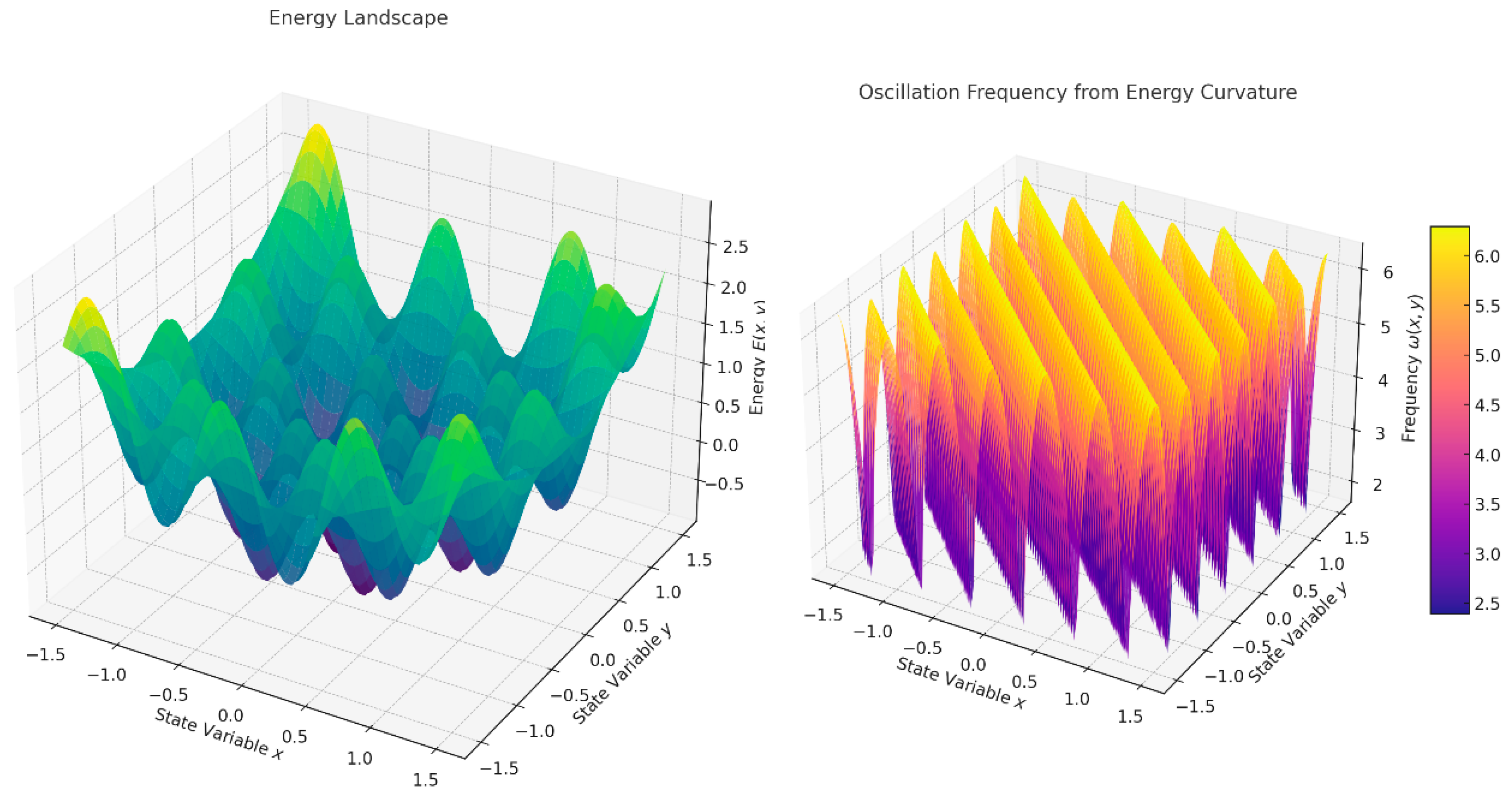
- Explanation of the Graphs
Section 3.1. Time Scales of Cognitive Processes
- Attention: Beta oscillations () mediate the maintenance of focus and the filtering of irrelevant information. These oscillations balance energy use, sustaining activity in prefrontal and parietal regions (Siegel, Donner, & Engel, 2012).
- Working Memory: Theta-gamma coupling supports the encoding and retrieval of information. Theta waves () provide a low-frequency scaffold, while gamma waves () carry high-frequency information, ensuring efficient energy use during memory tasks (Lisman & Jensen, 2013).
- Decision-Making: Decision-making involves transitioning between attractors in the energy landscape. The speed of these transitions depends on the curvature of the energy landscape and the oscillatory frequencies governing the process. Beta oscillations stabilize decision states, while gamma oscillations enable rapid transitions under high cognitive loads (Deco et al., 2013).
- 4.
- Energy Dissipation and Efficiency
- 5.
- Cognitive Load and Energy Barriers
- Simple tasks: Involve shallow energy wells, allowing rapid transitions with minimal energy.
Section 3.2. Cognitive and Functional Dynamics:
- Energy Barriers and Task Complexity:
- Obs: The Python code used for these illustrations can be found in the attachments section of this article.
Section 4. Discussion
Section 4.1. Thermodynamic Foundations of Neural Oscillations
Section 4.2. Neural Oscillations as Thermodynamic States
Section 4.2 Temporal Dynamics and Cognitive Processing
Section 4.3 Energy Landscapes and the Organization of Thought
Section 4.4 Philosophical Reflections on Energy and Cognition
Section 4.5 Implications for Understanding Human Potential
Section 5. Conclusions
Section 6. Attachments
References
- Bosman, C. A., et al. (2012). Attentional stimulus selection through selective synchronization between monkey visual areas. Neuron, 75(5), 875–888.
- Deco, G., Jirsa, V. K., & McIntosh, A. R. (2013). Resting brains never rest: Computational insights into potential cognitive states. Trends in Neurosciences, 36(5), 268–274.
- Engel, A. K., & Fries, P. (2010). Beta-band oscillations: Signaling the status quo? Current Opinion in Neurobiology, 20(2), 156–165.
- Friston, K. (2010). The free-energy principle: A unified brain theory? Nature Reviews Neuroscience, 11(2), 127–138.
- Howarth, C., Gleeson, P., & Attwell, D. (2012). Updated energy budgets for neural computation in the neocortex and cerebellum. Journal of Cerebral Blood Flow & Metabolism, 32(7), 1222–1232.
- Kilavik, B. E., Zaepffel, M., Brovelli, A., MacKay, W. A., & Riehle, A. (2013). The ups and downs of beta oscillations in sensorimotor cortex. Frontiers in Integrative Neuroscience, 7, 43.
- Montgomery, R. M. (2023). Simulating Topological Changes in Human Brain Networks: A Computational Approach. [CrossRef]
- Montgomery, R. M. (2024). Deep Learning for ADHD Diagnosis:Integrating Diverse EEG Biomarkers for Enhanced Predictive. [CrossRef]
- Montgomery, R. M. (2024)a. From Neural Cords to Complex Brains The Evolution of the Vertebrate Central Nervous System and Human Cognition. [CrossRef]
- Siegel, M., Donner, T. H., & Engel, A. K. (2012). Spectral fingerprints of large-scale neuronal interactions. Nature Reviews Neuroscience, 13(2), 121–134.
- Uhlhaas, P. J., & Singer, W. (2010). Abnormal neural oscillations and synchrony in schizophrenia. Nature Reviews Neuroscience, 11(2), 100–113.
Disclaimer/Publisher’s Note: The statements, opinions and data contained in all publications are solely those of the individual author(s) and contributor(s) and not of MDPI and/or the editor(s). MDPI and/or the editor(s) disclaim responsibility for any injury to people or property resulting from any ideas, methods, instructions or products referred to in the content. |
© 2024 by the author. Licensee MDPI, Basel, Switzerland. This article is an open access article distributed under the terms and conditions of the Creative Commons Attribution (CC BY) license (https://creativecommons.org/licenses/by/4.0/).


