

Submitted:
18 November 2024
Posted:
19 November 2024
You are already at the latest version
Abstract
Due to the ever-increasing interest in the use of rare earth metals in medicine, in this review we considered the interaction of cerium dioxide nanoparticles with the main excipients used in the development of cerium-containing pharmaceutical compositions for biomedical applications. The review was conducted on the international databases PubMed and ScienceDirect, and included original research and literature reviews. Publications devoted to the use of cerium dioxide in disease diagnosis, analysis of other substances, and branches of scientific knowledge other than medicine were excluded. Following the selection process, 171 publications were analyzed. Based on the experimental results and the possibility to extrapolate them to humans, we compared polyacrylate, polyvinylpyrrolidone, dextran, hyaluronic acid, chitosan, polycarboxylic acids, in particular citric acid and its salts, lecithin and phosphatidylcholine in the context of conservation of biological effects of cerium dioxide and its physicochemical properties, as well as the degree of study of these combinations.
Keywords:
nanoparticles
; excipients
; lanthanides
; rare earth metals
; cerium
; nanocerium
; cerium dioxide
; biopolymers
; liposomes
; polyvinylpyrrolidone
; hyaluronic acid
; chitosan
; polyacrylate
; dextran
; citrate
; lecithin
; phosphatidylcholine
; antitumor
; antioxidant
; antimicrobial
; regenerative
1. Introduction
Rare earth metal nanoparticles are becoming increasingly popular in the modern world for solving a number of biomedical problems. The number of data and publications has recently increased significantly, however, there are still many questions and problems regarding the creation of final dosage forms based on them [1]. One of the well-established lanthanides is cerium, a metal possessing labile variable valence and having two oxide forms [2]. The peculiarities of the crystal lattice structure give it antioxidant and enzyme-like activity [3,4]. The most promising form at the moment is recognized as cerium dioxide [5], which, according to many studies, has regenerative [6,7,8,9], antimicrobial [10,11,12] and redox activity [13,14,15,16]. According to a number of studies, not only the choice of synthesis method [5,17], but also the choice of excipient [18] are important aspects that ensure and even enhance these effects.
Excipients, which are commonly understood as components that do not have the properties of a drug substance, for a long time were positioned as completely indifferent substances [19], and their main functional values were mainly attributed to the properties of adjusting the organoleptic properties of preparations [20], giving the optimal dosage form [21], increasing the weight of the dosage form [22], facilitating dosing [23], providing resistance to adverse environmental factors [24]. Later it was found that many of them have their own pharmacological activity [25], and can reduce [26], and sometimes on the contrary, increase [27,28] the level of toxicity, affect the rate of release [29] and activity of the main active ingredient [30]. It was also shown that new compounds could be formed during the interactions, and, consequently, the properties of the final product changed too [31].
Thus, the selection of an excipient is a very important task, because in addition to providing the proper level of effect, stability, it should also have the property of high biocompatibility, and in the case of lanthanide nanoparticles, and the ability to prevent their aggregation, and therefore to ensure their nanoscale and ability to overcome biological membranes, which also plays a leading role in the realization of the effectiveness of this group of drugs. Given the fact that the effects of rare earth metal nanoparticles and cerium itself are not sufficiently studied, it is not enough to consider only the assumed results of their interaction with excipients, relying only on the data of physical and chemical properties of individual substances.
Due to the combination of these factors, in this review we considered the main excipients (biopolymers, carboxylic acids and their salts, as well as lipid derivatives) used in the synthesis of nanoceria and studies of the properties of cerium dioxide, allowing to preserve its specific physicochemical and biological properties, as well as the degree of investigability of these interactions.
2. Materials and Methods
This review was conducted on the international databases PubMed and ScienceDirect. For the PubMed database, searches were performed using the keywords: “rare earth metals“ and “excipients“, “nanoparticles“ and “efficiency“ and “excipients“ and “medicine“, “cerium“ and “excipients“, “lanthanides” and “excipients”, “cerium oxide” and “hyaluronic acid”, “cerium oxide” and “polyvinylpyrrolidone“, “cerium oxide“ and “chitosan“, “cerium oxide“ and “dextran“, “cerium oxide“ and “lecithin“, “cerium oxide“ and “citrate“, “cerium oxide“ and ‘collagen“, “cerium oxide“ and “gelatin“. For PubMed, the data set was 3, 118, 28, 4, 10, 8, 57, 18, 2, 30, 34, 26 publications, respectively. According to the inclusion and exclusion criteria, the filters “Clinical Trial”, “Meta-Analysis”, “Randomized Controlled Trial”, “Review”, and “Systematic Review” were set. For the categories “cerium” AND “excipients”, “lanthanides” AND “excipients”, “cerium oxide” and “hyaluronic acid”, “cerium oxide” and “polyvinylpyrrolidone”, “cerium oxide” and “chitosan”, “cerium oxide” and “dextran”, “cerium oxide” and “lecithin”, “cerium oxide” and “citrate”, “cerium oxide” and ‘collagen’, ‘cerium oxide’ and ‘gelatin’ search restrictions were not imposed due to the technical absence of classification of publications on this query in the PubMed system. The final number of publications for analysis was 1, 12, 28, 4, 10, 8, 57, 18, 2, 30, 34, 26, respectively.
Given the lack of database specialization in medical, biological and pharmaceutical fields of scientific knowledge, the query was adjusted for ScienceDirect by the keywords: “rare earth metals” and ‘excipients’, ‘metal-based nanoparticles’ and ‘efficiency’ and ‘excipients’ and ‘medicine’, ‘cerium’ and ‘excipients’ and ‘medicine’’, ‘lanthanides’ and ‘excipients’ and ‘medicine’, ‘cerium oxide’ and ‘hyaluronic acid’, “cerium oxide” and ‘polyvinylpyrrolidone’, ‘cerium oxide’ and ‘chitosan’, ‘cerium oxide’ and ‘dextran’, ‘cerium oxide’ and ‘lecithin’, ‘cerium oxide’ and ‘citrate’, ‘cerium oxide’ and ‘collagen’, ‘cerium oxide’ and ‘gelatin’. The number of publications were 77, 34, 273, 190, 644, 750, 2432, 713, 192, 1650, 1085, 1028, respectively. According to the inclusion and exclusion criteria, “Review articles” and “Research articles” filters were applied, resulting in a number of publications of 46, 18, 160, 105, 440, 533, 1598, 471, 112, 1222, 755, 670. In order to limit the data set to the target field of scientific knowledge, additional filters were used: “Biochemistry, Genetics and Molecular Biology”, “Materials Science”, “Pharmacology, Toxicology and Pharmaceutical Science”, “Medicine and Dentistry”, “Immunology and Microbiology”, “Agricultural and Biological Sciences”, “Neuroscience”. The number of publications according to the filters used was 31, 16, 120, 69, 321, 271, 271, 901, 331, 84, 248, 543, 457. No restrictions on the date of publication were imposed.
Thus, the sum of publications selected for further study was 200 for PubMed and 3144 for ScienceDirect. During the initial analysis, publications considering nanoparticles as a delivery system for other pharmaceutical substances, cerium as an oxidizing agent in the analysis of quantitative content of other pharmacologically active substances or a biosensor, lanthanides as detection reagents were excluded. This work does not exclude from the analysis publications that consider nanoparticles as a non-targeted research object or as model substances, as well as works that are not in the public domain.
Inclusion criteria for this study were as follows: availability of verified assessment of the effect of excipients on the efficacy of the active pharmaceutical substance; type of publications - systematic reviews, meta-analyses, clinical studies; field of research - biology, pharmacology, toxicology, pharmaceutical technology.
The following parameters were identified as exclusion criteria: studies on the application of nanoparticles and rare earth metals in environmental monitoring, analysis of substances using nuclear magnetic resonance and fluorimetry, manufacturing of stents and implants, as well as areas of scientific knowledge not directly related to biomedicine (energy, engineering, physics and astronomy). Publications that are descriptions of individual clinical cases, mini-reviews, patents, methodological guidelines, and conference abstracts. This review also does not consider the issues of diagnostics and application of rare earth metals as tools for instrumental methods of research. Materials devoted to the use of cerium and its derivatives as a fluorescent indicator in determining drug concentrations in biological fluids were not included. The paper does not consider the use of auxiliary substances during the synthesis of nanoparticles and the influence of reagents on the structure of particles.
3. Results
3.1. Results of the Literature Search and the Final Flowchart of the PRISMA Search Strategy
According to the results of the analysis, the number of papers meeting the above criteria amounted to 171 publications from an initial selection of 3,344 papers. Meta-analyses and systematic reviews on the given parameters are absent in the considered databases. Among the original studies, in vitro experiments predominate, the largest number of which falls on the work with cell and tissue cultures. 100% of authors use small rodents (rats, mice) as experimental animals. Studies involving humans are much less common. Among them only 50% are randomized controlled.
Analysis of review articles showed that in 96.52% of cases there is no description of the methodology of literature selection. The remaining 3.48% indicated the databases involved, including a detailed search strategy in 2.61%. Review articles do not aim to assess the effect of excipients on pharmacodynamic, pharmacokinetic and toxic parameters of nanoparticles in 100% of cases. Changes in these parameters are presented in the context of describing the properties of the excipients themselves. The final Flow diagram of the search strategy is presented in Figure 1.
3.2. Cerium Dioxide Nanoparticles and Biopolymers
The main biopolymers used to stabilize cerium dioxide nanoparticles are hyaluronic acid, dextran, chitosan, polyacrylate and polyvinylpyrrolidone [32,33]. It has been observed that they can influence the bioavailability values and pharmacological effects of cerium oxide [31,34]. For some biopolymers, such as, for example, polyacrylate, information on these properties is limited to data on cytotoxicity and isolated reports on the intensification of antiviral action of nanoceria [35]. For others, however, the interactions are very specific. These include polyvinylpyrrolidone, a hydrophilic, biodegradable, and nontoxic biopolymer that has good stabilizing properties and is widely used in medicine [36,37]. In particular, polyvinylpyrrolidone-coated cerium oxide shows antioxidant and cytoprotective effects in brain injury in an in vitro study using neuroblastoma and U937 cells and in vivo study involving rats [36,38]. It was observed that the antibacterial and regenerative properties of nanoceria were not reduced by this stabilization approach [38,39]. Limited in vitro studies evaluating the toxicity and toxicokinetics of cerium nanoparticles stabilized with polyvinylpyrrolidone are also mentioned in the literature. They report the absence of signs of cytotoxicity and apoptosis in cell cultures; however, activation of the EB transcription factor was observed, which, on the one hand, may find its application in the development of treatments for diseases associated with impaired lysosome function, and on the other hand, may be one of the early signs of specific toxicity of metal nanoparticles [40].
In contrast to the aforementioned little-studied combinations, the so-called “dextran synthesis” is among the most popular techniques for the preparation of nanoceria due to its high biocompatibility and relative simplicity of the fabrication methodology [31,32,41,42]. In addition to the stabilizing effect itself, the use of dextran increases the antibacterial effect of cerium oxide nanoparticles, including against antibiotic-resistant Escherichia coli (E. coli) biofilms [43]. High pharmacological activity of dextran-nanoceria complex against such microorganisms as S. aureus, S. epidermidis, E. coli, E. faecalis and P. aeruginosa has been noted [31,44,45,46,47]. It should be noted that its intensity properties of the dextran-nanoceria complex are dose-dependent, and according to several researchers has an optimum of pH=9 [31,45,48].
According to the findings of in vitro experiments by Kim S. J. and Chung B. H., the redox properties of nanoceria also depend on the acidity value of the medium [49]. On the one hand, this imposes certain limitations on the use of cerium oxide as an antioxidant, on the other hand, it opens a prospect as an antitumor agent, since cells of malignant neoplasms have slightly acidic pH [50]. Under in vitro conditions, dextran-coated nanoceria had a highly selective cytotoxic effect on cultures of osteosarcoma, A375 melanoma, and neuroblastoma cells; it did not protect lung carcinoma (A-549) and breast carcinoma (BT-474) cells from oxidative stress, while normal cell cultures remained intact [51,52,53]. A comparative analysis of the antitumor effect of cerium oxide and cerium oxide coated with dextran was performed using HeLa cells as an example by Miletić M. et al. The latter had a more pronounced cytostatic effect in vitro [54]. The observed phenomenon is probably due to the combination of functional groups on the cerium surface as well as their own redox properties [55,56]. The antitumor effect was also dose-dependent [32].
An alternative biocompatible polymer candidate for the role of excipient for nanoceria is hyaluronic acid. In addition to stabilizing cerium oxide, it has many additional functions. In particular, its compositions have anti-atherosclerotic and anti-inflammatory effects associated with the ability to bind to CD44 receptors of cells [57,58,59]. Further comparison of nanoceria+hyaluronic acid composition, free nanoceria and its complex with dextran by Wang S. et al. demonstrated greater antiatherosclerotic efficacy of hyaluronic acid. However, the studies were carried out only in vitro on human fibroblast cell cultures, so at the moment it is difficult to assess the scale of prospects for the use of this organometallic complex and its biocompatibility [57].
At the same time, the anti-inflammatory effect was demonstrated regardless of the causes of pathology development (from the model of radial tissue damage to osteoarthritis) and was often accompanied by a regenerative effect [60,61,62]. In addition to favorable effects on cells, several studies indicate the ability of this combination to improve the function of ischemic organs [63,64,65] as well as modulate the microenvironment [66].
With regard to malignant neoplasms, the role of hyaluronic acid compositions has been described in the context of induction of apoptosis of triple negative breast cancer cells, and as a means of enhancing the efficacy of photodynamic therapy and photothermal therapy [32,67,68,69]. These directions, as estimated by Zeng L. et al. from 2021, are named as one of the main vectors for the development of effective tumor treatment [70]. The role of hyaluronic acid in the application of this composition in oncology is to provide a targeting effect on tumor tissue [71]. Antibacterial properties of the combination are considered at additional introduction of zinc into the organometallic complex of cerium and hyaluronic acid, thus providing strengthening of antibacterial properties due to synergism of metallic nanoparticles. When studied on a wound surface, the role of hyaluronic acid in this case was to intensify the healing of lesions. The differences with the control group were statistically significant. At the same time, the authors of the work draw attention to the need to balance the target effect and independent toxicity of nanoparticles [72]. Undoubtedly, additional research is required, as the use of nanoceria may become one of the possible ways to overcome antibiotic resistance [31].
One of the most studied at the moment are compositions of cerium oxide nanoparticles with chitosan. They are recognized as biocompatible, possessing a homogeneous structure, and the particle size remains consistently smaller relative to other excipients [32,73,74]. According to the assessment of Fahmy H. M. et al. dated 2020, this is of particular importance for nanoparticles as it is directly related to the risk of toxic effects [75]. It should be noted the good solubility of this combination, as well as betraying the surface of cerium oxide with a positive charge [32,64,76]. It is believed that this approach reduces potential toxicity and also provides good adhesion to mucosal tissues [77,78].
Current publications provide a considerable amount of information on a wide range of antibacterial activity, including for MRSA [39,76,79,80]. Only for chitosan-nanoceria, results on the presence of high fungicidal activity against Aspergillus aureus and Agaricus volvaceus were revealed [81,82]. The described effects together with the regenerative properties of cerium oxide are a promising direction for the development of therapy of diabetic wounds, as well as bone tissue engineering - some of the most labor-intensive areas of regenerative medicine [83,84,85,86,87,88]. Important factors complementing the described pharmacological features are the combined prolonged release of cerium oxide (48 hours), the ease of application in the form of a gel or the possibility of exploitation in the form of a medical device (dressing) [85,89,90,91,92]. In all these directions of use, additional cytoprotective action is realized due to antioxidant effect [93]. The preservation of this property of cerium when coated with chitosan, also gives the possibility of using the composition in spinal cord injury, thus realizing a neuroprotective effect [94,95,96,97]. Interestingly, of the most investigated interactions of cerium oxide with excipients, only for the chitosan-nanocerium composition, it remains extremely limited considered in the direction of oncology. Targeting retinoblastoma cells has been described in the literature, which presumably should reduce the risk of development and severity of systemic side effects, as well as reduce tumor resistance to existing therapeutic options [98,99,100,101]. For advanced breast cancer, a different modification was proposed by Wang S. et al. Rods combining graphene, cerium and chitosan were proposed to target metastatic foci in bone tissue. As a result, this composition induced apoptosis of tumor cells through activation of caspase-3 protease, and also stimulated bone tissue regeneration through the BMP2/Smad signaling pathway [57]. In turn, attempts to combine cerium and chitosan nanoparticles with antimetabolite drugs under in vitro conditions did not demonstrate an increase in efficacy compared to samples containing only fluorouracil and chitosan and supplemented with silver nanoparticles [102].
In contrast, a considerable amount of data addresses the question of the possibility of using nanoceria-chitosan in ophthalmology [103]. The potential for use in the therapy of age-related macular dystrophy has been described due to protection against apoptosis, decreased production of anti-inflammatory cytokines, reduction of oxidative stress, and several other factors [64,104,105,106,107,108,109]. It is believed that the increase and acceleration of permeability by 42-43 times for cerium oxide is achieved precisely due to the addition of chitosan to the composition [110,111,112,113]. The antioxidant properties of nanoceria lead to a decrease in the severity of dry eye syndrome under experimental conditions by increasing the activity of bocaloid cells [114,115]. Improvement of morphological characteristics of conjunctival and corneal cells in vitro and in a mouse model was observed [111,115,116]. Biocompatibility was evaluated on ARPE-19 cell culture. As a result, no signs of inflammatory reactions were found, which emphasizes the promising application of chitosan-containing formulations [117]. The introduction of an additional pharmaceutically active substance (pilocarpine) into the complex of nanoceria and chitosan makes it possible to expand the range of applications in ophthalmology while maintaining the potentiating effect on the permeability of the complex through the cornea. It is claimed that the bioavailability of pilocarpine increased 250-fold under in vivo conditions [111,112,113]. Thus, such multifunctional systems can provide biocompatibility, reduce oxidative stress, and decrease the effects of inflammatory factors [118]. In addition, compositions containing nanocerium, chitosan and alginate have been developed. The role of cerium was to impart antibacterial effect to the membranes. The organic component provided elasticity of the products and stability under deformation. The additional use of carboxymethylcellulose in the composition brought adhesive properties and gel structure of the complex [119].
Special role in the creation of cerium-containing pharmaceutical compositions is played by such hydrophilic biopolymers as collagen and gelatin [120,121,122]. Due to their high biocompatibility [95], optimal rheological [123] and stabilizing properties [39], mucoadhesion, and high affinity to the tissues of the wound surface, they have found application in a wide range of directions for the development of agents for use in medicine [124,125,126]. In particular, optimal values of mechanical strength and porosity have led to the development of agents designed for dentistry and bone tissue engineering [84,126]. According to in vitro and in vivo studies, collagen scaffolds promote accelerated tissue regeneration and differentiation in the injured area [84,126]. According to Chen X.et al. assumption, it is a response to a specific stimulus - generation of reactive oxygen species. Synergism of antioxidant action of nanoceria and biopolymer matrix was noted [127]. When working with ovarian cancer cells, it was found that this combination may be a candidate for the role of an antitumor drug [128]. In the study of Zubari W.et al. it was found that when cerium oxide is replaced by its peroxide, it is possible to achieve intensification of angiogenesis processes to improve the healing of chronic wounds [129]. As a result of Inbasekar C. and Fathima N. N. experiment with collagen fibers obtained ex vivo, not only biopolymer has a stabilizing effect on nanocerium [130], but also cerium dioxide increases the stability of collagen at the molecular level [131].
At the same time, a partial hydrolysate of collagen, gelatin, has gained much more popularity in biomedicine. Like its predecessor, gelatin incorporating cerium oxide has been considered as a gel framework in bone engineering [84] and dentistry [132] with pronounced regenerative properties [133]. According to Bhushan S. et al., the specific antioxidant and antibacterial properties of cerium oxide were retained and the proliferative effect on bone tissue was demonstrated under in vitro conditions on cell culture and in ovo [84]. These results are supported by in vivo studies performed on rats [134]. Xuerui Chen et al. and Jain A. et al. mentioned that the combination of gelatin and nanoceria has antihypertrophic properties for cardiomyocytes [135,136]. Regarding the wound surface, the composition under consideration demonstrates regenerative and antioxidant properties [32,137] on 3T3-L1 and HaCaT cell cultures [138,139], as well as in vivo [140,141], including in the presence of concomitant pathology, as shown in several studies using HaCaT, RAW264.7 cultures and in an in vivo model of diabetes [142,143,144]. Evidence of a favorable antibacterial efficacy profile is currently reported for a significant spectrum of microorganisms such as Pseudomonas aeruginosa [145,146], S. Aureus. E. Coli [147]. It should be noted that gelatin helps to increase the bioavailability and efficacy of nanoparticles and provides prolonged and uniform release, which may provide better tolerability in the long term [148,149,150]. A much smaller number of studies address the application of the combination of gelatin and nanoceria in other areas of medicine. A number of works provide data on the possibility of using this combination as an antioxidant and regenerative agent for stimulation and regeneration of neurons [64,151,152] on cell cultures and in vivo [153], anti-inflammatory [154], including in lesions of the central nervous system [155], as well as in cardiology [76] and ophthalmology [156].
In summary, it should be noted that numerous studies describe the interaction of cerium oxide and biopolymers. Their use is widespread, but none of them can be characterized only as a stabilizer, since biopolymers themselves are capable of producing additional effects, as well as influencing the efficiency and spectrum of action of cerium dioxide.
3.3. Cerium Dioxide Nanoparticles and Carboxylic Acid Derivatives
The considerable popularity of the use of carboxylic acids and their derivatives as stabilizers of cerium oxide nanoparticles is due to a combination of reasons. First of all, as it was mentioned earlier, the pharmacological effect of nanoceria is best realized at slightly acidic pH value. Another significant factor is the fact that the presence of three or more carboxyl functional groups provides aggregative stability of particles, contributes to the maintenance of biological effects of cerium, and also serves as an additional source of energy for ATP synthesis. [17]. Such stabilizers include mellitic [157] and aconitic acids [158], but at the moment the biological effects and the possibility of using their compounds with cerium in medicine are not considered in the literature. A larger amount of data is presented for L-amino acids. For cerium oxide synthesized with glycine, proline, valine, histidine, cysteine, and glutamic acid, in vitro studies have been carried out and the results showed high stability as well as the possibility of regulating the morphology of nanoparticles [159,160]. For cysteine and glutamic acid, an evaluation of their properties in the context of biomedicine has been carried out. In particular, David Schubert et al. concluded that cerium oxide nanoparticles reduce oxidative stress induced by glutamic acid ingestion in HT22 nerve cell culture [161]. In turn, derivatives of cysteine and cysteine with glutamic acid (acetylcysteine and cysteine-arginine-glutamic acid-lysine-alanine peptide) demonstrated antioxidant effects [162] and targeting effects on tumor tissue [163]. An antitumor effect was also found for acetic acid-stabilized cerium oxide as demonstrated in a study on DMEM, HT-29, NCBI -C466, HFFF2 and NCBI -C163 cell cultures [164]. There are currently no data on experiments evaluating the realization of other pharmacological effects of nanoceria. At the same time, 2024 publications indicate a renewed interest of the international scientific community in the application of carboxylic acids. A large-scale in vitro study of compounds with sixteen organic acids on the stability of cerium oxide nanoparticles revealed that nanoceria stabilized by citric, malic, and isolimonoic acids exhibited the highest aggregation stability [165]. For malic acid, high antibacterial activity against E. coli and S. aureus, including the reduction of biofilm formation, was additionally revealed [166].
The most studied as a stabilizer of cerium dioxide nanoparticles for medical applications is citric acid and its salts, which are highly biocompatible [167,168,169]. The addition of citrate makes it possible to achieve an optimal particle size (in the range from 1 to 7 nm), and also contributes to an increase in the permeability of cerium oxide through cell membranes due to the negative zeta potential and, as a consequence, intensification of the antioxidant effect and a significant reduction in toxicity [170,171,172,173]. A comparative analysis of cellular uptake of nanoceria stabilized by polymers and citric acid demonstrated the greater efficiency of the latter [174,175]. It should be noted that there is no universal way to realize the regenerative properties of cerium oxide + citrate at any phase of wound healing: biological activity can take opposite effects depending on the method of synthesis and the nanoparticle concentration used [17]. It is worth noting that citrate-stabilized nanoceria can be incorporated into polymeric pharmaceutical compositions by integrating into hydrogel matrix or microspheres c preserving antioxidant and regenerative effects [73,176,177]. The results of experiments on the antibacterial effect of citrate-stabilized cerium dioxide are currently contradictory. In an extensive study using 6 strains of bacteria and 2 strains of fungi, a dose-dependent antimicrobial effect was found, most significant for E. coli [178]. In another work, dated 1999, there was information about the low ability of citrate nanoceria to exert bacteriostatic or bactericidal effect [179]. This phenomenon can be explained by the fact that standard methods for assessing antimicrobial activity are not relevant for cerium oxide nanoparticles. Another way to solve the problem may be the correct selection of doses, as well as the connection with polymer carriers for increasing antibacterial activity and penetration the blood-brain barrier [178,180]. Pharmacokinetic parameters (in particular, distribution) may also be dose-dependent and correlate with the route of administration [181].
The unique spectrum of pharmacological effects noted for citrate-stabilized cerium dioxide is of particular interest. Current literature provides data on immunomodulatory and antiviral [35], prophylactic in sunburns [182], therapeutic in multiple sclerosis [183,184,185], as well as in reproductive disorders in males [186], and many other pathologies [98]. At the same time, the literature mentions contradictory data on the prooxidant, cytotoxic effect of citrate-stabilized cerium nanoparticles on the brain and liver parenchyma, which requires additional study of the safety profile [167,187,188,189].
3.4. Cerium Dioxide Nanoparticles and Liposomes
Like other representatives of rare earth metals, cerium nanoparticles have a high affinity for lipid compounds. It would be expected to offer an option for the production of liposomal forms of cerium nanoparticles. Such an approach has been investigated by coating the surface of cerium nanoparticles with surfactant (composed predominantly of lipids, among which phosphatidylcholine and lecithin predominate) [190,191,192]. According to the researchers’ claims, such coating promotes endocytosis of the active compound. At the same time, a limitation was identified: the risk of aggregation of nanoparticles with proteins and lipids in the alveoli and, as a consequence, the risk of developing lung function disorders [192]. It should be noted that the studies were conducted using computer modeling, which introduces additional nuances when extrapolating the data to a real organism. The issue of private interaction between nanoceria and lecithin, a surface-active phospholipid that is a part of cell membranes of all living organisms, has been considered more fully in the literature. The data of in vitro studies of this composition turned out to be quite contradictory: no signs of cytotoxicity were revealed, but the antioxidant properties of cerium were also not manifested [193]. Opposite results with respect to free radicals were obtained with betaTC-tet insulinoma cells, as well as with respect to cytotoxicity in an in vivo study [188,194]. At the same time, lecithin has its own antioxidant properties [195]. It is worth noting that cerium also has an effect on lecithin, promoting its conversion to an organogel [196]. The combination of lecithin nanoliposomes and gel demonstrated synergistic antioxidant and anti-inflammatory effects when applied as a transdermal therapeutic system [197]. Consequently, it can be concluded that the interaction between cerium and lecithin is difficult to predict and ambiguous.
Separately, the combination of cerium and phosphatidylcholine was also considered, highlighting another potential problem for the embodiment of a technological solution: according to the results, cerium IV causes hydrolysis of phosphatidylcholine and other phosphoric acid esters at both acidic and slightly alkaline pH values. On the other hand, this observation may provide a foundation for the development of treatments for lysosomal accumulation diseases [198,199].
Thus, working with cerium poses additional problems to researchers that do not arise when working with other nanoparticles, including other lanthanides: preservation of the full range of its pharmacological effects, limitation of routes of administration due to the risk of adverse reactions in contact with surfactant, difficulties in selecting the composition to create biocompatible liposomal forms with satisfactory performance and stability. The main results of studies of interaction between cerium dioxide nanoparticles and excipients are summarized in Table 1.
In summary, it should be noted that the original studies are represented mainly by in vitro studies, which makes it difficult to draw conclusions regarding the behavior of the considered pharmaceutical compositions in the human body. The interaction between nanoparticles (including cerium oxide nanoparticles) and excipients has not been studied at the moment, this issue is only indirectly addressed.
4. Discussion
In this work, we did not consider the intrinsic pharmacological activity of cerium, but we considered the final set of possible effects when adding different excipients. In analyzing the literature data from a number of studies, we focused on the requirements of excipients and their significant effects when interacting with cerium dioxide, namely:
1) Maintaining nanoscale dimensionality. To this end, various stabilizers are used, introduced before or after synthesis to prevent particle aggregation.
2) Biocompatibility. For metallic nanoparticles, the main critical parameter is the absence of cytotoxicity to normal body cells.
3) Preservation of intrinsic pharmacological activity of nanoceria. The realization of this requirement is based on the need to maintain the optimal amount of the introduced excipient in order to avoid blocking access to the site of application of the effect (e.g., bacteria or body cells. In this case, the formation of new nanocomposites with enhanced or completely new properties is possible as in the case of dextran [31].
Various biopolymers as well as citric acid and its salts fulfill these requirements to a greater or lesser extent. The choice of the optimal excipient from this range of compounds may differ depending on the purpose of application as well as on the dosage form. Dextran should be considered the most studied and promising at the moment. There are enough studies in the literature describing the preservation of the main therapeutic properties of cerium dioxide, in particular, antioxidant [41,43,44,49,51], antibacterial [31,45,46,47] and regenerative [31,44]. The biocompatibility and efficacy of dextran stabilization are also unquestionable based on a significant number of studies on various cell cultures [31,41,42,44,49,51]. The optimal way of introducing this stabilizer from the position of efficiency of the final composition, is the addition of dextran before the synthesis process [31,41,42,45,46,47,49,51]. At the same time, similar data were obtained for nanocomposites obtained by stabilization after synthesis, but in a much smaller volume, which requires additional studies [43,44,53,54]. The second potential candidate is chitosan. Being biocompatible [73,74,77,84,87,90,108] and having its own antibacterial properties, it also retains all the main effects of cerium dioxide [78,79,81,83,84,85,86,90,97,108,115]. However, unlike dextran, there is no sufficient data on its ability to have a selective cytotoxic effect on tumor cells, as well as prolonged release.
Information on the interaction of other excipients with cerium dioxide is rather limited. In particular, hyaluronic acid may be an optimal solution when setting the task of realizing the antioxidant effect of nanoceria [57,59,65]. Citric acid, despite the high popularity of its use as a stabilizer, demonstrates very contradictory biological effects (both toxic [175] and opposite to those typical for cerium [175,179,187,188]) in vivo, which creates a primary need for a full-fledged and multistage assessment of acute and chronic toxicity of citrate-stabilized cerium dioxide, as well as a more detailed study of its effect on bacteria.
The biological interaction of nanoceria compounds with other excipients such as polyacrylate [34,35], polyvinylpyrrolidone [36,37], phosphatidylcholine [194] and lecithin [193,197] etc. is currently insufficiently studied and does not allow us to draw a reasonable conclusion about the safety and efficacy of these pharmaceutical compositions.
5. Conclusions
In connection with the above, it can be concluded that the development of specific forms of drugs and products for medical use requires careful selection of excipients and a complete step-by-step study of them under in vitro, ex vivo and in vivo conditions. At the moment, the most studied and safe excipients are biopolymers, in particular, dextran and chitosan. According to the results of the analysis, they allow to maintain all specific biological effects known for cerium dioxide, do not adversely affect the physicochemical properties of the nanoparticle, and have a satisfactory safety profile. The possibility of using other excipients requires additional studies.
Author Contributions
Conceptualization, S.A.T. and S.E.V.; methodology, S.A.T. M.P.K., V.A.S., R.R.A., V.A.P. ; validation, M.P.K., V.A.S., N.E.M., V.A.P., R.R.A. and G.D.; formal analysis, S.A.T.. V.A.S., N.E.M., R.R.A. G.D., and V.A.P.; investigation, S.A.T. M.P.K., V.A.P.; data curation, N.E.M.. R.R.A., G.D. and S.E.V.; visualization, S.A.T., M.P.K., R.R.A., and G.D. ; supervision, V.A.S., N.E.M., V.A.P., R.R.A.; project administration, S.E.V.; writing—original draft preparation, S.A.T., M.P.K. and S.E.V.; writing—review and editing, N.E.M., V.A.S., V.A.P., R.R.A. and G.D. All authors have read and agreed to the published version of the manuscript.
Funding
The research was funded by the Russian Science Foundation, grant No. 23-65-10040, https://rscf.ru/project/23-65-10040/.
Institutional Review Board Statement
Not applicable.
Informed Consent Statement
Not applicable.
Conflicts of Interest
The authors declare no conflicts of interest.
References
- Manturova, N.E.; Stupin, V.A.; Silina, E.V. Cerium Oxide Nanoparticles for Surgery, Plastic Surgery and Aesthetic Medicine. Plast. khir. 2023, 120. [Google Scholar] [CrossRef]
- Ravichandran, S.; Thangaraj, P.; Sengodan, P.; Radhakrishnan, J. Biomimetic Facile Synthesis of Cerium Oxide Nanoparticles for Enhanced Degradation of Textile Wastewater and Phytotoxicity Evaluation. Inorganic Chemistry Communications 2022, 146, 110037. [Google Scholar] [CrossRef]
- Pešić, M.; Podolski-Renić, A.; Stojković, S.; Matović, B.; Zmejkoski, D.; Kojić, V.; Bogdanović, G.; Pavićević, A.; Mojović, M.; Savić, A.; et al. Anti-Cancer Effects of Cerium Oxide Nanoparticles and Its Intracellular Redox Activity. Chemico-Biological Interactions 2015, 232, 85–93. [Google Scholar] [CrossRef] [PubMed]
- Tian, X.; Liao, H.; Wang, M.; Feng, L.; Fu, W.; Hu, L. Highly Sensitive Chemiluminescent Sensing of Intracellular Al3+ Based on the Phosphatase Mimetic Activity of Cerium Oxide Nanoparticles. Biosensors and Bioelectronics 2020, 152, 112027. [Google Scholar] [CrossRef]
- S Jairam, L.; Chandrashekar, A.; Prabhu, T.N.; Kotha, S.B.; Girish, M.S.; Devraj, I.M.; Dhanya Shri, M.; Prashantha, K. A Review on Biomedical and Dental Applications of Cerium Oxide Nanoparticles ― Unearthing the Potential of This Rare Earth Metal. Journal of Rare Earths 2023, 41, 1645–1661. [Google Scholar] [CrossRef]
- Pezzini, I.; Marino, A.; Del Turco, S.; Nesti, C.; Doccini, S.; Cappello, V.; Gemmi, M.; Parlanti, P.; Santorelli, F.M.; Mattoli, V.; et al. Cerium Oxide Nanoparticles: The Regenerative Redox Machine in Bioenergetic Imbalance. Nanomedicine (Lond.) 2017, 12, 403–416. [Google Scholar] [CrossRef] [PubMed]
- Mohammad; Khan, U.A.; Warsi, M.H.; Alkreathy, H.M.; Karim, S.; Jain, G.K.; Ali, A. Intranasal Cerium Oxide Nanoparticles Improves Locomotor Activity and Reduces Oxidative Stress and Neuroinflammation in Haloperidol-Induced Parkinsonism in Rats. Front. Pharmacol. 2023, 14, 1188470. [Google Scholar] [CrossRef] [PubMed]
- Wei, F.; Neal, C.J.; Sakthivel, T.S.; Seal, S.; Kean, T.; Razavi, M.; Coathup, M. Cerium Oxide Nanoparticles Protect against Irradiation-Induced Cellular Damage While Augmenting Osteogenesis. Materials Science and Engineering: C 2021, 126, 112145. [Google Scholar] [CrossRef]
- Silina, E.V.; Manturova, N.E.; Erokhina, A.G.; Shatokhina, E.A.; Stupin, V.A. Nanomaterials Based on Cerium Oxide Nanoparticles for Wound Regeneration: A Literature Review. RJTAO 2023, 26, 113–124. [Google Scholar] [CrossRef]
- Khan, M.; Wali, R.; Mashwani, Z.-R.; Raja, N.I.; Ullah, R.; Bari, A.; Zaman, S. ; Sohail Nanowarriors from Mentha: Unleashing Nature’s Antimicrobial Arsenal with Cerium Oxide Nanoparticles. ACS Omega 2024, 9, 15449–15462. [Google Scholar] [CrossRef]
- Singh, A.K.; Bhardwaj, K. Mechanistic Understanding of Green Synthesized Cerium Nanoparticles for the Photocatalytic Degradation of Dyes and Antibiotics from Aqueous Media and Antimicrobial Efficacy: A Review. Environmental Research 2024, 246, 118001. [Google Scholar] [CrossRef] [PubMed]
- Ha, H.-A.; Al-Ansari, M.M.; Al-Dahmash, N.D.; Krishnan, R.; Shanmuganathan, R. In Vitro Analyses of Cerium Oxide Nanoparticles in Degrading Anthracene/Fluorene and Revealing the Antibiofilm Activity against Bacteria and Fungi. Chemosphere 2023, 345, 140487. [Google Scholar] [CrossRef] [PubMed]
- Pérez Gutiérrez, R.M.; Rodríguez-Serrano, L.M.; Laguna-Chimal, J.F.; De La Luz Corea, M.; Paredes Carrera, S.P.; Téllez Gomez, J. Geniposide and Harpagoside Functionalized Cerium Oxide Nanoparticles as a Potential Neuroprotective. IJMS 2024, 25, 4262. [Google Scholar] [CrossRef] [PubMed]
- Ibañez, I.L.; Notcovich, C.; Catalano, P.N.; Bellino, M.G.; Durán, H. The Redox-Active Nanomaterial Toolbox for Cancer Therapy. Cancer Letters 2015, 359, 9–19. [Google Scholar] [CrossRef]
- Re, F.; Gregori, M.; Masserini, M. Nanotechnology for Neurodegenerative Disorders. Maturitas 2012, 73, 45–51. [Google Scholar] [CrossRef]
- Diebold, Y.; Calonge, M. Applications of Nanoparticles in Ophthalmology. Progress in Retinal and Eye Research 2010, 29, 596–609. [Google Scholar] [CrossRef]
- Silina, E.V.; Stupin, V.A.; Manturova, N.E.; Ivanova, O.S.; Popov, A.L.; Mysina, E.A.; Artyushkova, E.B.; Kryukov, A.A.; Dodonova, S.A.; Kruglova, M.P.; et al. Influence of the Synthesis Scheme of Nanocrystalline Cerium Oxide and Its Concentration on the Biological Activity of Cells Providing Wound Regeneration. IJMS 2023, 24, 14501. [Google Scholar] [CrossRef] [PubMed]
- Silina, E.; Stupin, V.; Manturova, N.; Vasin, V.; Koreyba, K.; Litvitskiy, P.; Saltykov, A.; Balkizov, Z. Acute Skin Wounds Treated with Mesenchymal Stem Cells and Biopolymer Compositions Alone and in Combination: Evaluation of Agent Efficacy and Analysis of Healing Mechanisms. Pharmaceutics 2021, 13, 1534. [Google Scholar] [CrossRef]
- Kalasz, H.; Antal, I. Drug Excipients. CMC 2006, 13, 2535–2563. [Google Scholar] [CrossRef]
- Nakama, K.A.; Dos Santos, R.B.; Serpa, P.; Maciel, T.R.; Haas, S.E. Organoleptic Excipients Used in Pediatric Antibiotics. Archives de Pédiatrie 2019, 26, 431–436. [Google Scholar] [CrossRef]
- Altman, R.; Bosch, B.; Brune, K.; Patrignani, P.; Young, C. Advances in NSAID Development: Evolution of Diclofenac Products Using Pharmaceutical Technology. Drugs 2015, 75, 859–877. [Google Scholar] [CrossRef] [PubMed]
- Markl, D.; Zeitler, J.A. A Review of Disintegration Mechanisms and Measurement Techniques. Pharm Res 2017, 34, 890–917. [Google Scholar] [CrossRef] [PubMed]
- Kean, E.A.; Adeleke, O.A. Orally Disintegrating Drug Carriers for Paediatric Pharmacotherapy. European Journal of Pharmaceutical Sciences 2023, 182, 106377. [Google Scholar] [CrossRef]
- Labetoulle, M.; Benitez-del-Castillo, J.M.; Barabino, S.; Herrero Vanrell, R.; Daull, P.; Garrigue, J.-S.; Rolando, M. Artificial Tears: Biological Role of Their Ingredients in the Management of Dry Eye Disease. IJMS 2022, 23, 2434. [Google Scholar] [CrossRef] [PubMed]
- Sajjadi, M.; Nasrollahzadeh, M.; Ghafuri, H. Functionalized Chitosan-Inspired (Nano)Materials Containing Sulfonic Acid Groups: Synthesis and Application. Carbohydrate Polymers 2024, 343, 122443. [Google Scholar] [CrossRef]
- Tonjan, R.; Singh, D. Functional Excipients and Novel Drug Delivery Scenario inSelf-Nanoemulsifying Drug Delivery System: A Critical Note. PNT 2022, 10, 368–383. [Google Scholar] [CrossRef]
- Chan, E.; Waggoner, C.; Boylan, P.M. Commentary: Is Polyethylene Glycol Toxicity From Intravenous Methocarbamol Fact or Fiction? Journal of Pain & Palliative Care Pharmacotherapy 2024, 38, 180–184. [Google Scholar] [CrossRef]
- Panfil, C.; Chauchat, L.; Guerin, C.; Rebika, H.; Sahyoun, M.; Schrage, N. Impact of Latanoprost Antiglaucoma Eyedrops and Their Excipients on Toxicity and Healing Characteristics in the Ex Vivo Eye Irritation Test System. Ophthalmol Ther 2023, 12, 2641–2655. [Google Scholar] [CrossRef]
- Palugan, L.; Filippin, I.; Cirilli, M.; Moutaharrik, S.; Zema, L.; Cerea, M.; Maroni, A.; Foppoli, A.; Gazzaniga, A. Cellulase as an “Active” Excipient in Prolonged-Release HPMC Matrices: A Novel Strategy towards Zero-Order Release Kinetics. International Journal of Pharmaceutics 2021, 607, 121005. [Google Scholar] [CrossRef]
- Kjar, A.; Wadsworth, I.; Vargis, E.; Britt, D.W. Poloxamer 188 – Quercetin Formulations Amplify in Vitro Ganciclovir Antiviral Activity against Cytomegalovirus. Antiviral Research 2022, 204, 105362. [Google Scholar] [CrossRef]
- Silina, E.V.; Manturova, N.E.; Ivanova, O.S.; Baranchikov, A.E.; Artyushkova, E.B.; Medvedeva, O.A.; Kryukov, A.A.; Dodonova, S.A.; Gladchenko, M.P.; Vorsina, E.S.; et al. Cerium Dioxide–Dextran Nanocomposites in the Development of a Medical Product for Wound Healing: Physical, Chemical and Biomedical Characteristics. Molecules 2024, 29, 2853. [Google Scholar] [CrossRef]
- Yadav, S.; Chamoli, S.; Kumar, P.; Maurya, P.K. Structural and Functional Insights in Polysaccharides Coated Cerium Oxide Nanoparticles and Their Potential Biomedical Applications: A Review. International Journal of Biological Macromolecules 2023, 246, 125673. [Google Scholar] [CrossRef] [PubMed]
- Zhu, X.; Xu, N.; Zhang, L.; Wang, D.; Zhang, P. Novel Design of Multifunctional Nanozymes Based on Tumor Microenvironment for Diagnosis and Therapy. European Journal of Medicinal Chemistry 2022, 238, 114456. [Google Scholar] [CrossRef] [PubMed]
- Morel, E.; Jreije, I.; Tetreault, V.; Hauser, C.; Zerges, W.; Wilkinson, K.J. Biological Impacts of Ce Nanoparticles with Different Surface Coatings as Revealed by RNA-Seq in Chlamydomonas Reinhardtii. NanoImpact 2020, 19, 100228. [Google Scholar] [CrossRef]
- Shcherbakov, A.B. CeO2 Nanoparticles and Cerium Species as Antiviral Agents: Critical Review. European Journal of Medicinal Chemistry Reports 2024, 10, 100141. [Google Scholar] [CrossRef]
- Kang, D.-W.; Cha, B.G.; Lee, J.H.; Yang, W.; Ki, S.K.; Han, J.H.; Cho, H.Y.; Park, E.; Jeon, S.; Lee, S.-H. Ultrasmall Polymer-Coated Cerium Oxide Nanoparticles as a Traumatic Brain Injury Therapy. Nanomedicine: Nanotechnology, Biology and Medicine 2022, 45, 102586. [Google Scholar] [CrossRef]
- Parimi, D.; Sundararajan, V.; Sadak, O.; Gunasekaran, S.; Mohideen, S.S.; Sundaramurthy, A. Synthesis of Positively and Negatively Charged CeO 2 Nanoparticles: Investigation of the Role of Surface Charge on Growth and Development of Drosophila Melanogaster. ACS Omega 2019, 4, 104–113. [Google Scholar] [CrossRef] [PubMed]
- Ling, Y.; Ramalingam, M.; Lv, X.; Zeng, Y.; Qiu, Y.; Si, Y.; Pedraz, J.L.; Kim, H.-W.; Hu, J. Recent Advances in Nanomedicine Development for Traumatic Brain Injury. Tissue and Cell 2023, 82, 102087. [Google Scholar] [CrossRef]
- Nosrati, H.; Heydari, M.; Khodaei, M. Cerium Oxide Nanoparticles: Synthesis Methods and Applications in Wound Healing. Materials Today Bio 2023, 23, 100823. [Google Scholar] [CrossRef]
- Song, W.; Soo Lee, S.; Savini, M.; Popp, L.; Colvin, V.L.; Segatori, L. Ceria Nanoparticles Stabilized by Organic Surface Coatings Activate the Lysosome-Autophagy System and Enhance Autophagic Clearance. ACS Nano 2014, 8, 10328–10342. [Google Scholar] [CrossRef]
- Weaver, J.D.; Stabler, C.L. Antioxidant Cerium Oxide Nanoparticle Hydrogels for Cellular Encapsulation. Acta Biomaterialia 2015, 16, 136–144. [Google Scholar] [CrossRef]
- Ciobanu, C.; Nica, I.; Dinischiotu, A.; Iconaru, S.; Chapon, P.; Bita, B.; Trusca, R.; Groza, A.; Predoi, D. Novel Dextran Coated Cerium Doped Hydroxyapatite Thin Films. Polymers 2022, 14, 1826. [Google Scholar] [CrossRef]
- Chesneau, C.; Pawlak, A.; Hamadi, S.; Leroy, E.; Belbekhouche, S. Cerium Oxide Particles: Coating with Charged Polysaccharides for Limiting the Aggregation State in Biological Media and Potential Application for Antibiotic Delivery. RSC Pharm. 2024, 1, 98–107. [Google Scholar] [CrossRef]
- Andrabi, S.M.; Singh, P.; Majumder, S.; Kumar, A. A Compositionally Synergistic Approach for the Development of a Multifunctional Bilayer Scaffold with Antibacterial Property for Infected and Chronic Wounds. Chemical Engineering Journal 2021, 423, 130219. [Google Scholar] [CrossRef]
- Alpaslan, E.; Geilich, B.M.; Yazici, H.; Webster, T.J. pH-Controlled Cerium Oxide Nanoparticle Inhibition of Both Gram-Positive and Gram-Negative Bacteria Growth. Sci Rep 2017, 7, 45859. [Google Scholar] [CrossRef]
- Webster, T. ; Wang; Perez Inhibited Growth of Pseudomonas Aeruginosa by Dextran- and Polyacrylic Acid-Coated Ceria Nanoparticles. IJN 2013, 3395. [Google Scholar] [CrossRef] [PubMed]
- Wang, Y.; Zhang, X.; Zheng, H.; Zhou, Z.; Li, S.; Jiang, J.; Li, M.; Fu, B. Remineralization of Dentin with Cerium Oxide and Its Potential Use for Root Canal Disinfection. IJN 2023, Volume 19, 1–17. [Google Scholar] [CrossRef]
- Zandi, M.; Hosseini, F.; Adli, A.H.; Salmanzadeh, S.; Behboudi, E.; Halvaei, P.; Khosravi, A.; Abbasi, S. State-of-the-Art Cerium Nanoparticles as Promising Agents against Human Viral Infections. Biomedicine & Pharmacotherapy 2022, 156, 113868. [Google Scholar] [CrossRef]
- Kim, S.-J.; Chung, B.H. Antioxidant Activity of Levan Coated Cerium Oxide Nanoparticles. Carbohydrate Polymers 2016, 150, 400–407. [Google Scholar] [CrossRef] [PubMed]
- Cai, S.S.; Li, T.; Akinade, T.; Zhu, Y.; Leong, K.W. Drug Delivery Carriers with Therapeutic Functions. Advanced Drug Delivery Reviews 2021, 176, 113884. [Google Scholar] [CrossRef] [PubMed]
- Alpaslan, E.; Yazici, H.; Golshan, N.H.; Ziemer, K.S.; Webster, T.J. pH-Dependent Activity of Dextran-Coated Cerium Oxide Nanoparticles on Prohibiting Osteosarcoma Cell Proliferation. ACS Biomater. Sci. Eng. 2015, 1, 1096–1103. [Google Scholar] [CrossRef]
- Rubio, L.; Marcos, R.; Hernández, A. Nanoceria Acts as Antioxidant in Tumoral and Transformed Cells. Chemico-Biological Interactions 2018, 291, 7–15. [Google Scholar] [CrossRef]
- Kalashnikova, I.; Mazar, J.; Neal, C.J.; Rosado, A.L.; Das, S.; Westmoreland, T.J.; Seal, S. Nanoparticle Delivery of Curcumin Induces Cellular Hypoxia and ROS-Mediated Apoptosis via Modulation of Bcl-2/Bax in Human Neuroblastoma. Nanoscale 2017, 9, 10375–10387. [Google Scholar] [CrossRef]
- Miletić, M.; Aškrabić, S.; Rüger, J.; Vasić, B.; Korićanac, L.; Mondol, A.S.; Dellith, J.; Popp, J.; Schie, I.W.; Dohčević-Mitrović, Z. Combined Raman and AFM Detection of Changes in HeLa Cervical Cancer Cells Induced by CeO 2 Nanoparticles – Molecular and Morphological Perspectives. Analyst 2020, 145, 3983–3995. [Google Scholar] [CrossRef]
- Li, C.; Zhao, W.; Liu, B.; Xu, G.; Liu, L.; Lv, H.; Shang, D.; Yang, D.; Damirin, A.; Zhang, J. Cytotoxicity of Ultrafine Monodispersed Nanoceria on Human Gastric Cancer Cells. Journal of Biomedical Nanotechnology 2014, 10, 1231–1241. [Google Scholar] [CrossRef] [PubMed]
- Barkam, S.; Das, S.; Saraf, S.; McCormack, R.; Richardson, D.; Atencio, L.; Moosavifazel, V.; Seal, S. The Change in Antioxidant Properties of Dextran-Coated Redox Active Nanoparticles Due to Synergetic Photoreduction–Oxidation. Chemistry A European J 2015, 21, 12646–12656. [Google Scholar] [CrossRef] [PubMed]
- Wang, S.; Zhang, J.; Li, W.; Chen, D.; Tu, J.; Sun, C.; Du, Y. Hyaluronic Acid-Guided Assembly of Ceria Nanozymes as Plaque-Targeting ROS Scavengers for Anti-Atherosclerotic Therapy. Carbohydrate Polymers 2022, 296, 119940. [Google Scholar] [CrossRef] [PubMed]
- Gao, Y.; Zou, J.; Chen, B.; Cao, Y.; Hu, D.; Zhang, Y.; Zhao, X.; Wen, J.; Liu, K.; Wang, K. Hyaluronic Acid/Serotonin-Decorated Cerium Dioxide Nanomedicine for Targeted Treatment of Ulcerative Colitis. Biomater. Sci. 2023, 11, 618–629. [Google Scholar] [CrossRef] [PubMed]
- Lord, M.S.; Farrugia, B.L.; Yan, C.M.Y.; Vassie, J.A.; Whitelock, J.M. Hyaluronan Coated Cerium Oxide Nanoparticles Modulate CD44 and Reactive Oxygen Species Expression in Human Fibroblasts. J Biomedical Materials Res 2016, 104, 1736–1746. [Google Scholar] [CrossRef]
- Man, J.; Shen, Y.; Song, Y.; Yang, K.; Pei, P.; Hu, L. Biomaterials-Mediated Radiation-Induced Diseases Treatment and Radiation Protection. Journal of Controlled Release 2024, 370, 318–338. [Google Scholar] [CrossRef]
- Min, K.; Sahu, A.; Jeon, S.H.; Tae, G. Emerging Drug Delivery Systems with Traditional Routes – A Roadmap to Chronic Inflammatory Diseases. Advanced Drug Delivery Reviews 2023, 203, 115119. [Google Scholar] [CrossRef] [PubMed]
- Lin, Y.-W.; Fang, C.-H.; Meng, F.-Q.; Ke, C.-J.; Lin, F.-H. Hyaluronic Acid Loaded with Cerium Oxide Nanoparticles as Antioxidant in Hydrogen Peroxide Induced Chondrocytes Injury: An In Vitro Osteoarthritis Model. Molecules 2020, 25, 4407. [Google Scholar] [CrossRef] [PubMed]
- Li, M.; Jin, M.; Yang, H. Remodelers of the Vascular Microenvironment: The Effect of Biopolymeric Hydrogels on Vascular Diseases. International Journal of Biological Macromolecules 2024, 264, 130764. [Google Scholar] [CrossRef]
- Saifi, M.A.; Seal, S.; Godugu, C. Nanoceria, the Versatile Nanoparticles: Promising Biomedical Applications. Journal of Controlled Release 2021, 338, 164–189. [Google Scholar] [CrossRef]
- Zuo, L.; Feng, Q.; Han, Y.; Chen, M.; Guo, M.; Liu, Z.; Cheng, Y.; Li, G. Therapeutic Effect on Experimental Acute Cerebral Infarction Is Enhanced after Nanoceria Labeling of Human Umbilical Cord Mesenchymal Stem Cells. Ther Adv Neurol Disord 2019, 12, 175628641985972. [Google Scholar] [CrossRef] [PubMed]
- Jin, Y.; Cai, D.; Mo, L.; Jing, G.; Zeng, L.; Cheng, H.; Guo, Q.; Dai, M.; Wang, Y.; Chen, J.; et al. Multifunctional Nanogel Loaded with Cerium Oxide Nanozyme and CX3CL1 Protein: Targeted Immunomodulation and Retinal Protection in Uveitis Rat Model. Biomaterials 2024, 309, 122617. [Google Scholar] [CrossRef]
- Li, J.; Peng, H.-L.; Wen, C.; Xu, P.; Shen, X.-C.; Gao, C. NIR-II-Responsive CeO 2– x @HA Nanotheranostics for Photoacoustic Imaging-Guided Sonodynamic-Enhanced Synergistic Phototherapy. Langmuir 2022, 38, 5502–5514. [Google Scholar] [CrossRef]
- Babu Varukattu, N.; Lin, W.; Vivek, R.; Rejeeth, C.; Sabarathinam, S.; Yao, Z.; Zhang, H. Targeted and Intrinsic Activity of HA-Functionalized PEI-Nanoceria as a Nano Reactor in Potential Triple-Negative Breast Cancer Treatment. ACS Appl. Bio Mater. 2020, 3, 186–196. [Google Scholar] [CrossRef]
- Ahmadi, S.; Rahimizadeh, K.; Shafiee, A.; Rabiee, N.; Iravani, S. Nanozymes and Their Emerging Applications in Biomedicine. Process Biochemistry 2023, 131, 154–174. [Google Scholar] [CrossRef]
- Zeng, L.; Cheng, H.; Dai, Y.; Su, Z.; Wang, C.; Lei, L.; Lin, D.; Li, X.; Chen, H.; Fan, K.; et al. In Vivo Regenerable Cerium Oxide Nanozyme-Loaded pH/H 2 O 2 -Responsive Nanovesicle for Tumor-Targeted Photothermal and Photodynamic Therapies. ACS Appl. Mater. Interfaces 2021, 13, 233–244. [Google Scholar] [CrossRef]
- Lee, C.R.; Kim, G.G.; Park, S.B.; Kim, S.W. Synthesis of Hyaluronic Acid-Conjugated Fe3O4@CeO2 Composite Nanoparticles for a Target-Oriented Multifunctional Drug Delivery System. Micromachines 2021, 12, 1018. [Google Scholar] [CrossRef]
- Zhao, C.; Wu, Z.; Pan, B.; Zhang, R.; Golestani, A.; Feng, Z.; Ge, Y.; Yang, H. Functional Biomacromolecules-Based Microneedle Patch for the Treatment of Diabetic Wound. International Journal of Biological Macromolecules 2024, 267, 131650. [Google Scholar] [CrossRef] [PubMed]
- Petrova, V.A.; Dubashynskaya, N.V.; Gofman, I.V.; Golovkin, A.S.; Mishanin, A.I.; Aquino, A.D.; Mukhametdinova, D.V.; Nikolaeva, A.L.; Ivan’kova, E.M.; Baranchikov, A.E.; et al. Biocomposite Films Based on Chitosan and Cerium Oxide Nanoparticles with Promising Regenerative Potential. International Journal of Biological Macromolecules 2023, 229, 329–343. [Google Scholar] [CrossRef] [PubMed]
- Hasanzadeh, L.; Kazemi Oskuee, R.; Sadri, K.; Nourmohammadi, E.; Mohajeri, M.; Mardani, Z.; Hashemzadeh, A.; Darroudi, M. Green Synthesis of Labeled CeO2 Nanoparticles with 99mTc and Its Biodistribution Evaluation in Mice. Life Sciences 2018, 212, 233–240. [Google Scholar] [CrossRef]
- Fahmy, H.M.; Abd El-Daim, T.M.; Mohamed, H.A.A.E.N.E.; Mahmoud, E.A.A.E.Q.; Abdallah, E.A.S.; Mahmoud Hassan, F.E.; Maihop, D.I.; Amin, A.E.A.E.; Mustafa, A.B.E.; Hassan, F.M.A.; et al. Multifunctional Nanoparticles in Stem Cell Therapy for Cellular Treating of Kidney and Liver Diseases. Tissue and Cell 2020, 65, 101371. [Google Scholar] [CrossRef] [PubMed]
- Meng, X.; Wang, W.-D.; Li, S.-R.; Sun, Z.-J.; Zhang, L. Harnessing Cerium-Based Biomaterials for the Treatment of Bone Diseases. Acta Biomaterialia 2024, 183, 30–49. [Google Scholar] [CrossRef]
- Mitra, R.N.; Gao, R.; Zheng, M.; Wu, M.-J.; Voinov, M.A.; Smirnov, A.I.; Smirnova, T.I.; Wang, K.; Chavala, S.; Han, Z. Glycol Chitosan Engineered Autoregenerative Antioxidant Significantly Attenuates Pathological Damages in Models of Age-Related Macular Degeneration. ACS Nano 2017, 11, 4669–4685. [Google Scholar] [CrossRef]
- Teng, M.; Li, Z.; Wu, X.; Zhang, Z.; Lu, Z.; Wu, K.; Guo, J. Development of Tannin-Bridged Cerium Oxide Microcubes-Chitosan Cryogel as a Multifunctional Wound Dressing. Colloids and Surfaces B: Biointerfaces 2022, 214, 112479. [Google Scholar] [CrossRef]
- Senthilkumar, R.P.; Bhuvaneshwari, V.; Ranjithkumar, R.; Sathiyavimal, S.; Malayaman, V.; Chandarshekar, B. Synthesis, Characterization and Antibacterial Activity of Hybrid Chitosan-Cerium Oxide Nanoparticles: As a Bionanomaterials. International Journal of Biological Macromolecules 2017, 104, 1746–1752. [Google Scholar] [CrossRef]
- Nosrati, H.; Heydari, M.; Tootiaei, Z.; Ganjbar, S.; Khodaei, M. Delivery of Antibacterial Agents for Wound Healing Applications Using Polysaccharide-Based Scaffolds. Journal of Drug Delivery Science and Technology 2023, 84, 104516. [Google Scholar] [CrossRef]
- He, X.; Gan, J.; Fakhri, A.; Dizaji, B.F.; Azarbaijan, M.H.; Hosseini, M. Preparation of Ceric Oxide and Cobalt Sulfide-Ceric Oxide/Cellulose-Chitosan Nanocomposites as a Novel Catalyst for Efficient Photocatalysis and Antimicrobial Study. International Journal of Biological Macromolecules 2020, 143, 952–957. [Google Scholar] [CrossRef]
- Shivakumar, P.; Gupta, M.S.; Jayakumar, R.; Gowda, D.V. Prospection of Chitosan and Its Derivatives in Wound Healing: Proof of Patent Analysis (2010–2020). International Journal of Biological Macromolecules 2021, 184, 701–712. [Google Scholar] [CrossRef]
- Kamalipooya, S.; Fahimirad, S.; Abtahi, H.; Golmohammadi, M.; Satari, M.; Dadashpour, M.; Nasrabadi, D. Diabetic Wound Healing Function of PCL/Cellulose Acetate Nanofiber Engineered with Chitosan/Cerium Oxide Nanoparticles. International Journal of Pharmaceutics 2024, 653, 123880. [Google Scholar] [CrossRef]
- Bhushan, S.; Singh, S.; Maiti, T.K.; Das, A.; Barui, A.; Chaudhari, L.R.; Joshi, M.G.; Dutt, D. Cerium Oxide Nanoparticles Disseminated Chitosan Gelatin Scaffold for Bone Tissue Engineering Applications. International Journal of Biological Macromolecules 2023, 236, 123813. [Google Scholar] [CrossRef] [PubMed]
- Tripathi, R.; Narayan, A.; Bramhecha, I.; Sheikh, J. Development of Multifunctional Linen Fabric Using Chitosan Film as a Template for Immobilization of In-Situ Generated CeO2 Nanoparticles. International Journal of Biological Macromolecules 2019, 121, 1154–1159. [Google Scholar] [CrossRef] [PubMed]
- Yildizbakan, L.; Iqbal, N.; Ganguly, P.; Kumi-Barimah, E.; Do, T.; Jones, E.; Giannoudis, P.V.; Jha, A. Fabrication and Characterisation of the Cytotoxic and Antibacterial Properties of Chitosan-Cerium Oxide Porous Scaffolds. Antibiotics 2023, 12, 1004. [Google Scholar] [CrossRef] [PubMed]
- Petrova, V.A.; Gofman, I.V.; Dubashynskaya, N.V.; Golovkin, A.S.; Mishanin, A.I.; Ivan’kova, E.M.; Romanov, D.P.; Khripunov, A.K.; Vlasova, E.N.; Migunova, A.V.; et al. Chitosan Composites with Bacterial Cellulose Nanofibers Doped with Nanosized Cerium Oxide: Characterization and Cytocompatibility Evaluation. IJMS 2023, 24, 5415. [Google Scholar] [CrossRef] [PubMed]
- Lu, C.-H.; Yu, C.-H.; Yeh, Y.-C. Engineering Nanocomposite Hydrogels Using Dynamic Bonds. Acta Biomaterialia 2021, 130, 66–79. [Google Scholar] [CrossRef]
- Dong, H.; Liang, W.; Song, S.; Xue, H.; Fan, T.; Liu, S. Engineering of Cerium Oxide Loaded Chitosan/Polycaprolactone Hydrogels for Wound Healing Management in Model of Cardiovascular Surgery. Process Biochemistry 2021, 106, 1–9. [Google Scholar] [CrossRef]
- Liu, H.; Chen, R.; Wang, P.; Fu, J.; Tang, Z.; Xie, J.; Ning, Y.; Gao, J.; Zhong, Q.; Pan, X.; et al. Electrospun Polyvinyl Alcohol-Chitosan Dressing Stimulates Infected Diabetic Wound Healing with Combined Reactive Oxygen Species Scavenging and Antibacterial Abilities. Carbohydrate Polymers 2023, 316, 121050. [Google Scholar] [CrossRef] [PubMed]
- Zubair, M.; Hussain, A.; Shahzad, S.; Arshad, M.; Ullah, A. Emerging Trends and Challenges in Polysaccharide Derived Materials for Wound Care Applications: A Review. International Journal of Biological Macromolecules 2024, 270, 132048. [Google Scholar] [CrossRef]
- Lo, S.; Mahmoudi, E.; Fauzi, M.B. Applications of Drug Delivery Systems, Organic, and Inorganic Nanomaterials in Wound Healing. Discover Nano 2023, 18, 104. [Google Scholar] [CrossRef]
- Liu, T.; Lu, Y.; Zhan, R.; Qian, W.; Luo, G. Nanomaterials and Nanomaterials-Based Drug Delivery to Promote Cutaneous Wound Healing. Advanced Drug Delivery Reviews 2023, 193, 114670. [Google Scholar] [CrossRef] [PubMed]
- Gong, W.; Zhang, T.; Che, M.; Wang, Y.; He, C.; Liu, L.; Lv, Z.; Xiao, C.; Wang, H.; Zhang, S. Recent Advances in Nanomaterials for the Treatment of Spinal Cord Injury. Materials Today Bio 2023, 18, 100524. [Google Scholar] [CrossRef] [PubMed]
- Hong, Q.; Song, H.; Lan Chi, N.T.; Brindhadevi, K. Numerous Nanoparticles as Drug Delivery System to Control Secondary Immune Response and Promote Spinal Cord Injury Regeneration. Process Biochemistry 2022, 112, 145–153. [Google Scholar] [CrossRef]
- Kumar, N.; Tyeb, S.; Verma, V. Recent Advances on Metal Oxide-Polymer Systems in Targeted Therapy and Diagnosis: Applications and Toxicological Perspective. Journal of Drug Delivery Science and Technology 2021, 66, 102814. [Google Scholar] [CrossRef]
- Fang, X.; Song, H. Synthesis of Cerium Oxide Nanoparticles Loaded on Chitosan for Enhanced Auto-Catalytic Regenerative Ability and Biocompatibility for the Spinal Cord Injury Repair. Journal of Photochemistry and Photobiology B: Biology 2019, 191, 83–87. [Google Scholar] [CrossRef]
- Stephen Inbaraj, B.; Chen, B.-H. An Overview on Recent in Vivo Biological Application of Cerium Oxide Nanoparticles. Asian Journal of Pharmaceutical Sciences 2020, 15, 558–575. [Google Scholar] [CrossRef]
- Rajput, S.; Malviya, R.; Uniyal, P. Advancements in the Diagnosis, Prognosis, and Treatment of Retinoblastoma. Canadian Journal of Ophthalmology 2024, 59, 281–299. [Google Scholar] [CrossRef]
- Datta, D.; Priyanka Bandi, S.; Colaco, V.; Dhas, N.; Siva Reddy, D.; Vora, L.K. Fostering the Unleashing Potential of Nanocarriers-Mediated Delivery of Ocular Therapeutics. International Journal of Pharmaceutics 2024, 658, 124192. [Google Scholar] [CrossRef]
- Shcherbakov, A.B.; Reukov, V.V.; Yakimansky, A.V.; Krasnopeeva, E.L.; Ivanova, O.S.; Popov, A.L.; Ivanov, V.K. CeO2 Nanoparticle-Containing Polymers for Biomedical Applications: A Review. Polymers 2021, 13, 924. [Google Scholar] [CrossRef] [PubMed]
- Hossein Karami, M.; Abdouss, M. Cutting-Edge Tumor Nanotherapy: Advancements in 5-Fluorouracil Drug-Loaded Chitosan Nanoparticles. Inorganic Chemistry Communications 2024, 164, 112430. [Google Scholar] [CrossRef]
- Lin, X.; Wu, X.; Chen, X.; Wang, B.; Xu, W. Intellective and Stimuli-Responsive Drug Delivery Systems in Eyes. International Journal of Pharmaceutics 2021, 602, 120591. [Google Scholar] [CrossRef] [PubMed]
- Yu, C.; Xu, J.; Heidari, G.; Jiang, H.; Shi, Y.; Wu, A.; Makvandi, P.; Neisiany, R.E.; Zare, E.N.; Shao, M.; et al. Injectable Hydrogels Based on Biopolymers for the Treatment of Ocular Diseases. International Journal of Biological Macromolecules 2024, 269, 132086. [Google Scholar] [CrossRef] [PubMed]
- Alrobaian, M. Pegylated Nanoceria: A Versatile Nanomaterial for Noninvasive Treatment of Retinal Diseases. Saudi Pharmaceutical Journal 2023, 31, 101761. [Google Scholar] [CrossRef]
- Bakhti, A.; Shokouhi, Z.; Mohammadipanah, F. Modulation of Proteins by Rare Earth Elements as a Biotechnological Tool. International Journal of Biological Macromolecules 2024, 258, 129072. [Google Scholar] [CrossRef]
- Kazemi, M.S.; Shoari, A.; Salehibakhsh, N.; Aliabadi, H.A.M.; Abolhosseini, M.; Arab, S.S.; Ahmadieh, H.; Kanavi, M.R.; Behdani, M. Anti-Angiogenic Biomolecules in Neovascular Age-Related Macular Degeneration; Therapeutics and Drug Delivery Systems. International Journal of Pharmaceutics 2024, 659, 124258. [Google Scholar] [CrossRef]
- Wang, K.; Mitra, R.N.; Zheng, M.; Han, Z. Nanoceria-loaded Injectable Hydrogels for Potential Age-related Macular Degeneration Treatment. J Biomedical Materials Res 2018, 106, 2795–2804. [Google Scholar] [CrossRef]
- Jabbehdari, S.; Handa, J.T. Oxidative Stress as a Therapeutic Target for the Prevention and Treatment of Early Age-Related Macular Degeneration. Survey of Ophthalmology 2021, 66, 423–440. [Google Scholar] [CrossRef]
- Sahu, D.K.; Pradhan, D.; Biswasroy, P.; Kar, B.; Ghosh, G.; Rath, G. Recent Trends in Nanocarrier Based Approach in the Management of Dry Eye Disease. Journal of Drug Delivery Science and Technology 2021, 66, 102868. [Google Scholar] [CrossRef]
- Xie, G.; Lin, S.; Wu, F.; Liu, J. Nanomaterial-Based Ophthalmic Drug Delivery. Advanced Drug Delivery Reviews 2023, 200, 115004. [Google Scholar] [CrossRef]
- Fatima, R.; Prasher, P.; Sharma, M.; Chellappan, D.K.; Gupta, G.; Singh, S.K.; Patravale, V.B.; Dua, K. Aminated Polysaccharides: Unveiling a New Frontier for Enhanced Therapeutic Efficacy. Journal of Drug Delivery Science and Technology 2023, 89, 105090. [Google Scholar] [CrossRef]
- Zhai, Z.; Cheng, Y.; Hong, J. Nanomedicines for the Treatment of Glaucoma: Current Status and Future Perspectives. Acta Biomaterialia 2021, 125, 41–56. [Google Scholar] [CrossRef] [PubMed]
- Wang, T.-J.; Rethi, L.; Ku, M.-Y.; Nguyen, H.T.; Chuang, A.E.-Y. A Review on Revolutionizing Ophthalmic Therapy: Unveiling the Potential of Chitosan, Hyaluronic Acid, Cellulose, Cyclodextrin, and Poloxamer in Eye Disease Treatments. International Journal of Biological Macromolecules 2024, 273, 132700. [Google Scholar] [CrossRef] [PubMed]
- Yu, F.; Zheng, M.; Zhang, A.Y.; Han, Z. A Cerium Oxide Loaded Glycol Chitosan Nano-System for the Treatment of Dry Eye Disease. Journal of Controlled Release 2019, 315, 40–54. [Google Scholar] [CrossRef] [PubMed]
- Onugwu, A.L.; Nwagwu, C.S.; Onugwu, O.S.; Echezona, A.C.; Agbo, C.P.; Ihim, S.A.; Emeh, P.; Nnamani, P.O.; Attama, A.A.; Khutoryanskiy, V.V. Nanotechnology Based Drug Delivery Systems for the Treatment of Anterior Segment Eye Diseases. Journal of Controlled Release 2023, 354, 465–488. [Google Scholar] [CrossRef]
- Buosi, F.S.; Alaimo, A.; Di Santo, M.C.; Elías, F.; García Liñares, G.; Acebedo, S.L.; Castañeda Cataña, M.A.; Spagnuolo, C.C.; Lizarraga, L.; Martínez, K.D.; et al. Resveratrol Encapsulation in High Molecular Weight Chitosan-Based Nanogels for Applications in Ocular Treatments: Impact on Human ARPE-19 Culture Cells. International Journal of Biological Macromolecules 2020, 165, 804–821. [Google Scholar] [CrossRef] [PubMed]
- Shafiq, M.; Rafique, M.; Cui, Y.; Pan, L.; Do, C.-W.; Ho, E.A. An Insight on Ophthalmic Drug Delivery Systems: Focus on Polymeric Biomaterials-Based Carriers. Journal of Controlled Release 2023, 362, 446–467. [Google Scholar] [CrossRef]
- Zhang, M.; Han, F.; Duan, X.; Zheng, D.; Cui, Q.; Liao, W. Advances of Biological Macromolecules Hemostatic Materials: A Review. International Journal of Biological Macromolecules 2024, 269, 131772. [Google Scholar] [CrossRef]
- Farasatkia, A.; Maeso, L.; Gharibi, H.; Dolatshahi-Pirouz, A.; Stojanovic, G.M.; Edmundo Antezana, P.; Jeong, J.-H.; Federico Desimone, M.; Orive, G.; Kharaziha, M. Design of Nanosystems for Melanoma Treatment. International Journal of Pharmaceutics 2024, 665, 124701. [Google Scholar] [CrossRef]
- Sarkar, A.; Dyawanapelly, S. Nanodiagnostics and Nanotherapeutics for Age-Related Macular Degeneration. Journal of Controlled Release 2021, 329, 1262–1282. [Google Scholar] [CrossRef] [PubMed]
- Zeng, S.; Chen, Y.; Zhou, F.; Zhang, T.; Fan, X.; Chrzanowski, W.; Gillies, M.C.; Zhu, L. Recent Advances and Prospects for Lipid-Based Nanoparticles as Drug Carriers in the Treatment of Human Retinal Diseases. Advanced Drug Delivery Reviews 2023, 199, 114965. [Google Scholar] [CrossRef] [PubMed]
- Thasu Dinakaran, V.; Santhaseelan, H.; Krishnan, M.; Devendiran, V.; Dahms, H.U.; Duraikannu, S.L.; Rathinam, A.J. Gracilaria Salicornia as Potential Substratum for Green Synthesis of Cerium Oxide Nanoparticles Coupled Hydrogel: An Effective Antimicrobial Thin Film. Microbial Pathogenesis 2023, 184, 106360. [Google Scholar] [CrossRef]
- Wang, C.-P.J.; Byun, M.J.; Kim, S.-N.; Park, W.; Park, H.H.; Kim, T.-H.; Lee, J.S.; Park, C.G. Biomaterials as Therapeutic Drug Carriers for Inflammatory Bowel Disease Treatment. Journal of Controlled Release 2022, 345, 1–19. [Google Scholar] [CrossRef]
- Iqbal, H.; Razzaq, A.; Zhou, D.; Lou, J.; Xiao, R.; Lin, F.; Liang, Y. Nanomedicine in Glaucoma Treatment; Current Challenges and Future Perspectives. Materials Today Bio 2024, 28, 101229. [Google Scholar] [CrossRef]
- Zhao, Y.; Song, L.; Li, M.; Peng, H.; Qiu, X.; Li, Y.; Zhu, B.; Liu, C.; Ren, S.; Miao, L. Injectable CNPs/DMP1-Loaded Self-Assembly Hydrogel Regulating Inflammation of Dental Pulp Stem Cells for Dentin Regeneration. Materials Today Bio 2024, 24, 100907. [Google Scholar] [CrossRef]
- Chen, X.; Wang, L.; Zhang, J.; Yan, H.; Wang, S.; Xiao, J. Controlled Release of Ceria and Ferric Oxide Nanoparticles via Collagen Hydrogel for Enhanced Osteoarthritis Therapy. Adv Healthcare Materials 2024, 2401507. [Google Scholar] [CrossRef] [PubMed]
- Chen, W.-F.; Malacco, C.M.D.S.; Mehmood, R.; Johnson, K.K.; Yang, J.-L.; Sorrell, C.C.; Koshy, P. Impact of Morphology and Collagen-Functionalization on the Redox Equilibria of Nanoceria for Cancer Therapies. Materials Science and Engineering: C 2021, 120, 111663. [Google Scholar] [CrossRef]
- Zubairi, W.; Tehseen, S.; Nasir, M.; Anwar Chaudhry, A.; Ur Rehman, I.; Yar, M. A Study of the Comparative Effect of Cerium Oxide and Cerium Peroxide on Stimulation of Angiogenesis: Design and Synthesis of Pro-angiogenic Chitosan/Collagen Hydrogels. J Biomed Mater Res 2022, 110, 2751–2762. [Google Scholar] [CrossRef]
- Khorrami, M.B.; Sadeghnia, H.R.; Pasdar, A.; Ghayour-Mobarhan, M.; Riahi-Zanjani, B.; Darroudi, M. Role of Pullulan in Preparation of Ceria Nanoparticles and Investigation of Their Biological Activities. Journal of Molecular Structure 2018, 1157, 127–131. [Google Scholar] [CrossRef]
- Inbasekar, C.; Fathima, N.N. Collagen Stabilization Using Ionic Liquid Functionalised Cerium Oxide Nanoparticle. International Journal of Biological Macromolecules 2020, 147, 24–28. [Google Scholar] [CrossRef] [PubMed]
- Guo, X.; Li, J.; Wu, Y.; Xu, L. Recent Advancements in Hydrogels as Novel Tissue Engineering Scaffolds for Dental Pulp Regeneration. International Journal of Biological Macromolecules 2024, 264, 130708. [Google Scholar] [CrossRef] [PubMed]
- Purohit, S.D.; Singh, H.; Bhaskar, R.; Yadav, I.; Chou, C.-F.; Gupta, M.K.; Mishra, N.C. Gelatin—Alginate—Cerium Oxide Nanocomposite Scaffold for Bone Regeneration. Materials Science and Engineering: C 2020, 116, 111111. [Google Scholar] [CrossRef] [PubMed]
- Li, F.; Li, J.; Song, X.; Sun, T.; Mi, L.; Liu, J.; Xia, X.; Bai, N.; Li, X. Alginate/Gelatin Hydrogel Scaffold Containing nCeO2 as a Potential Osteogenic Nanomaterial for Bone Tissue Engineering. IJN 2022, Volume 17, 6561–6578. [Google Scholar] [CrossRef]
- Chen, X.; Zhu, L.; Liu, J.; Lu, Y.; Pan, L.; Xiao, J. Greasing Wheels of Cell-Free Therapies for Cardiovascular Diseases: Integrated Devices of Exosomes/Exosome-like Nanovectors with Bioinspired Materials. Extracellular Vesicle 2022, 1, 100010. [Google Scholar] [CrossRef]
- Jain, A.; Behera, M.; Mahapatra, C.; Sundaresan, N.R.; Chatterjee, K. Nanostructured Polymer Scaffold Decorated with Cerium Oxide Nanoparticles toward Engineering an Antioxidant and Anti-Hypertrophic Cardiac Patch. Materials Science and Engineering: C 2021, 118, 111416. [Google Scholar] [CrossRef]
- Zivari-Ghader, T.; Rashidi, M.-R.; Mehrali, M. Biological Macromolecule-Based Hydrogels with Antibacterial and Antioxidant Activities for Wound Dressing: A Review. International Journal of Biological Macromolecules 2024, 279, 134578. [Google Scholar] [CrossRef]
- Raina, N.; Pahwa, R.; Thakur, V.K.; Gupta, M. Polysaccharide-Based Hydrogels: New Insights and Futuristic Prospects in Wound Healing. International Journal of Biological Macromolecules 2022, 223, 1586–1603. [Google Scholar] [CrossRef]
- Cheng, H.; Shi, Z.; Yue, K.; Huang, X.; Xu, Y.; Gao, C.; Yao, Z.; Zhang, Y.S.; Wang, J. Sprayable Hydrogel Dressing Accelerates Wound Healing with Combined Reactive Oxygen Species-Scavenging and Antibacterial Abilities. Acta Biomaterialia 2021, 124, 219–232. [Google Scholar] [CrossRef]
- Raja, I.S.; Fathima, N.N. Gelatin–Cerium Oxide Nanocomposite for Enhanced Excisional Wound Healing. ACS Appl. Bio Mater. 2018, 1, 487–495. [Google Scholar] [CrossRef]
- Lv, Y.; Xu, Y.; Sang, X.; Li, C.; Liu, Y.; Guo, Q.; Ramakrishna, S.; Wang, C.; Hu, P.; Nanda, H.S. PLLA–Gelatin Composite Fiber Membranes Incorporated with Functionalized CeNPs as a Sustainable Wound Dressing Substitute Promoting Skin Regeneration and Scar Remodeling. J. Mater. Chem. B 2022, 10, 1116–1127. [Google Scholar] [CrossRef]
- Augustine, R.; Zahid, A.A.; Hasan, A.; Dalvi, Y.B.; Jacob, J. Cerium Oxide Nanoparticle-Loaded Gelatin Methacryloyl Hydrogel Wound-Healing Patch with Free Radical Scavenging Activity. ACS Biomater. Sci. Eng. 2021, 7, 279–290. [Google Scholar] [CrossRef]
- Mushtaq, F.; Raza, Z.A.; Batool, S.R.; Zahid, M.; Onder, O.C.; Rafique, A.; Nazeer, M.A. Preparation, Properties, and Applications of Gelatin-Based Hydrogels (GHs) in the Environmental, Technological, and Biomedical Sectors. International Journal of Biological Macromolecules 2022, 218, 601–633. [Google Scholar] [CrossRef]
- Dong, H.; Li, J.; Huang, X.; Liu, H.; Gui, R. Platelet-Membrane Camouflaged Cerium Nanoparticle-Embedded Gelatin Methacryloyl Hydrogel for Accelerated Diabetic Wound Healing. International Journal of Biological Macromolecules 2023, 251, 126393. [Google Scholar] [CrossRef]
- Kapoor, D.U.; Patel, R.J.; Gaur, M.; Parikh, S.; Prajapati, B.G. Metallic and Metal Oxide Nanoparticles in Treating Pseudomonas Aeruginosa Infections. Journal of Drug Delivery Science and Technology 2024, 91, 105290. [Google Scholar] [CrossRef]
- Zamani, K.; Allah-Bakhshi, N.; Akhavan, F.; Yousefi, M.; Golmoradi, R.; Ramezani, M.; Bach, H.; Razavi, S.; Irajian, G.-R.; Gerami, M.; et al. Antibacterial Effect of Cerium Oxide Nanoparticle against Pseudomonas Aeruginosa. BMC Biotechnol 2021, 21, 68. [Google Scholar] [CrossRef] [PubMed]
- Singh, H.; Yadav, I.; Sheikh, W.M.; Dan, A.; Darban, Z.; Shah, S.A.; Mishra, N.C.; Shahabuddin, S.; Hassan, S.; Bashir, S.M.; et al. Dual Cross-Linked Gellan Gum/Gelatin-Based Multifunctional Nanocomposite Hydrogel Scaffold for Full-Thickness Wound Healing. International Journal of Biological Macromolecules 2023, 251, 126349. [Google Scholar] [CrossRef] [PubMed]
- Wickramasinghe, A.S.D.; Kalansuriya, P.; Attanayake, A.P. Nanoformulation of Plant-Based Natural Products for Type 2 Diabetes Mellitus: From Formulation Design to Therapeutic Applications. Current Therapeutic Research 2022, 96, 100672. [Google Scholar] [CrossRef] [PubMed]
- Asadi, N.; Pazoki-Toroudi, H.; Del Bakhshayesh, A.R.; Akbarzadeh, A.; Davaran, S.; Annabi, N. Multifunctional Hydrogels for Wound Healing: Special Focus on Biomacromolecular Based Hydrogels. International Journal of Biological Macromolecules 2021, 170, 728–750. [Google Scholar] [CrossRef]
- Tabassum, N.; Ahmed, S.; Ali, M.A. Chitooligosaccharides and Their Structural-Functional Effect on Hydrogels: A Review. Carbohydrate Polymers 2021, 261, 117882. [Google Scholar] [CrossRef]
- Marino, A.; Tonda-Turo, C.; De Pasquale, D.; Ruini, F.; Genchi, G.; Nitti, S.; Cappello, V.; Gemmi, M.; Mattoli, V.; Ciardelli, G.; et al. Gelatin/Nanoceria Nanocomposite Fibers as Antioxidant Scaffolds for Neuronal Regeneration. Biochimica et Biophysica Acta (BBA) - General Subjects 2017, 1861, 386–395. [Google Scholar] [CrossRef] [PubMed]
- Chakraborty, P.; Bhattacharyya, C.; Sahu, R.; Dua, T.K.; Kandimalla, R.; Dewanjee, S. Polymeric Nanotherapeutics: An Emerging Therapeutic Approach for the Management of Neurodegenerative Disorders. Journal of Drug Delivery Science and Technology 2024, 91, 105267. [Google Scholar] [CrossRef]
- Rahimi, B.; Behroozi, Z.; Motamednezhad, A.; Jafarpour, M.; Hamblin, M.R.; Moshiri, A.; Janzadeh, A.; Ramezani, F. Study of Nerve Cell Regeneration on Nanofibers Containing Cerium Oxide Nanoparticles in a Spinal Cord Injury Model in Rats. J Mater Sci: Mater Med 2023, 34, 9. [Google Scholar] [CrossRef] [PubMed]
- Zhang, S.; Liu, H.; Li, W.; Liu, X.; Ma, L.; Zhao, T.; Ding, Q.; Ding, C.; Liu, W. Polysaccharide-Based Hydrogel Promotes Skin Wound Repair and Research Progress on Its Repair Mechanism. International Journal of Biological Macromolecules 2023, 248, 125949. [Google Scholar] [CrossRef]
- Hekmatimoghaddam, S.; Iman, M.; Shahdadi Sardo, H.; Jebali, A. Gelatin Hydrogel Containing Cerium Oxide Nanoparticles Covered by Interleukin-17 Aptamar as an Anti- Inflammatory Agent for Brain Inflammation. Journal of Neuroimmunology 2019, 326, 79–83. [Google Scholar] [CrossRef]
- Maccarone, R.; Tisi, A.; Passacantando, M.; Ciancaglini, M. Ophthalmic Applications of Cerium Oxide Nanoparticles. Journal of Ocular Pharmacology and Therapeutics 2020, 36, 376–383. [Google Scholar] [CrossRef]
- Liang Ping Wu; Munakata, M. ; Kuroda-Sowa, T.; Maekawa, M.; Suenaga, Y. Synthesis, Crystal Structures and Magnetic Behavior of Polymeric Lanthanide Complexes with Benzenehexacarboxylic Acid (Mellitic Acid). Inorganica Chimica Acta 1996, 249, 183–189. [Google Scholar] [CrossRef]
- Omsk State Medical University; Solonenko, A. P.; Blesman, A.I.; Omsk State Medical University; Polonyankin, D.A.; Omsk State Technical University SYNTHESIS AND PHYSICOCHEMICAL INVESTIGATION OF CALCIUM SILICATE HYDRATE WITH DIFFERENT STOICHIOMETRIC COMPOSITION. DSMM 2018, 6, 215–221. [Google Scholar] [CrossRef]
- Atla, S.B.; Wu, M.-N.; Pan, W.; Hsiao, Y.T.; Sun, A.-C.; Tseng, M.-J.; Chen, Y.-J.; Chen, C.-Y. Characterization of CeO 2 Crystals Synthesized with Different Amino Acids. Materials Characterization 2014, 98, 202–208. [Google Scholar] [CrossRef]
- Thiruvengadam, R.; Easwaran, M.; Rethinam, S.; Madasamy, S.; Siddiqui, S.A.; Kandhaswamy, A.; Venkidasamy, B. Boosting Plant Resilience: The Promise of Rare Earth Nanomaterials in Growth, Physiology, and Stress Mitigation. Plant Physiology and Biochemistry 2024, 208, 108519. [Google Scholar] [CrossRef]
- Schubert, D.; Dargusch, R.; Raitano, J.; Chan, S.-W. Cerium and Yttrium Oxide Nanoparticles Are Neuroprotective. Biochemical and Biophysical Research Communications 2006, 342, 86–91. [Google Scholar] [CrossRef] [PubMed]
- Cheng, G.; Guo, W.; Han, L.; Chen, E.; Kong, L.; Wang, L.; Ai, W.; Song, N.; Li, H.; Chen, H. Cerium Oxide Nanoparticles Induce Cytotoxicity in Human Hepatoma SMMC-7721 Cells via Oxidative Stress and the Activation of MAPK Signaling Pathways. Toxicology in Vitro 2013, 27, 1082–1088. [Google Scholar] [CrossRef] [PubMed]
- Jiang, Q.; He, J.; Zhang, H.; Chi, H.; Shi, Y.; Xu, X. Recent Advances in the Development of Tumor Microenvironment-Activatable Nanomotors for Deep Tumor Penetration. Materials Today Bio 2024, 27, 101119. [Google Scholar] [CrossRef] [PubMed]
- Rasouli, Z.; Yousefi, M.; Torbati, M.B.; Samadi, S.; Kalateh, K. Synthesis and Characterization of Nanoceria-Based Composites and in Vitro Evaluation of Their Cytotoxicity against Colon Cancer. Polyhedron 2020, 176, 114297. [Google Scholar] [CrossRef]
- Hancock, M.L.; Grulke, E.A.; Yokel, R.A. Carboxylic Acids and Light Interact to Affect Nanoceria Stability and Dissolution in Acidic Aqueous Environments. Beilstein J. Nanotechnol. 2023, 14, 762–780. [Google Scholar] [CrossRef]
- Sen, A.; Oswalia, J.; Yadav, S.; Vachher, M.; Nigam, A. Recent Trends in Nanozyme Research and Their Potential Therapeutic Applications. Current Research in Biotechnology 2024, 7, 100205. [Google Scholar] [CrossRef]
- Yokel, R.A.; Au, T.C.; MacPhail, R.; Hardas, S.S.; Butterfield, D.A.; Sultana, R.; Goodman, M.; Tseng, M.T.; Dan, M.; Haghnazar, H.; et al. Distribution, Elimination, and Biopersistence to 90 Days of a Systemically Introduced 30 Nm Ceria-Engineered Nanomaterial in Rats. Toxicological Sciences 2012, 127, 256–268. [Google Scholar] [CrossRef]
- Franchi, L.P.; Manshian, B.B.; De Souza, T.A.J.; Soenen, S.J.; Matsubara, E.Y.; Rosolen, J.M.; Takahashi, C.S. Cyto- and Genotoxic Effects of Metallic Nanoparticles in Untransformed Human Fibroblast. Toxicology in Vitro 2015, 29, 1319–1331. [Google Scholar] [CrossRef] [PubMed]
- Bastos, V.; Ferreira De Oliveira, J.M.P.; Brown, D.; Jonhston, H.; Malheiro, E.; Daniel-da-Silva, A.L.; Duarte, I.F.; Santos, C.; Oliveira, H. The Influence of Citrate or PEG Coating on Silver Nanoparticle Toxicity to a Human Keratinocyte Cell Line. Toxicology Letters 2016, 249, 29–41. [Google Scholar] [CrossRef] [PubMed]
- Golyshkin, D.; Kobyliak, N.; Virchenko, O.; Falalyeyeva, T.; Beregova, T.; Ostapchenko, L.; Caprnda, M.; Skladany, L.; Opatrilova, R.; Rodrigo, L.; et al. Nanocrystalline Cerium Dioxide Efficacy for Prophylaxis of Erosive and Ulcerative Lesions in the Gastric Mucosa of Rats Induced by Stress. Biomedicine & Pharmacotherapy 2016, 84, 1383–1392. [Google Scholar] [CrossRef]
- Kobyliak, N.; Virchenko, O.; Falalyeyeva, T.; Kondro, M.; Beregova, T.; Bodnar, P.; Shcherbakov, O.; Bubnov, R.; Caprnda, M.; Delev, D.; et al. Cerium Dioxide Nanoparticles Possess Anti-Inflammatory Properties in the Conditions of the Obesity-Associated NAFLD in Rats. Biomedicine & Pharmacotherapy 2017, 90, 608–614. [Google Scholar] [CrossRef]
- Arndt, D.A.; Oostveen, E.K.; Triplett, J.; Butterfield, D.A.; Tsyusko, O.V.; Collin, B.; Starnes, D.L.; Cai, J.; Klein, J.B.; Nass, R.; et al. The Role of Charge in the Toxicity of Polymer-Coated Cerium Oxide Nanomaterials to Caenorhabditis Elegans. Comparative Biochemistry and Physiology Part C: Toxicology & Pharmacology 2017, 201, 1–10. [Google Scholar] [CrossRef]
- Fisichella, M.; Berenguer, F.; Steinmetz, G.; Auffan, M.; Rose, J.; Prat, O. Toxicity Evaluation of Manufactured CeO2 Nanoparticles before and after Alteration: Combined Physicochemical and Whole-Genome Expression Analysis in Caco-2 Cells. BMC Genomics 2014, 15, 700. [Google Scholar] [CrossRef] [PubMed]
- Safi, M.; Sarrouj, H.; Sandre, O.; Mignet, N.; Berret, J.-F. Interactions between Sub-10-Nm Iron and Cerium Oxide Nanoparticles and 3T3 Fibroblasts: The Role of the Coating and Aggregation State. Nanotechnology 2010, 21, 145103. [Google Scholar] [CrossRef]
- Ould-Moussa, N.; Safi, M.; Guedeau-Boudeville, M.-A.; Montero, D.; Conjeaud, H.; Berret, J.-F. In Vitro Toxicity of Nanoceria: Effect of Coating and Stability in Biofluids. Nanotoxicology 2013, 1–13. [Google Scholar] [CrossRef]
- Silina, E.V.; Manturova, N.E.; Vasin, V.I.; Artyushkova, E.B.; Khokhlov, N.V.; Ivanov, A.V.; Stupin, V.A. Efficacy of A Novel Smart Polymeric Nanodrug in the Treatment of Experimental Wounds in Rats. Polymers 2020, 12, 1126. [Google Scholar] [CrossRef]
- Popov, A.L.; Popova, N.R.; Tarakina, N.V.; Ivanova, O.S.; Ermakov, A.M.; Ivanov, V.K.; Sukhorukov, G.B. Intracellular Delivery of Antioxidant CeO 2 Nanoparticles via Polyelectrolyte Microcapsules. ACS Biomater. Sci. Eng. 2018, 4, 2453–2462. [Google Scholar] [CrossRef]
- Silina, E.V.; Ivanova, O.S.; Manturova, N.E.; Medvedeva, O.A.; Shevchenko, A.V.; Vorsina, E.S.; Achar, R.R.; Parfenov, V.A.; Stupin, V.A. Antimicrobial Activity of Citrate-Coated Cerium Oxide Nanoparticles. Nanomaterials 2024, 14, 354. [Google Scholar] [CrossRef]
- Zhang, H.; Feng, J.; Zhu, W.; Liu, C.; Gu, J. Bacteriostatic Effects of Cerium-Humic Acid Complex : An Experimental Study. BTER 2000, 73, 29–36. [Google Scholar] [CrossRef]
- Hardas, S.S.; Butterfield, D.A.; Sultana, R.; Tseng, M.T.; Dan, M.; Florence, R.L.; Unrine, J.M.; Graham, U.M.; Wu, P.; Grulke, E.A.; et al. Brain Distribution and Toxicological Evaluation of a Systemically Delivered Engineered Nanoscale Ceria. Toxicological Sciences 2010, 116, 562–576. [Google Scholar] [CrossRef]
- Carlander, U.; Moto, T.P.; Desalegn, A.A.; Yokel, R.A.; Johanson, G. Physiologically Based Pharmacokinetic Modeling of Nanoceria Systemic Distribution in Rats Suggests Dose- and Route-Dependent Biokinetics. IJN 2018, Volume 13, 2631–2646. [Google Scholar] [CrossRef]
- Zholobak, N.M.; Ivanov, V.K.; Shcherbakov, A.B.; Shaporev, A.S.; Polezhaeva, O.S.; Baranchikov, A.Ye.; Spivak, N.Ya.; Tretyakov, Yu.D. UV-Shielding Property, Photocatalytic Activity and Photocytotoxicity of Ceria Colloid Solutions. Journal of Photochemistry and Photobiology B: Biology 2011, 102, 32–38. [Google Scholar] [CrossRef]
- Heckman, K.L.; Estevez, A.Y.; DeCoteau, W.; Vangellow, S.; Ribeiro, S.; Chiarenzelli, J.; Hays-Erlichman, B.; Erlichman, J.S. Variable in Vivo and in Vitro Biological Effects of Cerium Oxide Nanoparticle Formulations. Front. Pharmacol. 2020, 10, 1599. [Google Scholar] [CrossRef] [PubMed]
- Heckman, K.L.; DeCoteau, W.; Estevez, A.; Reed, K.J.; Costanzo, W.; Sanford, D.; Leiter, J.C.; Clauss, J.; Knapp, K.; Gomez, C.; et al. Custom Cerium Oxide Nanoparticles Protect against a Free Radical Mediated Autoimmune Degenerative Disease in the Brain. ACS Nano 2013, 7, 10582–10596. [Google Scholar] [CrossRef] [PubMed]
- Dolati, S.; Babaloo, Z.; Jadidi-Niaragh, F.; Ayromlou, H.; Sadreddini, S.; Yousefi, M. Multiple Sclerosis: Therapeutic Applications of Advancing Drug Delivery Systems. Biomedicine & Pharmacotherapy 2017, 86, 343–353. [Google Scholar] [CrossRef]
- Kobyliak, N.M.; Falalyeyeva, T.M.; Kuryk, O.G.; Beregova, T.V.; Bodnar, P.M.; Zholobak, N.M.; Shcherbakov, O.B.; Bubnov, R.V.; Spivak, M.Y. Antioxidative Effects of Cerium Dioxide Nanoparticles Ameliorate Age-Related Male Infertility: Optimistic Results in Rats and the Review of Clinical Clues for Integrative Concept of Men Health and Fertility. EPMA Journal 2015, 6, 12. [Google Scholar] [CrossRef]
- Hardas, S.S.; Sultana, R.; Warrier, G.; Dan, M.; Florence, R.L.; Wu, P.; Grulke, E.A.; Tseng, M.T.; Unrine, J.M.; Graham, U.M.; et al. Rat Brain Pro-Oxidant Effects of Peripherally Administered 5nm Ceria 30 Days after Exposure. NeuroToxicology 2012, 33, 1147–1155. [Google Scholar] [CrossRef]
- Tseng, M.T.; Lu, X.; Duan, X.; Hardas, S.S.; Sultana, R.; Wu, P.; Unrine, J.M.; Graham, U.; Butterfield, D.A.; Grulke, E.A.; et al. Alteration of Hepatic Structure and Oxidative Stress Induced by Intravenous Nanoceria. Toxicology and Applied Pharmacology 2012, 260, 173–182. [Google Scholar] [CrossRef]
- Prasad, R.Y.; McGee, J.K.; Killius, M.G.; Suarez, D.A.; Blackman, C.F.; DeMarini, D.M.; Simmons, S.O. Investigating Oxidative Stress and Inflammatory Responses Elicited by Silver Nanoparticles Using High-Throughput Reporter Genes in HepG2 Cells: Effect of Size, Surface Coating, and Intracellular Uptake. Toxicology in Vitro 2013, 27, 2013–2021. [Google Scholar] [CrossRef]
- Numata, M.; Kandasamy, P.; Voelker, D.R. The Anti-inflammatory and Antiviral Properties of Anionic Pulmonary Surfactant Phospholipids. Immunological Reviews 2023, 317, 166–186. [Google Scholar] [CrossRef]
- Zhang, M.; Xu, F.; Cao, J.; Dou, Q.; Wang, J.; Wang, J.; Yang, L.; Chen, W. Research Advances of Nanomaterials for the Acceleration of Fracture Healing. Bioactive Materials 2024, 31, 368–394. [Google Scholar] [CrossRef] [PubMed]
- He, Y.; Liang, Y.; Han, R.; Lu, W.-L.; Mak, J.C.W.; Zheng, Y. Rational Particle Design to Overcome Pulmonary Barriers for Obstructive Lung Diseases Therapy. Journal of Controlled Release 2019, 314, 48–61. [Google Scholar] [CrossRef] [PubMed]
- Falchi, L.; Galleri, G.; Dore, G.M.; Zedda, M.T.; Pau, S.; Bogliolo, L.; Ariu, F.; Pinna, A.; Nieddu, S.; Innocenzi, P.; et al. Effect of Exposure to CeO2 Nanoparticles on Ram Spermatozoa during Storage at 4 °C for 96 Hours. Reprod Biol Endocrinol 2018, 16, 19. [Google Scholar] [CrossRef] [PubMed]
- Tsai, Y.-Y.; Oca-Cossio, J.; Agering, K.; Simpson, N.E.; Atkinson, M.A.; Wasserfall, C.H.; Constantinidis, I.; Sigmund, W. Novel Synthesis of Cerium Oxide Nanoparticles for Free Radical Scavenging. Nanomedicine 2007, 2, 325–332. [Google Scholar] [CrossRef]
- Yaşayan, G.; Nejati, O.; Ceylan, A.F.; Karasu, Ç.; Kelicen Ugur, P.; Bal-Öztürk, A.; Zarepour, A.; Zarrabi, A.; Mostafavi, E. Tackling Chronic Wound Healing Using Nanomaterials: Advancements, Challenges, and Future Perspectives. Applied Materials Today 2023, 32, 101829. [Google Scholar] [CrossRef]
- Lee, H.-Y.; Diehn, K.K.; Ko, S.W.; Tung, S.-H.; Raghavan, S.R. Can Simple Salts Influence Self-Assembly in Oil? Multivalent Cations as Efficient Gelators of Lecithin Organosols. Langmuir 2010, 26, 13831–13838. [Google Scholar] [CrossRef]
- Wang, W.; Xu, X.; Song, Y.; Lan, L.; Wang, J.; Xu, X.; Du, Y. Nano Transdermal System Combining Mitochondria-Targeting Cerium Oxide Nanoparticles with All-Trans Retinoic Acid for Psoriasis. Asian Journal of Pharmaceutical Sciences 2023, 18, 100846. [Google Scholar] [CrossRef]
- Kassai, M.; Teopipithaporn, R.; Grant, K.B. Hydrolysis of Phosphatidylcholine by Cerium(IV) Releases Significant Amounts of Choline and Inorganic Phosphate at Lysosomal pH. Journal of Inorganic Biochemistry 2011, 105, 215–223. [Google Scholar] [CrossRef]
- Williams, D.E.; Basnet, K.; Grant, K.B. Tuning Cerium(IV)-Assisted Hydrolysis of Phosphatidylcholine Liposomes under Mildly Acidic and Neutral Conditions. ChemBioChem 2015, 16, 1474–1482. [Google Scholar] [CrossRef]
Figure 1.
Final flowchart of the search strategy used to identify studies included in this review, based on PRISMA guidelines [Page MJ, et al. BMJ 2021;372:n71. doi: 10.1136/bmj.n71; https://creativecommons.org/licenses/by/4.0/.].
Figure 1.
Final flowchart of the search strategy used to identify studies included in this review, based on PRISMA guidelines [Page MJ, et al. BMJ 2021;372:n71. doi: 10.1136/bmj.n71; https://creativecommons.org/licenses/by/4.0/.].
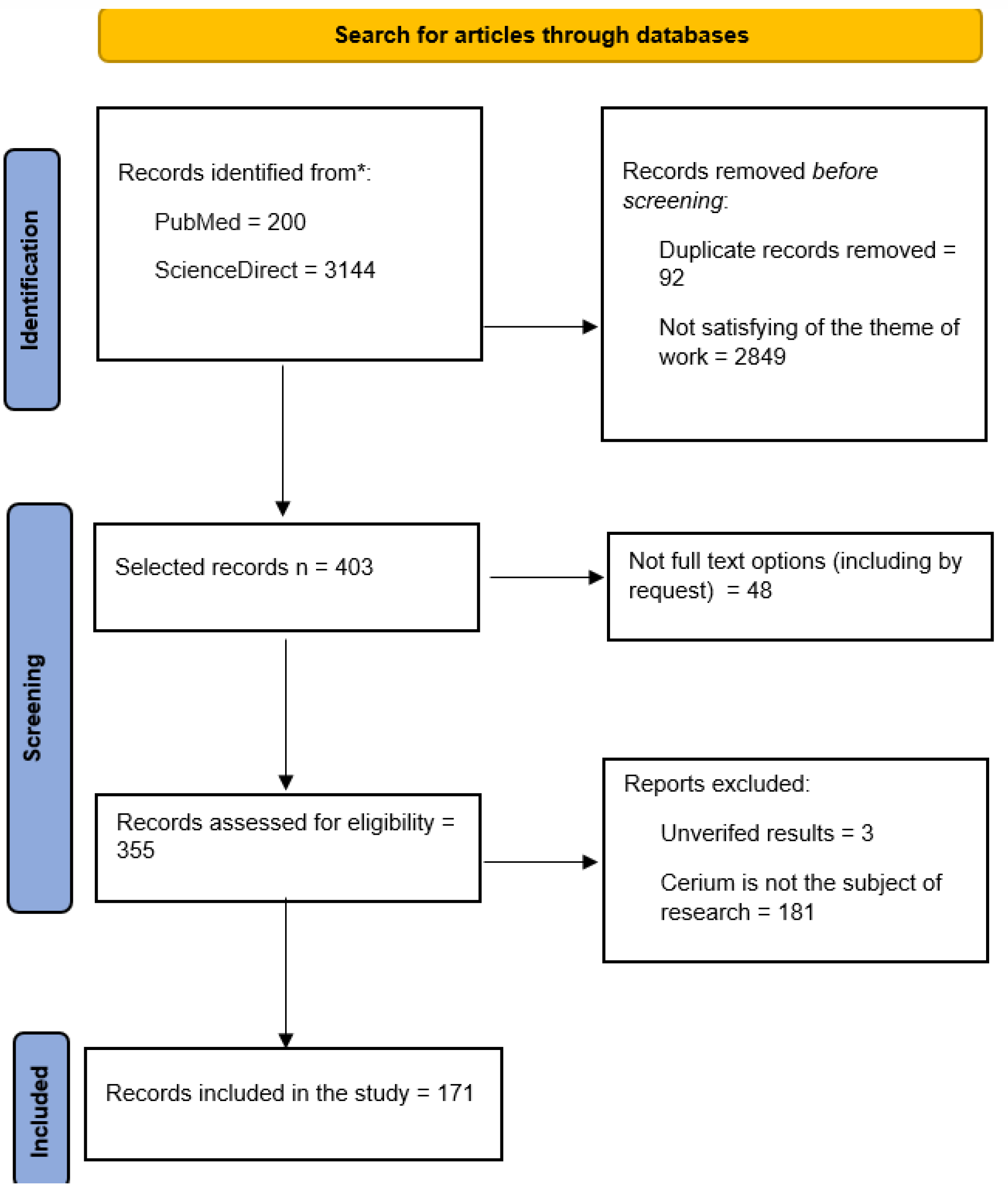

Table 1.
The result of the interaction of excipients and nanoceria.
| Сlass of excipient | Excipient | Adding excipient before/after synthesis CeO2 | Еffects | Methods | Sources |
|---|---|---|---|---|---|
| Biopolymers | Polyacrylate | Not synthesized | Growth inhibition | In vitro Chlamydomonas reinhardtii | [34] |
| Polyacrylate | After synthesis | Antiviral | In vitro. L929, EPT and Vero cells | [35] | |
| Polyvinylpyrrolidone | Before synthesis | Negative impact on the growth and development of larvae | In vitro. Drosophila melanogaster | [37] |
|
| Antioxidant | U937 cell line. in vivo | [36] |
|||
| Dextran | Before synthesis | High aggregative stability | In vitro | [31] | |
| Antimicrobial |
E. coli P. aeruginosa, S. epidermidis E. faecalis |
[31,45,46,47] |
|||
| Regenerative |
Human fibroblasts | [31] |
|||
| Antioxidant | MIN6, NIH3T3, HEK293T, Osteoblasts |
[41,49,51] | |||
| Biocompatibility |
Human fibroblasts HGF-1 | [42] | |||
| Cytotoxicity to tumor cells |
Osteosarcoma cells MG-63 |
[51] |
|||
| Less absorption by cells compared to other stabilizers | BGC-803 |
[55] |
|||
| photosensitivity | HUVEC, CCL-30 | [56] |
|||
| Dextran | After synthesis | High aggregative stability | In vitro | [43] | |
| Antimicrobial | E. coli, S. aureus | [43,44] | |||
| Regenerative | NIH 3T3, In vivo | [44] |
|||
| Antioxidant |
NIH 3T3, In vivo | [44] |
|||
| Slow release | neuroblastoma cells | [53] |
|||
| Cytotoxicity to tumor cells | neuroblastoma cells, HeLa | [53,54] | |||
| Dextran | Not synthesized | Cytotoxicity to tumor cells |
A549, HCT116, Hep3B, Caco-2 и HeLa | [52] | |
| Hyaluronic acid | Before synthesis | Cytotoxicity to tumor cells |
In vivo, MCF-7 | [70] |
|
| Anti-inflammatory | In vivo, ARPE-19, L929, RAW264.7, BV2 | [66] |
|||
| Anti-atherosclerotic | In vivo, MOVAS, RAW 264.7 | [57] | |||
| Hyaluronic acid | After synthesis | Antioxidant |
In vivo, HucMSC, Chondrocytes, Fibroblasts | [57,59,65] | |
| Cytotoxicity to tumor cells |
Fibroblasts, MDA-MB-231, KB, CT-26, MDA-MB-231 | [59,68,71] | |||
| Chitosan | Before synthesis | Biocompatibility | WEHI 164, ARPE-19 | [74,108] | |
| Cytoprotective |
ARPE-19, umbilical cord endothelium |
[108] |
|||
| Antimicrobial |
S. aureus, E. coli |
[85] |
|||
| Antioxidant | In vivo | [115] | |||
| Chitosan | After synthesis | Antioxidant |
In vivo, in vitro | [78,83,90] |
|
| Antimicrobial | S. aureus, E. coli, B. subtilis, MSSA, MRSA | [78,79,81,83,84,86,90] | |||
| Regenerative |
Fibroblasts, In vivo, human mesenchymal stem cells, ex vivo, L929, MC3T3-E1 cell | [73,78,83,84,90,97] |
|||
| Biocompatibility | In vivo, mesenchymal stem cells, MC3T3-E1 | [73,77,84,87,90] | |||
| Collagen | Before synthesis | Stabilization of collagen fibers | Ex vivo | [131] | |
| Collagen | After synthesis | Antioxidant |
in vivo, Ovarian cancer cells | [127,128] | |
| Regenerative |
hDPSC, in vivo | [126,127] | |||
| Anti-inflammatory | in vivo | [127] | |||
| Acceleration of angiogenesis | in vivo | [129] | |||
| Gelatin | Before synthesis | Antioxidant, antihypertrophic |
ex vivo | [136] | |
| Gelatin | After synthesis | Antioxidant | MC3T3-E1, In-ovo, L929, MG-63, HaCaT | [84,133,139,147] |
|
| Anti-inflammatory | in vivo | [155] | |||
| Antimicrobial | S. Aureus. E. Coli | [84,139,147] | |||
| Regenerative | in vivo, HaCaT, RAW264.7, MG-63, MC3T3-E1 | [133,134,139,141,142,144] | |||
| Gelatin | Not synthesized | Antioxidant | SH-SY5Y | [151] | |
| Regenerative | in vivo |
[153] |
|||
| Antimicrobial | P. aeruginosa | [146] |
|||
| Fatty substances | Lecithin | After synthesis | Biocompatibility | ram sperm | [193] |
| Antioxidant |
ram sperm, HaCat | [193,197] | |||
| Phospholipids | Phosphatidylcholine | Before synthesis | Antioxidant | betaTC-tet | [194] |
| Polycarboxylic acids | Mellitic acid | Before synthesis | Stability | In vitro |
[157] |
| Dicarboxylic acids | Malic acid | After synthesis | Stability | In vitro | [165] |
| Monocarboxylic acids | Acetic acid | After synthesis | Antitumor | DMEM, HT-29, NCBI -C466, HFFF2, NCBI -C163 | [164] |
| Polycarboxylic acids | Citrate | Before synthesis | Antioxidant | In vivo |
[170,176,186] |
| Regenerative |
Fibroblasts, human mesenchymal stem cells, human keratinocytes In vivo |
[17,176] |
|||
| Antimicrobial | B. subtilis, B. cereus, S. aureus, P. aeruginosa, E. coli, P. vulgaris, C. albicans, A. brasielensis | [178] | |||
| Stimulation of bacterial growth |
E. coli, B. pyocyaneus, S. aureus, Leuconostoc, Streptococcus faecalis | [179] |
|||
| Lack of pro- or antioxidant | In vivo | [180] | |||
| Prooxidant | In vivo | [187] | |||
| Cytoprotective | L929, VERO | [182] | |||
| Citrate | After synthesis | High cellular uptake | NIH/3T3 | [174] | |
| Toxicity in high doses |
NIH/3T3 | [175] | |||
| Prooxidant | NIH/3T3, In vivo | [175,188] | |||
| Accumulation in the reticuloendothelial system | In vivo |
[167] |
|||
| Regenerative |
Fibroblasts, human mesenchymal stem cells, human keratinocytes | [17] |
|||
| Antioxidant |
In vivo, RAW264.7, Hippocampal ischemia-based model of oxidative stress ex vivo |
[183,184] | |||
| Antioxidant | In vivo | [171] | |||
| Citrate | Not synthesized | Reduced toxicity | Caco-2 | [173] | |
| Pharmacokinetics dependence on the route of administration and dose | In silico | [181] | |||
| High aggregative stability | In vitro | [34] | |||
| Amino acids | Glutamic acid | After synthesis | Antioxidant | HT22 | [161] |
| Amino acid derivatives | N-acetylcysteine | Not synthesized | Antioxidant | SMMC-7721 | [162] |
Disclaimer/Publisher’s Note: The statements, opinions and data contained in all publications are solely those of the individual author(s) and contributor(s) and not of MDPI and/or the editor(s). MDPI and/or the editor(s) disclaim responsibility for any injury to people or property resulting from any ideas, methods, instructions or products referred to in the content. |
© 2024 by the authors. Licensee MDPI, Basel, Switzerland. This article is an open access article distributed under the terms and conditions of the Creative Commons Attribution (CC BY) license (http://creativecommons.org/licenses/by/4.0/).
Copyright: This open access article is published under a Creative Commons CC BY 4.0 license, which permit the free download, distribution, and reuse, provided that the author and preprint are cited in any reuse.


