

Submitted:
18 November 2024
Posted:
19 November 2024
You are already at the latest version
Abstract
Artificial intelligence is moving at rapid speeds, which clearly affects user interaction with digital marketing applications. A huge stake for ML is to personalize content, optimize usability and target with precision. Plus it has reshaped the way businesses communicate with their audience. This paper delves into the dual applications of ML in digital marketing, while focusing mainly on how these technologies are influencing this key human-computer interface (HCI). Through a detailed analysis of ML technologies, and in particular by exploring their effectiveness and the ethical dimensions of their development, we are given the opportunity to gain a clear understanding of the potential of ML that is transforming digital commerce. Furthermore, this paper delves into the challenges as well as future trends in the HCI interface in the context of digital marketing using AI, while offering valuable insights regarding this evolving landscape and the challenges presented in it. Of particular interest is the way in which these advanced technologies have radically transformed the digital marketing landscape. The case studies presented highlight their impact on both user experience and customer retention, while also highlighting ethical issues such as data privacy and algorithmic transparency.
Keywords:
Machine learning
; human-computer interaction
; digital marketing
; personalization
; user experience
; ethics
; artificial intelligence
; challenges
; trends
1. Introduction
In today's highly competitive digital environment, marketing strategies are adopting many new technologies with artificial intelligence (AI) leading the way. With the help of IT, the field of digital marketing has seen an unprecedented boom and a plethora of tools are freely offered, making it easier for companies in the field to create and publish valuable campaigns that resonate with individual users [1,2]. On the other hand, Machine Learning (ML) technologies, such as speech synthesis, translation and natural language processing (NLP), play a particularly important role in understanding the needs of real users, but also in satisfying these needs in real time, thereby improving personalization and user experience across all digital platforms [3].
With the help of ML, digital marketing has been able to bypass traditional methods, adopt highly personalized data-driven strategies and deliver unique campaigns. The key in the hands of companies is to leverage algorithms with real-time learning and decision-making capabilities that have the ability to predict customer preferences, provide an optimal content delivery and deliver hyper-ex [4]. It is worth noting that, virtual assistants have the ability to provide personalized support with exceptional accuracy and efficiency in predicting market patterns, effectively reshaping the marketing space into a dynamic and productive landscape [5,6].
In this paper, we explore in depth the various applications of ML in the digital marketing space, examine the ethical concerns associated with how these AI-based technologies are implemented, and evaluate the impact of the applications on the user experience. As such, we will examine future directions and emerging trends for AI in digital marketing and provide insights into how companies can adopt a truly serious and responsible attitude towards customers and how they can leverage these technologies to gain user trust and appreciation [7].
Finally, this paper begins by exploring the applications of IT in human resources, with a particular focus on its role in digital marketing, ethical considerations and the challenges of applying these types of technologies in digital marketing.
2. The Current State of Digital Marketing
Business marketing strategies in the digital age tend to rely more and more on cutting-edge technologies, such as artificial intelligence (AI) and machine learning (ML), with the main goal of achieving meaningful user engagement [9]. The integration of AI into digital marketing is an innovation that has significantly diversified the industry, allowing companies to create highly personalized and optimized campaigns that are responsive to individual users [1,2]. This paper focuses on the key role that AI applications play in digital marketing, as well as the ethical challenges associated with their implementation. Despite the benefits of these technologies, many questions arise regarding data protection and transparency of the algorithms used in these applications.
Below is a table of the technologies used in digital marketing, as well as the role they play and the tools they have in their quiver:

Table 1.
Technologies in Digital Marketing.
| Papers | Technologies | Role | Tools |
|---|---|---|---|
| [8,9,10,11] | Machine Learning (ML) | Enhances personalized content, optimizes usability, targets marketing | Chatbots, Content Recommendation Engines, Targeted Advertising |
| [12,13,14] | Natural Language Processing (NLP) |
Improves customer interaction, provides personalized answers in chatbots | Chatbots, Virtual Assistants, Voice Search Optimization |
| [15,16,17] | Predictive Analytics | Analyzes historical data to Predict consumer behavior and trends |
Recommendation Systems, Churn Prediction Models |
| [18,19,20] | Sentiment Analysis | Detects emotional cues to tailor communication for better satisfaction |
NLP systems, Sentiment Analysis Engines |
| [21,22,23,24] | Programmatic Advertising | Automates ad targeting and budget allocation, detects ad fraud | Real-Time Bid Optimization, Fraud Detection Systems |
| [25,26,27,28] | Explainable AI (XAI) | Provides transparency in AI decision-making processes |
Explainability Algorithms, Auditing Tools |
| [29,30,31] | Deep Learning | Models complex user-object interactions for accurate content recommendations |
Recommendation Engines, Context-Aware Recommenders |
| [32,33,34,35] | Neuromarketing (EEG, fMRI, Eye-Tracking) | Analyzes brain and Physiological responses to optimize product design |
EEG, fMRI, Eye- tracking Technologies |
| [36,37,38,39,40] | Generative AI | Automates content creation, generates personalized content at scale |
Generative Models, Text and Image Generators |
|
[41,42,43,44] |
Federated Learning | Enables decentralized model training, preserving user data privacy |
Federated AI Systems, Decentralized ML Models |
| [45,46,47,48,49,50,51] | Computer Vision | Analyzes images and videos to enhance visual marketing content | Visual Recognition Systems, AR/VR for Ads, Image Classification Models |
|
[52,53,54] |
Reinforcement Learning | Optimizes marketing strategies by learning from trial and error | Reinforcement Learning Agents, Ad Placement Optimization Engines |
|
[55,56,57,58] |
Blockchain for Digital Marketing | Secures transactions and improves transparency in digital ad bidding |
Blockchain-Ledger Systems, Smart Contracts for Digital Ads |
3. Methodology
The research method followed in this work is the qualitative descriptive approach. The data used are qualitative and divided into primary and secondary categories. The data sources were drawn through a literature review from available sources both online and offline, such as scientific journals, books, and reliable news. The collection of these sources was carried out in a way that allowed the information to be linked together. Data collection techniques included observation, interviews, and surveys. Data were thoroughly analyzed to conclude.
For the writing of the article, a systematic bibliographic review was carried out, to search for information on digital marketing. The search was carried out in five databases: ResearchGate, IEEE Xplore, Elsevier, Springer, and Google Scholar, using the terms: "Machine Learning (ML) in Digital Marketing", "Natural Language Processing (NLP) technologies in Digital Marketing", "AI marketing' and “Chatbots and Digital Marketing”. Additionally, a Google search was conducted to find books, publications, and organization websites using the same terms.
4. Machine Learning Technologies in Digital Marketing
As part of the digital marketing effort to empower companies with diverse and multifaceted applications, ML offers a rich range of applications such as the integration of natural language processing (NPL) in chatbots, and has managed to transform the way businesses interact with their customers worldwide. The core of ML is also increasingly used in content recommendation engines and targeted advertising [4].
On the other hand, the use of these applications has made it clear that chatbots can provide immediate and personalized answers to user questions, while at the same time collecting data, they allow for the analysis and prediction of user behavior [8]. It is worth adding that sentiment analysis through NPL technology is able to allow companies to better understand the emotional state of users and, therefore, it can help them significantly to adapt the way they communicate with customers [18,19].
In this way, both customer satisfaction and retention are increased, as well as companies provide more personalised solutions that meet individual customer needs [7].
In addition, data generated from customer interactions related to the user's profile and history feed the NPL systems of chatbots, giving the algorithms the advantage of "learning" and becoming more accurate over time. However, both privacy and data transparency remain key considerations when processing user data, and data security regulations such as GDPR require companies to implement particularly secure methods and procedures to analyze and manage data [8].
Customer trust is enhanced as they feel more secure about their data ,thus strengthening the long-term healthy relationship between companies and their customers. Moreover, chatbots can become even more human and more effective in their interactions with customers by securing this data [20].
Chatbots and virtual assistants: Designed with the help of artificial intelligence, they provide immediate and highly personalized responses that enhance customer trust and loyalty while improving user experience and satisfaction [59].
They use Natural Language Processing (NLP) to understand and respond to user queries naturally and conversationally [5]. They collect valuable information about users, simulate human interactions, and use this information to tailor consumer preferences [13]. For example, Sephora’s chatbot achieved a 30% increase in user engagement, while the personalized product recommendations offered by the chatbot improved customer retention. Chatbots are increasingly integrated into several social media platforms and messaging services, creating a unique experience for a business’s customers [11].
Advanced Natural Language Processing (NLP): is constantly evolving, enabling chatbots and virtual assistants to better understand user intent even when asked complex and ambiguous questions. They provide more accurate and personalized answers, while also detecting emotional cues from users through sentiment analysis, helping businesses tailor their responses and improve customer satisfaction [61].
Emotional intelligence integration: allows some chatbots equipped with sentiment analysis capabilities to adjust both their tone and responses for a more empathetic interaction [62].
Omnichannel presence: allows some chatbots to create a seamless and consistent customer experience by integrating with social media platforms and messaging services [31].
Predictive analytics: ML algorithms are excellent at analyzing vast amounts of historical data to predict consumer behavior, allowing businesses to anticipate trends and adjust their strategies [58]. Businesses can then create more effective and targeted marketing campaigns that resonate with their customers [23]. User engagement and listening hours increase by 40% based on Spotify’s analytics-based predictive recommendation system [15]. Amazon also leverages analytics to provide more personalized recommendations to improve customer satisfaction and increase sales [64]. In addition, machine learning enables personalized marketing campaigns that tailor content and recommendations to individual user preferences [22]. In the notable case of Starbucks, the recommendation engine significantly increased customer satisfaction and sales through personalized offers and also improved customer loyalty and engagement [58]. Hyper-personalization: tailoring content, recommendations, and offers by enabling hyper-personalized marketing campaigns [4]. This results in higher engagement and conversion rates. Research shows that predictive models effectively improve customer retention by up to 50% by developing targeted strategies [4].
Customer journey prediction: ML models can now predict customer journeys with incredible accuracy, allowing marketers to intervene at critical touchpoints and guide customers towards conversion [65].
Anticipating churn: Predictive models allow companies to proactively retain customers at risk of churn through targeted interventions [17].
Content recommendation engines: AI systems offer personalized content recommendations by analyzing user data related to browsing history, purchasing behavior, and preferences, thereby significantly increasing customer engagement and retention [16]. Furthermore, these systems understand individual user preferences and can recommend products and services related to users’ individual preferences [12]. On the other hand, excessive personalization can lead to “echo chambers” by limiting exposure to diverse content [66]. For example, Netflix’s recommendation system based on machine learning algorithms accounts for 80% of a user’s content viewing time [3]. Deep learning-based recommendations: Deep learning techniques are increasingly being used to model complex user-object interactions, successfully leading to more accurate and relevant content recommendations [29,30,67].
Context-based recommendations: Recommendation engines can now incorporate contextual factors such as time, location, and device type to further refine their recommendations and also improve the user experience [68].
Randomness and diversity: To avoid filter bubbles and promote exploration, recommender systems balance personalization with randomization and diversity in content suggestions [66].
Natural Language Processing (NLP): NLP is vital for sentiment analysis and understanding customer feedback, allowing businesses to gain much deeper insights into customer perceptions and opinions [69].
This allows for more nuanced and meaningful interactions, fostering stronger and deeper relationships with customers [21].
Advanced sentiment analysis: enabling businesses to gain deeper, more focused insights into customer views and sentiment [70].
Voice search optimization: with the rise of voice search, NLP techniques such as natural language understanding and natural language generation are being utilized very effectively to optimize content for voice queries as well as improve visibility in voice search results [71].
Social media listening: ML algorithms enable companies to track customer sentiment by analyzing and monitoring social media conversations while identifying influencers and proactively responding to customer concerns and issues [72].
Programmatic advertising: Artificial intelligence has the ability to automate ad targeting and budget allocation in real time, optimizing both efficiency and effectiveness in reaching the desired audience [73]. Programmatic advertising now uses ML algorithms to analyze user data and deliver ads to the most relevant users at the right time and place, while maximizing the impact of advertising campaigns [24]. This technology combats ad fraud by identifying anomalies that may exist in traffic patterns, thereby reducing ad waste [23].Real-time bid optimization: ML algorithms become “smarter” by learning from the data they collect and continuously adapt to optimize bidding strategies in real time, thereby achieving effective ad placements [75,80].
Targeting across devices: ML enables better targeting across devices, allowing marketers to deliver completely consistent messages and experiences to users across multiple devices [76]. Ad fraud detection: Machine learning algorithms are used to combat advertising fraud, they are even able to detect patterns and anomalies in advertising traffic data, protecting advertisers from wasted advertising [23].
Computer Vision is revolutionizing digital marketing by enabling the analysis and understanding of images in unprecedented ways [45,46]. Two key applications are product recognition and visual search [14,50,51].
Product recognition has the ability to automatically identify and categorize products in images, facilitating data analysis and process automation. A typical example is Google Lens, which uses deep learning algorithms to recognize objects in images and provide relevant information [77]. This technology can be used to analyze customer photos, identify trendy products, and provide personalized recommendations [47,48,49].
Visual search, on the other hand, allows users to search for products using images instead of text. This technology relies on image similarity algorithms and deep learning models to find visually similar products [78]. Platforms such as Pinterest and Google Image Search have built-in visual search, significantly improving the user experience and facilitating product discovery. This allows marketers to reach customers who may not know the exact name or keywords for a product but have a visual representation [31].
The diagram below reflects how Artificial Intelligence (AI) and Machine Learning (ML) are having a significant impact on ad scheduling, showing specific examples and benefits while providing a visual representation of the positive impact of AI and ML on ad scheduling [52,53].
Figure 1.
Enhanced NLP Integration in Chatbots and Customer Relations.
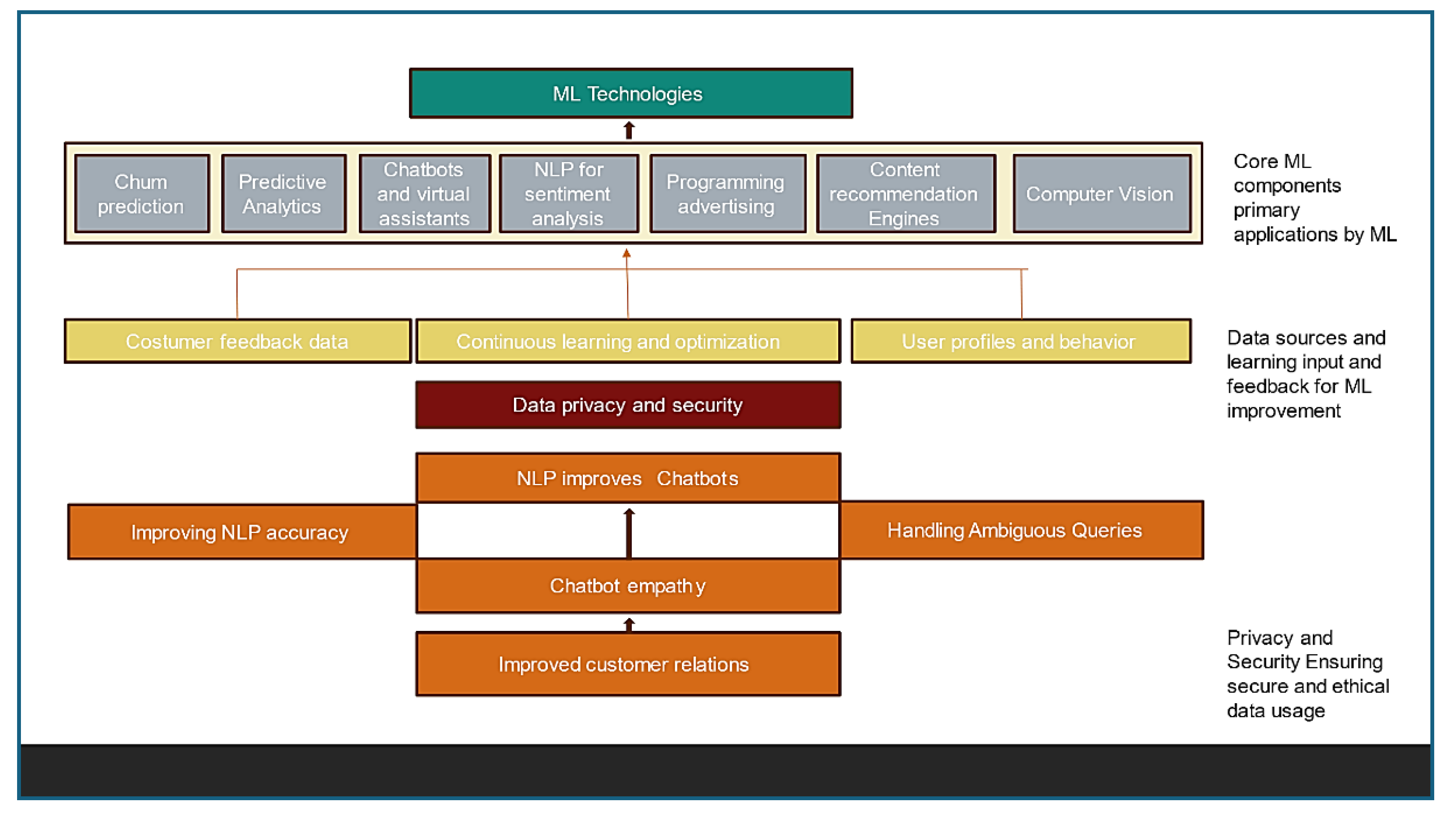
The diagram shows how chatbots have the potential to incorporate machine learning (ML) and natural language processing (NLP), and also highlights how these technologies are positioned to improve customer-business connections. It also shows how several machine learning applications, such as sentiment analysis and content recommendation engines, work together to improve chatbot performance [54]. These software programs are fed with user behavior profiles and customer feedback data, giving them the opportunity to continuously learn and optimize, which is certainly one of their positives. This information significantly helps chatbots answer ambiguous questions, improve accuracy, and tailor responses based on user sentiment. The chart also highlights the paramount importance of data security and privacy, while ensuring that all interactions comply with laws such as GDPR. Chatbots also improve and promote empathy in conversations, which leads to more personalized and stronger customer relationships.
5. The Intersection of AI, ML, and Neuromarketing
The fusion of AI and ML with neuromarketing techniques such as EEG, fMRI, and eye tracking are revolutionary innovations in deciphering and understanding consumer behavior. These techniques allow researchers to study in depth the reactions of consumers’ brains to various stimuli, including advertisements, products, and shopping experiences [79]. By analyzing neurological and physiological responses, AI and ML algorithms have been able to decode consumers’ emotions, preferences, and decision-making processes with unprecedented accuracy [32,33]. The use of AI and ML in brainwave analysis through EEG technologies also allows advertisers to understand users’ emotional reactions in real time. This is an advantage for marketers to design targeted and personalized campaigns, improving both product design and the overall customer experience.
On the other hand, this powerful combination raises ethical concerns. MRI measures blood flow in the brain, which is associated with neural activity. In neuromarketing, MRI is primarily used to identify areas of the brain that are activated when exposed to advertisements or products [81]. This technique allows researchers to identify the specific areas of the brain responsible for processing different types of information, such as visual cues, emotional responses, and decision-making. For example, fMRI can be used to study how consumers react to different product packaging designs. Eye tracking also records consumers’ eye movements, providing information about where and for how long they focus their attention. In neuromarketing, eye tracking is used to study consumers’ visual attention in both advertisements and product packaging and websites [82].
Marketers can optimize their designs to capture users’ attention by understanding where consumers look and for how long. This allows them to optimally design their websites and position their products accordingly. Tracking consumers’ eye movements provides information about where and for how long they focus their attention. In the field of neuromarketing, eye tracking is used to study consumers’ visual attention in both advertisements and product packaging and websites [82]. One problem is the gathering and evaluation of touchy neurological records, concerning records privateness and the capacity for patron manipulation, in addition to the capacity for AI and ML to take advantage of consumers` unconscious biases [83]. Marketers ought to make sure transparency withinside the use of neuromarketing strategies and keep away from manipulating or deceiving consumers. It ought to be ensured that the technology are used responsibly through adopting moral rules [34,35].
Machine studying (ML) has fashioned a brand new panorama in virtual advertising, supplying superior personalization, consumer engagement, and predictive analytics capabilities. However, it additionally increases moral troubles that want to be addressed to make sure accountable records use, records confidentiality, and person consent [55,56].
ML structures rely upon great quantities of private records, which increases issues approximately privateness and records security. Regulations along with the General Data Protection Regulation (GDPR) require organizations to make sure transparency, achieve knowledgeable consent, and protect person records. Companies that fail to conform face enormous consequences and reputational damage [6]. This calls for a shift in the direction of privateness-keeping system studying strategies along with federated studying and differential privateness [41,44].
An pressing want in virtual advertising is to make sure that records accumulated for centered marketing and marketing complies with those standards, making sure that customers are privy to how their records is getting used even as preserving manage over their preferences [83]. When customers are knowledgeable in element approximately advert personalization, with alternatives to decide out of precise classes or records points, then transparency and believe may be considerably improved [30,42].
Algorithmic bias and equity: Machine studying fashions have the capacity to in-advertently perpetuate biases gift withinside the schooling records, even main to discrimina-tory advertising outcomes [10]. Biased algorithms also are in all likelihood to unfairly goal or exclude precise groups, undermining person believe. Developing bias detection gear and accomplishing everyday audits can assist mitigate this issue [84]. Exploring equity-conscious system studying algorithms and incorporating numerous datasets in the course of schooling can similarly sell honest outcomes [85].
Adopting an advert concentrated on device can inadvertently sell activity or economic ser-vices commercials more often than not to sure demographic groups, thereby reinforcing social biases [86]. To cope with this problem, equity constraints may be applied withinside the algorithm, thereby making sure that possibilities are provided to a large audience.
Transparency and explanatory power: In ML structures utilized in advertising, the decision-making technique can every so often seem opaque. Explainable synthetic intelligence (XAI) lets in entrepreneurs and customers to recognize how ML fashions attain precise conclusions, thereby making sure transparency among entrepreneurs and customers, that is crucial [87].
In programmatic marketing and marketing, explainable algorithms can offer precise information approximately why precise customers had been centered, making sure that choices are obvious and justified [3]. This lets in entrepreneurs to optimize their campaigns and allows customers to recognize and probably undertaking concentrated on choices.
Ethical personalization: While customized advertising improves the person experi-ence, immoderate personalization can result in privateness breaches or the advent of “echo chambers” that restriction publicity to numerous content. The breadth stability among personalized advertising and person privateness is essential [88]. This calls for a person-centric approach, prioritizing customers` wellness and autonomy.
Companies should ensure that personalized offers or recommendations are not overly intrusive, respecting users’ autonomy and choice [88]. Providing users with options to differentiate recommendations or control the level of personalization can help achieve this balance. By proactively addressing these ethical concerns, companies can harness the power of ML in marketing while maintaining user trust and promoting fairness and transparency.
6. Challenges and Future Trends
Integrating ML into virtual advertising provides many challenges, which include the want for high-quality, numerous data, the complexity of ML algorithms, and the ability for over-personalization, that can result in consumer pain or distrust [57,58]. Neverthe-less, the destiny of ML in virtual advertising is bright, with advances in predictive AI, conversational AI, and using ML for social excellent anticipated to form the enterprise panorama withinside the coming years [89].
Future traits factor towards the improvement of explainable AI, which pursuits to make AI selections greater obvious to stop users, in addition to the growing use of AI for social excellent [90]. Explainable Artificial Intelligence (XAI) can play a key function as an intermediary among purchasers and algorithms, bringing them nearer together, making sensible AI-primarily based totally selections greater comprehensible to purchasers. In this way, AI can decorate each patron believe and transparency withinside the decision-making process, at the same time as supporting to lessen the moral problems that arise [15].
6.1. The Impact of AI and ML on Marketing Jobs and Skills
The advertising activity marketplace is being converted via way of means of the usage of synthetic intelligence and the invasion of gadget learning, main to the emergence of latest roles that re-quire new talents. New jobs, consisting of AI entrepreneurs, information scientists, and AI content material strategists, are getting an increasing number of applicable and in excessive demand [91]. In addition, marketers will want to broaden talents in information evaluation, AI device management, and innovative approach to thrive on this hastily converting landscape [90].
6.2. The Role of AI and ML in Social Media Marketing
AI and ML are essential to social media advertising, improving concentrated on, content material advent, and influencer advertising. AI algorithms generate customized content material recommendations, and NLP-powered sentiment evaluation permits entrepreneurs to gauge consumer reactions in real-time [74]. However, worries approximately the authenticity of influencer advertising campaigns and algorithmic biases continue to be key demanding situations [43].
Social media structures have converted right into a hub for AI and ML-primarily based totally marketing. These equipment permit entrepreneurs to each optimize content material advent and enhance concentrated on and execute influencer advertising campaigns. However, algorithmic biases and the authenticity of influencer partnerships pose demanding situations that would undermine agree with consumers [72]
6.3. The Future of AI and ML in Digital Marketing
Digital marketing is poised for transformation through emerging AI and ML technologies such as generative AI, explainable AI, and the metaverse discusses how AI-powered magnetic marketing within the context of the shift could significantly reshape customer interactions by delivering more personalized, real-time experiences [36,37].
Generative AI is remodeling content material introduction, even as explainable AI addresses worries approximately transparency in AI-pushed decisions [25,26]. The metaverse provides new possibilities for immersive advertising experiences [27,28]. However, entrepreneurs will want to make sure facts privacy [38,39], keep away from algorithmic bias, and preserve human oversight of their marketing and marketing campaigns [60].
Finally, Creative AI has the ability to automate complicated content material introduction processes, substantially decreasing charges even as enhancing output [40]. However, transparency in AI decision-making and the accountable use of purchaser facts continue to be vital to making sure the trustworthiness of those technology and their use in virtual advertising [63]
8. Conclusion
The convergence of virtual advertising and marketing, AI, and Machine Learning gives enormous possibilities for enhancing consumer experiences, however on the alternative hand, it increases many moral demanding situations that want to be studied and analyzed. AI and ML provide unparalleled equipment for customization and efficiency, however they have to be used responsibly to make certain purchaser safety and trust. The destiny of virtual advertising and marketing lies in leveraging AI and ML at the same time as retaining stability among generation and human creativity. of digital marketing, AI, and Machine Learning presents enormous opportunities for improving user experiences, but on the other hand, it raises many ethical challenges that need to be studied and analyzed. AI and ML offer unparalleled tools for personalization and efficiency, but they must be used responsibly to ensure consumer protection and trust. The future of digital marketing lies in leveraging AI and ML while maintaining a balance between technology and human creativity.
Author Contributions
Conceptualization, A.K., M.M., and K.C.S.; methodology, A.K.; software, A.K.; validation, A.K., M.M., and K.C.S.; formal analysis, A.K.; investigation, A.K.; resources, A.K., M.M., and K.C.S.; data curation, A.K.; writing—original draft preparation, A.K.; writing—review and editing, A.K.; visualization, A.K.; supervision, A.K.; project administration, A.K.; funding acquisition, M.M. All authors have read and agreed to the published version of the manuscrip.
Funding
This research received no external funding.
Conflicts of Interest
The authors declare no conflicts of interest.
References
- Hirvonen, N., Jylhä, V., Lao, Y., & Larsson, S. Artificial intelligence in the information ecosystem: Affordances for everyday information seeking. Journal of the Association for Information Science and Technology. 2023. https://asistdl.onlinelibrary.wiley.com/doi/pdfdirect/10.1002/asi.24860.
- Masnita, Y., Ali, J. K., Zahra, A., Wilson, N., & Murwonugroho, W. Artificial intelligence in marketing: Literature review and future research agenda. Journal of System and Management Sciences, 2024, 14(1), 120-140. https://www.researchgate.net/profile/Jati-Kasuma/publication/377177409_Artificial_Intelligence_in_Marketing_Literature_Review_and_Future_Research_Agenda/links/659801b02468df72d3fd120e/Artificial-Intelligence-in-Marketing-Literature-Review-and-Future-Research-Agenda.pdf.
- Alkhayyat, A., & Ahmed, A. M.. The impact of artificial intelligence on digital marketing. Diva. 2022. https://www.diva-portal.org/smash/record.jsf?pid=diva2%3A1663148&dswid=2424.
- Bulling, Andreas, et al. ETRA'21 Adjunct: ACM Symposium on Eye Tracking Research and Applications. In: Symposium on Eye Tracking Research and Applications (ETRA 2021). Association for Computing Machinery, 2021. [CrossRef]
- Haleem, A., Javaid, M., Qadri, M. A., Singh, R. P., & Suman, R. Artificial intelligence (AI) applications for marketing: A literature-based study. International Journal of Intelligent Networks, 3, 119-132. 2022. https://www.sciencedirect.com/science/article/pii/S2666603022000136.
- Floridi, L., et al. AI4People—an ethical framework for a good AI society: opportunities, risks, principles, and recommendations. Minds and Machines. 2018, 28(4), 689-707. https://link.springer.com/content/pdf/10.1007/s11023-018-9482-5.pdf.
- Vafeiadis, T., Diamantaras, K. I., Sarigiannidis, G., & Chatzisavvas, K. C. A comparison of machine learning techniques for customer churn prediction. Simulation Modelling Practice and Theory, 55, 1-9. 2015. https://www.academia.edu/download/55431256/A_comparison_of_machine_learning_techniques_for_customer_churn_prediction.pdf.
- Brei, V. A. Machine learning in marketing: The ultimate guide. Towards Data Science. 2020. https://www.nowpublishers.com/article/DownloadSummary/MKT-065.
- Thirumagal, P. G., Bhattacharjee, K., Dorbala, R., Palav, M. R., Viji, S., & Mahajan, V. Application of Machine Learning Algorithms in Personalized Marketing. In 2024 5th International Conference on Recent Trends in Computer Science and Technology (ICRTCST), 2024, 165-170. IEEE. https://www.researchgate.net/profile/Rajesh-Dorbala/publication/382011085_Application_of_Machine_Learning_Algorithms_in_Personalized_Marketing/links/669788e4cb7fbf12a457808c/Application-of-Machine-Learning-Algorithms-in-Personalized-Marketing.pdf.
- Potla, R. T. Enhancing Customer Relationship Management (CRM) through AI-Powered Chatbots and Machine Learning. Distributed Learning and Broad Applications in Scientific Research, 2023, 9, 364-383. https://dlabi.org/index.php/journal/article/download/85/83.
- Khanal, S. S., Prasad, P. W. C., Alsadoon, A., & Maag, A. A systematic review: machine learning based recommendation systems for e-learning. Education and Information Technologies, 2020, 25(4), 2635-2664. https://researchoutput.csu.edu.au/ws/portalfiles/portal/56945122/37059927_Published_article.pdf.
- Ekasari, S., Judijanto, L., & Vandika, A. Y. THE ROLE OF ARTIFICIAL INTELLIGENCE AND MACHINE LEARNING IN PRECISION TARGETING: REVOLUTIONIZING MARKETING STRATEGIES. Jurnal Ekonomi dan Bisnis, 2024, 2(3), 347-361. https://j-economics.my.id/index.php/home/article/download/130/161.
- Abiagom, C. N., & Ijomah, T. I. Enhancing customer experience through AI-driven language processing in service interactions. Open Access Research Journal of Engineering and Technology, 2024. https://www.researchgate.net/profile/Tochukwu-Ijomah-2/publication/383847613_Enhancing_customer_experience_through_AI-driven_language_processing_in_service_interactions/links/66dc43e12390e50b2c7212d0/Enhancing-customer-experience-through-AI-driven-language-processing-in-service-interactions.pdf.
- Xu, A., Liu, Z., Guo, Y., Sinha, V., & Akkiraju, R. A new chatbot for customer service on social media. Proceedings of the 2017 CHI Conference on Human Factors in Computing Systems, 2017, 3506–3510. [CrossRef]
- Croft, W. B., Metzler, D., & Strohman, T. Search Engines: Information retrieval in practice (2nd ed.). Addison-Wesley. 2010. https://www.academia.edu/download/30740463/z2009_2465.pdf.
- Waller, M. A., & Fawcett, S. E. Click here for a data scientist: Big data, predictive analytics, and theory development in the era of a maker movement supply chain. Journal of Business Logistics, 2013. 34(4), 249-252. https://onlinelibrary.wiley.com/doi/pdf/10.1111/jbl.12024.
- Aggarwal, C. C. Recommender Systems. Springer. 2016. https://www.academia.edu/download/63186644/2016_Book_RecommenderSystems20200503-102501-wsddcn.pdf.
- Ullah, I., Raza, B., Malik, A. K., Imran, M., Islam, S. U., & Kim, S. W. A churn prediction model using random forest: analysis of machine learning techniques for churn prediction and factor identification in telecom sector, 2019, IEEE access, 7, 60134-60149. https://ieeexplore.ieee.org/iel7/6287639/8600701/08706988.pdf.
- Ma, E., Cheng, M., & Hsiao, A. Sentiment analysis–a review and agenda for future research in hospitality contexts. International Journal of Contemporary Hospitality Management, 2018, 30(11), 3287-3308. https://www.emerald.com/insight/content/doi/10.1108/IJCHM-10-2017-0704/full/html.
- Pandey, K. K., Thorat, M., Joshi, A., Srinivas, D., Hussein, A., & Alazzam, M. B. Natural Language Processing for Sentiment Analysis in Social Media Marketing. In 2023 3rd International Conference on Advance Computing and Innovative Technologies in Engineering (ICACITE), 2023, May, pp. 326-330. IEEE. https://ieeexplore.ieee.org/abstract/document/10182590/.
- Rane, N. L., Desai, P., Rane, J., & Mallick, S. K. Using artificial intelligence, machine learning, and deep learning for sentiment analysis in customer relationship management to improve customer experience, loyalty, and satisfaction. Trustworthy Artificial Intelligence in Industry and Society, 2024, 233-261. https://www.researchgate.net/profile/Nitin-Rane-2/publication/385144825_Using_artificial_intelligence_machine_learning_and_deep_learning_for_sentiment_analysis_in_customer_relationship_management_to_improve_customer_experience_loyalty_and_satisfaction/links/6718965068ac304149aba1a8/Using-artificial-intelligence-machine-learning-and-deep-learning-for-sentiment-analysis-in-customer-relationship-management-to-improve-customer-experience-loyalty-and-satisfaction.pdf.
- Lambrecht, A., & Tucker, C. Can Big Data Protect a Firm from Competition? Strategic Management Journal. 2019, 40(8), 1378-1400. [CrossRef]
- Yuan, Y., Wang, F., Li, J., & Qin, R. A survey on real time bidding advertising. In Proceedings of 2014 IEEE International Conference on Service Operations and Logistics, and Informatics, 2014, October, (pp. 418-423). IEEE. https://www.researchgate.net/profile/Yong-Yuan-6/publication/288385861_A_survey_on_real_time_bidding_advertising/links/5857826308ae8f6955591df4/A-survey-on-real-time-bidding-advertising.pdf.
- Sadeghpour, S., & Vlajic, N. Ads and Fraud: a comprehensive survey of fraud in online advertising. Journal of Cybersecurity and Privacy, 2021, 1(4), 804-832. https://www.mdpi.com/2624-800X/1/4/39/pdf.
- Oentaryo, R., Lim, E. P., Finegold, M., Lo, D., Zhu, F., Phua, C., ... & Berrar, D. Detecting click fraud in online advertising: a data mining approach. The Journal of Machine Learning Research, 2014, 15(1), 99-140. https://www.jmlr.org/papers/volume15/oentaryo14a/oentaryo14a.pdf.
- Chen, L., Zhang, Z., Liu, Q., Yang, L., Meng, Y., & Wang, P. A method for online transaction fraud detection based on individual behavior. In Proceedings of the ACM Turing Celebration Conference-China, 2019, May, pp. 1-8). https://drive.google.com/file/d/1x29Ui9bMUM244wCw8udVVWs3hrfLucPB/view.
- Gilpin, L. H., Bau, D., Yuan, B. Z., Bajwa, A., Specter, M., & Kagal, L. Explaining explanations: An overview of interpretability of machine learning. In Proceedings of the 2018 IEEE 5th International Conference on Data Science and Advanced Analytics (DSAA) (pp. 80-89). IEEE. 2018. https://arxiv.org/pdf/1806.00069.
- Samek, W., Wiegand, T., & Müller, K. R. Explainable artificial intelligence: Understanding, visualizing, and interpreting deep learning models, arXiv:1708.08296, 2017. https://arxiv.org/abs/1708.08296.
- Binns, R., Veale, M., Van Kleek, M., & Shadbolt, N. 'It's reducing a human being to a percentage': Perceptions of justice in algorithmic decisions. In Proceedings of the 2018 CHI Conference on Human Factors in Computing Systems (pp. 1-14). ACM. 2018. https://arxiv.org/pdf/1801.10408.
- Yang, Q., Liu, Y., Chen, T., & Tong, Y. Federated machine learning: Concept and applications. ACM Transactions on Intelligent Systems and Technology (TIST). 2019, 10(2), 1-19. https://arxiv.org/pdf/1902.04885.
- Kumar, V., Rajan, B., Venkatesan, R., & Lecinski, J. Understanding the role of artificial intelligence in personalized engagement marketing. California Management Review. 2019, 61(4), 135-155. https://www.academia.edu/download/86990072/000812561985931720220604-1-poaljx.pdf.
- Li, T., Sahu, A. K., Talwalkar, A., & Smith, V. Federated learning: Challenges, methods, and future directions. IEEE Signal Processing Magazine. 2020, 37(3), 50-60. https://arxiv.org/pdf/1908.07873.
- Venkatraman, V., Clithero, J. A., Fitzsimons, G. J., & Huettel, S. A. New scanner data for brand marketers: How neuroscience can help better understand differences in brand preferences. Journal of Consumer Psychology. 2012, 22(1), 143-153. https://www.academia.edu/download/43033754/neuroscience_brands_jcp_2012.pdf.
- Plassmann, H., Ramsøy, T. Z., & Milosavljevic, M. Branding the brain: A critical review and outlook. Journal of Consumer Psychology. 2012, 22(1), 18-36. https://www.insead.edu/sites/insead/files/assets/faculty-personal-site/hilke-plassmann/documents/16_Plassmann_etal_JCP_2012.pdf.
- Wedel, M., & Pieters, R. A review of eye-tracking research in marketing. Review of Marketing Research. 2017, 4(1), 123-147. https://citeseerx.ist.psu.edu/document?repid=rep1&type=pdf&doi=9a52501bf7a3737f44836f63f3b219f24c8ecc02#page=144.
- Harris, J. M., Ciorciari, J., & Gountas, J. Consumer neuroscience for marketing researchers. Journal of consumer behaviour, 2018, 17(3), 239-252. https://www.academia.edu/download/67825891/fullpdf.pdf.
- Soni, V. Adopting generative ai in digital marketing campaigns: An empirical study of drivers and barriers. Sage Science Review of Applied Machine Learning, 2023, 6(8), 1-15. https://journals.sagescience.org/index.php/ssraml/article/download/108/90.
- Dwivedi, Y. K., Hughes, D. L., & Ismagilova, E. Artificial Intelligence (AI): Multidisciplinary perspectives on emerging challenges, opportunities, and agenda for research, practice, and policy. International Journal of Information Management. 2021, 57, 102-110. https://uobrep.openrepository.com/bitstream/handle/10547/623613/1_s2.0_S026840121930917X_main.pdf?sequence=4.
- Raghulan, A., & Jayanthi, N. Revolutionizing Marketing: How Ai is Transforming Customer Engagement. In International Conference on Digital Transformation in Business: Navigating the New Frontiers Beyond Boundaries (DTBNNF, 2024, (pp. 478-492). Atlantis Press. https://www.atlantis-press.com/article/126000484.pdf.
- Rodríguez Guzmán, M. M. Using generative AI tools to improve marketing communication: opportunities, challenges and best practices, Universitat Politècnica de València, 2024, https://riunet.upv.es/bitstream/handle/10251/207793/Rodriguez%20-%20Uso%20de%20herramientas%20de%20IA%20generativa%20para%20mejorar%20la%20comunicacion%20de%20marketing%20oportu....pdf?sequence=1.
- Divya, V., & Mirza, A. U. Transforming Content Creation: The Influence of Generative AI on a New Frontier. EXPLORING THE FRONTIERS OF ARTIFICIAL INTELLIGENCE AND MACHINE LEARNING TECHNOLOGIES, 143, 2024, https://www.researchgate.net/profile/Agha-Urfi-Mirza/publication/379654562_Exploring_the_Frontiers_of_Artificial_Intelligence_and_Machine_Learning_Technologies_CHAPTER_8_Transforming_Content_Creation_The_Influence_of_Generative_AI_on_a_New_Frontier/links/66138dd13d96c22bc77ada5f/Exploring-the-Frontiers-of-Artificial-Intelligence-and-Machine-Learning-Technologies-CHAPTER-8-Transforming-Content-Creation-The-Influence-of-Generative-AI-on-a-New-Frontier.pdf.
- Bonawitz, K., Eichner, H., Grieskamp, W., Huba, D., Ingerman, A., Ivkin, N., & Kiddon, C. Towards federated learning at scale: System design. Proceedings of Machine Learning and Systems. 2019, 12(1), 374-388. https://doi.org/10.48550/arXiv.1902.01046. [CrossRef]
- Bishop, S. Influencer management tools: Algorithmic cultures, brand safety, and bias. Social media+ society, 2021, 7.1: 20563051211003066. https://journals.sagepub.com/doi/pdf/10.1177/20563051211003066.
- Kairouz, P., McMahan, H. B., Alizadeh, M., & Wei, H. Advances and open problems in federated learning. Foundations and Trends® in Machine Learning. 2021, 14(1-2), 1-210. [CrossRef]
- Dwork, C., & Roth, A. The Algorithmic Foundations of Differential Privacy. Foundations and Trends in Theoretical Computer Science. 2014, 9(3-4), 211-407. [CrossRef]
- Abadi, M., Chu, A., Goodfellow, I., McMahan, H. B., Mironov, I., Talwar, K., & Zhang, L. Deep learning with differential privacy. In Proceedings of the 2016 ACM SIGSAC Conference on Computer and Communications Security (pp. 308-318). 2016. [CrossRef]
- Geyer, R. C., Klein, T., & Nabi, M. Differentially private federated learning: A client-level perspective. In Advances in Neural Information Processing Systems (NeurIPS). 2017. https://arxiv.org/abs/1712.07557.
- Jordon, J., Yoon, J., & van der Schaar, M. PATE-GAN: Generating synthetic data with differential privacy guarantees. In International Conference on Learning Representations (ICLR). 2018. https://arxiv.org/abs/1805.01993.
- Li, H., & Zhang, N. Computer Vision Models for Image Analysis in Advertising Research. Journal of Advertising, 2024, 1-20. https://www.tandfonline.com/doi/pdf/10.1080/00913367.2024.2407644.
- Du, Z., Liu, J., & Wang, T. Augmented reality marketing: A systematic literature review and an agenda for future inquiry. Frontiers in psychology, 2022, 13, 925963. https://www.frontiersin.org/articles/10.3389/fpsyg.2022.925963/pdf.
- Sysoiev, V., Kuchina, S., Kitchenko, O., Romanchik, T., & Kuchin, A. The Creation of Dynamic Visual Objects as a Factor for Optimizing Advertisements in E-Commerce. Jurnal The Messenger, 2023, 14(1), 57-75. https://core.ac.uk/download/pdf/577813755.pdf.
- Chen, W., Qiu, X., Cai, T., Dai, H. N., Zheng, Z., & Zhang, Y. Deep reinforcement learning for Internet of Things: A comprehensive survey. IEEE Communications Surveys & Tutorials, 2021, 23(3), 1659-1692. https://www.comp.hkbu.edu.hk/~henrydai/pubs/Deep_Reinforcement_Learning_for_Internet_of_Things_A_Comprehensive_Survey.pdf.
- Zhang, S. Utilizing Reinforcement Learning Bandit Algorithms in Advertising Optimization. Highlights in Science, Engineering and Technology, 2024, 94, 195-200, https://drpress.org/ojs/index.php/HSET/article/download/20574/20133.
- Sahu, M. K. Machine Learning for Personalized Marketing and Customer Engagement in Retail: Techniques, Models, and Real-World Applications. Journal of Artificial Intelligence Research and Applications, 2022, 2(1), 219-254. https://aimlstudies.co.uk/index.php/jaira/article/download/206/197.
- Raghavendra, G. S., & Lingam, M. S. Blockchain Technology In Digital Advertising: Transparency, Fraud Prevention And Trust. Educational Administration: Theory And Practice, 2024, 30(4), 3041-3049. https://kuey.net/index.php/kuey/article/download/1477/1074.
- Rabby, F., Chimhundu, R., & Hassan, R. Blockchain technology transforms digital marketing by growing consumer trust. Transformations Through Blockchain Technology: The New Digital Revolution, 2022, 265-289. https://www.researchgate.net/profile/Fazla_Rabby4/publication/359068019_Blockchain_Technology_Transforms_Digital_Marketing_by_Growing_Consumer_Trust/links/6375387754eb5f547cda1946/Blockchain-Technology-Transforms-Digital-Marketing-by-Growing-Consumer-Trust.pdf.
- Joo, M., Kim, S. H., Ghose, A., & Wilbur, K. C.Designing Distributed Ledger technologies, like Blockchain, for advertising markets. International Journal of Research in Marketing, 2023, 40(1), 12-21. https://papers.ssrn.com/sol3/Delivery.cfm?abstractid=4194180.
- Naqvi, M. H. A., Hongyu, Z., Naqvi, M. H., & Kun, L. Impact of service agents on customer satisfaction and loyalty: mediating role of Chatbots. Journal of Modelling in Management, 2024, 19(2), 470-491. https://www.researchgate.net/profile/Mishal-Naqvi/publication/373483868_Impact_of_service_agents_on_customer_satisfaction_and_loyalty_mediating_role_of_Chatbots/links/66fb6abe553d245f9e45d25e/Impact-of-service-agents-on-customer-satisfaction-and-loyalty-mediating-role-of-Chatbots.pdf.
- Hartmann, J., & Netzer, O. Natural language processing in marketing. In Artificial intelligence in marketing, 2023, 20, pp. 191-215). Emerald Publishing Limited. https://business.columbia.edu/sites/default/files-efs/citation_file_upload/HartmannNetzer2023.pdf.
- Siham, B.; Boumadiene, B; Abdelhamid, M. Symbiosis or Surveillance? Exploring the Relationship between AI, Big Data, and Consumer Privacy in Digital Marketing. Symbiosis, 2024, 9.04: 192-208. https://www.asjp.cerist.dz/en/downArticle/351/9/4/253534.
- Poria, S., Majumder, N., Mihalcea, R., & Hovy, E. Emotion recognition in conversation: Research challenges, datasets, and recent advances. IEEE access, 2019, 7, 100943-100953. https://ieeexplore.ieee.org/iel7/6287639/6514899/08764449.pdf.
- Singh, C. B., & Ahmed, M. M. Revolutionizing digital marketing: the impact of artificial intelligence on personalized campaigns, International Research Journal of Business and Social Science, 2024. https://www.researchgate.net/profile/Chandra-Bhooshan-Singh/publication/380270138_Publishers_Revolutionizing_digital_marketing_the_impact_of_artificial_intelligence_on_personalized_campaigns_ARTICLE_HISTORY/links/6633704f7091b94e93ea8dff/Publishers-Revolutionizing-digital-marketing-the-impact-of-artificial-intelligence-on-personalized-campaigns-ARTICLE-HISTORY.pdf.
- Wang, R., Bush-Evans, R., Arden-Close, E., Bolat, E., McAlaney, J., Hodge, S., ... & Phalp, K. Transparency in persuasive technology, immersive technology, and online marketing: Facilitating users’ informed decision making and practical implications. Computers in Human Behavior, 2023, 139, 107545. https://www.sciencedirect.com/science/article/pii/S074756322200365X.
- Yu, W., Zhu, C., Li, Z., Hu, Z., Wang, Q., Ji, H., & Jiang, M. A survey of knowledge-enhanced text generation. ACM Computing Surveys, 2022, 54(11s), 1-38. https://arxiv.org/pdf/2010.04389.
- Rana, J., Gaur, L., Singh, G., Awan, U., & Rasheed, M. I. Reinforcing customer journey through artificial intelligence: a review and research agenda. International Journal of Emerging Markets, 2022, 17(7), 1738-1758. https://core.ac.uk/download/pdf/483413717.pdf.
- Kaminskas, M., & Bridge, D. Diversity, serendipity, novelty, and coverage: a survey and empirical analysis of beyond-accuracy objectives in recommender systems. ACM Transactions on Interactive Intelligent Systems (TiiS), 2016, 7(1), 1-42. http://old-eclass.uop.gr/modules/document/file.php/DIT104/%CE%92%CE%B9%CE%B2%CE%BB%CE%B9%CE%BF%CE%B3%CF%81%CE%B1%CF%86%CE%AF%CE%B1%202017-2018/Diversity,%20Serendipity,%20Novelty,%20and%20Coverage.pdf.
- Zhang, S., Yao, L., Sun, A., & Tay, Y. Deep learning based recommender system: A survey and new perspectives. ACM computing surveys (CSUR), 2019, 52(1), 1-38. https://arxiv.org/pdf/1707.07435.
- Wu, L., Quan, C., Li, C., Wang, Q., Zheng, B., & Luo, X. A context-aware user-item representation learning for item recommendation. ACM Transactions on Information Systems (TOIS), 2019, 37(2), 1-29. https://arxiv.org/pdf/1712.02342.
- Liu, B. Sentiment analysis: Mining opinions, sentiments, and emotions. Cambridge University Press. 2020. http://tcci.ccf.org.cn/conference/2014/ppts/adl/adl52-l3.pdf.
- Anttila, M. M. Research on Search Engine Optimization Strategy for voice search. International Journal of Economics, Business and Management Research, 2021, 5(11). https://e-research.siam.edu/wp-content/uploads/2022/01/IMBA-2021-IS-Research-on-Search-Engine-Optimization-Strategy-for-Voice-Search.pdf.
- Stieglitz, S., Mirbabaie, M., Ross, B., & Neuberger, C. Social media analytics—Challenges in topic discovery, data collection, and data preparation. International Journal of Information Management. 2018, 59, 102350. https://www.sciencedirect.com/science/article/pii/S0268401217308526.
- Smith, K. T. Digital marketing strategies that Millennials find appealing, motivating, or just annoying. Journal of Strategic marketing, 2011, 19(6), 489-499. https://papers.ssrn.com/sol3/Delivery.cfm?abstractid=1692443.
- Agrawal, S., & Nadakuditi, S. AI-based Strategies in Combating Ad Fraud in Digital Advertising: Implementations, and Expected Outcomes. International Journal of Information and Cybersecurity, 2023, 7(5), 1-19. https://publications.dlpress.org/index.php/ijic/article/download/93/85.
- Nedić, B. Gartner’s top strategic technology trends. Proceedings on Engineering Sciences, 2019, 1(2), 433-442. http://www.cqm.rs/2019/papers_iqc/41.pdf.
- Pathak, A. R., Pandey, M., & Rautaray, S. Application of deep learning for object detection. Procedia computer science, 2018, 132, 1706-1717. https://www.sciencedirect.com/science/article/pii/S1877050918308767/pdf?md5=d31a961271e33c7dc31f12bb04bb66ae&pid=1-s2.0-S1877050918308767-main.pdf.
- Li, F., Zhu, L., Wang, T., Li, J., Zhang, Z., & Shen, H. T. Cross-modal retrieval: a systematic review of methods and future directions, arXiv preprint arXiv:2308.14263, 2023, https://arxiv.org/pdf/2308.14263.
- Zurawicki, L. Neuromarketing: Exploring the brain of the consumer, Springer Science & Business Media, 2010. https://books.google.com/books?hl=el&lr=&id=gy45SfmuxK4C&oi=fnd&pg=PR3&dq=Zurawicki,+L.+Neuromarketing:+Exploring+the+brain+of+the+consumer&ots=1uSrNZgK92&sig=-CdWnIpU0RBAxiStV1V9HFN7SPU.
- Pluta-Olearnik, M., & Szulga, P. The importance of emotions in consumer purchase decisions—A neuromarketing approach. Marketing of Scientific and Research Organizations, 2022, 44(2), 87-104. https://sciendo.com/pdf/10.2478/minib-2022-0010.
- Ariely, D., & Berns, G. S. Neuromarketing: the hope and hype of neuroimaging in business. Nature reviews neuroscience, 2010, 11(4), 284-292. https://www.ncbi.nlm.nih.gov/pmc/articles/PMC2875927/.
- Hubert, M., & Kenning, P. A current overview of consumer neuroscience. Journal of Consumer Behaviour: An International Research Review, 2008, 7(4-5), 272-292. https://www.academia.edu/download/50831188/A_current_overview_of_consumer_neuroscie20161211-21751-y07wk8.pdf.
- Brundage, M., Avin, S., Wang, J., Belfield, H., Krueger, G., Hadfield, G., ... & Anderljung, M. Toward trustworthy AI development: mechanisms for supporting verifiable claims. arXiv preprint arXiv:2004.07213, 2020, https://arxiv.org/pdf/2004.07213.pdf%C2%A0&hellip.
- El Ouadrhiri, A., & Abdelhadi, A. Differential privacy for deep and federated learning: A survey. IEEE access, 2022, 10, 22359-22380. https://ieeexplore.ieee.org/iel7/6287639/6514899/09714350.pdf.
- Mehrabi, N., Morstatter, F., Saxena, N., Lerman, K., & Galstyan, A. A survey on bias and fairness in machine learning. ACM computing surveys (CSUR), 2021, 54(6), 1-35. https://arxiv.org/pdf/1908.09635.pdf?fbclid=IwAR3pBovhUWB420mkGiw5ehZ7dHOg4b02n5g2XbDQf13nEoaHwBbNt6KSfRQ.
- Barocas, S., Hardt, M., & Narayanan, A. Fairness and machine learning: Limitations and opportunities. MIT press. 2023. https://fairmlbook.org/pdf/fairmlbook.pdf.
- Zhou, B., & Zou, T. Competing for recommendations: The strategic impact of personalized product recommendations in online marketplaces. Marketing Science, 2023, 42(2), 360-376. https://papers.ssrn.com/sol3/Delivery.cfm?abstractid=3761350.
- Arrieta, A. B., Díaz-Rodríguez, N., Del Ser, J., Bennetot, A., Tabik, S., Barbado, A., ... & Herrera, F. Explainable Artificial Intelligence (XAI): Concepts, taxonomies, opportunities and challenges toward responsible AI. Information fusion, 2020, 58, 82-115. https://arxiv.org/pdf/1910.10045.
- Binns, R. Fairness in machine learning: Lessons from political philosophy. In Conference on fairness, accountability and transparency, PMLR. 2018, pp. 149-159. http://proceedings.mlr.press/v81/binns18a/binns18a.pdf.
- Kotler, P., Kartajaya, H., & Setiawan, I. Marketing 6.0: the future is immersive. John Wiley & Sons, 2023. https://elib.vku.udn.vn/bitstream/123456789/4084/1/2024.%20Marketing%206.0-The%20Future%20Is%20Immersive%20%28English%29.pdf.
- Boddu, R. S. K., Santoki, A. A., Khurana, S., Koli, P. V., Rai, R., & Agrawal, A. An analysis to understand the role of machine learning, robotics and artificial intelligence in digital marketing. Materials Today: Proceedings, 2022, 56, 2288-2292. https://e-tarjome.com/storage/btn_uploaded/2022-02-02/1643779080_12308-English.pdf.
- Israeli, A., & Ascarza, E. Algorithmic bias in marketing. Harvard Business School Technical Note, 2020, 521-020. https://www.hbs.edu/faculty/Pages/item.aspx?num=59008.
- Lee, K. F. AI superpowers: China, Silicon Valley, and the new world order. Houghton Mifflin, 2018. https://theyonseijournal.com/wp-content/uploads/2020/07/Book-Review-Samuel-Gardner.pdf.
Disclaimer/Publisher’s Note: The statements, opinions and data contained in all publications are solely those of the individual author(s) and contributor(s) and not of MDPI and/or the editor(s). MDPI and/or the editor(s) disclaim responsibility for any injury to people or property resulting from any ideas, methods, instructions or products referred to in the content. |
© 2024 by the authors. Licensee MDPI, Basel, Switzerland. This article is an open access article distributed under the terms and conditions of the Creative Commons Attribution (CC BY) license (https://creativecommons.org/licenses/by/4.0/).
Copyright: This open access article is published under a Creative Commons CC BY 4.0 license, which permit the free download, distribution, and reuse, provided that the author and preprint are cited in any reuse.


