

Submitted:
16 November 2024
Posted:
18 November 2024
You are already at the latest version
Abstract
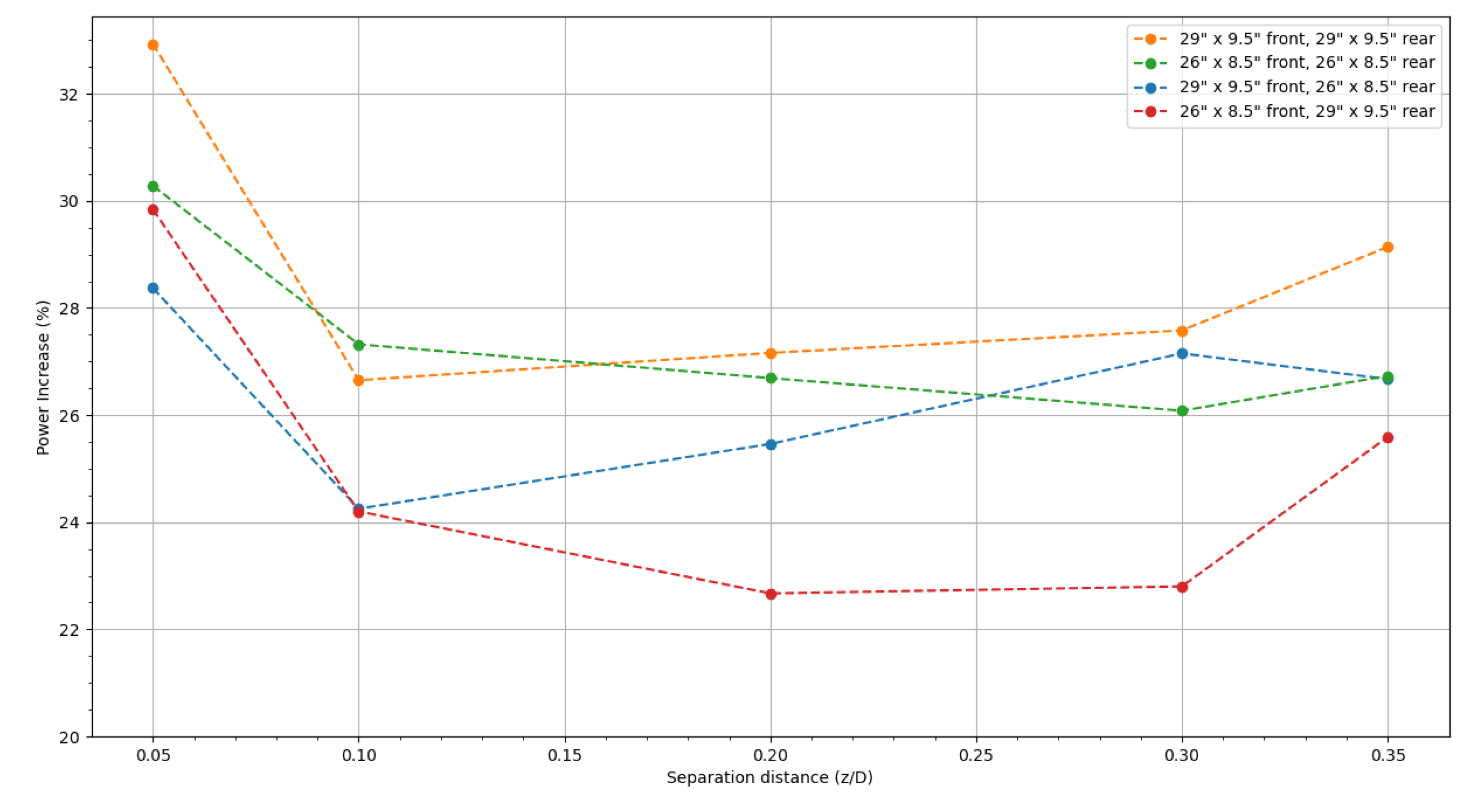
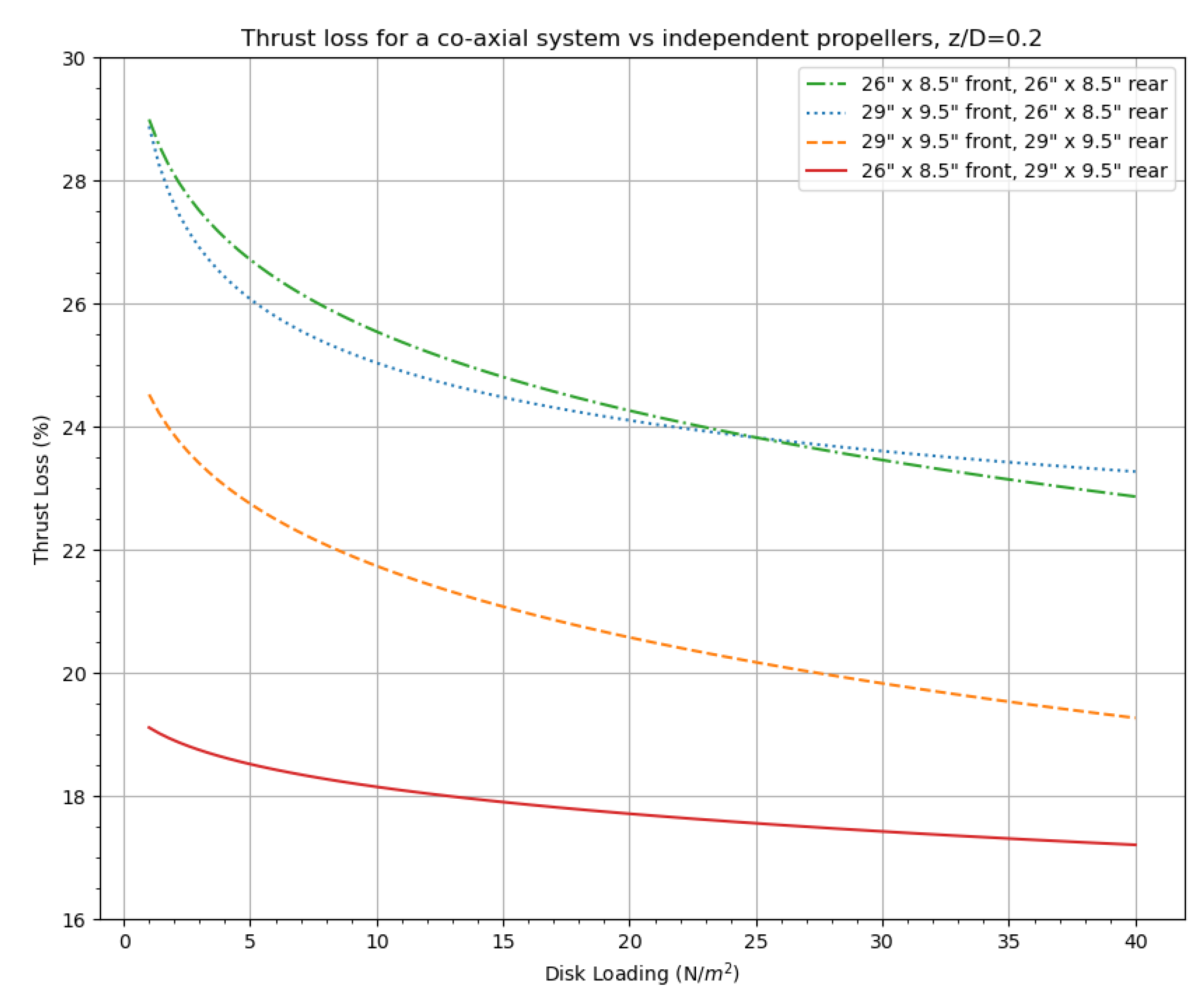
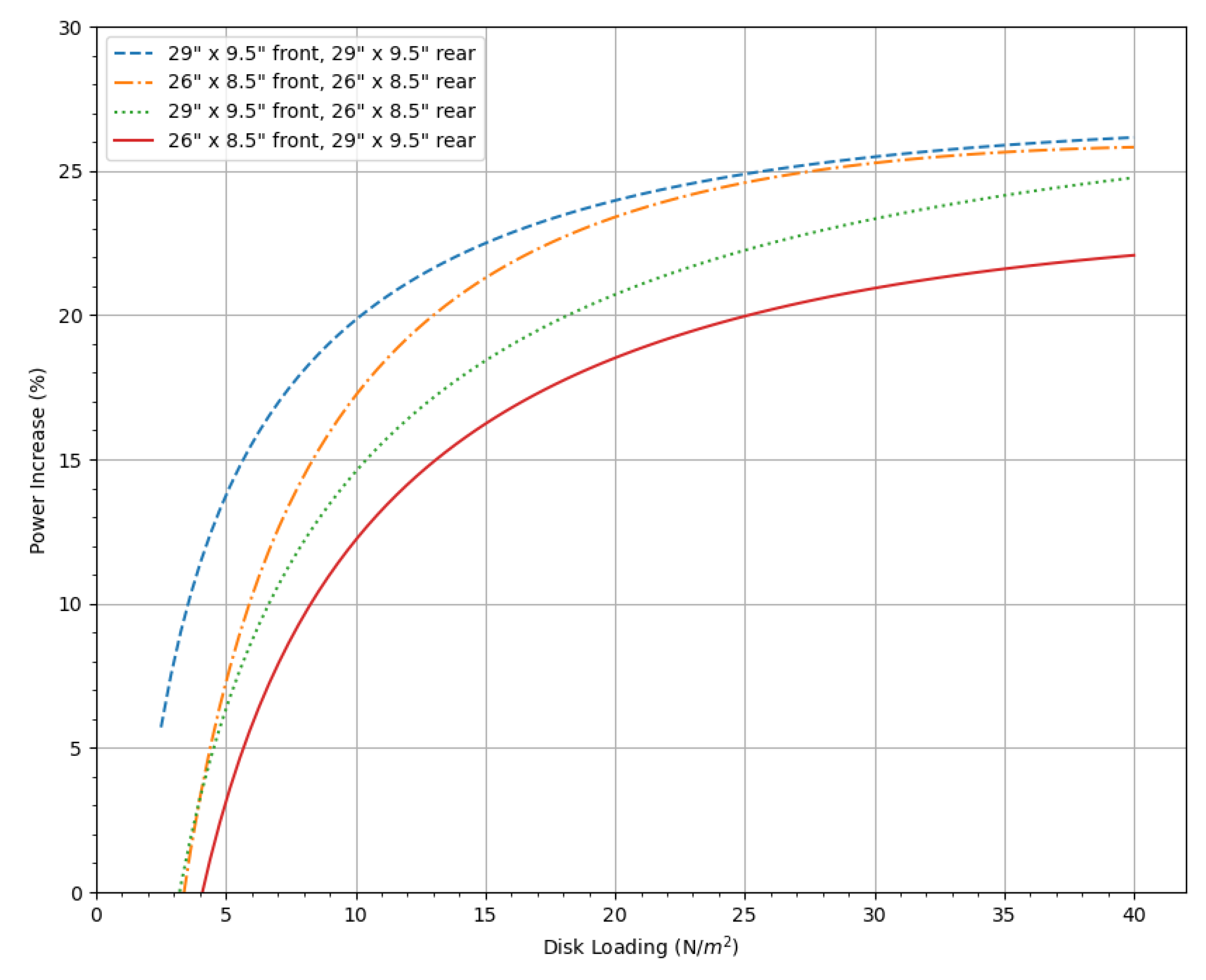
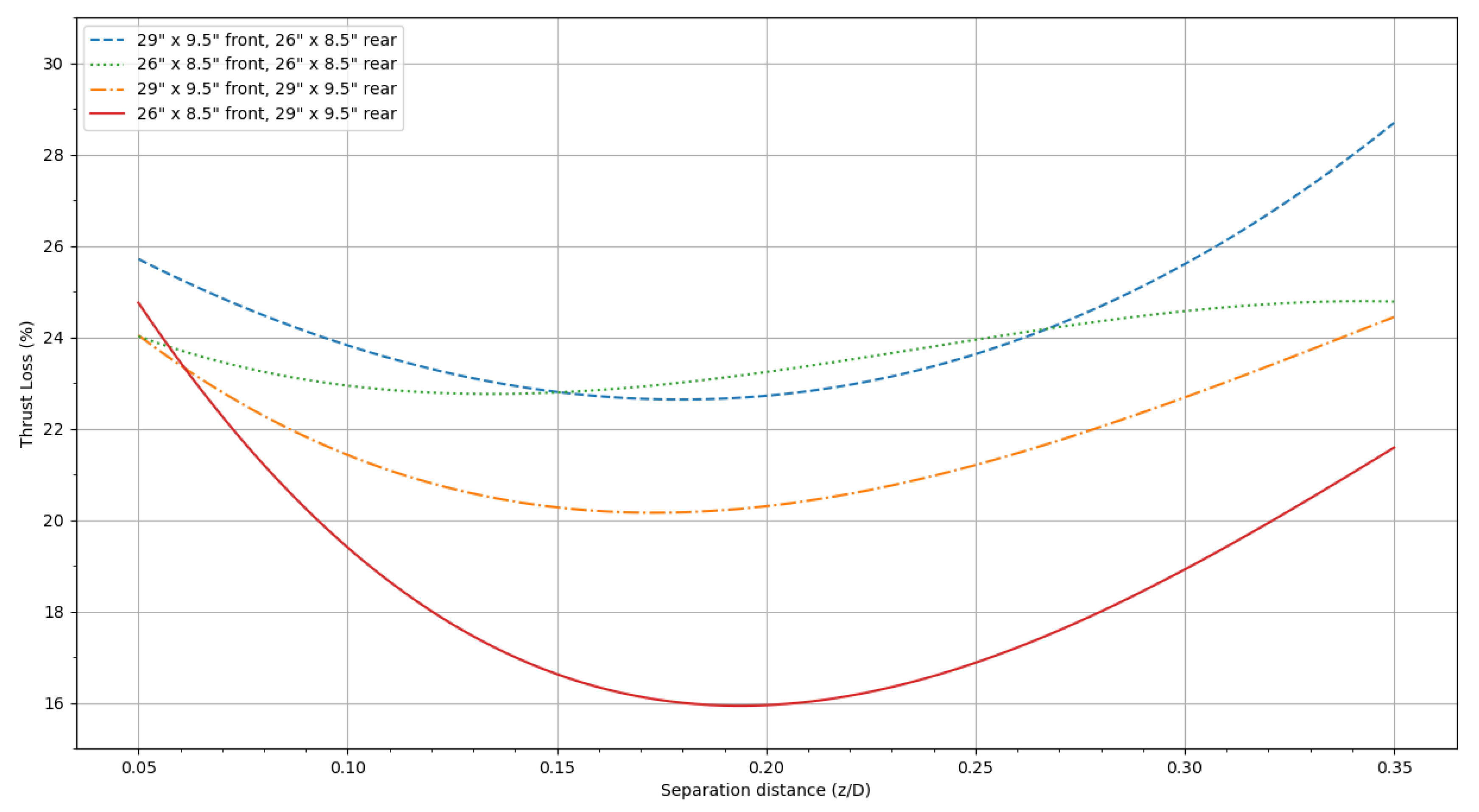
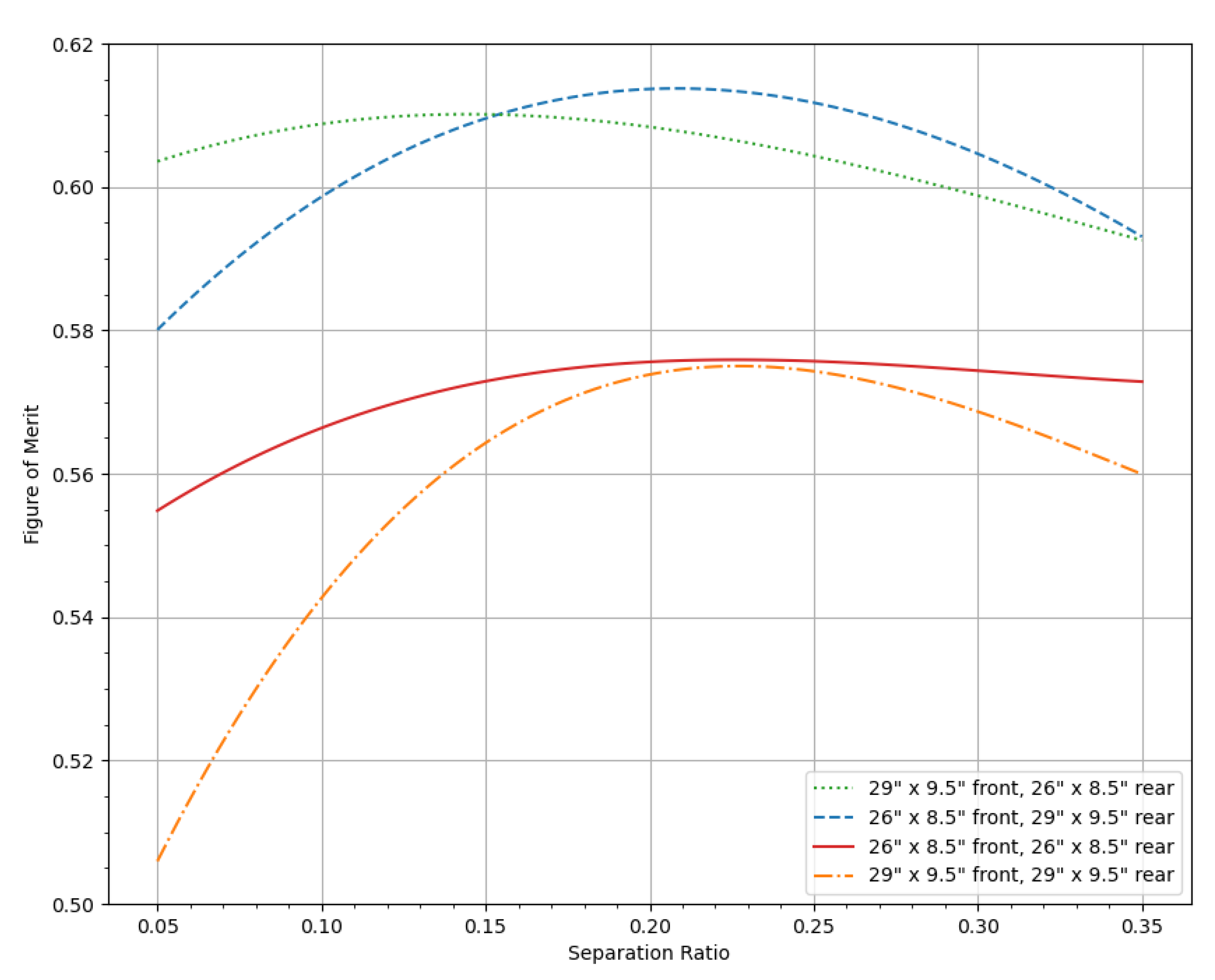
Co-axial rotors are a well understood propulsion method, which are especially practical for large Uncrewed Aerial Vehicles (UAVs), due to their increased thrust without changing the vehicle footprint. However, for co-axial systems with varying propeller diameters between the two disks, available research is more limited. The goal of this paper was to determine an optimal configuration for a variety of different unequal co-axial setups, using a plurality of different propeller combinations and separation ratios. Propellers with diameters of 26 and 29 inches are used in this study at separation ratios of 0.05 to 0.35. Experimental data was collected using an off-the-shelf FS15 TYTO thrust stand. The results show that in an unequal co-axial combination the user should place the smaller propeller upstream to minimise the aerodynamic losses on the downstream propeller. When compared to two independent rotors of the same size, with no interference losses, a 26” upstream rotor matched with a 29” downstream rotor minimised thrust loss to 16%, compared to 23% for the opposite arrangement. This configuration also reduced the power increase from 25.5% to 22.5%. It was also found that the optimal separation ratio (z/D) is approximately 0.2, regardless of the unequal propeller combination.
Keywords:
1. Introduction
2. Materials and Methods
2.1. Performance Characteristics
2.2. Experimental Equipment
2.3. Test Configurations
2.4. Experimental Procedure
3. Results
3.1. The Unique Case of Equal Throttle
3.2. Differences in Individual Propeller Performance
3.3. Thrust Loss
3.4. Power Increase
3.5. Total Thrust
3.6. Electrical and Mechanical Power
3.7. Figure of Merit
3.8. Separation Ratio
3.8.1. Thrust Loss
3.8.2. Figure of Merit
3.8.3. Power Increase
4. Discussion
5. Conclusion
Author Contributions
Funding
Data Availability Statement
Acknowledgments
Conflicts of Interest
Nomenclature
| A | Propeller disc area (m2) |
| B | Number of propeller blades |
| c | Blade chord length (m) |
| D | Propeller diameter (inches) |
| J | Propeller advance ratio, V/n D |
| n | Number of complete revolutions per second |
| p | Propeller pitch (inches) |
| P | Shaft power consumed by propeller (W) |
| Q | Propeller shaft torque (Nm) |
| r | Distance along the propeller radius (m) |
| R | Propeller blade radius (m) |
| T | Thrust produced by the propeller (N) |
| Tu | Thrust on upper rotor (N) |
| Tl | Thrust on lower rotor (N) |
| V | Freestream velocity (m/s) |
| W | Weight carried by rotor system (kg) |
| CT | Thrust Coefficient |
| CP | Power Coefficient |
| CQ | Torque Coefficient |
| mblade | Mass of a propeller blade (kg) |
Greek Symbols
| α | Propeller blade angle of attack (degree) |
| β | Propeller blade angle of twist (degree) |
| ηp | Propeller efficiency, J CT/CP |
| ξ | Non-dimensional radius, r/R |
| κint | Induced power interference factor for a co-axial rotor system |
| ρ | Air density (kgm−3) |
| σ | Rotor solidity |
| Ω | Propeller angular speed (rad/s) |
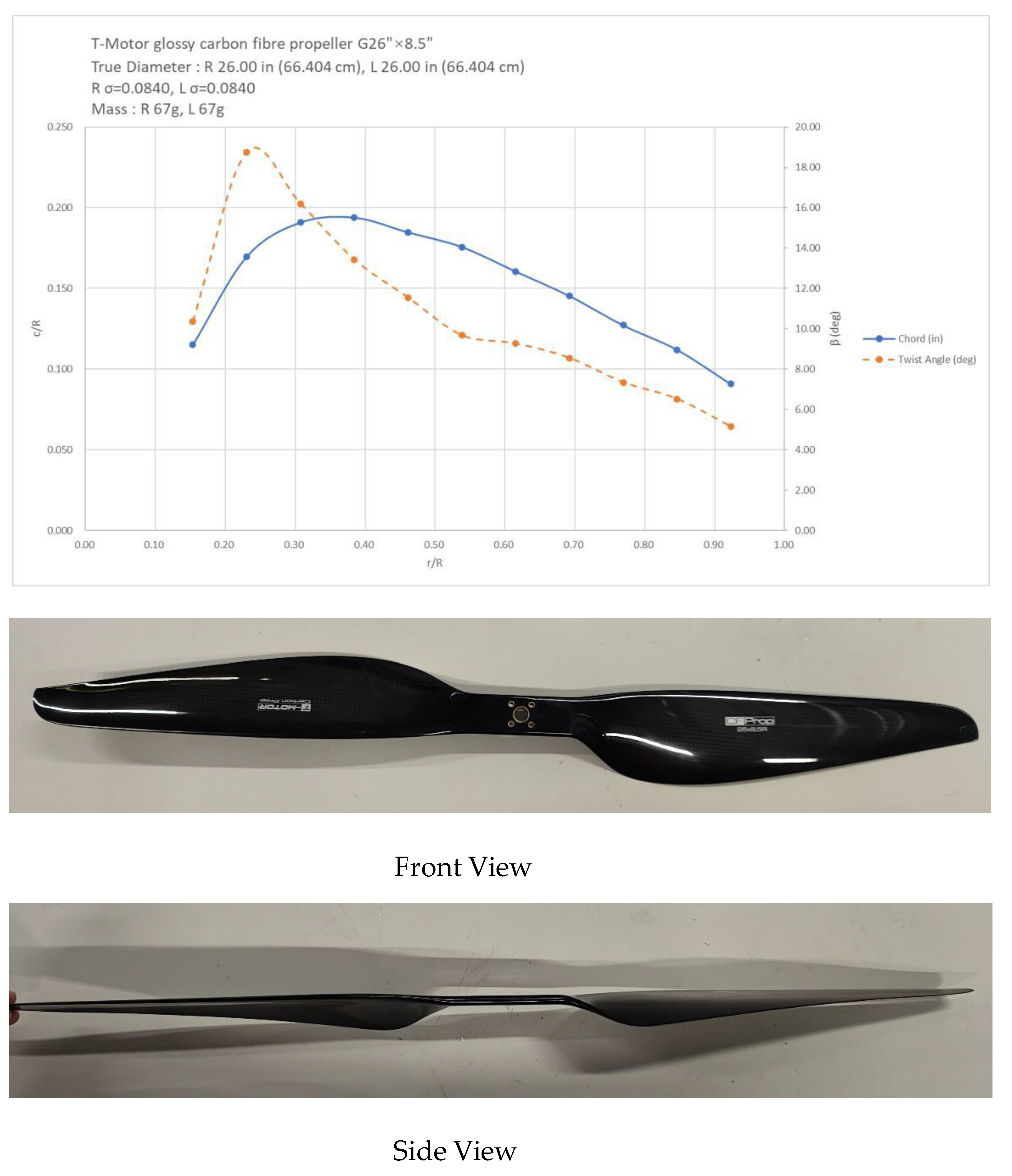
Appendix A. G26” x 8.5” Propeller Data
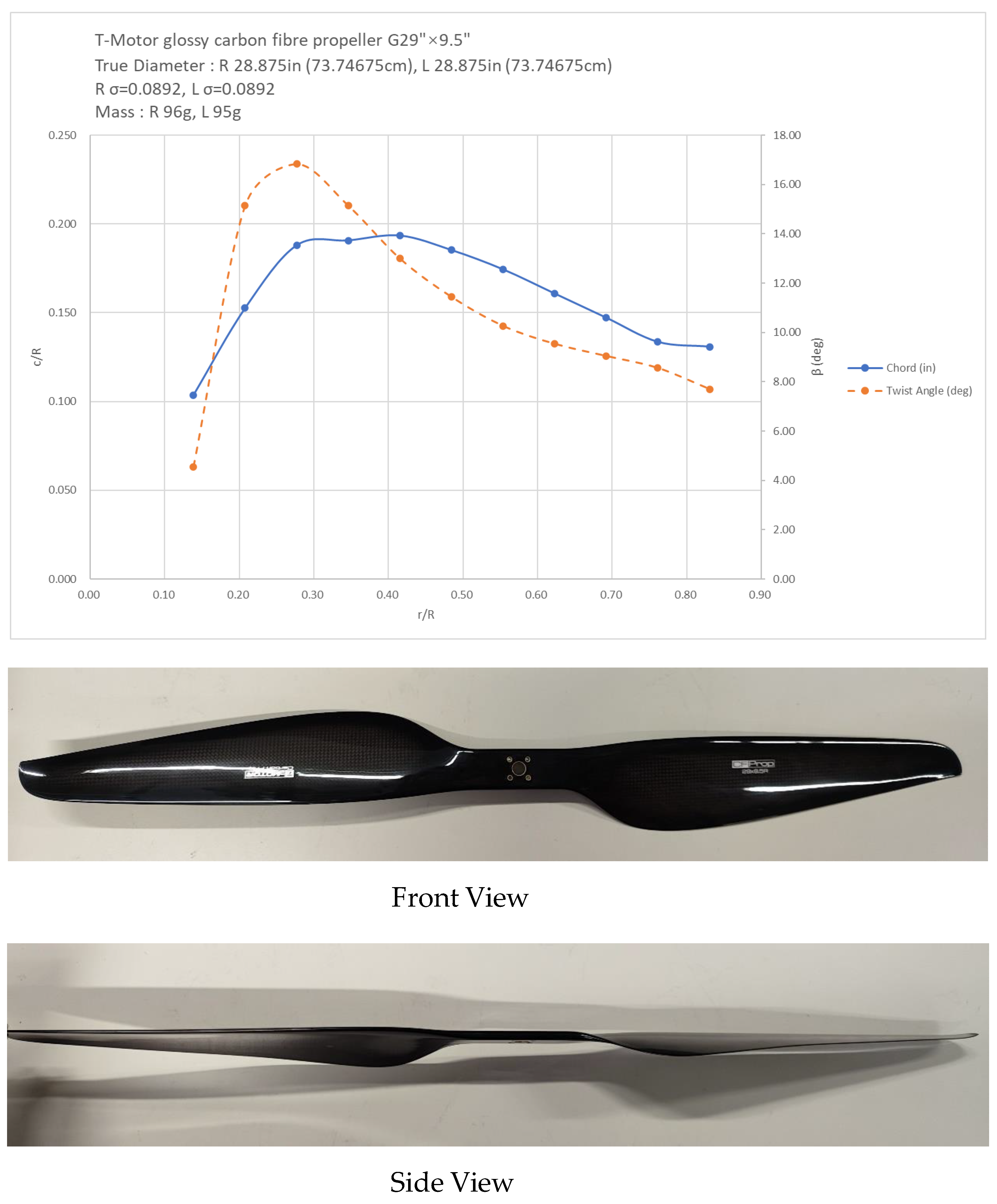
Appendix B. G29” x 9.5” Propeller Data
References
- P. J. P. Chaitanya, S.D. Prior, A.B. Parry, "On the optimum separation distance for minimum noise of contra-rotating rotors," Journal of Sound and Vibration, vol. 535, 2022. https://doi.org/10.1016/j.jsv.2022.117032.
- Z. Y. Heyong Xu, "Numerical Simulation of Unsteady Flow Around Forward Flight Helicopter with Coaxial Rotors," Chinese Journal of Aeronautics, vol. 24, no. 1, 2011. [CrossRef]
- N. K. Dhwanil Shukla, "Drone Scale Coaxial Rotor Aerodynamic Interactions Investigation," Journal of Fluids Engineering, vol. 141, no. 7, 2019. [CrossRef]
- M. B. Jonathon Bell, Stephen D Prior, Mehmet Ali Erbil, Mehmet Karamanoglu, "Development of a Test-Rig for Exploring Optimal Conditions of Small Unmanned Aerial Vehicle Co-Axial Rotor Systems," presented at the International Conference on Manufacturing Engineering Systems, Taiwan, 2010.
- S. N. L. Xing Zhu He, Yan Li Chen, Chun Xue Wang, Song Yang, "Research on Hover Characteristics of Ducted Fan with Coaxial Rotors," Applied Mechanics and Materials, vol. 427-429, 2013. [CrossRef]
- K. W. M. Joon W. Lim, Wayne Johnson, "Hover Performance Correlation for Full-Scale and Model-Scale Coaxial Rotors," Journal of the American Helicopter Society, vol. 54, 2009. [CrossRef]
- L. Ostar-Exel, "The effects of varying diameter on coaxial propellers for the propulsion of multirotor systems," Mechanical and Aerospace Engineering, School of Graduate Studies, The State University of New Jersey, 2019.
- M. Simões, "Optimizing a Coaxial Propulsion System to a Quadcopter Cédric," 2014.
- P. C. Sergi Palleja-Cabre, Phillip Joseph, "Acoustic and aerodynamic performance of co-axial contra-rotating rotors with unequal diameters," presented at the 30th AIAA/CEAS Aeroacoustics Conference, Rome, Italy, 2024.
- G. M. Hongming Cai, Zhongxin Li, "Aerodynamic Characteristics of a Ducted Fan System Based on Momentum Source Method," presented at the 3rd International Conference on Fluid Mechanics and Industrial Applications, Taiyun, China, 2019.
- K. T. S. Sunada, K. Kawashima, "Maximization of Thrust-Torque Ratio of a Coaxial Rotor," Journal of Aircraft, vol. 42, no. 2, 2005. [CrossRef]
- M. F. Z. Che Muhammad Ikram Che Umar, "Distance and Rotational Speed Analysis of Coaxial Rotors for UTHM CDrone," Progress in Aerospace and Aviation Technology, vol. 1, no. 1, pp. 45-55, 2021. 10.30880/paat.2021.01.01.006.
- S. W. Shuanghou Deng, Zheng Zhang, "Aerodynamic performance assessment of a ducted fan UAV for VTOL applications," Aerospace Science and Technology, vol. 103, 2020. [CrossRef]
- T. J. G. Paul Gerin Fahlstrom, "Propulsion," in Introduction to UAV Systems, Fourth Edition, 2012, p. 76.
- M. S. J. Gordon Leishman, "Figure of Merit Definition for Coaxial Rotors," Journal of the American Helicopter Society, vol. 53, pp. 290-300, 2008. [CrossRef]
- (1997). A Survey of Theoretical and Experimental Coaxial Rotor Aerodynamic Research.
- S. A. J. Gordon Leishman, "Aerodynamic Optimization of a Coaxial Proprotor," 2006.
- S. D. Prior, "Reviewing and Investigating the Use of Co-Axial Rotor Systems in Small UAVs," International Journal of Micro Air Vehicles, 2010. [CrossRef]
- S. D. Fernandes, "Performance Analysis of a Coaxial Helicopter in Hover and Forward Flight," Master of Science in Aerospace Engineering, Aerospace Engineering, 2017. [Online]. Available: https://commons.erau.edu/edt/326.
- J. E. Holzsager, "The effects of coaxial propellers for the propulsion of multirotor systems," Mechanical and Aerospace Engineering, School of Graduate Studies, Rutgers University, 2017.

| Case No. | Interference-Induced Power Factor,κint |
| 1 – Corotation in the same plane, at equal thrusts. | 1.4142 |
| 2 - Corotation in the same plane, at balanced torques. | 1.4142 |
| 3 – Equal thrusts with the lower rotor in the slipstream of the upper rotor. | 1.2808 |
| 4a – Balanced torque with the lower rotor in the slipstream of the upper rotor. | 1.2810 |
| 4b – Same thrust sharing ratio as found in the torque balanced case. | 1.2657 |
| Diameter (in) | Handedness | Pitch (in) | P/D Ratio | Mass (g) | Solidity |
| 29 | R | 9.5 | 0.3276 | 96 | 0.0892 |
| 29 | L | 9.5 | 0.3276 | 95 | 0.0892 |
| 26 | R | 8.5 | 0.3269 | 67 | 0.0840 |
| 26 | L | 8.5 | 0.3269 | 66 | 0.0840 |
| Measured Data | Unit | TYTO’s Stated Operational Limits |
| Thrust | N | 150 N |
| Current | A | 180 A |
| Torque | Nm | 8 Nm |
| Rotational Speed | rpm | 30,000 rpm |
| Electrical Input Power | W | 27 kW |
| Mechanical Output Power | W | 27 kW |
Disclaimer/Publisher’s Note: The statements, opinions and data contained in all publications are solely those of the individual author(s) and contributor(s) and not of MDPI and/or the editor(s). MDPI and/or the editor(s) disclaim responsibility for any injury to people or property resulting from any ideas, methods, instructions or products referred to in the content. |
© 2024 by the authors. Licensee MDPI, Basel, Switzerland. This article is an open access article distributed under the terms and conditions of the Creative Commons Attribution (CC BY) license (http://creativecommons.org/licenses/by/4.0/).


