Preprint
Review

This version is not peer-reviewed.

Solid-State NMR of Chemical Compounds – A Review

Submitted:

15 November 2024

Posted:

18 November 2024

You are already at the latest version

Abstract

Solid-state Nuclear Magnetic Resonance (NMR) spectroscopy has become an invaluable tool for elucidating the structural, dynamic, and compositional properties of chemical compounds across various fields, from organic and inorganic chemistry to materials science. This review summarizes recent advancements in solid-state NMR techniques, including high-field NMR, magic-angle spinning (MAS), and multidimensional approaches, which have significantly enhanced spectral resolution and sensitivity. The review explores applications in studying crystalline and amorphous compounds, probing atomic-level structure, and investigating molecular dynamics critical to catalysts, polymers, pharmaceuticals, and complex hybrid materials. Additionally, it highlights the synergy between solid-state NMR and other characterization methods, such as X-ray diffraction and electron microscopy, which together provide a comprehensive understanding of material properties. Concluding with an outlook on future developments, this review underscores solid-state NMR’s growing impact on molecular and materials characterization.

Keywords: 
;  

1. Introduction

Solid-state Nuclear Magnetic Resonance (NMR) spectroscopy has become an essential analytical tool in the study of chemical compounds, offering unique insights into molecular structure, dynamics, and interactions that are often inaccessible through other techniques. Unlike solution-state NMR, which requires compounds to be dissolved, solid-state NMR can analyze materials in their native solid forms, making it particularly valuable for studying a diverse array of substances, including crystalline solids, amorphous compounds, polymers, pharmaceuticals, and hybrid materials. The introduction of high-resolution techniques, such as magic-angle spinning (MAS) and high-field NMR, has dramatically improved the resolution and sensitivity of solid-state NMR, allowing for detailed structural analysis of complex compounds. Through these advances, solid-state NMR has been widely applied in material sciences for characterizing catalysts, drug formulations, and organic semiconductors, where precise structural information is essential for understanding and optimizing functionality. Additionally, recent technological progress in multidimensional and relaxation-assisted NMR methods has enabled the separation of overlapping signals, thereby enhancing the resolution of complex mixtures. This review explores how these innovations have broadened the scope of solid-state NMR applications across chemistry and material science, making it an indispensable tool for the detailed analysis of both organic and inorganic compounds.

2. NMR Techniques

In-Depth Analysis of NMR, Solid-State NMR, IR, Raman, and X-Ray Diffraction Techniques

Nuclear Magnetic Resonance (NMR), Solid-State NMR (SSNMR), Infrared (IR) spectroscopy, Raman spectroscopy, and X-ray diffraction (XRD) are among the most powerful tools in modern analytical chemistry, each providing unique insights into molecular structure, dynamics, and material properties. This paper examines the principles, applications, strengths, and limitations of each technique and compares their capabilities for comprehensive molecular and structural analysis across diverse sample types. By evaluating these techniques in parallel, this paper elucidates how they complement one another in solving complex analytical challenges in chemistry, biology, and materials science.
Structural elucidation and molecular analysis are foundational to advancements in materials science, chemistry, and biology. Each analytical technique offers unique benefits based on the nature of the sample, the level of structural detail required, and the conditions under which the analysis is conducted. Nuclear Magnetic Resonance (NMR) spectroscopy, in both its solution and solid-state forms, provides atomic-level structural information based on the magnetic properties of nuclei. Infrared (IR) and Raman spectroscopy allow for rapid vibrational analysis and functional group identification, while X-ray diffraction (XRD) is fundamental for determining crystalline structures in solid-state materials. This paper reviews the principles and applications of each technique and presents a comparative analysis, highlighting how these techniques are used individually and in concert to analyze molecular structures, crystallinity, and sample properties.
NMR spectroscopy exploits the magnetic properties of nuclei that possess a non-zero nuclear spin, such as 1H, 13C, and 15 N. In the presence of an external magnetic field, these nuclei align with or against the field, producing distinct energy levels. When a radiofrequency (RF) pulse is applied, the nuclei absorb energy and transition to higher energy states. As they return to their equilibrium state, they emit RF signals that can be detected and translated into an NMR spectrum. The spectrum provides information about chemical shifts, which reflect the electronic environment around each nucleus, revealing details about molecular structure, bonding, and dynamics. Solution-state NMR is commonly used for characterizing small organic molecules and studying macromolecular structures and dynamics. Advanced techniques, such as 2D NMR (e.g., COSY, HSQC) and NOESY, offer correlation data and spatial information about nuclei within close proximity, which is particularly valuable for complex molecules like proteins. Limitations of NMR include its relatively low sensitivity, which requires large sample concentrations, and the high cost of instrumentation and maintenance due to the need for high-field superconducting magnets and liquid helium cooling [1,2,3,4,5,6,7,8,9,10].
SSNMR adapts traditional NMR principles for samples in the solid phase, where molecular motions are restricted, resulting in broadened spectral lines due to dipolar couplings and anisotropic chemical shifts. Techniques such as Magic Angle Spinning (MAS) and Cross Polarization (CP) improve spectral resolution in SSNMR by averaging out these interactions. MAS involves spinning the sample at an angle of 54.74° (the “magic angle”) relative to the magnetic field, which reduces line broadening and enhances spectral clarity. Cross polarization transfers polarization from abundant nuclei (such as 1H) to rare nuclei (such as 13C), significantly increasing sensitivity. SSNMR is indispensable for studying complex solid-state materials, including polymers, pharmaceuticals, and ceramics, as well as insoluble biological assemblies like membrane proteins and amyloid fibrils. However, SSNMR requires specialized equipment and extended acquisition times due to the inherently low sensitivity of solid samples. Furthermore, the spectra obtained from SSNMR are often broader and less resolved compared to solution-state NMR, presenting challenges in peak assignment and data interpretation [11,12,13,14,15,16,17,18,19,20,21,22,23,24,25,26,27,28,29,30,31,32,33,34,35]. The advantages and disadvantages of four methods described in this review are given in Scheme 1.

IR Spectroscopy

IR spectroscopy measures the absorption of infrared light by molecular bonds, causing vibrational transitions that are characteristic of functional groups within the molecule. When a molecule absorbs IR radiation at specific frequencies, it excites vibrations such as stretching and bending modes, resulting in an absorption spectrum that serves as a molecular fingerprint. Fourier-transform infrared (FTIR) spectroscopy enhances resolution and acquisition speed, while Attenuated Total Reflectance (ATR) allows for straightforward analysis of solid and aqueous samples without extensive sample preparation. Although IR spectroscopy does not provide atomic-level structural information, it is an efficient and widely used technique for identifying functional groups, analyzing organic and inorganic compounds, and monitoring chemical reactions in real-time. A notable limitation of IR is that it may have difficulty analyzing mixtures with overlapping peaks, and it is less sensitive to non-polar bonds, limiting its applicability for symmetrical or non-polar compounds [36,37,38,39,40,41,42,43,44,45,46].

Raman Spectroscopy

Raman spectroscopy relies on the inelastic scattering of monochromatic light, usually from a laser source. When light interacts with a molecule, most photons scatter elastically (Rayleigh scattering), but a small fraction undergoes inelastic scattering, with a frequency shift that corresponds to molecular vibrational modes. This shift provides a unique vibrational signature of the molecule, similar to IR spectroscopy, but with complementary selection rules: IR is sensitive to polar bonds, while Raman is generally more responsive to non-polar bonds. Enhanced Raman techniques, such as Surface-Enhanced Raman Spectroscopy (SERS) and Resonance Raman, improve sensitivity and allow for trace analysis. Raman spectroscopy is valuable for studying inorganic compounds, nanomaterials, and aqueous biological samples, as water has a weak Raman signal. However, fluorescence can interfere with Raman signals in some samples, and Raman scattering is inherently weak, necessitating longer acquisition times or enhancement techniques. While it is less quantitative than NMR, Raman provides rapid, non-destructive molecular insights that make it suitable for a wide range of applications [47,48,49,50,51,52,53,54].

X-Ray Diffraction

X-ray diffraction is a cornerstone technique for determining the crystalline structure of solid materials. When X-rays are directed at a crystal, they diffract in specific directions based on the atomic arrangement within the crystal lattice. By measuring the angles and intensities of these diffracted beams, an electron density map of the crystal can be generated, allowing for the determination of atomic positions. XRD provides detailed structural information at atomic resolution, which is essential for materials science, mineralogy, and the analysis of small-molecule and protein crystals. XRD is particularly effective for highly ordered, crystalline samples; however, it is less effective for amorphous materials, which lack long-range order and therefore do not produce clear diffraction patterns. Single-crystal XRD requires well-formed crystals, while powder XRD is suitable for polycrystalline samples, but the latter generally provides less structural detail [55,56,57,58,59,60,61,62,63,64,65,66].
NMR and SSNMR provide unparalleled atomic-level structural information, particularly for organic compounds and complex biological molecules in solution or solid state. They excel in determining connectivity, conformation, and dynamic interactions within molecules. However, NMR requires high sample concentrations and is limited by its need for costly, specialized equipment, while SSNMR additionally requires longer acquisition times. IR and Raman spectroscopy, in contrast, offer rapid analysis with minimal sample preparation, excelling in identifying functional groups and molecular vibrations. IR is particularly suitable for analyzing polar bonds, while Raman complements this with sensitivity to non-polar bonds. Both techniques, however, offer limited structural detail compared to NMR and XRD. XRD is the gold standard for analyzing crystal structures, providing atomic-level detail for well-ordered samples. It is crucial for materials science and solid-state chemistry but requires high crystallinity and is less useful for amorphous samples.

3. Results and Discussion

Inorganic and Organic Compounds
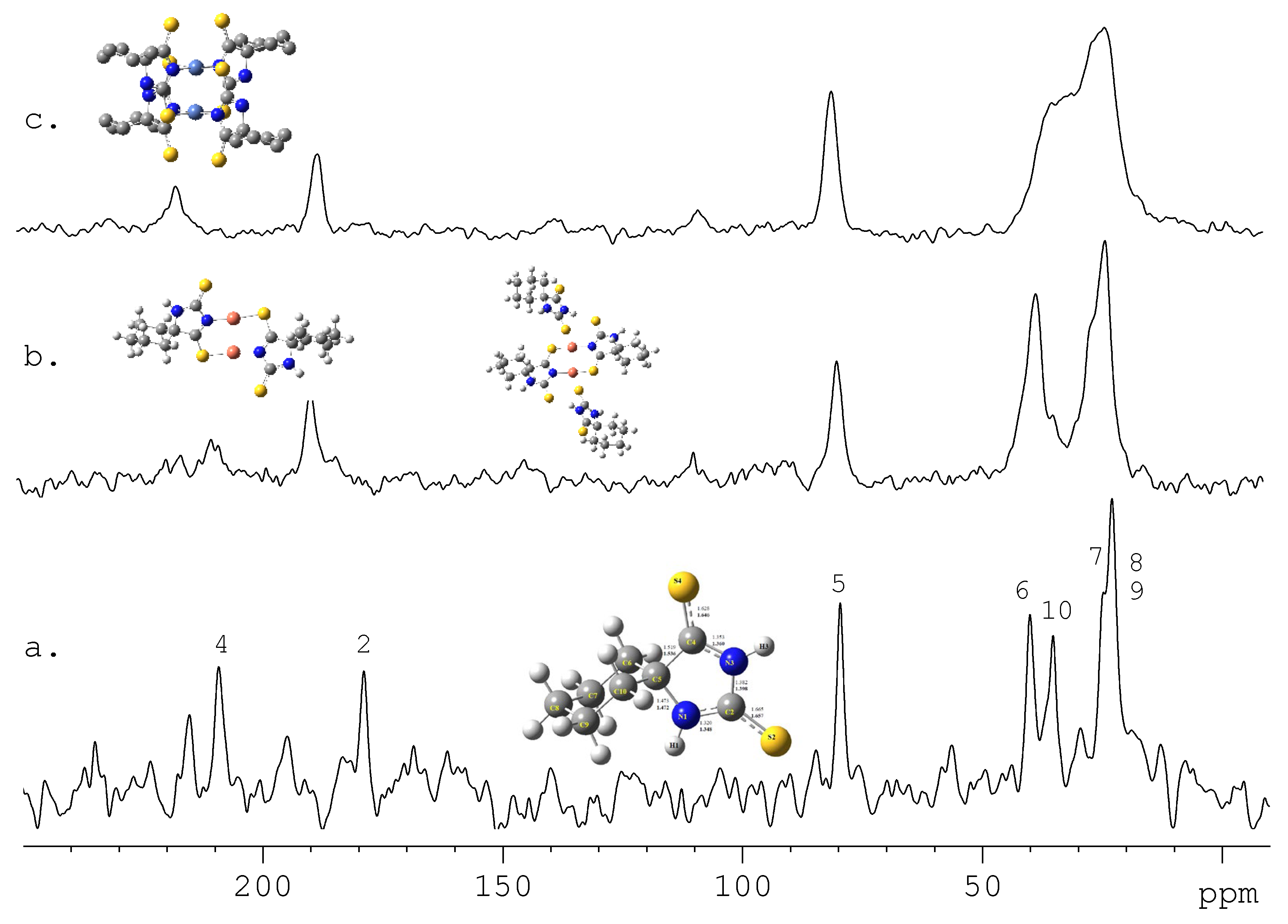
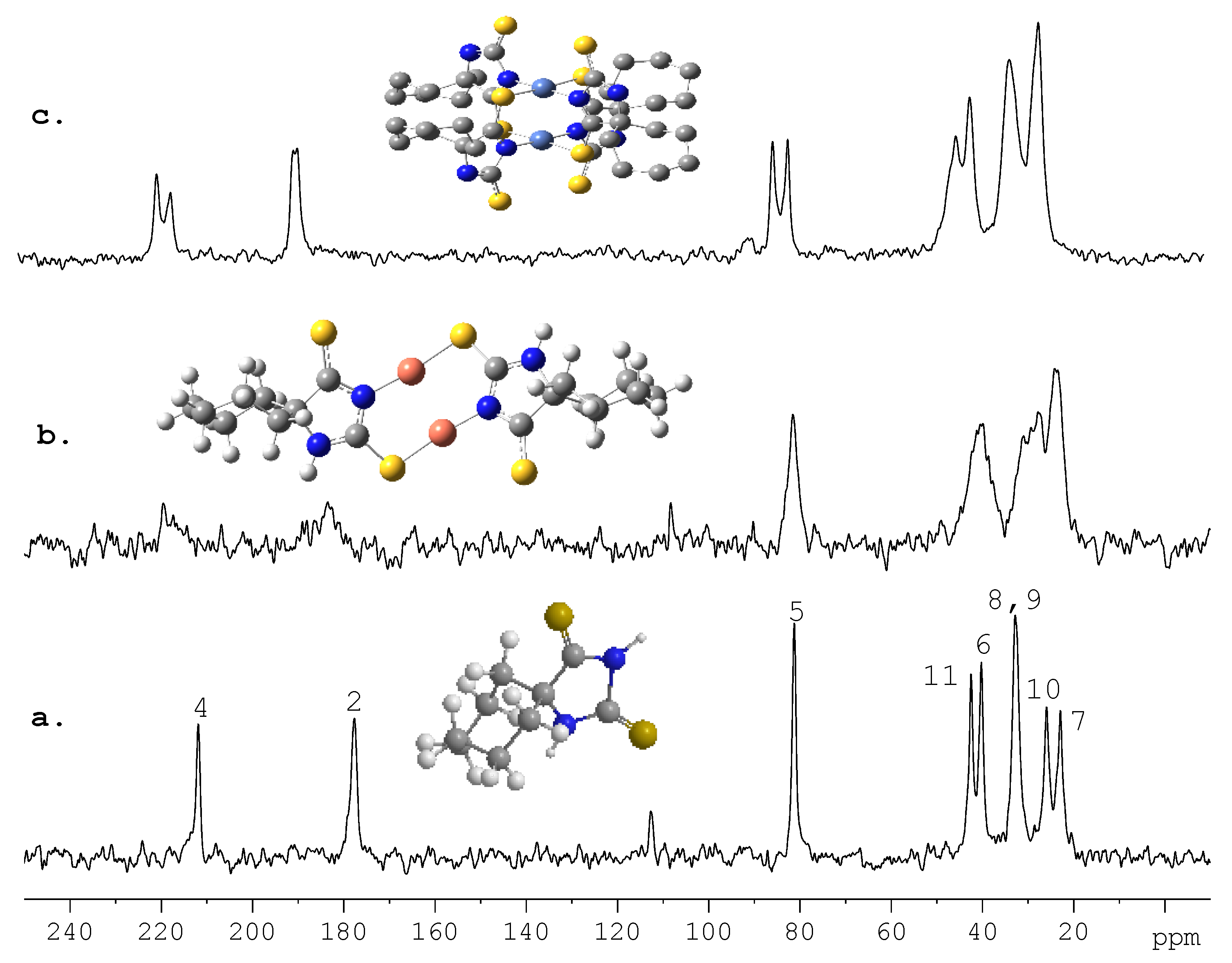
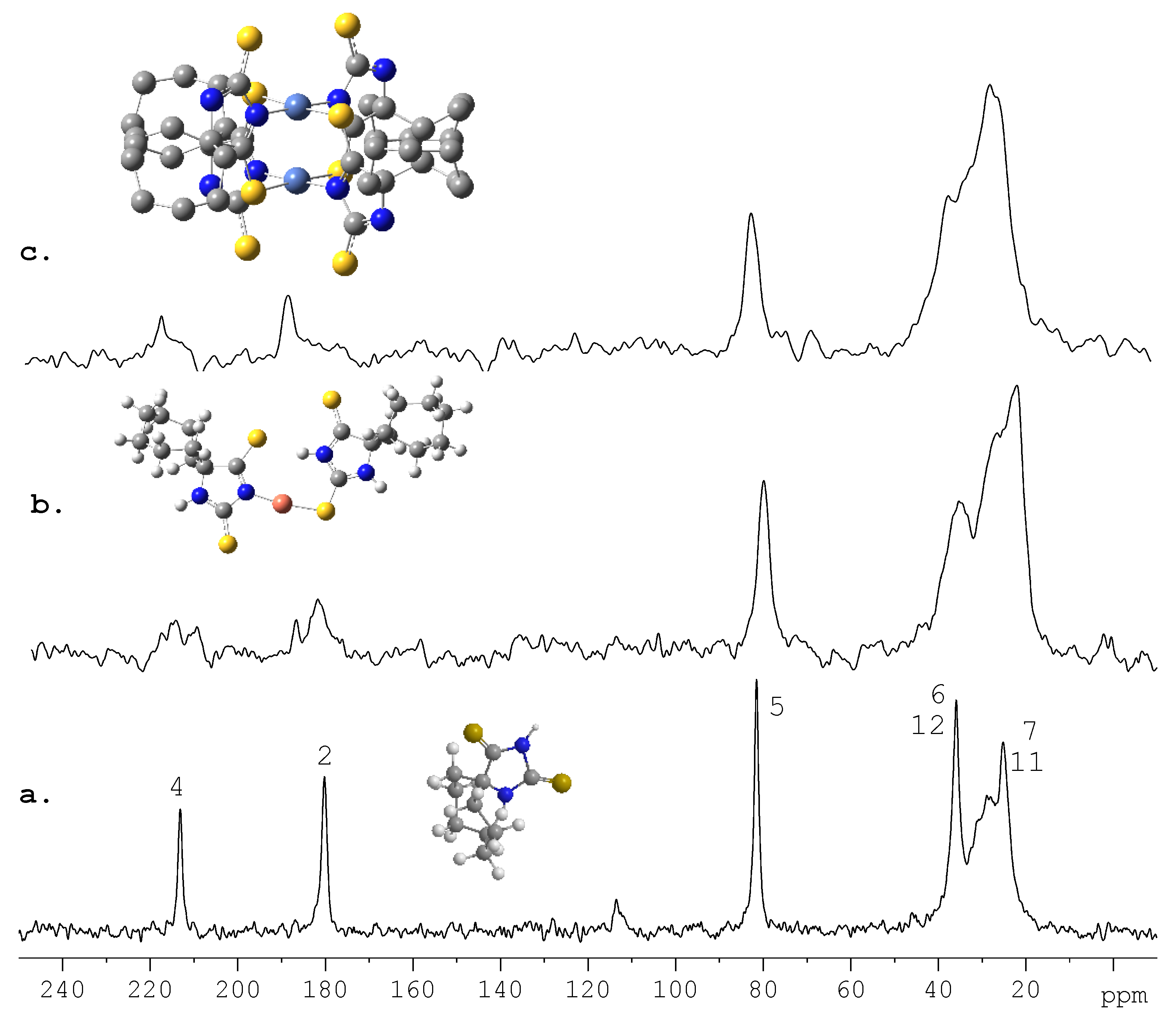
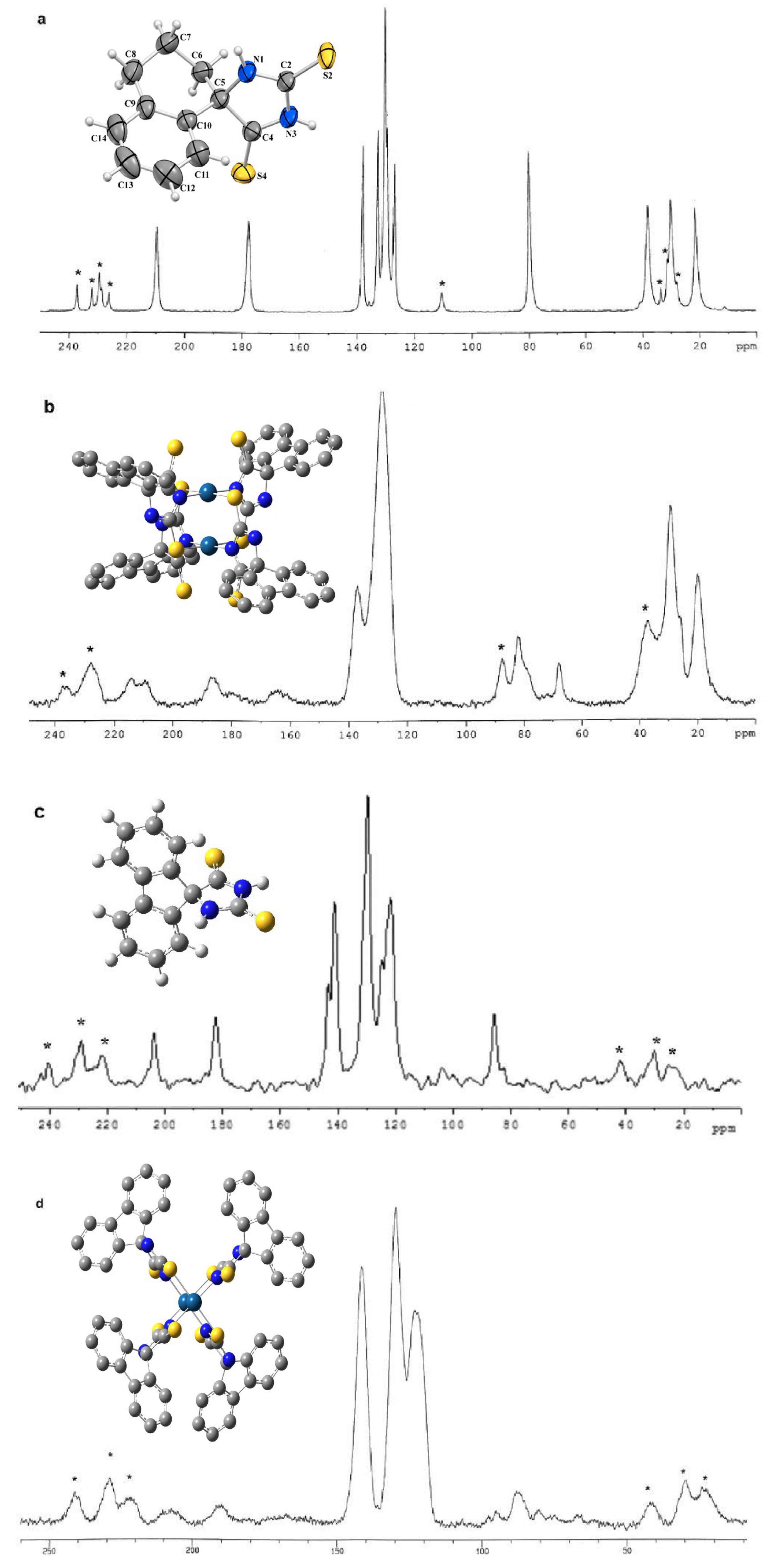
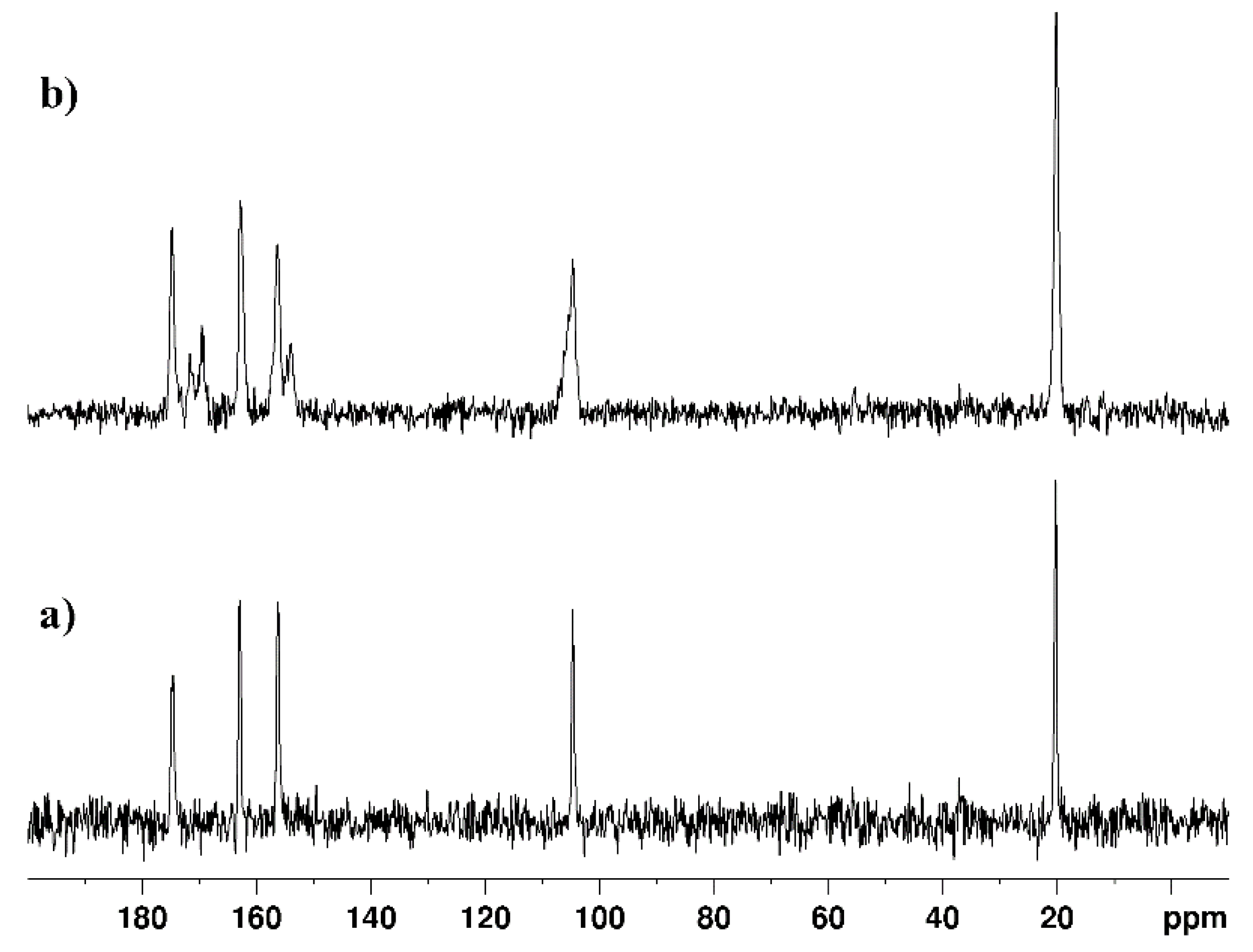
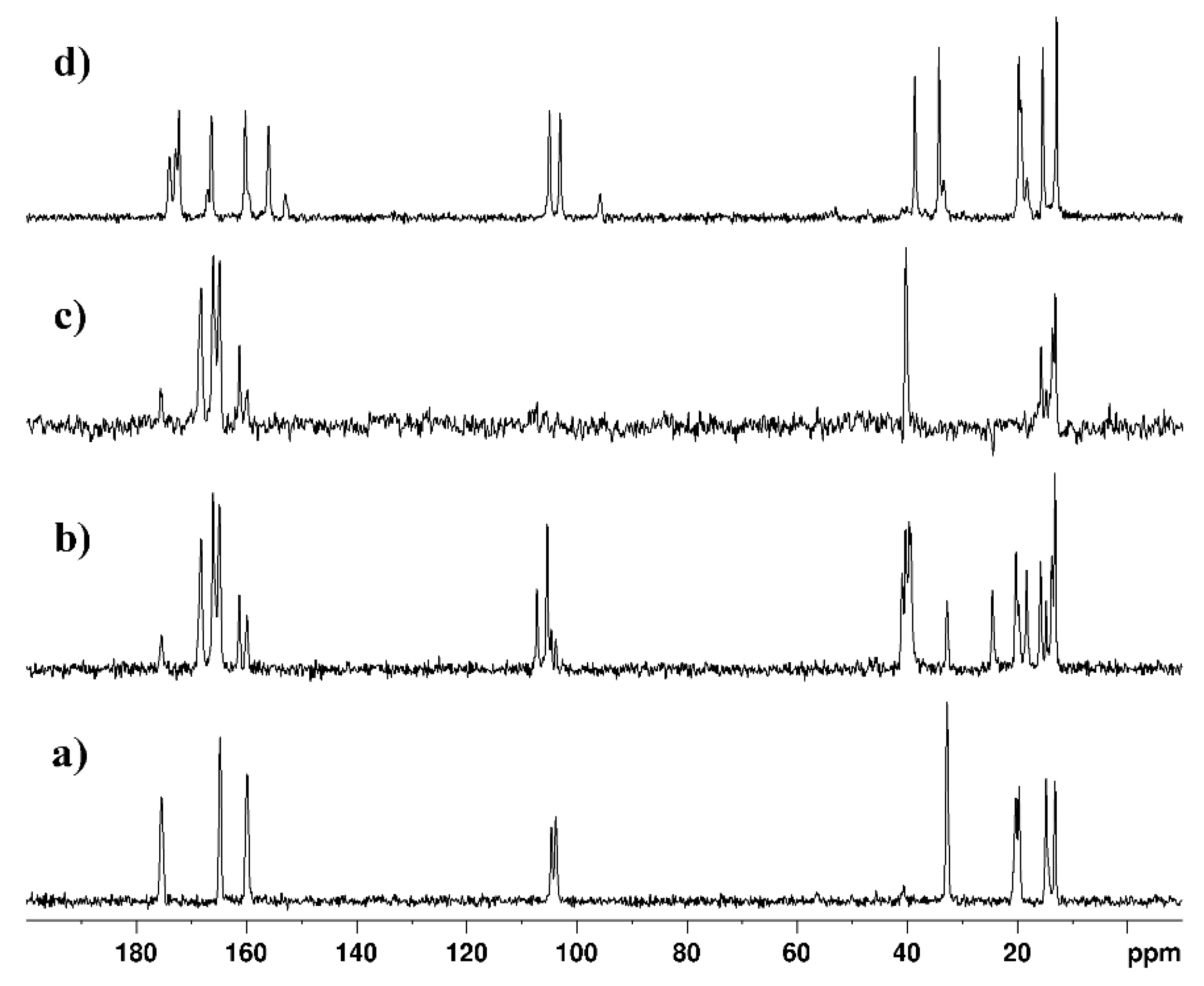
The complexation of cyclohexanespiro-5-(2,4-dithiohydantoin), with copper and nickel was studied by means of experimental and theoretical methods [67]. Dimeric structures for the Cu(I) and Ni(II) complexes were proposed in which the ligands were coordinated in N3^S4- and N3^S2-bridging ways, respectively, acting as monoanions. The results demonstrate that the combined experimental (13C CPMAS NMR, IR) and theoretical (DFT) approach can be used to characterize the molecular structure of solid complexes for which crystallographic data are not available. A combined approach of quantum chemical calculations and 13C CPMAS NMR data was used to find the most probable structures of nickel and copper complexes of cycloheptanespiro-5-(2,4-dithiohydantoin and cyclooctanespiro-5-(2,4-dithiohydantoin) [68]. Recently, we describe the synthesis and structure of Pt(II) complexes of two spiro-5-(2,4-dihiohydantoins), namely 3′,4′-dihydro-2H,2′H,5H-spiro[imidazolidine-4,1′-naphthalene]-2,5-dithione and spiro-(fluorene-9,4′-imidazolidine)-2′,5′-dithione [69]. Single-crystal analysis was used for the spiro-(benzocyclohexane-4′-imidazolidine)-2′,5′-dithione. The anticancer activity of all compounds were tested against different tumor cell lines (HL-60, BV-173, and K-562).
Figure 1. 13C CPMAS NMR spectra of L – (a.), Cu-L – (b.) and Ni-L – (c.) [67].
Preprints 139725 g001
Figure 2. 13C CPMAS NMR spectra of cycloheptanespiro-5-(2,4-dithiohydantoin) – (a), Cu complex – (b) and Ni complex – (c) [68].
Preprints 139725 g002
Figure 3. 13C CPMAS NMR spectra of cyclooctanespiro-5-(2,4-dithiohydantoin) – (a), Cu complex – (b) and Ni complex – (c) [68].
Preprints 139725 g003
Figure 4. 13C CPMAS NMR spectra of the studied compounds: 3′,4′-dihydro-2H,2′H,5H-spiro[imidazolidine-4,1′-naphthalene]-2,5-dithione (a); Pt complex (b); spiro-(fluorene-9,4′-imidazolidine)-2′,5′-dithione (c); Pt complex (d). Asterisks (*) denote spinning side bands (ssb). [69].
Preprints 139725 g004
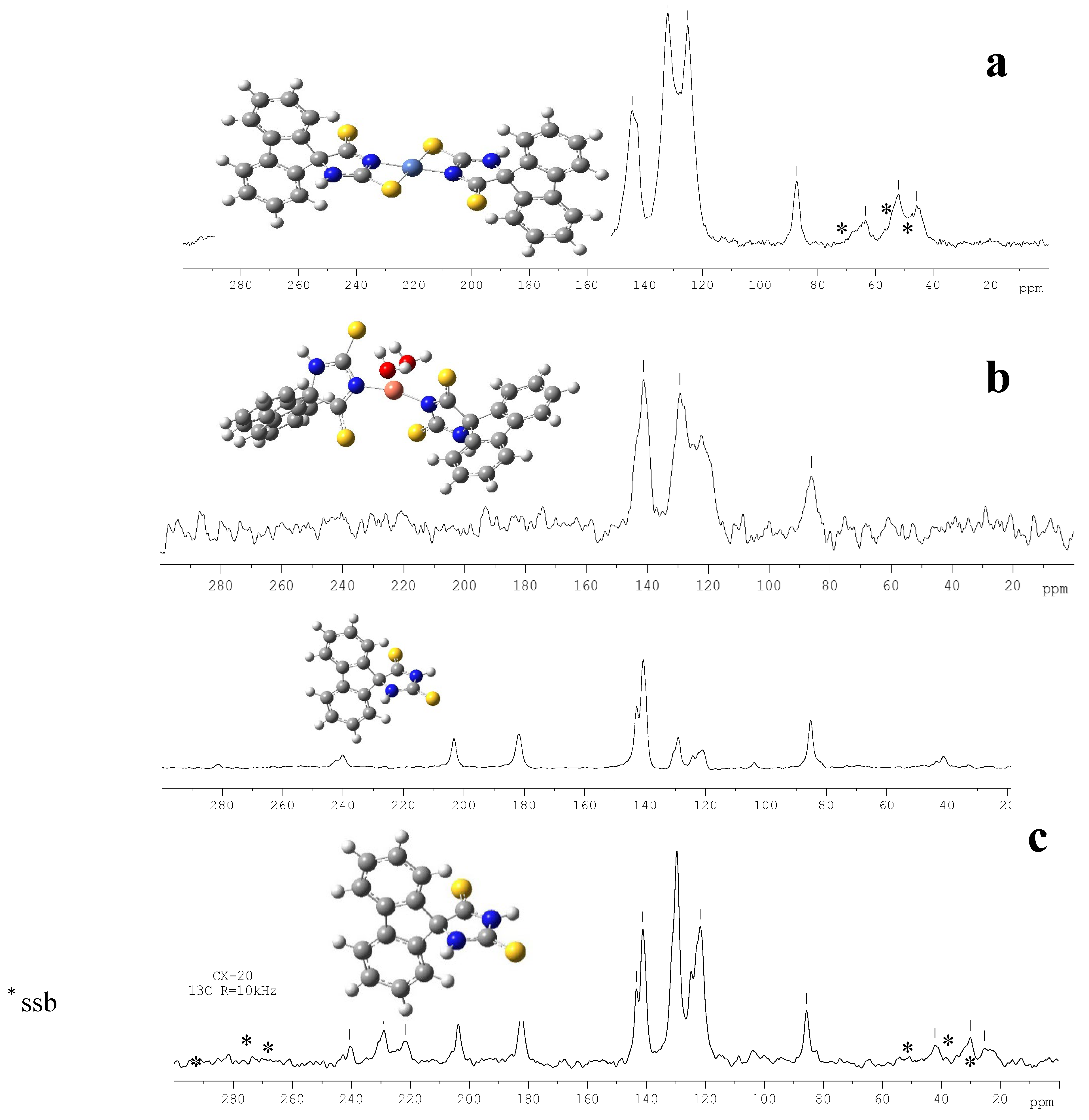
Synthesis and structural characterization of new Cu(II) and Ni(II) complexes of (9′-fluorene)-spiro-5-dithiohydantoin are reported [70]. All compounds were studied by means of experimental (13C CPMAS NMR, EPR, IR) and quantum-chemical (DFT/B3LYP-6-31G(d,p)) methods. Based on the experimental data, supported by theoretical calculation, the most probable structure of the complexes is suggested. The paramagnetic Cu(II) complex has distorted tetrahedral structure with two water and two ligand molecules coordinated to the metal ion. For the Ni(II) complex square planar geometry is suggested with two ligand molecules coordinated in a bidentate fashion.
Figure 5. 13C-NMR-CP-MAS spectra of Ni (II) and Cu(II) complexes (a and b, respectively) of (9΄-fluorene)-spiro-5-dithiohydantoin compared with those of the free ligand (c). Upper spectrum of (c) is recorded with dipolar dephasing pulse sequence (delay time before acquisition of 50 μs) which reduces signals from protonated carbons (at 129.66, 121.75 ppm). [70].
Preprints 139725 g005
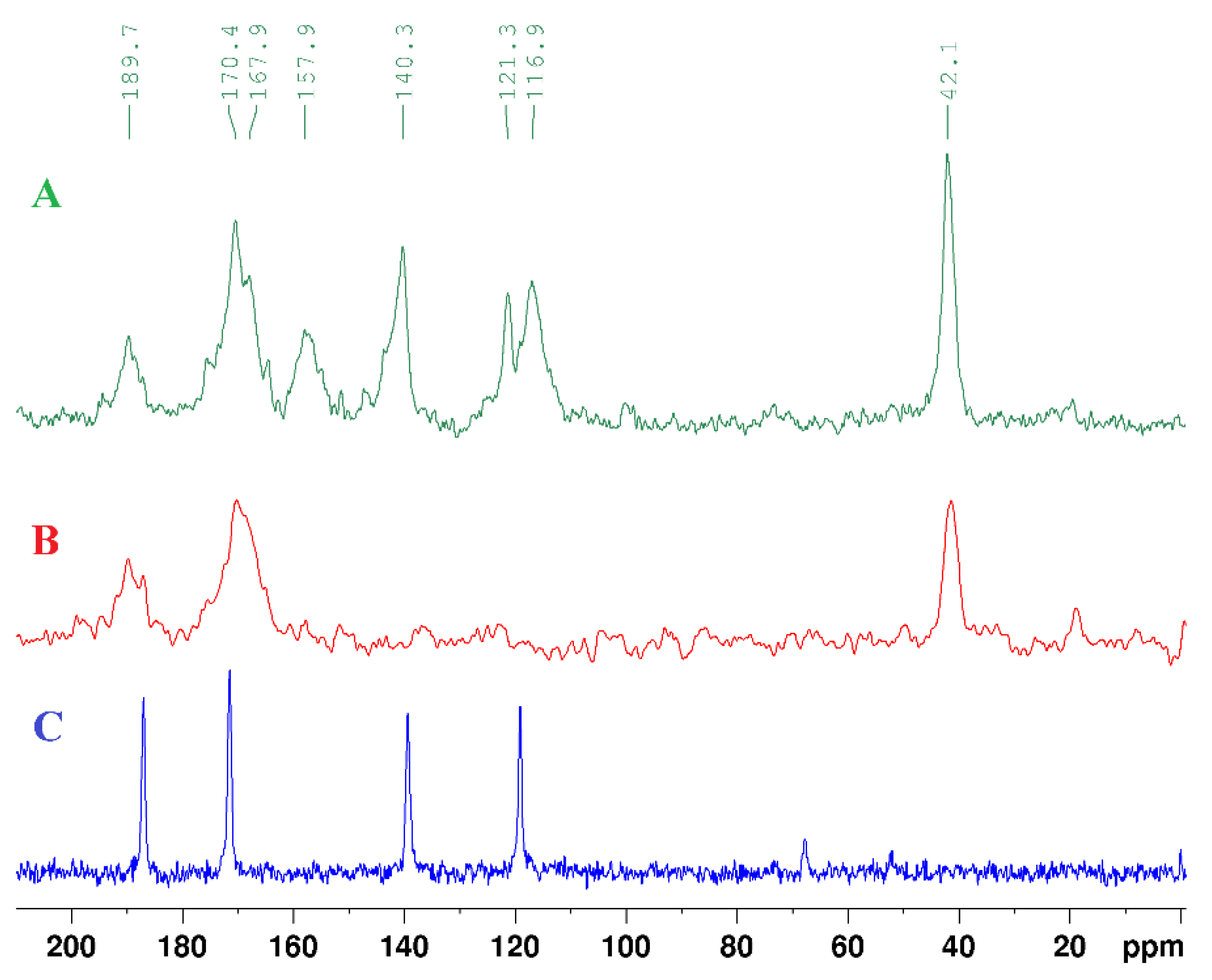
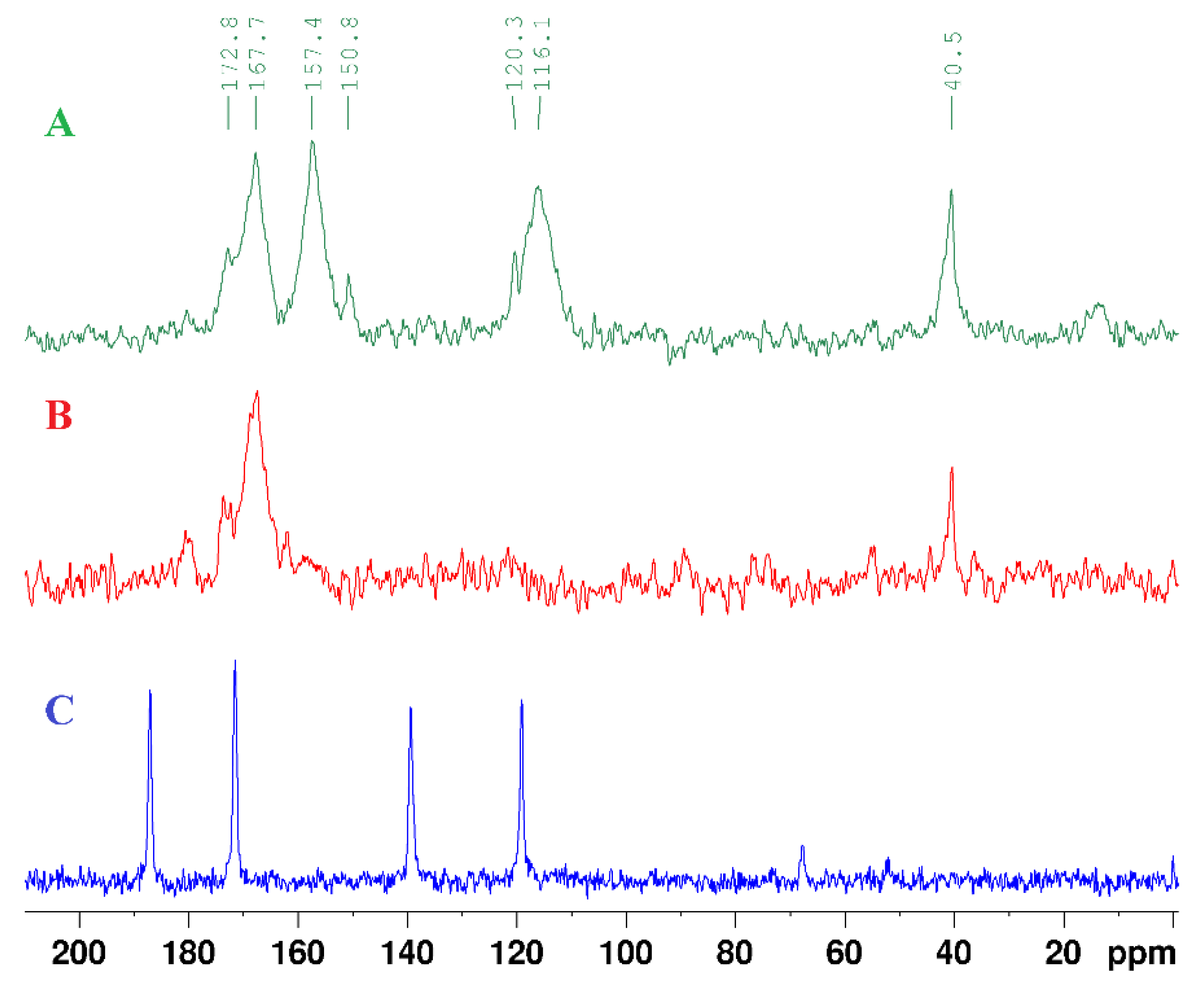
DFT GIAO computations were employed to confirm the experimental 13C CPMAS NMR results and to propose the most suitable model structure for the Al(III) complex [71]. Marinova et al. was obtained new Pd(II) and Cu(II) complexes with 6-methyl-2-thiouracil and 6-propyl-2-thiouracil [72], Au(III) and Cu(II) complexes with 2,4-dithiouracil [73], Au(III) complex with 6-methyl-2-thioxo-2,3-dihydropyrimidin-4(1H)-one [74], Pt(II) complexes with f 5-substituted 2,4-dithiohydantoins [75]. The solid-state NMR spectra of metal complexes [72,73,74] are given in Figure 6, Figure 7, Figure 8, Figure 9 and Figure 10.
Schiff bases are a widely studied class of organic compounds because of their versatility, ease of synthesis, and remarkable coordination abilities, which make them useful across multiple scientific fields. Named after the German chemist Hugo Schiff, these compounds are generally formed by the condensation of primary amines with carbonyl compounds (usually aldehydes or ketones). The resulting azomethine (-C=N-) functional group is essential to Schiff bases, lending them a unique chemical reactivity that allows for the formation of stable complexes with various metals.
1. Coordination Chemistry and Structural Properties:
Schiff bases are known for their ability to form stable complexes with transition metals, a property leveraged widely in coordination chemistry. Their coordination with metal ions largely depends on the lone electron pair on the azomethine nitrogen, which has been well-documented for its role in stabilizing these complexes [76] New Cu(II) complexes with 2,2’-bis(((E)-2-hydroxybenzylidene)amino)-[1,1’-biphenyl]-4,4′-dicarboxylic acid were synthesized by Bogdanovi’c et al. [77].
2. Applications in Biological Chemistry:
Schiff bases and their metal complexes often exhibit notable biological activities such as antimicrobial and antifungal properties [78]. The presence of the -C=N- group is thought to contribute to these effects due to its interaction with biological macromolecules. Тhe novel dinuclear Ag(I) complex with 2-((E)-(((E)-1-(thiazol-2-yl)ethylidene)hydrazono)methyl)phenol were obtained [79]. The antioxidant, antimicrobial and cytotoxic activities of the free ligand and the complex were discussed also. The new transition metal complexes with pyridoxal-semicarbazone ligand have shown significant biological activity [80]. Recently Sinicropi et al. presents a review witch highlights the latest research on the antimicrobial and cell-growth-inhibiting effects of Schiff base (SBs) metal complexes [81]. Additionally, recent findings on both single-core and dual-core SBs complexes are outlined, covering activities such as antioxidant, antidiabetic, antimalarial, antileishmanial, anti-Alzheimer’s, and catecholase functionalities. A study published describes the X-ray structure of nickel(II) complexes coordinated with a Schiff base derived from s-triazine hydrazine. This work discusses the complexes hexa-coordinated geometry and examines its potential antimicrobial properties, offering insights into the coordination behavior and structural stability [82] Another paper by Kargar et al. discusses various Schiff base complexes with metals such as Cu(II) and Zn(II), also characterized by X-ray diffraction. Their findings reveal the octahedral geometry around the Cu(II) ion, highlighting the Schiff base’s versatility in forming stable metal-ligand structures. This work also assesses the biological activity of these complexes, making it a valuable reference for both structural and functional insights [83].
New Mo(VI) complexes with (E)-4-amino-N’-(3-ethoxy-2-hydroxybenzylidene)benzohydrazide) was obtained [84]
Additionally, Al-Shboul et al. provide structural analyses using X-ray crystallography for complexes with metals like iron, copper and zinc coordinated to Schiff bases. This research examines both structure and bioactivity, demonstrating the broad utility of Schiff bases in synthesizing diverse metal complexes with unique geometries [85]
3. Optical Properties and Photoluminescence:
Schiff base-metal complexes are promising in the field of optoelectronics, particularly due to their luminescent properties. Their ability to emit light makes them suitable for applications like LEDs and optical sensors [86]. The new Ru(II) complex with dioxygen ligand 3,3-(DPEphos)-3-(η2-O2)-closo-3,1,2-RuC2B9H11 was obtained [87]. The electrochemical studies have shown reversible Ru(II)-Ru(III) transition making the complexes suitable for application in catalysis of polymerization. The p-type doping of poly[NiSchiff] materials forms the foundation for most of their applications in electrochemical cells [88]. Electrodes modified with this polymer experience cycles of charging and discharging, during which charge-compensating anions, and sometimes solvent molecules, move in and out of the polymer network to preserve its electrical neutrality. Zinc complexes were studied experimentally and theoretically in view of their possible application as emitters in organic light emitting diodes (OLEDs) [89]. Summary data on the structure of the complexes and the donor atoms involved in the coordination are given in Table 1.
4. Solar Cells and Photovoltaic Applications:
In renewable energy, Schiff bases have shown potential for photovoltaic applications due to their tunable electronic properties, enhancing light absorption and electron transfer. Recent studies highlight their use in dye-sensitized solar cells, where Schiff bases serve as dyes or sensitizers [90,91].

5. Future Directions and Structure-Property Relationship:

The design of new materials with improved electronic and photonic properties involves a deep understanding of the relationship between structure and function in Schiff base complexes [92].
These references provide a foundation for understanding the chemistry, properties, and wide-ranging applications of Schiff bases and should aid in further exploration of this field. In summary, Schiff bases are an attractive subject in coordination chemistry due to their versatility, multifaceted applications, and potential to advance various technological fields, especially in renewable energy and photonics.
One paper focuses on the analysis of solid-state NMR for catalysts and surface species, particularly leveraging high magnetic field strengths (28.2 T) and fast magic angle spinning (MAS) for improved resolution [93]. This approach is especially useful in studying surfaces such as silica-supported catalysts and alumina. It highlights the benefits of fast-MAS in resolving complex spectral details, which can improve understanding of active sites on catalyst surfaces. Another study examines phase evolution in perovskite materials using solid-state NMR, in combination with powder X-ray diffraction (XRD) and calorimetry [94]. This research explores mechanochemically synthesized dual-cation perovskites and provides insights into cation distribution and crystal phase transitions, which are critical for materials used in electronic and energy applications. A study presented a 3D relaxation-assisted separation technique to improve the resolution of solid-state NMR patterns, especially useful for overlapping signals in complex organic and biological compounds. This technique enhances signal processing through principal component analysis, allowing for better structural insights in compounds like polymers and pharmaceutical materials [95].
Cano et al. used 13C CP/MAS-NMR spectra of organic matter as influenced by climate, vegetation, and soil characteristics in soils from Murcia, Spain [96]. Solid-state cross-Polarization Magic Angle Spinning Carbon-13 Nuclear Magnetic Resonance used to investigate the structure and interactions of cellulose I by Larsson et al. [97]. Solid-state carbon-13 cross-polarization magic-angle spinning nuclear magnetic resonance spectroscopy is commonly used to study starches from plants such as potato, maize and wheat. However, its application to rice starch has been limited. In this study, was combined 13C CP/MAS NMR with deconvolution and subtraction techniques to analyze various rice varieties, including mutants that lack one or more enzymes involved in the biosynthesis of amylose and/or amylopectin. [98]. A series of 2-phenylimidazolecarbaldehydes [99] and 5-spiro-2,4-dithiohydantoins [100] were synthesized and investigated by detailed in the solid-state NMR and 1H and 13C NMR in solution, as well as DFT calculations also used. The summary data of organic compound are given in Table 2.

4. Conclusions

A review on solid-state NMR of chemical compounds would likely conclude by summarizing its essential contributions and advancements across chemistry and materials science. Here’s an outline of potential conclusions:
1. Versatile Tool for Structural Analysis: Solid-state NMR has emerged as a critical tool for studying the atomic-level structure of organic, inorganic, and hybrid materials. Its capability to provide information on both ordered and disordered phases allows scientists to probe complex structures, including crystalline lattices and amorphous regions that are often inaccessible by other techniques like X-ray diffraction.
2. Enhanced Understanding of Molecular Dynamics: Solid-state NMR enables the analysis of molecular motions and interactions within materials. This is particularly valuable for materials with specific applications, such as catalysts, pharmaceuticals, and organic semiconductors, where the dynamics impact material stability and functionality.
3. Technological Improvements: Advances like fast magic-angle spinning (MAS), high-field magnets, and multidimensional NMR techniques (such as 2D and 3D relaxation-assisted separation) have significantly improved the resolution and sensitivity of solid-state NMR. These advancements allow for detailed analysis of complex mixtures and overlapping signals, opening up new possibilities in fields like drug development and polymer science.
4. Complementary Role with Other Analytical Techniques: Solid-state NMR complements other methods, such as X-ray scattering and electron microscopy, providing insights at different structural levels. Together, these methods form a comprehensive toolkit for characterizing both the chemical and physical properties of materials.
Overall, the conclusions emphasize the value of solid-state NMR as an irreplaceable tool in modern chemical research, providing critical insights into the structure, dynamics, and properties of a vast range of chemical compounds.

Author Contributions

Conceptualization, P.M. and K.T; writing—original draft preparation, P.M. and K.T; writing—review and editing, P.M. and K.T; project administration, S.T.; funding acquisition, P.M.

Acknowledgments

We acknowledge the financial support from the Fund for Scientific Research of the Plovdiv University, project СП 23-ХФ-006.

Conflicts of Interest

The authors declare no conflict of interest.

References

  1. Yeongseo An, Sergey L. Sedinkin and Vincenzo Venditti. Solution NMR methods for structural and thermodynamic investigation of nanoparticle adsorption equilibria. Nanoscale Adv., 2022, 4, 2583-2607. [CrossRef]
  2. M. Mohan, A. B. A. Andersen, J. Mareš, N. D. Jensen, U. G. Nielsen, J. Vaara. Unravelling the effect of paramagnetic Ni²⁺ on the ¹³C NMR shift tensor for carbonate in Mg₂₋ₓNiₓ Al layered double hydroxides by quantum-chemical computations. Phys. Chem. Chem. Phys, 2023. [CrossRef]
  3. R. Uzal-Varela, F. Lucio-Martínez, A. Nucera, M. Botta, D. Esteban-Gómez, L. Valencia, A. Rodríguez-Rodríguez, C. Platas-Iglesias. A systematic investigation of the NMR relaxation properties of Fe(III)-EDTA derivatives and their potential as MRI contrast agents. Inorganic Chemistry Frontiers, 2023. [CrossRef]
  4. Ö. Üngör, S. Sanchez, T. M. Ozvat, J. M. Zadrozny. Asymmetry-enhanced 59Co NMR thermometry in Co(III) complexes. Inorganic Chemistry Frontiers, 2023. [CrossRef]
  5. Y. Zhang, H. T. Fei, G. T. Liu, W. Wang, Y. J. Sun, C. J. Wu. Exploring paramagnetic NMR and EPR for studying the bonding in actinide complexes. Dalton Transactions, 2023. [CrossRef]
  6. E. Göthner, K. Lehmann, D. Grote, A. L. Spek, J. P. Hill, M. Ikeda. NMR studies on manganese(II) complexes for enhanced relaxivity in MRI applications. Inorg. Chem., 2023. [CrossRef]
  7. H. K. Shin, S. J. Lee, T. J. Kim, K. G. Lee, D. H. Kang, J. T. Son. Analyzing 31P NMR shifts in molybdenum phosphide nanoclusters. J. Mol.Str., 2023. [CrossRef]
  8. D. Adams, C. J. Hines, M. L. Rodriguez. Utilizing high-field NMR for detection of low-spin iron(III) centers in bioinorganic complexes. J. Inorg. Biochem., 2023. [CrossRef]
  9. T. Bai, A. Y. Lee, J. Chen, Z. Ma. Coordination dynamics in copper(I) complexes: A study through variable-temperature NMR. Inorg. Chem. Commun., 2023. [CrossRef]
  10. G. L. Brett, R. D. Armstrong, S. P. Thomas, C. J. McQueen. Exploring transition metal complex environments via 1H and 31P NMR spectroscopy. Chemistry - A European Journal, 2023. [CrossRef]
  11. Middleton, D.A., Griffin, J., Esmann, M., Fedosova, N.U. Solid-state NMR chemical shift analysis for determining the conformation of ATP bound to Na,K-ATPase in its native membrane. RSC Advances, 2023. [CrossRef]
  12. Smith, M.E., et al. Recent progress in solid-state NMR of spin-½ low-γ nuclei applied to inorganic materials. Phys. Chem. Chem. Phys. 2023. [CrossRef]
  13. Zhang, L., et al. Advanced Solid-State NMR Studies of Transition Metal Complexes. J. Americ. Chem.l Soc., 2022. [CrossRef]
  14. Kumar, A.; Sahoo, S. K. Structural insights into metallocomplexes via SSNMR and DFT. Inorganic Chemistry Frontiers, 2021. [CrossRef]
  15. Pyykkö, P., et al. Analyzing the crystal lattice effects in inorganic complexes by MAS SSNMR. Dalton Transactions, 2020. [CrossRef]
  16. Yamada, K.; Saito, T. Exploring ligand field environments in metal complexes by SSNMR. Magnetic Resonance in Chemistry, 2019. [CrossRef]
  17. Goldman, M., et al. Solid-state NMR of paramagnetic inorganic materials. Accounts of Chemical Research, 2019. [CrossRef]
  18. Chen, S., et al. Applications of solid-state NMR in transition metal coordination complexes. Chemical Society Reviews, 2018. [CrossRef]
  19. Goodfellow, M.; et al. Insights into metal-oxo complexes via SSNMR. Chemistry - A European Journal, 2018. [CrossRef]
  20. Silva, T.F.; et al. High-resolution SSNMR for probing zeolite frameworks and associated metals. Microporous and Mesoporous Materials, 2017. [CrossRef]
  21. Garg, S.; et al. SSNMR in elucidating bimetallic complex structures. Journal of Magnetic Resonance, 2017. [CrossRef]
  22. Hara, Y.; et al. Computational solid-state NMR on organometallic systems. Computational Chemistry, 2016. [CrossRef]
  23. Wilson, J.E.; et al. Dynamic nuclear polarization in SSNMR for metal complexes. J. Americ. Chem. Soc., 2015. [CrossRef]
  24. Ivanchikova, I.D.; et al. SSNMR insights into catalytic active sites in complex oxides. Catalysis Today, 2015. [CrossRef]
  25. Furukawa, H.; et al. Metal-organic frameworks studied by SSNMR. Chemical Reviews, 2014. [CrossRef]
  26. Yates, J.R.; et al. SSNMR computational methods for inorganic complexes. J. Chem. Phys., 2014. [CrossRef]
  27. Ashbrook, S.E.; Wimperis, S. Exploring quadrupolar nuclei in inorganic systems using SSNMR. Progress in Nuclear Magnetic Resonance Spectroscopy, 2013. [CrossRef]
  28. Mason, H.E.; et al. Applications of SSNMR in porous and microporous materials. Solid State Nuclear Magnetic Resonance, 2013. [CrossRef]
  29. Brown, S.P.; et al. Advanced SSNMR for characterizing complex inorganic networks. Accounts of Chemical Research, 2012. [CrossRef]
  30. Feyrer, F.; et al. NMR crystallography applications in metal complex structures. Zeitschrift für Anorganische und Allgemeine Chemie, 2012. [CrossRef]
  31. Peters, D.; et al. SSNMR characterization of metal-ligand coordination frameworks. Dalton Transactions, 2011. [CrossRef]
  32. Deschamps, M.; et al. SSNMR of metal oxides in catalysis.Topics in Catalysis, 2011. [CrossRef]
  33. Ernst, M.; et al. Developments in SSNMR techniques for coordination chemistry. Angewandte Chemie International Edition, 2010. [CrossRef]
  34. Gray, H.B.; et al. Solid-state 15N NMR of nitrogen-rich complexes. Inorg. Chem., 2010. [CrossRef]
  35. Kaupp, M.; et al. Computational SSNMR approaches in metallocomplexes. Chem. Phys. Lett., 2010. [CrossRef]
  36. Iglesias-Reguant, A., Reis, H., Medveď, M., Luis, J. M., & Zaleśny, R. A New Computational Tool for Interpreting the Infrared Spectra of Molecular Complexes. Phys. Chem. Chem. Phys. 2023, 25, 11658-11664. [CrossRef]
  37. Golea, C. M.; Codină, G. G.; Oroian, M. Prediction of Wheat Flours Composition Using Fourier Transform Infrared Spectrometry (FT-IR). Food Control 2023, 143, 109318. [CrossRef]
  38. Yaman, H.; Aykas, D. P.; Rodriguez-Saona, L. E. Monitoring Turkish White Cheese Ripening by Portable FT-IR Spectroscopy. Front. Nutr. 2023, 10, 1107491. [CrossRef]
  39. Wu, J.; Peng, H.; Li, L.;Wen, L.; Chen, X.; Zong, X. FT-IR Combined with Chemometrics in the Quality Evaluation of Nongxiangxing Baijiu. Spectrochim. Acta Part A 2023, 284, 121790. [CrossRef]
  40. Laouni, A.; El Orche, A.; Elhamdaoui, O.; Karrouchi, K.; El Karbane, M.; Bouatia, M. A. Preliminary Study on the Potential of FT-IR Spectroscopy and Chemometrics for Tracing the Geographical Origin of Moroccan Virgin Olive Oils. J. AOAC Int. 2023, 106 (3), 804–812. [CrossRef]
  41. Cruz-Tirado, J. P.; de Franca, R. L.; Tumbajulca, M.; Barraza-Jauregui, G.; Barbin, D. F. Detection of Cumin Powder Adulteration with Allergenic Nutshells Using FT-IR and Portable NIRS Coupled with Chemometrics. J. Food Compos. Anal. 2023, 116, 105044. [CrossRef]
  42. Hajiseyedrazi, Z. S.; Khorrami, M. K.; Mohammadi, M. Alternating Conditional Expectation (ACE) Algorithm and Supervised Classification Models for Rapid Determination and Classification of Adulterated Cinnamon Samples Using Diffuse Reflectance FT-IR Spectroscopy. J. Food Compos. Anal. 2024, 131, 106226. [CrossRef]
  43. Reale, S.; Biancolillo, A.; Foschi, M.; Di Donato, F.; Di Censo, E.; D’Archivio, A. A. Geographical Discrimination of Italian Carrot (Daucus carota L.) Varieties: A Comparison Between ATR FT-IR Fingerprinting and HS-SPME/GC-MS Volatile Profiling. Food Control 2023, 146, 109508. [CrossRef]
  44. Sari, N.; Widiastuti, E. L.; Pratami, G. D. Microplastic Analysis at Seawater and Sediment in the Mahitam Island Lampung Bay Using FT-IR. J. Biol. Exp. Biodivers. 2023, 10 (1), 7–13. [CrossRef]
  45. El Orche, A.; et al. Comparative Analysis of Olive Oil Polyphenols Using FT-IR and GC-MS. Anal. Chem. Insights 2022, 14, 43–57. [CrossRef]
  46. Koubaa, Z.; Rouatbi, L.; Marrakchi, F.; Salih, B. Infrared Spectroscopic Study on Coordination in Metal Complexes. J. Mol. Struct. 2019, 1185, 132-145. [CrossRef]
  47. Ben Brahim, K.; Ben Gzaiel, M.; Oueslati, A.; Khirouni, K..; Gargouri, M.; Corbel, G.; Bardeau, J.-F. Organic–inorganic interactions revealed by Raman spectroscopy during reversible phase transitions in semiconducting [(C₂H₅)₄N]FeCl₄. RSC Advances 2021, 11, 18651-18660. [CrossRef]
  48. Lin, Y.; Yang, H.; Zhai, Y.; Cui, X.; Liu, J. Raman spectroscopy for in situ monitoring of reactions and phase transitions in metal–organic frameworks. Inorganic Chemistry Frontiers 2020, 7(14), 2713-2720. [CrossRef]
  49. Lv, X.; Li, X.; Li, G. Raman spectroscopic investigation of the structural changes in rare earth–metal phosphates. Journal of Raman Spectroscopy, 2019, 50(3), 524-533. [CrossRef]
  50. Kocak, Y.; Orhan, H. E.; Saka, E. T.; Demirbas, U. Insights into the structure of oxalate-based metal complexes using Raman and IR spectroscopy. Spectrochimica Acta Part A: Molecular and Biomolecular Spectroscopy 2018, 202, 268-275. [CrossRef]
  51. Saha, B.; Das, S.; Sen, P. Surface-enhanced Raman scattering study of transition metal complexes in inorganic matrices. Journal of Materials Chemistry A 2017, 5(14), 6694-6703. [CrossRef]
  52. Green, V.; Baxter, E. Raman spectroscopy of vanadyl–phosphate complexes: Implications for structural characterization. Inorganic Chemistry 2016, 55(7), 3156-3162. [CrossRef]
  53. Thompson, S. M.; Ellis, A. Using Raman and IR spectroscopy to monitor hydrolysis reactions in titanium complexes. Inorganica Chimica Acta 2015, 426, 145-152. [CrossRef]
  54. Ramachandran, A.: Patra, A. Metal-ligand vibrations in coordination compounds: Raman and IR spectroscopic analysis. Coordination Chemistry Reviews 2013, 257(3-4), 579-591. [CrossRef]
  55. Sekine, Y.; Nihei, M.; Kumai, R.; Nakao, H.; Murakami, Y.; Oshio, H. Investigation of the light-induced electron-transfer-coupled spin transition in a cyanide-bridged [Co₂Fe₂] complex by X-ray diffraction and absorption measurements. Inorganic Chemistry Frontiers, 2014, 1(4), 540-543. [CrossRef]
  56. Matteppanavar, S.; Rayaprol, S.; Singh, K.; Raghavendra Reddy, V.; Angadi, B. Structural, magnetic, and dielectric properties of perovskite-type complex oxides La₃FeMnO₇ studied using X-ray diffraction. J. Mater. Sci., 2015, 50(13), 4980-4993. [CrossRef]
  57. Mustafin, E.S.; Mataev, M.M.; Kasenov, R.Z.; Pudov, A.M.; Kaykenov, D.A. Synthesis and X-ray diffraction studies of a new pyrochlore oxide (Tl₂Pb)(MgW)O₇. Inorganic Materials, 2014, 50(5), 672-675. [CrossRef]
  58. Cheong, S.; Mostovoy, M. Multiferroics: a magnetic twist for ferroelectricity. Nature Materials, 2007, 6(1), 13-20. [CrossRef]
  59. Valencia, S.; Konstantinovic, Z.; Schmitz, D.; Gaupp, A. X-ray magnetic circular dichroism study of cobalt-doped ZnO. Physical Review B, 2011, 84, 024413. [CrossRef]
  60. Harder, R.; Robinson, I.K. Three-dimensional mapping of strain in nanomaterials using X-ray diffraction microscopy. New Journal of Physics, 2010, 12, 035019. [CrossRef]
  61. Newton, M.C.; Leake, S.J.; Harder, R.; Robinson, I.K. Three-dimensional imaging of strain in ZnO nanorods using coherent X-ray diffraction. Nature Materials 2010, 9, 120-125. [CrossRef]
  62. Cha, W.; Ulvestad, A.; Kim, J.W. Coherent diffraction imaging of crystal strains and phase transitions in complex oxide nanocrystals. Nature Communic. 2018, 9, 3422. [CrossRef]
  63. Diao, J.; Ulvestad, A. In situ study of ferroelastic domain wall dynamics in BaTiO₃ nanoparticles by X-ray diffraction microscopy. Physical Review Materials, 2020, 4, 053601. [CrossRef]
  64. Kim, J.; Robinson, I.K. Real-time observation of defect dynamics during oxidation in Pt nanoparticles using coherent X-ray diffraction imaging. Nano Letters 2015, 15(7), 5044-5051. [CrossRef]
  65. Pfeifer, M.A.; Williams, G.J.; Vartanyants, I.A.; Harder, R.; Robinson, I.K. Three-dimensional mapping of a deformation field inside a nanocrystal using coherent X-ray diffraction. Nature 2006, 442, 63-66. [CrossRef]
  66. Song, C.; Nam, D. Quantitative imaging of single, unstained viruses with coherent X-rays. Physical Review Letters, 2014, 101, 158101. [CrossRef]
  67. Ahmedova, A.; Marinova, P.; Paradowska, K.; Stoyanov, N.; Wawer, I.; Mitewa, M. Spectroscopic aspects of the coordination modes of 2,4-dithiohydantoins: Experimental and theoretical study on copper and nickel complexes of cyclohexanespiro-5-(2,4-dithiohydantoin), Inorg. Chim. Acta 2010, 363, 3919-3925. [CrossRef]
  68. Ahmedova, A.; Marinova, P.; Paradowska, K.; Marinov, M.; Wawer, I.; Mitewa, M. Structure of 2,4-dithiohydantoin complexes with copper and nickel – Solid-state NMR as verification method, Polyhedron 2010, 29, 1639-1645. [CrossRef]
  69. Ahmedova, A.; Pavlović, G.; Marinov, M.; Marinova, P.; Momekov, G.; Paradowska, K.; Yordanova, S.; Stoyanov, S.; Vassilev, N.; Stoyanov N. Synthesis and anticancer activity of Pt(II) complexes of spiro-5-substituted 2,4-dithiohydantoins”, Inorg. Chim. Acta 2021, 528, Article number 120605. doi.org/10.1016/j.ica.2021.120605.
  70. Ahmedova, A.; Marinova, P.; Paradowska, K.; Marinov, M.; Mitewa, M. Synthesis and characterization of Copper(II) and Ni(II) complexes of (9’-fluorene)-spiro-5-dithiohidantoin, J.Mol.Str. 2008, 892, 13-19. [CrossRef]
  71. Ahmedova, A.; Paradowska, K.; Wawer I. 1H, 13C MAS NMR and DFT GIAO study of quercetin and its complex with Al(III) in solid state, J. Inorg. Biochem. 2012, 110, 27-35. [CrossRef]
  72. Marinova, P.; Hristov,M.; Tsoneva, S.; Burdzhiev,N.; Blazheva, D.; Slavchev, A.; Varbanova, E.; Penchev, P. Synthesis, Characterization, and Antibacterial Studies of New Cu(II) and Pd(II) Complexes with 6-Methyl-2-Thiouracil and 6-Propyl-2-Thiouracil. Appl. Sci. 2023, 13, 13150-13168. [CrossRef]
  73. Marinova, P.; Stoitsov, D.; Burdzhiev, N.; Tsoneva, S.; Blazheva, D.; Slavchev, A.; Varbanova, E.; Penchev, P. Investigation of the Complexation Activity of 2,4-Dithiouracil with Au(III) and Cu(II) and Biological Activity of the Newly Formed Complexes. Appl. Sci. 2024, 14, 6601. [CrossRef]
  74. Marinova, P.; Burdzhiev, N.; Blazheva, D.; Slavchev, A. Synthesis and Antibacterial Studies of a New Au(III) Complex with 6-Methyl-2-Thioxo-2,3-Dihydropyrimidin-4(1H)-One. Molbank 2024, 2024, M1827. [CrossRef]
  75. Ahmedova, A.; Marinova, P.; Paradowska, K.; Tyuliev, G.; Marinov, M.; Stoyanov, N. Spectroscopic study on the solid state structure of Pt(II) complexes of cycloalkanespiro-5-(2,4-dithiohydantoins), Bulg. Chem. Communic., 2024, Vol. 56, Special Issue C, 89-95. [CrossRef]
  76. Gup, R.; Gokce, C. Coordination Chemistry of Schiff Bases and their Metal Complexes. Coord. Chem. Rev. 2015, 296, 101-109. [CrossRef]
  77. Bogdanovi’c, M.G.; Radnovi’c, N.D.; Barta Holló, B. Radanovi’c, M.M.; Kordi’c, B.B.; Raiˇcevi’c, V.N.; Vojinovi’c-Ješi’c, L.S.; Rodi’c, M.V. Polymeric Copper(II) Complexes with a Newly Synthesized Biphenyldicarboxylic Acid Schiff Base Ligand—Synthesis, Structural and Thermal Characterization. Inorganics 2022, 10, 261. [CrossRef]
  78. Ali, M.; Mirza, Z. Schiff Base Complexes as Antimicrobial Agents. J. Mol. Str. 2017, 1154, 187-201. [CrossRef]
  79. Altowyan, M.S.; Soliman, S.M.; Al-Wahaib, D.; Barakat, A.; Ali, A.E.; Elbadawy, H.A. Synthesis of a New Dinuclear Ag(I) Complex with Asymmetric Azine Type Ligand: X-ray Structure and Biological Studies. Inorganics 2022, 10, 209. [CrossRef]
  80. Jevtovic, V.; Golubovi’c, L.; Alshammari, O.A.O.; Alhar, M.S.; Alanazi, T.Y.A.; Rad-ulovi’c, A.; Nakarada, Ð.; Dimitri’c Markovi’c, J.; Raki’c, A.; Dimi’c, D. Structural, Antioxidant, and Protein/DNA-Binding Properties of Sul-fate-Coordinated Ni(II) Complex with Pyridox-al-Semicarbazone (PLSC) Ligand. Inorganics 2024, 12, 280. [CrossRef]
  81. Sinicropi, M.S.; Ceramella,J.; Iacopetta, D.; Catalano, A.; Mariconda, A.; Rosano, C.; Saturnino, C.; El-Kashef, H.; Longo, P. Metal Complexes with Schiff Bases: Data Collection and Recent Studies on Biological Activities. Int. J. Mol. Sci. 2022, 23, 14840. [CrossRef]
  82. Fathalla, E.M.; Abu-Youssef, M.A.M.; Sharaf, M.M.; El-Faham, A.; Barakat, A.; Haukka, M.; Soliman, S.M. Synthesis, X-ray Structure of Two Hexa-Coordinated Ni(II) Complexes with s-Triazine Hydrazine Schiff Base Ligand. Inorganics 2023, 11, 222. https:// doi.org/10.3390/inorganics11050222.
  83. Kargar, H.; Meybodi, F.A.; Ardakani, R.B.; Elahifard, M.R.; Torabi, V.; Mehrjardi, M.F.; Tahir, M.N.; Ashfaq, M.; Munaware, K.S. Synthesis, crystal structure, theoretical calculation, spectroscopic and antibacterial activity studies of copper (II) complexes bearing bidentate Schiff base ligands derived from 4-aminoantipyrine: Influence of substitutions on antibacterial activity. J. Mol. Struct. 2021, 1230, 129908. [CrossRef]
  84. Kargar, H.; Nateghi-Jahromi, M.; Fallah-Mehrjardi, M.; Behjatmanesh-Ardakani, R.; Munawar, K.S.; Ali, S.; Ashfaq, M.; Tahir, M.N. Synthesis, spectral characterization, crystal structure and catalytic activity of a novel dioxomolybdenum Schiff base complex containing 4-aminobenzhydrazone ligand: A combined experimental and theoretical study. J. Mol. Struct. 2022, 1249, 131645. [CrossRef]
  85. Al-Shboul, T.M.A.; El-khateeb, M.; Obeidat, Z.H.; Ababneh, T.S.; Al-Tarawneh, S.S.; Al Zoubi, M.S.; Alshaer,W.; Abu Seni, A.; Qasem, T.; Moriyama, H.; et al. Synthesis, Characterization, Computational and Biological Activity of Some Schiff Bases and Their Fe, Cu and Zn Complexes. Inorganics 2022, 10, 112. [CrossRef]
  86. Rao, C.N.R.; Nayak, B. Photoluminescent Metal-Organic Complexes with Schiff Bases for Optoelectronics. J. Phys. Chem. 2018, 122(4), 432-442. [CrossRef]
  87. Zimina, A.M.; Somov, N.V.; Malysheva, Y.B.; Knyazeva, N.A.; Piskunov, A.V.; Grishin, I.D. 12-Vertex clo-so-3,1,2- Ruthenadicarba-dodecaboranes with Chelate POP-Ligands: Synthesis, X-ray Study and Electrochemical Properties. Inorganics 2022, 10, 206. [CrossRef]
  88. Smirnova, E.; Ankudinov, A.; Chepurnaya, I.; Ti-monov, A.; Karushev, M. In-Situ EC-AFM Study of Electrochemical P-Doping of Polymeric Nickel(II) Com-plexes with Schiff base Lig-ands. Inorganics 2023, 11, 41. [CrossRef]
  89. Vladimirova, K. G.; Freidzon, A. Ya.; Kotova, O. V.; Vaschenko, A. A.; Lepnev, L. S.; Bagatur’yants, A. A.; Vitukhnovskiy, A. G.; Stepanov, N. F.; Alfimov M. V. Theoretical Study of Structure and Electronic Absorption Spectra of Some Schiff Bases and Their Zinc Complexes, Inorg. Chem. 2009, 48, 23, 11123–11130. [CrossRef]
  90. Wang, X.; Zhang, L. Applications of Schiff Base Complexes in Solar Cells. Solar Energy Materials and Solar Cells, 2020, 210, 110550. [CrossRef]
  91. M. Radanović, Mirjana, and Marijana S. Kostić. Schiff Bases and Their Metal Complexes in Solar Cells. Advances in Analytical Chemistry - Applications and Innovations [Working Title] 2024. IntechOpen. [CrossRef]
  92. Wang, S.; Yang, D. Structure-Property Relationships in Schiff Base-Metal Complexes for Advanced Functional Materials. Advanced Materials 2021, 33(5), 2100035. [CrossRef]
  93. Berkson Z, Björgvinsdóttir S, Yakimov A, Gioffrè D, Korzyński M, Barnes A, et al. Solid-state NMR spectra of protons and quadrupolar nuclei at 28.2 T: resolving signatures of surface sites with fast magic angle spinning. ChemRxiv. 2022;. [CrossRef]
  94. Sai S. H. Dintakurti, David Walker, Tobias A. Bird, Yanan Fang, Tim Whited and John V. Hanna. A powder XRD, solid state NMR and calorimetric study of the phase evolution in mechanochemically synthesized dual cation (Csx(CH3NH3)1-x)PbX3 lead halide perovskite systems, Phys. Chem. Chem. Phys., 2022, 24, 18004-18021. [CrossRef]
  95. Altenhof, A. R.; Jaroszewicz, M. J.; Frydman L.; Schurko, R. W. 3D relaxation-assisted separation of wideline solid-state NMR patterns for achieving site resolution. Phys. Chem. Chem. Phys. 2022, 24, 22792-22805. [CrossRef]
  96. Cano, A. Faz.; Mermut, A. R.; Ortiz, R.; Benke, M. B.; Chatson B. 13C CP/MAS-NMR spectra of organic matter as influenced by vegetation, climate, and soil characteristics in soils from Murcia, Spain. Can. J. Soil Sci. 2002, 82(4), 403-411. [CrossRef]
  97. Larsson, P.T.; Hult, E.L.; Wickholm, K.; Pettersson, E.; Iversen, T. CP/MAS 13C-NMR spectroscopy applied to structure and interaction studies on cellulose I. Solid State Nucl. Magn. Reson. 1999, 15(1), 31-40. [CrossRef]
  98. Etsuko Katoh, Katsuyoshi Murata, Naoko Fujita. 13C CP/MAS NMR Can Discriminate Genetic Backgrounds of Rice Starch. ACS Omega 2020, 5, 38, 24592–24600. [CrossRef]
  99. Burdzhiev, N.; Ahmedova, A.; Borrisov, B.; Graf R. Molecules 2020, 25, 3770-3790. [CrossRef]
  100. Antonov, V.; Nedyalkova, M.; Tzvetkova, P.; Ahmedova, A. Solid State Structure Prediction Through DFT Calculations and 13C NMR Measurements: Case Study of Spiro-2,4-dithiohydantoins, Z. für. Phys. Chem. 2016, 230, 909–930. [CrossRef]
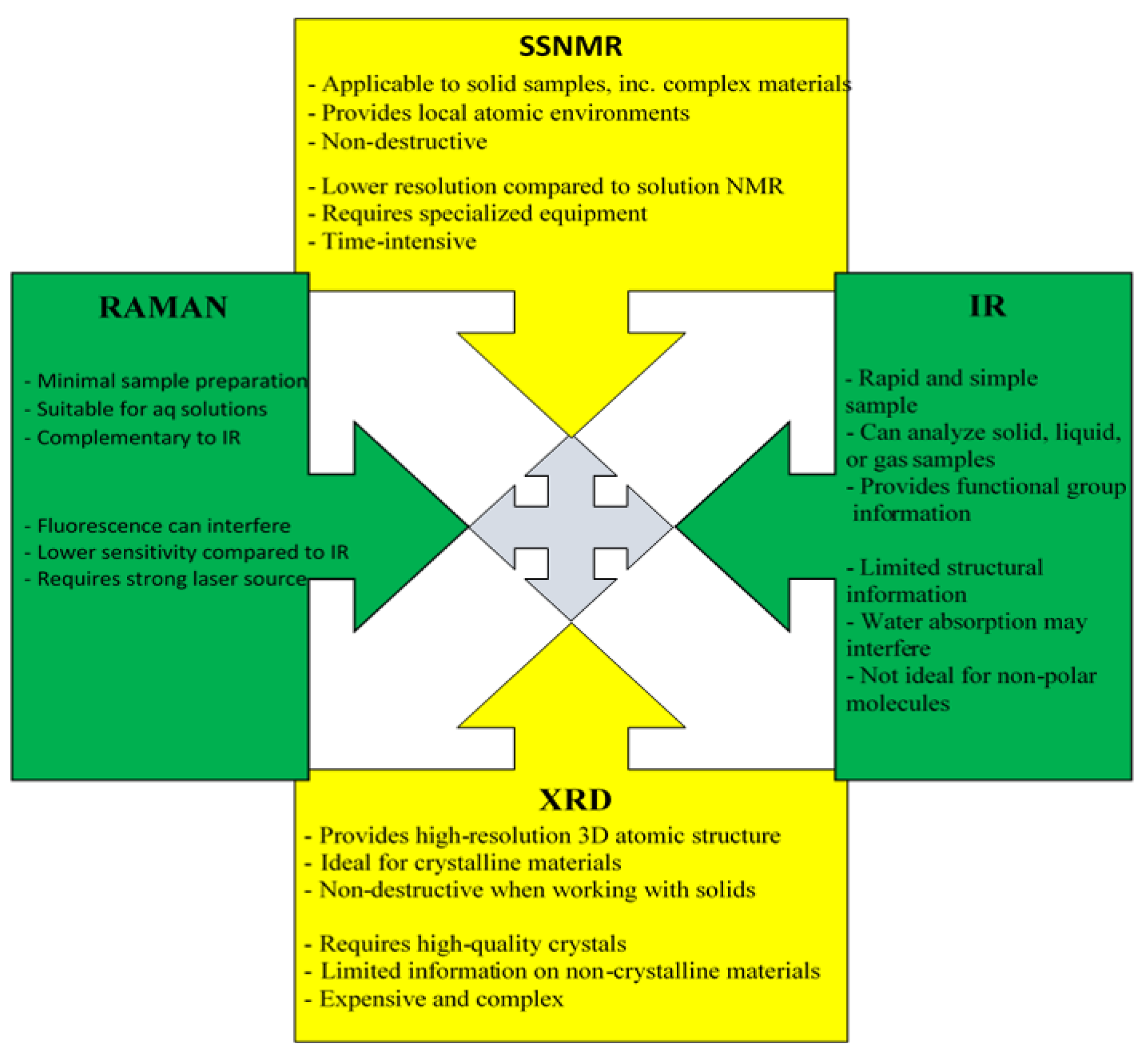
Scheme 1. The advantages and disadvantages of solid-state NMR, IR, Raman and X-ray methods.
Preprints 139725 sch001
Figure 6. Solid-state NMR of the ligand L1 (a) and its complex with copper (b) [72].
Preprints 139725 g006
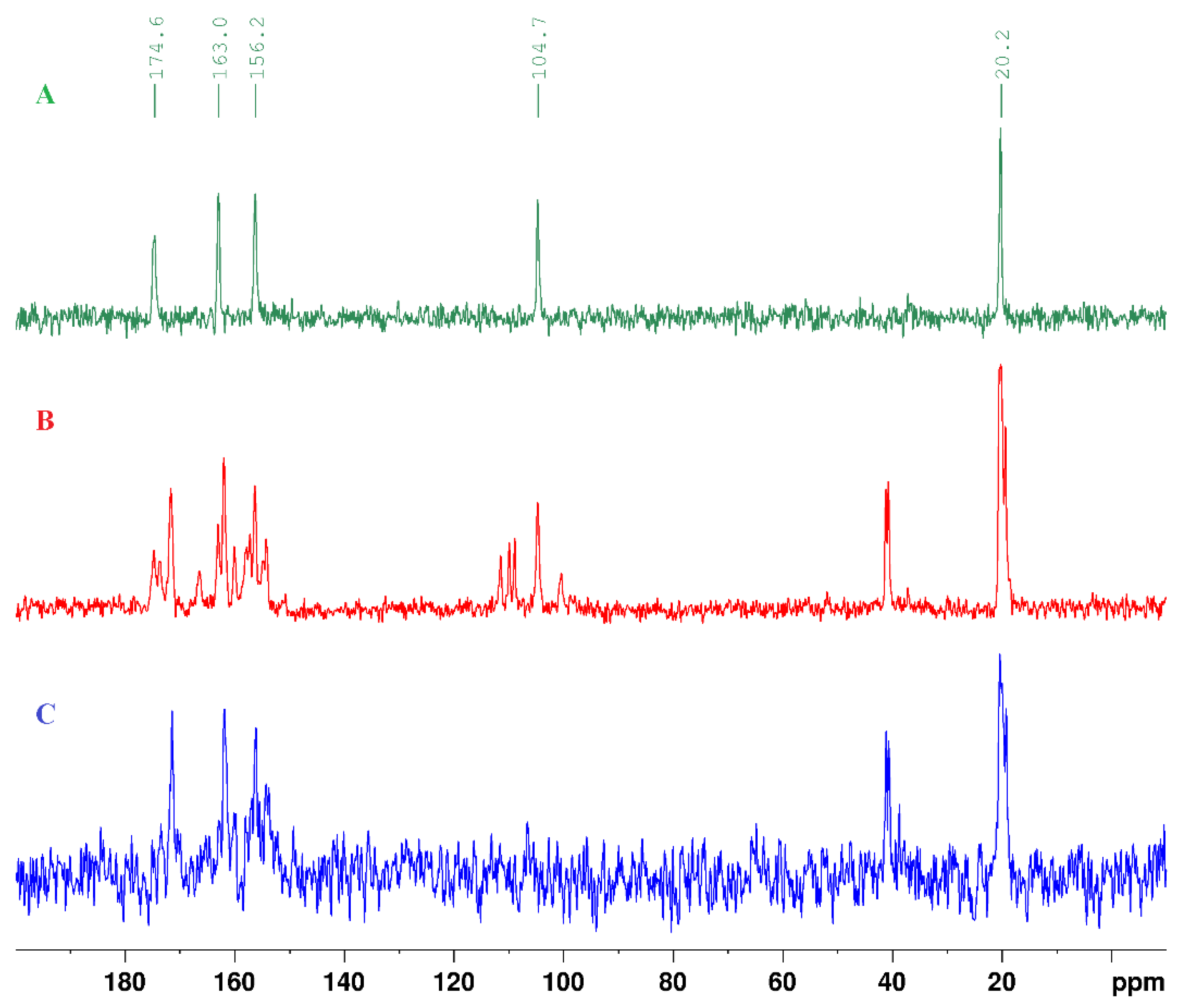
Figure 7. Solid-state NMR of the ligand L2 and its complexes: a) 13C CP spectrum of L2; b) 13C CP spectrum of Cu(II)L2; c) 13C CPPI spectrum of Cu(II)L2; d) 13C CP spectrum of Pd(II)L2 [72].
Preprints 139725 g007
Figure 8. CP MAS NMR spectrum of complex AuL (A); CPPI MAS NMR spectrum of complex AuL (B); CP MAS NMR spectrum of the ligand [73].
Preprints 139725 g008
Figure 9. 13C NMR acquired with MAS at 15 kHz. A—CP spectrum of the of complex CuL; B—CPPI spectrum of the complex; C—CP spectrum of the ligand [73].
Preprints 139725 g009
Figure 10. 13C NMR acquired with MAS at 15 kHz. A – CP spectrum of the ligand; B – CP spectrum of the complex; C – CPPI spectrum of the complex [74].
Preprints 139725 g010
Table 1. Summary data on the structure of the complexes and the donor atoms involved in the coordination.
technique donor atom metal structure references
13C CPMAS NMR, IR and FAB-MS and theoretical DFT studies N3^S4-bridging coordination Cu(I) and Ni(II) dimeric structures [67]
13C CPMAS NMR and theoretical DFT studies N3^S2-bridging coordination for L1 with Cu(I);
monodentate
coordination (N3- and S2- ) of two non-equivalent ligand molecules for L2 with Cu(I); N3^S4- bridging way for Ni(II)
Cu(I) and Ni(II) dimeric
structure for Cu(I) with L1; square planar for Ni(II) with L1 and L2
[68]
IR and 13C CPMAS NMR and theoretical DFT studies N and S Pt(II) square planar [69]
13C-NMR-CP-MAS, EPR,
IR and
quantum-chemical (DFT/B3LYP-6-31G
(d,p)) methods
N for Cu(II) and N3 and S2 for Ni(II) Cu(II) and Ni(II) distorted tetrahedral for Cu(II) and square planar for Ni(II) [70]
13C CPMAS NMR and theoretical DFT studies, X-ray O, Cl Al(III) six-membered chelate rings [71]
melting point analysis, MP-AES for Cu and Pd, UV-Vis, IR, ATR, 1H NMR, 13C NMR and Raman, Solid-state NMR spectroscopy O,S for L1 and S for L2 with Cu(II);
N, S, O with Pd(II)
Cu(II) and Pd(II) tetrahedral for Cu(II) with L1 and octahedral for L2; chelate for Pd(II) with L1 and L2 [72]
MP-AES for Cu and Au, ICP-OES for S, ATR, solution and solid-state NMR, and Raman
spectroscopy
N,S for Au(III) and O,S for Cu(II) Au(III) and Cu(II) chelate structure [73]
UV-Vis, IR, ATR, 1H NMR, HSQC, and Raman, solid-state NMR spectroscopy O, S Au(III) tetrahedral [74]
IR, FAB-MS, XPS, solid-state NMR spectroscopy and theoretical DFT studies N, S Pt(II) dimer, chelate structure [75]
X-ray neutral tridentate NNN-chelate Ni(II) distorted
octahedral geometry
[82]
X-ray bis-N,O-bidentate Schiff base ligands Cu(II) distorted tetrahedral
geometry
[83]
X-ray and FT-IR, 1H NMR, 13C NMR, and elemental analysis tridentate ONO-donor Schiff base ligand Mo(VI) distorted octahedral
coordination geometry
[84]
X-ray and 1H-, 13C-NMR, IR and UV-Vis spectroscopy and elemental analysis and theoretical DFT studies O, N Cu(II), Fe(II) and Zn(II) chelate structure [85]
X-ray O, N Ag(I) dinuclear complex, chelate structure [79]
X-ray, ESR, MALDI mass-spectrometry, NMR spectroscopy P, O, P Ru(II) and Ru(III) chelate structure [87]
X-ray crystallographic analysis, FTIR, EPR and UV-VIS spectroscopy theoretical DFT studies O, N Ni(II) distorted octahedral
coordination geometry
[80]
electrochemical quartz crystal microgravimetry
(EQCM) coupled with cyclic voltammetry (CV).
O, N Ni(II) tetrahedral
geometry, polymer
[88]
SC-XRD, IR, 1H-, 13C-NMR, TG–MS, X-ray for free ligand
O, N Cu(II) coordination number of Cu(II) is five, polymeric chains [77]
elemental analysis, IR spectroscopy, laser desorption/ionization mass spectrometry (LDI MS), and X-ray diffraction, theoretical analysis of electronic absorption spectra by the quantum-chemical TD DFT method O,N Zn(II) binuclear complex [89]
Table 2. Summary data on the organic compounds.
technique compounds reference
powder XRD, solid state NMR and calorimetric study (Csx(CH3NH3)1-x)PbX3 [94]
13C CP/MAS-NMR spectra organic matter [96]
CP/MAS 13C-NMR spectroscopy cellulose I [97]
13C CP/MAS NMR Rice Starch [98]
13C CPMAS NMR, Cross-polarization/polarization-inversion (CPPI), 1H-13C HETCOR MAS NMR spectra (2-Phenyl-1H-imidazol-4(5)-yl)methanol; (2-(4-Methoxyphenyl)-1H-imidazol-4(5)-yl)methanol; -(4-(hydroxymethyl)-1H-imidazol-2-yl)benzonitrile; 2-Phenyl-1H-imidazole-4(5)-carbaldehyde; 2-(4-methoxyphenyl)-1H-imidazole-4(5)-carbaldehyde; 4-(4-formyl-1H-imidazol-2-yl)benzonitrile; 2-(4-hydroxyphenyl)-1H-imidazole-4(5)-carbaldehyde [99]
13C CPMAS NMR and theoretical DFT studies cyclopentanespiro-5-(2,4-dithiohydantoin); cyclohexanespiro-5-(2,4-dithiohydantoin); cycloheptanespiro-5-(2,4-dithiohydantoin); cyclooctanespiro-5-(2,4-dithiohydantoin); 9’-fluorenespiro-5-(2,4-dithiohydantoin) [100]
Disclaimer/Publisher’s Note: The statements, opinions and data contained in all publications are solely those of the individual author(s) and contributor(s) and not of MDPI and/or the editor(s). MDPI and/or the editor(s) disclaim responsibility for any injury to people or property resulting from any ideas, methods, instructions or products referred to in the content.
Copyright: This open access article is published under a Creative Commons CC BY 4.0 license, which permit the free download, distribution, and reuse, provided that the author and preprint are cited in any reuse.
Prerpints.org logo

Preprints.org is a free preprint server supported by MDPI in Basel, Switzerland.

Subscribe

Disclaimer

Terms of Use

Privacy Policy

Privacy Settings

© 2025 MDPI (Basel, Switzerland) unless otherwise stated