

Submitted:
17 November 2024
Posted:
18 November 2024
You are already at the latest version
Abstract
This study investigates the antimicrobial effectiveness of an Indian Hand Sanitizer against Escherichia coli (E. coli) and Staphylococcus aureus (S. aureus) through determination of its Minimum Inhibitory Concentration (MIC) against the pathogens. Given the increasing global concern over infectious diseases caused by bacterial pathogens, the study focuses on the critical aspect of establishing efficient sanitization practices. This commonly used Hand Sanitizer, recognized for its widespread usage, undergoes scrutiny in this experiment for its Minimum Inhibitory Concentration (MIC) against S. aureus. Employing a broth dilution method with nutrient broth and clinical isolates, the study surprisingly reveals a notable inhibitory effect against E. coli at a concentration of 70%. In comparison, no inhibitory effect is observed for S. aureus across concentrations ranging from 30% to 80%. These results show that it's important to carefully choose sanitizers based on how well they work against different germs. It makes us think about trying different formulas and amounts of active ingredients to make sanitizers even better. While the study shows that sanitizers can help with some bacteria like E. coli, it also points out that it is ineffective up to a certain limit of usage against S. aureus. The two reasons for the lack of inhibition are discussed, that is alcohol tolerance and inefficacy of the hand sanitizer. Thus, this research gives us important information to improve how we make and use sanitizers to prevent infections in different settings.
Keywords:
Sanitation
; Alcohol Tolerance
; Sanitizer Efficacy
; Public Health
; Hygiene protocol
1. INTRODUCTION
Due to ever-growing research on lab cultures, establishing sanitization is critical, which needs the choice of effective sanitizers and other disinfectant agents. Consequently, the use of sanitizers has become commonplace in laboratories worldwide. These chemical agents, designed to eliminate or reduce microorganisms, play a stringent role in maintaining aseptic conditions. (Dhama, K. et al 2021). The emergence and spread of infectious diseases caused by bacterial pathogens have posed significant challenges to public health worldwide. Among the numerous bacterial pathogens, Escherichia coli (E. coli), a gram negative bacterium and Staphylococcus aureus (S. aureus), a gram positive bacterium are of particular concern due to their ability to cause severe illnesses in humans. These bacteria are commonly associated with foodborne illnesses, nosocomial infections, and community infections. (Mancuso et al. 2021)
In recent years, the use of sanitizers has become a crucial measure in controlling the transmission of bacterial pathogens. Sanitizers are widely used in various settings, including healthcare facilities, food processing industries, and household environment to reduce microbial contamination and prevent the spread of infections. However, it is essential to assess the effectiveness of sanitizers in eradicating specific bacterial pathogens to ensure their optimal use. (Muleba et al. 2022)
E. coli and S. aureus, being prevalent bacterial pathogens, have gained significant attention in research (Mancuso et al. 2021). Numerous studies have investigated the efficacy of different sanitizers in reducing the viability and infectivity of these bacteria. However, conflicting results and variations in methodologies employed across studies necessitate a comprehensive evaluation of the effects of sanitizers on E. coli and S. aureus.
This research project aims to assess the effectiveness of this commonly used sanitizer in eliminating E. coli and S. aureus, both individually. By evaluating the antimicrobial activity of sanitizers, we seek to contribute to the existing knowledge on their efficacy in controlling these pathogens and pave the way for enhanced public health practices and improved infection control measures.
Understanding the effectiveness of sanitizers against E. coli and S. aureus is crucial for establishing evidence-based guidelines and protocols for hygiene practices in various settings. Furthermore, it can aid in the development of more targeted and efficient sanitization strategies, ultimately contributing to the prevention and control of bacterial infections.
- Sanitizer Formulation :
Sanitizers, in the form of disinfectants, antiseptics, or sterilizers, are meticulously employed to cleanse surfaces, equipment, and personnel in laboratory settings. By targeting and destroying or inhibiting the growth of bacteria, sanitizers aid in preventing the transfer of contaminants that could compromise experimental results. (Iowa State University, College of Veterinary Medicine, 2023)
The Hand Sanitizer is a widely recognized brand that offers a range of sanitizing products aimed at reducing the spread of bacteria and viruses.
- Active Ingredients:
The sanitizers typically contain active ingredients such as alcohol (e.g., ethyl alcohol or isopropyl alcohol) or antimicrobial agents (e.g., benzalkonium chloride) that are known to have broad-spectrum antimicrobial properties. Alcohol-based sanitizers work by denaturing proteins, disrupting cell membranes, and ultimately leading to the inactivation or destruction of microorganisms. (Golin AP et al. 2020)
The following represent the ingredients of the Hand Sanitizer:
Alcohol, Aqua, Propylene Glycol, Isopropyl Alcohol, Niacinamide, Parfum, Aminomethyl Propanol, Tetrasodium EDTA, Carbomer, Tocopheryl Acetate, Silver Oxide, Bis-PEG-18 Methyl Ether Dimethyl Silane, Linalool.
- Concentration and Contact Time:
The efficacy of the Hand sanitizer depends on the concentration of active ingredients. Higher concentrations of alcohol generally have better antimicrobial effects. (Gold NA, et al. 2023)
- Mode of Action:
Alcohol-based sanitizers disrupt the outer lipid layer of bacterial cells, leading to their inactivation. This disruption compromises the integrity of the microorganisms, rendering them non-viable. By changing the structure of proteins in microbes, the sanitizer causes the bacteria to lose their protective layers and become ineffective. (Gold NA, et al. 2023)
- Effectiveness Against Bacteria :
The sanitizers are formulated to be effective against a wide range of bacteria, including common pathogens like E. coli and S. aureus. In order to reduce costs and minimize errors or failures in preparing sanitizers, it becomes important to standardize and present some chemical conducts, like their concentration, proven efficacy and the kind of bacteria on which they have their greatest impact. Validation of the efficacy of sanitizers is important too. This validation can be done by studying the MIC of chosen sanitizer against selected microorganisms. MIC, i.e. Minimum Inhibitory Concentration is the minimum concentration of the chemical agent which inhibit growth of the microorganism. The MIC will represent the concentration of the sanitizer that inhibits the growth of the bacteria. (Mazzola, P.G., et al. 2009)
2. MATERIALS AND METHODOLOGY
The present study was an in vitro study conducted at the Department of Microbiology, Guru Nanak Khalsa College of Arts, Science and Commerce, Matunga. The objective was to evaluate the efficacy of Hand Sanitizer against clinical isolates of the aforementioned test organisms. The test organisms were acquired from the college laboratory, and suspensions were made using sterile saline. The density of the organism was adjusted by adding more bacteria using a sterile loop or sterile saline. The suspensions were mixed well and maintained in sterile tubes for further use in the experiment.
A recently manufactured sanitizer was purchased from the retail store. It was ensured that the packaging was proper and that it was not damaged from any side. The culture media used was Nutrient Broth that was prepared in the laboratory under sterile conditions to ensure no contamination took place. The clinical isolates of S. aureus and
E. coli were maintained on nutrient agar slants and stored at 4˚C in the refrigerator at the laboratory.
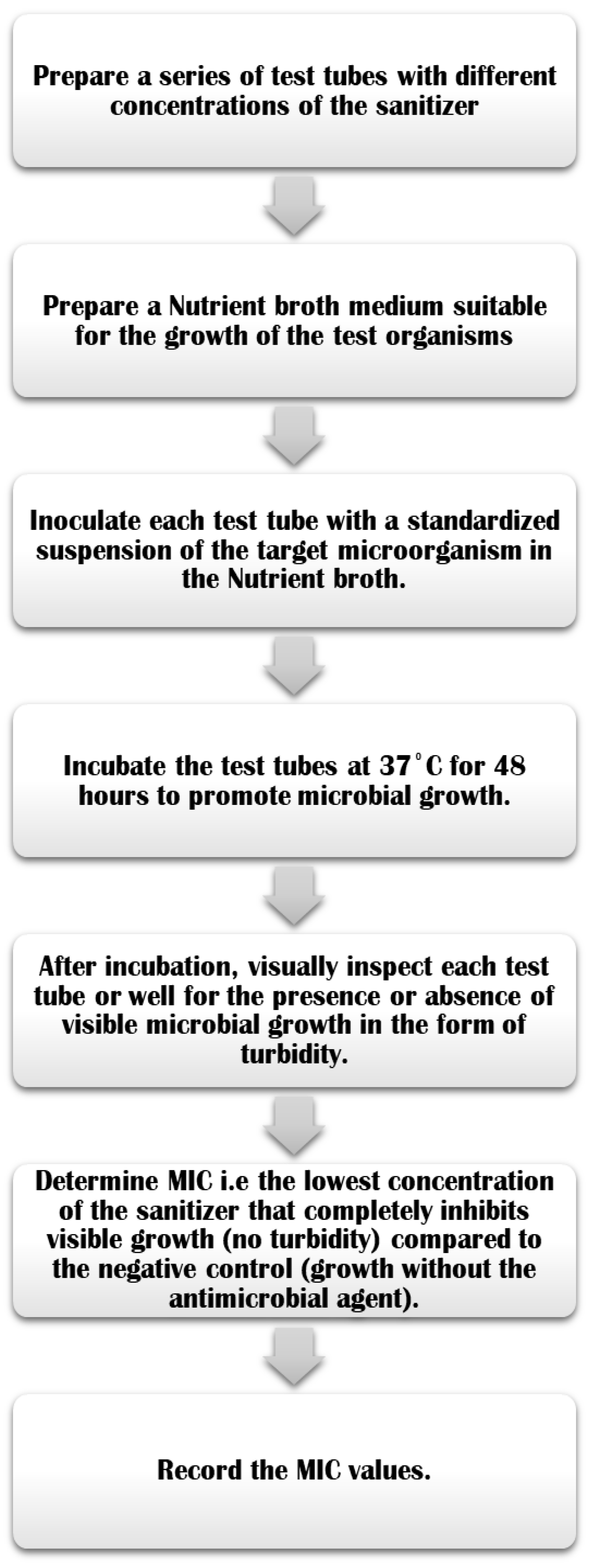
The method used was the broth dilution method, by inoculating the culture in a series of Nutrient broth containing the test organism to which dilutions of the sanitizers were inserted. First, dilutions of the sanitizer were prepared under aseptic conditions using distilled water as the diluent. The tubes were incubated for 48 hours. The highest dilution of the sanitizer at which no turbidity was observed indicated the MIC. In this way, the efficacy of the sanitizer was determined. The study was conducted over a period of 5 days. . Standard conditions involved using the alcohol-based hand sanitizer sample as the stock, diluting it with distilled water, and preparing suspensions of Escherichia coli and Staphylococcus aureus. Dilutions were made in the range of 30-80% at 10% intervals. The experiment was conducted using an incubator set at 37˚C for the specified duration.
Figure 1.
Schematic representation of Broth Dilution Method.
3. OBSERVATIONS AND RESULTS
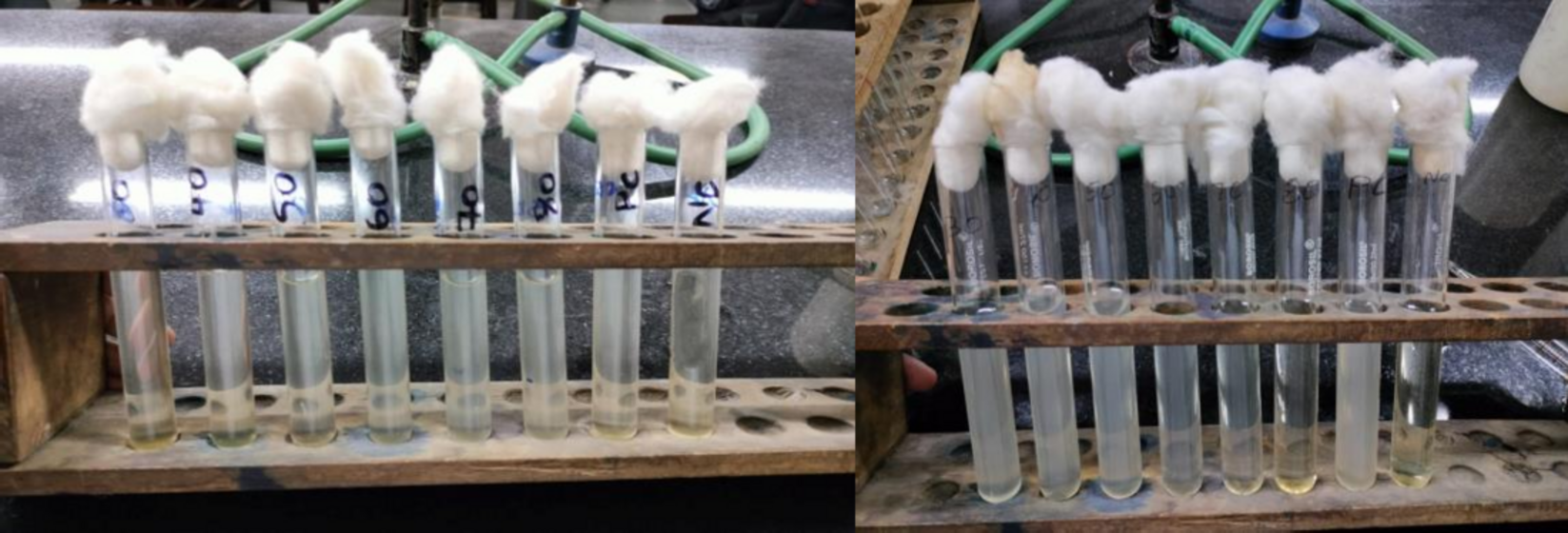
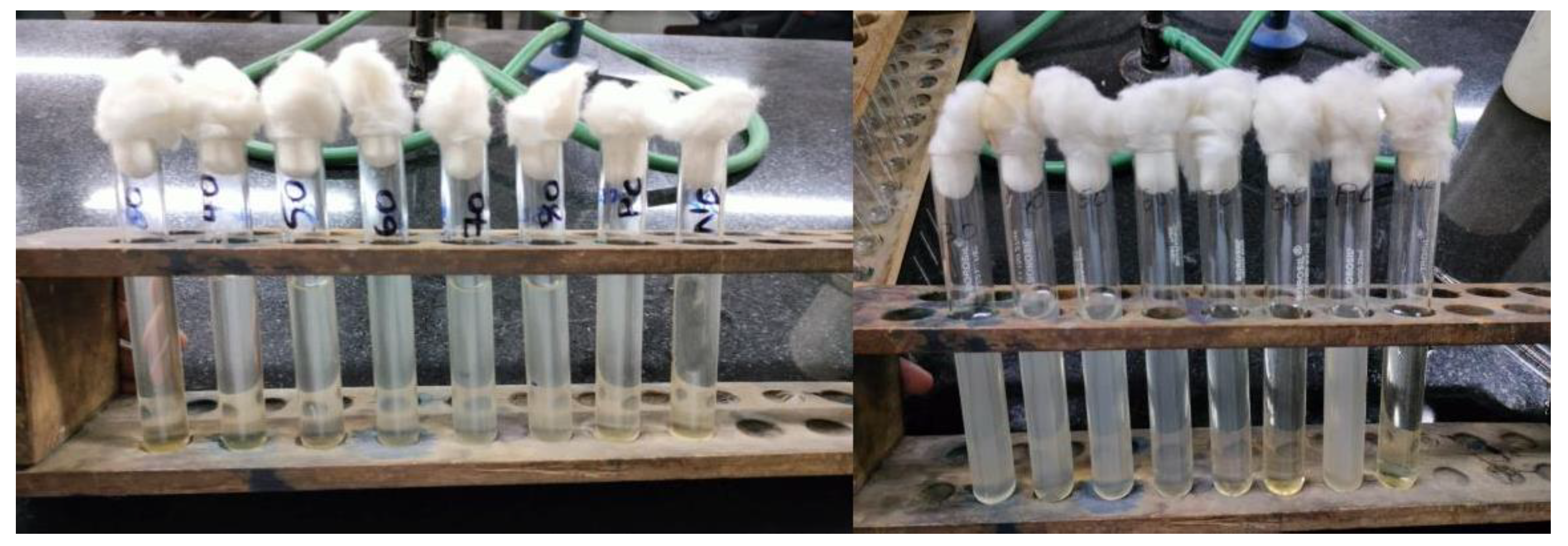
The Alcohol based Hand Sanitizer was found to be effective against E.coli only. MIC of the sanitizer for E.coli was determined to be 70%.
Growth of S.aureus was not inhibited by the sanitizer of the sanitizer. (upto 80%)

Table 1.
Observation Table for Staphylococcus aureus.
| Concentration (%) | E.coli (Growth) | S.aureus (Growth) |
|---|---|---|
| 30 | + | + |
| 40 | + | + |
| 50 | + | + |
| 60 | + | + |
| 70 | - | + |
| 80 | - | + |
| Positive Control | + | + |
| Negative Control | - | - |
Key : + = Turbidity observed (Growth), - = Turbidity not observed (No Growth).
Figure 2.
MIC observation for Staphylococcus aureus and Escherichia coli.
4. DISCUSSION
At present times, infections with E.coli and S.aureus are increasing at an alarming rate. Since E.coli and S.aureus are part of the normal flora in the intestinal tract and skin respectively, cross contamination is one of the top reasons for the spread of communicable disease in various settings like healthcare, industries and household environments (Poolman et al., 2018) Athough the density of the organism required for it to spread is not yet known, it is necessary to take into consideration the duration of time of contact, the normal flora of the patient and the colonization resistance. (Ducarmon, Q. R. et al. 2019)
The findings of this study demonstrate the significant impact of the Alcohol based Hand Sanitizer on reducing the growth and viability of only E. coli and not S.aureus.
Regarding E. coli, it is well-known for its ability to cause a range of infections, including gastrointestinal illnesses and urinary tract infections. S.aureus also causes respiratory infections. (Mueller M, Tainter CR. 2023) This study highlights the potential of sanitizersto mitigate the risk of E. coli infections by effectively reducing its viability. The use of sanitizers can be particularly crucial in healthcare settings where E. coli can be transmitted through contaminated surfaces or inadequate hand hygiene practices. By implementing proper sanitization measures, the transmission of E. coli can be diminished, thus minimizing the incidence of associated infections.
S. aureus, on the other hand, is a notorious pathogen responsible for various infections, including abscesses and bloodstream infections (Kwiecinski JM, Horswill AR. 2020). The inability of the hand sanitizer to inhibit S. aureus growth suggests that alternative measures may be necessary to control the transmission and infection caused by this pathogen. This is particularly important in healthcare settings where S. aureus infections, including bloodstream infections, can have severe consequences. In such cases, a comprehensive approach that includes proper hand hygiene practices, surface disinfection, and adherence to infection control guidelines becomes crucial. (Haque, M. et al. 2018)
It is worth noting that the type of sanitizer evaluated in this study was an alcohol-based sanitizer. Alcohol exerts its antimicrobial activity through various mechanisms, including protein denaturation, disruption of tissue membranes, and dissolution of lipids. These actions effectively reduce the viability and growth of bacterial pathogens.
The era of alcohol-tolerant bacteria has begun, leading to a shift from the use of alcohol based sanitizers to natural products like essential oils, aloe vera gel, etc. The resistance of Staphylococcus signifies that it’s infections possibly cannot be prevented through this hand sanitizer. Thus, hand washing with soap and water or other methods are recommended as an adjuvant.
While this study highlights the positive impact of sanitizers on E. coli, it is crucial to acknowledge the limitation regarding S.aureus. Firstly, the study focused on the in vitro efficacy of sanitizers, and further research is needed to evaluate their effectiveness in real-world settings. Additionally, the study primarily assessed the impact of sanitizers on viability, and future studies should consider additional factors such as surface disinfection and prevention of biofilm formation, with regard to gram positive S.aureus and gram negative Pseudomonas aeruginosa.
Further research is needed to explore the reasons behind the observed lack of efficacy of hand sanitizer against S. aureus. This may involve evaluating alternative formulations or concentrations of active ingredients, as well as investigating the potential role of other factors, such as the presence of organic matter or the development of antimicrobial resistance in S. aureus strains. The long-term effects of sanitizers and their optimal use in various settings to further enhance infection prevention and control measures should also be looked into. Future studies can focus on evaluating the effectiveness of hand sanitizers against multidrug-resistant strains, including methicillin-resistant Staphylococcus aureus (MRSA). (Golin, A. P. et al. 2020) Strategies such as incorporating synergistic antimicrobial combinations or developing novel agents may be explored.
5. CONCLUSION
In conclusion, the findings of this study underscore the importance of incorporating only sanitizers as an integral part of infection control strategies. By effectively reducing the viability of E. coli, sanitizers have the potential to significantly minimize its transmission and its associated infections.
It is important to note that the absence of inhibitory effects of the hand sanitizer against
S. aureus in this study does not negate its effectiveness against other microorganisms or diminish its potential benefits in reducing the transmission of other pathogens. Thus,hand wash with soap and water or other methods may be used as an adjuvant to usage of sanitizers. Hand sanitizers are valuable tools in promoting hand hygiene and preventing the spread of infections. However, it is crucial to select appropriate sanitizers and consider their specific efficacy against the target pathogens.
6. ACKNOWLEDGEMENT
The authors would like to express their sincere gratitude to Dr. Krupa Purandare, the Project Incharge, for her invaluable guidance and support throughout the research endeavor. The author is also thankful to Dr. Rina Mehra, Head of the Department of Microbiology, for fostering a conducive research environment. The author would like to acknowledge Mr. Adhiraj Kakade, Ms. Ria Jaiswal and Ms. Anusha Bhagwane for their efforts in conducting the initial procedures of this study. Appreciation is also extended to the technical staff for their invaluable assistance. Their collective contributions have been instrumental in the successful completion of this research project.
References
- Dhama, K., Patel, S.K., Kumar, R., Masand, R., Rana, J., Yatoo, M.I., Tiwari, R., Sharun, K., Mohapatra, R.K., Natesan, S., Dhawan, M., Ahmad, T., Emran, T.B., Malik, Y.S., Harapan, H. (2021, May 15). The role of disinfectants and sanitizers during COVID-19 pandemic: advantages and deleterious effects on humans and the environment. Environmental Science and Pollution Research International, 28(26), 34211-34228. doi:10.1007/s11356-021-14429-w. Available online at: pubmed.ncbi.nlm.nih.gov/33991301/[Accessed May 12, 2023]. [CrossRef]
- Mancuso, G., Midiri, A., Gerace, E., Biondo, C. (2021, October 12). Bacterial Antibiotic Resistance: The Most Critical Pathogens. Pathogens, 10(10), 1310. doi: 10.3390/pathogens10101310.Available online at : ncbi.nlm.nih.gov/pmc/articles/PMC8541462/ [Accessed May 14, 2023]. [CrossRef]
- Iowa State University, College of Veterinary Medicine. (n.d.). Disinfection 101. [Online]. Available online at: cfsph.iastate.edu/Disinfection/Assets/Disinfection101.pdf[Accessed: 24 May. 2024].
- Golin AP, Choi D, Ghahary A. (2020, Sep 18). "Hand sanitizers: A review of ingredients, mechanisms of action, modes of delivery, and efficacy against coronaviruses." Am J Infect Control. [Online]. 48(9), 1062-1067.Available online at : ajicjournal.org/article/S0196-6553(20)30562-9/fulltext [Accessed: 7 Jan. 2024].
- Gold NA, Mirza TM, Avva U. (2023, Aug 9). Alcohol Sanitizer. In: StatPearls [Internet]. Treasure Island (FL): StatPearls Publishing; 2023 Jan. Available online at : ncbi.nlm.nih.gov/books/NBK513254/ [Accessed: 7 Jan. 2024].
- Mazzola, P.G., Jozala, A.F., Novaes, L.C. de L., Moriel, P., & Penna, T.C.V. (2009). Minimal inhibitory concentration (MIC) determination of disinfectant and/or sterilizing agents. Brazilian Journal of Pharmaceutical Sciences, 45(2), 241-248. Available online at: scielo.br/j/bjps/a/9gTVphj3FzZms7Mnh7JBvrK/?format=pdf&lang=en [Accessed: 28 May 2023].
- Poolman JT, Anderson AS. (2018, Jul). "Escherichia coli and Staphylococcus aureus: leading bacterial pathogens of healthcare associated infections and bacteremia in older-age populations." Expert Rev Vaccines. [Online]. 17(7), 607-618. Available online at : tandfonline.com/doi/full/10.1080/14760584.2018.1488590 [Accessed: 7 Jan. 2024].
- Ducarmon, Q. R., Zwittink, R. D., Hornung, B. V. H., van Schaik, W., Young, V. B., & Kuijper, E. J. (2019). "Gut Microbiota and Colonization Resistance against Bacterial Enteric Infection." Microbiology and Molecular Biology Reviews, 83(3), 10.1128/mmbr.00007-19. Available online at : journals.asm.org/doi/abs/10.1128/mmbr.00007-19 [Accessed: 10 Jan. 2024].
- Mueller M, Tainter CR. (2023, Jul 13). "Escherichia coli Infection." StatPearls [Online]. Available online at : ncbi.nlm.nih.gov/books/NBK564298/ [Accessed: 7 Jan. 2024].
- Kwiecinski JM, Horswill AR. (2020, Feb). "Staphylococcus aureus bloodstream infections: pathogenesis and regulatory mechanisms." Curr Opin Microbiol. [Online]. 53, 51-60. Available online at : ncbi.nlm.nih.gov/pmc/articles/PMC7244392/#:~:text=Staphylococcus%20aureus%20 is%20an%20opportunistic,such%20as%20sepsis%20and%20endocarditis [Accessed: 3 June 2023].
- Haque M, Sartelli M, McKimm J, Abu Bakar M. (2018, Nov 15). "Health care- associated infections - an overview." Infect Drug Resist. [Online]. 11, 2321-2333. Available online at : dovepress.com/health-care-associated-infections-an-overview- peer-reviewed-fulltext-article-IDR[Accessed: 7 Jan. 2024].
Disclaimer/Publisher’s Note: The statements, opinions and data contained in all publications are solely those of the individual author(s) and contributor(s) and not of MDPI and/or the editor(s). MDPI and/or the editor(s) disclaim responsibility for any injury to people or property resulting from any ideas, methods, instructions or products referred to in the content. |
© 2024 by the authors. Licensee MDPI, Basel, Switzerland. This article is an open access article distributed under the terms and conditions of the Creative Commons Attribution (CC BY) license (http://creativecommons.org/licenses/by/4.0/).
Copyright: This open access article is published under a Creative Commons CC BY 4.0 license, which permit the free download, distribution, and reuse, provided that the author and preprint are cited in any reuse.


