Preprint
Article

This version is not peer-reviewed.

X1-Jacobi Differential Polynomial Systems and Related Double-Step Shape-Invariant Liouville Potentials Solvable by Exceptional Orthogonal Polynomials

Submitted:

16 November 2024

Posted:

18 November 2024

You are already at the latest version

Abstract

The paper develops the new formalism to treat both infinite and finite exceptional orthogonal polynomial (EOP) sequences as X-orthogonal subsets of X-Jacobi differential polynomial systems (DPSs). The new rational canonical Sturm-Liouville equations (RCSLEs) with quasi-rational solutions (q-RSs) were obtained by applying rational Rudjak-Zakhariev transformations (RRZTs) to the Jacobi equation re-written in the canonical form. The presented analysis was focused on the RRZTs leading to the canonical form of the Heun equation. It was demonstrated that the latter equation preserves its form under the second-order Darboux-Crum transformation. The associated Sturm-Liouville problems (SLPs) were formulated for the so-called ‘prime’ SLEs solved under the Dirichlet boundary conditions (DBCs). It was proven that one of the two X1-Jacobi DPSs composed of Heun polynomials contains both X1-Jacobi orthogonal polynomial system (OPS) and finite EOP sequence composed of the pseudo-Wronskian transforms of Romanovski-Jacobi (R-Jacobi) polynomials, while the second analytically-solvable Heun equation does not have the discrete energy spectrum. The quantum-mechanical realizations of the developed formalism were obtained by applying the Liouville transformation to each of the SLPs formulated in such a way.

Keywords: 
;  ;  ;  ;  ;  ;  ;  

1. Introduction

In the recently published article [1] we proved that the radial potential exactly solvable in terms of the hypergeometric functions [2] preserves its form under two sequential rational Darboux transformations (RDTs). It is essential that the first of these RDTs (using the ‘basic’ quasi-rational [3] solution (q-RS) as its transformation function (TF) converts the Schrödinger equation with the cited potential into the new radial Schrödinger equation exactly quantized in terms of polynomial solutions of the Heun equation [4] with degree-dependent exponent parameters. It was then proven that the new radial potential also preserves its form under two sequential RDTs. It was explicitly demonstrated that the conventional rules of the SUSY quantum mechanics [5] fail if the first RDT places the centrifugal barrier into the limit-circle (LC) range, while the second transformation keeps it within the same range.
The purpose of this analysis is to show that similar results can be formulated for the rational Darboux transforms ( R D T s ) of the trigonometric and hyperbolic Pöschl-Teller (t- and h-PT) potentials [6] quantized in terms of either infinite [7,8] or finite [9] exceptional orthogonal polynomial (EOP) solutions of the Heun equation with degree-independent exponent parameters. Note that the mentioned Heun-reference (HRef) potentials were incorrectly referred to in [10] as ‘shape-invariant’. Indeed the RDT using the lowest-energy eigenfunction as its TF creates a new pole on the real axis and therefore necessarily changes the form of the corresponding canonical Sturm-Liouville equation (CSLE). On other hand, as thoroughly discussed below, the Liouville potentials associated with the Heun-reference (HRef) CSLEs in question do preserve their form under two sequential (specially chosen) RDTs.
The important novel element of our approach [11–13] to the theory of the EOPs that we define them as solutions of the Bochner-type [14] ordinary differential equations (ODEs) with polynomial coefficients, rather than eigenpolynomials of the rational differential operator [15,16]. Let us remind the reader in this connection that, as stressed by Kwon and Littlewood [17], Bochner himself “did not mention the orthogonality of the polynomial systems that he found. The problem of classifying all classical orthogonal polynomials was handled by many authors thereafter” based on his analysis of possible polynomial solutions of complex second-order differential eigenequations. This observation brought the author [13,18] to the concept of complex exceptional Bochner (X-Bochner) polynomials which satisfy a second-order ordinary differential equation (ODE) of Bochner type but violate his theorem because each sequence either does not start from a constant or lacks a first-degree polynomial. Therefore we refer to these sequences as complex exceptional differential polynomial systems (X-DPSs) with the term ‘DPS’ used in exactly the same sense it is done by Everitt et al. [19,20] for conventional sequences of polynomials obeying the Bochner theorem.
It has been proven by Kwon and Littlejohn [17} that all the real field reductions of the complex DPSs constitute quasi-definite orthogonal polynomial sequences [21] and for this reason these authors refer to the latter as ‘OPSs’. However this is not true for the X-DPSs and we thus preserve the term ‘X-OPS’ solely for the sequences formed by positively definite orthogonal polynomials.
Any Bochner-type ODE with polynomial coefficients can be re-written in the form of the rational differential eigenequation which brings us to the exceptional operator introduced in [22], with the corresponding eigenpolynomials forming a X-DPS in our terms. While the authors of the cited paper (see also their more recent work [23]) are interested solely in X-OPSs, we [11,12,18] have been developing the technique covering both infinite and finite EOP sequences.
The formalism utilized by us [11] for constructing Xm-Jacobi DPSs goes back to the pioneering paper by Rudyak and Zakhariev [24] introducing the so-called [25] ‘generalized Darboux transformations’ of the generic CSLE. In [26] we suggested to term them as ‘Liouville-Darboux transformation’ (LDT) to stress that they can be re-interpreted as the three-step operations:
i)
the Liouville transformation from the CSLE to the Schrödinger equation;
ii)
the Darboux deformation of the corresponding Liouville potential;
iii)
the reverse Liouville transformation from the Schrödinger equation to the new CSLE using the same change of variable as at Step i),
making it easier to relate our results to the conventional recipes of the SUSY quantum mechanics [5]. It should be however stressed that the definition of these transformations ]24-26] requires no reference to the Liouville transformation and for this reason we prefer to refer to them as ‘Rudyak and Zakhariev transformations’ (RZTs) until we explicitly require for the transformation function (TF) of the given RZT not to have nodes inside the given quantization interval.
In the case of our interest the RZT using quasi-raional TF is applied to the Jacobi-reference (JRef) CSLE defined via (1)-(3) below. The transformed CSLE is then converted to the Bochner-type ODE with polynomial coeffiecients taking advantage of the fact that the density function (3) has only simple poles in the finite plane and as a results the mentioned gauge transformation is energy-independent [27]. Concequently the linear oeficient function of the resultant differential equation does not depend on degrees of the sought-for polynomials.
To construct the infinite and finite EOP sequences we take advantage of the concept of the prime rational SLEs (p-RSLEs) suggested by the author [28] earlier. The gauge transformation used to convert the given rational CSLE (RCSLE) to its prime form is chosen in such a way that the characteristic exponents (ChExps) of the two Frobenius solutions near the given singular endpoint differ only by their sign. As a result solving the resultant p-RSLE under the Dirichlet boundary conditions (DBCs) unambiguously determines the principal Frobenius solution (PFS). One of the benefits of our approach is that we can take advantage of the powerful spectral theorems proven by Gesztezy et al. [29] for solutions of the generic SLEs solved under the DBCs. In particular we assert that the q-RSs satisfying the DBCs are necessarily orthogonal and therefore this must be also true for their polynomial components.
It was revealed that the rational RZTs (RRZTs ) of the JRef CSLEs with the basic TFs result in the two distinguished HRef CSLEs with the third pole lying either inside the finite interval (-1,+1) or in the negative interval (-∞,-1). In the latter case the DBCs can be imposed at the endpoints of both intervals [-1,+1] or [1,∞]; however it turns out that the Lioiville potential on the positive infinite interval does not have the discrete energy spectrum. While the Sturm-Liouville problem (SLP) on the finite interval gives rise to the renowned X1-Jacobi OPS, the eigenfunctions for the HRef CSLE with the pole between -1 and +1 are expressible in terms of R D T s  of the Romanovski-Jacobi (R-Jacobi) polynomials [30–36]. It is remarkable that the latter (finite) EOP sequence belongs to the same X-DPS as the X-OPS and as a result is formally defined by the formulas discovered in [14] for its infinite X-orthogonal reduction. Based on this observation, Yadav et al. [37] refer to the X-DPS in question simply as ‘X1-Jacobi polynomials’. This important distinction between the X1-Jacobi polynomials and its infinite orthogonal reduction represented by the X1-Jacobi OPS was clarified in our works [12,38] (but nevertheless entirely disregarded in [10]).
Both SLPs sketched above can be converted by the Liouville transformation to the eigenproblems for the 1D Schrödinger equation giving rise to the two double-step shape-invariant potentials discovered by Quesne [7,8] and Bagchi et al. [9] respectively.
Another important development initiated in this paper is the notion of the quasi-orthogonality applied to polynomials with complex coefficients; namely, we say that the given sequence of complex polynomials in a real argument is quasi-orthogonal if there is a complex-valued weight such that the integral of the product of two polynomials multiplied by this weight vanishes for the specially selected integration interval. Our discovery of the exceptional quasi-orthogonal sequences of polynomials with complex coefficients was stimulated by Chen and Srivastava’s [34] observation that the orthogonality relations for both classical Jacobi and R-Jacobi polynomials can be extended to the complex field. While the formal ‘complexification’ of the Jacobi indexes preserving the conventional orthogonality relations between the classical Jacobi polynomials [39] is the well-established (though relatively little-known) fact [40], the broadening of this assertion to include the finite orthogonal sequences [34] constitutes the significant achievement mostly overlooked in the literature.

2. The q-RSs of the JRef CSLE with the Simple-Pole Density Function

Let us start our analysis with the Jacobi-reference (JRef) CSLE
  d 2     d η 2 + I o [ η ; λ o ] + ε   ρ   [ η ]         Φ   [ η ; λ o ;   ε ] =   0
with the single pole density function
ρ   [ η ] : =   1 | 1 η 2 | > 0
and the reference polynomial fraction (RefPF) parameterized as follows:
I o ( η ; λ o )         = ±   1 λ o ; 2 4 ( 1 η ) 2 +     1 λ o ; + 2 λ o ; 2 4 ( 1 η 2 )
= 1 2 ( 1 η 2 )       = ±   1 λ o ; 2 1 η 1 4 ( 1 η 2 )
where λ o ; ± are the exponents differences (ExpDiffs) for the poles at ±1 and the energy reference point is chosen via the requirement that the ExpDiff for the singular point at infinity vanishes at zero energy, i. e.,
l i m | η | η 2 I o [ η ; λ o ] = 1 4 .
The sign of the spectral parameter ε is chosen to be positive (negative) when the Sturm-Liouville problem in question is formulated on the finite interval 1 < η     < 1 (or respectively on the positive infinite interval 1 <   η   < ). An analysis of solutions of the CSLE (1) on the negative infinite interval <   η   < 1 can be skipped without loss of generality due to the symmetry of the RefPF (2) under reflection of its argument, accompanied by the interchange of the ExpDiffs λ o ; ± for the CSLE poles at ±1.
As initially pointed to in [27], the JRef CSLE with the density function (2) has four infinite sequences of the q-RSs
ϕ m [ η ; λ ] =   | 1 + η | 1 2 ( λ + 1 )   | 1 η | 1 2 ( λ + + 1 ) P m ( λ + , λ ) ( η )
( | λ ± | = λ o ; ± )
at the energies
ε = s g n ( 1 η 2 )   ε m ( λ ) ,  
With
ε m ( λ )   : = 1 4 ( λ + + λ + 2 m + 1 ) 2
By choosing [39]
  λ ,     λ + ,     λ + λ + + m k   for any positive integer k m
(cf. (102) in [41] or (88) in [42]) we assure that the Jacobi polynomials in question has exactly m simple zeros η l ( λ ; m ) . It is crucial that the Jacobi indexes do not depend on the polynomial degree, in contrast with the general case thoroughly examined by us in [43]. This remarkable feature of the CSLE under consideration is the direct consequence of the fact that the density function (2) has only simple poles in the finite plane and as a result the ExpDiffs for the CSLE poles at ±1 become energy-independent [4]. Consequently the polynomial components of the q-RSs (6) satisfy the eigenequation
Preprints 139875 i009
with dot standing for the derivative with respect to η. The vital point is that the linear coefficient function is independent of the polynomial degree, in the sharp contrast with the general case [43]. Note that the derivation of this equation was essentially based on the presumption that the quasi-rational function
ϕ 0 [ η ; λ ]   : =   | 1 + η | 1 2 ( λ + 1 )   | 1 η | 1 2 ( λ + + 1 )
satisfies the first-order differential equation:
ϕ 0 [ η ; λ ] = P 1 ( λ + , λ ) ( η ) η 2 1 ϕ 0 [ η ; λ ]
In other words,
l d   ϕ 0 [ η ; λ ] = P 1 ( λ + , λ ) ( η ) η 2 1
where the symbolic expression ld f[η] denotes the logarithmic derivative of the function f[η]. Re-writing the CSLE
  d 2     d η 2 + I o [ η ; λ o ] + ε 0 ( λ ) ρ   [ η ]         Φ   [ η ; λ o ;   ε 0 ( λ ) ] =   0
in the Riccati form we can represent the RefPf (3) in the generic form
I o [ η ; λ ] = l d     ϕ 0 [ η ; λ ]   + l d 2 ϕ 0 [ η ; λ ]     + ε 0 ( λ )     ρ   [ η ]
If the density function is identically equal to 1 then the presented expression turns into the standard supersymmetric representation of the quantum mechanical potential in terms of the superpotential represented by the logarithmic derivative of the transformation function (TF) ϕ 0 [ η ; λ ] . In next Section we will use this expression to expand the supersymmetric approach to the generic CSLE based on the formalism developed at the end of the last century by Rudjak and Zakhariev [24].

3. Rational Rudjak-Zakhariev Transforms of JRef CSLE

Each of these q-RSs can be used as the TF for the RRZT of the CSLE (1) defined via the requirement [26] that the quasi-rational function
* ϕ m [ η ; λ ] = 1 ρ     [ η ]     ϕ m [ η ; λ ] = * ϕ 0 [ η ; λ ] / P m ( λ + ,     λ ) ( η )
is the solution of the transformed CSLE
  d 2     d η 2 + I o [ η ; λ | m ] + | ε |   ρ   [ η ]           Φ   [ η ; λ ;   ε | m ] =   0
at the energy (7):
  d 2     d η 2 + I o [ η ; λ | m ] + ε m ( λ )   ρ   [ η ]         * ϕ m [ η ; λ ] =   0.
Representing the latter CSLE in the Riccati form:
I o [ η ; λ | m ] = l d     * ϕ m [ η ; λ ]   l d 2 * ϕ m [ η ; λ ]     ε m ( λ )     ρ   +   [ η ]
and taking into account that the quasi-rational function
* ϕ 0 [ η ; λ ] = ϕ 0 [ η ; λ 1 ]
satisfies the Riccati equation (14) with λ ± increased by 1:
l d     ϕ 0 [ η ; λ 1 ]   l d 2 ϕ 0 [ η ; λ 1 ]       ε 0 ( λ 1 )     ρ   +   [ η ] = I o [ η ; λ + 1 ]
one finds
I o [ η ; λ | m ] = I o [ η ; λ + 1 ] + l d P m ( λ + ,     λ ) ( η ) l d 2 P m ( λ + ,     λ ) ( η ) + 2 l d * ϕ 0 [ η ; λ ]     l d   P m ( λ + ,     λ ) ( η ) ε m ( λ ) ε 0 ( λ 1 )     ρ   +   [ η ] .
For m=1 the Jacobi polynomial in question takes form
P 1 ( λ + ,     λ ) ( η ) 1 2 ( λ + λ + + 2 )   [ η η 1 ( λ ) ]
with
η 1 ( λ ) =     λ λ + λ + + λ + 2
and therefore
l d   [ η η 1 ( λ ) ]   = 1 [ η η 1 ( λ ) ] 2 = l d 2   [ η η 1 ( λ ) ]
Taking into account that
ε 1 ( λ ) ε 0 ( λ 1 ) = λ + λ + + 2
P 1 ( λ + 1 , λ 1 ) ( η ) = P 1 ( λ + , λ ) ( η ) + η
and decomposing the first-degree Jacobi polynomial on the right can via (22), the RefPF of the RCSLE (7) can be represented for m=1 as
I o [ η ; λ | 1 ] = I o [ η ; | λ + 1 | ]         2 [ η η 1 ( λ ) ] 2 + 2 η ( η 2 1 ) [ η η 1 ( λ ) ] .
Examination of the RefPF (27) reveals that [11] we deal with the canonical form of the Heun equation [4] and therefore we refer to the RCSLE (16) as ‘restricted Heun-reference’ (restr-HRef) keeping in mind that the position of the third pole depends on the exponent parameters of the Heun equation.

4. Form-Invariance of restr-HRef CSLE Under Two Sequential RZTs

Let us apply the RRZT with the TF ϕ 1 [ η ; λ ] to the JRef CSLE (1), setting
* λ o ; ± : =   |   λ ± + 1 |
and
σ ± : = s g n (   λ ± + 1 ) ,
i.e.,
λ = σ × * λ o 1 .
Substituting (30) into (23) then gives
η 1 ( σ × * λ o 1 ) =     σ * λ o ; σ + * λ o ; + σ + * λ o ; + + σ * λ o ; =
e 3 σ ( * λ o )   : = σ   * λ o ; + * λ o ; σ   * λ o ; + * λ o ; +
Where
σ = s g n λ + 1 λ + + 1 .
Making use of the conventional parameter b ( β , α ) defined via (A37) in Appendix C we can alternatively represent the position (32) of the third pole of the RefPF (27) as
e 3 σ ( * λ o )   = 1 / b σ 1 ( * λ o )
By applying the RRZT with the TF ϕ 1 [ η ; λ ] to the JRef CSLE (1) we come to the two RCSLEs
    d 2     d η 2 + I o   [ η ; * λ o | σ ]     +   | ε |   ρ   [ η ]     Φ [ η ; * λ o ; ε | σ ] =   0           ( σ = ± )
with the RefPFs
I o   [ η ; * λ o | σ ] : = I o [ η ; * λ o ]         2 [ η e 3 σ ( * λ o ) ] 2 + 2 η ( η 2 1 ) [ η e 3 σ ( * λ o ) ]         ( σ = ± ) .
It directly follows from (32) that
1 < e 3 + ( * λ o ) < + 1
and
| e 3 ( * λ o ) |     > 1
respectively.
If the third pole lies outside the interval [-1,+1], we also choose
* λ o ; + >   * λ o ; ( σ = )
thereby assuring that it lies on the negative semi-axis:
e 3 ( * λ o ) < 1   .
By defining λ via (30) we find that the two sequential RRZTs with the TFs
* ϕ 1 [ η ; λ ]   = ρ 1 2   [ η ] / ϕ 1 [ η ; λ ]
and ϕ 1 [ η ; λ ] convert the restr-HRef CSLE with the RefPF (27) into another restr-HRef CSLE with the RefPF
I υ o [ η ; | 1 λ | , | 1 λ + |   ] = I o [ η ; λ + 1 ]         2 [ η η 1 ( λ ) ] 2 + 2 η ( η 2 1 ) [ η η 1 ( λ ) ] .
It then directly follows from the analysis presented in Appendix A that this is also true for the second-order Darboux-Crum transformation (DCT) with the seed functions (41) and
ϕ [ η ; λ | 1 ;   , 1 ] : = * ϕ 1 [ η ; λ ] W { ϕ 1 [ η ; λ ] , ϕ 1 [ η ; λ ] } .
We say that the restr-HRef CSLE (35) is double-step form-invariant iff the DCT in question keeps the position of the third pole within the intervals (37) or (38) respectively. In other words, the exponents (30) of the given TF must obey the constraint
s g n 1 λ 1 λ + = σ .
Theorem 1: The restr-HRef CSLE is double-step form-invariant for any value of the (positive by definition) ExpDiff *   λ o ; if σ + = + or for   * λ o ; > 2 , if σ = .
Proof of Theorem 1. Representing (30) as
  1 λ = 2 σ     * λ o ;   ,     1 λ + = 2 σ +   * λ o ; + ,  
let us start with the case σ = ,     σ + = σ = ±
  1   λ = 2 +   * λ o ;   ,     1 λ + = 2   +   σ     * λ o ; + .
Note that the parameters (46) are both positive if σ = + and have opposite signs if σ = and   * λ o ; + > 2 (or, to be more precise, * λ o ; > * λ o ; +   > 2 ) .
On other hand, examination of the parameters
1     λ =   2 * λ o ; ,       1 λ + =     2   +   * λ o ; +     f o r     σ = ±
reveals that they have opposite signs if   * λ o ; > 2 regardless of the value of the second ExpDiff   * λ o ; + , which completes the proof. □
Remark: The restr-HRef CSLE preserves its form under the DCTs specified by both combinations σ + = ± ,     σ = of the exponents (30) if 2 <   * λ o ; + < * λ o ; or if the parameters * λ o ; ± 2 have the same sign for σ = + .
Note that for all the anomalous cases:
i)
λ + =   * λ o ; + 1 ,         λ =   * λ o ; 1       ( σ = ,     σ + = + ,     * λ o ; +   < 2     ) ,
ii)
λ + =   * λ o ; + 1 ,         λ =   * λ o ; 1         ( σ = ± ,       * λ o ; + <   * λ o ; < 2 ) ,
iii)
λ + =   * λ o ; + 1 ,         λ = * λ o ; 1         ( σ =   σ + = + ,   * λ o ; + < 2 < * λ o ;   ) the ExpDiff for the pole of the JRef CSLE (1) at +1 lies within the limit-circle (LC) range ( 0 < λ o ; + < 1 ) and therefore this must be also true for the ExpDiff | 1 λ o ; + | for the pole of the restr-HRef CSLE obtained from (35) by the corresponding DCT. By analogy with the conclusion made by us in [1] for the radial JRef potential and its linear-tangent-polynomial (LTP) counter-part on the line, we assert that the conventional rules of the quantum-mechanics must fail for all the Liouville potentials associated with the listed anomalous cases. We shall come back to this issue in Section 8.

5. Pseudo-Wronskian Representation of X1-Jacobi DPSs
Let us now apply the RRZT with the TF ϕ 1 [ η ; λ   ] to another q-RS ϕ j [ η ; λ   ] with
the eigenvalue ε j ( λ   ) in the four quadrants σ of the vector parameter
λ : = σ × λ o σ × λ ( | λ ± |   = | λ ± |   > 0 )
The corresponding rational Rudjak-Zakharov transform ( R R Z T ) is given by the generic formula [24]
ϕ [ η ; λ | 1 ; σ , j ] : = * ϕ 0 [ η ; λ ] W { ϕ 1 [ η ; λ   ] , ϕ j [ η ; λ   ] } η η 1 ( λ )
Theorem 2. The restr-HRef CSLE (35) has four infinite sequences of q-RSs with the polyno-mial components formed by pseudo-Wronskians of two Jacobi polynomials.
Proof of Theorem 2. Representing the Wronskian in the right-hand side of (49) as
W { ϕ 1 [ η ; λ ] , ϕ j [ η ; λ ] } =   =   ± |   1 η | 1 2 ( λ + 1 ) × W { η η 1 ( λ ) ,   | 1 η | 1 2 ( λ λ ) P j ( λ + ,   λ ) ( η ) } ,
taking into account that
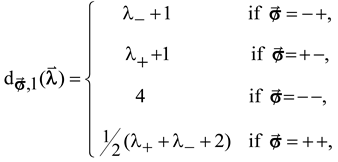
| 1 η | 1 2 ( σ 1 1 ) λ d   d η [ = | 1 η | 1 2 1 σ 1 λ P m ( λ + ,   λ ) ( η ) ] = d σ , 1 ( λ ) = ( η 1 ) 1 2 ( σ 1 1 ) P m σ + 1 2 σ 1 2 ( λ + + σ + 1 ,   λ + σ 1 ) ( η ) ,
where, according to (91) in [44] with α = λ + ,     β = λ , and n=1,
Preprints 139875 i052
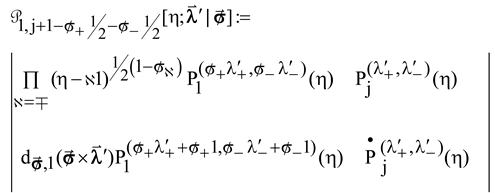
we introduce the pseudo-Wronskian polynomials via the relations:
Preprints 139875 i053
and then we re-write the polynomial component of the Wronskian (50) as follows
W { ϕ 1 [ η ; λ ] , ϕ j [ η ; λ ] } =     ϕ 0 [ η ; λ + 1 σ × 1 ] ϕ 0 [ η ; λ ] × P 1 , j + 1 σ + 1 2 σ 1 2 [ η ; λ | σ ] .
Keeping in mind (41), the solution (49) can be then represented in the following quasi-rational form:
ϕ [ η ; λ | 1 ; σ , j ] ϕ 0 [ η ; σ × ( λ + 1 ) ] η η 1 ( λ ) P j + 1 σ + 1 2 σ 1 2 [ η ; λ | 1 ; σ , j ] ,
which completes the proof of the Theorem 2.□
Comparing (54) with (A18) for σ =   and m=1, one finds that
P   1 , j + 2 [ η ; λ |   ] = D j + 2 [ η ; λ , 1 ; λ , j ]
Evaluating polynomials (A20) at 1 gives
  S m + 1 ( α , β ) ( 1 ) = 1 2 [ ( α + 1 ) ( 1 + 1 ) + ( β + 1 ) ( 1 1 ) ]   P m ( α , β ) ( 1 )
and therefore
D j + 2 [ 1 ; λ , 1 ; λ , j ] = 2 λ P 1 ( λ + , λ ) ( 1 ) P j ( λ + , λ ) ( 1 )
We thus proved that the PD (56) remains finite at 1 provided λ + , λ 1 and
the j-th degree polynomial does not vanish at one of the poles. Out of the four PD sequences introduced by us in [12] to generate the Xm-Jacobi DPSs it was the only sequence formed by the polynomials remaining finite at ±1 and therefore spanning the DPS which was referred by us for this reason as the Xm-Jacobi DPS of series D.
Representing the pseudo-Wronskians (53) for σ = ±   as
P 1 , j + 1 [ η ; λ |   ± ] = ( η ± 1 )   P 1 ( ± λ + ,   λ ) ( η ) P j ( λ + ,   λ ) ( η )   + ( λ 1 ) P 1 ( ± λ + ± 1 , λ 1 ) ( η ) P j ( λ + ,   λ ) ( η )
we come to the polynomials (A25) in Appendix B, with m set to 1. As demonstrated in Appendix C, the sequences (59) simply represent two alternative forms of the X1-Jacobi DPS of series J.
For σ = +   + the pseudo-Wronskian (53) turns into the polynomial Wronskian
P   1 , j [ η ; λ | +   + ] = 1 2 ( λ + + λ + 2 ) W { η η 1 ( λ ) , P j ( λ + ,   λ ) ( η ) }
Since each Wronskian in the sequence can be converted into the PD via (A58) in Appendix D, this polynomial sequence simply represents the alternative form of the aforementioned X1-Jacobi DPS of series D.
Let us now draw reader’s attention to the fact that the absolute values of the vector parameters
* λ : = σ × ( λ + 1 ) λ + σ × 1
specifying the power exponents of the q-RS (55) represent the ExpDiffs
| λ ± + σ ± 1 |   = * λ o ; ± : =   | λ ± + 1 |
for the poles of the RCSLE (35) at ±1, and therefore each pseudo-Wronskian polynomial remains finite at both poles (at least if λ ± + 1 are not negative integers with the absolute values smaller the polynomial degree).
Setting
* σ : = s g n ( * λ + * λ )
and taking into account (32), one finds
e 3 * σ ( * λ o ) = 1 / b ( * λ ) .
At this point it is convenient to explicitly re-write the CSLEs (35) as the canonical forms of the Heun equations
    d 2     d η 2 + I H   [ η ; * λ ]     +   | ε |   ρ   [ η ]     Φ [ η ; * λ ; ε ] =   0 ,
where we set
I H   [ η ; * λ ] : = I * σ o   [ η ; * λ o ]    
= I o [ η ; * λ ]         2 [ η b * σ 1 ( * λ ) ] 2 + 2 η ( η 2 1 ) [ η b * σ 1 ( * λ ) ]
Note that
b ( * λ ) = b ( * λ )
and therefore the rest-Heun equation (64) is invariant under the simultaneous change of the signs of both parameters * λ ± :
I H   [ η ; * λ ] = I H   [ η ; * λ ]
Since the polynomial sequences (58) and (59) start from the first-degree polynomial while the polynomial sequence (60) lacks a first-degree polynomial, all the mentioned polynomial sequences violate the prerequisites of the Bochner theorem. We thus arrived to one of the most important results of this paper.
Theorem 3.The polynomial sequences (58), (59), and (60) satisfy the Bochner-type ODEs with polynomial coefficients and therefore form the X-DPSs which either starts from a first-degree polynomial or respectively lacks a polynomial of this degree.
Proof of Theorem 3. First note that the function (55),
ϕ [ η ; σ × * λ 1 | 1 ; σ , j ] ϕ 0 [ η ; * λ ] η b σ ( * λ ) × P j + 1 σ + 1 2 σ 1 2 [ η ; σ × * λ 1 | 1 ; σ , j ] ,
is the solution of the ODE
    d 2     d η 2 + I H   [ η ; * λ ]     +   ε j ( * λ σ × 1 ) ρ   [ η ]   ϕ [ η ; σ × * λ 1 | 1 ; σ , j ] =   0 ,
where the vector parameter λ , specifying the corresponding eigenvalue, was replaced for * λ σ × 1 , based on the definition (61) of λ * , Taking into account that, according to (27),
η b * σ 1 ( * λ ) ϕ 0 [ η ; * λ ]   d 2         d η 2 ϕ 0 [ η ; * λ ] η b * σ 1 ( * λ ) = I H   [ η ; * λ ] 2 P 1 ( * λ + 1 , * λ 1 ) ( η ) ( η 2 1 ) [ η b * σ 1 ( * λ ) ] + ε 0 ( * λ ) η 2 1
we come to the Bochner-type ODE with the polynomial coefficients:
{ D [ η ; * λ ] + C 1 [ η ; * λ ; Δ ε j ( * λ ; σ )   ] } × P j + 1 σ + 1 2 σ 1 2 [ η ; σ × * λ 1 | 1 ; σ , j ] = 0 ,
where the coefficient function of the first derivative in the second-order differential expression
D [ η ; * λ ] : = ( η 2 1 ) [ η b * σ 1 ( * λ ) ] d 2     d η 2 + 2 B 2 [ η ;   * λ ] d       d η
represented by the second-degree polynomial
B 2 [ η ;   * λ ] : =   [ η b * σ 1 ( * λ ) ]   P 1 ( * λ + , * λ ) ( η ) + 1 η 2
As for the free term of the ODE (72), it constitutes the first-degree polynomial linear in the energy
C 1 [ η ; * λ ; ε   ] = 2 P 1 ( * λ + 1 , * λ 1 ) ( η ) ε [ η b * σ 1 ( * λ ) ] ,
With
Δ ε j ( * λ ; σ ) : = ε j ( * λ σ × 1 ) ε 0 ( * λ )
The important common feature of the ODEs (72) is that the leading coefficient polynomial of degree 3 has only simple zeros. This is the direct consequence of the fact that that each exponent of the quasi-rational function (69) coincides with one of the ChExps for the corresponding pole.
Introducing the parameters a = ( β α ) / 2 , b, and c = b +1/ a via (5a) and (5b) in [14], with
α * λ + ,     β * λ ,   b b ( * λ ) ,     n = j + 1 ,   * σ = + , σ = ±
here, one finds
P 1 ( α , β ) ( η ) = a ( c η 1 ) = a ( b η 1 ) + η
and
P 1 ( α 1 , β 1 ) ( η ) = a ( b η 1 ) .
The corresponding polynomial (74) takes form
B 2 [ η ; β , α ] = P 1 ( α , β ) ( η ) C 1 [ η ; β , α ; 0 ]
with
P 1 ( α , β ) ( η ) 1 2 ( η c )
and
C 1 [ η ; β , α ; 0 ] = ( β α ) [ 1 b ( β , α ) η ]
(cf. (2.1) in [45]). Note that
Δ ε n 1 ( β , α ; ± , ) = ( n 1 ) ( α + β + n )
and therefore the energy shift (83) vanishes for the first-degree X1-Jacobi polynomial (81), as expected.
The elementary change of variable η = 2 z 1 converts the Bochner-type ODE (72) to the Heun equations
d 2     d z 2 + B 2 [ z ; * a ( * λ )     ; * λ ] z ( z 1 ) [ z * a ( * λ )   ] d       d z + α n ( * λ ) β n ( * λ ) z q n ( * λ ; σ ) z ( z 1 ) [ z * a ( * λ )   ] × P n [ η ; σ × * λ 1 | 1 ; σ , n 1 + σ + 1 2 + σ 1 2 ] = 0 ,
where
* a ( * λ ) : = 1 2 [ b * σ 1 ( * λ ) + 1 ] ,
B 2 [ z ; * a     ; * λ ] : = 2 ( z * a )   P 1 ( * λ + , * λ ) ( 2 z 1 ) 4 z ( z 1 ) ,
and
α n ( * λ ) β n ( * λ ) = n ( * λ + * λ + + n 1 )
Combining the latter formula with
α n ( * λ ) + β n ( * λ ) = * λ + + * λ 1
gives
α n ( * λ ) n ,       β n ( * λ ) = * λ + + * λ + n 1
Evaluating the leading coefficient of the second-degree polynomial (86) confirms that
α n ( * λ ) β n ( * λ ) = n [ B 2 ; 2 ( * a ( * λ ) ; * λ ) + n 1 ]
in agreement with the general properties (1.1) and (1.2) of the Heine polynomials in [50].
The accessory parameter for the Heun equation (84) is given by the elementary formula
q n ( * λ ; σ ) = 1 2 C 1 [ 1 ; * λ ; Δ ε n ( * λ ; σ )   ]
Coming back to the particular case (77) and evaluating the polynomial (75) at η=-1, one finds
C 1 [ 1 ; * λ ; 0 ] = 2 * λ
and therefore
C 1 [ 1 ; * λ ; ε   ] = 2 [ * λ +   * a ( * λ )   ε ]
Taking into account that the energy shift (83) vanishes for n=1, we can re-write (91) as
q n ( * λ ; ± , ) = q 1 ( * λ ) [ ( n 1 ) ( * λ + * λ + + n )     * a ( * λ ) ]
With
q 1 ( * λ ) = * λ .
Expressing the polynomial (82) in terms of z:
C 1 [ 2 z 1 ; * λ ; 0 ] = 2 ( * λ λ +   ) [ b ( * λ ) z * a ( * λ ) ]
with
* a ( * λ ) = * λ * λ * λ +
one can verify that
1 2 C 1 [ 2 z 1 ; * λ ; 0 ] = α 1 ( * λ ) β 1 ( * λ ) z q 1 ( * λ )
as expected.
Comparing (89) with the parameters α and β defined via (6.5) in [46] we assert that the latter formulas specify the Heun equation for the polynomials of degree k+1 (not k as stated in [46]), with k standing for the integer j here. Re-writing (94) as
q n ( * λ ; ± , ) = * a ( * λ ) [ * λ + * λ ( n 1 ) ( * λ + * λ + + n ) ]
and making use of (87), coupled with (88), we can represent the last term in the brackets in the right-hand side of (99) as
( n 1 ) ( λ + λ + + n ) = α n ( λ ) β n ( λ ) + α n ( λ ) + β n ( λ ) + 1
which gives
q n ( * λ ; ± , ) = * λ * λ + * λ × [ * λ + * λ + α n ( * λ ) β n ( * λ ) + α n ( * λ ) + β n ( * λ ) + 1 ]
Setting
γ = * λ + 1 ,     * λ + * λ = α n ( * λ ) + β n ( * λ ) 2 γ + 3
turns (101) into the formula listed for the accessory parameter in [46].
Alternatively one can re-write the Bochner-type ODE (72) as the eigenvalue problem
T   * λ + , * λ ; 1 Δ ε j ( * λ ; σ ) P j + 1 σ + 1 2 σ 1 2 [ η ; σ × * λ 1 | 1 ; σ , j ] = 0
for the exceptional differential operator:
T   * λ + , * λ ; 1 ( η ) : = ( η 2 1 ) d 2     d η 2 B 2 [ η ; * λ ] b * σ 1 ( * λ ) η     d       d η + 2 P 1 ( * λ + 1 , * λ 1 ) ( η ) b * σ 1 ( * λ ) η
with the eigenvalues (76). We thus come to the renowned eigenequation [14,45] for the X1-Jacobi polynomials (A36):
T α , β ; 1 4 ( n 1 ) ( α + β + n ) P n ( α , β ) ( η ) = 0
though without any constraints on the relative sign of the parameters α and β. It should be however stressed that we list these operators only for the proper references and by no means need them in our analysis.

6. Energy Spectrum of ‘Prime’ SLEs Solved Under Dirichlet Boundary Conditions

Our next step is to formulate the Sturm-Liouville problems for the restr-HRef CSLEs (35) with the boundary conditions imposed at the ends of either finite interval (-1,+1) or positive interval (1,∞) assuming that the CSLE in question does not have poles inside the given interval. Instead of the conventional prerequisite of the spectral theory requiring the eigenfunctions to be normalizable with the weight ρ   [ η ] we require that the boundary conditions of our choice unambiguously select the PFS near each singular endpoint. To achieve this goal, we first convert the given CSLE to its ‘prime’ form (p-SLE) selected by the requirement that the characteristic exponents (ChExps) of the two Frobenius solutions near the given end differ only by their sign and as a result the DBC pinpoints the PFS.

6.1. X1-Jacobi OPS

In particular, the rational prime form of the JRef CSLE (1),
{ d     d η ( 1 η 2 ) d     d η q [ η ; λ o ]   + ε   }   Ψ [ η ; λ o ; ε ] =   0
for the finite interval (-1,+1) can be obtained by the gauge transformation
Φ [ η ; λ o ; ε ] = 1 η 2   Ψ [ η ; λ o ; ε ]
The PF representing the zero-energy free term has the following generic form [28]:
q [ η ;   λ o ] = p [ η ]   I o [ η ;   λ o ] + I { p [ η ] ) } ,
with
I ˜ { p [ η ] } : = 1 4 p 2 [ η ] / p [ η ] 1 2 p [ η ]
and
p [ η ] = 1 η 2 f o r       η ( 1 , + 1 ) ,
which gives [51],
I { ( 1 η 2 ) } = ( 1 η 2 ) 1
Keeping in mind that
l i m η ± 1 ( 1 η 2 ) q [ η ;   λ o ] = λ o ; ± 2   > 0
we confirm that the ChExps of the Frobenius solutions for the pole at ±1 have the same absolute value 1 2 λ o ; ± but differ by their sign. The PFS can be thus unambiguously determined by solving the p-SLE (106) under the DBCs
l i m η ± 1 Ψ [ η ; λ o ; ε j ( λ o ) ] =   0
One of the benefits of our approach is that we can take advantage of the powerful spectral theorems proven by Gesztesy et al. [29] for solutions of the generic SLEs solved under the DBCs.
Any eigenfunction of the p-SLE (106) with an eigenvalue ε j ( λ o ) can be represented in the form:
ψ n [ η ; λ o ] =   ( 1 + η ) 1 2 λ o ;   ( 1 η ) 1 2 λ o ; + F n [ η ; λ o ]
where the function F [ η ; λ o ] finite at the both endpoints:
0 < l i m η ± 1 | F j [ η ; λ o ] |   <
satisfies the ODE
( η 2 1 ) d 2     d η 2 + 2 P 1 ( λ o ; + ,   λ o ) ( η ) d       d η 1 4 [ ε j ( λ o ) ε 0 ( λ o ) ] × F j [ η ; λ o ] = 0
By converting this ODE to the hypergeometric equation, it can be shown [2] that the sought-for eigenfunctions are expressible in terms of the classical Jacobi polynomials with the positive indexes λ o ; ± as follows:
ψ j [ η ; λ o ] =   ( 1 + η ) 1 2 λ o ;   ( 1 η ) 1 2 λ o ; + P j ( λ o ; + , λ o ; ) ( η ) f o r       η ( 1 , + 1 )
The eigenfunctions (117) are normalizable:
1 + 1 d η   ψ j 2 [ η ; λ o ] <    
and mutually orthogonal:
1 + 1 d η   ψ j [ η ; λ o ] ψ j [ η ; λ o ] = 0         ( j j ) ,
which brings us to the conventional orthogonality relations for the classical Jacobi polynomials
1 + 1 d η   ( 1 + η ) λ o ;   ( 1 η ) λ o ; + P j ( λ o ; + , λ o ; ) ( η ) P j ( λ o ; + , λ o ; ) ( η ) = 0         ( j j ) .
It is worth mentioning that our approach does not allow one to formulate the spectral problem for the Jacobi differential equation if -1 < α, β ≤ 0 [14,41,44,48]. As discussed below, this limitation might affect the analysis of the transformed solutions in the LC region.
Similarly the restr-HRef CSLE (35) for σ = - can be converted to its prime form
{ d     d η ( 1 η 2 ) d     d η q   [ η ; * λ o | ]   + ε   }   Ψ [ η ; * λ o ; ε | ] =   0 f o r       η ( 1 , + 1 ) ,
where
q   [ η ; * λ o | ] = ( η 2 1 )   I o   [ η ; * λ o | ] + ( 1 η 2 ) 1       f o r       η ( 1 , + 1 ) .
Keeping in mind that
l i m η ± 1 ( 1 η 2 ) q   [ η ; * λ o | ] = * λ o ; ± 2   > 0
we can again confirm that the ChExps of the Frobenius solutions for the pole at ±1 have
the same absolute value 1 2 * λ o ; ± while differing by their sign and therefore one can
determine the PFS by solving the p-SLE (121) under the DBCs
l i m η ± 1 Ψ [ η ; * λ o ; ε ˜ n ( * λ o ) | ] =   0
Returning to the special case (77), we choose
λ = λ o
and
λ ± = * λ ± 1
under the restriction
λ o ; + > λ o ; > 1
requiring both singular endpoints of the JRef CSLE to be LP. The vector parameters (61) are defined via the relations:
* λ = λ o ; ± 1 = ± λ ± 1 = * λ o ; > 0
It directly follows from (128) that σ = + and hence σ = , as expected
Converting the solution (69) of the given CSLE to its prime form via the gauge transformation
ψ j [ η ; * λ o | ] = 1 η 2   ϕ [ η ; * λ 1 , * λ + 1 | 1 ; +   , j ] ,
one can directly verify that the R R Z T of the jth eigenfunction of the p-SLE (106),
ψ j [ η ; * λ o | ] = ψ 0 [ η ; * λ o ] η b ( * λ o ) P j + 1 ( * λ o ; + , * λ o ; ) ( η ) f o r       η [ 1 , + 1 ]
satisfies the DBCs at the ends of the specified interval and therefore represents an ei-
genfunction of the transformed p-SLE with the eigenvalue ε j ( λ o ) . Again the eigenfunctions are squarely integrable:
1 + 1 d η   ψ j 2 [ η ; * λ o | ] <    
and mutually orthogonal:
1 + 1 d η   ψ j [ η ; * λ o | ] ψ j [ η ; * λ o | ] = 0         ( j j ) ,
which brings us to the renowned orthogonality relations [14] for the X1-Jacobi OPS
1 + 1 d η   ω α , β [ η ]   P n ( α , β ) ( η ) P n ( α , β ) ( η ) = 0
 (α,β >0; n ≠ n′)
with the weight
ω α , β [ η ] = ( 1 η ) α ( 1 + η ) β   | η b ( α , β ) | 2
The sequence starts from the nodeless eigenfunction ψ 0 [ η ; * λ o | ] with the first-degree polynomial (81) having a zero inside the infinite interval (-∞,-1):
c ( * λ o ) : = * λ o ; + * λ o ; + + 2 * λ o ; + * λ o ; < 1
under the constraint (39), which implies the Dirichlet problem under consideration may not have solutions at energies smaller than ε 0 ( λ o ) . It directly follows from Proposition 5.1 in [14] that the X1-Jacobi polynomial of degree n has exactly n-1 zeros in (-1,+1)
and therefore no solution may exist between two sequential eigenvalues ε k 1 ( λ o ) and
ε k ( λ o ) . Since the given sequence of the eigenvalues is unbounded from above, the
q-RSs (130) constitute the complete set of the eigenfunctions for the given Dirichlet problem.
Note that the symplectic form for two eigenfunctions [52],
ψ j [ η ; * λ o | ] , ψ j [ η ; * λ o | ] : = ( 1 η 2 ) W { ψ j [ η ; * λ o | ] , ψ j [ η ; * λ o | ]   for     | η |   < 1
vanishes at the both singular ends ±1 and therefore it must vanish for any two eigenfunctions of the generic SLE
{ d     d η p [ η ; * λ o ]   d     d η + q p   [ η ; * λ o | ]   ε j ( λ o ) w p [ η ; λ o ]     }   ψ j p [ η ; * λ o | ] =   0
with the canonical form (35), i.e., iff
w p [ η ; λ o ]   / p [ η ; * λ o ]   1 η 2 > 0
and
q p   [ η ; * λ o | ] = p [ η ; * λ o ]     I o   [ η ; * λ o | ] + I { p [ η ; * λ o ]   }
In particular, Everitt [47] chose
p [ η ; * λ o ] = p α , β [ η ] = ( 1 η ) 2 ω α , β [ η ]
which brought him to the boundary conditions
p α , β [ η ] W { P 1 ( * λ o ; + , * λ o ; ) ( η ) , P n ( * λ o ; + , * λ o ; ) ( η ) }   η = ± 1 = 0
proven in his Remark 3.1iii. Imposing the Dirichlet boundary conditions (124) on the solutions of the p-SLE (121) thus presents the alternative way to obey these boundary conditions for Case 1 in [47]. Though his Case 2 (-1 < α,β < 0) is not covered by the technique developed here, the crucial advantage of our approach is that, as discussed in subsection 6.2, it can be easily extended to the infinite interval (1,∞) despite the fact the EOPs infinitely grow at the upper endpoint.
In Section 4 we ran into the anomalous RRZTs which interconvert the LC regions for the singular endpoints of the JRef CSLE (1) and restr-HRef CSLE (35). If R R Z T of the eigenfunction (117) has the form (129), with both Jacobi indexes lying between -1 and +1. While these q-RSs are mutually orthogonal, they do not obey the DBCs (124) and therefore do not represent the eigenfunctions of the p-SLE (121). As a result the orthogonality of these solutions cannot be justified within this framework.
Before concluding the discussion of the X1-Jacobi OPS, let us note that the symplectic form preserves its zero value if the parameters * λ o of the prime SLE (121) are extended to the complex field under the constraint R e     * λ o ; ± > 0 . Since the corresponding orthogonality weight (134) is complex, we refer to the corresponding complex polynomials in a real arguments as being ‘quasi-orthogonal’. As discussed in more details in Section 8, the CSLE (35) may have the third pole on real axis iff the arguments of both ExpDiffs * λ o ; ± coincide and the third pole always lies outside the real interval [-1,+1] in this case.
The quasi-orthogonality of Jacobi polynomials with complex indexes with real parts larger than -1 was proven in the monograph [40]. By extending (141) to the complex field one can also prove the quasi-orthogonality of the X1-Jacobi polynomials with complex indexes under the extended constraint R e     * λ ± > 1 . But again the crucial advantage of our approach is that it can be easily extended to the infinite interval (1,∞) despite the fact that the EOPs infinitely grow at the upper endpoint.

6.2. Finite Orthogonal Subsequences of X1-Jacobi DPS

We finally switch our discussion to the subject which has got a very little attention, compared with the X1-Jacobi OPS sketched above. Namely, our next step is to formulate the Sturm-Liouville problem on the infinite interval [1,∞) first for the JRef CSLE (1) and then for the restr-HRef CSLEs (35), taking advantage of the fact that the extraneous pole of the latter CSLE lies outside the cited interval in both cases υ = ±, provided that the ExpDiffs for the poles at ±1 are restrained by the condition (33) for υ = -.
The rational prime form of the JRef CSLE on the interval [1,∞) is obtained by choosing the leading coefficient to be the first-degree polynomial
p [ η ] = η 1 f o r       η [ 1 , ) ,
which brings us to the p-SLE [51]
{ d     d η ( η 1 )   d     d η + q [ η ;   λ o ] + ε ˜ j ( λ o ) w [ η ; λ o ]     }   ψ j [ η ; * λ o ] =   0   ( η > 1 )
with the zero-energy free term
q [ η ;   λ o ] = ( η 1 ) I o [ η ;   λ o ] + 1 4 ( η 1 )       ( η > 1 )
and the positive weight
w [ η ; λ o ] = ( 1 + η ) 1 < 1 2           ( η > 1 )   .
Taking into account that
l i m η 1 + ( η 1 ) q [ η ;   λ o ] = 1 4 λ o ; + 2   > 0
we confirm that the ChExps of the Frobenius solutions for the pole at +1 have the same absolute value 1 2 λ o ; + while differing by their sign. In contrast to the poles in the finite plane, the ExpDiff for the pole of the JRef CSLE (1) at infinity turns out to be energy-dependent. Keeping in mind that
l i m η ( η 1 ) q [ η ;   λ o ] = 0
we find that the ChExps of the Frobenius solutions for the pole at ∞ are real only at negative energies and have in this case the same non-zero absolute value 1 2 ε while
differing by their sign. We thus confirm that the PFSs of the p-SLE (143) near both singular endpoints) are unambiguously determined by the DBCs
ψ j [ 1 ; * λ o ] = l i m η ψ j [ η ; * λ o ] =   0 ,
as asserted.
One can directly verify that the q-RSs
ψ   + , j [ η ; λ o ] : = 1 η 1 ϕ   + , j [ η ; λ o ] ( 1 η < )
= ( 1 + η ) 1 2 ( 1 λ o ; )   ( 1 η ) 1 2 λ o ; + P j ( λ o ; + , λ o ; ) ( η )
associated with the eigenvalues
ε ˜ + . j ( λ o )   = 1 4 ( λ o ; λ o ; + 2 j 1 ) 2
satisfy the DBCs (148) for
0 j < 1 2 ( λ o ; , λ o ; + 1 )
and therefore are normalizable with the weight (145):
1 d η   ψ   + , j 2 [ η ; λ o ] w [ η ; λ o ] < .    
Being the eigensolutions of the Sturm-Liouville problem solved under the DBCs they must be also mutually orthogonal [29] with the weight (145):
1 d η   ψ   + , j [ η ; λ o ] ψ   + , j [ η ; λ o ] w [ η ; λ o ] = 0 f o r     j < j < 1 2 ( λ o ; , λ o ; + 1 ) ,
which brings us to the conventional orthogonality relations for the R-Jacobi polynomials
0 d z     ω α , β [ z ]   J j ( α , β ) ( z ) J j ( α , β ) ( z ) = 0
 (j ≠ j′)
with the weight
  ω α , β [ z ] : = z α     ( z + 1 ) | β | f o r       η [ 1 , )
under constraint α > 0, β < 0, where we adopted Askey’s [31] definition of the R-Jacobi polynomials which, as proven by Chen and Srivastava [34], is equivalent to the elementary formula
J n ( α ,   β ) ( z )     : =   P n (   α , β ) ( 2 z + 1 )     f o r     α > 1 ,     β < 0
with
z : = 1 2 ( η 1 )
Note that we [11] (see also [53]) changed the symbol R for J to avoid the confusion with R-Routh (Romanovski/pseudo-Jacobi [32,33] polynomials denoted in the recent publications [54,55,56,57,58] by the same letter ‘R’. More recently Masjed-Jamei [59] (see Table 2 in [60] for the explanatory summary of Moret-Bailey’s notation) started using the symbol J for the R-Routh polynomials which is insistent with the polynomial names in our classification scheme of the Romanovsi polynomials. On other hand, the symbol used for the R-Jacobi polynomials in the just appearing paper [61] has been reserved by us [62] for the Routh polynomials
m ( α R + i   α I ) ( x ) : = ( i ) m   P m ( α R + i   α I ,   α R i   α I ) ( i x )
It is worth mentioning that our derivation does not cover the orthogonality region of the R-Jacobi polynomials for α varying within the nonpositive interval (-1,0]. This deficiency of our approach dealing solely with eigenfunctions of the p-SLEs may result in some limitations on the actual range of the indexes of the R R Z T s of the R-Jacobi polynomials discussed below.
Examination of Masjed-Jamei’s [63] interconnection formula (2.8) between his ‘First Class’ and the Jacobi polynomials shows that the M-polynomials in his notation (see also [59,64]) are related to the R-Jacobi polynomials (157) via the elementary formula
M n ( p ,   q ) ( z )   = ( 1 ) n n !   J n ( q , p q ) ( z )
 for q > -1, p > 0
(It is worth to remind the abbreviation ‘OPS’ in [63] stands for the orthogonal polynomial set, but not for the infinite ‘orthogonal polynomial system’ – the abbreviation broadly used in the modern theory of the exceptional orthogonal polynomials [13,17,22,23,41].)
Since the prime SLE (143) has the discrete energy spectrum only for λ o ; > λ o ; + + 1 , the constraint (39) reveals the SLE (35) does not have normalizable solutions on the interval [1,∞) if σ = . Strating from this point we focus solely on the quantization of the SLE (35) with σ = + . Before coming to the case of our current interest (m=1), let us note that all the zeros of the solutions (117) lie between -1 and +1 for any j > 0 and therefore each of them can be used as the TF for the RRZT [11]. Each solution represents the PFS near the lower singular end point of the interval [1,∞) at the energy
ε ˜ + + , m ( λ o )   = 1 4 ( λ o ; + λ o ; + + 2 m + 1 ) 2 < ε ˜ + , 0 ( λ o )     f o r     m 1   ( σ = + ) .
In this paper we make use of the very first solution in this infinite sequence of the TFs formed by classical Jacobi polynomials. Alternatively we can consider the RRZT with the TF represented by the PFS near the infinity at the energy
ε ˜   , 1 ( λ o )   = 1 4 ( λ o ; + λ o ; + 3 ) 2 < ε ˜ + , 0 ( λ o )
which leads us to the same CSLE (35) with     σ = + . This is the direct manifestation of the form-invariance of the latter CSLE under the second-order DCT with the seed functions * ϕ + + , 1 [ η ; λ o ] and ϕ   , 1 [ η ; λ o ] .
To formulate the Sturm-Liouville problem on the infinite interval [1,∞) for the restr-HRef CSLE with σ = + , we convert the latter to its prime form with the leading coefficient function (142) and weight (145):
{ d     d η ( η 1 )   d     d η + q [ η ;   * λ o | + ] ε ˜ j ( * λ o | + ) w [ η ; λ o ]     }   ψ j [ η ; * λ o | + ] =   0 ,
where the zero-energy free term has the generic form
q [ η ; *   λ o | + ] = ( η 1 ) I o [ η ;   * λ o | + ] + 1 4 ( η 1 )       f o r     η > 1
Taking into account that
l i m η 1 ( η 1 ) q [ η ;   *   λ o | + ] = 1 4 * λ o ; + 2   > 0
and
l i m η ( η 1 ) q [ η ;   *   λ o | + ] = 0
we confirm that the ChExps of the Frobenius solutions for the poles at +1 or at infinity
have the same absolute value 1 2 * λ o ; + or respectively 1 2 ε while differing by their sign in both cases. Since the PFS of the p-SLE (163) at the given energy is unambiguously selected by the DBC at the corresponding endpoint, the DBCs
ψ j [ 1 ; * λ o | + ] = l i m η ψ j [ η ; * λ o | + ] =   0
unequivocally determine all the eigenfunctions of the given SLP.
By applying the RRZT with the TF ψ +   + , 1 [ η ; λ o ] to the eigenfunction (149), we find that the solution of the p-SLE (163)
ψ [ η ; λ | 1 ;   + , j ] ψ 0 [ η ; * λ ] η b ( * λ ) P j + 1 [ η ; λ | 1 ;     + , j ] ,
with   σ =   + ,  
  λ = λ o ; ,     λ = λ o
  * λ = λ o ; 1
and
  * λ o = λ o + 1
vanishes at η =+1 or, in other words, represents the PFS of the p-SLE (163) near the lower endpoint. Under the constraint (152) it also satisfies the DBC at infinity and therefore represents an eigenfunction of the p-SLE (163).
Theorem 4:The R R Z T s of the R-Jacobi polynomials form a finite EOP subset of the X-DPS of series J.
Proof of Theorem 4. One can directly verify that the eigenfunctions constructed in such a way are normalizable with the weight (145):
1 d η   ψ j 2 [ η ; λ | 1 ;   + , j ] w [ η ; λ o ] <   f o r     j < 1 2 ( λ o ; , λ o ; + 1 ) .
Again, being the eigensolutions of the Sturm-Liouville problem solved under the DBCs they must be mutually orthogonal [29] with the same weight on the infinite interval in question:
1 d η   ψ j [ η ; λ | 1 ;   + , j ]   ψ j [ η ; λ | 1 ;   + , j ] w [ η ; λ o ] = 0   f o r     j < j < 1 2 ( λ o ; , λ o ; + 1 ) .
combining (170) and (171) we can re-write (168) and the associated eigenvalues as
ψ j [ η ; * λ o ; , * λ o ; + |   + , 1 ] = ψ 0 [ η ; * λ o ; , * λ o ; + ] η b ( * λ o ; , * λ o ; + ) P j + 1 ( * λ o ; + , * λ o ; ) ( η )
and
ε ˜ j ( * λ o |   + ) : = ε j ( λ o ; , λ o ; + ) = 1 4 ( * λ o ; + * λ o ; + 2 j 1 ) 2
respectively. It then directly follows from (173) that the X1-Jacobi polynomials in question are mutually orthogonal with the weight
W   [ η ; * λ o | 1 ,   + ] : = 4 ( 1 + η ) * λ o ;   ( 1 η ) * λ o ; + ( * λ o ; + * λ o ; + ) 2 | η b ( * λ o ; , * λ o ; + ) | 2
namely,
1 d η     W   [ η ; * λ o | 1 ,   + ]   P n ( * λ o ; + , * λ o ; ) ( η ) P n ( * λ o ; + , * λ o ; ) ( η ) = 0 f o r     1 n < n < 1 2 ( λ o ; , λ o ; + 1 ) ,
which completes the proof of the Theorem 4.□
Theorem 4 constitutes one of the most important issues addressed by this analysis. Namely, we proved that at least some eigenfunctions of the p-SLE (163) solved under the DBCs are expressible in terms of a finite subset of the X1-DPS of type J. Yadav et al. [37] termed this subset simply as ‘X1-Jacobi polynomials’ (with reference to [14]), without going into any details. The surprising new element of their use of this term n is that the indexes of the X1-Jacobi polynomials in question have opposite signs and therefore do not belong to the X1-OPS. The cited assertion in [37] stimulated my interest in this problem [38] giving rise to the concept of the X-Jacobi DPSs which may contain both X-Jacobi OPSs [22,23] and finite EOP sequences formed by rational Darboux-Crum transforms ( R D C T s ) of the R-Jacobi polynomials.
Proposition 1. The polynomial of degree j+1 in the given EOP sequence has one real zero between -1 and 1 and j real zeros larger than 1. .
Proof of Proposition 1: First note that the EOP sequence in question starts from the first-degree polynomial (81) having a zero at
c ( * λ ) : = * λ + * λ + + 2 * λ * λ +
or, making use of (170) and (171),
c ( * λ o ; , * λ o ; + ) = * λ o ; * λ o ; + 2 * λ o ; + * λ o ; + = 1 2 ( * λ o ; + + 1 ) * λ o ; + * λ o ; + < 1.
It then directly follows from the orthogonality relations (177) that the polynomial of the degree j+1 must have at least j zeros larger than 1.
We still need to prove that no polynomial of degree j+1 may have all the zeros lying within the interval (1,∞) or, to be more precise, that each polynomial has a single zero inside the interval (-∞,1). The proof directly follows from our observation that the X1-Jacobi polynomial of degree j+1 coincides (after being converted to its monic form) with the second polynomial in the sequence of the monic Xj+1-Jacobi polynomials with the same indexes. Namely, re-writing (A26), coupled with (A29), as
P j , j + m [ η ; λ , λ + | +   ] = ( 1 ) m + 1 ( λ + + m ) P j , m + j ( λ + 1 , λ + 1 ) ( η )
and making use of (A23) for σ =   + shows that
P m , j + m [ η ; λ |   + ] = ( 1 ) m ( λ + + m ) P j , m + j ( λ + 1 , λ + 1 ) ( η )
The crucial point for our current discussion is that both indexes of the polynomial on the right are positive for λ + = λ o ; + > 1 and λ < 0 , which implies that the poly-
nomial (181) in the reflected argument -η belong to the Xj-Jacobi OPS and, in particular,
P 1 , j + 1 [ η ; λ |   + ] = ( λ + + 1 ) P j , 1 + j ( λ + 1 , λ + 1 ) ( η )
as asserted. It then directly follows from Proposition 5.4 in [42], with m=1, that each polynomial (182) under the constraint (152) has one zero between -1 and +1 and therefore the polynomial of order j+1 may not have more than j zeros larger than 1. This completes the proof of Proposition 1.□
We are now ready to prove that the q-RSs (174) represent all the possible solutions of the Dirichlet problem of our interest.
Theorem 5:The Dirichlet problem for the p-SLE (163) defined on the infinite positive interval [1,∞) does not have any solutions other than the eigenfunctions (174), assuming that the pole of the corresponding CSLE (35) at +1 is LP.
Proof of Theorem 5: Since the corresponding q-RS does not have nodes in [1,∞), the Dirichlet. problem in question may not have solutions below the energy ε ˜ 0 ( * λ o |   + ) . As the direct consequence of Proposition 1, we also assert that there may be no nodes between any two sequential eigenvalues ε ˜ n 1 ( * λ o |   + ) and ε ˜ n ( * λ o |   + ) .
However, compared with the proof presented by us for the X1-Jacobi OPS, a certain complication comes from the fact that there is only a finite number of the eigenfunctions expressible in terms of X1-Jacobi polynomials. We thus need also to confirm that no negative eigenvalue exists above the largest eigenvalue in the sequence (175) under the constraint (152).
Suppose that the given Dirichlet problem has a solution ψ n [ η ; * λ o | + ] at an energy ε ˜ n ( * λ o | + ) . The RRZT with the TF * ϕ + + , 1 [ η ; λ o ] then converts the latter eigenfunction into the following q-RS of the p-SLE (143):
ψ [ η ; λ o ] = ψ + + , 1 [ η ; λ o ] W { η 2 1 / ψ + + , 1 [ η ; λ o ] , ψ n [ η ; * λ o | + ] }
= η 2 1 ψ + + , 1 [ η ; λ o ] d   d η ψ + + , 1 [ η ; λ o ] ψ n [ η ; * λ o | + ] η 2 1
Examination of the sum
ψ [ η ; λ o ] = ( η 2 1 ) d   d η ψ n [ η ; * λ o | + ] η 2 1 + η 2 1   l d ψ + + , 1 [ η ; λ o ]   ψ n [ η ; * λ o | + ]  
reveals that each summand vanishes at the limit η → 1+, assuming that the pole the CSLE (35) at +1 lies in the LP region ( * λ o ; + > 1 ).
Next, the derivative appearing in the first summand must diminish at infinity faster
than η-2 and therefore the summand vanishes in the limit η → ∞. Furthermore, keeping in mind that ψ + + , 1 [ η ; λ o ] is a quasi-rational function, one finds
l i m η η 2 1   | l d ψ + + , 1 [ η ; λ o ] |     <
which assures that the second summand in (185) also vanishes at infinity. We conclude that the q-RS (183) of the p-SLE (143) satisfies the DBCs (146)-(147) and therefore represents an eigenfunction with an eigenvalue differing from any of eigenvalues (151). This result contradicts to the assertion that the latter represent the complete discrete energy spectrum of the given Dirichlet problem. We thus confirmed that the p-SLE (163) solved under the DBCs (165)-(166) may not have eigenfunctions other than (174).

7. Liouville Potentials Shape-Invariant Under Second-Order DCTs

To relate our approach to the conventional quantum-mechanical applications it is convenient to convert the CSLEs (1) and (35) by the gauge transformations
Ψ [ η ; λ o ; ε ] =   ρ 1 4 [ η ] Φ   [ η ; λ o ; ε ]
and respectively
Ψ [ η ; λ o ; ε | σ ] =   ρ 1 4 [ η ]   Φ [ η ; λ o ; ε | σ ]
to the algebraic SLEs:
  d     d η ρ 1 2 [ η ] d       d η + ε V [ η ; λ o ] ρ 1 2 [ η ]     Ψ [ η ; λ o ; ε ] =   0 s g n ε   = s g n ( 1 η )
and
  d     d η ρ 1 2 [ η ] d       d η + ε V [ η ; * λ o | σ ] ρ 1 2 [ η ]     Ψ [ η ; * λ o ; ε | σ ] =   0 s g n ε   = s g n ( 1 η )
defining the potentials
  ρ 1 2 [ η ] V [ η ; λ o ] = ρ 1 2 [ η ] [ η ]     I o   [ η ; λ o ] +   I { ρ 1 2 [ η ]   }
and
  ρ 1 2 [ η ]   V [ η ; * λ o | σ   ] : = ρ 1 2 [ η ]     I o   [ η ; * λ o | σ ] + ρ 1 2 [ η ] I { ρ 1 2 [ η ]   }
via the general formula (108) with
p [ η ] = ρ 1 2 [ η ]
The change of variable η ( x ) determined by the first-order ODE
η ( x ) = ρ 1 2 [ η ( x ) ]
converts each SLE into Schrödinger equation with the corresponding potential given by the conventional formulas [65]:
V ( x ; λ o ) : = V [ η ( x ) ; λ o ] = [ η ( x ) ] 2   I o [ η ( x ) ; λ o ] 1 2 { η ( x ) , x }
and
V [ η ( x ) ; * λ o | σ ] = [ η ( x ) ] 2     I o [ η ( x ) ; * λ o | σ ] 1 2 { η ( x ) , x }
where the Schwarzian derivative is related to the generic function (109) via the elementary formula
{ η ( x ) , x } = 2 p [ η ( x ) ] I ˜ { p [ η ] } η = η ( x )
Substituting (4) and
| 1 η 2 |   I ˜ { | 1 η 2 |   } = s g n ( 1 η ) 1 4 3 1 η 2 1
into the right-hand side of (191) gives
V [ η ; λ o ] = s g n ( 1 η ) λ o ; + 2 + λ o ; 2 1 2 ( λ o ; 2 λ o ; + 2 ) η   2 ( 1 η 2 ) .
Setting
2 A 1 : = λ o ; + + λ o ; ,   2 B = λ o ; λ o ; + ,   α : = λ o ; + ,       β : = λ o ;
for |η| < 1
or
2 A + 1 : = λ o ; + + λ o ; , 2 B = λ o ; λ o ; + ,   α : = λ o ; + ,       β : = λ o ;
for η > 1
and making the change of variable
η(x) = sin x
or
η(x) = cosh x
on the intervals (-1,+1) or (1,∞) accordingly, we come to the Schrödinger equation with the ‘Scarf I’ potential in [8] and the ‘generalized PT’ potential in [9] (t-PT and h-PT potentials in our terms).
The derived expression turns into the unified formula (18) in [10], with
z ( x ) η ,       C = s g n ( 1 η ) ,     α = λ o ; + ,     β = C λ o ; ,  
However there are two lapses in Lévai et al.’s formula (19) describing the corresponding eigenfunctions. Namely, 1 η must be changed for | 1 η | and (what is even more important!) one must to distinguish between the classical Jacobi polynomials for |η| < 1 and the R-Jacobi polynomials converted to the Jacobi form via (157). We shall come back to this issue after introducing a similar representation for the Liouville potential (192).
Replacing λ o for * λ o in (191) and subtracting the resultant function from (192), one finds
  V [ η ; * λ o | σ   ] = V [ η ; * λ o ] ρ 1 [ η ]     I o   [ η ; * λ o | σ ] I o   [ η ; * λ o ]  
or, making use of (36),
  V [ η ; * λ o | σ   ] = V [ η ; * λ o ]     2 sgn ( η 1 ) 1 η / e 3 σ ( * λ o ) 1   +   1 1 / [ e 3 σ ( * λ o ) ] 2 [ η / e 3 σ ( * λ o ) 1 ] 2         ( σ = ± )
Setting
2 A 1 : = * λ o ; + + * λ o ; , 2 B : = * λ o ; * λ o ; + ,
α : = * λ o ; + ,       β : = * λ o ; , e 3 ( * λ o ) = 2 A 1 2 B for |η| < 1
or
2 A + 1 : = * λ o ; * λ o ; + > 0 , 2 B : = * λ o ; + * λ o ; + ,
α : = * λ o ; + ,       β : = * λ o ; , e 3 + ( * λ o ) = 2 A + 1 2 B for η > 1
and making the change of variable (202) or (203) respectively, brings us to the potential (3.5) in [8] or accordingly (9) in [9].
Similarly, setting
z ( x ) η ,       C = s g n ( 1 η ) , α = * λ o ; + ,     β = C * λ o ;   ,
we come to the unified formula (21) for these two potentials in [10]. (Note that the title of the cited paper is misleading, since none of these potentials is shape-invariant in the conventional sense [5].)
Keeping in mind that
b 1 ( β , α ) = b ( β , α )
we conclude that
e 3 σ ( * λ o ) b ( β , α )
in both cases σ = + and σ = -. This important observation made by Lévai et al. [10] allowed these authors to represent the eigenfunctions of the Schrödinger equation with the potentials (206) in the uniform fashion, assuming that 1 η in their formula (22) is replaced for | 1 η | and (what is crucial for the current analysis) one makes a clear distinction between the X-orthogonal polynomial components of the q-RSs appearing in the right-hand side of the cited formula. Namely these polynomial components form the infinite X1-Jacobi OPS [14,47] for Quesne’s [8] rationally deformed t-PT potential and the finite EOP sequence composed of the R D T s of R-Jacobi polynomials for the BQR potential [9]. This fundamentally important clarification of the term ‘X1-Jacobi polynomials’ introduced by Yadav et al. [37] was thoroughly elucidated in my presentation in Prague [38], which was simply ignored in [10]. (Either no explication of the latter term was made in the just appearing study of Banerjee, Yadav et al. [66] on quasi-rational eigenfunctions of the Dirac equation with the potentials (206).)
Finally, let us notice that the parameter swap B A + 1 2 discussed in [67] is
equivalent to the interchange of the values of the ExpDiffs * λ o ; . As expected, the so
called ‘new’ potential (14) in [67] has the pole on the infinite interval (1,∞) and as a result it is not quantized via X-orthogonal polynomials.

8. Discussion

One of the most important elements of the presented analysis is the use of RRZTs as a systematic tool for constructing new RCSLEs solvable in terms of quasi-rational functions. By converting each of the constructed RCSLEs to its ‘prime’ form [28], we re-formulated the associated Sturm-Liouville problem as the Dirichlet problem and then took advantage of the rigorous theorems proven by Gesztesy et al. [29] for eigenfunctions of generic SLEs solvable under DBCs.
By requiring the eigenfunctions of all the prime SLEs to satisfy the DBCs we accurately confirmed that the given R R Z T s of the exactly solvable JRef CSLE (1) are themselves exactly solvable in terms of infinite or finite EOP sequences, in contrast with the numerous discussions of this issue in the literature [7,8,9,10,14,68,69,70,71], where the exact solvability of the Sturm-Liouville problems under consideration in terms of X-orthogonal polynomials was taken for granted. While the Sturm-Liouville problem solvable via the X1-Jacobi OPS was scrupulously analyzed by Everitt [47], its counterpart on the infinite interval (1,∞) has escaped attention of mathematicians so far.
The developed formalism was used to provide the rigorous mathematical basis for the unified description [10] of eigenfunctions of the Schrödinger equation with the Liouville potentials (206) solvable by infinite (σ = -) and finite (σ = +) EOP sequences. It was demonstrated that the finite subsequence of X-orthogonal polynomials discovered in [9] is composed of the R D T s of the R-Jacobi polynomials.
The suggested approach provides the accurate mathematical basis for the conventional SUSY theory of rationally extended potentials utilized in [7,8,9,10]. It should be stressed that the renowned SUSY rules [5] for the changes in energy spectra due to DTs of the Schrödinger equation were originally formulated [72,73] for potentials with exponential tails at ±∞. The latter restriction forced the ODE under consideration to have the LP singularities at the quantization ends. It has been then extended by Sukumar [74] to radial potentials without proper treating the LC range of the centrifugal barrier. Since then the SUSY rules for the radial Schrödinger equation were copied without attentive examination of this non-trivial problem, with Gangopadhyaya et al.’s paper [75] and Chapter 12 in [76] as the only known-to-me exceptions.
In [28] we presented the scrupulous analysis of the RRZTs of RCSLEs in case when the ExpDiffs for the poles at the origin lie within the LC range for either original or transformed CSLE and proved (making use of the corresponding prime SLEs solved under the DBCs) that that the R R Z T s of the eigenfunction do satisfy the DBCs unless the ExpDiffs lie within the LC range for both original or transformed CSLE. Since the RRZTs of this kind turn the centrifugal barriers into infinitely deep potential wells, the violation of the conventional SUSY rules in the latter case [51] may not seem very exciting.
In [1] we presented a more physical example of the breakdown of the conventional rules of the SUSY quantum mechanics for the scenario when the ExpDiff for the pole at the origin lies within the LC range only for the transformed RCSLE and as a result both initial and transformed potentials have centrifugal barriers at the origin. It was shown that this anomalous behavior of the transformed eigenfunctions was the direct manifestation of the fact that the first RRZT brought the quantum-mechanical system into the LC region, while the sequential transformation kept the system in this region, making unapplicable the conventional rules.
Let us mention once again that that the use of the DBCs allows one to select only the mutually orthogonal PFSs which is sufficient for quantum-mechanical applications. However, as an apparent setback of our approach, we were unable to pinpoint the X1-Jacobi polynomials with two negative indexes larger than -1 (which represent the polynomial components of mutually orthogonal non-principal Frobenius solutions). It is very possible that the eigenfunction of the prime SLE (163) are accompanied by a finite set of similar mutually orthogonal non-principal Frobenius solutions formed by the R D T s of the R-Jacobi polynomials.
By analogy with the quasi-orthogonality of the X1-Jacobi polynomials with the complex weight (134), one can extend the orthogonality relation (177) to the complex field provided that the complex indexes * λ o ; ± of the EOPs are restricted by the condition R e   * λ o ; ± > 0 . Our conclusion concerning the quasi-orthogonality of the R D T s of the R-Jacobi polynomials with the complex weight (176) was inspired by the work of Chen and Srivastava [34], who extended the conventional orthogonality condition for both classical Jacobi and R-Jacobi polynomials to the complex field (see the integrals (4.3) and (4.9) in [34]). Indeed, by analogy with the derivation of the orthogonality relation (177) under the real field, its extension to the complex indexes * λ o ; ± of the EOPs under the constraint R e   * λ o ; ± > 0 directly follows from the fact that the symplectic form
ψ j [ η ; * λ o | + ] , ψ j [ η ; * λ o | + ] : = ( η 2 1 ) W { ψ j [ η ; * λ o | + ] , ψ j [ η ; * λ o | + ]     f o r     η > 1
vanishes for any pair of solutions of the prime SLE (163) solved under the DBCs (165) and (166), provided that the complex indexes * λ o ; ± have positive real parts:
π / 2 < a r g   * λ o ; ± < + π / 2
and lie outside the real interval [1, ∞]. Representing (A37) as
b ( β , α ) = | α | 2 | β | 2 + I m ( α β * ) | β α | 2
we conclude that the third pole (34) of the CSLE (35) lies on the real axis iff
a r g   * λ o ; + = a r g   * λ o ;
which gives
b (   * λ o ; ,   * λ o ; + ) = | * λ o ; | + | * λ o ; + | | * λ o ; | | * λ o ; + |
More specifically, the third pole (34) of the CSLE (35) for σ= + is located on the negative semi-axis if we choose
| * λ o ; + |   < | * λ o ; |
Note that the third pole always lies outside the real interval [-1,+1] for σ = -.
It is very possible that the quasi-orthogonality relation (177) also holds for the first index within the interval (-1,0], but again our approach failed to address this issue.
Since the complex solutions in question are quasi-orthogonal (not orthogonal!), we doubt that they can represent the eigenfunctions of any properly formulated Sturm-Liouville problem and this was the main reason why this part of the discussion was removed from the main body.

9. Conclusions

The presented analysis provides the rigorous mathematical grounds for the so-called [10]] ‘unified supersymmetric description’ of two double step shape-invariant [12] potentials [8,9] quantized by infinite and respectively finite X-orthogonal sequences of Heun polynomials. As demonstrated above there are several reasons for a separate examination of the X1-Jacobi DPSs and the corresponding infinite and finite subsets of the EOPs, before proceeding to the general case of the Xm-OPSs [41,42] and the finite EOP subsequences of the Xm-Jacobi DPSs [11].
First, the four Xm-Jacobi DPSs of series D, W, J1 and J2 for m > 1 merge into the two DPSs of series J and D for m=1. In particular, the Xm-DPSs of series J1 and J2 merge into the single X-DPS for m =1 which contains both X1-Jacobi OPS and the finite EOP sequences composed of the RD   T   s of the R-Jacobi polynomials. As a result, the term ‘X1-Jacobi polynomials’, put forward by Yadav et al. [37] as the synonym for the X1-Jacobi DPS in our terms. has the unambiguous meaning, in contrast to the more equivocal epithet ‘Xm-Jacobi polynomials’ [70].
Secondly, the X1-Jacobi polynomials obey the additional symmetry relation (A38). Since all the polynomials forming the X1-Jacobi OPS have only one exceptional zero its location can be easily specified [46]. Furthermore one can compute asymptotics of the recurrence coefficients and investigate the limit of the corresponding Christoffel function [47].
Finally, both the X1-Jacobi DPSs are formed by Heun polynomials and therefore can be used as ‘guinea pigs’ in the theory of polynomial solutions of the Heun equation. The fact that the transformed CSLE has only one extraneous pole also made it easier to study its location and to unambiguously avoid the cases when it lies inside the quantization interval. In particular one can readily prove the quasi-orthogonality of the complex polynomials obtained by the complexification of the Xm-Jacobi OPSs and the finite EOP subsets of Xm-Jacobi DPSs; however the elimination of the cases when at least one of the poles lies inside the quantization interval represents a more challenging problem.

Funding

This research received no external funding.

Data Availability Statement

Data are contained within the article.

Conflicts of Interest

The author declares no conflict of interest.

Abbreviations

ChExp = characteristic exponent
CSLE = canonical Sturm-Liouville equation
DBC = Dirichlet boundary condition
DCT = Darboux-Crum transformation
D C T = Darboux-Crum transform
EOP = exceptional orthogonal polynomial
ExpDiff = exponent difference
JRef = Jacobi-reference
LC = limit circle
LDT = Liouville-Darboux transformation
LP = limit point
ODE = ordinary differential equation
PF = polynomial fraction
PFS = principal Frobenius solution
p-SLE = prime Sturm-Liouville equation
h-PT = hyperbolic Pöschl-Teller
t-PT = trigonometric Pöschl-Teller
RCSLE = rational CSLE
RDCT = rational Darboux-Crum transformation
R D C T = rational Darboux-Crum transform
RDT = rational Darboux transformation
R D T = rational Darboux transform
restr-HRef = restrictive Heun-reference
R-Jacobi = Romanovski-Jacobi
RRZT = rational Rudjak-Zakharov transformation
R R Z T = rational Rudjak-Zakharov transform
RZT = Rudjak-Zakharov transformation
R Z T = Rudjak-Zakharov transform
q-RS = quasi-rational solution
TF = transformation function

Appendix A

Rudjak-Zakhariev Transformation of Generic CSLE
Let ϕ τ [ η ; λ o ] be a nodeless solution of a CSLE
  d 2     d η 2 + I o [ η ; λ o ] + ε   ρ [ η ]       Φ [ η ; λ o ; ε ] =   0
at the energy
ε = ε τ ( λ o )
i.e.,
  d 2     d η 2 + I o [ η ; λ o ] + ε τ ( λ o )   ρ [ η ]     ϕ τ [ η ; λ o ] =   0
We define the Rudyak-Zahariev transformation of the given CSLE via the requirement that the function
* ϕ τ [ η ; λ o ] = ρ 1 2   [ η ]       ϕ τ [ η ; λ o ]
is the solution of the transformed CSLE:
  d 2     d η 2 + I o [ η ; λ o | τ ] + ε   ρ [ η ]   Φ [ η ; λ o ; ε ] =   0
at the same energy (A2), i.e.,
  d 2     d η 2 + I o [ η ; λ o | τ ] + ε τ ( λ o ) ρ [ η ]     *   ϕ τ [ η ; λ o ] =   0.
Representing both CSLEs (A3) and (A6) in the Riccati form:
I o [ η ; λ o ] = l d 2 ϕ τ [ η ; λ o ] l d   ϕ τ [ η ; λ o ] ε τ ( λ o )   ρ [ η ]
and
I o [ η ; λ o | τ ] : = l d 2   *   ϕ τ [ η ; λ o ] l d   *   ϕ τ [ η ; λ o ] ε τ ( λ o ) ρ [ η ] ,
subtracting one from another, and also taking into account that the logarithmic derivatives of the TF ϕ τ [ η ; λ o ] and its reciprocal (A4) are related in the elementary fashion:
l d * ϕ τ [ η ; λ o ] = l d   ϕ τ [ η ; λ o ] 1 2 l d ρ   [ η ]
one finds [24]
I o [ η ; λ o | τ ]     = I o [ η ; λ o ] + 2     ρ [ η ] d       d η l d   ϕ τ [ η ; λ o ]   ρ [ η ] + J { ρ [ η ] } ,
where the last summand represents the so-called [28] ‘universal correction’ defined via the generic formula
J { f [ z ] }     : = 1 2 f   [ z ] d   d z l d   f [ z ] f [ z ]
Let ϕ τ [ η ; λ o ] be another solution of the CSLE (A1) at an energy ε τ ( λ o ) :
  d 2     d η 2 + I o [ η ; λ o ] + ε τ ( λ o ) ρ [ η ]       ϕ τ [ η ; λ o ] =   0
Keeping in mind that the function
ϕ τ [ η ; λ o | τ ] : = * ϕ τ [ η ; λ o ]   W { ϕ τ [ η ; λ o ] , ϕ τ [ η ; λ o ] }
is the solution of the CSLE
  d 2     d η 2 + I o [ η ; λ o | τ ] + ε τ ( λ o ) ρ [ η ]     ϕ τ [ η ; λ o | τ ] =   0
let us now consider the sequential RZT of the CSLE (A5) with the TF (A13). Substituting (A9), (A10), and (A11) into the RefPF
I o [ η ; λ o | τ ; τ ]     = I o [ η ; λ o ] +
2     ρ [ η ] d       d η l d   * ϕ τ [ η ; λ o ]   + l d   W { ϕ τ [ η ; λ o ] , ϕ τ [ η ; λ o ] }   ρ [ η ] + J { ρ [ η ] } ,
we confirm that the sequential RZTs in question are equivalent to the second-order DCT of the CSLE (A1) with the seed functions ϕ τ [ η ; λ o ] and ϕ τ [ η ; λ o ] , namely, as originally brought to light by Schnizer and Leeb [25],
I o [ η ; λ o | τ ; τ ]     = I o [ η ; λ o ] +     ρ [ η ] d       d η l d   W { ϕ τ [ η ; λ o ] , ϕ τ [ η ; λ o ] }   ρ [ η ]
By combining
W { ϕ τ [ η ; λ o ] , ϕ τ [ η ; λ o ] } = [   ε τ ( λ o ) ε τ ( λ o ) ] ρ [ η ] ϕ τ [ η ; λ o ] ϕ τ [ η ; λ o ]

Appendix B

Rectangular polynomial matrix with X-orthogonality along both rows and columns
As it has been pointed to in [28], the Wronskian of two q-RSs of JRef CSLE can be written in the quasi-rational form
W { ϕ m [ η ; λ ] , ϕ j [ η ; λ ] } =   =   ± |   1 η | 1 2 ( λ + λ ) + 1 D m + j + 1 [ η ; λ , m ; λ , j ] ,
with the polynomial component represented by the ‘polynomial determinant’ (PD):
D m + j + 1 [ η ; λ , m ; λ , j ] : = P m ( λ + ,   λ ) ( η ) P j ( λ + ,   λ ) ( η ) S m + 1 ( λ + ,   λ ) ( η ) S j + 1 (   λ + ,   λ ) ( η )
where the second row is composed of the so-called [26,27,28] ‘supplementary Jacobi-seed polynomials’:
  S m + 1 ( α , β ) ( η ) : = 1 2 [ ( α + 1 ) ( η + 1 ) + ( β + 1 ) ( η 1 ) ]   P m ( α , β ) ( η ) + ( η 2 1 ) P m ( α , β ) ( η ) .
For
λ = λ ,     λ + = ± λ +
the PD vanishes at ± 1 respectively:
D m + j + 1 [ η ; λ , ± λ + , m ; λ , λ + , j ] = ( η 1 ) P m , j + m [ η ; λ |   ± ] ,
where
P m , j + m [ η ; λ |   ± ] : = [ ( η ± 1 ) W { P m ( ± λ + ,   λ ) ( η ) , P j ( λ + ,   λ ) ( η ) } + 2 λ P j ( λ + ,   λ ) ( η ) P m ( ± λ + ,   λ ) ( η ) ]
Examination of the polynomials (A22) reveals that [11]
P m , j + m [ η ; λ |   ± ] P   j , j + m [ η ; λ , ± λ + |   ± ] .
Making use of the fourth and last of Gauss’s contiguous relations in [77],
( η ± 1 ) P m ( λ + , λ ) ( η ) + λ P m ( λ + , λ ) ( η ) = ( λ + m ) P m ( λ + ± 1 , λ 1 ) ( η ) ,
one finds
P m , j + m [ η ; λ |   ± ] = ( η ± 1 ) P m ( ± λ + ,   λ ) ( η ) P j ( λ + ,   λ ) ( η ) + ( λ m ) P m ( ± λ + ± 1 , λ 1 ) ( η ) P j ( λ + ,   λ ) ( η ) .
Setting β = λ ,     α = λ + in (72) in [42] shows that
P m , j + m [ η ; λ , λ + | +   ] = ( 1 ) m ( λ + + j ) P m , m + j ( λ + 1 , λ + 1 ) ( η )
or, making use of (61) for σ = +   ,
( * λ + + j + 1 ) P m , m + j ( * λ + , * λ ) ( η ) = ( 1 ) m P m , j + m [ η ; * λ 1 , * λ + + 1 | +   ]
We conclude that he polynomials (A27) with
* λ = * λ o ; = β ,     * λ + = * λ o ; + = α or   λ + = α 1 ,       λ = β 1
must be mutually orthogonal with the weight (88) in the cited work.
The two exceptional infinite polynomial sequences are interrelated by the interchange of the indexes accompanied by the change of the argument, namely,
P m , j + m [ η ; λ , λ + |   + ] = ( ) j + m + 1 P m , j + m [ η ; λ + , λ | +   ]
Making use of (61) once again, but this time for σ =   + , we assert that the polynomials (A29) with
λ = * λ o ; ± 1   ,     λ = * λ o ; 1
are also mutually orthogonal with the weight
W * λ o ; + ,   * λ o ; ; m ( η ) : = (   1 + η ) * λ o ; (   1 η ) * λ o ; + | P m ( * λ o ; + 1 , * λ o ; 1 ) ( η ) | 2       ( | η |     < 1 )
Despite the mentioned interdependence, we, in contrast with [41,42], prefer to treat these two X-OPSs separately and refer to them as being of series J1 and J2, in following the terminology suggested in [68]. It should bed however stressed that, contrary to the definition (2.3) of these two series in [68] with n=m,
λ = λ o ; h + m + 1 2 > 0 ,   λ + = λ o ; + g + m 3 2 > 0 ,
and
  λ = λ o ; h + m 3 2 > 0 ,       λ + = λ o ; + g + m + 1 2 > 0
in our notation [51], the indexes of the Jacobi polynomials in the right-hand side of (A25) are independent of the polynomial degrees.
If we set
λ = λ o ;   ,     λ = λ o ; > 0
coupled with (A30), then the polynomials (A29) under the constraint (152) constitute the R D T s of the R-Jacobi polynomials constructed using the classical Jacobi polynomials as the polynomial components of the corresponding quasi-rational TFs. As a result, they must be mutually orthogonal with the weight
W   [ η ; * λ o | m ,   + ] : = ( 1 + η ) * λ o ;   ( 1 η ) * λ o ; + | P m ( * λ o ; + 1 , * λ o ; 1 ) ( η ) | 2
On other hand, as the direct consequence of the symmetry relation (A23), each polynomial (after being converted to its monic form) coincides with the m-th monic polynomial from the Xj-Jacobi OPS of series J1.
The main reason for distinguishing between the two X-OPSs is that the R D T s of the R-Jacobi polynomials belong to the Xm-Jacobi OPS of series J1, whereas Gȯmez -Ullate et al. [41,42] happened to focus on the properties of the Xm-Jacobi OPS of series J2, referring to the latter simply as the Xm-Jacobi OPS.

Appendix C

Two alternative representations of of the X1-Jacobi polynomials
In the separate publications [8] and [9] Quesne et al. introduced two alternative representations
2 ( β + j ) P j + 1 ( α , β ) ( η ) = ( η + 1 ) P j ( α 1 , β + 1 ) ( η ) [ η b ( α , β ) ] ×     [ ( η + 1 ) P j ( α 1 , β + 1 ) ( η ) + ( β + 1 ) P j ( α 1 , β + 1 ) ( η ) ]
and
2 ( α + j ) P j + 1 ( α , β ) ( η ) = ( η 1 ) P j ( α + 1 , β 1 ) ( η )   [ η b ( α , β ) ] ×     [ ( η 1 ) P j ( α + 1 , β 1 ) ( η ) + ( α + 1 ) P j ( α + 1 , β 1 ) ( η ) ]
for the polynomials P j + 1 ( α , β ) ( η ) and stated that they are both equivalent to the definition (56) of X1-Jacobi OPSs in [16]:
P j + 1 ( α , β ) ( η ) 1 2 ( η b ) P j ( α , β ) ( η ) + b P j ( α , β ) ( η ) P j 1 ( α , β ) ( η ) α + β + 2 j  
With
b ( β , α ) : = α + β β α
provided that one allows both indexes to take arbitrary real values. Note that X1-Jacobi polynomials defined via (56) in [14] obey the symmetry relation
P j + 1 ( β , α ) ( η ) = ( 1 ) j + 1 P j + 1 ( α , β ) ( η )
The latter took a more complicated form after these polynomials were later re-defined according to the relations [41,42]:
P 1 + j ( α , β ; 1 ) ( η ) P 1 , 1 + j ( α , β ) ( η ) = ( α + j ) ( β α ) α + j + 1 P j + 1 ( α , β ) ( η )
The two independent statements made in [8] and [9] have the important implications which were not properly appreciated in the literature. First this was the first (though implicit) instance of treating (A36) by Bagchi et al. [9] as the definition of the X1-Jacobi DPS rather than the X1-Jacobi OPS. Though the finite EOP sequence discovered by them obeyed the same three-term recurrence relations (A36) as the X1-Jacobi OPS [14], the cited authors were cautious enough not avoid the term ‘X1-Jacobi polynomials’ in this connection.
The second vital implication of the mentioned statements is that the Xm-Jacobi DPSs of series J1 and J2 [12, DPT] become identical for m=1. The main purpose of this Appendix is to explicitly validate this assertion.
First, making use of (22), we can represent (A22) for m=1 as
2 ± λ + λ + 2 P   1 , j + 1 [ η ; λ |   ± ] = ( η ± 1 ) P j ( λ + ,   λ ) ( η ) [ η η 1 ( λ , ± λ + ) ] × [ ( η ± 1 ) P j ( λ + ,   λ ) ( η )     + 2 λ P j ( λ + ,   λ ) ( η ) ]
Setting λ + = α 1 ,   λ = β + 1 for   σ =       + or λ + = α + 1 ,   λ = β 1 for σ = +   and also taking into account (23), coupled with (A37), we can re-write (A34) or respectively (A35) as follows:
P   1 , j + 1 [ η ; β + 1 , α 1 |   + ] = ( β + j ) ( β α ) P j + 1 ( α , β ) ( η )
and
P   1 , j + 1 [ η ; β 1 , α + 1 | +   ] = ( α + j ) ( β α ) P j + 1 ( α , β ) ( η )
= ( α + j + 1 ) P 1 , j + 1 ( α , β ) ( η )
It directly follows from the listed relations that the monic Xm-Jacobi DPSs of series J1 and J2 coincide for m=1.
To explicitly confirm this assertion, let us make use of the fourth and last of Gauss’s contiguous relations in [79],
( η 1 ) P j ( α + 1 , β 1 ) ( η ) + ( α + 1 ) P n ( α + 1 , β 1 ) ( η ) = ( α + j + 1 ) P j ( α , β ) ( η )
and
( η + 1 ) P j ( α 1 , β + 1 ) ( η ) + ( β + 1 ) P j ( α 1 , β + 1 ) ( η ) = ( β + j + 1 ) P j ( α , β ) ( η )
to simplify (A34) and (A35) as follows
2 ( β + j ) P j + 1 ( α , β ) ( η ) = ( 1 + η ) P j ( α 1 , β + 1 ) ( η ) ( β + j + 1 ) [ η b ( α , β ) ] × P j ( α , β ) ( η )
And
2 ( α + j ) P j + 1 ( α , β ) ( η ) = ( η 1 ) P j ( α + 1 , β 1 ) ( η ) ( α + j + 1 ) [ η b ( α , β ) ] × P j ( α , β ) ( η )
To proceed, let us first list two useful recursion relations
( α + β + 2 j ) ( η 1 ) P j ( α + 1 , β 1 ) ( η ) = [ ( α + β + 2 j ) η α β ] P j ( α , β ) ( η ) + ( α + j ) P j 1 ( α , β ) ( η )
and
( α + β + 2 j ) ( η + 1 ) P j ( α 1 , β + 1 ) ( η ) = α + β + ( α + β + 2 j ) η P j ( α , β ) ( η ) 2 ( β + j ) P j 1 ( α , β ) ( η )
which can be easily confirmed by re-writing (22.7.17) - (22.7.19) in [78] as
( η + 1 ) P j ( α 1 , β + 1 ) ( η ) = ( η 1 ) P j ( α , β ) ( η ) + 2 P j ( α 1 , β ) ( η )
( η 1 ) P j ( α + 1 , β 1 ) ( η ) = ( η + 1 ) P j ( α , β ) ( η ) 2 P j ( α , β 1 ) ( η ) ,
( α + β + 2 j ) P j ( α 1 , β ) ( η ) = ( α + β + j ) P j ( α , β ) ( η ) ( β + j ) P j 1 ( α , β ) ( η ) ,
and
( α + β + 2 j ) P j ( α , β 1 ) ( η ) = ( α + β + j ) P j ( α , β ) ( η ) + ( α + j ) P j 1 ( α , β ) ( η )
Substituting (A48) and (A49) into (A46) and (A47) respectively thus gives
2 ( α + β + 2 j ) P j + 1 ( α , β ) ( η ) = [ ( α + β + 2 j ) b α β ] P j ( α , β ) ( η ) / ( α + j ) 2 P j 1 ( α , β ) ( η ) ( α + β + 2 j ) ( η b ) P j ( α , β ) ( η )
And
2 ( α + β + 2 j ) P j + 1 ( α , β ) ( η ) = α + β + ( α + β + 2 j ) b P j ( α , β ) ( η ) / ( β + j ) 2 P j 1 ( α , β ) ( η ) ( α + β + 2 j ) ( η b ) P j ( α , β ) ( η ) .
Making use of the elementary formulas
( α + β + 2 j ) b α β = 2 ( α + j ) b
and
α + β + ( α + β + 2 j ) b = 2 ( β + j ) b
then brings us back to (A20) for both instances (A34) and (A35) which completes the proof.

Appendix D

Intrinsic Interconnection Between D- and W-Eigenpolynomials
Let us prove that the X1-Jacobi DPS of series D composed of the PDs
D j + 2 [ η ; λ , 1 ; λ , j ] : = P 1 ( λ + ,   λ ) ( η ) P j (   λ + ,   λ ) ( η ) S 2 ( λ + ,   λ ) ( η ) S j + 1 (   λ + ,   λ ) ( η ) ,
are related to the Wronskians of Jacobi polynomials via the elementary formula [11]:
D j + 2 [ η ; λ , 1 ; λ , j ] = 4 ( j + 2 ) j λ + λ × W { P 1 (   λ + 2 ,   λ 2 ) ( η ) , P j + 2 (   λ + 2 ,   λ 2 ) ( η ) } .
First, substituting
  S 2 ( λ + , λ ) ( η ) = [ P 1 ( λ + , λ ) ( η ) ] 2 + ( η 2 1 ) P 1 ( λ + , λ ) ( η ) ,
  S j + 1 ( λ + , λ ) ( η ) = P 1 ( λ + , λ ) ( η )   P j ( λ + , λ ) ( η ) + ( η 2 1 ) P j ( λ + , λ ) ( η )
into the second row of the PD (A58) and taking into account that
P 1 ( λ + ,   λ ) ( η ) P 1 ( λ + ,   λ ) ( η ) = 2 P 1 ( λ + 1 ,   λ 1 ) ( η )
one finds
D j + 2 [ η ; λ , 1 ; λ , j ] = P 1 ( λ + , λ ) ( η ) × [ ( η 2 1 ) P j ( λ + , λ ) ( η )   + 2 P 1 ( λ + 1 ,   λ 1 ) ( η ) P j (   λ + ,   λ ) ( η ) ] ( η 2 1 ) P 1 ( λ + , λ ) ( η ) P j ( λ + ,   λ ) ( η ) .
After multiplying the term in brackets by 1 2 ( j λ + λ ) , we can re-write the resultant expression as the Jacobi operator acting on the Jacobi polynomial of degree j+1:
( η 2 1 )   P j + 1 ( λ + 1 , λ 1 ) ( η ) + 2 P 1 ( λ + 1 , λ 1 ) ( η ) P j + 1 ( λ + 1 , λ 1 ) ( η ) = ( j + 1 ) ( j λ + λ ) P j + 1 ( λ + 1 , λ 1 ) ( η )
Similarly after multiplying the second summand in the right-hand side of (A63)by the same factor and taking advantage of the backward shift relation (E16) in [68]:
( η 2 1 ) P j + 1 (   λ + 1 ,   λ 1 ) ( η ) = 2 P 1 (   λ + ,   λ ) ( η ) P j + 1 (   λ + 1 ,   λ 1 ) ( η ) +   2 ( j + 2 ) P j + 2 (   λ + 2 ,   λ 2 ) ( η ) ,
we can re-write (A63) as
1 2 ( j λ + λ ) D j + 2 [ η ; λ , 1 ; λ , j ] = [ ( j + 1 ) ( j λ + λ ) λ + λ 2 ] × P 1 ( λ + ,   λ ) ( η )   P j + 1 ( λ + 1 , λ 1 ) ( η )   2 ( j + 2 ) P 1 ( λ + , λ ) ( η ) P j + 2 (   λ + 2 ,   λ 2 ) ( η )
Substituting
  ( j + 1 ) ( j λ + λ ) λ + λ 2 = ( j + 2 ) ( j 2 λ + λ )
and
P j + 2 ( λ + 2 , λ 2 ) ( η ) = 1 2 ( j 1 λ + λ ) P j + 1 ( λ + 1 , λ 1 ) ( η )
into the first summand in (A63) and also taking into account that
P 1 ( λ + , λ ) ( η ) P 1 ( λ + 2 , λ 2 ) ( η )
we come to the sought-for interrelation (A59) between the PDs and polynomial Wronskians.
In particular, substituting (A60) and (A61) into (A58) with j=0 and taking into account that
P 1 (   λ + 1 ,   λ 1 ) ( η ) P 1 (   λ + 1 ,   λ 1 ) ( η )
we can represent the resultant expression in the form of the Jacobi operator acting upon the second degree polynomial with the indexes λ ± 1 :
1 2 ( λ + + λ + 1 ) D 2 [ η ; λ , 1 ; λ , 0 ] = ( η 2 1 ) P 2 ( λ + 1 , λ 1 ) ( η ) + 2 P 1 ( λ + 1 , λ 1 ) ( η ) P 2 ( λ + 1 , λ 1 ) ( η )
which gives
  D 2 [ η ; λ , 1 ; λ , 0 ] = 4 P 2 (   λ + 1 ,   λ 1 ) ( η )   .
We thus conclude that the infinite sequence of the PDs (55) converted to their monic form starts from the monic Jacobi polynomial of the second degree. Setting side by side (A72) and (A59) with j=0 gives
P 2 (   λ + 1 ,   λ 1 ) ( η ) = 8 λ + + λ + 1 W { P 1 ( λ + 2 , λ 2 ) ( η ) , P 2 ( λ + 2 , λ 2 ) ( η ) }
Since the Wronskian of two classical Jacobi polynomials of sequential degrees ( λ ± > 1 ) may not have zeros between -1 and +1 [45] this must be also true for the Jacobi polynomials with negative indexes. We thus conclude that the corresponding q-RS can be used as the TF of the RDT to construct the X2-Jacobi OPS of series J3 [79]. Grandati and Bérard have proved this important observation for Jacobi polynomials of even degrees by using the disconjugacy theorem. Their proof can be independently confirmed based on our observation that the any Jacobi polynomial of even degree 2m can be represented (up to a normalizing multiplier) as the Wronskian of m Jacobi polynomials of sequential degrees starting from the first-degree polynomial.

References

  1. Natanson, G. Double-step shape-invariance of radial Jacobi-reference potential and breakdown of conventional rules of supersymmetric quantum mechanics. Axioms, 2024, 13, 273–26. [Google Scholar] [CrossRef]
  2. Natanzon G. A. Study of the one-dimensional Schrödinger equation generated from the hypergeometric equation. Vestn. Leningr. Univ. 1971. No 10, 22-28. English translation available online: arxiv.org/PS_cache/physics/pdf/9907/9907032v1.pdf.
  3. Gibbons, J. and Veselov A.P. On the rational monodramy-free potentials with sextic growth. J. Math. Phys. 2009, 50, 013513–25. [Google Scholar] [CrossRef]
  4. Sleeman, B.D.; Kuznetsov, V.B. §31.2: Heun functions: Normal form of Heun equation. In The NIST Handbook of Mathematical Functions; Olver, F.W., ed.; NIST: Gaithersburg, MD, USA, 201.
  5. Cooper, F.; Khare, A.; Sukhatme, U.P. Supersymmetry in Quantum Mechanics, Denver, World Scientific, 2001. [CrossRef]
  6. Pöschl, G.; Teller, F. Bemerkungen zur Quantenmechanik des anharmonischen Oszillators. Zs. Phys. 1933, 83, 143–151. [Google Scholar] [CrossRef]
  7. Quesne, C. Exceptional orthogonal polynomials, exactly solvable potentials and supersymmetry,” J. Phys. A 2008, 41, 392001, 6 pages. [CrossRef]
  8. Quesne, C. Solvable Rational Potentials and Exceptional Orthogonal Polynomials in Supersymmetric Quantum Mechanics. SIGMA 2009, 5, 084–24. [Google Scholar] [CrossRef]
  9. Bagchi, B.; Quesne, C.; Roychoudhury, R. Isospectrality of conventional and new extended potentials, second-order supersymmetry and role of PT symmetry. Pramana J. Phys. 2009, 73, 337–347. [Google Scholar] [CrossRef]
  10. Soltész, T.; Pethő, L.; Lévai, G. Unified supersymmetric description of shape-Invariant potentials within and beyond the Natanzon class. Symmetry 2024, 16, 174–25. [Google Scholar] [CrossRef]
  11. Natanson, G. Biorthogonal differential polynomial system composed of X-Jacobi polynomials from different sequences. 2018. Available online: researchgate.net/publication/322634977 (accessed on Jan. 22, 2018). [CrossRef]
  12. Natanson, G. X1-Jacobi differential polynomial system formed by solutions of Heun equation at fixed values of accessory parameter. 2018. Available online researchgate.net/publication/327235393 (accessed on 16 Nov. 2024). [CrossRef]
  13. Natanson, G. Two exceptional differential polynomial systems formed by Jacobi-seed Heun polynomials. 2019. Available online: researchgate.net/publication/336839244 (accessed on Oct. 30, 2019). [CrossRef]
  14. Bochner, S. Über Sturm-Liouvillesche Polynomsysteme, Math Z 1929, 29, 730-736. [CrossRef]
  15. Gȯmez-Ullate, D.; Kamran, N.; Milson, R. An extended class of orthogonal polynomials defined by a Sturm-Liouville problem. J. Math. Anal. Appl. 2009, 359, 352–367. [Google Scholar] [CrossRef]
  16. Gȯmez-Ullate, D.; Kamran, N.; Milson, R. An extension of Bochner’s problem: exceptional invariant subspaces. J Approx Theory 2010, 162, 987–1006. [Google Scholar] [CrossRef]
  17. Kwon, K.H.; .Littlejohn, L.L. Classification of classical orthogonal polynomials. J Korean Math Soc 1997, 34, 973-1008. Corpus ID:123032920.
  18. Natanson, G. Use of Wronskians of Jacobi polynomials with common complex indexes for constructing X-DPSs and their infinite and finite orthogonal subsets, 2019. Available from https://www.researchgate.net/publication/331638063 (accessed on March 10 2019). [CrossRef]
  19. Everitt, W.N.; Littlejohn, L.L. Orthogonal polynomials and spectral theory: a survey, In: Brezinski C.; Gori L.; Ronveaux A. editors. Orthogonal Polynomials and their Applications. IMACS Annals on Computing and Applied Mathematics, Vol.9, Basel: J.C. Baltzer, 1991, 21-55. ISSN 1012-2435.
  20. Everitt, W.N.; Kwon, K.H.; Littlejohn, L.L.; et al. Orthogonal polynomial solutions of linear ordinary differential equations”, J Comp & Appl Math 2001, 133, 85-109. [CrossRef]
  21. Chihara, T.S. An Introduction to Orthogonal Polynomials, Gordon and Breach, New York, 1978.
  22. Garcia-Ferrero, M.; Gomez-Ullate, D.; Milson, R. A Bochner type classification theorem for exceptional orthogonal polynomials. J. Math. Anal. & Appl. 2019, 472, 584–626. [Google Scholar] [CrossRef]
  23. Garcia-Ferrero, M.; Gomez-Ullate, D.; Milson, R. Classification of exceptional Jacobi polynomials, 2024. Available online: arXiv:2409.02656v1 (accessed on Sept 4 2024).
  24. Rudyak B., V.; Zakhariev B., N. New exactly solvable models for Schrödinger equation,” Inverse Problems. 1987, 3, 125-133.
  25. Schnizer, W. A.; Leeb, H. , Exactly solvable models for the Schrödinger equation from generalized Darboux transformations. J. Phys. A 1993, 26, 5145–5156. [Google Scholar] [CrossRef]
  26. Natanson, G. Single-source nets of algebraically-quantized reflective Liouville potentials on the line I. Almost-everywhere holomorphic solutions of rational canonical Sturm-Liouville equations with second-order poles. 2015. Available online: arXiv:1503.04798v2 (accessed on Dec 9 2015).
  27. Natanson, G. Gauss-seed nets of Sturm-Liouville problems with energy-independent characteristic exponents and related sequences of exceptional orthogonal polynomials I. Canonical Darboux transformations using almost-everywhere holomorphic factorization functions. 2013. Available online: arXiv:1305.7453v1 (accessed on May 31 2013).
  28. Natanson, G. Darboux-Crum Nets of Sturm-Liouville Problems Solvable by Quasi-Rational Functions I. General Theory. 2018. Available online: https://www.researchgate.net/publication/323831953 (accessed on 1 March 2018). [CrossRef]
  29. Gesztesy, F.; Simon, B.; Teschl, G. Zeros of the Wronskian and renormalized oscillation theory. Am. J. Math. 1996, 118, 571–594. [Google Scholar] [CrossRef]
  30. Romanovski, V.I. Sur quelques classes nouvelles de polynomes orthogonaux. C.R. Acad. Sci. 1929, 188, 1023–1025. [Google Scholar]
  31. Askey, R. An integral of Ramanujan and orthogonal polynomials,” J. Indian Math. Soc. 51 ( 1987), 27–36.
  32. Lesky, P.A. Vervollstandigungderklassischen Orthogonalpolynomedurch Erganzungen zum Askey—Schema der hypergeometrischen orthogonalen Polynome. Ost. Ak. Wiss. 1995, 204, 151–166. [Google Scholar]
  33. Lesky, P.A. Endliche und unendliche Systeme von kontinuierlichen klassichen Othogonalpolynomen. Z. Angew. Math. Mech. 1996, 76, 181–184. [Google Scholar] [CrossRef]
  34. Chen M., P.; Srivastava H., M. Orthogonality relations and generating functions for Jacobi polynomials and related hypergeometric functions, Appl. Math. Comput. 1995, 68, 153–188. [Google Scholar] [CrossRef]
  35. Koepf, W.; Masjed-Jamei, M. A generic polynomial solution for the differential equation of hypergeometric type and six sequences of orthogonal polynomials related to it,” Integral Transforms and Special Functions 2006, 17, 559-576. [CrossRef]
  36. Hetyei, G. Shifted Jacobi polynomials and Delannoy numbers. (2009). Available online: arXiv:0909.5512v2 (accessed on Dec 24 2009). [CrossRef]
  37. Yadav R., K.; Khare, A.; Mandal, B.P. The scattering amplitude for newly found exactly solvable potential. Ann. Phys. 2013, 331, 313–316. [Google Scholar] [CrossRef]
  38. Natanson, G. On quantization of Bagchi-Quesne-Roychoudhury potential by a finite X-orthogonal sequence of Heun eigenpolynomials. (Analytic and algebraic methods in physics XV, Prague, 10-13 September 2018). Slides are available online: researchgate.net/publication/326816855.
  39. Szego, G. Orthogonal Polynomials. (New York: Amer. Math. Soc., 1959) p.150.
  40. Rainville E.D. Special Functions. (The Macmillan Co., New York, 1960).
  41. Gȯmez-Ullate, D.;, Kamran N.; Milson R. On orthogonal polynomials spanning a non-standard flag. Contemp Math 2012, 563, 51–71. [CrossRef]
  42. Gȯmez-Ullate, D.; Marcellan, F.; Milson R., Asymptotic and interlacing properties of zeros of exceptional Jacobi and Laguerre polynomials,” J. Math. Anal. Appl. 2013, 399, 480–495. [CrossRef]
  43. Natanson, G. Survey of nodeless regular almost-everywhere holomorphic solutions for Exactly solvable Gauss-reference Liouville potentials on the line I. Subsets of nodeless Jacobi-seed solutions co-existent with discrete energy spectrum. 2016. Available online: arXiv:1606.08758. (accessed on 29 Oct 2016). [CrossRef]
  44. D. Gómez-Ullate, Y. D. Gómez-Ullate, Y. Grandati, and R. Milson, “Shape invariance and equivalence relations for pseudo-Wronskians of Laguerre and Jacobi polynomials.” J. Phys. A51 (2018), 345201, 28 pages.
  45. Liaw, C.; Littlejohn, L.L.; Stewart, J.; Wicks, Q. A spectral study of the second-order exceptional X1-Jacobi differential expression and a related non-classical Jacobi differential expression. J. Math. Anal. Appl. 2015, 422, 212–239. [Google Scholar] [CrossRef]
  46. Takemura, K. Multi-indexed Jacobi polynomials and Maya diagrams. J. Math. Phys. 2014, 55, 113501. [Google Scholar] [CrossRef]
  47. Everitt W N. Note on the X1-Jacobi orthogonal polynomials. 2008. Available online: arXiv:0812.0728v1 (accessed on Dec 3, 2008).
  48. Dimitrov, D.K.; Lun, Y.C. Monotonicity, interlacing and electrostatic interpretation of zeros of exceptional Jacobi polynomials, J. Approx. Theory 2014, 181, 18–29. [Google Scholar] [CrossRef]
  49. Horvath, A.P. Asymptotics for recurrence coefficients of X1-Jacobi polynomials and Christoffel function. Integral Transforms and Spec. Funct. 2020, 31, 87–106. [Google Scholar] [CrossRef]
  50. Martínez-Finkelshtein, A; Rakhmanov, E. A. On asymptotic behavior of Heine-Stieltjes and Van Vleck polynomials. Contemp. Math., 2010, 507, 209–232. [Google Scholar] [CrossRef]
  51. Natanson, G. Natanson, G. Breakup of SUSY Quantum Mechanics in the Limit-Circle Region of the Darboux/Pöschl-Teller Potential. 2019. Available online: https://www.researchgate.net/publication/334960618 (accessed on 1 October 2019).
  52. Everitt, W.N. A Catalogue of Sturm-Liouville Differential Equations. In Sturm-Liouville Theory, Past and Present; Amrein, W.O., Hinz, A.M., Pearson, D.B., Eds.; Birkhäuser Verlag: Basel, Switzerland, 2005; pp. 271–331. [Google Scholar] [CrossRef]
  53. Alhaidari A,D,; AssiI. A. Finite-Series Approximation of the Bound States for Two Novel Potentials. Physics 2022, 4, 1067–1080. [Google Scholar] [CrossRef]
  54. Raposo, A.P.; Weber H., J.; Alvarez-Castillo, D.E; Kirchbach, M. Romanovski polynomials in selected physics prob-lems,” Centr. Eur. J. Phys. 2007, 5, 253–284. [Google Scholar] [CrossRef]
  55. Weber H., J. Connections between Romanovski and other polynomials,” C. Eur. J. Math. 5 ( 2007), 581–595. [CrossRef]
  56. Avarez-Castillo D., E.; Kirchbach, M. , Exact spectrum and wave functions of the hyperbolic Scarf potential in terms of finite Romanovski polynomials,” Rev. Mex. Fis.E 2007, 53, 143–154. [Google Scholar]
  57. Quesne C, Extending Romanovski polynomials in quantum mechanics. J. Math. Phys. [CrossRef]
  58. Martınez-Finkelshtein, A. , Silva Ribeiro L. L.; Sri Ranga A.; Tyaglov M. Complementary Romanovski-Routh polynomials: From orthogonal polynomials on the unit circle to Coulomb wave functions. Proc. Amer. Math. Soc. 2019, 147, 2625–2640. [Google Scholar] [CrossRef]
  59. Masjed-Jamei, M. Special Functions and Generalized Sturm-Liouville Problems (Springer Nature Switzerland AG 2020), pp. 21-23. springer.com/book/10.1007/978-3-030-32820-7.
  60. Abo-Gabal, H.; Zaky, M.A.; Hafez, R.M; Doha, E.H. On Romanovski–Jacobi polynomials and their related approximation results. Numer. Methods Partial Differ. Equ.. 2020, 36, 1982–2017. [Google Scholar] [CrossRef]
  61. Youssri, Y.H.; Zaky, M.A.; Hafezd, R.M. Romanovski-Jacobi spectral schemes for high-order differential equations. Appl. Numer. Math. [CrossRef]
  62. Natanson, G. Rediscovery of Routh polynomials after hundred years in obscurity. In Recent Research in Polynomials; Özger, F., Ed.; IntechOpen: London, UK, 2023; 27p. [Google Scholar]
  63. Masjedjamei, M. Three finite classes of hypergeometric orthogonal polynomials and their application in functions approximation,” Integral Transforms and Special Functions 2002, 13, 169-190. [CrossRef]
  64. Masjed-Jamei, M.; Moalemi, Z.; Saad, N. Incomplete symmetric orthogonal polynomials of finite type generated by a generalized Sturm–Liouville theorem. J. Math. Phys. 0235; 01. [Google Scholar] [CrossRef]
  65. Erdelyi, A.; Bateman, H. Transcendental Functions; McGraw Hill: New York, NY, USA, 1953; Volume 1. [Google Scholar]
  66. Banerjee, S.; Yadav, R.K.; Khare, A.A.; Kumari, N.; Mandal, B.P. Solutions of (1+1)-dimensional Dirac equation associated with exceptional orthogonal polynomials and the parametric symmetry Int. J. Modern. Phys A 2023, 38, 2350069–23. [Google Scholar] [CrossRef]
  67. Yadav, R. K.; Khare, A.; Kumari, N.; Bagchi, B. and Mandal P. M. Parametric symmetries in exactly solvable real and PT symmetric complex potentials. J. Math. Phys. 2016, 57, 062106–22. [Google Scholar] [CrossRef]
  68. Odake, S.; Sasaki, R. Infinitely many shape invariant potentials and new orthogonal polynomials. Phys. Lett. B 2009, 679, 414–417. [Google Scholar] [CrossRef]
  69. Ho, C.-L.; Odake, S.; Sasaki, R. Properties of the Exceptional (Xl) Laguerre and Jacobi Polynomials. SIGMA 2011, 7, 107. [Google Scholar] [CrossRef]
  70. Yadav, R.K.; Khare, A.A.; Mandal, B.P. The scattering amplitude for one parameter family of shape invariant potentials related to Xm Jacobi polynomials. Phys. Lett. B 2013, 723, 433–435. [Google Scholar] [CrossRef]
  71. Yadav, R.K.; Banerjee, S. , Kumari N. ; Khare A.A.; Mandal B.P. One parameter family of rationally extended isospectral potentials, Ann. Phys. 2022, 436, 168679–27. [Google Scholar] [CrossRef]
  72. Andrianov, A.A.; Borisov, N.V.; Ioffe, M.V. The factorization method and quantum systems with equivalent energy spectra. Phys. Lett. 1984, 105, 19–22. [Google Scholar] [CrossRef]
  73. Sukumar, C.V. Supersymmetric quantum mechanics of one-dimensional system. J. Phys. A 1985, 18, 2917–2936. [Google Scholar] [CrossRef]
  74. Sukumar C., V. Supersymmetric quantum mechanics and the inverse scattering method. J. Phys. A 1985, 18, 2937–2955. [Google Scholar] [CrossRef]
  75. Gangopadhyaya, A.; Panigrahi P., K.; Sukhatme U., P. Analysis of inverse-square potentials using supersymmetric quantum mechanics,” J. Phys. A 1994, 27, 4295–4300. [Google Scholar] [CrossRef]
  76. Gangopadhyaya, A.; Mallow, J.V.; Rasinariu, C. Supersymmetric Quantum Mechanics. An Introduction (London: World Scientific Publishing, 2011), Ch. 12. [CrossRef]
  77. Weisstein, E.W. Jacobi Polynomials. MathWorld 2018. Available online: /en.wikipedia.org/wiki/Jacobi_Recurrence_relations (accessed on 15 July 2024).
  78. Abramowitz A; Stegun I. A. Handbook of Mathematical Functions (Washington DC: NBS, Applied Mathematics Series – 55, 1972) files.eric.ed.gov/fulltext/ED250164.pdf.
  79. Grandati, Y.; Bérard, A. Comments on the generalized SUSY QM partnership for Darboux- Pöschl-Teller potential and exceptional Jacobi polynomials. J Eng Math 2013, 82, 161–171. [Google Scholar] [CrossRef]
Disclaimer/Publisher’s Note: The statements, opinions and data contained in all publications are solely those of the individual author(s) and contributor(s) and not of MDPI and/or the editor(s). MDPI and/or the editor(s) disclaim responsibility for any injury to people or property resulting from any ideas, methods, instructions or products referred to in the content.
Copyright: This open access article is published under a Creative Commons CC BY 4.0 license, which permit the free download, distribution, and reuse, provided that the author and preprint are cited in any reuse.
Prerpints.org logo

Preprints.org is a free preprint server supported by MDPI in Basel, Switzerland.

Subscribe

Disclaimer

Terms of Use

Privacy Policy

Privacy Settings

© 2025 MDPI (Basel, Switzerland) unless otherwise stated