

Submitted:
13 November 2024
Posted:
15 November 2024
You are already at the latest version
Abstract
A motion picture content rating system classifies films for their suitability for audiences based on their treatment of issues such as sex, violence, or substance abuse, their use of profanity, etc., typically deemed unsuitable for children or adolescents. This rating is usually coupled with a minimum desired age that the film is suitable for. In this work, we apply Recommender Systems to predict personalized film age ratings of parents. According to the proposed methodology, we reduce the personalized film age prediction problem to the classic item recommendation problem by applying a recommender system for each age category of a film. The application of the recommender systems provides a recommendation for each age category of a film. Finally, these recommendations are combined to provide the final age recommendation of the parent (user). The proposed methodology is applied to state-of-the-art recommender systems. In addition, we have used as baselines for comparisons the direct application of a recommender system to the age prediction problem. This is achieved by treating each film as an item and assigning the given age as its rating. The experimental results demonstrate the efficiency and high performance of the proposed approach on a well-known, real-world dataset.
Keywords:
Recommender System
; Rating Systems
; Film Age Ratings
; Content Classification
; Film Recommendation
; Personalized Recommendations
1. Introduction
Extensive research has explored how consumption of media and audiovisual content affects children. The literature indicates that a child’s psychological development is likely influenced by emotional stages and social factors [1,2,3,4]. Media influences children and adolescents according to the amount and type of content consumed, as well as factors such as age, genetics, interpersonal relationships, context, and societal influences [5,6,7].
Given that media content such as sex, violence, or substance abuse is generally considered inappropriate for children and adolescents, it is essential to classify films based on their suitability for different audiences. This classification is provided by age rating systems for films that are designed to inform viewers, particularly parents, about the suitability of the content of a movie for different age groups. These systems, used by organizations such as the Motion Picture Association (MPA) [8] and Common Sense Media (CSM) [9], evaluate elements such as violence, language, sexual content, and thematic material. By assigning films to categories like "PG" (Parental Guidance) or "R" (Restricted), age ratings help audiences make informed decisions about what is appropriate for children, teens, and adults. Although these systems aim at consistency, cultural differences often lead to variations in ratings between countries. Parents often rely on media content classification systems, such as those provided by the Common Sense Media website [9], to help decide which films are appropriate for their children.
In countries such as Australia, Canada, and Singapore, an official government body decides on ratings; in other countries such as Denmark, Japan, and the United States, it is done by industry committees with little if any official government status. However, there are differences between these media content classification systems as well as between countries that have applied them in films. However, since the parent is responsible for preventing or not allowing a film to be seen by his child, it makes sense to create a recommender system that is able to provide personalized age ratings according to the parents’ beliefs about the content of the media for unseen films.
In this work, we apply Recommender Systems to predict personalized film age ratings for parents. The approach frames the problem as a multiple recommendation task by using a recommender system with age category. In this work, we use the Common Sense data set where the age categories . The use of multiple recommender systems provides a recommendation for each age category () of a film. The system then predicts age recommendations for each category, which are combined to generate the final personalized recommendation for the parent. According to our knowledge, this is the first work that solves the prediction problem of personalized film age ratings. Figure 1 shows the schema of the proposed system architecture.
This paper is structured as follows: Section 2 reviews the related work for age rating systems and recommender systems. In Section 3, we introduce the main problem formulation of the recommendation of personalized film age ratings (PFAR) that we study in this paper. Section 4 presents the proposed framework for the PFAR problem based on parental age ratings. Section 5 describes the experimental setup along with the results obtained. Finally, conclusions are provided in Section 6.
2. Related Work
In the following, we review the related work for film age rating systems and recommender systems.
2.1. Film Age Rating Systems
Film age rating systems are implemented worldwide to provide guidance on the suitability of films for different age groups. These systems are generally established by governments or independent organizations and generally differ from country to country, based on cultural norms and concerns about media content. In the following, we provide a brief summary of some major film age rating systems.
-
MPAA (Motion Picture Association of America) was established in the USA. The MPAA is one of the most well-known film classification system and has been in use since 1968 [8]. The key ratings include:
- -
- G (General Audience): Suitable for all ages.
- -
- PG (Parental Guidance): Some material may not be suitable for children.
- -
- PG-13: Parents are strongly advised that some content may be inappropriate for children under 13 years of age.
- -
- R (Restricted): Viewers under 17 years of age require an accompanying adult.
- -
- NC-17: No one 17 and under admitted.
-
BBFC (British Board of Film Classification) was established in UK [10].The BBFC has been classifying films since 1912, offering ratings that guide the public and protect younger viewers:
- -
- U (Universal): Suitable for all.
- -
- PG (Parental Guidance): General viewing, but some scenes may be unsuitable for young children.
- -
- 12A: Children under 12 years of age must be accompanied by an adult.
- -
- 15: Suitable only for viewers aged 15 and older.
- -
- 18: Suitable only for adults.
-
CNC (Centre National du Cinéma et de l’Image Animée) was established in France [11].The French system, managed by the CNC, uses a stricter approach to age ratings, with strong emphasis on protecting minors from harmful content:
- -
- U: Suitable for all.
- -
- 10: Not recommended for children under 10.
- -
- 12: Not recommended for children under 12.
- -
- 16: Not recommended for children under 16.
- -
- 18: Suitable only for adults.
-
FSK (Freiwillige Selbstkontrolle der Filmwirtschaft) was established in Germany [12].The German film classification system is managed by the FSK and offers the following categories:
- -
- 0: Suitable for all.
- -
- 6: Suitable for ages 6 and older.
- -
- 12: Suitable for ages 12 and older.
- -
- 16: Suitable for ages 16 and older.
- -
- 18: Suitable only for adults.
-
ACB (Australian Classification Board) was established in Australia [13] and has been in use since 1968.The Australia’s film rating system offers the following categories:
- -
- G: Suitable for all.
- -
- PG: Parental guidance recommended for viewers under 15.
- -
- M: Recommended for viewers 15 and over.
- -
- MA15+: Restricted to viewers 15 and older unless accompanied by an adult.
- -
- R18+:: Restricted to adult viewers (18+).
- -
- X18+:: Explicit adult content.
Film age rating systems generally consider the following elements when assigning ratings: Violence, Sexual content, profanity, substance abuse, themes (e.g. horror, suicide, etc.). Film age rating systems reflect the diverse cultural standards of different countries, aimed at protecting children and providing guidance to parents. Although there are similarities, the exact nature of these ratings can vary significantly, from permissiveness in one country to strict restrictions in another.
2.2. Recommender Systems
Recommender Systems (RS) collect information on the preferences of their users for a set of items by gathering users’ ratings or by monitoring users’ behavior using different sources of information in order to provide users with predictions and recommendations for items [14,15,16,17]. They have been becoming increasingly popular in assisting users take decisions more efficiently based on various different techniques [18]. Recommender systems have been successfully applied on a variety of entities such as e-shop items, web pages, news, social networks, articles, movies, music, hotels, television shows, books, restaurants, friends, etc. [17].
The problem that a recommender system tries to solve can be formulated as follows. Given a set U of users, a set I of items (e.g. movies, products, songs, etc.) and a set R of ratings (evaluations) of users for items, the goal of a recommender system is to predict the rating for a user-item pair that is not in R. In a recommender system, users register an account and provide ratings for items. Normally, as the number of users and ratings increases, the recommender system is able to provide more accurate predictions to its users. On the other hand, when the available rating data are extremely sparse (sparsity problem) or the system does not have information about the preferences of new users (cold start problem) [19], most recommendation systems fail to provide accurate predictions. The principal functionality of Recommender Systems is to predict the degree of preference of a user for an item.
In the literature, many different techniques appear for recommender systems. In the following, we provide a brief overview of the most popular ones. Recommender systems can be classified into two main categories namely Collaborative Filtering and Content-based. Collaborative filtering uses only the preferences (e.g. ratings) of users for items. Content-based Recommender Systems are additionally based on attributes of items and users (e.g. movie genre, content type, user age, etc.).
Collaborative Filtering (CF) techniques ([20,21,22]) analyze previous user behavior and preferences to make new predictions. While such systems usually suffer from the data sparsity and cold-start problems, they have the advantage of using preexisting information, which is automatically generated as users access and possibly rate items. Typically, user preferences are represented as numerical values within a specific range. In Memory-based CF schemes, these scores can be obtained by correlating information in one of the following ways [17]:
- item-to-item correlation, where recommendations are based on item properties, and the association between them;
- user-to-user correlation, where recommendations are obtained based on the demographic information of users;
- user-to-item correlation, where recommendations are obtained based on item preferences of users.
Model-based CF RSs use a variety of methods in order to construct a Model which is then used to provide recommendations. Such approaches are based on Dimensionality Reduction techniques (e.g., [23]), where latent variables are introduced to capture and explain the co-occurrence patterns in the data. In the context of Dimensionality Reduction, each user or item is represented as a vector, where the user’s vector corresponds to their set of ratings for all elements of the system. However, the sparsity of these vectors complicates the identification of correlations between pair of user-items. To address this challenge, various Dimensionality Reduction methods are employed, such as Singular Value Decomposition (SVD) ([24]), Principal Component Analysis, Probabilistic Latent Semantic Analysis, and Latent Dirichlet Allocation ([25]). The Matrix Factorization method ([26]) that characterizes both items and users by vectors of latent factors inferred from item rating patterns is also a Dimensionality Reduction technique. The high correlation between the factors of the item and the user leads to recommendations.
SCoR ([15]) assigns synthetic coordinates to users and items (nodes) as proposed in ([24,26]), but instead of using the dot product, SCoR uses the Euclidean distance between a user and an item. When the system converges, the distance between a user-item pair provides an accurate prediction of that user’s preference for the item. The SCoR framework has several benefits. SCoR requires no parameter tuning to achieve high performance and is more resistant to data sparsity compared to other algorithms. In addition, the Vivaldi synthetic network coordinates algorithm ([27]), which lies at the back-end of SCoR, has been successfully applied to movie recommendation ([15]), personalized video summarization ([28]), detection of abnormal profiles in Recommender Systems ([29,30]), community detection ([31]), and to the interactive image segmentation problem ([32]) providing high performance results compared to other state-of-the-art methods on public datasets.
Different architectures of artificial neural networks have also been used in Model-based RSs [16,33]. Convolutional Neural Networks (CNNs) ([34]) have been applied to the results of a reprocessing step e.g. the outer product of user and item ratings to obtain the 2D interaction map, in order to model the user-item interaction patterns and to capture the high-order correlations. Recently, the advances in graph neural networks adopt embedding propagation to aggregate neighborhood embedding iteratively. By stacking the propagation layers, each node can access high-order neighbors’ information, rather than only the first-order neighbors’ as the traditional methods do [33]. In [35], a Graph Convolutional Matrix Completion approach has been proposed using a graph auto-encoder framework based on differentiable message passing on the bipartite interaction graph. Combined with a bilinear decoder, new ratings are predicted in the form of labeled edges. The graph auto-encoder framework naturally generalizes to include side information for both users and items. In [16] neural network architectures have been explored for collaborative filtering. The authors devised a general framework and proposed three instantiations called GMF, MLP and NeuMF — that model user–item interactions in different ways. This work complements the mainstream shallow models for collaborative filtering, opening up a new avenue of research possibilities for recommendation based on deep learning.
Content-based Recommender Systems analyze items (content) or descriptions of items, to build item representations and user profiles, that can be used to recommend new items to users [36]. The recommendation process consists of matching up the attributes of user profiles against the attributes of content items. This process results to an appraisal of user interest for items ([37]), which is used for recommendations. Most content-based Recommender Systems use textual features to represent items and user profiles. There also exist several hybrid methods which combine more than one approaches in order to improve recommendations [38].
This paper is structured as follows: Section 2 reviews the related work for age rating systems and recommend systems. In Section 3, we introduce the main problem formulation of the recommendation of personalized film age ratings (PFAR) that we study in this paper. Section 4 presents the proposed framework for the PFAR problem based on parental age ratings. Section 5 describes the experimental setup along with the results obtained. Finally, conclusions are provided in Section 6.
3. Problem Formulation
The prediction problem of personalized film age ratings of parents, which can be seen as a recommendation task, is formulated below. A set U of users (parents), a set I of items (films) and a set of age ratings (evaluations) of parents for films is given, which is divided into a training and test set. The training set is used to determine the system parameters. , where be the set of age categories. Hereafter, without lose of generality, we will use the of the Common Sense data set, however the problem can be applied to any other dataset.
The goal of this problem is to predict the age for a parent-film pair, that is not in the training set (), belonging to the test set (). In order to evaluate the systems, we use the Root Mean Squared Error (RMSE) ([15,39]) which is suitable for Recommender Systems because it measures inaccuracies on all ratings, either negative or positive.
where is the set of age ratings values (parents declared ratings) and is the set age ratings produced by the recommendation algorithm for test set. The lower the calculated RMSE, the better the prediction accuracy of the system.
4. Proposed Methodology
This Section describes the proposed methodology of applying (multiple) recommender systems to predict personalized film age ratings of parents. According to the problem formulation, the given dataset consists of triples , where and denote the parent id, film id and the age category of film f according to the belief of the parent p, respectively. The dataset is divided into training () and test set (). The pseudo-code of the training phase of the proposed method is given in Algorithm 1. The input of the algorithm is the training set and the age categories . The output is the trained models of the recommender systems , , since in this work, we use a recommender system , for each age category as shown in Figure 1. The training step is comprised of a dataset transformation stage and the actual training stage. The data transformation phase employs a modified, generalized version of one-hot encoding, in order to transform the age values into different age categories. Therefore, we create triples for any triplet of the original training set, to train each recommender system , where . denotes the belief of the parent p and film f for the age category i. According to the definition of , can be simply defined by the following delta function according to .
However, better results are obtained when we allow non-zero values for values of i in the neighborhood of . As an example, one approach is the use of a partially linear function (triangular function) as defined in the following Equation (3), so that the belief of the parent gradually decreases as we move away from the selected age category .
where the parameter (e.g. ), corresponds on the slope of the triangular function. It should be noticed that when , we get the special case of the delta function. According to the proposed methodology, the training set for each recommender system , that is defined at line 5 of the Algorithm 1, is based on Equation (3). Finally, the trainRS procedure at line 7 of the Algorithm 1, trains the recommender system using the training set (i.e. the triplets that correspond to the same age category).
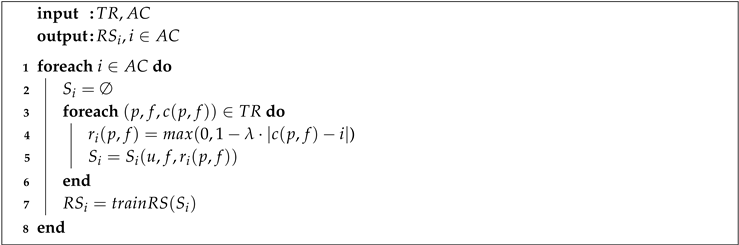 |
| Algorithm 1: The training phase of the proposed method. |
The final recommendation combines the resulting recommendations of the recommender systems , (see Figure 1). The output of each recommender system for some parent p and an item f corresponds to the predicted belief of that user that that item is appropriate for that age category. A natural way to combine the resulting recommendations, as is done on classification problems, is to select the age category with the highest recommendation (see Equation (4)), in order to produce a single cage category as the final output.
However, taking into account that the age categories are numerical values, better results are obtained when we get the expected value of the recommendation as defined the following equation:
The pseudo-code of the testing phase of the proposed method is given in Algorithm 2. The input of the algorithm is triple of the testing set, the age categories and recommender systems , that have been trained in the training phase of the method (see Algorithm 1). The output is the prediction of the age category. According to the proposed methodology, we combine the output of the recommendation of each recommender system getting the expected value of the recommendations (see line 4 of the Algorithm 2.
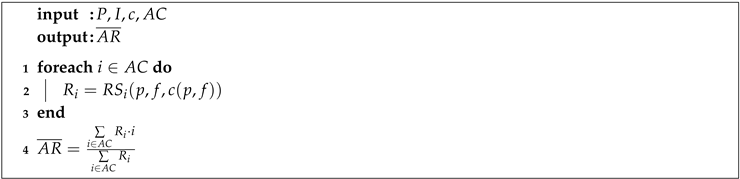 |
| Algorithm 2: The proposed application method of recommender systems to predict personalized film age ratings of parents. This algorithm shows the testing phase of the proposed method. |
5. Experimental Results
5.1. Dataset
We conducted our experiments using the age ratings provided by the users of the Common Sense site [9]. The site allows its users to specify their own age ratings on any movie they want. This enables our system to train its models on the personal age ratings provided by each user, and be able to predict personalized ratings on unrated movies, in similar fashion as with preference ratings in classic recommender systems scenarios. The original dataset contains 50781 age classifications on 12545 movies, by 45030 users. The dataset was split randomly into the training and test sets, with the test set containing approximately the of the triplets of the dataset. Figure 2 shows the distribution of the various age values over all entries in the test set.
5.2. Performance Evaluation
We performed a wide range of experiments in order to evaluate the performance of the proposed technique. All RMSE values reported are the average of five identical runs per value, with only minor differences between the averaged values observed only in the second decimal digits.
We first performed several experiments on the shape of the function that generates the values . We employed three different types of functions, namely the aforementioned linear function shown in Equation (3), a Normal (Gaussian) distribution-like function and a Laplace distribution-like function. In both of the last two cases, the maximum value was set to 1 (as in the linear function), while the variance and diversity parameters, respectively, were set to , which led to a similar behavior of the parameter in all three cases (i.e.: the larger the value, the wider the range of non-zero values). We performed several experiments, using only the information contained in the original training set, in order to find the most efficient function to employ, as well as the optimal value of . The results of those experiments are shown in Figure 3. As expected, the Laplace and Gaussian functions performed similarly, with the Laplacian one yielding the best result for a value of 0.9.
Using the aforementioned parameter values, we then performed extensive experiments using two Collaborative Filtering Recommender Systems, namely SCoR [15] and NeuMF [16]. The experiments can be divided into the following three groups.
- In the first group (MRS - Multiple Recommender Systems), the approach used is the one described so far in this paper (see Figure 1).
- The second group (SRS - Single Recommender System) is a variation of the first, where only one Recommender System was used, which was trained on the data of all age categories, instead of a separate independent recommender system per age category (see Figure 4a).
- Finally, the "RS" group corresponds to the experiments performed without any dataset transformation, where both recommender systems used (SCoR and NeuMF), were trained on the original age values (see Figure 4b). Those experiments were performed in order to demonstrate the necessity of the data transformation in the first phase.
One can see in the results shown in Table 1 that the MRS-SCoR combination outperforms the rest of the cases. In addition, worthy of note is the similarity of the RMSE values between the SRS and MRS cases while using the same recommender system (which was to be expected), as well as the fact that not both recommender systems enjoy similar improvements while employing the data transformation. At the same time, however, in both cases, those improvements are nevertheless significant.
In order to better understand the behavior of the proposed technique, on each of the two recommender systems used, we also demonstrate the Mean Average Error for all entries in the test file, per "correct" age category. The results are presented in Figure 5. One can see that SCoR outperforms NeuMF in most age categories except a narrow range in the middle of the entire age categories range. One can also see that most expediencies appear in the edge age categories, which is to be expected, as those age values are the furthest away from the mean of the age categories range.
In addition, in Figure 6, we show the ratio of the entries of the test file which were predicted with a given absolute error value (rounded to the closest integer). For instance, the ratio presented in the bars corresponding to the value of 0 in the x-axis shows the ratio of test file entries which were predicted with perfect accuracy. One can see that the MRS framework leads to slightly more test file entries with smaller errors. In addition, it is apparent that the SCoR recommender system benefits more from the proposed data transformation technique, since its ratios on the smaller errors are higher, while in contrast, its ratios on the higher errors are smaller than NeuMF.
We also present similar plots, in order to compare the various frameworks (RS, SRS, MRS) on a given recommender system. These are shown in Figure 8 and Figure 7. In Figure 8, the benefit of the proposed technique (namely MRS but also SRS) is apparent for all age categories, compared to RS, except on the edge age categories, where the use of the original age values (with no data transformation) leads to smaller errors. Also worthy of note is the fact that RS-NeuMF has similar behavior on both ages of the age category range, whereas RS-SCoR only performs poorly (but more so) on the higher age category values. In Figure 7, the benefit of the proposed technique is also apparent, since it is shown that for both SCoR and NeuMF, the use of MRS (and SRS to a slightly smaller extent) leads to higher ratios of the entries of the test file, which were predicted with smaller absolute errors.
Finally, we also performed experiments using the aforementioned parameter values (Laplace-like function with ) which provided the best RMSE values (see Table 1), in order to compare the two ways to combine the various recommendations into the final one (see Equations (4) and (5)). As mentioned before, Equation 5 produced the best results, specifically an RMSE of 2.83, as reported in Table 1, whereas the corresponding value while employing Equation (4) was 2.97.
6. Conclusions
We presented a methodology that applies Recommender Systems to predict personalized film age ratings for parents. According to the proposed methodology, we apply a recommender system for each age category of a film, yielding a recommendation for each age category of a film. The resulting recommendations are combined to provide the final age recommendation of the parent (user). We have applied the proposed methodology to state-of-the-art recommender systems (SCoR [15] and newMF [16]). These systems are compared with the corresponding direct application of the above recommender system to the age prediction problem. To our knowledge, this is the first work that solves the age prediction problem of personalized film age ratings.
The experimental results demonstrate the efficiency and high performance of the proposed approach on a well-known real-world dataset called common sense. It holds that the proposed methodology of multiple recommender systems clearly outperforms baselines using single recommender systems. As future work, we plan to apply the proposed methodology to other datasets and to even more recommender systems.
Author Contributions
The author confirms contribution to the paper as follows: Conceptualization, X.P., P.F. and C.P.; Funding acquisition, C.P.; Investigation, X.P., P.F. and C.P.; Methodology, X.P., P.F. and C.P.; Software, X.P. and P.F.; Validation, X.P.; Supervision, P.F. and C.P.; Data Curation, X.P. and P.F.; Writing – original draft, X.P. and C.P.; Writing – review & editing, X.P., P.F. and C.P..
Institutional Review Board Statement
Not applicable
Informed Consent Statement
Not applicable
Data Availability Statement
The original contributions presented in the study are included in the article, further inquiries or requests can be directed to the corresponding authors.
Conflicts of Interest
The authors declare no conflict of interest.
References
- Bronfenbrenner, U. Ecological systems theory (1992). Making human beings human: Bioecological perspectives on human development 2005, p. 106–173.
- Erikson, E.H. Childhood and Society; W.W. Norton and Company, 1950.
- Kelly, K.; Garbacz, A.; Albers, C. Theories of School Psychology Critical Perspectives; Routledge, 2020; p. 138–151.
- Piotrowski, J.T.; Valkenburg, P.M. Finding Orchids in a Field of Dandelions: Understanding Children’s Differential Susceptibility to Media Effects. American Behavioral Scientist 2015, 59, 1776–1789. [Google Scholar] [CrossRef]
- Gentile, D.; Bushman, B. Reassessing Media Violence Effects Using a Risk and Resilience Approach to Understanding Aggression; Psychology of Popular Media Culture, 2012; p. 138–151.
- Masten, A. Ordinary magic: Resilience processes in development. American Psychologist 2001, 56, 227–238. [Google Scholar] [CrossRef] [PubMed]
- Daskalaki, E.; Panagiotakis, C.; Papadakis, H.; Fragopoulou, P. Age recommendations for children’s films: associations between advisories on a US site and parents’ ratings. Journal of Children and Media 2022, 16, 532–542. [Google Scholar] [CrossRef]
- Motion Picture Association. https://www.motionpictures.org/. Accessed: 26/9/2024.
- Common Sense Media. https://www.commonsensemedia.org/. Accessed: 26/9/2024.
- British Board of Film Classification. https://www.bbfc.co.uk/. Accessed: 26/9/2024.
- Centre National du Cinéma et de l’Image Animée. https://www.cnc.fr/. Accessed: 26/9/2024.
- Freiwillige Selbstkontrolle der Filmwirtschaft. https://www.fsk.de/. Accessed: 26/9/2024.
- Australian Classification Board. https://www.classification.gov.au/. Accessed: 26/9/2024.
- Bobadilla, J.; Ortega, F.; Hernando, A.; Gutiérrez, A. Recommender systems survey. Knowledge-based systems 2013, 46, 109–132. [Google Scholar] [CrossRef]
- Papadakis, H.; Panagiotakis, C.; Fragopoulou, P. SCoR: A Synthetic Coordinate based System for Recommendations. Expert Systems with Applications 2017, 79, 8–19. [Google Scholar] [CrossRef]
- He, X.; Liao, L.; Zhang, H.; Nie, L.; Hu, X.; Chua, T.S. Neural collaborative filtering. Proceedings of the 26th international conference on world wide web, 2017, pp. 173–182.
- Panagiotakis, C.; Papadakis, H.; Papagrigoriou, A.; Fragopoulou, P. Improving recommender systems via a dual training error based correction approach. Expert Systems with Applications 2021, 183, 115386. [Google Scholar] [CrossRef]
- Xie, W.; Ouyang, Y.; Ouyang, J.; Rong, W.; Xiong, Z. User occupation aware conditional restricted boltzmann machine based recommendation. Internet of Things (iThings), 2016 IEEE International Conference on. IEEE, 2016, pp. 454–461.
- Guo, G.; Zhang, J.; Thalmann, D. Merging trust in collaborative filtering to alleviate data sparsity and cold start. Knowledge-Based Systems 2014, 57, 57–68. [Google Scholar] [CrossRef]
- Zhou, Y.; Wilkinson, D.; Schreiber, R.; Pan, R. Large-Scale Parallel Collaborative Filtering for the Netflix Prize. International conference on algorithmic applications in management. Springer, 2008, pp. 337–348.
- Elahi, M.; Ricci, F.; Rubens, N. A survey of active learning in collaborative filtering recommender systems. Computer Science Review 2016, 20, 29–50. [Google Scholar] [CrossRef]
- Papadakis, H.; Papagrigoriou, A.; Panagiotakis, C.; Kosmas, E.; Fragopoulou, P. Collaborative filtering recommender systems taxonomy. Knowledge and Information Systems 2022, 64, 35–74. [Google Scholar] [CrossRef]
- Goldberg, K.; Roeder, T.; Gupta, D.; Perkins, C. Eigentaste: A Constant Time Collaborative Filtering Algorithm. Inf. Retr. 2001, 4, 133–151. [Google Scholar] [CrossRef]
- Gorrell, G. Generalized Hebbian Algorithm for Incremental Singular Value Decomposition in Natural Language Processing. 11st Conference of the European Chapter of the Association for Computational Linguistics, 2006, pp. 97–104.
- Mobasher, B.; Burke, R.D.; Sandvig, J.J. Model-Based Collaborative Filtering as a Defense against Profil Injection Attacks. The Twenty-First National Conference on Artificial Intelligence and the Eighteenth Innovative Applications of Artificial Intelligence Conference, July 16-20, 2006, Boston, Massachusetts, USA, 2006, pp. 1388–1393.
- Koren, Y.; Bell, R.; Volinsky, C. Matrix factorization techniques for recommender systems. Computer 2009, 42, 30–37. [Google Scholar] [CrossRef]
- Dabek, F.; Cox, R.; Kaashoek, F.; Morris, R. Vivaldi: A decentralized network coordinate system. ACM SIGCOMM Computer Communication Review. ACM, 2004, Vol. 34, pp. 15–26.
- Panagiotakis, C.; Papadakis, H.; Fragopoulou, P. Personalized Video Summarization Based Exclusively on User Preferences. European Conference on Information Retrieval. Springer, 2020, pp. 305–311.
- Panagiotakis, C.; Papadakis, H.; Fragopoulou, P. Detection of hurriedly created abnormal profiles in recommender systems. 2018 International Conference on Intelligent Systems (IS), 2018, pp. 499–506.
- Panagiotakis, C.; Papadakis, H.; Fragopoulou, P. Unsupervised and Supervised Methods for the Detection of Hurriedly Created Profiles in Recommender Systems. Machine Learning and Cybernetics 2020. [Google Scholar] [CrossRef]
- Papadakis, H.; Panagiotakis, C.; Fragopoulou, P. Distributed detection of communities in complex networks using synthetic coordinates. Journal of Statistical Mechanics: Theory and Experiment 2014, 2014, P03013. [Google Scholar] [CrossRef]
- Panagiotakis, C.; Papadakis, H.; Grinias, E.; Komodakis, N.; Fragopoulou, P.; Tziritas, G. Interactive image segmentation based on synthetic graph coordinates. Pattern Recognition 2013, 46, 2940–2952. [Google Scholar] [CrossRef]
- Gao, C.; Zheng, Y.; Li, N.; Li, Y.; Qin, Y.; Piao, J.; Quan, Y.; Chang, J.; Jin, D.; He, X.; others. A survey of graph neural networks for recommender systems: Challenges, methods, and directions. ACM Transactions on Recommender Systems 2023, 1, 1–51. [Google Scholar] [CrossRef]
- He, X.; Du, X.; Wang, X.; Tian, F.; Tang, J.; Chua, T.S. Outer Product-based Neural Collaborative Filtering. arXiv preprint arXiv:1808.03912 2018.
- Berg, R.v.d.; Kipf, T.N.; Welling, M. Graph convolutional matrix completion. arXiv preprint arXiv:1706.02263 2017.
- Papadakis, H.; Papagrigoriou, A.; Kosmas, E.; Panagiotakis, C.; Markaki, S.; Fragopoulou, P. Content-based recommender systems taxonomy. Foundations of Computing and Decision Sciences 2023, 48, 211–241. [Google Scholar] [CrossRef]
- Pasquale Lops, M.d.G.; Semeraro, G. Content-based Recommender Systems: State of the Art and Trends. In Recommender Systems Handbook; Springer-Verlag: Berlin, Heidelberg, 2010; pp. 73–106. [Google Scholar]
- Logesh, R.; Subramaniyaswamy, V. Exploring hybrid recommender systems for personalized travel applications. In Cognitive informatics and soft computing; Springer, 2019; pp. 535–544.
- Adomavicius, G.; Kwon, Y. Improving aggregate recommendation diversity using ranking-based techniques. IEEE Transactions on Knowledge and Data Engineering 2012, 24, 896–911. [Google Scholar] [CrossRef]
Figure 1.
The schema of the proposed system architecture (Multiple Recommender Systems - MRS).
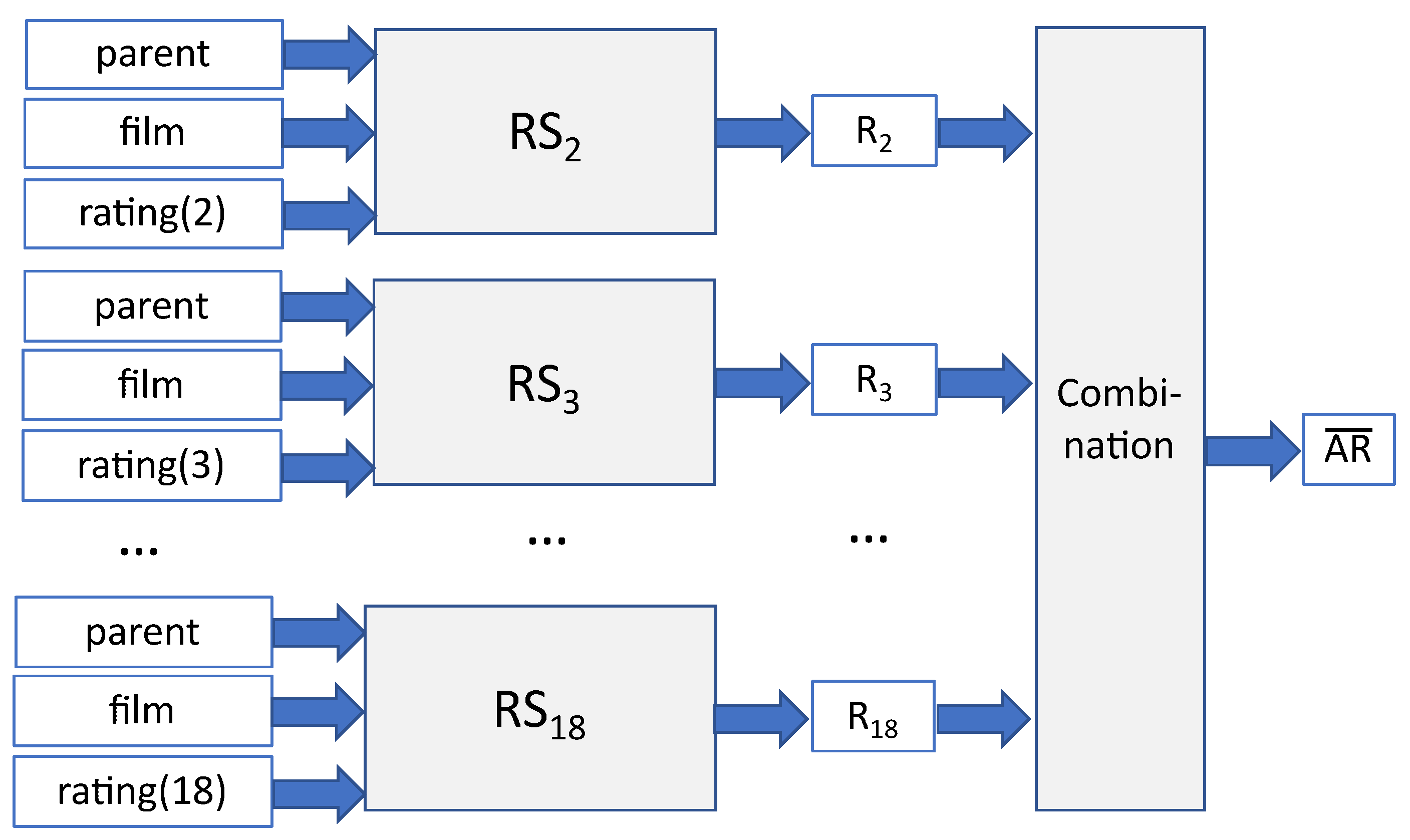
Figure 2.
The distribution of the age ratings in the common sense dataset test file.
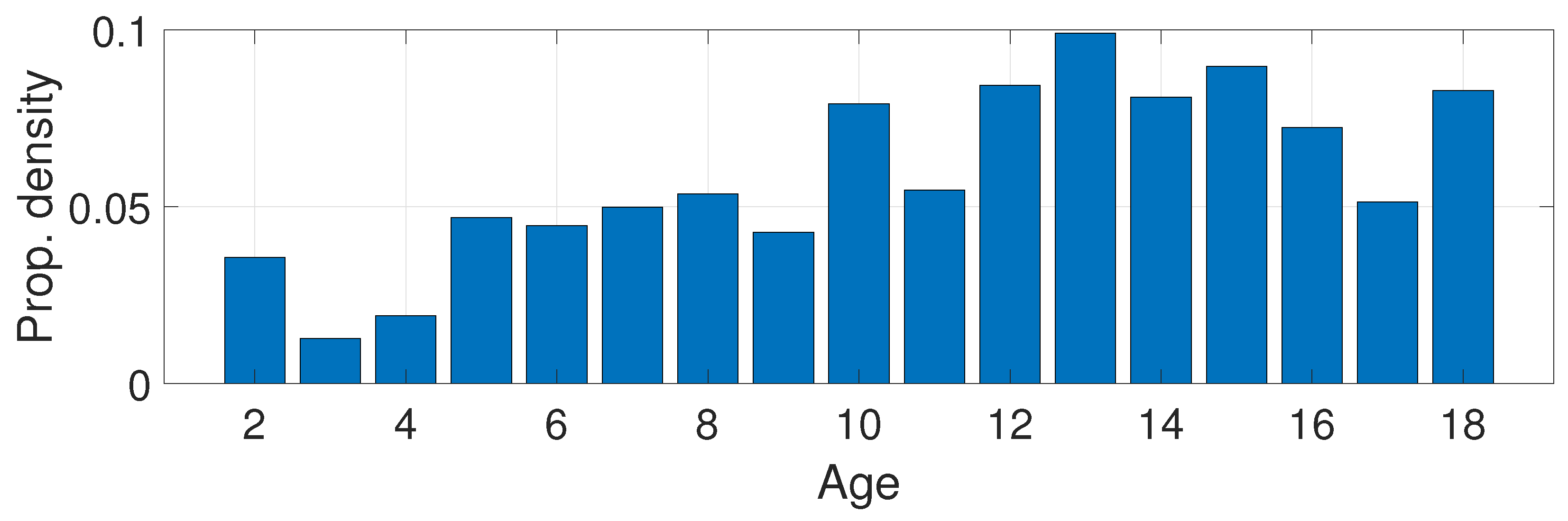
Figure 3.
The RMSE of MRS-SCoR system for different values of slope parameter .
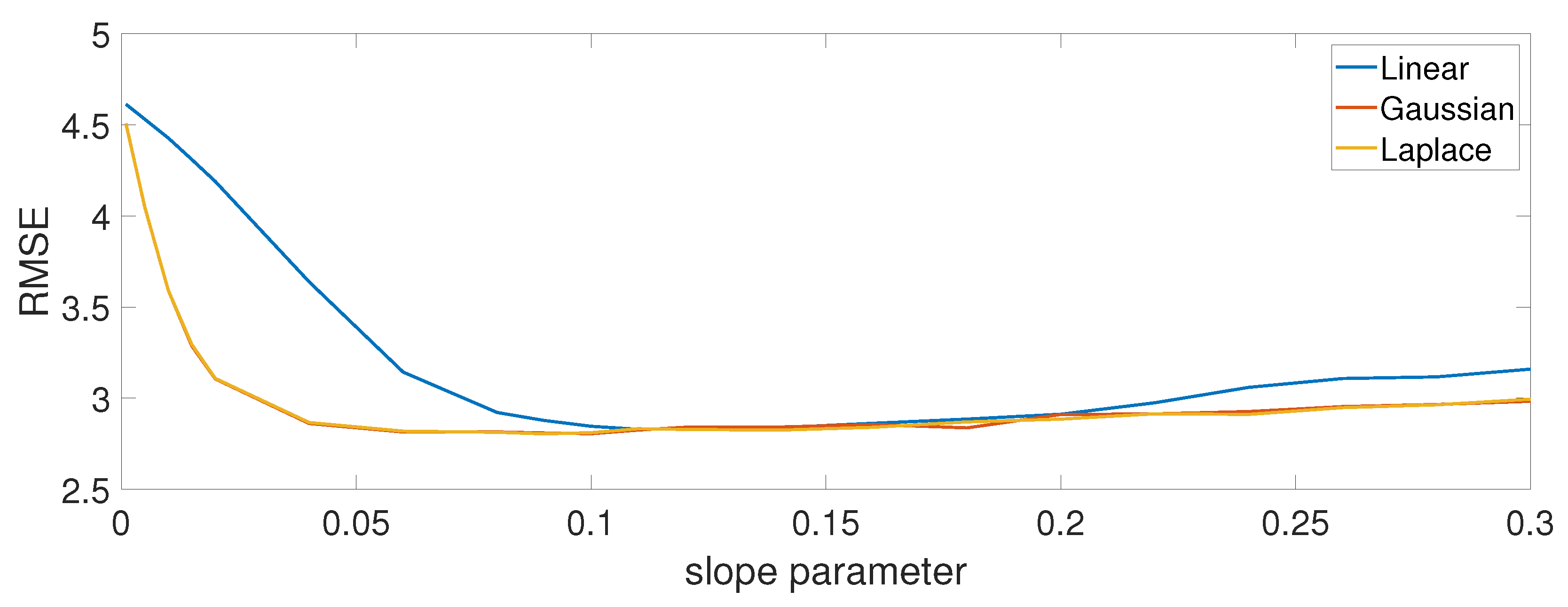
Figure 4.
(a) The schemata of the SRS (Single Recommender System) and (b) the RS architectures.
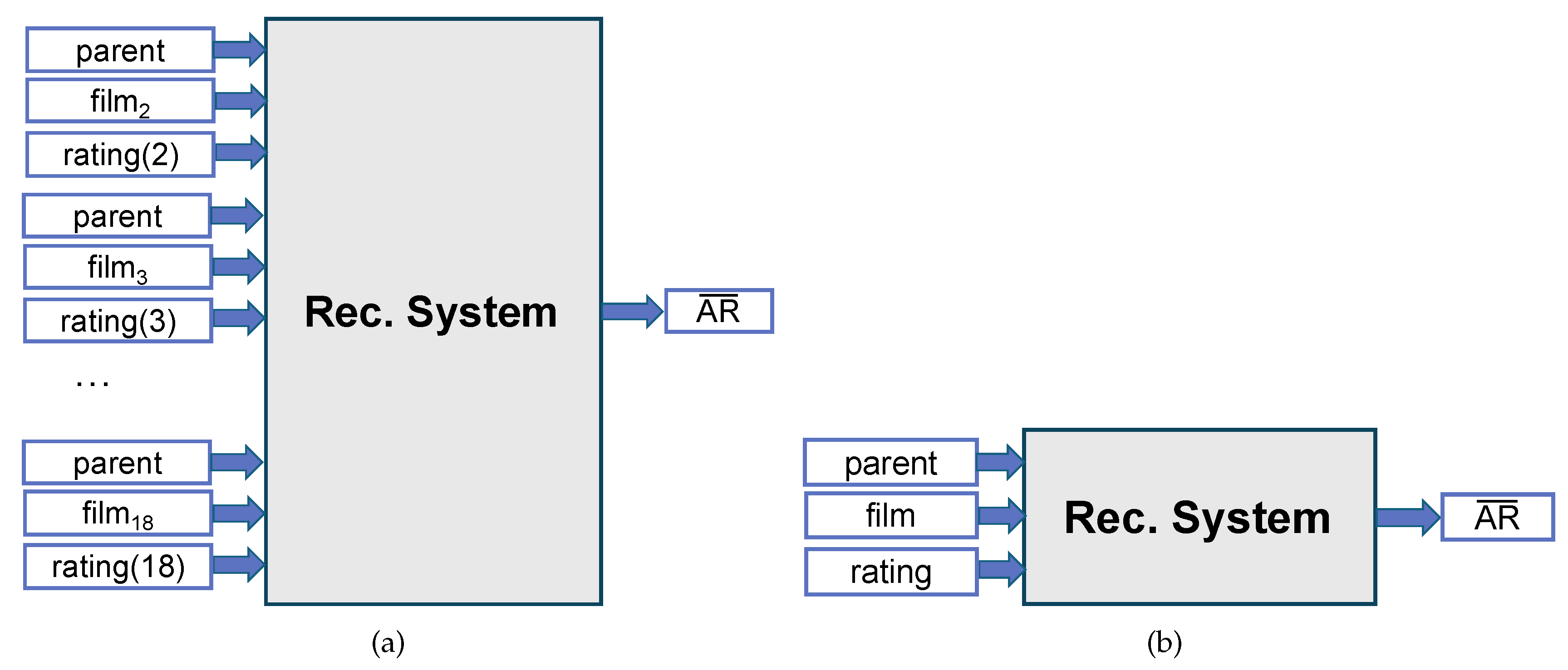
Figure 5.
The MAE for different age categories of NeuMF and SCoR recommender systems under (a) SRS and (b) MRS frameworks.
Figure 5.
The MAE for different age categories of NeuMF and SCoR recommender systems under (a) SRS and (b) MRS frameworks.
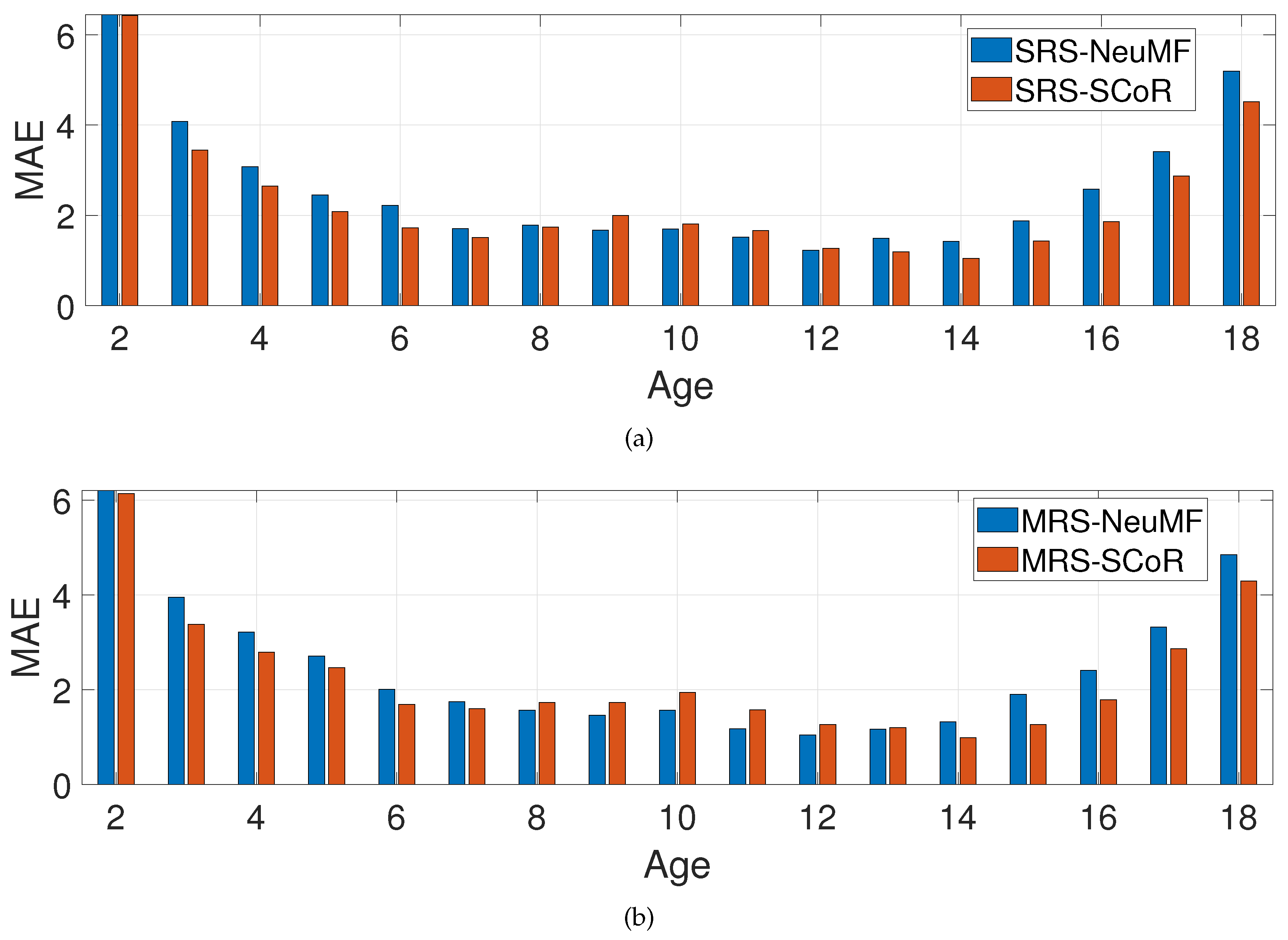
Figure 6.
The Probability Density Function (PDF) for different age errors of NeuMF and SCoR recommender systems under (a) SRS and (b) MRS frameworks.
Figure 6.
The Probability Density Function (PDF) for different age errors of NeuMF and SCoR recommender systems under (a) SRS and (b) MRS frameworks.
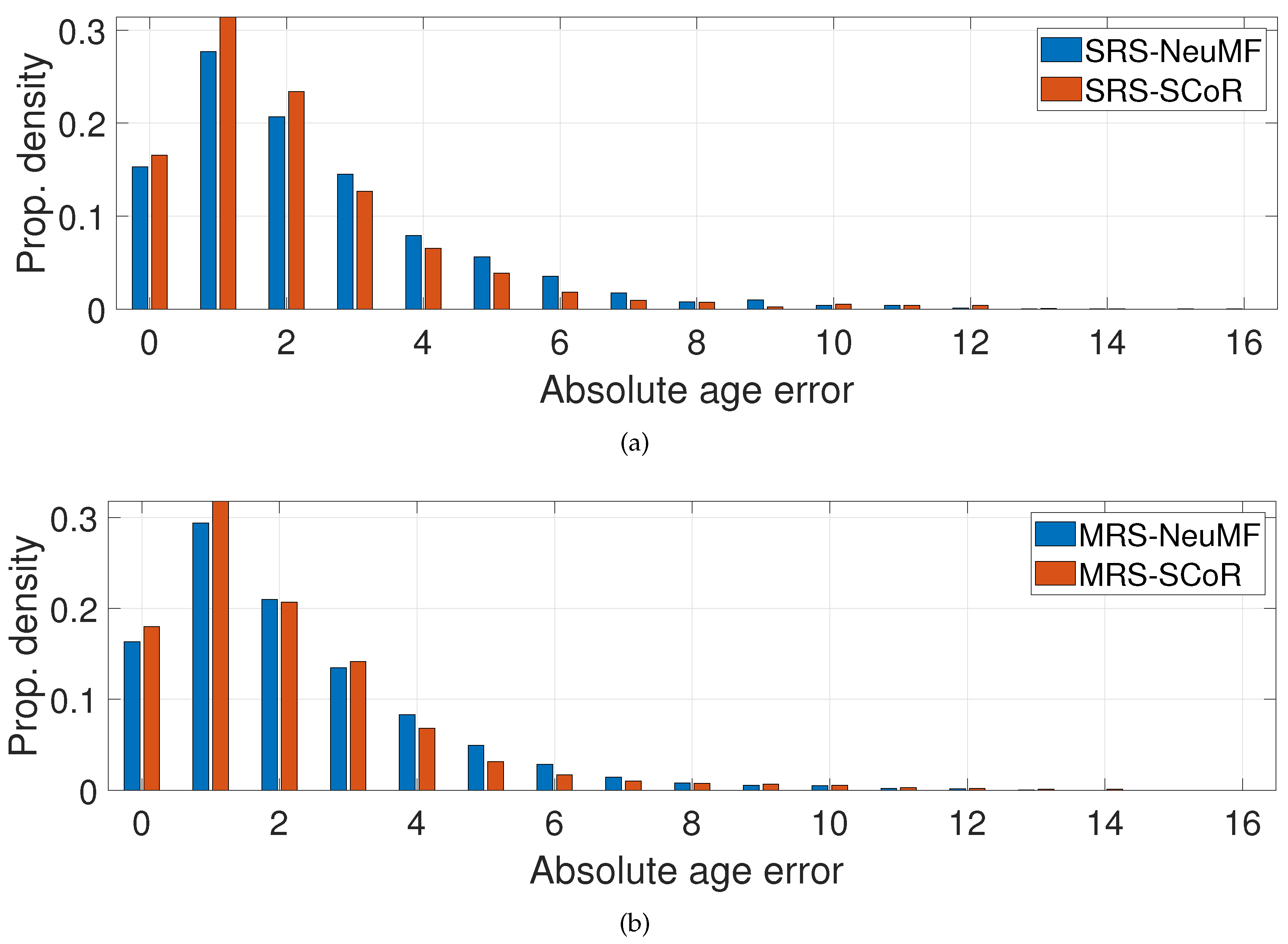
Figure 7.
The Probability Density Function (PDF) for different age errors of (a) NeuMF and (b) SCoR recommender systems under RS, SRS and MRS frameworks.
Figure 7.
The Probability Density Function (PDF) for different age errors of (a) NeuMF and (b) SCoR recommender systems under RS, SRS and MRS frameworks.
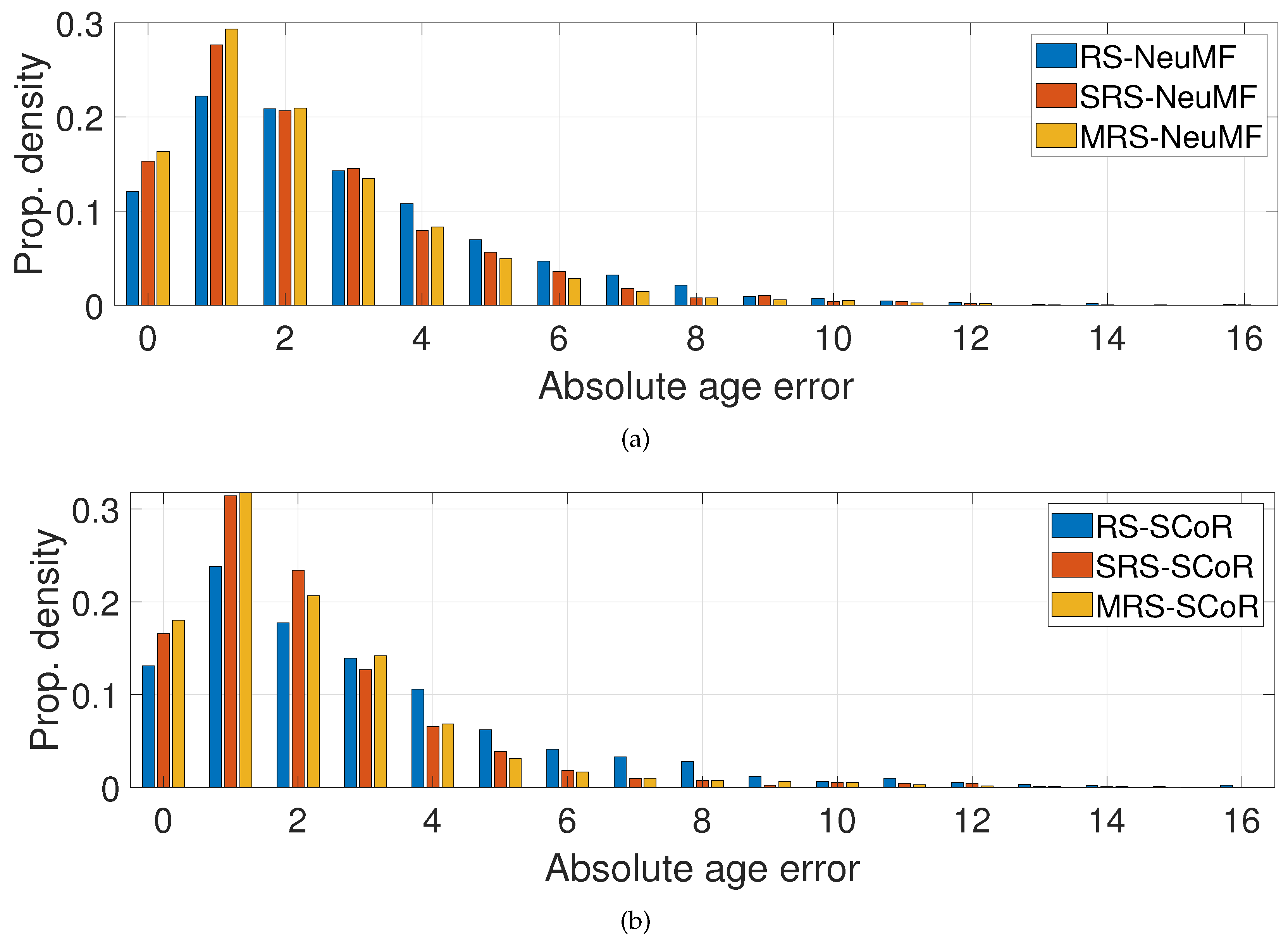
Figure 8.
The Mean Absolute Error (MAE) for different age categories of (a) NeuMF and (b) SCoR recommender systems under RS, SRS and MRS frameworks.
Figure 8.
The Mean Absolute Error (MAE) for different age categories of (a) NeuMF and (b) SCoR recommender systems under RS, SRS and MRS frameworks.
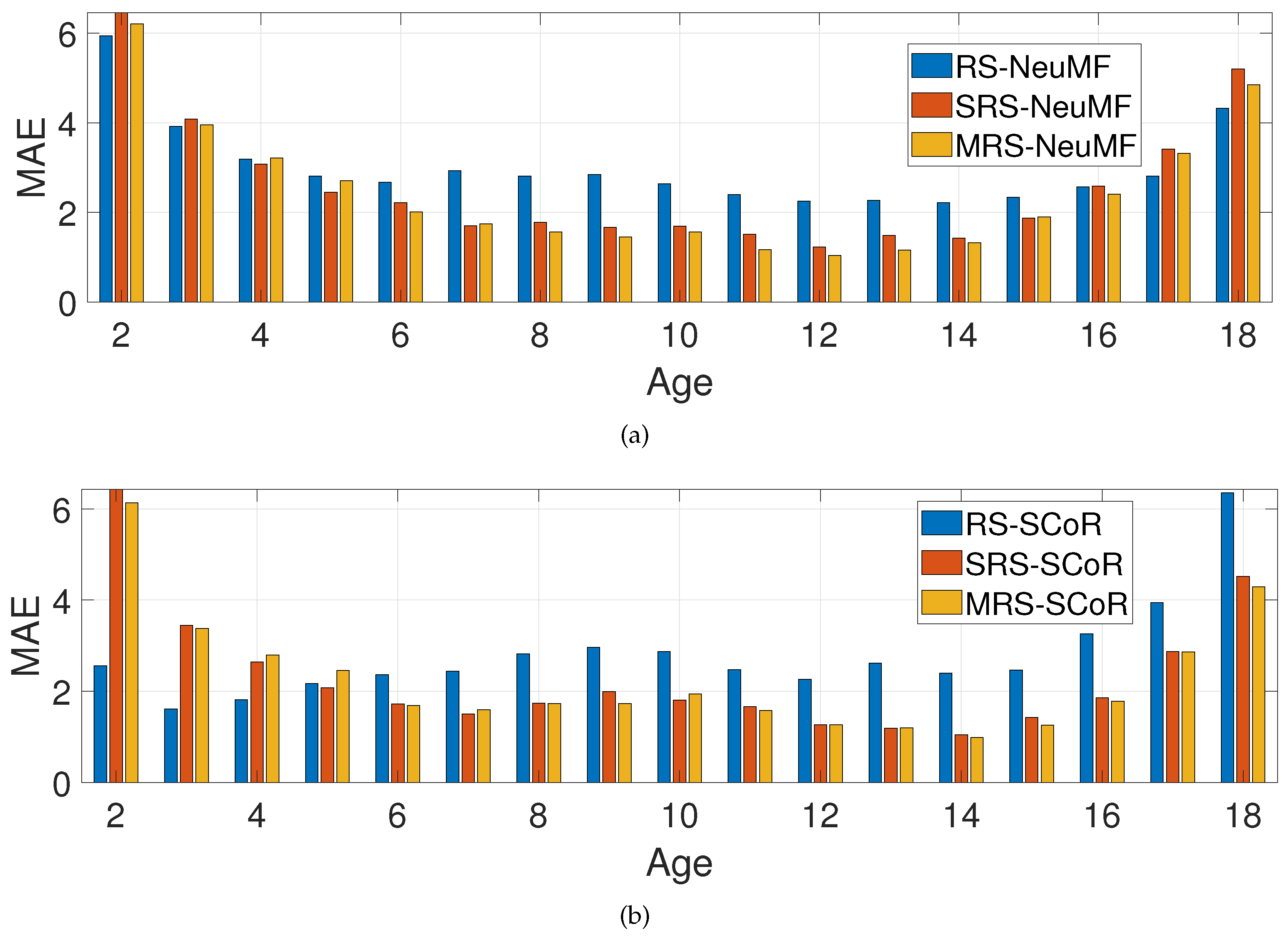

Table 1.
RMSE values for each system.
| RMSE | RS | SRS | MRS |
|---|---|---|---|
| SCoR | 3.99 | 2.88 | 2.83 |
| NeuMF | 3.67 | 3.14 | 2.93 |
Disclaimer/Publisher’s Note: The statements, opinions and data contained in all publications are solely those of the individual author(s) and contributor(s) and not of MDPI and/or the editor(s). MDPI and/or the editor(s) disclaim responsibility for any injury to people or property resulting from any ideas, methods, instructions or products referred to in the content. |
© 2024 by the authors. Licensee MDPI, Basel, Switzerland. This article is an open access article distributed under the terms and conditions of the Creative Commons Attribution (CC BY) license (http://creativecommons.org/licenses/by/4.0/).
Copyright: This open access article is published under a Creative Commons CC BY 4.0 license, which permit the free download, distribution, and reuse, provided that the author and preprint are cited in any reuse.


