

Submitted:
13 November 2024
Posted:
14 November 2024
Read the latest preprint version here
Abstract
Set duplicability is considered by showing that it provides an easy proof of Schröder-Bernstein Theorem, a fundamental result in the theory of cardinal numbers, usually based on arguments that are not very intuitive.
Keywords:
Cardinality
; Choice Axiom
; Set Duplicability
; Dedekind Infinity
1. Introduction
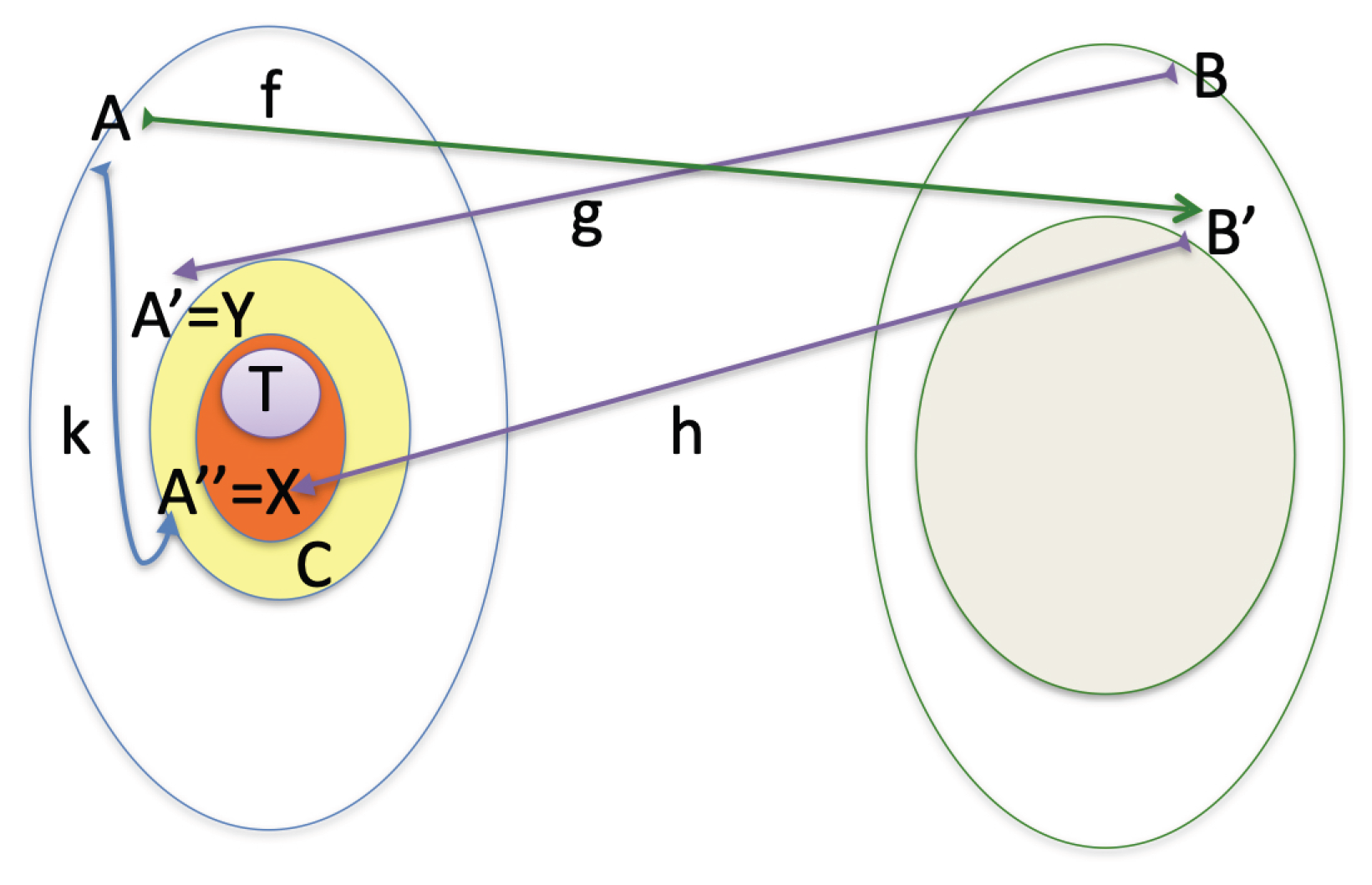
In a search for a simple proof of a well-known result about infinite sets I drew a diagram (see Figure 1), which immediately suggested a striking analogy with the picture of an egg, a sort of contradiction of the logical principle: “The part cannot be equal to the whole”. The egg is a part of an organism containing information about the whole organism. This reflexivity is a sort of Dedekind’s infinity DI (a set bijective with a proper part of itself, Galileo Galilei was the first who noticed this property of natural numbers). Set reflexivity and infinity are strictly related to duplicability, the basis of potentially infinite reproductive lines. What is the essence of this analogy? Cells are finite multisets of molecules, how can they exhibit a characteristic typical of infinity? It is not easy to answer, but It is worthwhile to remark that even if cells are finite, they are dynamic and open structures (objects inside them change in time and can continuously enter from or exit the environment).
The infinite is the essence of mathematics and the various forms of mathematical infinities (ordinal and cardinal numbers, infinitesimals, real and hyperreal numbers, and asymptotic orders) are the fields where the power of mathematical imagination reaches the highest level of creativity with paradoxes opening windows that shock our common sense. Mathematics tells us that reality is not only what we think to be, but a wider unimaginable painting of which we can reconstruct some pieces. However, contrarily to their apparent unpractical interest, infinite processes are driving forces of important applications of mathematics. As Gregory Chaitin claimed in many papers and conferences [1], also computers are conceptually a product of Cantor’s Paradise (an expression used by Hilbert in a famous paper of 1926), because the Turing machine was invented for generating computable real numbers. Turing’s discovery of the recursive enumerable set K is a version of Cantor’s diagonal argument.
In this note, the relationship of set duplicability is linked to a famous result in set theory enunciated, without proof, by Georg Cantor in 1887.
2. Set Duplicability
In 1878, Cantor proved two instances of , where ↔ denotes a 1-1 (bijective) function, that is, , where is the cardinality of the set A, such that , and is a kind of ordinal number called cardinal number. In the first instance of Cantor’s proofs , while in the second instance (the naturals and the reals respectively). These results about cardinal numbers were a shock. In a letter to Richard Dedekind Cantor wrote: I see it, but I cannot believe it, as reported in Abraham Fränkel’s book [8].
According to Cantor, a set is infinite if it includes a subset that is equipotent (1-1), with the set of natural numbers.
The bijection means that the set A is Cartesian Duplicable. The general proof that, for every infinite set A, requires the Axion of Choice AC [8]. Moreover, Tarski showed in 1924 [10] that “ for any infinite A” is equivalent to the Axiom of Choice AC.
Informally, the axiom of choice says that for any collection of nonempty sets, it is possible to construct a new set by choosing one element from each set (even if the collection is infinite). An equivalent formulation says that the Cartesian product of a collection of non-empty sets is non-empty. Many important results in set theory need AC to be proved. Axiomatic set theories, such as ZF (Zermelo Fränkel), establish axioms expressing the essence of sets, but avoiding the paradoxes arising when a naive notion of class is assumed, such as Russell’s paradox reported in 1902. The theory ZFC is the ZF theory with the Axiom of Choice.
Dedekind’s infinity DI of a set A claims that ( denotes an injective and not surjective function).
A set is (simply) Duplicable if , that is, if with both bijective with A. Dedekind Infinity implies Cantor’s infinity. If AC is assumed, set infinity is equivalent to Dedekind infinity. [4,5,7,10,11]. It was proved that set duplicability is weaker than AC [7].
Lemma 1
(Cartesian Duplicability implies Duplicability)
If A is a Cartesian duplicable set, it is a sum duplicable set.
Proof.
If A is Cartesian duplicable, then:
and the following chain of bijective functions holds:
where and (A includes a set bijective to and can be set as the element of this set corresponding to 0), then: . if then that is: Therefore, by (2) the thesis follows. □
According to John von Neumann [4,5], an ordinal number is the set of numbers preceding it. Therefore, the first ordinal number is ∅, the second one is , the third is , and in general the successor of an ordinal is . The union of all finite ordinals is , the first infinite ordinal. Then, the successor of is , therefore, the usual counting process of numbers can be extended to all transfinite numbers. Surprisingly, Cantor’s transfinite counting is strongly related to Archimedes’ counting process based on orders and periods [6].
Now, we give two different proofs of set duplicability. The first one uses AC; the other one does not use AC.
Lemma 2
(Set Infinity implies Set Duplicability)
Any infinite set A is duplicable, that is, it is equipotent to the union of two disjoint sets and that are both equipotent to A.
Proof 1.
It is well-known that AC implies that any set is well-ordered, that is, it is 1-1 with some ordinal . But . This can be shown in several ways, for example by using an argument similar to Cantor’s proof that (). □
Proof 2.
The infinity of A implies that, for any , surely there exists a subset that is a bijective image of a function f from to with . At this point, i) we mark a by 0, by replacing it with , and ii) if , we add the pair to a function g initially equal to ∅. We continue to repeat this procedure. Hence, the process goes on, step by step, by applying substeps i) and ii) for all unmarked elements present in A at that step (for infinite steps, they are an infinite set). The set of all 0-marked elements is bijective with the set of their images according to g, and the initial set A is 1-1 with . □.
Lemma 3
(Set Duplicability implies Set Infinity)
A duplicable set is infinite.
Proof. If a set is finite, it cannot be duplicable. This means, by contraposition, that a duplicable set has to be infinite. □
The second proof of the Lemma 2 can be extended to prove that, given an infinite set A and a family of finite sets , then . But a stronger result holds, because even when , for every , then (in this case AC seems to be essential in the proof). However, if we consider the ordinal numbers having a cardinality less than or equal to a cardinal number , then . The ordinal is an initial ordinal, and corresponds to the cardinal number . Cantors’s Continuum Hypothesis CH claims that , and a crucial result of the last century, solving the 23o Hilbert Problem presented in 1900, shows that there are models of sets where CH holds and models where CH does not hold [2].
The previous two lemmas show that the infinity of sets is equivalent to their duplicability. The same equivalence does not hold between infinity and Dedekind infinity. Namely, if a set is finite, it cannot be Dedekind infinite. Therefore, when a set is Dedekind infinite it has to be infinite. But non necessarily infinite sets are also Dedekind infinite because there exist models of ZF where there are sets infinite that are not Dedekind infinite, called iDf (infinite Dedekind finite).
Lemma 4
Given two sets if is 1-1 with a proper part of X, then .
Proof.
Let us denote by C the difference and by T its image in X such that (see Figure 1). At first glance, a 1-1 correspondence could be obtained by the union of the correspondence plus the identical correspondence . However, this is not the correct way to establish a correspondence . Namely, T (and any subset of X) has to be considered twice: when it is a subset of X and when it is a subset of Y and in the previous wrong solution T as a subset of Y remains uncovered by the correspondence. For this reason, set duplicability is essential to give the right 1-to-1 correspondence between X and Y. Let us suppose that T is infinite (otherwise the proof is trivial). For a better explanation let us denote by a superscript the superset where a set is considered. Now, by the Lemma 2, the set is bijective with the union of two disjoint sets that are both 1-to-1 with . Then X is 1-to-1 with Y as the union of the following three correspondences:
. □
The following Proposition will prove Schröder-Bernstein Theorem, shortly SBT, from the duplicability of infinite sets. A classical proof of SBT can be found in [3], and historical accounts of SBT are given in [9,12]. Given two sets , then means that there exists an injective function from A to B, while means that . If and a 1-1 function from A to B exists, then .
Proposition 4
(Cantor-Schröder-Bernstein Theorem)
If and , then .
Proof.
The following bijections derive from the hypothesis (see Figure 1, ):
1)
2)
3)
4) .
From 4) it follows that has to be bijective (in the correspondence k) with some subset T of . Therefore, we can apply Lemma 4 where and , from which the following correspondences follows:
5) . Then, from 2) and 5) we get the conclusion . □
References
- Chaitin, G.: A Century of Controversy over the Foundation of Mathematics. Finite versus Infinite: Contributions to an Eternal Dilemma, G. Păun, C. Calude (eds.), Springer-Verlag, London, 75-100 (2000).
- Cohen, P. J.: The independence of the Continuum Hypothesis. Proceedings of the National Academy of Sciences of the U.S.A. 50 (6): 1143–1148 (1963).
- Halmos, P.: Naive Set Theory, Springer (1974).
- Jech, T.: Set Theory, Springer (1997).
- Levy, A.: Basic Set Theory, Springer (1979).
- Manca, V.: Python Arithmetic, Springer (2024).
- Sageev, G.: An independence result concerning the Axiom of Choice. Ann. of Math. Logic, 8, 1-194, (2014).
- Fränkel, A. A.: Set Theory and Logic. Addison-Wesley (1966).
- Sieg, W.: The Cantor–Bernstein theorem: how many proofs? Phil. Trans. R. Soc. A 377: 20180031 (2019).
- Tarski, A.: Sur quelques theorems qui equivalent a l’axiome du choix. Fundamenta Mathematicae, 5: 147–154 (1924).
- Truss, J.: Two Equivalents of the Axiom of Choice. Journal of the London Mathematical Society, Vol. s2-6, Issue1 (1972).
- Wikipedia https://en.wikipedia.org/wiki/Schröder-Bernstein-theorem.
Figure 1.
The Scröder-Bernstein Theorem visualized according to a self-similarity perspective (T is the infinite set that is duplicated).
Figure 1.
The Scröder-Bernstein Theorem visualized according to a self-similarity perspective (T is the infinite set that is duplicated).
Disclaimer/Publisher’s Note: The statements, opinions and data contained in all publications are solely those of the individual author(s) and contributor(s) and not of MDPI and/or the editor(s). MDPI and/or the editor(s) disclaim responsibility for any injury to people or property resulting from any ideas, methods, instructions or products referred to in the content. |
© 2024 by the authors. Licensee MDPI, Basel, Switzerland. This article is an open access article distributed under the terms and conditions of the Creative Commons Attribution (CC BY) license (https://creativecommons.org/licenses/by/4.0/).
Copyright: This open access article is published under a Creative Commons CC BY 4.0 license, which permit the free download, distribution, and reuse, provided that the author and preprint are cited in any reuse.


