Preprint
Review

This version is not peer-reviewed.

Cooperation-Oriented Multi-Modal Shared Mobility for Sustainable Transport: Developments and Challenges

A peer-reviewed article of this preprint also exists.

Submitted:

12 November 2024

Posted:

13 November 2024

You are already at the latest version

Abstract

There is an increasing adoption of shared mobility for improving transport systems performance, reducing excessive private vehicle use, and making full utilization of existing infrastructure. Despite numerous studies in exploring the use of shared mobility for sustainable transport from different perspectives, how it has improved the sustainability of existing transport and what impact it has on various stakeholders are unclear. A systematic literature review, therefore, is carried out in this study on developing and adopting shared mobility for pursuing sustainable transport in urban traveling. Four emerging themes including (a) attitude and intention, (b) cooperation behaviors, (c) operations and decisions, and (d) performance evaluation have been identified, and some research gaps and challenges are discussed. An integrated framework for developing cooperation-oriented shared mobility is proposed. This leads to better understanding of share mobility and its use for sustainable transport.

Keywords: 
;  ;  ;  ;  ;  

1. Introduction

With the growing population and the increasing urbanization, the number of vehicles across the world is increasing rapidly (Chen and Deng, 2022; Molla et al., 2024). As a result, urban transport systems are facing numerous challenges due to growing traffic congestion, increasing environmental pollution, and growing greenhouse emissions (Shaheen et al.,2016; Chen and Deng, 2019). How to develop sustainable transport through adopting cooperation-oriented mobility solutions, therefore, is becoming critical (Duan et al., 2022).
Cooperation-oriented transport is about sharing and integrating all kinds of transport resources in urban traveling for improving individuals’ mobility (Chen and Deng, 2022). This involves various stakeholders such as government departments, enterprises, public organizations, and individuals taking cooperative decisions from planning, design, construction, and management to operations and maintenance of transport systems to meet multiple, often conflicting objectives (Chen and Deng, 2019; Molla et al., 2024). Cooperation-oriented transport provides stakeholders with more flexible, reliable, safe, and convenient transport services (Chen et al., 2017). This helps to address the growing challenging of urbanization and sustainable development.
The increasing use of cooperation-oriented transport leads to the wide adoption of innovative mobility solutions, including mobility as a service (MaaS) (Molla et al., 2024) and multi-modal shared mobility (MSM) (Meng et al., 2020). MaaS bundles transport options from multiple providers into consolidated digital platforms for delivering integrated mobility services (Duan et al., 2022). It provides travelers with latest technologies (Storme et al., 2020; Li and Voege, 2017) to combine information from different transport modes and services with payment models and product packages (Butler et al., 2021). MSM is a flexible and low collaboration requirement transport form that links available transport modes through transport providers, sharing bicycles, automatic driving, and buses for enhancing individuals’ mobility (Wong et al., 2020). These two innovative solutions share many common features, therefore often lumped together in pursuing sustainable transport. The adoption of such innovative solutions has demonstrated their potential in addressing the emerging challenges of urbanization and enhancing the sustainability of urban transport systems (Butler et al., 2021).
The growing adoption of innovative shared mobility solutions leads to numerous studies to understand how their use can help improve the sustainability of urban transport and what impact that they have on stakeholders (Butler et al., 2021). Despite numerous studies in exploring the application of shared mobility solutions in urban transport, how such applications have improved the sustainability of existing transport systems and what impact they have on individuals are unclear. A research question is, therefore, formulated in this study for addressing these issues as follows: What are the latest development and challenges in pursuing cooperation-oriented shared mobility for sustainable transport?
This study carries out a systematic review of the related research in shared mobility for sustainable transport. Such a review is conducted based on Emerald, ScienceDirect, SpringerLink, and Web of Science during the last ten years. Four emerging themes from existing studies including (a) attitude and intention, (b) cooperation behaviors, (c) operations and decisions, and (d) performance evaluation have been identified, and existing research gaps and challenges are discussed. An integrated framework is proposed for developing cooperation-oriented shared mobility, leading to better use of shared mobility for pursuing sustainable transport in urban traveling.
In what follows, the systematic review method is given in Section 2. A descriptive analysis of the identified literature is then described in Section 3. The emerging themes on shared mobility use for sustainable transport is identified in Section 4. Existing research gaps and challenges in utilizing shared mobility for sustainable transport are elaborated in Section 5. An integrated framework and the conclusion are finally presented respectively in Section 6 and Section 7.

2. The Review Method

This study follows a structured approach in conducting a systematic review in exploring the utilization of shared mobility for developing sustainable transport (Wolfswinkel et al., 2013). The adoption of this approach requires defining the review scope first before determining the terms for searching the selected database. This leads to the determination of the review sample and the examination of the selected sample. Finally, the review results can be summarized for reporting. This systematic review process is presented in Figure 1 as follows.
The review scope determines the boundary of the research topic, the sources, the type of literature, and the criteria and methods that the study uses to select, evaluate, and synthesize the literature (Wibowo et al., 2022). This study sources the related literature from Emerald, ScienceDirect, SpringerLink, and Web of Science. This is because these databases have an extensive coverage and strong representation in the publication of quality research articles in shared mobility (Benjaafar et al., 2019; Benjaafar & Hu, 2020).
Several search terms have been used for ensuring a broad coverage of the study including ‘shared mobility’, ‘cooperation consciousness’, ‘conscious cooperation’, ‘travel behavior’, ‘ridesharing’, ‘ride-hailing’, ‘car sharing’, ‘bike sharing’, ‘on-demand service platforms’, ‘MaaS’, ‘MSM’, and ‘sustainable transport’. Adopting these search terms in the search ensures that all the relevant literature in shared mobility can be identified (Hu and Creutzig, 2022).
Several criteria have been adopted to ensure the selection of the most relevant articles in the study. The document type, for example, is restricted to scholarly journals. The language is limited to English. The selected articles were published between 2014 and2024. Conference papers, book chapters, and white reports are not considered. Such articles may offer valuable insights. Peer-reviewed journal articles, however, are more indicative of cutting-edge research with higher impact (Wibowo et al., 2022).
The determination of the review scope and the search terms leads to the implementation of the search queries in the selected databases. It results in the retrieval of 2,172 articles from these four databases. This shows that shared mobility is a widely covered concept for developing sustainable transport.
The initial search result above is further screened to determine the final sample for detailed analysis. Such a screening process is done manually with the focus on the title and the abstract of each article for checking their relevance to this study (Wolfswinkel et al., 2013). As a result, 201 articles are selected. After removing the duplicated articles, 84 articles have been obtained for further analysis. The selected sample is finally coded and analyzed manually. Four emerging themes are then identified, and existing research gaps and challenges in the development of shared mobility for pursuing sustainable transport are discussed in the following.

3. Descriptive Literature Analysis

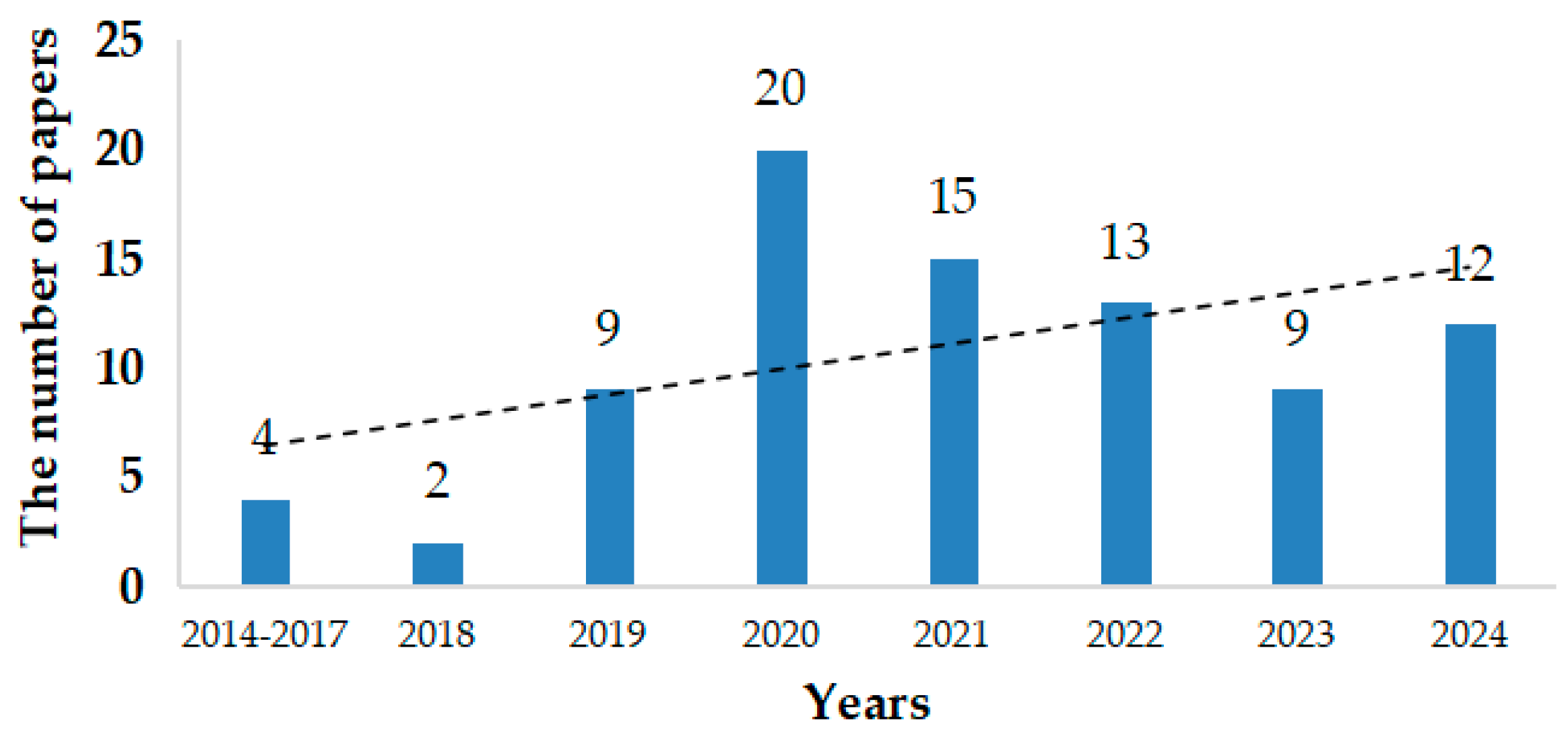
The sample of the identified articles is examined with respect to (a) publication trend, (b) publication outlet, and (c) study context (approaches, methods, and theoretical lens). Figure 2 presents an overview of the publication trend over time. It reveals that there is a non-linear time trend. There, however, appears to be an increasing interest in shared mobility. The 84 articles identified, 78 articles are published in 2019 and after.
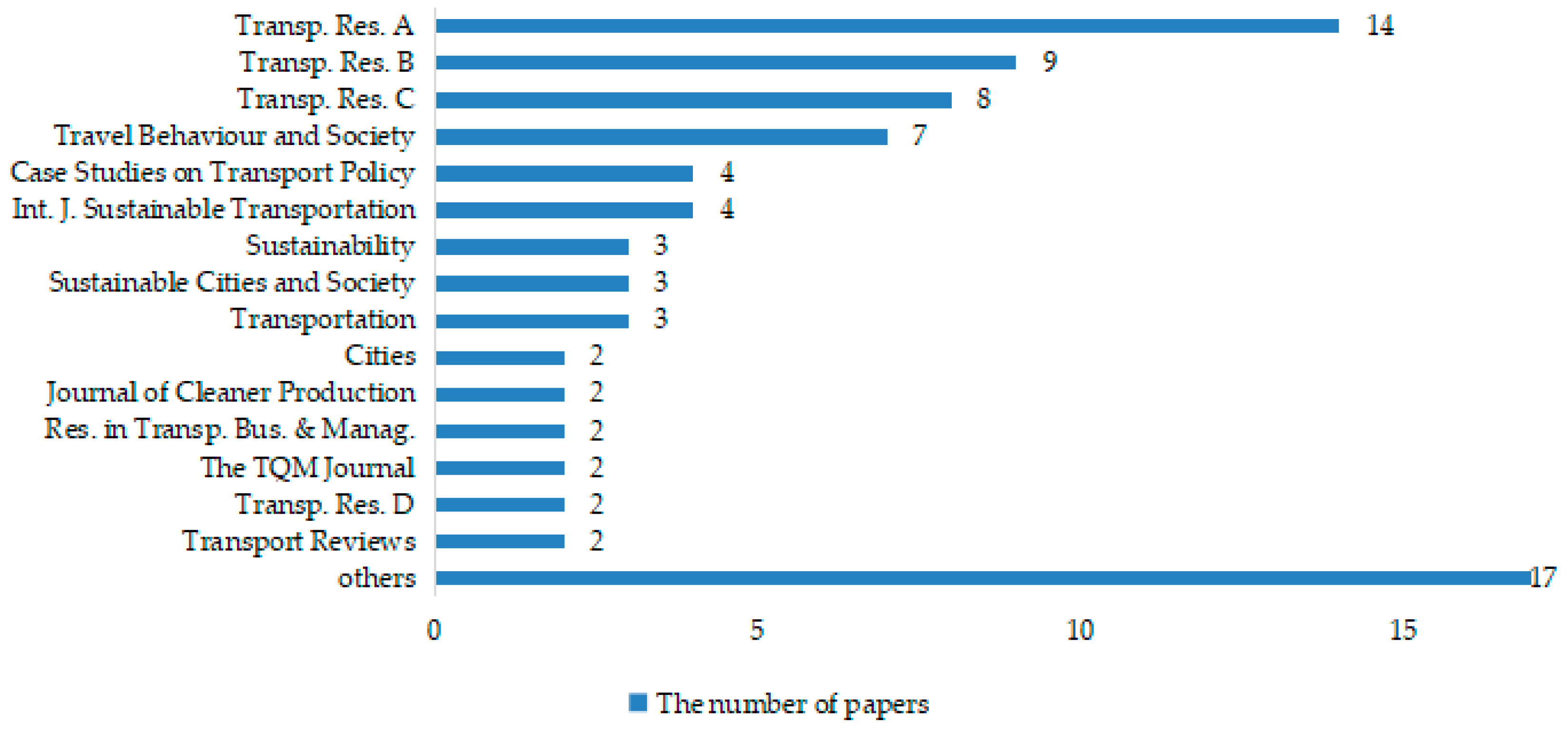
The publication outlet of the sample article is analyzed. Figure 3 presents the distribution of the articles across different outlets. It shows that most selected articles are from high-quality outlets listed as in Figure 3. It reveals that Transportation Research Part A and Part B have published the most articles on shared mobility, followed by Part C and Travel Behavior and Society.
The study context of the sample is examined. Table 1 presents the result. It shows that survey and simulation are the prominent methods in quantitative studies and case studies and field studies are the mainstream method in qualitative research. Econometric modelling with behavioural theories is the prevailing framework. It also reveals that mixed-methods approaches and experiments have demonstrated their applicability in the shared mobility studies.
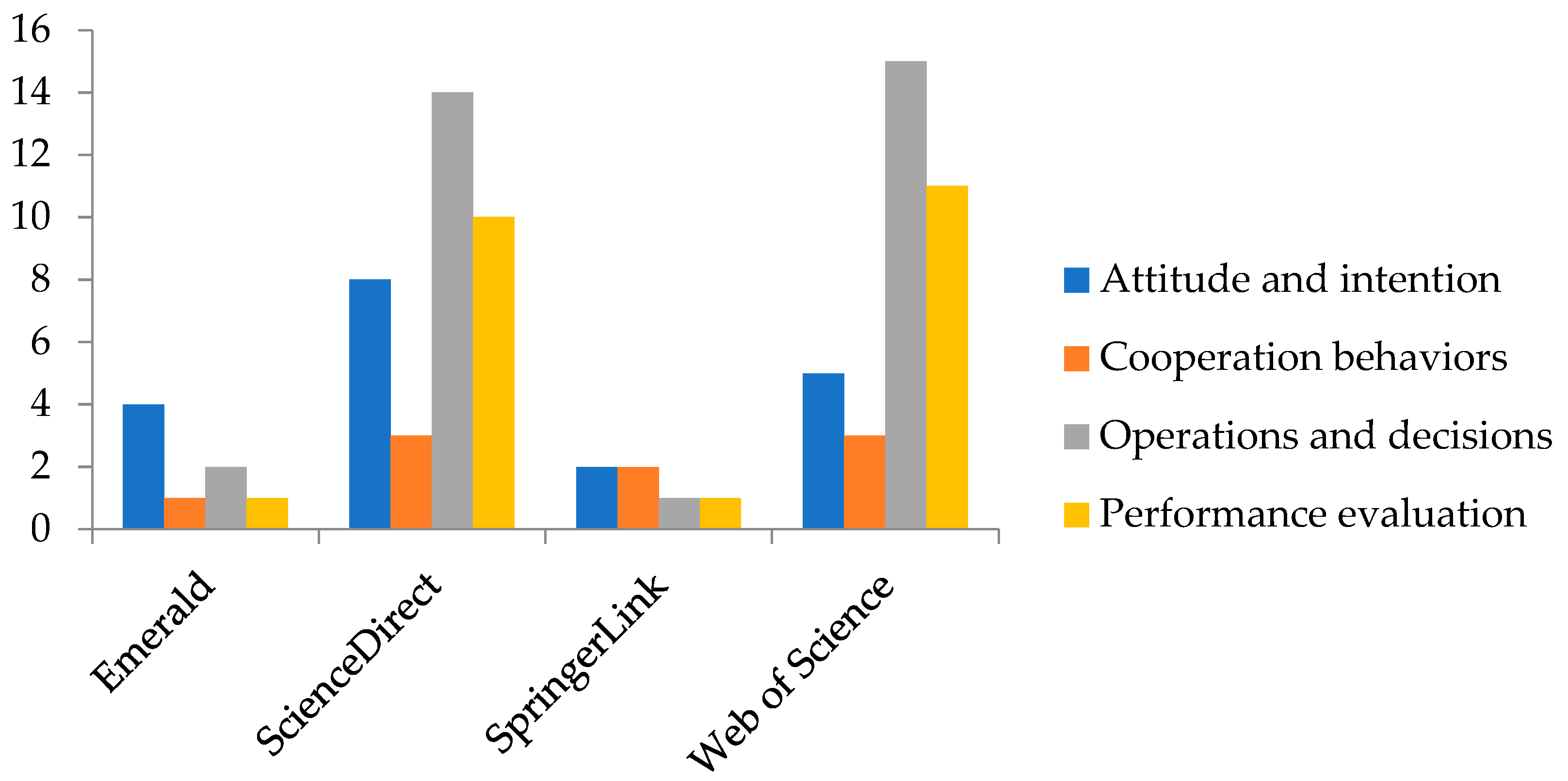
The distribution of the articles in the four databases is analyzed. As shown in Figure 4, ScienceDirect and Web of Science are the two prevailing databases which track the publication of most articles.

4. Emerging Research Themes

An examination of the sample leads to the identification of four themes in exploring the use of shared mobility for sustainable transport. These four themes include (a) attitude and intention, (b) cooperation behaviors, (c) operations and decisions, and (d) performance evaluation, discussed as follows.
Attitude and intention
Exploring individuals’ attitude and intention in utilizing shared mobility for pursuing sustainable transport has attracted increasing interest, leading to numerous studies being conducted. Such studies can be classified into sub-themes of (a) understanding individuals’ attitude, (b) exploring individuals’ intention, and (c) investigating the willingness to pay (WTP).
Attitude-based studies focus on what motivates individuals in adopting shared mobility for pursuing sustainable transport. Ciasullo et al. (2018), for example, explore the use of carpooling based on text analysis finding that economic performance, environment consideration, comfort, traffic, socialization, reliability, curiosity are critical to carpooling use. Moody et al. (2019) investigate the adoption of Uber and Lyft, revealing that individuals’ discriminatory attitude is critical to their use. Ahmed et al. (2021) examine how to influence user satisfaction in adopting ridesharing, discovering that perceived quality and value for money are the critical determinants for its use. Li et al. (2022b) show that the critical determinants for utilizing ride-hailing services depend on user orientation, travel characteristics, and perceived performance in urban traveling.
Intention-oriented studies concentrate on investigating what affects the intention of individuals to purchase shared mobility products and services in urban traveling. Mattia et al. (2019) and Chahine et al. (2024b), for example, reveal that subjective norm, perceived behavioral control, and attitude affect individuals’ intention to adopt shared mobility products and services. Herberz et al. (2020) find that environmental concerns, status, financial situation, independence, safety, and hedonic motives are critical for individuals’ intention to utilize shared mobility solutions. Duan et al. (2022) discover that costs, network externality, institutional factors, behavioral factors, environmental concerns, travel options, and socio-economic influence are critical to the intention of individuals in using MaaS. van Veldhoven et al. (2022) demonstrate that environmental value, ease of use, time saving, ownership, price, compatibility, digital savviness, and hedonic motivations are critical to individuals’ intention to the utilization of shared mobility. Molla et al. (2024) state that platform personalization, customizability, functional integration, network integration governance, and information schema congruity affect individuals’ intention to utilize shared mobility solutions such as MaaS.
WTP-aligned studies examine how much that individuals are prepared to pay for mobility products and services and identify what influences their WTP. Asgari and Jin (2019), for example, investigate individuals’ WTP for the use of autonomous vehicles, finding that driving pleasure, reasons for mode choice, trust and technical savvy are the critical determinants. Liljamo et al. (2020) explore individuals’ WTP for MaaS offerings, discovering that mobility costs, household’s income and gender are the dominant factors. Vij et al. (2020) survey 3985 representative Australians about their use of MaaS, revealing that age and lifecycle stage are the critical determinants in predicting individuals’ WTP for MaaS products. Lopez-Carreiro et al. (2021a) discover that the need for control, privacy concerns, environmental awareness, and services integration are the critical determinants of individuals’ WTP for MaaS. Lopez-Carreiro et al. (2021b) examine individuals’ WTP for MaaS, highlighting that demographic, socioeconomic, and travel-oriented variables are critical. Table 2 summarizes the related studies above.
Cooperation behaviors
Cooperation is about individuals working together to achieve shared objectives (Klein and Ben-Elia, 2016, 2018). Individuals make pro-social choices through cooperation even if such choices impose greater costs or confer less benefits (Hanaki et al., 2007). In transport, cooperation behaviors are about individuals making specific travel decisions for the community’s benefits in a voluntary manner (Chen and Deng, 2022).
Understanding what cooperation behaviors are and how cooperation behaviors can be developed directly affect the development of shared mobility for sustainable transport (Alessandretti et al., 2020). An examination of such studies in this perspective has identified three sub-themes including (a) behaviors patterns, (b) critical factors for adopting cooperation behaviors, and (c) formulation and evolution of cooperation behaviors.
Exploring individuals’ behavior patterns in urban traveling helps understand the utilization of shared mobility products and services under various contexts. This leads to many studies using some common theories to understand the cooperation behavior in utilizing shared mobility. Chen and Deng (2019), for example, present a conceptual framework to examine the interplay between social networks, information use, and conscious cooperation in shared mobility use, leading to three common cooperative behavior patterns being identified. Biehl et al. (2019) investigate the shift from using private vehicles to adopting shared mobility solutions from the community perspective finding that there is a significant difference in the utilization of shared mobility in different communities. Young and Farber (2019) examine the difference between ride-hailing users and other mode users regarding their socio-economic characteristics, discovering that ride-hailing is a phenomenon of wealthy young people. Bi and Ye (2021) investigate travel behavior of ride-sourcing users, leading to the identification of several user patterns through fusing Didi ride-sourcing data using the Latent Dirichlet Allocation model. Vega-Gonzalo et al. (2024) explore how shared mobility use affects car ownership in various population and geographic areas, discovering that the availability of shared mobility solutions can reduce private car ownership.
Critical factor-based studies concentrate on understanding what affects the development of cooperation behaviors in the use of shared mobility. Acheampong et al. (2020), for example, explore ride-hailing adoption in Ghana, finding that ease of use, safety risks, control, and a car dependent lifestyle significantly affect the ride-hailing use. Schikofsky et al. (2020) discover that autonomy, competence, the need of relating to peer groups, and expected usefulness are critical for the adoption of shared mobility. Lesteven and Samadzad (2021) explore the behavior of ride-hailing users in Tehran, finding that smartphone use and income level are critical. Shi et al. (2021) reveal that accessibility to bus stations negatively affects the utilization of ride-hailing in Chengdu. Zhou et al. (2022) show that weather conditions, travel time, and safety significantly influence the shared mobility adoption in Nanchang.
Some studies have been conducted in examining the formulation and evolution of cooperative behaviors in adopting shared mobility. Anagnostopoulou et al. (2020), for example, investigate how individuals change their mobility behaviors, finding that there is a positive behavioral change for more sustainable choices in the utilization of shared mobility. Chen (2015) proves that cooperative behaviors can be developed under specific conditions. Chen (2020) presents a dynamic model for developing cooperative behavior in the use of shared mobility, discovering that such behavior is associated with information use and social networks. Li et al. (2022a) presents a mathematical model for developing cooperative behavior in utilizing shared mobility. Gao et al. (2024) reveal that there is a non-linear relationship existent between bike-sharing and ride-hailing in the adoption of shared mobility for sustainable transport. Table 3 summarizes the discussion above.
Operations and decisions
Individuals’ attitude, intention, and behavior are critical for utilizing shared mobility in pursuing sustainable transport (Chen and Deng, 2022). Understanding cooperation behaviors of shared mobility adoption, therefore, requires exploring various shared mobility operations and decisions on strategic, tactical or operational layers (Chen et al., 2020). This results in many studies being conducted in exploring how shared mobility operations and decisions are made for improving sustainable transport. Such studies are caried out from the perspective of specific shared mobility modes, MaaS and MSM.
Single mode-based studies examine the adoption of specific shared mobility solutions and their impact on various stakeholders. Hong et al. (2017), for example, develop a ride-matching method to support better decisions for carpool commuters. Chen et al. (2020) propose a dynamic programming model for helping platforms better adjust supply and demand for optimizing their operations performance. Jian et al. (2020) present a comprehensive operation scheme to integrate shared vehicles and shared parking for improving the total social benefit of utilizing shared mobility. Ke et al. (2020) construct a ride-hailing model for investigating how ride-pooling affects traffic congestion and travel time. Sun et al. (2020) develop a theoretical model for exploring how ride-hailing platforms allocate customer requests to two (Inform and Assign) matching systems in facilitating the mobility of individuals. Yan et al. (2020) find that combining dynamic pricing and waiting mechanisms can optimize ride-hailing platform operations. Nguyen et al. (2022) propose an activity-based travel demand model to understand the operations of car sharing services . Xu et al. (2021) develop a generalized framework for examining how various operations strategies affect transport systems performance in pursuing sustainable transport. Guo et al. (2023) present a theoretical framework to better address the fragmentation of shared mobility markets with healthy competition between shared mobility providers.
MaaS-oriented studies explore the strategic or operational decisions of MaaS offerings with a focus on functionalities, customization, and integration of specific societal goals. Karlsson et al. (2020), for example, propose an analytical framework for MaaS development and implementation at the marco, meso and micro levels in urban traveling. Meurs et al. (2020) propose a comprehensive framework for developing and testing cooperation between and among transport providers in MaaS. Butler et al. (2021) develop a conceptual framework to help guide future research and MaaS development. Guyader et al. (2021) examine MaaS adoption revealing that institutional logics are the underlying reason for the tension in stakeholder collaboration. Alyavina et al. (2022) discuss the key dimensions of MaaS and contextualize its operational management for long-term sustainability. Athanasopoulou et al. (2022) explore the features of MaaS platforms finding that individuals prefer non-feature requirements more than feature ones. Xi et al. (2024) propose a mathematical model for maximizing the profit of MaaS platforms through making effective operational decisions. Yao and Zhang (2024) develop a matching framework for join pricing and assigning decisions in the multi-modal transport network that has incorporated MaaS systems.
MSM-aligned studies explore the impact of MSM operations and decisions on stakeholders. Cohen and Kietzmann (2014), for example, discuss how existing MSM business models affect the relationship between MSM providers and governments for sustainable transport. Ambrosino et al. (2016) introduce a conceptual framework for managing different transport services through using services agencies. Meng et al. (2020) find that the availability of various mobility modes improves individuals’ accessibility to meet multiple, often conflicting objectives of various stakeholders. Shokouhyar et al. (2021) conduct a three-phase study, leading to the identification of 18 challenges and 12 constructs to the sustainability of MSM. Deng et al. (2022) design a profit-sharing scheme for improving the profitability of digital platforms through cooperation in multi-modal transport networks. Narayanan and Antoniou (2023) develop a choice model for three shared mobility solutions for understanding how the use of these solutions is influenced by socio-demographic characteristics, trip-related variables, and supply parameters. Bandiera et al. (2024) propose a mathematical model to examine the interplay between MSM providers and individual users. Table 4 summarizes the discussion above.
Performance evaluation
Evaluating the performance of shared mobility is critical for developing sustainable transport (Chen and Deng, 2019). There are many studies in this regard that can be divided into three sub-themes including performance evaluation of specific shared mobility initiatives, performance evaluation of shared mobility development, and impact assessment, discussed as follows.
There are many studies assessing the overall performance of specific shared mobility initiatives. Jin et al. (2018), for example, conduct a systematic review on how ride-sourcing affects efficiency, equity, and sustainability, finding that ride-sourcing positively affects economic efficiency. Erhardt et al. (2019) explore the negative impact of Uber and Lyft, showing that transport network companies (TNCs) contribute the most to traffic congestion in San Francisco. Henao and Marshall (2019) examine the change of performance indicators of TNCs showing that ride-hailing adds approximately 83.5% more vehicle kilometers traveled (VKT) to transport systems in the Denver region. Tirachini and Gomez-Lobo (2020) examine how ride-hailing affects VKT, revealing that ride-hailing increases VKT unless its applications can substantially increase the occupancy rate in Mexico City. Tirachini et al. (2020) investigate the impact of shared mobility on travel behavior, transport sustainability, congestion, pollution, and crashes. Shen et al. (2021) present a solid empirical basis to state that transport authorities need work with private mobility service companies by studying a carpool incentive experiment in the Seattle region. Vélez (2024) conduct a literature review to investigate the environmental impact of shared mobility solutions including car sharing, carpooling, bike-sharing, and scooter/moped sharing. Coenegrachts et al. (2024) employ latent class cluster analysis and k-means clustering to provide an explorative analysis of the shared mobility market in 311 European cities, indicating that there are nine shared mobility systems clusters in European cities.
Performance-oriented studies explore the development of shared mobility focusing on MaaS. Matyas and Kamargianni (2019) examine whether MaaS can be adopted to promote shared mobility, finding that many people are willing to adopt such services. Reck et al. (2020) conduct an extensive review on MaaS design, thus developing a framework to compare design, development and outcome of such design choices. Zhang and Zhang (2021a) propose an alliance-based framework for Chinese MaaS systems, summarizing that the key to MaaS project success is related to industry alliance, government support, and data sharing. van den Berg et al. (2022) show that shared mobility products are different in how stakeholders are affected by the utilization and availability of mobility technologies. Muller et al. (2021) conduct a review of current simulation tools to assess the sustainability impact of MaaS from a systems perspective. Hensher et al. (2021) find that offered MaaS bundles has an encouraging impact on private car use by employing discrete-continuous choice modelling conduced on a Sydney MaaS trial project. Ho et al. (2021) develop a mixed logit choice model for understanding individuals’ selection between pay-as-you-go (PAYG) and four MaaS subscription plans, revealing that mobility bundles has a significant market and PAYG is preferred by those with varying travel needs. Lindkvist and Melander (2022) examine the MaaS literature, revealing that MaaS promises to deliver both social and environmental sustainability. Kriswardhana and Esztergár-Kiss (2023) investigate various critical factors that affect the adoption of shared mobility, leading to the identification of various environment and individual factors that affect the utilization of MaaS. Carbonara et at. (2024) employ a multi-case study to examine the impact of MaaS, revealing that similar strategies have been adopted in the transition to MaaS.
Impact-aligned studies examine the availability of shared mobility initiatives and their impact on stakeholders. Arias-Molinares and García-Palomares (2020), for example, conduct a case study to explore the development of MaaS, finding that there is little cooperation between stakeholders in existing shared mobility projects. Becker et al. (2020) run a joint simulation for a city-wide transport system, revealing that MaaS schemes may increase transport systems efficiency and reduce energy consumption. Christensen et al. (2022) apply social practice theories to assess the influence of MaaS, discovering that MaaS designs should consider the routinization and entanglement of individuals’ daily mobility practices. Ho (2022) assesses the viability and environmental sustainability of MaaS based on a five-month field trial, finding that MaaS use does affect individuals’ travel behavior. Krauss et al. (2023) conduct an experiment in Germany to explore the influence of mobility behavior on the use of MaaS bundles, stating that utilizing shared mobility offerings reduces private car use. Aba and Esztergár-Kiss (2024) carry out a MaaS pilot study in Budapest with the provision of detailed information about various perspectives of the service providers in MaaS adoption. Table 5 summarizes the discussion above.
The discussion above shows that shared mobility is an evolving phenomenon that stresses on shared use rather than ownership of transport facilities (Chen and Acheampong, 2023). This means that sustainable transport needs more cooperation between stakeholders (Pangbourne et al., 2018; Shokouhyar et al., 2021). Individuals focus on efficiency, economics, and flexibility. Transport authorities pursue more on social equity, reliability, and environmental friendliness. Often such goals are hard to be cooperative in pursuing sustainable transport (Coenegrachts et al., 2024). To address these challenges, innovative mobility solutions are required (Guan et al., 2024; Lyons et al. 2019).

5. Research Gaps and Questions

The systematic literature review above helps to identify the gaps and research questions in developing sustainable transport. Such research gaps and questions are discussed with respect to the four themes as follows.
Attitude and intention
Attitude and intention are the driving factors that affect individuals’ selection of shared mobility products and services in urban traveling (Chen and Deng, 2019). Despite numerous studies in exploring the attitude and intention from different perspectives, most studies focus on investigating the critical factors that influence the attitude and intention in adopting shared mobility. It is unclear whether existing findings can be applied to the utilization of cooperation-oriented multi-modal shared mobility. The specific elements and mechanisms that influence individuals’ attitude and intention to choose collaborative travel options within a multi-modal shared mobility context for sustainable transport remain largely unknown.
Cooperation behaviors
Conscious cooperation behaviors imply proactive acceptance and adoption of specific shared mobility products and services in pursuing sustainable transport (Chen and Deng, 2019). Exploring the behavioral pattern of individuals leads to many studies with the use of representative behavioral theories. Despite much progress being made, much of the research, however, concentrates on the behavior patterns of specific shared mobility solutions. In pursuing sustainable transport, multi-modal shared mobility is often required for achieving multiple and seemingly conflicting objectives which particularly needs more cooperative behavior in travel choice decisions. There is lack of investigation in examining the formation and evolution of cooperation behaviors in the adoption of the multi-modal shared mobility.
Operations and decisions
Operations and decisions are crucial to the achievement of specific objectives that various stakeholders pursue in shared mobility. Existing studies have tried to explore how operations and decisions have affected the shared mobility use. However, there are few studies in exploring the adoption of various mobility modes in pursuing sustainable transport through developing cooperation-oriented shared mobility.
Performance evaluation
There are many studies in evaluating the performance of shared mobility based on economic and non-economic criteria. Quantitative indicators such as VKT, VMT and qualitative indicators such as traffic congestion, emission or environmental hazards are considered. Existing studies explore how the adoption of shared mobility affects individuals’ behaviors in urban traveling, transport performance and social welfare, and examining the critical factors and mechanisms to the implementation of shared mobility initiatives. There is, however, lack of studies in exploring the economic, environmental and societal benefits of cooperation-oriented shared mobility. It is unclear of why some cooperation-oriented shared mobility pilots or trials have positive impacts while some not. Table 6 summarizes the research gaps and questions discussed above.

6. An Integrated Cooperation-Oriented Shared Mobility Framework

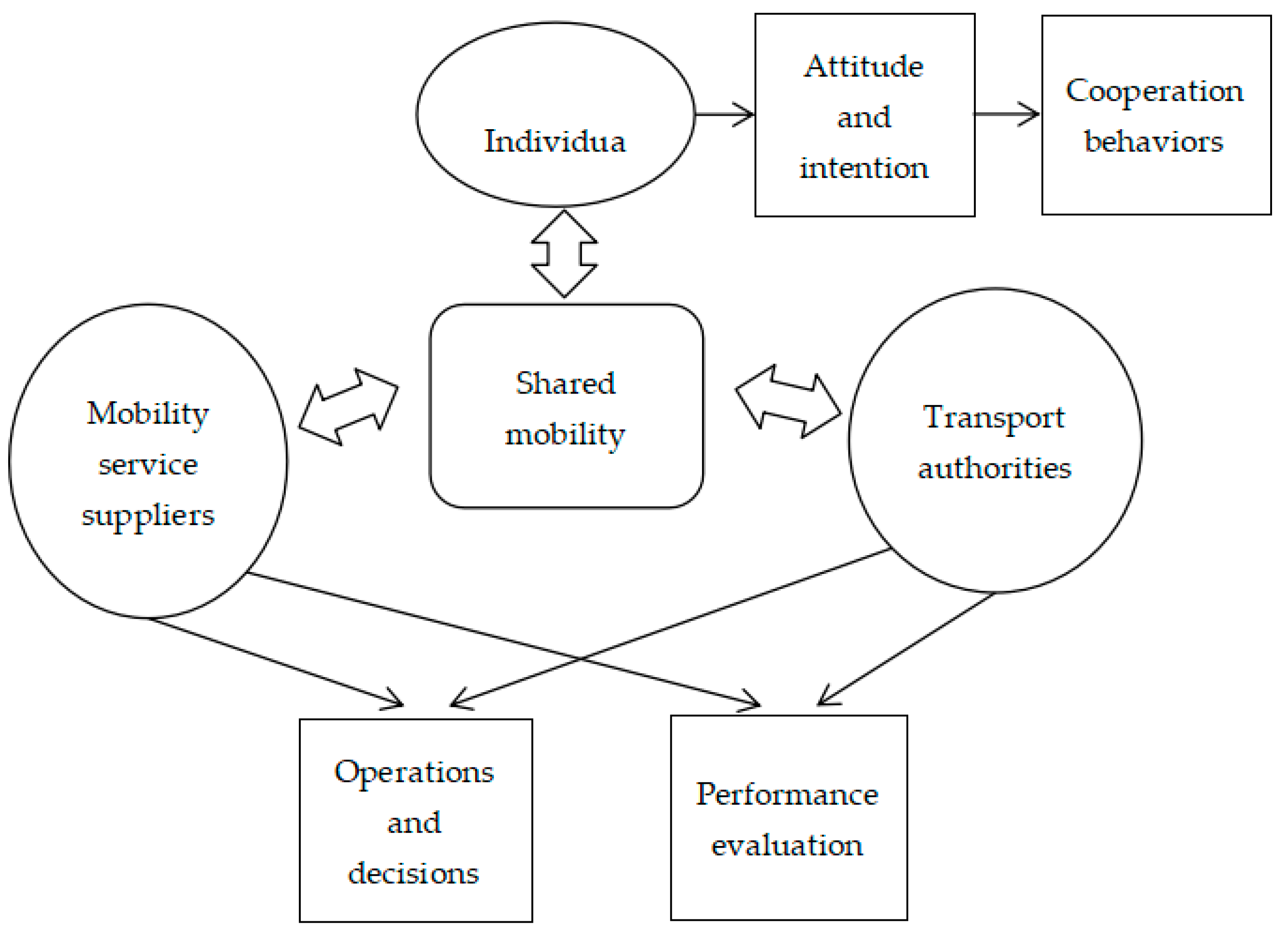
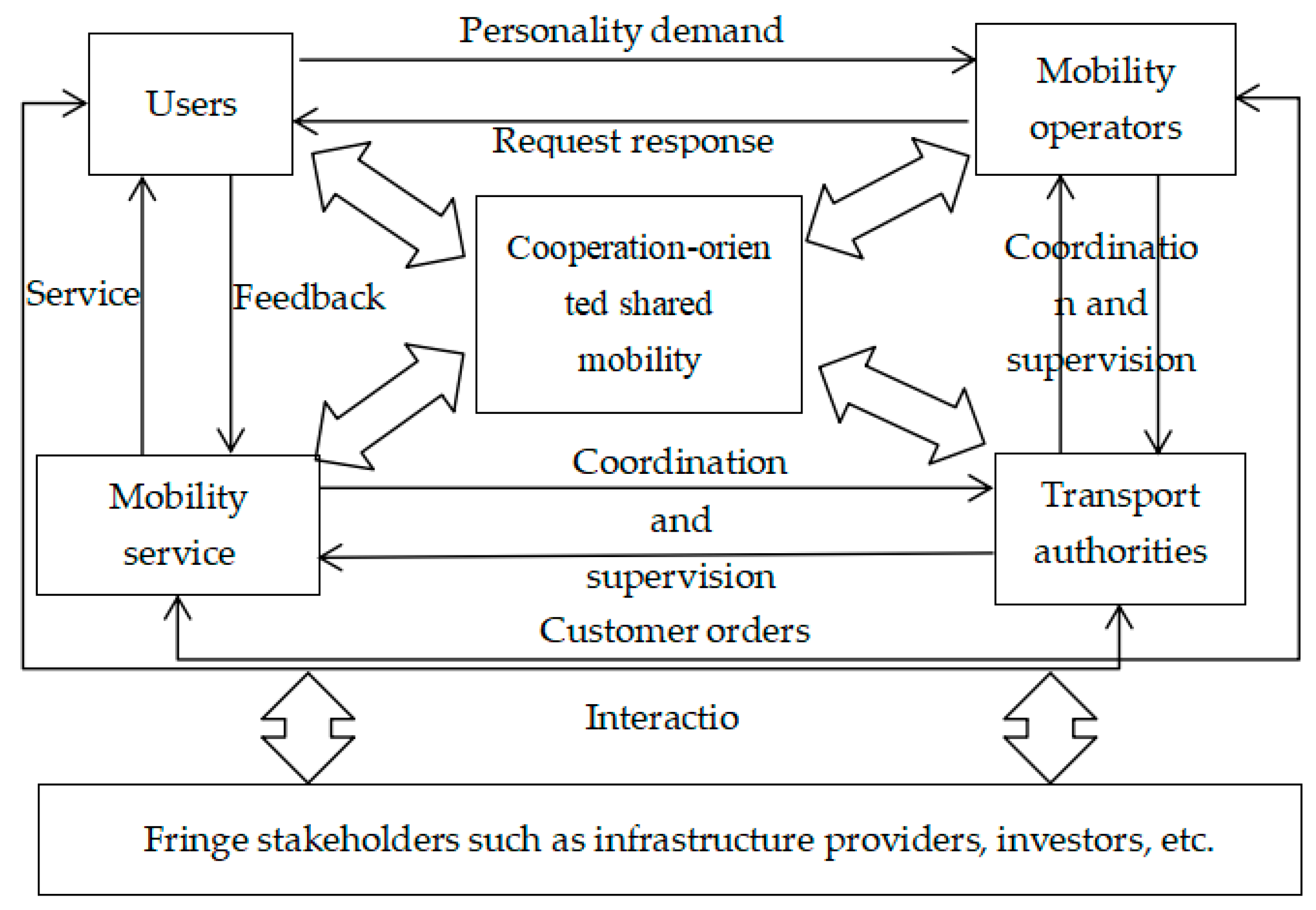
Developing shared mobility for sustainable transport requires holistic consideration of the four themes discussed above. These four themes are closely related based on the collaboration and cooperation between stakeholders. Figure 5 presents a framework for better describing the interplay between these themes and stakeholders.
The acceptance and adoption of shared mobility originate from individuals’ travel needs. These travel needs exert a direct effect on the attitude and intention of individuals in the use of shared mobility, and these attitude and intention propel various cooperation and non–cooperation behaviors. These behaviors then represent the demand side of the transport system. They provide specific benefits from economic, environmental, and societal perspectives (Chen and Deng, 2022).
The supply side of shared mobility includes mobility service providers and mobility operators (Chen and Deng, 2019). They deliver innovative mobility products and services with respect to specific government regulations and rules in their operations and decisions. These operations and decisions are assessed for understanding the performance and impact of such products and services. Transport authorities play the role of coordination and management involving planning, operations, and evaluation of shared mobility.
Shared mobility conforms to carbon footprint reduction advocate, thus being an attractive solution for sustainable transport (Zhang and Zhang, 2021a). It emphasizes sharing trip-rides or transport equipment rather than exclusive use or ownership (Wilson and Mason, 2020; Wong e al., 2020). Shared mobility, however, does not meet the travel need of every individual. To address such a challenge, other transport modes are required. This leads to the adoption of multi-modal shared mobility that includes private cars, bikes, and public transit (Shaheen et al., 2016).
Excessive use of private cars, however, may exert negative externalities and deviate from sustainable transport (Shaheen et al., 2017). It shows that the adoption of multi-modal shared mobility requires a balance between meeting individual travel needs and satisfying sustainable development goals. This needs individuals to make more cooperative choices in shared mobility (Chen and Deng, 2019).
Cooperation and collaboration are the foundation to the pursuit of multi-modal shared mobility for sustainable transport (Chen and Deng, 2022). This is determined by the cooperation feature, operations difficulty and output performance that individual transport modes have in providing mobility services. The cooperation feature is about the needs of specific transport mode on how much cooperative consciousness is required in adopting shared mobility. Operations difficulty is linked to the degree of difficulty for the demand side (individuals) to adopt this transport mode and the degree of difficulty for the supply side (providers) to operate related modes. Output performance is the reflection of achievement of sustainable objectives that shared mobility pursues. With the consideration of these three features, existing mobility solutions can be assessed, leading to the development of the summary of the cooperation matrix for developing sustainable shared mobility, shown as in Table 7.
Table 7 reveals that MaaS needs the highest level of cooperation between various stakeholders for sustainable transport. This means that the use of MaaS requires more conscious cooperation and collaboration between stakeholders. MaaS generate the best output performance with respect to the sustainable objectives. It is, however, difficult for the adoption due to various challenges in pursuing sustainable transport through cooperation and collaboration between stakeholders. This dilemma calls for novel shared mobility solutions capable of integrating the advantages of MaaS while addressing the challenges that it faces in facilitating the mobility of individuals in urban traveling.
A cooperation-oriented shared mobility (COSM) framework is, therefore, proposed in this study to better address the challenge that existing shared mobility solutions suffer from. Such a framework can facilitate the development of sustainable transport through better satisfying multiple but often conflicting objectives of stakeholders by combining multiple travel modes in urban traveling (Carbonara et al., 2024; Tian et al., 2024; Pamucar et al., 2022). To reduce the collaborative barriers between mobility service providers, COSM does not require integrating multiple travel services into integrated platforms. It is committed to make the allocation of transport resources in a transparent manner by providing diversified travel modes for reducing traffic congestion and improving mobility services efficiency. COSM is an effective integration of MSM and MaaS for fulfilling the needs of stakeholders through cooperation and collaboration.
Figure 6 presents an integrated COSM framework. This framework includes the main components and their relationships in an urban transport ecosystem. It provides flexibility, efficiency, safety, reliability, environmental friendliness, and transport equity for the mobility of people by leveraging every mode’s specific advantages.
A COSM ecosystem has four components. The first one is users. The second one is mobility service providers including (a) traditional services providers, (b) incumbent services providers, such as public transit, paratransit, shuttles, taxis, (c) self-services providers, such as private vehicles, e-scooter, bicycle, and (d) supportive services providers, such as mobile communication operators, information system developers, and data analysts. The third one is mobility operators often referred to as transport services platforms such as Uber, Lyft, or Didi. These platforms have numerous drivers who provide individuals with required services. They serve as the moderator for connecting providers and users. The fourth one is transport authorities who act as the intermediator and supervisor (Benjaafar et al., 2019).
There are complicated interplays between these four components. In shared mobility, individuals first send their travel demands through digital platform typically in a smart-phone app owned by mobility operations. These demands are transformed as a customer order through platforms. These orders are communicated to mobility service providers as soon as the platform matches the request with appropriate providers. The provider can then supply the individuals with the required services. In this process, transport authorities act as an intermediate role that ensures the mobility market is being operated according to the relevant regulations and policies.
There exist some differences between COSM and MaaS. The main difference between COSM and MaaS lies in the implementation difficulty of COSM that is much lower than MaaS. COSM does not require a single digital interface to provide integrated planning, booking, payment, ticketing and other core functions as required in MaaS (Molla et al., 2024). Users’ travel needs could be fulfilled by multi-services providers (MSPs) via multiple digital platforms. Collaboration is one of the essential elements for MaaS, while how to collaborate sufficiently exerts significant challenges because of the competitive nature among the different MSPs (Matowicki et al., 2022, Butler et al, 2021; Tirachini, 2020). MSPs can mitigate the requirements through cooperation between stakeholders. The other prominent difference lies in that COSM may not exclude the use of private vehicles (Wilson and Mason, 2020; Wright et al., 2020). All travel modes can be incorporated to achieve more efficient and flexible mobility. This inclusion shows that COSM can strive to fulfill multi-goals of stakeholders while providing more flexible services through cooperation and collaboration.
COSM has several advantages compared to existing shared-mobility solutions. These advantages are reflected in the difficulty of implementation (Tian et al., 2024) and the output performance (Jin et al., 2018). As a flexible and effective transport solution, COSM has enormous adaptability, which is realized by effective combination of specific mobility modes. COSM can incorporate private vehicles use in providing more choices in those suburban areas with low occupancy public transit or shared mobility travel modes (Carbonara et al., 2024; Zhou et al., 2020). This inclusion brings individuals more flexibility and efficiency in urban traveling. Furthermore, COSM does not commit to pursue a single online interface. It allows the use of diverse digital platforms with more safety, social inclusion and less collaboration requirements appeal than an integrated online interface (Guan et al, 2024; Kayikci et al., 2022; Bushell et al, 2022; Surakka et al., 2018). In summary, COSM can create compelling value for those pursuing higher efficiency and lower barriers solutions.

7. Conclusion

A systematic review is implemented in this study on the adoption of shared mobility for pursuing sustainable transport. As a result, the emerging themes and the challenges associated with the use of shared mobility for sustainable transport have been identified. An integrated framework through integrating MaaS and MSM has been developed for facilitating the development of shared mobility in pursuing sustainable transport.
The study shows that there are important distinctions between traditional shared mobility and COSM. There are many research questions that need to be addressed. Firstly, studying users’ attitudes, intentions and behaviors in COSM travel choice requires a better understanding of the relationship between the critical factors and COSM adoptions. Secondly, exploring how specific COSM operations and decisions are made is required for more insights on the planning and designing of COSM operational strategies and policies. Finally, assessment the implementation of different COSM initiatives is necessary, as such evaluations can provide appropriate suggestions for tackling the enormous challenges on sustainable transport development in fierce urbanized environments.

Acknowledgements

This work is supported by the National Natural Science Foundation of China (Grant no. 72171102).

References

  1. Aba, A., Esztergár-Kiss, D., 2024. A mobility pilot development process experimented through a MaaS pilot in Budapest. Travel Behaviour and Society, 37, 100846.
  2. Acheampong, R.A., Siiba, A., Okyere, D.K., Tuffour, J.P., 2020. Mobility-on-demand: An empirical study of internet-based ride-hailing adoption factors, travel characteristics and mode substitution effects. Transportation Research Part C: Emerging Technologies,115,102638.
  3. Ahmed, S., Choudhury, M.M., Ahmed, E., Chowdhury, U.Y., Asheq, A.A., 2021. Passenger satisfaction and loyalty for app-based ride-sharing services: through the tunnel of perceived quality and value for money. The TQM Journal, 33(6), 1411-1425.
  4. Ajzen, I., 1985. From intentions to actions: A theory of planned behaviour. In J. Kuhl, J. Beckmann (Eds.), Action control: From cognition to behaviour (pp. 11-39), Berlin: Springer-Verlag.
  5. Alessandretti, L., Aslak, U., Lehmann, S., 2020. The scales of human mobility.Nature, 587, 402–407.
  6. Alonso-González, M., Hoogendoorn-Lanser, S., van Oort, N., Cats, O., Hoogendoorna, S., 2020. Drivers and barriers in adopting Mobility as a Service (MaaS) – A latent class cluster analysis of attitudes. Transportation Research Part A:Policy and Practice,132,378-401.
  7. Alyavina, E., Nikitas, A., Njoya, E.T., 2022. Mobility as a service (MaaS): A thematic map of challenges and opportunities. Research in Transportation Business & Management,43,100783.
  8. Ambrosino, G., Nelson, J.D., Boero, M., Ramazzotti, D., 2016. From the Concept of Flexible Mobility Services to the ‘Shared Mobility Services Agency’. Paratransit: Shaping the Flexible Transport Future (Transport and Sustainability, Vol. 8), Emerald Group Publishing Limited, Bingley, pp. 203-215.
  9. Anagnostopoulou, E., Urbančič, J., Bothos, E., Magoutas, B., Bradesko, L., Schrammel, J., Mentzas, G., 2020. From mobility patterns to behavioural change: leveraging travel behaviour and personality profiles to nudge for sustainable transportation. Journal of Intelligent Information Systems,54(1), 157–178.
  10. Arias-Molinares, D., García-Palomares, J.C., 2020. Shared mobility development as key for prompting mobility as a service (MaaS) in urban areas: The case of Madrid. Case Studies on Transport Policy,8(3),846-859.
  11. Asgari, H., Jin, X., 2019. Incorporating attitudinal factors to examine adoption of and willingness to pay for autonomous vehicles. Transportation Research Record: Journal of the Transportation Research Board,2673(8), 418–429.
  12. Atasoy, B., Ikeda, T., Ben-Akiva, M.E., 2016. An Innovative Concept for Paratransit: Flexible Mobility on Demand, Paratransit: Shaping the Flexible Transport Future (Transport and Sustainability, Vol. 8), Emerald Group Publishing Limited, Bingley, pp. 357-375.
  13. Athanasopoulou, A., Deijkers, T., Ozkan, B., Turetken, O., 2022. MaaS platform features: An exploration of their relationship and importance from supply and demand perspective. Journal of Urban Mobility, 2,100028.
  14. Awad-Núñez, S., Julio, R., Gomez, J., Moya-Gómez, B., González, J.S., 2021.Post-COVID-19 travel behaviour patterns: impact on the willingness to pay of users of public transport and shared mobility services in Spain.European Transport Research Review,13, 20.
  15. Bandiera, C., Connors, R.D., Viti, F., 2024. Mobility service providers’ interacting strategies under multi-modal equilibrium. Transportation Research Part C: Emerging Technologies, In press.
  16. Becker, H., Balac, M., Ciari, F., Mackay, K., 2020. Assessing the welfare impacts of Shared Mobility and Mobility as a Service (MaaS). Transportation Research Part A:Policy and Practice,131,228-243.
  17. Benjaafar, S., Hu, M., 2020. Operations Management in the Age of the Sharing Economy: What Is Old and What Is New? Manufacturing & Service Operations Management 22(1), 93-101.
  18. Benjaafar, S., Kong, G., Li, X., Courcoubetis, C., 2019. Peer-to-peer product sharing: Implications for ownership, usage and social welfare in the sharing economy. Management Science, 65(2), 477–493.
  19. Bi, H., Ye, Z., 2021. Exploring ridesourcing trip patterns by fusing multi-source data: A big data approach, Sustainable Cities and Society, 64, 102499.
  20. Biehl, A., Chen, Y., Sanabria-Véaz, K, Uttal, D., Stathopoulos, A., 2019. Where does active travel fit within local community narratives of mobility space and place? Transportation Research Part A:Policy and Practice, 123, 269–287.
  21. Bushell, J., Merkert, R., Beck, M.J., 2022. Consumer preferences for operator collaboration in intra- and intercity transport ecosystems: Institutionalising platforms to facilitate MaaS 2.0. Transportation Research Part A:Policy and Practice, 160, 160-178.
  22. Butler, L., Yigitcanlar,T., Paz, A., 2021. Barriers and risks of Mobility-as-a-Service (MaaS) adoption in cities: A systematic review of the literature. Cities, 109,103036.
  23. Carbonara, N., Petruzzelli, A.M., Panniello, U., De Vita, D., 2024. Embracing new disruptions: Business model innovation in the transition to Mobility as a Service (MaaS). Journal of Cleaner Production, 464, 142744.
  24. Chahine, R., Christ, S.L., Gkritza, K., 2024a. A latent class analysis of public perceptions about shared mobility barriers and benefits. Transportation Research Interdisciplinary Perspectives, 25, 101132.
  25. Chahine, R., Losada-Rojas, L.L., Gkritza, K., 2024b. Navigating post-pandemic urban mobility: Unveiling intentions for shared micro-mobility usage across three U.S. cities. Travel Behaviour and Society, 36, 100813.
  26. Chen, Y., Acheampong, R.A., 2023. Mobility-as-a-service transitions in China: Emerging policies, initiatives, platforms and MaaS implementation models. Case Studies on Transport Policy, 13,101054.
  27. Chen, X., Zheng, H., Ke, J., Yang, H., 2020. Dynamic optimization strategies for on-demand ride services platform: Surge pricing, commission rate, and incentives. Transportation Research Part B: Methodological, 138, 23–45.
  28. Chen, X.G., 2015. General Research Framework and its Properties Analysis of Traffic Flow Evolutionary Dynamics. Journal of Management Sciences in China, 18(6),58-69. (in Chinese).
  29. Chen, X.G., 2020. Research on Behavioural Mechanism on Travel Cooperative Intention with Information Use and Social Networks Affecting. Soft Science, 34(5), 115-123. (in Chinese).
  30. Chen, X.G., Deng, H., 2019. A correlation analysis of information use, social networks and cooperation consciousness in travel behaviors. Transportation Research Part F:Traffic Psychology and Behaviour, 62, 819–832.
  31. Chen, X.G., Deng, H., 2022. Latent pattern analysis of conscious cooperation for developing sustainable transport. Transportation Research Part F:Traffic Psychology and Behaviour, 86,356–369.
  32. Chen, X.G., Zhu, Z.T., Dai, Y.H., 2017. Exploring cooperation in traffic and transportation systems: concepts, principles and approaches. 2017 4th International Conference on Management Science and Management Innovation (MSMI 2017), Jun.,23-25.
  33. Christensen, T.H., Friis, F., Nielsen, M.V., 2022. Shifting from ownership to access and the future for MaaS: Insights from car sharing practices in Copenhagen. Case Studies on Transport Policy,10(2),841-850.
  34. Ciasullo, M.V., Troisi, O., Loia, F., Maione, G., 2018. Carpooling: travelers’ perceptions from a big data analysis.The TQM Journal, 30(5), 554-571.
  35. Coenegrachts, E., Vanelslander, T., Verhetsel, A., Beckers, J., 2024. Analyzing shared mobility markets in Europe: A comparative analysis of shared mobility schemes across 311 European cities. Journal of Transport Geography, 118, 103918.
  36. Cohen, B., Kietzmann, J., 2014. Ride on! Mobility business models for the sharing economy. Organization & Environment, 27(3), 279–296.
  37. Davis, F. D., 1985. A technology acceptance model for empirically testing new end-user information systems: Theory and results (Doctoral dissertation, Massachusetts Institute of Technology).
  38. Delclòs-Alió, X., Gutiérrez, A., Tomàs-Porres, J., Vich, G., Miravet, D., 2023. Walking through a pandemic: How did utilitarian walking change during COVID-19?, International Journal of Sustainable Transportation, 17(10), 1155-1170.
  39. Deng, Y., Shao, S., Mittal, A., Twumasi-Boakye, R., Fishelson, J., Gupta A., Shroff, N.B., 2022. Incentive design and profit sharing in multi-modal transportation networks. Transportation Research Part B: Methodological,163,1-21.
  40. Duan, S.X., Tay, R., Molla, A., Deng, H., 2022. Predicting Mobility as a Service (MaaS) use for different trip categories: An artificial neural network analysis. Transportation Research Part A:Policy and Practice, 166, 135–149.
  41. Eagly, A. H., Chaiken, S., 1993. The psychology of attitudes. Fort Worth, TX: Harcourt Brace Jovanovich College Publishers.
  42. Erhardt, G.D., Roy, S., Cooper, D., Sana, B., Chen, M., Castiglione, J., 2019. Do transportation network companies decrease or increase congestion? Science Advances, 5(5), eaau2670.
  43. Fishbein, M., Ajzen, I., 1975. Belief, Attitude, Intention, and Behavior: An Introduction to Theory and Research. Reading, MA: Addison-Wesley.
  44. Freedman, J.L., Sears, D.O., Carlsmith, J.M., 1978, Social Psychology, London:Prentice-Hall.
  45. Gao, F., He, S., Han, C., Liang, J., 2024. The impact of shared mobility on metro ridership: The non-linear effects of bike-sharing and ride-hailing services. Travel Behaviour and Society, 37, 100842.
  46. Guan, X., Lierop, D.V., An, Z., Heinen, E., Ettema, D., 2024. Shared micro-mobility and transport equity: A case study of three European countries. Cities, 153, 105298.
  47. Guo, X., Qu, A., Zhang, H., Noursalehi, P., Zhao, J., 2023. Dissolving the segmentation of a shared mobility market: A framework and four market structure designs. Transportation Research Part C: Emerging Technologies, 157, 104397.
  48. Guyader, H., Nansubuga, B., Skill, K., 2021. Institutional Logics at Play in a Mobility-as-a-Service Ecosystem. Sustainability,13(15),8285.
  49. Hanaki, N., Peterhansl, A., Dodds, P.S., Watts, D.J., 2007. Cooperation in Evolving Social Networks, Management Science, 53(7), 1036–1050.
  50. Henao, A., Marshall, W.E., 2019. The impact of ride-hailing on vehicle miles traveled. Transportation, 46, 2173–2194.
  51. Hensher, D.A., Ho, C.Q., Reck, D.J., 2021. Mobility as a service and private car use: Evidence from the Sydney MaaS trial. Transportation Research Part A:Policy and Practice,145,17-33.
  52. Herberz, M., Hahnel, U.J.J., Brosch, T., 2020. The importance of consumer motives for green mobility: A multimodal perspective. Transportation Research Part A:Policy and Practice, 139, 102–118.
  53. Ho,C.Q., 2022. Can MaaS change users’ travel behaviour to deliver commercial and societal outcomes?Transportation Research Part A: Policy and Practice, 165,76-97.
  54. Ho, C.Q., Hensher, D.A., Reck, D.J., 2021. Drivers of participant’s choices of monthly mobility bundles: Key behavioural findings from the Sydney Mobility as a Service (MaaS) trial. Transportation Research Part C: Emerging Technologies,124,102932.
  55. Hong, Z., Chen, Y., Mahmassani, H.,S., Xu, S., 2017. Commuter ride-sharing using topology-based vehicle trajectory clustering: Methodology, application and impact evaluation. Transportation Research Part C: Emerging Technologies: 85, 573–590.
  56. Hu, J.W., Creutzig, F., 2022. A systematic review on shared mobility in China. International Journal of Sustainable Transportation, 16(4), 374-389.
  57. Hu, M., 2021. From the classics to new tunes: a neoclassical view on sharing economy and innovative marketplaces. Production and Operations Management, 30(6), 1668-1685.
  58. Jian, S., Liu, W., Wang, X.L., Yang, H., Waller, S.T., 2020. On integrating carsharing and parking sharing services. Transportation Research Part B: Methodological, 142,19–44.
  59. Jin, S.T., Kong, H., Wu, R., Sui, D.Z., 2018. Ridesourcing, the sharing economy, and the future of cities. Cities, 76, 96-104.
  60. Karlsson, I.C.M., Mukhtar-Landgren, D., Smith, G., Koglin, T., Kronsell, A., Lund, E., Sarasini, S., Sochor, J., 2020. Development and implementation of Mobility-as-a-Service – A qualitative study of barriers and enabling factors. Transportation Research Part A:Policy and Practice:Policy and Practice,131,283-295.
  61. Kayikci, Y., Kabadurmus, O., 2022. Barriers to the adoption of the mobility-as-a-service concept: The case of Istanbul, a large emerging metropolis.Transport Policy,129, 219-236.
  62. Ke, J.T., Yang, H., Zheng, Z.F., 2020. On ride-pooling and traffic congestion. Transportation Research Part B: Methodological, 142, 213–231.
  63. Klein, I., Ben-Elia, E., 2016. Emergence of cooperation in congested road networks using ICT and future and emerging technologies: A game-based review. Transportation Research Part C:Emerging Technologies, 72, 10–28.
  64. Klein, I., Ben-Elia, E., 2018. Emergence of cooperative route-choice: A model and experiment of compliance with system-optimal ATIS. Transportation Research Part F:Traffic Psychology and Behaviour,59,348–364.
  65. Klein, I., Levy, N., Ben-Elia, E., 2018. An agent-based model of the emergence of cooperation and a fair and stable system optimum using ATIS on a simple road network. Transportation Research Part C: Emerging Technologies,86, 183–201.
  66. Krauss, K., Reck, D.J., Axhausen, K.W., 2023. How does transport supply and mobility behaviour impact preferences for MaaS bundles? A multi-city approach. Transportation Research Part C: Emerging Technologies, 147, 104013.
  67. Kriswardhana, W., Esztergár-Kiss, D., 2023. A systematic literature review of Mobility as a Service: Examining the socio-technical factors in MaaS adoption and bundling packages. Travel Behaviour and Society, 31, 232–243.
  68. Lesteven, G., Samadzad, M., 2021. Ride-hailing, a new mode to commute? Evidence from Tehran, Iran. Travel Behaviour and Society,22,175-185.
  69. Li, J., Chen, D., Zhang., M., 2022a. Equilibrium modeling of mixed autonomy traffic flow based on game theory. Transportation Research Part B: Methodological, 166, 110-127.
  70. Li, X.F., Du, M.Y., Zhang, Y., Yang, J.Z., 2022b. Identifying the factors influencing the choice of different ride-hailing services in Shenzhen, China. Travel Behaviour and Society,29,53-64.
  71. Liljamo, T., Liimatainen, H., Pöllänen, M., Utriainen, R., 2020. People’s current mobility costs and willingness to pay for Mobility as a Service offerings.Transportation Research Part A:Policy and Practice,136,99-119.
  72. Lindkvist, H., Melander, L., 2022. How sustainable are urban transport services? A comparison of MaaS and UCC.Research in Transportation Business & Management,43,100829.
  73. Lopez-Carreiro, I., Monzon, A., Lois, D., Lopez-Lambas, M.E., 2021a. Are travellers willing to adopt MaaS? Exploring attitudinal and personality factors in the case of Madrid, Spain. Travel Behaviour and Society,25,246-261.
  74. Lopez-Carreiro, I., Monzon, A., Lopez-Lambas, M.E., 2021b. Comparison of the willingness to adopt MaaS in Madrid (Spain) and Randstad (The Netherlands) metropolitan areas. Transportation Research Part A:Policy and Practice,152,275-294.
  75. Lyons, G., Hammond, P., Mackay, K., 2019. The importance of user perspective in the evolution of MaaS. Transportation Research Part A:Policy and Practice,121,22-36.
  76. Matowicki, M., Amorim, M., Kern, M., Pecherkova, P., Motzer, N., Pribyl, O., 2022. Understanding the potential of MaaS – An European survey on attitudes. Travel Behaviour and Society,27,204-215.
  77. Mattia, G., Mugion, R.G., Principato, L., 2019. Shared mobility as a driver for sustainable consumptions: The intention to re-use free-floating car sharing. Journal of Cleaner Production,237,117404.
  78. Matyas, M, Kamargianni, M., 2019. The potential of mobility as a service bundles as a mobility management tool. Transportation, 46, 1951–1968.
  79. Meng, L., Somenahalli, S.,, Berry, S., 2020. Policy implementation of multi-modal (shared) mobility: review of a supply-demand value proposition canvas.Transport Reviews, 40(5), 670-684.
  80. Meurs, H., Sharmeen, F., Marchau, V., van der Heijden, R., 2020. Organizing integrated services in mobility-as-a-service systems: Principles of alliance formation applied to a MaaS-pilot in the Netherlands. Transportation Research Part A:Policy and Practice,131,178-195.
  81. Mock, M., 2023. Making and breaking links: the transformative potential of shared mobility from a practice theories perspective. Mobilities, 18(3), 374-390.
  82. Molla, A., Duan, S.X., Deng, H., Tay, R., 2024. The effects of digital platform expectations, information schema congruity and behavioural factors on mobility as a service (MaaS) adoption. Information Technology & People,. 37, 1, 81-109.
  83. Moody, J., Middleton, S., Zhao, J., 2019. Rider-to-rider discriminatory attitudes and ridesharing behavior. Transportation Research Part F: Traffic Psychology and Behaviour, 62, 258–273.
  84. Mourad, A., Puchinger, J., Chengbin, C., 2019. A survey of models and algorithms for optimizing shared mobility. Transportation Research Part B: Methodological, 123,323–346.
  85. Muller, M., Park, S., Lee,R., Fusco, B., de Almeida Correia, G.H., 2021. Review of Whole System Simulation Methodologies for Assessing Mobility as a Service (MaaS) as an Enabler for Sustainable Urban Mobility. Sustainability,13(10),5591.
  86. Narayanan, S., Antoniou, C., 2023. Shared mobility services towards Mobility as a Service (MaaS): What, who and when? Transportation Research Part A:Policy and Practice, 168, 103581.
  87. Nguyen, T.,K., Hoang, N.H., Vu, 2022. A unified activity-based framework for one-way car-sharing services in multi-modal transportation networks, Transportation Research Part E:Logistics and Transportation Review, 157, 102551.
  88. Ofori, K.S., Anyigba, H., Adeola, O., Junwu, C., Osakwe, C.N., David-West, O., 2022. Understanding post-adoption behaviour in the context of ride-hailing apps: the role of customer perceived value. Information Technology & People,35(5),1540-1562.
  89. Pamucar, D., Simic, V., Lazarević, D., Dobrodolac, M., Deveci, M., 2022. Prioritization of sustainable mobility sharing systems using integrated fuzzy DIBR and fuzzy-rough EDAS model. Sustainable Cities and Society,82,103910.
  90. Pangbourne, K., Stead, D., Mladenović, M., Milakis, D., 2018, "The Case of Mobility as a Service: A Critical Reflection on Challenges for Urban Transport and Mobility Governance", Marsden, G. and Reardon, L. (Ed.) Governance of the Smart Mobility Transition, Emerald Publishing Limited, Bingley, pp. 33-48.
  91. Rahimi, A., Azimi, G., Jin, X., 2020. Examining human attitudes toward shared mobility options and autonomous vehicles. Transportation Research Part F: Traffic Psychology and Behaviour,72, 133–154.
  92. Reck, D.J., Hensher, D.A., Ho, C.Q., 2020. MaaS bundle design. Transportation Research Part A:Policy and Practice:,141,485-501.
  93. Schikofsky, J., Dannewald, T., Kowald, M., 2020. Exploring motivational mechanisms behind the intention to adopt mobility as a service (MaaS): Insights from Germany. Transportation Research Part A:Policy and Practice,131,296-312.
  94. Shaheen, S., Cohen, A., Yelchuru, B., Sarkhili, S., 2017. Mobility on Demand Operational Concept Report. Technical Report. https://rosap.ntl.bts.gov/view/dot/34258.
  95. Shaheen, S., Cohen, A., Zohdy, I., 2016. Shared Mobility: Current Practices and Guiding Principles. U.S. Department of Transportation, Federal Highway Administration.
  96. Shen, Q., Wang, Y., Gifford, C., 2021. Exploring partnership between transit agency and shared mobility company: an incentive program for app-based carpooling. Transportation, 48, 2585–2603.
  97. Shi, K., Shao, R., De Vos, J., Cheng, L., Witlox, F., 2021.The influence of ride-hailing on travel frequency and mode choice. Transportation Research Part D:Transport and Environment,101,103125.
  98. Shokouhyar, S., Shokouhyar, S., Sobhani, A., Gorizi, A.J., 2021. Shared Mobility in Post-COVID Era:New Challenges and Opportunities. Sustainable Cities and Society, 67, 102714.
  99. Sochor, J., Strömberg, H., Karlsson, I.C.M., 2015. Implementing Mobility as a Service Challenges in Integrating User, Commercial, and Societal Perspectives. Transportation Research Record: Journal of the Transportation Research Board,2536, 1–9.
  100. Storme, T., De Vos, J., De Paepe, L., Witlox, F., 2020. Limitations to the car-substitution effect of MaaS. Findings from a Belgian pilot study. Transportation Research Part A:Policy and Practice,131,196-205.
  101. Sun, L., Teunter, R.H., Hua, G., Wu, T., 2020. Taxi-hailing platforms: Inform or Assign drivers? Transportation Research Part B: Methodological, 142,197–212.
  102. Surakka, T., Härri, F., Haahtela, T., Horila, A., Michl, T., 2018. Regulation and governance supporting systemic MaaS innovations. Research in Transportation Business & Management,27,56-66.
  103. Tian, C., Tu, K., Sui, H., Sun, Qi., 2024. Value co-creation in shared mobility: The case of carpooling in China. Technological Forecasting & Social Change, 205, 123481.
  104. Tirachini, A., 2020. Ride-hailing, travel behaviour and sustainable mobility: an international review. Transportation,47(4),2011-2047.
  105. Tirachini, A., Chaniotakis, E., Abouelela, M., Antoniou, C., 2020. The sustainability of shared mobility: Can a platform for shared rides reduce motorized traffic in cities? Transportation Research Part C: Emerging Technologies, 117, 102707.
  106. Tirachini, A., Gomez-Lobo, A., 2020. Does ride-hailing increase or decrease vehicle kilometers traveled (VKT)? A simulation approach for Santiago de Chile. International Journal of Sustainable Transportation, 14 (3), 187–204.
  107. van den Berg, V.A.C, Meurs, H., Verhoef, E.T., 2022. Business models for Mobility as an Service (MaaS).Transportation Research Part B: Methodological,157,203-229.
  108. van Veldhoven, Z., Koninckx, T., Sindayihebura, A., Vanthienen, J., 2022. Investigating public intention to use shared mobility in Belgium through a survey. Case Studies on Transport Policy,10(1),472-484.
  109. Vega-Gonzalo, M., Gomez, J., Christidis, P., Vassallo, J.M., 2024. The role of shared mobility in reducing perceived private car dependency. Transportation Research Part D:Transport and Environment, 126, 104023.
  110. Venkatesh, V., Morris, M.G., Davis, G.B., Davis, F.D., 2003. User acceptance of information technology: Toward a unified view. MIS Quarterly, 27(3), 425-478.
  111. Vélez, A.M.A., 2024. Environmental impacts of shared mobility: a systematic literature review of life-cycle assessments focusing on car sharing, carpooling, bikesharing, scooters and moped sharing, Transport Reviews, 44, 3, 634-658.
  112. Vial, G., 2019. Understanding digital transformation: A review and a research agenda. The Journal of Strategic Information Systems, 28(2), 118-144.
  113. Vij, A., Ryan, S., Sampson, S., Harris, S., 2020. Consumer preferences for Mobility-as-a-Service (MaaS) in Australia. Transportation Research Part C:Emerging Technologies,117,102699.
  114. Wang, H., Yang, H., 2019. Ridesourcing systems: A framework and review. Transportation Research Part B: Methodological, 129, 122–155.
  115. Wilson, A., Mason, B., 2020. The coming disruption – The rise of mobility as a service and the implications for government. Research in Transportation Economics, 83,100898.
  116. Wolfswinkel, J. F., Furtmueller, E., Wilderom, C.P., 2013. Using grounded theory as a method for rigorously reviewing literature. European Journal of Information Systems, 22(1), 45-55.
  117. Wong, Y.Z., Hensher, D.A., Mulley, C. 2020. Mobility as a service (MaaS): Charting a future context. Transportation Research Part A:Policy and Practice,131, 5-19.
  118. Wright, S, Nelson, J.D, Cottrill, C.D., 2020. MaaS for the suburban market: Incorporating carpooling in the mix. Transportation Research Part A:Policy and Practice,131,206-218.
  119. Xi, H., Li, M., Hensher., D.A., Xie, C., Gu, Z., Zheng, Y., 2024. Strategizing sustainability and profitability in electric Mobility-as-a-Service (E-MaaS) ecosystems with carbon incentives: A multi-leader multi-follower game, Transportation Research Part C: Emerging Technologies, 166, 104758.
  120. Xu, Z., Yin, Y., Chao, X., Zhu., H., Ye., J., 2021. A generalized fluid model of ride-hailing systems, Transportation Research Part B: Methodological, 150, 587-605.
  121. Yan, C., Zhu., H., Korolko, N., Woodard, D., 2020. Dynamic pricing and matching in ride-hailing platforms. Naval research logistics, 67(8),705–724.
  122. Yao, R., Zhang, K., 2024. Design an intermediary mobility-as-a-service (MaaS) platform using many-to-many stable matching framework. Transportation Research Part B: Methodological, In press.
  123. Young, M. Farber, S., 2019.The who, why, and when of Uber and other ride-hailing trips: An examination of a large sample household travel survey. Transportation Research Part A:Policy and Practice,119,383-392.
  124. Zhang, Z., Zhang, N., 2021a. A Novel Development Scheme of Mobility as a Service: Can It Provide a Sustainable Environment for China? Sustainability,13(8),4233.
  125. Zhang, Z.Y., Zhang, X.,2021b. Competition and coordination strategies of shared electric vehicles and public transportation considering customer travel utility. Environmental Science and Pollution Research, 28(44), 62142–62154.
  126. Zhou, F., Zheng, Z., Whitehead, J., Perrons, R.K., Washington, S., Page, L., 2020. Examining the impact of car-sharing on private vehicle ownership.Transportation Research Part A:Policy and Practice, 138, 322-341.
  127. Zhou, T., Zhang, J., Peng, L., Zhang, S., 2022. Exploring the determinants of public transport usage and shared mobilities: A case study from Nanchang, China. Sustainable Cities and Society,87,104146.
  128. Zhou, X., Liu, H., Li, J., Zhang, K., Lev, B., 2023. Omega. Channel strategies when digital platforms emerge: A systematic literature review, 120, 102919.
  129. Zhu, J., Xie, N., Cai, Z., Tang, W., Chen, X.M., 2023. A comprehensive review of shared mobility for sustainable transportation systems. International Journal of Sustainable Transportation, 17(5), 527-551.
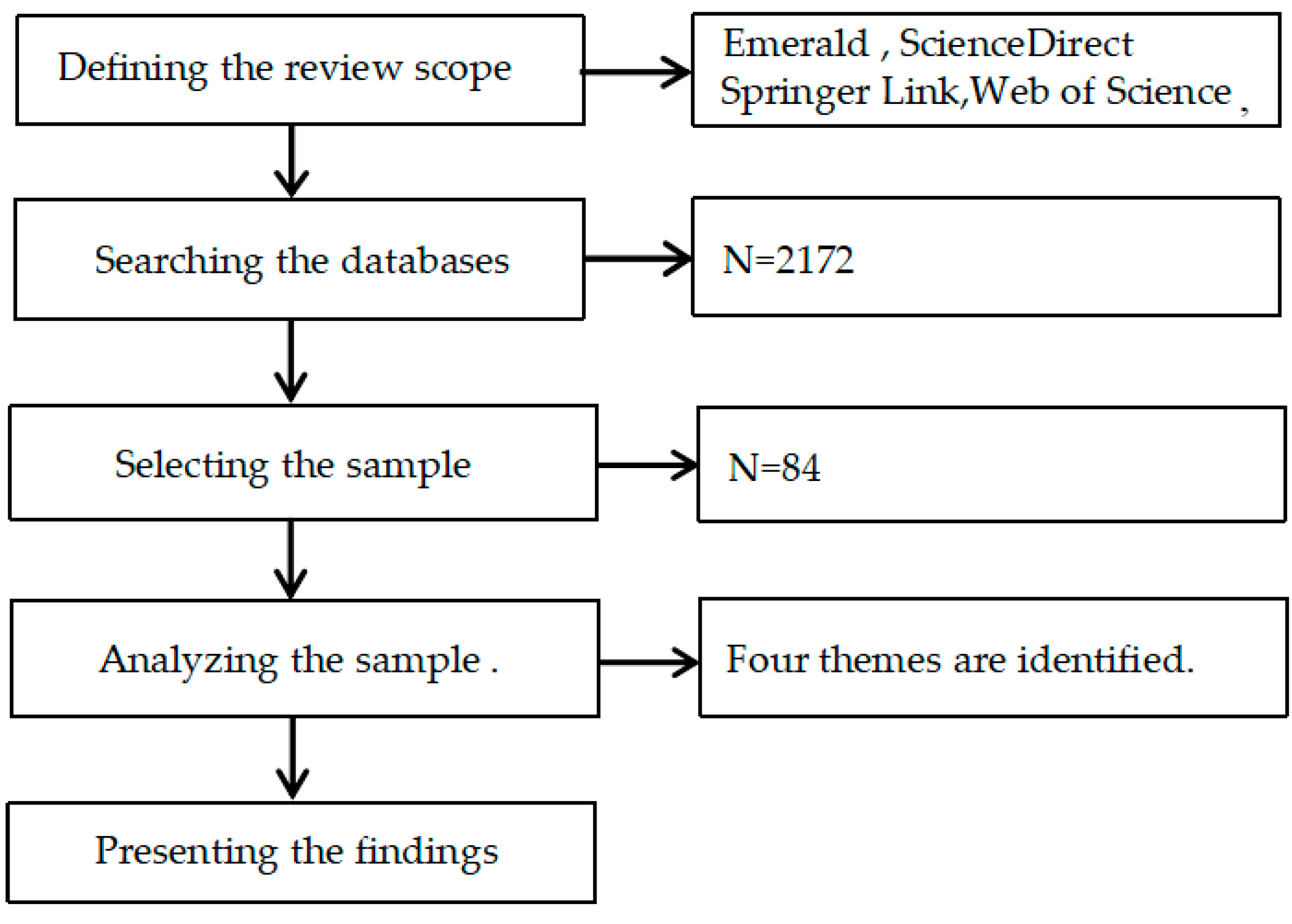
Figure 1. The systematic literature review process.
Preprints 139283 g001
Figure 2. An overview of the publication trend.
Preprints 139283 g002
Figure 3. The distribution of the articles in outlets.
Preprints 139283 g003
Figure 4. The distribution of the four themes.
Preprints 139283 g004
Figure 5. A conceptual framework of the relationship between the themes and stakeholders.
Preprints 139283 g005
Figure 6. An integrated framework of cooperation-oriented shared mobility ecosystems.
Preprints 139283 g006
Table 1. Studies on research approaches, methods and theoretical lens.
Approaches Methods Theories/Models No of Articles
Review None 7
Qualitative
Interview Social practice theories, dynamic capability theory, systems theory 3
Case study Innovation theory, stakeholder theory, supply-demand value proposition, technology-organization-environment framework 8
Field study Stakeholder theory, organizational socialization framework 4
Quantitative
Survey Econometric model, behavioral theory 17
Modeling,
simulation
Game theory, evolutionary game theory 7
mathematical model 16
Experiment Data mining, statistical techniques 9
Mixed-methods
Interview+ Survey None 4
Case study+ Survey None 6
Other None 3
Table 2. Attitude and intention based studies.
Themes References Approaches Critical Factors
Attitude Ciasullo et al. (2018) Text analytics Economic and environmental efficiency, comfort, socialization, reliability, curiosity
Moody et al. (2019) Survey Discriminatory attitude
Ahmed et al. (2021) Survey Perceived quality, value for money
Li et al. (2022b) Multinomial logistic model User orientation, travel characteristics, perceived performance
Chahine (2024a) Latent class analysis Benefits and barriers
Intention Mattia et al. (2019) Structural equation modeling (SEM) Attitude, subjective norm, perceived behavioral control
Herberz et al. (2020) SEM Environmental motives, status, financial, independence, safety, hedonic motives
Duan et al. (2022) Survey Costs, network externality, institutional factors, behavioral factors, environmental concerns, options, socio-economic influences
van Veldhoven et al. (2022) Confirmatory factor analysis (CFA) Environmental value, ease of use, time saving, ownership, price, compatibility, digital savviness
Molla et al. (2024) Survey Personalization, customizability, functional integration, network integration governance, information schema congruity
Chahine et al. (2024b) SEM Attitudes, perceived behavioral control, and social norms
WTP Asgari and Jin (2019) SEM Driving pleasure, reasons for mode choice, trust, technical savvy
Liljamo et al. (2020) Linear regression Costs, income, gender
Vij et al. (2020) Survey Age, lifecycle stage
Lopez-Carreiro et al. (2021a) Cluster analysis Control, privacy, environmental awareness, services integration
Lopez-Carreiro et al. (2021b) Gologit model Demographic, socioeconomic, travel-related variables
Table 3. Cooperation-based studies.
Themes References Approaches Critical Factors/Main Findings
Behavior patterns Chen and Deng (2019) Cluster analysis Three cooperation behaviors patterns
Biehl et al. (2019) Focus group The acceptance of shared mobility is different in communities
Young and Farber (2019) Statistical analysis Ride-hailing is related to wealthy young people
Bi and Ye (2021) Data mining Ridesourcing user patterns
Vega-Gonzalo et al. (2024) Multilevel ordered logit modeling Shared mobility reduces private car use
Critical factors Acheampong et al. (2020) SEM Ease of use, safety risks, control, car dependent lifestyle
Schikofsky et al. (2020) SEM Autonomy, competence, feeling of being social groups, usefulness
Lesteven and Samadzad (2021) Logit model Smartphone use and income level
Shi et al. (2021) Logistic model Accessibility to bus station
Zhou et al. (2022) Logit model Weather condition, travel time, safety
Formulation and evolution Chen (2015) Game theory Cooperation behaviors
Anagnostopoulou et al. (2020) Experiment Positive results on behavioral changes
Chen (2020) Latent class cluster analysis Cooperation is related to information use and social networks
Li et al. (2022a) Game theory Cooperation can be developed
Gao et al. (2024) Random forest model Bike-sharing and ride-hailing have non-linear effect on the use of metro
Table 4. Operations and decisions based studies.
Themes References Approaches Critical Factors/Main Findings
Single shared mobility Hong et al. (2017) Data-driven clustering Carpool programs contribute to less congested traffic and environment-friendly travel
Chen et al. (2020) Mathematical model Dynamic strategies help platforms adjust supply and demand for achieving optimization goals
Jian et al. (2020) Mathematical model Bundled mobility offerings can improve providers’ profit and individuals’ social welfare
Ke et al. (2020) Macroscopic diagram An optimal model for minimizing the time cost
Sun et al. (2020) Queueing theory Insights on how platforms allocate rides
Yan et al. (2020) Mathematical model Price variability is reduced and capacity utilization, trip throughput, and welfare are increased
Xu et al.(2021) Macroscopic fluid model A model for policy control
Nguyen et al. (2022) Mathematical model A mathematical model
Guo et al. (2023) Game/integer linear program Market design can reduce inefficiency and promote healthy competition
MaaS Karlsson et al. (2020) Case study A consistent characterization of business models
Meurs et al. (2020) Case study A conceptual framework for cooperation
Butler et al. (2021) Literature review Desired MaaS outcomes, supply side barriers and demand side risks related to MaaS adoption
Guyader et al. (2021) Case study Experimenting innovative solutions for key learnings about shared mobility ecosystems and stakeholders
Alyavina et al. (2022) Literature review Areas for affecting MaaS’ capacity
Athanasopoulou et al. (2022) Literature review Non-features requirements are highly valued
Xi et al. (2024) Mathematical model A novel e-MaaS ecosystem
Yao and Zhang (2024) Mathematical model A new MaaS platform design
MSM Cohen and Kietzman (2014) Qualitative exposition Existing models are fraught with conflicts, a merit model is the most promising one
Ambrosino et al. (2016) Literature review The role of a shared mobility centre in MSM use
Meng et al. (2020) Literature review Shared mobility requires collaborative partnership
Shokouhyar et al. (2021) Delphi approach 18 challenges and 12 constructs are critical to the sustainability of MSM
Deng et al. (2022) Game theory Platform profit increases through cooperation
Narayanan and Antoniou (2023) Multinomial logit model A choice model for selecting mobility services
Bandiera et al. (2024) Mathematical model A novel mathematical model on the interaction between providers and users
Table 5. Performance evaluation-oriented studies.
Themes References Approaches Critical Factors/Main Findings
Specific shared mobility Jin et al. (2018) Literature review Ride-sourcing affects efficiency, equity, and sustainability
Erhardt et al. (2019) Regression
model
TNCs contribute to growing traffic congestion
Henao and Marshall (2019) Experiment and survey Ride-hailing increases VKT
Shen et al. (2021) Regression Carpooling generates promising outcomes
Tirachini and Gomez-Lobo (2020) Monte Carlo simulation Ride-hailing increases occupancy rate, leading to increased VKT
Tirachini et al. (2020) Survey VKT depends on various factors
Coenegrachts et al. (2024) Latent class clustering Individuals have access to shared mobility
Vélez (2024) Literature review Travel behaviour, shared mobility modes, and local contexts are critical
Shared mobility performance Matyas and Kamargianni (2019) A Mixed MNL model MaaS bundles can introduce more travelers to use shared modes
Reck et al. (2020) Experiment A framework compare stated choice studies
Hensher et al. (2021) Choice model MaaS can change travel behaviour
Ho et al. (2021) Logit choice model PAYG is a preferred option for shared mobility
Lindkvist and Melander (2022) Literature review Sustainable business models for shared mobility
Muller et al. (2021) Literature review Comparative assessment of simulation tools for shared mobility solutions
Zhang and Zhang (2021a) Literature review Cooperation, government support, and data sharing are critical to shared mobility projects
van den Berg et al. (2022) Game theory MaaS benefits consumers by increasing competition and removing marginalization
Kriswardhana and Esztergár-Kiss (2023) Literature review Environment factors and user groups
Carbonara et at. (2024) Case study The MaaS operations process
Impact assessment Arias-Molinares and García-Palomares (2020) Case study Governance and collaboration is critical for developing MaaS
Becker et al. (2020) Simulation MaaS increases system efficiency, while substantially reducing energy consumption
Christensen et al. (2022) Interview MaaS should consider embodied routinization and entanglement of mobility practices
Ho (2022) Choice modeling MaaS affects travel behaviour
Krauss et al. (2023) Preference experiment Shared mobility use reduces car use
Aba and Esztergár-Kiss (2024) Case study MaaS is effective for reducing private car use
Table 6. Research gaps and questions.
Themes Topics Gaps Research Questions References
Attitude and intention Attitude
  • Few studies examine the influential factors of attitude, intention, and WTP in multi-modal shared mobility context
  • What are the influential factors of attitude, intention, and WTP related to cooperation-oriented shared mobility?
  • How do influential factors affect attitude, intention, and WTP related to cooperation-oriented shared mobility?
Ciasullo et al. (2018);
Asgari and Jin (2019);
Liljamo et al. (2020);
Vij et al. (2020);
Lopez-Carreiro et al. (2021a,2021b);
Duan et al.(2022);
Veldhoven et al. (2022);
Molla et al. (2024);
Chahine et al. (2024b)
Intention
  • Lack of studies in exploring the influence mechanism of attitude, intention, and WTP in multi-modal shared mobility context
Willingness to pay
Cooperation behaviors Behavior patterns
  • Most articles focus on the behavior patterns of single shared mobility or MaaS rather than cooperation-oriented shared mobility
  • What are the behavior patterns related to cooperation-oriented shared mobility?
  • What affects the cooperation-oriented shared mobility behavior?
  • How do the formulation and evolution of cooperation-oriented shared mobility behavior?
Chen and Deng (2019);
Young and Farber (2019); Acheampong et al. (2020); Schikofsky et al. (2020); Lesteven and Samadzad (2021); Shi et al. (2021);
Zhou et al. (2022);
Li et al. (2022a);
Gao et al. (2024); Vega-Gonzalo et; al. (2024)
Critical factors
  • Only a few studies focus on critical factors influencing on single shared mobility or MaaS
Formulation and evolution
  • Few studies investigate formulation and evolution of cooperation-oriented shared mobility
Operations and decisions Single shared mobility
  • Lack of studies on addressing of operations and decisions issues in cooperation-oriented shared mobility
  • What are the differences of operations and decisions between MaaS, MSM and cooperation-oriented shared mobility?
  • How to develop effective and viable operations and decisions strategies/solutions of cooperation-oriented shared mobility?
Hong et al. (2017);
Chen et al. (2020);
Jian et al. (2020);
Butler et al. (2021);
Xu et al.(2021);
Alyavina et al. (2022); Athanasopoulou et al. (2022); Guo et al. (2023);
Xi et al. (2024);
Yao and Zhang (2024)
MaaS
MSM
Performance evaluation Specific shared mobility
  • Lack of sufficient understanding the causes of resulting in different impacts of shared mobility pilots or trials
  • Why do some cooperation-oriented shared mobility pilots or trials have positive impacts while some not?
  • How to comprehensively assess outcomes involving economic, environmental and societal aspects of cooperation-oriented shared mobility pilots or trials?
Jin et al. (2018);
Erhardt et al. (2019);
Reck et al. (2020);
Tirachini and Gomez-Lobo (2020);
Hensher et al. (2021);
Muller et al. (2021);
Zhang and Zhang (2021a); Lindkvist and Melander (2022); Krauss et al. (2023); Kriswardhana and Esztergár-Kiss (2023);
Aba and Esztergár-Kiss (2024)
Shared mobility development
  • Most studies on performance evaluation and related impact assessment focus on specific shared mobility or MaaS
Impact assessment
Table 7. The cooperation matrix for developing sustainable shared mobility.
Transport mode Cooperation Operations Output References
Shared mobility Sharing vehicles Moderate Moderate Moderate Jian et al. (2020); Narayanan and Antoniou (2023); Chahine et al. (2024b)
Ridesharing Moderate Moderate Moderate Hong et al. (2017); Ke et al. (2020); Narayanan and Antoniou (2023); Vega-Gonzalo et al. (2024)
On-demand ride services Moderate Moderate Moderate Young and Farber (2019); Sun et al. (2020); Xu et al. (2021); Li et al. (2022b); Guo et al. (2023)
Micro-mobility Moderate Moderate Moderate Shi et al., (2021); Zhou et al. (2022); Zhu et al. (2023)
Non-shared mobility Private vehicle Inconspicuous Low Moderate /Inferior Zhou et al. (2020); Mock (2023); Vega-Gonzalo et al. (2024)
Other ownership modes Inconspicuous Low Moderate /Inferior Meng et al. (2020);
Shokouhyar et al. (2021); Delclòs-Alió et al. (2023)
MaaS Conspicuous High Excellent Alonso-González et al. (2020); Meurs et al. (2020); Butler et al. (2021); Alyavina et al. (2022); Xi et al. (2024)
Disclaimer/Publisher’s Note: The statements, opinions and data contained in all publications are solely those of the individual author(s) and contributor(s) and not of MDPI and/or the editor(s). MDPI and/or the editor(s) disclaim responsibility for any injury to people or property resulting from any ideas, methods, instructions or products referred to in the content.
Copyright: This open access article is published under a Creative Commons CC BY 4.0 license, which permit the free download, distribution, and reuse, provided that the author and preprint are cited in any reuse.
Prerpints.org logo

Preprints.org is a free preprint server supported by MDPI in Basel, Switzerland.

Subscribe

Disclaimer

Terms of Use

Privacy Policy

Privacy Settings

© 2026 MDPI (Basel, Switzerland) unless otherwise stated