

Submitted:
11 November 2024
Posted:
12 November 2024
You are already at the latest version
Abstract
This study addresses FinTech implementation challenges in the banking industry in Palestine. This was accomplished by adopting qualitative research methods. Semi-structured interviews were conducted with interviewees from the Palestinian Monetary Authority, banks, and Fintech companies. Thematic analysis was conducted using NVivo software to identify themes in the interview scripts. Research outcomes show many FinTech implementation challenges, including readiness of regulatory and legal environment, resistance to change within banks, customers’ culture and their digital literacy, cyber risks, insufficient IT and telecommunication infrastructure, limited availability of qualified FinTech talent, lack of national FinTech framework, and limited size of the Palestinian market. Additionally, Sharia compliance challenges were identified as special for Islamic banks. The main challenges of Nonbank fintech companies include the regulatory framework, capital accessibility, and low barriers for banking relationships adopted by the banking sector. Recommendations to banks and policymakers include the importance of introducing the FinTech framework and the need for a suitable legal framework and supportive regulatory environment. Additionally, recommendations highlighted the importance of initiatives concerning customer education and training, cyber risk mitigation, and the collaborative environment between banks and different ecosystem partners.
Keywords:
1. Background
2. Literature Review
- The first era is internal digitization, in which information technology usage is directed into internal processes or automation. Customers were dependent on one and two later channels: branches and ATMs. Financial institutions have locally developed information technology systems.
- The second era is provider-oriented digitization, in which financial institutions have shifted to the use of providers of information technology systems. As a result, the process and application functions were standardized. Outsourcing of business processes such as information systems and some back-office functions also occurred.
- Customer-oriented digitization is a third era in which customers have FinTech applications centered around them. Moreover, new entrants provide financial services, in addition to incumbents expanding the ecosystems.
- Fintech start-ups are entrepreneurial ventures that provide financial services in innovative ways across areas like payments, wealth management, lending, crowdfunding, capital markets, and insurance.
- Technology providers and developers work in emerging fields such as big data analytics, cloud computing, social media, and cryptocurrency. These tech advancements allow entrepreneurs to benefit from an environment with significant cost savings and minimal capital requirements.
- Governmental bodies are responsible for legislation and regulations, creating a supportive environment for entrepreneurs through favorable licensing and capital requirements, while tightening regulations on established companies. This approach fosters innovation and helps new solutions spread.
- Consumers, both individuals and organizations, play a major role. Millennials, those aged 18 to 34, are the primary consumers of Fintech in many countries, with future demographics also likely to favor Fintech.
- -
- Investment management: The selection of the best FinTech portfolios by financial institutions has the potential to provide better results. Incumbents may choose internal Fintech investments or collaborative investments with external start-ups.
- -
- Customer management: Considering the availability of unbundled financial services by FinTech companies focusing on niche markets and the tendency for customers to deal with different providers for different services, incumbents need to figure out ways to retain customers, and FinTech needs to be innovative in attracting and retaining customers.
- -
- Regulatory challenges: incumbents already face the regulatory requirements of capital adequacy, data security, and other reserves and regulations, whereas FinTech companies need to be aware of and keep an eye on future regulatory directions and requirements that affect their business models. Venaik, Garg and Agarwal (2024) argue that the Fintech sector has demonstrated significant potential to revitalize the current financial system, prompting regulators worldwide to work towards achieving a balance between innovation and protection.
- -
- Technology Integration: This focuses on financial institutions’ legacy IT systems and the challenges to integrate with FinTech new technologies.
- -
- Security and privacy: Fintech companies must pay attention to customers’ privacy and security of their information, where breaches to such data may result in losses. AlBenJasim et al. (2023) suggested that developing a cybersecurity framework for FinTech could be beneficial, offering a fresh perspective by highlighting it as a natural extension of existing knowledge.
- -
- Risk management: FinTech innovations and adopted technologies, such as Robo-advisory, may result in faulty investment advice where FinTech may be held liable.
- -
- Collaboration, where the development of a FinTech systematic framework is of clear importance, and adoption models are also being researched because of their high importance. Additionally, support from stakeholders, including regulators and banks, and the transition of FinTech’s consideration from disruption to collaboration is a challenge.
- -
- Regulation is another challenge owing to global differences in practices. Some are reactive, whereas others are proactive. The adoption of sandboxes by regulators can help better regulate this new field.
- -
- The protection and security of technology and data are of high importance for FinTech to secure the confidentiality of customers’ data and for the continuity and efficiency of service.
3. Methodology
3.1. Theoretical framework
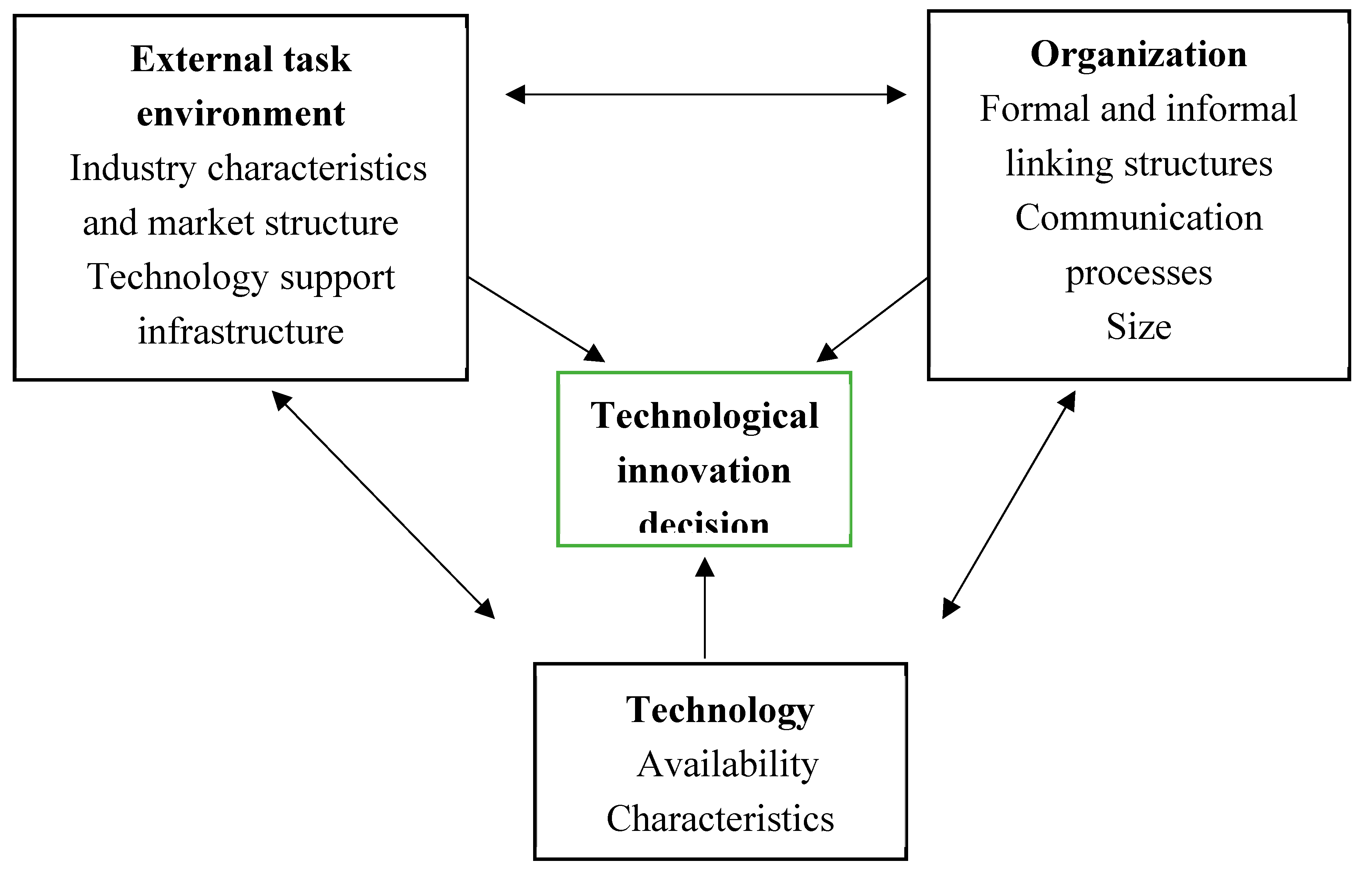
- Technology factors consider technology characteristics including systems and technologies both internal and external. Complexity, compatibility, availability, trialability, observability and other factors are of main importance to facilitate or restrict technology innovation in an organization.
- The organization factor considers the characteristics of the organization itself. Factors like culture, structure, size, available resources, and its capabilities affects the organizations’ position and abilities to adopt new innovative technologies.
- The environment factor is the external field where the organization operates. Many issues can be crucial including industry standards, regulatory environment and competition have large influence on the organization’s position towards development and innovation.
3.2. Instrument Development
3.3. Data Collection
3.4. Analysis Tools and Methods
4. Data Analysis
4.1. Regulatory and Legal Environment
4.2. Banks Resistance to Change and Lack of Agility
4.3. Customers’ Culture, Digital Literacy, and FinTech Awareness
4.4. Cyber Risks and Consumer Protection
4.5. IT and Telecommunication Infrastructure Availability and Cost
4.6. Limited Availability of Qualified Talent
4.7. The lack of FinTech Framework
4.8. Limited Market Size
4.9. Sharia Compliance and the Slowness of Its Updates
4.10. Non-bank Companies’ Challenges
Regulatory Challenges
Access to Capital and Funding
Low Barriers for Banking Relationships
Other Challenges for Non-Banks Companies
4.11. Other Challenges
- The anti-money laundry and counter financing of terrorism (AML/CFT) subject needs special attention while engineering FinTech services. FinTech companies lack experience and proper knowledge of this critical matter: Participant (X3) said “The third difficulty, I believe, is the issue of combating money laundering and combating terrorism”.
- The Absence of Ecosystem and its Interconnectivity Was identified as another challenge, where FinTech is dependent on connectivity with other stakeholders, such as billers and service providers, in addition to the banking system. Participant (X12) described that saying, “How to set up business architectures that connect with different networks”.
- Political Instability Caused by Occupation was mainly mentioned as a challenge, also causing a less attractive investment environment for investors, especially global investors. Participant (X17) said “Availability of FinTech investors that mean less FinTech and less competitors, affected by occupation”.
- Government Tec-Maturity and Technological Readiness Government in Palestine was described by participants as lacking digital services and development; hence, it is another challenge for FinTech in general and FinTech companies in particular. The government is a main biller from one side and has important resources required for FinTech, such as state registers. Participant (X9), for example, mentioned “Also the digital maturity of the government”.
- legacy IT systems at banks, FinTech trust by customers, customers’ perceived quality of service, fear from global FinTech players such as ApplePay, GooglePay, and Amazon market penetration without any ability to supervise or even proper regulatory frameworks and licensing.
5. Discussion
5.1. Investment Management
5.2. Customer Management
5.3. Regulatory Challenges
5.4. Banks Legacy Systems
5.5. Cyber Risks and Consumer Privacy Protection
5.6. Risk Management
5.7. Palestinian specific FinTech Challenges
- IT and communication infrastructure: Participants spoke about the weak communication infrastructure in Palestine, especially mobile frequencies. One participant explained that Palestine is split between West Bank, where 3G became available a few years ago, and Gaza Strip, which is still on the 2G. This is related to the restrictions of Israeli occupation, preventing and restricting the communication environment in Palestine. It was recently announced that 4G is expected to be approved by Israel soon. Knowing that FinTech is interrelated with Internet connectivity, and considering Palestinian telecommunication networks, participants considered this matter as an acritical challenge.
- Talent availability: This was addressed by all the participants as a challenge. All expressed their views about insufficient talent availability, both technological talents, and even business talent who innovate new ideas. While all agreed to the challenge, the proposed solutions included the ability to cooperate with external experts, the development of FinTech training programs for young graduates, and collaboration with universities to enhance Tech graduates. It is worth mentioning that continuous instabilities in Palestine and the occupation’s entry restrictions for international experts contributed to this challenge by preventing expertise exchange.
- Digital literacy: Participants considered weak digital literacy within some parts of the Palestinian population, limiting and creating challenges for FinTech development and adoption. They relate this challenge to seniors and older people, while young Palestinians, who are the majority, are tec-savvy high technology demands.
- The lack of a FinTech framework that clarifies strategy, organizes efforts, and shows development priorities was identified by participants with high importance. While it was part of the investment management challenge mentioned before Lee and Shin (2018), participants paid special attention to it because its severity increases with the severity of every other challenge.
- Sharia compliance for Islamic banking was mentioned by six out of seventeen participants, who are Islamic banks and PMA participants, as a challenge for Islamic banks. Participants highlighted a slow approval process by Sharia committee at each Islamic bank and by Islamic banking and finance agencies such as Accounting and Auditing Organizations for Islamic Financial Institutions (AAOIFI). Participants explained the inability to have comprehensive technological solutions for Islamic bank services, especially financing services. important to say, this challenge is not a Palestinian one; it concerns all Islamic banking providers globally. Participants elaborated that the FinTech Sharia compliance subject is attracting the attention of all stakeholders in the Islamic Banking industry, and intensive efforts are being made to address and accelerate the process.
- FinTech companies’ special challenges: On the other hand, according to five out of seventeen participants representing FinTech companies, there are challenges with high importance specific to those FinTech companies, which, according to the participants, require attention and solving.
- Regulatory challenges: Nine out of 17 participants mentioned the regulations as complex and difficult to comply with by FinTech companies, describing them as complex. rigid, sometimes restrictive to innovation, and time-consuming; for example, they mentioned capital requirements and restrictions on fees and commissions. One participant expressed his view that PMA is afraid that FinTech companies will gain market share.
- Limited access to capital, financing, and venture capital: Eight out of 17 participants spoke about the limited availability of venture capital and investment instruments. Moreover, access to financing is limited because banks are hesitant to lend to start-ups. The weak financial position led to the fear of loss in the case of failure of Fintech start-ups.
- Competition with banks was considered an important challenge for five out of 17 participants. They describe competition with banks as fierce and strong. It hardens considering the limited size of the Palestinian market and banks targeting and accepting all types of clients, from ultra-high net worth individuals (UHNI) to the smallest consumer clients. Consequently, this prevents Fintech companies from finding market gaps to penetrate the marketplace. On the other hand, banks and PMA participants argued that non-bank FinTech companies lacked creativity. One PMA participant criticized the FinTech companies for focusing only on payment services; such services he said, “are well served by banks”. This shows an irreconcilable position and paradox in the marketplace between banks, regulators, and FinTech companies.
6. Conclusions
References
- ABP (2023) Comparative Performance 2022. Available at:(Accessed: 22/11/2023).
- Albarrak, M.S. and Alokley, S.A. (2021) ‘FinTech: Ecosystem, Opportunities and Challenges in Saudi Arabia’, Journal of Risk and Financial Management, 14(10), pp. 460.
- AlBenJasim, S. , Dargahi, T., Takruri, H. and Al-Zaidi, R. (2023) ‘FinTech Cybersecurity Challenges and Regulations: Bahrain Case Study’, Journal of Computer Information Systems,, pp. 1–17. [CrossRef]
- Al-Daya, W. , Nassar, S. and Al-Massri, M. (2022) Financial Technology (FinTech) Innovations and the Future of Financial Institutions (FIs) in Palestine “An Exploratory Study”.. Development. Cham: Springer International Publishing, pp. 15.
- AllahRakha, N. (2023) ‘Legal Challenges for International Fintech Startups’, International Journal of Law and Policy, 1(8).
- Arner, D.W. (2016) ‘The Evolution of Fintech’, SSRN Electronic Journal, 47(4). [CrossRef]
- Awa, H.O. and Ojiabo, O.U. (2016) ‘A model of adoption determinants of ERP within T-O-E framework’, Information Technology & People, 29(4), pp. 901–930 Available at. [CrossRef]
- Awwad, B.S. (2023) ‘Fintech Adoption in Palestine: Bank Customers’ Perspectives’Technological Sustainability and Business Competitive Advantage Springer, pp. 153–167.
- Bhandari, V. (2021) ‘FinTech: A Study of Enablers, Opportunities, and Challenges in the Banking and Financial Services Sector’, Research Anthology on Concepts, Applications, and Challenges of FinTech,, pp. 24–31.
- Braun, V. and Clarke, V. (2012) Thematic analysis. American Psychological Association.
- CGFS&FSB (2017) FinTech credit Market structure, business models and financial stability implications. Available at:(Accessed: 13/4/2022).
- Dhakal, K. (2022) ‘NVivo’, Journal of the Medical Library Association : JMLA, 110(2), pp. 270–272. [CrossRef]
- Elia, G. , Stefanelli, V. and Ferilli, G.B. (2023) ‘Investigating the role of Fintech in the banking industry: what do we know?’, European Journal of Innovation Management, 26(5), pp. 1365–1393.
- Gierdien, A. and Jokonya, O. (2023) ‘Factors Affecting the Adoption of Financial Technology at Universities’Smart Technologies for Organizations: Managing a Sustainable and Inclusive Digital Transformation Springer, pp. 3–15.
- Gopal, S. , Gupta, P. and Minocha, A. (2023) Advancements in Fin-Tech and Security Challenges of Banking Industry. IEEE, pp. 1.
- Jackson, K. , Bazeley, P. and Bazeley, P. (2019) Qualitative data analysis with NVivo Sage.
- Karim, S. and Lucey, B.M. (2024) ‘BigTech, FinTech, and banks: A tangle or unity?’, Finance Research Letters, 64, pp. 105490.
- Khera, P. , Ng, S., Ogawa, S. and Sahay, R. (2022) Measuring Digital Financial Inclusion in Emerging Market and Developing Economies: A New Index Wiley.
- Lee, I. and Shin, Y.J. (2018) ‘Fintech: Ecosystem, business models, investment decisions, and challenges’, Business horizons, 61(1), pp. 35–46. [CrossRef]
- Lestari, D. and Rahmanto, B.T. (2023) ‘Fintech and its challenge for banking sector’, Lestari, D., & Rahmanto, BT (2021).Fintech and Its Challenge for Banking Sector.The Management Journal of BINANIAGA, 6(01), pp. 55–70.
- Limna, P. (2023) ‘The impact of NVivo in qualitative research: Perspectives from graduate students’, Journal of Applied Learning and Teaching, 6(2).
- Magdy Rezk, W. and Halim, M.A.A. (2022) ‘Financial technology (Fintech) in the Arab countries challenges and opportunities’, L’Egypte Contemporaine, 113(547), pp. 33–62.
- Mark, S. , Philip, L. and Adrian, T. (2007) Research Methods for business studentsFourth Edition England: Pearson Education Limited.
- Megahed, N. , Al-Kayaly, D. and Al-Hadad, A. (2021) ‘Relevance of DOI and TOE for assessing FinTech adoption by banks: comparative analysis between Egypt and Bahrain’, Journal for Global Business Advancement, 14(6), pp. 768–803.
- Murinde, V., Rizopoulos, E. and Zachariadis, M. (2022) ‘The impact of the FinTech revolution on the future of banking: Opportunities and risks’, International Review of Financial Analysis, 81, pp. 102103. [CrossRef]
- Naz, F. , Karim, S., Houcine, A. and Naeem, M.A. (2024) ‘Fintech growth during COVID-19 in MENA region: current challenges and future prospects’, Electronic Commerce Research, 24(1), pp. 371–392.
- Oberoi, V. and Dharni, K. (2023) ‘Challenges faced by the FinTech Industry: A Review’, Financial Technology and Business in the Era of Industry, 4, pp. 37.
- Oliveira, T. and Martins, M.F. (2011) ‘Literature review of information technology adoption models at firm level’, Electronic journal of information systems evaluation, 14(1), pp. pp110-121.
- PMA (2021) PMA Fact Sheet. Available at: https://www.pma.ps/Portals/0/Users/002/02/2/About%20PMA/Fact%20Sheet/En-Q4-2020.pdf?ver=2021-02-08-095545-730 (Accessed: 12/3/2021).
- Prastyanti, R.A. , Rezi, R. and Rahayu, I. (2023) ‘Ethical Fintech is a New Way of Banking’, Kontigensi: Jurnal Ilmiah Manajemen, 11(1), pp. 255–260.
- Premchand, A. and Choudhry, A. (2018) Open banking & APIs for transformation in banking. IEEE, pp. 25.
- Puschmann, T., Dr (2017) ‘Fintech’, Business & Information Systems Engineering, 59(1), pp. 69–76. [CrossRef]
- Restoy, F. (2019) ‘Regulating fintech: what is going on, and where are the challenges’, Bank for International Settlements,, pp. 1–7.
- Rogers, E.M. (1995) ‘Diffusion of Innovations: Modifications of a Model for Telecommunications’, in Stoetzer, M. and Mahler, A. (eds.) Die Diffusion von Innovationen in der Telekommunikation Berlin, Heidelberg: Springer Berlin Heidelberg, pp. 25–38.
- Sanyaolu, T.O. , Adeleke, A.G., Efunniyi, C.P., Azubuko, C.F. and Osundare, O.S. (2024) ‘Exploring fintech innovations and their potential to transform the future of financial services and banking’, International Journal of Scholarly Research in Science and Technology, 5(01), pp. 54.
- Schueffel, P. (2016) ‘Taming the Beast: A Scientific Definition of Fintech’, SSRN Electronic Journal, 4(4). [CrossRef]
- Strupczewski, G. (2021) ‘Defining cyber risk’, Safety Science, 135, pp. 105143. [CrossRef]
- Suryono, R.R. , Budi, I. and Purwandari, B. (2020) ‘Challenges and trends of financial technology (Fintech): a systematic literature review’, Information, 11(12), pp. 590.
- Tornatzky, L.G. , Eveland, J.D., Boylan, M.G., Hetzner, W.A., Johnson, E.C., Roitman, D. and Schneider, J. (1983) ‘The process of technological innovation: Reviewing the literature’,.
- Tripathy, A.K. and Jain, A. (2020) ‘FinTech adoption: strategy for customer retention’, Strategic Direction, 36(12), pp. 47–49. [CrossRef]
- Urumsah, D. , Ispridevi, R.F., Nurherwening, A. and Hardinto, W. (2022) ‘Fintech adoption: Its determinants and organizational benefits in Indonesia’, Jurnal Akuntansi dan Auditing Indonesia,, pp. 88–101.
- Vaismoradi, M. , Jones, J., Turunen, H. and Snelgrove, S. (2016) ‘Theme development in qualitative content analysis and thematic analysis’,.
- Venaik, A. , Garg, N. and Agarwal, V. (2024) ‘Global revolutionary challenges and opportunities of FinTech globally’, Revolutionary Challenges and Opportunities of Fintech,, pp. 187–203.
- Walker, T. , Nikbakht, E. and Kooli, M. (2023) ‘Fintech and banking: an overview’, The fintech disruption: how financial innovation is transforming the banking industry,, pp. 1–8.

| Construct | Proposed questions |
|---|---|
| General | Would you please describe the FinTech status in the banking sector in Palestine? |
| How about the non-banks affiliated FinTech companies? | |
| To what extent are banks responding to FinTech challenges? In what thoughts can you explain about sufficient FinTech provisions by banks to their customers? | |
| Technological | As technology is the second half of FinTech, how would you describe the Technological environment including but not limited to: availability of professionals who are able to develop FinTech Apps, telecommunication infrastructure, IT development services and support companies? |
| Organizational | How would you describe your bank’s budget for FinTech? |
| What challenges may Islamic banks face concerning FinTech adoption different than those faced by traditional banks? | |
| In your opinion, how can the new FinTech companies position themselves in the market so that they become successful? | |
| To what extent would bank customers change their bank because of other competitor banks are providing FinTech services earlier or faster? How about moving to non-banks companies because of the same? | |
| What about the challenges FinTech companies face/may face in Palestine? | |
| Environmental | What thoughts do you have about the regulatory environment’s that facilitates/encourages FinTech provision and implementation in Palestine? |
| What about the regulatory environment’s challenges or restrictions on FinTech? | |
| The legal environment has a critical effect on the business environment. What do you think about the legal environment with regards to FinTech in Palestine? | |
| How do you describe customers’ position to use FinTech? |
| Institute | Participants | Individual/Group Interview | Total participants | Number of interviews | Interview length (minutes) |
| PMA | Governor Deputy Governor, Assistant Governor |
Individual | 3 | 3 | 70 60 45 |
| Bank A | CEO, CFO | Group | 2 | 1 | 60 |
| Bank B | CEO, Head of strategy and IT | Group | 2 | 1 | 60 |
| Bank C | Consumer banking head | Individual | 1 | 1 | 45 |
| Bank D | CEO, Head of IT | Group | 2 | 1 | 60 |
| Bank E | CEO Head of IT |
Individual | 2 | 2 | 50 30 |
| E-Wallet A | CEO | Individual | 1 | 1 | 30 |
| E-Wallet B | Reflect Head | Individual | 1 | 1 | 30 |
| E-Wallet C | CEO | Individual | 1 | 1 | 30 |
| E-Wallet D | CEO | Individual | 1 | 1 | 30 |
| E-Wallet E | CEO | Individual | 1 | 1 | 30 |
| Count | 17 | 15 |
| Stage | Steps |
|---|---|
| Initialization | Reading transcriptions and highlighting meaning units; Coding and looking for abstractions in participants’ accounts; Writing reflective notes |
| Construction | Classifying; Comparing; Labelling; Translating & transliterating; Defining & describing. |
| Rectification | Immersion and distancing; Relating themes to established knowledge; Stabilizing. |
| Finalization | Developing the story line |
| Institute | Governor | Deputy Governor | Assistant Governor | Total |
| PMA | Yes | Yes | Yes | 3 |
| Total | 1 | 1 | 1 | 3 |
| Bank | CEO | IT/Strategy | CFO/Strategy | Consumer Banking Head | Past FinTech CEO | Total |
| Bank A | Yes | Yes | 2 | |||
| Bank B | Yes | Yes | 2 | |||
| Bank C | Yes | 1 | ||||
| Bank D | Yes | Yes | 2 | |||
| Bank E | Yes | 1 | ||||
| E-Wallet A | Yes | 1 | ||||
| E-Wallet B | Yes | 1 | ||||
| E-Wallet C | Yes | 1 | ||||
| E-Wallet D | Yes | 1 | ||||
| E-Wallet E | Yes | 1 | ||||
| Expert | Yes | 1 | ||||
| Total | 9 | 2 | 1 | 1 | 1 | 14 |
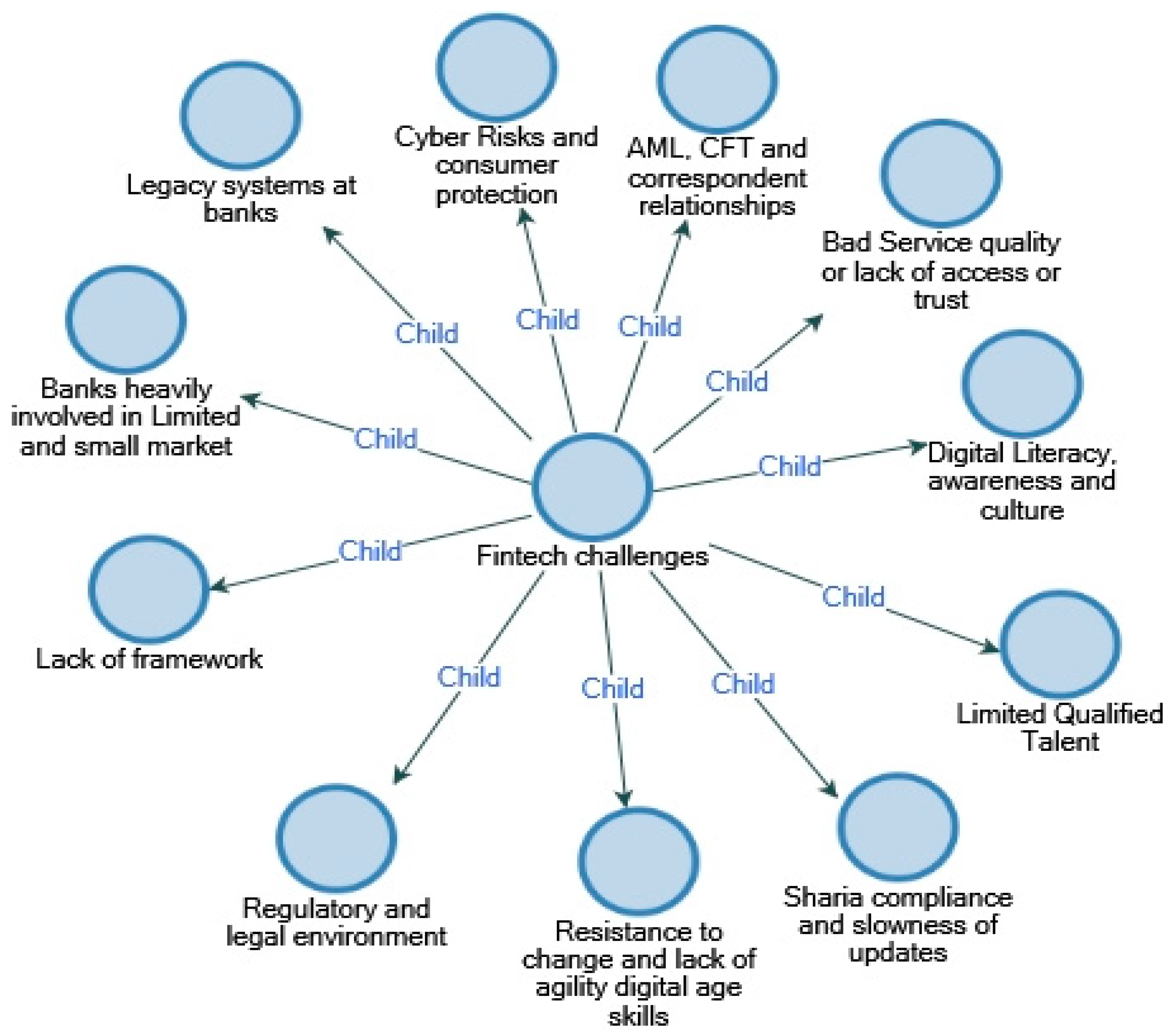
| Name | Files | References |
| Fintech challenges | 15 | 297 |
| AML, CFT and correspondent relationships | 5 | 9 |
| Bad Service quality or lack of access or trust | 4 | 6 |
| Banks heavily involved in Limited and small market | 7 | 12 |
| Cyber Risks and consumer protection | 8 | 17 |
| Digital Literacy, awareness and culture | 9 | 21 |
| Economic limits | 1 | 1 |
| Global Fintech penetrating local markets (without license) | 1 | 4 |
| IT and telecom Infrastructure availability and cost | 8 | 16 |
| Lack of Ecosystem interconnectivity | 6 | 8 |
| Lack of framework | 6 | 12 |
| Legacy systems at banks | 3 | 6 |
| Limited Qualified Talent | 10 | 16 |
| Non-bank challenges | 15 | 68 |
| Access to capital and funding and fear from failure | 8 | 10 |
| Cost of doing business | 5 | 8 |
| Fierce banks competition | 5 | 9 |
| Financial Infrastructure | 1 | 1 |
| Lack of creativity (copying global ideas only) | 3 | 6 |
| No financial inclusion problem and low banking barriers | 3 | 10 |
| Reputation and trust | 5 | 6 |
| Specific regulatory challenges | 9 | 18 |
| Political instability – challenges | 5 | 7 |
| Readiness of the government | 3 | 7 |
| Regulatory and legal environment | 15 | 53 |
| Resistance to change and lack of agility digital age skills | 11 | 24 |
| Sharia compliance and slowness of updates | 3 | 10 |
Disclaimer/Publisher’s Note: The statements, opinions and data contained in all publications are solely those of the individual author(s) and contributor(s) and not of MDPI and/or the editor(s). MDPI and/or the editor(s) disclaim responsibility for any injury to people or property resulting from any ideas, methods, instructions or products referred to in the content. |
© 2024 by the authors. Licensee MDPI, Basel, Switzerland. This article is an open access article distributed under the terms and conditions of the Creative Commons Attribution (CC BY) license (http://creativecommons.org/licenses/by/4.0/).


