

Submitted:
12 November 2024
Posted:
12 November 2024
You are already at the latest version
Abstract
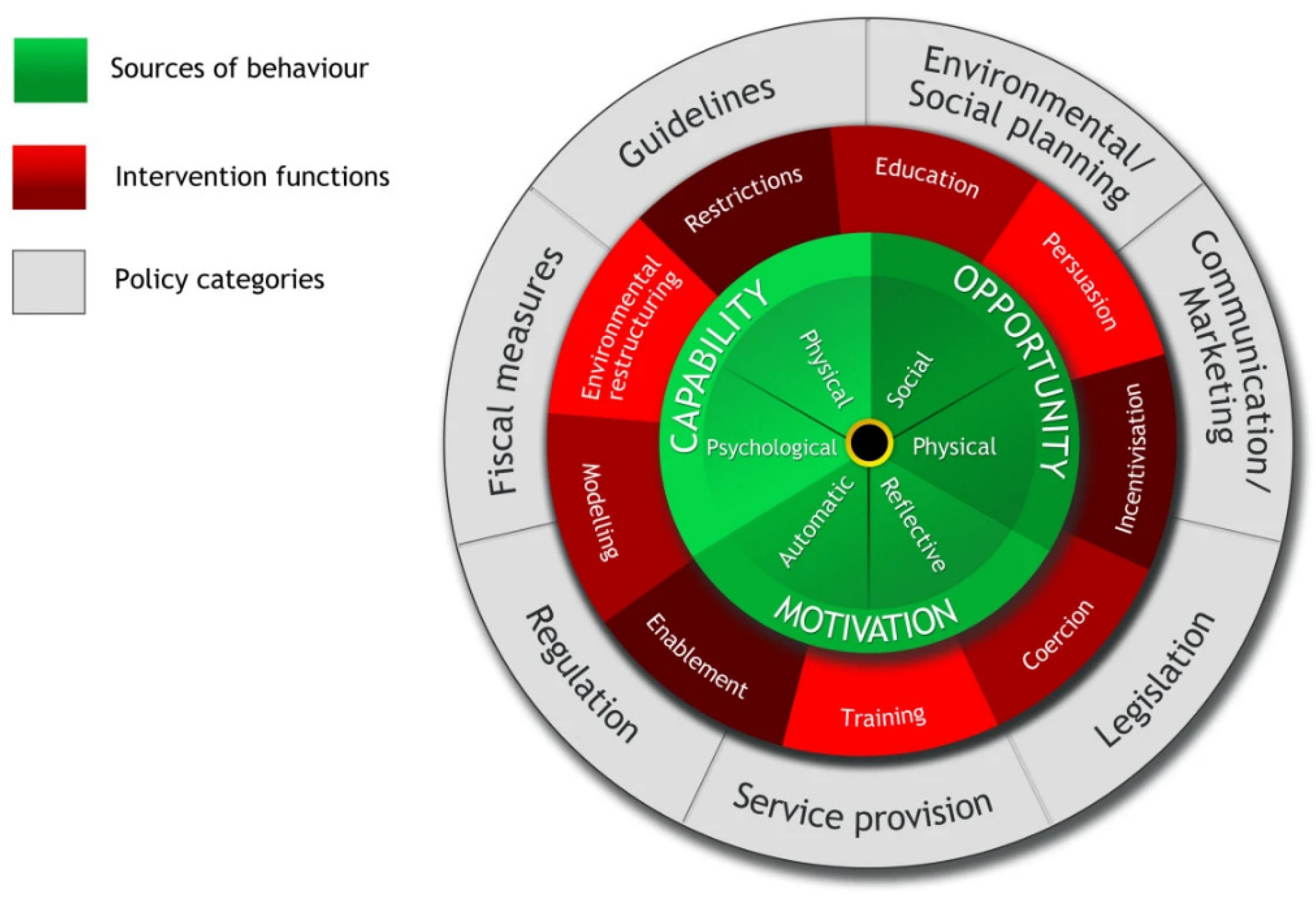
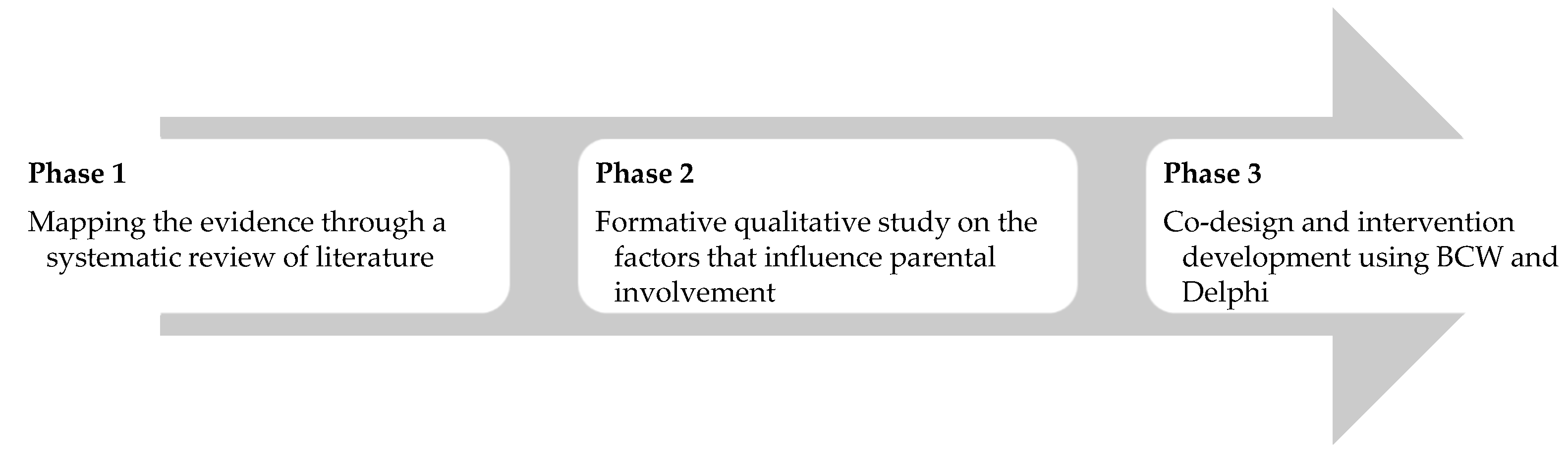
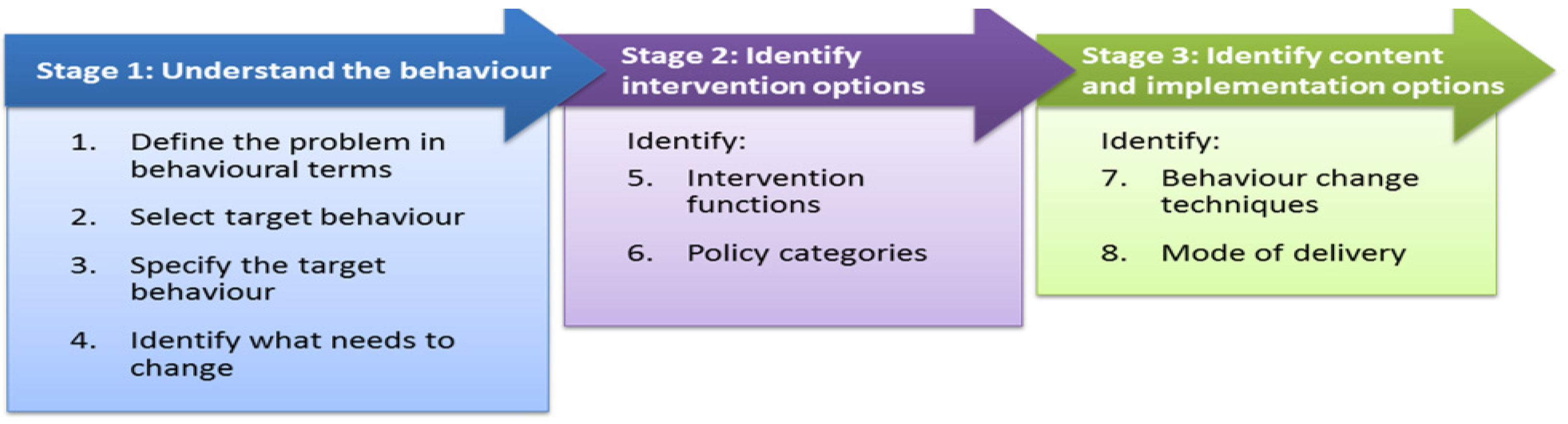
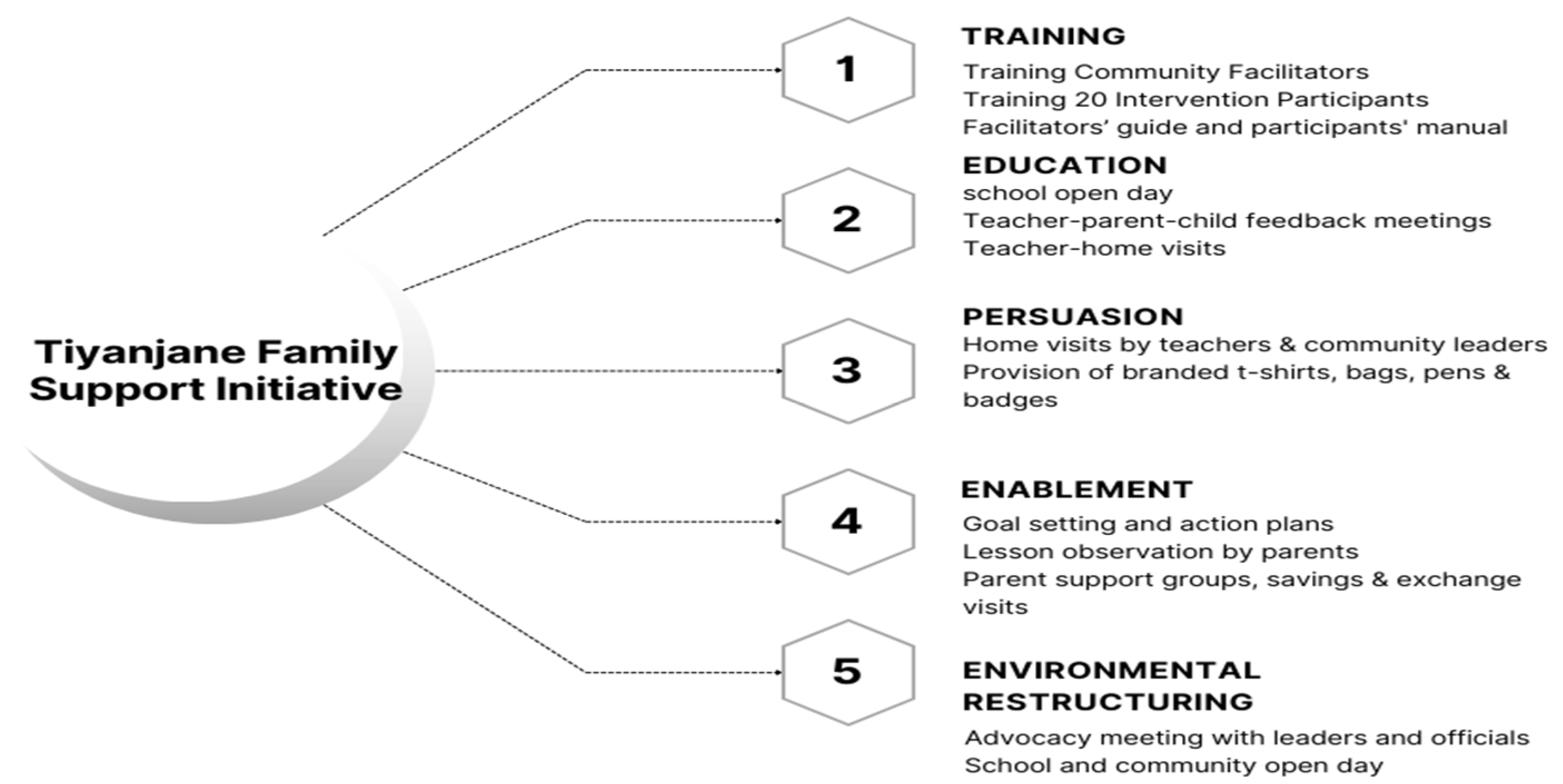
This paper describes the co-design of a participatory group intervention aimed at promoting and strengthening parental involvement in supporting the education of children with disabilities in Malawi. The intervention was developed through participatory co-design workshops and consensus meetings involving 23 stakeholders, including parents, teachers and community leaders. The Behaviour Change Wheel framework and the Delphi technique were used to guide the intervention development process to ensure theoretical robustness and contextual relevance. The proposed intervention, Tiyanjane (‘Let Us Unite’), includes facilitators’ and participants’ training and practical face-to-face sessions over ten weeks. The intervention will target four key areas: developing family action plans, holding regular meetings, providing ongoing support at home and school, and facilitating training and information exchange. This participatory approach with a wide range of local stakeholders offers valuable insights into the process of co-developing culturally relevant and theoretically grounded interventions that address the needs of families with children with disabilities in a low-resource setting. Future research should include an evaluation of the intervention’s feasibility and acceptability and examining its applicability in diverse socio-cultural settings within LMICs (low and middle-income countries).
Keywords:
1. Introduction
1.1. Theoretical Frameworks and Guidance
1.2. Co-Design and Reporting Intervention Development Processes
1.3. Aim and Objectives
2. Materials and Methods
2.1. Study Design
2.2. Setting
2.3. Participants and Recruitment
2.4. Intervention Development Overview
2.4.1. Intervention Development Stage 1: Understanding Parental Behaviours
2.4.2. Intervention Development Stage 2: Identifying Intervention Options
2.4.3. Intervention Development Stage 3: Identifying Content and Implementation Options
3. Results
3.1. Understanding the Behaviour
- Developing and executing family action plans: Parents often deprioritise their children’s education because of challenges in daily life, workload and resource constraints. This barrier was related to the COM-B Construct of Reflective Motivation.
- Conducting regular meetings and influencing activities: Limited opportunities for parents to engage with schools and a lack of confidence/skills to influence educational practices. These barriers were associated with the COM-B Constructs of Physical Opportunity and Psychological Capability.
- Providing follow-up support activities at school and home: Parents needed to have accommodative social environments and support systems, hindering their ability to sustain their children’s education. This barrier was aligned with the COM-B Construct of Social Opportunity.
- Facilitating training and information exchange: The lack of knowledge and motivation to support children with disabilities due to insufficient understanding of roles, children’s rights and disabilities. These barriers were associated with the COM-B Constructs of Psychological Capability and Automatic Motivation.
3.2. Stage 2: Identifying the Intervention Function Options (Steps 5-6)
3.3. Stage 3: Identifying Content and Implementation Options
4. Discussion
5. Conclusions
Supplementary Materials
Funding
Researcher Characteristics and Reflexivity
Institutional Review Board Statement
Informed Consent Statement
Data Availability Statement
Acknowledgments
Conflicts of Interest
References
- D. J. Musendo et al., “A Systematic Review of Interventions Promoting Parental Involvement in the Education of School-Aged Children With Disabilities,” Dec. 01, 2023, Cambridge University Press. [CrossRef]
- S. E. Goldman and M. M. Burke, “The Effectiveness of Interventions to Increase Parent Involvement in Special Education: A Systematic Literature Review and Meta-Analysis,” Apr. 03, 2017, Routledge. [CrossRef]
- J. L. Epstein, “School, family and community partnerships: Preparing educators and improving schools,” School, Family, and Community Partnerships: Preparing Educators and Improving Schools, Second Edition, pp. 1–634, Jan. 2018.
- W. H. Jeynes, “The Relationship Between Parental Involvement and Urban Secondary School Student Academic Achievement: A Meta-Analysis,” http://dx.doi.org/10.1177/0042085906293818, vol. 42, no. 1, pp. 82–110, Aug. 2016. [CrossRef]
- S. Bariroh, “The Influence of Parents’ Involvement on Children with Special Needs’ Motivation and Learning Achievement,” International Education Studies, vol. 11, no. 4, 2018. [CrossRef]
- J. Jafarov, “Factors Affecting Parental Involvement in Education: The Analysis of Literature,” Khazar Journal of Humanities and Social Sciences, vol. 18, no. 4, pp. 35–44, Dec. 2015. [CrossRef]
- J. Oranga, E. Obuba, I. Sore, F. Boinett, and J. Oranga, “Parental Involvement in the Education of Learners with Intellectual Disabilities in Kenya,” Journal 2022, vol. 9, p. 8542, 2022. [CrossRef]
- National Statistics Office, “2018 Malawi Population,” 2019. Accessed: Feb. 15, 2022. [Online]. Available online: http://www.nsomalawi.mw/images/stories/data_on_line/demography/census_2018/2018%20Malawi%20Population%20and%20Housing%20Census%20Main%20Report.pdf.
- UNICEF, “A Situation Analysis of Children with Disabilities in Malawi,” 2020.
- F. Nelson, C. Masulani-Mwale, E. Richards, S. Theobald, and M. Gladstone, “The meaning of participation for children in Malawi: insights from children and caregivers,” Child Care Health Dev, vol. 43, no. 1, pp. 133–143, 2017. [CrossRef]
- J. Njelesani, C. Cameron, D. Njelesani, M. Jamali, J. J. D. Andrion, and A. Munthali, “Recognizing the rights of children with disabilities in Malawi,” Disabil Soc, 2024. [CrossRef]
- C. Masulani-Mwale, D. Mathanga, F. Kauye, and M. Gladstone, “Psychosocial interventions for parents of children with intellectual disabilities–A narrative review and implications for low income settings,” Ment Health Prev, vol. 11, no. June, pp. 24–32, 2018. [CrossRef]
- L. Idrissa, “Educating Children With Disabilities In Malawi,” SSRN Electronic Journal, Nov. 2022. [CrossRef]
- L. M. Banks, X. Hunt, K. Kalua, P. Nindi, M. Zuurmond, and T. Shakespeare, “‘I might be lucky and go back to school’: Factors affecting inclusion in education for children with disabilities in rural Malawi,” Afr J Disabil, vol. 11, 2022. [CrossRef]
- L. M. Banks, H. Kuper, and S. Polack, “Poverty and disability in low- and middle-income countries: A systematic review,” PLoS One, vol. 12, no. 12, p. e0189996, Dec. 2017. [CrossRef]
- H. Kuper et al., “Rapid Evidence Assessment (REA) of What Works to Improve Educational Outcomes for People with Disabilities in Low-and Middle-Income Countries,” 2018.
- M. Gedfie and D. Negassa, “Parental Involvement in the Education of their Children with Disabilities: the case of Primary Schools of Bahir Dar City Administration, Ethiopia,” East African Journal of Social Sciences and Humanities, vol. 3, no. 2, pp. 43–56, Dec. 2018, Accessed: Mar. 27, 2023. [Online]. Available: https://www.haramayajournals.org/index.
- A. Harris and J. Goodall, “Do parents know they matter? Engaging all parents in learning,” Educational Research, vol. 50, no. 3, pp. 277–289, 2008. [CrossRef]
- E. E. Mantey, “Parental Involvement: A Response to Children with Disability’s Education,” African Research Review, vol. 14, no. 1, pp. 27–39, Apr. 2020. [CrossRef]
- K. Aruldas et al., “‘If he has education, there will not be any problem’: Factors affecting access to education for children with disabilities in Tamil Nadu, India,” PLoS One, vol. 18, no. 8, Aug. 2023. [CrossRef]
- C. He, N. Evans, H. Graham, and K. Milner, “Group-based caregiver support interventions for children living with disabilities in low-and-middle-income countries: Narrative review and analysis of content, outcomes, and implementation factors,” J Glob Health, vol. 14, 2024. [CrossRef]
- T. Smythe, V. Reichenberger, E. M. Pinzón, I. C. Hurtado, L. Rubiano, and H. Kuper, “The feasibility of establishing parent support groups for children with congenital Zika syndrome and their families: a mixed-methods study,” Wellcome Open Res, vol. 6, 2023. [CrossRef]
- M. Zuurmond et al., “Evaluating the impact of a community-based parent training programme for children with cerebral palsy in Ghana,” PLoS One, vol. 13, no. 9, Sep. 2018. [CrossRef]
- R. Nalugya et al., “Obuntu bulamu: Parental peer-to-peer support for inclusion of children with disabilities in Central Uganda,” Afr J Disabil, vol. 12, 2023. [CrossRef]
- F. B. Mbazzi et al., “‘Obuntu Bulamu’ – Development and Testing of an Indigenous Intervention for Disability Inclusion in Uganda,” Scandinavian Journal of Disability Research, vol. 22, no. 1, pp. 403–416, 2020. [CrossRef]
- F. Barker, L. Atkins, and S. de Lusignan, “Applying the COM-B behaviour model and behaviour change wheel to develop an intervention to improve hearing-aid use in adult auditory rehabilitation,” Int J Audiol, vol. 55, no. March, pp. S90–S98, 2016. [CrossRef]
- R. Crosnoe and A. C. Huston, “Socioeconomic Status, Schooling, and the Developmental Trajectories of Adolescents,” Dev Psychol, vol. 43, no. 5, pp. 1097–1110, Sep. 2007. [CrossRef]
- P. Craig, P. Dieppe, S. Macintyre, S. Michie, I. Nazareth, and M. Petticrew, “Developing and evaluating complex interventions: the new Medical Research Council guidance,” BMJ, vol. 337, no. 7676, pp. 979–983, Sep. 2008. [CrossRef]
- A. V. Creaser, D. D. A. V. Creaser, D. D. Bingham, H. A. J. Bennett, S. Costa, and S. A. Clemes, “The development of a family-based wearable intervention using behaviour change and co-design approaches: move and connect,” Public Health, vol. 217, pp. 54–64, Apr. 2023. [Google Scholar] [CrossRef]
- S. Michie, M. M. van Stralen, and R. West, “The behaviour change wheel: A new method for characterising and designing behaviour change interventions,” Implementation Science, vol. 6, no. 1, pp. 1–12, Apr. 2011. [CrossRef]
- D. Barrett and R. Heale, “What are Delphi studies?,” Evid Based Nurs, vol. 23, no. 3, pp. 68–69, Jul. 2020. [CrossRef]
- J. Webb, J. Foster, and E. Poulter, “Increasing the frequency of physical activity very brief advice for cancer patients. Development of an intervention using the behaviour change wheel,” Public Health, vol. 133, pp. 45–56, Apr. 2016. [CrossRef]
- L. Atkins and S. Michie, “Designing interventions to change eating behaviours,” Proc Nutr Soc, vol. 74, no. 2, pp. 164–170, May 2015. [CrossRef]
- H. Reid et al., “Use of the behaviour change wheel to improve everyday person-centred conversations on physical activity across healthcare,” BMC Public Health, vol. 22, no. 1, Dec. 2022. [CrossRef]
- R. Davis, R. Campbell, Z. Hildon, L. Hobbs, and S. Michie, “Theories of behaviour and behaviour change across the social and behavioural sciences: a scoping review,” Health Psychol Rev, vol. 9, no. 3, p. 323, Aug. 2015. [CrossRef]
- K. W. Davidson and U. Scholz, “Understanding and Predicting Health Behaviour Change: A Contemporary View Through the Lenses of Meta-Reviews,” Health Psychol Rev, vol. 14, no. 1, p. 1, Jan. 2020. [CrossRef]
- C. T. McEvoy et al., “Development of a peer support intervention to encourage dietary behaviour change towards a Mediterranean diet in adults at high cardiovascular risk,” BMC Public Health, vol. 18, no. 1, pp. 1–13, 2018. [CrossRef]
- K. Murphy et al., “Using the COM-B model and Behaviour Change Wheel to develop a theory and evidence-based intervention for women with gestational diabetes (IINDIAGO),” BMC Public Health, vol. 23, no. 1, Dec. 2023. [CrossRef]
- A. Erzse et al., “A Mixed-Methods Participatory Intervention Design Process to Develop Intervention Options in Immediate Food and Built Environments to Support Healthy Eating and Active Living among Children and Adolescents in Cameroon and South Africa,” Int J Environ Res Public Health, vol. 19, no. 16, p. 10263, Aug. 2022. [CrossRef]
- F. Oporia et al., “Development and validation of an intervention package to improve lifejacket wear for drowning prevention among occupational boaters on Lake Albert, Uganda,” Injury Prevention, vol. 29, no. 6, pp. 493–499, Dec. 2023. [CrossRef]
- E. G. Flaherty et al., “Adverse childhood experiences and child health in early adolescence,” JAMA Pediatr, vol. 167, no. 7, pp. 622–629, Jul. 2013. [CrossRef]
- B. W. Sahle, N. J. Reavley, A. J. Morgan, M. B. H. Yap, A. Reupert, and A. F. Jorm, “A Delphi study to identify intervention priorities to prevent the occurrence and reduce the impact of adverse childhood experiences,” Australian and New Zealand Journal of Psychiatry, vol. 56, no. 6, pp. 686–694, Jun. 2022. [CrossRef]
- A. F. Jorm, “Using the Delphi expert consensus method in mental health research,” Aust N Z J Psychiatry, vol. 49, no. 10, pp. 887–897, Oct. 2015. [CrossRef]
- W. H. Voorberg, V. J. J. M. Bekkers, and L. G. Tummers, “A Systematic Review of Co-Creation and Co-Production: Embarking on the social innovation journey,” Public Management Review, vol. 17, no. 9, pp. 1333–1357, Oct. 2015. [CrossRef]
- L. Andren, D. Papp, E. Penno, and A. Vallas, “Co-design As Collaborative Research,” Eesti Teadusliku Seltsi Rootsis: Aastaraamat. Annales Societatis Litterarum Estonicae in Svecia, vol. 11, p. 216;ill., Sep. 2018, Accessed: Sep. 13, 2024. [Online]. Available online: https://connected-communities.org/wp-content/uploads/2018/07/Co-Design_SP.pdf.
- E. M. Murtagh, A. T. Barnes, J. McMullen, and P. J. Morgan, “Mothers and teenage daughters walking to health: using the behaviour change wheel to develop an intervention to improve adolescent girls’ physical activity,” Public Health, vol. 158, pp. 37–46, May 2018. [CrossRef]
- E. Duncan et al., “Guidance for reporting intervention development studies in health research (GUIDED): an evidence-based consensus study,” BMJ Open, vol. 10, no. 4, p. e033516, Apr. 2020. [CrossRef]
- P. Hoddinott, “A new era for intervention development studies,” 2015. [CrossRef]
- D. J. Musendo, M. Zuurmond, T. Nkhonjera, S. Polack, and D. Patel, “‘It Is My Responsibility to Escort My Child to School …’ Factors Influencing Parental Involvement in Educating Children with Disabilities in Malawi,” Aug. 2024. [CrossRef]
- V. Tucker and I. Schwartz, “Parents’ Perspectives of Collaboration with School Professionals: Barriers and Facilitators to Successful Partnerships in Planning for Students with ASD,” School Ment Health, vol. 5, no. 1, pp. 3–14, 2013. [CrossRef]
- S. Mallonee, C. Fowler, and G. R. Istre, “Bridging the gap between research and practice: a continuing challenge,” Injury Prevention, vol. 12, no. 6, pp. 357–359, Dec. 2006. [CrossRef]
- S. Truelove, L. M. Vanderloo, P. Tucker, K. M. Di Sebastiano, and G. Faulkner, “The use of the behaviour change wheel in the development of ParticipACTION’s physical activity app,” Prev Med Rep, vol. 20, Dec. 2020. [CrossRef]
- F. Cornish et al., “Participatory action research,” Nature Reviews Methods Primers 2023 3:1, vol. 3, no. 1, pp. 1–14, Apr. 2023. [CrossRef]
- V. Haldane et al., “Community participation in health services development, implementation, and evaluation: A systematic review of empowerment, health, community, and process outcomes,” 2019. [CrossRef]
- L. M. Pfadenhauer et al., “Making sense of complexity in context and implementation: The Context and Implementation of Complex Interventions (CICI) framework,” Implementation Science, vol. 12, no. 1, pp. 1–17, Feb. 2017. [CrossRef]
- L. Yardley, L. Morrison, K. Bradbury, and I. Muller, “The Person-Based Approach to Intervention Development: Application to Digital Health-Related Behavior Change Interventions,” J Med Internet Res, vol. 17, no. 1, p. e30, Jan. 2015. [CrossRef]
- A. Pleasant, C. O’Leary, and R. H. Carmona, “Using formative research to tailor a community intervention focused on the prevention of chronic disease,” Eval Program Plann, vol. 78, p. 101716, Feb. 2020. [CrossRef]
- H. Moosapour, F. Saeidifard, M. Aalaa, A. Soltani, and B. Larijani, “The rationale behind systematic reviews in clinical medicine: a conceptual framework,” J Diabetes Metab Disord, vol. 20, no. 1, p. 919, Jun. 2021. [CrossRef]

| Participants (n) | Characteristics | Workshop Participants = n | Members of the Core Group = n |
|---|---|---|---|
| Sex (23) | Female | 13 | 5 |
| Male | 10 | 5 | |
| Participant category (23) | Parents | 10 | 2 |
| Teachers | 3 | 2 | |
| Community leaders | 3 | 2 | |
| Non-governmental organisation | 3 | 3 | |
| Disabled People’s Organisation | 2 | 1 | |
| Government officials | 2 | - | |
| Child impairment category of included parents | Hearing | 5 | 1 |
| Physical | 3 | 1 | |
| Visual | 1 | - | |
| Intellectual | 1 | - |
| Potential target behaviour(s) | Likely Impact | Ease of implementation | Likely spill over | Ease of measurement | Score out of 4 |
|---|---|---|---|---|---|
| Developing and implementing family action plans to promote habit formation | 4 | 3.3 | 3.7 | 3.7 | 3.7 |
| Hold regular meetings and influence change activities with other stakeholders | 3.7 | 3.7 | 3.3 | 3.7 | 3.6 |
| Provide follow-up support to families of children with disabilities at home and in school | 4 | 3.3 | 3.3 | 3.3 | 3.5 |
| Facilitate training and information-sharing platforms to share knowledge and awareness | 3.7 | 3.3 | 3 | 2.3 | 3.1 |
| Target behaviour | Who? | What? | When? | Where? | With whom? |
|---|---|---|---|---|---|
| Developing and executing family action plans | Parents | Write, share and review plans of action to support children, including what, when, where and who will do the actions. | Every school term | School, Home | Teachers and Community leaders |
| Conducting regular meetings and influencing activities | Parents, teachers, community | Meetings and activities that bring together parents, teachers, communities and other professionals | Weekly | School, Community, Home | Decision makers and the public |
| Providing follow-up support activities at home and in school | Teachers and community leaders | Home visits and follow-up support meetings with families of children with disabilities | Monthly | Home, Community | Parents |
| Facilitating training and information-sharing platforms | Parents, teachers, community | Group training activities to address knowledge and information gaps | Every school term (3 months) | Home, School |
Facilitators and All |
| Target behaviour | Who? | COM-B Construct | Details of what needs to be influenced and why it is important | Needs to be influenced for change to happen? |
|---|---|---|---|---|
| Developing and executing family action plans | Parents | Motivation (Reflective) | Due to workloads, challenging practicalities of daily lives and lack of resources, parents often fail to prioritise the education of their children | Yes |
| Parents and teachers | Capability (Psychological) | Parents and teachers need to have the tools and skills to plan for their children, and motivation to follow up on their commitments | Yes | |
| Conducting regular meetings and other influencing activities | Parents, teachers, community leaders | Opportunity (Physical) | There are limited opportunities for interaction and support for parents, often due to a lack of school openness and invitation for parents to engage in school activities | Yes |
| Parents, teachers, community leaders | Capability (Psychological) | Parents, teachers and community leaders need knowledge, skills and confidence to engage local leaders and influence change | Yes | |
| Providing follow-up support (school and home) | Teachers and community leaders | Opportunity (Social) | Parents felt inadequately supported by other parents, the school and the community, restricting opportunities to learn from others and be able to also support their children | Yes |
| Facilitating training and information-sharing platforms | Parents | Capability (Psychological) | Insufficient capacity to support children due to a lack of knowledge and understanding of disabilities, education rights as well as how to be involved | Yes |
| Parents and community leaders | Motivation (Automatic) | Unhelpful parental and community attitudes towards the children with disabilities and their families | Yes | |
| Teachers community leaders | Capability (Psychological) | Teachers and community leaders have limited knowledge of how to support parents of children with disabilities. | Yes |
Disclaimer/Publisher’s Note: The statements, opinions and data contained in all publications are solely those of the individual author(s) and contributor(s) and not of MDPI and/or the editor(s). MDPI and/or the editor(s) disclaim responsibility for any injury to people or property resulting from any ideas, methods, instructions or products referred to in the content. |
© 2024 by the authors. Licensee MDPI, Basel, Switzerland. This article is an open access article distributed under the terms and conditions of the Creative Commons Attribution (CC BY) license (https://creativecommons.org/licenses/by/4.0/).


